Feeds:
Entradas
Comentarios

Posts Tagged ‘Historia de Estados Unidos’

Gracias al gran trabajo de difusión del Reportero de la Historia, puedo compartir con mis lectores este interesante artículo escrito por Felipe Portales y publicado en Clarín. En su artículo, titulado “El negacionismo estadounidense”, Portales critica lo que él describe como la tendencia de los estadounidenses a negar “hechos evidentes de su realidad histórica”,  y que no es otra cosa que una manifestación de la idea del excepcionalismo norteamericano que hemos examinado en esta bitácora en varias ocasiones.

El negacionismo estadounidense

Felipe Portales

Clarín, 19 de agosto de 2013

El término “negacionismo” se ha acuñado para referirse a los intentos de negar la verdad histórica respecto del genocidio sufrido por el pueblo judío bajo el nazismo, el peor crimen contra la humanidad cometido en la historia. Pero en el fondo apunta a un concepto tan viejo como la misma humanidad: a la idea de que personas, grupos o naciones son muchas veces dominados por la tentación de negar hechos evidentes de su realidad histórica que vulneran gravemente la dignidad humana o la justicia o de atribuirles un significado exculpatorio, con el objeto de percibirse a sí mismos como impolutos.

Pareciera que el negacionismo adquiere un peso particularmente grave en situaciones de guerra virtual o real. Como lo afirma el dicho popular, la primera víctima de una guerra es la verdad. Pero en conexión con ello, constatamos desgraciadamente que ha predominado también el negacionismo en la generalidad de la autoconciencia nacional a lo largo de la historia, inclusive en tiempos de paz. De este modo, y partiendo por la desinformación tan común en la formación escolar de los pueblos, se va socializando la idea de que nuestra nación ha tenido siempre toda la razón en los conflictos internacionales en que se ha involucrado; de que prácticamente nunca ha hecho nada malo; y de que, en el peor de los casos, frente a hechos históricos completamente innegables y que hoy son incuestionablemente condenables, se considera que ellos fueron justificables en el contexto de la época. Y aún más, la formación escolar enfatiza también la excelencia general de la propia historia nacional en su ámbito propiamente interno. Todo esto en contradicción con la moral más elemental que postula y constata la esencial ambigüedad de la condición humana en esta tierra.

En este sentido, llama particularmente la atención el extremo a que se llega en Estados Unidos; y es muy preocupante, dada la gran hegemonía que aún tiene aquel país en el mundo.

De partida, la consideración estadounidense de que su democracia nace con su independencia no resiste análisis. ¡Cómo va a ser democracia un sistema social con esclavitud por casi un siglo! Además, fue de los últimos países occidentales en abolirla y para ello tuvo que padecer una cruenta guerra civil. Luego, durante otro siglo, Estados Unidos mantuvo una discriminación oficial y de apartheid contra los negros, que se mantuvo en ciertas instituciones nacionales y en varios Estados del sur. Recién en 1948 se terminó con ella en el Ejército y en 1954 respecto de la educación. Pero hubo que esperar hasta 1965 para que se le reconocieran a toda la población negra del país el conjunto de los derechos civiles, políticos, económicos, sociales y culturales. Es decir, solo se puede hablar de democracia en Estados Unidos –considerándolo como un sistema político basado en un sufragio universal efectivo- desde esa fecha bastante reciente. A lo anterior hay que agregar que con la complicidad o tolerancia –al menos- de muchas autoridades sureñas se mantuvo durante décadas una virtual violencia institucional contra los negros, representada principalmente por la acción del Ku Klux Klan

Otro elemento fundamental del negacionismo estadounidense lo constituyó su expansión hacia el oeste que fue justificada como un “mandato divino” (Ver Albert K. Weinberg.- Destino Manifiesto) y que incluyó el desplazamiento y exterminio de casi toda su población autóctona. Esto significó uno de los peores genocidios –si no el peor- cometidos por la humanidad durante el siglo XIX. Y en vez de haberlo reconocido posteriormente, la sociedad estadounidense se envaneció de aquel durante el siglo XX, convirtiendo por décadas la matanza de indígenas en uno de los temas “épicos” de su cinematografía; siendo solo desechado luego de su desastrosa experiencia bélica en Vietnam.

Un tercer elemento está referido a su auto-percepción de haber generado una sociedad de acuerdo a los valores cristianos del amor, cuando en realidad un ethos fundamental de su sociedad ha sido el individualismo, materialismo y consumismo que no pueden ser más antitéticos con los valores evangélicos. Dicho espíritu se ha reflejado en la conformación de una sociedad riquísima pero con una muy mala distribución de bienes, generando millones de personas que, escandalosamente, subsisten precariamente. Y, por otro lado, ha sido un país que ha agudizado las diferencias de ingreso a nivel mundial, desarrollando para ello un imperialismo y explotación económica que ha perjudicado especialmente a los pueblos latinoamericanos.

Un cuarto elemento ha sido la consideración de haber sido una nación promotora de la libertad y la democracia en el mundo, cuando uno de los elementos fundamentales y permanentes de su política exterior –especialmente respecto de América Latina- ha sido su imperialismo político. Así tenemos que se apoderó en el siglo XIX de cerca de la mitad de México; a fines del mismo siglo conquistó Puerto Rico y Filipinas, y hegemonizó Cuba; en la primera mitad del siglo invadió esporádicamente México y varios países del Caribe; luego de la segunda guerra mundial, a través de la Escuela de las Américas, deformó a la oficialidad de las Fuerzas Armadas de los países americanos en las doctrinas de la “seguridad nacional”, para que se ajustaran a sus intereses hemisféricos; para terminar en las décadas de los 60 y 70 apoyando numerosos golpes de Estado orientados por dicha doctrina.

Otro negacionismo particularmente chocante ha sido su “buena conciencia” respecto del uso de la bomba atómica en dos ocasiones contra cientos de miles de civiles inermes; sin duda el peor crimen de guerra efectuado en la historia. Y producto de ello ha seguido desarrollando de forma virtualmente demencial –y en lo que le han acompañado desgraciadamente varias otras naciones- un cada vez más apocalíptico arsenal nuclear.

Además, -y sin pretender ser exhaustivo- tenemos que en las últimas décadas la sociedad estadounidense parece creer que uno de sus objetivos fundamentales ha sido la promoción universal de los derechos humanos. Por cierto que en diversos casos lo ha hecho; pero más preponderante ha sido el apoyo brindado a dictaduras que se han subordinado a sus roles hegemónicos. Esto se ha visto especialmente en Asia, Africa y el Medio Oriente. Incluso, Estados Unidos ha llegado a invadir un país como Irak, en contra de la voluntad de Naciones Unidas. Y ha aplicado la violación del derecho internacional, la tortura y el asesinato como políticas oficiales. De este modo, ha ordenado la detención sin juicio por años de centenares de personas de diversas nacionalidades; ha aplicado “legalmente” formas de tortura como el “submarino”, el aislamiento por largos períodos de tiempo y el mantener detenidos en forma vejatoria e inhumana; y ha ordenado el asesinato de personas como fue el caso de Bin Laden.

Lo anterior se ha expresado en la región en el fomento o apoyo a las deposiciones de los presidentes de izquierda de Haití, Honduras y Paraguay; y en la sistemática hostilidad hacia gobiernos democráticos de izquierda de la región, como los de Bolivia, Ecuador y Venezuela; utilizando para ello argumentos reales o supuestos de violaciones de algunos derechos civiles y políticos. Mientras que respecto de gobiernos de derecha como los de Colombia y México, donde se viola gravemente el derecho a la vida, Estados Unidos ha mantenido una clara complacencia.

Por cierto, la sociedad estadounidense le ha aportado a la humanidad notables avances; particularmente en los ámbitos de la libertad religiosa; de la libertad académica; del desarrollo de la ciencia y tecnología para fines pacíficos; y de los modelos racionales de organización. Pero mientras continúe con sus negacionismos en temas tan relevantes como los anteriores y siga actuando sobre esas bases, no solo ensombrecerá todas sus contribuciones, sino que también estará colocando en grave peligro –particularmente por el riesgo de un conflicto nuclear- la subsistencia misma de la civilización humana.

Fuente: http://www.elclarin.cl/web/index.php?option=com_content&view=article&id=9014:el-negacionismo-estadounidense&catid=13&Itemid=12

Read Full Post »

A finales del siglo XIX el ejército de los Estados Unidos era muy pequeño, por lo que la declaración de guerra a España obligó al gobierno norteamericano a organizar regimientos de soldados voluntarios. Éstos jugaron un papel muy importante en las Filipinas combatiendo a Aguinaldo y sus seguidores. Uno de ellos fue el Thirteenth Minnesota  Volunteer Infantry Regiment. Comparto con mis lectores una nota de Frederick L. John publicado en el MinnPost  sobre  la participación de este regiminto en la batalla de Manila.

Soldiers of the Thirteenth Minnesota Infantry regiment on guard around Manila, August 1898.
(Minnesota Historical Society/Goodhue County Historical Society)

The Thirteenth Minnesota and the Battle for Manila

By Frederick L. Johnson | MinnPost  08/13/13

On August 13, 1898, the Thirteenth Minnesota Infantry Regiment led an American advance against Spanish forces holding the Philippine city of Manila. Their participation was crucial to the outcome of this

important Spanish-American War battle. Capturing Manila did not appear to be a problem to American war planners. U.S. naval forces had already crushed a Spanish fleet defending the town during the Battle of Manila Bay. That victory came on May 1, 1898, during the first week of fighting in the Spanish-American War. The triumph left the port blockaded and 10,000 soldiers of Spain’s garrison trapped.

America’s small professional army needed help fighting the Spanish in the Philippines and elsewhere. State National Guard units, including three Minnesota regiments, were «federalized» into to the U.S. Army on April 25, 1898. Minnesota guardsmen gathered at the state fair grounds two weeks later. A week after that, the Thirteenth Minnesota Infantry, one of regiments called up, was equipped and on trains to San Francisco. On June 26 they shipped to the Philippines.

The Minnesotans endured a tedious Pacific Ocean crossing of over a month. Sea-sickness plagued the men. A monotonous diet and poor water made matters worse. A three-day stopover in Hawaii, however, refreshed them for the last leg of the journey.

The Thirteenth Minnesota, under the command of Brigadier General Arthur MacArthur, reached Manila Bay on July 31. Two weeks later, MacArthur’s men took up shoreline positions outside the city of Manila. It seemed that a mock battle to preserve Spanish honor might be arranged, and real fighting avoided. The Spanish seemed ready to surrender, but only if the Filipino rebel forces nearby were kept out of the city.

With no deal finalized, the Americans attacked on August 13. The U.S. fleet opened the battle, directing naval gunfire at Spanish positions. Then, disregarding a heavy thunderstorm, the American infantry launched a two-pronged assault on Manila’s walled city. The Thirteenth Minnesota and the

U.S. Twenty-Third Infantry led the army’s right wing forward.

MacArthur’s men faced challenges as they advanced. Spanish units in front of them wanted to fight and were awaiting the Americans. The Twenty-Third was ordered to hold its position, leaving the Minnesotans to spearhead the advance alone.

A fierce firefight erupted. Spanish troops in well-fortified positions directed their volleys at the Minnesota regiment. Captain Oscar Seebach, commanding Company G, the Red Wing unit, deployed the company across the open road. He walked among the men urging them to keep down and open fire. They began taking casualties.

A rifle shot pierced Seebach’s lungs and knocked him out of the battle. Three enlisted men were quickly wounded, and Sergeant Charles Burnsen suffered a fatal head wound. Firing continued until the Spanish troops began to withdraw. At 1:30 the gunfire ceased and the American units occupied Manila.

Considering their placement during the fighting, it was not surprising the Thirteenth Minnesota suffered more casualties than any other unit. Twenty-three members of the regiment were wounded or killed.

Negotiations with Spain brought an end to the Spanish-American War in December 1898, but the Thirteenth Minnesota was not sent home. Filipino rebels opposed American domination. By February 1899, American and Filipino troops were fighting each other. The Minnesota unit joined other U.S. regiments in patrolling Manila and conducting operations against the rebels.

On May 22, 1899, seven companies of the Minnesota regiment began a thirty-three day mission to defeat the rebel forces. They covered 120 miles, captured twenty-eight towns, and destroyed enemy supplies. Then the rainy season swept into the Philippines forcing an end to military operations. The Americans, Minnesotans included, complained about midsummer’s boredom, monotony and heat.

Sgt. Edmund Neill of the Minnesota Thirteen’s Company G wrote home reporting that the men would do their duty but longed to go home. The Red Wing man claimed that every letter sent to Minnesota from his unit contained protests against the injustice of keeping the men in the Philippines.

Orders sending the Minnesotans home came on July 13, 1899. A month later the men boarded the transport Sheridan. As the vessel pulled out of Manila Bay, the ship’s band played «Home Sweet Home.» Fighting continued between American and Filipino forces, however, until July 4, 1902, when President Theodore Roosevelt finally declared an end to the conflict.

Frederick Johnson, a native of Red Wing, Minnesota, has written eight books and numerous magazine features regarding state and local history. His works include histories of Lake Minnetonka, Richfield, Bloomington, Edina, Red Wing, and Goodhue County.

Fuente: http://www.minnpost.com/mnopedia/2013/08/thirteenth-minnesota-and-battle-manila

Read Full Post »

Read Full Post »

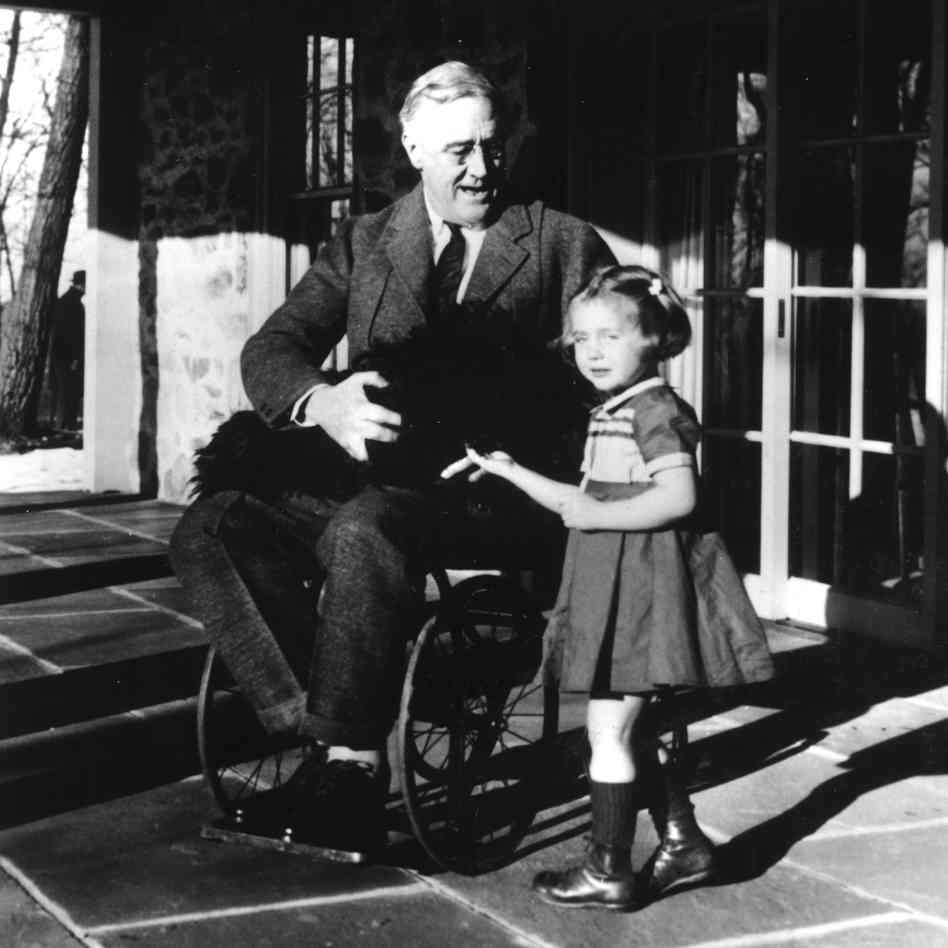
roosevelt102way_sq-6943e8ab2b83948dfb2f059bd2672e3dc2bd3cbb-s6-c30En 1921, Franklin D. Roosevelt (FDR) contrajo poliomelitis mientras vacacionaba con su familia. Esto limitó seriamente la movilidad, pero no la capacidad política del que considero uno de los tres presidentes más importantes en la historia de los Estados Unidos. A FDR le tocaron vivir los tiempos difíciles de la Gran Depresión y la Segunda Guerra Mundial. Padre del Nuevo Trato y artífice de la victoria estadounidense frente al fascismo, FDR cambió el carácter doméstico y la posición mundial de los Estados Unidos.

Por claras razones políticas, FDR escondió su limitación física, por lo que no debe sorprender que no se dejara ver en silla de ruedas y menos fotografiar. Sólo contamos con una foto tomada en 1941 en la que aparece el presidente en silla de ruedas en compañía de una niña.

Hace pocos días el Dr. Ray Begovich (profesor de periodismo en Franklin College, Indiana) se encontraba investigando en los Archivos Nacionales norteamericanos y para su sorpresa tropezó con un corto video en el que FDR es empujado en su silla de ruedas. El pietaje en cuestión, único en su clase,  fue tomado en el crucero USS Baltimore durante un visita de FDR a la base de Pearl Harbor en julio de 1944.

Aunque el video dura menos de un minuto, es uno de esos detalles curiosos que le pueden alegrar la mañana a un historiador.

Comparto mi alegría con mis lectores.

Norberto Barreto Velázquez, PhD

Lima, Perú, 15 de julio de 2013

Read Full Post »


The New York Times


July 2, 2013

Why the Civil War Still Matters


By ROBERT HICKS

FRANKLIN, Tenn. — IN his 1948 novel “Intruder in the Dust,” William Faulkner described the timeless importance of the Battle of Gettysburg in Southern memory, and in particular the moments before the disastrous Pickett’s Charge on July 3, 1863, which sealed Gen. Robert E. Lee’s defeat. “For every Southern boy fourteen years old,” he wrote, “there is the instant when it’s still not yet two o’clock on that July afternoon.”

That wasn’t quite true at the time — as the humorist Roy Blount Jr. reminds us, black Southern boys of the 1940s probably had a different take on the battle. But today, how many boys anywhere wax nostalgic about the Civil War? For the most part, the world in which Faulkner lived, when the Civil War and its consequences still shaped the American consciousness, has faded away.

Which raises an important question this week, as we move through the three-day sesquicentennial of Gettysburg: does the Civil War still matter as anything more than long-ago history?

Fifty years ago, at the war’s centennial, America was a much different place. Legal discrimination was still the norm in the South. A white, middle-class culture dominated society. The 1965 Immigration and Nationality Act had not yet rewritten our demographics. The last-known Civil War veteran had died only a few years earlier, and the children and grandchildren of veterans carried within them the still-fresh memories of the national cataclysm.

All of that is now gone, replaced by a society that is more tolerant, more integrated, more varied in its demographics and culture. The memory of the war, at least as it was commemorated in the early 1960s, would seem to have no place.

Obviously, there are those for whom Civil War history is either a profession or a passion, who continue to produce and read books on the war at a prodigious rate. But what about the rest of us? What meaning does the war have in our multiethnic, multivalent society?

For one thing, it matters as a reflection of how much America has changed. Robert Penn Warren called the war the “American oracle,” meaning that it told us who we are — and, by corollary, reflected the changing nature of America.

Indeed, how we remember the war is a marker for who we are as a nation. In 1913, at the 50th anniversary of Gettysburg, thousands of black veterans were excluded from the ceremony, while white Union and Confederate veterans mingled in a show of regional reconciliation, made possible by a national consensus to ignore the plight of black Americans.

Even a decade ago, it seemed as if those who dismissed slavery as simply “one of the factors” that led us to dissolve into a blood bath would forever have a voice in any conversation about the war.

In contrast, recent sesquicentennial events have taken pains to more accurately portray the contributions made by blacks to the war, while pro-Southern revisionists have been relegated to the dustbin of history — a reflection of the more inclusive society we have become. As we examine what it means to be America, we can find no better historical register than the memory of the Civil War and how it has morphed over time.

Then again, these changes also imply that the war is less important than it used to be; it drives fewer passionate debates, and maybe — given that one side of those debates usually defended the Confederacy — that’s a good thing.

But there is an even more important reason the war matters. If the line to immigrate into this country is longer than those in every other country on earth, it is because of the Civil War.

It is true, technically speaking, that the United States was founded with the ratification of the Constitution. And it’s true that in the early 19th century it was a beacon of liberty for some — mostly northern European whites.

But the Civil War sealed us as a nation. The novelist and historian Shelby Foote said that before the war our representatives abroad referred to us as “these” United States, but after we became “the” United States. Somehow, as divided as we were, even as the war ended, we have become more than New Yorkers and Tennesseans, Texans and Californians.

And Gettysburg itself still matters, for the same reason Abraham Lincoln noted so eloquently in his famous address at the site on Nov. 19, 1863. The battle consecrated the “unfinished work” to guarantee “that this nation, under God, shall have a new birth of freedom — and that government of the people, by the people, for the people, shall not perish from the earth.”

In that way, the Civil War is less important to the descendants of those who fought in it than it is to those whose ancestors were living halfway around the globe at the time. For if you have chosen to throw your lot in with this country, the American Civil War is at the foundation of your reasons to do so.

True, we have not arrived at our final destination as either a nation or as a people. Yet we have much to commemorate. Everything that has come about since the war is linked to that bloody mess and its outcome and aftermath. The American Century, the Greatest Generation and all the rest are somehow born out of the sacrifice of those 750,000 men and boys. None of it has been perfect, but I wouldn’t want to be here without it.

Robert Hicks is the author of the novels “The Widow of the South” and “A Separate Country.”


Read Full Post »

AHA

La American Historical Association (AHA), la asociación de historiadores  más antigua y prestigiosa de los Estados Unidos, acaba de reinaugurar su blog AHA Today. Por la variedad de sus contenidos, éste es un recurso muy valioso para aquellos interesados en el estudio e investigación de la historia estadounidense.


Read Full Post »

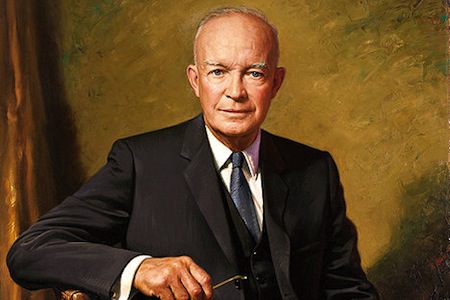
En este interesante artículo publicado por la History News Network (HNN) el  historiador norteamericano Keith W. Olson (University of Maryland) examina la presidencia de Dwight D. Eisenhower (Ike). Olson concluye que en estos momentos en que el Partido Republicano –derrotado por Barack Obama en noviembre pasado– busca reiventarse, Eisenhower debería ser el modelo a seguir por los Republicanos. Para ello destaca el caracter moderado del que es, sin lugar dudas, el presidente Republicano más importante de la segunda mitad del siglo XX.

Republicans Should Like Ike | History News Network.

469px-Dwight_D._Eisenhower,_official_Presidential_portrait

Dwight D. Eisenhower, «Ike»

As Republican leaders continue to try to redefine their party identity they would do well to review the legacy of Republican President Dwight D. Eisenhower, arguably, the most successful president since World War II. As president he faced crises and challenges both foreign and domestic, different from those of today but equal in magnitude, as well as the need to maintain national leadership.

During the 1950s the containment of the nuclear-armed Soviet Union dominated all other concerns. From the Truman administration, Eisenhower also inherited a limited war in Korea. A year later he faced a French request for military aid to save their colonial empire in Southeast Asia. Also in 1954 — and again in 1958 — he confronted tense relations with the People’s Republic of China over territorial claims and policies in the Formosa Strait.

In October 1956 three of the nation’s closest allies — the United Kingdom, France, and Israel — invaded Egypt without informing Eisenhower. The war soon involved threats from the Soviet Union. Simultaneously, the Soviets invaded Hungary to crush the Hungarian Revolution, which had overthrown the communist government in that country. A year after the Suez crisis the Soviets launched the world’s first human-made satellite, called Sputnik, to orbit the earth. While not a military threat, Sputnik sparked serious public discussion about America’s ability to compete with the Soviets.

To all of these crises Eisenhower sought non-military resolutions.

In Korea he completed a negotiated settlement, a policy the Truman administration had started. Eisenhower likewise successfully negotiated with the People’s Republic of China and aggressively pressured Britain and France into withdrawing from the Suez.

Eisenhower’s political, and economic achievements reflected stability, continuity, and moderation. As president he favored an increase in the minimum wage and extended unemployment benefits to an additional four million workers. In 1956 he broadened Social Security to include new categories of occupations and thereby added 10.5 million wage earners, including public school teachers.

Two initiatives illustrated Eisenhower’s commitment to infrastructure. The first was the St. Lawrence Seaway Act, which provided construction of locks that linked the Great Lakes to the Atlantic Ocean. In 1956 Congress enacted his proposed Federal Aid Highway Act, the largest public works project in American history. He wanted the project to finance itself through a federal tax on gas and oil with states contributing ten percent of construction cost in their states. In 1958 the National Defense Education Act provided the first major aid to higher education since 1862. Under Eisenhower the budget of the National Science Foundation more than doubled.

For Eisenhower the economy, especially the federal budget, directly related to military strength and domestic prosperity. He inherited a budget deficit of approximately $10 billion. By 1956 he balanced the first of his balanced budgets. Steadfastly he maintained high federal income tax to uphold economic health. For incomes over $400,000, the federal income tax was 91 percent (albeit with deductions). Eisenhower also systematically reduced the military budget in actual dollars as well as in percentage of the total budget through his New Look policy.

The congressional elections of 1954, 1956, and 1958 returned Democratic majorities to both houses of Congress. His 1956 re-election meant that he faced Democratic control of Congress for the last six years of his presidency.

In his farewell address Eisenhower wanted «to share a few final thoughts with you my countrymen.» After this beginning, he immediately reported that «Our people expect their president and the Congress to find essential agreement on issues of great moment, the wise resolution of which will better shape the future of the nation.» He referred to this relationship as «mutually interdependent» and continued that «In this final relations, the Congress and the administration have, on most vital issues, cooperated well, to serve the national good rather than mere partisanship, and so have assured that the business of the nation should go forward.» He concluded that «my official relationship with the Congress end[s] in a feeling, on my part, of gratitude that we have been able to do so much together.»

The American voters responded enthusiastically to Eisenhower’s leadership. In 1952 he won election by more than 6.5 million votes. Four years later he won reelection by more than 9.5 million votes. Another measure of evaluation was approval rating. Harry Truman left office with a rating of 23 percent, the lowest of any post-World War II president (until George W. Bush, that is). In Eisenhower’s last year 61 percent approved of Americans approved of his performance. His eight-year average approval was 65 percent. The trust American had in their government to do what was right all or most of the time constituted yet another category of evaluation. In 1960 the trust in government reached 70 percent.

The more scholars have researched about Eisenhower and his administration the higher their assessments. Consistently in polls he now merits eighth, ninth, or tenth rank among all presidents. In 1996, for example, The Arthur M. Schlesinger, Jr. poll of historians placed Eisenhower tenth. The Siena College Institute found that «experts» listed him in the top ten in its 1994, 2002, and 2010 surveys. C-SPAN’s 2009 analysis by «sixty-five historians and professional observers of the presidency» placed Eisenhower eighth.

With hindsight, of course, not all of Eisenhower’s decisions, actions, and policies win applause — but the total record is overwhelmingly favorable. In terms of legislation, international relations, and economics he left solid achievements. Voters overwhelmingly supported his presidency and scholars admire his record. During his presidency Eisenhower’s achievements and his public image contributed to high public trust in government, belief in the role of government, and ability to form bipartisan coalitions to advance the national interest. Eisenhower’s record is one Republican leaders should celebrate, not ignore.

Read Full Post »

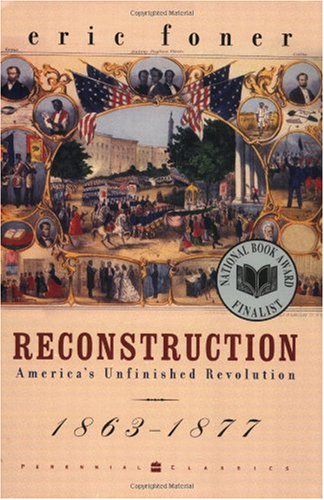
Foner - ReconstructionEn su reunión anual celebrada en San Francisco a mediados de abril de 2013, la Organization of American Historians (OAH) rindió un merecido homenaje al historiador Eric Foner (Columbia University) por los veinticinco años de la publicación de su clásico libro Reconstruction: America’s Unfinished Revolution, 1863-1877. Publicado en 1998 por Harper & Row, la obra de Foner  es uno de los libros imprescindibles para entender el periodo posterior a la guerra civil norteamericana.

El fin del conflicto Norte-Sur dio paso  a un problema: ¿qué hacer con los  estados sureños derrotados ? Abraham Lincoln favorecía una política generosa que permitiera la reintegración rápida de los sureños a la Unión norteamericana. Lamentablemente para éstos, Lincoln fue asesinado en 1865, lo que llevó a un intenso debate entre su sucesor, Andrew Johnson, y el Congreso federal.  Johnson creía necesario que los estados sureños fueron reincorporados a la nación norteamericana rápidamente. En el Congreso había un grupo de senadores y representantes conocidos como los radicales,  liderados por Thaddeus Stevens, que creían necesario aprovechar la derrota del Sur para reconstruir o rehacer esa región. Las diferencias entre el presidente y el Congreso desembocaron en un  conflicto directo que resultó en una victoria de los congresistas radicales. De ahí que se identifique el periodo posterior a la guerra civil como la era de la Reconstrucción.

Para celebrar los 25 años de Reconstruction: America’s Unfinished Revolution, la OAH organizó una mesa  compuesta por Foner, Kate Masur (Northwestern University), Heather Andrea Williams (Univeristy of North Carolina- Chapel Hill), Gregory P. Downs (CUNY), Thavolia Glymph (Duke University) y Steve Hahn (UPenn University). Estos colegas desarrollaron un interesante y valioso intercambio sobre la importancia de la obra de Foner en el desarrollo de la historiografía norteamericana.

Comparto con mis lectores un video de esta mesa que fue preparado por The History News Network (HNN).

Read Full Post »

Library of Congress

Library of Congress

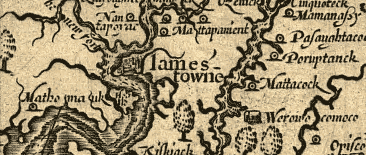
Científicos del Smithsonian Institute confirman la práctica de canibalismo en Jamestown, el primer asentamiento británico exitoso en América del Norte.

Cannibalism confirmed at Jamestown | History News Network.

Read Full Post »

1360065831La British Association of Nineteenth-Century Americanists (BrAnca) pone a disposición de aquellos interesados en la investigación de la historia y cultura de los Estados Unidos, una interesante y valiosa lista de recursos digitales. Esta lista abarca temas tan diversos como la literatura anti-esclavista, Mark Twain y su época, una impresionante colección de  fotos de linchamientos y  una colección de panfletos afro-americanos.

Read Full Post »

« Newer Posts - Older Posts »