
La prosperidad económica que caracterizó a la década de 1920 acabó abruptamente el 29 de octubre de 1929. Ese día los Estados Unidos entraron en una profunda crisis económica que duraría más de diez años y que amenazó el sistema de vida estadounidense. Para 1932, entre 10 y 15 millones de estadounidenses estaban desempleados, cientos de negocios de diversos tamaños se habían ido a la quiebra y por lo menos 5,000 bancos habían cerrado sus puertas. Nunca antes la economía estadounidense había caído tan bajo. Muestra de ello eran los cientos de personas que a diario hacían largas filas para recibir un plato de sopa o una manzana gratis.
Al comienzo de la crisis la presidencia de los Estados Unidos estaba ocupada por un político Republicano llamado Herbert Hoover, que no entendió las dimensiones del problema económico por el que estaban atravesando los Estados Unidos y, por ende, fue incapaz de tomar las medidas necesarias. En 1932, fue electo presidente Franklin D. Roosevelt, quien le había prometido al pueblo norteamericano un liderato activo y eficaz. Una vez en la Casa Blanca, Roosevelt puso en marcha un programa agresivo para enfrentar las consecuencias de la crisis económico. Este programa fue conocido como el Nuevo Trato y se caracterizó por una intensa experimentación e intervención directa del gobierno federal en la economía.
El Nuevo Trato provocó el crecimiento del tamaño e influencia del gobierno federal, transformándole en un Estado moderno. El gobierno federal se convirtió en el proveedor de protección, ayuda directa, trabajo, préstamos y pagos del seguro social de millones de estadounidenses. Además, el gobierno intervino de forma directa en la economía de la nación para sustituir al sector privado como motor económico. El sector privado vio, no sin horror, como el Estado creó una serie de mecanismo para regularle, supervisarle y controlarle. En otras palabras, el Nuevo Trato aceleró el proceso de regulación federal iniciado durante la Era Progresista que buscaba generar orden a la vida económica del país. Por primera vez en la historia estadounidense el gobierno federal garantizó el derecho de los trabajadores a formar y unirse a sindicatos laborales. Además, el gobierno jugó un papel fundamental redefiniendo las relaciones obrero-patronales al establecer salarios mínimos y máximo de horas de trabajo.

El Nuevo Trato también fue fundamental en el desarrollo de un estado del bienestar o “welfare state” en los Estados Unidos. El gobierno aceptó la responsabilidad sobre el bienestar colectivo e individual de millones de ciudadanos. Nunca antes en la los ciudadanos habían recibido tanto del gobierno como durante el Nuevo Trato. Sin embargo, esa ayuda no era perfecta ni incluía a todos. En comparación del estado de bienestar desarrollado en Europa, el Nuevo Trato tuvo serias limitaciones. Por ejemplo, la administración Roosevelt no pudo incluir un seguro medico universal como parte del Seguro Social por la oposición de diversos sectores del país, entre ellos la Asociación Médica Norteamericana. Los trabajadores agrarios y domésticos también fueron dejados fuera del Seguro Social, lo que limitó su alcance.
El Nuevo Trato reconoció la pobreza como un mal económico, no como una falla personal o el resultado de flojera o vagancia. A pesar de ello, los reformistas no encontraron una solución para este asunto. Algunos de ellos creían que con el fin de la Depresión se lograría nuevamente que todos los norteamericanos estuvieran empleados y que ello reduciría la pobreza. Desafortunadamente, eso no ocurrió y el fin de la Depresión no significó el fin de la pobreza.
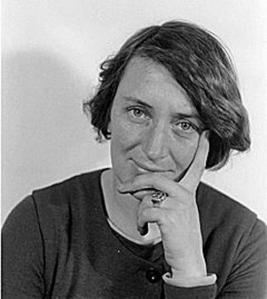
Dorothea Lange
Los novotratistas no se limitaron a atender los serios problemas socioeconómicos de su sociedad, pues también le dieron importancia a otras áreas, entre ellas, las artes. Entre 1935 y 1943, los fotógrafos de la Farm Security Administration (Administración de Seguridad Agraria) recorrieron el país documentando la pobreza. También buscaban dar a conocer un segmento de la sociedad estadounidense desconocido para el resto del país. Una de las fotógrafas más importantes de ese proyecto fue Dorothea Lange (1896-1965), quien entre 1935 y 1939 produjo una impresionante obra que tuvo alcance nacional a través de la prensa. Su trabajo se concentró en fotos de pobres y marginados: campesinos, familias desplazadas, inmigrantes, japoneses internados, etc.
En esta nota publicada en el New York Times, Tess Taylor comenta su «pilgrimage» en algunas de zonas de California, específìcamente, del Imperial County, recorridos por Lange hace más de ochenta años. Sus comentarios resultan muy interesantes y las fotos que los acompañan son realmente impresionantes.
Para ver más fotos de Dorothea Lange se puede visitar la sección que le dedica la página web de la Biblioteca del Congreso, seleccionando aquí.

Credit…Paul S. Taylor/The Dorothea Lange Collection, the Oakland Museum of California
The Californian photographer known for her images of the Great Depression is a guide to the complexity of the present.
By
HOLTVILLE, Calif. — It’s late when I check into the Barbara Worth Country Club, 600 miles southeast of my home in the Bay Area. Spare rooms border dark fields, a dry golf course and a web of open irrigation troughs that help make Imperial County one of the biggest agricultural producers in California. Holtville calls itself the carrot capital of the world, and even now, after this season’s harvest, stray carrot tops bolt, blooming to seed.
Fifteen miles from my hotel is the border with Mexico, a boundary now marked by barbed wire that loops around the edges of the All-American Canal, an elaborate, 80-mile long aqueduct that diverts water from Colorado to irrigate farmland that would otherwise get around three inches of rain per year.


“They’ll sleep in the row (to hold a place in the field) to earn sixty cents a day.” — From Dorthea Lange’s caption notes.

When I arrive in April 2019, Donald Trump has just visited Imperial County to stump for his wall. But I’m not here to talk politics, exactly. Instead, I’m on a pilgrimage to visit as many of the places Dorothea Lange photographed in California as I can.
Ms. Lange came to Imperial County during the late 1930s, capturing a different generation of migrants drawn here from Mexico, the Philippines, Oklahoma and the Dakotas, looking for work in the carrot fields. In 1937, she photographed ramshackle tents lining a canal; a group of Model T’s making haphazard camp in a gully. In other shots, cabbage pickers bend deep and hoist baskets high on their shoulders.
Ms. Lange, best known for her Depression-era photographs of migrant laborers, began photographing bread lines and labor strikes near her San Francisco studio in 1932. In the 1920s, she had made her living as a society portraitist, photographing San Francisco’s wealthiest families — the Levi Strauss and the Haas families among them.
As the Great Depression worsened, she began photographing people she saw on the streets: men curled up sleeping or in line for food. In 1935, she married the economist Paul Taylor; they left San Francisco together to photograph the living conditions of agricultural laborers up and down the state, from Davis and Marysville all the way to Imperial County. The Farm Security Administration supported their work.

“Mam, I’ve picked peas from Calipatria to Ukiah. This life is simplicity boiled down.” — From Dorthea Lange’s notebook

In 2017, I started reading Ms. Lange’s notebooks, now held at the Oakland Museum of California. On lined 3 by 5 inch pages, in penciled-in cursive, she captures American history in staccato fragments, jotting down what laborers paid for gas, rent and food; how much they could make picking a day’s worth of potatoes. On one June trip following the melon harvest in El Centro, under a heading “The camp,” she notes someone saying: “This is a hard life to swallow, but I can’t just rest here.”
“We come from all states and we can’t make a dollar in this field noways. Working from seven in the morning until 12 noon, we earn an average of 35 cents,” a worker told her in 1937.

“Not enough money for cotton sacks” reads another note; “All I’ve got is right here.”
“2 children 4-6.”
“Sold everything little by little.”
“We said we came from,” she writes in a note that ends in an eerie, indecipherable smudge: “They said, “Why don’t you go back there then?”
“This country’s a hard country” one woman told Ms. Lange. “If you die, you’re dead — that’s all.”
As a poet, I was drawn to the chorus of voices Ms. Lange recorded, which call across time. Her notebooks catalog concerns that feel sharply relevant eight decades later: the search for shelter, a fair wage and stable work.
Last year, from January to October, I drove across California, following routes Ms. Lange noted in her travels from 1935 to 1942, by which time she had been hired by the Office of War Information to document the process of Japanese internment.

As I visited encampments, internment centers and small agricultural towns, I used Ms. Lange’s images and words as a lens to help refract the messy complexity of California’s present. I grew up a mile from where Ms. Lange lived in Berkeley. My town, El Cerrito, populated quickly in the early 1940s by an influx of shipyard workers, has neat cottage bungalows with lemon trees on tight plots. Ms. Lange photographed these in 1942 as a hopeful emblem of the New California: an emergent middle class.
But the Bay Area today is no picture of middle class stability. My once modest neighborhood has skyrocketing home prices — a small three-bedroom that eight years ago cost $500,000 now lists for $1.3 million, while roughly 28,000 homeless people sleep on the streets in the Bay Area each night. Vacant lots, industrial blocks and underpasses nearby fill with semipermanent encampments. I bike my children to school each day through a maze of tents and trailers.
Following Ms. Lange’s images and notes has become a study in uneasy juxtapositions: rifts between enormous wealth and unsettled poverty, some of which feel new, some like a continuation of the past.

In Imperial County, which now has the highest unemployment rate in California, Eddie Preciado of Catholic Charities holds beds at the county’s one homeless shelter for men, offering shelter to migrant laborers who cross the border to pick corn.
“There’s still no dedicated housing for agricultural workers,” he told me. Down the road, a detention center run by Management Training Corporation for ICE holds 782 beds.
“Most middle-class jobs are in border security,” Mr. Preciado said.
In Nipomo, where Ms. Lange pulled over near a frozen pea field to make her famous photograph “Migrant Mother” in 1936, a new community of $1.2 million tract homes overlooks rows of factory-farmed strawberry fields edged with workers’ trailers.


I asked a bartender at Jocko’s Steakhouse where I could find the spot where “Migrant Mother” was photographed.
“I don’t know,” he said “but people are still always coming through.”
Last spring, walking a section of Route 98 in Imperial County just after dawn, I remembered Ms. Lange’s images of Model T’s camped in arroyos. Those gullies are now lined with border security officers in shiny trucks parked at quarter-mile intervals to police those who make their way north.
Ms. Lange often said, “A camera is a tool for learning how to see without a camera.” I wonder what details she’d notice, what notes she’d take now.

Tess Taylor (@Tessathon) is a poet and author. Her book of poems “Work & Days” was named one of the best books of poetry of 2016 by The Times. Her new collection of poetry “Last West: Roadsongs for Dorothea Lange” is part of the “Dorothea Lange: Words & Pictures” exhibition at the Museum of Modern Art.
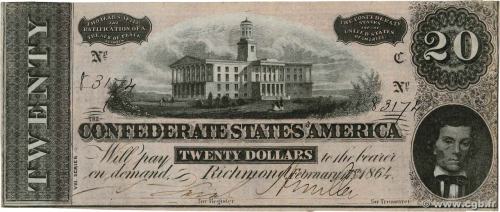 Leap Year en Richmond, Virginia
 El diario


 La primera reacción de los congresistas Republicanos al plan del presidente fue favorable. Tanto moderados como radicales decidieron darle una oportunidad a Johnson y a su plan. Éstos esperaban que los nuevos gobiernos sureños aprovecharan la gran oportunidad que el plan Johnson significaba y actuaran de buena fe. Desafortunadamente, esto no ocurrió porque los nuevos gobiernos sureños buscaron resucitar la esclavitud a través de una serie de leyes, conocidas como los
  En febrero de 1866, el presidente Johnson vetó la nueva ley de la Oficina de Libertos y la Ley de derechos civiles. Además, lanzó un fuerte ataque contra los radicales, acusándoles de traidores que no querían restaurar la Unión.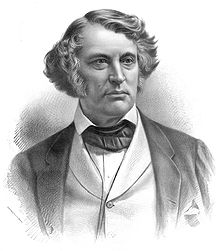


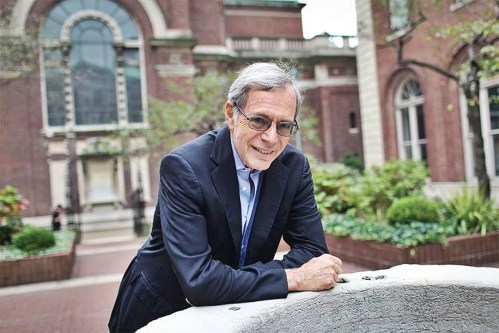
 Eric Foner: That played an important part in the ideological edifice of the Jim Crow era. The supposed horrors of Reconstruction were part of the justification for taking the right to vote away from black men in the late 19th, early 20th Century. That people no longer generally hold that view and actually know little is better. That at least now if people are interested, they can go at it with a fresh, a clean slate rather than having to disabuse themselves of a lot of mythologies.
 Eric Foner: I think that’s a great question and I will withdraw my word failure. You’re absolutely right. It is so embedded. That idea is so embedded that it’s just impossible to avoid. The problem with declaring Reconstruction a failure is that then it makes the question at hand why did it fail, rather than what it seek to accomplish and how much of that was accomplished? If you define Reconstruction as the effort to create a utopian society, it failed. We haven’t had one yet, and certainly if you go a little less expansive than that and just say the effort to put into the laws and constitution and to enforce them, the basic rights of citizens for all Americans, including African-Americans, well it’s not exactly that it failed, but it didn’t become secure enough that later on these rights couldn’t be taken away.
 Eric Foner: He wrote back and said, “You’re absolutely right. I shouldn’t have said that, but my wife is from South Carolina,” and I’ve heard this all the time. And I said to myself, “That’s a funny way of running journalism.” You put in your article what your wife told you over breakfast. But be that as it may, you don’t see that anymore. I think what now, if Reconstruction pops up is Tim Scott is the first black Senator from South Carolina and the first ones were in Reconstruction. I think Reconstruction is being seen as a time when positive things happened even though negative things happened as well. So I think it’s good. And of course the Gates series was very important as you well know, that there’s now a national park site being developed in Beaufort, South Carolina to highlight the history of Reconstruction. So I think Reconstruction is, people are encountering it in all sorts of venues and I think in a more modern form than the old what we call Dunning School approach.
 Eric Foner: Well there were still slaves on the ground when the Civil War ended, quite a few of them. People who had gotten to Union lines or where the Union Army had come and established control, yeah. Part of their job, part of the Union Army’s job once the Emancipation Proclamation was issued, was to protect the freedom that Lincoln had announced. But legally speaking, emancipation and abolition are not quite the same thing. Slavery is created by state law, not federal law, state law. States can abolish slavery as the Northern states did soon after the American Revolution, but freeing individuals does not abrogate the state laws that create slavery. That’s why Lincoln’s, even though you wouldn’t quite see this in the movie. That’s fine. It’s not a historical treatise. Lincoln’s preferred route to the end of slavery during the war was state by state abolition.
 Eric Foner: Yeah. The 14th Amendment, I would say, is working out the consequences of the 13th Amendment as well as the consequences of the Civil War. I see the 14th Amendment as putting the Northern Republicans understanding of what they had achieved in the Civil War into the constitution. Some of it has something to do with race or slavery, for example, that Confederate bonds are never going to be repaid. If you patriotically loaned money to the Confederacy, forget it. You’re never getting that back. It has to do with various other things related to the war. But the first section, which is the key one, is really henceforth because of the abolition of slavery, everybody born in the United States is a citizen of the United States.
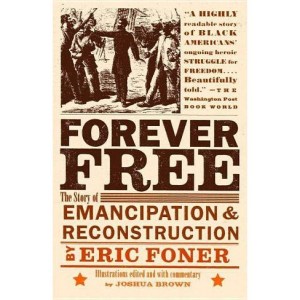 Eric Foner: So Indians were not citizens and it’s not until 1924 that Congress enacts a law making all Native Americans, regardless of where they are living, regardless of what tribe they in, citizens of the United States. So yeah. These amendments had exemptions, they had loopholes, they had serious flaws. Women, as you said, certainly objected to the 15th Amendment, which didn’t give them the right to vote, and the second clause of the 14th Amendment, which introduces the word male for the first time into the constitution. These measures were compromises. They were worked out after long debate and amendments and ups and downs in Congress. There’s no single mind behind the 13th, 14th or 15th Amendments. They were the result of all sorts of negotiation and controversy. Nonetheless, the basic principles are pretty clear. The abolition of slavery, the establishment of a universal notion of citizenship, despite without the native Americans and of equality among those citizens and the vast expansion of the right to vote.
 El actual proceso de residenciamiento del Presidente Donald J. Trump ha provocado una serie de interrogantes no sólo políticas, sino también históricas. Debe recordarse que en más de doscientos años de historia de la república estadounidense, esta es la tercera vez que un residente de la Casa Blanca es residenciado (el triste honor lo comparten Adrew Johnson y William J. (Bill) Clinton).

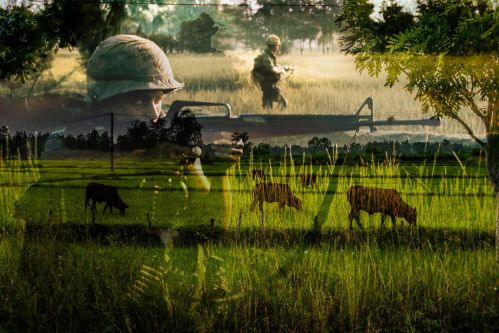 La década de 1970 fue un periodo muy duro para el pueblo estadounidense. Divididos por una guerra lejana, los estadounidenses eligieron a un nuevo presidente, Richard M. Nixon, que prometió acabar con la participación de su país en la guerra de Vietnam y lo hizo, pero que también violó la ley y abusó de su poder, comprometiendo la imagen y la confianza del gobierno de los Estados Unidos. Tras miles de muertos y miles de millones de dólares invertidos, los últimos estadounidenses fueron expulsados de Vietnam en 1975. Esta derrota –la primera en la historia de Estados Unidos– sumió al país en un periodo de indecisión y duda. Para complicar las cosas, los gastos de la guerra, unidos al aumento en los costos de la energía, llevaron a la nación a una profunda crisis. Todo ello llevó a muchos a pensar que la decadencia del poderío y riqueza de los Estados Unidos era algo inevitable.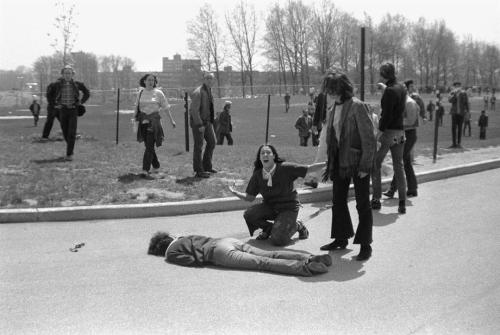
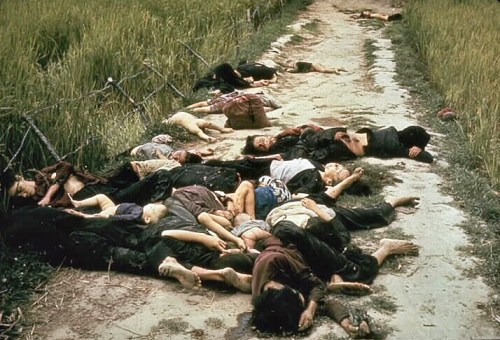
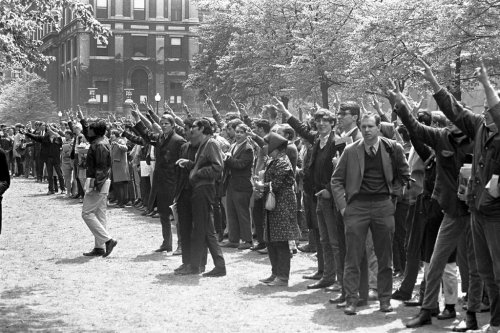
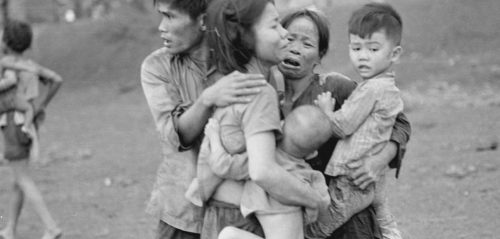
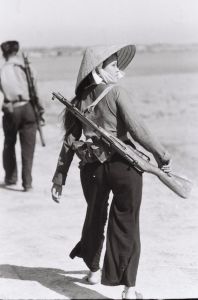 La derrota en Vietnam afectó la visión que tenían los Estados Unidos de sí mismos, pues les obligó a reconocer los límites de su poder. El país entró en lo que ha sido denominado como el síndrome de Vietnam, es decir, una menor propensión hacia las intervenciones militares en segundos y terceros países. En 1973, fue aprobada la Ley de Poderes de Guerra, obligando al Presidente a informarle al Congreso cualquier uso de la fuerza en las primeras cuarenta y ocho horas de haber ocurrido. De no haber una declaración de guerra, las hostilidades sólo pueden durar sesenta días.




 El Imperio de Calibán