Feeds:
Entradas
Comentarios

Archive for the ‘Afroamericanos’ Category

En Estados Unidos se dedica el mes de febrero a conmemorar y celebrar la historia de los afroamericanos, tema que no es ajeno a esta bitacora. ¿Qué mejor manera de comenzar este mes que con un artículo que busca rescatar la profundidad de uno de los íconos del movimiento de los derechos civiles? En este escrito que comparto con mis lectores, la politóloga estadounidense Jeanne Theoharis nos recuerda que la labor y el legado de  Rosa Parks no se limitan a su desafío a la segregación racial de la transportación pública en la Alabama de los años 1950. La figura de Parks es mucho más grande que eso. Según la Dra. Theoharis, la Sra. Parks dedicó muchos años de su vida a luchar contra el racismo en  los estados del norte. También resalta sus simpatías con los Black Panthers y su admiración por Malcolm X. 

En otras palabras, Rosa Parks -como tambien el Dr. King- es un personaje mucho más complejo  del que los medios, los libros textos y los políticos usualmente proyectan en un esfuerzo de apropiación que busca diluir su mensaje y su ejemplo, y hacerlos así aceptables.


A  booking photo of Rosa Parks taken on Feb. 22, 1956, at the county sheriff’s office in Montgomery, Ala.

Credit…Montgomery County Sheriff’s Office, via Associated Press

The Real Rosa Parks Story Is Better Than the Fairy Tale

The New York Times   February 1, 2021 


Mug shot No. 7053 is one of the most iconic images of Rosa Parks. But the photo, often seen in museums and textbooks and on T-shirts and websites, isn’t what it seems. Though it’s regularly misattributed as such, it is not the mug shot taken at the time of Mrs. Parks’s arrest in Montgomery, Ala., on Dec. 1, 1955, after she famously refused to give up her seat on a bus to a white passenger. It was, in fact, taken when she was arrested in February 1956 after she and 88 other “boycott leaders” were indicted by the city in an attempt to end the boycott. The confusion around the image reveals Americans’ overconfidence in what we think we know about Mrs. Parks and about the civil rights movement.

Martin Luther King Jr. and Rosa Parks dominate the Civil Rights Movement chapters of elementary and high school textbooks and Black History Month celebrations. And yet much of what people learn about Mrs. Parks is narrow, distorted, or just plain wrong. In our collective understanding, she’s trapped in a single moment on a long-ago Montgomery bus, too often cast as meek, tired, quiet and middle class. The boycott is seen as a natural outgrowth of her bus stand. It’s inevitable, respectable and not disruptive.

But that’s not who she was, and it’s not how change actually works. “Over the years, I have been rebelling against second-class citizenship. It didn’t begin when I was arrested,” Mrs. Parks reminded interviewers time and again.

Rosa Parks papers give insight into the civil rights icon

Born Feb. 4, 1913, she had been an activist for two decades before her bus stand — beginning with her work alongside Raymond Parks in 1931, whom she married the following year, to organize in defense of the “Scottsboro Boys” (nine Black teenagers who were falsely accused of raping two white women). Indeed, one of the issues that animated her six decades of activism was the injustice of the criminal justice system — wrongful accusations against Black men, disregard for Black women who had been sexually assaulted, and police brutality. With a small group of other activists, including E.D. Nixon, who would become branch president, she spent the decade before her well-known bus stand working to transform the Montgomery NAACP into a more activist chapter that focused on voter registration, criminal justice and desegregation. This was dangerous, tiring work and Mrs. Parks said it was “very difficult to keep going when all our work seemed to be in vain.” But she persevered.

Dispirited by the lack of change and what she called the “complacency” of many peers, she reformed the NAACP Youth Council in 1954 and urged her young charges to take greater stands against segregation. When 15-year-old Claudette Colvin was arrested for refusing to give up her seat on a bus in March 1955, many Black Montgomerians were outraged by Mrs. Colvin’s arrest, but some came to decide that the teenager was too feisty and emotional, and not the right test case. Mrs. Parks encouraged the young woman’s membership in the Youth Council and was the only adult leader, according to Ms. Colvin, to stay in touch with her the summer after her arrest. Mrs. Parks put her hope in the spirit and militancy of young people.
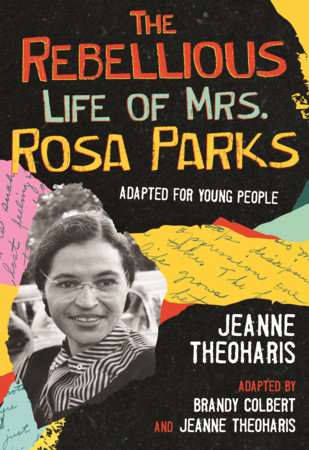
The Rebellious Life of Mrs. Rosa Parks (Young Readers Edition) by Jeanne  Theoharis: 9780807067574 | PenguinRandomHouse.com: BooksThat evening on the bus, Mrs. Parks challenged the police officers arresting her: “Why do you push us around?” There are no photos from the arrest — no sense this would be a history-changing moment. But networks that had been built over years sprang into action late that night when Mrs. Parks decided to pursue her legal case and called Fred Gray, a young lawyer and fellow NAACP member, to represent her. Mr. Gray called the head of the Women’s Political Council, Jo Ann Robinson, who decided to call for a one-day boycott on Monday, the day Mrs. Parks would be arraigned in court.

Braving danger, Ms. Robinson left her home in the middle of the night to run off 50,000 leaflets with the help of a colleague and two trusted students. In the early-morning hours, the women of the W.P.C. fanned out across the city, leaving the leaflets in churches, barbershops and schools. Mr. Nixon began calling the more political ministers to get them on board. Buoyed by the boycott’s success that first day, the community decided to continue. The boycott succeeded in part because the Black community organized a massive car pool system, setting up some 40 pickup stations across town, serving about 30,000 riders a day, and in part because of a federal legal case challenging Montgomery’s bus segregation that Mr. Gray filed in February with courageous teenagers, Ms. Colvin and Mary Louise Smith, serving as two of the four plaintiffs.

The boycott seriously disrupted city life and bus company revenues. Police harassed the car pools mercilessly, giving out hundreds of tickets — and then, when that didn’t work, the city dredged up an old anti-syndicalism law and indicted 89 boycott leaders. Refusing to be cowed or to wait to be arrested, Mrs. Parks, along with others, presented herself to the police while scores of community members gathered outside. Mug shot No. 7053.

The Rosa Parks fable also erases the tremendous cost of her bus stand and the decade of suffering that ensued for the Parks family. They weren’t well-off. The Parkses lived in the Cleveland Court projects, Mrs. Parks’s husband, Raymond, working as a barber at Maxwell Air Force Base and Mrs. Parks spending her days in a stuffy back room at Montgomery Fair department store altering white men’s suits. Five weeks after her bus stand, she lost her job; then Raymond lost his. Receiving regular death threats, they never found steady work in Montgomery again. Eight months after the boycott’s successful end, the Parks family was forced to leave Montgomery for Detroit, where her brother and cousins lived. They continued to struggle to find work, and she was hospitalized to treat ulcers in 1959, which led to a bill she couldn’t pay. It was not until 1966, 11 years after her bus arrest, after she was hired to work in U.S. Representative John Conyers’s new Detroit office, that the Parks family registered an income comparable to what they’d made in 1955. (Mrs. Parks had supported Mr. Conyers’s long-shot bid for Congress in 1964.)


Mrs. Parks spent the next several decades of her life fighting the racism of the North — “the Northern promised land that wasn’t,” she called it — marching and organizing against housing discrimination, school segregation, employment discrimination and police brutality. In July 1967, on the fourth day of the Detroit uprising, police killed three Black teenagers at the Algiers Motel. Justice against the officers proved elusive (ultimately none of them were punished for murder or conspiracy) and Detroit’s newspapers grew reluctant to press the issue. At the request of young Black Power activists who refused to let these deaths go unmarked and the police misconduct be swept under the rug, Mrs. Parks agreed to serve as a juror on the “People’s Tribunal” to make the facts of the case known.

Credit…Michael J. Samojeden/Associated Press

“I don’t believe in gradualism,” she made clear, “or that whatever is to be done for the better should take forever to do.” In the 1960s and ’70s, she was part of a growing Black Power movement in the city and across the country. Describing Malcolm X as her personal hero, she attended the 1968 Black Power convention in Philadelphia in 1968 and the 1972 Gary Convention, worked for reparations and against the war in Vietnam, served on prisoner defense committees, and visited the Black Panthers’ school in 1980. “Freedom fighters never retire,” she observed at a testimonial for a friend — and she never did.

But this Rosa Parks is not the one most of us learned about in school or hear about during Black History Month commemorations. Instead, we partake in an American myth, as President George W. Bush put it after her death in 2005, that “one candle can light the darkness.” A simple seamstress changes the course of history with a single act, decent people did the right thing and the nation inexorably moved toward justice. Mrs. Parks’s decades of work challenging the racial injustice puts the lie to this narrative. The nation didn’t move naturally toward justice. It had to be pushed.
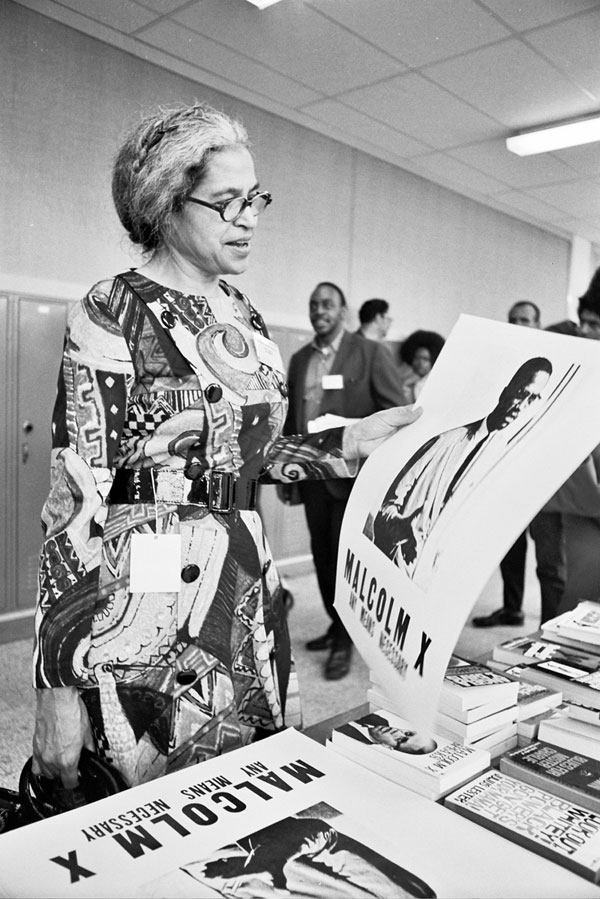
The Rebellious Life of Mrs. Rosa Parks – Race, Politics, Justice

The boycott was a tremendous feat of organization that drew on networks built over years. Understanding the demonization, death threats and economic hardship Mrs. Parks endured for more than a decade underscores the costs of such heroism. Most Americans did not support the civil rights movement when it was happening; in a Gallup poll right before the March on Washington in 1963, only 23 percent of Americans who were familiar with the proposed march felt favorably toward it.

Reckoning with the fact that Mrs. Parks spent the second half of her life fighting the racism of the North demonstrates that racism was not some regional anachronism but a national cancer. And seeing how she placed her greatest hope in the militant spirit of young people (finding many adults “complacent”) gives the lie to the ways commentators today have used the civil rights movement to chastise Black Lives Matter for not going about change the right way. Learning about the real Rosa Parks reveals how false those distinctions are, how criminal justice was key to her freedom dreams, how disruptive and persevering the movement, and where she would be standing today — an essential lesson young people, and indeed all Americans, need to understand to grapple honestly with this country’s history and see the road forward.

Jeanne Theoharis is a professor of political science and the author of eleven books on the civil rights and Black Power movements including “The Rebellious Life of Mrs. Rosa Parks” and “The Rebellious Life of Mrs. Rosa Parks Young Readers’ Edition,” co-adapted with Brandy Colbert.

Read Full Post »

A la hora de explicar el arraigo y popularidad de Donald J. Trump entre millones de estadounidense imperan dos factores: el económico y el racial. El primero hace alusión a los efectos de más de trienta años de neoliberalismo «reaganiano»  sobre las clases media y baja blanca estadounidenses. Su empobrecimiento y abandono por parte de los principales partidos políticos -y en especial los Democratas- las hizo muy receptivas a la demagogia de Trump.  Las fabricas se fueron a China o a México, los estadounidense de baja nivel educativo vieron sus opciones económicas reducirse, los ricos se hicieron más ricos y  los pobres cayeron víctimas de opiáceos y de la avariacia de ciertas compañías farmaceuticas.  El esperado goteo (trickle-down) de la riqueza no llegó.

En cuanto al tema racial, es necesario reconocer que, contrario a lo que muchos pensaron, la victoria de Obama en 2008 no marcó el fin de los conflictos raciales en Estados Unidos. Por el contrario, la presencia de un negro en la Casa Blanca exacerbó los ánimos raciales y preparó el camino para el éxito del discurso racista de Trump.  Sitiéndose amenazados y preocupados por perder sus privilegios ante el crecimiento y avance de las minorías raciales, millones de estadounidense vieron en Trump el líder necesario para hacer a Estados Unidos blanco de nuevo. Con Trump en la presidencia, supremacistas blancos y otros grupos extremistas se sintieron el libertad de expresar abiertamente lo que pensaba o sentían en privado.

¿Cuál de estas explicaciones es la correcta? No creo en explicaciones simples, por lo que veo necesario recurrir a ambas para entender cómo llegamos a la toma del Capitolio el 6 de enero de 2021. Ese día, miles de estadounidenses, en su inmensa mayoría  blancos, llegaron a Washington D.C. convocados por el Presidente para cuestionar la certificación congresional de la victoria de Joe Biden. En lo que los medios identificaron erróneamente como algo inédito en la historia de Estados Unidos, los seguidores de Trump marcharon sobre el Congreso y con una facilidad pasmosa lo tomaron por la fuerza. Luego vino un despliegue de lo peor de la sociedad estadounidense.

Quienes participaron en el ataque al Congreso se hicieron parte de una tradición estadounidense, la de cuestionar los resultados electorales cuando no favorecen a un sector social o racial.

En este escrito, el periodista británico Toby Luckhurst reseña los eventos que ocurrieron en Wilmington, Carolina del Norte, cuando en 1898 una turba de hombres blancos derrocaron a una coalición racialmente mixta, que democráticamente habían ganado el control de la ciudad.


Wilmington 1898: When white supremacists overthrew a US government

Toby Luckhurst

BBC News

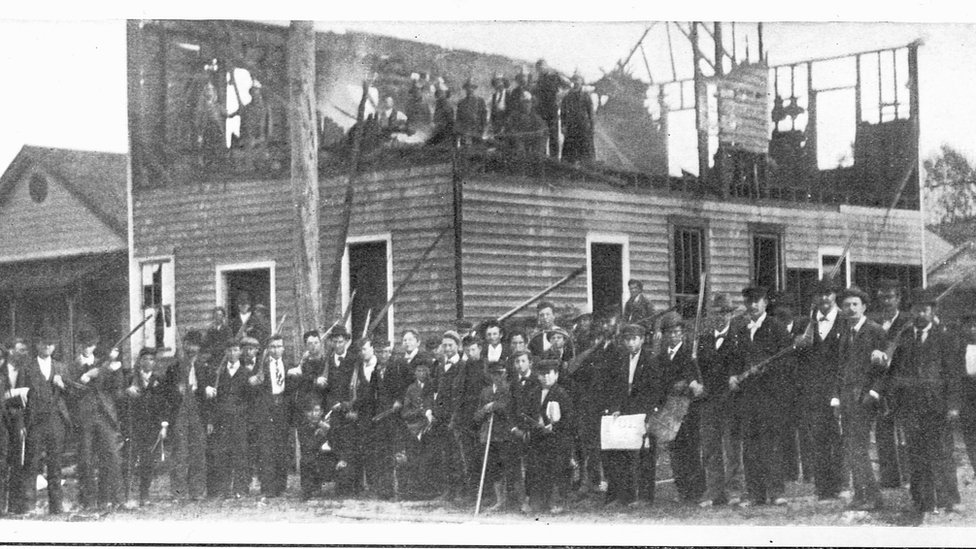
A mob stands outside the burnt offices of the Wilmington Daily Record

The mob burned down the offices of the Wilmington Daily Record a caption

Following state elections in 1898, white supremacists moved into the US port of Wilmington, North Carolina, then the largest city in the state. They destroyed black-owned businesses, murdered black residents, and forced the elected local government – a coalition of white and black politicians – to resign en masse.

Historians have described it as the only coup in US history. Its ringleaders took power the same day as the insurrection and swiftly brought in laws to strip voting and civil rights from the state’s black population. They faced no consequences.

Wilmington’s story has been thrust into the spotlight after a violent mob assaulted the US Capitol on 6 January, seeking to stop the certification of November’s presidential election result. More than 120 years after its insurrection, the city is still grappling with its violent past.

Short presentational grey line

After the end of the US Civil War in 1865 – which pitted the northern Unionist states against the southern Confederacy – slavery was abolished throughout the newly-reunified country. Politicians in Washington DC passed a number of constitutional amendments granting freedom and rights to former slaves, and sent the army to enforce their policies.

But many southerners resented these changes. In the decades that followed the civil war there were growing efforts to reverse many of the efforts aimed at integrating the freed black population into society.

Wilmington in 1898 was a large and prosperous port, with a growing and successful black middle class. Undoubtedly, African Americans still faced daily prejudice and discrimination – banks for instance would refuse to lend to black people or would impose punishing interest rates. But in the 30 years after the civil war, African Americans in former Confederate states like North Carolina were slowly setting up businesses, buying homes, and exercising their freedom. Wilmington was even home to what was thought to be the only black daily newspaper in the country at that time, the Wilmington Daily Record.

300+ Unfair politics ideas | african american history, black history,  history facts«African Americans were becoming quite successful,» Yale University history professor Glenda Gilmore told the BBC. «They were going to universities, had rising literacy rates, and had rising property ownership.»
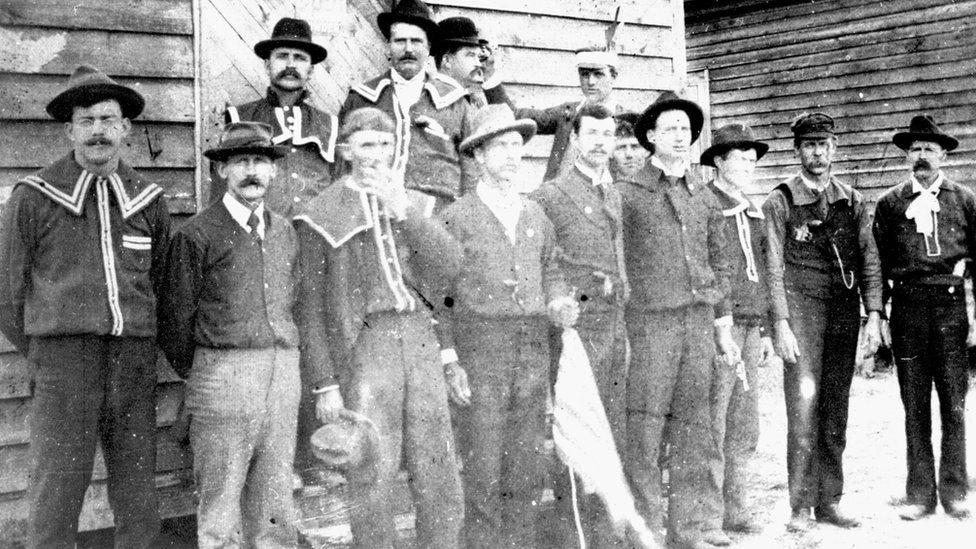
This growing success was true across the state of North Carolina, not just socially but politically. In the 1890s a black and white political coalition known as the Fusionists – which sought free education, debt relief, and equal rights for African Americans – won every state-wide office in 1896, including the governorship. By 1898 a mix of black and white Fusionist politicians had been elected to lead the local city government in Wilmington.

But this sparked a huge backlash, including from the Democratic Party. In the 1890s the Democrats and Republicans were very different to what they are today. Republicans – the party of President Abraham Lincoln – favoured racial integration after the US Civil War, and strong government from Washington DC to unify the states.

But Democrats were against many of the changes to the US. They openly demanded racial segregation and stronger rights for individual states. «Think of the Democratic party of 1898 as the party of white supremacy,» LeRae Umfleet, state archivist and author of A Day of Blood, a book about the Wilmington insurrection, told the BBC.

Democratic politicians feared that the Fusionists – which included black Republicans as well as poor white farmers – would dominate the elections of 1898. Party leaders decided to launch an election campaign based explicitly on white supremacy, and to use everything in their power to defeat the Fusionists. «It was a concerted, co-ordinated effort to use the newspapers, speechmakers and intimidation tactics to make sure the white supremacy platform won election in November 1898,» Ms Umfleet said.

White militias – including a group known as the Red Shirts, so named for their un

iforms – rode around on horseback attacking black people and intimidating would-be voters. When black people in Wilmington tried to buy guns to protect their property, they were refused by white shopkeepers, who then kept a list of those who sought weapons and ammo.

Red Shirts pose at the polls in North Carolina

Enter a captioThe Red Shirts militia intimidated and attacked blacn

Newspapers meanwhile spread claims that African Americans wanted political power so they could sleep with white women, and made up lies about a rape epidemic. When Alexander Manly, owner and editor of the Wilmington Daily Record, published an editorial questioning the rape allegations and suggesting that white women slept with black men of their own free will, it enraged the Democratic party and made him the target of a hate campaign.

The day before the state-wide election in 1898, Democratic politician Alfred Moore Waddell gave a speech demanding that white men «do your duty» and look for black people voting.

And if you find one, he said, «tell him to leave the polls and if he refuses kill, shoot him down in his tracks. We shall win tomorrow if we have to do it with guns.»

The Democratic party swept to victory in the state elections. Many voters were forced away from polling stations at gunpoint or refused to even try to vote, for fear of violence.

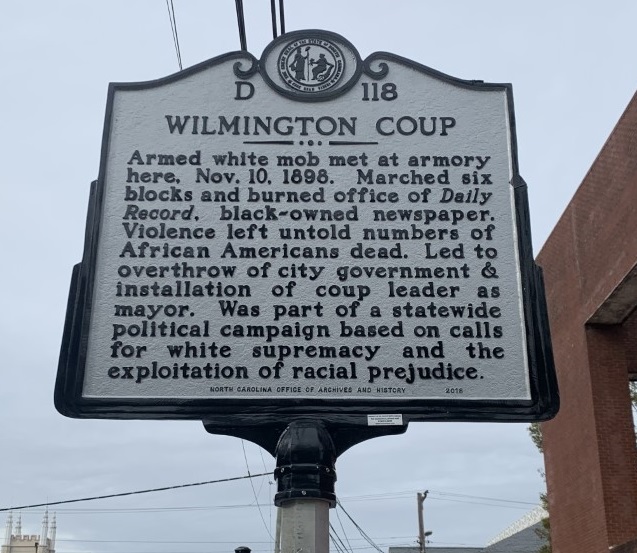
But the Fusionist politicians remained in power in Wilmington, with the municipal election not due until the next year. Two days after the state election Waddell and hundreds of white men, armed with rifles and a Gatling gun, rode into the town and set the Wilmington Daily Record building alight. They then spread through the town killing black people and destroying their businesses. The mob swelled with more white people as the day went on.

Wilmington Coup 1898 | Downtown Wilmington, NC

As black residents fled into the woods outside the town, Waddell and his band marched to the city hall and forced the resignation of the local government at gunpoint. Waddell was declared mayor that same afternoon.

«It [was] a full-blown rebellion, a full-blown insurrection against the state government and the local government,» Prof Gilmore said.

Within two years, white supremacists in North Carolina imposed new segregation laws and effectively stripped black people of the vote through a combination of literacy tests and poll taxes. The number of registered African American voters reportedly dropped from 125,000 in 1896 to about 6,000 in 1902.

«Black people in Wilmington didn’t think that something like this would ever happen,» Prof Gilmore said. «There was a Republican governor in the state, their congressman was a black man. They thought that things were actually getting better. But part of the lesson about it was as things got better, white people fought harder.»

Deborah Dicks Maxwell is president of the local branch of the National Association for the Advancement of Colored People [NAACP] in Wilmington. Born and raised in the town, she didn’t learn about the attack until she was in her thirties.

«It was something that those who are here [in Wilmington] knew but it was not widely talked about,» she told the BBC. «It’s not in the school curriculum like it should be – no one wants to admit this happened.»

It was not until the 1990s that the city began to discuss its past. In 1998 local authorities commemorated the 100th anniversary of the attack, and two years later set up a commission to establish the facts. Since then the city has erected plaques at key points to commemorate the events, and has created the 1898 Monument and Memorial Park – something Ms Dicks Maxwell described as «small but significant».

Given what the city has gone through, it’s no surprise that its residents and historians who have covered its past drew parallels between the 1898 insurrection and the attack on the US Capitol this month. Ms Dicks Maxwell and her NAACP branch had for months after the US election been highlighting what they saw as the similarities between what happened in Wilmington and how politicians today in the US were trying to undermine the election results.

«Earlier that day we had a press conference denouncing our local congressman for supporting Trump, [saying] that there would be a possible coup and that we did not want another coup to ever occur in this country,» she said. Just hours later the mob marched on the US Capitol.

Christopher Everett is a documentary maker who made a film about the 1898 insurrection, Wilmington on Fire. When Mr Everett saw the attack on the Capitol he thought of Wilmington.

«No one was held accountable for the 1898 insurrection. Therefore it opened up the floodgates, especially in the south, for them to… strip African Americans’ civil rights,» he told the BBC. «That’s the first thing that came to my mind after the DC insurrection – you’re opening the door for something else to happen, or even worse.»

The 1898 attack was not covered up. University buildings, schools and public buildings throughout the state were all named after the instigators of the insurrection. Men would later claim to have taken part in the attack to boost their stature in the Democratic Party. As the decades passed, history books started to claim the attack was in fact a race riot started by the black population and put down by white citizens.

«Even after the massacre, a lot of these folks who participated in and orchestrated the insurrection became immortalised – statues, buildings named after them, throughout the country, especially in North Carolina,» Mr Everett said.

CWilmington insurrection of 1898 - Wikiwandharles Aycock – one of the organisers of the white supremacy electoral campaign – became governor of North Carolina in 1901. His statue now stands in the US Capitol, which rioters entered on 6 January.

Mr Everett is now filming a sequel to his documentary to examine how Wilmington is grappling with its past. He said many local leaders are working to «bring the city of Wilmington back to the spirit of 1897, when you had this Fusion movement of white folks and black folks working together and making Wilmington an example of what the new south could have been after the civil war.»

«Wilmington was a model for the white supremacy movement with the insurrection,» he said. «But now Wilmington could also be a model to show how we can work together and overcome the stain of white supremacy as well.»

Read Full Post »

El David Bruce Centre for American Studies de la Keele University en Inglaterra, acaba de anunicar el inicio de su ciclo de conferencias virtuales.  Estas son completamente gratuitas y abordarán temas muy diversos de la historia estadouidense. Entre ellas destaca, dado el contexto electoral actual, la charla que dictará el Dr. Adam Fairclough sobre la elección de 1876, tal vez la más controversial en la historia de Estados Unidos. Comparto con mis lectores el programa de este ciclo de conferencias.


Screen Shot 2020-10-09 at 11.50.03 AM

David Bruce Centre for American Studies Seminar Programme

Semester 1, 2020/21

October 14, 2020

Dr Patrick Andelic, Northumbria University

‘We Came Here To Take the Bastille’: The Watergate Babies and the Democratic Party in Congress after 1974

Join Microsoft Teams Meeting

November 4, 2020

Dr Rebecca Macklin, Mellon Postdoctoral Fellow at the Penn Program in Environmental Humanities and Bruce Centre Research Fellow

Relationality as Decolonial Method: Reading Resistance Across Native American and South African Literatures

Join Microsoft Teams Meeting

November 18, 2020

Prof. Adam Fairclough. Leiden University (Emeritus)

Parade of Perjurers: The Potter Committee and the Stolen Elections of 1876

Join Microsoft Teams Meeting

 November 25, 2020

Dr Maria Flood, Keele University

‘The film we’ve been waiting for’: Audience, Emotion, and Black Boyhood iMoonlight (2016)

Join Microsoft Teams Meeting

Unless otherwise stated, seminars are held virtually on Microsoft Teams at 2.15pm.  If you wish to attend a seminar, please use the hyperlink under each speaker’s paper title, or contact the DBC director, Dr David Ballantyne (d.t.ballantyne@keele.ac.uk).


Read Full Post »

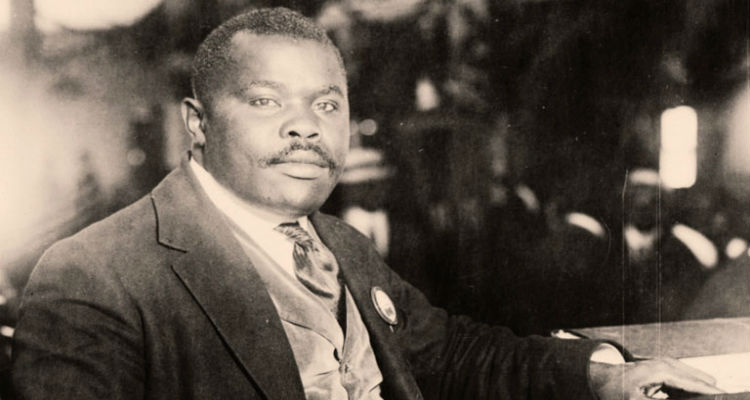
El panafricanismo y el nacionalismo negro no son temas ajenos a esta bitácora. En varias ocasiones hemos abordado ambos, especialmente al enfocar la figura de Marcus Garvey. Lo que no hemos atendido en la visión internacional y geopolítica de éstos. En este interesante ensayo publicado en JStor Daily, Mohammed Elnaiem, estudiante graduado de Sociología en la Universidad de Cambridge, analiza la compleja relación entre la intelectualidad negra estadounidense y el ascenso del Imperio Japonés.

September 1905. Japan had just become the first Asian power to defeat a European Empire with the conclusion of the Russo-Japanese War. For more than a year, the Japanese Empire and Tsarist Russia had been vying for control over Korea and Manchuria. On September 5th, Japan forced a Russian retreat, sending shockwaves across the intellectual sphere of black America and the colonial world. As Bill V. Mullen of Purdue University eloquently notes in his 2016 book, W.E.B. Du Bois: Revolutionary Across the Color Line, Du Bois was so moved that he declared: “The magic of the word ‘white’ is already broken.” Du Bois was convinced that “the awakening of the yellow races is certain… the awakening of the brown and black races will follow in time.”

For anti-colonial intellectuals and black activists in the U.S., the Japanese victory presented a moment of realization: If, with the right strategy, European colonialists could be forced to retreat from far east Asia, why couldn’t they be forced to leave the Caribbean and Africa?

By the time World War I began, Du Bois would write a seminal essay, “The African Roots of War,” wherein he would ask why African workers and laborers would participate in a war they couldn’t understand. Why, he wondered, would “Africans, Indians and other colonial subjects” fight for the sole aim of “the exploitation of the wealth of the world mainly outside the European circle of nations?” He demanded that they take inspiration from “the awakened Japanese.” By the end of World War I, African American and Japanese intellectuals would develop a transpacific camaraderie.

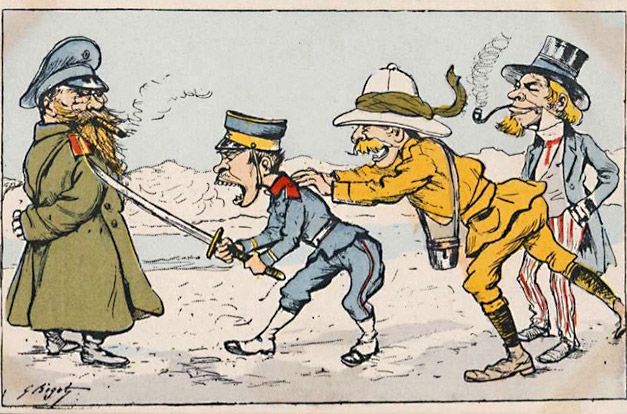
For Du Bois and his contemporaries, the Japanese victory proved that the empire could be a fulcrum for the colored peoples of the world, a means by which European expansion could be dislodged. But what a paradox this was: The Japanese empire, which sought nothing but the occupation of Korea, Manchuria, and if possible, the whole Far East, was being cheered on by self-identified anti-colonial intellectuals.

Regardless, Japan cast its spell on black consciousness, and by the end of World War I, African American and Japanese intellectuals would develop a transpacific camaraderie. African Americans would praise Japanese diplomacy, and Japanese intellectuals—left-wing or right-wing—would condemn Jim Crow. To understand this relationship, one must look to Paris.

The Paris Peace Conference & the End of WWI

To conclude the first World War, U.S. President Woodrow Wilson laid out a structure that would inspire the UN decades later. In Paris, he announced his fourteen points for a new world order built on peace and self-determination of oppressed peoples. He called it the League of Nations.

 William Monroe Trotter
William Monroe Trotter

Meanwhile, in the States, the lynching of blacks went unanswered and segregation continued unabated. A liberal abroad, and a so-called pragmatist at home, Wilson was seen as hypocritical by many of the black-left intelligentsia. In fact, William Monroe Trotter—an eminent voice against segregation in the early twentieth century, and a man who once campaigned for Wilson’s presidency—became one of his greatest foes.

Trotter gained nationwide infamy after being kicked out of the White House for challenging Wilson. He had been invited to speak on civil rights issues, but challenged the president on racial segregation among federal employees. Trotter called this segregation humiliating. Wilson responded firmly, exclaiming, “Your tone, sir, offends me.” Trotter was subsequently expelled from the premises.

From then on, Trotter made it his mission to embarrass Wilson on the global stage. When Wilson declared his plan to espouse his “fourteen points” for a global, post-war order at the Paris Peace Conference in 1919, Trotter not only proposed a fifteenth point for racial equality, but travelled to Paris to protest and ensure its inclusion in the negotiations.

A. Phillip Randolph, a pioneer of the civil rights movement, sought to highlight the symbolism of Trotter’s actions. As Yuichiro Onishi, an African Americanist at the University of Minnesota notes, in a March 1919 issue of The Messenger, Randolph remarked that:

Trotter wanted to use his presence as a weapon to demonstrate Washington’s failure to reconcile Jim Crow laws with the liberal principles that Wilson espoused abroad. It was an ingenious, albeit unprepared, plan: Trotter arrived too late.

At the time, Japanese politicians seemed to be watching U.S. race relations closely. It could have been coincidental or it could it have been intentional, but Baron Nobuaki Makino, a senior diplomat in the Japanese government and the principal delegate for the Empire, proposed Japan’s “racial equality bill” at the meeting to found the League of Nations. Japan only said that all nations were equal, but this seemingly offended Wilson (and the leaders of Australia and the UK). The proposal was immediately struck down.Was it love? Solidarity? Or a pragmatic way to highlight the hypocrisy of the United States?

The symbolic value of these actions nonetheless reignited African American intellectual admiration for Japan. Fumiko Sakashita, a professor at Ritsumeikan University in Japan, shows how Japanese intellectuals were humbled by this. One Pan-Asian, and self-described “right-wing literary,” Kametaro Mitsukawa, hyperbolically asked why “black people exhibit the portrait of our baron Nobuaki Makino alongside that of the liberator Abraham Lincoln on the walls of their houses?” A correspondent in Chicago, Sei Kawashima, told his readers that “Japan’s proposal of abolishing racial discrimination at the peace conference… gave black people a great psychological impact at that time.”

That it did. Marcus Garvey, a leading nationalist and Pan-Africanist who advocated for African Americans to return to Africa, was so impassioned that he believed that after the Great War, “the next war will be between the Negroes and the whites unless our demands for justice are recognized… With Japan to fight with us, we can win such a war.”

Marcus Garvey

Japan’s newfound interest in African American affairs only blossomed. As Sakashita notes, Fumimaro Konoe, a delegate at the Paris Peace Conference and future prime minister of Japan, wrote in his book that “black rage against white persecutions and insults” were at an all-time high. Fusae Ichikawa, a Japanese woman suffragist, wrote an article about the struggle of black women, which she saw first hand after touring the country with the NAACP. She called it a “disgrace to civilization.” It’s not entirely clear why Japanese thinkers glanced across the Pacific with such concern for the U.S.’s blacks. Was it love? Solidarity? Or a pragmatic way to highlight the hypocrisy of the United States?

Even in Paris, Onishi argues, Japan won German concessions in Shantung China, and demanded control in the Marshalls, the Marianas, and the Carolines. “Reference to lynching,” Onishi writes “served as one of the best rhetorical defences of Japan’s imperialist policy.” Whatever the intentions of Japanese intellectuals may have been, in other words, the Japanese government found this preoccupation useful and even promoted it.

Some black intellectuals caught on to this, and suspicion arose. “A word of warning, however, to the unsuspecting,” wrote A. Phillip Randolph and Chandler Owen in 1919. “The smug and oily Japanese diplomats are no different from Woodrow Wilson, Lloyd George or Orlando. They care nothing for even the Japanese people and at this very same moment are suppressing and oppressing mercilessly the people of Korea and forcing hard bargains upon unfortunate China.”

Garvey’s followers disagreed, seeing Japan as a source of messianic salvation.

Decades later, during World War II, when Japan began to steer towards the direction of Fascist Italy and Nazi Germany, an African American ambivalence would develop towards Tokyo. As described by Kenneth C. Barnes, a professor of history at the University of Central Arkansas, there were on the one hand the Neo-Garveyites, those who infused his belief of an apocalyptic race war with religious, redemptive overtones. You could find them in the unlikeliest of places; as black sharecroppers in rural Mississippi County, Arkansas, for instance. On the other hand, there were the liberals, socialists, and mainstream black intellectuals who compared Jim Crow at home to Japanese repression abroad, reminding Washington that, at least in their view, the U.S. was the very monster it was fighting.

Japan in the Axis & a Divided Black Diaspora

In 1921, in the small community of Nodena in Misissippi County, Arkansas, a man was lynched. Henry Lowry was a forty-year-old black sharecropper. A mob of six hundred people poured gasoline over his body and set it ablaze atop a bonfire. Perhaps it was the only way to die with dignity, or maybe he wanted to end the misery, but Lowry grabbed the first pieces of hot coal he could find and swallowed them.

The event was traumatic for the blacks of Mississippi County. One in five residents of the county was black. Many of them were enraged, and many became susceptible to the oratory of Marcus Garvey, a Jamaican immigrant who called for black self-reliance, economic independence, and a military alliance among blacks and Japanese against white power. Not long after Lowry was lynched, eight chapters of the Universal Negro Improvement Association (UNIA), Garvey’s organization, were formed in Mississippi County.

By 1934, the influence of the UNIA had already made its mark on the sharecroppers, and many were devout followers. In that year, a Filipino man who was honourably discharged from the Navy showed up in Mississippi County, Arkansas, one day. He was a former member of the Pacific Movement of the Eastern World, an organisation linked to the UNIA that tried to organize blacks to commit treason and support Japan in the war effort.

His real name was Policarpio Manansala, but he went by the name Ashima Takis. He was Filipino but faked a Japanese accent. Manansala had thousands of followers in the rural south. In his study on Mississipi county, Barnes recounts the story of how Takis attracted a Filipino-Mexican couple and a black man. They were arrested after giving a speech contending that “this country could be taken over entirely by the colored races” if they united with Japan. They did their time, but managed to evade the prosecutor’s recommendation that they be arrested for anarchy and an alleged plot to overthrow the government. They got off easier than most.

In fact, during the second world war, hundreds of African Americans were arrested on charges of sedition, including Elijah Muhammed, the mentor of Malcolm X and the spiritual leader of the Nation of Islam. One article in the Times Daily, dated August 19, 1942, talked about Robert Jordan, a “West Indian negro,” and four others who were arrested on a sedition conspiracy indictment due to their role in an Ethiopian Pacific movement which envisioned “a coalition of Africa and Japan in an Axis-dominated world.” The four leaders in charge were arrested amid a lecture they gave to hundreds of African Americans in a Harlem hall.

But this approach was not the only one. Others sought to resist black oppression through another discourse. Particularly after the Pearl Harbor attack, Japan became a rhetorical target for the African American elite, Sakashita notes. Insofar as Japan was an ally of Hitler’s Germany and Mussolini’s Italy, it needed to be critiqued in the “war against Hitlerism at home, and Hitlerism abroad.” Just as liberals and socialists criticized the internment of Japanese Americans in concentration camps set up by the United States government—asking, as one George Schuyler did, if “this may be a prelude to our own fate”—they took the opportunity to remind the U.S. that its condemnations of Japan were warranted, although hypocritical.

One cartoon featured in the Baltimore Afro-American put this prevailing sentiment the best. As Sakashita reconstructs it, it shows “a grinning Hitler and smiling slant-eyes Japanese soldiers witness hanging and burning… [a] lynching.” The cartoon didn’t stop short of marshalling the very American patriotism that the U.S. used in its war effort to say that the U.S. was complicit in fascism at home. For some blacks, even in the latter half of the twentieth century, Japan remained as “leader of the darker races.” For others, it was a wartime enemy. What is for certain is that Imperial Japan was a preoccupation of the black radical imagination.


Read Full Post »

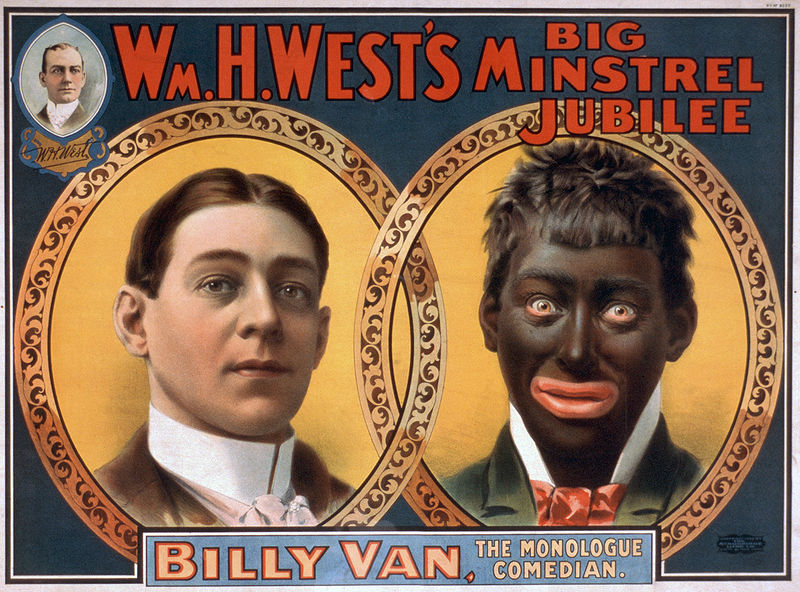
Minstrel_PosterBillyVanWare_edit

La foto en la que, alegadamente aparece el gobernador de Virginia Ralph Northam con la cara pintada de negro en el anuario de su escuela de medicina, ha colocado en la vitrina nacional estadounidense el tema del  blackface. Esta practica, asociada a los espectáculos de vodevil conocidos como minstrels,  formó parte de la cultura racista estadounidense desde mucho antes del estallido guerra civil y siguió siéndolo mucho después  del fin de la esclavitud.

A través de una excelente entrevista a la historiadora Rhae Lynn Barnes, mi podcast favorito de historia de Estados Unidos –Backstory– analizada el papel que han jugado el blackface y el minstrelsy en la historia de Estados Unidos.

Los interesados en escuchar la entrevista la encontraran aquí.

Read Full Post »

Thin LightAcabo de leer un libro extraordinario, The Thin Light of Freedom: The Civil War and Emancipations in the Heart of America. Su autor, Edward L. Ayers, es un historiador estadounidense, ex Presidente de la Universidad de Richmond y miembro fundador del  podcast de historia estadounidense Backstory.  The Thin Light of Freedom completa su obra In The Presence of Mine Enemies: War in the Heart of America, 1859-1863, ganadora del prestigioso Bancroft Prize del año 2004.

Ganador del 2018 Lincoln Prize, este libro examina la guerra de secesión estadounidense a partir de 1863, desde la perspectiva de dos condados estadounidenses claves por su ubicación estratégica: Franklin (Pensilvania-Unionista) y Augusta (Virginia-Confederado). Ello le permite a su autor hacer un examen  micro de un proceso histórico tan complejo como la guerra civil estadounidense.

Dada la magnitud de esta obra, me limitaré hacer algunos comentarios generales sobre su contenido.

Ayers

Edward L. Ayers

En más de una ocasión he escuchado  a colegas minimizar e inclusive negar la esclavitud como el factor clave de la guerra civil estadounidense. Quienes así piensan, por lo general justifican su argumento subrayando la disposición de Lincoln para un acomodo con el Sur que evitara la secesión y la guerra. Ayers hace un trabajo extraordinario subrayando la centralidad de la esclavitud  en el guerra civil estadounidense. Tal vez Lincoln estuvo dispuesto a llegar a un acuerdo sobre el futuro de la esclavitud, pero el Sur no. En otras palabras, es la tenaz resistencia de los esclavistas lo que lleva al Norte a adoptar una posición abolicionista. Según Ayers, la libertad para los negros avanzó más rápido de lo que sus defensores habían podido imaginar, gracias a la agresividad de los sureños. Para acabar con el Sur – y poner fin a la guerra – era necesario acabar con la esclavitud.

Ayers enfatiza que la emancipación y la Reconstrucción no eran inevitables resultados de la economía moderna, del poder del Norte o de la justicia. Las consecuencias de la guerra permanecieron en duda durante el conflicto y el periodo posterior. Pocos hubieran imaginado en 1860 que en cinco años la esclavitud sería destruida y que los libertos se convertirían en ciudadanos estadounidenses.

En la etapa posterior a la guerra –la llamada Reconstrucción– la actitud de los sureños también jugó un papel clave. Su resistencia y oposición ayudaron a que la revolución que la Reconstrucción significaba avanzara.

Sin embargo, no hay un final feliz. Los enemigos de la libertad de los negros no desaparecieron después de la Reconstrucción. Éstos no se rindieron y por décadas lucharon para hacer retroceder la expansión de la democracia en el Sur, socavando los derechos adquiridos por los negros en la década de 1860.

15disunion-blog480

The Battle of Nashville (Library of Congress)

No puedo terminara sin subrayar dos elementos impresionantes de este libro: lo bien que está escrito y sus fuentes. Esta es una obra con una narración extraordinaria que atrapa al lector sin perder profundidad académica. Ayers recurre a una variedad extraordinaria de fuentes primaras: periódicos, informes, cartas, etc. Destaca el uso de diarios para reconstruir cómo experimentaron la guerra soldados, esposas de soldados, civiles, etc.

Norberto Barreto Velázquez

Lima, 19 de julio de 2018

Read Full Post »

Huellas2

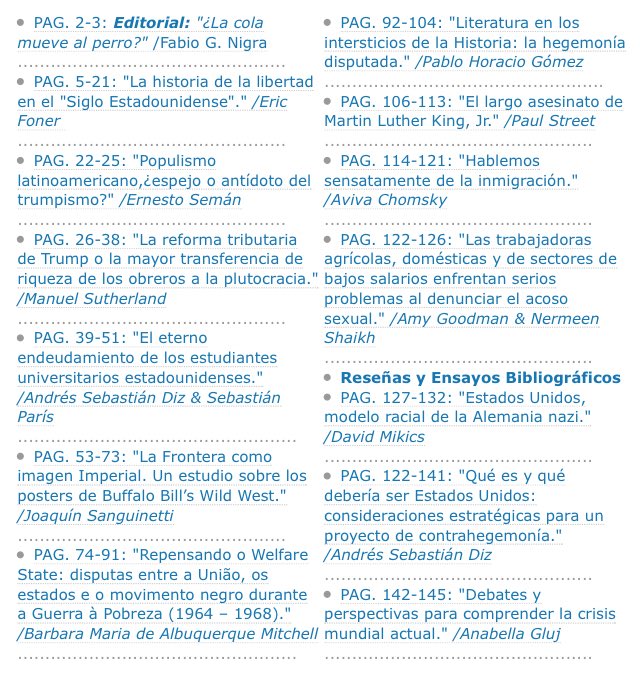
Acaba de ser publicado un nuevo número de la revista Huellas de Estados Unidos. Este excelente proyecto de los colegas de la Cátedra de Estados Unidos  (UBA) ya suma catorce números, todos dedicados a promover un análisis latinoamericano de la historia estadounidense. Este número incluye ensayos sobre temas muy variados: la Guerra contra la Pobreza de Lyndon B. Johnson y el movimiento negro, los afiches (posters) del famoso Wild West de Buffalo Bill  y el asesinato «moral, intelectual e ideológico» de Martin Luther King. Este número también contiene ensayos sobre temas de gran actualidad, como el endeudamiento de los  estudiantes universitarios y la recién aprobada reforma tributaria impulsada por Donald Trump. Además de una sección de reseñas y ensayos bibliográficos, este número también incluye una conferencia dictada por el gran historiador estadounidense Eric Foner titulada La historia de la libertad en el “Siglo Estadounidense” (Museo Histórico Nacional del Cabildo y de la Revolución de Mayo, Buenos Aires, Argentina. 28 de septiembre de 2017).  Vayan, nuevamente, nuestras felicitaciones y agradecimientos al equipo editorial de Huellas de Estados Unidos.

Norberto Barreto Velázquez

29 de abril de 2018

Huellas.jpg

Read Full Post »

Malcolm X y el pensamiento nacionalista caribeño

Francisco J. Concepción

El Post Antillano    22 de mayo de 2015

thrykjyjUsualmente, la visión que tenemos de nuestro Caribe es que solo recibimos, pero no damos nada a los imperios. Somos las víctimas del imperialismo europeo y luego del imperialismo estadounidense. Solemos ver nuestra historia como sujetos pasivos que solo hemos sido sometidos por las fuerzas externas. Esta visión de la historia solo nos ayuda a comprender una parte de nuestra realidad. No voy a declarar una gran resistencia, una gran lucha, un gran cimarronaje, tampoco voy a inventarme próceres que no hicieron lo que quisiéramos que hubieren hecho. Pero quiero hoy mirar un poco más profundamente cómo es que desde el Caribe hemos transformado, con nuestras ideas, el mundo que nos rodea.

Malcolm X, Malcolm Little, como se llamó al nacer, hubiera cumplido noventa años el pasado 19 de mayo si no hubiera sido asesinado en el 1965. Malcolm X fue asesinado el 21 de febrero de 1965, Albizu murió el 21 de abril de 1965, no olvidemos eso. Hoy, y ya hace unos veinte años, Malcolm es reconocido como una de los pensadores políticos negros de Estados Unidos más importantes y, tal vez, más originales. Todos conocemos las películas, los libros, las reseñas, sus debates con Martin Luther King, y los debates que su figura ha provocado. Uno de esos debates está relacionado con el uso de la violencia como forma de resistencia ante el racismo blanco.

Mientras que Martin Luther King se destacó como el negro de los blancos por su promoción de la no-violencia, Malcolm se convirtió en el promotor principal de la autodefensa de los negros ante la agresión blanca.

La voz de este líder miembro de la Nación del Islam, luego fundador de la Organización por la Unidad Afroamericana, se convirtió en el reto principal que tuvo que enfrentar el sistema de privilegio blanco, y de clase, en Estados Unidos. Esta voz tan reconocida está enmarcada en un contexto determinado que aún tiene que ser estudiado con detenimiento. La voz de Malcolm X está impregnada de la voz de su padre, quien fuera un predicador bautista y seguidor de Marcus Garvey, el organizador, pensador y dirigente político oriundo de Jamaica. Pero la voz de Malcolm también refleja la voz de su madre, Louise Little, oriunda de Granada, la isla del Caribe que fuera invadida por Estados Unidos bajo la administración de Ronald Reagan.

Desde esta perspectiva, no hay duda de que Malcolm refleja una voz plenamente caribeña, por el legado de Marcus Garvey, quien se destacara por una prédica radicalmente contraria a la integración racial y a favor del nacionalismo negro dentro de Estados Unidos. Ese nacionalismo que ha sido sofocado y escondido detrás del saneamiento que se hizo de la imagen de Malcolm X con la publicación de su autobiografía. Manning Marable, en su libro Malcolm X: A life of reinvention, demuestra que la autobiografía de Malcolm trata de esconder su radicalismo nacionalista detrás de su conversión al islam sunita que se anunció en el 1964. Este ocultamiento ha servido para dejar de un lado la dimensión caribeña del pensamiento de Malcolm, sobre todo, porque los autores blancos, que escriben desde el mismo privilegio que atacó Malcolm, han enfatizado su historia y discursos luego de 1964 y han tratado de obviar, tildándolo de locuras, su nacionalismo que estuvo atado a su experiencia en la Nación del Islam y al pensamiento de Marcus Garvey.

Ese pensamiento político está enmarcado en la historia fruto de la plantación. Esa plantación que tanto caracteriza al sur de Estados Unidos, pero también al Caribe. No olvidemos que Colin Woodard, en su libro American Nations, demuestra que la plantación sureña de Estados Unidos tiene su origen en Barbados, es decir, que esa plantación, como sistema, es de origen caribeño. Esa misma plantación que caracteriza la construcción de la mentalidad negra del Caribe. Esa plantación que marca profundamente las palabras del Coronel Riggs cuando anuncia que dará guerra contra todos los puertorriqueños, como muestra el libro de Nelson A Denis, War against all Puerto Ricans. Malcolm parte del análisis de la negritud que es fruto de la plantación, por eso es que podemos decir que su voz es parte de una reflexión caribeña que intenta colocar nuestra realidad, como hijos de la plantación, en medio de un mundo que está en proceso de globalizarse.

Malcolm X hace una aportación importante al pensamiento nacionalista, sobre todo al puertorriqueño, al reconocer que hay una dimensión internacional de dicho pensamiento. El ataque que hace Carlos Pabón, en su libro Polémicas, al nacionalismo puertorriqueño, donde afirma que adoptó un tercermundismo que le dirigió a un nacionalismo menos socialista y más insular, se debilita ante la evidencia del desarrollo internacionalista del nacionalismo negro en el pensamiento de Malcolm X. Si Malcolm comienza a hablar de la Conferencia de Bandung, de 1954, como el modelo del internacionalismo negro y de la unidad afroamericana, es porque dicho evento, tercermundista por excelencia, constituye un cambio radical en la construcción de las voces poscoloniales del mundo. En 1955 Malcolm adopta el tercermundismo poscolonial como el modelo para lo que luego sería su propuesta política en la década de los sesenta.

El Caribe, mundo de la plantación, pero también del cimarrón, es el referente fundamental del desarrollo del pensamiento de Malcolm X. Su reunión con Fidel Castro, a principios de los sesenta, es un ejemplo más de cómo el Caribe va configurando el pensamiento de Malcolm. Al final de su vida, cuando funda la Organización por la Unidad Afroamericana, anuncia que no se trata de una organización solo de Estados Unidos. Malcolm dice que se trata de una organización que quiere lograr la liberación del negro en todo el hemisferio occidental, desde el Caribe, América Latina y Estados Unidos. Esa organización es una alianza transnacional, al estilo de la Universal Negro Improvement Association (UNIA) de Marcus Garvey, fundada en Jamaica, luego llevada a Estados Unidos.

Malcolm X representa un nacionalismo internacionalista, poscolonial, de origen caribeño que aspira a establecer alianzas transnacionales que debiliten el sistema de privilegio blanco. Este nacionalismo transnacional que se refleja en el pensamiento de Malcolm no es muy distinto del nacionalismo de Pedro Albizu Campos, quien comienza su proyecto político viajando por América Latina y el Caribe. En este momento no podemos dejar de considerar que probablemente el pensamiento de Malcolm X y de Albizu era mucho más semejante, a pesar de sus diferencias originales, al final de sus vidas. Ambos, muertos en el 1965, asesinados por el mismo poder, representan una estirpe nacionalista poscolonial que se articuló como un reto al privilegio imperialista blanco. Ambos fueron voces que promovieron el uso de la violencia de los de “abajo” como un instrumento válido de defensa de los pueblos.

Malcolm X es un pensador caribeño, de eso no tengo dudas, y su aportación tiene que ser parte de nuestros debates hoy. El reto es mayor, una globalización que reestructura y restablece las cadenas de poder que el antiimperialismo de los sesenta pretendió combatir. La voz de Malcolm X se refleja en las aspiraciones a un mundo de justicia, pero de una justicia de verdad, justicia con equidad.

Crédito foto: Cheikh.Ra Films, http://www.flickr.com, bajo licencia de Creative Commons (https://creativecommons.org/licenses/by-sa/2.0/)

Read Full Post »

« Newer Posts