Feeds:
Entradas
Comentarios
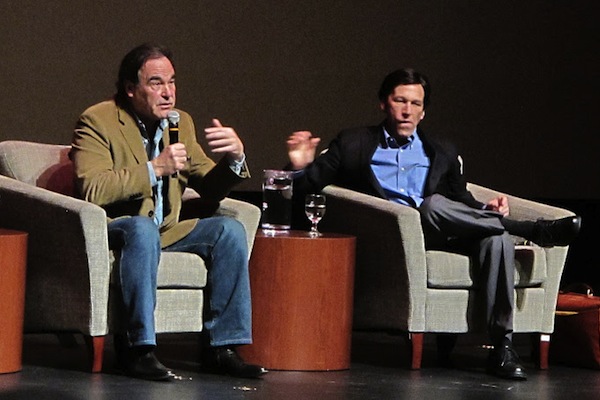
Stone and Kuznick at Illinois State University in January 2013.

Stone and Kuznick at Illinois State University in January 2013.

Oliver Stone and Peter Kuznick: The United States «is the Roman Empire» [INTERVIEW]

by Satoko Oka Norimatsu and Narusawa Muneo

History News Network, October 7, 2013

Cross-posted from Japan Focus

The Japanese weekly Shukan Kinyobi and The Asia-Pacific Journal: Japan Focus  jointly interviewed Oliver Stone and Peter Kuznick, co-authors of The Untold History of the United States, a 10-episode documentary series (broadcast on Showtime Network, 2012-13) and a companion book of the same name (Simon and Schuster, 2012), on August 11 in Tokyo. It was the eighth day of the duo’s twelve-day tour of Japan, right after they visited Hiroshima and Nagasaki to participate in the sixty-eighth memorial of the atomic bombing on August 6 and 9 respectively, and before they visited Okinawa, to witness the realities of the continuing U.S. military base occupation and resistance to it. Stone and Kuznick, relaxed with a few late-afternoon drinks between two large public events in Hibiya, Tokyo, talked about the importance of learning and teaching history, the “thread of civilization” as a people’s “weapon of truth,” to defend against the power of the American empire, whose image has been molded on the continuing distortion of history and glorification of past wars. This applies to Japan and its government’s denial of aggression in its past wars, too. The interview ranges widely over their five years of collaboration on the Untold History.

Oliver Stone, filmmaker and screenwriter, has won numerous Academy Awards for his work on such iconic films as Platoon, Wall Street, JFK, Born on the Fourth of July, Natural Born Killers, Salvador, and W. He and Peter Kuznick co-authored The Untold History of the United States, the 10-part documentary series broadcast on Showtime Network, and the book with the same title published by Simon & Schuster, 2012. Peter Kuznick is a professor of history and director of the Nuclear Studies Institute at American University.

Shukan Kinyobi and Japan Focus: At the commemoration of the fiftieth anniversary of the Vietnam War in 2012, Obama reflected on the war “with solemn reverence upon the valor of a generation that served with honor,” and initiated a thirteen-year program to “pay tribute to the men and women who answered the call of duty with courage and valor.” Why are the experiences of the Vietnam War being glorified now? Did the war not bring about disastrous outcomes, as you argue in your book?

Oliver Stone: There has certainly been a strong drift to the right both in the United States and now in Japan. The drift to the right started with Reagan, though some people would argue that it started with Nixon, and Johnson, after Kennedy was killed — you can argue that. The drift to the right accelerated under Reagan, and it was Reagan who was most aggressive in redefining the Vietnam War as, not a disgrace, but something to be proud of. He termed negativity toward the war as the “Vietnam syndrome,” which was quite strong, considering that only ten years before we had withdrawn from Vietnam and we were really lost. I think Reagan believed that he could revamp American society by giving it economic strength and historical purpose, as Abe is trying in Japan. You redefine the history, and you redefine the economy. Reagan starts it, and George H.W. Bush does it better. He is the one who suffered from the “wimp factor,” but after the Kuwait invasion in 1991 he announces that the “specter of Vietnam has been buried forever under the desert sands of the Arabian Peninsula,” and then this is backed by Clinton. So this is the tradition now. Obama recently made a statement on the sixtieth anniversary of the armistice of the Korean War that “the war was no tie. Korea was a victory.” He was praising the U.S. military extravagantly.

So, this is a different kind of syndrome in the United States. No matter what history says, the military is worshipped. If you look at Obama’s statement on the fiftieth anniversary of the Vietnam War, he does not really talk about the war when he says, “we reflect with solemn reverence, upon the valor of a generation that served with honor.” You can never question your soldiers’ valor. Many of the veterans who go to war want to feel that they served with honor, even if it was a losing cause or a bad cause. On the other hand, behind that is a revising of history where he is basically saying that the war in Vietnam was a noble cause. I think it was a lost cause; a bad cause. The battlefield of the future is the history. History, memory of history, and the correct memory of history is the slender thread of our civilization.

I know this in my heart, because if you think about it, in our own lives, previous lives, my life, your life, what do we have? Where are we right now? Every one of us has a history. We have loves, hates, affairs — we have gone through life and every single one of us has a say about history. Those people who remember history and have an awareness of themselves do better in life, generally speaking. They are able to evaluate themselves as they mature, they can change as I did, to evolve, if evolution comes from knowing who you are. So the very concept of denying your own past is lying at the greatest level. It goes to the heart of every individual and to the heart of a nation.

Peter Kuznick: The Vietnam syndrome is very important. The attack on the Vietnam syndrome began as soon as the war ended. Gerald Ford during his presidency said, “We have to stop looking to the past; we have to look to the future.” This was one week before the fall of Saigon on April 30, 1975, the end of the Vietnam War. The process began from that point, to forget Vietnam, to wipe it from history — the causes of Vietnam, and the consequences of Vietnam. In 1980, Commentary, a leading neocon magazine, edited by Norman Podhoretz, devoted an issue to the Vietnam syndrome. Conservatives understood at that point that unless they could change the perception of the American people about the Vietnam War, they could not intervene capriciously in other countries and expand what had become an American empire. So they made a deliberate effort to change the narrative about the Vietnam War, because Vietnam had become for most Americans by that point a nightmare. Some people saw it as a mistake, as an aberration, but many of us understood it as an extremely ugly example of an interventionist American policy that had been playing out around the world for decades. So the right wing made a systemic effort to cleanse history, because they knew that was essential to build the kind of empire that they wanted to attain, and, as Oliver says, Reagan pursued it most aggressively. But we saw it also with Carter. Carter starts his administration progressively, but by the end he had moved to the right and was talking about the nobility of the struggle in Vietnam. Reagan embraced it directly, as did Clinton who, in his student days, had actively opposed the war. If you look at what he says, it is the same as Ford, Reagan and everybody else: the nobility of the cause — the American troops were great, just because they fought and died, and you have to wave the flag for the American troops.

This was also essential for neocon proponents of “the new American century.” People behind George W. Bush again rewrote the history of Vietnam. Conservative obfuscation has been deliberate and systematic. Even in the naming. We refer to it in America as “the war in Vietnam.” We talk about “the Soviet invasion of Afghanistan,” but we do not talk about the “American ‘invasion’ of Vietnam.” But that was what it was — a bloody invasion that began slowly and built up over the years, in which the United States used every kind of lethal power, except for the atomic bomb. We had free-fire zones in which we were able to shoot and kill anything that moved. It was a war of atrocities. People say that the My Lai Massacre was an atrocity, but dismiss it as an aberration. But if you study the actual history, read Nick Turse’s recent book, or look at Oliver’s movies, you see that Vietnam was a series of atrocities on a smaller scale. That is why the Vietnamese are surprised by the American focus on My Lai. They know that My Lais, though on a smaller scale, were occurring throughout the country with shocking regularity.

The Vietnam Memorial in Washington, D.C. is powerful and moving. It has the names of all the 58,286 Americans who died in the war. The message is that the tragedy of Vietnam was the fact that 58,286 Americans died. That is indeed tragic. Robert McNamara (Secretary of Defense 1961-68) came into my class and said he accepted the fact that 3.8 million Vietnamese died. The memorial does not have the names of 3.8 million Vietnamese or the hundreds of thousands of Laotians, Cambodians and others. The Okinawa war memorial tells a different story. It has the names of all the Okinawans, Japanese, Americans, and all the others who died in the Battle of Okinawa, and that makes a real statement about the horrors of war. The Vietnam memorial does not.

If the 250-foot long Vietnam memorial wall contained all the names of the Vietnamese, Laotians, and Cambodians, do you know how long it would be? Over four miles! What a statement that would make.

But right now, there is a campaign to forget, and Obama participated in it when he welcomed the troops home from Iraq. Obama is the voice of the empire, and empire requires forgetting, cleansing, and wiping out the past about Vietnam, Iraq, Kuwait, Salvador, and even World War II. None of these stories have been told honestly and truthfully in the United States and that is why it is so important to fight over the correct interpretation of history; otherwise U.S. leaders are going to repeat the crimes and atrocities in much the same way that they got away with them in the past.

For over tem years since the dawn of the twenty-first century, the U.S. has engaged in the so-called “War on Terror.” It seems that the American evaluation of the war has been ambiguous, but how much of a sense of failure is there? Has nothing changed after all? What was this war about?

Kuznick: The “war on terror” is an absurdity from the start. It is a part of an Alice in Wonderland-like through-the-looking-glass experience in which you see the world turned upside down; you are in a world of absurdity. After September 11, 2001, the United States entered a world in which enemies were magnified into these terrifying powerful forces.

9/11 was a colossal fuck-up by the Bush administration. Minneapolis FBI agent Coleen Rowley was trying to warn the Bush administration that there were people learning to fly airplanes who had no interest in learning how to land. There were repeated warnings that Osama bin Laden and Al Qaeda were planning attacks on the United States. Intelligence officials knew that an attack was imminent and they tried desperately to alert Bush to this. George Tenet, the head of the CIA, was running around Washington with his hair on fire, trying to get somebody to listen — Condoleezza Rice, Donald Rumsfeld, George Bush, Dick Cheney — and they all told him to get lost. They had more pressing matters to deal with. So first of all, 9/11 was a complete failure by the Bush administration, partly of intelligence, but mostly of leadership, and then instead of viewing it as what it was — a well-planned and well-executed operation, a crime against the American people committed by a vile group that needed to be brought to justice — they made it into a global War on Terror and pursued a neocon agenda that did more to harm the United States than Al Qaeda could have done in a thousand years.

Zbigniew Brzezinski, whom we are very critical of when he was Carter’s anti-Soviet National Security Director, nailed this right from the beginning. He said you cannot fight a war against a tactic. What is the real enemy? Bush said that they hated us for our freedom. What an absurd, lying statement that was! “They hate us for our freedom”! U.S. leaders knew that they had real issues. We do not agree with the Islamic extremists or countenance their tactics, but there were issues with the U.S. policy in Israel, the suppression of the Palestinians, and the presence of U.S. troops in Saudi Arabia, their holy land. Those were the real issues. There is no justification for what they did. It was one of the series of terrorist attacks — the U.S.S. Cole, the Riyadh bombing, the bombings in Africa — this had been going on for some time. But Bush and Cheney decided to use this to their advantage, and the Project for the New American Century said in its 2000 report that it was going to take a long time for U.S. to remilitarize and increase defense spending in the way they want unless there was “a new Pearl Harbor.” The United States got a new Pearl Harbor, and then they cynically exploited this by playing on Americans’ fear that they lived in such a hostile and dangerous world surrounded by enemies with frightening capabilities. This mindset has continued and Obama bought in to this. Bush, Cheney, and Obama have pushed this to the point where we have the kind of surveillance state that was exposed by Edward Snowden.

Although war should benefit no one, the US government does not appear to change its war policy or fundamentally reduce the defense spending which is as much as 40 percent of the federal budget. Is war an inevitable agenda for U.S.? Does war continue because of the war profiteers within the U.S. administration?

Stone: I think it is a very good question. I remember as a history student as a boy, you know you always hear about the War of 1812, the Revolutionary War, then you hear about the war against the Creek Indians if you want to consider that a war, but it is ongoing war — battles going on with the Indians all the time. The Civil War, the Mexican War, and then a period of Reconstruction with no foreign wars, until the Spanish-American war of 1898. That was a long stretch. So the United States had a relatively austere record of war, although it was certainly aggressive. We invaded Canada in 1812 and we were repulsed by the British again. So by the time we come to World War I, we were really novices of war. I think the Civil War was extremely bloody, but World War I was like a new century, and America becomes different. A lot of American people recoiled in the aftermath of World War I, and I think that was part of the reason why we stayed out of World War II for so long. It was the strong feeling that we had been suckered by the British and French empires into World War I. Not to mention the role played by the Morgan Bank. People were really pissed off in the 1930s and understandably so. We do not overlook, but American history overlooks the Nye Committee, hearings led by North Dakota Senator Gerald Nye into war profiteering in World War I. I found that fascinating. I have read some of those hearings and felt really angry, because although everything Nye and other critics said was true, we drew the wrong conclusions, and by the time it really mattered in Spain for us to stand up to fascism, we did not. It is ironic how history works.

(To Peter) Do you want to continue on? (Kuznick: Absolutely. We have been so focused during this trip on Hiroshima and Nagasaki and U.S.-Japan-related issues that we haven’t had a chance to talk about these things.) Let’s talk about war now. Be creative. Let’s just talk about what war is.

Kuznick: Smedley Butler, highly decorated Marine Corps Major General said, “War is a racket.” [8] He said that he was “a high-class muscle man for Big Business, for Wall Street, and for the bankers. … a gangster for capitalism.” He starts in the Philippines and then he goes through all the countries he led interventions into. He said he was a front man for Brown Brothers Harriman. The military was the arm of the bankers and the industrialists, because if we trace the history of the American empire since the 1890s, we see that it was the 1893 depression in the United States that was in some ways the beginning. After 1893, American leaders had two possible ways to go: one was to spread the wealth so that there would be enough consumers who could purchase American goods and spark the recovery from depression; and the other was to expand overseas in search of resources, cheap labor, and new markets. What did the United States do? It expanded overseas.

Stone: I am curious about that. When Henry Wallace becomes Secretary of Agriculture in the depression, he adopts a policy of recovery through scarcity. What does he do? He killed lots of pigs and cut the cotton crop.

Kuznick: That was a temporary action. He hated it. Recovery through scarcity went against the grain of Americans’ core beliefs. A similar approach was evident in the Natural Industrial Recovery Act. What they were trying to do was to reduce the surplus on the market in order to raise prices. They slaughtered those pigs, but distributed them to the American people so Wallace at least was feeding the hungry on an unprecedented scale….

Stone: So, the United States paid farmers not to grow. It’s crazy. (Kuznick: It’s crazy, and Wallace said so at the time.) There is one thing I want to say, and this is a very important point. Wallace understood one big thing in the world — food. If people grow food for the world, there will be peace. And I think that is so true, and that is so basic because, when you look at world history, the scarcity of food has driven so many wars. I cannot believe what I heard in Japan in these last weeks; people talking about starvation during war. Wallace understood it is absolutely necessary to produce enough to feed everyone so that people do not go to war over scarce food and resources. (Kuznick: For decades, Wallace’s hybrid corn fed the world.) One of the moving moments in history that Peter brought to my attention was that in 1940, Franklin Roosevelt wrote a letter to the Democratic Party that said, “The Democratic Party cannot face in two directions at once … you are either for Wall Street (money and profit), or you’re for people.” Roosevelt made it clear that Henry Wallace was his candidate and he would not run for his third term unless Wallace was nominated. It was a powerful letter, which the Democratic Party should read every four years and wake up, because they lost that vision.

Kuznick: I gave that letter to Ralph Nader and he quoted it in his book. In retrospect, that may have been a mistake. As Oliver said, the Democratic Party has lost its bearings today and tramples the legacy of Roosevelt and Wallace, and post-Cuban Missile Crisis John Kennedy. It now stands for surveillance; it stands for the tripling of the troops in Afghanistan; it stands for kowtowing to bankers. We would like to think the Democrats are progressive, but under the Clintons and Obama, they have devolved into more efficient managers of the American empire. They do not challenge the empire. Republicans are crude. Republicans try to impose the empire by force. Obama is smarter. He knows he can also impose the empire by deception (Stone: soft words). So he has figured out the way to institutionalize Bush policies and make them a permanent feature of American life. That is why Bush’s press spokesman, Ari Fleischer, recently said we are living through Bush’s fourth term. This is not true in certain aspects of domestic policy, but it is sadly close to the mark on foreign policy. And in certain ways, Obama is actually worse than Bush.

Stone: I believe in evolution. I understand why a country makes mistakes. I pray for my country every morning in meditation. I take at least half an hour in meditation. I pray for my country, and the world…. I wish… I wish people could… learn… to be sweet. Gentle.

The American empire does not seem to have lasting power, mostly because of its financial difficulty. But if you look at the recent subservience of the European Union in dealing with Edward Snowden’s case, the U.S .still seems to have great power and control. Where do you think the empire is going?

Stone: This is the reason why I am sticking around because it is a good story. There is tension. Okay? We do not know the outcome. No one in this room knows and even Obama does not know. That is the game. The game is, every day we engage all our political sensitivities and send our diplomats abroad and all the military. How do we stay who we are? That is what they think about. Or how do we think about the future? How do they plan for this? Do you realize that we wake up every day into this giant, gigantic worldwide Godzilla beast? How do we live with the monster? Every day we have millions of men going to work in the military, the national security complex everywhere in the world. We are a massive mobile empire, bigger than anything that anyone has dreamed of. That’s one side of the story. And then the other side of the story is the misperception that if we do not grow today, if we do not eat more, what is going to happen to us? The empire’s appetites are insatiable. That insecurity has to be responded to. It is like a dragon saying, “What am I going to eat today?” Do you understand how bad this can get? So for the dragon to say, “I don’t need to eat as many eggs and lions and trees today. I can maybe survive on less.” That is the tension of our times. That is why all those people like hibakusha and the peace activists, are bringing moral force into the universe — Buddhists, Catholics, all over the world. There is this huge energy that is emerging out there. Believe me, I feel it. There is an enormous struggle as Peter says, between the dragon with arms and we have only the truth as our weapon, and I find that to be the key issue of our days, and I am curious. So that is why I am sticking around, because, otherwise, I think I will die. If the bad guys win, I do not want to be around anymore.

Kuznick: The danger comes from having an empire with unlimited military strength but very limited moral vision and increasingly limited economic control; that creates the most dangerous situation of all. Dying empires can bring everything down with them. Countries can too. If Israel feels existentially threatened, it will almost certainly use its nuclear weapons. The United Sates has lost its moral authority and its philosophical vision, (Stone: to some people, not all) and the younger generation is losing its hope for a better future.

Stone: It is all those kids who cheered for Osama bin Laden’s death. The majority of Americans thought it was going in the right direction. By the way, there was a poll that said 51 percent of 18-29 year olds think the Vietnam War was a good thing.

Kuznick: However, if you look at the polls about nuclear abolition, the 18-29 year olds are in favor of it. (Stone: That is easy. Vietnam is not.) So what I am saying is that they are confused. They do not have a clear understanding of history. What I’m talking about is the position the United States is in, being armed to the teeth, being able to destroy the world but losing power, influence, and moral authority. We lost it at 9/11, our response to 9/11 with Abu Ghraib, with Guantanamo, the torture, the Patriot Act, massive surveillance, George Bush’s war policies…We see what we are ready to do now in the Asia Pivot. We are willing to militarize the Pacific in order to contain China. But the United States is getting relatively weaker as China and other countries are growing at a much faster rate. China spends three times as much of its GDP on infrastructure as the U.S. does. (Stone: That is about economics, only.) Yes, but militarily also. (Stone: But their military budget is still only ten percent of ours.) Well, we’re weaker economically. In 2011 per capita Chinese GDP was only 9 percent of that in the U.S., but that was double what it had been only four years earlier. So much of our economy is based on finance now; so much of it is based on speculation. The United States does not produce as we used to. (Stone: We produce movies.) We produce two things: movies and academia. (Stone: armaments.) I am saying we are losing power at this crucial junction when China is rising, India is rising, and maybe Japan is finding its footing again.

Stone: This is the same argument as when Britain was losing power because Germany was gaining in 1914, but do not underestimate Britain. We are the Roman Empire. I am interested in the Roman Empire because it didn’t succumb. Christianity was imposed by Constantine, and, all of a sudden, the empire extended itself for four, five hundred years. It had destroyed Jesus in 33 A.D. or thereabouts, Jerusalem in 70 A.D. It took Rome 230 years to embrace Christianity. Think about it, we may very well turn out like Rome did; to embrace some form of this new religion and we might find our way.

Kuznick: Exactly, we still have hope; many Americans hate the direction in which the country is heading and want to see a different future. And Obama represented that in the minds of American people and especially in the minds of young people during his first campaign. That is partly why I am so mad at him, because he took the dreams of those in the younger generation who believed in something — and he destroyed them.

Stone: Empire. Remember, no empire lasts. Peter says this empire in the U.S. can deny history and overcome history, and we pointed to Star Wars in our series — how cruel this can become, from space to destroy whatever is against you. We will become a tyranny. The question is can the tyranny last? (Kuznick: and I am saying no — not as a tyranny.) Germany lasted… in 1941, no one could stop Germany, what a great moment for Hitler and then, by 1943, he was starting to run. So no empire lasts. That is all I can tell you, but the Roman Empire has defied logic by lasting the longest because you can still be in Roman Empire in 800 A.D. and still have some semblance of civilization in Greece and places like that.

Kuznick: But our goal is to divert the United States, to change direction before it becomes an absolute tyranny. The United States does terrible things, but there are also other things going on there. We still have the freedom to make the kind of documentaries we made and write the books that we write. Don’t minimize the importance of that. People are not entirely repressed in the United States, though they are monitoring us, and they are physically capable of repressing us. There are a lot of people, even people in power and people in the military, who defy the idea that the United States should become a tyranny, a total national security state, the worst kind of dictatorship. We do not know which way the United States might go. My fear is that the United States, rather than going down, will bring down the rest of the world with it, but that is what we are trying to prevent. We are at a unique historical juncture. Our goal is to make sure that we have a future so that future generations can get it right, but the possibility is that we blow the whole thing up before that happens. Our mission is getting through this period of darkness to a point where there is a future. Oliver says that he is not expecting to see this in his lifetime, and, realistically, he might be right, but our goal is to make sure that there is a future.

Stone: I think that many people through history felt the same way. Everybody says it is a crisis now. I think in 800 A.D., if you lived on the borders of Greece or Turkey, you would feel the same way. Everyone creates their own crisis in their times so this is an old story; it’s a his-story. (Kuznick: But it’s a new story in one way. The United States has enough nuclear weapons to end life on the planet. In 800 AD, they could not end life on the planet. They could perhaps systematically go around and kill everybody, but that is not the same thing as a nuclear war.) That is cruel. When somebody comes to kill you, that is cruel.

Talking about cruelty, we saw the cruelty of the Japanese army in Nagasaki — exhibits of the Nanjing Massacre, military sex slavery, and Unit 731 at the Oka Masaharu Museum. The U.S. too, even after its use of the atomic bomb, used cruel weapons such as Agent Orange, depleted uranium weapons, cluster bombs, and drones. The nature of war is cruel, but in the case of the U.S., it seems rampant. Is there any historical significance in this cruelty of the United States?

Stone: I do not believe that the United States was as cruel as Germany and Japan were. I mean I was in Vietnam; I saw Agent Orange dropped on us many times. I still do not know. Maybe I am going to be a victim of it. I do not think about it that much, but I know people have claimed they had been. We saw the results with the Vietnamese. Agent Orange was the cruelest we became. Although we developed mustard gas in World War I, we never used it. The atomic bomb and Agent Orange were the worst. When Obama talks about Syria and he says that the red line for Syria is chemical weapons, what a fucking hypocrite! Why doesn’t he look at our own history? He probably would not even admit that we used chemical weapons in Vietnam. And we made a big deal about Saddam Hussein’s having used chemical weapons when we were trying to justify invading Iraq. (Kuznick: But when Saddam used them against the Iranians, we initially ran interference for him at the UN, preempting a resolution explicitly condemning the Iraqi use. He was our ally. And after he used them against Iraq’s own Kurdish people at Halabjah in 1988, the U.S. increased aid to his vile regime.) So who makes money off this? Dow Chemical profited immensely in Vietnam, but the students drove their recruiters off campus. But cruelty, no; cruelty is not human nature. There are always cruel soldiers in every country in the world, people who are racist, people who are stupid. But as a policy, the United States… take waterboarding. We do it, but we always back away from it, whereas you have to admit that the Germans and the Japanese wholeheartedly embraced cruelty for many years. If they had been winners in World War Ⅱ, we would be experiencing Unit 731 in Manchuria. (To Peter) Would you disagree with that?

Kuznick: We do not know. It is one of those unknowables, because there are other sides to Japan also. Japanese cruelty was extraordinary, and astounding, but we know that Americans were also very cruel to the Japanese. They executed the prisoners of war and knocked out their gold teeth with bayonets. We boiled their skulls in World War Ⅱ, and American soldiers sent them to their sweethearts. We cut off their ears. And we added some atrocities of our own — like firebombing over one hundred Japanese cities and the atomic bombings, for which there was absolutely no justification — morally or militarily — despite almost seven decades of official distortion and obfuscation. Warfare itself turns people and nations into beasts, not everybody, but enough people, especially when leadership encourages it. Then you see the massacre in My Lai. These soldiers were not monsters, these were the Boy Scouts, and these were the kids who made out on Friday night behind the parking lot (Stone: A lot of them were in Platoon). They did not start off as monsters. (Stone: They used to have a cliché in the U.S., “Give a kid a gun and you will see. He will become a killer.”) But America… as D. H. Lawrence said, “American soul is hard, isolate, stoic, and a killer/”

Martin Luther King, in his speech “I have a dream,” called for of a world without racism. How about a world without war? What kind of leadership is required to achieve that?

Kuznick: Martin Luther King’s dream was not just about racism. He was one of the earliest advocates of nuclear abolition in the United States. Martin Luther King and Coretta Scott King were deeply committed to nuclear abolition. They were profoundly opposed to war. King hated the Vietnam War. He waited to come out and denounced it, but he did very early, compared to the popular understanding. And the other leaders of the civil rights movement tried to stifle him. They tried to quiet him by saying, “You’ll undermine the civil rights movement if you talk about the Vietnam War.” But he said, “I have to do it.” So, it’s not unconnected. Martin Luther King knew that cruelty in one area is connected to the cruelty in another area and you have to have a holistic vision of the ways in which people are repressed. That is what we are trying to do — you cannot compartmentalize historically what happened in the 1890s or early 1900s and what is happening today.

We search for the patterns from the beginning, and that was the key to our Untold History project. That is why we try to cover such a broad period of time, because these patterns show that these were not aberrations. The patterns show that these are really intrinsically deeply grounded in the American psyche, American economy, American military, American culture, and American society. But we also wanted to show another side, because, like Japan, American history is a struggle for the American soul. In 1941, Henry Luce said that the twentieth century must be the American century, and a few months later, Vice President Henry Wallace replied that the twentieth century must instead be the “century of the common man.” Here are two fundamentally conflicting visions of what the United States should be, and this is what we are trying to show. King understood that, and King stood with Henry Wallace, John Kennedy, Franklin Roosevelt, Eleanor Roosevelt, Eugene Debs, Charlotte Perkins Gilman, Paul Robeson, Howard Zinn, and, at times, William Jennings Bryan — the progressive forces in American history.

Stone: The question I raise is about every leader that emerges. A leader has to last, and has to deal with power, and that was why Kennedy was special. Roosevelt was special. Roosevelt had polio. Kennedy was wounded in World War II, and also had Addison’s disease. I believe it is the comeback that makes the leaders. Nelson Mandela in prison, and Aung San Su Ki in Burma — comebacks.

Japan faces debate over historical issues such as the Nanjing Massacre and military sex slavery, and when we try to deal with these issues honestly we are called anti-Japanese. Do you get such reaction too as being called anti-American or unpatriotic? How do you deal with such criticism?

Stone: I think the strongest credential I can put forward would be, number one, my service in the military in Vietnam, which is hard for them to get around. John McCain can bluster all he wants, but at the end of the day, he was a bomber; he bombed people from the air and he knows that. I do not understand the man’s mentality, how, after being in the prison camp like he was, he can still have such anger and hatred in his heart for the perceived enemies of the United States, possibly soon including China. McCain is what I would call an unreconstructed, un-evolved soldier; many of them exist. I, on the other hand, feel good about my mission … because I served honorably. To be honest, I mean it was not an honorable war, but I served honorably within the confines of my own understanding of the war. And at the end of the day, I became a warrior for peace, which is what I am now, not a warrior for more wars, so I feel strong about that.

And number two, I think what is very important for me is that I did not speak out until I had made roughly eighteen feature films. I spoke as a dramatist, which is my profession. I am not a historian, and I do not pretend to be. I do not have the grounding in it, but I do care about history and I can dramatize it well. Now as I speak out as a documentarian with a background of having made movies, I get criticized very often for nonsense reasons, rubbish reasons. The way they threw it at me was that I made up history, and it took me a while to understand it. Many dramatists have used history before me and I do not apologize for doing historical drama. I never once claimed that I was doing a documentary, and I was not doing a documentary, never, and they put words in my mouth. Anyway, that is why I feel that I can talk strongly without feeling shame.

At the end of your book, you entrust hope to people. Americans are responsible for dealing with what is called “American exceptionalism,” but the responsibility also lies with people in Japan and the rest of the world. What can people of Japan and the world do in solidarity with American citizens in order to achieve the “century of the common people”, as Wallace said, and to confront and conquer the greed for power and control?

Kuznick: It needs to be an international effort along the lines you suggest. We are getting very positive responses around the world to what we are doing, in the United Kingdom, Japan, Australia, New Zealand, Turkey, Russia, Bulgaria, Israel … most countries understand the problems in the way we are laying them out because we are talking directly to Americans, but we are also talking to the peoples of the world. The corrosive nature of empire does not just affect the people in the United States, but people everywhere. We see hope in responses that we are getting everywhere, particularly among young people. We are trying to give them a different understanding of history, because we believe that history is the tool. While our enemies’ weapons are military weapons, our weapon is history, understanding, knowledge, and truth.

So the question is, what is the strength of honesty and truth versus the strength of cannons, bombers, submarines, and surveillance technology? That is the battle we are in. We have seen truth win out in certain situations, prevail over military force and that is what we are trying to do and that is a global effort. We think that people in Japan should repudiate AMPO along with the U.S. bases, take leadership in the fight for the abolition of nuclear weapons and start telling the truth about their own history. We want you to do that in solidarity with the people in the United States. We know that Japan tends to be a conformist society, rather than one in which people make waves, but after Fukushima, we saw the Japanese starting to organize and protest. That happened in the 1960s with AMPO and Vietnam, and it hadn’t happened in a long time on such a large scale. So we look to the Japanese, including the brave people in Okinawa, and we look to the people around the globe to join us in this effort. We think that the Untold History is a vehicle that everybody can rally around to, and it is not just about our untold history but it is for journalists like you, along with historians, to tell the untold history of Japan or the untold history of other countries, because we are all in the same boat where governments lie about the past. They lie because they know they can get away with it. But we are saying they cannot get away with it.

Satoko Oka Norimatsu is Director of Peace Philosophy Centre. She is a Japan Focus coordinator. Narusawa Muneo is an editor of Shukan Kinyobi, a weekly magazine established in 1993.

An abbreviated version of this interview in Japanese appeared in the September 6, 2013 edition of Shukan Kinyobi.
– See more at: http://hnn.us/article/153509#sthash.R91YLqEI.dpuf

CommunityNewsletter_0

Even Richard Hofstadter Would Be Amazed by Tea Party Extremism

by Robert Brent Toplin

History News Network – October 7, 2013

Back in the 1950s and 1960s, when new forms of right-wing extremism began to make an impact in American life, historian Richard Hofstadter published essays that drew attention to the “symbolic aspect of politics.” Hofstadter acted in the fashion of an amateur psychologist, attempting to make sense of “non-rational” factors. His judgments about the mentality of leaders and followers on the right, based on emerging social science research of the time, were highly speculative. Nevertheless, some of his observations still excite interest. Historians and pundits often refer to Hofstadter’s ideas about the “paranoid style.” Much-overlooked, however, is a sub-theme in Hofstadter’s writing. That discussion focused on the emergence of “fundamentalism” in American politics. Individuals who seek a broader understanding of the present political standoff in Washington may find Hofstadter’s judgments thought-provoking.

Richard Hofstadter recognized that evangelical leaders were playing a significant role in right-wing movements of his time, but he noticed that a “fundamentalist” style of mind was not confined to matters of religious doctrine. It affected opinions about secular affairs, especially political battles. Hofstadter associated that mentality with a “Manichean and apocalyptic” mode of thought. He noticed that right-wing spokesmen applied the methods and messages of evangelical revivalists to U.S. politics. Agitated partisans on the right talked about epic clashes between good and evil, and they recommended extraordinary measures to resist liberalism. The American way of life was at stake, they argued. Compromise was unsatisfactory; the situation required militancy. Nothing but complete victory would do.

A related outlook has appeared in recent fights over the budget and the debt ceiling. These days, many Republicans claim the stakes in current political confrontations are huge. They say Obamacare will ruin the country. It represents another incursion of Big Government. Washington is the principal source of our economic problem; it needs major downsizing. Barack Obama, champion of Big Government, is a terrible president. We must oppose him vigorously to save the free and prosperous society we all cherish.

As many journalists have pointed out, these hyperbolic claims do not pass the reality test. They represent gross exaggerations. Furthermore, Obama and the Democrats are not going to undermine the president’s signature achievement, the Affordable Care Act. Additionally, journalists warn that Republican threats to take the nation to the brink may cause another gigantic financial crisis.

These critics understand that the current fight in Congress is not 100 percent about ideology. Many GOP representatives and senators fear that they will lose their seats in a primary election if they do not satisfy diehard conservatives, especially Tea Party enthusiasts at the grass roots. Journalists also recognize that some moderate Republicans are willing to support a clean Continuing Resolution. They would agree to end the government shutdown if Speaker John Boehner would allow the entire House to vote.

Republicans have split on questions about strategy, but they have not divided significantly on matters of ideology. Most of them remain solidly opposed to the Affordable Care Act. They have defended that stand as a highly principled position. Representative Steven King, Republican from Iowa, asserted that Republicans were on the correct track “because we’re right, simply because were right.” Congressman, John Culberson, Republican of Texas, said he was holding firm in demanding major adjustments to Obamacare because he had been elected to defend “core principles.”

Culberson could just as well have said he was defending core beliefs, for that is an essential element in radically conservative politics today. With religious-like intensity, many in the GOP express their political faith. On economic questions, they view government as far too large, costly and encroaching in the lives of Americans. Important questions about the potential of government to advance the society’s goals receive scant attention in conservative rhetoric and in right-oriented media. Often conservatives couch negative judgments about government with fundamentalist-style certitude.

Obviously, political fundamentalism is not the exclusive outlook of partisans on the right. All political groups have the potential to act like True Believers. Liberals, too, often close their thoughts to contrary opinions. In the years since Richard Hofstadter’s death in 1970, however, many observers of American politics have noted that resemblances to fundamentalist religion appear especially in the thinking and behavior of militant conservatives.

In What’s the Matter With Kansas? (2004) Thomas Frank observed that, “Conservatives often speak of a conversion experience, a quasi-religious revelation.” Frank noticed that right-wing militants often try to “excommunicate” individuals in their movement who seem guilty of “this or that bit of heresy or thought-error.” Michael Lind, who worked inside the conservative movement before abandoning it, pointed out in 1996 that “American conservatives have adopted free-market fundamentalism, in its crudest forms, as their political religion.” In a similar way in 2004 Robert Reich detected a fundamentalist mentality in arguments about the economy. Conservatives believe “the free market has the same intoxicating quality that religion has to born-again Christians,” observed Reich. “Facts aren’t especially relevant. The perfection of the market has to be accepted as a matter of faith.”

These judgments do not imply criticism of pious Americans. “Faith” is a respected personal choice in matters of religion. But when a fundamentalist perspective applies to politics, compromise becomes extremely difficult. Political notions take on the character of orthodoxy — of accepted and unquestioned truths. Supporters of the faith often fail to exhibit the kind of critical and open-minded mentality that that is essential for the working of a vibrant and effective democracy.

The scholarship on fundamentalist religious thought has produced findings that seem relevant to present-day U.S. politics (and relevant to observations Richard Hofstadter made years ago). In major studies that examine diverse groups, including Christians, Jews and Muslims, Martin E. Marty, R. Scott Appleby, Gabriel Almond, and Karen Armstrong have discovered patterns that cut across groups. Fundamentalists often project a dualistic, Manichaean viewpoint. Judging disagreements in apocalyptic terms, fundamentalists characterize societal issues as vital struggles between the forces of light and darkness. Champions of a fundamentalist perspective call for uncompromising commitment to the faith.

These writers examined religious views, not political ones, yet a reading of important recent scholarship on conservatism suggests connections. In It’s Even Worse Than It Looks, Thomas E. Mann and Norman J. Ornstein largely blame Republicans for dysfunction in Washington. The GOP has become “ideologically extreme,” they conclude, disregarding “conventional understanding of facts, evidence, and science…» In Rule and Ruin: The Downfall of Moderation and the Destruction of the Republican Party, From Eisenhower to the Tea Party, Geoffrey Kabaservice shows how champions of extreme conservatism squeezed out defenders of a more responsible and balanced kind. His book traces a rich American tradition of moderate conservatism. Unfortunately, the current GOP has lost sight of that tradition. “Political movements based on dogmatic, unthinking certitude may be fatal to treasured American values,” argues Kabaservice.

George M. Marsden, a prominent historian of fundamentalist religious movements in the United States, offered an “offhand” definition of a fundamentalist as “an evangelical who is angry about something.” A related political outlook in U.S. politics appeared in a poll by the Pew Research Center released in late September, 2013. The 41 percent of Republicans who said they were “angry” at the government was a far higher percentage than anger expressed by any other political or ideological group tested. A news story about the poll in the Washington Post concluded that the Republican base is “mad as hell at the federal government and by extension Barack Obama.” The article reported that angry citizens are eager to march, give money, and vote.

Here, then, is the significant marriage between practical politics and a fundamentalist-style political religion. Republican intransigence in clashes over Obamacare, budgets, and debt ceilings may reflect smart politics from the radical Right’s point of view. Militant conservatives in Washington can succeed in channeling the base’s anger while also boosting their political careers. They treat political fights in Washington like holy crusades and are generously rewarded for their militancy in conservative voting districts.

Ultras of the right may eventually fold in their battle against Obama and the Affordable Care Act, but their fundamentalist approach to politics is likely to remain an important characteristic of national politics. It will remain difficult to achieve progress when one party is especially influenced by leaders and supporters who treat compromise as an abandonment of core principles and who judge issues in the manner of a political faith. The nation’s leaders may find ways to squirm out the current crisis, but they will face continued challenges as long as a religion-like approach to conservatism remains prominent in Washington.

If Richard Hofstadter were alive today, he would probably be amazed to see that the fundamentalist style exhibited by a relatively small minority in the 1950s and 1960s has become a major force in the nation’s politics

Robert Brent Toplin, University of North Carolina, Wilmington (Emeritus), has published several books about history, politics, and film, including Radical Conservatism: The Right’s Political Religion.

– See more at: http://hnn.us/article/153514#sthash.mv5wTp7w.dpuf

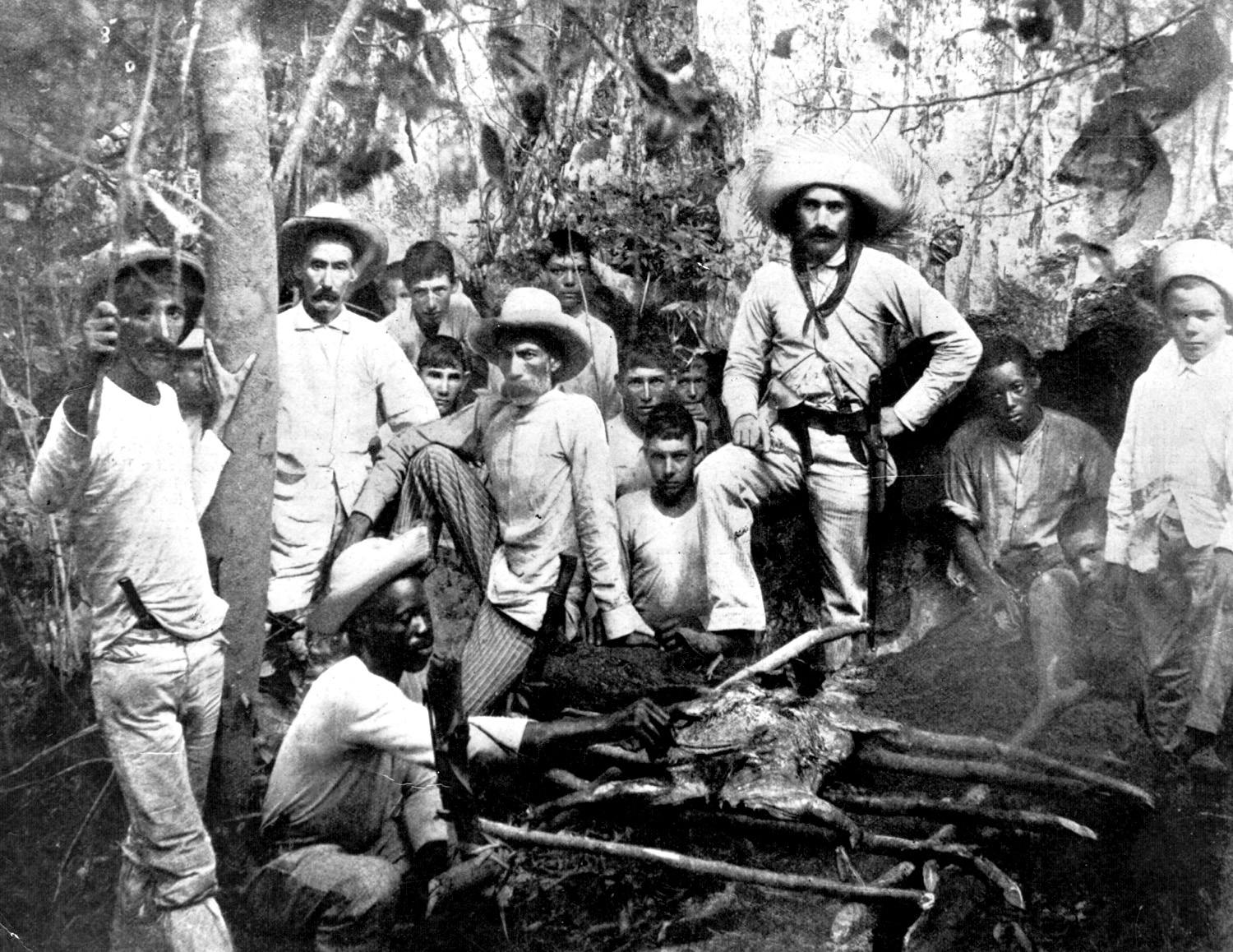
Cuban Rebels

Cuban rebel soldiers cook a pig for dinner on January 1, 1896. Photograph by Hulton Archive/Getty.

A Useful Corner of the World: Guantánamo

PAUL KRAMER

The New Yorker

July 31, 2013

It was 1935, and the Guantánamo naval base had to go. So declared an American commission stocked with foreign-policy experts: the United States was pursuing less antagonistic relations with its southern neighbors, and an American base on Cuban soil, anchored by a lease without an end date, looked increasingly like an “anomaly.” Weren’t there enough defensible harbors on the United States’ own Gulf Coast, or on Puerto Rico? The commission wrote that the U.S. government should “seriously consider whether the retention of Guantánamo will not cost more in political misunderstanding than it is worth in military strategy.”

Where was the base? This was a trickier question than might first appear. It straddled both sides of lower Guantánamo Bay, roughly five hundred miles east and south of Havana, about as far from the capital as one could travel and remain in Cuba. The bay opened onto the Windward Passage, one of the hemisphere’s most trafficked sea-lanes, linking the Eastern Seaboard to the Gulf of Mexico, Central and South America, and, through the Panama Canal, the Pacific Ocean. In 1899, an American military planner, stressing the need for naval bases and coaling stations in Cuba, had called the island “an outer bar of the Mississippi.”

The terrain that rose above the bay—dry, sun-blasted hills, where cactus and scrub clung to outcroppings of barren rock—was hostile enough that Cuba’s Spanish rulers had taken their time colonizing the region. For centuries, Guantánamo had effectively been no state’s domain, a haven for pirates and slaves escaping both Cuba and Haiti, only a hundred miles across the Windward Passage at its nearest point. For them, Guantánamo had meant something like freedom.

The more perplexing question was where the base stood legally. By the late nineteenth century, U.S. commercial and military interests in Cuba and the wider Caribbean had deepened. When a Cuban uprising against Spanish control threatened to secure the island’s independence, American policymakers pursued military intervention, capitalizing on popular outrage at the mysterious explosion of the U.S.S. Maine, in Havana harbor, in February of 1898. In a nine-day battle for Guantánamo Bay, American soldiers, under Commander Bowman H. McCalla, and Cuban insurgents defeated the Spanish garrison. In June, the Cuban diplomat Manuel Sanguily wrote to a friend, “Now that they have seen Guantánamo, they will never renounce their control over it.”

He was not far off. The United States took possession of Guantánamo Bay through what might be called gunboat tenancy. While Cuba’s constitutional convention gathered in late 1900 and early 1901, Secretary of War Elihu Root listed provisions that “the people of Cuba should desire” for their constitution; these included granting the United States the right to intervene freely in Cuban affairs and access to land for naval bases. These demands went into the Platt Amendment, passed by the U.S. Senate on March 1, 1901, and submitted to the convention for adoption; the United States would withdraw its forces from the island only after the delegates incorporated it into their constitution. Cubans opposed the Platt Amendment in speech, pamphlet, and mass protest; Juan Gualberto Gómez, a delegate and a former general, charged that it would transform Cubans into a “vassal people.” Nevertheless, under pressure a divided convention adopted it.

The U.S. Navy moved quickly. Two 1903 agreements gave the United States control of forty-five square miles of land and water—a space about two-thirds the size of Washington, D.C.—for coaling and naval stations “and for no other purpose.” Rent was $2,000 a year, paid in gold; lacking a cutoff date, the lease was “for the time required.”

The terms were ambiguous from the start. Cuba retained “ultimate sovereignty,” for example, but the United States exercised “complete jurisdiction and control.” A second lease, signed in 1934, similarly embraced uncertainty. It raised the rent to $4,085, but provided no termination date. The agreement could be ended by American withdrawal or by a bilateral settlement, but not by Cuban action alone. The Navy had sprawled onto a thousand or so additional acres, but the new agreement did not say where they were: the base would continue occupying “the territorial area that it now has.”

At noon on December 10, 1903, the United States assumed “complete jurisdiction and control.” A marine brigade, five naval companies, and a few Cubans looked on as the Stars and Stripes was hoisted to a twenty-one-gun salute. The American Minister stayed home, as did high-ranking Cuban officials. The Atlanta Constitution noted that most Cubans “were not inclined to sanction by their presence an act which they chose to consider was unjustly imposed on them.”

Some Americans questioned the United States’ imposition of power beyond its borders. What would be the legal status of these newly conquered territories? Supreme Court Justice Melville Weston Fuller, dissenting in the 1901 Downes v. Bidwell case on the status of Puerto Rico, had warned that “if an organized and settled province of another sovereignty is acquired by the United States,” Congress would retain the power “to keep it, like a disembodied shade, in an intermediate state of ambiguous existence for an indefinite period.”

Others were more sanguine. As Woodrow Wilson, who was the president of Princeton at the time, put it in an April, 1907, address, “Colonies must be obtained or planted, in order that no useful corner of the world may be overlooked or left unused.” The corollary to this imperial proposition: once you wrested turf from somebody else, you found something to do with it.

But during the next thirty years U.S. officials failed to make the Guantánamo base as useful as they had hoped. Congressmen wanted to spend naval funds on bases near their constituents. Fresh water had to be brought from Guantánamo City, hauled in railroad tanks to Navy barges, then pumped into storage tanks. “Here we are ensconced in Guantánamo Bay for ten years,” the American journalist Stephen Bonsal complained in 1912, “and we have not raised a finger to fortify what the Russians or the Japanese, or any other predatory people, would immediately convert into a great naval station and citadel and proudly christen ‘Mistress of the Caribbean.’ ”

It was not that the base went unused. It hosted naval exercises and drills, and it resupplied U.S. vessels. The roughly twenty-year U.S. occupations of both Haiti and the Dominican Republic commenced with invasions from Guantánamo. The base was also useful to thousands of Cuban laborers who earned their livelihood on its wharfs and in its machine shops and warehouses.

While the boundaries of the base were indefinite, it was, in the twenties and early thirties, clearly outside the precincts of Prohibition. Officers stocked up on alcohol from Cuban suppliers. Sailors crammed bars in Caimanera and Guantánamo City, seeking rum and economically vulnerable women; this was called “liberty.” For many, the base was a weird cocktail of dull heat, lassitude, and excess. Morally and geographically, it was, one visitor wrote, “on the fringes of things.”

Cubans march against American interference on Guantánamo. September 15, 1933. Photograph courtesy Keystone-France/Getty.

Cubans march against American interference on Guantánamo. September 15, 1933. Photograph courtesy Keystone-France/Getty.

The Second World War rescued the base. A hub in the United States’ Caribbean convoy system, by the mid-nineteen-forties, it was the second-busiest port in the Western Hemisphere, after New York. Franklin D. Roosevelt himself visited twice in two years. (Harry Truman also stopped by, seasick, in 1948.) The base acquired the nickname Gitmo, from the Navy call signal GTMO; sailors boasting of their access to Cuban women jested that it was not called “git’ mo’ ” for nothing.

But the buildup only sharpened the question of where Gitmo actually was. Did Cuban or U.S. law apply? The lease covered the mutual return of fugitives, but who would prosecute Cuban pilferers on base or brawling American sailors in Caimanera? Customarily, each state tried its own citizens but when, in September, 1954, a Cuban worker named Lorenzo Salomón Deer was accused of stealing $1,543.26 in cigarettes from the Navy exchange, he was imprisoned on the base by naval authorities and given no access to his family or a lawyer. It was, one Cuban union leader said, “as if he had been swallowed by the earth.” Deer was released, two weeks later, and charged his captors with beatings and other abuses. (The Navy’s Office of Industrial Relations conceded that Deer’s detention had been “excessive.”) “We could not conceive that in a naval establishment of the most powerful nation in the world, champion of democracy, things like this could happen,” read an editorial in a union bulletin, “and much less [that it would] use methods and systems of terror.”

The postwar years would be remembered by many of its more élite American residents as the base’s golden age: robust funding, ice-cream shops, bowling alleys, affordable servants. For many, Gitmo was Mayberry with iguanas. “Guantanamo Bay is in effect a bit of American territory, and so it will probably remain as long as we have a Navy,” Rear Admiral Marion E. Murphy wrote in a celebratory 1953 history. It was “inconceivable that we would abandon it.” A contemporary sailor’s song was less enthusiastic:

So, hurray for old Gitmo on Cuba’s fair shore
The home of the cockroach, the flea and the whore
We’ll sing of her praises and pray for the day
We’ll get the hell out of Guantánamo Bay.

These were also the years when American officials bolstered the dictatorship of Fulgencio Batista, who confronted a popular rebellion after July, 1953. Fidel Castro and his fellow-insurgents considered the base a tool of counterrevolution; its lease was invalidated by its coercive origin and would, in any case, be nullified when they triumphed.

But the revolution made use of the base, too. It was the source of American hostages that revolutionaries seized on several occasions. Base workers who sympathized with the revolt smuggled out bullets, spare parts, clothing, and gas. Once in power, Castro declined to profit from the base in at least one respect, proudly refusing to cash the United States’ annual rent checks. Still, he did not ban Cubans from working there; instead, he ordered them to convert their dollars into pesos right outside the gates. The enemy remained stubbornly—and conveniently—within.

After the Cuban missile crisis—when the Soviets aimed three cruise-missile launchers at the base from fifteen miles away—one novel use was considered: faking an attack against Gitmo as the pretext for U.S. military intervention into Cuba. One plan, Operation Northwoods, included orchestrated riots outside the main gate and sabotage in the harbor. In an October, 1962, meeting, Attorney General Robert Kennedy asked “whether there is some ship that, you know, sink the Maine again or something.” Gitmo was no longer on the fringes of things.

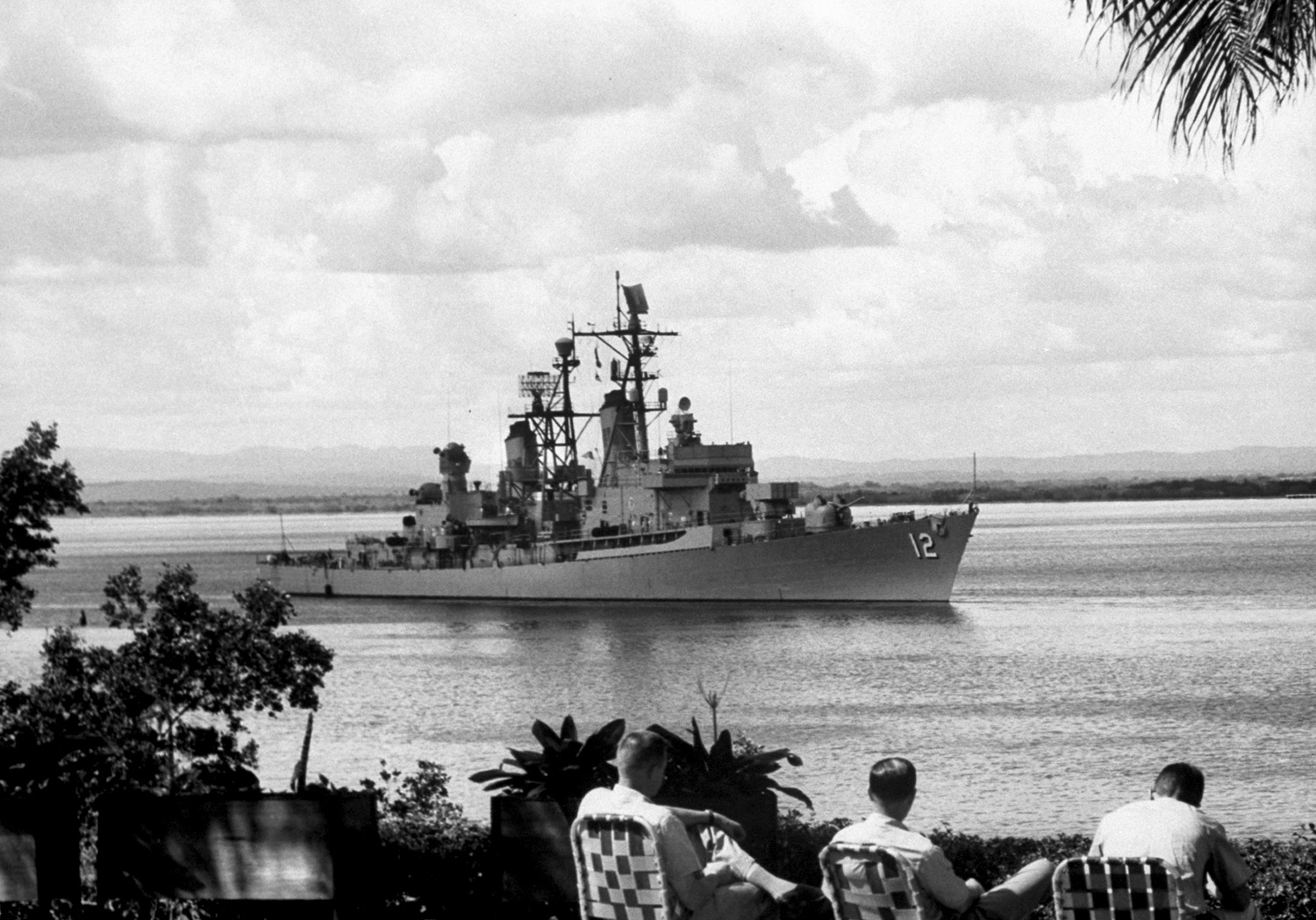
The US Armed Forcese destroyer Sullivan

The U.S. Destroyer Sullivan in Guantánamo Bay on November 13, 1962. Photograph by Robert W. Kelley/Time Life Pictures/Getty.

It was also, after 1964, not entirely a part of Cuba. That February, the U.S. Coast Guard intercepted four Cuban fishing boats in American territorial waters in the Florida Keys. The authorities locked thirty-six crewmen in eight-by-ten-foot cells in a Florida jail. Cuba’s Foreign Minister, Raúl Roa, declared this an “act of piracy” and announced that Cuba was cutting off the base’s water. Gitmo’s commander, Admiral John D. Bulkeley, activated an emergency ration plan that stretched the base’s ten-to-twelve day water reserve. Lyndon Johnson, in his third month as President, pushed back. The majority of Cuban base workers were fired, and the base’s water was supplied by ship. Construction of a desalination plant began within two months; by July, the swimming pools were full. The Navy erected a sign above the dry pipeline: “GITMO WATER LIBERATED FROM CUBA AT THIS POINT.”

It was the decisive, almost final round in the base’s separation from the rest of the island. In late 1958, the U.S. Navy enclosed Gitmo in a perimeter fence. By late 1960, it had set a minefield that would soon contain over 50,000 mines, spread over more than 700 acres: the largest minefield in the world. Following the failed invasion of the island by C.I.A.-trained forces at the Bay of Pigs, in April, 1961, the Cuban government rimmed the base with its own wide trench of uncrossable Maya cactus, a barrier quickly dubbed the Cactus Curtain. Jetting in its food, transporting most of its laborers in from Jamaica, and later the Philippines—here, at last, was the Guantánamo base as citadel, at once insular and global.

Physical isolation defined the daily reality of naval officers, sailors, base workers, and their families. A base is usually a place of supply; Gitmo depended utterly on the outside world. Auto parts could take three months to arrive, so base personnel jerry-rigged “Gitmo specials” from scavenged parts. Fresh vegetables, nearly impossible to grow in Guantánamo’s parched soil, were flown in from Norfolk, Virginia. By the mid-nineteen-eighties, the base could generate three million gallons of desalinated water each day, but the plant ran on high-priced fuel. Gitmo residents drank the most expensive water on earth. As for “liberty,” it now meant a short flight to the brothels of Kingston and Port-au-Prince.

U.S. officials began realizing that Gitmo had outlived its strategic usefulness, having been rendered anachronistic by nuclear submarines and redundant by the Roosevelt Roads anchorage in Puerto Rico. In July, 1981, a report surfaced that the Reagan Administration might hand over the base—“an obsolete military facility,” in the words of one high-ranking official—if Cuba took back unwanted refugees. The base’s presiding officer had been downgraded from rear admiral to captain.

But the United States hung on. The reason was the Cold War. Gitmo’s main purpose in the late nineteen-seventies and eighties was ostentatious, technological muscle-flexing: showing Cuba and the Soviets that the United States still held sway in the Caribbean, in what one captain called a “visible manifestation of interest.” When, in August of 1979, American policymakers received reports (later proved inaccurate) of a newly arrived Soviet combat brigade in Cuba, they sent 1,800 marines in on three ships, simulating an assault on Gitmo using “inert ordinance.” The goal was to communicate America’s grit. “It’s crazy,” a young sergeant observed. “We’re invading ourselves.”

Then a new use for the base was discovered: the storage of people.

In September, 1991, a brutal coup overthrew the first democratically elected President of Haiti, Jean-Bertrande Aristide, and hundreds of thousands fled the new regime on the open sea. The George H. W. Bush Administration, fearing what an incoming wave of Haitians might do to Bush’s reëlection chances, sought a way to prevent Haitians from drowning and also from exercising their full rights to asylum hearings, a place under U.S. control but far from legal aid, where deportations to Haiti would be speedy.

The answer was Gitmo. By November, 1991, the U.S. Coast Guard was shipping Haitians to the base. By the following July, nearly 37,000 people were confined in makeshift tent cities ringed with barbed wire. Cuban officials’ objections to the base soon included its “concentration camp” on Cuban territory. Prisoners claimed that they were treated like animals, given rotting food, subjected to forced medical treatment, denied counsel. For the more than 26,000 people found by the I.N.S not to be migrating for “political” reasons, Gitmo was a ticket back to danger and, in some cases, death. For 267 Haitians granted asylum on political grounds but denied entry under a 1987 law that blocked them from immigrating because they were H.I.V.-positive, it was purgatory. “They were even harsher with us than with the others,” Yolande Jean, a democracy activist, recalled. The refugees at Camp Bulkeley—reserved exclusively for H.I.V.-positive refugees—burned their tents and hurled rocks at their captors. Many joined in a hunger strike.

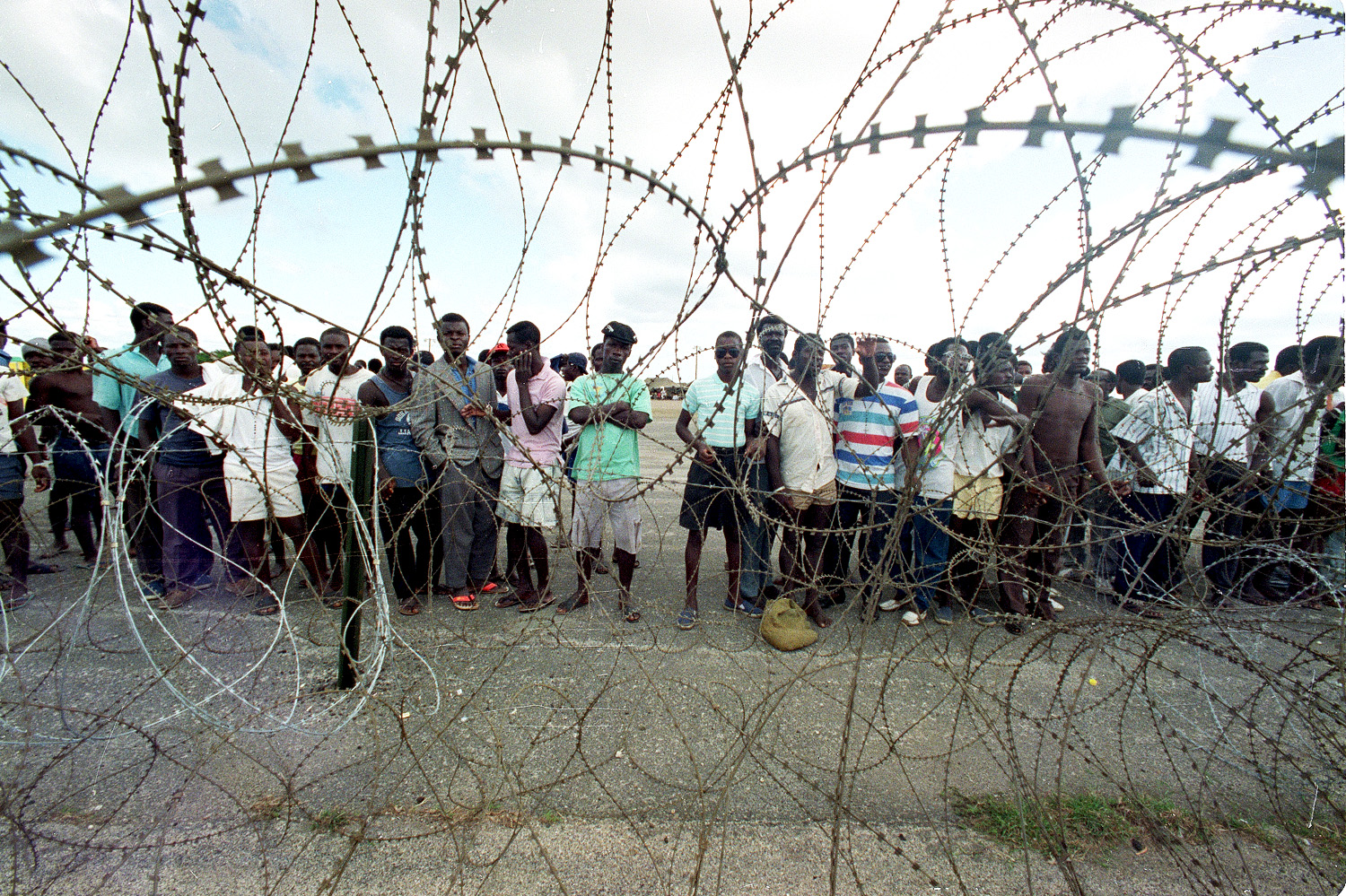
HAITIAN REFUGEES

Haitian refugees behind a razor-wire enclosed camp at the Guantánamo naval base on December 29, 1991. Photograph by Bebeto Matthews/AP.

Activists in the United States protested the denial of the detainees’ rights. A team of students and professors at Yale Law School took their case, Haitian Centers Council, Inc. v. Sale, to the U.S. District Court for New York’s Eastern District, where it was heard by Judge Sterling Johnson, Jr. They argued that constitutional protections applied to the base as an area under the “complete jurisdiction and control of the United States.” Lawyers for the government responded that Gitmo was simply “a military base in a foreign country” and “not United States territory.” Detainees there were “outside the United States and therefore they have no judicially cognizable rights in United States courts.” Judge Johnson was incredulous:

You’re saying, if I hear you correctly, that [government officials], assuming that they are arbitrary and capricious and even cruel, that the courts would have no jurisdiction because the conduct did not occur on U.S. soil? That’s what you’re saying?

The government’s lawyers concurred.

On June 8, 1993, Judge Johnson decided the case in the Haitians’ favor, condemning conditions at the refugee camp at Gitmo and ordering it closed. He insisted that due-process guarantees under the U.S. Constitution extended to the base: these included the right to a lawyer, to proper medical care, and to not be held indefinitely without charge. Otherwise, he told an I.N.S. attorney, the state possessed unchecked authority “to take, kidnap, or abscond, whatever you want to call it, take a group and put them into a compound, whether you call it a humanitarian camp or a prison, keep them there indefinitely while there has been no charge leveled against them and there is no light at the end of the tunnel.”

The camp was shut down, and the remaining detainees admitted to the United States. But the Clinton Justice Department found Johnson’s decision troubling, and pursued a deal with the Haitians’ legal team: the Administration would comply with Johnson’s orders and drop an appeal; in return, Johnson’s decision would be vacated from the record. The advocates agreed, fearing that an appeal would prolong their clients’ detention and might, ultimately, succeed. According to one official, the Clinton Administration wanted to preserve “maximum flexibility.”

A year later, the camps were back. A crackdown by Haiti’s dictators and Castro’s sudden granting of permission to depart Cuba encouraged tens of thousands of rafters to take to the water. The Clinton Administration took full advantage of Gitmo’s “flexibility.” At the peak of the exodus, in the summer of 1994, roughly 16,800 Haitians and 22,000 Cubans were held at the base, in separate, adjoining tent cities on the abandoned McCalla runway. There were more protests, hunger strikes, repressions. Gitmo was becoming a rights-less island within an island. For those who refused to coöperate, there was an exposed, open-air prison, consisting of forty small, chain-link cells.

Haitian and Cuban plaintiffs sued. The January, 1995, decision, in Cuban American Bar v. Christopher, by the Eleventh U. S. Circuit Court of Appeals, rejected the logic of Johnson’s orders, and firmly situated Gitmo outside the United States and constitutional limits on state power. The court dismissed arguments that leased military bases abroad “which continue under the sovereignty of foreign nations” were functionally equivalent to land borders or ports of entry. Laws mandating asylum hearings, for example, “bind the government only when the refugees are at or within the borders of the United States.” Apparently, Gitmo was not at or within these borders.

The refugees were released the following year. The Cubans were permitted entry into the United States. The Haitians were involuntarily returned to Haiti, which U.S. military forces had, once again, invaded, reinstating the deposed and weakened Aristide. “The camps of Guantánamo are closing, but… Guantánamo Bay is a painful story that’s not over yet,” the Cuban refugee journalist Mario Pedro Graveran wrote in January of 1996. The tent cities were dismantled. The prison was left standing.

It was 1996, and Guantánamo was still, somehow, American ground. The United States’ possession of the enclave had survived apathy and revolution. It had been, indisputably, a useful corner of the world. Each time its hold had been shaken—by Cuban opponents, Americans worried by the base’s diminishing returns, the trouble of running it, the toll it took on global good will—new purposes had been found with unfailing ingenuity. As station and school, leverage and message, weapon and prison, Gitmo had been cast—intermittently, at least—as essential to the United States’ position in the world. After nearly a century of ambiguity, it was, for the time being, anyway, a space of American power that was juridically no man’s land. Who knew? Maybe there would be a use for that.

Paul Kramer is an associate professor of history at Vanderbilt University and the author of “The Blood of Government: Race, Empire, the United States and the Philippines” (University of North Carolina Press, 2006). He also wrote the article “The Water Cure,” which ran in the February 28, 2008, issue of the magazine.

For more information on the history of the Guantánamo base, see the Guantánamo Public Memory Project; Caribbean Sea Migration Collection; “Guantánamo: A Working-Class History Between Empire and Revolution,” by Jana Lipman (University of California Press, 2008); “Guantánamo: An American History,” by Jonathan M. Hansen (Macmillan, 2011); “Guantánamo, USA: The Untold History of America’s Cuban Outpost,” by Stephen Irving Max Schwab (University Press of Kansas, 2009).

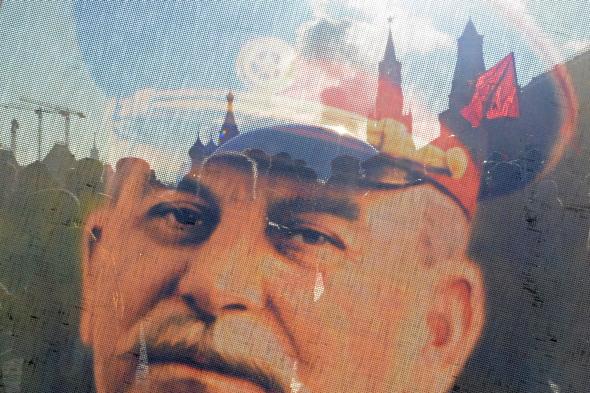
Russian Communists and their supporters are seen through a transparent portrait of Soviet dictator Josef Stalin as they lay flowers at his tomb at the Red Square in Moscow on March 5, 2013, to mark the 60th anniversary of Stalin's death. Photo by KIRILL KUDRYAVTSEV/AFP/Getty Images

Russian Communists and their supporters are seen through a transparent portrait of Soviet dictator Josef Stalin as they lay flowers at his tomb at the Red Square in Moscow on March 5, 2013, to mark the 60th anniversary of Stalin’s death.
Photo by KIRILL KUDRYAVTSEV/AFP/Getty Images

El  artículo de Vladimir Putin publicado en el New York Times, criticando una posible intervención militar estadounidense en Siria, ha levantado una gran polémica, entre otras cosas, por su referencia al alegado carácter excepcional de la nación norteamericana. Si proponerselo, Putin generó un gran debate académico e ideológico en torno al significado del exepcionalismo estadounidense. En este interesante artículo, el lingüista Ben Zimmer analiza  el origen de la frase misma, cuestionando que ésta hubiese sido creada por José Stalin.

Did Stalin Really Coin «American Exceptionalism»?
By Ben Zimmer

Slate.com  September 27, 2013

The phrase «American exceptionalism» has been much in the news ever since Russian President Vladimir Putin wrote an op-ed piece in the New York Times taking issue with President Obama’s statement that America’s foreign policy «makes us exceptional.» «I would rather disagree with a case he made on American exceptionalism,» Putin countered. «It is extremely dangerous to encourage people to see themselves as exceptional, whatever the motivation.»

Putin’s comments revived an old discussion about the origins of the phrase. On Talking Points Memo, Josh Marshall addressed an article by Terrence McCoy—»How Joseph Stalin Invented ‘American Exceptionalism‘»—that appeared last year on the Atlantic’s website. And on Real Clear Politics, Robert Samuelson wrote that «the most interesting fact to surface in the ensuing debate over «American exceptionalism» is that the phrase was first coined by Putin’s long-ago predecessor, Joseph Stalin.» But should Stalin really get the credit?

First off, it’s important to note that «American exceptionalism» has moved through a few different historical waves (as linguist Mark Liberman observed last year in his piece, «The third life of American Exceptionalism«). The first wave was in the ’20s and ’30s, when American socialists argued over whether the United States was immune to what Marx thought was an inevitable move of capitalist societies toward communism by means of violent struggle. The second wave (the focus of Josh Marshall’s TPM post) came after World War II, when historians like Richard Hofstadter reframed the question of «American exceptionalism» in a more positive manner, as a way to explain how the U.S. had avoided the bloody conflicts experienced by Europe in the 20th century.

Most recently, as when «exceptionalism» became a buzzword among Republican presidential candidates in the last election, the term takes on highly patriotic overtones, resonating with Ronald Reagan’s image of the U.S. as «a shining city on a hill.» Republicans have faulted Obama for lacking faith in American exceptionalism, which may have encouraged his «exceptional» rhetoric in his address to the nation on Syria. That might play well for a domestic audience, but to Putin it sounded jingoistic.

But back to Putin’s predecessor, Stalin. McCoy’s piece for the Atlantic seeks to dispel the idea that Alexis de Tocqueville had something to do with creating the expression. (He did call the U.S. «exceptional» in Democracy in America, but not to imply that the country was somehow extraordinary, as Mark Liberman also noted.) In the place of the de Tocqueville myth, however, McCoy introduces another:

In 1929, Communist leader Jay Lovestone informed Stalin in Moscow that the American proletariat wasn’t interested in revolution. Stalin responded by demanding that he end this «heresy of American exceptionalism.» And just like that, this expression was born. What Lovestone meant, and how Stalin understood it, however, isn’t how Gingrich and Romney (or even Obama) frame it. Neither Lovestone nor Stalin felt that the United States was superior to other nations—actually, the opposite. Stalin «ridiculed» America for its abnormalities, which he cast under the banner of «exceptionalism,» Daniel Rodgers, a professor of history at Princeton, said in an interview.

Stalin, to say the least, wasn’t happy with Lovestone’s news. «Who do you think you are?» he shouted, according to Ted Morgan’s biography of Lovestone. «(Leon) Trotsky defied me. Where is he? (Grigory) Zinoviev defied me. Where is he? (Nikolai) Bukharin defied me. Where is he? And you! Who are you? Yes, you will go back to America. But when you get back there, nobody will know you except your wives.»

While the heated exchange between Lovestone and Stalin is well-attested (it led to Lovestone’s expulsion from the Communist Party), it’s rather easy to debunk the notion that Stalin introduced the phrase «American exceptionalism» at this meeting. The biography cited by McCoy states that Lovestone and his delegation set sail from New York on March 23, 1929, and the delegation arrived in Moscow on April 27. Lovestone’s confrontation with Stalin had to have been after that date. But the earliest example given by the Oxford English Dictionary is from a few months earlier, in the Jan. 29 issue of the Daily Worker:

1929 Brouder & Zack in Daily Worker (N.Y.) 29 Jan. 3/2   This American ‘exceptionalism’ applies to the whole tactical line of the C.I. as applied to America. (This theory pervades all the writings and speeches of the Lovestone–Pepper group up until the present.)

And Lovestone may have been using the term earlier than that, as the OED also includes a bracketed citation from the Nov. 1928 issue of the Communist in which he lays out the «exceptionalism» thesis: «We are now in the period of decisive clashes between socialist reformism and communism for the leadership of the majority of the working class. This is in all countries of high capitalist development with the exception of the United States where we have specific conditions.»

If Stalin did indeed tell Lovestone (presumably through an interpreter) to end the «heresy of American exceptionalism» when they met in the spring of 1929, Stalin would have been throwing the phrase back at him rather than coining it anew, since Lovestone’s position on the matter had already been reported in the Communist press. Of course, that doesn’t make for as good a story. Then again, as long as Americans are feeling so patriotic in this latest wave of «exceptionalism,» why shouldn’t Americans get credit for coining the expression, rather than a French writer like de Tocqueville or a Soviet leader like Stalin?

A version of this post originally appeared on Language Log.

Opinionator - A Gathering of Opinion From Around the Web

A Slave’s Service in the Confederate Army

By RONALD S. CODDINGTON
 

The New York Times, September 24, 2013

Sgt. Andrew M. Chandler began his memoir of fighting at Chickamauga with utilitarian prose that belied the horrible, bloody waste that the battle wrought on northwest Georgia in September 1863. “I was engaged in the battle of Chickamauga, belonged to the Forty-fourth Mississippi Regiment, Patton Anderson’s Brigade, Hindman’s Division,” he wrote for an 1894 article in Confederate Veteran magazine.

The highlight of Chandler’s story occurred on the second day of the battle, after he participated in a charge that resulted in the capture of a Union artillery battery. “In this charge we, our brigade” – which fought under the command of Maj. Gen. Thomas C. Hindman – “broke the Federal line and drove them nearly one mile, when we were recalled and reformed, and marched back to the old field, which was literally covered with dead and wounded Yankees,” he wrote.

The federals had sent more troops to fight the Mississippians. As the bluecoats converged on their position, Chandler recalled an exchange that he had with Hindman, a dapper dresser bursting with aggression from his 5-foot-1-inch frame. “General Hindman stopped his horse in rear of our company, when I said to him, ‘General, we are the boys to move them!’ he replied, ‘You are, sir.’ We were then ordered to the foot of a long ridge, heavily wooded. After remaining there lying down for some twenty minutes, the Yankees charged our brigade.”

Chandler abruptly ended his narrative here. He did not describe the rest of the attack – which was strange but telling, because during the fighting a bullet tore into his right leg and ankle and took him out of action. But Chandler’s military records and an anecdote passed down through the family over the following century and a half filled in the rest of his story.

A surgeon examined the 19-year-old Chandler as he lay on the battlefield, determined the wound serious and sent him to a makeshift hospital. Soon afterward Chandler was joined by Silas, a family slave seven years his senior.

24disunion-img-blog427

Andrew Martin Chandler of the Forty-fourth Mississippi Infantry and Silas Chandler, circa 1861.

In the hospital, according to family history, surgeons decided that the injured leg could not be saved and decided to amputate. Then Silas stepped in. As one of Chandler’s descendants explained, “Silas distrusted Army surgeons. Somehow he managed to hoist his master into a convenient boxcar.” They rode the rails to Atlanta, where Silas sent a request for help to Chandler’s relatives. An uncle came to their assistance, and brought both men home to Palo Alto, Miss., where they had started out two years earlier.

When the war broke out in 1861, Chandler enlisted in the “Palo Alto Confederates,” a local military company that eventually joined the 44th Mississippi. His concerned mother, Louisa, sent Silas, one of her 36 slaves, off to war with him.

Thousands of slaves served their masters and masters’ sons in the Confederate Army before and after the “Black Republican” in the White House, as some referred to President Abraham Lincoln, issued the Emancipation Proclamation. Many remained with their owners throughout the war.

Silas had known nothing but slavery his entire life. Born into bondage on the Chandler plantation in Virginia, he moved with the family to Mississippi when he was about 2. He was trained as a carpenter, and the Chandlers brought in extra income by hiring Silas out to locals in need of his skills — a common practice in the antebellum South. The money Silas earned by his labor was paid to the Chandlers, who gave him a small portion. According to a story passed down through Silas’s descendants, he saved the pennies that he received in a jar that he hid in a barn for safekeeping.

Around 1860 Silas wed Lucy Garvin in a slave marriage, not recognized by law. A light-skinned woman, she was the illegitimate daughter of a mulatto house slave named Polly and an unnamed plantation owner. She was classified as an octoroon, or one-eighth African, which determined her legal status as a slave.

The next year Silas bid his newlywed wife farewell and went to war with Chandler. He shuttled back and forth from encampments in Georgia and elsewhere to the plantation in Mississippi to procure and deliver much-needed supplies to Chandler. No account exists that Silas ever attempted to flee to Union-held territory.

At the Battle of Chickamauga, the 44th went into action with 272 men and suffered 30 percent casualties, including Chandler. According to the Chandler family, Silas accompanied him to Mississippi. “A home town doctor prescribed less drastic measures and Mr. Chandler’s leg was saved.”

Chandler “was able to do Silas a service as well,” noted the family. During one campaign, Silas “constructed a shelter for himself from a pile of lumber, the story goes. A number of calloused Confederate soldiers attempted to take Silas’s shelter away from him, and when he resisted threatened to take his life. At this point Mr. Chandler and his comrade Cal Weaver, came to Silas’s defense and threatened the marauders with the same kind of treatment they had offered Silas. This closed the argument.”

Chandler’s Chickamauga wound ended his combat service. But Silas went back to the front lines with Chandler’s younger brother, Benjamin, who enlisted in the Ninth Mississippi Cavalry in January 1864.

Silas accompanied the younger Chandler and the rest of the Ninth as they skirmished with advance elements of Maj. Gen. William T. Sherman’s army through Georgia and the Carolinas. Then, during the Confederacy’s final days, Benjamin Chandler and a detachment of his fellow Mississippians joined the military escort that guarded President Jefferson Davis as he and his entourage fled Richmond.

By the time Davis reached Georgia, fears that his large escort would draw the attention of numerous Union patrols crisscrossing the countryside in search of him prompted commanders to act. On May 7, 1865, most of the escort was disbanded. Davis continued to ride south with a much smaller and less conspicuous guard.

Benjamin Chandler and Silas were part of the group ordered to disband. Three days later, Chandler surrendered to federals near Washington, Ga. Silas was by his side.

President Davis was captured the same day, about 175 miles south in the Georgia village of Irwinsville.

Silas returned home, and reunited with Lucy. They eventually had 12 children, 5 of whom lived into adulthood. Silas became a carpenter in the Mississippi town of West Point, and he taught the trade to at least four of his sons. “They built some of the finest houses in West Point,” noted a family member, who added that Silas and his boys constructed “houses, churches, banks and other buildings throughout the state.”

Silas lived within a few miles of his former masters, the Chandler brothers. In 1868, Silas and other freedmen constructed a simple Baptist altar near a cluster of bushes on land adjacent to property owned by Andrew and his family. The freedmen soon replaced it with a wood-frame church. In 1896, one of Silas’s sons participated in the construction of a new church on the same site.

In 1888, Mississippi established a state pension program for Confederate veterans and their widows. African-Americans who had acted as slave servants to soldiers in gray were also allowed to participate. Over all, 1,739 men of color were on the pension rolls, including Silas.

Benjamin Chandler died in 1909. Silas passed away in September 1919 at age 82. Andrew Chandler survived Silas by only eight months. He died in May 1920.

In 1994, the Sons of Confederate Veterans and the United Daughters of the Confederacy conducted a ceremony at the gravesite of Silas in recognition of his Civil War service. An iron cross and flag were placed next to his monument.

The event prompted mixed reactions from descendants of Silas and Andrew. Silas’s great-granddaughter, Myra Chandler Sampson, denounced the ceremony as “an attempt to rewrite and sugar-coat the shameful truth about parts of our American history.” She added that Silas “was taken into a war for a cause he didn’t believe in. He was dressed up like a Confederate soldier for reasons that may never be known.”

But Andrew Chandler Battaile, great-grandson of Andrew, met Myra’s brother Bobbie Chandler at the ceremony. He saw the experience a bit differently. “It was truly as if we had been reunited with a missing part of our family.”

Bobbie Chandler, for his part, accepts the role his great-grandfather played in the Confederate army. He observed, “History is history. You can’t get by it.”

Follow Disunion at twitter.com/NYTcivilwar or join us on Facebook.

Sources: Confederate Veteran Magazine, (1894, 1910); Andrew M. Chandler military service record, National Archives and Records Administration; Benjamin S. Chandler military service record, National Archives and Records Administration; Silas Chandler pension record, Mississippi Department of Archives and History; West Point (Mississippi) Daily Times Leader, Jan. 4, 1950; 1850, 1910, 1860 Federal Census, 1860 Slave Schedules, National Archives and Records Administration; Dunbar Rowland, Mississippi: Contemporary Biography, Vol. 3; James G. Hollandsworth Jr., “Black Confederate Pensioners After the Civil War,” Mississippi History Now (May 2008); Andrew M. Chandler Papers, Collection of Andrew Chandler Battaile; Myra C. Sampson, “Silas Chandler”; Bobbie Chandler to the author, May 8, 2010; Richard Rollins, “Black Southerners in Gray.”

disunion_roncoddington-thumbStandardRonald S. Coddington is the author of “Faces of the Civil War” and “Faces of the Confederacy.” His most recent book is “African American Faces of the Civil War.” He writes “Faces of War,” a column for the Civil War News.

CommunityNewsletter_0

The Republican Party’s Hidden Racial History

by Timothy N. Thurber

History News Network

On September 17, lawyers from the Brennan Center for Justice at New York University joined the Texas State Conference of the NAACP, the Mexican American Legislative Caucus of the Texas House of Representatives, and others in a lawsuit to overturn a new state voter identification law (Brennan Center).

A month earlier, North Carolina enacted a statute containing several reforms, including a requirement that voters produce government-issued photo identification and a seven-day reduction in the period for early voting.

These and similar proposals in other states have sparked sharp partisan fights. Democrats believe that they violate the Voting Rights Act and constitute deliberate efforts by Republicans to suppress voting by nonwhites, students, and others who by and large do not favor the GOP. Firmly denying any intent of malice against any demographic group, Republicans insist that reforms are needed to combat voter fraud.

Conflicts over voting are as old as the republic, but they have intensified since President Barack Obama’s 2012 re-election and the Supreme Court’s June 2013 decision striking down Section Four of the Voting Rights Act, which determined the states and localities required to seek federal approval for changes in election laws. “Preclearance,” as this policy was commonly known, applied primarily to the South. Republicans have tended to applaud the Court’s ruling, arguing that discrimination against nonwhites once was a problem but is now so rare that federal oversight is no longer needed. Colin Powell stands a rare exception within the GOP; he has denounced the North Carolina statute as morally wrong, based on inaccurate beliefs about the extent of fraud, and politically suicidal. The Republican Party, he contends, should be reaching out to blacks and other nonwhites.

For some observers, these developments are the latest chapter in the shift of the pro-civil rights “party of Lincoln” to a southern-controlled, states’ rights GOP that has little room for African Americans. Didn’t overwhelming majorities of congressional Republicans favor the Voting Rights Act in 1965? Yes. In the Senate, thirty Republicans backed the legislation, and only two opposed. House Republicans voted five-to-one for it. As Republicans have been noting ever since, that was a higher percentage of support than registered by Democrats.

A closer look at the events of 1965, however, reveals that the current Republican approach to voting is more similar to that of a half century ago than the final congressional tallies indicate. So, too, is the contemporary political context.

In March 1965, President Lyndon Johnson proposed legislation that greatly expanded federal authority over state election laws, particularly in the South. The bill contained a “trigger” provision that used voter participation data from 1964 to automatically suspend literacy tests in several southern states and bring those states under the preclearance requirement. This approach would relieve individuals and organizations of many of the considerable legal hurdles (and, in numerous instances, personal risk) of filing lawsuits. That case-by-case method had been tried under the 1957 and 1960 civil rights laws but had resulted in few new black voters.

Led by Everett Dirksen (Ill.), Senate Republicans allied with non-southern Democrats to defeat southerners’ efforts to preserve local autonomy, most notably their attempts to delete the trigger and preclearance provisions. Republicans also backed cloture, which ended the southern Democrats’ filibuster and ensured that the bill would pass.

House Republicans initially rallied behind legislation, offered by Gerald Ford (Mi.) and William McCulloch (Oh.), that enhanced federal jurisdiction compared to earlier civil rights laws but nevertheless preserved more state autonomy compared to Johnson’s. Their bill did not automatically ban literacy tests or contain preclearance requirements. Since the early twentieth century, Republicans had favored literacy tests in their own states and insisted upon maximizing state authority over voting rules, largely in response to high levels of immigration to the Northeast and Midwest. Low levels of black voting, Ford and McCulloch argued, might stem from factors unrelated to discrimination. The pair also pointed out that their legislation would apply to more southern states than did the president’s. Prominent civil rights groups and leaders preferred Johnson’s approach, however.

The Senate’s action, plus the sizable Democratic majority in the House, meant that the Ford-McCulloch legislation had no chance. House Republicans then fell in line with the winning side. Just one of the seventeen Republicans from the ex-Confederate states voted for Johnson’s measure. Southern Republicans, in other words, were just as eager as southern Democrats to limit Washington’s reach.

The political context of the mid-1960s also echoes the present. In 1965, Republicans were debating how to rebuild their party. The 1964 election had been a disaster not just for presidential nominee Barry Goldwater, but for the party as well. A handful of Republicans wanted to more closely align the GOP with the civil rights movement. Doing so, they argued, would increase African American support and help the party with the expanding number of whites, in the South and elsewhere, who favored a more racially egalitarian society. “We have got to get the party away from being an Anglo-Saxon Protestant white party,” Charles Percy asserted. Percy had just lost his bid to be governor of Illinois; he would be elected to the Senate in 1966. Likewise, Governor George Romney (Mi.) fired off a twelve page letter to Goldwater in which he noted that the Arizona senator had received eight million fewer votes than Richard Nixon did in 1960 and voiced alarm over the “southern-rural-white” thrust of the senator’s campaign. “The party’s need to become more broadly inclusive and attractive,” Romney emphasized, “should be obvious to anyone.”

Romney and Percy were minority voices within their party. Most Republicans continued to agree with Goldwater that the black vote was largely unwinnable and essentially irrelevant. Whites far outnumbered African Americans in most of the nation, including most of the South. As Johnson’s bill was being debated, state and local Republicans from Dixie warned northern GOP lawmakers that allying with president would undermine the party’s recent growth in Dixie. Worried that the elimination of literacy tests would mean a large influx of black voters, one Louisiana organization appealed to Nixon to lobby congressional Republicans on the South’s behalf. Illiterate African Americans, they wrote the former vice president, simply followed Democrats’ instructions or sold their votes for beer or a few dollars. The head of the Mississippi GOP predicted chaos “if large numbers of ignorant, illiterate persons are suddenly given the vote.”

Concerns over fraud were not limited to the South. Believing that the Democrats had stolen the 1960 election through fraud in Chicago and elsewhere, the RNC had launched Operation Eagle Eye in 1964. Republicans across the nation tried a variety of techniques to prove that many African American voters were ineligible. Republicans also worked to dissuade blacks from voting by spreading false information in African American neighborhoods regarding the voting process. Operation Eagle Eye flopped, but Republicans would continue to use many of these methods in the decades ahead.

Timothy N. Thurber is Associate Professor of History at Virginia Commonwealth University, and author of The Politics of Equality: Hubert H. Humphrey and the African American Freedom Struggle, and, most recently, Republicans and Race: The GOP’s Frayed Relationship with African Americans, 1945–1974.
– See more at: http://hnn.us/article/153358#sthash.xPizvkxg.dpuf

El enfoque histórico-cultural de Emely Rosenberg y la política expansionista estadounidense

por Pablo L. Crespo Vargas

Spreading the american dreamUno de los problemas, más significativos, que confrontaron los estudiosos de la historia diplomática estadounidense hasta comenzada la segunda mitad del siglo XX fue la falta de un acercamiento o una explicación cultural donde se analizaran los distintos aspectos del desarrollo de las relaciones internacionales de este país. Los cambios producidos en el pensamiento académico luego de finalizada la Segunda Guerra Mundial, donde se presentaron una serie de factores que incluyen mayores oportunidades de estudio gracias a los beneficios educativos a veteranos, el aumento de instituciones universitarias estatales, y los movimientos de derechos humanos, feministas e indigenistas, que motivaron a muchos a realizar estudios postsecundarios, sin importar la clase social de la que provenían, también se sintieron en la historiografía estadounidense.[1]
Los recién formados historiadores comenzaron a ver la historia desde una perspectiva fuera del punto de vista elitista que se había caracterizado hasta ese momento.[2] Uno de los mejores ejemplos de esta situación lo encontramos en la obra de Emily S. Rosenberg. Esta historiadora busca presentarnos como la cultura estadounidense jugó un papel trascendental en el desenvolvimiento de la política exterior de los Estados Unidos. Es importante señalar, que la autora, establece los límites a su trabajo en “examine the process by which some Americans, guided and justified by the faiths of liberal-developmentalism, sought to extend their technology-based economy and mass culture to nearly every part of the world.” En otras palabras, Rosenberg no trabaja el efecto de la americanización en otros países o culturas, aunque estos son estudiados con mayor detenimiento por otros investigadores, sino que se enfoca en cómo se dio este proceso desde la perspectiva estadounidense.
La tesis de la autora se centra en el desarrollo de una ideología llamada liberalismo-desarrollista [liberal-developmentalism], el cual tenía cinco puntos o ideas de gran importancia. El primero es la creencia de que todos los países debían copiar el desarrollo económico estadounidense. El segundo punto es la fe existente en el desarrollo de la economía a base de una iniciativa privada. Le seguía la creencia de mantener acceso libre al comercio y a las inversiones. La cuarta idea es el fomento del flujo continuo de la información y la cultura. Por último, se promovía la creencia de que el gobierno tenía la función de proteger la empresa privada, a la vez que se estimulaba y regulaba la participación estadounidense en la economía mundial y el intercambio cultural. Estas ideas se fueron desarrollando y utilizando para poder crear un ambiente favorable a los inversionistas estadounidenses que se aventuraran en el extranjero, teniendo el consentimiento del sistema gubernamental para ello.
En la obra se va presentando la evolución de estas ideas, que Rosenberg divide en tres periodos significativos. Primero, el estado promocional [Promotional State], desarrollado entre 1890 y 1912. En este periodo, el gobierno federal buscaba facilitar el desarrollo económico de las empresas privadas que se desarrollaron en el mercado internacional. Segundo, el estado cooperativista [Cooperative State], promovido después de la Primera Guerra Mundial. En él, el gobierno se inmiscuyó en el desarrollo de las inversiones estadounidenses en el extranjero, buscando posiciones ventajosas en el ámbito internacional; y a su vez, manteniendo la posición política que los Estados Unidos obtuvo al terminar este conflicto. Por último, se desarrolló el estado regulador [Regulatory State], que a partir de la década del 30 buscaba integrar las relaciones entre empresarios y gobierno federal para facilitan los objetivos de ambos.
Los dos puntos que la autora recalca son: (1) la estrecha relación entre la expansión económica estadounidense y los aspectos culturales que se desarrollaban en este país y (2) la correlación existente entre el grado de intromisión del gobierno de los Estados Unidos en los intereses económico y la proyección hegemónica desarrollada ante el resto del planeta. No ha de extrañarnos, que a mayor proyección mundial como potencia de primer orden, mayor era el grado de relación entre el gobierno y los intereses económicos. Sobre este último punto podemos observar dos hipótesis. En la primera, que el gobierno estadounidense utilizó la expansión económica desarrollada por los inversionistas para crear una plataforma que sirvió para promover y proyectar a los Estados Unidos como una potencia de primer orden. Segundo, que el gobierno fue empujado por los intereses económicos para desarrollar una hegemonía que los protegiera en el extranjero. Aunque podemos estar tentados a escoger solamente una explicación, la obra nos demuestra que en un principio los inversionistas y empresarios estadounidenses [los grupos misioneros también aprovecharon el momento] lograron atraer el interés gubernamental; pero, que al pasar el tiempo y los Estados Unidos transformarse en una nación de primer orden su interés por mantener un predominio económico era más latente y la proyección de la cultura estadounidense era vital para tales fines.
Dentro de los aspectos culturales se puede apreciar el surgimiento de ideas progresistas que son propagadas y asimiladas por la población en general. Algunas de estas ideas fueron vistas como precondiciones a una sociedad moderna y de avanzada de una nación destinada a ser modelo universal. Estas incluyen la supuesta superioridad de la sociedad cristiana protestante, la prepotencia anglosajona y el desarrollo económico de la sociedad estadounidense. Estas ideas crearon una mentalidad de superioridad que puede ser apreciada en las campañas misioneras, que buscaban expandir sus creencias religiosas en el extranjero, de la misma forma que los inversionistas buscaban prosperidad en los mercados internacionales.
Otro aspecto cultural que no podríamos dejar a un lado es la importancia que tuvo el llamado sueño americano [American Dream], el cual estaba relacionado con el desarrollo de alta tecnología y el consumo en masa. Si la proyección de este ideal anterior al periodo de la Segunda Guerra Mundial fue realizado por misioneros, misiones diplomáticas e intereses económicos; el desarrollo de los medios de comunicación masivos fue toda una innovación que se encargó de llevar a cada rincón del mundo el pensamiento y estilo de vida estadounidense luego de finalizada esta guerra. La intención, según nos indica la autora, era crear cierto grado de empatía hacia el estilo de vida democrático, de sabiduría e integración social estadounidense. Se puede pensar que la expansión cultural era parte importante en la creación de mercados económicos e intelectuales donde el pensamiento estadounidense predominaba.
Los planteamientos de la autora podrían estar presentando una fuerte influencia revisionista. De hecho, la presentación de una serie de problemas o contradicciones entre el ideal liberal desarrollista y lo practicado en realidad nos hace pensar en la obra del historiador William A. Williams: The Tragedy of American Diplomacy. Entre los puntos trágicos que presenta Rosenberg está la política de dos varas que el gobierno estadounidense utilizó para promover los intereses económicos y diplomáticos propios. El mejor ejemplo fue la política dirigida a condenar y demonizar los monopolios extranjeros; mientras que se promovía el que empresas estadounidenses monopolizaran en países de economía débil y con gobiernos de fácil corrupción.
Según la autora, las justificaciones que cada generación de estadounidenses presentó para el desarrollo de una conducta no liberal dentro del liberalismo-desarrollista son otro ejemplo de la importancia del aspecto cultural dentro de la historia diplomática. Estas son tres: “Doctrines of racial superiority and evangelical mission […], a faith in granting prerogatives to new middle-class professionals […] and a fervent anti-Communism”. Dos de ellas son de corte ideológico: la superioridad racial junto a la evangelización y el desarrollo del anti comunismo; pero su contenido está arraigado al desarrollo cultural de una nación que evolucionó en un marco anglosajón, de creencias religiosas protestantes y con una economía esencialmente capitalista donde el individuo era responsable de su prosperidad tanto terrenal como espiritual. A su vez, la responsabilidad del individuo al progreso llevó al desarrollo de una clase media profesional que promoviera cambios en la tecnología y en la calidad de vida que presentaba el llamado American Dream.
Los planteamientos de corte liberal que Rosenberg expone al presentar un punto de vista cultural pudieran molestar a historiadores conservadores que solo ven intereses estratégicos y económicos en sus señalamientos. Sin embargo, no podemos dejar a un lado, el desarrollo de una política exterior que no se basó únicamente en las pretensiones de grandeza que puede tener una élite, o en los deseos de riqueza que los empresarios vieron en los mercados internacionales, sino, que dentro de todo esto existe un intercambio de ideas, una proyección de lo que es el país y sus pobladores y cómo estos pueden interactuar con otras cultura, aunque en este caso se buscaba que otras culturas asimilaran la de ellos para así poder crear un cierto grado de identificación del cual se suponía que ambos lados se beneficiaran.
Obra principal:
Emily S. Rosenberg: Spreading the American Dream: American Economic and Cultural Expansion, 1890-1945 [1982], New York: Hill and Wang, 1999
Obras citadas:
Appleby, Joyce, Lynn Hunt & Margaret Jacob: Telling the Truth About History, New York, Norton, 1994
William, David: A Peoples History of the Civil War: Struggles for the Meaning of Freedom, New York, New Press, 2006
Williams, William A.: The Tragedy of American Diplomacy, New York, Delta Books, 1962
Otras obras de referencia sobre el tema:
Hogan, Michael J. & Thomas Paterson (eds.), Explaining the History of American Foreign Relations, 2nd ed., New York, Cambridge University Press, 2004
Joseph, Gilbert M, Catherine C. Legrand & Ricardo D. Salvatore (eds.): Close Encounters of Empire: Writing the Cultural History of U.S.-Latin American Relations, Duke University Press, 1998.
Kaplan, Amy & Donald E. Pease (eds.): Cultures of United States Imperialism, Duke University Press, 1999.

[1] David William: A Peoples History of the Civil War: Struggles for the Meaning of Freedom, 2006, pág. 11.
[2] Véase a Joyce Appleby, Lynn Hunt & Margaret Jacob: Telling the Truth About History, 1994, págs. 146-151.

Tiempos de Nemosine, blog  del Doctor Cruz M. Ortiz Cuadra, profesor de la Universidad de Puerto Rico (Humacao), publica unas interesantes fotos de la Guerra Hispanoamericana en Puerto Rico. Creo que éstas podrían resultar de interés para los lectores de esta bitácora.

Para ver las fotos ir aquí: Fotos.

book_thumb_13079En esta entrevista de la New Books in History Network, el historiador Tevi Troy habla de su nuevo libro titulado What Jefferson Read, Ike Watched, and Obama Tweeted: 200 Years of Popular Culture in the White House (Regnery History, 2013).  Esta obra analiza la interacción de los presidentes norteamericanos con la cultura popular estadounidense.

Para oir la entrevista ir aquí.

Educación e imperio

por EFRÉN RIVERA RAMOS

El Nuevo Día, 19 de septiembre de 2013

indexUn libro publicado recientemente por la Editorial de la Universidad de Wisconsin arroja nueva luz sobre la relación entre las reformas educativas, el colonialismo y la modernización de Puerto Rico en la primera mitad del siglo 20.

En la obra, titulada “Negotiating Empire: The Cultural Politics of Schools in Puerto Rico, 1898-1952”, su autora, la profesora Solsiree del Moral, de la Universidad de Amherst, documenta la centralidad de las escuelas públicas puertorriqueñas en el proceso de configuración de una nueva sociedad colonial embarcada en una profunda transformación social, política y cultural.

El libro complementa la valiosa investigación de Aida Negrón de Montilla, que analizó los esfuerzos de americanización a través del sistema de educación pública desplegados por los comisionados de instrucción designados por el presidente de Estados Unidos. Del Moral escudriña el período desde otra perspectiva: la de los maestros, padres y estudiantes de la época. Constituye, pues, una historia escrita “desde abajo”, que ilustra las complejidades de las respuestas de la heterogénea comunidad escolar a las políticas educativas de la nueva metrópolis imperial.

Sobresale en este trabajo meticuloso el examen constante de las variables de la raza, el género y la clase social, no sólo en la composición del magisterio de entonces, sino en el abordaje de los administradores y el liderato profesional, intelectual y político a los problemas de la educación en Puerto Rico.

Las consideraciones de género se detallan particularmente en el capítulo tres, dedicado al examen de la ciudadanía, el género y las escuelas. La autora examina desde las discusiones sobre las supuestas debilidades de las maestras para enfrentar los retos de la escolarización en el mundo rural hasta la estructura patriarcal de las asociaciones magisteriales y los debates sobre para qué debían educarse las niñas en la nueva sociedad emergente.

Resulta reveladora la referencia a la relación entre el analfabetismo, la masculinidad y la guerra, en el contexto del rechazo masivo del ejército estadounidense de los varones puertorriqueños que no sabían leer y escribir y sus efectos en la discusión pública del momento. El análisis revalida la necesidad de encarar sin ambages el tema del género en cualquier proyecto de reforma escolar. En el capítulo cuatro se destacan los asuntos de la raza y la clase social, ambos estrechamente vinculados tanto a las visiones imperiales sobre Puerto Rico como a las respuestas de las élites puertorriqueñas a la nueva situación. La intersección de raza y clase social se torna particularmente aguda en el caso de la creciente diáspora puertorriqueña en Estados Unidos.

El texto analiza un estudio sobre los niños puertorriqueños en Nueva York encomendado por la Cámara de Comercio de esa ciudad en 1935 a un grupo de científicos sociales. Los investigadores concluyeron que los estudiantes boricuas constituían un grupo inferior intelectualmente en comparación con otros sectores de la población. Recomendaron que se restringiera la migración de Puerto Rico hacia Estados Unidos.

La respuesta de prominentes educadores puertorriqueños no fue mejor. Para impugnar el estudio, un subcomisionado de educación de Puerto Rico alegó que la muestra no era representativa de los puertorriqueños de la isla, pues la mayoría de los estudiantes estudiados eran negros y pobres. Otro indicio, según la autora, de cómo el imaginario sobre la diáspora se ha ido moldeando tanto por la visiones circuladas por sectores diversos de la sociedad estadounidense como por los grupos profesionales, intelectuales y políticos dominantes en Puerto Rico.

Una contribución importante del libro es la conexión que establece entre las políticas educativas implantadas en Puerto Rico y las desarrolladas por los reformadores estadounidenses para Hawai, Filipinas, los pueblos indígenas, las comunidades negras del Sur y los grupos de nuevos inmigrantes. Coloca, además, las iniciativas impulsadas en Puerto Rico en el contexto mayor de los desarrollos pedagógicos del momento en la América Latina y el Caribe.

Se trata de una lectura iluminadora del pasado con aplicaciones de valor para el presente.

Fuente: http://www.elnuevodia.com/columna-educacioneimperio-1597160.html