Feeds:
Entradas
Comentarios

Before Solomon Northup: Fighting Slave Catchers in New York

by Marjorie Waters

HNN, October 18, 2013

12 Years a Slave, the 1853 book and now a feature film starring Chiwetel Ejiofor, Michael Fassbender, Benedict Cumberbatch, and Brad Pitt, has made Solomon Northup the most well-known Northerner to be kidnapped into slavery, but he was not alone. Men, women, entire families, children — all African Americans were vulnerable, whether they were escaped slaves or, like Northup, legally free. When Northup was seized in 1841, a kidnapping epidemic in the North was well into its second decade. Among the many victims was William Dixon, taken near his home on the corner of Hester Street and the Bowery in lower Manhattan in 1837.

Most runaway slaves were young men, and many set their sights on New York City. They were drawn by the density, especially below 14th Street, and by the numbers of free blacks. In 1830, just three years after slavery ended in New York State, Manhattan was home to a quarter million people, including some 14,000 African Americans. It was the largest black population in the North. But the city did not welcome fugitive slaves. Despite a growing abolitionist movement, the dominant atmosphere of New York was pro-Southern and pro-slavery, a product of the city’s deep involvement in the cotton trade. If runaways made it to this complicated place, they called themselves free, took new names, and kept their heads down.

Slave catchers knew that New York was fertile ground, and they prowled the city streets with the law on their side. The U.S. Constitution protected the right of slave owners to reclaim runaways, and the 1793 Fugitive Slave Law established the procedure. It required little more than a hearing before a U.S. judge or a local magistrate, and some paperwork. Those who interfered were subject to a $500 fine.

If a captive admitted to being an escaped slave, his or her fate was sealed. If not, the judge or magistrate made a determination, often relying on a vague description: “He is about 5 feet 10 inches high, about 30 years of age, very dark complexion … large whiskers, and a sharp face.” Most hearings were over quickly, and captives could be on a southbound ship before family or friends knew they were missing.

William Dixon was a big, powerfully built man who earned his living as a whitewasher. On the morning of April 4, 1837, he picked up his brush and pail and said good bye to his wife. Minutes later he was seized by three men. One was a Baltimore policeman named Ridgely, and the other two were New Yorkers whom Dixon may well have recognized: Tobias Boudinot and Daniel Nash.

Most black New Yorkers knew these men, by reputation and probably on sight. Their names (and those of informers, black or white) were circulated by the New York Committee of Vigilance, a mostly black organization formed in 1836. It focused much of its effort on the men who made slave catching a thriving business in the city: Boudinot and Nash, both New York policemen, and City Recorder Richard Riker, the local magistrate who usually ruled in their favor. Local abolitionists called this threesome the Kidnapping Club.

In the growing face-off between North and South, several Northern states wrote personal liberty laws to protect their free citizens from unlawful seizure, which Southern interests vigorously challenged. New York’s 1828 law gave fugitives the right to petition for the writ de homine replegiando, entitling them to a jury trial. The Committee of Vigilance championed this right, and the New York Manumission Society, an organization of prominent white men, provided victims with a lawyer. Help was available for captives, assuming they were not whisked away to a waiting ship.

For unknown reasons, William Dixon was not whisked away. He spent a week in Bridewell Prison, located in City Hall Park. This lucky delay gave anti-kidnapping forces time to prepare. The Manumission Society assigned lawyer Horace Dresser, and the Vigilance Committee publicized this latest capture. When Dixon’s hearing finally began on April 11, it was so crowded with his supporters that Recorder Riker had to move the proceedings out of his chambers and into a larger space in City Hall. The spotlight was on this case.

On the first day, Dresser petitioned for de homine replegiando, Riker set bail at $500, and William Dixon made a statement to the court. He said he was innocent, a free man. A. G. Ridgely made a counter claim: that “William Dixon” was a slave named Jake, owned by Dr. Walter Allender of Baltimore, and that he had run away in 1832.

On the second day, witnesses testified in support of each side. Several said they’d known Dixon in the North before 1832. A free black man from Philadelphia stated that he had known the captive all his life, known his parents, and visited their home. All the witnesses on Dixon’s behalf, and Dixon himself, had been coached to lie. The truth would have returned Dixon to slavery.

A crowd of black New Yorkers, estimated at 1,000 or more, gathered outside City Hall and waited for word. Many of them had likely been on hand when Riker heard another kidnaping case, just days earlier. Then they had watched powerlessly as the captive, who admitted to being a fugitive, was led away. Now they were agitated and determined. At the end of the second day of the hearing, the sheriff appeared, leading Dixon back to Bridewell. Uncertain how to read what they saw, the crowd surged forward. A voice called, “To the rescue!” Someone tossed Dixon a dagger and a knife and told him to run. He hesitated, then raced down Duane Street and hid in a basement, where he was easily recaptured. Justice of the Peace John Bloodgood, who was not involved in Dixon’s case, saw the commotion from City Hall, called for police support, and rushed out to help the sheriff. Instead he was attacked himself. A woman came up from behind and grabbed him violently around the neck. Other protestors tackled the justice and assaulted him. When police arrived, most of the attackers escaped into the crowd, but the woman and one of the men were arrested.

Months of legal wrangling over Dixon followed, covered by the white abolitionist press and The Colored American, New York’s new black newspaper. By July, Dixon’s supporters had at last managed to raise the bail. He was released from prison and secretly taken to Canada, where he was safely beyond Allender’s reach. He was still there in September, when Justice Bloodgood dropped charges against his attackers, noting that the woman was too ill to appear in court, and the man had died in Bridewell. Surviving records do not indicate whether they had contracted a deadly disease in prison, where infectious outbreaks were common, or had been beaten for assaulting Justice Bloodgood. But the mob action, and all the attention paid to Dixon, apparently rattled City Hall. In October, when Boudinot and Nash appeared with another captive, four magistrates refused to hear the case, Riker and Bloodgood among them.

Dixon spent four months in Canada. In November 1837, a member of the Manumission Society traveled north and brought him back to New York, possibly for a court appearance. For his supporters, and perhaps for Dixon himself, more than his personal freedom was at stake. They were looking to win this case and strengthen the legal defense of future captives. Still, Dixon could have remained in Canada, free, and he chose not to.

His case unresolved, Dixon returned to his home and went back to work. Several months later, on a New York street, he ran into someone from his slavery days, a Baltimore runaway who had just made it to freedom and was feeling indescribable relief. Dixon nervously told the man he was no longer known as Jake, and that Allender was trying to reclaim him. He warned the newcomer to trust no one, and not to go to the wharves for work or to a boarding house for a room. He said there were informers who would betray him to slave catchers for a few dollars. Seemingly worried that this vulnerable man might sell what he knew, Dixon soon vanished into the crowded streets.

Solomon Northup was a freeman, tricked and sold into bondage. William Dixon was an actual fugitive who was not returned to slavery. Dr. Allender may have been unwilling to spend more on an aging runaway, or he may have been urged not to give abolitionists a dangerous legal victory. Whatever the reason, Dixon’s case never came before New York’s highest court. Like Northup’s, his story was remarkable and rare. Most victims of kidnapping never saw freedom again.

In the 1840 census, William Dixon was listed as a free colored person living with his wife in their old neighborhood. But life was not easy in a city that still leaned so heavily toward the south. Dixon had challenged the Kidnapping Club, and won. But Tobias Boudinot, the club’s most powerful member, remained on New York’s police force, rising to the rank of captain. In 1850, William A. Dixon, occupation whitewasher, age 50, was listed in the federal census among the inmates of city prison — the Tombs — charged with an unspecified felony. The same year, the new Fugitive Slave Law preempted Northern states’ personal liberty laws and significantly strengthened the rights of slave holders. By then, the recent fugitive who met Dixon on the street had moved to Rochester and taken the name Frederick Douglass.

– See more at: http://hnn.us/article/153653#sthash.jgaX3Pzw.dpuf

Marjorie Waters has been a consultant to the New-York Historical Society education department, writing and developing classroom materials for the Society’s major exhibitions. She developed a case study about William Dixon for the curriculum for New York Divided: Slavery and the Civil War, the historical society’s follow-up exhibition to Slavery in New York. This article is based on that case study.

By Brenda E. Stevenson

HNN, October 18, 2013

The ordeal of Solomon Northup, a free man of color from New York who was kidnapped in Washington, D.C. and sold as a slave in Louisiana, is the focus of the new film 12 Years a Slave, directed by British filmmaker Steve McQueen and based on Northup’s 1853 published autobiographical account. The film has received much early critical acclaim, and rightfully so. It is, without a doubt, one of the best depictions of antebellum slave life put to film and, along with, Haile Gerima’s 1993 masterwork Sankofa, Stan Lathan’s 1987 Uncle Tom’s Cabin, the indomitable classic Roots of 1977, and Gabriel Ranger’s 2010 I Am Slave, the story of the contemporary enslavement of Mende Nazer, 12 Years a Slave presents some of the most compelling, and soon to be iconic, images of slave women on celluloid. .

Indeed, one of the aspects of Northup’s autobiography that convinced director McQueen to adapt it to film was the Northrup’s depiction of slave women in his lengthy account. Published descriptions of the plight of enslaved women, of course, made for an important abolitionist device intended to gain sympathy for their cause. True stories of the inability of enslaved women to maintain the gendered conventions of the day — domesticity, sexual purity, and maternal sacrifice — because of their status as physical and sexual laborers who could not be legally married or have parental control over their children, abound in published accounts from the late antebellum era. Twelve Years a Slave: Narrative of Solomon Northup, a Citizen of New-York, Kidnapped in Washington City in 1841, and Rescued in 1853 (which Northup dedicated to Harriet Beecher Stowe, whose own character “Eliza” was the most famous iconic slave woman of the era) certainly made it possible for a Northern audience to accept the details of rampant sexual abuse and forced concubinage detailed, for example, in Louisa Picquet’s Octoroon: A Tale of Southern Slave Life and Harriet Jacobs’ Incidents in the Life of a Slave Girl, both published in 1861.

On morning in March 1841, in Saratoga Springs, New York, when Merrill Brown and Abram Hamilton approached Solomon Northup as part of an elaborate scheme to kidnap and sell him as a slave, their target was about thirty-three, a literate, urban, Christian husband and father of three, a skilled craftsman, inventor, and musician. He brought these lenses of free manhood, Christianity, middle class status and intelligence to the terrifying scenario of slavery he endured. His views of the women he encountered in the South perhaps were shaped more by the thirty-three years he had lived free in the North, than the twelve he labored as a slave in Louisiana. Nonetheless, Northup’s autobiography offers the historian of slavery and Southern women a rich palette of Southern slave and female life — some of it captured remarkably well in McQueen’s film version.

From the first day that Solomon is enslaved in a Washington, D.C. slave pen, he takes note of the women around him, providing his reader with detailed accounts of their personal histories — their marital status and their children, their physical attributes, particular skills, and personalities. He first meet Eliza, a concubine with two children, who epitomizes the loss so many enslaved women and their young endured as a result of sale and separation. Eliza had believed that her sexual relationship with her owner, which resulted in the birth of her youngest child, would protect her family from sale, since he had promised to free all of them.

Eliza mourns her losses bitterly throughout the early part of Northup’s saga and, as well, in McQueen’s film. Solomon befriends and tries to comfort Eliza, but there is no comfort for her. In the narrative, Solomon describes Eliza’s fall from domestic to field slave — because her new mistress, Mrs. Ford, cannot tolerate her overwhelming sadness. She eventually dies of a broken heart and body worn out from toil. In the movie, however, Eliza becomes the one example of enslavement that Solomon absolutely rejects — a defeated shell, unable to move on and survive long enough for the hopeful day of freedom.

Eliza is neither Northup’s nor McQueen’s only concubine. Unlike Solomon’s narrative, which is filled with women of varied status and occupation, all of the enslaved women who have substantial roles in McQueen’s film adaptation are concubines. Along with Eliza there are also Patsey, the brutalized sex slave of Edwin Epps, and Harriet Shaw, the slave “mistress” of a neighboring plantation who serves as “lady” of her master’s house. It is on Patsey on whom McQueen’s film version and, to some extent, Solomon Northup’s published account, hang the representation of slave women and their troubled relationships with their mistresses.

Edwin Epps, the master of Solomon and Patsey, was, according to census documents, born in about 1808 in North Carolina. By the time that Solomon came to be enslaved on his cotton plantation in Avoyelles, Louisiana in the mid-1840s, Epps owned approximately eight slaves, including “Platt,” the slave name given to Solomon. Records indicate that Epps’ other slaves were purchased together from Buford’s plantation in Williamsburg, South Carolina and had a long memory of their communal ties and experiences before meeting Solomon. This small community was comprised of a single man, a family of five, and a single female — Patsey. Edwin Epps was married with a growing number of children by his wife, Mistress Mary. Solomon spends the majority of his twelve years enslaved on the Epps’ plantation, offering in his autobiography specifics of the labor, culture, resistance and social lives of those who worked with and resided close to him.

When documenting the experiences of the enslaved women he knew, Northup is careful to emphasize their property value and, relatedly, their capacity as laborers. While he details some of the work of domestics performed in their owner’s house, kitchen, yard, laundry, and barn, Solomon clearly is amazed by enslaved women’s physical might as field workers. He expressly notes, as examples to his readers, the “stout” lumberwomen who could fell trees in the forest as efficiently as their male peers; Patsey’s ability to pick five hundred pounds of cotton in one day; and the women on Jim Burns’ neighboring sugar and cotton plantation who produced fine harvests without any male assistance. Of the prime females he met, Solomon exclaimed: “they perform their share of all the labor required on the plantation. They plough, drag, drive team, clear wild lands, work on the highway, and so forth.” Not only did these women work like men, Northup testifies, but endured the same punishments as men, typically administered by men. As overseer for Epps for eight years, Solomon himself was compelled to beat men and women regularly without distinction.

The women that Northup describes also resist their enslavement, an aspect of their lives not revealed in the film. Solomon recounts, for example, his encounters with Celeste, who lived near the Epps’ plantation, but hid in the swamp for almost three months in order to avoid the barbaric whippings of her overseer. Rachel, Northup noted, risked a beating herself in order to offer a cup of water to the author, after he was left hanging for several hours by an enraged master. Patsey endured the most brutal punishment Solomon describes. She left the Epps planation without permission to get soap from neighbor, and fellow concubine, Harriet Chase. She did so because her nemesis, Mrs. Epps, refused to allow Patsy the means to clean herself. Hers is a slight, but profoundly important, act of female resistance, one that speaks volumes about the importance enslaved women placed on their appearance and femininity. It was Mrs. Epps’ determination, however, that Patsey, her husband’s involuntary lover, should not enjoy any such female “rights.”

It is in this important triangulated relationship between Master Epps, Patsey, and Mistress Epps, that Northup’s readers, and McQueen’s viewing audience — learn much about the status and intimate relationships of enslaved and slaveholding women in plantation homes. Patsey, both Northup and McQueen make clear, is the obsession of both her master and her mistress. The forced concubine of her owner, the most hated slave of her mistress, Patsey is essential to understanding the hundreds of thousands of slave girls and women who, on the one hand, were sexually harassed and abused by their owners and overseers; and on the other, received the relentless abuse of jealous planter women.

Why Patsey? Many, but certainly not all of these girls and women, were domestics and bi- or multiracial. Patsy was neither, thereby linking her to the larger population of enslaved women, the majority of whom endured some kind of sexual abuse or harassment in their youth. Still, Patsey is depicted as exceptional in Northup’s narrative, and in McQueen’s choice of a physical type to play her role, because she is culturally, and physically, distinct from her peers. Patsey is the daughter of a “Guinea” woman, the only one of Epps’ slaves with such a close ancestral tie to Africa. It is a position, Northup explains, that imbued her with an unusual pride. Despite the constant brutality she endured, from both master and mistress, Northup describes Patsey as having an “air of loftiness in her movement, that neither labor, nor weariness, nor punishment could destroy,” with a kind of delight for life.

Patsey is the female version of Solomon, not far from freedom, impossible to “break.” Her importance as a female “type,” therefore, also is rooted in the discovery that not only slave men had to be “broken” through the whip and loss of “masculine” control over their families and movement; but that women too had to be subdued. As with Patsey, this submission was sought through rape, as well as physical abuse, and denial of their femininity.

It was, of course, Patsey’s inability to be defeated that so unnerves both Mr. and Mrs. Epps. Mr. Epps wants to own Patsey’s body unconditionally. She must work harder than anyone else in his cotton fields by day, permit his sexual satisfaction at night, and yield to his barbaric whippings upon his whims. She was, he notes repeatedly, his property, to do with whatever he liked. Mrs. Epps wants to control her husband’s dalliances and maintain her pride. She wants all of her slaves to understand that they are her inferiors and only tolerated for their capacity to enrich her family. She cannot tolerate Patsey because her husband, through his sexual association with both women, equates the two, publicly and privately. It is only by ridding her home of the slave woman, either by completely destroying her or having her husband sell, that she can restore her honor as wife and mistress.

Both Northup and McQueen, to their credit, brilliantly expose Patsey’s pathos and her slave mistress’s contribution to it. Mrs. Epps, in Northup’s narrative and its film adaptation, certainly is not the submissive, compassionate Southern matron, so often depicted in literature and film. Although Solomon, like other male slave narrative authors, does try to expose a more gentle side of his mistress, McQueen paints her as the “hell cat” and “devil” that former slave women, in their own narratives, are so eager to commit to public memory. Neither narrative nor film adaptation, however, sentimentalize Master Epps’ relationship with Patsey. There is no love there, Northup and McQueen agree. Epps is a sadist; Patsey his bonded victim.

McQueen is less honest, perhaps, in his development of the third concubine character, Harriet Shaw. He embellishes tremendously Solomon Northup’s spare description of Harriet, having her appear on screen as the genteel hostess of tea parties organized on her master’s/lover’s veranda, accompanied by her two favorite neighbors, slaves Solomon and Patsey. The experiences of Eliza, Northrup’s first slave female acquaintance described in his narrative, flies in the face of McQueen’s Hollywood version of concubine Harriet’s “freedom” and “prosperity. “ According to Solomon’s account, Eliza too had been in Harriet’s position, only to be later sold, separated from her children and left to die in a poor slave shack on the edge of a cotton field she was too weak to work.

Like all primary documents on slave and plantation life, and certainly the films about these subjects that come to big and little screens alike, neither Solomon Northup’s 1853 account, nor Steve McQueen’s screen adaptation, deliver a comprehensive view of the lives of bondswomen and men or their owners. Still, both of these works provide a documentation and visualization of enslaved women in the antebellum South, their labors, loves and losses, that contribute to the ongoing, and burgeoning, discourse.

URL: http://hnn.us/article/153647

Brenda E. Stevenson is Professor of History at UCLA. She is the author of Life in Black and White: Family and Community in the Slave South and The Contested Murder of Latasha Harlins: Justice, Gender and the Origins of the L.A. Riots, among other scholarly works.

October 17, 2013

The Indian at Appomattox

By C. JOSEPH GENETIN-PILAWA

Secretary of State William H. Seward thought the Union Army was no place for an Indian.

In September 1861, Ely S. Parker, a Tonawanda Seneca from western New York and a close friend of the Union general Ulysses S. Grant, approached Seward requesting a commission. He refused, telling Parker that the war was “an affair between white men.”

“Go home, cultivate your farm,” Seward instructed. “We will settle our own troubles among ourselves,” he explained, “without any Indian aid.”

This was the third time Parker had attempted to volunteer for service and the third time he had been rebuffed. Years later, perhaps still angry from the numerous rejections, Parker recalled, “I did go home and planted crops and myself on the farm.”

Not only were Seward’s words insulting, but in retrospect they were also myopic. Parker later came to perform a key role in the Civil War. He ably served as General Grant’s aide and confidant, and on one occasion, saved the general from capture — perhaps even death.

Most memorably, Parker played a vital part in the final days of the war; it was by his own hand that the terms of surrender were inked at Appomattox Court House.

Despite these examples, Parker, like most Indians, has been almost entirely excised from our commemoration of the Civil War. If native contributions are remembered at all, they appear quietly on the margins. But they shouldn’t.

Parker’s long and often colorful relationship with the Union Army’s most revered general began before the war. The Seneca leader worked for the Treasury Department as a civil engineer in the 1850s; among other projects, he built a customs house and post office in Galena, Ill. There he befriended Grant, at the time a down-on-his-luck former Army officer.

In the years after the Civil War, Parker often told a story about an early encounter with the future war hero and president. One evening, as he walked past a barroom, he heard raucous noises. Upon further inspection, he soon realized that one of the voices belonged to his new friend, who was engaged in a fight against practically everyone else in the bar. Parker rushed to his aid and, in a scene reminiscent of later western films, the two men, pressed back-to-back, fought their way out of the establishment.

Eventually, Parker sidestepped the intractable Seward, and received a commission in the Union Army through another Galena friend, John E. Smith, who was a brigadier general and division commander in Grant’s army. Grant endorsed the commission request himself, noting, “I am personally acquainted with Mr. Parker and I think [he is] eminently qualified for the position.” Shortly after the fall of Vicksburg on July 7, 1863, Parker joined Smith’s Seventh Division, 17th Army Corps at the rank of captain, serving as assistant adjutant general of volunteers. Smith, concerned that his division lacked an engineer, soon assigned Parker to that duty as well. Parker was no doubt enthusiastic to serve in a capacity that so fully matched his training and previous experience, but he saw little action in the weeks after Vicksburg. Finally in September, he was transferred directly to Grant’s personal staff.

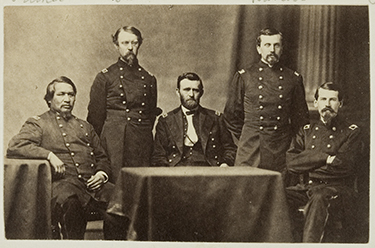
General Ulysses S. Grant and Staff: Ely Samuel Parker (left sitting), Adam Badeau, General Grant (at table), Orville Elias Babcock, Horace Porter. WIKIPEDIA

General Ulysses S. Grant and Staff: Ely Samuel Parker (left sitting), Adam Badeau, General Grant (at table), Orville Elias Babcock, Horace Porter. WIKIPEDIA

The “Indian at headquarters,” as many common soldiers referred to Parker, drew quite a bit of attention and became a noticeable fixture within Grant’s inner circle. In his mid-30s during the war, Parker stood 5 feet, 8 inches tall, and weighed about 200 pounds. Despite his robust frame, those who knew him well commented on his quiet and calm demeanor. Some remarked about his uncanny memory and knowledge by calling him “200 pounds of encyclopedia,” but Parker self-deprecatingly referred to himself as “a savage Jack Falstaff.” Although he served primarily as an “indoor man,” drafting orders and handling correspondence for Grant, he saw action at Chattanooga and later during the Wilderness Campaign in Virginia.

On May 7, 1864 — the night after the Battle of the Wilderness — Parker accompanied Grant and Gen. George Meade, along with a few others, in moving the general’s headquarters. As they traversed the roads and paths around the battleground, they found themselves surrounded by smoldering thickets and congested main paths. They took a side route to avoid these obstacles. Unbeknown to Cyrus Comstock, the aide-de-camp who was leading the group, they had stumbled dangerously close to the Confederate line.

Parker, riding in the rear, realized the perilous predicament and warned Grant and the others ahead. Before long, he took the lead, and, as he later wrote, “put the spurs to my black horse and galloped off in another direction and they full tilt after me.”

Parker spoke with a captured Confederate captain shortly after the ensuing Battle of Spotsylvania. The man had watched the Union officers gallop a mere 200 yards from his post and admitted that he and his compatriots were planning to ambush Grant and the rest of the men “in the next five minutes,” had Parker not led them away.

At the end of the war, Parker again demonstrated his poise and composure, this time in the front parlor of Wilmer McLean’s home at Appomattox Court House. After Grant had drafted the terms of surrender, he “called Colonel Parker to his side and looked it over with him.” Shortly thereafter, Grant asked his senior adjutant general, Theodore S. Bowers, to pen the final terms in ink. Bowers was too nervous to write, destroying several sheets of paper in the process. Grant then turned to Parker, who quietly transcribed the final copy, thus being the last person to put ink to paper before the two famous generals scrawled their names.

Native communities and the Civil War share a curious history. Native Americans largely disappear from our recollection of those events, save for the marginal locations where they act as sidebars to the events happening on major battlefields and campaigns. Or, when native people do appear in the geographic center of the war, they are depicted as people thrust into daunting and precarious positions, such as those of Southern Indian nations — the Choctaw especially.

All of these stories are important, but others are, too. Although Parker’s wartime career may have been exceptional, owing in part to antebellum friendships with men who found themselves in positions of power during the war, Native American contributions to the war should be highlighted more often and in the same breath as those of men like Grant, Meade and countless others. Indigenous men from across the United States joined both Union and Confederate armies and participated in ways far more meaningful than most Americans have remembered. During these sesquicentennial years of Civil War commemoration, it is important to remind ourselves that it was more than an “affair between white men.”

Sources: Ely S. Parker, “Writings of General Parker,” Proceedings of the Buffalo Historical Society 8 (1905); Horace Porter, “Campaigning with Grant”; Sylvanus Cadwalader, “Three Years with Grant”; Arthur Parker, “The Life of General Ely S. Parker”; William Armstrong, “Warrior in Two Camps: Ely S. Parker, Union General and Seneca Chief”; Laurence Hauptman, “The Iroquois in the Civil War: From Battlefield to Reservation.” The author would like to thank James J. Buss, Boyd Cothran, Betsy Hall and Steve Hochstadt for sharp and insightful suggestions.

C. Joseph Genetin-Pilawa in an assistant professor of history at Illinois College and the author of  Crooked Paths to Allotment: The Fight over Federal Indian Policy after the Civil War.

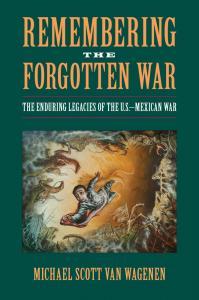
H-Diplo Review Essay on Michael Scott Van Wagenen. Remembering the Forgotten War: The Enduring Legacies of the U.S.–Mexican War. Amherst and Boston: University of Massachusetts Press, 2012. 330 pp., 30 b&w illus. ISBN 978-1-55849-930-0.

Reviewed for H-Diplo by Douglas Murphy, National Park Service

9781558499294The fact that there are distinct differences in the way that citizens of the United States and Mexico recall the conflict between their two countries has long been a sort of elephant in the room. Observers seem eager to point out that it is there but rarely appear motivated to explain how it managed to squeeze through the doorway. Over the past thirty years, it has become a tradition for authors to point out that Americans “generally give scant attention to the sordid but successful adventure” 1 that transferred half of Mexico’s territory to the United States while at the same time noting that “the bitterness of the loss has not been erased from Mexican memory.”2 The cause of this divergence is generally left unstated, though readers are frequently left with the vague impressions that Mexicans have nurtured a grudge for decades and Americans have simply elected to sweep an unseemly chapter in their history under the rug.
Michael Van Wagenen has dared to venture into this room and finally asks how the elephant got there. He reviews more than 160 years of United States and Mexican history and a diversity of source materials in an effort to determine how memories of that war have evolved since 1846 and the implications of those recollections for each nation and in terms of the relations between the countries.
He reveals two very different approaches to memory. Mexico carefully crafted an official memory of the conflict, not as an expression of anger against the United States, but as part of an effort to set aside the shame of defeat and create national unity and support of the central state.    At the heart of this effort the “Niños Heroes”—six young military cadets who died in defense of their country— evolved into martyrs who «inspired pride in the indomitable Mexican spirit and forwarded …domestic and international goals» (138). By contrast, recollection of the war in the United States has always been a much more diffuse enterprise, with communities and individuals taking the lead in devising memorials and monuments to local heroes or connections. Many of the initial efforts to mark the war were swept away by the Civil War, which had a much larger and more direct impact on American lives. Many Mexican War veterans also served the Confederacy, and when the Union was restored, there was little effort to honor the men who had later turned against their country. By the twentieth century, only a few staunch descendants of the players in the grand drama of 1846-1848 continued to develop monuments and memorials, often to glorify themselves at the exclusion of others.
The author finds pitfalls in both routes to memory. In the United States, where the federal government has generally avoided the memory-making business, heritage groups and Chicano groups often find themselves at odds over interpretations of the war while the mass of population cares little at all. In Mexico, the effort to establish an official memory has been equally problematic. Efforts to wean generations of citizens on the legend of the Niños Heroes, for example, have occasionally backfired, with protesters co-opting the story to justify resistance to the government and its policies. The mythology of the Boy Heroes also occasionally conflicts with relations with the United States. In one of the more interesting themes of the book Van Wagenen describes how the Mexican government has struggled, occasionally in vain, to use the war to promote nationalist rather than anti-Yanqui sentiment. Likewise he recounts the complex dance that U.S. officials must undertake in order to respond to Mexico’s memory of the war and the complex array of memories on the home front.
The book delves into broad array of topics from U.S. town names and the Mexican national anthem in the nineteenth century to efforts to develop bi-national cooperation on documentaries and historic sites in the late twentieth century. Other topics include veteran’s pensions, Santa Anna’s captured leg, living history programs and battle reenactments, and even films about deserters and cannibalism. The reader comes away with a clear impression that the war has never been forgotten at all, but molded, misinterpreted, and distorted to serve many different ideologies and causes.
Despite this extensive coverage, the book also occasionally leaves the reader wanting more. In several instances, the author describes how certain groups recalled the war, sets forth a handful of examples, then suggests that this sentiment was shared by a much larger segment of the population. The conclusions are likely true, but because of the dearth of surveys or polls that would provide statistical support, it would be helpful to see additional citations and demonstrations that corroborate these assertions. Also absent is a discussion of formal education in the United States. While there is an interesting analysis of the ways in which Mexican authorities have utilized textbooks to portray the North American intervention and to inculcate children, there is no equivalent look at the United States. Anyone who has ever interacted with the American general public on the topic of the war with Mexico has frequently heard the lament, ‘they never taught that in school.’ Van Wagenen states with conviction that many Americans draw their limited, often-erroneous knowledge of the U.S.-

Mexican War from television programs like Davy Crockett and The Simpsons. Unfortunately he does not delve into the U.S. education system or explain why the conflict continues to receive scant attention in elementary and high school classrooms.
These omissions do not undermine the overall value of this work. The book still provides an important explanation of how two societies developed very different memories of a shared conflict. Although other readers will have differing ideas on what should have been added or left out, they will at least come away with an understanding of how the elephant entered the room and even gain some insight about where it might go from here.

1. Lester Langley, Mexamerica: Two Countries, One Future (New York: Crown Publishers, 1988), 281.

2. Jeffrey Davidow, The Bear and the Porcupine: The U.S. and Mexico (Princeton, N.J.: Markus Wiener Publishing, 2007), 14.

Douglas Murphy is Chief of Operations at Palo Alto Battlefield National Historical Park. He received his Ph.D. from the University of North Carolina at Chapel Hill. His publications on the U.S.-Mexican War include “The March to Monterrey (Tennessee) and the View From Chapultepec (Wisconsin), The Mexican War and U.S. Town Names,” Military History of the West, Fall 2010, and «Dogs of Destiny, Hounds From Hell, American Soldiers and Canines in the Mexican War,» Military History of the West, Spring 1996.  His book War Comes to the Rio Grande: The Opening Campaign of the Mexican War will be published by Texas A&M University Press in 2014.

URL: http://www.h-net.org/~diplo/essays/PDF/Murphy-Wagenen.pdf

Huellas2

Acaba de salir el úlimo número de la revista Huellas de Estados Unidos de la Cátedra de Historia de Estados Unidos de la UBA. Componen este número un interesante grupo de trabajos sobre aspectos ideológicos de política exterior estadounidense y sobre el tema del consenso político. Completan este número un par de valiosos documentos sobre el racismo. Todos los ensayos y reseñas están disponibles en PDF.

Comparto aquí el índice de este número.
………………………………………….

………………………………………….

………………………………………….

……………………………………………

………………………………………….

……………………………………………

………………………………………….

………………………………………….

………………………………………….

………………………………………….

An Isolationist United States? If Only That Were True
Tim Reuter

Forbes, October 10, 2013

“Peace, commerce, and honest friendship with all nations, entangling alliances with none.”  Thomas Jefferson, First Inaugural Address.

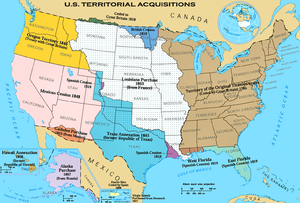
This image depicts the Territorial acquisitions of the United States, such as the Thirteen Colonies, the Louisiana Purchase, British and Spanish Cession, and so on.  (Photo credit: Wikipedia)

This image depicts the Territorial acquisitions of the United States, such as the Thirteen Colonies, the Louisiana Purchase, British and Spanish Cession, and so on. (Photo credit: Wikipedia)

George Orwell once wrote that if “thought corrupts language, language can also corrupt thought.”  He derided his contemporaries for how their use and abuse of the term fascism emptied the word of any meaning.  The subsequent inability to define fascism degraded it “to the level of a swearword,” and a slur for use against anyone or anything deemed undesirable.

The same holds true for the word isolationism, and its use in American foreign policy discussions.  Proponents of American empire hurl the words isolationism and isolationist at their critics to tar them as ignoramuses and kooks.  The neoconservative movement’s scion, super hawk Bill Kristol, has dismissed, the non-interventionist and possible 2016 presidential candidate, Senator Rand Paul as a “neo-isolationist.”

Charles Krauthammer was more explicit in a Washington Post op-ed on August 1:

“The Paulites, pining for the splendid isolation of the 19th century, want to leave the world alone on the assumption that it will then leave us alone.  Which rests on the further assumption that international stability — open sea lanes, free commerce, relative tranquility — comes naturally, like the air we breathe.  If only that were true. Unfortunately, stability is not a matter of grace.  It comes about only by Great Power exertion… World order is maintained by American power and American will.  Take that away and you don’t get tranquility.  You get chaos.”

The specter of renewed intervention in the Middle East (attacking Syria) may have passed, but the slur remains.  Neoconservative intellectuals, obsessed with American military might, have stamped non-interventionists and the war weary public alike as isolationists.

But in the history of American foreign affairs, isolation has never meant a lonely existence.  Instead, it implied security.  The “splendid isolation” phrase mocked by Krauthammer comes from late Nineteenth Century British statesman who viewed Britain’s interests as distinct from continental Europe’s.  The English Channel separated British security concerns from the continent’s power politics and wars.  This geographic isolation helped demarcate differences between colonial security interests, which Britain routinely acted on, and homeland security.

Something similar was true for the United States.  German Chancellor Otto von Bismarck put the matter well: “The Americans are truly a lucky people.  They are bordered to the north and south by weak neighbors and to the east and west by fish.”  The Founding Fathers agreed.

Americans had the geographic luck of distance from Europe and its conflicts.  Out of this ability to avoid unnecessary wars that jeopardized life and liberty, came the Founders’ caution.  Before Jefferson’s aforementioned quip, George Washington stated the matter bluntly in his Farewell Address.  “It is our true policy to steer clear of permanent alliances with any portion of the foreign world.”

Such counsel contained a powerful strain of realism.  Strict neutrality was the infant nation’s best hope for survival amid international turmoil.  The global nature of the French Revolutionary and Napoleonic Wars threatened to ensnare and destroy the republic with one misstep or ill-fated alliance.  President James Madison nearly did just that in the War of 1812 when British forces burned Washington D.C.

In the republic’s harrowing early years, one should note the impossibility of isolation or having no foreign contact.  The world war meant the U.S. needed diplomatic relations and readiness for conflict.  Sometimes the two overlapped, such as when hostilities began in 1812 over the repeated impressment of American sailors into the Royal Navy.  But, the key for the Founders was to comprehend foreign threats and respond appropriately.

Prescribed aloofness from European power politics never concerned diplomacy or trade.  The Founders encouraged the latter, while the former became easier after Napoleon’s fall in 1815.  Indeed, diplomacy was critical to bolstering U.S. security.

The Louisiana Purchase of 1803 did more than add land.  It reduced the presence of France, and then Spain, in North America and secured American control of the Mississippi River.  The Adams-Onís Treaty of 1819 built off of Jefferson’s work.  It exchanged vague boundary claims in present-day Texas for Spanish Florida, and consolidated American control of land east of the Mississippi River.  Moreover, New Spain (Mexico and Central America) became independent soon thereafter.

In 1823, President James Monroe warned European nations against re-colonizing Latin America.  Such efforts would constitute a serious threat to U.S. security.  Despite America’s inability to enforce the Monroe Doctrine, and whether by design or accident, Britain tacitly approved.  Spanish re-conquest likely meant a reestablished mercantilist system.  If the Royal Navy kept prospective colonizers out, those new markets would likely stay open.  This overlap of British economic interests and American geopolitical interests benefited the United States immensely.

As Europe settled into peace, foreign crises abated and the market revolution began.  Over the succeeding years, U.S. economic growth exploded, the restraints of weakness fell away, and politicians’ desire to exercise power grew.  From 1815 to the Civil War, Americans made plenty of mischief abroad.  The U.S. declared one war (against Mexico 1846-1848), threatened another with Britain over border disputes regarding Canada out west (1845-1847), and issued ultimatums to Spain about freeing Cuba (the 1854 Ostend Manifesto).

The justification for this belligerency may sound familiar, freedom.  In July 1845, a young writer named John L. O’Sullivan published an editorial entitled “Annexation” in The United States Democratic Review.  This piece mixed freedom with foreign policy, and turned a famous phrase.  O’Sullivan opined about America’s “manifest destiny” to “overspread the continent allotted by Providence for the free development of our yearly multiplying millions.”

O’Sullivan did not mean territorial acquisition by force.  Instead, the spread of free peoples and success of free institutions would exercise a gravitational pull.  American energy and productivity would inexorably draw North America’s foreign territories into the Union.  California, then part of Mexico, was a case in point.

“Already the advance guard of the irresistible army of Anglo-Saxon emigration has begun to pour down upon it, armed with the plough and the rifle, and marking its trail with schools and colleges, courts and representative halls, mills and meeting-houses.  A population will soon be in actual occupation of California, over which it will be idle for Mexico to dream of dominion.”

Stated succinctly, freedom’s power lay internally.  Americans’ success as free people marked them as chosen by God to show the way to a better future.  Moreover, once the U.S. conquered North America, no European power would equal its strength.  O’Sullivan concluded:

“Away, then, with all idle French talk of balances of power on the American continent [emphasis in the original]… And whosoever may hold the balance, though they should cast into the opposite scale all the bayonets and cannon, not only of France and England, but of Europe entire, how would it kick the beam against the simple solid weight of two hundred and fifty, or three hundred millions-and American millions-destined to gather beneath the flutter of the stripes and stars, in the fast hastening year of the Lord 1945!”

Others shared such sentiments, including the new president.  In his first annual message to Congress in December 1845, President James Polk stated, “the expansion of free principles and our rising greatness as a nation are attracting the attention of the powers of Europe.”  That attention brought about the threat of a “ ‘balance of power’ ” system imposed “on this continent to check our advancement.”

The solution was territorial acquisition.  A trans-continental United States would, excluding British Canada, end European intrigue and mischief making in North America.  If it came at the expense of others, then so be it.  Such thinking was not confined to the younger generation.  President Andrew Jackson said of Mexico’s breakaway Texas province in 1844: it was “the key to our safety” and would “lock the door against future danger.”  Texas was duly annexed in February 1845, while the Oregon territory and California followed soon thereafter.

But ultimately, America’s exaltation of freedom did not stop with continental conquest.  It turned outward after Reconstruction and the beginning of the Industrial Revolution.  While not inevitable, the transition from Jefferson’s “empire of liberty,” to an imperial power built off early expansionist impulses.

As European nations carved up Africa, Americans watched a horror show closer to home.  In February of 1895, Cuba’s Spanish masters brutally suppressed an insurrection.  Mass arrests, concentration camps, and destruction of property continually wracked the island.  Such carnage, inflamed by mass media, attracted renewed American interest in obtaining Cuba.  However, the reasons for annexation had changed with the times.

Early interest fit into O’Sullivan’s model of gravitational pull.  As Monroe’s Secretary of State (1817-1825), John Quincy Adams labeled Puerto Rico and Cuba “natural appendages of the North American continent.”  Once free, both could “gravitate only towards the North American Union.”  His contemporaries and successors agreed: Madison tried to buy the island in 1810 and annexationists eagerly awaited its freedom in 1848 as revolution gripped Europe.  Yet, Cuba stayed Spanish real estate.

With wealth and power by the end of the Nineteenth Century, American opinions on imperialism had changed.  Given its proximity, Cuba was a logical target.  Some, such as Senator Henry Cabot Lodge of Massachusetts, appealed to security concerns.  He called Cuba a “necessity” to the defense of the Panama Canal upon its completion.  Others, namely Senator Morgan of Alabama, thought the prior generations’ wisdom was obsolete.  He unabashedly stated, “Cuba should become an American colony.”

While Cuba burned, jingoists kept agitating for colonialism on newer, and more expansive, grounds.  In April 1898, with war declared on Spain, freedom’s forceful expansion reached its supreme perversion in a speech by Senator Albert Beveridge of Indiana.  “The progress of a mighty people and their free institutions” begun at the Nineteenth Century’s start was nearing its apex.  “Fate has written our policy for us; the trade of the world must and shall be ours.”  This quest for an empire of trade wrested Cuba, Puerto Rico, Guam, and the Philippines from Spain in three months.

The turn from the past finished four years later in a faraway land.  On July 4, 1902 President Theodore Roosevelt extended pardons to all those involved in the Filipino insurrection.  This gesture came after roughly a million Filipinos died in a guerilla war against U.S. forces.  Upwards of 75,000 American soldiers suppressed the rebellion, captured Aguinaldo (the rebellion’s leader), and solidified American control over the nation’s new Pacific trade post.  All that remained was to “civilize and Christianize” the “little brown brothers.”  While it might take a while, Governor-General William Howard Taft estimated “fifty or one hundred years,” the empire would endure.

The neocons’ chest thumping about American power relies on alleged international benefits, open seas, outweighing the negatives of expense or quagmires.  They seemingly do not consider, or care about, domestic consequences; centralized power, distorted perceptions of the military’s role in protecting society, and intellectuals playing social engineers.

Some statesmen, in their humility, knew better.  Eighty-one years before Roosevelt’s pivot to imperialism, John Quincy Adams channeled his father’s generation.  On July 4, 1821, he issued as sublime a statement of U.S. foreign policy ever written.

“But she [America] goes not abroad, in search of monsters to destroy.  She is the well-wisher to the freedom and independence of all. She is the champion and vindicator only of her own… She well knows that by once enlisting under other banners than her own, were they even the banners of foreign independence, she would involve herself beyond the power of extrication, in all the wars of interest and intrigue, of individual avarice, envy, and ambition, which assume the colors and usurp the standard of freedom.  The fundamental maxims of her policy would insensibly change from liberty to force [emphasis added].”

How prophetic.  Yet, it seems the era of intervention that climaxed under President George W. Bush is at its end.  Its foundational ideas are in retreat despite the bellowing of its loudest spokesmen.   The next, and final, step for such bankrupt ideas and the isolationist slur is residence in the dustbin of history.

This article is available online at:
http://www.forbes.com/sites/timreuter/2013/10/10/an-isolationist-united-states-if-only-that-were-true/

by Jeremy Kuzmarov

October 10, 2013
 

A U.S. Marine helicopter (a Huey, not a Black Hawk) over Mogadishu in 1992. Photo credit: Wiki Commons.

Last week marked the twentieth anniversary of the infamous Black Hawk Down incident where Somali militia fighters loyal to Mohammed Farah Aidid shot down two American helicopters using rocket-propelled grenades. Mobs then hacked the fallen pilots to death with machetes and dragged their mutilated bodies through the streets as trophies. To mark the anniversary, 60 Minutes aired a segment focused on efforts by two private American security contractors to recover remnants of the helicopter that had been shot down, while interviewing retired Special Forces operative who had survived the ordeal.

Like much mainstream media coverage of U.S. foreign policy, the program memorialized the deaths only of the Americans killed in the fighting. While the death of those young men was indeed tragic, what went unreported is the fact that the militia fighters who shot down the Black Hawk helicopters had been previously attacked and family members had been killed by U.S. forces. In rescue operations, American helicopter gunners and Special Forces fired into crowds, killing and wounding hundreds of Somalis, a third of them women and children, compared to eighteen American dead. Bill Clinton commented: “When people kill us, they should be killed in greater numbers.”

American military intervention in Somalia was officially designed to establish a “secure environment for the delivery of humanitarian relief” after clan warfare erupted following the overthrow of dictator Siad Barre. Unbeknownst to most Americans, the United States had helped to create the conditions that produced unrest, flooding the country with weaponry during the Cold War along with the Soviets. In 1988, Barre’s legions leveled the northern city of Hargeisa and killed 60,000 in an effort to suppress an Isaaq clan based rebellion. The U.S. assisted Barre with intelligence and shipped 1,200 M-16 assault rifles and 2.8 million rounds of ammunition, having provided over $1 billion in aid since his ascension in 1969. Pointing to the strategic interests driving U.S. policy, General Norman Schwarzkopf noted that The Red Sea, with the Suez Canal in the North and the Bab-el-Madeb in the South, is one of the most vital sea lines of communication and a critical shipping link between our Pacific and European allies.”

After Barre’s ouster, the opposition split into two factions, one led by Aidid, the former army chief of staff trained under American police programs. Africa Watch reported that the warring parties engaged in “wanton and indiscriminate attacks on civilians,” producing conditions of famine. On December 9, 1992, as the TV networks broadcast harrowing images of emaciated children, the lame-duck Bush administration launched Operation Restore Hope, in which 28,000 U.S. forces stormed Mogadishu in what Le Monde described as “the most media-saturated landing in military history.” Lives were likely saved, though food had already begun to get through by this time and relief specialist Fred Cuny noted a smaller operation in the famine triangle away from Mogadishu would have been more effective.

U.S.-U.N. forces were commanded by Admiral Jonathan Howe, a key figure in the capture of Manuel Noriega and William Garrison, a cigar chomping Texan with twenty-five years experience in unconventional warfare. Charging Gen. Aidid with war crimes for interfering with their mission, they bombed radio Mogadishu, possibly to prevent announcement of a peace deal between the clans. Pakistani soldiers subsequently fired on demonstrators, prompting counter-attacks by Aidid’s militias who killed 24 of them. The U.N. Security Council then authorized “all necessary measures to apprehend those responsible.” The U.S.-U.N. placed a $25,000 bounty on Aidid’s head and engaged in manhunt operations which culminated in the Black Hawk Down incident. War crimes were committed by American, Belgian, Canadian and French forces, who tortured prisoners, raped women, destroyed cultural symbols and shot missiles into clan elder meetings, a marketplace and the main hospital in Mogadishu. Americans taking the lead in fighting operations did not know enough about Somalia to “write a high-school paper about it,” according to journalist Mark Bowden. “Their experience of battle, unlike that of any other generation of American soldiers was colored by action movies. They remarked again and again how much they felt like they were in a movie, and had to remind themselves that this horror, the blood, the death, was real.”

As political scientist David Gibbs has pointed out, American envoy Robert Oakley had close relations with the Continental Oil Company (Conoco) which provided military intelligence and helped plan the logistics for the Marine landing. Its corporate compound was transformed into a defacto U.S. embassy. The Los Angeles Times reported that “industry sources said that the companies holding the Somali exploration rights are hoping that the Bush administration’s decision to send U.S. troops will also help protect their multimillion dollar investments there.” Early in the operation, Conoco made an agreement with Aidid that it would back him if he would grant Conoco exclusive rights to oil exploration. Aidid however did not want to barter away Somali resources, demanding large concessions, and so Conoco switched to backing rival Ali Mahdi. American foreign policy followed suit. Aidid subsequently urged his supporters to “turn against the Americans” and began waging urban guerilla warfare. Journalist Scott Peterson notes that the U.S. essentially handed Aidid the patriotic mantle of the Mad Mullah (Mohammed Abdullah Hassan), a nineteenth-century nationalist who had mobilized support against Italian and British occupiers.

The Black Hawk Down incident should provide a cautionary tale about military intervention and its often destructive consequences. Unfortunately, the public remains misinformed about U.S. foreign policy, in good part because they rely for information on TV shows like 60 Minutes which fail to dig beneath the surface to uncover the hidden motives driving U.S. intervention or analyze its effect on the subject population.

Jeremy Kuzmarov is J.P. Walker assistant professor of history at the University of Tulsa and author of Modernizing Repression: Police Training and Nation Building in the American Century (Massachusetts, 2012).

– See more at: http://hnn.us/article/153561#sthash.tFKAucYo.dpuf

by D. Andrew Austin and Mindy R. Levit

October 9, 2013


Photo credit: Wiki Commons.

The following is excerpted from the paper «The Debt Limit: History and Recent Increases,» published by the Congressional Research Service on September 25, 2013.

Origins of the Federal Debt Limit

Congress has always placed restrictions on federal debt. Limitations on federal debt have helped Congress assert its constitutional powers of the purse, of taxation, and the initiation of war. Between World War I and World War II the form of statutory restrictions on federal debt evolved into an aggregate limit that applied to nearly all the federal debt outstanding.

Before World War I, Congress often authorized borrowing for specific purposes, such as the construction of the Panama Canal. (76) Congress also often specified which types of financial instruments Treasury could employ, and specified or limited interest rates, maturities, and details of when bonds could be redeemed. In other cases, especially in time of war, Congress provided the Treasury with discretion, subject to broad limits, to choose debt instruments. (77) Some opponents raised concerns that granting the Treasury Secretary authority to issue debt could affect monetary policies, which might tighten credit conditions. Proponents contend that federal borrowing would not disrupt settlements on such monetary issues reached in 1878 and 1890. Such concerns became moot after the establishment of the Federal Reserve System in 1913.

For example, the War Revenue Act of 1898 allowed Treasury to use certificates of indebtedness, which had maturities of a year or less, and were used for short-term borrowing and cash management, as well as long-term bonds. (78) For example, the 1898 War Revenue Act (30 Stat. 448-470) that funded Spanish-American War costs granted the Treasury Secretary the authority to have $100 million outstanding in certificates of indebtedness with maturities under a year, which were mainly sold to large investors, banks, and other financial institutions. The act also allowed the Treasury to issue $400 million in longer-term notes and bonds, which were made available to public subscription, allowing smaller investors to participate. Proponents of the act, however, made clear their intention to allow the Treasury Secretary substantial administrative leeway within those limits. (79)

World War I and the Liberty Bond Acts

Over time, the leeway granted the Treasury Secretary tended to expand. For example, the Second Liberty Bond Act of 1917, which helped finance the United States’ entry into World War I, dropped certain limits on the maturity and redemption of bonds. (80) The act also incorporated unused borrowing capacity authorized by the First Liberty Bond Act (40 Stat 35; P.L. 65-3) and other previous borrowing acts. (81) Separate limits for previous debt issues, however, were retained in the text of that act — an overall aggregated debt limit evolved later. Features of debt authorized by previous acts, such as the broad tax exemption for First Liberty Bond Act securities, remained intact.

Subsequent borrowing measures were drafted as amendments to Second Liberty Bond Act until 1982. (82) Setting debt policy by amendments to the Second Liberty Bond Act of 1917 rather than through original statutes reflected changes in legislative drafting practices at that time. (83)

In the 1920s, Congress provided Treasury Secretary Andrew Mellon with additional leeway in order to replace expensive older federal debt with cheaper new issues. Congress allowed Treasury to issue notes, a financial instrument issued extensively in the Civil War and rarely thereafter, and limited the amount of notes outstanding, rather than the sum of issuances, which gave greater Treasury flexibility to roll over debt. Savings certificates designed for small investors were also reintroduced. (84)

Aggregate Debt Limit Created in 1930s

In the 1930s, Congress moved towards aggregate constraints on federal borrowing that allowed the Treasury greater ability to respond to changing conditions and more flexibility in financial management. In 1930, Treasury Secretary Mellon, noting that Liberty bonds would become ready for refinancing in the next few years, argued that «orderly and economical management of the public debt requires that the Treasury Department should have complete freedom in determining the character of securities to be issued and should not be confronted with any arbitrary limitation» (85) Congress granted the U.S. Treasury greater flexibility in issuing bonds in 1931. (86)

In 1935, Treasury Secretary Henry Morgenthau called for replacing a limit on bond issuance with a more flexible limit on the amount of outstanding bonds. This change underlined Treasury bonds’ role as a means of managing federal finances rather than securities tied to specific projects of wars. (87) Following that request, Congress then established a $20 billion limit on shorter-term debt and a $25 billion limit on outstanding bonds.

In March 1939, President Franklin Roosevelt and Secretary Morgenthau asked Congress to eliminate separate limits on bonds and on other types of debt. (88) The House approved the measure (H.R. 5748) on March 23, 1939, and the Senate passed it on June 1 (P.L. 76-201). When enacted on June 20, the measure created the first aggregate limit ($45 billion) covering nearly all public debt. (89) Combining a $30 billion limit on bonds with a $15 billion limit on shorter-term debt, while retaining the $45 billion total limit in effect, enabled Treasury to roll over maturing notes into longer-term bonds. This measure gave the Treasury freer rein to manage that would reduce interest costs and minimize financial risks stemming from future interest rate changes. (90) While a separate $4 billion limit for «National Defense» series securities was introduced in 1940, legislation in 1941 folded that borrowing authority back under an increased aggregate limit of $65 billion. (91)

Although the Treasury was delegated greater independence of action on the eve of the United States’ entry into World War II, the debt limit at the time was much closer to total federal debt than it had been at the end of World War I. For example, the 1919 Victory Liberty Bond Act (P.L. 65-328) raised the maximum allowable federal debt to $43 billion, far about the $25.5 billion in total federal debt at the end of FY1919. (92) By contrast, the debt limit in 1939 was $45 billion, only about 10 percent above the $40.4 billion total federabl debt of that time (93).

World War II and After

The debt ceiling was raised to accommodate accumulating costs for World War II in each year from 1941 through 1945, when it was set at $300 billion. (94) After World War II ended, the debt limit was reduced to $275 billion. Because the Korean War was mostly financed by higher taxes rather than by increased debt, the limit remained at $275 billion until 1954. After 1954, the debt limit was reduced twice and increased seven times, until March 1962 when it again reached $300 billion, its level at the end of World War II. Since March 1962, Congress has enacted 77 separate measures that have altered the limit on federal debt. (95) Most of these changes in the debt limit were, measured in percentage terms, small in comparison to changes adopted in wartime or during the Great Depression. Some recent increases in the debt limit, however, were large in dollar terms. For instance, in May 2003, the debt limit increased by $984 billion and in February 2010 the debt limit was increased by $1.9 trillion. (P.L. 111-139)

* * * * *

(76) Spooner Act of June 28, 1902 (32 Stat 481; P.L. 57-183)

(77) Marshall A. Robinson, The National Debt Ceiling: An Experiment in Fiscal Policy, (Washngton, D.C.: Brookings Institution, 1959), pp. 1-6.

(78) The War Revenue Act was enacted June 13, 1898. Much of the legislative text of the act’s public borrowing sections (§32, 33) were drawn from the acts of June 30, 1864, ch. 172 §1 (13 Stats. 218) and of March 3, 1865, ch. 77 (13 Stats. 469).

(79) See House debate, Congressional Record, vol. 31, part 6 (June 9, 1898), pp. 5713-5728; and Senate debate on June 10, 1898, pp. 5732-5749.

(80) P.L. 65-43, 40 Stat. 288, enacted September 24, 1917. See H. J. Cooke and M. Katzen, «The Public Debt Limit,» Journal of Finance, vol. 9, no. 3 (September 1954), pp. 298-303. The Second Liberty Bond Act allowed purchases of government debt of allied (i.e., Entente) countries, which would have complicated limits on the final redemption of federal bonds issued to fund their purchase. Some federal bonds issued in the wake of the Panic of 1893 did not have maturity limits.

(81) The other acts were the Panama Canal measure (Spooner Act; P.L. 57-183), the Payne-Aldrich Tariff Act of August 5, 1909 (36 Stat 11; P.L. 61-5); and two emergency bond measures passed in March 1917 (39 Stat 1002 and 39 Stat 1021).

(82) In 1982, the debt limit was codified into 31 U.S.C. §3101 by P.L. 97-258. Subsequent changes in the debt limit have been drafted as amendments to 31 U.S.C. §3101.

(83) Middleton Beaman, a former Law Librarian of the Library of Congress, Columbia Law School professor, and advocate for the professionalization of drafting legislation, retured to Washington in 1916 to assist the House Ways and Means Committee, which originated the Liberty Bond acts and other borrowing and revenue measures. This arrangement was formalized in 1918, when the Legislative Drafting Service, the predecessor office of the modern Office of Legislative Counsel, was established. Donald R. Kennon and Rebecca M. Rodgers, The Committee on Ways and Means a Bicentennial History 1789-1989, H. Doc. 100-244, p. 258. See also, Middleton Beaman, «Bill Drafting,» Law Library Journal, vol. 7 (1914), pp. 64-71. For a critical view of legislative drafting in prior decades, see James Bryce, The American Commonwealth, 3rd revised ed., vol. 1 (New York: Macmillan, 1920), chapter XV on «Congressional Legislation.»

(84) Revenue Act of November 23, 1921 (42 Stat 227; P.L. 67-98). See also Paul Studenski and Herman E. Kroos, Financial History of the United States, 2nd ed. (New York: McGraw-Hill, 1963), p. 316.

(85) Annual Report of the Secretary of the Treasury for 1930, p. 39. Available at http://fraser.stlouisfed.org/docs/publications/treasar/AR_TREASURY_1930.pdf.

(86) For details, see Kenneth D. Garbade, Birth of a Market, (MIT Press: Cambridge, MA, 2012), pp. 314-317.

(87) Ibid.

(88) New York Times, «President Urges Ending of Limit on Bonded Debt; Asks Congress to Facilitate Borrowing by Eliminating $30,000,000,000, ‘Ceiling’ Stands by Total Debt Top $45 Billion All Right for Now, Message Says — Yielding to Economizers is Seen,» March 21, 1939.

(89) P.L. 76-201. See also Senate debate, Congressional Record, vol. 84, part 6 (June 1, 1939), pp. 6480, 6497, 6501.

(90) This limit did not apply to certain previous public debt issues that compromised a very minor portion of the federal debt.

(91) Revenue Act of June 25, 1940 (54 Stat 516; P.L. 76-656) and Revenue Act of February 19, 1941 (55 Stat 7).

(92) U.S. Bureau of the Census, Historical Statistics of the United States: Colonial Times to 1970, H. Doc. 93-78 (Washington, GPO, 1975), Series Y 493-504.

(93) For a list of changes in the debt limit between September 1917 and 1941, see U.S. Treasury, Statistical Appendix 1980, Table 32 entitled «Debt limitation under the Second Liberty Bond Act, as amended, beginning 1917.»

(94) Public Debt Acts of 1941 (P.L. 77-7), 1942 (P.L. 77-510), 1943 (P.L. 78-333), and 1945 (P.L. 79-48).

(95) U.S. Office of Management and Budget, FY2010 Budget of the U.S. Government: Historical Tables, Table 7-3. Increases in the debt limited potentially enabled by the Budget Control Act of 2011 are counted as one alteration.

D. Andrew Austin is an analyst in economic policy and Mindy R. Levit is an analyst in public finance for the Congressional Research Service.

– See more at: http://hnn.us/article/153551#sthash.S5ogBP1B.dpuf

Opinionator - A Gathering of Opinion From Around the Web

Maximilian in Mexico

By PHIL LEIGH
 
New York Times, October 4, 2013

On Oct. 3, 1863, a Mexican delegation arrived in the Austrian port city of Trieste to officially offer Mexico’s imperial crown to the 31-year-old Archduke Ferdinand Maximilian, a scion of the Austrian branch of the Hapsburg royal family and the brother of the Austrian emperor, Franz Josef I.

For 300 years the family’s Spanish branch and its successors had, by virtue of its seat in Madrid, ruled over colonial Mexico and much of the Western Hemisphere. After Mexico won independence in 1821, it fell into a constant state of near anarchy; There were 75 government successions by the time the American Civil War started. Conservative Mexicans and wealthy ex-patriots longed for the stability that a European monarchy might provide, and some of them recalled wistfully the steady hand of the Hapsburgs.

Maximilian was interested for two reasons. The liberal-minded archduke felt he could improve Mexico. Perhaps more important, there was nothing for him at home: his brother was just two years older, and was looking forward to a long reign (in fact, he ruled until his death during World War I).

Still, Maximilian would never have ascended the Mexican throne were it not for yet another emperor, Napoleon III of France. Since Napoleon III’s famous uncle sold Louisiana to the United States in 1803, France had no major stake in the Western Hemisphere. With the advent of America’s Civil War, the French monarch sensed an opportunity to change that, with Maximilian as his puppet.

In early 1862, as America convulsed through the first year of its Civil War, France began placing troops in Mexico to collect customs duties on goods, in order to force the country to make payments on a defaulted debt to several European countries. But the Mexican government was too poor to concurrently make the payments and at the same time support the army of President Benito Juárez. Initially, soldiers from Spain and Britain joined the French, but were withdrawn once they realized Napoleon was scheming to establish a puppet monarchy. As a result, Maximilian would have no power without the presence of the 40,000-man French Army.

Napoleon had hoped to get Maximilian installed a year or so earlier, but he did not capture Mexico City until June 1863. Additionally, the archduke’s October ’63 acceptance of the crown was conditioned on “a vote of the whole country,” which was quickly achieved by gathering signatures under the glitter of French bayonets.

Still, Napoleon knew how drawn out the war was becoming and reasoned that President Abraham Lincoln would be too focused on suppressing the Confederacy to oppose him. The Monroe Doctrine would be temporarily impotent, while the future offered possibilities to render it permanently ineffective.

Although Juárez was forced out of Mexico City, he remained in the country opposing Maximilian during the entire American Civil War. Juárez quickly sided with Lincoln. Early in the war he granted the United States the right to land troops on Mexico’s west coast, where they could march rapidly into Arizona territory if needed to confront a possible Confederate drive westward. On doubtful authority the first Confederate minister to Mexico, John Pickett, countered by offering to support Mexico in the reoccupation of territories lost in the Mexican War, including the present states of California, Arizona, and New Mexico, if Juarez would cancel his deal with Lincoln.

Although Juárez declined, Washington realized that the Confederates could make a similar offer to Maximilian, turning the Mexican crisis into a proxy war. As one visitor to the archduke’s castle in Trieste wrote the Confederate minister in Paris,

Maximilian expressed the warmest possible interest in the Confederate cause. He said he considered it identical with that of the new Mexican Empire … that he was particularly desirous that his sentiments upon this subject should be known to the Confederate President.

The presence of a monarchy supported by a French army south of the border alarmed Washington and the far western states. In January 1864 Senator James McDougall of California proposed a Congressional resolution stating that French intervention in Mexico was “an act unfriendly to the republic of the United States.” It called upon the French to withdraw by March 15, and threatened war if they didn’t. But Lincoln wanted only one war at a time and had the motion sidetracked.

Nonetheless, three months later the House of Representatives unanimously approved a resolution that stated:

The Congress of the United States are unwilling … to leave … the impression that they are indifferent … [to] the deplorable events … in Mexico and … declare that it does not … acknowledge any monarchial government … in America under the auspices of any European power.

Although the Union’s concerns had validity, France wanted to avoid open warfare. In a Paris meeting before departing for Mexico, Napoleon, hopeful of territorial gains whichever side was victorious, convinced Maximilian to avoid endorsing the Confederacy until it won independence. As early as January 1863 the French consuls in Galveston and Richmond had been urging Texans to secede from the Confederacy..

After hearing about the French agitation in Texas, the Confederate Secretary of State, Judah Benjamin, instructed his Belgium minister to investigate. The man replied, “Mexico as she was previous to her dismemberment is the … cherished end at which [Napoleon III] aims.” Lincoln’s government captured Benjamin’s letter and asked its Brussels representative for his opinion. He confirmed that Napoleon III wanted Mexico to restore the borders applicable before the Mexican War. In short, he wanted Mexico to reclaim not only the Mexican Cession, but also Texas. Indeed, owing to its French traditions, Napoleon III believed that he might even be able to recover Louisiana. If all went as he hoped, France would once again have a major stake in the New World and the Monroe Doctrine would be meaningless.

The Confederacy reacted by expelling the offending diplomats, but Lincoln changed military priorities. After the fall of Vicksburg, Gen. Ulysses S. Grant wanted to lead an army reinforced by Gen. Nathaniel Banks against Mobile, Ala. A glance at a map confirms the obvious logic of the movement. Lincoln would not permit the advance, writing Grant, “in view of recent events in Mexico, I am greatly impressed with the importance of reestablishing the national authority in Western Texas as soon as possible.”

After a modest move against Brownsville and the Texas coast in November 1863, General in Chief Henry Halleck and cotton speculators urged a modification to the Union’s plans in the coastal Southwest that resulted in General Banks’s disastrous Red River Campaign in the spring of 1864. The goal was to capture the rebel stronghold at Shreveport, La., and then occupy the cotton fields of east Texas, while incidentally seizing up to 300,000 cotton bales (worth about $2 billion in today’s dollars) along the way. Unfortunately, even though Union forces outnumbered the rebels by more than two-to-one the Confederates turned back the federal offensive. Banks returned to New Orleans with fewer than 5,000 cotton bales, and the drive into Texas was halted.

Fortunately for the Union, the French and Maximilian were having a much harder time stabilizing their hold on Mexico than they had expected. After the end of the war, in an effort to help Juárez, Grant sent Gen. Philip Sheridan to the Rio Grande with an army of 50,000 men. Since Secretary of State William H. Seward did not want a war with Mexico or the French, he persuaded President Andrew Johnson to issue a ban on exports of weapons and ammunition. But Grant secretly ordered Sheridan to supply Juárez with matériel and weapons, including about 30,000 rifles.

Soon thereafter, Napoleon III announced a staged withdrawal of French troops, which left Maximilian nearly defenseless within two years. Juárez regained power in 1867, and promptly executed the naïve archduke.


Sources: “James J. Horgan, ““A Confederate Bull in a Mexican China Shop,” from “Divided We Fall: Essays on Confederate Nation Building,” John M. Belohlave, ed.; Henry Martyn Flint, “Mexico Under Maximilian”; Gene Smith, “Maximilian and Carlota”; Donald Miles, “Cinco de Mayo”; Robert Kerby, “Kirby Smith’s Confederacy”; Dean Mahin, “One War at a Time”; Frank Owlsey, “King Cotton Diplomacy”; Ludwell Johnson, “Red River Campaign”; G. J. Meyer, “A World Undone.”

disunion-phil-leigh-thumbStandardPhil Leigh is an independent Civil War historian and author. He is writing a book about wartime intersectional trade between North and South, “Trading With the Enemy.”

Political Posters in Castillo de San Cristobal - 06

The Untold Origins of the Cuban Missile Crisis

by Jack Coulhoun

History News Network, October 7, 2013

Excerpted from Gangsterismo: The United States, Cuba, and the Mafia, 1933-1966.

Jack Colhoun, “Aggressive U.S. Moves Against Cuba Loomed Large in Khrushchev’s Decision to Deploy Missiles to Cuba”

In Moscow, Chairman Nikita Khrushchev received fragmentary intelligence reports on Operation Mongoose. Khrushchev’s son Sergei writes, “Information came through secret channels about President Kennedy’s adoption of a wide-ranging plan, ‘Mongoose,’ to destabilize the situation in Cuba.” The younger Khrushchev adds, “Every day the Cubans expected a new invasion, this time not just by emigres but by the U.S. Army.”

The KGB was also picking up intelligence about large-scale U.S. military exercises rehearsing an invasion of Cuba. KGB Chief Vladimir Semichastny wrote in a February 21, 1962 report, “Military specialists of the USA had revised an operational plan against Cuba, which according to the information, is supported by President Kennedy.” The new KGB chief stated U.S. Army and Navy personnel would “be supported by military air assets based in Florida and Texas.”

In Washington, the Navy Commander-in-Chief, Atlantic (CINCLANT) issued planning directives for U.S. operational plans (OPLANs) for an invasion of Cuba in a February 14, 1962 telegram. OPLANs 314-61 and 316-61, joint Army, Navy, Air Force, and Marine Corps operations, were detailed plans for an amphibious landing of ground forces supplemented by air strikes. OPLAN 316-62 included a ground combat force of 150,000 troops. The Pentagon estimated that it would take ten days of heavy combat and 18,500 U.S. casualties to drive the Cuban revolution from power with an occupation of the island to follow.

In spring 1962, the United States conducted military exercises to test the readiness of its Cuba OPLANs with a series of military maneuvers in the Atlantic Ocean from North Carolina to the Caribbean Sea.

In April 1962, Chairman Nikita Khrushchev was in Bulgaria on a state visit. But his thoughts were thousands of miles away in the Caribbean. He worried that the United States was preparing to invade Cuba, and was preoccupied with defending the Cuban revolution.

The idea of deploying Soviet missiles to Cuba came to Khrushchev as he strolled along the Black Sea in Varna, Bulgaria with Defense Minister Rodion Malinovsky. Malinovsky pointed to Turkey across the Black Sea, noting the U.S. Jupiter missile base there. Intermediate-range Jupiter missiles could reach targets in the Ukraine and southern Russia within a matter of minutes. Khrushchev asked why the Soviet Union did not have the right to deploy missiles to Cuba as the United States did in Turkey. He was convinced that the presence of Soviet missiles in Cuba would deter a U.S. invasion of Cuba. Back in Moscow, Khrushchev pressed Malinovsky again: “What about putting one of our hedgehogs down the Americans’ trousers?”

This time, however, Khrushchev made a strategic argument. He pointed out that the installation of missiles in Cuba would also augment the Soviet Union’s strategic nuclear force.

He elaborated, “According to our intelligence we are lagging almost fifteen years behind the Americans in warheads. We cannot reduce that lead even in ten years. But our rockets on America’s doorstep would drastically alter the situation and go a long way towards compensating us for the lag in time.” Soviet intermediate-range ballistic missiles in Cuba would be capable of striking targets deep inside the United States, including New York and Washington.

The Kremlin was acutely aware of the margin of U.S. superiority over the Soviet Union in strategic nuclear weapons. According to Anatoly Dobrynin, the USSR’s ambassador in Washington, the USSR had 300 nuclear warheads compared to a U.S. arsenal of 5,000 warheads for intercontinental ballistic missiles (ICBMs) and B-52 bombers with an intercontinental range in October 1962. Khrushchev discussed his plan to deploy Soviet missiles to Cuba with only a handful of Soviet leaders.

Khrushchev consulted Foreign Minister Andrei Gromyko about his missile deployment plan. “The situation forming around Cuba at the moment is dangerous,” Khrushchev said. “It is essential that we deploy a certain quantity of our nuclear missiles there for its defense, as an independent state.” Gromyko responded, “I have to say quite frankly that taking our own nuclear missiles to Cuba will cause a political explosion in the United States.” Khrushchev dismissed Gromyko’s warning. Instead, he sought the counsel of Anastas Mikoyan, a veteran member of the Presidium and his closest associate.

Khrushchev later wrote, “Comrade Mikoyan expressed his reservations.” Khrushchev continued, “His opinion was that we would be taking a dangerous step … This step bordered on adventurism. This risk lay in the fact that in wanting to save Cuba, we could be drawn into a very terrible and unprecedented nuclear missile war. That had to be avoided by every possible means, and to consciously provoke such a war would really be dangerous.”

Khrushchev would not be deterred. On May 24, 1962, the Presidium met to consider Khrushchev’s missile deployment idea. According to the minutes of the meeting, the Presidium gave “full and unanimous approval of enterprise ‘Anadyr’ (subject to receiving F. Castro’s agreement).” KGB officer Alexandr Alexiev was summoned back to Moscow from his post in Cuba. When Khrushchev informed him that he would return to Cuba as the new Soviet ambassador, Alexiev was puzzled, because he was not a diplomat. Khrushchev explained, “What is important is that you are friendly with Fidel, with the leadership.” He noted, “And they believe in you, which is the most important thing.”

Khrushchev added, “Comrade Alexiev, to help Cuba, to save the Cuban revolution, we have reached a decision to place rockets in Cuba.” He asked, “What do you think? How will Fidel react? Will he accept or not?” Alexiev said he thought Castro would reject the missiles because they would compromise the independence of the Cuban revolution. Khrushchev responded, “There’s no other way for us to defend him.” He continued, “The Americans only understand force. We can give them back the same medicine they gave us in Turkey. Kennedy is pragmatic, he is an intellectual, he’ll comprehend and won’t go to war…”

The success of Khrushchev’s [ill-fated] exercise in Soviet missile power was predicated on presenting President Kennedy with a fait accompli. The Soviet “hedgehogs” would be installed in Cuba while Washington was preoccupied with the November 1962 congressional elections. Khrushchev would tell Kennedy about the Soviet missile deployment after the elections, when the missiles would be fully operational. Khrushchev [was confident] that Kennedy would not launch U.S. military strikes against the missile sites, because he could not be sure of taking out all of the missiles. He reasoned that Kennedy would grudgingly accept the missiles in Cuba as an alternative to nuclear war with the Soviet Union.

In June, Alexiev returned to Cuba with a delegation from the Soviet Union, including Marshal Sergei Biryuzov, head of the Strategic Rocket Forces, and Politburo member Sharaf Rashidov. When the delegation met with Fidel Castro, the Soviets discussed the international situation and the possibility of a U.S. invasion of Cuba. Marshal Biryuzov asked Castro what he thought would deter U.S. military intervention. Castro replied, “If the United States knows that an invasion of Cuba would imply war with the Soviet Union, then, in my view, that would be the best way to prevent an invasion of Cuba.” Castro wanted a formal Cuba-USSR defense pact.

The Soviet delegation insisted that only Soviet missile power could prevent U.S. intervention. The Soviets said the missiles would also enhance the power of the USSR and the Socialist bloc of nations. Castro responded, “If making such a decision is indispensable for the socialist camp, I think we will agree to the deployment of Soviet missiles on our island.” But he wanted to consult with his closest colleagues before making a decision about the missiles.

The next day Alexiev met again with Castro, who was joined by Che Guevara, President Osvaldo Dorticos, Carlos Rafael Rodriguez, and Blas Roca. Guevara stated, “Anything that can stop the Americans is worthwhile.” The Cubans approved the broad outline of the missile deployment plan. The details would be negotiated later in Moscow. The idea that Soviet missiles in Cuba would make the Socialist bloc stronger appealed to the Cuban revolutionaries. It also tempered their concern that the missiles would compromise the independence of the revolution.

Jack Coulhoun is an independent historian of the Cold War. He received his PhD from York University in Toronto in 1976. His work has been published by the Washington Post, Toronto Star, Christian Science Monitor, The Nation, The Progressive, National Catholic Reporter, In These Times, and Covert Action Quarterly. He was Washington bureau chief of the Guardian newsweekly from 1985 to 1992. –

See more at: http://hnn.us/article/153504#sthash.TjdAjtiq.dpuf