Feeds:
Entradas
Comentarios

Archive for the ‘Imperialismo norteamericano’ Category

Gracias al gran trabajo de difusión del Reportero de la Historia, puedo compartir con mis lectores este interesante artículo escrito por Felipe Portales y publicado en Clarín. En su artículo, titulado “El negacionismo estadounidense”, Portales critica lo que él describe como la tendencia de los estadounidenses a negar “hechos evidentes de su realidad histórica”,  y que no es otra cosa que una manifestación de la idea del excepcionalismo norteamericano que hemos examinado en esta bitácora en varias ocasiones.

El negacionismo estadounidense

Felipe Portales

Clarín, 19 de agosto de 2013

El término “negacionismo” se ha acuñado para referirse a los intentos de negar la verdad histórica respecto del genocidio sufrido por el pueblo judío bajo el nazismo, el peor crimen contra la humanidad cometido en la historia. Pero en el fondo apunta a un concepto tan viejo como la misma humanidad: a la idea de que personas, grupos o naciones son muchas veces dominados por la tentación de negar hechos evidentes de su realidad histórica que vulneran gravemente la dignidad humana o la justicia o de atribuirles un significado exculpatorio, con el objeto de percibirse a sí mismos como impolutos.

Pareciera que el negacionismo adquiere un peso particularmente grave en situaciones de guerra virtual o real. Como lo afirma el dicho popular, la primera víctima de una guerra es la verdad. Pero en conexión con ello, constatamos desgraciadamente que ha predominado también el negacionismo en la generalidad de la autoconciencia nacional a lo largo de la historia, inclusive en tiempos de paz. De este modo, y partiendo por la desinformación tan común en la formación escolar de los pueblos, se va socializando la idea de que nuestra nación ha tenido siempre toda la razón en los conflictos internacionales en que se ha involucrado; de que prácticamente nunca ha hecho nada malo; y de que, en el peor de los casos, frente a hechos históricos completamente innegables y que hoy son incuestionablemente condenables, se considera que ellos fueron justificables en el contexto de la época. Y aún más, la formación escolar enfatiza también la excelencia general de la propia historia nacional en su ámbito propiamente interno. Todo esto en contradicción con la moral más elemental que postula y constata la esencial ambigüedad de la condición humana en esta tierra.

En este sentido, llama particularmente la atención el extremo a que se llega en Estados Unidos; y es muy preocupante, dada la gran hegemonía que aún tiene aquel país en el mundo.

De partida, la consideración estadounidense de que su democracia nace con su independencia no resiste análisis. ¡Cómo va a ser democracia un sistema social con esclavitud por casi un siglo! Además, fue de los últimos países occidentales en abolirla y para ello tuvo que padecer una cruenta guerra civil. Luego, durante otro siglo, Estados Unidos mantuvo una discriminación oficial y de apartheid contra los negros, que se mantuvo en ciertas instituciones nacionales y en varios Estados del sur. Recién en 1948 se terminó con ella en el Ejército y en 1954 respecto de la educación. Pero hubo que esperar hasta 1965 para que se le reconocieran a toda la población negra del país el conjunto de los derechos civiles, políticos, económicos, sociales y culturales. Es decir, solo se puede hablar de democracia en Estados Unidos –considerándolo como un sistema político basado en un sufragio universal efectivo- desde esa fecha bastante reciente. A lo anterior hay que agregar que con la complicidad o tolerancia –al menos- de muchas autoridades sureñas se mantuvo durante décadas una virtual violencia institucional contra los negros, representada principalmente por la acción del Ku Klux Klan

Otro elemento fundamental del negacionismo estadounidense lo constituyó su expansión hacia el oeste que fue justificada como un “mandato divino” (Ver Albert K. Weinberg.- Destino Manifiesto) y que incluyó el desplazamiento y exterminio de casi toda su población autóctona. Esto significó uno de los peores genocidios –si no el peor- cometidos por la humanidad durante el siglo XIX. Y en vez de haberlo reconocido posteriormente, la sociedad estadounidense se envaneció de aquel durante el siglo XX, convirtiendo por décadas la matanza de indígenas en uno de los temas “épicos” de su cinematografía; siendo solo desechado luego de su desastrosa experiencia bélica en Vietnam.

Un tercer elemento está referido a su auto-percepción de haber generado una sociedad de acuerdo a los valores cristianos del amor, cuando en realidad un ethos fundamental de su sociedad ha sido el individualismo, materialismo y consumismo que no pueden ser más antitéticos con los valores evangélicos. Dicho espíritu se ha reflejado en la conformación de una sociedad riquísima pero con una muy mala distribución de bienes, generando millones de personas que, escandalosamente, subsisten precariamente. Y, por otro lado, ha sido un país que ha agudizado las diferencias de ingreso a nivel mundial, desarrollando para ello un imperialismo y explotación económica que ha perjudicado especialmente a los pueblos latinoamericanos.

Un cuarto elemento ha sido la consideración de haber sido una nación promotora de la libertad y la democracia en el mundo, cuando uno de los elementos fundamentales y permanentes de su política exterior –especialmente respecto de América Latina- ha sido su imperialismo político. Así tenemos que se apoderó en el siglo XIX de cerca de la mitad de México; a fines del mismo siglo conquistó Puerto Rico y Filipinas, y hegemonizó Cuba; en la primera mitad del siglo invadió esporádicamente México y varios países del Caribe; luego de la segunda guerra mundial, a través de la Escuela de las Américas, deformó a la oficialidad de las Fuerzas Armadas de los países americanos en las doctrinas de la “seguridad nacional”, para que se ajustaran a sus intereses hemisféricos; para terminar en las décadas de los 60 y 70 apoyando numerosos golpes de Estado orientados por dicha doctrina.

Otro negacionismo particularmente chocante ha sido su “buena conciencia” respecto del uso de la bomba atómica en dos ocasiones contra cientos de miles de civiles inermes; sin duda el peor crimen de guerra efectuado en la historia. Y producto de ello ha seguido desarrollando de forma virtualmente demencial –y en lo que le han acompañado desgraciadamente varias otras naciones- un cada vez más apocalíptico arsenal nuclear.

Además, -y sin pretender ser exhaustivo- tenemos que en las últimas décadas la sociedad estadounidense parece creer que uno de sus objetivos fundamentales ha sido la promoción universal de los derechos humanos. Por cierto que en diversos casos lo ha hecho; pero más preponderante ha sido el apoyo brindado a dictaduras que se han subordinado a sus roles hegemónicos. Esto se ha visto especialmente en Asia, Africa y el Medio Oriente. Incluso, Estados Unidos ha llegado a invadir un país como Irak, en contra de la voluntad de Naciones Unidas. Y ha aplicado la violación del derecho internacional, la tortura y el asesinato como políticas oficiales. De este modo, ha ordenado la detención sin juicio por años de centenares de personas de diversas nacionalidades; ha aplicado “legalmente” formas de tortura como el “submarino”, el aislamiento por largos períodos de tiempo y el mantener detenidos en forma vejatoria e inhumana; y ha ordenado el asesinato de personas como fue el caso de Bin Laden.

Lo anterior se ha expresado en la región en el fomento o apoyo a las deposiciones de los presidentes de izquierda de Haití, Honduras y Paraguay; y en la sistemática hostilidad hacia gobiernos democráticos de izquierda de la región, como los de Bolivia, Ecuador y Venezuela; utilizando para ello argumentos reales o supuestos de violaciones de algunos derechos civiles y políticos. Mientras que respecto de gobiernos de derecha como los de Colombia y México, donde se viola gravemente el derecho a la vida, Estados Unidos ha mantenido una clara complacencia.

Por cierto, la sociedad estadounidense le ha aportado a la humanidad notables avances; particularmente en los ámbitos de la libertad religiosa; de la libertad académica; del desarrollo de la ciencia y tecnología para fines pacíficos; y de los modelos racionales de organización. Pero mientras continúe con sus negacionismos en temas tan relevantes como los anteriores y siga actuando sobre esas bases, no solo ensombrecerá todas sus contribuciones, sino que también estará colocando en grave peligro –particularmente por el riesgo de un conflicto nuclear- la subsistencia misma de la civilización humana.

Fuente: http://www.elclarin.cl/web/index.php?option=com_content&view=article&id=9014:el-negacionismo-estadounidense&catid=13&Itemid=12

Read Full Post »

A finales del siglo XIX el ejército de los Estados Unidos era muy pequeño, por lo que la declaración de guerra a España obligó al gobierno norteamericano a organizar regimientos de soldados voluntarios. Éstos jugaron un papel muy importante en las Filipinas combatiendo a Aguinaldo y sus seguidores. Uno de ellos fue el Thirteenth Minnesota  Volunteer Infantry Regiment. Comparto con mis lectores una nota de Frederick L. John publicado en el MinnPost  sobre  la participación de este regiminto en la batalla de Manila.

Soldiers of the Thirteenth Minnesota Infantry regiment on guard around Manila, August 1898.
(Minnesota Historical Society/Goodhue County Historical Society)

The Thirteenth Minnesota and the Battle for Manila

By Frederick L. Johnson | MinnPost  08/13/13

On August 13, 1898, the Thirteenth Minnesota Infantry Regiment led an American advance against Spanish forces holding the Philippine city of Manila. Their participation was crucial to the outcome of this

important Spanish-American War battle. Capturing Manila did not appear to be a problem to American war planners. U.S. naval forces had already crushed a Spanish fleet defending the town during the Battle of Manila Bay. That victory came on May 1, 1898, during the first week of fighting in the Spanish-American War. The triumph left the port blockaded and 10,000 soldiers of Spain’s garrison trapped.

America’s small professional army needed help fighting the Spanish in the Philippines and elsewhere. State National Guard units, including three Minnesota regiments, were «federalized» into to the U.S. Army on April 25, 1898. Minnesota guardsmen gathered at the state fair grounds two weeks later. A week after that, the Thirteenth Minnesota Infantry, one of regiments called up, was equipped and on trains to San Francisco. On June 26 they shipped to the Philippines.

The Minnesotans endured a tedious Pacific Ocean crossing of over a month. Sea-sickness plagued the men. A monotonous diet and poor water made matters worse. A three-day stopover in Hawaii, however, refreshed them for the last leg of the journey.

The Thirteenth Minnesota, under the command of Brigadier General Arthur MacArthur, reached Manila Bay on July 31. Two weeks later, MacArthur’s men took up shoreline positions outside the city of Manila. It seemed that a mock battle to preserve Spanish honor might be arranged, and real fighting avoided. The Spanish seemed ready to surrender, but only if the Filipino rebel forces nearby were kept out of the city.

With no deal finalized, the Americans attacked on August 13. The U.S. fleet opened the battle, directing naval gunfire at Spanish positions. Then, disregarding a heavy thunderstorm, the American infantry launched a two-pronged assault on Manila’s walled city. The Thirteenth Minnesota and the

U.S. Twenty-Third Infantry led the army’s right wing forward.

MacArthur’s men faced challenges as they advanced. Spanish units in front of them wanted to fight and were awaiting the Americans. The Twenty-Third was ordered to hold its position, leaving the Minnesotans to spearhead the advance alone.

A fierce firefight erupted. Spanish troops in well-fortified positions directed their volleys at the Minnesota regiment. Captain Oscar Seebach, commanding Company G, the Red Wing unit, deployed the company across the open road. He walked among the men urging them to keep down and open fire. They began taking casualties.

A rifle shot pierced Seebach’s lungs and knocked him out of the battle. Three enlisted men were quickly wounded, and Sergeant Charles Burnsen suffered a fatal head wound. Firing continued until the Spanish troops began to withdraw. At 1:30 the gunfire ceased and the American units occupied Manila.

Considering their placement during the fighting, it was not surprising the Thirteenth Minnesota suffered more casualties than any other unit. Twenty-three members of the regiment were wounded or killed.

Negotiations with Spain brought an end to the Spanish-American War in December 1898, but the Thirteenth Minnesota was not sent home. Filipino rebels opposed American domination. By February 1899, American and Filipino troops were fighting each other. The Minnesota unit joined other U.S. regiments in patrolling Manila and conducting operations against the rebels.

On May 22, 1899, seven companies of the Minnesota regiment began a thirty-three day mission to defeat the rebel forces. They covered 120 miles, captured twenty-eight towns, and destroyed enemy supplies. Then the rainy season swept into the Philippines forcing an end to military operations. The Americans, Minnesotans included, complained about midsummer’s boredom, monotony and heat.

Sgt. Edmund Neill of the Minnesota Thirteen’s Company G wrote home reporting that the men would do their duty but longed to go home. The Red Wing man claimed that every letter sent to Minnesota from his unit contained protests against the injustice of keeping the men in the Philippines.

Orders sending the Minnesotans home came on July 13, 1899. A month later the men boarded the transport Sheridan. As the vessel pulled out of Manila Bay, the ship’s band played «Home Sweet Home.» Fighting continued between American and Filipino forces, however, until July 4, 1902, when President Theodore Roosevelt finally declared an end to the conflict.

Frederick Johnson, a native of Red Wing, Minnesota, has written eight books and numerous magazine features regarding state and local history. His works include histories of Lake Minnetonka, Richfield, Bloomington, Edina, Red Wing, and Goodhue County.

Fuente: http://www.minnpost.com/mnopedia/2013/08/thirteenth-minnesota-and-battle-manila

Read Full Post »

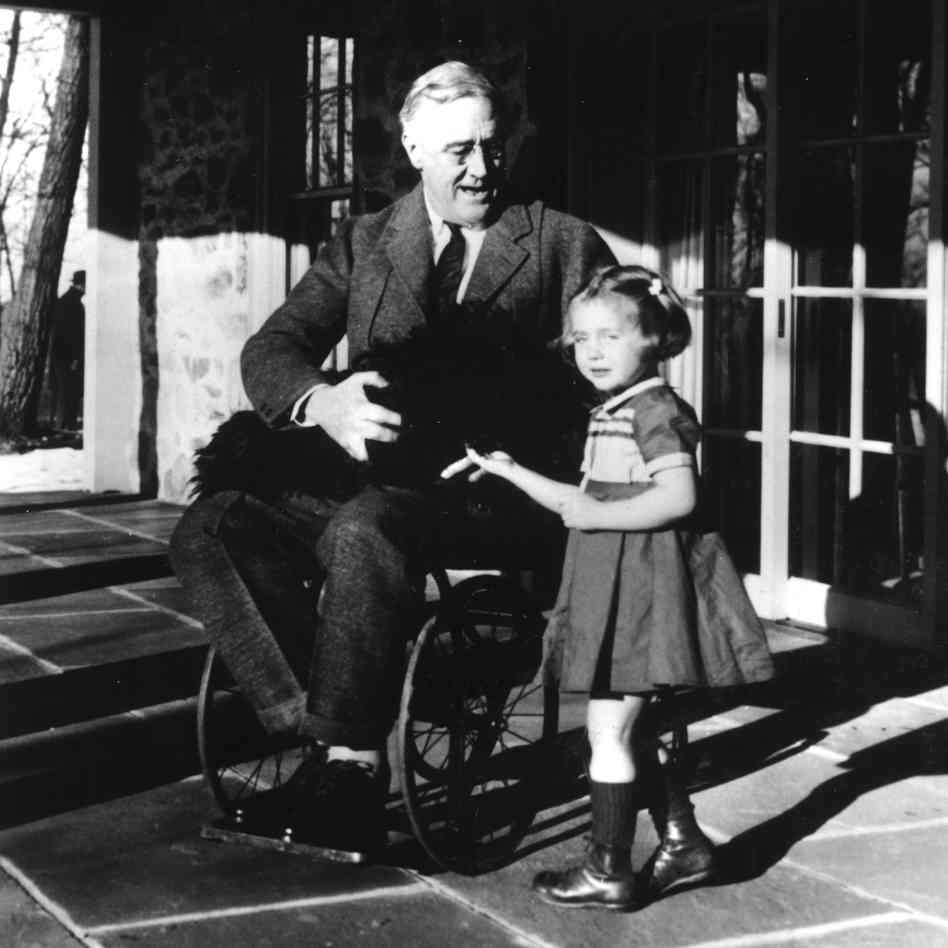
roosevelt102way_sq-6943e8ab2b83948dfb2f059bd2672e3dc2bd3cbb-s6-c30En 1921, Franklin D. Roosevelt (FDR) contrajo poliomelitis mientras vacacionaba con su familia. Esto limitó seriamente la movilidad, pero no la capacidad política del que considero uno de los tres presidentes más importantes en la historia de los Estados Unidos. A FDR le tocaron vivir los tiempos difíciles de la Gran Depresión y la Segunda Guerra Mundial. Padre del Nuevo Trato y artífice de la victoria estadounidense frente al fascismo, FDR cambió el carácter doméstico y la posición mundial de los Estados Unidos.

Por claras razones políticas, FDR escondió su limitación física, por lo que no debe sorprender que no se dejara ver en silla de ruedas y menos fotografiar. Sólo contamos con una foto tomada en 1941 en la que aparece el presidente en silla de ruedas en compañía de una niña.

Hace pocos días el Dr. Ray Begovich (profesor de periodismo en Franklin College, Indiana) se encontraba investigando en los Archivos Nacionales norteamericanos y para su sorpresa tropezó con un corto video en el que FDR es empujado en su silla de ruedas. El pietaje en cuestión, único en su clase,  fue tomado en el crucero USS Baltimore durante un visita de FDR a la base de Pearl Harbor en julio de 1944.

Aunque el video dura menos de un minuto, es uno de esos detalles curiosos que le pueden alegrar la mañana a un historiador.

Comparto mi alegría con mis lectores.

Norberto Barreto Velázquez, PhD

Lima, Perú, 15 de julio de 2013

Read Full Post »


The New York Times


July 2, 2013

Why the Civil War Still Matters


By ROBERT HICKS

FRANKLIN, Tenn. — IN his 1948 novel “Intruder in the Dust,” William Faulkner described the timeless importance of the Battle of Gettysburg in Southern memory, and in particular the moments before the disastrous Pickett’s Charge on July 3, 1863, which sealed Gen. Robert E. Lee’s defeat. “For every Southern boy fourteen years old,” he wrote, “there is the instant when it’s still not yet two o’clock on that July afternoon.”

That wasn’t quite true at the time — as the humorist Roy Blount Jr. reminds us, black Southern boys of the 1940s probably had a different take on the battle. But today, how many boys anywhere wax nostalgic about the Civil War? For the most part, the world in which Faulkner lived, when the Civil War and its consequences still shaped the American consciousness, has faded away.

Which raises an important question this week, as we move through the three-day sesquicentennial of Gettysburg: does the Civil War still matter as anything more than long-ago history?

Fifty years ago, at the war’s centennial, America was a much different place. Legal discrimination was still the norm in the South. A white, middle-class culture dominated society. The 1965 Immigration and Nationality Act had not yet rewritten our demographics. The last-known Civil War veteran had died only a few years earlier, and the children and grandchildren of veterans carried within them the still-fresh memories of the national cataclysm.

All of that is now gone, replaced by a society that is more tolerant, more integrated, more varied in its demographics and culture. The memory of the war, at least as it was commemorated in the early 1960s, would seem to have no place.

Obviously, there are those for whom Civil War history is either a profession or a passion, who continue to produce and read books on the war at a prodigious rate. But what about the rest of us? What meaning does the war have in our multiethnic, multivalent society?

For one thing, it matters as a reflection of how much America has changed. Robert Penn Warren called the war the “American oracle,” meaning that it told us who we are — and, by corollary, reflected the changing nature of America.

Indeed, how we remember the war is a marker for who we are as a nation. In 1913, at the 50th anniversary of Gettysburg, thousands of black veterans were excluded from the ceremony, while white Union and Confederate veterans mingled in a show of regional reconciliation, made possible by a national consensus to ignore the plight of black Americans.

Even a decade ago, it seemed as if those who dismissed slavery as simply “one of the factors” that led us to dissolve into a blood bath would forever have a voice in any conversation about the war.

In contrast, recent sesquicentennial events have taken pains to more accurately portray the contributions made by blacks to the war, while pro-Southern revisionists have been relegated to the dustbin of history — a reflection of the more inclusive society we have become. As we examine what it means to be America, we can find no better historical register than the memory of the Civil War and how it has morphed over time.

Then again, these changes also imply that the war is less important than it used to be; it drives fewer passionate debates, and maybe — given that one side of those debates usually defended the Confederacy — that’s a good thing.

But there is an even more important reason the war matters. If the line to immigrate into this country is longer than those in every other country on earth, it is because of the Civil War.

It is true, technically speaking, that the United States was founded with the ratification of the Constitution. And it’s true that in the early 19th century it was a beacon of liberty for some — mostly northern European whites.

But the Civil War sealed us as a nation. The novelist and historian Shelby Foote said that before the war our representatives abroad referred to us as “these” United States, but after we became “the” United States. Somehow, as divided as we were, even as the war ended, we have become more than New Yorkers and Tennesseans, Texans and Californians.

And Gettysburg itself still matters, for the same reason Abraham Lincoln noted so eloquently in his famous address at the site on Nov. 19, 1863. The battle consecrated the “unfinished work” to guarantee “that this nation, under God, shall have a new birth of freedom — and that government of the people, by the people, for the people, shall not perish from the earth.”

In that way, the Civil War is less important to the descendants of those who fought in it than it is to those whose ancestors were living halfway around the globe at the time. For if you have chosen to throw your lot in with this country, the American Civil War is at the foundation of your reasons to do so.

True, we have not arrived at our final destination as either a nation or as a people. Yet we have much to commemorate. Everything that has come about since the war is linked to that bloody mess and its outcome and aftermath. The American Century, the Greatest Generation and all the rest are somehow born out of the sacrifice of those 750,000 men and boys. None of it has been perfect, but I wouldn’t want to be here without it.

Robert Hicks is the author of the novels “The Widow of the South” and “A Separate Country.”


Read Full Post »

AHA

La American Historical Association (AHA), la asociación de historiadores  más antigua y prestigiosa de los Estados Unidos, acaba de reinaugurar su blog AHA Today. Por la variedad de sus contenidos, éste es un recurso muy valioso para aquellos interesados en el estudio e investigación de la historia estadounidense.


Read Full Post »

Seleccione aquí para una versión en castellano de este artículo.

TomDispatch

Naming Our Nameless War 

How Many Years Will It Be?
By Andrew J. Bacevich

For well over a decade now the United States has been “a nation at war.” Does that war have a name?

It did at the outset.  After 9/11, George W. Bush’s administration wasted no time in announcing that the U.S. was engaged in a Global War on Terrorism, or GWOT.  With few dissenters, the media quickly embraced the term. The GWOT promised to be a gargantuan, transformative enterprise. The conflict begun on 9/11 would define the age. In neoconservative circles, it was known as World War IV.

Upon succeeding to the presidency in 2009, however, Barack Obama without fanfare junked Bush’s formulation (as he did again in a speech at the National Defense University last week).  Yet if the appellation went away, the conflict itself, shorn of identifying marks, continued.

Does it matter that ours has become and remains a nameless war? Very much so.

Names bestow meaning.  When it comes to war, a name attached to a date can shape our understanding of what the conflict was all about.  To specify when a war began and when it ended is to privilege certain explanations of its significance while discrediting others. Let me provide a few illustrations.

With rare exceptions, Americans today characterize the horrendous fraternal bloodletting of 1861-1865 as the Civil War.  Yet not many decades ago, diehard supporters of the Lost Cause insisted on referring to that conflict as the War Between the States or the War for Southern Independence (or even the War of Northern Aggression).  The South may have gone down in defeat, but the purposes for which Southerners had fought — preserving a distinctive way of life and the principle of states’ rights — had been worthy, even noble.  So at least they professed to believe, with their preferred names for the war reflecting that belief.

Schoolbooks tell us that the Spanish-American War began in April 1898 and ended in August of that same year.  The name and dates fit nicely with a widespread inclination from President William McKinley’s day to our own to frame U.S. intervention in Cuba as an altruistic effort to liberate that island from Spanish oppression.

Yet the Cubans were not exactly bystanders in that drama.  By 1898, they had been fighting for years to oust their colonial overlords.  And although hostilities in Cuba itself ended on August 12th, they dragged on in the Philippines, another Spanish colony that the United States had seized for reasons only remotely related to liberating Cubans.  Notably, U.S. troops occupying the Philippines waged a brutal war not against Spaniards but against Filipino nationalists no more inclined to accept colonial rule by Washington than by Madrid.  So widen the aperture to include this Cuban prelude and the Filipino postlude and you end up with something like this:  The Spanish-American-Cuban-Philippines War of 1895-1902.  Too clunky?  How about the War for the American Empire?  This much is for sure: rather than illuminating, the commonplace textbook descriptor serves chiefly to conceal.

Strange as it may seem, Europeans once referred to the calamitous events of 1914-1918 as the Great War.  When Woodrow Wilson decided in 1917 to send an army of doughboys to fight alongside the Allies, he went beyond Great.  According to the president, the Great War was going to be the War To End All Wars.  Alas, things did not pan out as he expected.  Perhaps anticipating the demise of his vision of permanent peace, War Department General Order 115, issued on October 7, 1919, formally declared that, at least as far as the United States was concerned, the recently concluded hostilities would be known simply as the World War.

In September 1939 — presto chango! — the World Warsuddenly became the First World War, the Nazi invasion of Poland having inaugurated a Second World War, also known asWorld War II or more cryptically WWII.  To be sure, Soviet dictator Josef Stalin preferred the Great Patriotic War. Although this found instant — almost unanimous — favor among Soviet citizens, it did not catch on elsewhere.

Does World War II accurately capture the events it purports to encompass?  With the crusade against the Axis now ranking alongside the crusade against slavery as a myth-enshrouded chapter in U.S. history to which all must pay homage, Americans are no more inclined to consider that question than to consider why a playoff to determine the professional baseball championship of North America constitutes a “World Series.”

In fact, however convenient and familiar, World War II is misleading and not especially useful.  The period in question saw at least two wars, each only tenuously connected to the other, each having distinctive origins, each yielding a different outcome.  To separate them is to transform the historical landscape.

On the one hand, there was the Pacific War, pitting the United States against Japan.  Formally initiated by the December 7, 1941, attack on Pearl Harbor, it had in fact begun a decade earlier when Japan embarked upon a policy of armed conquest in Manchuria.  At stake was the question of who would dominate East Asia.  Japan’s crushing defeat at the hands of the United States, sealed by two atomic bombs in 1945, answered that question (at least for a time).

Then there was the European War, pitting Nazi Germany first against Great Britain and France, but ultimately against a grand alliance led by the United States, the Soviet Union, and a fast fading British Empire.  At stake was the question of who would dominate Europe.  Germany’s defeat resolved that issue (at least for a time): no one would.  To prevent any single power from controlling Europe, two outside powers divided it.

This division served as the basis for the ensuing Cold War,which wasn’t actually cold, but also (thankfully) wasn’t World War III, the retrospective insistence of bellicose neoconservatives notwithstanding.  But when did the Cold Warbegin?  Was it in early 1947, when President Harry Truman decided that Stalin’s Russia posed a looming threat and committed the United States to a strategy of containment?  Or was it in 1919, when Vladimir Lenin decided that Winston Churchill’s vow to “strangle Bolshevism in its cradle” posed a looming threat to the Russian Revolution, with an ongoing Anglo-American military intervention evincing a determination to make good on that vow?

Separating the war against Nazi Germany from the war against Imperial Japan opens up another interpretive possibility.  If you incorporate the European conflict of 1914-1918 and the European conflict of 1939-1945 into a single narrative, you get a Second Thirty Years War (the first having occurred from 1618-1648) — not so much a contest of good against evil, as a mindless exercise in self-destruction that represented the ultimate expression of European folly.

So, yes, it matters what we choose to call the military enterprise we’ve been waging not only in Iraq and Afghanistan, but also in any number of other countries scattered hither and yon across the Islamic world.  Although the Obama administration appears no more interested than the Bush administration in saying when that enterprise will actually end, the date we choose as its starting point also matters.

Although Washington seems in no hurry to name its nameless war — and will no doubt settle on something self-serving or anodyne if it ever finally addresses the issue — perhaps we should jump-start the process.  Let’s consider some possible options, names that might actually explain what’s going on.

The Long War: Coined not long after 9/11 by senior officers in the Pentagon, this formulation never gained traction with either civilian officials or the general public.  Yet the Long War deserves consideration, even though — or perhaps because — it has lost its luster with the passage of time.

At the outset, it connoted grand ambitions buoyed by extreme confidence in the efficacy of American military might.  This was going to be one for the ages, a multi-generational conflict yielding sweeping results.

The Long War did begin on a hopeful note.  The initial entry into Afghanistan and then into Iraq seemed to herald “home by Christmas” triumphal parades.  Yet this soon proved an illusion as victory slipped from Washington’s grasp.  By 2005 at the latest, events in the field had dashed the neo-Wilsonian expectations nurtured back home.

With the conflicts in Iraq and Afghanistan dragging on, “long” lost its original connotation.  Instead of “really important,» it became a synonym for “interminable.”  Today, the Long Wardoes succinctly capture the experience of American soldiers who have endured multiple combat deployments to Iraq and Afghanistan.

For Long War combatants, the object of the exercise has become to persist.  As for winning, it’s not in the cards. TheLong War just might conclude by the end of 2014 if President Obama keeps his pledge to end the U.S. combat role in Afghanistan and if he avoids getting sucked into Syria’s civil war.  So the troops may hope.

The War Against Al-Qaeda: It began in August 1996 when Osama bin Laden issued a «Declaration of War against the Americans Occupying the Land of the Two Holy Places,” i.e., Saudi Arabia.  In February 1998, a second bin Laden manifesto announced that killing Americans, military and civilian alike, had become “an individual duty for every Muslim who can do it in any country in which it is possible to do it.”

Although President Bill Clinton took notice, the U.S. response to bin Laden’s provocations was limited and ineffectual.  Only after 9/11 did Washington take this threat seriously.  Since then, apart from a pointless excursion into Iraq (where, in Saddam Hussein’s day, al-Qaeda did not exist), U.S. attention has been focused on Afghanistan, where U.S. troops have waged the longest war in American history, and on Pakistan’s tribal borderlands, where a CIA drone campaign is ongoing.  By the end of President Obama’s first term, U.S. intelligence agencies were reporting that a combined CIA/military campaign had largely destroyed bin Laden’s organization.  Bin Laden himself, of course, was dead.

Could the United States have declared victory in its unnamed war at this point?  Perhaps, but it gave little thought to doing so.  Instead, the national security apparatus had already trained its sights on various al-Qaeda “franchises” and wannabes, militant groups claiming the bin Laden brand and waging their own version of jihad.  These offshoots emerged in the Maghreb, Yemen, Somalia, Nigeria, and — wouldn’t you know it — post-Saddam Iraq, among other places.  The question as to whether they actually posed a danger to the United States got, at best, passing attention — the label “al-Qaeda” eliciting the same sort of Pavlovian response that the word “communist” once did.

Americans should not expect this war to end anytime soon.  Indeed, the Pentagon’s impresario of special operations recently speculated — by no means unhappily — that it would continue globally for “at least 10 to 20 years.”   Freely translated, his statement undoubtedly means: “No one really knows, but we’re planning to keep at it for one helluva long time.”

The War For/Against/About Israel: It began in 1948.  For many Jews, the founding of the state of Israel signified an ancient hope fulfilled.  For many Christians, conscious of the sin of anti-Semitism that had culminated in the Holocaust, it offered a way to ease guilty consciences, albeit mostly at others’ expense.  For many Muslims, especially Arabs, and most acutely Arabs who had been living in Palestine, the founding of the Jewish state represented a grave injustice.  It was yet another unwelcome intrusion engineered by the West — colonialism by another name.

Recounting the ensuing struggle without appearing to take sides is almost impossible.  Yet one thing seems clear: in terms of military involvement, the United States attempted in the late 1940s and 1950s to keep its distance.  Over the course of the 1960s, this changed.  The U.S. became Israel’s principal patron, committed to maintaining (and indeed increasing) its military superiority over its neighbors.

In the decades that followed, the two countries forged a multifaceted “strategic relationship.”  A compliant Congress provided Israel with weapons and other assistance worth many billions of dollars, testifying to what has become an unambiguous and irrevocable U.S. commitment to the safety and well-being of the Jewish state.  The two countries share technology and intelligence.  Meanwhile, just as Israel had disregarded U.S. concerns when it came to developing nuclear weapons, it ignored persistent U.S. requests that it refrain from colonizing territory that it has conquered.

When it comes to identifying the minimal essential requirements of Israeli security and the terms that will define any Palestinian-Israeli peace deal, the United States defers to Israel.  That may qualify as an overstatement, but only slightly.  Given the Israeli perspective on those requirements and those terms — permanent military supremacy and a permanently demilitarized Palestine allowed limited sovereignty — the War For/Against/About Israel is unlikely to end anytime soon either.  Whether the United States benefits from the perpetuation of this war is difficult to say, but we are in it for the long haul.

The War for the Greater Middle East: I confess that this is the name I would choose for Washington’s unnamed war and is, in fact, the title of a course I teach.  (A tempting alternative is the Second Hundred Years War, the «first» having begun in 1337 and ended in 1453.)

This war is about to hit the century mark, its opening chapter coinciding with the onset of World War I.  Not long after the fighting on the Western Front in Europe had settled into a stalemate, the British government, looking for ways to gain the upper hand, set out to dismantle the Ottoman Empire whose rulers had foolishly thrown in their lot with the German Reich against the Allies.

By the time the war ended with Germany and the Turks on the losing side, Great Britain had already begun to draw up new boundaries, invent states, and install rulers to suit its predilections, while also issuing mutually contradictory promises to groups inhabiting these new precincts of its empire.  Toward what end?  Simply put, the British were intent on calling the shots from Egypt to India, whether by governing through intermediaries or ruling directly.  The result was a new Middle East and a total mess.

London presided over this mess, albeit with considerable difficulty, until the end of World War II.  At this point, by abandoning efforts to keep Arabs and Zionists from one another’s throats in Palestine and by accepting the partition of India, they signaled their intention to throw in the towel. Alas, Washington proved more than willing to assume Britain’s role.  The lure of oil was strong.  So too were the fears, however overwrought, of the Soviets extending their influence into the region.

Unfortunately, the Americans enjoyed no more success in promoting long-term, pro-Western stability than had the British.  In some respects, they only made things worse, with the joint CIA-MI6 overthrow of a democratically elected government in Iran in 1953 offering a prime example of a “success” that, to this day, has never stopped breeding disaster.

Only after 1980 did things get really interesting, however.  The Carter Doctrine promulgated that year designated the Persian Gulf a vital national security interest and opened the door to greatly increased U.S. military activity not just in the Gulf, but also throughout the Greater Middle East (GME).  Between 1945 and 1980, considerable numbers of American soldiers lost their lives fighting in Asia and elsewhere.  During that period, virtually none were killed fighting in the GME.  Since 1990, in contrast, virtually none have been killed fighting anywhere except in the GME.

What does the United States hope to achieve in its inherited and unending War for the Greater Middle East?  To pacify the region?  To remake it in our image?  To drain its stocks of petroleum?  Or just keeping the lid on?  However you define the war’s aims, things have not gone well, which once again suggests that, in some form, it will continue for some time to come.  If there’s any good news here, it’s the prospect of having ever more material for my seminar, which may soon expand into a two-semester course.

The War Against Islam: This war began nearly 1,000 years ago and continued for centuries, a storied collision between Christendom and the Muslim ummah.  For a couple of hundred years, periodic eruptions of large-scale violence occurred until the conflict finally petered out with the last crusade sometime in the fourteenth century.

In those days, many people had deemed religion something worth fighting for, a proposition to which the more sophisticated present-day inhabitants of Christendom no longer subscribe.  Yet could that religious war have resumed in our own day?  Professor Samuel Huntington thought so, although he styled the conflict a “clash of civilizations.”  Some militant radical Islamists agree with Professor Huntington, citing as evidence the unwelcome meddling of “infidels,” mostly wearing American uniforms, in various parts of the Muslim world.  Some militant evangelical Christians endorse this proposition, even if they take a more favorable view of U.S. troops occupying and drones targeting Muslim countries.

In explaining the position of the United States government, religious scholars like George W. Bush and Barack (Hussein!) Obama have consistently expressed a contrary view.  Islam is a religion of peace, they declare, part of the great Abrahamic triad.  That the other elements of that triad are likewise committed to peace is a proposition that Bush, Obama, and most Americans take for granted, evidence not required.  There should be no reason why Christians, Jews, and Muslims can’t live together in harmony.

Still, remember back in 2001 when, in an unscripted moment, President Bush described the war barely begun as a “crusade”?  That was just a slip of the tongue, right?  If not, we just might end up calling this one the Eternal War.

Andrew J. Bacevich is a professor of history and international relations at Boston University and a TomDispatch regular. His next book, Breach of Trust: How Americans Failed Their Soldiers and Their Countrywill appear in September.

Follow TomDispatch on Twitter and join us on Facebook orTumblr. Check out the newest Dispatch book, Nick Turse’sThe Changing Face of Empire: Special Ops, Drones, Proxy Fighters, Secret Bases, and Cyberwarfare.

View this story online at: http://www.tomdispatch.com/blog/175704/

Read Full Post »

Avatar de Javier R. Almeyda-LoucilBiblioteca Virtual de Puerto Rico

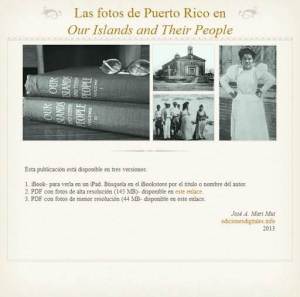
Luego de la Guerra Hispanoamericana se escribieron muchos libros sobre las nuevas posesiones que adquirió Estados Unidos  en el Pacífico y en el Caribe. Y es que todo iba dirigido a marimutque la sociedad y el capital americano conociera las nuevas oportunidades de negocio que ofrecía estos territorios. El libro Our Island and Their People  (1900) fue uno de esos libros y a su vez es uno de los más conocidos. Para Puerto Rico el valor de esta obra recae en la extensa colección de fotos y descripción de nuestra isla para esos años.

El Dr. José A. Mari Mut, destacado científico y entomólogo del Recinto Universitario de Mayaguez (UPR) luego de una extensa producción en la literatura científica, ha decidido realizar diversos trabajos sobre la historia y cultura de Puerto Rico. Y gracias a estos trabajos, el Dr. Mari Mut nos vuelve a traer a la atención  precisamente…

Ver la entrada original 82 palabras más

Read Full Post »

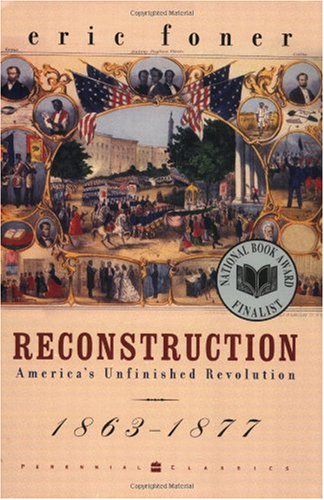
Foner - ReconstructionEn su reunión anual celebrada en San Francisco a mediados de abril de 2013, la Organization of American Historians (OAH) rindió un merecido homenaje al historiador Eric Foner (Columbia University) por los veinticinco años de la publicación de su clásico libro Reconstruction: America’s Unfinished Revolution, 1863-1877. Publicado en 1998 por Harper & Row, la obra de Foner  es uno de los libros imprescindibles para entender el periodo posterior a la guerra civil norteamericana.

El fin del conflicto Norte-Sur dio paso  a un problema: ¿qué hacer con los  estados sureños derrotados ? Abraham Lincoln favorecía una política generosa que permitiera la reintegración rápida de los sureños a la Unión norteamericana. Lamentablemente para éstos, Lincoln fue asesinado en 1865, lo que llevó a un intenso debate entre su sucesor, Andrew Johnson, y el Congreso federal.  Johnson creía necesario que los estados sureños fueron reincorporados a la nación norteamericana rápidamente. En el Congreso había un grupo de senadores y representantes conocidos como los radicales,  liderados por Thaddeus Stevens, que creían necesario aprovechar la derrota del Sur para reconstruir o rehacer esa región. Las diferencias entre el presidente y el Congreso desembocaron en un  conflicto directo que resultó en una victoria de los congresistas radicales. De ahí que se identifique el periodo posterior a la guerra civil como la era de la Reconstrucción.

Para celebrar los 25 años de Reconstruction: America’s Unfinished Revolution, la OAH organizó una mesa  compuesta por Foner, Kate Masur (Northwestern University), Heather Andrea Williams (Univeristy of North Carolina- Chapel Hill), Gregory P. Downs (CUNY), Thavolia Glymph (Duke University) y Steve Hahn (UPenn University). Estos colegas desarrollaron un interesante y valioso intercambio sobre la importancia de la obra de Foner en el desarrollo de la historiografía norteamericana.

Comparto con mis lectores un video de esta mesa que fue preparado por The History News Network (HNN).

Read Full Post »

Read Full Post »

Library of Congress

Library of Congress

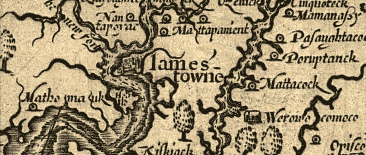
Científicos del Smithsonian Institute confirman la práctica de canibalismo en Jamestown, el primer asentamiento británico exitoso en América del Norte.

Cannibalism confirmed at Jamestown | History News Network.

Read Full Post »

« Newer Posts - Older Posts »