Feeds:
Entradas
Comentarios

The Warren Court Decisions Earl Warren Said Were the Most Important … «One Person, One Vote» 

 HNN   June 18, 2014

In an age of increasingly sophisticated, computer driven gerrymandering, an imagined, but non-existent, epidemic of voter fraud that has led to a profusion of voter identification laws, and an infusion of corporate money into the electoral system, we as Americans continue to wrestle with basic notions of fair representation. As we struggle to make our political system more truly democratic, we ought to consider the bold and historic actions taken by the Supreme Court of the United States fifty years ago this month.

On June 15, 1964, just four days after the United States Senate brought an end to the filibuster against the Civil Rights Act, the Supreme Court of the United States handed down a series of decisions that established the principle of “one person, one vote” in all state legislatures. For the remainder of his life, Chief Justice Earl Warren maintained that these decisions trumped all others made during his tenure, including the segregation decisions, in terms of their importance to American democracy.

Prior to the reapportionment rulings, American democracy was a deliberately misshapen enterprise. In a U.S. version of “rotten boroughs,” district boundaries in almost every state were readily drawn to give some citizens a far greater voice than others. In California in 1960, for example, a state senator from the Eastern Sierra had a mere 14,000 constituents, while a peer from Los Angeles represented more than six million.

Like Jim Crow, this practice seemed to defy the most elementary notions of democracy as a system of popular self-rule – and yet it had many defenders. Malapportionment circumscribed the political power of labor and civil rights advocates and promoted a pro-business, anti-labor agenda of low taxes, limited government spending, and minimal regulation. In the American South, malapportionment served as a cornerstone of white supremacy, ensuring the overrepresentation of the most ardent segregationists and thus further delaying the realization of civil and voting rights for African Americans. As the 20th century proceeded, urban and suburban populations swelled dramatically while legislative districts remained roughly the same. As a result, minority rule intensified.

After World War II, individual citizens, municipal officials, and civic organizations began to seek relief, but repeatedly failed, thwarted by a conspiracy of inaction among lawmakers and judges.

Finally, in 1962, the Supreme Court decided the time had come to intervene. In Baker v. Carr, a majority of the Warren Court ignored the angry dissent of Felix Frankfurter and ruled that federal courts did have jurisdiction to consider whether or not legislative malapportionment violated the Equal Protection Clause of the Fourteenth Amendment. Deliberations in Baker proved so exacting that they contributed to the physical decline and ultimate resignation of Frankfurter and one of his colleagues.

Baker v. Carr did not establish a standard for states to follow in drawing legislative districts, but the decision did open the doors of the federal courts to litigants to challenge malapportionment. Within two years, attorneys and plaintiffs in more than three-dozen states had done just that.

During a tumultuous term that began in October 1963 and was tragically interrupted by the assassination of President John F. Kennedy, the Supreme Court heard oral arguments and issued full opinions in seven of these cases. In February 1964, the Court announced that each state’s districts for the U.S. House of Representatives must contain, as nearly as possible, the same number of people. What came next proved far more controversial.

On June15, 1964, Warren delivered the Court’s opinion in Reynolds v. Sims. Declaring that “legislators represent people, not trees or acres,” he announced that the Equal Protection Clause required both chambers in a state’s bicameral legislature to be apportioned according to the principle of “one person, one vote.”

Although less well-known than Reynolds, a companion case, Lucas v. Forty-Fourth General Assembly of Colorado, turned out to be the most important decision handed down that day. In it, the Court made clear that its ruling in Reynolds left no room for states to deviate from straight population equality in either branch of a bicameral legislature, even if a state’s voters supported a less rigorous standard in a referendum. In one broad stroke , the Court effectively rendered unconstitutional almost every state legislature in the nation. By the end of the decade, the Court had determined that apportionments for all elective municipal and county offices—including city councils, boards of supervisors, and school boards, among others—must adhere to the same standard.

Proponents of reapportionment hailed the decisions as “magnificently liberating,” a step “toward establishing democracy in the United States,” while opponents denounced them as the most significant “usurpation of power by the judicial branch” in American history. Opposition to the decisions of June 15, 1964, soon coalesced around Senator Everett Dirksen of Illinois, the Republican Minority Leader who enjoyed close ties with national business organizations. Dirksen championed a constitutional amendment that would have allowed state legislatures to apportion one branch of a bicameral legislature on factors other than population. When this approach failed to draw enough support in the Senate, he and others took a more radical step. In order to overturn the court’s decision, they sought to hold the first Constitutional Convention since the founding convention of the 1780s. Over the course of five years, from 1964 to 1969, thirty-three states, just one short of the constitutional threshold, petitioned for such a convention.

Ultimately, time proved the most important ally of the pro-reapportionment forces. The principal of “one person, one vote” soon became the norm in every state and led to a profound transformation in American democracy. In many states, the stranglehold of rural voters was broken, as residents of the burgeoning suburbs exerted more influence.

As the essence of majority rule confronts new challenges, most especially from a profusion of corporate money into the electoral process and a frightening retreat from the massive achievements of the Voting Rights Act, we would do well to remember the reapportionment revolution of the 1960s and its reminder of the need for constant vigilance against counter-majoratarian impulses in our democracy.

J. Douglas Smith is the author of On Democracy’s Doorstep: The Inside Story of How the Supreme Court Brought “One Person, One Vote” to the United States, published by Hill & Wang, June 10, 2014.


hnn-logo-new

No End of a lesson- Unlearned

William R. Polk

HNN June 15, 2014

America appears once again to be on the brink of a war. This time the war is likely to be in Syria and/or in Iraq. If we jump into one or both of these wars, they will join, by my count since our independence, about 200 significant military operations (not all of which were legally «wars») as well as countless «proactive» interventions, regime-change undertakings, covert action schemes and search-and-destroy missions. In addition the United States has provided weapons, training and funding for a variety of non-American military and quasi-military forces throughout the world. Within recent months we have added five new African countries. History and contemporary events show that we Americans are a warring people.

So we should ask: what have we learned about ourselves, our adversaries and the process in which we have engaged?

The short answer appears to be «very little.»

As both a historian and a former policy planner for the American government, I will very briefly here (as I have mentioned in a previous essay, I am in the final stages of a book to be called A Warring People, on these issues), illustrate what I mean by «very little.»

I begin with us, the American people. There is overwhelming historical evidence that war is popular with us. Politicians from our earliest days as a republic, indeed even before when we were British colonies, could nearly always count on gaining popularity by demonstrating our valor. Few successful politicians were pacifists.

Even supposed pacifists found reasons to engage in the use of force. Take the man most often cited as a peacemaker or at least a peaceseeker, Woodrow Wilson. He promised to «keep us out of war,» by which he meant keeping us out of big, expensive European war. Before becoming president, however, he approved the American conquest of Cuba and the Philippines and described himself as an imperialist; then, as president, he occupied Haiti, sent the Marines into the Dominican Republic and ordered the Cavalry into Mexico. In 1918, he also put American troops into Russia. Not only sending soldiers: his administration carried out naval blockades, economic sanctions, covert operations — one of which, allegedly, involved an assassination attempt on a foreign leader — and furnished large-scale arms supplies to insurgents in on-going wars.

The purpose, and explanation, of our wars varied. I think most of us would agree that our Revolution, the First World War and the Second World War were completely justified. Probably Korea was also. The United States had no choice on the Civil war or, perhaps, on the War of 1812. Many, particularly those against the Native Americans would today be classified as war crimes. It is the middle range that seem to me to be the most important to understand. I see them like this.

Some military ventures were really misadventures in the sense that they were based on misunderstandings or deliberate misinformation. I think that most students of history would put the Spanish-American, Vietnamese, Iraqi and a few other conflicts in this category. Our government lied to us — the Spaniards did not blow up the Maine; the Gulf of Tonkin was not a dastardly attack on our innocent ships and Iraq was not about to attack us with a nuclear weapon, which it did not have.

But we citizens listened uncritically. We did not demand the facts. It is hard to avoid the charge that we were either complicit, lazy or ignorant. We did not hold our government to account.

Several war and other forms of intervention were for supposed local or regional requirements of the Cold War. We knowingly told one another that the «domino theory» was reality: so a hint of Communist subversion or even criticism of us sent us racing off to protect almost any form of political association that pretended to be on our side. And we believed or feared that even countries that had little or no connections with one another would topple at the touch — or even before their neighbors appeared to be in trouble. Therefore, regardless of their domestic political style, monarchy, dictatorship. democracy., it mattered not, they had to be protected. Our protection often included threats of invasion, actual intervention, paramilitary operations, subversion and/or bribery, justified by our proclaimed intent to keep them free. Or at least free from Soviet control. Included among them were Guatemala, Nicaragua, Brazil, Chile, Italy, Greece, Syria, Lebanon, Iran, Indonesia, Vietnam and various African countries.

Some interventions were for acquisition of their resources or protection of our economic assets. Guatemala, Chile, Iraq, Iran and Indonesia come to mind.

Few, if any, were to establish the basis of peace or even to bring about ceasefires. Those tasks we usually left to the United Nations or regional associations.

The costs have been high. Just counting recent interventions, they have cost us well over a hundred thousand casualties and some multiple of that in wounded; they have cost «the others» — both our enemies and our friends — large multiples of those numbers. The monetary cost is perhaps beyond counting both to them and to us. Figures range upward from $10 trillion.

The rate of success of these aspects of our foreign policy, even in the Nineteenth century, was low. Failure to accomplish the desired or professed outcome is shown by the fact that within a few years of the American intervention, the condition that had led to the intervention recurred. The rate of failure has dramatically increased in recent years. This is because we are operating in a world that is increasingly politically sensitive. Today even poor, weak, uneducated and corrupt nations become focused by the actions of foreigners. Whereas before, a few members of the native elite made the decisions, today we face «fronts.» parties, tribes and independent opinion leaders. So the «window of opportunity» for foreign intervention, once at least occasionally partly open, is now often shut.

Delta Force of Task Force 20 alongside troops of 3rd Battalion, 327th Infantry Regiment, at Uday Hussain and Qusay Hussein’s hideout (Wikipedia)

I will briefly focus on five aspects of this transformation:

First, nationalism has been and remains the predominant way of political thought of most of the world’s people. Its power has long been strong (even when we called it by other names) but it began to be amplified and focused by Communism in the late Nineteenth century. Today, nationalism in Africa, much of Asia and parts of Europe is increasingly magnified by the rebirth of Islam in the salafiyah movement.

Attempts to crush these nationalist-ideological-religious-cultural movements militarily have generally failed. Even when, or indeed especially when, foreigners arrive on the scene, natives put aside their mutual hostilities to unite against them. We saw this particularly vividly and painfully in Somalia. The Russians saw it in Çeçnaya and the Chinese, among the Uyghur peoples of Xinjiang (former Chinese Turkistan).

Second, outside intervention has usually weakened moderate or conservative forces or tendencies within each movement. Those espousing the most extreme positions are less likely to be suborned or defeated than the moderates. Thus particularly in a protracted hostilities, are more likely to take charge than their rivals. We have seen this tendency in each of the guerrilla wars in which we got involved; for the situation today, look at the insurgent movements in Syria and Iraq. (For my analysis of the philosophy and strategy of the Muslim extremists, see my essay «Sayyid Qutub’s Fundamentalism and Abu Bakr Naji’s Jihadism» on my website.)

What is true of the movements is even more evident in the effects on civic institutions and practices within an embattled society. In times of acute national danger, the «center» does not hold. Centrists get caught between the insurgents and the regimes. Insurgents have to destroy their relationship to society and government if they are to «win.» Thus, in Vietnam for example, doctors and teachers, who interfaced between government and the general population were prime targets for the Vietminh in the 1950s.

And, as the leaders of governments against whom the insurgents are fighting become more desperate, they suppress those of their perceived rivals or critics they can reach. By default, these people are civilians who are active in the political parties, the media and the judiciary . And, as their hold on power erodes and «victory» becomes less likely, regimes also seek to create for themselves safe havens by stealing money and sending it abroad. Thus, the institutions of government are weakened and the range of enemies widens. We have witnessed these two aspects of «corruption» — both political and economic — in a number of countries. Recent examples are Vietnam and Afghanistan.

In Vietnam at least by 1962 the senior members of the regime had essentially given up the fight. Even then they were preparing to bolt the country. And the army commanders were focused on earning money that they sold the bullets and guns we gave them to the Vietminh. In Afghanistan, the regime’s involvement in the drug trade, its draining of the national treasury into foreign private bank accounts (as even Mr. Karzai admitted) and in «pickpocketing» hundreds of millions of dollars from aid projects is well documented.  (See the monthly reports of the American Special Inspector General for Afghan Reconstruction.)

Third, our institutional memory of programs, events and trends is shallow. I suggest that it usually is no longer than a decade. Thus, we repeat policies even when the record clearly shows that they did not work when previously tried. And we address each challenge as though it is unprecedented. We forget the American folk saying that when you find yourself in a hole, the best course of action is to stop digging. it isn’t only that our government (and the thousands of «experts,» tacticians and strategists it hires) do not «remember» but also that they have at hand only one convenient tool — the shovel. What did we learn from Vietnam? Get a bigger, sharper shovel.

Fourth, despite or perhaps in part because of our immigrant origins, we are a profoundly insular people. Few of us have much appreciation of non-American cultures and even less fellow feeling for them. Within a generation or so, few immigrants can even speak the language of their grand parents. Many of us are ashamed of our ethnic origins.

Thus, for example, at the end of the Second World War, despite many of us being of German or Italian or Japanese cultural background, we were markedly deficient in people who could help implement our policies in those countries. We literally threw away the language and culture of grandparents. A few years later, when I began to study Arabic, there were said to be only five Americans not of Arab origin who knew the language. Beyond language, grasp of the broader range of culture petered off to near zero. Today, after the expenditure of significant government subsidies to universities (in the National Defense Education Act) to teach «strategic» languages, the situation should be better. But, while we now know much more, I doubt that we understand other peoples much better.

If this is true of language, it is more true of more complex aspects of cultural heritage. Take Somalia as an example. Somalia was not, as the media put it, a «failed state»; it was and is a «non-state.» That is, the Somalis do not base their effective identify as members of a nation state. Like almost everyone in the world did before recent centuries, they thought of themselves as members of clans, tribes, ethnic or religious assemblies or territories. It is we, not they, who have redefined political identity. We forget that the nation-state is a concept that was born in Europe only a few centuries ago and became accepted only late in the Nineteenth century in Germany and Italy. For the Somalis, it is still an alien construct. So, not surprisingly, our attempt to force them or entice them to shape up and act within our definition of statehood has not worked. And Somalia is not alone. And not only in Africa. Former Yugoslavia is a prime example: to be ‘balkanized’ has entered our language. And, if we peek under the flags of Indonesia, Burma, Pakistan, Afghanistan, Iraq, the Congo, Mali, the Sudan and other nation-states we find powerful forces of separate ethnic nationalisms.

The effects of relations among many of the peoples of Asia and Africa and some of the Latin Americans have created new political and social configurations and imbalances within and among them. With European and American help the governments with which we deal have acquired more effective tools of repression. They can usually defeat the challenges of traditional groups. But, not always. Where they do not acquire legitimacy in the eyes of significant groups — «nations» — states risk debilitating, long-term struggles. These struggles are, in part, the result of the long years of imperial rule and colonial settlement. Since Roman times, foreign rulers have sought to cut expenses by governing through local proxies. Thus, the British turned over to the Copts the unpopular task of colleting Egyptian taxes and to the Assyrians the assignment of controlling the Iraqi Sunnis. The echo of these years is what we observe in much of the «Third World» today. Ethnic, religious and economic jealousies abound and the wounds of imperialism and colonialism have rarely completely healed. We may not be sensitive to them, but to natives they may remain painful. Americans may be the «new boys on the block,» but these memories have often been transferred to us.

Finally, fifth, as the preeminent nation-state America has a vast reach. There is practically no area of the world in which we do not have one sort of interest or another. We have over a thousand military bases in more than a hundred countries; we trade, buy and sell, manufacture or give away goods and money all over Latin America, Africa, Asia and Europe. We train, equip and subsidize dozens of armies and even more paramilitary or «Special» forces. This diversity is, obviously, a source of strength and richness, but, less obviously, it generates conflicts between what we wish to accomplish in one country and what we think we need to accomplish in another. At the very least, handling or balancing our diverse aims within acceptable means and at a reasonable cost is a challenge.

It is a challenge that we seem less and less able to meet.

Take Iraq as an example. As a corollary of our hostility to Saddam Husain, we essentially turned Iraq over to his enemies, the Iraqi Shia Muslim. (I deal with this in my Understanding Iraq, New York: HarperCollins, 2005, 171 ff.) There was some justification for this policy. The Shia community has long been Iraq’s majority and because they were Saddam’s enemies, some «experts» naively thought they would become our friends. But immediately two negative aspects of our policy became evident: non-specialists: first, the Shiis took vengeance on the Sunni Muslim community and so threw the country into a vicious civil war. What we called pacification amounted to ethnic cleansing. And, second, the Shia Iraqi leaders (the marjiaah) made common cause with coreligionist Iranians with whom we were nearly at war all during the second Bush administration. Had war with Iran eventuated, our troops in Iraq would have been more hostages than occupiers. At several points, we had the opportunity to form a more coherent, moral and safer policy. I don’t see evidence that our government or our occupation civil and military authorities even grasped the problem; certainly they did not find ways to work toward a solution. Whatever else may be said about it, our policy was dysfunctional.

I deserve to be challenged on this statement: I am measuring (with perhaps now somewhat weakened hindsight) recent failures against what we tried to do in the Policy Planning Council in the early 1960s. If our objective is, as we identify it, to make the world at least safe, even if not safe for democracy, we are much worse off today than we were then. We policy planners surely then made many significant mistakes (and were often not heeded), but I would argue that we worked within a more coherent framework than our government does today. Increasingly, it seems to me that we are in a mode of leaping from one crisis to the next without having understood the first or anticipating the second. I see no strategic concept; only tactical jumps and jabs.

So what to do?

At the time of the writing of the American Constitution, one of our Founding Fathers, Gouverneur Morris, remarked that part of the task he and others of the authors put it, was “to save the people from their most dangerous enemy, themselves.” Translated to our times, this is to guard against our being «gun slingers.» All the delegates were frightened by militarism and sought to do the absolute minimum required to protect the country from attack. They refused the government permission to engage in armed actions against foreigners except in defense. I believe they would have been horrified, if they could have conceived it, by the national security state we have become. They certainly did not look to the military to solve problems of policy. They would have agreed, I feel sure, that very few of the problem we face in the world today could be solved by military means So, even when we decide to employ military means, we need to consider not only the immediate but the long-term effects of our actions. We have, at least, the experience and the intellectual tools to do so. So why have we not?

We have been frequently misled by the success of our postwar policies toward both Germany and Japan. We successfully helped those two countries to embark upon a new era. And, during the employment of the Truman Doctrine in Greece, the civil war there ended. There were special reasons for all three being exceptions. Perhaps consequent to those successes, when we decided to destroy the regimes of Saddam Husain and Muammar Qaddafi, we gave little thought of what would follow. We more or less just assumed that things would get better. They did not. The societies imploded. Had we similarly gone into Iran, the results would have been a moral, legal and economic disaster. Now we know — or should know — that unless the risk is justified, as our Constitution demands it be by an imminent armed attack on the United States, we should not make proactive war on foreign nations. We have sworn not to do so in the treaty by which we joined the United Nations. In short, we need to be law abiding, and we should look before we leap.

Our ability to do any of these things will depend on several decisions.

The first is to be realistic: there is no switch we can flip to change our capacities. To look for quick and easy solutions is part of the problem, not part of the solution.

The second is a matter of will and the costs and penalties that attach to it. We would be more careful in foreign adventures if we had to pay for them in both blood and treasure as they occurred. That is, «in real time.» We now avoid this by borrowing money abroad and by inducing or bribing vulnerable members of our society and foreigners to fight for us.. All our young men and women should know that they will be obliged to serve if we get into war, and we should not be able to defer to future generations the costs of our ventures. We should agree to pay for them through immediate taxes rather than foreign loans.

The third is to demand accountability. Our government should be legally obligated to tell us the truth. If it does not, the responsible officials should be prosecuted in our courts and, if they violate our treaties or international law, they should have to come before the World Court of Justice. We now let them off scot-free. The only «culprits» are those who carry out their orders.

Fourth, in the longer term, the only answer to the desire for better policy is better public education. For a democracy to function, its citizens must be engaged. They cannot be usefully engaged if they are not informed. Yet few Americans know even our own laws on our role in world affairs. Probably even fewer know the history of our actions abroad — that is, what we have done in the past with what results and at what cost.

And as a people we are woefully ignorant about other peoples and countries. Polls indicate that few Americans even know the locations of other nations. The saying that God created war to teach Americans geography is sacrilegious. If this was God’s purpose, He failed. And beyond geography, concerning other people’s politics, cultures and traditions, there is a nearly blank page. Isn’t it time we picked up the attempt made by such men as Sumner Wells (with his An Intelligent American’s Guide to the Peace and his American Foreign Policy Library), Robert Hutchins, James Conant and others (with the General Education programs in colleges and universities) and various other failed efforts to make us a part of humanity?

On the surface, at least, resurrecting these programs is just a matter of (a small amount of) money. But results won’t come overnight. Our education system is stogy, our teachers are poorly trained and poorly paid, and we, the consumers, are distracted by quicker, easier gratifications than learning about world affairs. I had hoped that we would learn from the «real schools» of Vietnam and other failures, but we did not. The snippets of information which pass over our heads each day do not and cannot make a coherent pattern. Absent a matrix into which to place «news,» it is meaningless. I have suggested in a previous essay that we are in a situation like a computer without a program. We get the noise, but without a means to «read» it, it is just gibberish.

Our biggest challenge therefore comes down to us: unless or until we find a better system of teaching, of becoming aware that we need to learn and a desire to acquire the tools of citizenship, we cannot hope to move toward a safer, more enriching future.

This is a long-term task.

We had better get started.

William R. Polk was a professor of history at the University of Chicago. During the Kennedy and part of the Johnson administrations, he was the member of the Policy Planning Council responsible for North Africa, the Middle East and Central Asia. Among his books are «Understanding Iraq, Violent Politics and Understanding Iran.» He is vice chairman of the W.P. Carey Foundation

 The Surprising Evidence hat Woodrow Wilson Was Suffering from a Brain Malfunction Before the Stroke that Crippled Him

Richard Striner

HNN   June 15, 2014

This is part three of a three-part series distilling the thesis of Richard Striner’s new book, Woodrow Wilson and World War One: A Burden Too Great to Bear, published by Rowman & Littlefield in April 2014. (Click here for Part 1 and here for Part 2.) Mr. Striner is a professor of history at Washington College. His other books include Father Abraham: Lincoln’s Relentless Struggle to End Slavery and Lincoln’s Way: How Six Great Presidents Created American Power.   – See more at: http://hnn.us/article/155787#sthash.W5bIvaw3.dpuf


Almost everyone who knows anything about Woodrow Wilson agrees he was a tragic figure. But the admirers and detractors of Wilson have differed sharply down the years as to whether Wilson’s tragedy was essentially his own fault. One critical fact about the tragedy was obviously not his fault: the stroke that he suffered on October 2, 1919. And due to the underlying condition of arteriosclerosis (diagnosed as early as 1906), distinguished medical observers have theorized that Wilson suffered from a progressive cerebro-vascular deterioration resulting in episodic dementia as early as 1917.

As one studies the historical record in detail — a record set forth in magnificent abundance by the editorial team led by the late Arthur S. Link that produced the 69-volume Papers of Woodrow Wilson — there is much to support the belief that he was hampered by his medical condition.

Wilson’s judgment seemed grossly impaired by the war years. He was extraordinarily petulant and irrational by 1918, and contemporaneous observers who were in a position to know commented often on his strange and quirky ways.

In 1919, Wilson’s pre-existing medical and mental conditions arguably led to a breakdown months before his paralytic stroke, which occurred on October 2. The nature of this breakdown could be seen as early as February, in a series of words and actions that prefigured his behavior of November and December, at which point he was clearly out of his mind.

When Wilson sailed to Europe aboard the USS George Washington, he had — typically — no substantive strategy for preventing the kind of vindictive peace that he had warned against in his 1917 “Peace Without Victory” speech. One of the advisers recruited for the U.S. peace delegation, Yale historian Charles Seymour, recalled that Wilson turned to him during the voyage and asked, “What means, Mr. Seymour, can be utilized to bring pressure upon these people in the interest of justice?” It was very late indeed for Wilson to be thinking in these terms, especially after the many missed opportunities in 1917 and 1918 to build the political pre-conditions for “peace without victory.”

John Maynard Keynes, at that time serving as an adviser to David Lloyd George, argued in his best-selling book The Economic Consequences of the Peace that Wilson could have come to Europe with a formidable basis for pressuring the allies. Keynes wrote that “Europe was in complete dependence on the food supplies of the United States; and financially she was even more absolutely at their mercy. Europe not only already owed the United States more than she could pay; but only a large measure of further assistance could save her from starvation and bankruptcy.” Referring to Wilson, Keynes wrote that “never had a philosopher held such weapons wherewith to bind the princes of this world.”

If Wilson had explored the possibility of offering a debt moratorium to the allies, the reparations that the British and the French would inflict upon the Germans might have been far less severe. But Wilson never seriously considered that option in 1918 or 1919, as the historical record demonstrates.

The negotiations over reparations and territorial settlements were grueling, but Wilson consoled himself with the fact that the League of Nations won general approval at the Paris Peace Conference in January, though the task of hammering out the details of its overall plan and structure was difficult. Wilson returned briefly to the United States in late February to sign legislation that the lame-duck Congress had passed in its final session. Here was an opportunity to test and adjust the domestic politics regarding both the League and the overall treaty.

Wilson’s behavior in February and early March shows clearly that a mental breakdown was beginning. Some of his behavior, to be sure, was quintessentially Wilsonian: his proclamations, for instance, that pure idealism had won the war and that power politics had nothing to do with the outcome were symptomatic of the escapism that was intermittently a factor in his thinking. In Boston, he delivered the following incantation: “In the name of the people of the United States I have uttered as the objects of this great war ideals, and nothing but ideals, and the war has been won by that inspiration.” He had engaged in this sort of hyperbole many times and it had rendered him largely incapable of strategic thinking since the war began. But some other episodes during this visit showed a new and shocking deterioration.

At the suggestion of Col. House, he sponsored a dinner at the White House to explain the preliminary terms of the League covenant to select members of Congress. The results of this meeting showed clearly that the League was in trouble on Capitol Hill. Several worried Democrats suggested that Republican feedback should supply the basis for revisions that Wilson could bring with him when he returned to Paris. But Wilson refused to consider this.

Two days later, Henry Cabot Lodge made a powerful and persuasive speech on the floor of the Senate denouncing the preliminary structure of the League. Wilson’s response was appallingly simple: he threw a public temper tantrum. In remarks at a meeting of the Democratic National Committee, he proclaimed that all who opposed the preliminary plans for the League were imbeciles. Listen to him: “Of all the blind and little provincial people, they are the littlest and most contemptible . . . . They have not even got good working imitations of minds. They remind me of a man with a head that is not a head but is just a knot providentially put there to keep him from raveling out . . . . They are going to have the most conspicuously contemptible names in history. The gibbets that they are going to be erected on by future historians will scrape the heavens, they will be so high.”

Just before Wilson returned to Paris, Lodge circulated in the Senate a document in which the signatories declared that they would under no circumstances vote for the League in its existing form. Lodge obtained more than enough signatures to show Wilson he was beaten unless he made revisions to the League.

Wilson did so when he returned to Paris, and these new deliberations were as grueling as the earlier ones had been. But Wilson refused to have any contact with Lodge and his supporters, which meant that all of his work was a waste of time, for Lodge was engaging in a simple game of payback, an exercise for the fun of it to make Wilson humble himself and give Republicans a “piece of the action.” Surely at some level Wilson sensed what was going on, but his vanity, his stubbornness, and his indignation were becoming more severe.

Wilson’s signature in 1913


His health began to give way in recurrent bouts of illness. But something drastic seemed to happen to him on April 28 — something that did not come to light until many years later, when historian Arthur S. Link was editing the Wilson documents from 1919. Let Link and his editorial colleagues tell the story: “It became obvious to us while going through the documents from late April to about mid-May 1919 that Wilson was undergoing some kind of a crisis in his health . . . . Whatever happened to Wilson seems to have occurred when he was signing letters in the morning of April 28” when his handwriting changed and became almost bizarre.

Wilson’s signature in spring 1919


The editors continue: “Wilson’s handwriting continued to deteriorate even further. It grew increasingly awkward, was more and more heavily inked, and became almost grotesque.” Link summoned some medical specialists who told him that in their own opinion there was simply no doubt about it: Wilson had suffered a stroke on the morning of April 28.

And then he threw away yet another opportunity to strike a blow for “peace without victory.” When the terms of the Versailles treaty were made public there was widespread outrage regarding their severity. David Lloyd George, the British prime minister, was stricken, and he called the British delegation together on June 1. Their decision was unanimous: the terms of the treaty should be softened.

But when Wilson was approached, he declared that the severe terms were perfectly appropriate. According to one account, he proclaimed that “if the Germans won’t sign the treaty as we have written it, then we must renew the war.”

When he returned to the United States, his mental decline proceeded rapidly. He seemed to be more and more convinced that a religious drama was being enacted, a drama that he could understand more than others. When he presented the treaty to the Senate on July 10, he declared that “the stage is set, the destiny disclosed. It has come about by no plan of our conceiving, but by the hand of God who led us into this way. We cannot turn back. We can only go forward, with lifted eyes and freshened spirit, to follow the vision.” A Democrat, Senator Henry Fountain Ashurst, reacted to the speech as follows: “Wilson’s speech was as if the head of a great Corporation, after committing his company to enormous undertakings, when called upon to render a statement as to the meanings and extent of the obligations he had incurred, should arise before the Board of Directors and tonefully read Longfellow’s Psalm of Life.” Republican responses to the speech were even less charitable.

In August Wilson came to his senses and began to engage in discussions with congressional opponents, including some Republicans known as “mild reservationists” who supported the treaty but insisted on some clarifications to the League covenant, especially in regard to the issue of military force. But on August 11, his mood changed abruptly, and he made his fateful decision to appeal to the American people on a speaking tour that would take him to the West Coast and back.

Before he left, however, he made a significant (if private) concession: he gave his preliminary assent to some secret text for a possible “reservation” to the League covenant that was drafted by Democratic Senator Gilbert Hitchcock.

The speaking tour broke his health permanently, and after falling ill in Pueblo, Colorado, he returned to Washington, where the paralytic stroke occurred on October 2. After a medical team diagnosed the stroke, Wilson’s wife made the very bad decision to conceal the diagnosis from the public. Wilson could and should have been relieved of his presidential duties. As an invalid who had suffered a severe brain injury, he became more irrational and petulant than ever before.

The preliminary showdown in Congress over the Versailles treaty and its League covenant happened in November. Lodge had drafted a series of reservations, the most important of which concerned Article 10, which pertained to collective security and the use of military force under League auspices. Lodge’s text was negative and grudging: it declared that the United States would never participate in collective security actions as recommended by the League unless Congress approved through its constitutional prerogative to declare war. As Arthur Link noted years ago, the Lodge reservation was essentially the same as the Hitchcock reservation that Wilson had secretly approved, though the tone of Lodge’s reservation was of course nasty and negative. But both of them said essentially the same thing: the United States could never be drawn into war against the opposition of the people’s elected representatives.

Wilson, however, was convinced that the Lodge reservation “cuts the very heart out of the treaty.” A caucus of Democratic senators had voted to obey the president’s wishes, so bipartisan discussions with Republican “mild reservationists” were called off. The treaty went down to defeat on November 19.

The reaction was one of bipartisan shock, especially with Republicans such as former President William Howard Taft, who supported the League and who declared that the Lodge reservation “does not modify the original article nearly so much as a good many people have supposed it did.”

So bipartisan discussions resumed in January 1920. Success was approaching as more and more Democrats rebelled against Wilson’s delusional position. Wilson ranted that he would never tolerate “disloyalty,” and he did his best to use party discipline to force recalcitrant Democrats into line. When the treaty was considered again on March 19, twenty-two Democrats broke with Wilson and voted for the treaty with the Lodge reservations attached. But that was seven votes shy of the necessary two-thirds majority. The treaty of Versailles was rejected once and for all on that spring day in 1920. And the blame must be placed where it belongs: at the bedside of Woodrow Wilson.

In the opinion of John Milton Cooper, Jr., one of Wilson’s greatest admirers among academic historians, “in the first three months of 1920” Wilson seemed to be in the grip of “mental instability, if not insanity . . . . He should not have remained in office.”

As this series has attempted to argue — and as my book Woodrow Wilson and World War I: A Burden Too Great to Bear seeks to demonstrate at length — the catastrophe of Wilson’s wartime leadership started long before his madness. For a long time, qualified medical observers have theorized that Wilson suffered from a cerebro-vascular condition that warped his judgment for several years before the stroke. To the extent that these theories are justified, Wilson was not to blame for the blunders and follies that characterized his behavior during World War I. On the other hand, if his mistakes — especially his earlier mistakes when his mind was more lucid, the mistakes that resulted from aversion to strategic thinking — sprang from character flaws that can afflict any one of us, the judgment of history must be severe.

But one thing seems certain to me after studying the record in detail: Woodrow Wilson was not the right leader for the United States during World War I.

 Richard Striner (Washington College) is a historian focused on political and presidential history.

Las Abejeras del Capital en Porto Rico

Jose Anazagasty Rodríguez

80 grados    13 de junio de 2014


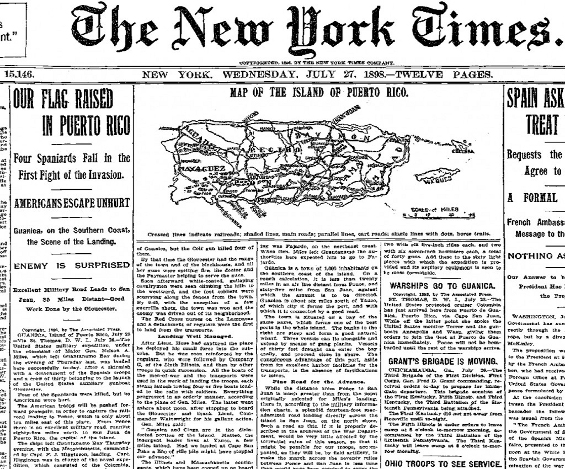
NYT PR July 27 1898

Después de la guerra hispanoamericana varias casas publicadoras, revistas, y periódicos divulgaron numerosos textos que recogían las experiencias y observaciones de las visitas de diversos viajeros estadounidenses a Puerto Rico. Estos viajeros articularon a través de sus narrativas el discurso colonial de la era inicial del imperialismo transcontinental estadounidense. Son por ello un objeto de estudio imprescindible de la “historia de lo imaginario” propuesta por Arcadio Díaz. Fue Díaz quien precisamente afirmó la necesidad de examinar diversas “zonas oscuras” del ’98, entre las que incluyo las relaciones con el espacio, y por supuesto, con la naturaleza.

La inspección y descripción absoluta y detallada de la colonia y su gente, incluyendo el paisaje, fue el propósito fundamental de esas narrativas de viaje. Sus descripciones, aunque enmarcadas en el realismo descriptivo, produjeron una visión estética de la naturaleza isleña articulada a través de varios significados que puntualizaron su riqueza simbólica y material. Puesto que esas representaciones iban dirigidas a la audiencia estadounidense requirieron que sus autores integraran el paisaje tropical de Puerto Rico, raro y confuso para muchos estadounidenses, al ámbito de su cultura. Para ello los autores movilizaron tropos conocidos por sus lectores en Estados Unidos, entre ellos la figura retórica del Edén. Muchos de esos escritores representaron la Isla como un jardín edénico, recurriendo a lo que Carolyn Merchant llamó la “narrativa de la restauración del Edén,” una narrativa familiar a los estadounidenses.

Aparte de convertir el paisaje de la recién adquirida colonia en un objeto familiar el tropo justificó, apelando a la jardinería, la colonización de la naturaleza isleña y sus habitantes. Efectivamente, la etimología de la palabra colonizar traza una conexión a las palabras colonus y colere, labrador y cultivar, respectivamente. La jardinería representaba para el nuevo colonus, los estadounidenses, el conjunto de técnicas necesarias para el control y manejo de los recursos naturales de la nueva colonia. Era la alegoría ajustada a la práctica de cultivar, de culturar la naturaleza apropiada y expropiada, es decir, colonizada.

La jardinería incluye la construcción de un espacio, de un jardín. La narrativa edénica de los textos estadounidenses produjo, en efecto, y a través de varias “geografías imaginativas,” espacios, el ordenamiento territorial y colonial del paisaje puertorriqueño. Pero se trataba ya en el 98 de lo que Henri Lefebvre llamó la producción capitalista del espacio. Pero, la producción del espacio es siempre corolario de la producción de la naturaleza. Y como he planteado en otros contextos existe una conexión entre la narrativa de la recuperación del Edén y lo que Neil Smith llamó la producción capitalista de la naturaleza. En los textos americanos, la conversión de la naturaleza isleña en recursos, el inventario textual y prospección económica de los mismos, así como su valuación monetaria, todo presente en varios textos estadounidenses, contribuyeron a instituir las formas en que la naturaleza sería alterada, capitalizada, circulada, intercambiada y consumida, material e ideológicamente, como bien material en términos de la lógica abstracta de su valor de intercambio en el mercado capitalista. En otras palabras la alegoría edénica movilizada por varios textos estadounidenses animó y justificó la intervención y ordenación capitalista-colonialista de la explotación y manejo de los recursos naturales de la Isla.

La producción capitalista de la naturaleza envuelve la subsunción formal y real de la naturaleza a las redes del capitalismo. Los textos estadounidenses que de una forma u otra escribieron sobre la naturaleza en Puerto Rico contribuyeron a ello, principalmente a la subsunción formal de la misma, aparte de sentar las bases para su prevista subsunción real a las abarcadoras redes del capital. Esto apunta a que la problemática de los estadounidenses, en adición a la delineación de la administración política a seguir en Puerto Rico, ya expuesto en detalle por Lanny Thompson, incluía además prescribir e instituir las formas de explotar y administrar los recursos naturales de la nueva colonia. Sus descripciones del entorno natural puertorriqueño participaron de la apropiación y la organización de su explotación comercial. Contribuyeron así a la ampliación de la subsunción formal, funcionando, naturalmente, como una estrategia primaria del capital para la apropiación y subordinación expresa, precisa y determinada de los recursos naturales.

Los estudiosos del tema, entre ellos Manuel Valdés Pizzini, Mario R. Cancel, José Anazagasty, José E. Martínez y Carlos I Hernández, entre otros, ya han conectado las prácticas de significación de varios de los textos estadounidenses con las prácticas económicas del capitalismo colonial, incluyendo su manejo de los recursos naturales de la isla.Estos textos, más allá de delinear la forma de administración política de lo que muchos llamaron Porto Rico también mostraron, proyectaron y justificaron la expansión económica del capital estadounidense en la Isla. Para ello detallaron el potencial económico de la colonia, incluyendo las posibilidades de invertir capital allí, la disponibilidad de materia prima y recursos naturales, la infraestructura adecuada y la reserva de trabajadores, entre otras cosas. Uno de los propósitos de muchos de estos textos y sus proyecciones económicas fue seducir a los inversionistas y comerciantes potenciales, interesarlos en las posibilidades agrícolas, comerciales e industriales de la isla.

La prospección de la isla también fue científica; Puerto Rico fue objeto de las observaciones y prácticas científicas estadounidenses realizadas por varios científicos de ese país alrededor de la Isla. Muchos de estos científicos, a través de diversos textos, también participaron de la producción capitalista de la naturaleza. Se esperaba que los científicos, particularmente aquellos al servicio del Estado, ayudaran a manejar el ambiente y sus recursos de forma racional. Por ejemplo, y como demostró Manuel Valdés Pizzini, diversos procesos ideológicos y discursivos ligados a la ciencia participaron del diseño de estrategias para el manejo estadounidense de los bosques después de la Guerra Hispanoamericana. Los estadounidenses, a la vez que devaluaron el manejo español de los bosques, recurrieron a discursos particulares de la dasonomía y la silvicultura—la racionalidad científica—para legitimar su ordenamiento y manejo particular—colonial—de los bosques puertorriqueños.

Pero en la mayoría de los casos la problemática, ahora científica, no era únicamente determinar la forma racional de manejar los recursos naturales de la colonia caribeña sino también detectar los recursos rentables y prescribir su explotación lucrativa, lo que requirió, como explica J.R. Mcneill en Colonial Crucible, la institucionalización de una ciencia ambiental. Esa ciencia, también ideológica y discursiva, participó de la producción capitalista de la naturaleza y el manejo de los recursos naturales.

La Estación Experimental de Puerto Rico, ubicada en Mayagüez, fue una importante manifestación de la institucionalización del manejo científico y racional de los recursos naturales, particularmente en el ámbito de la agricultura. Los investigadores afiliados a esa estación dirigieron muchas de sus investigaciones no solo al estudio de fenómenos naturales sino además a la “mejor” explotación y comercialización de diversos recursos naturales y agrícolas. Muchos de los hallazgos y recomendaciones económicas de esas investigaciones fueron publicados en diversas revistas y periódicos, incluyendo Porto Rico Progress. Un buen ejemplo es el artículo “Bees in Porto Rico,” publicado en 1910 justamente en esa revista. Este fue escrito por W.V. Tower, un entomólogo especialista en abejas afiliado a la mencionada estación y fue publicado tanto en inglés como en español.

Tower comenzó su artículo con algunos detalles sobre la introducción de las abejas a Puerto Rico, indicando que las mismas fueron introducidas posiblemente por un tal Mr. Filippi, quien ubicó colmenas de abejas italianas en la finca Juanita en Las Marías. También señaló que la mayoría de esas colmenas fueron destruidas por un huracán en 1899 pero que las abejas sobrevivientes produjeron colmenas silvestres en Las Marías. Tower afirmó esto último fundamentado en las anécdotas de los “vecinos” de Las Marías, quienes le comentaron haberse topado varias veces con colmenas de abejas silvestres. Para el entomólogo la descripción de aquellas abejas silvestres por parte de los vecinos apuntaba a que se trataba de abejas italianas, las sobrevivientes de las colmenas de Filippi.

Tower, desde la Estación Experimental de Puerto Rico, promovía el avance de “apiarios comerciales.” Destacaba en su ensayo que en apenas dos años desde que comenzó el proyecto ya habían enviado abejas a unas cincuenta personas. El entomólogo procedió entonces a confirmar el potencial lucrativo de los apiarios: “Desde que me encargue de esta obra, he estado siempre en busca de plantas apropiadas para abejas, y soy de opinión que Puerto Rico tiene gran cantidad de plantas melíferas, y dudo que exista una localidad en donde las abejas no resulten un buen negocio.”

abejas

Caja de abejas. Foto en “Rearing Queen Bees in Porto Rico”, publicado en 1918.

Su apoyo a la producción comercial de miel fue seguido por una serie de recomendaciones dirigidas a maximizar la productividad y potencial comercial de los apiarios, de la producción comercial de miel. Primero, recomendó localizar los apiarios en las faldas de los cerros y en las tierras dedicadas al cultivo del café, y aquellos lugares con varias plantas melíferas. Segundo, ofreció un inventario cabal de plantas melíferas: guamá, palma real, cocotero, moca, jobo, palo blanco, grosellas, higüerillo, y guara. Tercero, subrayó la importancia de las abejas en la fertilización de flores, como las de naranjo, lo que aumentaría las cosechas de frutas. De hecho, señaló que la presencia de más abejas hubiese evitado la escasez de flores de naranjo ese año, 1910, lo que pudo haber garantizado una mejor cosecha de naranjas. Cuarto, Tower recomendó aglutinar los esfuerzos hacia la producción de miel de extracción, objetando la producción de los panales y las secciones de a libra, los que según explicaba eran difíciles de embarcar y distribuir en los mercados, aunque la miel puertorriqueña solo se exportaba a Estados Unidos y en ocasiones a Alemania.

Tower, aunque afirmaba que la producción de los panales y las secciones de a libra podían explotarse para el consumo local, favorecía que los principiantes recurrieran la producción de miel de extracción, por ser este un método más fácil de manejar. Además, la producción de miel de extracción era, afirmaba el entomólogo, menos trabajosa para las abejas, pues evitaba que estas tuvieran que producir panales nuevos constantemente. Añadió también que la producción de miel de extracción facilitaba dominar las abejas porque reducía la tendencia de estas a formar enjambres, lo que no sucedía con los otros modos de producción de miel. Para él, la producción de enjambres disminuía la “fuerza productora de la colmena,” y con ello el potencial comercial de la apicultura. Finalmente, ese modo de producción de miel de extracción, el “método artificial,” permitía producir cera con menos miel, lo que se traducía, explicaba él, en ganancias monetarias, dependiendo claro está del precio de la miel vis-a-vis la cera en los mercados. Finalmente, recomendó seguir usando abejas italianas, porque aunque estas eran las más difíciles de subyugar eran muy buenas defendiéndose de las polillas de cera.

Tower, vaticinaba, si se seguían sus recomendaciones, y gracias a las favorables condiciones ambientales de la Isla, como la presencia de diversas plantas melíferas y la presencia de abejas italianas saludables, un buen éxito económico para la apicultura comercial en Puerto Rico: “El porvenir de los apicultores puertorriqueños es brillantísimo. No se conocen enfermedades que molesten a las abejas. La putrefacción de la cría—terrible enfermedad que puede estudiarse en una de las islas vecinas así como en los Estados Unidos—no ha sido introducida en Puerto Rico.”

Tower, y muchos científicos como él, participando de la subsunción formal de la naturaleza, de las abejeras y su miel en su caso, contribuyeron a la marcha de la naturaleza como estrategia de acumulación capitalista en Puerto Rico. Los científicos asistieron el “imperialismo ecológico”, el control capitalista-estadounidense del flujo de recursos naturales procedentes de la isla. Los estadounidenses, claro está, no fueron los únicos en proyectar y explotar los recursos naturales de la Isla o de convertirlos en bienes lucrativos formal y realmente. Los españoles y los puertorriqueños mismos hicieron lo suyo. Además, la Estación Experimental de Puerto Rico promovió la participación de apicultores locales, inclusive enviándoles abejas y entrenándolos. No promovió, como ocurrió con otros recursos, el control absoluto del capital estadounidense sobre la producción de miel. Pero el proyecto colonial-capitalista de los estadounidenses extendió e intensificó la producción capitalista de la naturaleza, particularmente de su integración formal, como nunca antes, y con la racionalidad científica de su parte.


José Anazagasty Rodríguez

José Anazagasty Rodríguez  es Catedrático Asociado en el programa de Sociología del Departamento de Ciencias Sociales de la Universidad de Puerto Rico, Recinto Universitario de Mayagüez. Es especialista en sociología ambiental, estudios americanos y teoría social, y ha realizado investigaciones en la retórica imperialista estadounidense y la producción capitalista de la naturaleza en Puerto Rico. Es co-editor, con Mario R. Cancel, de los libros «We the people: la representación americana de los puertorriqueños 1898-1926 (2008)» y «Porto Rico: hecho en Estados Unidos (2011)».


River of Hope: Forging Identity and Nation in the Rio Grande Borderlands

Marshall Poe

New Books in History    June 12, 2014

Omar Valerio Jiménez

Omar Valerio Jiménez

Historically speaking, who you were depended on who your rulers were and the ethnic identity (including language, religion, and folkways) of “your” people. In the era of nation-states–that is, our era–these two characteristics have, for most people, been fused. Ethnic Germans live in Germany, ethnic Chinese live in China, ethnic Egyptians live in Egypt. The exceptions to this rule are two: ethnic minorities (e.g., Jews, Kurds, Uyghers, etc.) residing in nation-states and people who live in the shifting borderlands between nation-states.

511zJ3AL48L__SL160_Omar Valerio-Jiménez‘s fascinating book River of Hope: Forging Identity and Nation in the Rio Grande Borderlands (Duke University Press, 2013) is about identity in one particularly interesting shifting borderland, that found in the Rio Grande region between New Spain/Mexico and the United States. Valerio-Jiménez shows that the people of the Rio Grande were, ethnically speaking, many: a variety of native Americans, Spanish soldiers and colonists, Mexican and American immigrants of every stripe. The border shifted back and forth; the river and its people for the most part remained, adapting to new regimes and new conditions. Just “who” they were at any given time depended on a whole variety of factors, all of which are expertly explored by Valerio-Jiménez. Listen in to our fascinating discussion.

The Invasion of America  

Este  mapa interactivo del desarrollo del expansionismo continental estadounidense,  examina la adquisisicón de territorios a través de los tratados y órdenes ejecutivas relacionadas con las llamadas naciones indias. En otras palabras, ilustra el proceso de despojo de las tierras de los pobladores norteamericanos originales por parte del gobierno federal norteamericano entre 1776 y 1876. También contiene vínculos a los textos de los tratados en cuestión  y un video, los que podrían resultar herramientas muy útiles para educadores.

El mapa esta accesible aquí.

Imagen

I Freed Myself: African American Self-Emancipation in the Civil War Era

Marshall Poe 

New Books in History  June 5, 2014

David Williams

David Williams

Lincoln was very clear–at least in public–that the Civil War was not fought over slavery: it was, he 61eT-apOtrL._SL160_said, for the preservation of the Union first and foremost. So it’s not surprising that when the conflict started he had no firm plan to emancipate the slaves in the borderland or Southern states. He also knew that such a move might prove very unpopular in the North.

So why did he issue the Emancipation Proclamation on January 1, 1863? There are many reasons. According to David Williams‘ fascinating new book I Freed Myself: African American Self-Emancipation in the Civil War Era (Cambridge University Press, 2014), an important and neglected one has to do with African American self-emancipation. After the war began, masses of slaves began to leave the South and head for the Northern lines. The Union forces received them as “contraband” seized from the enemy during wartime. As such, their status was uncertain. Many wanted to fight or at least serve as auxiliaries in the Union armies like freemen, but they were still seen as property. As Williams points out, the North certainly needed their manpower–as Lincoln knew better than anyone. Bearing this in mind, the President felt the time was propitious to do what he thought was right all along–free the slaves. Listen in.

The Political War

Allen C. Guelzo

The New York Times  June 5, 2014

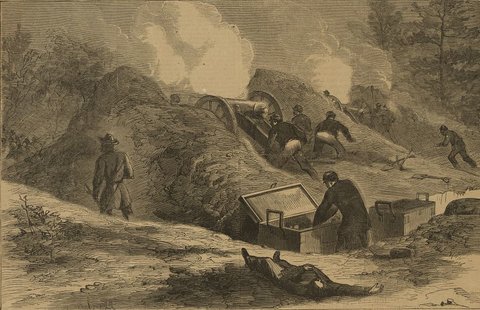
A Union artillery battery at Cold Harbor. Library of <Congress

A Union artillery battery at Cold Harbor. Library of <Congress

Pity Abraham Lincoln. Everything that should have gone right for the Union cause in the spring of 1864 had, in just a few weeks, gone defiantly and disastrously wrong.

For two years, the 16th president had toiled uphill against the secession of the Confederate states, against the incompetence of his luckless generals and against his howling critics from both sides of the congressional aisle. Finally, in the summer and fall of 1863, the course of the war had begun to turn his way. Two great victories at Gettysburg and Vicksburg staggered the Confederates, and those were followed by a knockdown blow delivered at Chattanooga by the man who was fast becoming Lincoln’s favorite general, Ulysses S. Grant. “The signs look better,” Lincoln rejoiced, “Peace does not appear so distant as it did.”

Peace was not the only thing that would be brought closer by victory. The presidential election of 1864 was looming, and if Lincoln had any desire for a second term, a victorious end to the war was the surest way to secure it. He had never seriously considered taking what appeared to some people as an obvious shortcut to remaining in office – declaring the war to be a national emergency and suspending elections for the duration, though two Union governors, in Indiana and Illinois, had done what amounted to that on the state level. That only made the need for military victory all the more urgent, and so Lincoln installed Grant as general in chief of all the Union armies in March 1864, and Grant obliged him with a comprehensive strategic plan that united Union assaults in Georgia, Alabama and, under his own direct command, in Virginia.

None of it worked, and the place where it seemed to work the least was under Grant’s own nose. Crossing the Rapidan River on May 4, 1864, Grant’s army entered at once into a series of head-to-head contests with Robert E. Lee’s fabled Army of Northern Virginia. Fighting three pitched battles – at the Wilderness, Spotsylvania Court House and the North Anna River – and enduring numerous smaller collisions, Grant worked his way down toward the Confederate capital at Richmond, which he got within 10 miles of by the end of the month. But the fighting had cost a colossal total of 40,000 dead, wounded and missing, and Lincoln gloomily understood that the Northern public “hold me responsible.”

They weren’t the only ones. Radicals within Lincoln’s own Republican Party in Congress had long been convinced that Lincoln’s preference for a soft postwar Reconstruction was dis-heartening the Republican base. They were further angered when the Republican national committee, headed by Lincoln’s ally Edwin D. Morgan, met in late February 1864 and announced that the party would hold its presidential nominating convention in Baltimore in June, not as “Republicans,” but as the “National Union Convention.” As Grant’s campaign in Virginia ground agonizingly forward, the most vehement of the Radicals – led by Frederick Douglass, Wendell Phillips and Horace Greeley – staged a protest convention in Cleveland’s Cosmopolitan Hall, and on June 4 nominated the Radical darling, John Charles Fremont.

If ever there was a moment when Lincoln needed good news from the battlefield, it was now, and Grant wanted to deliver it. The staggering blows he had dealt the rebels convinced him a little too easily that the Confederates were “really whipped,” that “our men feel they have gained morale over the enemy and attack with confidence,” and that with one more blow, “success over Lee’s army is already assured.” On June 1, Grant launched a hasty strike at Cold Harbor, before the bulk of his army could get into action. Even so, the attack cracked the Confederate defenses on the Cold Harbor road and forced them to fall back. With another good push, Grant might just be able “crush Lee’s army on the north side of the James, with the prospect in case of success of driving him into Richmond, capturing the city perhaps without a siege, and putting the Confederate government to flight” – not to mention providing a rousing military endorsement for Lincoln’s renomination.

But Grant, in his eagerness, had badly misread the Confederates, and when he launched a full-dress attack at Cold Harbor on June 3, it resembled (as one Confederate general put it) “not war but murder.” Well-prepared Confederate infantrymen mowed down federal at-tackers. Grant’s army sustained 3,500 casualties in the main attack and another 2,500 in related actions that day, and the armies settled into a miserable standoff.

Yet Grant carefully limited his report of the Cold Harbor debacle to four terse sentences, including the claim that “our loss was not severe.” And in the official report of the campaign he filed after the war, Cold Harbor consumed just three sentences in 51 pages. For years afterward, Grant’s doubters wondered whether he had deliberately soft-pedaled the failure at Cold Harbor in order to limit political damage to Lincoln on the eve of the Baltimore convention. There is no direct evidence of such collusion; still, Grant’s dismissal of his losses as “not severe” is peculiar.

Even more peculiar, newspaper reporting from the field was shut down by the War Department because of “a violent storm.” The New York Times (whose editor, Henry Raymond, was the new chairman of the National Union Party’s national Committee) did not publish an ac-count of the June 3 attack for three more days, and even then, merely observed that “losses were inconsiderable.”

Strangest of all, however, was Grant’s refusal to propose a truce to recover the wounded from the battlefield until June 7. Military tradition dictated that only the loser of an engagement asked for such a truce. Even though there could not have been much debate about who had won and who had lost at Cold Harbor, Grant delayed the truce agreement (and any public admission of defeat) for four days, while men suffered and died from thirst, blood loss and exposure.

By June 7, however, any anxiety that bad news from Cold Harbor would endanger Lincoln’s nomination was past. That same day, the Union National Convention opened at the Front Street Theater in Baltimore, with Robert J. Breckinridge asking triumphantly, “Does any one doubt that this convention intends to say that Abraham Lincoln shall be the nominee?” They did not, and the next day, undisturbed by any news of Cold Harbor, Lincoln – described by one state delegation as “the second savior of the world” – was unanimously renominated by the convention.

Given how diligently the National Union Party’s staff had worked to ensure Lincoln’s renomination in the months before the Baltimore assembly, even the freshest news from Cold Harbor might not have made much difference. But keeping the ill wind at bay certainly did not hurt. Nor was it uncommon in this war for the impact of bad military news to be blunted by creative hesitation. One of Grant’s corps commanders was overheard telling a staffer not to report actual casualty figures: “It will never do, Locke, to make a showing of such heavy losses.” After that, wrote the officer who overheard him, “I always doubted reports of casualties.” It irked one Philadelphia newspaper on June 9 to admit that “we can scarcely find out that there was fought one of the bloodiest battles of the war, yet, until yesterday, no one knew its result.” This was, in the end, a highly political war, in which military decisions frequently turned before the winds of politics. And in the coming months, Lincoln would find far greater political challenges in the path of re-election than the ones presented by Cold Harbor.

Follow Disunion at twitter.com/NYTcivilwar or join us on Facebook.


Sources: R.P. Basler, ed., “Collected Works of Abraham Lincoln”; Larry T. Balsamo, “’We Cannot Have Free Government without Elections’: Abraham Lincoln and the Election of 1864,” Journal of the Illinois State Historical Society 94 (Summer 2001); Gordon C. Rhea, “Cold Harbor: Grant and Lee, May 26-June 3, 1864”; Ralph Morris Goldman, “The National Party Chairmen and Committees: Factionalism at the Top”; Andrew F. Rolle, “John Charles Fremont: Character As Destiny”; The War of the Rebellion: A Compilation of the Official Records of the Union and Confederate Armies, Series One, 37 (pt 1); Gordon C. Rhea, “The Overland Campaign,” Hallowed Ground 15 (Spring 2014); The New York Times, June 6 and 8, 1864; Ernest B. Furgurson, “Not War But Murder: Cold Harbor, 1864”; D.F. Murphy, “Proceedings of the National Union Convention Held in Baltimore, Md., June 7th and 8th, 1864”; Morris Schaff, “The Battle of the Wilderness”; David E. Long, “Cover-up at Cold Harbor,” Civil War Times Illustrated 36 (June 1997).


Allen C. Guelzo, professor of the Civil War era at Gettysburg College, is the author, most recently, of “Gettysburg: The Last Invasion.”

Who Was Jim Crow?

HNN Staff   October 31, 2011

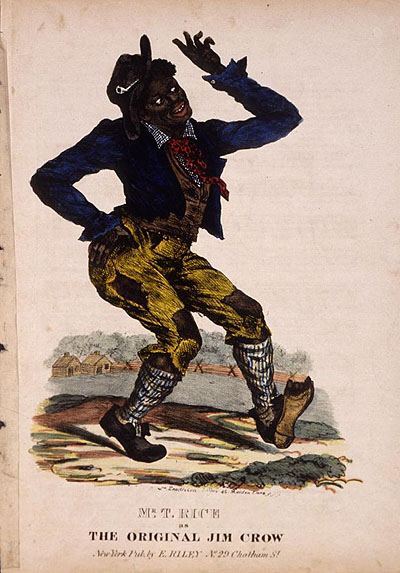
Cover to an early edition of "Jump Jim Crow" sheet music (c 1832) -- Wikipedia -

Cover to an early edition of «Jump Jim Crow» sheet music (c 1832) — Wikipedia


Jim Crow laws, as most Americans should (hopefully) know, were the racist segregation laws which cemented white supremacy over African Americans throughout the United States from the end of Reconstruction in 1877 to the civil rights movement’s victories in the mid-1960s.

But who the heck was Jim Crow, and why did his name grace some of the most odious laws in American history?

Jim Crow was not actually a person—the name comes from an 1828 show by Thomas Dartmouth “Daddy” Rice.  Rice, in a proto-minstrel act, would put on blackface and sing “Jump Jim Crow,” with the refrain:

Wheel about, an’ turn about, an’ do jis so;
Eb’ry time I wheel about, I jump Jim Crow.

The song was quite popular in the early half of the 1800s, and “Jim Crow” quickly became a disparaging term for blacks, but it wasn’t until toward the end of the century that the name was applied to the various post-Reconstruction “black codes” in the South (the New York Times referred to Louisiana’s “‘Jim Crow’ Law” as early as 1892).


The song was quite popular in the early half of the 1800s, and “Jim Crow” quickly became a disparaging term for blacks, but it wasn’t until toward the end of the century that the name was applied to the various post-Reconstruction “black codes” in the South (the New York Times referred to Louisiana’s “‘Jim Crow’ Law” as early as 1892). – See more at: http://hnn.us/article/142719#sthash.iswHNd5D.dpuf

Jim Crow laws, as most Americans should (hopefully) know, were the racist segregation laws which cemented white supremacy over African Americans throughout the United States from the end of Reconstruction in 1877 to the civil rights movement’s victories in the mid-1960s.

But who the heck was Jim Crow, and why did his name grace some of the most odious laws in American history?

Jim Crow was not actually a person—the name comes from an 1828 show by Thomas Dartmouth “Daddy” Rice.  Rice, in a proto-minstrel act, would put on blackface and sing “Jump Jim Crow,” with the refrain:

Wheel about, an’ turn about, an’ do jis so;
Eb’ry time I wheel about, I jump Jim Crow.

The song was quite popular in the early half of the 1800s, and “Jim Crow” quickly became a disparaging term for blacks, but it wasn’t until toward the end of the century that the name was applied to the various post-Reconstruction “black codes” in the South (the New York Times referred to Louisiana’s “‘Jim Crow’ Law” as early as 1892).

– See more at: http://hnn.us/article/142719#sthash.iswHNd5D.dpuf

Cover to an early edition of «Jump Jim Crow» sheet music (c 1832) — Wikipedia

Jim Crow laws, as most Americans should (hopefully) know, were the racist segregation laws which cemented white supremacy over African Americans throughout the United States from the end of Reconstruction in 1877 to the civil rights movement’s victories in the mid-1960s.

But who the heck was Jim Crow, and why did his name grace some of the most odious laws in American history?

Jim Crow was not actually a person—the name comes from an 1828 show by Thomas Dartmouth “Daddy” Rice.  Rice, in a proto-minstrel act, would put on blackface and sing “Jump Jim Crow,” with the refrain:

Wheel about, an’ turn about, an’ do jis so;
Eb’ry time I wheel about, I jump Jim Crow.

The song was quite popular in the early half of the 1800s, and “Jim Crow” quickly became a disparaging term for blacks, but it wasn’t until toward the end of the century that the name was applied to the various post-Reconstruction “black codes” in the South (the New York Times referred to Louisiana’s “‘Jim Crow’ Law” as early as 1892).

– See more at: http://hnn.us/article/142719#sthash.iswHNd5D.dpuf

Black Women Entertainers in a Revolutionary Time: An Interview with Historian Ruth Feldstein – See more at: http://hnn.us/article/155821#sthash.pv6BHGCY.dpuf

Black Women Entertainers in a Revolutionary Time: An Interview with Historian Ruth Feldstein

Robin Lindley

HNN June 9, 2014


“Culture was a key battleground of the civil rights movement,” writes historian Dr. Ruth Feldstein who explores race and gender as well as the connection of art and activism in her compelling new study, How It Feels to Be Free: Black Women Entertainers and the Civil Rights Movement (Oxford University Press).

Dr. Feldstein’s book focuses on the activism and influence of six prominent black performing artists: Lena Horne, Nina Simone, Abbey Lincoln, Miriam Makeba, Cicely Tyson and Diahann Carroll. As these women entertained America they also spoke out in various ways for equality and justice in support of the civil rights struggle.

The trailblazer, brilliant vocalist and star of stage and screen Lena Horne, led the way with her performances in the 1930s and 1940s that introduced wide audiences to a fresh and novel talent, and her activism that grew, crossed many divides, and matured in the 1960s. In the shadow of Horne, the five younger artists each broke new ground in her own way to transform American culture and to reshape outdated views of race and gender, forging black power and evolving feminism.

In her sweeping account, Dr. Feldstein details the work and struggle of each of these women who achieved fame in male-dominated cultural industries while resisting racist and sexist stereotypes. She discusses the how South African singer Miriam Makeba connected the American civil rights movement with the anti-apartheid campaign in her native land; how jazz icon Nina Simone confronted audiences with the brutality of racial discrimination in her fiery, moving songs; how the outspoken vocalist and actress Abbey Lincoln broke new ground in music and film; how actress Diahann Carroll made history as television’s Julia in 1968 and then struggled with the ways she was typecast; and how award-winning actress Cicely Tyson advocated for human rights and for dignified portrayals of African Americans on screen and television as she starred in renowned films such as Sounder and The Autobiography of Miss Jane Pittman.

How It Feels to Be Free has been praised for its originality, insight, and its blending of political and cultural history. Dr. Daphne Brooks of Princeton University wrote: “By placing black female musicians and actors at the center of Civil Rights history, Ruth Feldstein has written a tremendously important study that challenges readers to consider the imaginative activism of artists who performed progressive representations of black womanhood. How It Feels to Be Free takes readers on a critical journey across the mid-twentieth century freedom struggle by way of women performers who rehearsed, remixed, and renegotiated civil rights and black power politics, as well as emergent feminisms.» And Peniel E. Joseph, author of Stokely: A Life commented: «How It Feels to Be Free stands out as an enormous act of historical recovery. Ruth Feldstein masterfully illuminates the way in which black women entertainers actively participated in the civil rights struggle and helped to transform American and international race relations. A powerful and thought provoking book that will change the way we look at gender, civil rights, and the black freedom movement.»

Dr. Ruth Feldstein is an associate professor of history at Rutgers University, Newark.  Her teaching and research focus on the intersections of gender and race and the relationships between culture and politics. Her first book was Motherhood in Black and White: Race and Sex in American Liberalism, 1930-1965, an intellectual and cultural history of liberalism and race from the New Deal to the Great Society.

Dr. Feldstein graciously responded by email to a daunting series of questions on her new book.

Robin Lindley: How did you come to write about the civil rights movement through the stories of this group of black female entertainers?

Dr. Ruth Feldstein: For one, I wanted to tell the stories of women whose voices have not been heard. While it is a bit ironic to say that about amazing vocalists like Lena Horne, Nina Simone, or Abbey Lincoln, these and other women have been marginal to our political histories of these decades. Theirs are not the melodies that we tend to hear at Martin Luther King Day celebrations each January. Yet there was far more to civil rights than “I have a dream,” and there was far more to culture and civil rights than “We Shall Overcome.”

I also wanted to consider how politics and social movements were relevant to the thousands upon thousands of Americans and non-Americans who did not (or today, do not) consider themselves particularly political. After all, plenty of people never marched or boycotted or worked on behalf of any particular candidate in the late 50s into the 70s. Nevertheless, they encountered black activism when they bought certain albums or listened to certain songs or watched particular films or television shows. In other words, we need to expand the parameters in which we see people acting politically. When we do so, we can see that these six trailblazing women were critical to what were arguably the two most transformative social movements of the twentieth century: civil rights and women’s liberation.

Abbey Lincoln

Robin Lindley: How did you choose the six women you focus on in the book? What connections did you find in terms of the civil rights movement?

Dr. Ruth Feldstein: That’s a great question, and plenty of readers offer me lists of their favorites who could have been included. I chose to focus on these six women because of their diversity and because of what they had in common.

In terms of their diversity, the book traverses television and film, jazz and pop music, the NAACP and the Black Panthers, Selma and South Africa. That is, I incorporated women entertainers who worked across different cultures and industries—and not just women in jazz or women on television; I also wanted to tell a story that cuts across national boundaries and typical political divides of liberalism and radicalism.

On the other hand, even with these differences, the six women I write about did have a lot in common: they all had relationships to organized political movements for racial equality; they all were popular within, and beyond, the United States; and they were all were political subjects and intellectuals and not “merely” entertainers. Perhaps of greatest significance, though, they shared a loosely connected community. The women in How It Feels To Be Free were essential to a larger interracial group of activists/entertainers that came of age culturally and politically in New York—primarily in the Village and in Harlem–in the late 1950s. Their communities included HarryBelafonte, James Baldwin, Lorraine Hansberry, Maya Angelou, and Ossie Davis,to name just a few. The book is a history of that urban subculture and its gendered dimensions at the same time that it offers snapshots of particular figures.

This is not to say that there were not many other black women entertainers from this period whose careers mattered to the civil rights movement. I feel lucky to have been researching and writing this book when other writers and scholars have told wonderful stories about other women, and I look forward to reading more of this exciting work.

Robin Lindley: What was your research process? Did you have an opportunity to interview any of your subjects?

Dr. Ruth Feldstein: My process was to research and write, research and write, chapter by chapter; initially, each chapter felt relatively independent. As the process continued over time, I started to see more and more links between and among the women. In fact, they were connected to each other in all sorts of ways. But this wasn’t necessarily obvious at the outset because critics from the late 1950s—when Nina Simone, Miriam Makeba, Abbey Lincoln, Diahann Carroll, and Cicely Tyson all came of age professionally—wrote about each one in isolation. It took time for me to see that they were an emergent collectivity of ambitious black women performers who together were building their careers, innovating, and making political commitments.

I made a conscious decision not to interview the women I was writing about. I made that choice because I really wanted to listen in on the conversations that were happening in that period of time. My main questions were about how people at the time made these women and their careers meaningful—how the women worked to represent themselves and how other people reacted to them and made them celebrity-activists. I felt that talking to them decades later would certainly be incredibly interesting, but would not necessarily help me to answer those questions and, in fact, could possibly distract me from those questions.

Robin Lindley: I think many Americans think first of male leaders such as Dr. King and Malcolm X or Stokely Carmichael or male entertainers such as Harry Belafonte and Sidney Poitier when they think of the sixties and the civil rights movement. What are a few things you would like others to know about the role of women in the movement?

Dr. Ruth Feldstein: I absolutely agree with you, Robin. The story of the civil rights movement—at least the one that I learned in grade school, high school and even into college, and the one that my students tell me they are still getting in high school—tends to revolve around male leaders and songs like “We Shall Overcome” as the ubiquitous background soundtrack. Occasionally a woman—usually Rosa Parks—shows up in that story; but even then she tends to appear as the “tired, old seamstress,” who “suddenly” decided not to give up her seat on a bus in Montgomery (this despite her decades of activism). But when we bring black women entertainers center-stage, the history of civil rights looks different.

For example, in 1963, just a month after the March on Washington and Martin Luther King’s iconic “I Have a Dream” speech, Nina Simone wrote the song “Mississippi Goddam.” The song had an upbeat tempo, but offered incredibly incendiary lyrics filled with anger. Simone rejected the notion that race relations could change gradually and shattered the assumption that African Americans would patiently use the legislative process to seek political rights. She even declared, “But this whole country is full of lies, You’re all gonna die and die like flies.”

In a moment that many people today remember as the high water mark of liberal, interracial, nonviolent, church-based activism that culminated in passage of landmark civil rights legislation, Simone dramatically departed from conventional wisdom and imagined another kind of black freedom. A few years later, the vision that she offered in “Mississippi Goddam” would become known widely as black power.

Nina Simone

Contrary to the neat historical trajectories which assume that black power only arose in the late 1960s, Simone’s album makes clear that black power perspectives were already taking shape and circulating widely years earlier—in organizations, but also on vinyl albums that music fans played around the world. So by listening to this woman’s voice, we can reperiodize civil rights, and mess up what is sometimes an overly schematic story of civil rights versus black power.

But there’s more to it than that. When Simone denounced racism and those who called on black Americans to wait patiently for progress, she did so in ways that emphasized female power. In one verse, Simone sang:

Yes, you lied to me all these years

You told me to wash and clean my ears

And talk real fine, just like a lady

And you’d stop calling me Sister Sadie.

But this whole country is full of lies

You’re all gonna die and die like flies

I don’t trust you any more

You keep on saying “Go Slow.

When Simone rejected the impulse to “talk like a lady” she was saying that black women did not have to focus on appearance, diction, and manners—to “wash and clean my ears,” to “talk like a lady” as she put it—to claim their rights; she argued that doing so did not stop whites from calling black women “Sister Sadie” instead of their real names. She was saying that women should not have to behave a certain way to be recognized as deserving. Here and in other songs, Simone staged an assault—simultaneously—on racism and on expectations of female propriety. For her, black power was about black female power.

This is just one example of how listening to women allows us to reconceptualize as well as reperiodize histories of the movement.

Robin Lindley: Lena Horne is a pivotal and overarching figure in your book. How did she influence the civil rights movement and the younger women you profile?

Dr. Ruth Feldstein: Lena Horne was older than the other five women in How It Feels to Be Free. In the 1930s and 40s, when Makeba, Simone, Carroll, Lincoln were kids, really, Horne challenged long entrenched assumptions about black women. For example, in 1941, she became the first African American woman to sign a contract with a major Hollywood studio, one in which MGM executives acceded to her demand that she not play any maids on film. She rejected definitions of black women as either sexualized Jezebels or as caretaking and subordinate Mammies. These were powerful and deeply ingrained images that had boxed in all black women for centuries. Instead, Lena Horne made it possible for fans across lines of race to imagine a black woman as glamorous, and as an unavailable object of desire. In many respects, then, Horne created the template for the modern and glamorous politicized female black celebrity.

In the late 1950s, younger black women encountered, played with, and bent sometimes beyond recognition that template. Diahann Carroll was a singer and actress who invited numerous comparisons to Horne. Starting in the 50s, Carroll worked to update and maintain Horne’s insistence that that a black woman could simultaneously be respectable, sexual, and glamorous. Other black women performers also grappled with Horne’s image. But they did more to redefine celebrity culture and they transformed meanings of glamour for black women.

Lena Horne

 Robin Lindley: Miriam Makeba was South African but performed extensively in the US. Wasn’t she important in terms of educating many about international liberation movements and conditions in the US?

Dr. Ruth Feldstein: Miriam Makeba was a South African singer who came to the U.S in 1959. Within days of arriving, she made her American debut and was a big sensation. But in contrast to her good friend, Nina Simone, Makeba insisted that she was “just” an entertainer, and she avoided confrontations and overtly political lyrics. Nevertheless, she was able to make connections for her audiences in the United States between domestic black activism and anticolonial struggles. Americans who knew little about Africa beyond Tarzan paid attention to anti-apartheid activism when they saw the exiled Makeba on the popular Steve Allen television show and in the commercial mainstream in the early 1960s. In all sorts of ways—with her music, her lyrics, her appearance, her wardrobe, with what she did and said on-stage and off—she was able to get white and black Americans to see and understand black South Africans who lived under apartheid rule. Without ever using the phrase “black power” in this period, Makeba affirmed the power of blackness and affirmed the power of Africa; she offered a vision of black power for women and men across borders.

Robin Lindley: Actress Cicely Tyson may be best remembered now for her groundbreaking roles in Sounder and The Autobiography of Miss Jane Pittman, but she was also deeply committed to the civil rights movement. How do you see Tyson’s role?

Dr. Ruth Feldstein: Tyson’s commitment to the civil rights movement was not separate from her acting career; in fact, her commitment to civil rights expressed itself directly in relation to the groundbreaking roles she worked so hard to get. For example, she avoided musicals because she felt that so many white consumers assumed that black performers were “naturally” drawn to those roles, and she refused to adhere to those assumptions. Starting in 1959, when she played the part of a young African woman on the television drama Camera Three, Tyson wore her hair in a short, cropped Afro. She maintained her short Afro in her role as a secretary to a liberal white social worker on the critically acclaimed (but short-lived) television drama on CBS, East Side, West Side (1963). It was “my way of picketing” she later said about her hair.

Tyson also did not work for long stretches—in part because she was so selective about what parts she would accept and because she felt so strongly that it was important to represent black women in certain ways. And when her career did take off in the 1970s, many of her most significant roles engaged with the political debates going on around her—from welfare to police brutality, to name just two—even in stories like Sounder that were set in the past.

Robin Lindley: How did these artists affect the feminist movement?

Dr. Ruth Feldstein: The women I write about did not necessarily call themselves feminists. But gender was critical to their vision of black freedom. They offered critiques and made demands that became central tenets of feminism generally and of black feminism specifically. I’ll offer just a few examples, but there are many to choose from.

Abbey Lincoln’s career started as in nightclubs; she wore tight fitting low cut gowns and was known as the “sepia Marilyn Monroe.” But by the late 1950s, she had rejected that music and that sexualized image. She had realized “how wonderful it is to be a black woman,” she said, and with that, opted for more experimental jazz vocals and a very different personal style.

A few years later, in 1968, Lincoln, known for her connections to black nationalist politics and her experimental jazz vocals, co-starred alongside Sidney Poitier in the film, For Love of Ivy. Ivy, a young woman domestic (Lincoln in a straight-haired wig), wants to leave her job, is financially independent, hard-working, sexually active, and, as she explains to the Poitier character on their first date, uninterested in marriage. The sex scene between the two stars was one of the first times a commercial Hollywood film featured unmarried black characters in an elegant and romantic setting. “Nobody asks what I want,” declares Ivy, toward the end the film, as she protests the ways that both the white family and Poitier’s character try to control her.

Off-screen, Lincoln talked about the film in ways that highlighted the strength and dignity of working class black women. She discussed the limited options they had for work, and spoke out about her own experiences as a domestic. In other words, Lincoln put the character’s quest for independence and autonomy—economic andsexual—at the center of the story. She anticipated a black feminist perspective that took into account the aspirations and experiences of working-class black women.

In another example, in South Africa, Miriam Makeba was nicknamed the “nut brown baby.” She disapproved of the U.S.-made skin-lighteners that were so popular among her peers in the early 1950s and refused to appear in advertisements for these products that sexualized and celebrated light skinned black women.

Coming back to Nina Simone, many of what we think of as Simone’s civil rights songs emphasized female power. In addition to “Mississippi Goddam,” “Pirate Jenny,” for example, was a song about a poor working class black woman’s fantasies of violence; she feels empowered as she imagines enacting revenge against the white townspeople who watch her “gawking” as she scrubs floors. In the song “Four Women” (1966), Nina Simone sang about four different types of black women from different periods in U.S. history, each of whom wrestled with the combination of racism, sexism, and color consciousness. The final woman in the song, “Peaches” would “kill the first mother I see” because her “life has been rough.” “Four Women” became one of Simone’s most popular songs.

So too, Cicely Tyson’s choice to take on distinctly unglamorous roles had everything to do with both race and gender. Sounder’s emphasis on a loving black family directly countered images of black families as “dysfunctional,” and as caught in a “tangle of pathology” as Daniel Patrick Moynihan had put it in 1965. Tyson talked about this when she promoted the film: If it were not for unified, loving black families, she said “we would not be where we are today as a race of people.”

Tyson was also countering images of black women—and black mothers specifically–that were popular in the late 60s early 70s: as promiscuous “bad mothers” who were only concerned about getting the next welfare check. After seeing Sounder, one white woman wrote to Tyson that “I never knew that kind of love went on between a black man and woman. I thought you were sexual animals.” This comment is just one indication that Tyson’s performances were never just about race and civil rights, or just about gender and women’s liberation, but were always about both. Tyson’s portrayal of Rebecca spoke to how intertwined issues of race and gender were in the performance and consumption of black womanhood.

Cicely Tyson

Robin Lindley: Didn’t each of these women artists suffer career setbacks because of their political expressions and promotion of black activism?

Dr. Ruth Feldstein: The women I write about were enormously popular, in the United States and around the world. Miriam Makeba sang at John F. Kennedy’s birthday party celebration at Madison Square Garden in 1962 (where Marilyn Monroe made an even more famous appearance!), and was the first South African singer to receive a Grammy award; Diahann Carroll won a Tony award for No Strings in (1962); and Cicely Tyson and Diahann Carroll each received Oscar nominations for best actress in a lead role for their performances in Sounder (1972) and Claudine (1974).

At the same time, it is worth emphasizing the risks that black women took when they straddled the worlds of culture and politics. After one influential critic accused Abbey Lincoln of being a “professional Negro” for singing songs that had political content on the album Straight Ahead in 1961, she did not record an independent album for over a decade. Miriam Makeba was exiled from her home country of South Africa for decades because of her associations with anti-apartheid activism. She was initially very successful in the United States but, when she married Stokely Carmichael in 1968—an activist known for his connections to black power—she was effectively blacklisted in the American entertainment industry. Nina Simone faced criticism and threats of censorship when she wrote and performed songs like “Mississippi Goddam” that challenged white Americans and denounced interracialism. Cicely Tyson waited years between parts, and almost gave up acting altogether, because she refused to accept roles that she felt sexualized or otherwise demeaned black women. When Diahann Carroll—long associated with glamour and high fashion—took on the part of a working class, single black mother (in the film Claudine, in 1974), she earned an Academy Award nomination, but she also faced a tremendous amount of criticism—for “slumming,” for being incapable of playing the part of a poor black woman in an “authentic” manner, and more. She felt her career floundered after that.

It was never easy, and the women I write about negotiated their ambition and talent and their political commitments in all sorts of ways.

It’s also worth adding that this pattern of silencing them persists today. Nina Simone has become an increasingly iconic figure, especially since her death. A few years ago, my daughter’s public school teacher asked me to come in and talk to the class about music and civil rights. I prepared a program for them about her and about “Mississippi Goddam.” The morning I was scheduled to go in, I got a call from the assistant principal saying that they would not let me play that song to middle schoolers. “Mississippi Goddam” remains deeply controversial in some places.

Robin Lindley: One interesting theme was how several of these black women challenged mainstream white standards of beauty—and that seems an important part of this story. How did some change their appearance and how did white audiences respond?

Dr. Ruth Feldstein: That’s a great point, Robin. All of the women I write about were involved in a process of politicized self-fashioning. This was a process in which race and femininity played intersecting parts.

In the 1940s, for example, Lena Horne became known as the first “black pin up girl.” It’s easy for us to forget that in the 1940s the very idea of “beauty” was racially specific. A black woman couldn’t be a “sex symbol,” according to this twisted racial logic, because for centuries, so many whites believed that black women were inherently available to white men. But Horne said no; through her appearance, she claimed—and was granted access—to the category of beauty. Lena Horne made it possible for fans across lines of race to imagine a black woman as glamorous, as someone who white and black men could look at but not have.

Twenty years later, Makeba, Simone, Lincoln, and Tyson also insisted that how they looked mattered to their racial politics. But in contrast to Horne who claimed that black women had access to definitions of beauty and glamour that historically were associated with whiteness, they did more to transform or reject these definitions of beauty altogether. Hair was one of the crucial props that that they drew on to do so.

Diahann Carroll

In the late 1950s, for example, when singer Abbey Lincoln left the world of nightclubs and declared that “I demand that I be respected as a dignified Negro woman,” she simultaneously embraced modern jazz vocals and started to wear her hair natural. Similarly, starting in 1959, Tyson also wore her hair in a short, cropped Afro. Nina Simone wore her hair in dramatically different styles from one performance to the next, including straight-haired wigs, but as early as 1961 these styles included a natural Afro style. In South Africa in the fifties, Miriam Makeba had refused to appear in enormously popular ads for skin lighteners; from her opening night at the Village Vanguard in 1959 and during all of her years of celebrity in the United States, she refused to straighten her hair—opting instead for what she called her “short and woolly” style.

These women—and others, it’s worth adding, including Odetta, Melba Liston, and Maya Angelou, to name just a few—were not glamorous in the ways that Lena Horne had carved out and claimed that category. But they redefined glamour in the context of their politics. They insisted that how they looked made them desirable and desiring—and political—black women.

Robin Lindley: These stories resonate today—a half century later— as Americans continue to grapple with issues of race, the role of women, voting and other civil rights, and more. How do you see that resonance now?

Dr. Ruth Feldstein: I think that the question of who gets to tell black women’s stories, how those stories should be told, and what these stories mean are very much with us. We see this in so many places—from debates about Beyonce, to fierce disagreements about Lupita Nynong’o’s wardrobe and body and hair, to questions about Michelle Obama’s arms. I also think that black feminist criticism has flourished. There are many brilliant black women writing and thinking and speaking about these questions of race and women and sexuality and popular culture. They’re doing so in and out of the academy and making tremendous contributions to conversations about these critical issues.

Robin Lindley: Is there anything else you hope students of history and other readers take from your book?

Dr. Ruth Feldstein: I hope that readers see that history is messy and complicated, and that not everyone or everything “fits” into the categories we’ve established as “important.” I also hope that readers see that Americans and non-Americans have expressed political demands imaginatively as well as with marches and boycotts, and that politics did, and still can, happen in what might seem to be unlikely ways and unlikely places.

Robin Lindley: Thank you so much Dr. Feldstein for sharing your insights on these accomplished artists and the civil rights movement.


Robin Lindley is a Seattle writer and attorney, and the features editor for the History News Network. His writing also has appeared in Writer’s Chronicle, Crosscut, Real Change, Re-Markings, Documentary, NW Lawyer, and more.  He can be reached at robinlindley@gmail.com. For a full list of Mr. Lindley’s interviews for HNN, click here.