Publicado en Imperialismo norteamericano | Etiquetado Dwight D. Eisenhower, Military-Industrial Complex | Leave a Comment »
En su primer año en la presidencia, Lyndon B. Johnson (LBJ) inició un programa de reformas sociales que en su conjunto son conocidas como la Gran Sociedad y que estaba basado en dos objetivos centrales: acabar con la pobreza y con la injusticia racial. El Presidente buscó trasformar al país por medio de una serie de importantes reformas. En 1964, Johnson logró que el Congreso aprobara la Ley de Derechos Civiles y una reducción en los impuestos de unos $10 mil millones, que produjo un aumento en el capital de inversión y en el consumo personal. Como resultado, la economía creció y el déficit presupuestario se redujo.
Johnson también le declaró la guerra a la pobreza. La prosperidad de la década de 1950 no acabó con la pobreza en los Estados Unidos. En su clásica obra The Other America (1962), el activista político Michael Harrington alegaba que 40 millones de estadounidenses no tenían una dieta apropiada y vivían en pésimas condiciones. Con muy poca o ninguna ayuda estatal, los pobres estaban atrapados en círculo vicioso que no les permitía salir de la cultura de la pobreza. La falta de educación, cuidado médico y empleo les condenaban, según Harrington, a ser “extranjeros” en su propio país. Para enfrentar esta situación, LBJ propuso la creación de programas de entrenamiento que permitieran que los pobres se integraran a la economía norteamericana. En 1964 fue aprobada la Ley de Oportunidades Económicas creando una entidad federal –la Oficina de Oportunidades Económicas– encargada de combatir la pobreza. El arsenal de la administración Johnson contra la pobreza incluyó los creación de los “Job Corps”, una especie de Cuerpos de Paz locales, y la creación del programa de Head Star para niños preescolares, entre otros.
Los programas de la Gran Sociedad causaron revuelo entre los conservadores, entre ellos, el Senador por Arizona Barry Goldwater. Goldwater se oponía al crecimiento del gobierno a través de la creación de programas de asistencia social y del gasto deficitario. El Senador también se opuso a las medidas a favor de la integración ración racial de la sociedad norteamericana. Para las elecciones de 1964, los conservadores, con Goldwater a la cabeza, tomaron el control del Partido Republicano y adoptaron un plataforma completamente opuesta a la Gran Sociedad. Durante la campaña presidencial, Goldwater criticó la Ley de Derechos Civiles, la guerra contra la pobreza, la política exterior de Johnson, etc. Sin embargo, ello no fue suficiente para evitar una gran victoria Demócrata, pues Johnson fue electo con el 61.1% de los votos populares (43,127,041 votos). Goldwater sólo recibió el 38.5% de los votos populares (27,175,754 votos) y sólo ganó 6 de los 50 estados de la Unión.
Fortalecido por una victoria aplastante, LBJ impulsó su programa de reformas. En 1965 fueron creados el Medicare y el Medicaid para proveer de servicios médicos gratuitos a los ancianos y los recipientes de ayuda social o welfare, respectivamente. También fueron aprobadas leyes proveyendo mil millones de dólares para la educación elemental y secundaria, suspendiendo las pruebas de alfabetismo como requisito electoral, asignando $8 mil millones a programas de vivienda, asignando $650 millones para becas y préstamos a bajo interés para estudiantes universitarios, creando la National Endowment for the Arts para promover la producción artística y el desarrollo cultural, y aboliendo el sistema de cuotas migratorias creado en 1924, abriendo nuevamente las puertas de los Estados Unidos a los inmigrantes.
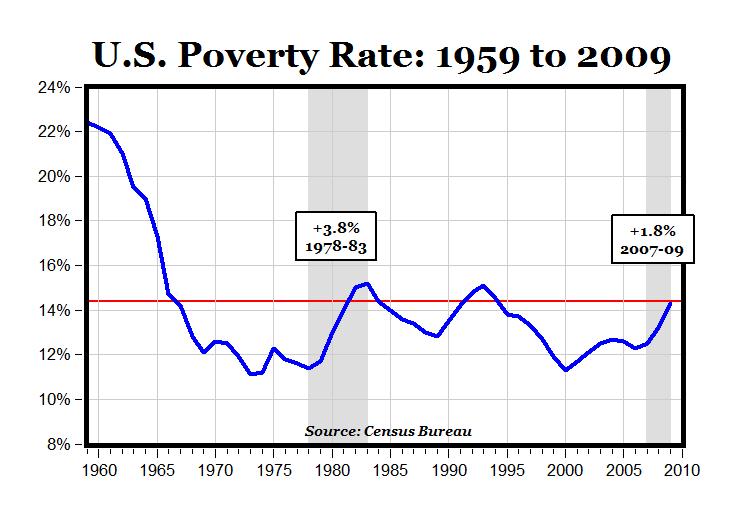
Fuente: CARPE DIEM Professor Mark J. Perry’s Blog for Economics and Finance (http://mjperry.blogspot.com/2010/09/us-poverty-rate-1959-to-2009.html)
En términos generales, la Gran Sociedad tuvo un impacto positivo en las vidas de millones de estadounidenses. Prueba de ello es que la proporción de pobres bajó de 22% en 1960 a 13% en 1969, la mortalidad infantil bajó un tercio, los Head Star atendieron a 2 millones de niños y el ingreso de las familias afroamericanas aumento de un 54% a 61% del ingreso de sus homologas blancas. El porcentaje de ciudadanos negros en la pobreza bajó de 40 a 20%. En sus primeros diez años de existencia, el Medicare y el Medicare proveyeron asistencia médica a 47 millones de norteamericanos a un costo de $28 mil millones. Sin embargo, la participación de los Estados Unidos en la guerra de Vietnam comprometió el programa liberal. Para 1966, el gobierno federal gastaba 20 veces más en el conflicto indochino, que en la lucha contra la pobreza. Además, no todos los estadounidenses estaban felices con el liberalismo de LBJ. Muchos rechazaban la regulación de los negocios y la intervención del gobierno federal en la educación pública. Otros, veían con recelo el crecimiento del gobierno federal y su intervención de la vida de los norteamericanos. Las elecciones legislativas de 1966 sirvieron de barómetro nacional, pues los demócratas perdieron 47 representantes, lo que selló el destino del reformismo de Johnson.
Norberto Barreto Velázquez, PhD
Publicado en Gran Sociedad, Guerra contra la pobreza, Lyndon B. Johnson, Pobreza | Etiquetado Great Society, Lyndon B. Johnson, Poverty, War on Poverty | 1 Comment »
Acaba de culminar la reunión anual número ciento veintiocho de la American Historical Association (AHA). Como parte de su cobertura de las actividades celebradas durante tan importante reunión, la History News Network publicó una serie de vídeos cortos con la participación de destacados historiadores norteamericanos. En el video que comparto con mis lectores, Frederick Logevall (Cornell University) analiza las causas de la intervención norteamericana en la guerra de Vietnam.
Publicado en Guerra de Vietnam | Etiquetado American Historical Association, Frederick Logevall, Vietnam War | Leave a Comment »

The Preacher and the President
By SEAN A. SCOTT
December 23, 2013
The Civil War caused numerous churches and denominational bodies to deliberate over secular matters and oftentimes to pass political resolutions. Indeed, many patriotic church members entirely disapproved of pastors who failed to give outspoken support to the federal cause, because they considered the Civil War to be a providential means for refining and preserving the sacred Union. The story of one Presbyterian minister who resisted that pressure to bring politics into pulpit, Samuel B. McPheeters, illustrates the perils of public neutrality and reveals how the war complicated church-state relations.
Born in North Carolina in 1819, McPheeters graduated from the University of North Carolina and Princeton Seminary before becoming a pastor in Virginia and Missouri, ending up in St. Louis. On sabbatical in the New Mexico Territory when the war began, he urged his home congregation at Pine Street Presbyterian in St. Louis to refrain from discussing politics in church. Upon his return he pursued a neutral course, believing that it accorded with the Gospel’s teachings on political matters, and that such neutrality would promote congregational unity among residents living in that divided city. Still, he took an oath of allegiance to the United States government, and from all appearances everyone seemed satisfied with his loyalty.
But some members of Pine Street Church wondered if their pastor’s silence was merely a pretext for hiding disloyal sentiments. After publicly articulating his apolitical views during the annual meeting of the Old School Presbyterian General Assembly in 1862, McPheeters returned to St. Louis to find a letter from 31 members of his church demanding that he divulge his personal sympathies or again publicly proclaim his loyalty. He refused, explaining that the church must stand above the political fray since its welfare was not linked to any particular administration or form of government but instead sought to advance the interests “of a Kingdom not of this world.”
Unpersuaded by this response, the disgruntled members threatened to leave the church in mid-October if McPheeters did not condemn the Confederacy. On Dec. 13 the ringleaders of the discontented party — George Strong, James Corbitt and John Ferguson — published their grievances in The Missouri Democrat, a staunchly Republican paper. Portrayed as a Confederate sympathizer, McPheeters drew the attention of local military authorities, and on Dec. 19 Gen. Samuel Curtis and Provost Marshal Franklin Dick issued Special Order No. 152, which prohibited the clergyman from preaching, banished him and his wife from the state on the grounds of “unmistakable evidence” of disloyalty and handed over control of Pine Street Church to Strong, Corbitt and Ferguson. The primary proof of McPheeters’s disloyal behavior, it seems, was that he had allowed a baby to be baptized as Sterling Price, after the former governor and Confederate general. After circulating the order, Dick boasted, “If the President will sustain me, I will rid the State of Rebel Preachers.”
Given 10 days to leave Missouri, the resolute minister determined to fight for the church’s freedom from civil interference. Journeying to Washington to present his case, McPheeters sought assistance from his former congregant, Attorney General Edward Bates, who secured an interview with Abraham Lincoln. When the three men met on Dec. 27, McPheeters was surprised that the president not only knew of him but was evidently predisposed against him from reading papers that his opponents had forwarded. After listening to the Presbyterian’s defense, Lincoln reportedly declared, “If this order should be revoked it would be considered a secession triumph.”
The president probed further about specific details, remarked that the war had blurred the line separating church and state, and concluded that McPheeters had not violated his oath of allegiance or committed any act justifying the harsh order. Aware of the implications of his decision, Lincoln proceeded cautiously, choosing to temporarily suspend the order of banishment until he reached a definitive judgment.
Lincoln’s directive was not well received. General Curtis immediately protested against allowing the “bad rebel doing injury here” to remain in St. Louis. Although he had been reprieved from exile, McPheeters was disappointed that he had failed to protect the church from governmental intrusion, since the military still banned him from preaching. Unrelenting in his pursuit of McPheeters, George Strong traveled to Washington and met with Lincoln himself.
Having heard both parties in person, on Jan. 2, 1863, Lincoln advised Curtis how to proceed. He believed that McPheeters truly sympathized with the South, yet he found no reason for expelling the minister, since he had taken an oath of allegiance and had not been charged with committing any act or neglecting any duty worthy of such treatment.
However, even though he doubted the propriety of punishing a citizen on the mere suspicion of disloyal sentiments, he gave Curtis permission to act in whatever manner he thought best for securing “the public good.” Lincoln then appended one of the most important statements made during the war regarding the proper relation between church and state: “The U.S. government must not, as by this order, undertake to run the churches. When an individual, in a church or out of it, becomes dangerous to the public interest, he must be checked; but let the churches, as such take care of themselves.”
The president clearly disapproved of civil and military authorities becoming entangled in religious affairs by removing certain ministers and appointing others without conclusive evidence of traitorous activity, but by deferring to the judgment of local officials, he practically ensured that such abuses would continue to occur.
After receiving word from Lincoln, Curtis revised Special Order No. 152 to permit McPheeters to remain in the city. Pine Street Presbyterian remained closed until early March 1863, when Strong and his allies relinquished control of the building. Still forbidden to preach, McPheeters refused a salary from the church. He found employment, ironically, in a municipal government office, and throughout the spring and summer of 1863 watched almost helplessly as Strong and a few sympathetic members of the Presbytery of St. Louis connived together in an attempt to have him officially expelled from the church.
After almost a year had elapsed with no change in his condition, he complained to Gov. Hamilton Gamble that the military allowed him to enjoy all the rights of a citizen apart from engaging in pastoral ministry, the one thing that he maintained the state had no power to deprive.
Things were moving, though: A short time earlier several individuals had appealed to Lincoln to have the Presbyterian reinstated to his pulpit. On Dec. 22, 1863, the perplexed president, who thought that the case had been settled, reiterated that the government had no business deposing or appointing ministers, and any person who did so acted without his approval. “The assumption that I am keeping Dr. M. from preaching in his church is monstrous,” an irritated Lincoln wrote.
After speaking with Bates, on Dec. 31 the attorney general notified McPheeters that “the President considers you as free in the enjoyment of your ecclesiastical rights.” In January 1864 McPheeters resumed preaching at Pine Street Presbyterian, albeit briefly, for later that year the Presbytery of St. Louis, in an effort to bolster its patriotic credentials, barred him from ministry. After the Presbyterian General Assembly declined to overrule this decision, McPheeters moved to Kentucky.
McPheeters’s troubles demonstrate the fine line that ministers who wanted to keep politics out of the pulpit had to walk during the war. Lincoln’s lip service to the separation of church and state cleared him from direct responsibility for any violations of religious freedom, yet at the same time he turned a blind eye as generals and provost marshals carried out policies that contradicted his known personal views. Within weeks he would learn that the government had authorized an extensive takeover of Southern churches, and he would draw on the opinions formed during the McPheeters affair for damage control.
 Sean A. Scott is a history instructor at Huntington University and the author of “A Visitation of God: Northern Civilians Interpret the Civil War.”
Publicado en Imperialismo norteamericano | Etiquetado Abraham Lincoln, American Civil, Samuel B. McPheeters | Leave a Comment »

Herbert Hoover´s Crusade Against Collectivism
HNN ❘ December 23, 2013
Note by the book’s editor: This introduction is adapted from The Crusade Years, 1933-1955: Herbert Hoover’s Lost Memoir of the New Deal Era and Its Aftermath, edited and with an introduction by George H. Nash, excerpt below (Hoover Institution Press, 2013).
On a cool October morning in 1964, Herbert Hoover died in New York City at the age of ninety. He had lived a phenomenally productive life, including more than half a century in one form or another of public service. It was a record that in sheer scope and duration may be without parallel in American history.
His life had begun in humble circumstances in 1874 in a little Iowa farming community as the son of the village blacksmith. Orphaned before he was ten, he managed to enter Stanford University when it opened its doors in 1891. Four years later he graduated with a degree in geology and a determination to become a mining engineer.

Image via Wiki Commons.
From then on, Hoover’s rise in the world was meteoric. By 1914, at the age of forty, he was an internationally acclaimed and extraordinarily successful mining engineer who had traveled around the world five times and had business interests on every continent except Antarctica.
During World War I, Hoover, residing in London, rose to prominence as the founder and director of the Commission for Relief in Belgium, an institution that provided desperately needed food supplies to more than nine million Belgian and French citizens trapped between the German army of occupation and the British naval blockade. His emergency relief mission in 1914 quickly evolved into a gigantic humanitarian enterprise without precedent in world history. By 1917 he was an international hero, the embodiment of a new force in global politics: American benevolence.
When America declared war on Germany in 1917, Hoover returned home and became head of the United States Food Administration, a specially created wartime agency of the federal government. At the conflict’s victorious close in 1918, President Woodrow Wilson dispatched him to Europe to organize food distribution to a continent careening toward disaster. There, for ten grueling months, he directed American- led efforts to combat famine and disease, establish stable postwar economies, and in the process check the advance of Bolshevik revolution from the East.
A little later, between 1921 and 1923, Hoover’s American Relief Administration administered a massive emergency relief operation in the interior of Soviet Russia, where a catastrophic famine — Europe’s worst since the Middle Ages — had broken out. At its peak of operations, his organization fed upward of ten million Russian citizens a day.
All in all, between 1914 and 1923 the American-born engineer-turned-humanitarian directed, financed, or assisted a multitude of international relief endeavors without parallel in the history of mankind. It was later said of him that he was responsible for saving more lives than any other person in history.
During the Roaring Twenties Hoover ascended still higher on the ladder of public esteem. As secretary of commerce under Presidents Warren Harding and Calvin Coolidge, he became one of the three or four most influential men in the U.S. government. In 1928, the “master of emergencies” (as admirers called him) was elected president of the United States in a landslide — without ever having held an elective public office.
Then came the crash of 1929 and the most severe economic trauma this nation has ever experienced. During his tormented presidency, Hoover strained without stint to return his country to prosperity while safeguarding its political moorings. His labors — even now misunderstood — seemed unavailing, and in the election of 1932 his fellow citizens’ verdict was harsh.
Before his single term as chief executive, Hoover’s career trajectory had curved unbrokenly upward. Now it headed pitifully down. “Democracy is not a polite employer,” he later wrote of his defeat at the polls. On March 4, 1933, he left office a virtual pariah, maligned and hated like no other American in his lifetime.
And then, astonishingly, like a phoenix, he slowly rose from the ashes of his political immolation. Now came the final phase of Hoover’s career: his remarkable ex-presidency. For the next thirty-one and one-half years, in fair political weather and foul, the former chief executive became, in his self-image, a crusader — a tireless and very visible castigator of the dominant political trends of his day. He behaved as a committed ideological warrior more persistently and more fervently than any other former president in our history.
Why? Most of all, it was because Hoover perceived in the New Deal of Franklin Roosevelt not a moderate and pragmatic response to economic distress but something more sinister: a revolutionary transformation in America’s political economy and constitutional order. Having espied the unpalatable future, Hoover could not bring himself to acquiesce.
It is this eventful period in Hoover’s career — and, more specifically, his life as a political pugilist from 1933 to 1955 — that is the main subject of the volume before you. The Crusade Years is a previously unknown memoir that Hoover composed and revised during the 1940s and 1950s — and then, surprisingly, set aside. Placed in storage by his heirs aft er his death, the manuscript (in its various versions) lay sequestered — its existence unsuspected by scholars — until 2009, when it was discovered among the files of another hitherto inaccessible Hoover manuscript being readied for posthumous publication.
This other tome, known informally as the Magnum Opus, addressed American foreign policy in the 1930s and 1940s. Part memoir, part diplomatic history, part polemic, it was a scathing indictment of what Hoover termed Franklin Roosevelt’s “lost statesmanship” during World War II. Hoover ultimately titled the book Freedom Betrayed. It was published in 2011 by the Hoover Institution Press.
The Crusade Years — a companion volume of sorts to the Magnum Opus — covers much the same time period on the American home front. More fully a memoir than Freedom Betrayed, it recounts Hoover’s family life aft er March 4, 1933, his myriad philanthropic interests, and, most of all, his unrelenting “crusade against collectivism” in American life. Rescued from obscurity, this nearly forgotten manuscript is published here — and its contents made available to scholars — for the first time.
– See more at: http://hnn.us/article/154275#sthash.PEOcGduq.dpuf
Publicado en Imperialismo norteamericano | Etiquetado Herbert Hoover, United States Food Administration, Warren Harding, Woodrow Wilson | Leave a Comment »
by Joan Brumberg
HNN December 16, 2013
This type of studio portrait is as American as the diaries of adolescent girls or pictures of girls with dolls and horses. This is a classic American icon: a pretty little boy with ringlets who looks to us like a girl but his gender is marked by giving him a gun. Commercial portraits like these are commonplace. You can find them at garage and junk sales and, of course, on eBay by the hundreds.


Endorsed and paid for by proud American parents, the studio set ups illustrate how longstanding the American love affair with the gun has been. Taking affectionate pictures of boys with guns — to mark a first hunt, a birthday, or at Christmas — was part of the process of recording a son’s development. Many contemporary families have snapshots of boys with toy shot guns and rifles next to the family Christmas tree or car.
In the nineteenth century, many boys grew up learning that the ability to shoot to secure food was central to the adult male role. As they aged, boys got careful instruction on the use of guns from fathers and uncles and, in the twentieth century, as food sourcing changed, from pamphlets and books, frequently provided by the National Rifle Association.

But some boys, like Charley Miller, an adolescent murderer in the 1890s whom I have written about, purchased cheap hand guns in a show of braggadocio and then used them to kill. Standing around in a studio posed with guns and cigars was a playful show of maturity for youth whose stage of life was characterized, then as now, by emotional volatility. As the twentieth century progressed, snapshots replaced studio portraits and thousands of young boys posed in mass-produced cowboy outfits — duded up — like Western gunslinger stories and films. In peace and in war, those close to draft age displayed real weapons in postures that were less playful and more aggressive.
The level of male violence we live with today should not shock a nation where pictures like these are endemic. The archives of American social history provide little comfort for those of us anxious to sever the connection between boys and guns. We may be working against the grain, but it is worth it.
Jacobs Brumberg is author of Kansas Charley: The Boy Murderer, now available as an ebook. She is an emeritus professor of history at Cornell University and author of The Body Project: An Intimate History of American Girls and Fasting Girls:The History of Anorexia Nervosa.
– See more at: http://hnn.us/article/154231#sthash.CmREOYHu.dpuf
Publicado en Imperialismo norteamericano | Etiquetado American Boys, Gun culture, Guns | Leave a Comment »
Lincoln’s 10 Percent Plan
By RICK BEARD New York Times ❘ December 9, 2013By early November 1863, Abraham Lincoln found himself frustrated with the glacial pace of wartime reconstruction efforts, particularly in Louisiana. In an August letter to Maj. Gen. Nathaniel Banks, the president had outlined “what I would like Louisiana to do.” His wish list included a new constitution, statewide adoption of emancipation, a system to help ease the transition from slavery to freedom for blacks and whites and education for young freedmen and women. He went on to assure his abolitionist general that “I shall not … retract the emancipation proclamation; nor … ever return to slavery any person who is free by the terms of that proclamation, or by any of the acts of Congress.”
Now, three months later, the president once more wrote to Banks, to note that “nothing has yet been done,” a fact that “disappoints me bitterly.” A clearly impatient Lincoln urged Banks to “go to work and give me a tangible nucleus … which I can at once recognize and sustain as the true State government. … Time is important,” he continued, for there was danger that disloyal men might “set up a State government, repudiating the emancipation proclamation, and re-establishing slavery,” a situation he could not “recognize or sustain.”
The commander in chief’s sense of urgency about reconstruction was understandable. Events had long ago disabused him of an early belief that there existed a strong pro-Union element in the South. Victories at Gettysburg, Vicksburg and Chattanooga had led him to hope (and perhaps fear) that the Confederacy might be at the point of imminent collapse. As the Lincoln biographer David Donald notes, “There was a real possibility that the Confederates, admitting defeat, might claim that they had never been out of the Union — a legal fiction [Lincoln] and his advisers had always stoutly maintained — and send back to Washington the same congressmen who had denounced the Union in 1861.” Lincoln, Donald argues, feared such a circumstance would “make probable ‘a renewal of the terrible scenes through which we are now passing.’”
Despite assurances from Senator Zachariah Chandler, a Radical Republican from Michigan and frequent critic of the president, that “You are today master of the Situation if You stand firm,” Lincoln fully grasped the dilemma that crafting a reconstruction policy presented. “[I must] stand firm enough not to go backward,” he told Chandler, “and yet not go forward fast enough to wreck the country’s cause.”
Three major roads to reconstruction presented themselves. Prominent conservatives such as Reverdy Johnson, a Maryland lawyer and Democratic politician, embraced “The Union as it was, and the Constitution as it was.” The withdrawal of the Emancipation Proclamation and the issuance of general amnesty would enable former Confederate states to send new representatives to Washington, effectively ending the war.
By the fall of 1863, however, events had conspired to make such a backward step increasingly unlikely; the real contest over reconstruction policy resided within the Republican Party. While Republicans as one agreed that slavery must go and that states-rights secessionists must be prevented from resuming their antebellum prominence, a wide gap yawned between the radicals and conservatives.
Pennsylvania congressman Thaddeus Stevens contended that the Confederate states were “conquered provinces.” Reconstruction, he insisted, must “revolutionize Southern institutions, habits, and manners. … The foundation of their institutions … must be broken up and relaid, or all our blood and treasure have been spent in vain.” Senator Charles Sumner argued that the seceded states had committed “state suicide,” and in doing so had forfeited their rights and reverted to territorial status.
In the September 1863 Atlantic Monthly, Sumner elaborated on his argument in “Our Domestic Relations; or, How to Treat the Rebel States.” Reconstruction policy, Sumner claimed, was a legislative, not an executive, responsibility. Congress should divide the liberated lands “among patriotic soldiers, poor whites, and freedmen” as “a restraint upon the lawless vindictiveness and inhumanity of the Rebel States.”
Postmaster General Montgomery Blair fired back almost immediately. In an October speech — “On the Revolutionary Schemes of the Ultra Abolitionists, and in Defence of the Policy of the President” — he contended that peace was “menaced by the ambition of the ultra-Abolitionists” who, “whilst pronouncing philippics against slavery seek to make a caste of another color by amalgamating the black element with the free white labor of our land.” Reconstruction, Blair believed, must be trusted to the “safe and healing policy of the President.”
Lincoln knew enough to avoid this intraparty scrimmage. There could be “little difference among loyal men” over the issue of keeping “the rebellious populations from overwhelming and outvoting the loyal minority,” he told one visitor. The question of whether the seceded states remained states or reverted to territories was “merely metaphysical,” because everyone agreed that they were “out of their proper relation with the Union, and that the sole object of the government … is to again get them into that proper relation.”
Shortly after returning from the dedication of the new national cemetery at Gettysburg on Nov. 19, Lincoln set about defining how to restore the seceded states to their “proper relation.” Working from his sickbed — he had contracted what was probably a mild case of smallpox and was bedridden for the better part of the two weeks after Nov. 25 — Lincoln began preparing his annual address to Congress, the forerunner to today’s State of the Union.
An amalgam of reports from cabinet secretaries as well as Lincoln himself, the 6,000-word address has been generally judged to be a rather tepid affair, suggesting perhaps that inspiration temporarily deserted the ailing president. As one historian has noted, the report is more memorable for what it omitted — any mention of the “new birth of freedom,” the completion of the Capitol, the heroic performance of black troops or his nascent relationship with Frederick Douglass — rather than for what it included.
The president received much higher marks, both then and now, for the Proclamation of Amnesty and Reconstruction, which he appended to the annual message. Less a blueprint for the postwar South than a wartime measure intended to shorten the fighting, the proclamation offered political repatriation for those portions of the Confederacy under Union control. Those willing to take an oath of allegiance to the United States would receive “full pardon … with restoration of all rights of property, except as to slaves.” Among those ineligible for a pardon were Confederate civil or diplomatic officers, military or naval officers above the respective ranks of colonel and lieutenant, former members of Congress who left to aid the rebellion and anyone mistreating captured black or white Union troops.
As soon as 10 percent of the eligible voters in the 1860 election took the oath of allegiance, they could reestablish a state government that would receive the guarantees of a republican form of government and protection against invasion and domestic violence outlined in Article IV, Section 4 of the Constitution. Lincoln took care to note that “whether members sent to congress from any state shall be admitted to seats constitutionally rests exclusively with the respective houses, and not to any extent with the Executive.”
The proclamation further provided that “the name of the state, the boundary, the subdivisions, the constitution, and the general code of laws” would be maintained “as before the rebellion,” subject only to the provisions regarding the inviolability of emancipation. State governments were further assured that the “National Executive “ would not object to any temporary arrangement that, while recognizing the permanent freedom of former slaves, would take into account “their present condition as a laboring, landless, and homeless class.”
Lincoln’s Dec. 8 proclamation met with immediate acclaim across the political spectrum. The author and social activist Charles Eliot Norton declared it an “admirably timed” state paper that would “compel even politicians to like virtue.” The noted diarist George Templeton Strong proclaimed: “Uncle Abe is the most popular man in America today” and suggested that “the weight of his personal character may do a great deal toward restoration of our national unity.” Surveying the political landscape, The Chicago Tribune editorialized that “the political future begins to look clear,” while the president’s secretary John Hay noted that “men acted as if the Millennium had come.”
The outpouring of support was hardly surprising, for the proclamation had a little something for almost everyone but the freedmen. Conservatives were pleased that the plan recognized the prewar boundaries and laws of the states, excepting slavery; that it acknowledged local control; and that Lincoln would tolerate a gradual adjustment to freedom by the former slaves. The New York World, an organ for the Democratic Party, adjudged the proclamation “a creditable specimen of political dexterity [that] trims with marvelous adroitness between the two factions of the Republican party.”
Radical Republicans took comfort in Lincoln’s obvious commitment to emancipation’s permanence, the inclusion of a strict loyalty oath, and his nod toward congressional authority over admission of new members elected by the new state governments. Charles Sumner wrote, “He makes emancipation the cornerstone of reconstruction and I am ready to accept any system which promises this result.” His fellow Massachusetts senator, Henry Wilson, declared, “The president has struck another great blow … God bless him.”
While fulsome, such praise was not universal. The Chicago Times protested that Lincoln was either “insane with fanaticism, or a traitor who glories in his country’s shame.” In a Dec. 13 letter to Gen. Benjamin Butler, Wendell Phillips argued that the amnesty program “makes the negro’s freedom a mere sham.” The administration was “willing that the negro should be free” but sought “nothing else for him.” In a particularly cutting observation, Phillips wrote, “What McClellan was on the battlefield — ‘Do as little hurt as possible!’ — Lincoln is in civil affairs — ‘Make as little change as possible!’”
Among the president’s harshest critics was his new friend, Frederick Douglass. The abolitionist lion roared that Lincoln “has virtually laid down this as the rule of his statesmen: Do evil by choice right from necessity. …Our Government asks the Negro to espouse its cause” and “turn against his master.” Once peace came, Douglass feared the government would “hand the Negro back to the political power of his master, without a single element of strength to shield himself from the vindictive spirit sure to be roused against the whole colored race.”
Lincoln’s Proclamation of Amnesty and Reconstruction was hardly the last word on reconstruction. The president himself had hedged his bets, suggesting in the accompanying annual address that “saying that reconstruction will be accepted if presented in a specified way … [is not to say] it will never be accepted in any other way.”
His critics among the Radical Republicans began to argue that the threshold for readmittance was too low and express fears that Lincoln’s 1864 re-election bid would benefit unduly from votes from the new states. Within months he would infuriate these critics by vetoing the Wade Davis Act, which sought far harsher terms for reconstruction. But for a brief moment in December 1863, Lincoln may well have been the “most popular man in America.”
Follow Disunion at twitter.com/NYTcivilwar or join us on Facebook.
Sources: Michael Burlingame, “Abraham Lincoln: A Life”; Richard Carwardine, “Lincoln: A Life of Purpose and Power”; David Herbert Donald, “Lincoln”; Eric Foner, “Forever Free: The Story of Emancipation and Reconstruction”; Eric Foner, “The Fiery Trial: Abraham Lincoln and American Slavery”; Eric Foner, “Reconstruction: America’s Unfinished Revolution, 1863-1877”; Harold Hyman and William M. Wiecek, “Equal Justice Under the Law: Constitutional Development, 1835-1875”; James M. McPherson, “Battle Cry of Freedom: The Civil War Era”; Mark E. Neely Jr., “Lincoln and the Triumph of the Nation: Constitutional Conflict in the American Civil War”; Phillip Shaw Paludan, “The Presidency of Abraham Lincoln”; Glenna R. Schroeder-Lein, “Lincoln and Medicine”; Ronald C. White, Jr., “A. Lincoln: A Biography.”
 Rick Beard, an independent historian and exhibition curator, is co-author of the National Park Service publication “Slavery in the United States: A Brief Narrative History.”
Publicado en Esclavitud, Guerra civil norteamericana, Reconstrucción | Etiquetado Abraham Lincoln, American Civil War, Charles Sumner, Proclamation of Amnesty and Reconstruction, Reconstruction, Slavery | Leave a Comment »
The Last Nuclear Weapons Left Cuba in December 1962
Soviet Military Documents Provide Detailed Account of Cuban Missile Crisis Deployment and Withdrawal
New Evidence on Tactical Nuclear Weapons – 59 Days in Cuba
National Security Archive Electronic Briefing Book No. 449
Posted December 11, 2013
Edited by Svetlana Savranskaya and Thomas Blanton
With Anna Melyakova

Col. Beloborodov on board the Indigirka bound for Cuba, 1962 (photo courtesy of Beloborodov family and Michael Dobbs)
Washington, DC, December 11, 2013 – The last Soviet nuclear warheads in Cuba during the Cuban Missile Crisis did not leave the island until December 1, 1962, according to Soviet military documents published today for the first time in English by the National Security Archive at George Washington University (www.nsarchive.org).
At 9 o’clock in the morning on December 1, 1962, the large Soviet cargo ship Arkhangelsk quietly left the Cuban port of Mariel and headed east across the Atlantic to its home port of Severomorsk near Murmansk. This inconspicuous departure in fact signified the end of the most dangerous crisis of the Cold War. What was called «the Beloborodov cargo» in the Soviet top secret cables — the nuclear warheads that the Soviet armed forces had deployed in Cuba in October 1962 — was shipped back to the Soviet Union on Arkhangelsk.
According to the documents, Soviet nuclear warheads stayed on the Cuban territory for 59 days — from the arrival of the ship Indigirka on October 4 to the departure of Arkhangelsk on December 1. U.S. intelligence at the time had no idea about the nature of the Arkhangelsk cargo. Arkhangelsk carried 80 warheads for the land-based cruise missile FKR-1, 12 warheads for the dual-use Luna (Frog) launcher, and 6 nuclear bombs for IL-28 bombers — in total, 98 tactical nuclear warheads. Four other nuclear warheads, for torpedoes on the Foxtrot submarines, had already returned to the Soviet Union, as well as 24 warheads for the R-14 missiles, which arrived in Cuba on October 25 on the ship Aleksandrovsk, but were never unloaded. The available evidence suggests that the 36 warheads for the R-12 missiles that came to Cuba on the Indigirka also left on Aleksandrovsk, being loaded at Mariel between October 30 and November 3.
The question of tactical nuclear weapons — their number, their intended use, command and control procedures, and even the dates of their arrival and departure — has created many puzzles for students of the Cuban Missile Crisis for years since the planner of Operation Anadyr, General Anatoly Ivanovich Gribkov, revealed their presence in Cuba in 1962 at a critical oral history conference of American, Soviet and Cuban policymakers and scholars in Havana in January 1992, co-organized by the National Security Archive. In the last twenty years, numerous scholars have published on the issue, each introducing additional evidence and moving the debate forward step by step.[1]
Today’s posting brings together the most important pieces of evidence documenting the presence of tactical nuclear weapons in Cuba during the Missile Crisis — the most authoritative story so far based on documents. Although many of the documents included here were previously published in English by the Archive and by the Cold War International History Project, this posting includes three newly translated documents, never available before in English, which provide detailed accounts of the Soviet deployment of missile forces and nuclear warheads and the exact chronology of the deployment.
One of the new documents, a contemporaneous after-action report written in December 1962 by Major General Igor Statsenko, provides details of the deployment and withdrawal of the Missile Division (the R-12 and R-14 regiments and supporting personnel) under Statsenko’s command (Document 1). A second new document is the report written by Lieutenant General Nikolai Beloborodov (commander of the Soviet nuclear arsenal in Cuba during the Cuban Missile Crisis) in the 1990s, most likely on the basis of his own contemporaneous documents, which describes the delivery, deployment and withdrawal of all nuclear warheads, which were under his command (Document 2).
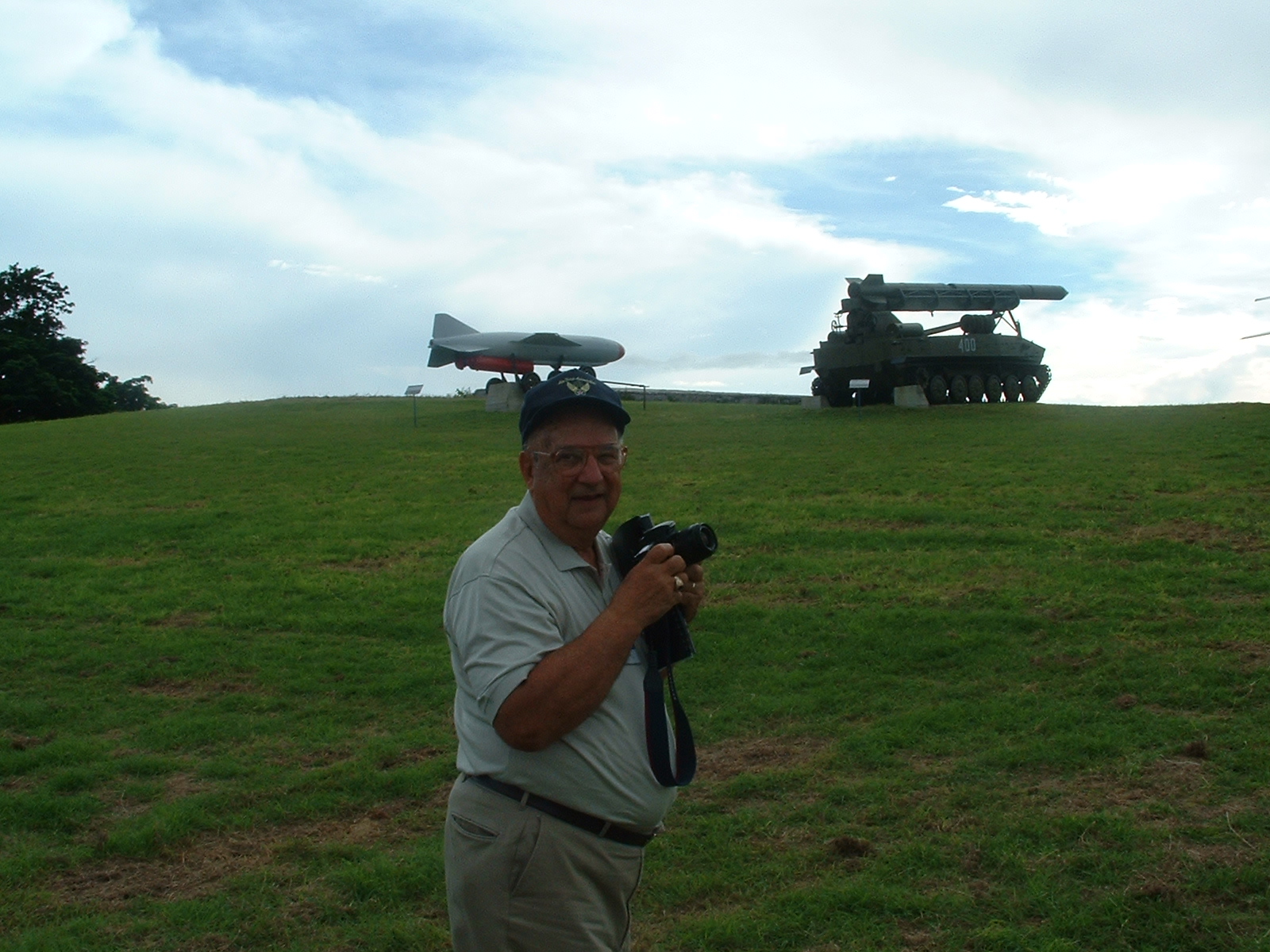
Former CIA photointerpreter Dino Brugioni takes pictures of FKR and Luna missiles in Cuba, 2002 (photo by Svetlana Savranskaya)
Both reports read as understated but pointed condemnation of the Soviet General Staff’s planning of the Cuban operation. Statsenko’s report describes shortcomings in initial reconnaissance and camouflage and ignorance of local conditions on the part of the Operation Anadyr planners. Beloborodov’s report points to difficulties with storing nuclear warheads in the tropical conditions, unanticipated transportation problems, and the camouflage issues. His report also reveals the fact that even as the Soviet Presidium was deciding to pull back the strategic missiles (ships carrying parts of Statsenko’s division turned around on October 25 rather than challenge the U.S. quarantine of Cuba), the Soviet support troops in Cuba were given orders to unload the tactical warheads from Aleksandrovsk, and did that during the nights of October 26, 27 and 28-because at that moment, the Soviets were planning to leave tactical nuclear weapons in Cuba. On the basis of these two reports and all other Soviet documents available today, the following chronology outlines the Soviet decisions relating to the tactical nuclear weapons in Cuba.
Brief chronology of Soviet tactical nuclear weapons in Cuba:
- May 24, 1962 -original plan for Operation Anadyr included deployment of 80 FKR cruise missiles with nuclear warheads.
- June 10-Operation Anadyr approved by the Soviet Presidium.
- September 7-the «Pitsunda decision.» Khrushchev augmented the original plan by adding 6 nuclear bombs for IL-28 bombers and 12 short-range nuclear missiles for the dual-use system Luna/Frog.
- October 4-Indigirka arrived in Mariel with 36 warheads for R-12, 36 warheads for FKR, 12 warheads for Lunas, and 6 nuclear bombs for Il-28s.
- October 22-Presidium discussed the possibility of using tactical nuclear weapons in the event of an American invasion of Cuba.
- October 23-Aleksandrovsk arrived in La Isabella with 24 warheads for R-14 and 44 warheads for FKRs.
- October 26-28-Aleksandrovsk «partially» unloaded-warheads for FKRs were unloaded and sent to units.
- October 30-Aleksandrovsk ordered back to Severomorsk still carrying the 24 warheads for R-14s, after probably loading the 36 R-12 warheads at Mariel harbor and departing November 3.[2]
- November 2-Anastas Mikoyan arrived in Cuba as Khrushchev’s special envoy.
- November 8-Mikoyan suggested transferring «all remaining weapons» to the Cubans after special training.
- Nov 12-Khrushchev decided to remove the IL-28 bombers.
- November 22-Mikoyan informed the Cuban leadership that all nuclear weapons would be removed from Cuba.[3]
- December 1-all tactical nuclear warheads left Cuba on Arkhangelsk.
- December 20-Arkhangelsk arrived in Severomorsk.
The original Soviet plan for Operation Anadyr, presented to the Presidium on May 24, 1962 and finally approved on June 10, in addition to the deployment of the R-12 and R-14 missiles, provided for the inclusion in the Soviet Group of Forces in Cuba of 80 land-based front cruise missiles (FKR) with the range of 111 miles (Document 3). In September, Khrushchev decided to strengthen the Group of Soviet forces in Cuba and augment the nuclear portion of the deployment with additional 12 tactical dual-use Luna (Frog) launchers with 12 nuclear warheads for them, and 6 nuclear bombs for specially fitted IL-28 bombers, although he rejected a Defense Ministry proposal also to add 18 nuclear-armed R-11 short-range SCUD missiles (Document 5).
The strategic missiles, R-12 and R-14, could only be used by direct orders from Moscow. To the best of our knowledge, Soviet commanders in Cuba did not have the physical capability to use them without the codes sent from the Center. However, there is considerable debate as to whether commanders of tactical weapons units had authority to launch their own nuclear warheads (Document 7). They certainly had the capability.
Initially, at the Havana conference in 1992, General Gribkov stated that such authorization was given by the central command in the event of a U.S. airborne landing in Cuba. He presented a draft order providing for such pre-authorization, but that order was not signed by Defense Minister Malinovsky. According to Gribkov and other Soviet participants of the crisis, such authorization was given by Malinovsky orally to commanders before their departure for Cuba. The cable sent later, on October 27, categorically forbidding Soviet military to use tactical nuclear weapons without an order from Moscow, shows that the Soviet Presidium was very concerned about an unauthorized use of tactical weapons (Document 11). This provides indirect support to the argument that it was the understanding of the field commanders that tactical nuclear weapons would be used to repel a U.S. attack on Cuba. Even if the official pre-authorization order was not signed by the Defense Minister, we can conclude that in all likelihood, tactical nuclear weapons would most definitely be used in a first salvo if U.S. forces had landed in Cuba. The Presidium discussion of October 22 shows that the Soviet top leadership envisioned this scenario as well.
After the most dangerous phase of the crisis was resolved on October 28, and Khrushchev promised to withdraw «the weapons you call offensive» from Cuba, the world rejoiced. However, the Soviet leadership knew better-almost 43,000 troops and all the nuclear warheads were still in Cuba. Now they had to negotiate their own Soviet-Cuban missile crisis. Khrushchev sent his right-hand man, Deputy Prime Minister Anastas Mikoyan, to Cuba to oversee the removal of the missiles, salvage the Soviet-Cuban friendship, and negotiate the future Soviet-Cuban military agreement.
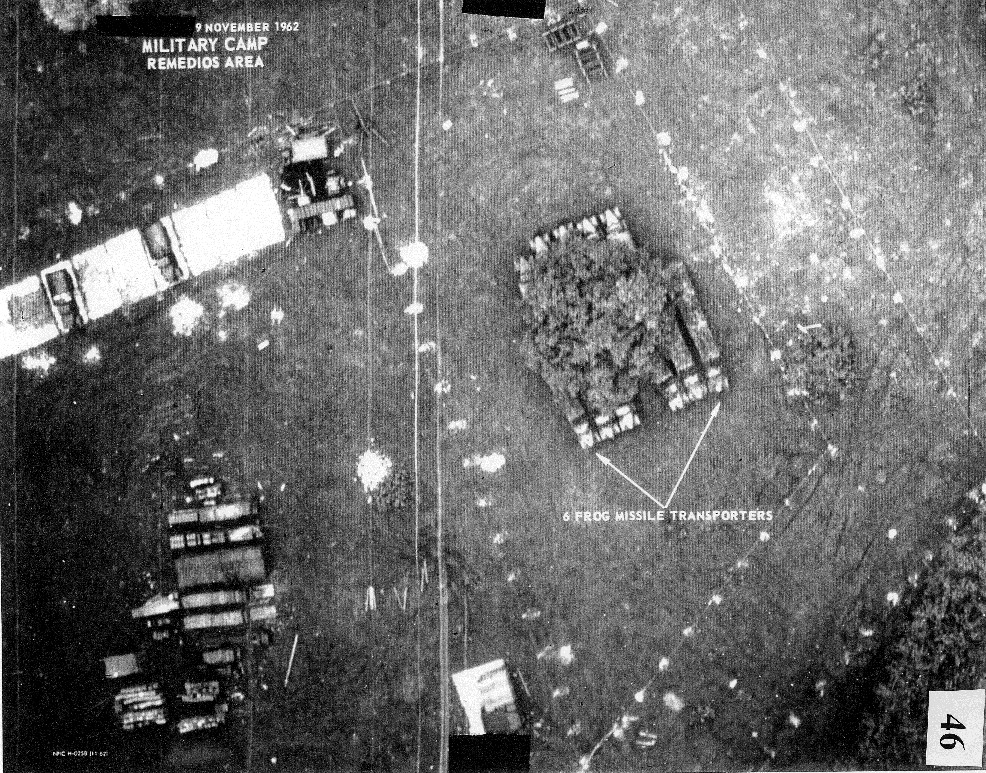
U.S. low-level reconnaissance photo of Luna/Frog short-range missiles in Cuba, November 1962 (photo from Dino Brugioni Collection, National Security Archive)»
When Anastas Mikoyan arrived in Cuba, in the course of his extensive conversations over three days, he informed the Cubans that all the weapons other than those specifically mentioned in the Khrushchev-Kennedy statements would be left in Cuba: «you know that not only in these letters but today also, we hold to the position that you will keep all the weapons with the exception of the ‘offensive’ weapons and associated service personnel, which were promised to be withdrawn in Khrushchev’s letter.»[4] The documents suggest, as of early November 1962, that the Soviet intention was to withdraw the offensive weapons (the strategic missiles), but keep a massive military base in Cuba and make no more concessions to the United States. All tactical nuclear weapons, IL-28s and the combat troops except missile support personnel would remain on the island. This position, however, evolved significantly in the dynamic days of the November crisis.
In his talks with the Cubans, Mikoyan gradually realized that this would not be an easy relationship. He was taken aback by the Cuban romanticism and their professed willingness to «die beautifully.» But at the same time, his priority was to keep Cuba as a Soviet ally. He thought perhaps the best solution could be to strengthen the Cuban defenses but not to keep a large Soviet base. On November 8, he proposed to the Presidium to gradually transfer all the remaining weapons to the Cuban armed forces after a period of training by Soviet military specialists (Document 13). Because none of the these tactical weapons were mentioned in the Kennedy-Khrushchev correspondence and because the Americans were essentially oblivious to their delivery to the island, at the time it seemed to him that it would have been the most natural and logical way to resolve the Soviet-Cuban crisis. He requested permission from the Central Committee to tell Castro regarding the future military agreement that rather than maintaining a Soviet military base, «the Cuban personnel with the assistance of our specialists will gradually start to operate all Soviet weapons remaining in Cuba. […] As these personnel become prepared, gradually the Soviet people will be replaced with the Cubans. Upon completion of a certain time period necessary [to master] the military technology, all Soviet personnel will be replaced by the Cuban personnel, and those Soviet experts in special areas, without whom it would be difficult for the Cuban army [to function] will stay with you and work here as advisers in such number and for such a period of time as necessary.» On November 9, Presidium member Gromyko in a cable approved Mikoyan’s new line for negotiations with the Cubans.
Just as soon as Mikoyan presented the idea to his Cuban hosts, Khrushchev decided to agree to the U.S. demand to withdraw IL-28 bombers, which created a new crisis with the Cubans, who now had good grounds to expect further Soviet concessions and unleashed their fury on Mikoyan. Trying to mend relations once again, the Soviet envoy repeated to his Cuban hosts that although IL-28s would be withdrawn, all other weapons would stay, that «Cuba’s fire power is very strong.[…] not a single other socialist country, if we leave out the Soviet Union, possesses such modern powerful combat weapons as you have.» In his conversation with Castro on November 13, speaking about the military agreement, Mikoyan stated: «I want to reiterate that very powerful defensive weapons remain in Cuba. We will be able to transfer them to you when the Cuban military officials become familiar with them. This military equipment is incomparably more powerful than any equipment that Cuba currently has. These are the most advanced weapons comrade Pavlov [Gen. Issa Pliyev, commander of the Group of Soviet Forces in Cuba] currently has. The CC CPSU’s resolution is to transfer them to you over the course of time.» Mikoyan added that «even with ground inspections, it is practically impossible to find the warheads.» (Document 14).
Over the next several days, the Cubans, from the Soviet point of view, started behaving even more erratically, making the situation more dangerous and unpredictable. Castro ordered the Cuban air defenses to shoot at low-flying U.S. aircraft and sent a message to the Cuban representative at the United Nations, Carlos Lechuga, that «we possess tactical nuclear weapons, which we should keep.» What became clear to Mikoyan during numerous conversations with the Cuban leadership is that the Soviets could not really control their Cuban ally, and that if they were going to maintain Cuba as an ally, they would need to accept the fact that the Cubans would not always follow the Soviet script and that in fact they would develop quite an independent foreign policy. In these circumstances, transferring nuclear weapons to such an ally would be too risky. The Soviets had to pull them back.
Mikoyan understood that it would be his task to reconcile his hosts to the loss of all the nuclear weapons which they were promised. He suggested this course of action to the Presidium in a cable written right after midnight on November 22. In that cable, he also proposed that as an explanation, he could tell the Cubans that the Soviet Union had an «unpublished law» that prohibited the transfer of nuclear weapons to other countries (Document 16). In the morning on November 22, Mikoyan received a cable with the Presidium’s approval of his proposal (Document 17). Mikoyan met with the top Cuban leadership to explain this decision during the long late night conversation on November 22. Castro tried to persuade Mikoyan to leave the tactical weapons in Cuba. The Cuban leader pointed out that the Americans were not aware of the presence of these weapons on the island, and that the Soviets did not have to keep a military base in Cuba but could train the Cuban military, as the initial agreement had stipulated. He said these weapons could be hidden in caves. He begged the Soviet representative to leave him the weapons that meant so much to the Cubans. But Mikoyan was not swayed by his arguments. The tactical warheads had to go home (Document 18).
On November 25, the Soviet support troops started pulling the warheads from the storage facilities to the port of Mariel and loading them on the Arkhangelsk. The loading was completed and the ship departed Cuba on December 1, 1962.
Previously declassified U.S. documents published by the National Security Archive show that U.S. intelligence did not detect any of the nuclear warheads in Cuba during the crisis — either for the strategic missiles or for the tactical delivery systems — and close examination of U.S. overhead photography by author Michael Dobbs established that U.S. intelligence never located the actual storage bunkers for the warheads. U.S. planners assumed the missile warheads were present in Cuba, but discounted the possibility — even after seeing the dual-capable Luna/Frog in reconnaissance photographs as early as October 25 — that tactical warheads were on the island or might ever be used. U.S. analysts completely mistook the FKR cruise missiles for the conventionally-armed Sopka coastal defense missiles, and never understood the likelihood that the U.S. base at Guantanamo would be smoking radiating ruin from an FKR nuclear warhead if the U.S. invaded. Thus the shock to former officials such as Robert McNamara when they heard from Soviet veterans during the historic 1992 Cuban Missile Crisis conference in Havana that tactical nuclear weapons had been part of the operation from the beginning.[5]
The National Security Archive has worked since 1986 to open Cuban Missile Crisis files in the U.S., the former Soviet Union, and Cuba, including the successful Freedom of Information Act lawsuit that forced release of the famous Kennedy-Khrushchev letters. The Archive’s publications on the Missile Crisis include two massive indexed collections of thousands of pages of declassified U.S. documents, two editions of a one-volume documents reader, the multi-volume briefing book for the landmark 2002 Havana conference organized by the Archive on the Missile Crisis, the 50th anniversary collection from dozens of overseas archives co-published with the Cold War International History Project, and most recently the inside account from the Soviet side by Sergo Mikoyan and Svetlana Savranskaya, which published the transcripts of the contentious Soviet-Cuban talks over withdrawal of Soviet weapons after most of the world thought the missile crisis was over.
THE DOCUMENTS
Document 1: Report of Major-General Igor Demyanovich Statsenko, Commander of the 51st Missile Division, about the Actions of the Division from 07.12.62 through 12.01.1962. Circa December 1962.
This contemporaneous after-action report, published here for the first time in English, provides invaluable detailed information on the deployment of the 51st missile division as part of the Soviet Group of Forces in Cuba. While the report describes the difficulties of the deployment, it also points to shortcomings of the General Staff planning for the deployment. The report shows how even in adverse circumstances, with part of the shipment of missiles and missile support troops interrupted by the U.S. quarantine, the 51st division deployed and assumed battle readiness ahead of schedule, and as the Cuban Missile Crisis reached its peak «on October 27th, 1962, the division was able to deliver a strike from all 24 launchers.»
Document 2: The War was Averted (Soviet nuclear weapons in Cuba, 1962). Memoir of Lieutenant General Nikolai Beloborodov, head of the Soviet nuclear arsenal in Cuba. Circa early 1990s.
This memoir-report was written by Nikolai Beloborodov in the 1990s, most likely on the basis of his own contemporaneous after-action report. It provides details of transportation, deployment and removal of nuclear warheads from Cuba. His report also reveals the fact that even as the Soviet Presidium was deciding to pull back the strategic missiles (ships with missiles started turning around on October 25 so as not to challenge the U.S. quarantine line), the Soviet support troops were given orders to unload the tactical warheads from Aleksandrovsk, and did so during the nights of October 26, 27 and 28 — because at that moment, the Soviets were planning to leave tactical nuclear weapons in Cuba. It is not clear from this report whether the warheads for R-12 missiles were loaded back on Aleksandrovsk before it sailed back to Moscow on November 3 but other evidence suggests that was the case.
Document 3: Memorandum from Malinovsky and Zakharov on deployment of Soviet Forces to Cuba, 24 May 1962. Translated by Raymond L. Garthoff for CWHIP.[6]
This is the original General Staff plan of Operation Anadyr presented to the Soviet Presidium on May 24 and finally approved by the Soviet leadership on June 10, 1962. As part of a large-scale deployment of the Group of Soviet Forces in Cuba, this plan provided for 16 ground-based front cruise missile launchers and five «special» nuclear warheads for each launcher — 80 in total — with a range up to 180 kilometers (111 miles).
Document 4: Memorandum from R. Malinovsky to N.S. Khrushchev. On the Possibility of Reinforcing Cuba by Air. 6 September 1962. Translated by Raymond L. Garthoff for CWHIP.
Defense Minister Malinovsky presented these proposals on expediting the shipments of weapons to Cuba and augmenting the deployment with additional tactical nuclear weapons. His proposal included adding 12 Luna/Frog launchers with nuclear warheads, 6 nuclear bombs for IL-28 planes, and 18 nuclear-armed R-11M missiles [Scud A with a range of 150 kilometers].
Document 5: Memorandum from R. Malinovsky and M. Zakharov to Commander of Group of Soviet Forces in Cuba, 8 September 1962. Translated by Raymond L. Garthoff for CWHIP.
After Khrushchev’s decision on September 7, Malinovsky and Zakharov sent a revised deployment plan to the Commander of the Soviet Group of Forces. The addition of Lunas and bombs for Il-28s was approved by the top leadership, but Khrushchev canceled the deployment of R-11s.
Document 6: Memorandum from R. Malinovsky and M. Zakharov to the Chief of the 12th Main Directorate of the Ministry of Defense.
Orders to the 12th Main Directorate-the unit of the Defense Ministry responsible for nuclear warheads-confirm the addition of 12 Luna warheads and 6 bombs for Il-28s to be shipped to Cuba.
Document 7: [Draft] Memorandum from R. Malinovsky and M. Zakharov to Commander of Group of Soviet Forces in Cuba on Pre-delegation of launch authority, 8 September 1962.
This memorandum, which was prepared but never signed by Defense Minister Malinovsky authorized local commanders in Cuba to make a decision to use tactical nuclear weapons in the event of a U.S. attack on Cuba if they could not establish contact with Moscow (a very similar pre-delegation policy was followed by the U.S. at the time). General Anatoly Gribkov, one of the principal planners of Operation Anadyr stated in 1992 that the memo reflected the oral instructions that commanders received in Moscow before their deployment to Cuba. The existence of this draft suggests that it was Malinovsky’s preferred option but Khrushchev probably had not approved it-therefore the memo was never signed. However, it is clear that Soviet commanders in Cuba had the capability to launch tactical nuclear weapons, and many of them subsequently stated that they had received pre-delegation instructions orally.
Document 8: Malinovsky Report on Special Ammunition for Operation Anadyr, 5 October 1962.
The Defense Minister’s report to Khrushchev about the progress of shipping of Soviet armaments to Cuba specifically states that Aleksandrovsk was fully loaded and ready to sail.
Document 9: Telegram from Malinovsky to Pliyev, 22 October 1962.
On the day that President Kennedy publicly announced the U.S. discovery of the missiles in Cuba and the U.S. quarantine, the Soviet Defense Minister orders the Commander of the Soviet Group of Forces to raise the level of combat readiness and prepare to repel a possible U.S. invasion with combined Soviet and Cuban forces but specifically excluding the missile forces (Statsenko) and all nuclear warheads («Beloborodov Cargo»).
Document 10: Telegram from Malinovsky to Pliyev, 25 October 1962.
Malinovsky orders Pliyev not to unload the warheads for R-14s from the Aleksandrovsk and get the ship ready to sail back to the USSR. The telegram does not include any instructions regarding either the FKR warheads (they were unloaded and transferred to storage) or R-12 warheads (most likely they were returned to the Soviet Union on Aleksandrovsk).
Document 11: Telegram from Malinovsky to Pliyev, 27 October 1962.
Moscow issues strict orders prohibiting local commanders from using tactical nuclear weapons. This concern on the part of the central leadership gives indirect support to Gribkov’s argument that local commanders were instructed in the spirit of the September 8 memo-that in case of an American attack, they had the authority to use tactical nuclear weapons. Now Khrushchev wanted to make it very clear that under no condition were tactical nuclear weapons to be used.
Document 12: Telegram from Malinovsky to Pliyev, circa 5 November 1962.
The telegram instructs Pliyev that tactical nuclear warheads would most likely be left in Cuba under his control.
Document 13: Telegram from Mikoyan to CC CPSU and Gromyko’s response, 8-9 November 1962.
Anastas Mikoyan, who was negotiating the resolution of the Soviet-Cuban Missile crisis with the Cuban leadership, came to the conclusion that it would be inexpedient to keep a full-scale Soviet military base in Cuba. He proposed to the Soviet Presidium to gradually transfer all the remaining weapons to the Cuban armed forces after a period of training by Soviet military specialists–«the Cuban personnel with the assistance of our specialists will gradually start to operate all Soviet weapons remaining in Cuba.» He requested Presidium approval for him to present this idea to the Cubans. The proposal was approved in the telegram signed by Gromyko on the next day.
Document 14: Record of Conversation between A. I. Mikoyan and F. Castro, 13 November 1962.
In this conversation, the first one after Khrushchev decided to remove Il-28s from Cuba, Mikoyan was trying to assure Fidel Castro that the Soviet Union was not abandoning its Latin American ally and would make no further concessions to the United States. He informed Castro that the CC CPSU passed a resolution to leave all the remaining weapons in Cuba and to transfer them to the Cuban Army over time. The Cuban firepower would not diminish and it will retain powerful defensive weapons: «These are the most advanced weapons comrade Pavlov [Gen. Pliyev, commander of the Group of Soviet Forces in Cuba] currently has. The CC CPSU’s resolution is to transfer them to you over the course of time.» Mikoyan added that «even with ground inspections, it is practically impossible to find the warheads.»
Document 15: Telegram from Malinovsky to Pliyev, 20 November 1962.
This telegram orders Pliyev to load all tactical warheads on steamship Atkarsk and send them back to the Soviet Union. This might have been a draft cable, anticipating an imminent policy change, or there might be a mistake in the date, which was transcribed from an original that is not available. We know from Beloborodov that on November 22 all tactical nuclear weapons were still in Cuba, that they only started to be pulled to the Mariel pier on November 25 and that loading lasted till November 30. Also, they were loaded and shipped back to the Soviet Union on Arkhangelsk, not Atkarsk. This telegram was probably the basis of General Gribkov’s oft-cited assertion that all Soviet tactical weapons left Cuba on November 20, 1962.
Document 16: Telegram from Mikoyan to CC CPSU, 22 November 1962.
This telegram was sent by Mikoyan either right after midnight on November 22, or late in the evening on November 21 but put into his logbook as of November 22. Mikoyan was scheduled to have a meeting with the entire top Cuban leadership to discuss the future of the Soviet-Cuban military agreement. By this time, Mikoyan came to the conclusion that leaving tactical nuclear weapons in the hands of the Cubans was dangerous, so he requested from the Central Committee to approve his suggestion-to tell the Cubans that the Soviet Union had an «unpublished law» prohibiting transfer of nuclear weapons to third parties. Most likely, Mikoyan made up this «law» for the occasion, but it seems to have stuck as a precedent for future Soviet policy. The Presidium gave its approval next morning.
Document 17: CC CPSU additional instructions to Mikoyan, 22 November 1962.
This cable signed by Gromyko approves Mikoyan’s suggestion from the previous night and categorically states that he was to tell Castro and the top Cuban leadership that all tactical nuclear weapons would be removed from Cuba.
Document 18: Record of Conversation between A.I. Mikoyan and F. Castro, 22 November 1962.
This crucial conversation, which lasted over four hours in the evening of November 22 settled all the main remaining issues of the Cuban Missile Crisis-most importantly the fate of the remaining tactical nuclear weapons in Cuba. Mikoyan admitted that they were still in Cuba and that the Americans indeed had no idea that they were deployed, but that the Soviet Union decided to pull them back due to the «unpublished law» prohibiting the transfer. This memcon provides an extraordinary glimpse into the microcosm of the Soviet-Cuban relations and helps one understand the depth of Castro’s humiliation at the Soviet hands during the Cuban missile crisis. For him, the resolution of the crisis meant that he was abandoned by his Soviet ally and left to the mercy of the American imperialists-because the Cuban security now depended not on the powerful Soviet weapons but on the U.S. non-invasion assurances, which the Cubans were not inclined to trust.
NOTES
[1] See especially Raymond L. Garthoff, «New Evidence on the Cuban Missile Crisis: Khrushchev, Nuclear Weapons, and the Cuban Missile Crisis,» CWIHP Bulletin 11, pp. 251-262; Aleksandr Fursenko and Timothy Naftali , «The Pitsunda Decision,» CWIHP Bulletin 10, pp. 223-227; and Svetlana Savranskaya, «Tactical Nuclear Weapons in Cuba: New Evidence,» CWIHP Bulletin 14/15, pp. 385-398. The question of tactical nuclear weapons also gets detailed treatment in Sergei Khrushchev, Nikita Khrushchev: Rozhdenie Superderzhavy (Moscow: Vremya, 2010).
[2] There is a Malinovsky cable dated October 30 ordering the commander of the Group of Soviet Forces in Cuba to load the R-12 warheads on the Aleksandrovsk and send to Severomorsk; and the CIA retrospective in January 1963 of overhead photography of the Aleksandrovsk‘s movements placed the ship at Mariel on November 3, at sea on November 10, and back at Severomorsk on November 23 with «missile nose cone vans» on deck. (See Dwayne Anderson, «On the Trail of the Alexandrovsk,» Studies in Intelligence, Vol. 10, Winter 1966, declassified 1995, available at www.foia.cia.gov). Beloborodov’s account has Aleksandrovsk leaving Havana on October 30, but it is likely that he is referring to the order from Malinovsky. Less likely is the possibility that the R-12 warheads may have remained for the Arkhangelsk to carry.
[3] In the Defense Ministry cables that were transcribed by Russian veterans for publication in 1998, one dated November 20 orders the commander of the Group of Soviet Forces to load all tactical warheads on «steamship Atkarsk«; but Beloborodov’s account specifically cites the Arkangelsk, not the Atkarsk, and the cables between Mikoyan and Moscow place the decision to withdraw the tacticals only on November 21 and 22. The Defense Ministry transcription may be misdated, or if the date is correct, perhaps the Ministry was already anticipating the political decision.
[4] Telegram from Mikoyan to CC CPSU, November 6, 1962 in Sergo Mikoyan, edited by Svetlana Savranskaya, The Soviet Cuban Missile Crisis: Castro, Mikoyan, Kennedy, Khrushchev and the Missiles of November (Washington and Stanford: Wilson Center Press and Stanford University Press, 2012), p. 344.
[5] See Raymond L. Garthoff, «The Havana Conference on the Cuban Missile Crisis: Tactical Weapons Disclosure Stuns Gathering,» CWIHP Bulletin 1, Spring 1992, pp. 2-4.
[6] In this document, the number of the missile division is given as the 43rd missile division, but in the military documents from the fall of 1962, the number of the division is consistently the 51st missile division. Most likely, the number was changed when the division was reorganized in the summer, according to the General Staff directive of June 13. Statsenko describes the radical reorganization of the division, which resulted in the situation where he only knew one regiment commander out of five, and 500 officers and 1000 sergeants and soldiers were replaced.
Publicado en Crisis de los misiles | Etiquetado Cold War, Cuba, Cuban Missile Crisis, Nikita Khrushchev, Tactical Nuclear Weapons | Leave a Comment »
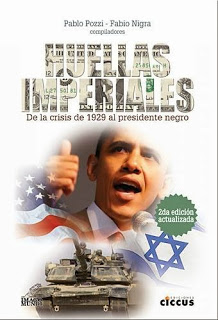 La editorial Imago Mundi anuncia la publicación de la segunda edición del libro Huellas imperiales de la crisis de 1929 al presidente negro. Compilado por los doctores Pablo Pozzi y Fabio Nigra, esta nueva edición de Huellas imperiales repite muchos de los ensayos de la primera edición, pero acompañados de nuevos trabajos. Éstos no sólo ponen al día al libro al examinar la presidencia de Obama, sino que también examinan temas como la cultura consumista, los campos de internamiento durante la segunda guerra mundial, la teocracia y nacionalismo, el Partido Comunista norteamericano, el racismo y raza y el lobby israelí en Estados Unidos. Sin lugar, este libro está destinado a convertirse en una herramienta muy útil para la enseñanza de la historia estadounidense en el mundo hispano parlante.
Norberto Barreto Velázquez, PhD
Lima, 10 de diciembre de 2013
Publicado en Imperialismo norteamericano | Etiquetado Fabio G. Nigra, Huellas imperiales, Pablo Pozzi | Leave a Comment »
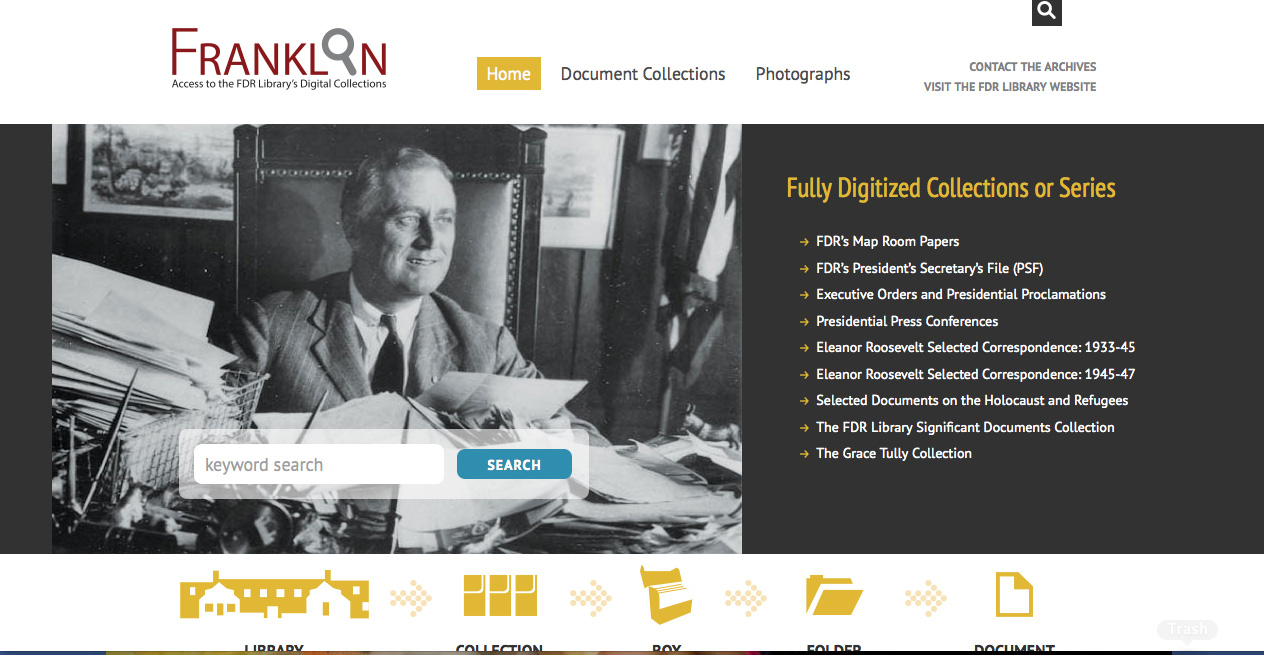
La Biblioteca y Archivo Presidencial Franklin D. Roosevelt acaba de inaugurar FRANKLIN, su portal de acceso libre a más de 300,000 documentos y fotos. Estoy totalmente seguro de que FRANKLIN, se convertirá en una herramienta muy útil para todos aquellos interesados en el estudio de uno de los periodos más fascinantes de la historia norteamericana: la Era Roosevelt.
Publicado en Nuevo Trato, Presidentes de Estados Unidos | Etiquetado FRANKLIN, Franklin D. Roosevelt | Leave a Comment »
Blog Stats
- 1.344.630 hits
-
Únete a otros 1.512 suscriptores
Entradas y Páginas Populares
Publicaciones

-




- julio 2026
- marzo 2026
- febrero 2026
- agosto 2025
- junio 2025
- marzo 2025
- febrero 2025
- enero 2025
- diciembre 2024
- noviembre 2024
- octubre 2024
- septiembre 2024
- julio 2024
- junio 2024
- mayo 2024
- abril 2024
- marzo 2024
- febrero 2024
- enero 2024
- diciembre 2023
- noviembre 2023
- octubre 2023
- agosto 2023
- julio 2023
- junio 2023
- mayo 2023
- abril 2023
- marzo 2023
- febrero 2023
- diciembre 2022
- noviembre 2022
- octubre 2022
- septiembre 2022
- agosto 2022
- julio 2022
- junio 2022
- mayo 2022
- abril 2022
- marzo 2022
- febrero 2022
- enero 2022
- diciembre 2021
- noviembre 2021
- octubre 2021
- septiembre 2021
- agosto 2021
- julio 2021
- junio 2021
- mayo 2021
- abril 2021
- marzo 2021
- febrero 2021
- enero 2021
- diciembre 2020
- noviembre 2020
- octubre 2020
- septiembre 2020
- agosto 2020
- julio 2020
- junio 2020
- mayo 2020
- abril 2020
- marzo 2020
- febrero 2020
- enero 2020
- diciembre 2019
- noviembre 2019
- octubre 2019
- agosto 2019
- julio 2019
- junio 2019
- mayo 2019
- abril 2019
- marzo 2019
- febrero 2019
- enero 2019
- noviembre 2018
- octubre 2018
- agosto 2018
- julio 2018
- mayo 2018
- abril 2018
- marzo 2018
- febrero 2018
- enero 2018
- octubre 2017
- septiembre 2017
- agosto 2017
- abril 2017
- marzo 2017
- diciembre 2016
- octubre 2016
- septiembre 2016
- junio 2016
- mayo 2016
- noviembre 2015
- octubre 2015
- septiembre 2015
- agosto 2015
- julio 2015
- junio 2015
- mayo 2015
- abril 2015
- marzo 2015
- febrero 2015
- enero 2015
- diciembre 2014
- noviembre 2014
- octubre 2014
- septiembre 2014
- agosto 2014
- julio 2014
- junio 2014
- mayo 2014
- abril 2014
- marzo 2014
- febrero 2014
- enero 2014
- diciembre 2013
- noviembre 2013
- octubre 2013
- septiembre 2013
- agosto 2013
- julio 2013
- junio 2013
- mayo 2013
- abril 2013
- marzo 2013
- febrero 2013
- diciembre 2012
- noviembre 2012
- octubre 2012
- septiembre 2012
- junio 2012
- mayo 2012
- febrero 2012
- enero 2012
- diciembre 2011
- noviembre 2011
- agosto 2011
- junio 2011
- mayo 2011
- abril 2011
- enero 2011
- noviembre 2010
- julio 2010
- junio 2010
- mayo 2010
- marzo 2010
- febrero 2010
- enero 2010
- diciembre 2009
- noviembre 2009
- octubre 2009
- septiembre 2009
- agosto 2009
- julio 2009
- junio 2009
- mayo 2009
- abril 2009
- marzo 2009
- enero 2009
- septiembre 2008
- julio 2008
- mayo 2008
- abril 2008


