Feeds:
Entradas
Comentarios

Archive for 2014

DOKTOR ZOOM

Wonkette.com March 30, 2014

super-green-beretYou’ll never guess what fun topic we’re going to address this week, kids! That’s right: The years of Mitt Romney’s mission in France! We’ll learn all about how the Vietnam War was a just and important fight to save Southeast Asia from being crushed by dominoes, and why things happened as they did — or as Donald Rumsfeld recently analyzed the war with characteristic depth, “Some things work out, some things don’t, that didn’t.”

With typical clarity of purpose, our 8th-grade textbook, America: Land I Love (A Beka, 1994, 2006), explains exactly why America had to fight in Vietnam:

Concerned Americans believed in the domino theory of Communism in the poorer areas of the world. President Eisenhower had first used this term while referring to Southeast Asia. He said all of the countries there were like a row of standing dominoes. South Vietnam was the first domino, and the Communists were trying to knock it over. lf South Vietnam fell, all of the others — Cambodia, Laos, Thailand, Burma, Indonesia — would fall, too. Lesser developed nations were especially vulnerable to Communism. Foreign policy planners began to refer to the poorest nations as the “Third World.”

Eisenhower believed it, and it must have been so. Also the third world (no, they don’t explain the term). Strangely, Land I Love makes no mention of how, following the fall of South Vietnam, all those other countries turned communist as well.

Our other text, the 11/12th-grade United States History for Christian Schools (Bob Jones University Press, 2001), is a little less absolute about all this; it devotes space to the initial involvement in Vietnam in the ’50s and early ’60s in fairly objective terms, and described the shift in American troops’ role from “advisors” to combatants with this up-to-date metaphor:

Ostensibly the troops were there to train the South Vietnamese army and to protect American personnel. However, the situation in Asia, as one historian has noted, was proving to be like a “tar baby”: the more the United States tried to free itself, the more entangled it became.

Surprisingly, considering its tendency to be the less frothing-mad of the two texts, U.S. Historyhas no doubt about the reality of the event that led to the expansion of the U.S. role:

In the midsummer of 1964 the American destroyer Maddox repulsed an attack by North Vietnamese patrol boats in the Gulf of Tonkin. Although the affair was relatively minor, Johnson denounced this attack on an American vessel and asked Congress to pass a joint resolution giving him authority to respond to Communist aggression in Vietnam.

Land I Love at least calls it an “alleged” attack, but in its eagerness to justify the fight against atrocity-committing communists, weirdly suggests that it came after American soldiers were in frequent combat:

Communist guerrillas, called Viet Cong, terrorized innocent South Vietnamese villagers, forcing men, women, and children to help them. The Viet Cong sometimes equipped little children with explosives and sent them on suicide missions against unsuspecting American soldiers who had come to liberate the villages. In 1964, the North Vietnamese navy allegedly attacked American ships in the Gulf of Tonkin.

Apart from that Gulf of Tonkin slip, U.S. History presents a pretty fair discussion of the Vietnam conflict, noting that it was “not a clear-cut conflict between two separate nations, as the Korean War had been. Americans were fighting both the North Vietnamese and pro-Communist South Vietnamese (called the Viet Cong).” U.S. History even notes that the South Vietnamese government, while non-Communist, “was corrupt, undemocratic, and unstable. The only advantage it offered to Americans was that it was ‘better than the Communists.’” We’re wondering if Bob Jones University has investigated the loyalty of whoever wrote that — nothing of the sort appears in Land I Love.

And then there’s the whole “limited war” strategy; U.S. History suggests that it was not a simple decision:

Johnson was committed to the idea of a limited, defensive war. He did not want to risk an outright war against North Vietnam — a war which might draw in the Soviet Union or Communist China, divert dollars from the Great Society at home, and prove politically damaging.

Land I Love knows, of course, that the real purpose of teaching history is to tell children who the good guys and bad guys were:

President Johnson wanted to fight the Communists in South Vietnam, but Congress refused to allow American forces to take the offensive and invade Communist North Vietnam. Congress opposed a clear military victory and the President himself wavered in his commitment because he did not want military spending to interfere with social welfare programs.

Under President Johnson, the United States sent some 500,000 American soldiers to South Vietnam to defend freedom in a no-win conflict known as the Vietnam War. These men fought bravely but they were not allowed to win. Conservative Americans felt that if the military had been allowed to fight the war as it should have been fought, fewer people would have been killed and Communism would have been defeated in that part of the world.

Land I Love is not quite as certain about how the war “should have been fought,” but it knows for sure that we should have won, because we’re America.

To its credit, U.S. History includes this lovely cynical comment from an unidentified girl in the early days of the campus protest movement: “I was told if I voted for Goldwater we would be at war in six months. I did — and we were.” It even acknowledges that the Johnson administration was deceptive about he progress of the war:

President Johnson feared that if Americans knew how deeply committed the United States was to the war and how it was actually going, they would stop supporting the programs of the Great Society. Therefore, he attempted to disguise the number of U.S. troops involved in the conflict and to cover setbacks. All that the American people generally heard were cheery, optimistic reports of how well the war was going.

U.S. History even blames Johnson’s deceptions — partly — for the public response to the 1968 Tet Offensive, noting that after the Viet Cong’s initially successful assault on targets all over South Vietnam, U.S. and South Vietnamese troops eventually “drove back the enemy, recapturing what had been lost and inflicting massive casualties”:

Militarily, the Tet Offensive was a failure for the Communists, but it had a dramatic effect on the American public. Television newscasts emphasized the negative aspects — the suddenness of the attack and the heavy losses — thus leading many Americans to believe that Tet was a Communist victory. The U.S. government, to some extent, reaped what it had sown. Having misled the American people and media about the course of the war, the government now faced the wrath of a public who wanted to know how things could come so close to disaster so suddenly. After Tet, many Americans were seemingly no longer looking to win the war; they only wanted a way out.

That’s really not much different from Kid Zoom’s secular textbook, The American Pageant, which says the Tet offensive “ended in a military defeat but a political victory for the Viet Cong.”

Happily, we have Land I Love to infuse a much-needed taste of Pure Wingnut Bullshit:

The Tet Offensive. Congress’s refusal to allow the American military to take an offensive position and fight to win was exposed in early 1968 when the Viet Cong began a series of devastating battles known as the Tet Offensive. As American and South Vietnamese troops suffered heavy casualties, it became clear that unless Congress allowed the troops to invade North Vietnam, Laos, and Cambodia and wipe out the Communist guerrillas and their war factories, the Vietnam conflict would never end.

Land I Love is so busy with the “what we shoulda done” to even note that the Tet offensive didn’t succeed in holding any significant territory — so yep, that really was some political victory for the Viet Cong; it even convinced rightwing textbook editors that all was lost.

We’ll let Land I Love have the last word this week, because it’s just so brilliantly paranoid, right down to the paragraph heading:

Betrayals all around. Although Congress refused to allow the needed military action, American and South Vietnamese forces managed to hold the Communists back. But Communist troops from North Vietnam continued to pour into the South, and European countries who sympathized with the Communists continued to supply North Vietnam with food and medical supplies. Some conservatives felt that Communist sympathizers in high-ranking government positions were deliberately hindering the U.S. military’s ability to achieve a victory in Vietnam.

Yes, this Christian textbook just complained that North Vietnamese were allowed to eat and get medical supplies. And of course, we never find out who those high-ranking traitors were, with all their back-stabbing, but they were almost certainly there.

Next Week: We’ll wrap up Vietnam and look at the dangerous radicals in the “peace” movement; take a wild guess which textbook makes no mention at all of My Lai, the Pentagon Papers, or Kent State? Hint: It’s the one that’s sure America was betrayed.

[Image Credit: Cover of Tod Holton: Super Green Beret (1967). Read the whole incredible mess at Ethan Persoff’s blog]


Read more at http://wonkette.com/545253/sundays-with-the-christianists-u-s-history-books-that-won-in-vietnam#gRL3CPftg9kVRjiD.99

Read Full Post »

The Nativist Origins of Philippines Independence

Richard Baldoz

Truthout April 1, 2014

The flag of the United States is lowered while the flag of the Philippines is raised during the Independence Day ceremonies on July 4, 1946. (Photo: <a href=" http://upload.wikimedia.org/wikipedia/commons/0/09/Philippine_Independence%2C_July_4_1946.jpg" target="_blank"> via Philippine Presidential Museum and Library/a>)

The flag of the United States is lowered while the flag of the Philippines is raised during the Independence Day ceremonies on July 4, 1946. (Photo via Philippine Presidential Museum and Library)


This week marks the 80th anniversary of the passage of the Tydings-McDuffie Act, which established conditions for the United States to grant the Philippines its independence after nearly five decades of American rule. The circumstances surrounding the passage of this historic legislation serve as a reminder of our nation’s lamentable experiment with overseas empire-building and a reckoning with this imperial past help us to understand one of the most visible legacies of this complicated relationship, the large number of Filipinos currently living in the United States.

The act often was hailed as evidence of the benevolent character of the American imperial project, which was motivated by the desire to «uplift and civilize» the native population who had suffered under more than three centuries of Spanish domination. The US annexed the Philippines in 1899 in the aftermath of the Spanish-American War, despite objections from Filipino leaders who already had formed an independent government. American statesmen, however, declared Filipinos unfit for self-rule. Only after a protracted period of intensive colonial tutelage would Filipinos be allowed to run their own affairs. Adding insult to injury, American officials argued (without irony) that the US was duty-bound to take possession of the islands to protect them from the nefarious designs of self-serving foreign powers.

The eventual withdrawal of US sovereignty over the Philippines was far from a foregone conclusion that vindicated the American way of empire, and the origins of the Tydings-McDuffie Act offer a far more complex story involving racial animus, economic competition and the entanglement of domestic and foreign policy objectives.

Filipinos, as American colonial subjects, were exempted from restrictive laws that barred immigration from Asia countries. The exponential growth of the agribusiness sector in Hawaii and the West Coast during the early 20th century spurred a large demand for cheap, flexible labor. Agribusiness concerns actively recruited Filipinos to do field and cannery work previously carried out by Chinese and Japanese immigrants.

Filipino immigration to the United States during the early decades of the 20th century generated significant controversy, especially on the West Coast, where their arrival was characterized as the «third Asiatic invasion» (following on the heels of the Chinese and Japanese «invasions»). Following the popular cultural script of the period, the newcomers were accused of stealing jobs from white citizens, spreading disease and displaying a propensity for criminality. The fact that the first wave of Filipino immigrants was made up overwhelmingly of young male laborers without traditional family moorings was viewed as a budding social problem.

Beginning in the late 1920s, the powerful West Coast nativist lobby pressed federal officials to enact legislation barring the entry of Filipinos. These efforts failed to make headway in Congress, with many lawmakers expressing concern about the diplomatic fallout that might result from excluding Filipino immigrants while they lived under the American flag. Key Congressional leaders worried that such a course of action would violate international norms followed by other imperial powers allowing colonial subjects unimpeded access to the «mother country.»

The failure of the federal government to take action compelled nativist leaders to ratchet up their campaign, hoping to galvanize greater public support for exclusion. Alarmist rhetoric accusing Filipino immigrants of brazenly defying the color line by pursuing social relationships with white women attracted significant media attention. Filipinos, moreover, were charged with exhibiting a penchant for labor militancy that threatened to upend the traditional balance of power between agribusiness and immigrant workers.

Moral panics about interracial sex and political subversion soon spurred public action most visibly manifested in a series of race riots and vigilante campaigns targeting Filipino immigrants on the West Coast in the late 1920s and early 1930s. Violence and acrimony directed at the «invaders» attracted national media attention and eventually prompted Congress to hold hearings on the «Filipino problem.» The nativist lobby used the platform to press its case for exclusion, soliciting support from Southern Congressional representatives, drawing comparisons between Filipino and African-American men’s alleged ardor for white women. Legislation aimed at restricting Filipino immigration stalled again, with the Philippines status as a US possession remaining the chief sticking point.

Nativist leaders quickly adopted a new strategy, embracing the cause of Philippine independence in the early 1930s. Once the Philippines was granted its sovereignty, they reasoned, Filipinos would no longer be exempt from restrictive immigration quotas. While there had long been a vocal base of support in Congress for Philippine independence, it was opposed by powerful constituencies in the federal government who viewed the archipelago as a valuable geo-strategic asset.

The nativist lobby entered into a makeshift coalition with two other important groups pushing for independence. The first was Midwestern agricultural interests, concerned about the importation of inexpensive Philippine products that entered the US duty-free because of the colonial status of the islands. Domestic sugar beet growers feared competition from cheap Philippine cane sugar, and dairy farmers saw coconut oil (formerly a key ingredient in margarine) as hurting the demand for butter. Their political agenda ran parallel to that of the nativists, except they advocated independence as a way to restrict the free entry of Philippine goods, rather than Filipino labor.

Filipino nationalists made up another segment of the independence coalition. Their demands for self-determination pre-dated the Spanish-American War, and indignity surrounding racist treatment and violence against Filipinos living in the US gave their campaign a renewed urgency. While Filipino leaders recognized that they their political allies had less-than-noble intentions, they believed that a Faustian pact was the price to pay for freedom.

The Tydings-McDuffie Act was signed into law in March 1934, despite opposition from the State Department and War Department. The act bore the hallmarks of the various interest groups involved in its passage. In a nod to the opposition, the Philippines would have to complete a 10-year probationary period before the US would formally relinquish its sovereignty over the islands. The status of Filipinos remained largely unchanged during this so-called «Commonwealth» period. They continued to «owe allegiance» to the United States while the Philippines remained under US administrative jurisdiction.

Although independence was delayed for 10 years, two key sections of the act went into effect immediately. Tariffs targeting Philippine sugar, coconut oil and other products were implemented quickly – a clear victory for Midwestern agribusiness interests. In addition, Filipinos immediately were subject to restrictive immigration laws barring the admission of other Asian groups. The Philippines was granted a token quota of 50 immigrants per year, the lowest number allotted to any country in the world. Nativist leaders were quick to take credit for the harsh new quota, believing that it reflected the prevailing racial animus towards Filipinos in the United States.

The unsavory political forces that helped push the Tydings-McDuffie Act through Congress were not lost on Filipino leaders, who observed that the act was as much about the «independence of America from the Philippines» as it was about independence for the Philippines. Filipinos living in the United States faced an uncertain future and remained a feature of everyday life, a fact evidenced by the passage of the Filipino Repatriation Act in 1935, which aimed to «relocate» resident Filipinos back to their homeland.

The Philippines’ march to independence was thrown into peril halfway through its 10-year probation, when Japan attacked the Philippines on December 8, 1941. Interestingly, a little-known provision of the Tydings-McDuffie Act empowered the president of the United States to conscript all Philippine military personnel into the US armed forces. President Roosevelt did just that and approximately 200,000 Filipinos eventually would serve under US military command during World War II.

The Allied war victory ensured that Philippine independence was put back on track and the war-torn country finally was granted its sovereignty on July 4, 1946. The date was a conscious choice made by US officials that would serve as a permanent reminder of America’s lasting influence over the islands. The large and growing Filipino population currently residing in the United States is one enduring consequence of that influence. Filipinos have long been coveted by American employers because of their English language skills and familiarity with US culture. These traits, of course, are the inheritance of empire and a reminder that Filipinos came to the United States only after Americans came to the Philippines.

Richard Baldoz is an assistant professor of sociology at Oberlin College and the author of the award-winning book The Third Asiatic Invasion: Empire and Migration in Filipino America, 1898-1946.

RELATED STORIES

The African-American Connection to the Philippines

By Bill Fletcher, Jr., The Michigan Citizen | Op-Ed

From the Philippines to the NSA: 111 Years of the US Surveillance State

By Mike Morey, Occupy.com | News Analysis

Filipino Gov. Misused Public Funds as People Suffer From Post-Typhoon Devastation

By Jessica Desvarieux, The Real News Network | Video Interview

Read Full Post »

What Really Killed William Henry Harrison?

NEW YORK TIMES     MARCH 31, 2014

William Henry Harrison, the ninth president of the United States, holds a distinction that with luck will never be equaled: He was our shortest-serving president, dying on April 4, 1841, after just a month in office.

What killed him? Historians have long accepted the diagnosis of Harrison’s doctor, Thomas Miller: “pneumonia of the lower lobe of the right lung, complicated by congestion of the liver.”

The pneumonia was thought to be a direct result of a cold the 68-year-old Harrison caught while delivering a numbingly long Inaugural Address (at 8,445 words, the longest in history) in wet, freezing weather without a hat, overcoat or gloves.

But a new look at the evidence through the lens of modern epidemiology makes it far more likely that the real killer lurked elsewhere — in a fetid marsh not far from the White House.

The first clue that the pneumonia diagnosis was wrong lies in Miller’s own apparent uneasiness with it. “The disease,” he wrote, “was not viewed as a case of pure pneumonia; but as this was the most palpable affection, the term pneumonia afforded a succinct and intelligible answer to the innumerable questions as to the nature of the attack.”


             An 1846 map of Washington, top, shows the home (A) of              William Henry Harrison, above, its water supply (B), and a field of “night soil” (C) that could have harbored deadly bacteria.

Harrison — who had had some medical training as a young man — summoned Miller to the White House on March 26, complaining not of a lung ailment but of anxiety and fatigue. Miller did not bleed him, as was the standard treatment for pneumonia at the time. (More about what he did do in a moment.) But Miller may have overlooked a clue that was in front of his nose.

In those days the nation’s capital had no sewer system. Until 1850, some sewage simply flowed onto public grounds a short distance from the White House, where it stagnated and formed a marsh; the White House water supply was just seven blocks downstream of a depository for “night soil,” hauled there each day at government expense.

That field of human excrement would have been a breeding ground for two deadly bacteria, Salmonella typhi and S. paratyphi, the causes of typhoid and paratyphoid fever — also known as enteric fever, for their devastating effect on the gastrointestinal system.

Two other antebellum presidents, James K. Polk and Zachary Taylor, developed severe gastroenteritis while living in the White House. Taylor died, while Polk recovered, only to be killed by what is thought to have

Harrison had a history of dyspepsia, or indigestion, which potentially heightened his risk of infection by gastrointestinal pathogens that might have found their way into the White House water supply.

Although we have no record of how he managed his dyspepsia, the standard treatment in the 1840s was carbonated alkali, which would have neutralized the gastric acid that otherwise kills harmful bacteria. In the absence of the gastric acid barrier, gastroenteritis can be caused by as few as one ten-thousandth the number of bacteria usually needed.

In 1841 there was no effective treatment for enteric fever. The most a doctor could do was adhere steadfastly to medicine’s most sacred tenet, primum non nocere — first do no harm.

At least Miller did not bleed the president. But he gave him a host of toxic medications that were then considered the standard of care — including opium, which retards the intestine’s ability to rid itself of microbial pathogens, facilitating their invasion into the bloodstream.

Enemas, which Miller repeatedly gave to Harrison, are also potentially dangerous in such patients. They can perforate ulcers produced by S. typhi and S. paratyphi in the ileum, the lower end of the small intestine, through which the bacteria would be able to  escape from the intestine into the bloodstream, resulting in sepsis.

As he lay dying, Harrison had a sinking pulse and cold, blue extremities, two classic manifestations of septic shock. Given the character and course of his fatal illness, his untimely death is best explained by enteric fever. Pneumonia was a secondary diagnosis — as Harrison’s hapless doctor perhaps suspected all along.

Jane McHugh is a writer in San Antonio. Dr. Philip A. Mackowiak, a scholar in residence at the University of Maryland, is the author of “Diagnosing Giants: Solving the Medical Mysteries of Thirteen Patients Who Changed the World.”

Read Full Post »

Brazil Marks 50th Anniversary of Military Coup

National Security Archive Electronic Briefing Book No. 465

April 2, 2014

Edited by James G. Hershberg and Peter Kornbluh
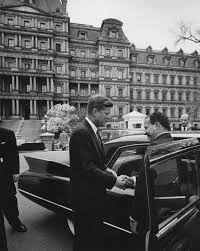
JFK and Goulart 2

President Kennedy and President Joao Goulart on a state visit to Washington April 2, 1962.

Washington, DC, April 2, 2014 – Almost two years before the April 1, 1964, military takeover in Brazil, President Kennedy and his top aides began seriously discussing the option of overthrowing Joao Goulart’s government, according to Presidential tape transcripts posted by the National Security Archive on the 50th anniversary of the coup d’tat. «What kind of liaison do we have with the military?» Kennedy asked top aides in July 1962. In March 1963, he instructed them: «We’ve got to do something about Brazil.»

The tape transcripts advance the historical record on the U.S. role in deposing Goulart — a record which remains incomplete half a century after he fled into exile in Uruguay on April 1, 1964. «The CIA’s clandestine political destabilization operations against Goulart between 1961 and 1964 are the black hole of this history,» according to the Archive’s Brazil Documentation Project director, Peter Kornbluh, who called on the Obama administration to declassify the still secret intelligence files on Brazil from both the Johnson and Kennedy administrations.

Revelations on the secret U.S. role in Brazil emerged in the mid 1970s, when the Lyndon Johnson Presidential library began declassifying Joint Chiefs of Staff records on «Operation Brother Sam» — President Johnson’s authorization for the U.S. military to covertly and overtly supply arms, ammunition, gasoline and, if needed, combat troops if the military’s effort to overthrow Goulart met with strong resistance. On the 40th anniversary of the coup, the National Security Archive posted audio files of Johnson giving the green light for military operations to secure the success of the coup once it started.

«I think we ought to take every step that we can, be prepared to do everything that we need to do,» President Johnson instructed his aides regarding U.S. support for a coup as the Brazilian military moved against Goulart on March 31, 1964.

But Johnson inherited his anti-Goulart, pro-coup policy from his predecessor, John F. Kennedy. Over the last decade, declassified NSC records and recently transcribed White House tapes have revealed the evolution of Kennedy’s decision to create a coup climate and, when conditions permitted, overthrow Goulart if he did not yield to Washington’s demand that he stop «playing» with what Kennedy called «ultra-radical anti-Americans» in Brazil’s government. During White House meetings on July 30, 1962, and on March 8 and 0ctober 7, 1963, Kennedy’s secret Oval Office taping system recorded the attitude and arguments of the highest U.S. officials as they strategized how to force Goulart to either purge leftists in his government and alter his nationalist economic and foreign policies or be forced out by a U.S.-backed putsch.

Indeed, the very first Oval Office meeting that Kennedy secretly taped, on July 30, 1962, addressed the situation in Brazil. «I think one of our important jobs is to strengthen the spine of the military,» U.S. Ambassador Lincoln Gordon told the President and his advisor, Richard Goodwin. «To make clear, discreetly, that we are not necessarily hostile to any kind of military action whatsoever if it’s clear that the reason for the military action is…[Goulart’s] giving the country away to the…,» «Communists,» as the president finished his sentence. During this pivotal meeting, the President and his men decided to upgrade contacts with the Brazilian military by bringing in a new US military attaché-Lt. Col. Vernon Walters who eventually became the key covert actor in the preparations for the coup. «We may very well want them [the Brazilian military] to take over at the end of the year,» Goodwin suggested, «if they can.» (Document 1)

By the end of 1962, the Kennedy administration had indeed determined that a coup would advance U.S. interests if the Brazilian military could be mobilized to move. The Kennedy White House was particularly upset about Goulart’s independent foreign policy positions during the Cuban Missile Crisis. Although Goulart had assisted Washington’s efforts to avoid nuclear Armageddon by acting as a back channel intermediary between Kennedy and Castro — a top secret initiative uncovered by George Washington University historian James G. Hershberg — Goulart was deemed insufficiently supportive of U.S. efforts to ostracize Cuba at the Organization of American States. On December 13, Kennedy told former Brazilian President Juscelino Kubitschek that the situation in Brazil «worried him more than that in Cuba.»

On December 11, 1962, the Executive Committee (EXCOMM) of the National Security Council met to evaluate three policy alternatives on Brazil: A. «do nothing and allow the present drift to continue; B. collaborate with Brazilian elements hostile to Goulart with a view to bringing about his overthrow; C. seek to change the political and economic orientation of Goulart and his government.» [link to document 2] Option C was deemed «the only feasible present approach» because opponents of Goulart lacked the «capacity and will to overthrow» him and Washington did not have «a near future U.S. capability to stimulate [a coup] operation successfully.» Fomenting a coup, however «must be kept under active and continuous consideration,» the NSC options paper recommended.

Acting on these recommendations, President Kennedy dispatched a special envoy — his brother Robert — to issue a face-to-face de facto ultimatum to Goulart. Robert Kennedy met with Goulart at the Palacio do Alvarada in Brazilia on December 17, 1962. During the three-hour meeting, RFK advised Goulart that the U.S. had «the gravest doubts» about positive future relations with Brazil, given the «signs of Communist or extreme left-wing nationalists infiltration into civilian government positions,» and the opposition to «American policies and interests as a regular rule.» As Goulart issued a lengthy defense of his policies, Kennedy passed a note to Ambassador Gordon stating: «We seem to be getting no place.» The attorney general would later say that he came away from the meeting convinced that Goulart was «a Brazilian Jimmy Hoffa.»

Kennedy and his top aides met once again on March 7, 1963, to decide how to handle the pending visit of the Brazilian finance minister, Santiago Dantas. In preparation for the meeting, Ambassador Gordon submitted a long memo to the president recommending that if it proved impossible to convince Goulart to modify his leftist positions, the U.S. work «to prepare the most promising possible environment for his replacement by a more desirable regime.» (Document 5) The tape of this meeting (partially transcribed here for the first time by James Hershberg) focused on Goulart’s continuing leftward drift. Robert Kennedy urged the President to be more forceful toward Goulart: He wanted his brother to make it plain «that this is something that’s very serious with us, we’re not fooling around about it, we’re giving him some time to make these changes but we can’t continue this forever.» The Brazilian leader, he continued, «struck me as the kind of wily politician who’s not the smartest man in the world … he figures that he’s got us by the—and that he can play it both ways, that he can make the little changes, he can make the arrangements with IT&T and then we give him some money and he doesn’t have to really go too far.» He exhorted the president to «personally» clarify to Goulart that he «can’t have the communists and put them in important positions and make speeches criticizing the United States and at the same time get 225-[2]50 million dollars from the United States. He can’t have it both ways.»

As the CIA continued to report on various plots against Goulart in Brazil, the economic and political situation deteriorated. When Kennedy convened his aides again on October 7, he wondered aloud if the U.S. would need to overtly depose Goulart: «Do you see a situation where we might be—find it desirable to intervene militarily ourselves?» The tape of the October 7 meeting — a small part of which was recently publicized by Brazilian journalist Elio Gaspari, but now transcribed at far greater length here by Hershberg — contains a detailed discussion of various scenarios in which Goulart would be forced to leave. Ambassador Gordon urged the president to prepare contingency plans for providing ammunition or fuel to pro-U.S. factions of the military if fighting broke out. «I would not want us to close our minds to the possibility of some kind of discreet intervention,» Gordon told President Kennedy, «which would help see the right side win.»

Under Gordon’s supervision, over the next few weeks the U.S. embassy in Brazil prepared a set of contingency plans with what a transmission memorandum, dated November 22, 1963, described as «a heavy emphasis on armed intervention.» Assassinated in Dallas on that very day, President Kennedy would never have the opportunity to evaluate, let alone implement, these options.

But in mid-March 1964, when Goulart’s efforts to bolster his political powers in Brazil alienated his top generals, the Johnson administration moved quickly to support and exploit their discontent-and be in the position to assure their success. «The shape of the problem,» National Security Advisor McGeorge Bundy told a meeting of high-level officials three days before the coup, «is such that we should not be worrying that the [Brazilian] military will react; we should be worrying that the military will not react.»

«We don’t want to watch Brazil dribble down the drain,» the CIA, White House and State Department officials determined, according to the Top Secret meeting summary, «while we stand around waiting for the [next] election.»


THE DOCUMENTS

Document 1: White House, Transcript of Meeting between President Kennedy, Ambassador Lincoln Gordon and Richard Goodwin, July 30, 1962. (Published in The Presidential Recordings of John F. Kennedy, The Great Crises, Volume One (W.W. Norton), edited by Timothy Naftali, October 2001.)

The very first Oval Office meeting ever secretly taped by President Kennedy took place on July 30, 1962 and addressed the situation in Brazil and what to do about its populist president, Joao Goulart. The recording — it was transcribed and published in book The Presidential Recordings of John F. Kennedy, The Great Crises, Volume One — captures a discussion between the President, top Latin America aide Richard Goodwin and U.S. Ambassador to Brazil Lincoln Gordon about beginning to set the stage for a future military coup in Brazil. The President and his men make a pivotal decision to appoint a new U.S. military attaché to become a liaison with the Brazilian military, and Lt. Col. Vernon Walters is identified. Walters later becomes the key covert player in the U.S. support for the coup. «We may very well want them [the Brazilian military] to take over at the end of the year,» Goodwin suggests, «if they can.»


Document 2: NSC, Memorandum, «U.S. Short-Term policy Toward Brazil,» Secret, December 11, 1962

In preparation for a meeting of the Executive Committee (EXCOMM) of the National Security Council, the NSC drafted an options paper with three policy alternatives on Brazil: A. «do nothing and allow the present drift to continue; B. collaborate with Brazilian elements hostile to Goulart with a view to bringing about his overthrow; C. seek to change the political and economic orientation of Goulart and his government.» Option C was deemed «the only feasible present approach» because opponents of Goulart lacked the «capacity and will to overthrow» him and Washington did not have «a near future U.S. capability to stimulate [a coup] operation successfully.» Fomenting a coup, however «must be kept under active and continuous consideration,» the NSC options paper recommended. If Goulart continued to move leftward, «the United States should be ready to shift rapidly and effectively to…collaboration with friendly democratic elements, including the great majority of military officer corps, to unseat President Goulart.»


Document 3: NSC, «Minutes of the National Security Council Executive Committee Meeting, Meeting No. 35,» Secret, December 11, 1962

The minutes of the EXCOMM meeting record that President Kennedy accepted the recommendation that U.S. policy «seek to change the political and economic orientation of Goulart and his government.»


Document 4: U.S. Embassy, Rio de Janeiro, Airgram A-710, «Minutes of Conversation between Brazilian President Joao Goulart and Attorney General Robert F. Kennedy, Brasilia, 17 December 1962,» December 19, 1962

In line with JFK’s decision at the Excom meeting on December 11 to have «representative sent specially» to talk to Goulart, the president’s brother made a hastily-prepared journey to «confront» the Brazilian leader over the issues that had increasingly concerned and irritated Washington-from his chaotic management of Brazil’s economy and expropriation of U.S. corporations such as IT&T, to his lukewarm support during the Cuban missile crisis and flirtation with the Soviet bloc to, most alarming, his allegedly excessive toleration of far left and even communist elements in the government, military, society, and even his inner circle. Accompanied by US ambassador Lincoln Gordon, RFK met for more than three hours with Goulart in the new inland capital of Brasília at the modernistic lakeside presidential residence, the Palácio do Alvorada. A 17-page memorandum of conversation, drafted by Amb. Gordon, recorded the Attorney General presenting his list of complaints: the «many signs of Communist or extreme left-wing nationalists infiltration» into civilian government, military, trade union, and student group leaderships, and Goulart’s personal failure to take a public stand against the «violently anti-American» statements emanating from «influential Brazilians» both in and out of his government, or to embrace Kennedy’s Alliance for Progress. Turning to economic issues, he said his brother was «very deeply worried at the deterioration» in recent months, from rampant inflation to the disappearance of reserves, and called on Goulart to get his «economic and financial house in order.» Surmounting these obstacles to progress, RFK stressed, could mark a «turning point in relations between Brazil and the U.S. and in the whole future of Latin America and of the free world.» When Goulart defended his policies, Kennedy scribbled a note to Ambassador Gordon: «We seem to be getting no place.» JFK’s emissary voiced his fear «that President Goulart had not fully understood the nature of President Kennedy’s concern about the present situation and prospects.»


Document 5: Department of State, Memorandum to Mr. McGeorge Bundy, «Political Considerations Affecting U.S. Assistance to Brazil,» Secret, March 7, 1963

In preparation for another key Oval office meeting on Brazil, the Department of State transmitted two briefing papers, including a memo to the president from Amb. Gordon titled «Brazilian Political Developments and U.S. Assistance.» The latter briefing paper (attached to the first document) was intended to assist the President in deciding how to handle the visit of Brazilian Finance Minister San Tiago Dantas to Washington. Gordon cited continuing problems with Goulart’s «equivocal, with neutralist overtones» foreign policy, and the «communist and other extreme nationalist, far left wing, and anti-American infiltration in important civilian and military posts with the government.»


Document 6: Excerpts from John F. Kennedy’s conversation regarding Brazil with U.S. Ambassador to Brazil Lincoln Gordon on Friday March 8, 1963 (Meeting 77.1, President’s Office Files, John F. Kennedy Presidential Library, Boston)

On March 8, 1963, a few days before Dantas’ arrived, JFK reviewed the state of US-Brazilian relations with his top advisors, including Secretary of State Dean Rusk, his ambassador to Brazil, Lincoln Gordon, and his brother Robert. Unofficially transcribed here by James G. Hershberg (with assistance from Marc Selverstone and David Coleman) this is apparently the first time that it has been published since the tape recording was released more than a decade ago by the John F. Kennedy Presidential Library in Boston. As the comments by Rusk, Gordon, and RFK make clear, deep dissatisfaction with Goulart persisted. «Brazil is a country that we can’t possibly turn away from,» Secretary of State Rusk told the president. «Whatever happens there is going to be of decisive importance to the hemisphere.» Rusk frankly acknowledged that the situation wasn’t yet so bad as to justify Goulart’s overthrow to «all the non-communists or non-totalitarian Brazilians,» nor to justify a «clear break» between Washington and Rio that would be understood throughout the hemisphere. Instead, the strategy for the time being was to continue cooperation with Goulart’s government while raising pressure on him to improve his behavior, particularly his tolerance of far-leftist, anti-United States, and even communist associates-to, in JFK’s words, «string out» aid in order to «put the screws» on him. The president’s brother, in particular, clearly did not feel that Goulart had followed through since their meeting a few months earlier on his vows to put a lid on anti-U.S. expressions or make personnel changes to remove some of the most egregiously leftist figures in his administration. Goulart, stated RFK, «struck me as the kind of wily politician who’s not the smartest man in the world but very sensitive to this [domestic political] area, that he figures that he’s got us by the—and that he can play it both ways, that he can make the little changes…and then we give him some money and he doesn’t have to really go too far.»


Document 7: CIA, Current Intelligence Memorandum, «Plotting Against Goulart,» Secret, March 8, 1963

For more than two years before the April 1, 1964 coup, the CIA transmitted intelligence reports on various coup plots. The plot, described in this memo as «the best-developed plan,» is being considered by former minister of war, Marshal Odylio Denys. In a clear articulation of U.S. concerns about the need for a successful coup, the CIA warned that «a premature coup effort by the Brazilian military would be likely to bring a strong reaction from Goulart and the cashiering of those officers who are most friendly to the United States.»


Document 8: State Department, Latin American Policy Committee, «Approved Short-Term Policy in Brazil,» Secret, October 3, 1963

In early October, the State Department’s Latin America Policy Committee approved a «short term» draft policy statement on Brazil for consideration by President Kennedy and the National Security Council. Compared to the review in March, the situation has deteriorated drastically, according to Washington’s point of view, in large measure due to Goulart’s «agitation,» unstable leadership, and increasing reliance on leftist forces. In its reading of the current and prospective situation, defining American aims, and recommending possible lines of action for the United States, the statement explicitly considered, albeit somewhat ambiguously, the U.S. attitude toward a possible coup to topple Goulart. «Barring clear indications of serious likelihood of a political takeover by elements subservient to and supported by a foreign government, it would be against U.S. policy to intervene directly or indirectly in support of any move to overthrow the Goulart regime. In the event of a threatened foreign-government-affiliated political takeover, consideration of courses of action would be directed more broadly but directly to the threatened takeover, rather than against Goulart (though some action against the latter might result).» Kennedy and his top aides met four days later to consider policy options and strategies–among them U.S. military intervention in Brazil.


Document 9: Excerpts from John F. Kennedy’s conversation regarding Brazil with U.S. Ambassador to Brazil Lincoln Gordon on Monday, October 7, 1963 (tape 114/A50, President’s Office Files, John F. Kennedy Presidential Library, Boston)

«Do you see a situation where we might be-find it desirable to intervene militarily ourselves?» John F. Kennedy’s question to his ambassador to Brazil, Lincoln Gordon, reflected the growing concerns that a coup attempt against Goulart might need U.S. support to succeed, especially if it triggered an outbreak of fighting or even civil war. This tape, parts of which were recently publicized by Brazilian journalist Elio Gaspari, has been significantly transcribed by James G. Hershberg (with assistance from Marc Selverstone) and published here for the first time. It captured JFK, Gordon, Defense Secretary Robert S. McNamara and other top officials concluding that the prospect of an impending move to terminate Goulart’s stay in office (long before his term was supposed to come to an end more than two years later) required an acceleration of serious U.S. military contingency planning as well as intense efforts to ascertain the balance between military forces hostile and friendly to the current government. In his lengthy analysis of the situation, Gordon — who put the odds at 50-50 that Goulart would be gone, one way or another, by early 1964 — outlined alternative scenarios for future developments, ranging from Goulart’s peaceful early departure («a very good thing for both Brazil and Brazilian-American relations»), perhaps eased out by military pressure, to a possible sharp Goulart move to the left, which could trigger a violent struggle to determine who would rule the country. Should a military coup seize power, Gordon clearly did not want U.S. squeamishness about constitutional or democratic niceties to preclude supporting Goulart’s successors: «Do we suspend diplomatic relations, economic relations, aid, do we withdraw aid missions, and all this kind of thing — or do we somehow find a way of doing what we ought to do, which is to welcome this?» And should the outcome of the attempt to oust Goulart lead to a battle between military factions, Gordon urged study of military measures (such as providing fuel or ammunition, if requested) that Washington could take to assure a favorable outcome: «I would not want us to close our minds to the possibility of some kind of discreet intervention in such a case, which would help see the right side win.» On the tape, McNamara suggests, and JFK approves, accelerated work on contingency planning («can we get it really pushed ahead?»). Even as U.S. officials in Brazil intensified their encouragement of anti-communist military figures, Kennedy cautioned that they should not burn their bridges with Goulart, which might give him an excuse to rally nationalist support behind an anti-Washington swerve to the left: Washington needed to continue «applying the screws on the [economic] aid» to Brazil, but «with some sensitivity.»


Document 10: State Department, Memorandum, «Embassy Contingency Plan,» Top Secret, November 22, 1963

Dated on the day of President Kennedy’s assassination in Dallas, this cover memo describes a new contingency plan from the U.S. Embassy in Brazil that places «heavy emphasis on U.S. armed intervention.» The actual plan has not been declassified.


Document 11: NSC, Memcon, «Brazil,» Top Secret, March 28, 1964

As the military prepared to move against Goulart, top CIA, NSC and State Department officials met to discuss how to support them. They evaluated a proposal, transmitted by Ambassador Gordon the previous day, calling for covert delivery of armaments and gasoline, as well as the positioning of a naval task force off the coast of Brazil. At this point, U.S. officials were not sure if or when the coup would take place, but made clear their interest in its success. «The shape of the problem,» according to National Security Advisor McGeorge Bundy, «is such that we should not be worrying that the military will react; we should be worrying that the military will not react.»


Document 12: U.S. Embassy, Brazil, Memo from Ambassador Gordon, Top Secret, March 29, 1964

Gordon transmitted a message for top national security officials justifying his requests for pre-positioning armaments that could be used by «para-military units» and calling for a «contingency commitment to overt military intervention» in Brazil. If the U.S. failed to act, Gordon warned, there was a «real danger of the defeat of democratic resistance and communization of Brazil.»


Document 13: Joint Chiefs of Staff, Cable, [Military attaché Vernon Walters Report on Coup Preparations], Secret, March 30, 1964

U.S. Army attaché Vernon Walters meets with the leading coup plotters and reports on their plans. «It had been decided to take action this week on a signal to be issued later.» Walters reported that he «expects to be aware beforehand of go signal and will report in consequence.»


Document 14 (mp3): White House Audio Tape, President Lyndon B. Johnson discussing the impending coup in Brazil with Undersecretary of State George Ball, March 31, 1964.


Document 15: White House, Memorandum, «Brazil,» Secret, April 1, 1964

As of 3:30 on April 1st, Ambassador Gordon reports that the coup is «95% over.» U.S. contingency planning for overt and covert supplies to the military were not necessary. General Castello Branco «has told us he doesn’t need our help. There was however no information about where Goulart had fled to after the army moved in on the palace.


Document 16: Central Intelligence Agency, Intelligence Cable, «Departure of Goulart from Porto Alegre for Montevideo,» Secret, April 2, 1964

CIA intelligence sources report that deposed president Joao Goulart has fled to Montevideo.


Read Full Post »

U.S. National Archives Web Site Uploads Hundreds of Thousands of Diplomatic Cables from 1977

National Security Archive Electronic Briefing Book No. 463

March 27, 2014

Edited by William Burr


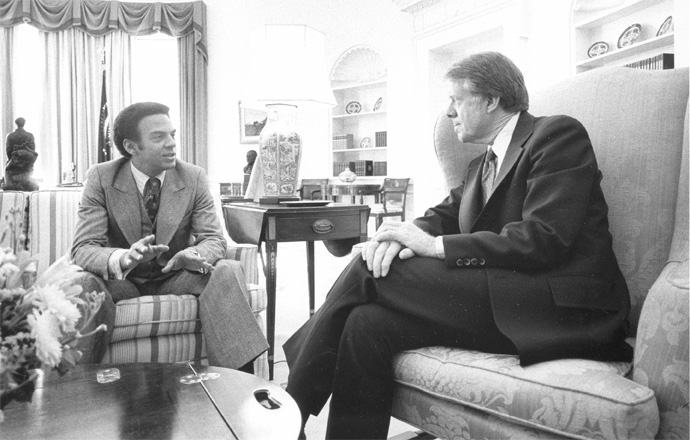
Ambassador to the United Nations Andrew Young meeting with President Jimmy Carter. Young served as ambassador during 1977-1979, but was forced to resign because of an unauthorized meeting with Palestinian diplomats. (Photograph from Still Pictures Unit, National Archives and Records Administration, RG 59-SO, box 39)

Ambassador to the United Nations Andrew Young meeting with President Jimmy Carter. Young served as ambassador during 1977-1979, but was forced to resign because of an unauthorized meeting with Palestinian diplomats. (Photograph from Still Pictures Unit, National Archives and Records Administration, RG 59-SO, box 39)

Washington, DC, March 27, 2014 – In February 2014, the National Archives and Records Administration (NARA) posted 300,000 State Department telegrams from 1977 — the first year of the Jimmy Carter administration — on its Access to Archival Databases system. This posting is another step in carrying out the commitment that NARA and the State Department have made to putting on-line major State Department document databases and indexes as they are declassified. The 1977 telegrams cover the gamut of issues of the day: human rights on both sides of the Cold War line, U.S.-Soviet relations, China, NATO issues, nuclear proliferation, the Middle East Crisis, African affairs, a variety of diplomatic and security relationships around the world from Latin American to Southeast Asia, and issues of growing concern, such as women in development. The last release of on-line State Department material — telegrams and other records for 1976 — was in January 2010. Meeting the requirements of the Privacy Act, budgetary problems, and a complex declassification process prolonged the review and release of the 1977 material.

NARA’s mass posting of State Department telegrams began in 2006 when it uploaded nearly 320,000 declassified telegrams from 1973 and 1974. During the following years, NARA posted hundreds of thousands of telegrams from 1975 and 1976, bringing the total to nearly a million. The Access to Archival Databases (AAD) search engine permits searches for documents on a year-to-year basis, but in 2012 Wikileaks usefully repackaged the telegram databases by aggregating them, making it possible to search through all of telegrams at once.

The National Archives has not publicized this or previous diplomatic telegram releases so the National Security Archive is stepping in to the breach to alert researchers and to offer some interesting examples of the new material. Some key documents are already available in the State Department’s Foreign Relations of the United States historical series, but there is more material than the FRUSeditors can use on many topics. A stroll through the AAD search engine produces absorbing results. Among the highlights from the search conducted by the editor:

  • During Jimmy Carter’s first year, U.S. officials in Moscow and Washington wondered about Soviet General Secretary Leonid Brezhnev’s state of health and its implications for Moscow-Washington relations, which were already complicated by disagreements over strategic arms control and human rights policy. In an exchange of telegrams State Department intelligence and the U.S. Embassy in Moscow argued over the former’s view that Brezhnev’s health problems meant that he was «no longer in command of all aspects of Soviet policy.» For the Bureau of Intelligence and Research (INR), even if Brezhnev was losing control, he could still be a channel of communication, not unlike Mao Zedong’s declining years where «we had more success with Mao’s slobbering and shambling through critical meetings with U.S. representatives …than we have had since Mao’s passing.» Disagreeing with that assessment, U.S. Ambassador Malcolm Toon acknowledged that Brezhnev «suffers from a variety of physical ailments» but he «is still in control.»
  • When two senior U.S. officials met with South Korean dictator General Park Chung Hee in 1977 to discuss the withdrawal of U.S. forces, they brought up human rights problems. The detention of dissidents arrested at Myeongdong Cathedral in 1976 was one issue that concerned the White House but Park was reluctant to take a lenient approach because it would «encourage defendants to violate Korean law again.»
  • According to a report from the U.S. Embassy in Thailand on the situation in Cambodia and the status of organized resistance against the Khmer Rouge, two informants declared that «the fruit of Khmer Rouge rule might well be the extinction of the Cambodian race.» While the Khmer Rouge had continued «to eliminate anyone associated with the former regime,» the «greatest threat to life in Cambodia» was disease and famine. The recent rice harvest had been good but the regime was stockpiling and exporting the grain.
  • A telegram on a conversation between U.S. Ambassador to the United Nations Andrew Young and an influential figure in the South African National Party, Cornelius («Connie») Petrus Mulder, who was «more liberal» but did not want to get «out in front of agreed policy on apartheid.» Young conveyed the message that the administration sought «progressive transformation of South Africa toward majority rule» and the discussion covered the range of regional issues as well as the Young’s argument about the possibility of reconciliation based on the «sharing of economic benefits.»
  • In mid-1977, the Temple University biologist Niu Man-Chiang was visiting Beijing and met with Deng Xiaoping (Teng Hsiao-Ping in the Wade-Giles transliteration), who, after very difficult years during the Cultural Revolution, was again holding top-level positions. Deng claimed that he «was in charge of two things: science and the military,» but kept bringing the discussion back to economic policy, especially solving the problem of «feeding a growing population,» for which he proposed restricting births and growing more food.

The release includes telegrams at many levels of classification, from «Unclassified» and «Official Use Only» to «Confidential» and «Secret.» Moreover, telegrams with a variety of handling restrictions are available, including «Limdis» [limited distribution], «Exdis» [exclusive distribution], and «Nodis» [no distribution except with permission], as well as «Noforn» [no foreign nationals] and «STADIS» [State Department distribution]. Unlike the previous telegram releases, the one for 1977 includes the «nodis» items and also the closely-held cables with the «Cherokee» distribution control, usually reserved for messages involving the secretary of state and senior White House officials. The Cherokee control originated during the 1960s, when Dean Rusk was Secretary of State.  It was named after Cherokee County, Georgia, where he was born.  Information confirmed in e-mail from David Langbart, National Archives, 28 March 2014.

The downside of the 1977 release is that nearly 60,000 telegrams have been exempted altogether, about 19.5 percent of the total for the year. This means that thousands of documents will remain classified for years; even if persistent researchers deluge NARA with requests they will take years to process under present budgetary limitations. Yet, 19.5 percent is close to the same exemption rate for the previous two years: 23 percent for 1976 and 19 percent for 1975. The specific reasons for the withdrawal of a given document are not given; according to information on the Web site, they are withdrawn variously for national security reasons, statutory exemptions, or privacy. No doubt specific statutory exemptions such as the CIA Act and the Atomic Energy Act play a role, which makes one wonder how many exempted documents concern such things as obsolete nuclear stockpile locations that are among the U.S. government’s dubious secrets. Moreover, given the endemic problem of over-classification at the Pentagon, it is possible that the Defense Department erroneously classified some information, for example, telegrams relating to NATO’s Nuclear Planning Group.

The collection of telegrams is only a segment of the State Department record for that year; still to be declassified and processed for 1977 is the index to the P-reels, the microfilmed record of the non-telegram paper documentation. Moreover, top secret telegrams are not yet available for any year since 1973 and collections of «Nodis» telegrams from the mid-1970s remain unavailable. No doubt, NARA’s inadequate funding is an important cause of delay. OMB and Congress have kept NARA on an austerity budget for years; this is a serious problem, which directly damages the cause of greater openness for government records. In real terms (adjusted for inflation), the NARA budget has been declining since FY 2009, despite the agency’s ever-growing responsibility for billions of pages of paper and electronic records. Consistent with the policy of forced austerity, OMB has cut NARA’s budget for the next fiscal year by $10 million.

At the current rate it will be years before all the telegrams before all telegrams and other material for the 1970s, much less the 1980s, are on-line at AAD. While the State Department has moved forward in reviewing telegrams from the 1980s, its reviewers need to catch up with the «Nodis» and top secret central files from the mid-1970s and 1977 before they get too far ahead of themselves. As for the telegrams for 1978 and 1979, according to recent reports, they have been fully reviewed for declassification and physically transferred to NARA. When they will become available is not clear. They may have to go through a review for privacy information by NARA, for example, of material concerning visa applications. That was a major element contributing to the delay in the release of the 1977 telegrams. Such a review is justifiable, such as when social security numbers are at issue; certainly protecting private information deserves special care. Nevertheless, there is concern, even among NARA staffers, that the privacy review process may be becoming too extensive (e.g., excluding old mailing addresses). More needs to be learned about criteria used for the privacy review.

Note: As in the previous openings, some telegrams are missing for technological reasons. Over the years, when IT specialists migrated the telegram collections from one electronic medium to another some records were lost. Such missing records, of which there are over 3,800 for 1977 are indicated by this wording: «telegram text for this mrn [message reference number] is unavailable.» That does not mean that all are gone for good; some copies will show up in embassy files or presidential libraries. Moreover, copies can often be found in P-reel microfilm collections at the State Department and the National Archives, depending on the years. The «message attribution» information appended to such documents [an example] includes the microfilm numbers that can be used for requesting copies.


Read Full Post »

How a Woman Born into Slavery Helped Build New York City’s First African American Research Library 

HNN  March 31, 2014

Image via University of North Carolina.

A short article sandwiched in between a controversy in the harness racing world and assorted advertisements reminds us of how important the knowledge of history is. Published in the New-York Daily Tribune on January 26, 1896, “Literature by Negroes” announced a new project by a local club: “Under the skylight of a business house in Murray St. is the nucleus of a unique library, which treats the rise and development of the American negro (sic).”  The Women’s Loyal Union (WLU), the article explained, sought a home for the books, pamphlets and periodicals collected in an effort to preserve and transmit African American literature, history and culture. Formed in December of 1892, the WLU supported “all constitutional, natural and civil rights of the people of African descent in this country.”   The group emerged shortly after the Lyric Hall testimonial that helped launch Ida B. Wells’ anti-lynching campaign. Journalist Victoria Earle Matthews (1861-1907), president of the WLU, was one of two organizers of the event that enabled Wells to share her story from a public platform and bring attention to racist mob violence in the New South.  Matthews served as the driving force behind the initiative featured in the article, too.

The establishment of a collection of books and other materials may seem like a departure from a civil rights agenda but for Matthews, the two remained inextricably linked. Born into slavery in Fort Valley, Georgia, she moved to New York City with her mother and sister after the Civil War. Her entrance into the workforce as a domestic effectively ended her formal education. However, she became an avid autodidact. Social worker Frances R. Keyser characterized her as a “book-loving” individual who “never missed an opportunity to improve her mind”.  With journalist and historian J. E. Bruce, Matthews formed the Enquiry Club in the early 1880s. Bruce credited her with focusing their reading and discussions on history. He recalled; “under her presidency, [we] got very busy and soon…discover[ed] that after all we who call ourselves Negroes are really somebody, that our forebears had done some things for which they have not been given full credit.” Though the group disbanded after two years, Matthews continued to promote the significance of what she called Race Literature. For her, such literature by African American women and men offered not only a counter-narrative to a distorted view of the past and present but critical sources of pride, purpose and identity — fuel for the engine of social justice and a changed sense of self.  Bruce believed she “had planted the seeds” that flourished into the Black Studies movement.

The Daily Tribune reporter regarded Matthews as chiefly responsible for assembling “this novel collection.” Most likely, it was she who envisioned the possibility of a more permanent home such as “an alcove … in one of the public libraries of New York.”   Moreover, Matthews’ persuasive powers may also have convinced luminaries such as D. Alexander Crummell to pledge items from their private collections for a reference section, according to the article. Yet, public library space did not materialize during the late nineteenth century; not until 1925 did the forerunner to the Schomburg Center for Research in Black Culture open. The full realization of Matthews’ dream took decades to accomplish.

All or part of the materials mentioned in the article appear to have been placed at the White Rose Home, the settlement house Matthews co-founded. She drew upon this collection for the classes she offered in Race History. Keyser described her as she neared the end of her losing battle with tuberculosis, still determined to share what she knew. Such knowledge had empowered her and she wanted to provide young people with similar inspiration.  Awareness of “the work and worth of the men and women of their race” was transformative.  As Women’s History Month draws to a close, it is worthwhile to remember Victoria Earle Matthews and the belief that sustained her: history matters.

Elizabeth Hohl is a lecturer at Fairfield University. She holds a PhD in women’s studies and history.

Read Full Post »

Want to See How Afghanistan Will Turn Out After the U.S. Withdrawal? Look to Latin America 

HNN   March 31, 2014 

Image via Wiki Commons.

Many who reacted to President Obama’s recent suggestion that he might pull out all U.S. troops from Afghanistan by December have used the U.S. occupations of Germany and Japan after World War II to argue that troops can bring the security and stability needed for long-term nation building.

Although the occupations in Europe and Asia were logical responses to wars against the United States just as the U.S. invasion of Afghanistan followed upon 9/11, the analogy should end there. Successful nation building does not depend mostly on the occupying force but rather on the capacity — more important, the willingness — of the occupied society to carry it out. The Germans and Japanese under occupation had the capacity to rebuild their nations simply because they had already been industrial, centralized nations before the war. They also had the willingness because anti-Nazis in Germany and anti-militarists in Japan, who hated the ideologies behind the aggression of their nation, were now in charge.

A far better analogy for the situation in Afghanistan takes us back a generation further, to the U.S. occupations in Central America and the Caribbean around World War I. Then as now, the United States perceived a security threat — German gunboats, schemes to build another canal in Central America — that compelled them to occupy small, poor, agricultural nations.

Like Afghanistan, those places strained the definition of “nation.” Nicaragua (occupied 1912-1933), Haiti (1915-1934), and the Dominican Republic (1916-1924) were all afflicted by caudillos, strongmen whose power rested on their control of small private armies and especially their ability to resist centralized power. “Leaders” in Managua, Port-au-Prince, and Santo Domingo were beholden to these regional power brokers. Presidents were weak, corrupt, and isolated. They expressed nationalism but didn’t really care about the future of their country. Such characters should sound familiar to anyone who has dealt with Hamid Karzai.

Seeing decentralization as debilitating to security or development, occupying Americans tried to build nations. They had locals build roads and string telegraph wires alongside them. They funded hospitals and reorganized schools. They surveyed lands, to make them easier to buy and sell. Most important, they trained national constabularies that were, for the first time, able to use those roads to put down any caudillo’s regional challenge.

None of it magically created the “national feeling” that occupiers wanted. It didn’t help that Americans also used forced labor, torture, racism, and strong-arm diplomacy to speed up nation building. But even without such brutality, centralization was a pipe dream that barely advanced, even after decades of occupation.

The unwillingness of Latin Americans to centralize and adopt other behaviors of industrialized democracies was made most evident, as it is now in Afghanistan, when talk of withdrawal came up. After World War I, when the Germans no longer threatened the Caribbean basin, the strategic rationale for troops evaporated. Even violent insurrectionary movements had been wiped out or had laid down their weapons.

So it was time for U.S. troops to go, but they soon learned that withdrawal would be a long, drawn-out process that entailed coming to terms with the painful reality that nation building had failed. Marines oversaw elections in each of these three occupations, but in each, candidates made wild promises and vicious accusations while they betrayed political allies. They remained wedded to personalism, following leaders who presented absolutely no program for the betterment of their nations. They continued draining the treasury and using governments not to implement policy but to hand out jobs to friends and family.

American occupiers were without good options, as the Obama administration is today. If they insisted on keeping a high level of troops, they faced calls for “self-government” from Latin Americans and cries from back home that the money would be better spent in the United States, especially as the Great Depression stifled budgets. If they kept a small amount of troops in country, as they did in Nicaragua for thirteen years and as Obama is now considering, those troops merely propped up a puppet government that fell as soon as they left. And the more Americans negotiated withdrawal agreements, the more they gave in to Latin American demands to control their own politics. Delay, then as now, was a losing strategy.

When the Marines did leave the Caribbean, the result they witnessed in each occupation was the worst of all worlds: dictators used the coercive power of national constabularies to destroy, rather than build up, what incipient democracy there was. Anastazio Somoza in Nicaragua, Rafael Trujillo in the Dominican Republic, and eventually François Duvalier in Haiti crushed caudillos and “nationalized” power without the required nationalism.

The lessons for Afghanistan today are dispiriting and opaque. There will be no happy ending, no riding into the sunset. Leaving earlier rather than later, as most Americans seem to want, makes sense, but isn’t a panacea. Afghans will sooner or later have to face their own demons and progress at their own pace. Peoples cannot be forced into nationalism; they must build it through their own initiative, trauma, and tears.

Alan McPherson is professor of international and area studies at the University of Oklahoma and the author of The Invaded: How Latin Americans and Their Allies Fought and Ended U.S. Occupations.


Read Full Post »

The Civil Rights Heroes the Court Ignored in The New York v. Sullivan

Garrett Epps

The Atlantic March 20, 2014

National Archives

I’m late to the 50th birthday party for New York Times v. Sullivandeliberately so. It’s no fun to be the sourpuss. Sullivan has been celebrated by top legal and media figures from the moment it was decided until its half-centenary this month. Alexander Meiklejohn, the philosopher, called it at the time “an occasion for dancing in the streets.” In his meticulous 1992 book, Make No Law: The Sullivan Case and the First Amendment, famed Supreme Court reporter Anthony Lewis wrote that the case “gave [the First Amendment’s] bold words their full meaning.” And a few weeks ago, University of Chicago Professor Geoffrey Stone wrote that, whatever its flaws, Sullivan “remains one of the great Supreme Court decisions in American history.” The New York Times itself, the winner of the case, congratulated the nation and the Court on “the clearest and most forceful defense of press freedom in American history.” I used to be a newspaper editor. I was dealing with libel threats at my college paper before I was old enough to vote. So I’m grateful for Sullivan’s broad protection of free speech and press. The Court’s decision defused an existential threat to press freedom—a systematic campaign (detailed well by Lewis in Make No Law) to drive the major networks and papers out of the South by using local libel laws to bleed or bankrupt them.  The Court was wise to stop that cold. And yet … and yet. There are some ghosts at the Sullivan feast.  Here are their names: Ralph David Abernathy, S.S. Seay Sr., Fred L. Shuttlesworth, and J.E. Lowery. These four black ministers fought against Southern apartheid—and though the fight in the end was won, these four men lost a great deal in the struggle. Their story is the underside of New York Times v. Sullivan, the part that the “post-racial” America of 2014 is not eager to remember. On March 29, 1960, The New York Times published an advertisement funded by Northern supporters of Martin Luther King and the Southern Christian Leadership Council, who were locked in a struggle to desegregate Montgomery, Alabama. Entitled “Heed Their Rising Voices,” it described a number of actions the city government had taken to thwart Civil Rights Movement protests and punish those who engaged in them. A few of the facts, however, were wrong—not surprising, given that it was written by Bayard Rustin, another Civil Rights hero who was not on the ground in Alabama. Rustin also signed the four ministers’ names to the advertisement—without notifying or consulting them. Days later, L.B. Sullivan, police commissioner of Montgomery, filed suit in a state court against both the Times and the ministers for supposedly defaming him. Even though he hadn’t even been named in the advertisement, the all-white jury awarded Sullivan the full half-million dollars he asked for. A few similar verdicts would have bankrupted even the Times; it pulled its reporters out of Alabama. Other cases were filed against other news organizations; Southern officials boasted publicly that they had found a tool to silence the hated Northern press. The four ministers were also adjudged liable for the full amount. The trial judge wouldn’t even allow them to move for a new trial. Alabama authorities seized their cars and land without waiting for their appeal. Even though both cases ended up in the Supreme Court, they were presented very differently. As Lewis notes dryly, “The Times petition did not emphasize the racial issue.” The issue, for the Times, was press freedom. The ministers’ lawyers, however, cited the shocking racial climate in the court—the jury was all white, the courtroom was forcibly segregated by the trial judge, the judge permitted Sullivan’s lawyers to use derogatory racial terms and refer to cannibalism in the Congo, and the judge refused to call the ministers’ black lawyers “Mister,” as he did Sullivan’s (and the Times’s) white ones. “[T]he jury had before it an eloquent assertion of the inequality of the Negro in the segregation of the one room, of all rooms, where men should find equality before the law,”  the ministers’ brief said. One of the lawyers, Samuel Pierce (later a member of Ronald Reagan’s Cabinet), told the Court, “it is difficult to see how there can be equal protection under the laws and due process in a court where there’s not even equality of courtesy or recognition of human dignity.” Judgment day for the ministers and the Times came on March 9, 1964. In a single opinion for the Court, Justice William Brennan wrote first, that “an otherwise impersonal attack on governmental operations” can never be defamatory of a government official who is not named in the attack, and, second, that even false statements of fact about public officials are protected by the First Amendment unless they are made with “actual malice.” That term means that the person making the statement must either know it is false or at least think it may be false; “pure heart, empty head” protects against libel of officials. Sullivan was and remains a triumph for the Times and the pressBut here is the opinion’s entire discussion of the ministers’ claims: “The individual petitioners contend that the judgment against them offends the Due Process Clause because there was no evidence to show that they had published or authorized the publication of the alleged libel, and that the Due Process and Equal Protection Clauses were violated by racial segregation and racial bias in the courtroom.” Because it had decided the First Amendment issue, Brennan wrote, “we do not decide the questions presented by the other claims of violation of the Fourteenth Amendment.” Am I the only one who wonders why a Court that was bold in defense of the press could not even mention segregation? Or to wince when the opinion relies on the words of a slaveholder, Thomas Jefferson? Am I the only one who remembers that Brennan, the liberal icon, told four brave men their issues were not worthy of address? L.B. Sullivan lives on in the case’s name. The ministers have disappeared. As a Southern-born white, I do not owe my freedom to The New York Times but to men like those four ministersAbernathy, Seay, and Shuttlesworth are dead, but Joseph Lowery, who is 90, gave the invocation at Barack Obama’s first inauguration.  The Times recorded his attendance at the commemoration of King’s “I have a dream speech” last August. But as far as I can tell, it did not give him any credit for its landmark free press victory. My point is not to skewer the Times, which I admireit is to remind us all that American history has a tendency to grow whiter over time. Know these names: Abernathy, Lowery, Seay, Shuttlesworth. Know the names of the other African Americans who risked (and sometimes lost) everything they had to free Americans of every race.  And by all means celebrate New York Times v. Sullivan. In some ways it really is an occasion for dancing in the streets. But perhaps we should not expect Joseph Lowery to dance. Garrett Epps, a former reporter for The Washington Post, is a novelist and legal scholar. He teaches courses in constitutional law and creative writing for law students at the University of Baltimore and lives in Washington, D.C. His new book is American Epic: Reading the U.S. Constitution.

Read Full Post »

Maryland Man May Have Found Two Lost of Forgotten Photos of Lincon´s Funeral Procesion

Michael E. Ruane

Washington Post   March 19, 2014

In the first photograph, the crowd outside the church seems to be waiting for something to come down the street. Children stand up front so they can see. Women, in the garb of the mid-1800s, shield themselves from the sun with umbrellas. White-gloved soldiers mill around. And a few people have climbed a tree for a better view.

(Mathew Brady/The National Archives)

In this second shot, some heads are bowed. Men have taken off their hats. And the blur of a large black object is disappearing along the street to the left of the frame. What the scene depicts, why it was photographed, or where, has been a mystery for decades, experts at the National Archives say. But a Maryland man has now offered the theory that the two photos are rare, long-forgotten images of Abraham Lincoln’s funeral procession in New York City.

(Mathew Brady/The National Archives)

Paul Taylor, 60, of Columbia, a retired federal government accountant, believes the scene is on Broadway, outside New York’s historic Grace Church.

The day is Tuesday, April 25, 1865, 11 days after Lincoln was shot at Ford’s Theatre in Washington.

 And the crowd is waiting for, and then seems to be paying homage before, a horse-drawn hearse, whose motion makes it appear as a black blur as it passes by in the second picture.

If Taylor is right, scholars say he has identified rare photos of Lincoln’s marathon funeral rites, as well as images that show mourners honoring the slain chief executive.

Plus, it appears that the photographs were taken from an upper window of the studio of famed Civil War photographer Mathew Brady, which was across the street from the church.

“It’s a big deal,” said Richard Sloan, an expert on the Lincoln funeral ceremonies in New York. “What makes it even a bigger deal is to be able to study the people. Even though you can’t see faces that well, just studying the people tells a story.”

Sloan added, “It’s as if you’re there, and you can see the mood.”

Many people, including children, are in their Sunday best. A few look up at the camera. Flowers are in bloom. But there is no levity.

Sloan said he is convinced that the pictures show the funeral scenes: “There’s no doubt about it.”

But experts at the Archives caution that although the theory sounds good, there could be other explanations, and no way to prove it conclusively.

The digital photographs were made from some of the thousands of Brady images acquired by the federal government in the 1870s and handed down to the National Archives in the 1940s, according to Nick Natanson, an archivist in the Archives’ still-picture unit.

Next year is the 150th anniversary of Lincoln’s assassination.

The two photos in question, both captioned “scene in front of church,” apparently had gone unnoticed for decades.

“We’ve had many inquiries about many images in the Brady file,” he said. “I can’t remember . . . any inquiries about these two particular images. I don’t think I ever noticed them before.”

But something about them intrigued Taylor when he saw them among the hundreds of Brady photographs posted on an Archives Flickr photo-sharing site in January.

Both were unusual four-image pictures — four shots of the same scene grouped together.

“I was just struck by the scene,” Taylor said. “That is not your normal scene in front of church. There’s just people everywhere: the streets, the sidewalks, the roof. They’re in the trees. This is not your normal Sunday.”

In the second picture, “I saw this black streak,” he said. “When I looked at it closer, I saw what it was. It was a funeral vehicle. . . . I knew it was Lincoln. It had to be. It couldn’t be anybody else.”

Natanson, of the Archives, was skeptical. “It still strikes me as odd that . . . there wouldn’t have been some mention or some hint [in the caption] of the monumental nature of the event,” he said.

There could have been other events, “maybe even other processions, maybe even other funerals” during that time period, he said. “I don’t think its possible to establish this without any doubt.”

But if Taylor is right, it could be an important discovery, Natanson said: “It isn’t as if there are dozens of images of the funeral procession anywhere.”

The funeral observances for Lincoln, who was assassinated by actor John Wilkes Booth on April 14, 1865, went on for more than two weeks. During that time, the president’s body was moved by train on a 13-day, 1,600-mile journey from Washington to Springfield, Ill., where he was buried May 4.

Along the way, the train stopped in over a dozen major cities, and his coffin was removed for numerous processions and elaborate tributes.

Washington historian James L. Swanson has called the funeral journey a “death pageant” that was viewed by millions of people and that helped create the image of Lincoln the martyred president.

New York was the fourth major stop on the journey, after Baltimore, Harrisburg, and Philadelphia.

The president’s coffin, with the lid unfortunately open, was placed on view in New York’s City Hall on April 24, according to Swanson’s account. Lincoln had been dead for 10 days, and his face was “not a pleasant sight,” the New York Times reported.

The next day, with the lid closed, the coffin was borne through jammed streets aboard a black hearse decorated with flags and black plumes and drawn by a team of 16 horses shrouded in black.

A half-million people lined the route, much of which was along Broadway.

“Thousands and thousands of these lookers on were too young . . . and were doubtless brought in order that in old age they might say they saw the funeral procession of Abraham Lincoln,” the Times wrote the next day.

Taylor said his investigation of the photos began Jan. 4, when he first noticed them. The captions didn’t give him much to go on. The problem was that the original glass negatives probably didn’t have captions on them, said Brady biographer Robert Wilson. And by the time the government acquired the negatives, any caption information that went with them was probably lost.

Taylor turned to the Internet for images of historic churches, to see whether he could find the one in the Brady images. He looked up historic churches in Baltimore. No luck. Then he tried historic churches in New York.

That search brought up Grace Episcopal church, the 168-year Gothic edifice on Broadway at Tenth Street.

“I’m looking at it, and that was it,” he said. “I had it.”

He e-mailed his findings to the Archives on March 3.

Taylor, who said he has long been fascinated by historic photographs, said he does not think the images have ever been published before.

Bob Zeller, president of the Center for Civil War photography, agreed, but he wrote in an e-mail: “There is always a slim chance that somebody somewhere has recognized and printed [them] in some obscure . . . publication.”

“Either way, it’s incredibly historic, (a) totally fresh piece of our American photo history,” he wrote. “Even if someone materializes, that still means 99.9 percent of us, enthusiasts and historians, have never seen it.”

Read Full Post »

Fifty years later, new accounts of its fraught passage reveal the era’s real hero—and it isn’t the Supreme Court.
Michael O’Donell
The Atlantic  March 19, 2014

President Johnson confronts Senator Richard Russell, the leader of the filibuster against the civil-rights bill. (Yoichi Okamoto/National Archives)

In the winter of 1963, as the Civil Rights Act worked its way through Congress, Justice William Brennan decided to play for time. The Supreme Court had recently heard arguments in the appeal of 12 African American protesters arrested at a segregated Baltimore restaurant. The justices had caucused, and a conservative majority had voted to decide Bell v. Maryland by reiterating that the Fourteenth Amendment’s equal-protection clause did not apply to private businesses like restaurants and lunch counters—only to “state actors.” The Court had used this doctrine to limit the reach of the Fourteenth Amendment since 1883. Brennan—the Warren Court’s liberal deal maker and master strategist—knew that such a decision could destroy the civil-rights bill’s chances in Congress. After all, the bill’s key provision outlawed segregation in public accommodations. Taxing his opponents’ patience, he sought a delay in order to request the government’s views on the case. He all but winked and told the solicitor general not to hurry.

And then the conservatives on the Court lost their fifth vote. Justice Tom Clark changed his mind and circulated a draft opinion granting the appeal. In a revolutionary constitutional change, lunch counters and restaurants would suddenly be liable if they violated the equal-protection clause. But Brennan foresaw a new difficulty. By now it was June 1964, and a coalition of northern Democratic and Republican senators looked set to break a southern filibuster and pass a strong civil-rights bill. Would a favorable Supreme Court ruling actually give wavering senators an excuse to vote no? They might say there was no need for legislation because the Court had already solved the problem. So Brennan, ever nimble, engineered a tactical retreat by assembling a majority that avoided the merits of the case altogether. It was an alley-oop to the political branches. They grabbed the ball and dunked it. Ten days after the Court’s decision, Congress passed the Civil Rights Act and the president signed it into law.

In the popular imagination, the Supreme Court is the governmental hero of the civil-rights era. The period conjures images of strong white pillars, Earl Warren’s horn-rims, and the almost holy words Brown v. Board of Education. But in Bell, the Court vindicated civil rights by stepping aside. As Bruce Ackerman observes in The Civil Rights Revolution, Brennan realized that a law passed by democratically elected officials would bear greater legitimacy in the South than a Supreme Court decision. He also doubtless anticipated that the act would be challenged in court, and that he would eventually have his say. The moment demonstrated not merely cooperation among the three branches of government, but a confluence of personalities: Brennan slowing down the Court, President Johnson leaning on Congress to hurry up, and the grandstanders and speechmakers of the Senate making their deals, Everett Dirksen and Hubert Humphrey foremost among them. In this age of obstruction and delay, it is heartening to recall that when the government decides to act, it can be a mighty force.

But three equal branches rarely means three equal burdens, and the civil-rights era was no exception. Although the Court-centered narrative undervalues the two political branches, of those two branches it was the executive that provided decisive leadership in the 1960s. Just as the intragovernmental cooperation of 1964 is striking in light of today’s partisan gridlock, the presidential initiative displayed during the mid-’60s is worth considering in light of Barack Obama’s perceived hands-off approach to lawmaking. Of course, no discussion of civil-rights leadership is complete without including Martin Luther King Jr., who provided moral and spiritual focus, infusing the movement with resolution and dignity. But the times also called for a leader who could subdue the vast political and administrative forces arrayed against change—for someone with the strategic and tactical instincts to overcome the most-entrenched opponents, and the courage to decide instantly, in a moment of great uncertainty and doubt, to throw his full weight behind progress. The civil-rights movement had the extraordinary figure of Lyndon Johnson.

The Civil Rights Act turns 50 this year, and a wave of fine books accompanies the semicentennial. Ackerman’s is the most ambitious; it is the third volume in an ongoing series on American constitutional history called We the People. A professor of law and political science at Yale, Ackerman likens the act to a constitutional amendment in its significance to the country’s legal development. He acknowledges the Supreme Court’s leadership during the 1950s, when President Eisenhower showed little enthusiasm for civil rights, and when Congress passed the largely toothless Civil Rights Act of 1957. During those same years, the Court spoke with a loud, clear voice, unanimously deciding Brown, which ordered the desegregation of schools, and Cooper v. Aaron, which held that state segregation laws conflicting with the Constitution could not stand. But the Supreme Court does not command the National Guard or control the budget. Someone needed to enforce those decisions in the defiant South. That is why, Ackerman writes, “the mantle of leadership passed to the president and Congress,” beginning with the 1964 law.

But the political branches ventured into the fray only in the last weeks of 1963. President Kennedy had introduced the bill in June of that year with much ambivalence. As Todd S. Purdum, a senior writer at Politico, recounts in An Idea Whose Time Has Come, Kennedy had led a sheltered life in matters of race. While generally sympathetic to civil-rights ideals, he “believed that strong civil rights legislation would be difficult if not impossible to pass, and that it could well jeopardize the rest of his legislative program.” He had tried to attack literacy tests and other barriers to voting with legislation but had twice been defeated in the Senate, where the old bulls of the South wielded the filibuster with practiced skill. (Roy Wilkins of the NAACP observed, “Kennedy was not naïve, but as a legislator he was very green.”) He regarded Martin Luther King Jr. warily, and with each new southern crisis saw his agenda slipping away. But events finally forced Kennedy to act. The Freedom Riders in Montgomery, the dogs and water cannons in Birmingham, and the sit-in in Jackson all made further equivocation on civil rights impossible by the spring of 1963. Four hours after Kennedy’s speech calling for legislation, an assassin murdered the NAACP organizer Medgar Evers in his own driveway. Five months after that, the bill was stuck in the House Rules Committee—“the turnstile at the entry to the House of Representatives,” in Purdum’s phrase—and the country had a new president.

In 1963, the Reverend Joseph Carter (far left) was the first African American in his Louisiana parish to register to vote. He was jeered as he walked down the courthouse steps. (Bob Adelman/Corbis)

Purdum, whose book is an astute, well-paced, and highly readable play-by-play of the bill’s journey to become a law, describes the immense challenges facing Lyndon Johnson after Kennedy’s assassination. “When it came to civil rights, much of America was paralyzed in 1963,” he writes. That certainly included Congress. The civil-rights bill, which had been languishing in the House since June, had no hope of coming to a full vote in the near future, and faced even bleaker prospects in the Senate. In fact, Kennedy’s entire legislative program was at a standstill, with a stalled tax-cut bill, eight stranded appropriations measures, and motionless education proposals. And Congress was not Johnson’s only problem. He also had to ensure the continuity of government, reassure the United States’ allies, and investigate Kennedy’s assassination. Purdum’s version of this story is excellent, but he cannot surpass the masterful Robert A. Caro, who offers a peerless and truly mesmerizing account of Johnson’s assumption of the presidency in The Passage of Power.

Days after Kennedy’s murder, Johnson displayed the type of leadership on civil rights that his predecessor lacked and that the other branches could not possibly match. He made the bold and exceedingly risky decision to champion the stalled civil-rights bill. It was a pivotal moment: without Johnson, a strong bill would not have passed. Caro writes that during a searching late-night conversation that lasted into the morning of November 27, when somebody tried to persuade Johnson not to waste his time or capital on the lost cause of civil rights, the president replied, “Well, what the hell’s the presidency for?” He grasped the unique possibilities of the moment and saw how to leverage the nation’s grief by tying Kennedy’s legacy to the fight against inequality. Addressing Congress later that day, Johnson showed that he would replace his predecessor’s eloquence with concrete action. He resolutely announced: “We have talked long enough in this country about equal rights. We have talked for 100 years or more. It is time now to write the next chapter, and to write it in the books of law.”

President Johnson talks with civil-rights leaders in the Oval Office in January 1964. From left: Martin Luther King Jr., LBJ, Whitney Young, and James Farmer. (Yoichi Okamoto/AP)

The New York Times journalist Clay Risen contends in The Bill of the Century that Johnson’s contribution to the Civil Rights Act’s success was “largely symbolic.” One might say the same thing about Neil Armstrong’s walk on the moon. Sometimes symbolism is substance—especially where the presidency is concerned. The head of the executive branch firmly seized the initiative, taking up a moribund bill addressing the nation’s most agonizing problem. Here was Johnson, president for only five days, working out of the Executive Office Building because the White House was still occupied by Kennedy’s family and staff, with an election already looming less than a year away. Instead of proceeding tentatively, as most anyone in those circumstances would have done, he radiated decisiveness, betting everything he had right after he got it. As Caro shows so persuasively, from that moment, Johnson’s urgency and purpose infused every stage of the bill’s progress. And in the days and weeks that followed, the stagnant cloud that had settled over Kennedy’s agenda began to lift.

Symbolism was the least of it. Johnson took off his jacket and tore into the legislative process intimately and tirelessly. As the former Senate majority leader, he knew his way around Capitol Hill like few other presidents before him—and none since. The best hope of moving the civil-rights bill from the House Rules Committee—whose segregationist chairman, Howard Smith of Virginia, had no intention of relinquishing it—was a procedure called a “discharge petition.” If a majority of House members sign a discharge petition, a bill is taken from the committee, to the chagrin of its chairman. Johnson made the petition his own personal crusade. Even Risen credits his zeal, noting that after receiving a list of 22 House members vulnerable to pressure on the petition, the president immediately ordered the White House switchboard to get them on the phone, wherever they could be found. Johnson engaged an army of lieutenants—businessmen, civil-rights leaders, labor officials, journalists, and allies on the Hill—to go out and find votes for the discharge petition. He cut a deal that secured half a dozen votes from the Texas delegation. He showed Martin Luther King Jr. a list of uncommitted Republicans and, as Caro writes, “told King to work on them.” He directed one labor leader to “talk to every human you could,” saying, “if we fail on this, then we fail in everything.”

The pressure worked. On December 4—not two weeks into Johnson’s presidency—the implacable Chairman Smith began to give way. Rather than have the bill taken from his committee, he privately agreed to begin hearings that would conclude before the end of January, and then release the bill. Smith looked set to renege on his agreement in the new year, but reluctantly kept his word, allowing the bill to be sent to the full House on January 30, 1964. Risen credits others with this development, suggesting that it was Representative Clarence Brown of Ohio, a Republican member of the Rules Committee, among others, who got Smith to move. Risen is particularly sharp on the evolution of the Republicans during these tumultuous years, but here he accords them too much clout. Brown had to answer to House Republican Leader Charles Halleck of Indiana, whose support Johnson likely bought by proposing, and then personally securing, a NASAresearch facility at Purdue University, in Halleck’s district. And the entire Republican caucus in the House was wilting under Johnson’s relentless and very public campaign to portray “the party of Lincoln” as obstructing civil rights by opposing the discharge petition.

Johnson kept the bill moving in the Senate by dislodging President Kennedy’s tax-cut bill from the Finance Committee. As vice president, Johnson had advised Kennedy not to introduce civil-rights legislation until the tax cut had cleared Congress. Kennedy didn’t listen, and now both bills were stuck. (Like House Rules, Senate Finance had a wily segregationist for a chairman: Harry Byrd of Virginia.) Risen minimizes the significance of this problem, writing that the tax bill “presented no procedural obstacle to the civil rights bill, only a political one.” (And when does politics ever derail legislation?!) As Caro explains, the tax bill was a hostage. By holding it in committee, the South pressured the administration to give up on civil-rights legislation, with the implication that the withdrawal of the latter might produce movement on the former. But Johnson and Byrd were old friends, and during an elaborate White House lunch they came to an understanding: if Johnson submitted a budget below $100 billion, Byrd would release the tax bill. Johnson then personally bullied department heads to reduce their appropriations requests, and delivered a budget of $97.9 billion. The Finance Committee passed the tax bill on January 23, 1964, with Byrd casting the deciding vote to allow a vote, then weighing in against the measure itself. The Senate passed the tax bill on February 7, mere days before the civil-rights bill cleared the House.

Finally, Johnson helped usher the bill to passage in the Senate by working to break the southern filibuster, which was led by his political patron, the formidable Richard Russell of Georgia. In light of the Senate’s fiercely guarded independence, the president could not operate in the open; he had to use proxies like Humphrey, who was his protégé and future vice president, as well as the bill’s floor manager. Johnson impressed upon Humphrey that the vain and flamboyant Senate Republican Leader Everett Dirksen of Illinois was the key to delivering the Republican votes needed for cloture:

“You and I are going to get Ev. It’s going to take time. We’re going to get him. You make up your mind now that you’ve got to spend time with Ev Dirksen. You’ve got to let him have a piece of the action. He’s got to look good all the time. Don’t let those [liberal] bomb throwers, now, talk you out of seeing Dirksen. You get in there to see Dirksen. You drink with Dirksen! You talk with Dirksen! You listen to Dirksen!”

Johnson demanded constant updates from Humphrey and Majority Leader Mike Mansfield, and always urged more-aggressive tactics. (“The president grabbed me by my shoulder and damn near broke my arm,” said Humphrey.) Even though Senate Democrats did not deploy all those tactics, Johnson’s intensity nevertheless set the tone and supplied its own momentum. He kept up a steady stream of speeches and public appearances demanding Senate passage of the strong House bill, undiluted by horse-trading. And he personally lobbied senators to vote for cloture and end the filibuster. Risen contends that Johnson “persuaded exactly one senator” to change his vote on cloture. Given that it is of course impossible to know what motivated each senator’s final decision, this lowball figure is expressed with too much certitude. Evidence presented by Purdum and Caro suggests that Johnson’s importuning, bribing, and threatening may have made an impact on closer to a dozen. The Senate invoked cloture on June 10, breaking the longest filibuster in the institution’s history. The full Senate soon passed the bill. Johnson signed it into law on July 2, 1964, and immediately turned his energies to what would become another landmark statute: the Voting Rights Act of 1965.

Risen’s attempt to minimize Johnson’s significance in the passage of the Civil Rights Act—“he was at most a supporting actor”; “he was just one of a cast of dozens”; “the Civil Rights Act was not his bill by any stretch”—is perplexing. In an otherwise strong book, his revisionist view is less a question of facts than of emphasis: after all, Purdum too notes that Johnson “strategically limit[ed] his own role” at key moments (careful, for example, not to upstage Dirksen). But Risen seems bent on denying Johnson his due, drawing nearly every inference against him and repeatedly overstating the anti-Johnson case. On the one hand, Risen is right to take a fresh look at the evidence and tell the story from a new perspective, focusing on unsung heroes such as Dirksen, Humphrey, Representative William McCulloch, and Nicholas Katzenbach of the Justice Department. He makes a fair point in questioning the way history awards presidents the credit for measures that by necessity cross many desks. On the other hand, Risen is simply wrong to portray Johnson as some hapless operator for trying multiple tactics and targets, some of them unsuccessfully. Johnson’s very comprehensiveness is what jarred the sluggish and paralyzed Capitol into action and ultimately moved the bill.

President Johnson signs the Civil Rights Act into law on July 2, 1964. (Cecil Stoughton/White House Press Office)

If the president led and Congress followed, where did that leave the Supreme Court? Three months after Johnson signed the Civil Rights Act, the Court heard arguments in a pair of cases challenging the constitutionality of its most contentious provision—Title II, which outlawed segregation in public accommodations. In December 1964 the Court decided Katzenbach v. McClungand Heart of Atlanta Motel v. United States, upholding Title II as a valid exercise of Congress’s commerce power. In the years since, the act has been a remarkable success. Its acceptance in the South was surprisingly quick and widespread. In a stroke, the act demolished the rickety but persistent foundation for segregation and Jim Crow. Title II reached far into the daily lives of southerners, creating an unprecedented level of personal mingling between the races and making integration a fact of daily life. Title VII, meanwhile, has vastly reduced workplace discrimination, through the efforts of the Equal Employment Opportunity Commission. Although years of toil, struggle, and bloodshed still lay ahead, the 1964 law dealt a major blow to the system of segregation. The past 50 years of American history are almost unimaginable without it.

And yet the anniversary prompts an ominous reconsideration of the Supreme Court’s role in civil rights. In 1954, the Court launched the federal government’s assault on segregation, with Brown. In 1964, it got out of the way of the political branches, then quickly ratified their work. Today when it comes to racial civil rights, the Roberts Court is an aggressively hostile force. Recall Ackerman’s contention that the 1964 act has taken on the weight of a constitutional amendment. At a literal level, this is of course untrue: the act was not ratified by three-quarters of the states and is not part of the written Constitution. This means that a constitutional amendment is not needed to overturn the Civil Rights Act, which is vulnerable to a subsequent act of Congress or, more to the point, a decision by the Supreme Court.

Ten years ago, even mentioning this possibility would have seemed outrageous. But last June, the Court decided Shelby County v. Holder, striking down Section 4(b) of the Voting Rights Act of 1965 as unconstitutional. Section 4(b) listed the states with a history of voting discrimination that were required to seek preclearance from the Justice Department or the courts before amending their voting laws. The 5–4 decision by Chief Justice John Roberts is nothing short of appalling: as unpersuasive as it is misguided, it is, in Ackerman’s words, “a shattering judicial betrayal” of the civil-rights era. It is also the Roberts Court’s most brazenly activist decision: Congress has reauthorized the Voting Rights Act four times, most recently in 2006, with votes of 390–33 in the House and 98–0 in the Senate. In her brilliant dissent, Justice Ruth Bader Ginsburg summed up the decision’s obtuseness: “Throwing out pre-clearance when it has worked and is continuing to work to stop discriminatory changes is like throwing away your umbrella in a rainstorm because you are not getting wet.”

Shelby County may be so unique that it portends no harm for the Civil Rights Act. After all, the preclearance regime was extraordinarily invasive. Ackerman calls it the biggest federal intrusion into the prerogatives of the southern states since Reconstruction. But Title II of the Civil Rights Act is also strong medicine, reaching beyond state actors to tell private businesses whom they must serve. It was by far the act’s most controversial provision—and it remains controversial among some conservatives. In 2010, Senator Rand Paul caused a sensation by arguing that the provision in the Civil Rights Act dealing with “private business owners” (ostensibly Title II) is unconstitutional. He quickly walked back his comments, but his father, Ron Paul, proudly continues to make the same argument, and the Tea Party is listening. The Heritage Foundation’s Web site files the McClung decision upholding Title II on its “Judicial Activism” page, tagged to the terms Abusing Precedent and Contorting Text. The Voting Rights Act decision can only embolden Title II’s opponents.

And they just might get a hearing. Three trends in the Roberts Court’s jurisprudence suggest that the justices would be more receptive to a challenge to Title II than any prior Court. First is its disregard for precedent. The Roberts Court has repeatedly ignored prior decisions when doing so enabled a conservative victory—most notoriously in the areas of gun regulation (District of Columbia v. Heller) and campaign finance (Citizens United v. Federal Election Commission). Hence it is little comfort that the Court upheld Title II in 1964. It had also previously upheld the Voting Rights Act and its reauthorizations. Second is the Roberts Court’s impatience with open-ended civil-rights measures, which some justices believe are no longer necessary. “The tests and devices that blocked access to the ballot have been forbidden nationwide for over 40 years,” the Court wrote in Shelby County, dismissing the need for ongoing vigilance against voting discrimination. And third is the Court’s continued disdain for the commerce clause. Remember when Roberts’s decision upholding the Affordable Care Act made the point that the act was not a valid exercise of Congress’s commerce power? He was singling out the section of the Constitution that supports the Civil Rights Act.

The 1964 law is not in imminent danger from the Supreme Court. But it is worth considering how a hostile Court changes the equation from 1964, when the judiciary acted in concert with the political branches. The new paradigm places a premium on presidential leadership, at the very least in nominating judges and justices who are in sympathy with the great statutes of the 1960s. But the battle over the Civil Rights Act shows that presidents who are serious about concrete social progress must do even more.

Lyndon Johnsons, of course, do not come along every four or every 40 years. Even if they did, Johnson brought plenty of darkness (election stealing, a credibility gap, Vietnam) along with the light (Civil Rights Act, Voting Rights Act, Great Society). Moreover, not every president needs to be a legislative genius in order to pass laws. Obama, after all, gambled big on the Affordable Care Act, investing the same type of capital in health care that Johnson invested in civil rights. It is now the law of the land. But the energy and purpose that Johnson brought to the Civil Rights Act struggle remains inspiring, and is a model for all presidents. As Richard Russell, the South’s leader in the Senate during the 1960s, put it to a friend a few days after Kennedy’s assassination: “You know, we could have beaten John Kennedy on civil rights, but not Lyndon Johnson.”

Michael O’Donnell is a lawyer in Chicago. His writing has appeared in The Wall Street Journal, The Nation, and The Washington Monthly.

Read Full Post »

« Newer Posts - Older Posts »