Feeds:
Entradas
Comentarios

Archive for the ‘Imperialismo norteamericano’ Category

The Civil War’s Most Famous Clown

David Carlyon

The New York Times September 18, 2014

A clown ran for public office – and no, that’s not the beginning of a joke. On Sept. 15, 1864, America’s most famous circus clown, Dan Rice, accepted the Democratic nomination for the Pennsylvania State Senate. And it was just his first foray into politics: Even while continuing his career as a clown, a state convention later considered him as a candidate for Congress, and, in 1867, he made a brief but legitimate run for president.

Dan Rice, ca. 1870.

Dan Rice, ca. 1870.Credit David Carlyon

While the idea of a clown running for office sounds like a gimmick, in the 1860s it was taken seriously — because circus itself was taken seriously, as adult fare. Long before it was relegated to children’s entertainment, early circus in this country combined what appealed to grown-up tastes: sex, violence, political commentary and, in a horse-based culture, top-notch horsemanship. George Washington attended the first circus in 1793 in Philadelphia not for family-friendly amusement — a notion that didn’t emerge until the 1880s — but as a horseman keen to see animals and humans working together at a peak level.

Sex and violence enhanced the appeal. Like later burlesque comedians, talking clowns told dirty jokes in a titillating whirl of the scantily clad: Circus acrobats and riders showed more skin — or flesh-colored fabric that seemed to be skin — than could be seen anywhere else in public life.

Walt Whitman approved. Reviewing a circus in 1856 in Brooklyn, he wrote: “It can do no harm to boys to see a set of limbs display all their agility.” (In a favorite mind-plus-body theme, Whitman added: “A circus performer is the other half of a college professor. The perfect Man has more than the professor’s brain, and a good deal of the performer’s legs.”) Meanwhile, fights were a daily occurrence, drawing attention the way fights at soccer matches do now. Violence was so common that Rice’s journal from 1856 noted the rare days when no fight occurred.

And while nostalgia portrays early circus as small and quaint, antebellum tents were some of the largest structures on the continent, seating thousands, while over the winter, circuses played major city theaters.

Dan Rice stood in the center of this lively public arena. Born in New York City in 1823, he burst onto the circus scene in the 1840s with a lightning-quick wit and sharp topical instincts that made him a national favorite. Proclaiming himself “the Great American Humorist,” he combined ad-libs, jokes ancient and new, sexual allusions, comic and sentimental songs, clever parodies of Shakespeare and quips on current events. (He did little physical comedy, which was the specialty of knockabout clowns and acrobats.)

Scholars believe that Mark Twain, who later adopted that Great American Humorist label, used Rice as his model for the clown described in “Huckleberry Finn,” “carrying on so it most killed the people,” as “quick as a wink with the funniest things a body ever said.” Though obscure when he died in 1900, Rice had probably been seen by more Americans than any other public figure. Nor was renown restricted to the United States: Imitators in England and Germany appropriated his famous name in their own acts.

As the country tumbled toward war, Rice expanded his “hits on the times.” Instead of Bozo, think Jon Stewart or Rush Limbaugh. Or Robin Williams, who shared the same quick wit, verbal virtuosity, and sharp political humor. (In fact, Williams toyed with the idea of playing Rice in a movie.) Rice’s expanded approach extended to his costumes, as he alternated between traditional clown garb decorated in stripes and stars, and a new look of tailcoat, vest, and pants, the Great American Humorist as respectable gentleman, a man with serious opinions on the events of the day.

Once the Civil War erupted, Rice pushed directly into politics, a Peace Democrat condemning Abraham Lincoln and “Black Republicans” from the circus ring. By 1864, it was a natural step for the Democrats of Erie, Pa.., near his winter quarters in Girard, to choose the nationally prominent “Col. Dan Rice” as their candidate for the state senate. (The title was self-granted, matching the times’ martial mood.)

Writing from his tour on Sept. 15 to accept the nomination, Rice denied that he worshipped “at the shrine of any political dogma,” but did declare that his “proclivities were formerly with the Whigs.” He condemned Lincoln for violating the Constitution and creating an imperial presidency. Rice wrote: “When I see the great principles of personal liberty and the rights of property being cloven down by the men now running the machine of Government, ‘the ancient landmarks’ of the Constitution ‘which our fathers set’ removed, I feel like crying, in the language of the Holy Writ, ‘cursed be he that removeth them.’”

Historians, adopting the later family-friendly image of circus, assumed that a clown’s campaign for office had to be a publicity stunt. But Rice’s nomination was no joke. Chicago newspapers took it seriously: On Sept. 23, the Republican Tribune opened a two-day attack in its headline, “Dan Rice and Disloyalty.” It complained that Rice filled “his ring talk with disloyal utterances and flings at Lincoln and the war. A trimmer so cautious as this personage who once, it is said, actually gave a performance under the confederate flag, should understand that this style of thing will not pay in loyal communities.” (The “Confederate flag” jab was political spin, because Rice presented his circus in New Orleans when Louisiana seceded.)

Next the Tribune claimed that no one laughed at Rice’s “quips and pasquinades persistently leveled at the President, the war, the government, and the anti-slavery sentiment of the north.” That Rice could make these jokes and still attract customers is another indication that late into 1864, discontent about the war remained strong. The Tribune, in an allusion to Southern sympathizers known as Copperheads, concluded by urging the press on his route to guard that his jokes did not “resemble a certain kind of soda — ‘drawn from copper.’” (Rice, visiting his friend Morrison Foster, Stephen Foster’s brother, apparently met the notorious Copperhead Clement Vallandigham there.)

Even as criticism of abolitionists continued, the crucible of war was burning away belief that the nation’s “peculiar institution” of slavery was acceptable. And as the country changed, so did Rice. In a July 4 speech in Elmira, N.Y., he had declared that blacks “are God’s creatures, and shouldn’t belong to Jeff. Davis, or any other man,” for they “were not made for southern planters to vote on, nor northern fanatics to dote on.” He added a folksy variation on Lincoln’s theme of equality: “Let every tub stand on its own bottom.”

Rice ran an abbreviated campaign. He was still a businessman with a show to troupe. He also knew he faced an uphill battle, running against a Republican incumbent, Morrow Lowry, in a heavily Republican district. Whatever advantage his national renown gave him was offset by the leading families of Girard, who harbored the distaste of small-town gentry for “the show business.” That distaste increased when Rice married into one of those families against their objections, to a woman the same age as his daughters

A trading card advertising Dan Rice's circus in 1873.
A trading card advertising Dan Rice’s circus in 1873.Credit David Carlyon

Despite such handicaps, in November Rice ran ahead of the Democratic ticket. He attracted 40 percent of the district’s vote, while the presidential candidate Gen. George McClellan got only 36 percent.

Later, like others who had criticized the war, Rice sought to shore up his reputation for patriotism. In 1865 in Girard he erected what was said to be the first Civil War monument, with a ceremony featured on the front page of the Nov. 25 Harper’s Weekly.

He also began peddling a claim that he’d been Abraham Lincoln’s pal, dropping by the White House to cheer up war-weary Abe and advise him on the mood of the country. Blatantly false, the tale thrived thanks to Rice’s national stature and the postwar urge to paper over the bitter divide of the war. The Lincoln fiction survived intact into the 20th century, as a bit of trivia about the president, because it fit a new sentimentality about clowns as sweetly innocuous. It was easier to believe in a clown consoling Lincoln than one attacking him as a tyrant.

Another claim, though one that Rice didn’t make himself, said he’d been the model for Uncle Sam. At first glance it’s unlikely. Thomas Nast, the cartoonist who completed the evolution of that image to the icon we know today, was a fervent Republican who wouldn’t have knowingly based anything on a fervent Democrat like Rice. But it wouldn’t have been unusual to be unconsciously influenced by one of the most famous Americans of the era. In any case Nast drew a cartoon that echoed Rice perfectly, combining the famous clown’s democratic irreverence, his trademark goatee, the top hat he often wore, and a mash-up of his two primary costumes, a clown’s stars and stripes and the fancy wardrobe of a middle-class gentleman. If anyone could be said to have been the model for Uncle Sam, it was Dan Rice, circus clown and political candidate.

Follow Disunion at twitter.com/NYTcivilwar or join us on Facebook.


Sources: David Carlyon, “Dan Rice: The Most Famous Man You’ve Never Heard Of “ and Carlyon, “Twain’s ‘Stretcher’: The Circus Shapes Huckleberry Finn,” South Atlantic Review, 72.4 (Fall 2007); Dan Rice, “Fourth of July Oration,” “Dan Rice’s Songs, Sentiments, Jests, and Stories”; Walter A. McDougall, “Throes of Democracy: The American Civil War Era: 1829-1877.”


David Carlyon is the author of “Dan Rice: The Most Famous Man You’ve Never Heard Of.”

Read Full Post »

Transcripts Kept Secret for 60 Years Bolster Defense of Oppenheimer’s Loyalty

William J. Broad

The New York Times   October 11, 2014

A detonation over the Marshall Islands in 1952 was the first test of a hydrogen bomb. Credit Underwood Archives, via Getty Images

At the height of the McCarthy era, J. Robert Oppenheimer, the government’s top atomic physicist, came under suspicion as a Soviet spy.

After 19 days of secret hearings in April and May of 1954, the Atomic Energy Commission revoked his security clearance. The action brought his career to a humiliating close, and Oppenheimer, until then a hero of American science, lived out his life a broken man.

But now, hundreds of newly declassified pages from the hearings suggest that Oppenheimer was anything but disloyal.

Historians and nuclear experts who have studied the declassified material — roughly a tenth of the hearing transcripts — say that it offers no damning evidence against him, and that the testimony that has been kept secret all these years tends to exonerate him.

“It’s hard to see why it was classified,” Richard Polenberg, a historian at Cornell University who edited a much earlier, sanitized version of the hearings, said in an interview. “It’s hard to see a principle here — except that some of the testimony was sympathetic to Oppenheimer, some of it very sympathetic.”

Photo

J. Robert Oppenheimer Credit Associated Press

A crucial element in the case against Oppenheimer derived from his resistance to early work on the hydrogen bomb. The physicist Edward Teller, who long advocated a crash program to devise such a weapon, told the hearing that he mistrusted Oppenheimer’s judgment, testifying, “I would feel personally more secure if public matters would rest in other hands.”

But the declassified material, released Oct. 3 by the Energy Department, suggests that Oppenheimer opposed the hydrogen bomb project on technical and military grounds, not out of Soviet sympathies.

Richard Rhodes, author of the 1995 book “Dark Sun: The Making of the Hydrogen Bomb,” said the records showed that making fuel to test one of Teller’s early H-bomb ideas would have forced the nation to forgo up to 80 atomic bombs.

“Oppenheimer was worried about war on the ground in Europe,” Mr. Rhodes said in an interview. He saw the need for “a large stockpile of fission weapons that could be used to turn back a Soviet ground assault.”

The formerly secret testimony “was immensely relevant to Oppenheimer’s opposition,” he said, adding, “There’s a lot here for historians to digest.”

Robert S. Norris, a senior fellow at the Federation of American Scientists and the author of “Racing for the Bomb,” a biography of Lt. Gen. Leslie R. Groves, the military leader of the World War II project to develop the atomic bomb, said a reading of the formerly secret testimony showed it had little or nothing to do with national security.

“In many cases, they deleted material that was embarrassing,” he said in an interview. “That’s pretty obvious.”

The Energy Department, a successor to the Atomic Energy Commission, offered no public analysis of the 19 volumes and no explanation for why it was releasing the material now. It did, however, note that the step took 60 years. Sidestepping questions of guilt or innocence, it referred to the 1954 hearing as a federal assessment of Oppenheimer “as a possible security risk.”

Steven Aftergood, director of the Federation of American Scientists’ project on government secrecy, called the release “long overdue” and added, “It lifts the last remaining cloud from the subject.”

Priscilla McMillan, an atomic historian at Harvard and author of “The Ruin of J. Robert Oppenheimer,” applauded the release but also expressed bafflement at its having taken six decades, saying her own research suggested that the transcripts held “zero classified data.”

An eccentric genius fond of pipes and porkpie hats, Oppenheimer grew up in an elegant building on Riverside Drive in Manhattan, attended the Ethical Culture School and graduated from Harvard in three years. After studies in Europe, he taught physics at the University of California, Berkeley.

As a young professor, he crashed his car while racing a train, leaving his girlfriend unconscious. His father gave the young woman a painting and a Cézanne drawing.

In the 1930s, like many liberals, Oppenheimer belonged to groups led or infiltrated by Communists; his brother, his wife and his former fiancée were party members.

The physicist Edward Teller. In secret hearings in 1954, Teller said he did not trust Oppenheimer’s judgment. Credit Associated Press

The physicist Edward Teller. In secret hearings in 1954, Teller said he did not trust Oppenheimer’s judgment. Credit Associated Press

In the 1940s at Los Alamos in New Mexico, in great secrecy, he led the scientific effort that invented the atomic bomb. Afterward, as chairman of the Atomic Energy Commission’s main advisory body, he helped direct the nation’s postwar nuclear developments.

Oppenheimer’s downfall came amid Cold War fears over Soviet strides in atomic weaponry and Communist subversion at home. In 1953, a former congressional aide charged in a letter to the Federal Bureau of Investigation that the celebrated physicist was a Soviet spy.

Troubled by the allegation, President Dwight D. Eisenhower ordered “a blank wall” erected between Oppenheimer and any nuclear secrets.

No evidence came to light that supported the spy charge. But the security board found that Oppenheimer’s early views on the hydrogen bomb “had an adverse effect on recruitment of scientists and the progress of the scientific effort.” He died in 1967, at 62.

Experts who have looked at the declassified transcripts say they cast startling new light on the Oppenheimer case. Dr. Polenberg of Cornell, for example, expressed bewilderment that 12 pages of testimony from Lee A. DuBridge, a friend and colleague of Oppenheimer’s who discussed the atomic trade-offs and the European war situation, had remained secret for 60 years.

“A difference of opinion doesn’t mean disloyalty,” he said. “It’s hard to see why it was redacted.”

Dr. Polenberg also pointed to 45 pages of declassified testimony from Walter G. Whitman, an M.I.T. engineer and member of the Atomic Energy Commission’s advisory body. “In my judgment,” Mr. Whitman said of Oppenheimer, “his advice and his arguments for a gamut of atomic weapons, extending even over to the use of the atomic weapon in air defense of the United States, has been more productive than any other one individual.”

Asked his opinion of Oppenheimer as a security risk, he called him “completely loyal.”

Alex Wellerstein, an atomic expert at the Stevens Institute of Technology, said in a comment on the secrecy blog of the Federation of American Scientists that years ago he had asked the government to declassify the secret Oppenheimer testimony.

The department’s public silence on his request, he said, made the unveiling look like “the result of an internal interest in the files rather than prodding from an outside historian.”

A few of the declassifications cast new light on what were already famous moments in Oppenheimer’s downfall.

Isidor I. Rabi, a Nobel laureate and veteran of the Manhattan Project who staunchly defended the beleaguered physicist, told atomic investigators that he found the hearing “most unfortunate” given what “Dr. Oppenheimer has accomplished.”

The restored transcript adds a deleted phrase in which Dr. Rabi mentioned the hydrogen bomb, then also known as the Super. It underscored the depth of his fury.

“We have an A-bomb,” he told the hearing, as well as “a whole series of Super bombs.” He added: “What more do you want, mermaids?”

Read Full Post »

Here Is What Can Make a Difference in Race Relations – And It Happened in Major League Baseball Decades Ago

Michael H. Ebner

HNN  October 12, 2014


The obituary a few weeks ago of a former major league baseball player – George Shuba – has furnished a useful lesson about race.

Shuba, a journeyman outfielder, played for six years with the Brooklyn Dodgers (1948-1950 and 1951-1955). He never appeared in more than one-hundred games during his career, although he did have the distinction of playing in the World Series of 1952, 1953, and 1955. Brooklyn won its first world championship in the latter year. On the field Shuba is best remembered as a dependable pinch hitter – lifetime batting average of .259, with twenty-five home runs (one of them against the Yankees in the World Series of 1953) – for a team that was regularly in contention for the National League pennant.

Largely forgotten until the publication of his obituary last week, now Shuba is celebrated for breaking an inter-racial taboo. He did so by extending his hand by way of congratulating teammate Jackie Robinson, who had just hit a home run for the minor league team known as the Montreal Royals of the International League. The late Jules Tygiel, a peerless researcher, made no mention of it. Arnold Rampersad, in his biography of Robinson, mentions the handshake – and includes a photograph of it – but does not make much of the incident.

Next we turn to the obituary of Steve Gromek (1920-2002), a pitcher for the Cleveland Indians and later the Detroit Tigers. Over a seventeen-year career (1941-1957), he compiled a respectable win-loss record of 128-108. He won nineteen games during 1951 and eighteen in 1954. Gromek also won a World Series game in 1948, filling in for baseball legend Bob Feller who required an extra day of rest.

When Jackie Robinson arrived in the major leagues in 1947, he experienced the sting of racial hostility. A handful of his Brooklyn Dodger teammates unsuccessfully sought to prevail on the management of the Dodgers to drop Robinson from the roster. Pee Wee Reese – the team’s captain and shortstop, later elected to the Baseball Hall of Fame – rejected the opportunity to sign a petition circulated among teammates opposing Robinson’s presence on the roster. Well known is that the ringleader of the petition effort, Dixie Walker, ultimately found himself traded away by the Dodgers.

When the Dodgers played in Cincinnati a fan hurled vicious epithets at Robinson. Reese – a native Kentuckian – quietly walked across the infield to Robinson and gently placed his arm on his teammate’s shoulder. The hecklers ceased. While this moment remains much remembered, no known image exists.

This brings us to Larry Doby, the first African American to play in the American League. The rookie outfielder hit a key home run in the World Series of 1948, securing Gromek’s winning pitching effort. Afterwards Gromek enthusiastically hugged Doby in the clubhouse, an image that made its way into newspapers. Margaret Mackenzie wrote about the episode for the Pittsburgh Courier, a widely read African American newspaer: »That picture of Gromek and Doby has unmistakable flesh and blood cheeks pressed close together, brawny arms tightly clasped, equally wide grins.» The chief message of the Doby-Gromek picture is acceptance.»

Years later Gromek, a native of Hammtramck, Michigan – a largely white working-class suburb adjacent to Detroit – experienced ostracism but quickly shrugged it off. Today the Gromek-Doby embrace remains an iconic image in the history of American race relations.

These episodes – each of them situated in the immediate aftermath of World War II – reflect changing racial sensibilities. The Swedish social scientist Gunnar Myrdal, in his landmark book – An American Dilemma (1944) – anticipated the shifting tableaux of race relations in post-war American culture. What is remarkable is that major league baseball – its game played before crowds numbering in the tens of thousands – represented an agent of social change. The re-integration of professional baseball occurred seven years in advance of Brown v. Tulsa Board of Education.

Michael H. Ebner is professor of American history of emeritus at Lake Forest College. He can be reached at ebner@mx.lakeforest.edu

Read Full Post »

How Even President Obama Gets U.S. History Wrong: We Weren’t a Colonial Power?

by Roxanne Dunbar-Ortiz

HNN October 10, 2014

In a 2009 interview with Al Arabiya Television in Dubai, soon after his first inauguration, President Barack Obama affirmed that the U.S. government could be an honest broker in the Israeli-Palestinian conflict, saying, “We sometimes make mistakes. We have not been perfect. But if you look at the track record, as you say, America was not born as a colonial power.”

One has to query the president: How did the United States begin with thirteen small colonies/states hugging the Atlantic seaboard and end up in the mid-twentieth century with fifty states over much of North America, and a number of island colonies in the Pacific and the Caribbean? Apparently, it was manifest destiny at work.

According to the centuries-old Doctrine of Discovery, European nations acquired title to the lands they “discovered,” and Indigenous inhabitants lost their natural right to that land after Europeans had arrived and claimed it.Under this legal cover for theft, European wars of conquest, domination, and in some cases–such as the United States–settler colonial states devastated Indigenous nations and communities, ripping their territories away from them and transforming the land into private property. Most of the land appropriated by the United States ended up in the hands of land speculators and agribusiness operators, many of which, up to the mid-nineteenth century, were plantations worked by another form of private property, enslaved Africans.

Arcane as it may seem, the Doctrine of Discovery remains the basis for federal laws still in effect that control Indigenous peoples’ lives and destinies, even their histories by distorting them.

From the mid-fifteenth century to the mid-twentieth century, most of the non-European world was colonized under the Doctrine of Discovery, one of the first principles of international law Christian European monarchies promulgated to legitimize investigating, mapping, and claiming lands belonging to peoples outside Europe. It originated in a papal bull issued in 1455 that permitted the Portuguese monarchy to seize West Africa. Following Columbus’s infamous exploratory voyage in 1492, sponsored by the king and queen of the infant Spanish state, another papal bull extended similar permission to Spain. Disputes between the Portuguese and Spanish monarchies led to the papal-initiated Treaty of Tordesillas (1494), which, besides dividing the globe equally between the two Iberian empires, clarified that only non-Christian lands fell under the discovery doctrine.

This doctrine, on which all European states and the United States relied, thus originated with the arbitrary and unilateral establishment of the Iberian monarchies’ exclusive rights under Christian canon law to colonize foreign peoples, and this right was later seized by other European monarchical colonizing projects. The French Republic used this legalistic instrument for its nineteenth- and twentieth-century settler colonialist projects, as did the newly independent United States when it continued the colonization of North America begun by the British.

In 1792, not long after the founding of the United States, Secretary of State Thomas Jefferson claimed that the Doctrine of Discovery developed by European states was international law applicable to the new U.S. government as well. In 1823 the U.S. Supreme Court issued its decision in Johnson v. McIntosh. Writing for the majority, Chief Justice John Marshall held that the Doctrine of Discovery had been an established principle of European law and of English law in effect in Britain’s North American colonies and was also the law of the United States. The Court defined the exclusive property rights that a European country acquired by dint of discovery: “Discovery gave title to the government, by whose subjects, or by whose authority, it was made, against all other European governments, which title might be consummated by possession.” Therefore, European and Euro-American “discoverers” had gained real-property rights in the lands of Indigenous peoples by merely planting a flag. Indigenous rights were, in the Court’s words, “in no instance, entirely disregarded; but were necessarily, to a considerable extent, impaired.” The Court further held that Indigenous “rights to complete sovereignty, as independent nations, were necessarily diminished.” Indigenous people could continue to live on the land, but title resided with the discovering power, the United States. The decision concluded that Native nations were “domestic, dependent nations.”

In fact, Indigenous peoples were not allowed to continue living on their land under Andrew Jackson’s presidency; with the Indian Removal Act that he pushed through Congress, all the Indigenous nations east of the Mississippi were dissolved and their citizens were forcibly relocated to “Indian Territory,” which itself was later dissolved to become a part of the state of Oklahoma.

The Doctrine of Discovery is so taken for granted that it is rarely mentioned in historical or legal texts published in the Americas.

In the era of global decolonization of the second half of the 20th century, Native Americans remained colonized. The official celebration of Columbus is a metaphor and painful symbol of that traumatic past, although the United States did not become an independent republic until nearly three centuries after Columbus’s first voyage. None of Columbus’s voyages touched the continental territory now claimed by the United States.

Native American nations and communities are involved in decolonization projects, including the development of international human rights law to gain their right to self-determination as Indigenous Peoples, having gained the United Nations’ 2007 Declaration on the Rights of Indigenous Peoples, which the Obama administration endorsed. It’s time for the United States government to make a gesture toward acknowledgement of its colonial past and a commitment to decolonization. Doing away with the celebration of Columbus, the very face of the onset of colonialism in the Western Hemisphere, could be that gesture. In its place proclaim that fateful date of the onset of colonialism as a Day of Solidarity and Mourning with the Indigenous Peoples. In retiring Columbus, nullification of the Doctrine of Discovery is also required.

The affirmation of democracy requires the denial of colonialism, but denying it does not make it go away. Only decolonization can do that.

Roxanne Dunbar-Ortiz grew up in rural Oklahoma, the daughter of a tenant farmer and part-Indian mother. She has been active in the international Indigenous movement for more than four decades and is known for her lifelong commitment to national and international social justice issues. After receiving her PhD in history at the University of California at Los Angeles, she taught in the newly established Native American Studies Program at California State University, Hayward, and helped found the Departments of Ethnic Studies and Women’s Studies. Her latest book is “An Indigenous Peoples’ History of the United States.” –

Read Full Post »

“1898”, McGee y el imperialismo progresista

José Anazagasty Rodrìguez


80 grados   3 de octubre de 2014

WilliamJohnMcGee_1900_Smithsonian02861200

William J. McGee

La Era Progresista fue un periodo de la historia estadounidense, entre la última década del siglo 19 y las primeras dos del siglo 20, protagonizada por un movimiento social reformista que concretó diversas reformas en los campos sociales, políticos, económicos, y ambientales. Este movimiento acogió la instauración del progreso como su problemática primordial. Se trataba de un progresismo liberal y crítico del Gilded Age que, pese a ello, no se alejaba demasiado del polo conservador del liberalismo.

El progresismo, indeterminado, desafía cualquier intento de definirlo, esto por haber sido un movimiento heterogéneo, dinámico y complejo. Se trataba también de un movimiento que de muchas formas intentó reconciliar varias tendencias opuestas: entre lo nuevo y lo viejo, entre el individuo y la sociedad, entre la racionalidad científica y la lógica del protestantismo cristiano, entre el fomento del crecimiento económico y los excesos del desarrollo capitalista, entre otras tensiones. Sin embargo, muchos progresistas, arraigados a la modernización, defendieron y promovieron tenazmente la racionalidad científica, reclamando eficiencia y apoyando la intrusión tecnocrática en el ordenamiento y control social. Y algunos favorecieron la intervención estatal para garantizar incluso un crecimiento económico eficiente pero sensato, oponiéndose a los monopolios y los excesos corporativos. Pero el movimiento también apoyó la expansión territorial de los Estados Unidos, su ingreso a los círculos imperialistas a finales del siglo 19.

El origen de la Era Progresista coincidió con la génesis de la fase hemisférica del imperialismo estadounidense. Fue en los primeros años de la Era Progresista que Estados Unidos se inició como fuerza imperialista, esto tras adquirir en 1898 un imperio directo transcontinental que incluyó a varias islas. Sin embargo, las conexiones entre el progresismo y el imperialismo estadounidense son pocas veces destacadas por los estudiosos de la historia imperial estadounidense. Entre los historiadores estadounidenses y otros estudiosos de esa nación predomina una interpretación ortodoxa y dogmática que imagina el progresismo y el imperialismo como incompatibles. Pero contrario a esta tesis, y como demostró William E. Leuchtenburg, la mayoría de los progresistas favorecieron el imperialismo, algunos más que otros. Más aún, el contenido ideológico del progresismo y del imperialismo concordó muchas veces, un contenido también palpable en varias políticas coloniales estadounidenses. Un buen ejemplo fue la Ley de los 500 Acres, implantada en Puerto Rico por la administración militar-colonial estadounidense, la que estaba fundamentada en el llamado progresista a regular los monopolios, esfuerzo concretizado en las llamadas “antitrust laws.” Otro buen ejemplo fue el manejo de los recursos naturales en las colonias, como el ordenamiento racional y científico de los bosques puertorriqueños a través de la dasonomía y la silvicultura durante la Era Progresista, prácticas asociadas a Gifford Pinchot, conocido conservacionista progresista. De hecho, el conservacionismo de la época nos permite examinar algunos de los paralelos entre el contenido ideológico del progresismo y el imperialismo.

Me propongo a continuación, y mediante una lectura de uno de los escritos de William J. McGee publicado en National Geographic Magazine en 1898 antes de que este sirviera como oficial gubernamental bajo Theodore Roosevelt, develar algunos aspectos de esa afinidad y del apoyo progresista al imperialismo.

El movimiento conservacionista, antecesor del ambientalismo moderno estadounidense, se dividió en dos tendencias principales. Una de estas tendencias enfatizó el uso y manejo eficiente de los recursos naturales para garantizar el crecimiento económico sostenido de la nación. La otra tendencia enfatizaba la restauración y conservación de los recursos naturales por razones estéticas, morales y recreacionales. La tensión entre estas tendencias han marcado las políticas ambientales estadounidenses desde entonces, como ilustra la historia del US Forest Service. Jhon Muir fue el gestor más importante de la segunda tendencia mientras que Gifford Pinchot fue el gestor más importante de la primera.

William Joseph McGee, quien ya discutí en un artículo previo, también fue un importante representante de esta segunda tendencia y ambos apoyaron el imperialismo estadounidense, inclusive como actores importantes en la administración de Theodore Roosevelt. McGee fue antropólogo, etnólogo, inventor, geólogo y conservacionista. Fue ideólogo del conservacionismo en las esferas gubernamentales de la administración Roosevelt, participando inclusive de la redacción de los discursos presidenciales. McGee fue también Vicepresidente y Secretario del Inland Waterway Commision, dirigente del Bureau of Ethnology, y Presidente y Vicepresidente del National Geographic Society.

Para McGee el conservacionismo era la fase más avanzada de la evolución, esta entendida desde la perspectiva lamarckista. McGee, igual que Frederick J. Turner, consideraba la expansión territorial determinante en la evolución de los Estados Unidos. Es por ello que McGee celebró y justificó la adquisición de un imperio directo transcontinental a finales del siglo 19. Fue precisamente en el mismo año de la Guerra Hispanoamericana, 1898, que McGee pronunció ante una sección conjunta de la National Geographic Society y la American Society for the Advancement of Science un discurso sobre el crecimiento territorial de los Estados Unidos en el que explicaba, elogiaba y hasta legitimaba la expansión territorial. Su discurso sería más tarde publicado en National Geographic Magazine ese mismo año.

Según McGee, la anexión de Hawái, Filipinas y Puerto Rico resumían una larga pero interrumpida historia de expansión territorial estadounidense, la que describió como una carrera sin paralelos, esto por el tremendo y rápido crecimiento territorial que envolvió. Además, McGee afirmaba que esta fue una carrera expansionista amigable y de anexiones voluntarias que no envolvieron conquistas inspiradas en “motivos mercenarios.” Insistía además en que esa carrera benefició a los habitantes de las tierras agregadas tanto como a los estadounidenses. Afirmaba también que el crecimiento territorial de los Estados Unidos no era sino la expresión de su “destino manifiesto”, un destino afín con las leyes naturales de la evolución. En adición, McGee alegaba que el crecimiento territorial envolvió la rápida asimilación y “conquista noble” de la naturaleza, la superación de diversos obstáculos naturales mediante la innovación tecnológica producto del carácter innovador de los estadounidenses. Finalmente, cada extensión territorial, insistía McGee, estuvo precisamente caracterizada por efectos positivos y significativos en el carácter nacional e individual de los estadounidenses.

Para McGee, con toda aquella épica historia expansionista como precedente, no había razones para pensar que sería distinto con “la isla jardín de Porto Rico,” y “las cientos de islas filipinas.” Con esos planteamientos McGee movilizó varios de los mismos conceptos utilizados por los imperialistas estadounidenses, incluyendo la idea de los Estados Unidos como una nación excepcional y benevolente cuyo destino expreso, aparte de perfeccionar continuamente su carácter, era expandirse alrededor del globo, conquistar la naturaleza y llevar las buenas nuevas de sus innovaciones, el progreso, al resto de los habitantes del planeta. Pero quizá lo más interesante de las expresiones de McGee fue su caracterización de la expansión territorial estadounidense, del imperialismo, como un proceso natural.

Según McGee, si los nuevos territorios representaban una pequeña extensión de tierra, una mera “onda en la corriente del progreso nacional,” el proceso y sus consecuencias serían similares a expansiones previas. Los estadounidenses, realizando su destino manifiesto, incorporarían esas tierras y sus habitantes rápidamente para, y guiados por la benevolencia, transferirles grandes beneficios a los habitantes de aquellas tierras, de paso conquistando la naturaleza y sus frenos al progreso humano mediante la ciencia y la tecnología. Para McGee la posesión de las islas les requería a los estadounidenses producir dispositivos que le permitieran acortar el tiempo y aniquilar el espacio, una fuerza naval para McGee. El entonces Vicepresidente de la National Geographic Society vaticinaba, probablemente inspirado en Alfred T. Mahan, que Estados Unidos se convertiría en la “nación naval de la Tierra.” Para McGee, vencer esos obstáculos marítimos significaba, como significó vencer las fuerzas naturales en expansiones previas, el avance del carácter estadounidense, tanto a nivel individual como a nivel nacional. Y eso no era otra cosa para él que el progreso mismo de la humanidad.

En su artículo McGee recurrió a los números y varias tablas y gráficas para detallar la expansión territorial de los Estados Unidos a lo largo de su historia. Para él, cada expansión territorial, medida en millas cuadradas, fue seguida de un aumento poblacional considerable así como de un incremento significativo en la actividad comercial. Pero para McGee el auténtico crecimiento de la nación no estaba en esos indicadores territoriales, poblacionales y comerciales sino más bien en el avance de la iniciativa estadounidense, en la progresión de su vigor intelectual, físico y moral, en lo que llamó la “individualidad inteligente” de los estadounidenses, quienes unidos laboraban para “elevar” la humanidad y mejorar el mundo. Este énfasis en los lazos sociales y la cooperación era característico del progresismo. Para McGee el mejor indicador, aunque indirecto, del crecimiento en dicho vigor e individualidad, donde recaía el verdadero crecimiento de la nación, era la riqueza derivada de la expansión territorial:

The strenght of America is indeed faintly suggested by broad territorial expanse, teeming millions of people, and half the railways of the world; the real strenght lies in the immeasurable capabilities of individuals, who have already made noble conquest of nature’s forces; and there are no units for measuring the spontaneous powers of freemen united by common impulse in the common task of elevating mankind and bettering the world. While there is no direct way of measuring the individuality—much less the unity—of the American people, there are certain values indicating this quality even more clearly tan area or population; one of these is wealth, individual and collective.

McGee, al convertir la lucrativa expansión territorial estadounidense en un proceso natural, y por ende normal, ofreció a sus oyentes, miembros de la National Geographic Society y la American Society for the Advancement of Science, una interpretación lamarckista de imperialismo estadounidense, una similar a la de la “Tesis de la Frontera” de Frederick Jason Turner. Para McGee, y como el mismo expresó, el progreso estadounidense residía en la “conquista de la naturaleza” y no en la “conquista de las naciones” o en políticas nacionales. Para el conocido conservacionista-progresista la historia de Estados Unidos era la de una nación formada en su choque con la naturaleza, una historia en la que los estadounidenses además de acomodarse a las circunstancias ambientales transformaban su entorno a su favor, tomando, como se infiere del evolucionismo de Lamarck, una participación activa en la mutación del ambiente y consecuentemente de su propia especie. Y esa transformación era para McGee tan subjetiva como material. En la lucha con la naturaleza se construían la sociedad estadounidense y su identidad nacional. Allí también se construía el imperio y el futuro mismo de toda la humanidad, con los Estados Unidos a la vanguardia de su evolución.

El resultado ideológico de la narrativa lamarckista, turneriana y progresista de McGee fue conspicuo, coherente y efectivo: la naturalización del imperialismo. Y lo hizo, como es típico también de la retórica colonialista, en dos sentidos. Primero, McGee redujo el imperialismo a un fenómeno natural; el imperialismo estadounidense, parte de la historia humana, solo seguía las leyes naturales. Segundo, McGee convirtió el imperialismo en un fenómeno regular, un fenómeno que corrientemente ocurre, y por ende normal o natural. McGee lo hizo regular, habitual, ordinario. La expansión territorial era para McGee una expresión corriente de la conquista de la naturaleza y además conforme a las leyes de la evolución. El imperialismo estadounidense, como confirmaba el influyente conservacionista, no era una nueva política nacional sino la continuación de un proceso natural, centenario, exitoso y usual en la historia de la nación estadounidense:

He errs who forgets the history of this country. Every citizen of the United States would do well to remember the decades past, and realize that the growth of 1898 marks no new policy, and is but the normal continuation of a course of development successfully pursued for a century.

Read Full Post »

Huellas2

Último número de Huellas de Estados Unidos

3 de octubre de 2014

El sétimo y último número de la revista on-line Huellas de Estados Unidos. Perspectivas y debates desde América Latina, rinde homenaje al recientemente fallecido historiador norteamericano Gabriel Kolko. Marxista convencido, Kolko desarrolló  una valiosa obra crítica sobre diversos temas de la historia estadounidense, entre los que destacan,   el desarrollo del capitalismo estadounidense, la llamada era progresista, el imperialismo norteamericano y  la guerra de Vietnam. Entre sus libros más importantes se encuentran: The Triumph of Conservatism: A Reinterpretation of American History, 1900-1916 (New York, NY: The Free Press, 1963), Anatomy of a War: Vietnam, the United States, and the Modern Historical Experience (New York, NY: The Free Press, 1985) y Century of War: Politics, Conflicts, and Society since 1914 ( New York, NY: The New Press. 1994).

Huellas de Estados Unidos rinde a homenaje a este gran historiador con un editorial de la pluma de Pablo A. Pozzi y un trabajo de Leandro Della Mora sobre el análisis que hizo Kolko del conflicto vietnamita. También se incluyen dos trabajos del propio Kolko: «El fin de la guerra de Vietnam, hace 30 años» y «La lección de una derrota total de Estados Unidos» y «Usemos la cabeza. Recetas para el peliagudo planeta de hoy».

Además de las piezas dedicadas a Kolko, este número de Huellas incluye una interesante selección de ensayos sobre diversos temas. Los trabajos de Leonardo Pataccini y Arno J. Mayer enfocan el espinoso tema de las relaciones ruso-norteamericanas y la guerra civil ucraniana. Valeria L. Carbone y Meghan Keneally examinan el tema las relaciones raciales en Estados Unidos, exacerbado por los recientes brotes de violencia racial. Roberto A. Ferrero examina el desarrollo de las relaciones mexicano-estadounidenses, Marcela Croce analiza el uso imperialista del cine infantil de Hollywood y Sonali Konhatkar enfoca la figura de Cesar Chavez.

Mis felicitaciones a los editores de Huellas de Estados Unidos por lo balanceado de este número y por el merecido homenaje a Gabriel Kolko.

Norberto Barreto Velázquez

Lima, 3 de octubre de 2014

Read Full Post »

The frontispiece from the Memoirs of Henry Obookiah, published 1818. Photo: Wikimedia Commons.

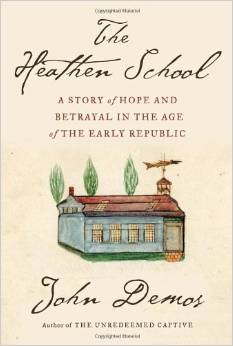
The Heathen School: A Story of Hope and Betrayal in the Age of the Early Republic
John Demos

Great failure is often more enduring than we realize. Before the downward spiral, the effort seems to cast the future in its image. It captures a moment and then goes uncommemorated. Yet it does not go away. It is as if the hopes it once contained continue to smolder.

The Paris Commune, the revolutionary socialist government that ruled the French capital in the spring of 1871, was such a failure: virtually erased from the public memory of modern Paris, but an inspiration to generations of socialists before the Russian Revolution and a corresponding source of fear for their opponents. Another such failure was the Foreign Mission School of Cornwall, Connecticut, the subject of John Demos’s new book, The Heathen School, freshly longlisted for the 2014 National Book Award.

The comparison, I concede, seems grandiose. The Commune left thousands, possibly tens of thousands, dead and large swaths of Paris in ruins. The Foreign Mission School destroyed only itself, leaving disillusioned graduates and an embittered and divided local community that threatened, but never executed, violence. It did its damage at a distance.

What unites the Commune with the Foreign Mission School is the bright and defining hope each originally contained and the disappointment each eventually produced. The Commune was a moment when France seemed to augur a new day; the school embodied equivalent optimism for the United States. Cornwall was a visible world of farms, forests, and villages but also an invisible world where God and Satan contested. God’s victory would be America’s gift to posterity.

The Heathen School, as it was called in everyday speech, became an American exercise in revolutionary uplift designed to transform the vast non-Christian world into something that looked like Connecticut. Instead of sending missionaries to the heathen, the school brought the heathen to the missionaries. The school would transform young men into Christians able to become missionaries or to assist them. It was part of an American project to spread republicanism and Protestant Christianity—for Americans regarded the two as inextricably linked—across the globe.

indexDemos possesses an uncanny ability to see the reflection of a much larger world in the towns of colonial New England and the early republic. In The Heathen School, what Demos discerns is American exceptionalism: the proposition that the United States is a chosen nation whose history diverges from all others and whose destiny will determine the fate of the world. It is an idea still embraced by most American politicians (even when they are smart enough not to believe it) and loathed by most American historians.

Extravagant ideas can alight on modest places. Cornwall is a small town in what was, during the early nineteenth century, the heartland of a New England evangelicalism determined to change the world. Some of the locals were articulate proponents of American exceptionalism and made it the rationale for the school. The United States was, according to Yale College President Timothy Dwight, the place where “Empire’s brightest throne shall rise.” Lyman Beecher of Connecticut—the father of Henry Ward Beecher and Harriet Beecher Stowe, who followed the reforming zeal of evangelicalism into abolition—already knew the answer when he asked, “From what nation shall the renovating power go forth?” There was less a fine line between American benevolence and American imperialism than no line at all.

It later became a cliché that Protestant missionaries to Hawaii, including those associated with the Heathen School, “came to do good and did well,” but the original enthusiasm for uplift was genuine. These were people who thought the millennium might be at hand. The American Board of Commissioners for Foreign Mission, sponsors of the Foreign Mission School, reversed the connections between expanding American trade and spreading the Gospel. “Natives of almost every heathen country” were being drawn from their homes by American commerce, the Board said. If not converted, they would bring the worst of American society back to their lands, corrupting their countrymen and prejudicing them against Christianity. The Foreign Mission School would take non-Christians drawn to the United States by commerce, or those who already lived within its boundaries, educate them, convert them, and send them home to transform their homelands.

The school was thus ancestral to a variety of American projects designed to make foreigners into instruments of conversion, people who would turn their countrymen into people like us. Our current rationale in training military officers and economists is not so different than that for training missionaries. As the sponsors of the Heathen School knew, the results could be disappointing. Frequently, they still are, unless you consider the likes of General Abdel Fattah el-Sisi and Mohamed Morsi, both partially educated on American shores, successful at creating New England in Egypt.

• • •

We tend not to look closely at the societies we expect to transform. We collapse them into largely undifferentiated lumps. This is true now as it was then. The very term Heathen School conveyed the American sense of a vast, indistinguishable mass of non-Christians. The students who came to the school were, however, disparate. Hawaiians dominated the first class, but it also included an Abenaki Indian, a Bengali, and a man named John Johnson, whose father was the child of an “English gentleman” and a “Hindoo woman” and whose mother was “a Jewess of the race of black Jews.” Later Tahitians came, as did at least one more Jew, a student from Timor, a Malay held as a slave in China, a Chinese, and two Greek boys from Malta. The students came from the four corners of the earth, but they were heathens one and all.

Demos breaks the undifferentiated mass into particular people. He concentrates on a small set of individuals—Henry Obookiah, who was Hawaiian, John Ridge and Elias Boudinot, both of whom were Cherokees from Georgia, and Sarah Bird Northrup and Harriet Gold, who were from Cornwall. The desire for salvation ran together with more earthly ones. The result is a book as much about psychology as theology and as much about intimacy as commerce.

In Demos’s books people who think they control events find themselves shaken by those supposedly under their influence. But the Hawaiian Henry Obookiah, who both in a sense created the Heathen School and was its chief product, was not the challenge that brought the imperial dream down.

Events far from New England uprooted Obookiah and deposited him in Connecticut. The internal wars that yielded the kingdom of Hawaii orphaned Obookiah, and the China and Pacific trade, of which the Hawaiian Islands were an integral part, set him in motion. He became a Kanaka, an expatriate Hawaiian sailor, who made his way to New England and arrived at Yale in search of an education. In Demos’s interpretation he was in search of family; he thought he found it in Connecticut.

Obookiah underwent a classic Protestant conversion experience and came “home to New Jerusalem,” entering the church on April 9, 1815. It was Obookiah who formulated a plan to return to Hawaii “to preach the Gospel to my Countrymen” in their own language. He became the most celebrated of the group of Hawaiians who formed the nucleus of the Foreign Mission School’s first class. It was, the American Board believed, the hand of providence that brought Obookiah to Connecticut. The founders felt “confident that this thing is from God . . . [and] will, among others, be a means of evangelizing the world.” Obookiah did seem to be the real thing. He invented orthography for writing Hawaiian, learned Hebrew, and grew famous, which proved useful for raising money and advancing the cause.

Obookiah died of typhus in 1818, one of those fortunate deaths that frees a person from responsibility for failures to come. As was the custom, his deathbed scene was fully described and his words recorded. Lyman Beecher preached his eulogy. His ghostwritten Memoirs would go through “about a dozen editions,” according to Demos. His goals, though, were largely unfulfilled. In Hawaii the missionaries, accompanied by several of the graduates of the Foreign Mission School, made converts, but the students were by and large a disappointment. In time the Americans took over the islands, enriched themselves, and largely dispossessed the inhabitants, who dwindled in numbers.

When Obookiah died the Hawaiian missionaries had not yet departed, nor had John Ridge, Elias Boudinot, and the other Cherokee students arrived at the Heathen School. After 1818 American Indians would dominate the student body. There was tension between the Indians and the Pacific Islanders; there were issues with truancy, discipline, and uneven academic achievement. But most troubling were relationships between the Cornwall girls and the scholars, or, as officials put it, “the colored boys.”

The desire to save the Indians, and a long history of sexual relations between Indian women and white men, did not prepare Cornwall for consensual sexual relations—in or out of marriage—between its white women and the school’s Indian men. To many readers, this will not come as a surprise, but the history of interracial sex is far more complicated than most Americans believe, and even more complicated than Demos makes it here. In the nation’s first days, it was fairly common and, if not fully accepted in all configurations, not routinely condemned or punished. But as the nineteenth century went on, prejudices against what became known as miscegenation intensified and hardened. The end of slavery—and with it the guaranteed subordination of black men and the coerced availability of black women—alongside worries about inheritance and property transmission and changing ideas about race all made interracial sex less tolerated than it had been earlier in American history. In Cornwall signs of this resistance appeared early.

John Ridge was from a leading Cherokee family and had already been to mission schools within the Cherokee Nation before he came to Cornwall in 1818. His romance with Sarah Northrup would have been utterly conventional had he not been Cherokee and she not been white. He was sick and entered the Northrup home. Sarah and her mother nursed him. He fell in love with Sarah and she with him.

The family sought to disrupt the romance by sending Sarah to her grandparents. The American Board decided it was time for John to return home, but neither distance nor time stilled their passion for each other—a passion that disturbed the social order. John Ridge published a denunciation of racial prejudice that allowed the “most stupid and illiterate white man” to disdain the most polished Indian. With Sarah’s devotion to John remaining strong, and her parents fearful that she would waste away longing for him and become vulnerable to consumption, Sarah’s family agreed to the marriage. It took place in January 1824, after John returned to Cornwall. Although some defended the marriage, much of Cornwall was outraged, and threats of violence accompanied the denunciations. John and Sarah moved to New Echota in the Cherokee Nation.

The marriage of John Ridge’s cousin Elias Boudinot to Harriet Gold bred even greater resentment and brought public demonstrations of disapproval. Harriet’s brothers and sisters and their spouses bitterly opposed the marriage. One of her brothers-in-law, the Reverend Cornelius Everest, wrote, “We weep; we sigh; our feelings are indescribable. Ah, it all is to be summed up in this—our sister loves an Indian! Shame on such love.” A minister from a neighboring town married Elias and Harriet in March of 1826 because the local minister refused to do so. They, too, would depart for the Cherokee Nation.

The school defended racial equality in the abstract, but not the actual fact of the marriages. Its evangelical supporters would not accept intermarriage, and the Ridge-Northrup wedding appears to have precipitated a decline in contributions. The founders had lost faith in their scholars, the last of whom would leave in 1828. Most of the graduates were disappointments to their teachers.

• • •

With the Boudinot-Gold marriage, Demos’s attention shifts to Cherokee country, and he signals the shift with what he calls an interlude. Demos narrates his own journeys paralleling those of his characters. He traveled to Hawaii to find Obookiah’s birthplace. And nearly two centuries after the Ridges and Boudinots settled in New Echota, Demos went for a visit.

We cannot time travel. A stop in Cornwall, or New Echota, or Obookiah’s birthplace leaves the visitor firmly in the present. But the past often lingers; its evidence endures. There are original buildings in Cornwall, fewer in New Echota. And at these sites stories and storytellers meet. Right here, in this house, this happened; here, these people once lived.

The historian’s next step is at once problematic and wondrous. Demos takes it. “In my mind’s eye I can glimpse the scholars passing in and out,” he writes of his visit to Cornwall. Being there “lessened the distance between my own world and that of the school.” Similarly in Georgia he muses that, for Harriet Gold, New Echota was a blank space to be filled in by experience. “So too, in my own case: an equally blank space. Until I have a chance to go there.” He travels to encounter traces of the past that remain visible.

That past was a Cherokee past, and what happened to the Cherokees in the 1820s and 1830s was a disgrace to the United States, but it was not a simple story, and Demos does not try to suggest otherwise. The Cherokee story shadowed, he writes, “on a vastly grander scale, that of the Foreign Mission School—high hopes, valiant efforts, leading to eventual tragic defeat.”

The same sense of mission and providential destiny that created the mission school ultimately did in the Cherokees. This is not to say the American Board destroyed them; many of their missionaries remained ardent supporters of the Cherokees’ attempt to retain their homeland. But the very sense of Christian superiority and providential favor for the United States embedded in the school also inspired those who sought to dispossess the Cherokees. Indians recognized this, and tried to counter it. They sought to separate American providential thinking into its secular and religious strains and pit them against each other. Indians hoped Christians would not evict Christians. They would, and they did.

Both Ridge and Boudinot had reason to doubt the value of the American Board as an ally, and neither thought that the United States would honor existing treaties. Seeing resistance as hopeless, they joined the Treaty Party, which ceded the Cherokees’ homeland to the United States. The Treaty Party had no authority, and the vast majority of Cherokees who followed Head Chief John Ross opposed them and their treaty, which was ratified, if only barely, by the Senate. In what Demos rightly describes as ethnic cleansing, the Cherokees and their neighbors lost their land, and many lost their lives in government roundups and a forced march west. For enabling this dispossession and dislocation, Ridge and Boudinot would pay with their lives when the surviving Cherokees reached Indian Territory.

The removal of the Cherokees would seem to make the tale of the Heathen School a familiar American story in which race takes the center stage. Racial prejudice sought to thwart the marriages of the Ridges and Boudinots and ultimately did in the school itself. Racial prejudice launched the Cherokees on the Trail of Tears. But if race in the United States is a familiar topic, it is also a complicated one, and Demos shows its complications. His great strength as a historian is his ability to move effortlessly from the personal to the national, and when he does so here, a story about heathens and “colored boys” expands to include black slaves.

Many members of the Cherokee elite were slaveholders, and when Sarah Ridge, née Northrup, moved to Georgia, she mutated from a Yankee to a plantation mistress. She was in the eyes of both Cherokees and black slaves a “white lady,” the very status that brought so much trouble in Cornwall. With her husband’s assassination, Sarah was described as having “a dead heart in a living bosom.” Her Cherokee relatives sought to strip her and her children of their inheritance since she was “a white lady and had no clan.” She lived by hiring out her slaves. Her sons grew up quarrelsome and violent. They, along with a sizeable number of anti-Ross Cherokees, stood with the Confederacy, as did, although Demos does not mention it, Boudinot’s son, Elias Cornelius.

Lyman Beecher’s descendants became abolitionists, but the descendants of the leading Cherokee graduates of the Heathen School joined the Confederacy in defense of human slavery. Two of them, John Rollins Ridge and Elias Cornelius Boudinot, eventually fled the Cherokee Nation under threat of death and ended up alienated from both their New England and Cherokee roots. The failures of the Heathen School had only ramified.

Demos draws a parallel between Cornwall’s opposition to interracial marriage in the nineteenth century and the illegality of same-sex marriage in the twenty-first. His intent, I think, is something more than to compare inequities, particularly since, with same-sex marriage now legal in Connecticut, the analogy might produce comforting feelings of growing tolerance. Demos is too good a historian to think the past will be much of a comfort to us. He has crafted the book otherwise. His heroes, Sara and John Ridge, do not become villains, but they are more than simply victims of racism. Similarly the Cherokees and Hawaiians were betrayed and despoiled, but they were not innocents.

Demos’s analogies have a deeper target: the American sense of being a beacon to the world, its last best hope. This only leads us astray. We want to shape the world without the world touching us and revealing our own limits and prejudices, but more than that we insist on foreigners being unrealized versions of ourselves. We educate the Sisis and Morsis thinking they will become agents of our desires and in so doing forget that they, like the students at the Heathen School, were never ours to shape.

Richard White, Margaret Byrne Professor of American History at Stanford University, is author, most recently, of Railroaded: The Transcontinentals and the Making of Modern America.

Read Full Post »

Mark MazzettiThe Way of the Knife: The CIA, a Secret Army, and a War at the Ends of the Earth

by Mark Lauchs 

New Books in Foreign Policy  August 8, 2014

Mark Mazzetti

Mark Mazzetti

[Cross-posted from New Books in Terrorism and Organized Crime] There are many movies 517SbF-1VcL._SL160_about evil CIA agents assassinating supposed enemies of the US. Those who saw the latest Captain America movie will have witnessed the plan by Hydra (a fascist faction within a secret agency presumably within the CIA) build floating gunships that can identify and eliminate those who pose a threat to national security. We are not there yet, but Mark Mazzetti‘s book The Way of the Knife: The CIA, a Secret Army, and a War at the Ends of the Earth (Penguin, 2013)  should give us some anxiety about the current technology used for “extra-judicial killings”. Mazzetti gives us the history of the drone wars – a term hated by the Air Force who note that the drones are piloted aircraft  albeit from a remote location – and their ability to be used for the elimination of… well, enemies of the US and its allies. Having said that, this is not a diatribe of opposition but a balanced and careful examination of history and political process. At the core of the book is a discussion of how the CIA and the US military are running parallel drone operations with different criteria and standards of care and success. Mazzetti’s book presents us with, what I found to be, a frightening insight into operations that are so common that they rarely rate a mention in the media. I highly recommend the book and suggest that anyone running a course on military ethics include it in their reading list. There is more than enough ethical controversy raised in the book to fill a semester of discussion.

Read Full Post »

Watergate’s most lasting sin: Gerald Ford, Richard Nixon, and the pardon that made us all cynics

Rick Perlstein

Salon.com   September 8, 2014

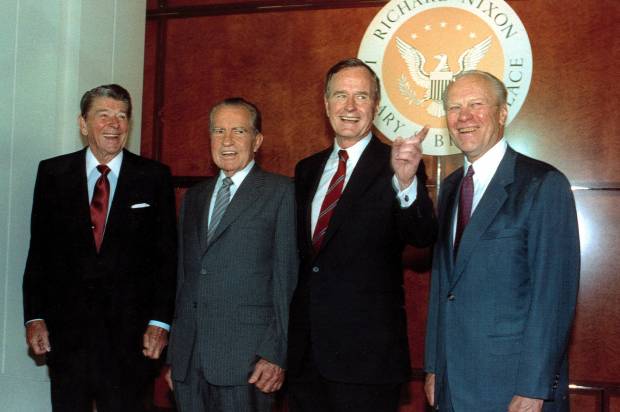
Ronald Reagan, left, Richard Nixon, and Gerald Ford, far right, pose with George Bush in the Richard Nixon Library and Birthplace in 1990. (AP Photo/Barry Thumma) (Credit: Associated Press)

Ronald Reagan, left, Richard Nixon, and Gerald Ford, far right, pose with George Bush in the Richard Nixon Library and Birthplace in 1990. (AP Photo/Barry Thumma) (Credit: Associated Press)

When you’ve published a book about Watergate, your phone rings off the hook in the days leading up to Aug. 9, 2014, the 40th anniversary of Richard Nixon’s resignation. But my phone’s been quiet this week — even though the event that took place almost exactly one month later, on Sept. 8, 1974, is the one that really changed the world. It’s still changing the world 40 years later.

Gerald Ford had announced upon acceding to the highest office in the land, “Our Constitution works; our great republic is a government of laws and not men. Here the people rule.” For the sentiment, he reaped a harvest of gratitude. The very existence of this new presidency, everyone said, proved that “the system worked.”

Then, four Sundays later, 11:05 a.m., when many Americans would have, like Ford, just returned from church — in the mood, he hoped, for mercy — Ford proceeded to read, then sign, a proclamation announcing that pursuant to Article II, Section 2 of the Constitution, he was granting “a full, free, and absolute pardon unto Richard Nixon for all offenses against the United States which he, Richard Nixon, committed or may have committed or taken part in during the period from January 20 through August 9, 1974.”

It was an enormously unpopular act. Ford’s approval rating declined from 71 to 49 percent, the most precipitous in history. This pardon was proof, the people said, that the system didn’t work — America was still crooked. Suspicions were widespread that it was the fruit of a dirty deal between Nixon and Ford: the presidency in exchange for the pardon. “The son of a bitch pardoned the son of a bitch,” was how Carl Bernstein broke the news Bob Woodward on the phone.

Since then, judgment on the pardon has reversed 180 degrees. First Woodward, then Bernstein, came to conclude there had been no deal, and that this was instead an extraordinarily noble act: Ford “realized intuitively that the country had to get beyond Nixon.” After Ford died in 2006, Peggy Noonan went even further. She said Ford “threw himself on a grenade to protect the country from shame.”

They’re wrong. For political elites took away a dangerous lesson from the Ford pardon — our true shame: All it takes is the incantation of magic words like “stability” and “confidence” and “consensus” in order to inure yourself from accountability for just about any malfeasance

In 1975 the Senate and House empaneled committees to investigate the CIA, FBI and, later, the NSA after it was discovered these agencies had operated unethically and illegally. The House committee, under Rep. Otis Pike, who died last year in obscurity, discovered not merely that the CIA was out of control, but that it was incompetent — for instance, predicting Mideast peace the week before the Yom Kippur War broke out. Frank Church’s Senate committee, meanwhile, proved the NSA was illegally gathering the telegraph traffic of American citizens, without even top executives of the telegraph companies being aware of it.

But, in the spirit of the Nixon pardon, the idea of holding elite institutions to reckoning had fallen out of favor. At the height of the intelligence investigations Washington Post’s publisher Katharine Graham complained of the media’s tendency to “see a conspiracy and cover-up in everything.” Sen. J. William Fulbright said “these are not the kind of truths we need most right now,” that the nation demanded “restored stability and confidence” instead. The CIA had no trouble promptly drumming up a disingenuous propaganda campaign that all but neutered reform. And, 39 years later, these institutions are still largely broken, and still almost entirely unaccountable.

Follow the thread a little more than a decade later. Ronald Reagan’s administration contravened law and its own solemn pledges by selling hundreds of thousands of missiles to Iran in an attempt to free hostages held in Lebanon. The president’s own diaries revealed that he approved the action; he lied about that in a press conference. The deal didn’t even work; Hezbollah just took more hostages. Then profits were diverted to the Nicaraguan Contras in direct violation of congressional statute. But instead of a Watergate-style Senate investigation (the one in 1973 heard witnesses live on TV for over five months and produced 26 volumes of reports), Iran-Contra was investigated by a panel convened by Reagan himself and led by a political ally, Sen. John Tower; at subsequent congressional hearings, deliberately limited in scope, the star witness, Oliver North, testifying under immunity, bragged of destroying thousands of pages of evidence.

Six administration officials, including former Defense Secretary Caspar Weinberger, were indicted by a special prosecutor. But one month before leaving office, President George H.W. Bush — who did not testify in congressional hearings about his own involvement in the affair as vice president, because the Democratic chairman, Sen. Daniel Inouye, wished to spare him embarrassment — pardoned them all.

Just like 40 years ago today, a longing for consensus over messy conflict, for elite comity instead of accountability, “stability and confidence” instead of justice, trumped all.

Meanwhile, the congressional minority report on Iran-Contra, drafted by then-Rep. Richard Cheney, all but rejected the very notion of congressional oversight over the executive branch — and Cheney, as George W. Bush’s vice president, literally took Iran-Contra as the subject for a “lessons learned” workshop on how to put such a foreign policy into practice.

Note, of course, that Cheney had once been top deputy in Gerald Ford’s White House. The Nixon pardon had to have been a lesson learned for him, too — future administrations would let the Bush administration get away with things like illegally spying on Americans, and starting a war on false pretenses, scot-free. And he was right: Following his 2008 election, President Obama announced “that we need to look forward as opposed to looking backward.”

Comity over accountability. Denialism instead of risking national “shame.” In 2001, the John F. Kennedy Library awarded Ford its Profile in Courage award for the pardon decision. But the idea that “too big to fail” institutions are too fragile to handle honest reckoning with the truth is not courage. It is civic cowardice. Better, much better, that we keep the faith: that our Constitution can work, that our great republic is a government of laws and not men, and that here, the people rule.

Rick Perlstein is the author of «The Invisible Bridge,» «Nixonland: The Rise of a President and the Fracturing of America» and «Before the Storm: Barry Goldwater and the Unmaking of the American Consensus»

Read Full Post »

H-Diplo-LOGO

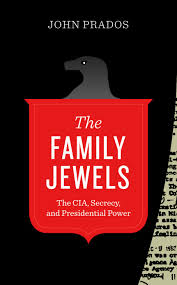
Comparto con mis lectores esta excelente reseña del más reciente libro del historiador estadounidense John Prados sobre el papel jugado por la CIA en la historia de Estados Unidos.

John Prados. The Family Jewels: The CIA, Secrecy, and Presidential Power. Austin: University of Texas Press, 2013.

Reviewed by Paul M. McGarr (University of Nottingham)
Published on H-Diplo (September, 2014)

PradosJohn Prados ends his latest book on the Central Intelligence Agency (CIA) with a call to action. In The Family Jewels: The CIA, Secrecy, and Presidential Power, Prados argues that the intelligence system in the United States is broken. Setting out a case for intelligence reform, this prominent commentator on the secret world declares that “There is much work to be done by presidents, legislators, officials and citizens. The time to start is now” (p. 333). From its inception in the late 1940s, Prados suggests, the CIA’s interrelationship with its executive patron in the White House has served the American people poorly. In short, the CIA is presented as a dysfunctional intelligence organization, tainted by habitual abuses of power, recurrent illegality, and an inveterate obsession with concealing, when not willfully misrepresenting, the less savory aspects of its institutional history. The extent to which intelligence agencies can, and should, be held publicly accountable for their actions within the framework of a democratic society forms the leitmotif of this account of the CIA and its “Family Jewels,” or most controversial intelligence operations.

Prados’s particular reading of the CIA and its operational history is unsurprising given his background as a leading advocate of government transparency and position as a senior fellow of the Washington DC-based National Security Archive, which for decades has been at the forefront of efforts to liberalize the disclosure of classified state records. Few scholars of intelligence, or indeed wider American foreign policy, will find much in the way of new evidence in this book. To a large extent Prados offers up a comprehensive and expertly crafted, if by now familiar synthesis, of the most controversial covert operations mounted by the CIA during the second half of the twentieth century and, more recently, in the context of an ongoing global war on terror. Prados provides detailed and engaging accounts of the original Family Jewels revelations, which were first aired in the New York Times in late 1974; the subsequent Year of Intelligence in 1975; the CIA’s involvement in political surveillance on American soil; and agency complicity in eavesdropping, extrajudicial detention, and assassination plots; all cover well worn historical ground.[1] Likewise, Prados’s examinations of the efforts undertaken by Langley to control the CIA’s public image and manipulate official and unofficial documentary representations of agency history have recently attracted scholarly attention.[2]

The value of this latest in a long and seemingly endless line of polemics focused on the CIA, resides in the questions that it poses to contemporary American policymakers and their broader political constituencies. Prados meticulously catalogues and forensically interrogates evidence that suggests the CIA has long played fast and loose with its own charter and the U.S. Constitution in support of White House policy. Moreover, the U.S. intelligence communities “tendency to replicate” legally and ethically questionable activities in pursuit of executive directives has, in Prados’s eyes, proved singularly counterproductive and is indicative of the “disturbing” possibility “that abuse fulfills some functional purpose” (p. 322).

Supporters of the Agency will undoubtedly take exception to the stridency with which Prados condemns the CIA’s institutional culture and operational performance. To be sure, mundane yet successful intelligence operations, for obvious reasons, tend to remain hidden from public view and, in any case, generate fewer media headlines and much less controversy than more spectacular “failures.” Indeed, a central plank of Prados’s thesis is that manifestations of “abuse” within the intelligence environment “fester” in the dark shadows of excessive and unwarranted secrecy (p. 323). Equally, rightly or wrongly, the agency has invariably been forced to assume the role of public fall guy whenever a capricious president encounters political difficulties as a consequence of intelligence “blowback.” In fact, to his credit, Prados is careful to emphasize the long-standing and pivotal role played by senior government officials outside the agency, including Henry Kissinger, Dick Cheney, and Donald Rumsfeld, in exerting pressure on the CIA to launch controversial and action-orientated operations. Most notably, Dick Cheney is castigated as “the leading ringmaster” behind a litany of intelligence impropriety stretching back over thirty years, originating in efforts to hamstring the Rockefeller Commission on intelligence in the mid-1970s, and continuing through post-9/11 furors involving extraordinary rendition, enhanced interrogation, and NSA eavesdropping (p. 323). Democrat politicians come in for similar censure. In electing not to pursue Bush administration officials and CIA officers for acts of allegedly illegality, yet prosecuting CIA whistleblowers, such as John Kiriakou, and expanding the use of drone strikes across Africa, the Middle East, and South Asia, Barak Obama has perpetuated “actions [that] have damaged America’s real interests” (p. 326).

ciaThe book makes its biggest impact by deftly weaving a litany of historic intelligence abuses into the narrative of contemporary debates surrounding tensions between the preservation of national security on the one hand, and the maintenance on civil liberties and individual freedoms on the other. Prados constructs a strong case for interpreting Family Jewel abuses not as unfortunate historical glitches, but instead as components in an endemic pattern of executive misconduct, the roots of which stretch back to the formation of the postwar national security state. In this sense, perhaps a common thread can be discerned, as Prados claims, between the imprisonment and maltreatment of Yuri Nosenko, a KGB defector to United States in the 1960s, and the secret prisons, extraordinary renditions, enhanced interrogation practices employed by the CIA after 2001. The National Security Agency (NSA) communication interception programs recently revealed by Edward Snowden could be seen to have antecedents in CIA and NSA surveillance operations mounted inside the United States during the 1950s and 1960s, such as CHAOS, SHAMROCK and MINARET. The current deployment of drones armed with Hellfire missiles in Afghanistan, Pakistan, Somalia, and Yemen to target foreign nationals deemed threats to the United States, contain faint echoes of earlier assassination plots hatched against Fidel Castro, Patrice Lumumba, and Rafael Trujillo. For sure, as Prados is at pains to point out, “the issue of abuse in intelligence activities” has hardly receded since the 1970s (p. 3). In fact, it has mushroomed in the aftermath of 9/11.

Prados argues that this abuse thrives amid secrecy and, in turn, corrodes public trust and confidence in the important work performed by intelligence agencies. Prados’s antidote to the malaise afflicting America’s intelligence community is a large dose of transparency. Noting that “over the years Langley has worked very hard to cloak its daggers” (p. 190), Prados reopens the long-standing debate about how open and accountable intelligence agencies can be in a liberal democracy while, at the same time, safeguarding the anonymity of sources and methods and preserving operational effectiveness. Unsurprisingly, perhaps, Prados’s answer is, quite a lot more open than at present. Indeed, Prados insists that disclosure of questionable intelligence practices is not the problem. Investigate journalists from Seymour Hersh, the reporter responsible for uncovering the original Family Jewels, to Dana Priest, the Washington Poststaffer who broke the post-9/11 “Top Secret America” story, are lauded for performing a valuable public service. However, continued vigilance on the part of the Fourth Estate, Prados concludes, can only be of limited utility in holding governments and intelligence services to account. Press exposes and the disclosures of whistle-blowers from Philip Agee to Edward Snowden, have, after all, failed to stem a recurring pattern of intelligence scandals. The voting public and political classes have notably short memories. In Prados’s estimation, the historical pattern of questionable practices and the efforts to evade accountability exhibited by America’s spymasters are suggestive of an urgent need to reform the current system of intelligence oversight.

Lambasting existing regulatory mechanisms as not fit for the purpose, Prados bemoans that congressional committees tasked with scrutinizing the CIA’s work rely heavily on agency disclosure, are understaffed, and are subject to powerful political and legal pressures. In their place, Prados proposes an oversight system centered upon regular public reviews of intelligence agencies. Such a radical prescription for reform raises a number questions. Is a public role in intelligence oversight practical? How would the security implications inherent in such a system be overcome? Would public intelligence hearings turn into media circuses reminiscent of the Church and Pike Committee enquiries of the mid-1970s, or the Iran-Contra inquests a decade later? Would, in short, such a system of oversight generate more heat than light?

John Prados has produced an expertly crafted and thought-provoking account of the faultiness between the United States’s intelligence community and its clients in the White House. He makes a strong case for intelligence reform. Prados’s prescriptions for change, however, are less persuasive. Ultimately, it is by challenging the American public to engage more meaningfully with complex and contentious debates within the intelligence sphere that encompass issues of ethics, civil liberties, and national security, that Prados’ book promises to make its greatest mark.

Notes

[1]. Some of the best accounts that address CIA covert action include Roy Godson, Dirty Tricks or Trump Cards: US Covert Action and Counterintelligence(Washington, DC: Brassey’s, 1996); Gregory Treverton, Covert Action: The Limits of Intervention in the Postwar World (New York: Basic Books, 1987); and John Prados, Safe for Democracy: The Secret Wars of the CIA (Chicago: Ivan R. Dee, 2006).

[2]. See, Paul McGarr and Matthew Jones, “‘Real Substance, Not Just Symbolism’? The CIA and the Representation of Covert Operations in the Foreign Relations of the United States Series,” in Intelligence Studies in Britain and the US: Historiography since 1945, ed. Christopher R. Moran and Christopher J. Murphy (Edinburgh: Edinburgh University Press, 2013), 65-89; and Christopher R. Moran, ‘The Last Assignment: David Atlee Phillips and the Birth of CIA Public Relations,” International History Review 35, no. 2 (2013): 337-355.

Printable Version: http://www.h-net.org/reviews/showpdf.php?id=41209

Citation: Paul M. McGarr. Review of Prados, John, The Family Jewels: The CIA, Secrecy, and Presidential Power. H-Diplo, H-Net Reviews. September, 2014.
URL: http://www.h-net.org/reviews/showrev.php?id=41209

Read Full Post »

« Newer Posts - Older Posts »