Feeds:
Entradas
Comentarios

Archive for 2014

A Civil War Myth That Hurts Us All

Ira Chernus

HNN  May 25, 2014
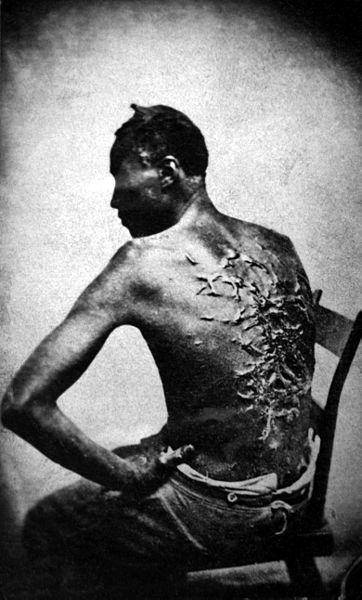
153357-362px-Cicatrices_de_flagellation_sur_un_esclaveWhy are so many Americans woefully ignorant of their nation’s history? That perennial question is raised yet again by Timothy Egan in his latest column on the New York Times website.

To prove that the problem is real, Egan cites two pieces of evidence. The first one surely is cause for concern: «a 2010 report that only 12 percent of students in their last year of high school had a firm grasp of our nation’s history» (though historians will surely wish that Egan had added a link to the report, so we could track down the source).

Egan’s second piece of evidence suggests that he may be a participant in as well as observer of the problem. «Add to that,» he writes, «a 2011 Pew study showing that nearly half of Americans think the main cause of the Civil War was a dispute over federal authority — not slavery — and you’ve got a serious national memory hole.»

I’m no expert on the Civil War, but I’ve read a number of recent books by historians who are. They all agree that in 1861, when thousands of Northerners eagerly enlisted, few were  signing up to fight for the abolition of slavery. They were signing up to do the one and only thing Abraham Lincoln called them to do: to save the Union, which is to say to affirm federal authority over all the states.

True, the dispute over federal authority was sparked by the problem of slavery. Most Northerners were determined to stop slavery — but only in the territories of the West, where they feared slaves would block work opportunities for free whites. Hence the popular slogan: «Free Soil, Free Labor, Free [White] Men.»

When it came to the existing slave states, most Northerners agreed with Lincoln that there was no legal ground to abolish slavery. Most expert historians suggest that there was still not enough political will in the North to try to abolish slavery.

So from the North’s point of view, at least, federal authority was indeed the fundamental issue.

Only gradually, as the war progressed, did many Northerners come to see it as a war against slavery. Many others never reached that point, as Steven Spielberg’s recent film Lincoln reminded us. Even among those who did get there, most probably embraced abolition largely as both a symbol of and strategic means to victory in the war, not as a good in and of itself.

In the South issues of slavery and federal authority certainly were inextricably entwined. «Slavery was enshrined into the very first article of the Confederate Constitution; it was the casus belli, and the founding construct of the rebel republic,» as Egan writes. That’s a good snapshot of the issue from the Southerners’ perspective.

But it’s the winners who are supposed to write the history of any war. For a Northerner to cite the Confederate Constitution as the full explanation for the war is questionable, at best.

So let’s thank Timothy Egan for adding a bit more proof that even «opinion leaders,» as he writes (as well as «corporate titans, politicians, media personalities and educators») are sunk, more or less, in that national memory hole. At least their knowledge of history usually has some serious holes in it.

And I should personally thank Egan for reinforcing a point that’s dear to me: When we recall our history, and especially when we bring that memory into the political arena, we are more often in the realm of myth than empirical fact — though most of our political and historical myths aren’t simply falsehoods; they include facts, but those facts are always wrapped in imaginative, symbolic narratives that dictate how we interpret the facts.

The story of the Civil War as essentially a war against slavery — with all other issues secondary — is a fine example. It’s a story so deeply rooted in American public memory, at least outside the white South, that it will probably never be dislodged, no matter how many historians write how many books. Such is the power of myth.

When Egan wanted to understand why Americans have such a weak grasp of their history, though, he didn’t look into the power of myth. Instead he «asked a couple of the nation’s premier time travelers, the filmmaker Ken Burns and his frequent writing partner Dayton Duncan.»

Burns said: «It’s because many schools no longer stress ‘civics,’ or some variation of it,» so students don’t learn «how government is constructed» — a curiously irrelevant response from someone who has enriched our understanding of so many aspects of our history.

Duncan did offer a direct and provocative, if speculative, answer: «Americans tend to be ‘ahistorical’ — that is, we choose to forget the context of our past, perhaps as a way for a fractious nation of immigrants to get along.»

That’s where Egan adds his comment on the South’s Constitution and slavery as the casus belli, as if to prove the point by example. «That history may hurt,» he explains, implying that North and South can get along easier if we ignore the hurts of their fractious past. «But without proper understanding of it, you can’t understand contemporary American life and politics.»

No arguing with that conclusion. Coming on the heels of Egan’s (mis)reading of the causes of the Civil War, though, it points to a more complex view of the American memory hole.

Why do most Americans outside the white South embrace the mythic view of the Civil War as a battle essentially over slavery, from beginning to end? Isn’t it because «history may hurt» — because it would, and should, pain us to recall how deeply racist most Northern whites were in 1861, and how many were willing to let slavery continue in the existing slave states?

If we believe the story of the North in 1861 as a monolithic block dedicated to eradicating slavery, it eases the hurt. It lets us believe that white America, outside the South, has a proud history of sacrificing blood and treasure for the cause of racial equality. It makes the rapid end of Reconstruction, the white Northerner apathy toward Jim Crow laws in the South until the 1960s, and white racism in the North until the present day all look like aberrations in a fundamentally moral history.

So we can more easily forget that, as Ta-Nehisi Coates reminds us, «America was built on the preferential treatment of white people — 395 years of it.» He rightly laments «our inability to face up to the particular history of white-imposed black disadvantage,» an unbroken history that continues to the present day in wealth, jobs, housing, education, incarceration, voting, and so many other areas of life.

If our ultimate goal is, as Egan suggests, to understand contemporary life and politics, the prevailing myth of the Civil War as a crusade for freedom and equality is counterproductive.

That doesn’t mean we should aim to replace myth with pure objective fact — a noble but impossible dream. It does mean we need a myth of the Civil War that comes closer to the facts and helps to close the still-yawning gap between black and white America. We need a myth that makes sense out of all kinds of racism and racial disparities in the present, not one that obscures them.

Such a myth would probably open up more white hurt, at least for a while. But it’s the only way we might possibly, some day, heed Lincoln’s call to bind up the nation’s wounds.
 

Read Full Post »

Reminding People of a Lynching Was What Bothered Them? 

HNN  May 30, 2014


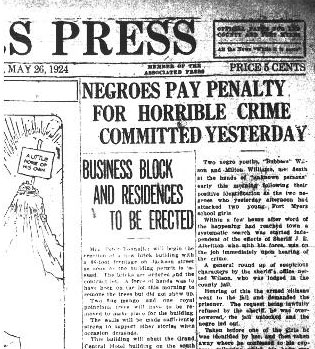
155743-LynchingArticleI recently contributed to items in the local press (see here) and on radio (see here) concerning the ninetieth anniversary of a particularly gruesome lynching that took place in Fort Myers, Florida, over the weekend of May 25-26, 1924. Predictably, some local respondents were not happy that this anniversary was being publicized. One disgruntled reader complained, «Just can’t allow racism to fade away can you News Press? Instead of a piece relating how people of different races help each other because of their selfless goodwill (past or present), you all instead choose to keep alive a 90 year old evil doing by long since dead racist murderers.» In this article I will demonstrate why such reactions are mistaken and why these events should continue to be analyzed and explored in public media.

The first reason to keep highlighting this history is that lynching arose from racist stereotyping, a menace that continues in the present day. In Fort Myers in 1924, two black teenagers, aged just 16 and 14 were seen skinny-dipping with two white female friends. The two boys were assumed to be guilty of rape. In an article published by Steve Dougherty in the Fort Myers News-Press in 1976, an eyewitness stated that one of the girls protested that the two boys were innocent of any wrong-doing, yet the boys were still lynched. The racist beliefs of the whites overwhelmed their willingness to view the evidence impartially. This has clear parallels with criminal justice today, where juries can be influenced by the fact that young black males continue to be depicted in some media as criminal and sexually aggressive, instead of being treated as individuals.

The second reason is that the historical record on lynching is incomplete and in need of correction. Although the NAACP did awesome work to keep records of lynchings, it often had to rely on newspaper reports that presented the events from the point of view of the lynchers. In Fort Myers, for example, the motive of the lynchers was recorded as being to punish sexual assault (rape), yet this assault existed only in the eyes of the beholders. No evidence was presented to establish that the lynching victims had committed the alleged crime. The name of one of the victims was repeatedly given as Bubbers Wilson, when infact the death records clearly show that his name was RJ Johnson, a fact that the black community knew very well.

Failure to verify such facts at the time shows the local contempt of authorities for justice and accurate reporting. These violations of the historical record should be corrected; it is surely our duty as scholars to attend to this.

A third reason to focus on such lynchings is to ask our students and readers to walk a mile in the shoes of African-Americans of both historical periods. A white student of today who places himself or herself in the mind of a black male from 1924 can better understand how a young black male must continue to have two «looking glass selves»: a self that is reflected back to him by his fellow blacks, and one that is reflected back to him by a white viewpoint of suspicion and prejudice. Trayvon Martin spent his short life looking into these mirrors, which played a role in his death. Perhaps the student of today will be the juror of tomorrow, and the justice system is more likely to be seen to be doing its job correctly: treating all persons equally before the law, regardless of gender or skin color?

Jonathan Harrison is an adjunct Professor in Sociology at Florida Gulf Coast University and Hodges University whose PhD was in the field of racism and antisemitism.

Read Full Post »

“How Immigration Became Illegal”: Aviva Chomsky on U.S. Exploitation of Migrant Workers

Democracy Now  May 30, 2014

We are joined by Aviva Chomsky, whose new book, «Undocumented: How Immigration Became Illegal” details how systemic prejudice against Mexicans and many other migrant workers has been woven into U.S. immigration policies that deny them the same path to citizenship that have long been granted to European immigrants. She also draws parallels between the immigration laws now in place that criminalize migrants, and the caste system that has oppressed African Americans, as described by Prof. Michelle Alexander in her book, «The New Jim Crow.» Chomsky’s previous book on this topic is «They Take Our Jobs! and 20 Other Myths about Immigration.» She is a professor of history and coordinator of Latin American studies at Salem State University in Massachusetts.

Transcript

This is a rush transcript. Copy may not be in its final form.

JUAN GONZÁLEZ: We turn now to a new book that documents how systemic prejudice against Mexicans and many other migrant workers has been woven into U.S. immigration policies that deny them the same path to citizenship that has long been granted to European immigrants. The book is by Aviva Chomsky, and it’s called, «Undocumented: How Immigration Became Illegal.»

AMY GOODMAN: Chomsky’s previous book on this topic is, «‘They Take Our Jobs!’ and 20 Other Myths About Immigration.» She is Professor of History and Coordinator of Latin American Studies at Salem State University in Massachusetts. In case you’re wondering, yes, she’s the eldest daughter of Professor Noam Chomsky. She is joining us from Boston. Professor Chomsky, welcome to Democracy Now! Talk about this history that is not very well understood, I think, in this country.

AVIVA CHOMSKY: Right, I agree that it is not very well understood. We often hear people saying this is a country of immigrants, as if that explains something. But, I think when we say this is a country of immigrants, we are actually hiding as much as we are explaining. OK, let me try to explain that. So this is a country of immigrants. People have in mind Ellis Island, they have in mind the European immigrants, they have in mind the people who, under U.S. law have been considered immigrants since really the founding of the country. We need to think about how immigration and citizenship work together. That is those who the law has considered immigrants are those who were considered to be potential citizens.

Now, citizenship law in the U.S. restricted citizenship to white people until the Civil War. After the Civil War, citizenship was restricted to white people and people of African descent. So those who were immigrants, so prior to the Civil War, many people who were not white were brought into the country, were physically present in the country, came into the country on their own, were conquered and incorporated into the country, but they could not be citizens. And they were not considered immigrants when they entered the country. The only ones who were were considered immigrants were the Europeans. After the Civil War, not only is citizenship extended to people of African descent, none of whom are immigrating to the United States of coming to the United States in the aftermath of centuries of slavery and, finally, the war and abolition of slavery, but other people, for example, the Chinese, who are coming into the country, are still not eligible for citizenship. In fact, they’re legally defined as racially ineligible to citizenship.

And what really makes things complicated for immigration law is when citizenship by birth is created with the 14th amendment in 1868, also in the aftermath of the Civil War, because it creates this sort of logical impossibility that people who have been declared racially ineligible for citizenship, people who were not considered immigrants even when they come to the country, they’re considered workers but not immigrants, that they can then obtain access to citizenship by birth. It is this logical impossibility of people who are legally defined as racially ineligible to citizenship and then because of being physically present, able to obtain immigrant citizenship by birth, that leads Congress to start setting up restrictions on immigration. And restrictions against people who are considered to be racially ineligible to citizenship, that is the Chinese and eventually all Asians, and Asia is very broadly defined under this law.

JUAN GONZÁLEZ: Aviva Chomsky, I wanted to ask you, in your introduction, you refer to a phrase that I’ve heard often from readers and callers, usually angry readers and callers to me at the Daily News, when they say, Mr. Gonzalez, what part of illegal don’t you understand? You raise the point that the concept of the illegality in terms of immigration is actually a relatively new term in American history, and it’s also been changed over time. And it’s use has become — has always been racialized. Could you talk about that?

AVIVA CHOMSKY: Yes, absolutely. I think it is part of the same system I was describing before that restricted immigration to white people and citizenship to white people and then started to cut off immigration. But as immigration started to be restricted for groups, including Asians and eventually even for Europeans who were considered to be inferior Europeans, like southern and eastern Europeans in the 1920s, Mexican border crossing was never restricted. Mexican border crossing was never restricted because Mexican labor was so utterly necessary in the southwest of the United States and because Mexicans were not considered immigrants, so therefore, their immigration did not have to be restricted. They were considered to be workers, legally discriminated against for what were considered racial grounds, that is they were so-called «Mexican.» That was perfectly legal. To deprive them of citizenship was perfectly legal. And, the system worked from the perspective of maintaining United States is a white country because unlike the Asians, Mexican migration was generally circular migration. That is, Mexicans came, worked for a season or year or a couple of years, and returned to Mexico. So the history of border migrations for 150 years was one of circular migrations that were basically either completely unregulated or, for example during 1942 and 1964, extended through 1967, government-sponsored through the Bracero program, but migrations that denied citizenship and denied rights to the Mexicans who were in the country.

So the creation of illegality and starting to call this migration illegal happens in 1965, really, when Mexican migration is, for the first time, considered to be immigration and is legally restricted, that is, a quota is put on Mexican migration as it is on every country of the world. And in a situation where tens of thousands of Mexicans have been crossing the border legally and recruited and sometimes even coerced, every year, all of a sudden, this is made illegal. It is not stopped, but it is given a different name. Instead of calling it the Bracero program, it is called illegal migration. It is still just as necessary to the economy of the Southwest, it’s still encouraged by all different sectors, but the discrimination against these workers is now justified by this introduction of this new terminology and status of the illegality. I hope I explained that, it’s a little complicated.

JUAN GONZÁLEZ: And your point is that once this new illegality for Mexican immigration begins post-1965, that then begins the criminalization of Mexicans as migrants. And you draw the parallel in your book with Michelle Alexander’s book on mass incarceration and how the racialization that occurs — and describes in her book, «The New Jim Crow: Mass Incarceration In the Age of Colorblindness.» This is Alexander speaking on Democracy Now!

MICHELLE ALEXANDER: I think we have become blind in this country to the ways in which we have managed to reinvent a caste-like system here in the United States, one that functions in a manner that is as oppressive in many respects as the one that existed in South Africa under apartheid and that existed under Jim Crow here in the United States. Although our rules and laws are now officially colorblind, they operate to discriminate in a grossly disproportionate fashion through the War On Drugs and the get tough movement, millions of poor people — overwhelmingly poor people of color, have been swept into our nation’s prisons and jails, branded criminals and felons, primarily for nonviolent and drug-related crimes. The very source of crimes that occur with roughly equal frequency in middle-class white neighborhoods and on college campuses, but go largely ignored. Branded criminal felons and the are ushered into a permanent second class status where they’re stripped of their many rights supposedly won in the civil rights movement like the right to vote, the right to serve on juries and the right to be free, of legal discrimination in employment, housing, access to education and public benefits.

JUAN GONZÁLEZ: So, Aviva Chomsky, you draw similar parallels in terms of the criminalization of Mexicans. Could you elaborate?

AVIVA CHOMSKY: Yeah, when you listen to Michelle Alexander list the legal disabilities that come with a criminal record, they look exactly like the legal disabilities that come to Mexicans because of their illegal status. That is, they can’t vote, they can’t serve on juries, they aren’t eligible for public benefits, they’re legally prohibited from working. When I read Michelle Alexander’s book and heard her speak about this I thought, there is a real parallel here. One part of the parallel is that the dismantling of the Jim Crow regime as a result of popular mobilization and the civil rights movement goes along with a dismantling of the regime of legalized discrimination against Mexicans embodied in the Bracero program. That is the idea that we can actually step up and say outright that this is what we are doing, we are going to bring in Mexican workers and discriminate against them just because they’re Mexicans. You can’t do that anymore in the climate of the 1960’s. And yet another idea of hers that I find so compelling is this idea of status as a caste, and the creation of a new status for these Mexican workers that justifies mistreatment by criminalization, rather than overtly by race like it is OK to discriminate against them just because they are Mexican. Now we won’t call it that, now we’re going to turn them into criminals and then we can justify discrimination on the basis of the fact that we’re calling them criminals.

AMY GOODMAN: Aviva Chomsky, as we wrap up, you have written several books now on immigration. You wrote, «‘They Take Our Jobs!’ and 20 Other Myths About Immigration,» and of course your new book, «Undocumented: How Immigration Became Illegal.» What surprised you most in your research for this book?

AVIVA CHOMSKY: I think what surprised me most happened before I knew I was writing the book, but it’s one of the things that led me to write the book. I had been working with immigrants, including many undocumented immigrants in the U.S. really since the early 1980’s. But I had never been to the border. And some of my friends who worked with border organizations down in Arizona kept saying, you can’t keep talking about immigration without coming to the border. And finally in 2010, I took a group of students on a trip with No More Deaths, where we worked on the Mexican side of the border taking testimonies from people who had been deported, people who had mostly been picked up in the desert and were dumped in Nogales Sonora on the Mexican side of the border, taking their testimonies and hearing stories. Just realizing the drastic and devastating nature of our immigration policies and their impact on people and really turning the border into what felt like a war zone, but there was no war. These people were displaced and uprooted and homeless because of deliberate U.S. policies.

AMY GOODMAN: Aviva Chomsky, we want to thank you for being with us. A new book, «Undocumented: How Immigration Became Illegal.» She is a professor at Salem State College — Salem State University in Massachusetts. This is Democracy Now!, democracynow.org, The War and Peace Report. When we come back, we continue our discussion about reparations in America. Stay with us

Read Full Post »

The Case for Reparations: Ta-Nehisi Coates on Reckoning With U.S. Slavery & Institutional Racism

Democracy Now    May 29, 2014

An explosive new cover story in the June issue of The Atlantic magazine by the famed essayist Ta-Nehisi Coates has rekindled a national discussion on reparations for American slavery and institutional racism. Coates explores how slavery, Jim Crow segregation, and federally backed housing policy systematically robbed African Americans of their possessions and prevented them from accruing inter-generational wealth. Much of the essay focuses on predatory lending schemes that bilked potential African-American homeowners, concluding: «Until we reckon with our compounding moral debts, America will never be whole.» Click here to watch Part 2 of this interview.»:http://www.democracynow.org/2014/5/30/part_2_ta_nehisi_coateson

Transcript

This is a rush transcript. Copy may not be in its final form.

AMY GOODMAN: «The case for reparations. 250 years of slavery. Nine years of Jim Crow. 60 years of separate but equal. 35 years of racist housing policy. Until we reckon with our compounding moral debts, America will never be whole.» So begins an explosive new cover story in the June issue of the Atlantic magazine by the famed essayist Ta-Nehisi Coates. The article is being credited for rekindling a national discussion on reparations for American slavery and institutional racism.

JUAN GONZÁLEZ: In the essay, Ta-Nehisi Coates exposes how slavery, Jim Crow, segregation, and federally backed housing policy systematically robbed African Americans of their possessions and prevented them from accruing intergenerational wealth. Much of the piece focuses on predatory lending schemes that built potential African-American homeowners. This is a video that The Atlantic released a preview its new cover story, «The Case for Reparations.»

*BILLY LAMAR BROOKS SR.: This area here represents the poorest of the poor in the city of Chicago.

MATTIE LEWIS: I’ve always wanted to own my own house, because I work for white people when I was in the South, and they had beautiful homes and I always said, one day I was going to have me one.

JACK MACNAMARA: White folks created the ghetto. It drives me crazy today even that we don’t admit that. This is the best example I can think of the institutional racism.

JUAN GONZÁLEZ: To talk about «The Case for Reparations,» we’re joined now by Ta-Nehisi Coates here in New York City. Welcome to Democracy Now! You start your article with one particular figure, Clyde Ross. Tell us his story and why you decided to begin with him.

TA-NEHISI COATES: Mr. Ross is really just emblematic of much of what has happened to African-Americans across the 20th century, and I emphasize 20th century. Mr. Ross was born in the Delta region of Mississippi. His family was not particularly poor, they actually quite prominent farmers. They had their land and virtually all of their possessions taken from them through a scheme around allegedly back taxes and were reduced to sharecropping. In the sharecropping system, there was no sort of assurances over what they might get versus what they actually picked. When I first met Mr. Ross, the first thing he said to me was he left Mississippi for Chicago because he was seeking the protection of the law. I didn’t quite understand what he meant by that. But, as he explained it to me, he said, listen, there were no black judges, no black prosecutors, no black police — basically, we had no law. We were outlaws and people could take from us whatever they wanted. That was very much his early life. He went to Chicago thinking things would be a little different. On the surface, they were. He managed to get a job, got married, had a decent life. He was basically looking for that one more emblem of the American middle class in the Eisenhower years, and that was the possession of a home. Unfortunately, due to government policy, Mr. Ross at that time, like most African-Americans, was unable to secure a loan due to policies or red-lining and deciding who deserved the loans and who doesn’t. There was a broad, broad consensus that African-Americans, for no other reason besides blatant racism, could not be responsible homeowners. Mr. Ross, as happens when people are pushed out of the legitimate loan market ended up in the illegitimate loan market and got caught up in the system of contract buying, which is essentially just a particularly onerous rent to own scheme for people looking to buy houses. Ended up purchasing a house, I believe at $27,000 he paid for it. The person who sold it to him had bought the house only six months before for $12,000. Mr. Ross later became an activist, helped formed the Contract Buyers League, and just fought on behalf of African American home owner on the west side of Chicago. I should add that it is estimated during this period that 85% of African-Americans looking to buy homes in Chicago bought through contract lending.

JUAN GONZÁLEZ: Let’s hear Clyde Ross and his onward speaking a in 1969 on behalf of the Contract Buyers League a coalition of black homeowners on Chicago’s South and West Sides from all of whom had been locked into the the same system of predatory lending.

CLYDE ROSS: They have cheated us out of more than money. We have been cheated out of the right to be human beings in a society. We have been cheated out of buying homes at a decent price. Now it’s time now, we got a chance. The Contract Buyers League has presented a chance for these people in this area to move out of this crippled society, to move up. Stand on your own two feet. Be human beings, fight for what you know is right. Fight.

AMY GOODMAN: Ta-Nehisi Coates, can you talk about this example and others in this remarkable piece and how you then talk about the bill for reparations that has been introduced by John Conyers year after year in the house, and what reparations would actually look like?

TA-NEHISI COATES: What I try to establish in this piece is that there is a conventional way of talking about the relationship in America between the African-American community and the white community, and it is one that we are very comfortable with. I call it basically the lunch table view of the problem with racism in America is that black people want to sit at one table and white people want to sit at another lunch table. If we could just get black and white people to like each other, love each other, everything would be solved. In fact, even these terms that we’re using are inventions, and they’re inventions of racism. If you trace back the history back to 1619, a better way of describing the relationship between black and white people is one of plunder, the constant stealing, the taking from black people that extends from slavery up through Jim Crow policy. Slavery is obviously the stealing of people’s labor. In some cases the outright theft of people’s children, and the vending of people’s children, the taking of the black body for whatever profit you can wring from it, up through the Jim Crow South where you have a system of debt peonage, sharecropping — which really isn’t much different minus the actual selling of children you steal, exploiting labor and taking as much as you can from it. Into a system when you think about something like separate but equal. In the Civil Rights Movement, we traditionally picture colored only water fountains, white only restrooms. The thing people have to remember, if you take a state like Mississippi or anywhere in the deep South where you have a public university system, black people are paying into that. Black people are pledging their fealty to the state and yet, they aren’t getting the same return. This is theft. This is systemized. When we try to talk about the practicality of it, I spent 16,000 words almost just trying to actually make the case. At the end, what I come to is that the actionable thing right now is to support Representative John Conyers’ Bill H.R.40 for a study of what slavery has actually done, what the legacy of slavery has actually done to black people and what are remedies we might come up with. I did that not so much to dodge the question, but because I think to actually even sketch out what this might be would take another 16,000 words. We have to calculate what slavery was. We have to calculate what Jim Crow was. We have to calculate what we lost in terms of redlining and come to some sort of ostensible number and figure out whether we can actually pay it back. And if we can’t, what we might do in lieu of that.

JUAN GONZÁLEZ: When you mentioned that the systemic plunder that occurred, I mean, this is not ancient history.

TA-NEHISI COATES: No, no.

JUAN GONZÁLEZ: In the most recent economic crisis in the country, there was this enormous reduction in the wealth of African-Americans in the country as a result of the housing crisis, yet the narrative portrays it as the housing crisis was caused — the conservative narrative is — by affirmative action policies of Fannie Mae and Freddie Mac to make it easier for African-Americans with low credit to get loans. Talk about that and this enormous wealth loss that occurred recently.

TA-NEHISI COATES: Well, the great sociologist Douglas Massey has a very interesting paper out specifically about the foreclosure crisis as it should be rightly called that happened very, very recently. One of the things he demonstrates in the paper is the thing that made this possible, segregation was a driver of this. If you think about it, it makes perfect sense. The African-American community is the most segregated community in the country, and what you have in that community is a population of people who have been traditionally cut off from wealth building opportunities. So, anxious to get wealth-building opportunities. If you are a banker and you are looking sell a scheme to somebody and rip somebody off, well there your marks are, right there, right in the same place. That’s essentially what happened.

AMY GOODMAN: Ta-Nehisi Coates, I wanted to go to this issue of reparations and the examples you have seen, for example, after the Holocaust, Germany and the Jews. Can you talk about how those reparations took place?

TA-NEHISI COATES: It is very, very interesting. One of the reasons why I included that history, because as we know, reparations for African-Americans has all sorts of practical problems that we would have to deal with and fight about. I wanted to just demonstrate that even in the case of reparations to Israel, the one that’s most cited, this was not a sure thing. One thing that people often say about African-American reparations is, well, oh you’re just talking about savory, that was so long ago, as though if we were talking about a more proximate or more present case it would be much easier. But, in fact, the fact it was so close made it really, really hard for people, made it hard for some Israelis who did not want to feel like they were taking a buck off of folks’ mothers or brothers or sisters or grandmas who had just been killed. In Germany in fact, if we look at the public opinion surveys at the time, they were no more — Germans in the popular sense — were no more apt to take responsibility today than Americans are for slavery. So, it was a very, very difficult piece. What’s interesting and I think one of the lessons that can be learned from it, however, is the way it was structured. In fact, Germany did not just cut a check to Israel. What they actually did was they gave them vouchers. Those vouchers that were worth a certain amount of money, those vouchers had to be used with German companies. So, essentially, what they structured was a stimulus for West Germany while giving reparations to Israel at the same time. It gives us some clue that some sort of creative solutions we might have in the African-American community.

JUAN GONZÁLEZ: One of the issues you also raise is that this reparations demand is not new in American history. You talk about Belinda Royall who in 1783 had been a slave for 50 years, became a freed woman. She petitioned the Commonwealth of Massachusetts for reparations.

TA-NEHISI COATES: Right, right, right, and I think people think of this as something that just sort of came up, you know 150 years — Black people — reparations is basically as old as this country is, and it’s not just, as you mention, Belinda Royall, people like that, but, it is also white people who understood at the time some great injury had been done. Many of the quaker meetings for instance — basically, they would excommunicate people who didn’t just free their slaves, but actually gave them something, you know, paid them reparations in return. We have the great quote from Timothy Dwight who was the president of Yale who said, to liberate these folks, to free these folks and to give them nothing would be to entail a curse upon them. Effectively, that is actually what happened upon African American and really, I would argue, upon the country at large. Many, many people of the Revolutionary generation, the generation that fought in the Revolutionary War, understood that slavery was somehow in contradiction to what America was saying it was. Many of those folks also at the very least gave land to African-Americans when they were liberated. Some of them educated them. But they understood to just cut somebody out into the wild, which is basically what happened to black people, would not be a good thing.

AMY GOODMAN: Ta-Nehisi Coates, we want to thank you very much for being with us. We’re going to do part two right after the show and we will post it online at democracynow.org. Ta-Nehisi Coates is a national correspondent of The Atlantic where he writes about culture, politics and social issues. He has just written a cover story called «The Case for Reparations.» Ta-Nehisi Coates is also the author of the memoir «The Beautiful Struggle

Read Full Post »

Part 2: Ta-Nehisi Coates on Segregation, Housing Discrimination and “The Case for Reparations”

Democracy Now May 30, 2014

We air part two of our interview with famed essayist Ta-Nehisi Coates about his cover article in The Atlantic, “The Case for Reparations,” in which he exposes how slavery, Jim Crow segregation, and federally backed housing policy have systematically robbed African Americans of their possessions and prevented them from accruing inter-generational wealth. “It puts a lie to the myth that African Americans who act right, who are respectable, are somehow therefore immune to the plunder that is symptomatic of white supremacy in this country,” Coates says. “It does not matter. There’s no bettering yourself that will get you out of this.”

Watch Part 1 of this interview.

Read Full Post »

Has Rising Inequality Brought Us Back to the 1920s? It Depends on How We Measure Income

Brookings  May 20, 2014

It is now commonplace to say American inequality has reached a peak not seen since the roaring ‘20s. Though often repeated, the claim is flatly untrue under the most comprehensive—and meaningful—definition of family income.

In a widely circulated column, Adair Turner, former chairman of UK’s Financial Services Authority, told readers “The top 1 percent of Americans … have seen their incomes almost triple [since 1979], with their share of national income reaching 20 percent, a figure not seen since the 1920s.” Eduardo Porter recently informed New York Times readers that “The share of national income captured by the richest 1 percent of Americans is even higher than it was at the dawn of the 20th century.” Both writers also noted that U.S. households at the bottom or in the middle of the income distribution have seen almost no gain in income since the 1970s.

It is not hard to find income series that support Turner’s and Porter’s summary of the historical trends. Thomas Piketty and Emmanuel Saez have published statistics based on IRS records and the national income accounts suggesting that the percentage of cash market income received by top income recipients is near the peak seen in the late 1920s. (“Cash market income” consists of taxable wages, self-employment income, interest, dividends, and other cash income other than government benefits.) The Census Bureau publishes income distribution statistics based on households’ pre-tax cash incomes, that is, their cash market incomes plus the cash government benefits they receive.

The Piketty-Saez estimates confirm the claim that Americans in the top 1% receive a historically large share of pre-tax cash market incomes. The Census money income statistics show that, between 1979 and 2012, households in the middle of the income distribution saw small income gains while households in the bottom one-fifth experienced small losses in average incomes.  Both income series have a venerable place in the nation’s economic statistics. The income tax statistics give us one of our oldest statistical series on the distribution and trend in U.S. incomes. The Census Bureau’s money income statistics, which date back to the mid-1940s, add to the information provided by IRS statistics by expanding the types of income that are included and providing information on a more broadly representative sample of Americans.  (A sizeable but varying percentage of families do not file income tax returns, while nearly all households can be interviewed in the Census Bureau’s annual income survey.)

A notable problem with both the IRS income series and the Census Bureau’s money income statistics is the omission of personal tax payments and noncash income items from the income measure. For example, neither income series includes food stamps, housing assistance to low-income families, or the free health benefits provided by companies to their employees and by the government to people enrolled in Medicare or Medicaid. The IRS income tabulation published by Piketty and Saez excludes all government transfer benefits, including cash as well as in-kind transfers.

An unfortunate side effect of these omissions is that an increasing percentage of the gross incomes received by Americans is excluded from the most commonly cited income measures.  At the same time, the two income series miss the effect of shifting tax policy on family tax burdens. The Congressional Budget Office has tried to remedy these deficiencies by including most of the missing income items in a more comprehensive income definition. In addition, it has adjusted the income statistics to reflect size differences among households. It seems plausible to think a single-person household can live more comfortably on $40,000 a year than a four-person family.  Household size has shrunk over time, so even if median household income has remained unchanged, the income available to support each household member has gone up.  Finally, the CBO has made adjustments in households’ income to reflect the federal taxes they are expected to pay through social insurance contributions, personal and corporate income taxes, and excise taxes. (Unfortunately, the adjustments do not include the effects of state and local taxes.)

The CBO income measure is far from perfect, but it comes closer than the older income series to reflecting the spendable incomes of American families. If we define income to mean the annual resource flow available to a family to pay for its consumption, including health care, then the CBO income measure does a far better job than either the cash market income reported on families’ income tax returns or the Census money income measure. Instead of showing that the incomes of low- and middle-income families barely budged after the late 1970s, the CBO tabulations suggest that Americans in the bottom one-fifth of the distribution saw their real net incomes climb by almost 50%.  Those in the middle fifth of the distribution saw their incomes grow 36%.  Their after-tax income gains are nowhere near as large as those enjoyed by the top 1%, who saw their after-tax incomes triple, but they reflect a sizeable improvement in household net incomes. The estimated gains are also more consistent with our aggregate statistics on the overall trend in disposable income.

It is harder to evaluate longer term changes in American inequality under a comprehensive net income definition. So far as I know, no government agency or scholar has offered such estimates. It should be plain, however, that under a comprehensive income definition inequality is far lower today than it was in the late 1920s.  In 1929 government transfer payments to households represented less than 1% of U.S. personal income. Fifty years later, in 1979, government transfers were 11% of personal income. By 2012 they were 17% of personal income.

We have only one inequality estimate showing distributional trends back to the late 1920s, and that is the one calculated by Piketty and Saez. Their measure of income excludes government transfers. Everything we know about the distribution of government benefits suggests they narrow income disparities. They are a much more important component of income for low- and middle-income families than for the well-to-do, who derive nearly all their pre-tax incomes from the market. The CBO estimates show, for example, that when we rank households by their market incomes, households in the bottom one-fifth of the distribution receive almost three times as much government transfers as market income.  Households in the middle fifth of the market income distribution receive about one dollar in government transfers for every $5 in market income. The households in the top 1% of market income recipients receive about $150 in market income for every $1 they receive in government transfers. These estimates are based on CBO estimates of 2010 incomes. We do not have comparable estimates for the late 1920s, but we know that government transfer benefits constituted less than 1% of personal income at that time. It follows that the final distribution of income—including tax payments and transfer benefits—was much closer to the distribution of market income. In the 1920s government transfers were far too small to have a noticeable impact on the distribution of final incomes.

Though most experts on income measurement are aware of the shortcomings of the standard income measures, it is surprising how little of this knowledge has seeped into popular discussion of inequality. Based on our best statistics it is almost certain that market income inequality, after shrinking in the four decades through 1970, began to grow again and has now reached a peak last seen in 1928. However, progressive income taxes and government redistribution are far more important in determining Americans’ incomes today than they were in the 1920s. To disregard the impact of transfers and progressive taxation on the distribution of income and family well-being is to ignore America’s most expensive efforts to lessen the gap between the nation’s rich, middle class, and poor.

Editor’s Note: This piece was originally published in RealClearMarkets.

Gary Burtless

Senior Fellow, Economic Studies

The John C. and Nancy D. Whitehead Chair

Gary Burtless researches labor market policy, income distribution, population aging, social insurance, household saving, and the behavioral effects of taxes and government transfers. He was an economist with the U.S. Department of Labor.


Read Full Post »

A Mysterious Map of Louisiana

Susan Schulten

The New York Times   May 25, 2014


These days the intersection of cartography and Big Data is all the rage: Using information from the 2010 census, countless news outfits, including The New York Times, have created tools allowing readers to make customized maps of everything from trends in ethnic and racial composition to the dynamics of housing development. Indeed, we have come to expect that any large body of data will be visualized through maps and infographics. Such tools help to transform information into knowledge, and at their best allow us to see patterns that might otherwise be lost.

But while the technology may be new, the idea of mapping data in the United States can actually be traced to the Civil War. Earlier posts in Disunion have discussed the maps of slavery generated by the United States Coast Survey. At the same time, the Census Office (also part of the Treasury Department) was experimenting with maps of not just one but multiple types of data. These were designed to aid the Union war effort, but perhaps more importantly to plan for Reconstruction.

The National Archives


One of the most fascinating — and mysterious — of these experiments is an unsigned, undated map of Louisiana, buried within the voluminous war records of the National Archives. The map contains almost no environmental information save for the river systems and a few railroads. Even roads are omitted, truly unusual for any 19th-century map.

Instead, the emphasis is on parish boundaries, within which are listed free and slave populations alongside data about resources, from swine to ginned cotton. While this population data would have been available as early as 1862, the agricultural data was only published in 1864. With this information, officers and administrators moving through the state could locate the richest parishes, the largest sources of labor and the easiest means of river and rail transportation. (Oddly, the map does not list the output from over 1,500 sugar plantations located along the lower Mississippi River.)

A closer look at southeastern Louisiana
A closer look at southeastern Louisiana    (The National Archives)

The Census Office was experimenting with this type of map throughout the war. At the request of Gen. William Tecumseh Sherman, for instance, the superintendent of the census annotated a previously printed map of Georgia with information on livestock and crop yields as the former embarked on his ambitious march in the fall of 1864 deep into enemy territory. But Louisiana presented an entirely different — though equally unprecedented — challenge to the Union Army: how to control and administer a conquered region where nearly half the population was no longer strictly enslaved, but which was largely exempt from the Emancipation Proclamation.

The quandary began in April 1862, when Adm. David Farragut captured New Orleans. Soon after, President Lincoln appointed Gen. Benjamin Butler as commander of the gulf. Lincoln hoped to cultivate Unionist sentiment in New Orleans, and thereby lure Louisiana out of the Confederacy. But Butler’s rigid policies and questionable confiscation of cotton alienated many in New Orleans and the parishes beyond, even though his military quarantine effectively ended the murderous yellow fever epidemic that had ravaged the city for decades.

Butler’s tenure was brief, and by the end of 1862 Lincoln had replaced him with the former governor of Massachusetts, Maj. Gen. Nathaniel P. Banks. As commander of the gulf, Banks’s military charge was to expand the realm of Union control into Texas and up the Mississippi. But equally complex was the political task of governing an area under Union occupation. In 1860 Louisiana had a population of 600,000, slightly more than half of whom were white. Yet in some of the parishes with large plantations, blacks far outnumbered whites, especially after the war took men of military age to the Confederate Army. The Confiscation Act of March 1862 prohibited Union soldiers from returning slaves to their masters, and thereby the very presence of the Army disrupted slavery. But without any clear mandate for emancipation, many of the conditions of slavery remained. Louisiana was in limbo.

Thus Banks faced the problem of rebuilding an immensely fertile region with a profoundly unstable (and still unfree) labor system. That’s where the map came in, for it allowed Banks to see the general economic capacity of the state. While such data would have been available to anyone with access to the published records of the 1860 census (published in 1862), to see such information organized geographically enabled Banks to think strategically about managing the population, its chief crop and its food supply.

Banks’s system of labor contracts drew intense criticism from all sides, including freedmen, former plantation owners and especially antislavery Republicans in the Union. Historians have also judged it harshly for its repressive techniques, which reflected a desire to control the black population and keep plantations functioning. At the height of its operation in 1864, Banks’s system of labor contracts involved 50,000 laborers on 1,500 estates. And in part because of his labor policies, the state’s agricultural production grew significantly in 1863. In this situation, Banks probably used the map to measure the strength and resources of individual parishes. The map probably also aided Banks as he began to conscript blacks (sometimes forcibly) into the Army. By the end of 1864 he had organized more than 28 regiments, which meant that Louisiana contributed more black soldiers to the Union Army than any other state.

In these various ways, the map measured the population and its resources. In this respect the map anticipates the extensive Federal mapping efforts of the Census after the war; by the 20th century, such cartographic and statistical tools of governance had become routine.

In both the management of labor and soldiers, the map enabled Banks to govern and control by seeing the aggregate strength and composition of the population and its resources. In this respect the map anticipated the extensive federal mapping efforts of the census in postwar decades; today we live with such tools as a matter of course.

In the summer of 1864, Louisiana designed a new state constitution that abolished slavery. Thereafter, in some respects, the map was immediately outdated, and in fact it may be one of the last maps that used the term “slave.” Yet while such a category was crumbling throughout 1864, the conditions of true freedom lay far in the future, and in fact Banks’ strict efforts to regulate the movement of African-Americans laid the groundwork for the punitive black codes of the early Reconstruction period. After all, his primary goal was to control the population, and in this respect the map was no mystery at all, but the result of the logic of war.

Map courtesy of the National Archives and Records Administration in College Park, Maryland.

Follow Disunion at twitter.com/NYTcivilwar or join us on Facebook.


Susan Schulten

Susan Schulten is a history professor at the University of Denver and the author of “The Geographical Imagination in America, 1880-1950” and “Mapping the Nation: History and Cartography in Nineteenth-Century America.”

Read Full Post »

PRC-Logo

From Germany to Mexico: How America’s source of immigrants has changed over a century

Where US immigrants come from, state by state today and a century agoWith more than 40 million immigrants, the United States is the top destination in the world for those moving from one country to another. Mexico, which shares a nearly 2,000-mile border with the U.S., is the source of the largest wave of immigration in history from a single country to the United States.

But today’s volume of immigrants, in some ways, is a return to America’s past. A century ago, the U.S. experienced another large wave of immigrants. Although smaller at 18.2 million, they hailed largely from Europe. Many Americans can trace their roots to that wave of migrants from 1890-1919, when Germany dominated as the country sending the most immigrants to many of the U.S. states, although the United Kingdom, Canada and Italy were also strongly represented.

In 1910, Germany was the top country of birth among U.S. immigrants, accounting for 18% of all immigrants (or 2.5 million) in the United States. Germans made up the biggest immigrant group in 17 states and the District of Columbia, while Mexico accounted for the most immigrants in just three states (Arizona, New Mexico and Texas). Behind Germany, the second-most number of immigrants in the U.S. were from Russia and the countries that would become the USSR (11%, or 1.6 million).

US Immigrants from Germany, Mexico

Since 1965, when Congress passed legislation to open the nation’s borders, immigrants have largely hailed from Latin America and Asia. In states that have attracted many immigrants, the current share of immigrants is below peaks reached more than a century ago. Today there are four states (California, New York, New Jersey and Florida) in which about one-in-five or more people are foreign born. California peaked in 1860 at 39.7%, when China was the top country of birth among immigrants there. Meanwhile, New York and New Jersey peaked in 1910 at 30.1% (Russia and the USSR) and 26.2% (Italy), respectively.

Today, five times as many immigrants in the U.S. are from Mexico than China, the country with the second-highest number of immigrants (5% of all immigrants in the U.S., or 2.2 million). Mexico is the birthplace of 29% (or 11.7 million) of all immigrants in the United States. Immigrants born in Mexico account for more than half of all of the foreign born in four states: New Mexico (72.4%), Arizona (60.2%), Texas (59.7%) and Idaho (53.5%).

Despite Mexico’s large numbers, immigrants come to the U.S. from all over the world. India is the top country of birth among immigrants in New Jersey, West Virginia  and Pennsylvania, even though only about one-in-ten immigrants in each state are from India. Canada is the top country of birth for immigrants in Maine (27%), New Hampshire (14%), Vermont (23%), North Dakota (19%) and Montana (25%). Filipinos account for a large share of immigrants in Hawaii (45%) and Alaska (30%).

Percentage of U.S. population that is foreign born

Note: Countries are defined by their modern-day boundaries, which may be different from their historical boundaries. For example, China includes Hong Kong, Macau and Taiwan. Russia and the former USSR countries are combined in this analysis, even though the Soviet Union was only in existence between 1922 and 1991. Birthplace is self-reported by respondents. 


Read Full Post »

Thomas Paine, Our Contemporary

Chris Hedges

Truthdig   May 25 2014

Read Full Post »

arbannsmU.S. Covert Intervention in Chile: Planning to Block Allende Began Long before September 1970 Election

National Security Archive Electronic Briefing Book No. 470

May 23, 2014

For more information contact:
Peter Kornbluh 202/374-7281 or peter.kornbluh@gmail.com


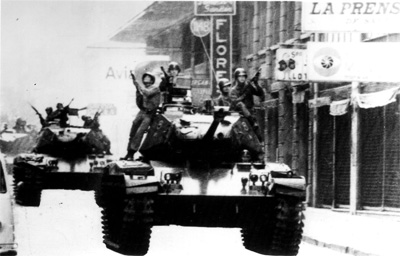
battleOfChileWashington, DC, May 23, 2014 – Covert U.S. planning to block the democratic election of Salvador Allende in Chile began weeks before his September 4, 1970, victory, according to just declassified minutes of an August 19, 1970, meeting of the high-level interagency committee known as the Special Review Group, chaired by National Security Advisor Henry Kissinger. «Kissinger asked that the plan be as precise as possible and include what orders would be given September 5, to whom, and in what way,» as the summary recorded Kissinger’s instructions to CIA Director Richard Helms. «Kissinger said we should present to the President an action plan to prevent [the Chilean Congress from ratifying] an Allende victory…and noted that the President may decide to move even if we do not recommend it.»

The document is one of a compendium of some 366 records released by the State Department as part of its Foreign Relations of the United States (FRUS) series. The much-delayed collection, titled «Chile: 1969-1973,» addresses Richard Nixon’s and Kissinger’s efforts to destabilize the democratically elected Socialist government of Salvador Allende, and the U.S.-supported coup that brought General Augusto Pinochet to power in 1973. The controversial volume was edited by two former officials of the State Department’s Office of the Historian, James Siekmeier and James McElveen.

«This collection represents a substantive step forward in opening the historical record on U.S. intervention in Chile,» said Peter Kornbluh, who directs the Chile documentation project at the National Security Archive, and is the author of The Pinochet File: A Declassified Dossier on Atrocity and Accountability. Kornbluh called on the State Department to continue to pursue the declassification of all relevant records on the U.S. role in Chile, including all records of CIA contacts with the Chilean military leading up to the September 11, 1973, coup; CIA funding for the truckers’ strike as part of the «destabilization» campaign, and CIA intelligence on the executions of two U.S. citizens in the wake of the military takeover, Charles Horman and Frank Teruggi.

The FRUS series is scheduled to release an electronic supplement of additional records in the fall, and to publish another volume,Chile, 1973-1976, next year. «The next volume could advance the historical record on CIA support for the Chilean secret police, DINA, CIA knowledge of Operation Condor, and Pinochet’s act of international terrorism in Washington D.C. that killed Orlando Letelier and Ronni Karpen Moffitt,» Kornbluh suggested.

In the aftermath of General Augusto Pinochet’s arrest in October 1998, the National Security Archive, along with victims of the Pinochet regime, led a campaign to press the Clinton administration to declassify the still-secret documents on Chile, the coup and the repression that followed. Some 23,000 NSC, State Department, Defense Department and CIA records were released. Some of those have been included in the new FRUS collection which contains a set of meeting memoranda of the «40 Committee» — an interagency group chaired by Henry Kissinger which oversaw covert operations in Chile, as well as dozens of formerly secret cables, including CIA communications.

The release of the records comes amidst renewed debate over the CIA role in supporting the military coup in Chile. The forthcoming issue of Foreign Affairs contains an article by former CIA operative Jack Devine, «What Really Happened in Chile: the CIA, the Coup Against Allende, and the Rise of Pinochet,» which reveals that intelligence he obtained on September 9, 1973, alerted President Nixon in advance to the timing of the coup. «I sent CIA headquarters in Langley a special type of top-secret cable known as a CRITIC, which takes priority over all other cables and goes directly to the highest levels of government. President Richard Nixon and other top U.S. policymakers received it immediately. ‘A coup attempt will be initiated on 11 September,’ the cable read.»

Nevertheless, Devine asserts that the CIA «did not plot with the Chilean military to overthrow Allende in 1973.»

However, according to a transcript of the first phone conversation between Kissinger and Nixon following the coup, when the President asked if «our hand» showed in the coup, Kissinger explained that «we didn’t do it,» in terms of direct participation in the military actions: «I mean we helped them,» Kissinger continued. «[deleted word] created the conditions as great as possible.»

The Kissinger-Nixon transcript is reproduced in the 2013 edition of The Pinochet File.

Read the FRUS volume here


Read Full Post »

« Newer Posts - Older Posts »