Feeds:
Entradas
Comentarios

Archive for mayo 2014

The Cartoon that Made People Scare to Go War in 1914

 Charles F. Howlett

HNN   May 1i, 2014

Historians, journalists, and leading political figures are now commemorating the one hundredth anniversary marking the beginning of World War 1. At the time of this tragic event it was called the Great War and would be referred to in history textbooks as such for a mere twenty-one years after its conclusion. Sadly, the world experienced another global conflict starting in 1939 and the Great War became World War 1.

At the time armed conflict began in August 1914, it was considered the Great War because it was total and its impact felt worldwide. Primarily, in the low countries of Western Europe and France fierce battles were waged marked by trench warfare so graphically depicted by German soldier Eric Remarque’s powerful work All Quiet on the Western Front and visually displayed in the 1939 movie of the same name starring American actor Lew Ayers; Ayers, by the way, though classified as a conscientious objector, served as my dad’s Army combat medic in the Philippines in 1944-45. Battles were also fought on the high seas, principally in the North Atlantic where the submarine came to symbolize a new twist to conventional warfare, abandoning all forms of civility with respect to terms of engagement. There were also large cannons capable of launching shells twenty-plus miles, mechanized tanks, battleships, which the Germans proudly referred to as dreadnoughts, and worst of all, mustard gas. Indeed, over the course of four years, Europe, America, and parts of the decaying Ottoman Empire were thrust into the worst war civilization had ever encountered. It was a game changer and by the time it was over, November 11, 1918, at least 8.5 million combatants were killed and many more wounded, untold numbers of civilians died, whole empires were destroyed, and societies were devastated by modern technological warfare. Physical, moral, and psychological shock reverberated throughout the European continent and elsewhere.

No one could have predicted how catastrophic it would be. But at the start of hostilities when Germany officially invaded Belgium on August 4, 1917, bringing Great Britain into the war on the side of France and Russia, a cartoonist by the name of John Tinney McCutcheon burst upon the scene in an effort to capture the realities of the time. He would not disappoint as his vivid imagination and poignant realism gave instant credibility to the popularity of wartime cartoons as a serious form of journalism. Indeed, other cartoonists such as J.N. Ding (Jay Norwood Darling), James Harrison “Hal” Donahey, and Edwin Marcus would follow suit as they, too, used their artistic talents to depict the costs of war.

But it was McCutcheon who got the ball rolling. He was certainly an interesting and dynamic person who loved the thrill of adventure; he went where the story was, regardless of the dangers involved. He was born on an Indiana farm in 1870, but destined to travel worldwide. At the age of sixteen he entered Purdue University, switching majors from mechanical engineering to industrial arts because he hated math. He chose wisely as his skills as a graphic artist would eventually garner him a Pulitzer Prize in 1931 for his cartoon, “A Wise Economist Asks a Question.” He worked for the Chicago Tribune for forty years, entertaining thousands of readers each day as his cartoons appeared on the front page just above the fold. But none would have as much long lasting impact as the one that was published on August 7, 1914.

It was while he was working for the Chicago Tribune covering the political turmoil in Mexico, where he also met Pancho Villa and drew a cartoon of this Mexican revolutionary sitting at a table with a pistol laying on top, that war officially broke out in Europe. McCutcheon, the adventurer, promptly left Mexico for Chicago to obtain correspondent credentials. While awaiting a ship bound for England to cover the hostilities—he was one of only four American newspapermen to be on-the-scene reporters at the war’s beginning and would make two others trips, one riding in a French warplane that was shot at by the Germans—he sketched five noted war cartoons capturing his feelings about the European conflict. One stood out. He succinctly titled it “The Colors.”

The cartoon quickly captured the attention of a wide readership not only among Tribune subscribers but also among readers throughout the country. His cartoon was widely distributed and supporters of peace relied upon it to call attention to the dangers of war. Peace activists were moved by the depictions of McCutcheon’s cartoon. It provided anti-preparedness advocates with a simple, yet powerful, message that the burden of war is shouldered by all. “The Colors” also inspired a later effort by the newly-established Woman’s Peace Party to display its own “War Against War” exhibit, replete with peace/antiwar cartoons, attracting thousands of visitors in May 1916 in cities across the United States. In 1919, moreover, when George J. Hecht published his The War in Cartoons: A History of the War in 100 cartoons by 27 of the most prominent American Cartoonists, he promptly took notice of McCutcheon’s “The Colors.” It remains one of the most famous antiwar cartoons of all time.

When it first appeared no one, not even McCutcheon, could have guessed how influential it would become. But at the top of the first page in The Chicago Tribune on August 7, readers were instantaneously focused on a simple, yet compelling, cartoon with four panels. As readers gazed at each panel they were suddenly drawn to the words below each one: “Gold and green are the fields in peace”; “Red are the fields in war”; “Black are the fields when the cannons cease”; “And white forevermore.”

Each line takes on even greater significance when attached to the picture above. Readers are first drawn to a harvest of peaceful abundance as a farmer tills his soil while bundling his wheat. Then reality sets in as the field is littered with dead soldiers and smoke billowing upward from exploding cannon shells. In the aftermath of the battle are the mourners, grieving at the loss of so many innocent lives. Finally, one is led to white gravestones marking the place where the soldiers died. All the while three of four trees remain intact—nothing goes unscathed from war’s wrath—as witness to the tragic events that just took place, yet symbols of survival and future hope. Civilization must press on. His words, coupled with such powerful images, highlight the somber significance of war’s real impact on life.

And so, we have “The Colors.”

One hundred years later as we reflect on McCutcheon’s words and images in “The Colors,” we should be reminded, as the eminent peace historian Lawrence Wittner points out, that in the past century wars led to the deaths of over a hundred million people, and today, we live in a world armed with some 17,000 nuclear weapons. Many additional lives continue to be lost in the present century due to ongoing internal fighting and external war. Sadly, “the colors” haven’t changed.

This is the black and white version readers saw in the Chicago Tribune:


 Charles F. Howlett is a Professor in the Education Division’s Graduate Programs at Molloy College. He has authored, co-authored, and co-edited books numerous book in American history and education, including the forthcoming Antiwar Dissent and Peace Activism in World War I America with Scott Bennett. He will be presenting a talk, “Images of Peace Activism in World War 1,” at the First World War Conference in October at Georgian Court University in New Jersey.


Read Full Post »

Brown v. Board of Education

HNN

The Warren Court (1953)

This page lists articles that put into historical perspective the changes wrought by the Supreme Court decision Brown v. Board of Education (1954). Click here to read the Brown decision.

Commentary on Recent Supreme Court Decisions Involving Brown

History

  • Bonnie Goodman Interview with Michael J. Klarman, Winner of the 2005 Bancroft Prize
  • Christopher W. Schmidt The Delusions Behind the Brown Decision
  • Ian Haney Lopez The Supreme Court Case that Got Right What Brown Got Wrong
  • Kansas State Historical Association«Brown v. Board of Education: The Case of the Century»–The Kansas Bar Association created a 70-minute video,»Brown v. Board of Education of Topeka: The Case of the Century,» and related teaching materials as a project for the 50th anniversary of the landmark decision. The video features a reenactment of the 1952 and 1953 oral arguments presented to the U. S. Supreme Court. The video will run continuously during the exhibit, Equal Education: The Fight, The Right May 1 – 30, 2004, at the Kansas History Center and Museum.
  • Eric Foner & Randall KennedyBrown at 50
  • Michael Klarman The Supreme Court Has Never Been in the Vanguard of Social Reform
  • Robert Jackson Symposium To commemorate and consider Brown at 50, the Robert H. Jackson Center recently hosted three special events in Jamestown, New York, and at nearby Chautauqua Institution. The symposium featured Nicholas Katzenbach, law clerks from the Supreme Court of 1954, and the sisters Linda Brown Thompson and Cheryl Brown Henderson, daughters of the late Oliver Brown of Topeka.
  • Newsweek Photo Gallery from the Era of Brown
  • Ellis Cose Why Brown Seems to Be a Bust
  • Suzanne Sataline Charles Sumner Made the Case Against Segregated Schools a Century Before Brown
  • Thomas Sowell We Are Still Paying the Price for the Faulty Reasoning in Brown
  • Sara Hebel 50 Years After Brown Inequities Remain at Universities
  • James Patterson Why It’s Right to Remember Brown
  • William Kashatus Despite Brown We Are Re-Segregating Our Schools
  • Cass SunsteinBrown Reconsidered?
  • Drew Jubera Why Wasn’t It Brown vs. Alabama or Brown vs. South Carolina?
  • Michael Klarman Why Brown Had Such an Impact
  • Chronicle of Higher Education What New Books Are Saying About the Impact of the Brown Decision
  • Justin EwersBrown V. Board of Education: 50 Years Later
  • Rick Shenkman The Panel Devoted to Brown at the 2004 OAH Convention


Read Full Post »

The Ambivalent Legacy of Brown v. Board

Jelani Cobb 

The New Yorker  May 16, 2014

brown-board-legacy.jpg

Brown v. Board plaintiffs, Topeka, Kansas, 1953. Photograph by Carl Iwasaki/Time Life Pictures/Getty.

In March of 1863, a fugitive slave named Gordon found his way to the Union Army lines in Baton Rouge, Louisiana. Exhausted from his efforts to escape his slaveholders and their dogs, he showed up in tattered rags. When doctors examined him, they saw that his back was marred by a lattice of keloid scars, evidence of the severe whippings he’d endured in bondage. He was photographed, and the image of this former slave, stripped to the waist, with lash marks inscribed on his skin like a bas-relief, was widely distributed in the North—as indisputable evidence of the evil that had brought the nation to the brink of self-destruction. Unlike the authors of slave narratives, Gordon’s ruined flesh could not be accused of hyperbole.

Gordon enlisted in the Union Army, and the image of his lacerated back came to represent an imperative in future struggles for racial equality. Merely highlighting the existence of injustice was insufficient; you had to show the brutal consequences of that injustice, as vividly as possible.

This kind of scar-bearing was an integral part of the twentieth-century movement to uproot Jim Crow, which reached its zenith sixty years ago this Saturday, with the Supreme Court’s ruling in Brown v. Board of Education. Thurgood Marshall’s assault on the edifice of segregation had been confounded by the question of whether the Fourteenth Amendment prohibited racial segregation. The Supreme Court’s decision in Plessy v. Ferguson, in 1896, had held that a putatively benign social separation could coexist with the amendment’s guarantee of equal protection under the law. The majority opinion, in fact, went so far as to argue that efforts to overturn segregation had been motivated by blacks’ misperceptions of the practice:

We consider the underlying fallacy of the plaintiff’s argument to consist in the assumption that the enforced separation of the two races stamps the colored race with a badge of inferiority. If this be so, it is not by reason of anything found in the act, but solely because the colored race chooses to put that construction upon it.

To combat the notion that the evils of segregation were so much hyperbole, Marshall and the other lawyers at the N.A.A.C.P. Legal Defense Fund called upon the psychologists Kenneth and Mamie Clark, whose famous “doll tests” had demonstrated that racism was damaging to the minds of black children. Beginning in 1939, the Clarks had conducted experiments showing that, when presented with two dolls identical in every way except color, black children consistently attributed favorable characteristics like beauty and intelligence to the white dolls, while reserving their most negative assessments for the dolls they most resembled. The Clarks’ work demonstrated that scars need not be visible in order to be indelible, and their data helped to bolster Marshall’s contention that racial separation violated the Fourteenth Amendment’s equal-protection clause.

The nascent civil-rights movement drew its moral authority, in some measure, from the image of African-Americans who were psychologically “damaged” by the legacy of slavery and the ongoing travesty of segregation. But those arguments, about the extent to which racism had wounded the African-American mind, have had a far more complicated legacy than the celebration of Brown would suggest. As the historian Daryl Michael Scott argues in his 1997 book, “Contempt and Pity”:

Liberals used damage imagery to play upon the sympathies of the white middle class. Oppression was wrong, they suggested, because it damaged personalities and changes had to be made to promote the well-being of African Americans. Rather than standing on the ideals of the American creed and making reparations for the nation’s failure to live up to the separate but equal doctrine set forth in Plessy v. Ferguson, liberals capitulated to the historic tendency of posing blacks as objects of pity.

Six decades after the Supreme Court struck down de-jure segregation, vast swaths of the American education system remain separated by race—indeed, there has been a trend toward resegregation in many areas, particularly in the South. But the most telling indicator of the ambiguous legacy of Brown may be the way we perceive the kinds of arguments that led to the decision.

In 1986, the anthropologist John Ogbu conducted a study of African-American academic performance, and he concluded that many black students viewed high educational achievement as a form of “acting white.” Ogbu’s conclusions were widely disputed by other researchers, yet the term—succinct in its oversimplification—leapt from scholarly journals into public debates about race. The Clarks’ doll tests were seen as an indictment of white racism, but the notion of “acting white”—fundamentally rooted in a similar tendency to ascribe virtue to whiteness—was nonetheless deployed as a means of pointing toward African-Americans’ own self-defeating behavior.

This rhetoric was not confined to white conservatives. In 2004, at a dinner sponsored by the N.A.A.C.P. Legal Defense Fund to mark the fiftieth anniversary of their victory in the Brown case, Bill Cosby departed from his notes and launched into a tirade against the shortcomings of impoverished African-Americans. Speaking of Kenneth Clark, by then an elderly widower, Cosby said:

Kenneth Clark, somewhere in his home in upstate New York … just looking ahead. Thank God, he doesn’t know what’s going on, thank God. But these people, the ones up here in the balcony fought so hard. Looking at the incarcerated, these are not political criminals. These are people going around stealing Coca-Cola. People getting shot in the back of the head over a piece of pound cake! Then we all run out and are outraged, “The cops shouldn’t have shot him.” What the hell was he doing with the pound cake in his hand?

Cosby’s remarks were applauded by many on the right, as well as by more than a few African-Americans. What was once considered “damage” had been transformed—by the passage of a few decades and by the insistence that racism was behind us now—into “pathology.” Cosby’s intemperate rhetoric tapped into a vein of frustration, seldom voiced in public, that, a half century beyond the most crucial judicial decision of the civil-rights era, the problems once attributed to legal segregation managed to persist. Despite Cosby’s invective, it was never clear where that frustration should be attributed. There are no metrics for how quickly a group should recover from legally enforced subordination, and no statistical rendering of ongoing racial inequalities could match the explanatory power of a “Colored Only” sign. If these complexities confounded people like Cosby, who’d actually lived through segregation, there was scant hope that they’d be readily perceived by many people who hadn’t.

Yet some things have remained constant. Alarmingly, versions of the Clarks’ doll test conducted in the past few years still yield results similar to those of the original experiments. In 2011, the sociologist Karolyn Tyson showed that concerns over “acting white” among black students tended to arise not in overwhelmingly black schools but precisely in settings in which black students were underrepresented. And yet, sixty years after Brown, the prevailing idea in these debates remains one that is similar to the argument presented in Plessy: that the major, and perhaps the only, problem with ongoing segregation is the way black people perceive and respond to it.

The United States may not be “post-racial,” as many claimed in the wake of Barack Obama’s election, but it clearly sees itself as post-racism, at least when it comes to explaining the color-coded disparities that still define the lives of millions of its citizens.

Jelani Cobb is Associate Professor of History and Director of the Institute for African American Studies at University of Connecticut.


Read Full Post »

Imagen

America as the second home of arnis, escrima, kali

 Perry Gil S. Mallari  

The Manila Times   May 18, 2014

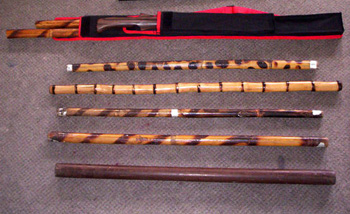
A collection of escrima fighting sticks. CONTRIBUTED PHOTO

A collection of escrima fighting sticks. CONTRIBUTED PHOTO

It was born in the Philippines but I would say that the United States is the second home of arnis, escrima and kali collectively known as Filipino martial arts (FMA).

Transplanted mainly through various waves of migration, the FMA has established deep roots in America. The growth, evolution and mutation of the FMA in the US are incomparable to any other nations where Philippine martial arts were also exported.

The FMA could have been exported to the US much earlier than the known exodus of Filipino farm laborers to California and Hawaii during the turn of the 20th century.

The book Manila Men in the New World: Filipino Migration to Mexico and the Americas from the Sixteenth Century by Floro L. Mercene tells that prior to the influx of farm worker from the Philippines to America during the said period, Filipino mariners under a Spanish command landed in Morro Bay, California in October 1587.

It is amazing to realize that Filipinos have reached the New World (what would become the United States of America) much earlier than the American colonization of the Philippines at the turn of the 20th century.

2-FMA-in-America

Cover of the book Manila Men in the New World: Filipino Migration to Mexico and the Americas from the Sixteenth Century by Floro L. Mercene.

Lafcadio Hearn, an American journalist wrote an article in the March 31, 1883 issue of Harper’s Weekly about a Filipino settlement in Saint Malo, Louisiana. The settlers of the community that were called “Manilamen,” were believed to be the roots of Filipinos in America. Hearn at that time believed that the settlement was already in existence for 50-years however, extensive research conducted by Marina Espina, a librarian at the University of New Orleans revealed that it could have existed earlier.It is amazing to realize that Filipinos have reached the New World (what would become the United States of America) much earlier than the American colonization of the Philippines at the turn of the 20th century.

Espina in 1988 published the results of her studies in a book titled Filipinos in Louisiana (A. F. Laborde & Sons, New Orleans, Louisiana, 1988).

Hearn described the Manilamen as seasoned fishermen who were robust and polite and could speak in Tagalog and Spanish. A part of the article reads: “Most of them are cinnamon-colored men; a few are glossily yellow, like that bronze into which a small proportion of gold is worked by the molder. Their features are irregular without being actually repulsive; some have the cheek-bones very prominent and the eyes of several are set slightly aslant. The hair is generally intensely black and straight, but with some individuals it is curly and browner. In Manila there are several varieties of the Malay race, and these Louisiana settlers represent more than one type. None of them appeared tall; the greater number were under-sized, but all well knit, and supple s fresh-water eels. Their hands and feet were small; their movements quick and easy, but sailorly likewise, as of men accustomed to walk upon rocking decks in rough weather. They speak the Spanish language; and a Malay dialect is also used among them.”

Evidences have been found that a number of Filipinos even participated in the American Civil War. This was proven by the research conducted by Nestor Palugod Enriquez, a retired US Navy personnel turned Filipino American historian. Enriquez located the specific names of Filipino volunteers on the following records: the Massachusetts State Rosters, Military Images magazine, original muster rolls at the National Archives, the New Hampshire Rosters (issued by State Adjutant General.

Pension—Pension Records, National Archives, Washington, D.C.) and the Naval Rendezvous Reports (available at the National Archives, Washington, D.C.). There is a high probability that those early Filipinos in America may have had used their skills in arnis, escrima and kali in that war.

But the biggest part of the FMA migration in the US most probably occurred at the beginning of the 20th century when many Filipino men filled in the demand for workers in the plantations of Hawaii and the farmlands of California. Many FMA pioneers in America like Angel Cabales, Juanito Lacoste and Leo Giron were at one time or another worked as farm laborers in Hawaii and California. A part of Dan Inosanto’s book The Filipino Martial Arts, narrates of how Cabales made it to the US, it reads, “Cabales left the Philippines in 1939 and joined a crew of a cargo ship that took him to distant ports of the world. Each port, each foreign dock brought a new set of adventures and with them a knowledge of survival. After working in Alaska, Cabales wandered from county to county in California. He ultimately joined the Filipino farm laborers around Stockton where he now lives.”

Mark Wiley, in his book Filipino Martial Culture tells how Giron arrived in America, “Like other Filipinos who relocated in the United States, Giron did so by way of boat.

He traveled on the President Lincoln and docked in San Francisco on November 17, 1926. Soon thereafter he relocated to Stockton, California, and took work cutting celery and asparagus for seventeen and a half cents an hour. The hourly wage at that time was thirty-five cents an hour.”

Perhaps one of the most notable early public demonstrations of the FMA in the US was that of the late Grandmaster Ben Largusa. Largusa, a disciple of juego todo champion Floro Villabrille performed at the historic Ed Parker Long Beach Karate International in 1964. Bruce Lee performed there too and Parker recalled in one of his writings before he passed away that Lee and Largusa impressed the other masters who were present in the event.

In 1966, Cabales opened the first public escrima academy in the US in Stockton, California.

Then came global recognition via the medium of cinema. Inosanto briefly but spectacularly introduced the FMA to moviegoers worldwide through the film The Game of Death starring the legendary Lee. Known as Lee’s protégé, Inosanto was responsible in introducing the late founder of jeet kune do to escrima specifically the use of the tabak toyok or nunchaku. With an international superstar like Lee picking up escrima sticks, the FMA was finally included in the world map of martial arts. Few would argue that this film is an important landmark in the history of the FMA and much of the FMA’s popularity today, it owe to Inosanto’s film works.


Read Full Post »

Happy 50th Anniversary National Museum of American History!

 Pamela M. Henson  January 23, 2014

Smithsonian Institute Archives

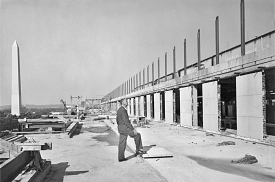
Frank A. Taylor at Museum of History & Technology, by Unknown, c. 1964, Smithsonian Archives - History Div, SIA2009-0003 or 83-2074

Frank A. Taylor at Museum of History & Technology, by Unknown, c. 1964, Smithsonian Archives – History Div, SIA2009-0003 or 83-2074

On the evening of January 22, 1964, the Smithsonian hosted an A-List party to dedicate its newest museum, the Museum of History and Technology, now the National Museum of American History.  The building was the dream of its first director, Frank A. Taylor, who had joined the National Museum staff after high school, and after graduate school, advanced to Curator, Director, and Director General of all Smithsonian museums.  When Taylor returned from World War II, he recalled in an oral history interview, the exhibits in the old National Museum buildings looked shabby and out of date.  He first led an Exhibits Modernization Program, which oversaw the renovation of all the National Museum’s exhibits from the mid-1950s to the mid-1960s.  The new exhibits attracted new interest in the Institution among the U. S. Congress and donors.  The Smithsonian had been attempting to establish a separate history museum since the 1920s, but had met with little support.  Taylor initially sought to build a museum of technology, like the Deutsches Museum in Germany, but was convinced to include plans for a museum of American history.  With the support of the new Secretary, Leonard Carmichaellegislation was signed into law on June 31, 1956, creating the new museum. The first modern building on the National Mall, the new museum opened with ten exhibit halls completed, with an additional fifty opening in the following years.

Chief Justice Warren Speaking at the Museum of History and Technology Dedication, by Unknown, January 22, 1964, Smithsonian Archives - History Div, SIA2011-1489 and P-6411-19.

Chief Justice Warren Speaking at the Museum of History and Technology Dedication, by Unknown, January 22, 1964, Smithsonian Archives – History Div, SIA2011-1489 and P-6411-19.

Former history teacher and Smithsonian supporter President Lyndon Johnson dedicated the building on January 22, at a black tie party attended by Members of Congress, philanthropists, Smithsonian Regents, and many other distinguished guests.  The party was not without its hiccups, Taylor recalled.  The U. S. Secret Service was present since the President was speaking, and they sprang into action when someone accidently bumped against the stage light switch and turned it off.  Shortly thereafter, the wife of a member of the Smithsonian Board of Regents could no longer see her husband on stage. He was recovering from a serious heart attack, so she alerted the Secret Service, who once again sprang into action, only to find he had moved his seat a bit and was hidden behind another person.  But overall the party was a great success, setting the stage for the Secretary-elect S. Dillon Ripley, who assumed office that week and oversaw the Institution’s great period of growth from 1964 to 1984.

Newly Completed Museum of History and Technology, by Unknown, 1964, Smithsonian Archives - History Div, SIA2010-2181 or P6499-A or MAH-P6499A.

Newly Completed Museum of History and Technology, by Unknown, 1964, Smithsonian Archives – History Div, SIA2010-2181 or P6499-A or MAH-P6499A.

The Museum opened to the public on January 23rd, and in the first weekend, 54,000 people visited the new Museum.  The new halls included the Flag Hall, First Ladies’ Hall, and the halls of Everyday Life in the American Past, American Costume, Farm Machinery, Light Machinery, Tools, Vehicles, Railroads, as well as a temporary exhibition presenting examples of exhibits to be installed in other halls of the building.

So we send out congratulations for a happy 50th anniversary to the National Museum of American History and all the staff and volunteers who have made it a success in the past five decades!

Related Resources:

National Museum of American History, Smithsonian Institution Archives

Read Full Post »

Unprecedented Film of Franklin Delano Roosevelt Walking Donated to Pennsylvania Historical and Museum Commission

Harrisburg, Pa.May 15, 2014   PRNewswire-USNewswire

Never before seen footage of President Franklin Delano Roosevelt walking was unveiled today at the Pennsylvania State Archives. The film was shot in 1937 by Harrisburg native and Major League Baseball pitcher James (Jimmie) DeShong on his 8mm home movie camera.

Pennsylvania First Lady Susan Corbett, along with members of DeShong’s family unveiled the rare film.

Pres. Roosevelt was paralyzed from the waist down by polio in 1921. In the film, he is walking up a ramp in Washington, D.C.’sGriffith Stadium. Pres. Roosevelt is wearing braces on his legs as he holds an assistant’s arm and grasps a handrail to make it up the steps.

It is one of only two known extended film clips in existence showing Pres. Roosevelt walking. It is so rare, that filmmaker Ken Burns is using it in his upcoming documentary «The Roosevelts: An Intimate History»
 which will air on PBS beginningSeptember 14, 2014.

«We were thrilled with the discovery of a new piece of film footage of Franklin Delano Roosevelt walking. Any film of him struggling to get from one place to another is extremely rare, as the Secret Service either prohibited or confiscated cameras whenever FDR was making an attempt to propel himself from his car to anywhere else,» said Ken Burns. «The President wanted to minimize the public’s knowledge of the devastating effects polio had had on him – he was completely paralyzed from the waist down and he could not walk without the aid of a cane and braces on both legs. The press in those days complied with his request not to be filmed.»

DeShong however had extraordinary access to the field that day. He was able to get eight seconds of footage of President Roosevelt walking in a public setting.

DeShong’s daughter, Judith Savastio, donated the film, and all of its associated copyrights, to the Pennsylvania State Archives so that the archives can conserve, preserve, interpret and make it accessible to the public. The Pennsylvania State Archives was determined to be the most appropriate institution to receive the film as a donation due to its rare political, sports, and Pennsylvania-related content.

«We are extremely grateful that Mrs. Savastio chose Pennsylvania’s State Archives to care for and preserve this extraordinary film,» said First Lady and Pennsylvania Historical and Museum Commissioner Susan Corbett. «Her generous donation is allowing the world to see something it has never seen before. This unique look at Franklin Delano Roosevelt gives us a better understanding of his physical struggles and his courage and strength in leading our country through difficult times despite personal challenges.»

Along with the historic footage of Pres. Roosevelt, several Major League baseball all-stars and executives can easily be identified in the film. They include Joe McCarthyCharlie Gehringer, Spud Chandler, Lou GehrigJimmie Foxx, Lefty Grove, Hank Greenberg, Baseball Commissioner Judge Kenesaw Mountain LandisCarl Hubbell, Dizzy Dean, Lefty Gomez, Red Rolfe,Eddie Collins and Tom Yawkey.

In addition to the Major League Baseball and Pres. Roosevelt footage, the film also contains family and hunting scenes taken throughout Pennsylvania.

The original film was cleaned, preserved and digitized into high definition files by Florentine Films, the production company ofKen Burns.

To view an excerpt of the film including footage of Pres. Roosevelt and American and National League players visit www.phmc.state.pa.us.

The Pennsylvania Historical and Museum Commission is the official history agency of the Commonwealth of Pennsylvania.

Media Contact: Howard Pollman, 717-705-8639

Editors Note: The entire statement from Ken Burns is as follows:

«We were thrilled with the discovery of a new piece of film footage of Franklin Delano Roosevelt walking. Any film of him struggling to get from one place to another is extremely rare, as the Secret Service either prohibited or confiscated cameras whenever FDR was making an attempt to propel himself from his car to anywhere else. The President wanted to minimize the public’s knowledge of the devastating effects polio had had on him – he was completely paralyzed from the waist down and he could not walk without the aid of a cane and braces on both legs. The press in those days complied with his request not to be filmed.

We thought we had found and used all the rare bits and pieces that existed. But this remarkable 8 seconds provided to us by the Pennsylvania State Archives is one of the very best pieces of film that so clearly shows what a brave struggle it was for FDR to move. The fact that he is on an incline and that it is very windy makes his walking even more arduous. The wind even presses his pants against his withered legs and you can clearly see the braces underneath.

This priceless piece of film replaces a still photograph in a key sequence in Episode Four of our series on the Roosevelts and makes the scene far more moving by allowing the audience to see FDR in action. When the film was discovered, we had already completed our series, but once we saw this terrific find, we asked PBS for permission to do a re-edit on the broadcast master of Episode Four so that we could include it.

This 8 seconds enriches our series and helps deepen the American public’s understanding of the strength and fortitude this badly disabled man brought to the task of seeing our country through two of the worst crises in our history – the Depression and World War II.

Thanks so much to the wonderful folks at the Pennsylvania State Archives, especially Richard Saylor and Linda Ries, for allowing us the use of this remarkable film footage in our series for PBS – The Roosevelts: An Intimate History.»

 Ken Burns, Director and Producer

SOURCE Pennsylvania Historical and Museum Commission

RELATED LINKS
http://www.phmc.state.pa.us

Read Full Post »

Malvivir entre algodones

Tereixa Constenla

El país   14 de mayo de 2014

En 1936 el fotógrafo Walker Evans y el periodista James Agee viajaron a Alabama para sumergirse en la realidad de los algodoneros por encargo de la revista Fortune. A pesar de que los paliativos del presidente Roosevelt ya estaban en marcha (el New Deal), los estadounidenses seguían arrastrando la Gran Depresión. Más de un millón de familias, que dependían de las idas y venidas de las cosechas en campos arrendados y atados a préstamos con los propietarios de la tierra, desprendían el aire desesperado de los okies que John Steinbeck reflejó en Las uvas de la ira (1939).

Floyd Burroughs junto a los niños de la familia Tingle en Alabama en 1936. / WALKER EVANS / CAPITÁN SWING

Floyd Burroughs junto a los niños de la familia Tingle en Alabama en 1936. / WALKER EVANS / CAPITÁN SWING

Agee y Evans se centraron en tres (los Tingle, los Fields y los Burroughs), seleccionadas como representativas de la media (ni entre las mejores ni entre las peores), para plasmar sus supervivencias épicas. Y no solo. También para analizar las estructuras económicas y el “márketing aspiracional” que mantenía aquel sistema que condenaba a más de ocho millones de personas a encerronas existenciales, a llevar una vida “tan profundamente privada y dañada y atrofiada en el transcurso de ese esfuerzo que solo se la puede llamar vida por cortesía biológica”, escribió Agee. El reportaje jamás salió en Fortune por razones ignoradas, aunque proporcionó algunas de las imágenes más icónicas de Evans (el retrato del aparcero Floyd Burroughs, por ejemplo) y la fuerza motriz del libro Elogiemos ahora a hombres famosos, publicado en 1940 con mínima repercusión (tendrían que pasar dos décadas para que fuese reivindicado como un clásico).

El reportaje original se esfumó hasta que en 2003 la hija de James Agee recuperó la colección de manuscritos que su padre dejó en su casa de Greenwich Village para cederla a la Universidad de Tennessee. Allí se descubrió el texto sobre el viaje a Alabama y, en 2012, casi ocho décadas después, se publicó al fin en Estados Unidos Algodoneros. Tres familias de arrendatarios, que ahora sale en España de la mano de la pequeña editorial Capitán Swing. Junto a las 30.000 palabras originales del artículo se incluyen las fotografías de Walker Evans, la cámara que arropó de dignidad la pobreza campesina.

Elizabeth Tingle, en Alabama en 1936. / WALKER EVANS / CAPITÁN SWING

Elizabeth Tingle, en Alabama en 1936. / WALKER EVANS / CAPITÁN SWING

Pero, se pregunta Adam Haslett, autor de Union Atlantic, en la introducción del libro, “¿por qué habríamos de dedicar nuestro tiempo a leer, setenta años después, un artículo rechazado acerca de un mundo desaparecido?”. Una razón es su sabiduría periodística: Agee elude el sensacionalismo –de ahí que descarte a los más míseros de los míseros- y contextualiza las vidas cotidianas en un marco político, económico y sociológico. “El capitalismo de pacotilla de los terratenientes se sustenta en parte en los vestigios de la deferencia feudal que muestran los granjeros atados a sus tierras”, afirma Haslett. Otra es visionaria: merece ser leído como una lección para el presente. “No hace falta ser un experto para percibir de qué forma nuestro propio sistema crediticio, administrado ya no por terratenientes de pacotilla sino por bancos, agencias de calificación de riesgos y compañías de gestión de cobros, ha establecido una impersonal variante financiero-capitalista de la trampa de endeudamiento que Agee describió hace 77 años”, añade.

Bud Fields, en Alabama en 1936. / WALKER EVANS / CAPITÁN SWING

Bud Fields, en Alabama en 1936. / WALKER EVANS / CAPITÁN SWING

El texto es un zarpazo a la neutralidad periodística. Quizás John Houston entrevió la razón mejor que nadie: “Jim Agee era un Poeta de la Verdad; un hombre que no se preocupaba en absoluto por su apariencia, solamente por su integridad. Ésta la preservaba como algo más valioso que la vida. Llevaba su amor por la verdad hasta el extremo de la obsesión”. Agee, que fue guionista de La reina de África y que en 1958 ganaría un póstumo Pulitzer con Una muerte en familia, se sumerge (literalmente) en el entorno de los granjeros, analiza el sistema que lo sustenta y concluye: “Un ser humano cuya vida se nutre de una posición aventajada adquirida de la desventaja de otros seres humanos, y que prefiere que esto permanezca de este modo, es un ser humano solo por definición, y tiene mucho más en común con la chinche, la tenia, el cáncer y los carroñeros del hondo mar”. A veces es la poesía de Agee la que toma algunos párrafos al asalto, como en la descripción de Floyd Burroughs: “Como tantas personas que no saben leer ni escribir, maneja las palabras con torpe economía y belleza, como si fueran animales de granja abriendo un terreno escabroso”.

El artículo está estructurado como un informe, que desmenuza aspectos básicos (dinero, cobijo, comida, ropa, trabajo, temporada de recolección, educación, ocio y salud), y concluye con dos apéndices dedicados a los negros y a los terratenientes que, sin ser Simon Legree, el esclavista malvado de La cabaña del tío Tom, se guían por un marco de creencias que “justifican su posición y sus medios de vida”. Agee había decidido centrar el reportaje en los granjeros blancos para que la cuestión racial no contaminase lo demás pero tampoco les excluyó por completo, dado que uno de cada tres arrendatarios era negro. “Al negro lo odian por ser negro; lo odian porque creen que ninguna mujer blanca sin protección está a salvo a un kilómetros de distancia de él; lo odian porque trabajará por un jornal sobre el que un hombre blanco escupiría y porque aceptará un trato ante el que un hombre blanco mataría; naturalmente, lo odian más que nadie los blancos que por razones de fuerza mayor se hallan tan bajo en la escala social como él. Quizá huelga decir que trabaja por el jornal que le ofrecen porque tiene que vivir”.

Read Full Post »

The National Pastime, Amid a National Crisis

The New York Times    May 9, 2014

Michael Beschloss


An early version of a baseball game took place in the background as members of the 48th New York State Volunteer Infantry lined up in Fort Pulaski, Ga., in 1862. Credit Western Reserve Historical Society

An early version of a baseball game took place in the background as members of the 48th New York State Volunteer Infantry lined up in Fort Pulaski, Ga., in 1862. Western Reserve Historical Society

This is one of the earliest photographs ever taken of a baseball game, and it happened by accident. The photographer, Henry P. Moore, of Concord, N.H., was focusing on the well-uniformed Union soldiers of the 48th New York State Volunteer Infantry, but he also captured their baseball-playing comrades in the background.

The “hurler” (as pitchers were called), wearing a white shirt, is tossing underhand (by the rules of the day) to a “striker” (batter), with bent knee. At the time, baseball had yet to achieve anything like the level of importance it later attained; for Moore, it was just something that got into your picture frame when you were trying to photograph soldiers on display.

It was the second year of the Civil War, and the scene was Fort Pulaski, Ga., which stood on an island at the mouth of the Savannah River. After falling to the Confederacy in 1861, the fortress had been bombarded for 30 hours and seized back in April 1862, preventing the rebels from using the vital port of Savannah. Like an increasing number of both rebel and Union soldiers, Pulaski’s warriors were encouraged to divert themselves from time to time by turning to baseball.

By combining the Civil War and baseball, Moore’s photograph merges two of the most important elements of the American historical experience, both of which, to this day, have deep emotional resonance. Baseball did not became the “national pastime” until long after Appomattox, but Americans came to feel so passionately about the game that some mythmakers tried to embellish the historical record by exaggerating its importance during the time the Union fought the South.

For instance, Abner Doubleday (1819-1893) — revered as the Union’s second in command at Fort Sumter, S.C., who, in April 1861, had fired the first shot defending the beleaguered federal garrison — was posthumously claimed to be the “inventor” of baseball. This was although Doubleday had made no such assertion for himself, left no evidence of it in his papers, and, at the time he was supposed to have fashioned the game in Cooperstown, N.Y., (now home of the Baseball Hall of Fame), was studying at West Point. To this day, some baseball fans insist (inaccurately) that home plate was designed to resemble the five-sided Fort Sumter, recognizing Doubleday’s “contribution” to the game.

Others exaggerated baseball’s place in the life of the greatest Civil War figure of all.

As a lawyer, and maybe as president, Abraham Lincoln may have picked up a bat in an early version of the game called “town ball”; he almost certainly viewed games on what is now the Ellipse, south of the White House. But later fabulists insisted that he was such a baseball fanatic that, when about to be notified by a Republican delegation of his nomination for President in 1860, Lincoln, playing baseball in Springfield, said, “They’ll have to wait a few minutes, until I make another hit.”

Of another, more ludicrous, made-up scene, you can agree with the moral of the story without accepting that it happened. This had the grievously wounded president on his deathbed in April 1865, regaining consciousness long enough to utter final words to Abner Doubleday: “Keep baseball going. The country needs it!”


Read Full Post »

Rare photos of Spanish-American war were ‘simply waiting to be re-discovered’

Daily Mail  Online  May 10, 2014

Rare pictures of the U.S. Navy taken during the Spanish-American war have been unearthed after being found hidden away in storage by military archivists.

They were only brought to light again when the photo archive team was preparing for a major renovation and archivists Dave Colamaria and Jon Roscoe stumbled across the pictures.

Lisa Crunk, head of the photo archives branch at the Naval History and Heritage Command, said: ‘The plates were individually wrapped in tissue paper and include full captions and dates, which were likely prepared by the photographer, Douglas White.

´Research on Mr White discovered that he was a special war correspondent of the San Francisco Examiner during the Philippines War.

‘Once it was realised what we had uncovered, there was tremendous excitement amongst the staff, especially the historians.

‘The images are an amazing find, though they were never really lost – they were simply waiting to be rediscovered.’

Plans are now in place for the entire collection to be re-housed into new archival enclosures and shelving units.


The USS Raleigh in action in 1898.<br /><br /><br /><br /><br /><br /><br /><br /><br /><br /><br /><br /><br />
The cruiser took part in the Battle of Manila Bay/Cavite on May 1, 1898

The USS Raleigh in action in 1898. The cruiser took part in the Battle of Manila Bay/Cavite on May 1, 1898

Another U.S. Navy vessel to be involved in the conflict was the USS Boston, pictured here in 1898. It was also involved in the Battle of Manila

Another U.S. Navy vessel to be involved in the conflict was the USS Boston, pictured here in 1898. It was also involved in the Battle of Manila

The USS Petrel was also part of the fleet, which took part in the war. The vessel, pictured here in 1898, is described as a gun boat

The USS Petrel was also part of the fleet, which took part in the war. The vessel, pictured here in 1898, is described as a gun boat

An image of the wreck of the Spanish armed transporter Cebu, taken sometime after a battle

An image of the wreck of the Spanish armed transporter Cebu, taken sometime after a battle

The Spanish cruiser, the Castilla, was lost in the Battle of Manila Bay with 25 men killed and 80 wounded

The Spanish cruiser, the Castilla, was lost in the Battle of Manila Bay with 25 men killed and 80 wounded

This image of the Spanish Fleet in the Suez Canal was one of many uncovered in storage at the Naval History and Heritage Command

This image of the Spanish Fleet in the Suez Canal was one of many uncovered in storage at the Naval History and Heritage Command

Apprentice boys pictured aboard the USS Olympia, the flagship of the Asiatic Squadron

Apprentice boys pictured aboard the USS Olympia, the flagship of the Asiatic Squadron

American sailors pictured during the Spanish-American war. They are Dave Ireland, Purdy, Tom Griffin and John King

American sailors pictured during the Spanish-American war. They are Dave Ireland, Purdy, Tom Griffin and John King

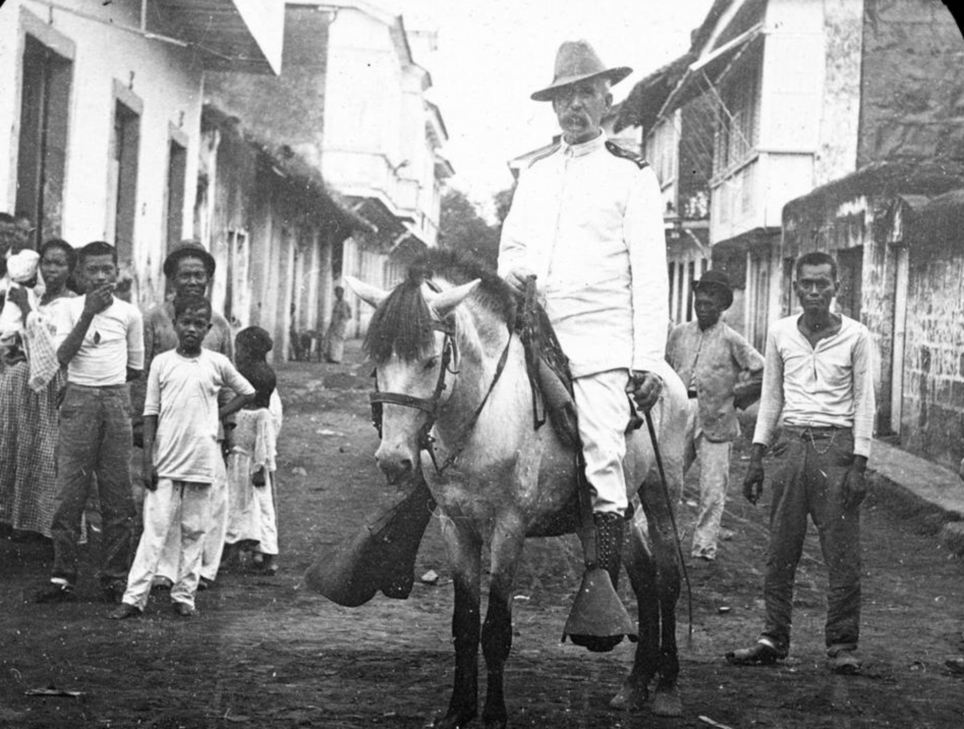
Captain Dennis Geary of the California Heavy Artillery rides his horse through Cavite in the Philippines

Captain Dennis Geary of the California Heavy Artillery rides his horse through Cavite in the Philippines

The crew of the Spanish cruiser Reina Cristina in prayer before battle on April 24, 1898

The crew of the Spanish cruiser Reina Cristina in prayer before battle on April 24, 1898

Read Full Post »

Felon disfranchisement preserves slavery’s legacy

By Pippa Holloway

Oxford University Press Blog    April 28, 2014

Nearly six million Americans are prohibited from voting in the United States today due to felony convictions. Six states stand out: Alabama, Florida, Kentucky, Mississippi, Tennessee, and Virginia. These six states disfranchise seven percent of the total adult population – compared to two and a half percent nationwide. African Americans are particularly affected in these states. In Florida, Kentucky, and Virginia more than one in five African Americans is disfranchised. The other three are not far behind. Not only do individuals lose voting rights when they are incarcerated, on probation, or paroled, a common practice in many states, but some or all ex-felons are barred from voting. All six of these states have non-automatic restoration processes that make it difficult or impossible to have one’s rights restored. Not coincidentally, all of these states maintained a system of racial slavery until the Civil War.

At the other end of the spectrum are northeastern states, mostly those in New England, which put up few obstacles to voting by convicted individuals. Maine and Vermont are the only states in the nation that do not disfranchise anyone for a crime, even individuals who are incarcerated. Among the remaining 48 states, Massachusetts and New Hampshire disfranchise the smallest percentage of convicted individuals. Connecticut, Rhode Island, and Pennsylvania are also far below the national average.

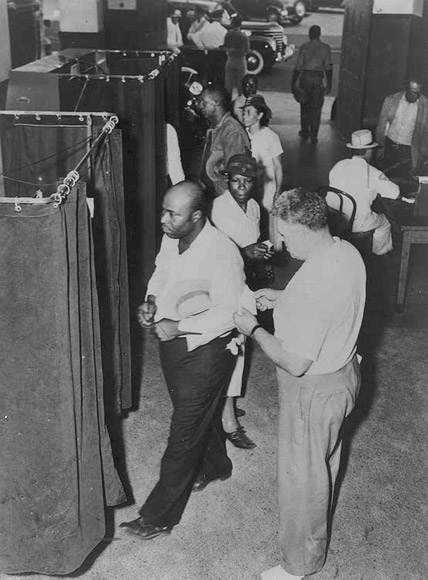
Voters at the Voting Booths. ca. 1945. NAACP Collection, The African American Odyssey: A Quest for Full Citizenship, Library of Congress. Public domain via Wikimedia Commons. - See more at: http://blog.oup.com/2014/04/felon-disfranchisement-preserves-slaverys-legacy/#sthash.wdlC2De3.dpuf

Voters at the Voting Booths. ca. 1945. NAACP Collection, The African American Odyssey: A Quest for Full Citizenship, Library of Congress. Public domain via Wikimedia Commons. – See more at: http://blog.oup.com/2014/04/felon-disfranchisement-preserves-slaverys-legacy/#sthash.wdlC2De3.dpuf

Generalizations about regional difference are complex should be made cautiously. Although the six states with the highest rates of disfranchisement are all in the South, six other states also impose life-long disfranchisement for some or all felons. Arizona and Nevada have relatively high rates of felon disfranchisement. Midwestern states, particularly Illinois, Indiana, Ohio, and Michigan, have low rates of felon disfranchisement, as does North Dakota. Nonetheless, the Northeast and South stand in stark contrast.

Regional differences in felon disfranchisement today are the result of regionally divergent histories of slavery and criminal justice. New England states had outlawed slavery by 1800. Soon, they also stopped treating convicts like slaves, barring state-administered corporal punishment for criminal offenses in the first few decades of the nineteenth century. Instead, northeastern states embraced an ideology of criminality that emphasized rehabilitation. This attitude toward both slavery and punishment led many citizens and lawmakers in the northeast to oppose disfranchisement of convicts or at least curb the reach of this punishment. In the colonial era, Connecticut limited the courts that could deny convicts the vote. Maine’s 1819 constitutional convention rejected a proposal to disfranchise for crime. Vermont ended the practice in 1832. In other northeastern states proponents of such disfranchisement measures faced strong opposition. For example, Pennsylvania’s 1873 constitutional convention restricted felon disfranchisement to those convicted of election-related crimes; an effort to disfranchise convicts in Maryland in 1864 passed only after a long debate.

In contrast in the nineteenth-century South two groups were permanently cast out of full citizenship: African Americans and convicts. Although the enslavement of African Americans ended in 1865, “infamy” – the legal status of those convicted of serious crimes – was imposed on a growing number of the new black citizens. Accusations of prior crimes were used in the 1866 election as one of the first tools used to deny the vote to former slaves. In the 1870s, nearly every state in the former Confederacy (Texas being the exception) modified its laws to disfranchise for petty theft, a move celebrated by white leaders as a step toward disfranchising African Americans.

The legacy of slavery and segregation in the South is important to this story but so is the different regional trajectory of criminal justice. All southern states except South Carolina and Georgia (states today that still have among the lowest rates of disfranchisement in the South) enacted laws disfranchising for crime between 1812 and 1838, and there is little evidence of dissent or debate over this punishment anywhere in the region. Furthermore, southern states rejected the concept of criminal rehabilitation and focused instead on punishment. After the Civil War “convict lease” systems replicated in many ways the system of slavery for those who fell into it, creating a class of mostly-black individuals who were subject to physical punishment, public abuse, and humiliation, and denied voting rights.

PippaIn the past, as is also true today, individuals with criminal convictions fought long battles to regain their voting rights. Far from being a population that is uninterested in politics, individuals barred from voting have challenged obstacles to re-enfranchisement and overcome tremendous hurdles to have their voting rights restored. Consider the case of Jefferson Ratliff, an African American farmer living in Anson County, North Carolina, who in 1887 paid the court an astounding $14 to have his citizenship rights restored, ten years after his conviction for larceny (including three years’ incarceration) for stealing a hog. In Giles County, Tennessee in 1888 a man named Henry Murray paid $2.70 in court costs in an unsuccessful effort to have his voting rights restored. In other cases, poor and illiterate individual petitioners facing a complicated legal process sought help from friends and neighbors. In Georgia, Lewis Price petitioned Governor William Y. Atkinson in 1895 for a pardon so that he could vote. He explained, “I am a poor ignorant negro and I have no money to pay to the lawyers to work for me. So I have to depend on my friends to do all of my writing.”

The historical record shows that state and local governments have consistently failed, throughout the nation’s history, to enforce these laws in a fair and uniform way. Coordinating voter registration lists with criminal court records and pardon records — difficult in today’s world of information technology — was nearly impossible in the late nineteenth and early twentieth century. People who should have been able to vote were often denied the vote due to false allegations of disfranchising offenses; convictions were secured through suspect judicial processes prior to an election for partisan ends; and people who should have been disfranchised often voted. Sometimes these appear to have been honest mistakes made by officials charged with merging complicated statutory and constitutional requirements with voter registration data and court records. In many cases though, other agendas—partisan, racial, personal—seem to have been at work. In short, felon disfranchisement laws have long been subject to error and abuse.

Race both rationalized and motivated laws imposing lifelong disfranchisement for certain criminal acts in the post-Civil War period. Since then a variety of factors have led to the persistent sense, particularly in southern states, that individuals with prior criminal convictions are marked with a disgrace and contamination that is incompatible with full citizenship. Felon disfranchisement today preserves slavery’s racial legacy by producing a class of individuals who are excluded from suffrage, disproportionately impoverished, members of racial and ethnic minorities, and often subject to labor for below-market wages. In these six southern states, the ballot box is just as out of reach for former convicts as it was for enslaved African Americans two centuries ago.

Dr. Pippa Holloway is the author of Living in Infamy: Felon Disfranchisement and the History of American Citizenship, published Oxford University Press in December 2012. She is Professor of History at Middle Tennessee State University. Contemporary data comes from Christopher Uggen, Sara Shannon, Jeff Manza, “State-Level Estimates of Felon Disenfranchisement in the United States, 2010.”


Read Full Post »

« Newer Posts - Older Posts »