Feeds:
Entradas
Comentarios

Posts Tagged ‘Jim Crow’

El sistema de segregación racial establecido en el Sur de los Estados Unidos en las últimas décadas del Siglo XIX, tuvo terribles consecuencias a corto y a largo plazo. El  Jim Crow –como fue conocido este sistema– buscaba garantizar el predominio político, económico y social de los blancos, manteniendo subordinados y sometidos a los negros a través de un sistema que combinaba restricciones legales y terrorismo racial.

En este escrito, Livia Gershon nos da un excelente ejemplo de la capacidad destructora del Jim Crow. Siguiendo al historiador Andrew Gómez, Gershon examina el efecto que tuvo la segregación racial sobre los cubanos residentes en la Florida.  Según ella, a finales del siglo XIX, en una pequeña parte de la costa de Florida existía una cultura única  creada por inmigrantes cubanos. Este era un microcosmo racialmente integrado, en donde cubanos blancos y negros convivían hasta que el Jim Crow se impuso y  los separó.

Gershon es una escritora independiente cuyos trabajos han aparecido en publicaciones como Salon y Aeon Magazine.


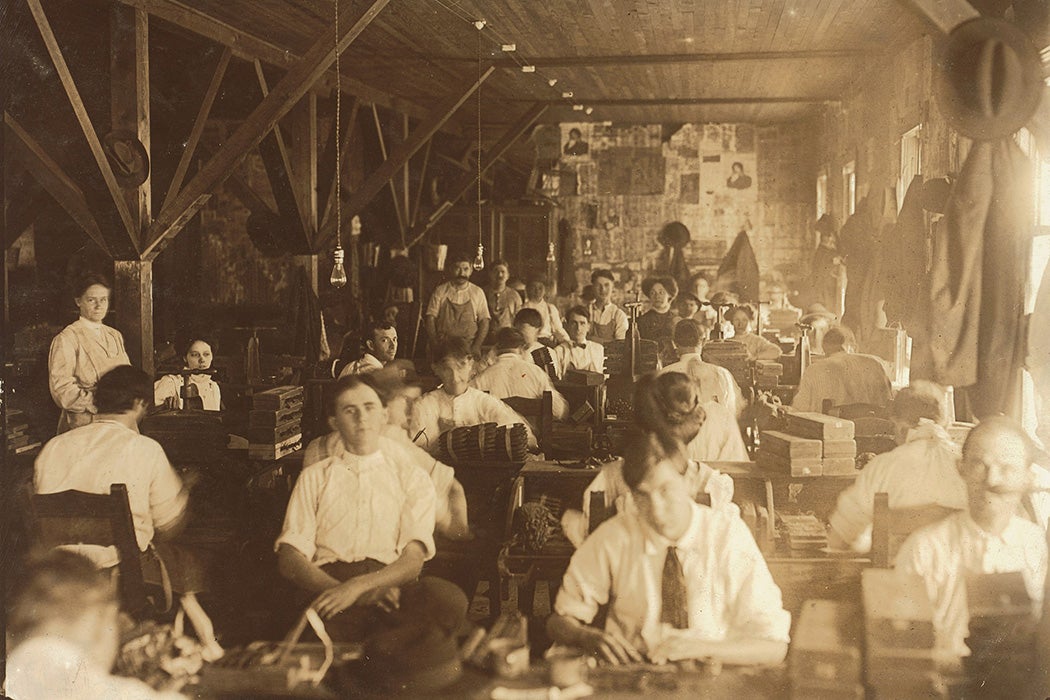
A few of the workers of the San Martin Cigar Company in Tampa, Florida

Cómo Jim Crow dividió a los cubanos de Florida

Livia Gershon 

JStor Daily   21 de enero de 2024

Según el historiador Andrew Gómez, el comienzo de la Guerra de los Diez Años de Cuba en 1868 hizo que los fabricantes de cigarros cubanos y sus empleados huyeran a Florida, específicamente a Ybor City (ahora parte de Tampa) y Key West. Los trabajadores de esta industria multimillonaria tenían varias mezclas de ascendencia africana, europea e indígena. Y, a pesar de la jerarquía racial histórica de Cuba, trajeron consigo el espíritu del movimiento independentista de la nación, que estaba cada vez más comprometido con la igualdad racial.

“En Florida, los cubanos de color organizaron comités revolucionarios, trabajaron en concierto con líderes militares y mantuvieron profundos vínculos con la prensa regional”, escribe Gómez.

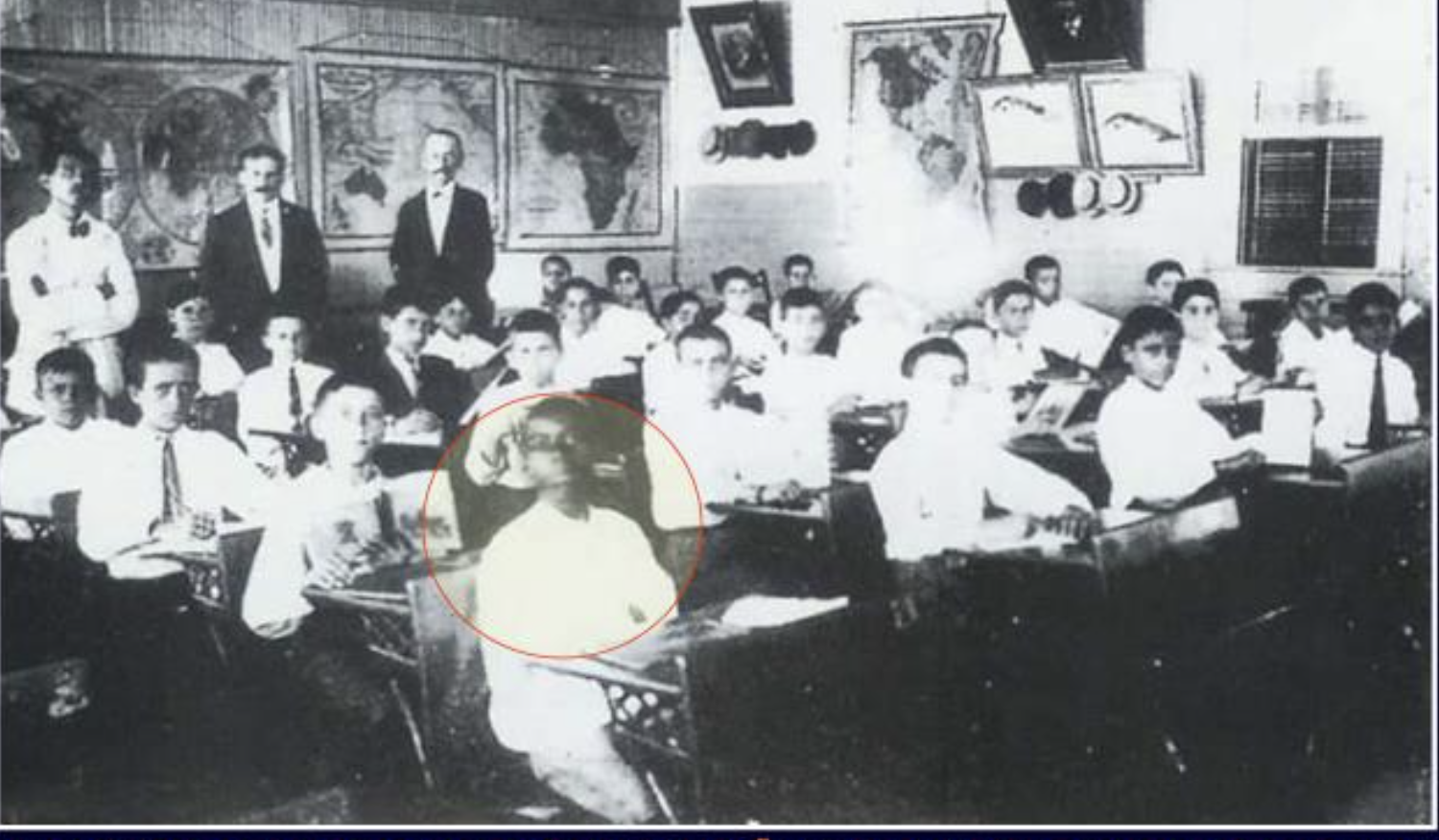
El Instituto San Carlos de Cayo Hueso, fundado en 1871 por cubanos de Florida, albergó una de las primeras escuelas racialmente integradas en los Estados Unidos y albergó conferencias muy concurridas donde se discutía la importancia de los cubanos negros para el futuro de ese país. El instituto era una de las más prominentes de las muchas sociedades de ayuda mutua de la zona, que ofrecía seguro médico, ayuda con los entierros, entretenimiento y otros servicios. Mientras tanto, en las fábricas de cigarros, las organizaciones laborales construidas por anarquistas y socialistas, como La Resistencia de Ybor City, reclutaron trabajadores de todos los puestos de trabajo sin discriminar por  raza y género.

Estudiantes del Instituto San Carlos

Para la cultura estadounidense más amplia de la época, los cubanos ocupaban un estatus racial entre negros y blancos, al igual que  los inmigrantes de Europa del Este y del Sur, los mexicanos y  los Creoles. Pero, escribe Gómez, eso comenzó a cambiar a medida que las leyes de Jim Crow y el terrorismo supremacista blanco se intensificaron.

Bajo el gobernador Edward Aynesworth Perry, elegido en 1885, el gobierno de Florida revirtió los cambios de la era de la Reconstrucción, destituyendo a los funcionarios negros de sus cargos y consagrando la segregación racial en la constitución estatal. A finales de la década de 1880, algunos de los muchos matrimonios entre cubanos de diferentes tonos de piel estaban siendo cuestionados como mestizaje (miscegenation).

A principios del siglo XX, las sociedades de ayuda mutua, incluido el Instituto San Carlos, adoptaron reglas que excluían a los cubanos negros. Y las escuelas cubanas, muchas de las cuales inicialmente habían desafiado los requisitos de segregación de la década de 1880 en Florida, se convirtieron gradualmente en instituciones solo para blancos. A algunos cubanos de piel más oscura se les prohibió la entrada a los cines y a las piscinas que disfrutaban sus primos.

Mientras tanto, escribe Gómez, los comités de vigilantes disolvieron las organizaciones sindicales radicales. En su lugar, la Cigar Makers International, afiliada a la Federación Americana del Trabajo, comenzó a organizar las fábricas de cigarros, pero solo a los trabajadores blancos.

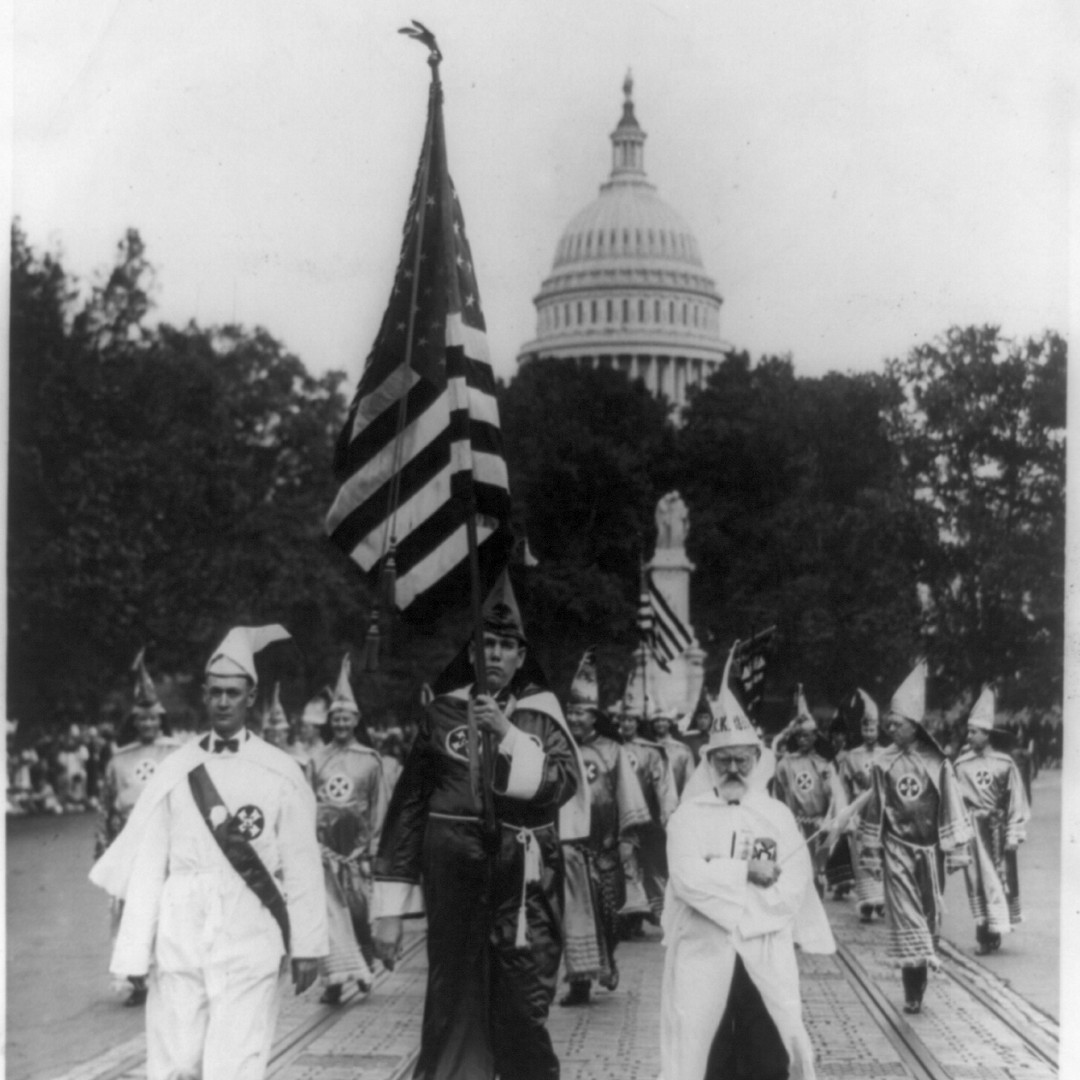
The Rise and Fall of the Second Ku Klux Klan - The AtlanticLa década de 1920 trajo la segunda ola del Ku Klux Klan a las comunidades de todo el país. En el sur de la Florida, el Ku Klux Klan atacó a miembros de la comunidad cubana, en particular a aquellos que cruzaban la línea divisoria cada vez más sólida que separaba a mujeres y hombres, blancos y negros.

La segregación legal y el terrorismo racial empujaron a los cubanos negros a las escuelas e instituciones afroamericanas, que se volvieron cada vez más multiculturales. A pesar de las barreras lingüísticas, culturales y religiosas, muchas personas de estas comunidades formaron amistades y matrimonios.

Los cubanos blancos, por su parte, siguieron la misma trayectoria que las comunidades española e italiana de la región, integrándose cada vez más en la sociedad anglosajona blanca.


Recursos

JSTOR es una biblioteca digital para académicos, investigadores y estudiantes. Los lectores de JSTOR Daily pueden acceder a la investigación original detrás de nuestros artículos de forma gratuita en JSTOR.

Jim Crow and the Caribbean South: Cubans and Race in South Florida, 1885–1930s

By: Andrew Gomez

Journal of American Ethnic History, Vol. 36, No. 4 (Summer 2017), pp. 25–48

University of Illinois Press on behalf of the Immigration & Ethnic History Society


Traducido por Norberto Barreto Velázquez

Read Full Post »

Es común conceptualizar el racismo y la segregación racial en los Estados Unidos como productos del Sur y de la guerra civil. Se olvida o peor, se esconde, que en el Norte el racismo era, tal vez más solapado, pero muy intenso y violento. En este corto e interesantísimo ensayo, la Dra. Alysa Lopez analiza las batallas que se libraron en los cines del Norte, en las primeras décadas del siglo XX,  entre los afroamericanos que reclamaban igualdad y quienes los querían mantener en una posición inferior y segregada.

Alyssa Lopez es profesora a de Historia en Providence College.  Su área de investigación es la historia afroamericana de principios del siglo XX con énfasis en el cine y el activismo. Su trabajo actual se centra en la cultura cinematográfica negra en la ciudad de Nueva York antes de la Segunda Guerra Mundial, analizando cómo los neoyorquinos negros utilizaron los teatros y el cine para luchar por la igualdad de acceso a la ciudadanía en la ciudad y la modernidad urbana frente a una sociedad abrumadoramente excluyente. Su libro, Reel Freedom: Black Film Culture in Early Twentieth Century New York City será publicado por  Temple University Press. También es editora asociada de Gotham: A Blog for Scholars of New York City History.


Las salas de cine, el norte urbano y la vigilancia de la línea de color

Alyssa Lopez 

Black Perspectives

5 de diciembre de 2023

Mientras que las áreas urbanas de Estados Unidos fueron testigos de un auge masivo en la popularidad de las películas y el cine a principios del siglo XX, estas mismas ciudades, como Nueva York, Chicago, Atlantic City y Filadelfia, trabajaron conscientemente para mantener las líneas rígidamente segregadas de la supremacía blanca. Como han explicado las académicas Jacqueline Stewart, Cara Caddoo  y Allyson Nadia Field, los principales desarrollos en la industria cinematográfica ocurrieron simultáneamente con importantes transiciones en la vida cultural y social afroamericana. De hecho, a medida que las películas se convirtieron en sinónimo de la vida urbana, los migrantes negros y los inmigrantes se dirigieron a estas áreas, aumentando el número de habitantes por miles en las ciudades del norte y el medio oeste. Junto con estos acontecimientos, las fuerzas policiales locales y los empleados de los teatros, a veces trabajando juntos, se esforzaron por mantener los límites raciales en los teatros de los barrios y en los teatros populares. El cine, “como un lugar, un medio y un conjunto de prácticas“, se convirtió rápidamente en una vía importante para reivindicar quién tenía pleno acceso a la ciudad y quién podía vivir sus vidas plenas sin inhibiciones. Entendiendo esto con bastante claridad desde el inicio del  medio, los urbanitas negros desafiaron las limitaciones de su derecho a participar en este nuevo medio de creación de lugares, utilizando una variedad de tácticas para comprometerse con el medio y exigir un acceso completo a la ciudad.

En 1909, en medio de un auge generalizado de Nickelodeon, James Metcalfe, un escritor cultural   de la revista Life y periódicos de todo el país, escribió de manera bastante explícita sobre las formas en que los empleados del teatro trabajaban con la policía para mantener sus lugares blancos. Estableció un conjunto claro de instrucciones que funcionaban para eludir los derechos civiles de los negros a sentarse donde quisieran: un ujier se ofrece a trasladar a los clientes negros sentados en la orquesta a mejores asientos; al llegar a estos nuevos asientos, los tramoyistas precolocados se pelean con los clientes negros, lo que crea un disturbio y provoca llamar a la policía; A continuación, se retira a los infractores del teatro y se les arresta. “El resto, por supuesto”, insistió Metcalfe ominosamente, “es fácil”.1 A lo largo de principios del siglo XX, a medida que las fuerzas policiales se profesionalizaban cada vez más, la industria cinematográfica se convirtió en un elemento básico cultural, y los migrantes e inmigrantes negros se mudaron en masa a ciudades en crecimiento, esta escena se repitió una y otra vez en diversas formas.

City TheatreDos años más tarde, en Manhattan, el gerente del New York Theatre llamó a la policía para denunciar al Sr. y la Sra. Roberts cuando se negaron a abandonar la sección de la orquesta para ir al balcón. A pesar del hecho de que sus boletos eran exactamente para donde estaban sentados y las leyes de derechos civiles del estado ciertamente estaban de su lado, el oficial de policía los amenazó con arrestarlos si no se movían. En un caso similar, unos años más tarde, en Cincinnati, Ohio, el hijo de un pastor local fue expulsado a la fuerza de un teatro por un oficial de policía porque la gerencia se opuso a su presencia en el establecimiento solo para blancos. Cuando el pastor acudió al alcalde y a la policía para quejarse de esta forma de discriminación descaradamente obvia, el oficial alegó ignorancia de la ley. Explicó que simplemente no era consciente de lo que no podía hacer como oficial. En otros casos, como en Filadelfia en 1929 y de nuevo en Muncie, Indiana, en 1934, el florete de Metcalfe se desarrolló exactamente como lo había planeado. Los clientes que insistían en sus derechos, negándose a moverse de los asientos comprados, fueron arrestados por conducta desordenada en el teatro.

No siempre se necesitaban agentes de policía para mantener violentamente la segregación ilegal. En 1925, el Dr. Leon Headen, de Chicago, fue brutalmente golpeado por varios ujieres cuando se negó a tomar un asiento peor que el que se le había asignado. Si bien el Dr. Headen finalmente recibió una indemnización por daños y perjuicios por la violencia física, el teatro decididamente no fue declarado culpable de discriminación. En bastantes casos, las mujeres negras fueron sometidas a la fuerza mientras los empleados de los teatros intentaban mantener la línea de color en las ciudades urbanas. En 1924, el gerente de un teatro de Filadelfia gritó epítetos raciales a una joven pareja a la que estaba tratando de echar de su teatro. A continuación, agarró a la joven del brazo y la obligó a salir. Un repartidor de boletos en Atlantic City, tan comprometido con mantener a una joven negra fuera del Teatro Real en 1937, en realidad se sacó el brazo de la cuenca, dislocándose el hombro.

Incluso sin todo esto —un arresto o un altercado violento— la amenaza de un espectáculo público mayor fue suficiente para evitar que algunos clientes negros insistieran inmediatamente en sus derechos. En estos casos, como profetizó Metcalfe, la segregación y el mantenimiento de la supremacía blanca fueron, de hecho, “fáciles”. La acusación de alteración del orden público generalmente se lanzaba sobre los clientes negros, mientras que los empleados del teatro a menudo eran deliberadamente ruidosos con aquellos a quienes intentaban mover al balcón o eliminar por completo. Muchas víctimas simplemente querían evitar cualquier posibilidad de humillación y vergüenza, eligiendo en su lugar salir del teatro sin una confrontación directa.

Aun así, existía una variada tradición de protesta contra tales abusos, movimientos deliberados que trasladaban la vergüenza de los clientes negros a los blancos (empleados y funcionarios del teatro) que infringían la ley. Muchos, como la joven pareja Roberts y el Dr. Headen, por ejemplo, presentaron una demanda contra los teatros y empleados infractores y finalmente ganaron daños y perjuicios. Activistas locales, líderes religiosos y políticos, y miembros de las ramas de la NAACP se reunieron con gerentes de teatros, como en un caso de Bayonne, Nueva Jersey, para convencerlos de que pusieran fin a la discriminación. También educaron a los residentes negros creando volantes sobre los derechos civiles, alentando a las personas a “conocer la ley, conocer sus derechos, ¡y luego defenderlos!” —y repartirlos en las iglesias.2 Otros urbanitas negros publicaron cartas al editor en periódicos negros locales, en las que exponían tanto a los empleados racistas del teatro como a los llamamientos a la acción para la comunidad negra. Algunos incluso respondieron con la misma fuerza. En un incidente, un estudiante universitario de la ciudad de Nueva York se defendió cuando varios empleados del teatro le impusieron las manos para mantenerlo fuera de la orquesta.

Alyssa Lopez – History at Providence College

Alyssa Lopez

El objetivo era evitar que la segregación y la discriminación se expandieran en  las zonas urbanas del norte y el medio oeste, lugares que antes se consideraban refugios de actos tan obvios e insidiosos de Jim Crow. En Bayonne, los activistas citaron la segregación en los teatros como “’un caldo de cultivo’ para la discriminación racial”, mientras que un periodista negro del St. Paul Echo explicó que las victorias judiciales contra los empleados racistas de los teatros “servirán como un freno a intentos similares en otras empresas”.3 La esperanza sincera era que estas extensas protestas contra la discriminación ilegal, junto con  las que se llevaban contra el cine racista como El nacimiento de una nación y otras películas, “frenaran el prejuicio del color demoníaco” antes de que se extendiera a otros lugares.4

Por mucho que se vigilara este aspecto de la vida urbana, los urbanitas negros se negaron a ceder ante Jim Crow North. Comprendieron la importancia de los vínculos del cine con otros aspectos de sus vidas en la ciudad. Una y otra vez, periodistas y activistas negros advirtieron sobre la discriminación y la segregación en las salas de cine que se extendían a más aspectos de la vida urbana: restaurantes, otras diversiones e incluso escuelas. Además, la capacidad de relacionarse con el cine se consideraba parte integrante de la plena experiencia de la gran ciudad. Delimitar dónde y cómo las comunidades negras podían hacer esto también imponía reglas (ilegales, por cierto) sobre su propia capacidad para moverse y elegir sus diversiones libremente. A principios del siglo XX, por lo tanto, el cine era un medio importante para reclamar el espacio en muchas ciudades, para reclamar el derecho a pertenecer sin concesiones, algo con lo que muchos afroamericanos buscaban lidiar y experimentar.

Referencias:

  1. “Negros en los teatros de Nueva York”, New York Age, 18 de noviembre de 1909.
  2. “Bayonne Theatre Discrimination Brings Protest”, New York Age, 13 de julio de 1929.
  3. “Bayonne Theatre”, “Comentarios de los editores de The Age sobre dichos de otros editores”, New York Age, 8 de enero de 1927.
  4. “Another Theatre Manager Fined”, New York Age, 11 de noviembre de 1911.

Traducido por Norberto Barreto Velázquez


Read Full Post »

Race to Nowhere

For over a century, black elites have pushed improved “race relations” instead of redistribution as the solution to inequality.

Jacobin  Issue 18 Summer 2015

«The Union as It Was. The Lost Cause, Worse than Slavery.» Illustration by Thomas Nast, 1874.

The new issue of Jacobin, commemorating the 150th anniversary of Union victory and emancipation, is out now.

When black progressives today think about the Civil War, they are often more struck by what didn’t happen than what did.

Michelle Alexander’s much-lauded The New Jim Crow: Mass Incarceration in the Age of Colorblindness is a case in point. Citing W. E. B. Du Bois’s lament that “former slaves had ‘a brief moment in the sun’ before they were returned to a status akin to slavery,” Alexander intimates that abolitionists failed to see that slavery was just one instance in a series of forms of “racialized social control” that not only have reappeared, but have also “evolved” and “become perfected, arguably more resilient to challenge, and thus capable of enduring for generations to come.”

What this narrative of unremitting bleakness overlooks is that the South chose armed rebellion in order to maintain political control over its system of labor — a system that enslaved blacks while impoverishing white agricultural and industrial laborers. From the standpoint of Southern planters and industrialists, the most terrifying prospect of emancipation was the possibility that laborers, black and white, would eschew elite guidance and wield political power in the form of the ballot and office-holding to further their own interests.

It came as no surprise, then, that when former slaves did begin to make this prospect a reality, Southern elites responded not only with violence and political fraud, but also with an intellectual campaign carried out in newspapers, journals, fiction, poetry, and historical writing to demonstrate the incapacity of blacks for self-government and the corruption that would ensue when the unlettered and inexperienced held the reins of power.

What is more surprising, if lesser known, is the role that many black elites (along with their sympathetic white counterparts) played in ratifying aspects of white reactionary thought toward the end of the nineteenth century. Some twenty-five years after Appomattox the fact that black men and unpropertied whites could vote made possible the rise of the Populist Movement, which directly challenged the economic order of the South by “proposing to substitute popular rule for the rule of capital.”

Black elites, whose political viability depended on their perceived legitimacy as “race leaders,” were disturbed by the reality of poor blacks acting politically without their guidance or sanction. And when the planter and industrial elite struck back against Populism with violence and disfranchisement — a backlash that tended to make all blacks, and not merely workers, its target — black elites sought to meliorate these effects by proposing a transformation — not of the economic basis of society, but rather of the black image in the white mind — to improve “race relations.”

Indeed for nearly 130 years, black elites in the United States have been offering up improved “race relations” rather then interracial workers alliances against capital as the primary solution to American inequality.

From the moment the Civil War ended, the question of what an American society without slavery would look like dominated political discussion. If the inaugural issue of the Nation magazine opined that“Nobody whose opinion is of any consequence, maintains any longer that [blacks’] claim to political equality is not a sound one,” the actual picture was more complicated.

While many black commentators and freedmen expected emancipation to usher black Americans fully and without restriction into the nation’s civic, social, and economic life, relatively few white Americans — even among those who abhorred slavery and championed the freedman’s political rights — felt similarly.

And while many Americans, black and white, celebrated the idea that the freedmen would now be able to join the ranks of wage laborers, few of either race saw this change as a significant step towards enhancing the political and economic power of workers generally against employers and landowners in the immediate aftermath of the war.

Recent commentary on the limits of emancipation has typically made much of the lack of racial egalitarianism within the Republican Party and even among abolitionists, seeing within this the seeds of subsequent political defeats.

On this account what made the Civil War and the Civil Rights victories of the 1960s something like “non-events” (and what could likewise undermine any success at ending mass incarceration) was the failure to, as Michelle Alexander puts it, “address . . . racial divisions and resentments,” which thereby allowed the next “system of racialized social control [to] emerge.”

In bringing slavery to an end the Civil War opened up contestation not only over the place that former slaves would have in American society, but also over the role that wage earners and women would play in a post-slavery political order.

Jacobin-Series-3bdd91b95cfc219305403acaa1630163

Egalitarian visions, however, were met by concerted forces that did not want the end of slavery to lead to the complete emancipation of wage laborers. That is, any newly won freedoms should not address the way that market coercion severely limited the capacity of working Americans to control their lives and destinies. And while this limitation would ultimately prove equally consequential for the subsequent history of social justice, it has often been hidden by the significant shadow cast by the narrative of American racism and white supremacy.

When John William De Forest, a former Union officer and Freedman’s Bureau administrator, published his 1867 novel Miss Ravenal’s Conversion from Secession to Loyalty — which is perhaps the only significant novel about the Civil War written by an actual combatant — he sought, among other things, to champion a view that the “victory of the North is at bottom the triumph of laboring men living by their own industry, over non-laboring men who wanted to live by the industry of others.”

Steeped in the free labor ideology of the North, De Forest’s novel spliced a love story onto a realist account of the war in a way that reflected even as it sought to suppress tensions within the idea of free labor that had come to mark the difference between North and South.

In finally uniting the book’s hero Captain Edward Colburne of the Union army with erstwhile Southern sympathizer, Miss Lillie Ravenal, whom he has loved from the beginning of the novel, De Forest reveals that his view of the ideal free laborer was less the “propertyless proletarian” whose “freedom derived not from the ownership of productive property but from the unfettered sale of . . . labor power — itself a commodity — in a competitive market” than the “independent proprietor,” who had long been identified as being independent enough to secure the freedom of thought and action necessary for responsible citizenship.

We can see the inadequacy of wage labor in Colburne’s assessment of his economic situation after the war. Here we learn that “his salary as captain” had enabled him “to lay up next to nothing,” and that rising gold prices had diminished “the cash value” of what salary he did earn.

These dire prospects, however, do not turn out to be ultimately damning. Trained as a lawyer and in possession of a small inheritance from his dead father, Colburne, by partnering with a colleague, is able in short order to find himself “in possession of a promising if not an opulent business” and is ready to assume his role as head of household with the widowed Lillie Ravenal as his wife and her son as his stepson.

As the novel moves toward a full elaboration of its vision of free labor, it also leaves by the wayside the attempt by Lillie’s father, Dr Ravenal, to reconstruct black labor. Despite being born in South Carolina and having resided in New Orleans for twenty years, Dr Ravenal is a staunch Union man. At a moment when it appears that the Union forces have secured the area around New Orleans, Dr Ravenal determines to demonstrate the superiority of free labor to slave labor by eagerly taking charge of a plantation leased to him by the federal government. His responsibility, as he sees it, is not only economic, but also ideological and pedagogical. To be successful he must “produce not only a crop of corn and potatoes, but a race of intelligent, industrious and virtuous laborers.”

So, with lectures to the ex-slaves about the virtue of labor, sobriety, and the like, Dr Ravenal sets out to put black labor to work for wages. A Confederate counterattack cuts short his “grand experiment of freedman’s labor,” but not before the novel has had time enough to make clear its view that while reconstructing black labor may ultimately succeed, the effort will take time because the habits and attitudes ingrained by a history of enslavement will not disappear overnight.

Contrasting the realities of the South as he sees it to the “pure fiction” of Harriet Beecher Stowe’s Uncle Tom, Dr Ravenal asserts, “There never was such a slave, and there never will be. A man educated under the degrading influences of bondage must always have some taint of uncommon grossness and lowness.” De Forest reiterated this vision in his reflections on his experience with Reconstruction in South Carolina, observing that “the Negro’s acquisition of property, and of those qualities which command the industry of others, will be slow. What better could be expected of a serf so lately manumitted?”

Undergirding De Forest’s vision of black freedmen gradually acquiring the skills and habits necessary to become prosperous cooperative laborers is what Eric Foner terms free labor’s belief that “a harmony of interests” defined the relation of capital to labor. The conditions necessary for capital to profit from its outlays were deemed to be those that were most conducive to the flourishing of labor. Class conflict could be imagined only in terms of deficiencies of character among the uncooperative.

Thus, despite their sympathies for the freedmen, black and white elites in the North generally embraced a view of the recently emancipated as a population in need of tutelage and leadership rather than as peers who had the capacity to present their own visions of social and economic life.

Black novelist, former abolitionist, and temperance advocate Frances E. W. Harper begins her 1892 novel, Iola Leroy, or Shadows Uplifted, with depictions of illiterate and semi-literate black slaves debating among themselves the best course of action to take in response to the approaching Union army.

However, by the later chapters of that novel, as she seeks to validate genteel black leadership, a less flattering view of freed people emerges. In one instance Harper has one of her exemplary black characters respond to a claim in the newspaper that “colored women were becoming unfit to be servants for white people,” by concluding “that if they are not fit to be servants for white people, they are unfit to be mothers to their own children.”

This character’s readiness to interpret the uncooperativeness of black domestics as indication of debility is of a piece with the novel’s larger attempt to present black labor as educable and not rebellious. As we learn from another of the novel’s admirable characters, “the Negro is not plotting in beer-salons against the peace and order of society. His fingers are not dripping with dynamite, neither is he spitting upon your flag, nor flaunting the red banner of anarchy in your face.”

These sentiments were echoed by black social reformer, Anna Julia Cooper, in her landmark 1892 work of cultural commentary, A Voice From the South, which famously asserted that it would only be when the black woman was able to enter into American society on terms of equality that true social justice would be achieved. While on Cooper’s account genteel black women should expect acceptance as full equals, laboring blacks were to be prized for racial qualities that guaranteed their capacity as tractable workers.

Cooper writes that the Negro’s “Instinct for law and order, his inborn respect for authority, his inaptitude for rioting and anarchy, his gentleness and cheerfulness as a laborer, and his deep-rooted faith in God will prove indispensable and invaluable elements in a nation menaced as America is by anarchy, socialism, communism, and skepticism poured in with all the jail birds from the continents of Europe and Asia.”

To be sure black workers were not often met with open arms by their white counterparts. And it was not always the case that black novelists assumed innate antagonism between black and white laborers. J. McHenry Jones’s 1896 novel, Hearts of Gold, depicts Welsh miners in a Southern town who, moved by their sense that convict labor “degraded” labor generally and by “a deep-seated hatred . . . against systematic cruelty,” harbor a black runaway from a convict labor camp and then march en masse to destroy the camp and liberate its inmates.

Nonetheless, the representational tendency to align black Southern labor with the interests of their employers also reflected the continued commitment of black elites to the idea “that a community of equal men could be created by allying labor (blacks) and capital to produce material progress and enlightenment,” rather than by allying black laborers with their white counterparts. Instead of building the political power of labor, they called for building the integrity and esteem of the black race.

But whether these representations of black and white labor were disparaging or laudatory, what connected them was that they were, in some way or another, a response to the rise of the Southern Alliance in the 1880s, which was followed by the emergence of the Populist Party in the 1890s.

More to the point, according to Judith Stein, the Southern Alliance was paralleled by and helped fuel the Colored Farmers Alliance, which grew to encompass more than a million black farmers by the early 1890s. While in many cases the political organization of black farm laborers strengthened the hand of black political elites in seeking concessions from white industrialists and landowners, the efficacy of these alliances also challenged the ability of these elites to set the terms and goals of black political activity.

Black elites had sought to assure whites in both the South and the North that black political participation was consistent with the idea of rule by the “best” men of society. In principle then, if not always in fact, the stance of black political elites placed them at odds with the idea that relatively uneducated laborers could wield political power effectively. Thus, in novel after novel produced by the black political class, writers inserted scenes where unschooled black laborers pleaded for the leadership and guidance of their black genteel betters.

Of course, the most egregious disparager of interracial labor alliances against capital was Booker T. Washington, the founder of the Tuskegee Institute. Indeed, historian Michael Rudolph West has credited Washington with inventing “race relations.” Washington’s 1901 autobiography, Up From Slavery, attributed Southern labor unrest to the interference of “professional labour agitators” who had their eyes on the savings of thrifty workers and goaded them into going out on strikes that would leave them “worse off at the end.”

Washington’s rise as a political force in the South coincided with the rise of Populism. The ability of Populists to mount successful political challenges to Southern Democrats depended on the votes of black Alliance members.

It was their awareness of this fact that drove white industrialists and planters in the 1890s to secure the dominance of the Democratic Party by pursuing across-the-board disfranchisement of blacks as well as many poor whites. Jim Crow America was the result of a successful counterrevolution against an interracial labor threat — a counterrevolution aided and abetted by the rise of Bookerism and the Tuskegee Machine.

What Tuskegee represented as an institution, and what Up From Slavery testified to as a program, was the idea that the problem of the South was not primarily a problem of who held political power, but rather one of determining how best to incorporate a despised caste into the social and economic fabric of the nation. In the place of political transformation Washington offered up race relations, with Tuskegee positioned to provide an army of “trained men and women to confront the militancy of an industrial proletariat.”

Viewed against the rise of Populism one can see that the Civil War, by granting blacks political rights, set the stage for what would become one of the most profound challenges to capital in the history of the United States. That the Populist challenge was defeated does not diminish its significance. And given that it was only after the defeat of Populism that disfranchisement and Jim Crow were able to succeed suggests the potential instructiveness of that history for the present moment, a history that does not attest simply to the periodic reemergence of white supremacy across time as Alexander and so many others have alleged.

Rather, if racialized forms of exclusion tend to rise in the wake of successful efforts by industrial and financial interests to undermine the political power of labor, to make our primary task that of addressing “racial divisions and resentments,” as Alexander calls for, risks giving pride of place to a new era of race relations, and not the broader vision of social justice that she describes at the end of The New Jim Crow.

Then, as now, the most reliable path to a progressive politics that produces true justice and human rights is that which begins with building the political power of workers. It is this proposition that has often made elite opponents of white supremacy — both black and white — deeply uncomfortable.
Kenneth W. Warren is a professor of English at the University of Chicago. His most recent book is What Was African American Literature?

Read Full Post »

The Cold Cases of the Jim Crow Era

The New York Times  August 28, 2015
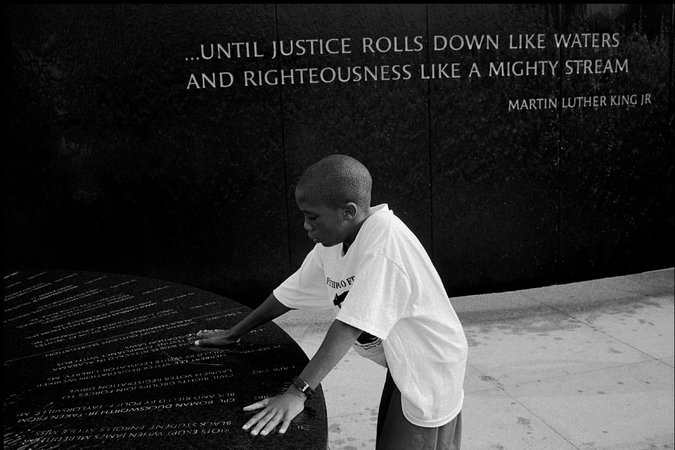
At the Civil Rights Memorial in Montgomery, Ala., in 1995. Credit Eli Reed/Magnum Photo

At the Civil Rights Memorial in Montgomery, Ala., in 1995. Credit Eli Reed/Magnum Photo

In March 1941, President Franklin D. Roosevelt received a letter from a desperate mother. Her son, who was black, had been killed two years earlier, his body pulled from a river near Pickens, Miss.

“I am sending a contract in regards to the lynching of my son Willie Jack Heggard,” wrote Jane Heggard. “I have tried every way to have a trial, but no lawyer will accept the case, because a white man killed an innocent man.”

Despite her plea, it is unlikely we will ever know who killed Ms. Heggard’s son. Roosevelt’s assistant attorney general said it was up to the state of Mississippi, which apparently failed to investigate the crime. Like the thousands of Latin American “desaparecidos” who were terrorized in the 1970s and ’80s, Willie Jack Heggard is among America’s “disappeared,” one of hundreds of black Americans who were victims of racial violence from 1930 to 1960.

Our opportunity to capture their stories — and an important part of our nation’s history — is quickly vanishing as memories fade, witnesses die and evidence disappears. Time is running out to achieve some measure of justice.

For the past seven years, we have traveled throughout the South to document these cold cases. Many of the documents — sworn statements, court transcripts and coroners’ reports — are stored in dusty courthouses, threatened by fires, floods and rodents. Compared with the relatively robust archive on lynchings between 1882 and 1930, researchers have not fully explored the social and political costs of racial violence during the 30 years before 1960.

In 2008, Congress acknowledged this gap in our historical knowledge and passed the Emmett Till Unsolved Civil Rights Crime Act, named for the 14-year-old boy who was pulled from his bed in Mississippi on Aug. 28, 1955, tortured and thrown in the Tallahatchie River. His case has not been fully resolved, although his killers confessed to a magazine in exchange for $4,000. The Emmett Till act authorizes the Department of Justice to coordinate with local authorities and investigate racially motivated homicides that occurred before 1970.

The problem is, the act has not been adequately funded, and its narrow focus on viable prosecutions limits its efficacy. Many homicides can no longer be prosecuted. In some cases, the government has limited federal jurisdiction. In others, witnesses and perpetrators have died. This year, the Department of Justice reported that it had completed just 105 investigations and three prosecutions over the past several years.

Clearly, the federal government needs to expand the act’s focus. Even if they are largely symbolic, prosecutions themselves are a form of truth telling, and require local governments who often ignored or sanctioned the killings to help re-examine this history.

In addition, prosecutions should be considered alongside remedies like truth commissions, restitution and official apologies which acknowledge that these murders were part of a pattern of intimidation against entire communities, intended to stifle full citizenship. Finally, along with better funding for the Till act, President Obama and Congress should establish an initiative to collect oral histories from this period.

It wouldn’t be the first time the federal government has undertaken a large oral history project. From 1936 to 1938, the Federal Writers’ Project conducted over 2,300 interviews with elderly former slaves. The Civil Liberties Act of 1988 funded oral histories and gave reparations to Japanese-Americans sent to internment camps during World War II. In 2000, Congress created the Veterans History Project so Americans could “better understand the realities of war.»

And several states — including North Carolina, Oklahoma and Florida — have already sponsored commissions on race riots before 1930 that attempted to assess the long-term impact of the murders, looting, arson and other property damage that ruined thriving African-American communities. Some recommended monetary reparations, economic redevelopment or commemorative monuments. Not all of the solutions were implemented, but the work itself was a significant step forward.

Some countries are confronting shameful episodes in their histories that had been intentionally ignored. In 2007, Spain passed the Law of Historical Memory to recognize those who suffered under Franco, which has supported the exhumation of graves from that era. In June, Canada’s Truth and Reconciliation Commission called the decades-long abuse of aboriginal children in residential schools “cultural genocide.”

A full accounting of the past may evoke shame, pain and impulses to remember and forget. But an acknowledgment that this legacy of violence still haunts African-American communities may foster more productive conversations and help generate trust in our legal system.

Emmett Till, who was killed 60 years ago today, is a victim whose story we know. His name endures because his mother “wanted the world to see what they did.” His memory beckons us to learn the fate of hundreds of others, like Willie Jack Heggard. We must find America’s disappeared, learn their stories and allow them to live in our history.

Read Full Post »

America’s Long History of Racial Fear

By

We’re History  June 24, 2015
An Amalgamation Waltz

An Amalgamation Waltz. Edward Williams Clay, 1839 (Photo: American Antiquarian Society)

Calling Wednesday’s shootings in Charleston a “tragedy” makes this explosion of murderous violence seem like an accident. It isn’t an accident. It is the legacy of an excruciating history that began with racial slavery and continued through the post-Civil War campaign to maintain white supremacy – a campaign that has persisted to the present day and which shapes how many white Americans think about and respond to black Americans.

At the heart of Wednesday’s violence is America’s history of chattel slavery, a labor system built on violence, in which all whites were effectively authorized to do violence to African Americans in order to keep them at work and prevent them from challenging their enslavement. But this brutal system also produced rebellions. Whites – even those who never owned a slave – lived with the fear that that racial order might be turned upside down, destroying everything that they held dear. In other words, whites attributed to blacks the same desire for domination that they themselves were exercising. It is no accident that the alleged shooter is reported to have said: “You rape our women and you’re taking over our country.”

The history of chattel slavery, upended in the Civil War, was followed by the history of Reconstruction, a moment during which America’s racial hierarchy was unsettled, and black people were able to claim a measure of political and civil equality. But the moment was a brief one. White conservatives all over the South, abetted by many white northerners, denounced the new interracial Southern governments as exactly the “world turned upside down” that they had feared during slavery. They overthrew those governments by force and fraud and set about reconstructing white supremacy as best they could without the law of slavery as a foundation.

The Reconstruction years thus gave way to another history: the continuing struggle by white supremacist activists to create and enforce Jim Crow’s exclusion, segregation, and lynching. This struggle took a lot of work, and it required that whites remain intensely fearful of blacks. One of the greatest victories of white supremacy in this era was to persuade whites that they confronted an epidemic of black men raping white women. Despite overwhelming evidence that this claim was unfounded (especially as revealed by Ida B. Wells-Barnett), the fantasy that predatory black men routinely victimized white women became the justification for lynching. Those fears may have run deepest in the South, where the great majority of the black population resided well into the twentieth century, but they found a home in the North and West as well.

As Jim Crow began to crack beneath the blows of the post-WWII black freedom movement, politicians drew on that history to sustain white racial domination. Scare campaigns against the Civil Rights Movement promised that civil and political equality would unleash black men’s alleged sexual ambitions and, once again, overturn a well-established racial hierarchy. The power and persuasiveness of those arguments helped explain the residential segregation and redlining across the North that lies at the heart of so many of today’s inequities. It lay behind the differential sentencing laws for powder and crack cocaine and undergirded the fearful discussion of “super-predators” in the 1980s and 1990s. It is still used to justify the overwhelmingly disproportionate police scrutiny, arrest, and conviction and incarceration of African Americans.

America’s long racial history of imagining blacks as fearsome, criminal, and bent on political and sexual domination has never gone away. This is not because the fantasy is real, but because it has played such a powerful role for hundreds of years. No wonder that it is so readily wielded as a weapon, whether through cynicism, ignorance, or ruthlessness. No wonder that its murderous version of history was so easy for Dylann Roof to find and embrace.

Dylan Roof’s murderous night is not simply a South Carolina tragedy. It is an expression and a consequence of American history – a history that the nation has hardly reckoned with, much less overcome.

About the Author

Stephen Kantrowitz

Stephen Kantrowitz is Vilas Distinguished Achievement Professor of History at the University of Wisconsin-Madison and the author of several books, including Ben Tillman and the Reconstruction of White Supremacy.

Read Full Post »

EJI

EJI’S NEW LYNCHING REPORT DOCUMENTS AN ERA OF RACIAL TERRORISM

Equal Justice Initiative   February 10, 2015

The Equal Justice Initiative (EJI) today released Lynching in America: Confronting the Legacy of Racial Terror, which documents EJI’s multi-year investigation into lynching in twelve Southern states during the period between Reconstruction and World War II. EJI researchers documented 3959 racial terror lynchings of African Americans in Alabama, Arkansas, Florida, Georgia, Kentucky, Louisiana, Mississippi, North Carolina, South Carolina, Tennessee, Texas, and Virginia between 1877 and 1950 – at least 700 more lynchings of black people in these states than previously reported in the most comprehensive work done on lynching to date.

Lynching in America makes the case that lynching of African Americans was terrorism, a widely supported phenomenon used to enforce racial subordination and segregation. Lynchings were violent and public events that traumatized black people throughout the country and were largely tolerated by state and federal officials. This was not “frontier justice” carried out by a few marginalized vigilantes or extremists. Instead, many African Americans who were never accused of any crime were tortured and murdered in front of picnicking spectators (including elected officials and prominent citizens) for bumping into a white person, or wearing their military uniforms after World War I, or not using the appropriate title when addressing a white person. People who participated in lynchings were celebrated and acted with impunity. Not a single white person was convicted of murder for lynching a black person in America during this period.

The report explores the ways in which lynching profoundly impacted race relations in this country and shaped the contemporary geographic, political, social, and economic conditions of African Americans. Most importantly, lynching reinforced a narrative of racial difference and a legacy of racial inequality that is readily apparent in our criminal justice system today. Mass incarceration, racially biased capital punishment, excessive sentencing, disproportionate sentencing of racial minorities, and police abuse of people of color reveal problems in American society that were shaped by the terror era.

No prominent public memorial or monument commemorates the thousands of African Americans who were lynched in America. Lynching in America argues that is a powerful statement about our failure to value the black lives lost in this brutal campaign of racial violence. Research on mass violence, trauma, and transitional justice underscores the urgent need to engage in public conversations about racial history that begin a process of truth and reconciliation in this country.

“We cannot heal the deep wounds inflicted during the era of racial terrorism until we tell the truth about it,” said EJI Director Bryan Stevenson. “The geographic, political, economic, and social consequences of decades of terror lynchings can still be seen in many communities today and the damage created by lynching needs to be confronted and discussed. Only then can we meaningfully address the contemporary problems that are lynching’s legacy.”

Read Full Post »

19up-blacksouth-master675

Black Southern Voters, Poised to Play a Historic Role

Nate Cohn

The New York Times   July 18, 2014

Southern black voters don’t usually play a decisive role in national elections. They were systematically disenfranchised for 100 years after the end of the Civil War. Since the days of Jim Crow, a fairly unified white Southern vote has often determined the outcome of elections.

This November could be different. Nearly five decades after the passage of the Voting Rights Act, black voters in the South are poised to play a pivotal role in this year’s midterm elections. If Democrats win the South and hold the Senate, they will do so because of Southern black voters.

The timing — 50 years after the passage of the Civil Rights Act and 49 years after the passage of the Voting Rights Act — is not entirely coincidental. The trends increasing the clout of black voters reflect a complete cycle of generational replacement in the post-Jim Crow era. White voters who came of age as loyal Democrats have largely died off, while the vast majority of black voters have been able to vote for their entire adult lives — and many have developed the habit of doing so.

This year’s closest contests include North CarolinaLouisiana and Georgia. Black voters will most likely represent more than half of all Democratic voters in Louisiana and Georgia, and nearly half in North Carolina. Arkansas, another state with a large black population, is also among the competitive states.

Southern black voters have already made their mark on this year’s midterm elections. Last month, Senator Thad Cochran defeated a Tea Party challenger with the help of a surge in black turnout in a Republican run-off in Mississippi.

Black voters in the South have played an important role in a handful of federal elections since 1965, when the Voting Rights Act was passed. In 1976, Jimmy Carter won the presidency with the help of black voters in the Deep South. Democrats also won many competitive Senate seats in the South in 1998. Black voters have even played a decisive role in some states that will be crucial this November: They represented about half of Senator Mary Landrieu’s supporters in Louisiana 2002 and 2008; and in North Carolina in 2008, nearly half of President Obama’s supporters were black.

But there has not been a year since Reconstruction when a party has depended so completely on black voters, in so many Southern states, in such a close national contest. President Carter, for instance, won by a comfortable margin in most of Dixie, with strong support among white voters. In 1998, Senate control was not at stake, and Mr. Obama’s 2008 victory in North Carolina was icing on the cake.

If Democrats win this November, black voters will probably represent a larger share of the winning party’s supporters in important states than at any time since Reconstruction. Their influence is not just a product of the Senate map. It also reflects the collapse in Southern white support for Democrats, an increase in black turnout and the reversal of a century-long trend of blackoutmigration from the South.

State-level Democrats performed fairly well among Southern white voters in the decades after the passage of the Voting Rights Act. A majority of white voters were still self-identified Democrats who formed their partisan allegiances when white supremacist Democrats ruled Dixie. As a result, Southern Democrats did not usually depend on black voters, who generally turned out at lower rates than white voters.

That era has come to an end. Today, the overwhelming majority of voters, white and black alike, reached voting age after the passage of the Voting Rights Act. Southern politics are now defined by the post-Civil Rights era: The old generation of Southern white Democrats has almost entirely departed the electorate, leaving white voters overwhelmingly Republican. Mr. Obama won about 15 percent of white voters in the Deep South in 2012.

Democrats lamented low black turnout for decades, but Southern black turnout today rivals or occasionally exceeds that of white voters. That’s in part because black voters, for the first time, have largely been eligible to vote since they turned 18. They have therefore had as many opportunities as their white counterparts to be targeted by campaigns, mobilized by interest groups or motivated by political causes.

Mr. Obama is part of the reason for higher black turnout, which surpassed white turnout nationally in the 2012 presidential election, according to the census. But black turnout had been increasing steadily, even before Mr. Obama sought the presidency. In 1998, unexpectedly high black turnout allowed Democrats to win a handful of contests in the Deep South; in 2002, Ms. Landrieu won a Senate runoff with a surge in black turnout.

The Supreme Court’s decision last year to strike down a central provision of the Voting Rights Act unleashed a wave of new laws with a disparate impact on black voters, including cuts in early voting and photo-identification requirements.

These laws will disenfranchise an unknown number of eligible voters, but probably not so many as to have a big effect on election results. In Georgia, where a voter ID law has been in place since 2007, the black turnout rate has increased to nearly match that of whites.

The post-Jim Crow era also led to the end and eventual reversal of the Great Migration, the exodus of blacks from the South to escape racist laws and seek better economic opportunities. The South was home to about 90 percent of the nation’s African-Americans until the beginning of the 20th century. By 1970, 53 percent of blacks lived there.

This trend reversed in the decades after the passage of the Civil Rights Act. Today, 57 percent of black Americans live in the South; more than one million black Southerners today were born in the Northeast.

Nowhere has the remigration done more to improve Democratic chances than in Georgia, where Democrats have a chance to win an open Senate seat this November. Since 2000, as the black population has risen, the share of registered voters who are white has dropped to 59 percent, from 72 percent.

The Democratic nominee in Georgia is Michelle Nunn, a candidate symbolic of generational change in her own right. She is the daughter of Sam Nunn, a conservative Democratic former senator from rural, downstate Georgia who was first elected in 1972. If Ms. Nunn wins this November, it will be with only a handful of the rural, Southern white voters who adored her father.

The state’s growing black population will give her a chance to win with less than one-third of the white vote, a tally that would have ensured defeat for Democrats just a few years ago. Her pathway to victory would be unrecognizable to her father, who never won re-election with less than 80 percent of the vote.


Read Full Post »

Who Was Jim Crow?

HNN Staff   October 31, 2011

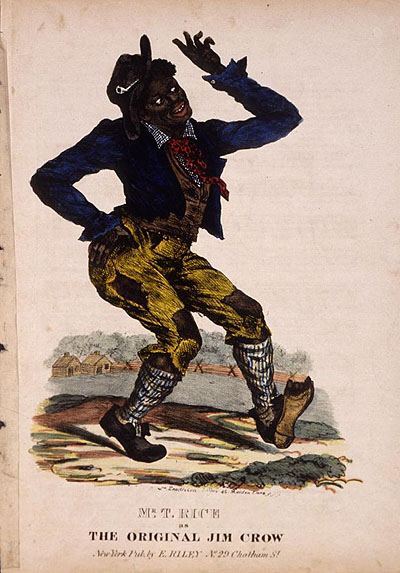
Cover to an early edition of "Jump Jim Crow" sheet music (c 1832) -- Wikipedia -

Cover to an early edition of «Jump Jim Crow» sheet music (c 1832) — Wikipedia


Jim Crow laws, as most Americans should (hopefully) know, were the racist segregation laws which cemented white supremacy over African Americans throughout the United States from the end of Reconstruction in 1877 to the civil rights movement’s victories in the mid-1960s.

But who the heck was Jim Crow, and why did his name grace some of the most odious laws in American history?

Jim Crow was not actually a person—the name comes from an 1828 show by Thomas Dartmouth “Daddy” Rice.  Rice, in a proto-minstrel act, would put on blackface and sing “Jump Jim Crow,” with the refrain:

Wheel about, an’ turn about, an’ do jis so;
Eb’ry time I wheel about, I jump Jim Crow.

The song was quite popular in the early half of the 1800s, and “Jim Crow” quickly became a disparaging term for blacks, but it wasn’t until toward the end of the century that the name was applied to the various post-Reconstruction “black codes” in the South (the New York Times referred to Louisiana’s “‘Jim Crow’ Law” as early as 1892).


The song was quite popular in the early half of the 1800s, and “Jim Crow” quickly became a disparaging term for blacks, but it wasn’t until toward the end of the century that the name was applied to the various post-Reconstruction “black codes” in the South (the New York Times referred to Louisiana’s “‘Jim Crow’ Law” as early as 1892). – See more at: http://hnn.us/article/142719#sthash.iswHNd5D.dpuf

Jim Crow laws, as most Americans should (hopefully) know, were the racist segregation laws which cemented white supremacy over African Americans throughout the United States from the end of Reconstruction in 1877 to the civil rights movement’s victories in the mid-1960s.

But who the heck was Jim Crow, and why did his name grace some of the most odious laws in American history?

Jim Crow was not actually a person—the name comes from an 1828 show by Thomas Dartmouth “Daddy” Rice.  Rice, in a proto-minstrel act, would put on blackface and sing “Jump Jim Crow,” with the refrain:

Wheel about, an’ turn about, an’ do jis so;
Eb’ry time I wheel about, I jump Jim Crow.

The song was quite popular in the early half of the 1800s, and “Jim Crow” quickly became a disparaging term for blacks, but it wasn’t until toward the end of the century that the name was applied to the various post-Reconstruction “black codes” in the South (the New York Times referred to Louisiana’s “‘Jim Crow’ Law” as early as 1892).

– See more at: http://hnn.us/article/142719#sthash.iswHNd5D.dpuf

Cover to an early edition of «Jump Jim Crow» sheet music (c 1832) — Wikipedia

Jim Crow laws, as most Americans should (hopefully) know, were the racist segregation laws which cemented white supremacy over African Americans throughout the United States from the end of Reconstruction in 1877 to the civil rights movement’s victories in the mid-1960s.

But who the heck was Jim Crow, and why did his name grace some of the most odious laws in American history?

Jim Crow was not actually a person—the name comes from an 1828 show by Thomas Dartmouth “Daddy” Rice.  Rice, in a proto-minstrel act, would put on blackface and sing “Jump Jim Crow,” with the refrain:

Wheel about, an’ turn about, an’ do jis so;
Eb’ry time I wheel about, I jump Jim Crow.

The song was quite popular in the early half of the 1800s, and “Jim Crow” quickly became a disparaging term for blacks, but it wasn’t until toward the end of the century that the name was applied to the various post-Reconstruction “black codes” in the South (the New York Times referred to Louisiana’s “‘Jim Crow’ Law” as early as 1892).

– See more at: http://hnn.us/article/142719#sthash.iswHNd5D.dpuf

Read Full Post »

The Case for Reparations: Ta-Nehisi Coates on Reckoning With U.S. Slavery & Institutional Racism

Democracy Now    May 29, 2014

An explosive new cover story in the June issue of The Atlantic magazine by the famed essayist Ta-Nehisi Coates has rekindled a national discussion on reparations for American slavery and institutional racism. Coates explores how slavery, Jim Crow segregation, and federally backed housing policy systematically robbed African Americans of their possessions and prevented them from accruing inter-generational wealth. Much of the essay focuses on predatory lending schemes that bilked potential African-American homeowners, concluding: «Until we reckon with our compounding moral debts, America will never be whole.» Click here to watch Part 2 of this interview.»:http://www.democracynow.org/2014/5/30/part_2_ta_nehisi_coateson

Transcript

This is a rush transcript. Copy may not be in its final form.

AMY GOODMAN: «The case for reparations. 250 years of slavery. Nine years of Jim Crow. 60 years of separate but equal. 35 years of racist housing policy. Until we reckon with our compounding moral debts, America will never be whole.» So begins an explosive new cover story in the June issue of the Atlantic magazine by the famed essayist Ta-Nehisi Coates. The article is being credited for rekindling a national discussion on reparations for American slavery and institutional racism.

JUAN GONZÁLEZ: In the essay, Ta-Nehisi Coates exposes how slavery, Jim Crow, segregation, and federally backed housing policy systematically robbed African Americans of their possessions and prevented them from accruing intergenerational wealth. Much of the piece focuses on predatory lending schemes that built potential African-American homeowners. This is a video that The Atlantic released a preview its new cover story, «The Case for Reparations.»

*BILLY LAMAR BROOKS SR.: This area here represents the poorest of the poor in the city of Chicago.

MATTIE LEWIS: I’ve always wanted to own my own house, because I work for white people when I was in the South, and they had beautiful homes and I always said, one day I was going to have me one.

JACK MACNAMARA: White folks created the ghetto. It drives me crazy today even that we don’t admit that. This is the best example I can think of the institutional racism.

JUAN GONZÁLEZ: To talk about «The Case for Reparations,» we’re joined now by Ta-Nehisi Coates here in New York City. Welcome to Democracy Now! You start your article with one particular figure, Clyde Ross. Tell us his story and why you decided to begin with him.

TA-NEHISI COATES: Mr. Ross is really just emblematic of much of what has happened to African-Americans across the 20th century, and I emphasize 20th century. Mr. Ross was born in the Delta region of Mississippi. His family was not particularly poor, they actually quite prominent farmers. They had their land and virtually all of their possessions taken from them through a scheme around allegedly back taxes and were reduced to sharecropping. In the sharecropping system, there was no sort of assurances over what they might get versus what they actually picked. When I first met Mr. Ross, the first thing he said to me was he left Mississippi for Chicago because he was seeking the protection of the law. I didn’t quite understand what he meant by that. But, as he explained it to me, he said, listen, there were no black judges, no black prosecutors, no black police — basically, we had no law. We were outlaws and people could take from us whatever they wanted. That was very much his early life. He went to Chicago thinking things would be a little different. On the surface, they were. He managed to get a job, got married, had a decent life. He was basically looking for that one more emblem of the American middle class in the Eisenhower years, and that was the possession of a home. Unfortunately, due to government policy, Mr. Ross at that time, like most African-Americans, was unable to secure a loan due to policies or red-lining and deciding who deserved the loans and who doesn’t. There was a broad, broad consensus that African-Americans, for no other reason besides blatant racism, could not be responsible homeowners. Mr. Ross, as happens when people are pushed out of the legitimate loan market ended up in the illegitimate loan market and got caught up in the system of contract buying, which is essentially just a particularly onerous rent to own scheme for people looking to buy houses. Ended up purchasing a house, I believe at $27,000 he paid for it. The person who sold it to him had bought the house only six months before for $12,000. Mr. Ross later became an activist, helped formed the Contract Buyers League, and just fought on behalf of African American home owner on the west side of Chicago. I should add that it is estimated during this period that 85% of African-Americans looking to buy homes in Chicago bought through contract lending.

JUAN GONZÁLEZ: Let’s hear Clyde Ross and his onward speaking a in 1969 on behalf of the Contract Buyers League a coalition of black homeowners on Chicago’s South and West Sides from all of whom had been locked into the the same system of predatory lending.

CLYDE ROSS: They have cheated us out of more than money. We have been cheated out of the right to be human beings in a society. We have been cheated out of buying homes at a decent price. Now it’s time now, we got a chance. The Contract Buyers League has presented a chance for these people in this area to move out of this crippled society, to move up. Stand on your own two feet. Be human beings, fight for what you know is right. Fight.

AMY GOODMAN: Ta-Nehisi Coates, can you talk about this example and others in this remarkable piece and how you then talk about the bill for reparations that has been introduced by John Conyers year after year in the house, and what reparations would actually look like?

TA-NEHISI COATES: What I try to establish in this piece is that there is a conventional way of talking about the relationship in America between the African-American community and the white community, and it is one that we are very comfortable with. I call it basically the lunch table view of the problem with racism in America is that black people want to sit at one table and white people want to sit at another lunch table. If we could just get black and white people to like each other, love each other, everything would be solved. In fact, even these terms that we’re using are inventions, and they’re inventions of racism. If you trace back the history back to 1619, a better way of describing the relationship between black and white people is one of plunder, the constant stealing, the taking from black people that extends from slavery up through Jim Crow policy. Slavery is obviously the stealing of people’s labor. In some cases the outright theft of people’s children, and the vending of people’s children, the taking of the black body for whatever profit you can wring from it, up through the Jim Crow South where you have a system of debt peonage, sharecropping — which really isn’t much different minus the actual selling of children you steal, exploiting labor and taking as much as you can from it. Into a system when you think about something like separate but equal. In the Civil Rights Movement, we traditionally picture colored only water fountains, white only restrooms. The thing people have to remember, if you take a state like Mississippi or anywhere in the deep South where you have a public university system, black people are paying into that. Black people are pledging their fealty to the state and yet, they aren’t getting the same return. This is theft. This is systemized. When we try to talk about the practicality of it, I spent 16,000 words almost just trying to actually make the case. At the end, what I come to is that the actionable thing right now is to support Representative John Conyers’ Bill H.R.40 for a study of what slavery has actually done, what the legacy of slavery has actually done to black people and what are remedies we might come up with. I did that not so much to dodge the question, but because I think to actually even sketch out what this might be would take another 16,000 words. We have to calculate what slavery was. We have to calculate what Jim Crow was. We have to calculate what we lost in terms of redlining and come to some sort of ostensible number and figure out whether we can actually pay it back. And if we can’t, what we might do in lieu of that.

JUAN GONZÁLEZ: When you mentioned that the systemic plunder that occurred, I mean, this is not ancient history.

TA-NEHISI COATES: No, no.

JUAN GONZÁLEZ: In the most recent economic crisis in the country, there was this enormous reduction in the wealth of African-Americans in the country as a result of the housing crisis, yet the narrative portrays it as the housing crisis was caused — the conservative narrative is — by affirmative action policies of Fannie Mae and Freddie Mac to make it easier for African-Americans with low credit to get loans. Talk about that and this enormous wealth loss that occurred recently.

TA-NEHISI COATES: Well, the great sociologist Douglas Massey has a very interesting paper out specifically about the foreclosure crisis as it should be rightly called that happened very, very recently. One of the things he demonstrates in the paper is the thing that made this possible, segregation was a driver of this. If you think about it, it makes perfect sense. The African-American community is the most segregated community in the country, and what you have in that community is a population of people who have been traditionally cut off from wealth building opportunities. So, anxious to get wealth-building opportunities. If you are a banker and you are looking sell a scheme to somebody and rip somebody off, well there your marks are, right there, right in the same place. That’s essentially what happened.

AMY GOODMAN: Ta-Nehisi Coates, I wanted to go to this issue of reparations and the examples you have seen, for example, after the Holocaust, Germany and the Jews. Can you talk about how those reparations took place?

TA-NEHISI COATES: It is very, very interesting. One of the reasons why I included that history, because as we know, reparations for African-Americans has all sorts of practical problems that we would have to deal with and fight about. I wanted to just demonstrate that even in the case of reparations to Israel, the one that’s most cited, this was not a sure thing. One thing that people often say about African-American reparations is, well, oh you’re just talking about savory, that was so long ago, as though if we were talking about a more proximate or more present case it would be much easier. But, in fact, the fact it was so close made it really, really hard for people, made it hard for some Israelis who did not want to feel like they were taking a buck off of folks’ mothers or brothers or sisters or grandmas who had just been killed. In Germany in fact, if we look at the public opinion surveys at the time, they were no more — Germans in the popular sense — were no more apt to take responsibility today than Americans are for slavery. So, it was a very, very difficult piece. What’s interesting and I think one of the lessons that can be learned from it, however, is the way it was structured. In fact, Germany did not just cut a check to Israel. What they actually did was they gave them vouchers. Those vouchers that were worth a certain amount of money, those vouchers had to be used with German companies. So, essentially, what they structured was a stimulus for West Germany while giving reparations to Israel at the same time. It gives us some clue that some sort of creative solutions we might have in the African-American community.

JUAN GONZÁLEZ: One of the issues you also raise is that this reparations demand is not new in American history. You talk about Belinda Royall who in 1783 had been a slave for 50 years, became a freed woman. She petitioned the Commonwealth of Massachusetts for reparations.

TA-NEHISI COATES: Right, right, right, and I think people think of this as something that just sort of came up, you know 150 years — Black people — reparations is basically as old as this country is, and it’s not just, as you mention, Belinda Royall, people like that, but, it is also white people who understood at the time some great injury had been done. Many of the quaker meetings for instance — basically, they would excommunicate people who didn’t just free their slaves, but actually gave them something, you know, paid them reparations in return. We have the great quote from Timothy Dwight who was the president of Yale who said, to liberate these folks, to free these folks and to give them nothing would be to entail a curse upon them. Effectively, that is actually what happened upon African American and really, I would argue, upon the country at large. Many, many people of the Revolutionary generation, the generation that fought in the Revolutionary War, understood that slavery was somehow in contradiction to what America was saying it was. Many of those folks also at the very least gave land to African-Americans when they were liberated. Some of them educated them. But they understood to just cut somebody out into the wild, which is basically what happened to black people, would not be a good thing.

AMY GOODMAN: Ta-Nehisi Coates, we want to thank you very much for being with us. We’re going to do part two right after the show and we will post it online at democracynow.org. Ta-Nehisi Coates is a national correspondent of The Atlantic where he writes about culture, politics and social issues. He has just written a cover story called «The Case for Reparations.» Ta-Nehisi Coates is also the author of the memoir «The Beautiful Struggle

Read Full Post »

The Ambivalent Legacy of Brown v. Board

Jelani Cobb 

The New Yorker  May 16, 2014

brown-board-legacy.jpg

Brown v. Board plaintiffs, Topeka, Kansas, 1953. Photograph by Carl Iwasaki/Time Life Pictures/Getty.

In March of 1863, a fugitive slave named Gordon found his way to the Union Army lines in Baton Rouge, Louisiana. Exhausted from his efforts to escape his slaveholders and their dogs, he showed up in tattered rags. When doctors examined him, they saw that his back was marred by a lattice of keloid scars, evidence of the severe whippings he’d endured in bondage. He was photographed, and the image of this former slave, stripped to the waist, with lash marks inscribed on his skin like a bas-relief, was widely distributed in the North—as indisputable evidence of the evil that had brought the nation to the brink of self-destruction. Unlike the authors of slave narratives, Gordon’s ruined flesh could not be accused of hyperbole.

Gordon enlisted in the Union Army, and the image of his lacerated back came to represent an imperative in future struggles for racial equality. Merely highlighting the existence of injustice was insufficient; you had to show the brutal consequences of that injustice, as vividly as possible.

This kind of scar-bearing was an integral part of the twentieth-century movement to uproot Jim Crow, which reached its zenith sixty years ago this Saturday, with the Supreme Court’s ruling in Brown v. Board of Education. Thurgood Marshall’s assault on the edifice of segregation had been confounded by the question of whether the Fourteenth Amendment prohibited racial segregation. The Supreme Court’s decision in Plessy v. Ferguson, in 1896, had held that a putatively benign social separation could coexist with the amendment’s guarantee of equal protection under the law. The majority opinion, in fact, went so far as to argue that efforts to overturn segregation had been motivated by blacks’ misperceptions of the practice:

We consider the underlying fallacy of the plaintiff’s argument to consist in the assumption that the enforced separation of the two races stamps the colored race with a badge of inferiority. If this be so, it is not by reason of anything found in the act, but solely because the colored race chooses to put that construction upon it.

To combat the notion that the evils of segregation were so much hyperbole, Marshall and the other lawyers at the N.A.A.C.P. Legal Defense Fund called upon the psychologists Kenneth and Mamie Clark, whose famous “doll tests” had demonstrated that racism was damaging to the minds of black children. Beginning in 1939, the Clarks had conducted experiments showing that, when presented with two dolls identical in every way except color, black children consistently attributed favorable characteristics like beauty and intelligence to the white dolls, while reserving their most negative assessments for the dolls they most resembled. The Clarks’ work demonstrated that scars need not be visible in order to be indelible, and their data helped to bolster Marshall’s contention that racial separation violated the Fourteenth Amendment’s equal-protection clause.

The nascent civil-rights movement drew its moral authority, in some measure, from the image of African-Americans who were psychologically “damaged” by the legacy of slavery and the ongoing travesty of segregation. But those arguments, about the extent to which racism had wounded the African-American mind, have had a far more complicated legacy than the celebration of Brown would suggest. As the historian Daryl Michael Scott argues in his 1997 book, “Contempt and Pity”:

Liberals used damage imagery to play upon the sympathies of the white middle class. Oppression was wrong, they suggested, because it damaged personalities and changes had to be made to promote the well-being of African Americans. Rather than standing on the ideals of the American creed and making reparations for the nation’s failure to live up to the separate but equal doctrine set forth in Plessy v. Ferguson, liberals capitulated to the historic tendency of posing blacks as objects of pity.

Six decades after the Supreme Court struck down de-jure segregation, vast swaths of the American education system remain separated by race—indeed, there has been a trend toward resegregation in many areas, particularly in the South. But the most telling indicator of the ambiguous legacy of Brown may be the way we perceive the kinds of arguments that led to the decision.

In 1986, the anthropologist John Ogbu conducted a study of African-American academic performance, and he concluded that many black students viewed high educational achievement as a form of “acting white.” Ogbu’s conclusions were widely disputed by other researchers, yet the term—succinct in its oversimplification—leapt from scholarly journals into public debates about race. The Clarks’ doll tests were seen as an indictment of white racism, but the notion of “acting white”—fundamentally rooted in a similar tendency to ascribe virtue to whiteness—was nonetheless deployed as a means of pointing toward African-Americans’ own self-defeating behavior.

This rhetoric was not confined to white conservatives. In 2004, at a dinner sponsored by the N.A.A.C.P. Legal Defense Fund to mark the fiftieth anniversary of their victory in the Brown case, Bill Cosby departed from his notes and launched into a tirade against the shortcomings of impoverished African-Americans. Speaking of Kenneth Clark, by then an elderly widower, Cosby said:

Kenneth Clark, somewhere in his home in upstate New York … just looking ahead. Thank God, he doesn’t know what’s going on, thank God. But these people, the ones up here in the balcony fought so hard. Looking at the incarcerated, these are not political criminals. These are people going around stealing Coca-Cola. People getting shot in the back of the head over a piece of pound cake! Then we all run out and are outraged, “The cops shouldn’t have shot him.” What the hell was he doing with the pound cake in his hand?

Cosby’s remarks were applauded by many on the right, as well as by more than a few African-Americans. What was once considered “damage” had been transformed—by the passage of a few decades and by the insistence that racism was behind us now—into “pathology.” Cosby’s intemperate rhetoric tapped into a vein of frustration, seldom voiced in public, that, a half century beyond the most crucial judicial decision of the civil-rights era, the problems once attributed to legal segregation managed to persist. Despite Cosby’s invective, it was never clear where that frustration should be attributed. There are no metrics for how quickly a group should recover from legally enforced subordination, and no statistical rendering of ongoing racial inequalities could match the explanatory power of a “Colored Only” sign. If these complexities confounded people like Cosby, who’d actually lived through segregation, there was scant hope that they’d be readily perceived by many people who hadn’t.

Yet some things have remained constant. Alarmingly, versions of the Clarks’ doll test conducted in the past few years still yield results similar to those of the original experiments. In 2011, the sociologist Karolyn Tyson showed that concerns over “acting white” among black students tended to arise not in overwhelmingly black schools but precisely in settings in which black students were underrepresented. And yet, sixty years after Brown, the prevailing idea in these debates remains one that is similar to the argument presented in Plessy: that the major, and perhaps the only, problem with ongoing segregation is the way black people perceive and respond to it.

The United States may not be “post-racial,” as many claimed in the wake of Barack Obama’s election, but it clearly sees itself as post-racism, at least when it comes to explaining the color-coded disparities that still define the lives of millions of its citizens.

Jelani Cobb is Associate Professor of History and Director of the Institute for African American Studies at University of Connecticut.


Read Full Post »

Older Posts »