Feeds:
Entradas
Comentarios

Archive for agosto 2015

A Guide to the Hiroshima and Nagasaki Attacks

Seventy years ago, the United States committed one of the most horrific atrocities in military history. Why?

 
Jacobin   August 9, 2015
The atomic bomb exploding in Nagasaki, Japan. Corbis

The atomic bomb exploding in Nagasaki, Japan. Corbis

Seventy years ago today, the United States detonated a plutonium implosion-type atomic bomb over the Japanese city of Nagasaki, killing between 40,000 and 80,000 people.

It was only the second time an atomic weapon had been used in warfare. The first time had occurred three days before, when the United States dropped a uranium gun-type atomic bomb on Hiroshima. Between 90,000 and 170,000 people died in that attack.

It was one of the greatest wartime atrocities ever perpetrated. The United States political and military establishment unleashed all the destructive power of the most potent weapons ever created on two civilian populations of little strategic importance. It was a brutal show of force that announced the arrival of the new American superpower and helped establish the stakes of the Cold War.

As a State Department memo written during the Carter administration explained, “the Soviets know that this terrible weapon has been dropped on human beings twice in history and it was an American president who dropped it both times. Therefore, they have to take this into consideration in their calculus.”

The nuclear attacks on Hiroshima and Nagasaki remain two of the most shameful moments in US history. Perhaps because of this lingering shame, they are too often left understudied. Often they are dismissed as acts of simple naivety — as if President Truman were unaware of the murderous potential of his Space Age super-weapons — or alternatively as an act of wanton callousness, evacuating these events of their political content.

In this short primer, Jacobin briefly describes the attacks, their aftermath, and the continuing relevance of nuclear weapons on the global stage today.

Did the US have to bomb Hiroshima and Nagasaki to end the war?

No. There is no truth to the common argument that the United States military had to use nuclear bombs on Japanese civilians to end World War II.

American leaders at the time understood well that they had other options. In fact, Truman mentions this in his memoirs, recalling his worry that, should American atomic tests fail, the Soviet ground invasion of Japan would precipitate the Japanese surrender, thus amplifying Soviet influence in East Asia. The Joint Chiefs of Staff of the US military had begun planning a detailed ground invasion of their own, a strategy deliberately developed to avoid the use of nuclear warfare in the Pacific.

But more importantly, Japan was profoundly isolated in the region and in the world following the surrender of Nazi Germany. The Japanese state had already begun to collapse, with military and executive bureaucracies in disarray. The Soviet declaration of war — which occurred on August 8, between the bombing of Hiroshima and the bombing of Nagasaki — so panicked Japanese Prime Minister Kantarō Suzuki that, when he was advised not to plan a military response to the imminent invasion, he reportedly replied, “then the game is up.”

Whatever cynical agenda motivated the American leaders’ decision to annihilate hundreds of thousands of Japanese lives with new-fangled apocalypse technology, it wasn’t out of an interest in preventing further suffering. The bombing of Hiroshima and Nagasaki was geopolitical posturing at its most barbaric, a catastrophic display of military capability engineered to send a message to the Soviet Union and other powers unfriendly to global US hegemony.

It wasn’t about ending the war. It was about announcing American willingness to use doomsday weapons on civilian populations. In August 1945, President Truman and the American establishment held a gun to the head of the entire world. And that gun remains in place to this day.

The atomic bombing of Nagasaki, Japan. Library of Congress

The atomic bombing of Nagasaki, Japan. Library of Congress

What were the effects of the bombings?

At about 11:00 on the morning of August 9, Kermit Beahan — an American bombadier who would later describe the attack as “the best way out of a hell of a mess” — found a hole in the clouds above Nagasaki and dropped the atomic bomb. It took about forty-six seconds to fall. When it exploded there was an overwhelming flash of light, followed ten seconds later by a deafening roar.

Speaking to the Houston Chronicle years later, Beahan would describe the aftermath of the explosion, saying, “’I saw a mushroom cloud bubbling and flashing orange, red and green. It looked like a picture of hell. The ground itself was covered by a rolling black smoke.”

The temperature under the explosion has been estimated to exceed 3,000 degrees centigrade — hot enough to incinerate human bodies. Sharp heat rays carried enormous amounts of radiation, which were imperceptible in the moment but would have devastating health effects. The risk of developing leukemia has been estimated at 46 percent for those exposed to  atom bomb radiation.

The obscenity of the nuclear attacks is illustrated in vivid detail in the testimony of survivors, known in Japan as hibakusha.

Emiko Fukahori was only seven-years-old at the time of the bombing, which occurred as she played in a shady bamboo grove close to Nagasaki:

I was totally absorbed in playing when I heard the sound of an airplane (a B-29). I somehow immediately knew it was an enemy aircraft. … When the bomb exploded, the first one into the shelter was Sumi-chan, then me, and then a third child. The last girl was incinerated and died on the spot. When I was going into the shelter, I felt the heat on my back, so I escaped the fate of the third child by just a hair’s breadth.

When I left the shelter, the adults had been burnt all over their bodies, and were gasping for breath. The surrounding area had completely changed– all the large moso bamboo trees had been knocked down. A woman covered in blood was calling for help as she came up from below, which frightened me. …

Fukahori’s older brother also survived the explosion. But, like many who experienced the bomb’s lethal radiation, his health began to deteriorate soon afterward.

He started suffering nosebleeds about a week after the bombing. They called a doctor, and my aunt put a wash basin by his side and stayed up all night taking care of him. But the bleeding from his gums and nose grew worse, and he finally died on the 22nd.

Before he breathed his last, he complained that his stomach and legs hurt very much. I was sleeping next to him, and he told me to bring a knife because an atomic bomb was lodged in his stomach. I couldn’t bear to watch him suffer, so I got up to get him a knife, but my uncle scolded me.

My brother’s corpse had no blood at all. It was as white as a wax dummy. My mother died in Nagasaki at about the same time, and my sister and younger brother died weeping over her body. I was told they held the funeral for all three on the same day.

Horrific symptoms of this kind were widespread.

Tatsuichiro Akizuki was a young doctor at a Nagasaki medical center 1.4 kilometers from the explosion’s epicenter. At the time of the explosion he was working at the hospital, and recalls yellow smoke billowing in through the building’s collapsed stories. It didn’t take long for the wounded to begin approaching the hospital.

About 10 or 15 minutes later, throngs of wounded people streamed up the hill to the hospital. The people in the nearby fields and streets looked as if they had all been burned white, and they had somehow lost their clothes. They staggered towards us, heads in their hands, calling for help. The people who came later were different. Their faces were blackish and had swollen like pumpkins. You couldn’t tell the men from the women. They all stopped to wash off in the river, started walking again, and then stopped to wash off again. Then they all fell flat on their faces and stopped walking. There were a lot of blackened corpses by the river’s edge. …

There were corpses in which the heads had been split open, and intestines were spilling from their abdomens. Most of the others had burns–on their face and back, their legs and calves, or their chest and abdomen. The people who were in the fields and paddies turned around to look behind them when the flash from the bomb came, and they were burned on their face and back at the same time

He provided round-the-clock treatment to thousands of bomb victims, encountering symptoms he had never seen before and that he was entirely unprepared to treat.

Starting about the third day, patients turned black and had diarrhea. They told me that blood had come from their mouths, which had turned purplish. By the fourth or fifth day, I thought this might have been dysentery or peliosis. But some of those people had not been wounded in the bombing, and I began to get suspicious and had a sense of foreboding.

The effects of the bombing lingered long after the morning of the August 9, 1945. Amnesty International estimates that by the end of 1945, 70,000 people had died in Nagasaki as a result of the bombing. In the 40 years that followed, 24,000 more would perish as a result of radiation toxicity and burning.

On November 2, Japan signed the instruments of surrender, effectively surrendering control of the Japanese state and economy to the American establishment.

What did the American public think?

The unprecedented horror of nuclear warfare — so recklessly unleashed by the American executive without so much as a pale imitation of democratic decision-making or regard for human life — managed to cut through even the patriotic bravado of the World War II homefront. Though conservative elements of the public — and most of the military establishment — welcomed the use of the bombs and praised Truman’s choice to deploy such novel killing instruments, Americans were overwhelmingly disquieted by the attacks.

Even Truman felt the need to backpedal a little bit when the extent of the devastation became clear. Instead of the chest-pounding typical of wartime presidents, he offered a lukewarm statement that approaches, but stops short, of an apology — the political equivalent of a grimace and a shrug:

I realize the tragic significance of the atomic bomb … It is an awful responsibility which has come to us … We thank God that it has come to us, instead of to our enemies; and we pray that He may guide us to use it in His ways and for His purposes.

But even American Christian organizations — hardly known for their willingness to contradict the president or criticize the military — weren’t willing to concede this faux-theological justification for such careless destruction of human life. In 1946, the Federal Council of Churches issued a strongly-worded statement that read:

As American Christians, we are deeply penitent for the irresponsible use already made of the atomic bomb. We are agreed that, whatever be one’s judgment of the war in principle, the surprise bombings of Hiroshima and Nagasaki are morally indefensible.

Internationally, the response was even graver. Unsurprisingly, the bombings found little support among the millions of people living in Third World nations who now witnessed the scale of US cruelty during wartime, and who imagined their own hamlets, ports, and cities in the place of Hiroshima and Nagasaki. And a war-weary Europe was largely unimpressed with the careless savagery of the American military, having recently seen their own cities demolished by bombs while the United States mainland remained entirely untouched.

The human effects of the bombings were so shocking that almost no one could celebrate them uncritically without inviting criticism from the Left, Right, and center.

But, true to form, the jingoistic American enchantment with US military capacity proved strong enough to make hometown heroes out of some participants in the nuclear attacks, including the navigator of the Hiroshima bomber Enola Gay, who was uncritically celebrated in his small Pennsylvania town’s local paper as recently as last year.

Ground Zero in Hiroshima, Japan. US Army

Ground Zero in Hiroshima, Japan. US Army.

What effects have the bombings had on global politics?

Following the introduction of nuclear weapons to the arsenals of the world’s largest military powers, a strong international movement for nuclear disarmament emerged, lambasting global leaders as careless cynics who had put humanity on the path towards annihilation. With the horror witnessed in Hiroshima and Nagasaki fresh in the minds of many, the movement quickly gained traction and became a real force in international politics, helping to encourage the passage of the Nuclear Non-Proliferation Treaty in 1970 and contributing the commonly-used peace sign to the lexicon of popular political symbols.

In 1982, one million people demonstrated in New York City’s Central Park, demanding a bilateral end to nuclear arms testing in an effort to de-escalate the Cold War. It has been celebrated as the largest political demonstration in American history.

But despite this pushback, nuclear capability continues to be a potent bargaining chip in diplomatic negotiations. The United States occupies the ironic position of self-appointed moral gatekeeper of nuclear technology worldwide — as if the country’s spectacular demonstration of the bomb’s destructive potential in 1945 granted the US an historical right to determine who gets to have it and who doesn’t. And this has served to obscure the United States’ continued interest in developing increased nuclear capability and repeated flouting of its own treaties limiting nuclear weapons manufacturing.

Most recently, the international community has witnessed American saber-rattling in response to Iranian nuclear ambitions, and the specter of nuclear warfare has been used twice to justify US military interventions in Iraq.

How should we remember the bombings?

The bombings of Hiroshima and Nagasaki offer a powerful reminder of the savagery of war. And the unilateral decision of the military and executive branches to develop nuclear weapons and launch the devastating attack offers insight into the power mechanics of the US state.

But despite the richness of these political conclusions — and the vital importance of building towards a world free of the possibility of nuclear war — there are moments when all we can do is mourn.

We mourn the hundreds of thousands of lives lost in Hiroshima and Nagasaki, as socialists and as human beings.

Jonah Walters is a researcher at Jacobin.

Read Full Post »

Lyndon B. Johnson-Remarks on the Signing of the Voting Rights Act (August 6, 1965)

Read Full Post »

“We Have Passed the Stage of Amateur Evil:” Scientists respond to the Atomic Bomb, August 6, 1945

A mother fled the flames with her child in her arms.

A mother fled the flames with her child in her arms. Yamada Ikue. Age at blast: 12, Image created at: 41(Photo: Hiroshima Peace Memorial Museum, MIT Visualizing Cultures)

On August 6, 1945, Eugene Cotton, a Lieutenant in the US Army Air Corps, wrote to his fiancée from his posting in California.

Dearest Mary,This morning I opened my eyes about 4 a.m. and found myself wide awake for no apparent reason. An odd feeling overcame me that something terrible had happened, and yet it seemed foolish to think so. Finally I went back to sleep and convinced myself that all was well. Then, when the news was broadcast at noon, I knew I had been right. The announcement of the new atomic bomb, and its use without warning, made me realize that we have passed beyond the stage of amateur evil. Man has openly begun to lay plans for his own destruction.

Cotton was one of hundreds of thousands who, having left service in the European theater of the war, were slated to take part in a massive invasion of the Japanese islands in late 1945 and early 1946. He was 23 years old, a recent college graduate with a degree in physics, and had undergone training at both MIT and Berkeley before joining the Army to do meteorological work in the Atlantic. The atomic bomb the United States dropped on Hiroshima on August 6, 1945 may have saved his life, but as a scientist, he was horrified by what he saw.

He was not alone. Much has been written about the political decisions made in those fateful days between the successful Trinity nuclear test in July 1945 and its deployment in early August, though it is clear that Truman himself was never particularly in doubt about what he would do. But the scientific community was split by the bomb. Even many of those physicists who had helped conceive and design it eventually came to oppose its use. Physicists like Albert Einstein, J. Robert Oppenheimer, and Leo Szilard – among many others – found their own beliefs challenged by the awesome responsibility of the bomb and its implications for future generations.

In August of 1939, Albert Einstein – acting on prompting from fellow physicist Leo Szilard – wrote a letter urging US President Franklin D. Roosevelt to consider the creation of a bomb based on the principle of nuclear fission. Einstein was a pacifist by nature, but feared that Hitler’s Germany, with its access to skilled physicists and intent on expanding its natural resources, would develop a fission bomb. Roosevelt largely ignored the letter until just before the country’s entry into the war in 1941, when he created an organization to attempt development of an atomic weapon. Einstein himself was too high profile to take part in the top secret Manhattan Project, however, and grew increasingly wary of it, especially after the bomb’s use in August 1945. In 1952, Einstein spoke out strongly against the arms race that his work helped precipitate, asserting that “[nations] feel moreover compelled to prepare the most abominable means, in order not to be left behind in the general armaments race. Such procedure leads inevitably to war, which, in turn, under today’s conditions, spells universal destruction.” Einstein later called his involvement in the Manhattan Project his life’s biggest regret.

Einstein was not the only major figure to turn away from what he created. Few were more intimately involved with the creation of the first atomic bomb than J. Robert Oppenheimer, the head of the lab at Los Alamos, New Mexico, the lab that actually created and tested it. Oppenheimer’s involvement during the program itself was energetic and enthusiastic; his fellow project members were often in awe of his work ethic and mastery of the project’s many details. He was an unabashed champion of the bomb.

And then he saw it go off.

Oppenheimer told different versions of what went through his head when he saw the first nuclear explosion, but in the mid-1950s he often claimed that a line from the Hindu Bhagavad Gita, “I am become Death, destroyer of worlds,” summed up his reaction to the sight. Over the five years after the Trinity test in New Mexico, Oppenheimer began to shift his support, pushing for international control over atomic weaponry, especially after fellow Manhattan Project member Edward Teller helped create a working theory for a hydrogen bomb. Indeed, Teller attempted to have Oppenheimer’s security clearance revoked in the 1950s because of his opposition to the hydrogen bomb project and the development of thermonuclear weapons. In later life, Oppenheimer tried to direct scientific inquiry away from the development of ever more advanced weapons and toward a more creative, productive nuclear science.

Of those who worked on the Manhattan Project, the one who most completely reversed his support for the atomic bomb was, ironically, the man who had first conceived of the concept of a nuclear chain reaction, Dr. Leo Szilard. Szilard was a Hungarian Jew and a refugee from the increasingly hostile atmosphere in Europe in the 1930s. Terrified of a bomb in the hands of Hitler’s Germany, Szilard was the one who pushed Einstein to write his fateful letter. Unlike Einstein, though, Szilard took part in the work at Los Alamos. There, he was generally seen as a disruptive influence, often at odds with the Project’s military head, General Leslie Groves. By the end of the war, Szilard was questioning whether the bomb should be used at all. He attempted to convince President Roosevelt that using the bomb would be a moral failing and might unleash an uncontrollable nuclear arms race, but Roosevelt died, leaving the decision to Truman. Following the nuclear destruction of Hiroshima and Nagasaki, Szilard wrote extensively against the bomb. In a 1947 article in the Bulletin of Atomic Scientists entitled “Calling for a Crusade,” Szilard called science in general into question for pursuing “progress” without ethics. In 1949, he wrote a short story in which he imagined himself a war criminal in a future destroyed by atomic weapons.

Eugene Cotton, too, feared this in 1945. He worried that with the bomb, the country had set “a horrible pattern for the next half-century.” He blamed not science itself, but the scientists who took part in the project: “What makes me most fearful and ashamed is that highly regarded physicists have developed this thing, using the highest forms of our science. I can think of no greater disgrace than to have made possible such a weapon.” He called the scientists on the project “unaffected and unmoved” – an opinion formed from immediacy and youth, but not unsupported by evidence. He saw the events of that morning as the worst possible outcome of science: destruction in the place of progress, hubris over morality, technology as God.

Cotton concluded his letter to his wife, promising that he still had “much hope, for us and our generation.” In the end, he and men like him helped to provide that hope. Though the world certainly felt the weight of a looming nuclear war for the next half-century, it never did experience one, thanks in part to the regrets and warnings of Cotton and his fellow scientists.

Andrew Lipsett

Andrew Lipsett teaches United States History at Billerica Memorial High School in Billerica, MA. His interests include race, identity, and membership, and he blogs about history, memory, and memorialization at Graves of Note.

Read Full Post »

W. E. B. Du Bois to Malcolm X: The Untold History of the Movement to Ban the Bomb 

By Vincent Intondi

Zinn Education Project July 30, 2015

Coretta Scott King (R) with Women Strike for Peace founder Dagmar Wilson (L) in a march on the United Nations Plaza, New York City, Nov. 1, 1963. Image: © Bettmann/CORBIS, used with permission.

When the Rev. Martin Luther King Jr. announced his strong opposition to the war in Vietnam, the media attacked him for straying outside of his civil rights mandate. In so many words, powerful interests told him: “Mind your own business.” In fact, African American leaders have long been concerned with broad issues of peace and justice—and have especially opposed nuclear weapons. Unfortunately, this activism is left out of mainstream corporate-produced history textbooks.

On June 6, 1964, three Japanese writers and a group of hibakusha (atomic bomb survivors) arrived in Harlem as part of the Hiroshima/Nagasaki World Peace Study Mission. Their mission: to speak out against nuclear proliferation.

malcolmx_yuri_kochiyama

Malcolm X and Yuri Kochiyama

Yuri Kochiyama, a Japanese American activist, organized a reception for the hibakusha at her home in the Harlem Manhattanville Housing Projects, with her friend Malcolm X. Malcolm said, “You have been scarred by the atom bomb. You just saw that we have also been scarred. The bomb that hit us was racism.” He went on to discuss his years in prison, education, and Asian history. Turning to Vietnam, Malcolm said, “If America sends troops to Vietnam, you progressives should protest.” He argued that “the struggle of Vietnam is the struggle of the whole Third World: the struggle against colonialism, neocolonialism, and imperialism.” Malcolm X, like so many before him, consistently connected colonialism, peace, and the Black freedom struggle. Yet, students have rarely heard this story.

With the recent developments in Charleston surrounding the Confederate flag, there is a renewed focus on what should be included in U.S. history textbooks and who should determine the content. Focusing on African American history, too often textbooks reduce the Black freedom movement to the Montgomery Bus Boycott and the March on Washington. Rosa Parks and Dr. King are put in their neat categorical boxes and students are never taught the Black freedom struggle’s international dimensions, viewing slavery, Jim Crow, and the Civil Rights Movement as purely domestic phenomena unrelated to foreign affairs. However, Malcolm X joined a long list of African Americans who, from 1945 onward, actively supported nuclear disarmament. W. E. B. Du Bois, Bayard Rustin, Coretta Scott King, Dr. Martin Luther King Jr., and the Black Panther Party were just a few of the many African Americans who combined civil rights with peace, and thus broadened the Black freedom movement and helped define it in terms of global human rights.

W. E. B. Du Bois

W. E. B. Du Bois

If students learn about Du Bois at all, it is usually that he helped found the National Association for the Advancement of Colored People (NAACP) or that he received a PhD from Harvard. However, a few weeks after the atomic bombings of Hiroshima and Nagasaki, Du Bois likened President Truman to Adolph Hitler, calling him “one of the greatest killers of our day.” He had traveled to Japan and consistently criticized the use of nuclear weapons. In the 1950s, fearing another Hiroshima in Korea, Du Bois led the effort in the Black community to eliminate nuclear weapons with the “Ban the Bomb” petition. Many students go through their entire academic careers and learn nothing of Du Bois’ work in the international arena.

bayardrustin_antinuclearrally

Bayard Rustin speaking at the 1958 Anti-Nuclear Rally in England. Image: Contemporary Films.

If students ever hear the name Bayard Rustin, it is usually related to his work with the March on Washington. He has been tragically marginalized in U.S. history textbooks, in large part because of his homosexuality. However, Rustin’s body of work in civil rights and peace activism dates back to the 1930s. In 1959, during the Civil Rights Movement, Rustin not only fought institutional racism in the United States, but also traveled to Ghana to try to prevent France from testing its first nuclear weapon in Africa.

These days, some textbooks acknowledge Dr. King’s critique of the Vietnam War. However, King’s actions against nuclear weapons began a full decade earlier in the late 1950s. From 1957 until his death, through speeches, sermons, interviews, and marches, King consistently protested the use of nuclear weapons and war. King called for an end to nuclear testing asking, “What will be the ultimate value of having established social justice in a context where all people, Negro and White, are merely free to face destruction by Strontium-90 or atomic war?” Following the Cuban Missile Crisis in October 1962, King called on the government to take some of the billions of dollars spent on nuclear weapons and use those funds to increase teachers’ salaries and build much needed schools in impoverished communities. Two years later, receiving the Nobel Peace Prize, King argued the spiritual and moral lag in our society was due to three problems: racial injustice, poverty, and war. He warned that in the nuclear age, society must eliminate racism or risk annihilation.

cnd_letter_mlk_650pxw

Letter from the Campaign for Nuclear Disarmament inviting Dr. King and Bayard Rustin to their mass march. Click to read letter at the King Center website.

Dr. King’s wife largely inspired his antinuclear stance. Coretta Scott King began her activism as a student at Antioch College. Throughout the 1950s and 1960s, King worked with various peace organizations, and along with a group of female activists, began pressuring President Kennedy for a nuclear test ban. In 1962, Coretta King served as a delegate for Women Strike for Peace at a disarmament conference in Geneva that was part of a worldwide effort to push for a nuclear test ban treaty between the United States and the Soviet Union. Upon her return, King spoke at AME church in Chicago, saying: “We are on the brink of destroying ourselves through nuclear warfare . . . . The Civil Rights Movement and the Peace Movement must work together ultimately because peace and civil rights are part of the same problem.”

Soon, we will commemorate the 70th anniversaries of the atomic bombings of Hiroshima and Nagasaki. Not long after comes the anniversary of the 1963 March on Washington. Students will then return to school and to their history textbooks. However, most will not learn how these issues are connected. They will not learn of all those in the Civil Rights Movement who simultaneously fought for peace. But this must change, and soon. The scarring of war and poverty and racism that Malcolm X spoke of continues. It’s time that students learn about the long history of activism that has challenged these deadly triplets.

vincent_intondiVincent J. Intondi is an associate professor of history at Montgomery College and director of research for American University’s Nuclear Studies Institute. He is the author of African Americans Against the Bomb: Nuclear Weapons, Colonialism, and the Black Freedom Movement(Stanford University Press, 2015).

Read Full Post »

America’s First Muslim Convert: Alexander Russell Webb

Webb1

In a post-9/11 world, there are a variety of representations of Islam. From the US President, to academics, to twenty-four hour news talking heads, many praise Islam as peaceful or condemn it as a religion of hate. What many forget is that this love-hate representation of Islam goes back to over a century. While the current series on Islam in America focuses on a variety of representations of Islam, positive and negative, this post focuses on one of the earliest proponents of Islam in America, the tradition’s first American convert, Alexander Russell Webb.

The Nineteenth Century was a period of unprecedented religious innovation within the United States. Traditions such as Mormonism, Spiritualism, Christian Science, New Thought, Theosophy, as well as small religious movements based on charismatic figures all flourished. It was also at this time that America started looking east and paying attention to the religions of India, China, and Japan. By the end of the century, the first American Buddhist organization was founded by Japanese missionaries in California. It was during this period when so many eyes were looking east that Alexander Russell Webb found Islam.

Born in 1846 in the Hudson River Valley in the state of New York, Webb grew up surrounded by great diversity of people and religious traditions. It was in Upper State New York that Joseph Smith, Jr. claimed to be visited by the Angel Maroni, thus founding Mormonism, and it was also here that the Fox Sisters heard spectral wrapping that led to the emergence of Modern Spiritualism. While Webb was brought up a Presbyterian, by the time he reached maturity and attended Claverack College in Claverack, New York, which promoted free thinking and intellectual rigor, he had been exposed to a variety of religious traditions. Later in life he claimed to lose his religion in his mid-twenties, but it is fair to say he became disillusioned with the faith of his childhood and became a seeker. Webb’s biographer, Umar F. Abd-allah, calls this Webb’s “Spiritual Vagabond” period.[1] As with most seekers, he read about and investigated other religions, usually by reading various texts. This came to a head in 1880-81 when Webb joined the Theosophical Society and converted, as so many Theosophists did, to Buddhism.

Webb2

The Theosophical Society, founded in 1875 in New York City, claimed that all religions derived from one ancient wisdom and thus all religions contained at least a portion of the truth. However, in the earliest years, the society promoted the view that Buddhism and Hinduism contained the truest forms of those traditions and thus Theosophists promoted these traditions, in opposition to Western traditions, especially Christianity. Webb became interested in these “Oriental” ideas and found a group of like-minded people who shared his rejection of Christianity and the materialism of Victorian America. At one point Webb traveled to India, the place where the Theosophical Society moved its headquarters, and met numerous Theosophists, some of which were Muslim. It was also within the context of Theosophy that Webb first learned about Mohammed and he began to study his history and the history of Islam. According to Theosophical sources, Webb gave a lecture in India about Mohammed’s orientalism explaining how it was compatible with Theosophical principles. Finally, Webb claimed that Mohammed had secret, esoteric teaching that only the privileged few knew.[2]

Webb began to correspond with a number of Muslims at this time from a variety of places. One important correspondence was with Mirza Ghulam Ahmad, a controversial leader in Islam. He claimed that he was the fulfiller of the end times prophesies and that Islam was the final dispensation of the truth. While the correspondence was brief, lasting from 1886-1887, it was influential on Webb who seemed to decide that Islam was the best eastern religion to manifest the Ancient Wisdom of which Theosophy spoke. Webb writes to Ahmad, “I think I understand you to be a follower of the esoteric teachings of Mohammed, and not what is known to the masses of the people as Mohammedanism.”[3] Webb also corresponded with prominent American officials and through these connections was appointed Consul to the Philippines by the United States government in 1888.[4] It was during his time in the Philippines that Webb finally converted to Sunni Islam. After his conversion, his family who had also moved to Manila converted. Webb maintained his correspondence with prominent Muslim figures throughout India and the Middle East.

In 1892 Webb resigned from his position in Manila and traveled to India where he met up with Moulvi Hassan Ali and other Muslims to raise funds for American missionary work. Having been an American Consul afforded Webb many privileges as he traveled and he used these advantages towards furthering his cause. After a year of traveling throughout India seeking funds, Webb finally returned to America, arriving in New York City in February 1893. It was in Manhattan that Webb began promoting his faith, publishing a book entitled Islam in America. The purpose of the book, he claims is to “give to the English-speaking world a brief but accurate and reliable description of the character and purpose of Mohammed (pbuh), and a general outline of the Islamic system.”[5] He also published an English language newspaper called, Moslem World, promoting Islam and giving news of various kinds relevant to the religion. All these efforts to promote Islam in a positive light were funded by his supporters South Asian Muslim and Ottoman supporters, including the Ottoman Sultan Abdul Hamid II.[6] However, their support was intermittent and thus Webb often struggled to make ends meet.

Perhaps his most successful attempt to promote Islam positively and the event for which Webb is best known is his attendance as the only representative for Islam at the 1893 World Parliament of Religions.  The World Parliament of Religions took place in Chicago during the Columbian Exposition, the World’s Fair. During his speech, he criticized the bigotry against Muslims by Americans, noting how any Muslim who does wrong becomes representative of the whole religion. Webb also implored his audience to see the reason and logic behind Islam and to give it a fair chance by impartially studying it. Overall his efforts received positive, or at least polite responses, all except his mild defense of Islamic polygamy which was met with hisses and rebuke.[7]

Webb returned to New York City to continue his missionary work, but he made little progress and continued to struggle to secure funding for his mission. In 1901 he travelled to Turkey where he was awarded a medal by the Sultan for his missionary work. Eventually he relocated to New Jersey where he lived out the rest of his life promoting Islam to the best of his ability.

Webb grew up at a time of great religious change and innovation. Not only were new religions being founded, but religions from Asia were seen as viable alternatives to traditional forms of Christianity. America was no longer isolated by two oceans, its citizens and religious traditions were being exported and new religions imported. His adoption and promotion of Islam offers a great example of the ways Islam has been represented within the public over the last century. After the American Civil War, the United States began a new spiritual quest, looking for renewal and rebirth. In Webb, one strand of that rebirth begins. While he was far from successful in his efforts to spread his newfound faith, his tireless missionary work laid the groundwork for those that followed.

For more about Alexander Russell Webb see:

Abd-allah, Umar F., A Muslim in Victorian America: The Life of Alexander Russell Webb. New York: Oxford University Press, 2006.

Seager, Richard Hughes, ed., The Dawn of Religious Pluralism: Voices from the World Parliament of Religions, 1893. La Salle: Open Court Press, 1993.

Footnotes

[1] Abd-allah, Umar F., A Muslim in Victorian America, 52.

[2] Abd-allah, Umar F., A Muslim in Victorian America, 59.

[3] Abd-allah, Umar F., A Muslim in Victorian America, 65.

[4] Curtis, Edward E., Ed. Encyclopedia of Muslim-American History, 554.

[5] Webb, Islam in America, 9.

[6] Curtis, Edward E., Ed. Encyclopedia of Muslim-American History, 554.

[7] Seager, Richard Hughes, ed., The Dawn of Religious Pluralism, 279.

About John L. Crow

John L. Crow is an Instructional Development Faculty at Florida State University’s Office of Distance Learning and a PhD graduate student in FSU’s Department of Religion. He has an extensive background in information technology and is academically trained in American Religious History and Western Esotericism. His interests, however, are wide ranging, dealing with technology related to on-line active learning, digital humanities, body studies, the intersection of science and religion, and the development of eastern religions within the west, particularly Buddhism in the West.

Read Full Post »

Harry Truman’s Atomic Bomb Decision: After 70 Years We Need to Get Beyond the Myths 

HNN August 2, 2015

President Truman’s decision to use the atomic bomb against Japan in 1945 is arguably the most contentious issue in all of American history. The bombings of Hiroshima and Nagasaki have generated an acrimonious debate that has raged with exceptional intensity for five decades. The spectrum of differing views ranges from unequivocal assertions that the atomic attacks were militarily and morally justified to claims that they were unconscionable war crimes. The highly polarized nature of the controversy has obscured the reasons Truman authorized the dropping of the bomb and the historical context in which he acted.

The dispute over the atomic bomb has focused on competing myths that have received wide currency but are seriously flawed. The central question is, “was the bomb necessary to end the war as quickly as possible on terms that were acceptable to the United States and its allies?”

The “traditional” view answers the question with a resounding “Yes.” It maintains that Truman either had to use the bomb or order an invasion of Japan that would have cost hundreds of thousands of American lives, and that he made the only reasonable choice. This interpretation prevailed with little dissent among scholars and the public for the first two decades after the end of World War II. It still wins the support of a majority of Americans. A Pew Research Center poll published in April 2015 showed that 56% of those surveyed, including 70% aged 65 and over, agreed that “using the atomic bomb on Japanese cities in 1945 was justified,” while 34% thought it was unjustified.

The “revisionist” interpretation that rose to prominence after the mid-1960s answers the question about whether the bomb was necessary with an emphatic “No.” Revisionists contend that Japan was seeking to surrender on the sole condition that the emperor, Hirohito, be allowed to remain on his throne. They claim that Truman elected to use the bomb despite his awareness that Japan was in desperate straits and wanted to end the war. Many revisionists argue that the principal motivation was not to defeat Japan but to intimidate the Soviet Union with America’s atomic might in the emerging cold war.

It is now clear that the conflicting interpretations are unsound in their pure forms. Both are based on fallacies that have been exposed by the research of scholars who have moved away from the doctrinaire arguments at the poles of the debate.

The traditional insistence that Truman faced a stark choice between the bomb and an invasion is at once the most prevalent myth and the easiest to dismiss. U.S. officials did not regard an invasion of Japan, which was scheduled for November 1, 1945, as inevitable. They were keenly aware of other possible means of achieving a decisive victory without an invasion. Their options included allowing the emperor to remain on the throne with sharply reduced power, continuing the massive conventional bombing and naval blockade that had destroyed many cities and threatened the entire Japanese nation with mass starvation, and waiting for the Soviets to attack Japanese troops in Manchuria. Traditionalists have generally played down the full range of options for ending the war and failed to explain why Truman regarded the bomb as the best alternative.

A staple of the traditional interpretation is that an invasion of Japan would have caused hundreds of thousands of American deaths, as Truman and other officials claimed after the war. But it is not supported by contemporaneous evidence. Military chiefs did not provide estimates in the summer of 1945 that approached numbers of that magnitude. When Truman asked high-level administration officials to comment on former president Herbert Hoover’s claim that an invasion would cost 500,000 to 1,000,000 American lives, General Thomas T. Handy, General Marshall’s deputy chief of staff, reported that those estimates were “entirely too high.” Hoover apparently based his projections on an invasion of the entire Japanese mainland, but military planners were convinced that landings on southern Kyushu and perhaps later on Honshu, if they became necessary, would force a Japanese surrender.

The revisionist interpretation suffers from even more grievous flaws. Japanese sources opened in the past few years have shown beyond reasonable doubt that Japan had not decided to surrender before Hiroshima. It is also clear from an abundance of evidence that U.S. officials were deeply concerned about how to end the war and how long it would take. The arguments that Japan was seeking to surrender on reasonable terms and that Truman knew it are cornerstones of the revisionist thesis. They have been refuted by recent scholarship, though impressing the Soviets was a secondary incentive for using the bomb.

The answer to the question about whether the bomb was necessary is “Yes”. . . and “No.” Yes, it was necessary to end the war at the earliest possible moment, and that was Truman’s primary concern. Without the bomb, the war would have lasted longer than it did. Nobody in a position of authority told Truman that the bomb would save hundreds of thousands of American lives, but saving a far smaller number was ample reason for him to use it. He hoped that the bomb would end the war quickly and in that way reduce American casualties to zero.

No, the bomb was not necessary to avoid an invasion of Japan. The war would almost certainly have ended before the scheduled invasion. A combination of the Soviet invasion of Manchuria, the effects of conventional bombing and the blockade, the steady deterioration of conditions in Japan, and growing concerns among the emperor’s advisers about domestic unrest would probably have brought about a Japanese surrender before November 1. And no, the bomb was not necessary to save hundreds of thousands of American lives.

The controversy over Truman’s decision seems certain to continue. The use of a bomb that killed tens of thousands instantaneously needs to be constantly re-examined and re-evaluated. This process should be carried out on the basis of documentary evidence and not on the basis of myths that have taken hold and dominated the discussion for 70 years.

J. Samuel Walker is the author of Prompt and Utter Destruction: Truman and the Use of Atomic Bombs against Japan (University of North Carolina Press, 1997, second edition, 2004). He is now working on a third edition of the book.

Read Full Post »

President Truman and the Atom Bomb Decision: “Preventing an Okinawa from One End of Japan to Another” 

HNN    August 3, 2015

What did President Harry S. Truman and his senior advisers believe an invasion of Japan would cost in American dead? For many years this has been a matter of heated historical controversy, with Truman’s critics maintaining that the huge casualty estimates he later cited were a «postwar creation» designed to justify his use of nuclear weapons against a beaten nation already on the verge of suing for peace. The real reasons, they maintain, range from a desire to intimidate the Russians to sheer bloodlust. One historian wrote in the New York Times: «No scholar of the war has ever found archival evidence to substantiate claims that Truman expected anything close to a million casualties, or even that such large numbers were conceivable.» Another skeptic insisted on the total absence of «any high-level supporting archival documents from the Truman administration in the months before Hiroshima that, in unalloyed form, provides even an explicit estimate of 500,000 casualties, let alone a million or more.»

A series of documents discovered at the Harry S. Truman Presidential Library and Museum in Independence, Missouri, and described by this author in an article in the Pacific Historical Review, tell a different story.

In the midst of the bloody fighting on Okinawa, which began in April 1945, President Truman received a warning that the invasion could cost as many as 500,000 to 1,000,000 American lives. The document containing this estimate, «Memorandum on Ending the Japanese War,» was one of a series of papers written by former President Herbert Hoover at Truman’s request in May 1945.

The Hoover memorandum is well known to students of the era, but they have generally assumed that Truman solicited it purely as a courtesy to Hoover and Secretary of War Henry Stimson, who had been Hoover’s Secretary of State. What had lain buried in the Truman Library archives, however, was Harry Truman’s reaction to Hoover’s memoranda and the “Truman-Grew-Hull-Stimson-Vinson exchange” that it prompted.

Truman reviewed the material from the former president and after writing “From Herbert Hoover” across the top of its memo 4, “Memorandum on Ending the Japanese War,” he forwarded the original copy to his manpower czar, Fred M. Vinson on or about Monday, June 4. The War Mobilization and Reconversion director had no quarrel with the casualty estimate when he responded on Thursday, 7 June, suggesting that Hoover’s paper be sent to Secretary Stimson and Acting Secretary of State Joseph C. Grew, as well as former Secretary of State Cordell Hull, who was currently a patient at the Bethesda Naval Medical Center.

Truman agreed and had his staff type up additional copies of memo 4 on Saturday, June 9 and sent them to Stimson, Grew, and Hull asking each for a written analysis and telling both Grew and Stimson that he wished to discuss their individual analyses personally — eye to eye — after they submitted their responses. Stimson subsequently sent his copy to the Deputy Chief of Staff, Major General Thomas J. Handy because he wanted to get “the reaction of the Operations Division Staff to it” and mentioned in his diary that he “had a talk both with Handy and [General George C.] Marshall on the subject.” Handy’s staff then produced a briefing paper for Stimson which drew attention to the fact that memo 4’s figure of potentially 1,000,000 American dead was fully double the Army’s estimates.  It was “entirely too high under the present plan of campaign” which entailed only the seizure of southern Kyushu, the Tokyo region, and several key coastal areas.  The pointed disclaimer “under the present plan of campaign” was, however, literally the only part of the 550-word analysis, excluding headlines, that carried a typed underline and was an ominous reminder that the battle then raging on Okinawa was itself not playing out as planned.

Hull was the first to respond directly to Truman. He branded memo 4 Hoover’s “appeasement proposal” in his June 12 letter because it suggested that the Japanese be offered lenient terms to entice them to a negotiating table. Hull did not take issue with the casualty estimate. Grew also did not take issue with the casualty estimate in his June 13 memorandum and confirmed that the Japanese “are prepared for prolonged resistance” and that “prolongation of the war will cost a large number of human lives.”

Grew’s opinion would not have come as any surprise to the president since he had told Truman, ironically just hours after the meeting with Hoover, that “The Japanese are a fanatical people capable of fighting to the last man. If they do this, the cost in American lives will be unpredictable.” One can readily surmise that Hoover and Grew’s statements, hitting virtually back-to-back in the midst of America’s costliest campaign of the Pacific war on Okinawa, were not of much comfort to the new commander in chief.

Grew’s memorandum, messengered by government courier, and Hull’s letter both arrived on Wednesday, June 13, and Truman subsequently met with Admiral William D. Leahy on the matter. Leahy, who was the president’s personal representative on the Joint Chiefs of Staff and acted as unofficial chairman at their meetings, sent a memorandum, stamped “URGENT” in capital letters, to the other JCS members as well as Secretary of War Stimson and Secretary of the Navy James Forrestal. The president wanted a meeting the following Monday afternoon, June 18, 1945, to discuss, “the losses in dead and wounded that will result from an invasion of Japan proper,” and Leahy stated unequivocally that “It is his intention to make his decision on the campaign with the purpose of economizing to the maximum extent possible in the loss of American lives. Economy in the use of time and in money cost is comparatively unimportant.” The night before the momentous meeting, Truman wrote in his diary that the decision whether to “invade Japan [or] bomb and blockade” would be his “hardest decision to date.”

The “Truman-Grew-Hull-Stimson-Vinson exchange” not only places the very high casualty numbers squarely on the President’s desk long before Hiroshima, but, says Robert Ferrell, editor of Truman’s private papers, it demonstrates that Truman «was exercised about the 500,000 figure, no doubt about that.» Ferrell adds that the exchange answers the question of why Truman called the June 18 meeting with the Joint Chiefs, Navy Secretary Forrestal, and Stimson. Said the senior archivist at the Truman Library, Dennis Bilger, when shown the documents: «This is as close to a one-to-one relationship as I have ever seen in the historical record.» Yet another discovery, by the Hoover Presidential Library’s former senior archivist, Dwight M. Miller, indicates that the huge casualty estimate likely originated during Hoover’s regular briefings by Pentagon intelligence officers.

The possible cost in American blood was of paramount importance. Entering the war “late” –and because of its sheer distance from Europe and the western Pacific – the United States did not begin to experience casualties comparable to those of the other belligerents until the conflict’s final year. By then the U.S. Army alone was losing soldiers at a rate that Americans today would find astounding, suffering an average of 65,000 killed, wounded, and missing each and every month during the “casualty surge” of 1944-45, with the November, December, and January figures standing at 72,000, 88,000 and 79,000 respectively in postwar tabulations.

Most of these young men were lost battling the Nazis, but Truman was greatly disturbed by the casualty figures from the ongoing Okinawa Campaign and the Marines’ recent battle on Iwo Jima. Even though the United States was by now several months into the steep increase in draft calls implemented under President Franklin D. Roosevelt to produce a 140,000-men-per-month “replacement stream” for the now one-front war, Truman wanted to directly address this matter with his most senior advisors.

The president’s meeting with the Joint Chiefs and service secretaries took place before one of the recipients of Truman directive, Stimson, had submitted a written response. It was not until after the meeting and several drafts that Stimson wrote: “The terrain, much of which I have visited several times, has left the impression on my memory of being one which would be susceptible to a last ditch defense such as has been made on Iwo Jima and Okinawa and which of course is very much larger than either of those two areas. . . . We shall in my opinion have to go through a more bitter finish fight than in Germany [and] we shall incur the losses incident to such a war.”

At the Monday meeting, all the participants agreed that an invasion of the Home Islands would be extremely costly, but that it was essential for the defeat of Imperial Japan. Said Marshall: “It is a grim fact that there is not an easy, bloodless way to victory.” There was also considerable discussion of the tactical and operational aspects surrounding the opening invasion of Kyushu, the southernmost of Japan’s Home Islands, with the emphasis on their effects on American casualties. The meeting transcript says that: “Admiral Leahy recalled that the President had been interested in knowing what the price in casualties for Kyushu would be and whether or not that price could be paid. He pointed out that the troops on Okinawa had lost 35 percent in casualties.”

Leahy noted that “If this percentage were applied to the number of troops to be employed in Kyushu, he thought from the similarity of the fighting to be expected, that this would give a good estimate of the casualties to be expected. He was interested therefore in finding out how many troops are to be used in Kyushu.”

Leahy did not believe that the dated and narrowly constructed figure of 34,000 ground force battle casualties in a ratio table accompanying General Marshal’s opening presentation offered a true picture of losses on Okinawa which, depending on the accounting method used, actually ran from 65,631 to 72,000 partially because of extreme exhaustion and combat-related psychosis. He used the total number of Army-Marine casualties to formulate the 35 percent figure, a figure which excluded the U.S. Navy’s brutal losses to Japanese Kamikaze suicide aircraft. Since Leahy, as well as the other participants including Truman, already knew that ground force casualties on Okinawa were far higher than 34,000 and approximately how many men were to be committed to the Kyushu fight, he was obviously making an effort — commonly done in such meetings — to focus the participants’ attention on the statistical consequences of the disparity. General Marshall presented the most recent figure for the troop commitment in this first (and smaller) operation of the two-phase invasion, 766,700, and allowed those around the table, including Leahy, to draw their own conclusions as to long-term implications.

A discussion then ensued on the sizes of the opposing Japanese and American forces which was fundamental to understanding how Leahy’s 35 percent might play out. Finally, Truman, who was continuing to monitor the rising casualty figures from Okinawa on a daily basis cut to the bottom line since the initial assault, Operation Olympic against the Island of Kyushu, would in fact be dwarfed by the Spring 1946 strike directly at Tokyo, Operation Coronet: “The President expressed the view that it was practically creating another Okinawa“ to which “the Chiefs of Staff agreed.”

More discussion ensued and Truman asked “if the invasion of Japan by white men would not have the effect of more closely uniting the Japanese?” Stimson stated that “there was every prospect of this.” He added that he “agreed with the plan proposed by the Joint Chiefs of Staff as being the best thing to do, but he still hoped for some fruitful accomplishment through other means.” The “other means” included a range of measures from increased political pressure brought to bear through a display of Allied unanimity at the upcoming conference in Potsdam to the as yet untested atomic weapons that it was hoped would “shock” the Japanese into surrender.

Continued discussion touched on military considerations and the merits of unconditional surrender, and the president moved to wrap up the meeting: “The President reiterated that his main reason for this conference with the Chiefs of Staff was his desire to know definitely how far we could afford to go in the Japanese campaign. He was clear on the situation now and was quite sure that the Joint Chiefs of Staff should proceed with the Kyushu operation” and expressed the hope that “there was a possibility of preventing an Okinawa from one end of Japan to the other.”
Other HNN articles by D. M. Giangreco relating to President Harry S. Truman’s decision to drop the atomic bomb: 

D. M. Giangreco is the author of Hell to Pay: Operation Downfall and the Invasion of Japan, 1945-1947 (Naval Institute Press, 2009) and his Journal of Military History article “Casualty Projections for the U.S. Invasions of Japan: Planning and Policy Implications” was awarded the Society for Military History’s Moncado Prize in 1998. The following article is abridged from his Pacific Historical Review article, “ ‘A Score of Bloody Okinawas and Iwo Jimas’: President Truman and Casualty Estimates for the Invasion of Japan” which is available from the University of California Press. 

Read Full Post »

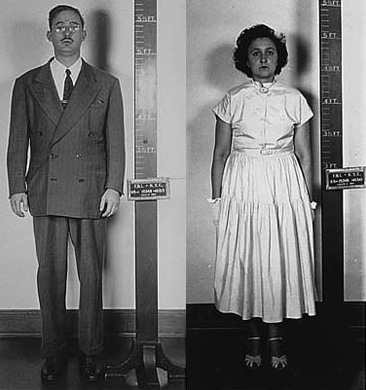
rosenbergs

olice photos of Julius and Ethel Rosenberg (Source: Exhibits from the Julius and Ethel Rosenberg Case File, 03/13/1951 – 03/27/1951)

New Rosenberg Grand Jury Testimony Released!

David Greenglass Transcript Opened by Court Order in Case Brought by National Security Archive and Historical/Archival Associations
Greenglass testimony at trial helped send his sister Ethel Rosenberg to the electric chair, but to the grand jury he said the opposite: “I never spoke to my sister about this at all.”
Edited by Thomas Blanton
Posted – July 14, 2015
Updated – July 15, 2015, 1 p.m.

Washington, D.C., July 15, 2015 – The newly released grand jury testimony by Ethel Rosenberg’s brother David Greenglass suggests he committed perjury on the witness stand in the Rosenberg spy trial, according to experts who analyzed the documents released today and posted by the National Security Archive.

The grand jury testimony from August 1950 shows Greenglass resisting prosecutors’ questions implicating his sister, in one case (page 30) insisting: «I said before, and say it again, honestly, this is a fact: I never spoke to my sister about this at all.»

But at trial in March 1951, Greenglass and his wife Ruth put Ethel at the center of the conspiracy, typing up handwritten notes for delivery to the Soviets and operating a microfilm camera hidden in a console table – neither of which is mentioned in the grand jury statements.

Decades later, after Greenglass served nearly 10 years in prison and his wife was not even indicted, Greenglass admitted to journalist Sam Roberts that he had lied on the stand to protect his wife, whom the grand jury testimony shows was far more central to the spying than was Ethel.

Experts participating in a briefing today at the National Security Archive decried the prosecutors’ behavior as either having suborned false testimony, or presenting testimony they had reason to know was false. Attorney David Vladeck, who led the litigation to open the Rosenberg grand jury records on behalf of petitioners including the National Security Archive and the major historical associations, pointed out that prosecutors intended to use Ethel to put pressure on Julius to confess, but neither did so and thus «called the Justice Department’s bluff» in a miscarriage of justice.

Legal scholar Brad Snyder described the mistake of the U.S. Supreme Court in not accepting cert in the Rosenberg case in 1953, thus enabling their execution, when the contrast between grand jury testimony and trial testimony showed «reversible error.»

Author Steve Usdin, whose book Engineering Communism (Yale University Press) describes two of the Rosenberg spy ring’s members who went on to build the Soviet Union’s Silicon Valley, commented that the Greenglass testimony was «the last important evidence we’re likely ever to have on the Rosenberg case.» Usdin pointed out that the documents provided answers to three key questions: Were the Rosenbergs guilty of spying? Yes. Was their trial fair? Probably not. Did they deserve the death penalty? No.

Archive director Tom Blanton summed up the discussion by describing the Cold War narrative of the Rosenberg case as a black-and-white argument – supporters said they were framed, critics called them traitors. The evidence now shows both were right – a much more nuanced and difficult story. Yes, Julius Rosenberg led an active spy ring; no, Ethel Rosenberg was not an active spy, even though witting. Blanton commented that the case should be a warning about the perils of unchecked prosecutors’ power.

* * * * *

[Press Advisory]

New Rosenberg Grand Jury Transcripts To Be Released Wednesday, July 15, 2015

Key Testimony from Ethel’s Brother, David Greenglass, May Show Perjury

Result of open records lawsuit by National Security Archive and historical associations

Briefing scheduled by plaintiffs, experts, at 2 p.m., Gelman Library, George Washington University

Posted – July 14, 2015

For more information:
National Security Archive, nsarchiv@gwu.edu, 202.994.7000

Washington D.C., July 14, 2015 – Tomorrow the public will see for the first time the actual transcripts of previously secret grand jury testimony by Ethel Rosenberg’s brother, David Greenglass, in the espionage trial from the early 1950s that sent Ethel and Julius Rosenberg to the electric chair on charges of spying for the Soviet Union.

To explain the documents and provide context, the National Security Archive will host a press briefing at 2 p.m. on Wednesday, July 15, at Gelman Library, George Washington University, 7th floor (where the Archive is located), 2130 H Street NW, Washington D.C. 20037.

The U.S. government has decided not to appeal the federal court decision on May 19, 2015 ordering the release of the Greenglass testimony, in a lawsuit brought by the National Security Archive and major historical and archival associations.

Previously in 2008, the petitioners succeeded in winning release of most of the other Rosenberg grand jury testimony, but Greenglass – who was still alive at the time – objected and the court declined to include his transcripts. Greenglass passed away in 2014 and the plaintiffs re-opened the case before Judge Alvin Hellerstein in federal district court in New York.

Police mugshots of David and Ruth Greenglass (public domain)

The transcripts will show whether Greenglass mentioned to the grand jury what became his most incendiary charge at trial against his sister, that she had typed up his handwritten notes for delivery to the Soviets. Historians have now concluded that he lied on the witness stand.

Copies of the transcripts will be available on the Archive’s web site,www.nsarchive.org, and at the press briefing at 2 p.m. The government has announced that the National Archives and Records Administration will also post the transcripts starting at noon on July 15 at www.nara.gov.

Together with the Archive, the petitioners included the American Historical Association, the American Society of Legal History, the Organization of American Historians, the Society of American Archivists, and journalist Sam Roberts who authored a biography of Greenglass. Representing the petitioners are Georgetown University Law Center professor David C. Vladeck and Debra L. Raskin of the New York firm Vladeck, Waldman, Elias & Engelhard, who also authored the original 2008 petitions that opened the previous Rosenberg grand jury records.

Participating in the briefing will be Rosenberg case experts Brad Snyder and Steve Usdin, together with Archive director Tom Blanton and the petititioners’ lead attorney David Vladeck.

For background on the case, and previous news-making releases, see http://nsarchive.gwu.edu/news/20150519/

Read Full Post »

“Everybody’s talking bout…” – The Music of Nina Simone for Today’s Frustrations

It has been a year since the deaths of Eric Garner in Staten Island, New York, and Michael Brown in Ferguson, Missouri.  Their deaths kicked off a movement challenging police brutality.  From the deaths of Garner and Brown slogans like: “Hands Up, Don’t Shoot!” “I Can’t Breathe!” and most notably “Black Lives Matter” arose to proclaim the value of Black lives in the midst of an overwhelming tide of racial violence.  One year later, the list of victims keeps growing.  Freddie Gray’s death in Baltimore, the murder of the Charleston Nine at Emmanuel A.M.E. Church, Sandra Bland in Texas, Sam DuBose in Cincinnati, and many others keep engaging the conversation on the value of Black lives.  New hashtags like “#SayHerName and #IfIdieinpolicecustody reflect what has become a disturbing reality.  In one year the list as well as people’s frustration keeps growing.

On any given day, I can open up my Facebook newsfeed, and see a diverse list of postings from militant outrage to statements proclaiming love, compassion, and understanding are the answers to people decrying that Black people must value their own lives first to the questioning of whether the victims truly met the standard of etiquette as dictated in politics of respectability.  A post by one of my friends punched through the noise of Facebook.  She recently attended an event in a local national park.  When she left the party, she unwittingly drove in the wrong direction and was stopped by Park Police.  In that moment, she was absolutely terrified.  In that moment, she realized that any action might be misconstrued by the police officer, and she could become the next victim.  The traffic stop went surprisingly well, yet my friend’s experience reflects the nature of the times.

My colleague Rhon Manigault-Bryant posted “Life Goes On:” A Meditation from Howard Thurman as a source of solace.  I have also found the writings of Howard Thurman, but at this particular moment I find myself in need of a stronger expression of what I can best describe as righteous indignation.  Approximately 50 years ago, Nina Simone captured her frustration with the violence against Blacks in her iconic song “Mississippi Goddam.”   The song is a melodic indictment of the violence, the calls for Blacks to act respectably, and the requests for slow methodic change.  The song would ultimately have a deleterious effect on Simone’s career, but it remains a significant musical expression of the Civil Rights era.

Noelle Trent

UntitledNoelle Trent recently earned her doctorate in American history at Howard University. Her dissertation, “Frederick Douglass and the Making of American Exceptionalism,” examines how noted African-American abolitionist and activist, Frederick Douglass, influenced the development of the American ideas of liberty, equality, and individualism which later coalesced to form the ideology of American exceptionalism. Dr. Trent also holds a Master’s degree in Public History from Howard University and is a member of Phi Beta Kappa. She has worked with several noted organizations and projects, including the National Archives and Records Administration, the National Park Service, Catherine B. Reynolds Civil War Washington Teacher’s Fellows, and the Smithsonian Institution’s National Museum of African American History and Culture and the National Museum of American History. She has presented papers and lectures at the American Historical Association, Association for the Study of African American Life and History, the Lincoln Forum, and the Frederick Douglass National Historic Site. She currently resides in suburbs of Washington, DC.

Read Full Post »

Celebrating Emancipation

Frederick Douglass and the story of New York City’s 1865 “Emancipation Jubilee.”

 
Jacobin   August 1, 2015
An 1865 illustration in Harper's magazine celebrating Emancipation.

An 1865 illustration in Harper’s magazine celebrating Emancipation.

The ongoing campaign to eradicate Confederate symbols marks an important moment in American public memory, perhaps allowing the scars of slavery and segregation to start healing. Yet while the actions of Bree Newsome and company have been truly inspiring, the collective feeling when the flags began to come down seemed mainly to be a sigh of relief.

One hundred fifty years earlier, in the first summer after the actual downfall of the Confederacy, African Americans across the land were more upbeat. Emancipation did not immediately bring full equality, but the war’s end was still cause for optimism. The shackles had come off in the South, while in the North, blacks no longer had to fear being sent back to slavery. It was time for celebration.

In New York, their previous efforts to do so had sparked controversy. Just a few weeks after Gen. Robert E. Lee’s surrender in April 1865, the New York Common Council had denied blacks the right to formally participate in President Lincoln’s funeral procession. At a Cooper Union event in early June, an indignant Frederick Douglass called the council’s action “the most disgraceful and scandalous proceeding ever exhibited by people calling themselves civilized.”

But on August 1, both Douglass and Manhattan’s African-American community were in a far better mood as they traveled across the East River for an “Emancipation Jubilee” in Brooklyn. And though he only spoke for a few minutes at the gathering, Douglass again memorably captured the spirit of the moment.

The jubilee was timed to coincide with West Indian Emancipation Day, which marked the end of slavery in the British Empire in 1834. Initially celebrated in abolitionist centers like Philadelphia, Boston, and Upstate New York, by the 1850s Emancipation Day events could be found across the frontier, from Indiana to California.

Douglass had regularly attended such events near his home in RochesterBut while he had close ties to many Brooklyn abolitionists, Douglass hadn’t yet journeyed down for one of the local jubilees, which had been held regularly since the early 1850s. Everyone knew that the first one after the Civil War would be grand, though.

At just over 5,000 (or 1.5% of the city total), Brooklyn’s black population was still relatively small in 1865. Yet over the preceding two decades, black communities in Williamsburg and Weeksville had served as abolitionist strongholds. During and after the Draft Riots of July 1863, many blacks from Manhattan had also taken refuge on the other side of the East River.

The August 1 festivities took place in what is now Bedford-Stuyvesant, at two sites that have since been demolished — the vast Hanft’s Myrtle Avenue Park and the nearby, smaller Lefferts Park.

Despite their racist caricatures of “exultant darkies” or “dancing darkies,” lengthy accounts in the Democratic Brooklyn Daily Eagleand the Republican New York Times conveyed the mood of the attendees. “Twenty thousand men, women and children of sable hue yesterday mingled their joys and experiences in the suburban parks of the city of churches,” the Times wrote. At stands outside Myrtle Avenue Park, the Eagle reported, “quaint-looking damsels in gorgeously striped dresses with brilliant turbans on their heads” dispensed peaches and pigs’ feet, with sides of corn, cabbage, apple dumplings, and chicken potpie.

Writing in Horace Greeley’s New York TribuneSydney Howard Gay— a leading white abolitionist and longtime friend of Douglass — maintained a more genteel tone. “Colored people” turned out in great numbers in their “Sunday best,” Gay noted. He described a range of activities on display, from formal dancing to less high-brow amusements like a Jefferson Davis knock-down game, with three tosses costing a nickel.

In addition to live bands, carnival attractions, and sporting events (including a game played by the Weldenken Colored Baseball Club of Williamsburg), there were also talks given by an array of distinguished African-American speakers. At Myrtle, Professor William Howard Day (who had challenged segregation in Michigan in the late 1850s) explained the history of West Indian emancipation; while at Lefferts, two leading local abolitionist ministers, James Pennington and James Gloucester, urged receptive listeners to continue the fight for full equality.

Jacobin-Series-3bdd91b95cfc219305403acaa1630163

When Douglass addressed the Myrtle gathering, the great orator was surprisingly brief. But what he said was also surprising, as illustrated by the divergent reports found in the various daily newspapers.

By most accounts, Douglass cheerfully told the enthusiastic crowd, “No man here wants to know whether liberty is a good thing or slavery a bad thing; we all know it already; we don’t want any instruction.” After all, he said, the main message of abolitionists had always been that “‘every man is his own master; every man belongs to himself.”

But what Douglass said next remains open to dispute. According to the Times (and the Eagle), he stated: “Every man has the right to do as he pleases, to come and go, to make love, get married, and do all sorts of things that are pleasant and profitable. [Applause.] We are here to enjoy ourselves — to sing, dance and make merry. I am not going to take up your time; go on; enjoy yourselves. [Prolonged cheering.]” The Tribune account by Douglass’s friend Sydney Gay, however, says nothing about love or marriage, and skips right to “[w]e are here…to sing, dance, and make merry.”

Perhaps the most convincing reportage can be found in the New York Herald. James Gordon Bennett’s paper — which had the largest circulation in the US — may have been a house organ of the War Democrats (who supported the Union but opposed Lincoln). But during the Civil War, the Herald bolstered its journalistic reputation by sending numerous correspondents into the field.

Near the end of its lengthy August 2, 1865 recap of the preceding day’s Jubilee events, the Herald presented Douglass’s statements as follows:

The only thing abolitionists ever taught the American people was that every man is himself. That is all. Every man belongs to himself — can belong to nobody else. We are not here for instruction. We are here to enjoy ourselves, to play ball, to dance, to make merry, to make love (laughter and applause), and to do everything that is pleasant. I am not going to take up your time. Go on, and enjoy yourselves.

The moral instruction to “get married” is conspicuously absent here. Yet of the various reports, the Herald’s is the one that most reads like an impromptu direct address. Such carefree comments by Douglass ultimately seem most befitting for an ecstatic day-long jubilee, one filled with joy in every sense of the word.

Beyond simply playful encouragement, Douglass in his brief remarks urged African Americans in Brooklyn and elsewhere to start envisioning their own future, and to fully enjoy their freedom. Any hopes for a bright future would be short-lived, of course. But in the summer after the war, blacks everywhere could echo Douglass’s insistence that at last, “every man belongs to himself.”

Theodore Hamm is chair of journalism and new media studies at St Joseph’s College in Clinton Hill, Brooklyn.

Read Full Post »

« Newer Posts