Feeds:
Entradas
Comentarios

Archive for 2014

index2

The Civil War and P.T.S.D.

Dillon Carroll

The New York Times   May 23, 2014

Edson Bemis was a hard man to kill. Rebel soldiers tried three times, and three times they failed. At the Battle of Antietam, a musket ball ripped through his left arm. Two years later, in the horrible fighting in the Wilderness, he was shot in the abdomen, just above the groin. The ball was never extracted, remaining in his body until the day he died.

The Confederates came the closest to killing Bemis in February 1865. At Hatcher’s Run, Va., a Minié ball struck him in the head. He lay near death for several days, his skull cracked and leaking brain matter. Most passed him off for dead. Dr. Albert VanDevour, however, did not, and instead performed a risky surgery to remove the bullet from his skull. Bemis improved immediately, eventually recovering, much to the shock of everyone.

The war was finally over for Bemis. He moved to Suffield, Conn., with his wife, Jane, where they hoped to start a new life. He began working for W.W. Cooper’s, a local merchant house, but very quickly it became clear to everyone that Bemis was not right. One of his colleagues at W.W. Cooper’s, George N. Kendall, described his health as “never very good,” and Bemis began to suffer from “spells of vertigo” or “something that afflicted his head” so much so that he frequently could not work.

Kendall noticed that Edson was also “very forgetful.” He had wild mood swings, and Kendall wrote “any little thing irritates him.” He was increasingly subject to memory loss. Sometimes, for several hours each day, he had no memory of where he had been or what he had done. Eventually he had to stop working at W.W. Cooper’s because of his condition.

In 1890, Bemis suffered what appeared to be a stroke, and his condition, which was already bad, got exponentially worse. A pension official came to Suffield to interview the Bemis family and friends, and immediately noticed that although Bemis was only 55 in 1895, he walked “like a man of 80!” His wife had to assist him in dressing, she had to “cut his meat and wash his potatoes” and she described him as being “like a child.” The pension official wrote that Bemis’s only job each day was to go to the post office “right below here for the mail and to a few houses above for a pail of milk every day this is all he can do.”

In 1900, Jane had apparently had enough, and Bemis was examined and institutionalized in Westboro Insane Hospital in Westboro, Mass. By this time, his condition had spiraled even further. A doctor at Westboro, Lewis Bryant, wrote that Bemis believed he was “thirty years old” but he could not recall the present “year month or day of the week.” Bemis believed that “the civil war is still going on” and, occasionally, would “see dogs in the room.” Bryant described him as “silly, emotional, crying and laughing without apparent cause” and having “little memory confusing the present with the past…soils his clothing has had delusions and false sights, and at times requires the care and attentions usually given a child.”

Celestia Bemis, his sister, who coincidentally married a man with the last name Bemis, came to Westboro and took charge of Edson, taking him to her farm in North Brookfield. Celestia and Jane did not get along, and their feud spilled over into the notes of the pension official who occasionally checked up on Bemis. Jane claimed that Celestia ordered her to stay away from him, because her presence excited him too much, while Celestia claimed that Jane had never once tried to visit Bemis, and was content to keep cashing his pension checks without ever seeing him. Jane last saw her husband in August of 1900; he died two months later. She continued collecting a pension until her death in 1917.

Bemis’s story was not an uncommon one among Civil War veterans. Historians are beginning to uncover what was a virtual epidemic of emotional, psychological and neurological trauma that afflicted soldiers after the war. Veterans labored under emotional and psychological stress in ways that are disturbingly similar to the present. Alcoholism was rampant, as was unemployment. Suicide was endemic. Civil War veterans dotted the wards of insane asylums across the country.

Modern science would most likely have given Bemis a diagnosis of traumatic brain injury, caused by a blow to the head or a penetrating injury of the skull. Such injuries are all too common among veterans of Iraq and Afghanistan today. Symptoms of T.B.I. range from headaches, confusion, lightheadedness and dizziness to fatigue, mood changes, depression, changes in sleep patterns, restlessness and agitation. That seems to be consistent with Bemis’s litany of postwar complaints.

RELATED

If so many Civil War veterans were troubled with emotional and psychological trauma, why has it taken us so long to discover them? Veterans were loath to admit they were traumatized. In the 19th century, mental illness carried a tremendous stigma, and most veterans fought a private battle rather than disclose their trauma.

Additionally, most families preferred to care for mentally ill loved ones at home. Bemis’s care as his mental health declined became a community project. Jane certainly performed the lion’s share of the work. She dressed him, fed him, and sometimes had to help him in the bathroom. But she could not watch him all the time. A.P. Sherwin, a local doctor, later testified that everyone “in town knows soldier to be mentally afflicted” and all the people in Suffield near the Bemis household “watch him closely.” Jane Bemis testified that she did not watch him “on the street” because “everybody knows him” and that he only “goes a short way from home.”

Finally, the relationship between warfare and psychological trauma has only recently become better understood. War trauma has distressed veterans in nearly every war, but the whispers of shell shock and combat fatigue never really entered the public consciousness. It was not until after Vietnam that veterans’ groups successfully lobbied the American Psychiatric Association to include post-traumatic stress disorder in the Diagnostic and Statistics Manual of Mental Disorders. Since then, our understanding and empathy for veterans afflicted with psychological trauma has grown rapidly. Bemis’s life demonstrates that combat has been damaging to the human brain and the human psyche long before we were willing and able to give the maladies a name.

Follow Disunion at twitter.com/NYTcivilwar or join us on Facebook.


Sources: Soldier’s Certificate No. 59,267, Cpl. Edson D. Bemis, Company K, 20th Massachusetts Volunteer Infantry, National Archives; Case Files of Approved Pension Applications of Veterans Who Served in the Army and Navy Mainly in the Civil War and the War with Spain, 1861-1934, National Archives; Steven T. DeKosky, “Traumatic Brain Injury: Football, Warfare, and Long-Term Effects,” in the New England Journal of Medicine 363, No. 14 (Sept. 30, 2010); Rebecca J. Anderson, “Shell Shock: An Old Injury with New Weapons,” Molecular Interventions 8, No. 5 (Oct. 2008); Emily Singer, “Brain Trauma in Iraq,” Technology Review 111, No. 3 (May–June 2008); Jeanne Marie Laskas, “Game Brain,” GQ, Oct. 2009; Ben McGrath, “Does Football Have a Future?” New Yorker, Jan. 31, 2011.

Dillon Carroll

Dillon Carroll is a graduate student in history at the University of Georgia.


Read Full Post »

The Ludlow Massacre Still Matters 

Ben Mauk

The New Yorker  May 19, 2014


ludlow-massacre-580.jpeg

On April 20, 1914, members of the Colorado National Guard opened fire on a group of armed coal miners and set fire to a makeshift settlement in Ludlow, Colorado, where more than a thousand striking workers and their families were camped out. Today, the Ludlow massacre, which Caleb Crain wrote about in The New Yorker in 2009, remains one of the bloodiest episodes in the history of American industrial enterprise; at least sixty-six men, women, and children were killed in the attack and the days of rioting that followed, according to most historical accounts. Although it is less well-remembered today than other dark episodes in American labor history, such as the Triangle Shirtwaist Factory fire that claimed a hundred and forty-six lives, the Ludlow massacre—which Wallace Stegner once called “one of the bleakest and blackest episodes of American labor history”—changed the nation’s attitude toward labor and capital for the next several decades. Its memory continues to reverberate in contemporary political discourse.

In the summer of 1913, United Mine Workers began to organize the eleven thousand coal miners employed by the Rockefeller-owned Colorado Fuel & Iron Company. Most of the workers were first-generation immigrants from Italy, Greece, and Serbia; many had been hired, a decade prior, to replace workers who had gone on strike. In August, the union extended invitations to company representatives to meet about their grievances—including low pay, long and unregulated hours, and management practices they felt were corrupt—but they were rebuffed. A month later, eight thousand Colorado mine workers went on strike. Among their demands were a ten-per-cent pay raise, the enforcement of an eight-hour working day, and the right to live and trade outside the company-owned town. Many of the rights they sought were required by Colorado law but remained unenforced.

After getting evicted from their company-owned homes, the workers based their operations in makeshift tent cities surrounding the mines, the largest of which was the Ludlow camp. The Rockefellers responded by hiring a detective agency—comprised of “Texas desperadoes and thugs,” according to “Legacy of the Ludlow Massacre,” a sharply researched 1988 book by Howard M. Gitelman—who would periodically raid the camps, firing rifles and shotguns. In November, the state governor called in the Colorado National Guard at the company’s behest; the Guard’s wages were supplied by the Rockefeller family, and they helped to form militias whose members carried out sporadic raids and shootings in the tent cities.

The strike stretched on for months, and in April, 1914, John D. Rockefeller, Jr., appeared before Congress, where he framed the standoff as “a national issue, whether workers shall be allowed to work under such conditions as they may choose.” He balked at the possibility of allowing “outside people”—meaning union organizers—“to come in and interfere with employees who are thoroughly satisfied with their labor conditions.” The committee chairman asked Rockefeller whether he would stand by his anti-union principles even “if it costs all your property and kills all your employees.” Rockefeller replied, “It is a great principle.”

On April 20th, a day after Orthodox Easter, four militiamen brandished a machine gun at some of the striking miners. At some point, shots were fired—the accounts are predictably inconsistent as to who fired first—and a day-long gunfight ensued.

That evening, the National Guardsmen set fire to the Ludlow colony. Thirteen residents who tried to flee were shot and killed as the camp burned to the ground, and many more burned to death. Discovered among the ruins the following morning was a women’s infirmary, where four women and eleven children had sought to escape the fighting by hiding in a cellar-like pit. All the children and two of the women died. One survivor, Mary Petrucci, lost three of her own children in the infirmary. Years later, she recalled, “I came out of the hole. There was light and lots of smoke. I wandered among the ashes until a priest found me. I couldn’t feel anything. I was cold.”

News of the attack—and especially of the deaths under the infirmary tent—pulled the nation’s attention from the United States’ potential involvement in the Mexican Revolution. To many Americans, the massacre exposed the consequences of unchecked corporate might, and it roused the conscience of a country that had previously demonstrated impassive ambivalence toward organized labor. (Decades later, a song by Woody Guthrie captured the common sentiment of the event’s immediate aftermath: “We took some cement and walled the cave up where you killed these thirteen children inside / I said ‘God bless the Mine Workers Union,’ then I hung my head and cried.”)

Two days later, Congress convened to discuss the events at Ludlow, and to consider how the government might check martial power wielded by private industrialists. One senator, Iowa’s “radical Republican,” William Kenyon, decried the government’s ties to the violence, noting that “the Colorado Fuel & Iron Company, or the company controlling it, has certain of its bonds on deposit with the General Education Board of the Rockefeller Foundation, with which the Department of Agriculture of our Government seems to have been in partnership for some little time.” Another senator expressed a broader concern: “I fear that unless society can in some manner reconcile these troubled conditions as between capital and labor, Mexico is not the only country that will be torn by internecine strife.”

Rockefeller, for his part, released a memorandum in June, months after federal troops had been ordered to Colorado to quell the days of violent rioting that had followed the events of April 20th. “There was no Ludlow massacre,” he wrote. “The engagement started as a desperate fight for life by two small squads of militia … against the entire tent colony, which attacked them with over three hundred armed men.” He also offered a lengthy technical explanation of why the deaths in the infirmary were the result of inadequate ventilation and overcrowding, not of actions taken by “the defenders of law and property, who were in no slightest way responsible for it.”

Despite Rockefeller’s arguments, after Ludlow the Wild West era of company towns began to wane, and stricter labor laws began to appear on the books—and were even enforced. Support for unions reached an all-time high in the nineteen-thirties, as described by James Surowiecki in a 2011 article for the magazine. Yet, as Surowiecki also noted, the influence of trade unions, which supplanted company unions following the 1935 Wagner Act, has been declining for decades, as part of a general rightward shift in American politics which began in the sixties. Since the 2008 recession, there has been growing resentment for union members among non-unionized workers; in 2010, support for unions reached a historic low, according to a Pew poll.

Yet the struggle that Ludlow embodied—and that, historically, unions have taken up—is a contemporary one, even if unions are no longer playing as public a role. Today, some of the fiercest workers’-rights battles take place over government regulations that protect low-income workers’ access to Medicaid and other social services, and that buoy the federal minimum wage, which is currently far below its 1968 peak value. In her recently published autobiography, Senator Elizabeth Warren wrote that “Big corporations hire armies of lobbyists to get billion-dollar loopholes into the tax system and persuade their friends in Congress to support laws that keep the playing field tilted in their favor.” In this, she sounds almost exactly like the Republican senators who, in the days after Ludlow, worried about Colorado Iron & Fuel’s deep government influence.

What was at stake at Ludlow remains pertinent even within the modern coal industry. Last week, the Center for Public Integrity won a Pulitzer Prize for its investigative report on efforts to deny benefits to coal miners with black-lung disease. The seriesdescribes how industry-compensated lawyers have frequently withheld evidence from judges in order to defeat the medical claims of miners suffering from the resurgent ailment, which today affects about six per cent of miners in central Appalachia, according to government statistics reported in the series.

A different kind of violence is visited upon today’s miners. There are no overt, bloody showdowns between striking workers and armed National Guardsmen whose paychecks come from corporate barons. But industry money—in the form of fees paid by mine companies for consultant work—still appears to influence the diagnoses of doctors and radiologists, according to copious research compiled by the Center. And the coal industry’s go-to law firm withheld dissenting medical evidence that supported miners’ claims in eleven of the fifteen cases featured in the report. As a result, ailing and dying miners are denied the support they are owed.

There are eighty-five thousand coal miners left in the United States, but, while many are union members, the influence of the United Mine Workers was already waning by the early eighties, according to the Center for Public Integrity report. Today the union represents about twenty thousand active miners, according to the Wall Street Journal. Instead of union pressure, it was more likely the Center’s investigation that prompted the Department of Labor to announce, in February, a series of reforms that will make it easier for miners with black-lung disease to collect their medical benefits. A hundred years ago, it took a great and deadly injustice to spur lasting government reform. Here’s hoping we learn from it.

Photograph: Fotosearch/Getty

Ben Mauk is a writer from Baltimore, Maryland.He is a regular online contributor to The New Yorker, and his essays and stories appear in The Sun magazine, The American Reader, The Believer, The Los Angeles Review of Books, and elsewhere.

From 2007 to 2009, he was an editor at Dana Press in Washington, D.C. and New York City. He is a graduate of Cornell University and the Iowa Writers’ Workshop, and the recipient of a 2014-15 U.S. Fulbright Award for Young Journalists.

He lives in Iowa City, where he teaches at the University of Iowa. 

Read Full Post »

arbannsm

CIA SUCCESSFULLY CONCEALS BAY OF PIGS HISTORY

National Security Archives   May 21, 2014


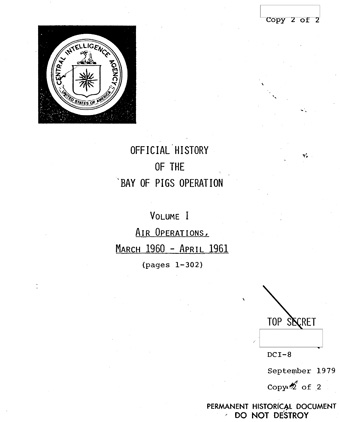
bayopigsThumbWashington, DC, May 21, 2014 – The U.S. Court of Appeals for the D.C. Circuit yesterday joined the CIA’s cover-up of its Bay of Pigs disaster in 1961 by ruling that a 30-year-old volume of the CIA’s draft «official history» could be withheld from the public under the «deliberative process» privilege, even though four of the five volumes have previously been released with no harm either to national security or any government deliberation.

«The D.C. Circuit’s decision throws a burqa over the bureaucracy,» said Tom Blanton, director of the National Security Archive (www.nsarchive.org), the plaintiff in the case. «Presidents only get 12 years after they leave office to withhold their deliberations,» commented Blanton, «and the Federal Reserve Board releases its verbatim transcripts after five years. But here the D.C. Circuit has given the CIA’s historical office immortality for its drafts, because, as the CIA argues, those drafts might ‘confuse the public.'»

«Applied to the contents of the National Archives of the United States, this decision would withdraw from the shelves more than half of what’s there,» Blanton concluded.

The 2-1 decision, authored by Judge Brett Kavanaugh (a George W. Bush appointee and co-author of the Kenneth Starr report that published extensive details of the Monica Lewinsky affair), agreed with Justice Department and CIA lawyers that because the history volume was a «pre-decisional and deliberative» draft, its release would «expose an agency’s decision making process in such a way as to discourage candid discussion within the agency and thereby undermine the agency’s ability to perform its functions.»

This language refers to the fifth exemption (known as b-5) in the Freedom of Information Act. The Kavanaugh opinion received its second and majority vote from Reagan appointee Stephen F. Williams, who has senior status on the court.

bayopigsOn the 50th anniversary of the Bay of Pigs invasion in 2011, the National Security Archive’s Cuba project director, Peter Kornbluh, requested, through the FOIA, the complete release of «The Official History of the Bay of Pigs Operation» — a massive, five-volume study compiled by a CIA staff historian, Jack Pfeiffer, in the 1970s and early 1980s. Volume III had already been released under the Kennedy Assassination Records Act; and a censored version of Volume IV had been declassified years earlier pursuant to a request by Pfeiffer himself.

The Archive’s FOIA request pried loose Volumes I and II of the draft history, along with a less-redacted version of Volume IV, but the CIA refused to release Volume V, so the Archive filed suit under FOIA in 2012, represented by the expert FOIA litigator, David Sobel. In May 2012, U.S. District Judge Gladys Kessler held that Volume V was covered by the deliberative process privilege, and refused to order any segregation of «non-deliberative» material, as required by FOIA.

The Archive appealed the lower court’s decision, and with representation from the distinguished firm of Skadden Arps Meagher Slate & Flom, brought the case to the D.C. Circuit, with oral argument in December 2013. The National Coalition for History, including the American Historical Association and other historical and archival professional organizations, joined the case with anamicus curiae brief authored by the Jones Day law firm arguing for release of the volume.

Titled «CIA’s Internal Investigation of the Bay of Pigs Operation,» Volume V apparently contains Pfeiffer’s aggressive defense of the CIA against a hard-hitting 1961 internal review, written by the agency’s own Inspector General, which held the CIA singularly responsible for the poor assumptions, faulty planning and incompetence that led to the quick defeat of the paramilitary exile brigade by Fidel Castro’s military at the Bahia de Cochinos between April 17 and April 20, 1961.

The Archive obtained under FOIA and published the IG Report in 1998. The CIA has admitted in court papers that the Pfeiffer study contains «a polemic of recriminations against CIA officers who later criticized the operation,» as well as against other Kennedy administration officials who Pfeiffer contended were responsible for this foreign policy disaster.

In the dissenting opinion from the D.C. Circuit’s 2-1 decision yesterday, Judge Judith Rogers (appointed by Bill Clinton) identified multiple contradictions in the CIA’s legal arguments. Judge Rogers pointed out that the CIA had failed to justify why release of Volume V would «lead to public confusion» when CIA had already released Volumes I-IV. She noted that neither the CIA nor the majority court opinion had explained «why release of the draft of Volume V ‘would expose an agency’s decision making process,'» and discourage future internal deliberations within the CIA’s historical office any more than release of the previous four volumes had done.

Prior to yesterday’s decision, the Obama administration had bragged that reducing the government’s invocation of the b-5 exemption was proof of the impact of the President’s Day One commitment to a «presumption of disclosure.» Instead, the bureaucracy has actually increased in the last two years its use of the b-5 exemption, which current White House counselor John Podesta once characterized as the «withhold if you want to» exemption.

The majority opinion also left two openings for transparency advocates. It invites Congress to set a time limit for applying the b-5 exemption, as Congress has done in the Presidential Records Act. Second, it concludes that any «factual material» contained in the draft should be reachable through Freedom of Information requests.


Read Full Post »

logo

The Civil Rights Project    May 15, 2014

Segregation Increases after Desegregation Plans Terminated by Supreme Court

LOS ANGELES: Marking the 60th anniversary of the landmark U.S. Supreme Court decision Brown v Board of Education, UCLA’s Civil Rights Project/Proyecto Derechos Civiles (CRP) assessed the nation’s progress in addressing school segregation in it’s new report released today, Brown at 60: Great Progress, a Long Retreat and an Uncertain Future, and found that the vast transformation of the nation’s school population since the civil rights era includes an almost 30% drop in white students and close to quintupling of Latino students.

Brown at 60 shows that the nation’s two largest regions, the South and West, now have a majority of what were called “minority” students. Whites are only the second largest group in the West. The South, always the home of most black students, now has more Latinos than blacks and is a profoundly tri-racial region.

The Brown decision in 1954 challenged the legitimacy of the entire «separate but equal» educational system of the South, and initiated strides toward racial and social equality in schools across the nation. Desegregation progress was very substantial for Southern blacks, in particular, says the report, and occurred from the mid-1960s to the late l980s.

The authors state that, contrary to many claims, the South has not gone back to the level of segregation beforeBrown. It has, however, lost all of the additional progress made after l967, but is still the least segregated region for black students.

Since the 1990s, the Supreme Court has fundamentally changed desegregation law, states the report, and many major desegregation plans have ended. CRP’s statistical analysis shows that segregation increased substantially after desegregation plans were terminated in many large districts including Charlotte, NC; Pinellas County, FL; and Henrico County, VA.

«Brown was a major accomplishment and we should rightfully be proud. But a real celebration should also involve thinking seriously about why the country has turned away from the goal of Brown and accepted deepening polarization and inequality in our schools,” said Gary Orfield, co-author of the study and co-director of the Civil Rights Project. “It is time to stop celebrating a version of history that ignores our last quarter century of retreat and begin to make new history by finding ways to apply the vision of Brown in a transformed, multiracial society in another century.”

This new research affirms that the growth of segregation coincides with the demographic surge in the Latino population. Segregation has been most dramatic for Latino students, particularly in the West, where there was substantial integration in the l960s but segregation has soared since.

The report stresses that segregation occurs simultaneously across race and poverty. The report details a half-century of desegregation research showing the major costs of segregation, particularly for students of color and poor students, and, conversely, the variety of benefits offered by schools with student enrollment of all races.

Among the key findings of the research are:

  • Black and Latino students are an increasingly large percentage of suburban enrollment, particularly in larger metropolitan areas, and are moving to schools with relatively few white students.
  • Segregation for blacks is the highest in the Northeast, a region with extremely high district fragmentation.
  • Latinos are now significantly more segregated than blacks in suburban America.
  • Black and Latino students tend to be in schools with a substantial majority of poor children, while white and Asian students typically attend middle class schools.
  • Segregation is by far the most serious in the central cities of the largest metropolitan areas; the states of New York, Illinois and California are the top three worst for isolating black students.
  • California is the state in which Latino students are most segregated.

The report concludes with recommendations about how the nation might pursue making the promise of Brown a reality in the 21st century–providing equal opportunity to all students regardless of race or economic background.

“Desegregation is not a panacea and it is not feasible in some situations,” said co-author Erica Frankenberg, assistant professor at Pennsylvania State University. “Where it is possible–and it still is possible in many areas–desegregation properly implemented can make a very real contribution to equalizing educational opportunities and preparing young Americans to live, work and govern together in our extremely diverse society.”

Brown at 60 is being released from New York University’s Metropolitan Center for Research on Equity and the Transformation of Schools, where Orfield delivers the keynote address, on Friday, May 16, 2014, for Brown 60 and Beyond. The report includes various tables showing segregation state-by-state and can be found here.

Related Documents


About the Civil Rights Project at UCLA

Founded in 1996 by former Harvard professors Gary Orfield and Christopher Edley, Jr., The Civil Rights Project/Proyecto Derechos Civiles is now co-directed by Orfield and Patricia Gándara, professors at UCLA. Its mission is to create a new generation of research in social science and law on the critical issues of civil rights and equal opportunity for racial and ethnic groups in the United States. It has monitored the success of American schools in equalizing opportunity and has been the authoritative source of segregation statistics. CRP has commissioned more than 400 studies, published more than 15 books and issued numerous reports from authors at universities and research centers across the country. The U.S. Supreme Court, in its 2003 Grutter v. Bollingerdecision upholding affirmative action, and in Justice Breyer’s dissent (joined by three other Justices) to its 2007Parents Involved decision, cited the Civil Rights Project’s research.


Read Full Post »

hnn-logo-new


What We Can Learn from the Progressives Is What Not to Do 

HNN  May 18, 2014

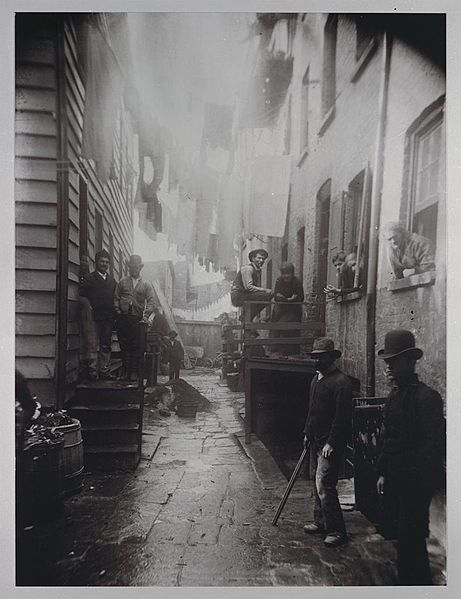
The crime ridden area of Bandit's Roost (1888) by Jacob Riis, from How the Other Half Lives.  - See more at: http://hnn.us/article/155583#sthash.3RP6JbgP.dpuf

The crime ridden area of Bandit’s Roost (1888) by Jacob Riis, from How the Other Half Lives.

Inequality seems to be on everyone’s radar these days. Barack Obama has declared it the “defining issue” of our time. The American public’s appetite for a 700-page book explaining the economics of inequality has Harvard University Press scrambling to fill orders. And the recent “Money Issue” of the New York Times Magazine weighed in on May 4, evoking Jacob Riis’s 1890 exposé of Lower East Side tenement squalor, How the Other Half Lives, with this cover headline:

“Rich City, Poor City: What it Feels Like to Have and Have Not in New York.”

The Magazine’s “Money Issue” is only the latest evidence that the collective distress over disparity is stimulating a revival of Progressive-era thinking: prominent historians, economists, and former government officials have all issued explicit calls for a return to Progressivism.i The Magazine deserves close attention, however, because it captures various pitfalls of heeding that call if we don’t maintain some critical historical perspective.

One reporter’s commentary, noting the political unlikelihood of large tax increases on the wealthy, stresses the equalizing potential of education, echoing (without invoking) Progressive-era philanthropists and educational reformers such as Andrew Carnegie, John D. Rockefeller, Andrew Mellon, and John Dewey. “The great income gains for the American middle class and poor in the mid-to-late 20th century,” he writes, “came after this country made high school universal and turned itself into the most educated nation in the world.”

This distorts history by conflating sequence and causation. Progressive philanthropists and advocates of universal secondary education, while providing avenues for individual social mobility, did not bring about widespread democratization. Workers’ movements, redistributionist programs, and protective labor legislation during the Depression preceded education as the cause of increasing equality, ensuring a more equitable division of wartime and postwar economic growth thereafter…in part through increased funding for education!

The mid-century educational boom, in other words, was primarily an effect, not a cause of economic leveling. In the earlier era of inequality, educational opportunities and the chance to take advantage of them remained off-limits for most Americans (and immigrants) for reasons of race, national origin, gender, and (most importantly, because it transcended all those categories) money. That is the case again today.

Another piece in the Magazine provides a glimpse into the life of teenagers in the Brownsville, Brooklyn projects. This article, “On the Brink in Brownsville,” updates How the Other Half Lives for 2014, presenting mostly bourgeois readers with alarming conditions—including domestic abuse in teenage relationships, violence as play, and normalized petty theft—in a low-income urban area.

2Riis’s reports from the city’s “dark corners” may have launched the Progressive Era, but his lurid tales and graphic photographs of non-white delinquency also fed racist and xenophobic fears (it did not help that Riis was himself a racist). The Brownsville story falls into this Progressive-era trap. Its detached account of a black community’s apparent apathy to mob behavior, and its concluding anecdote of its black teenage subject’s smirking about plans “to hang out in the neighborhood again this summer”—absent any meaningful form of analysis—are like cattle-prods for racism.

A quick glance at Times readers’ online comments confirms this: the bulk of them, including the seven top “Reader’s Picks” as of Tuesday afternoon, spew bile about “sociopathology,” a lack of “discipline and purpose,” and “subcultures…based on laziness, stupidity, and an incomprehensible tendency to ‘blame somebody else.’ ” Without deeper insight into the political-economic roots of conditions in Brownsville, the Magazine’s story tends to incite reaction instead of inspiring intervention.

The cover story, meanwhile, describes “an exercise in ‘radical empathy’ ” between students at the $43,000-per-year Fieldston Ethical Culture School, and University Heights High, a public school in the poorest area of the Bronx. As the story explains, each student paired up with one from the other school, shared a story “that in some way defined them,” and then recounted the partner’s anecdote as if it were his or her own.

Bourgeois Progressives made similar, or even more ambitious attempts to meet New York’s working poor on “equal” terms. Some, such as Lillian Wald, moved to the Lower East Side to live among immigrant workers in settlement houses. Wealthy women, such as Alva Belmont and Anne Tracy Morgan (J.P.’s daughter), joined immigrant socialists Pauline Newman and Rose Schneiderman in the 1909-1910 strike of shirtwaist makers. That strike galvanized the International Ladies’ Garment Workers’ Union, one of twentieth-century New York’s most progressive organizations, and a forerunner to the CIO.

The cross-class mutual interests that emerged from such encounters between rich and poor New Yorkers laid much of the intellectual groundwork for the regulatory reform in public health, workplace safety, and urban zoning that most people think of as among the Progressive Era’s greatest successes in redressing inequality. So perhaps we should be glad that a more recent generation of the affluent and afflicted are reaching out to each other, and that the press is noticing.

But Progressive-era New Yorkers indulged in less inspiring exercises in “radical empathy” across class lines, and the Magazine’s story reflects these as well.

On Christmas, 1899, thousands of the city’s poor gathered on the arena floor at Madison Square Garden for a dinner of suckling pig and cranberry relish, courtesy of the Salvation Army. Meanwhile, as the New-York Tribune reported, “thousands of well-fed and prosperous people” paid a dollar each to congregate in the mezzanine and watch the poor eat. One organizer of the event declared, “It means the dawning of a new era, the bridging of the gulf between the rich and the poor.”ix Most newspapers celebrated the event in similar terms the next day.x

Comparing this event to the Fieldston and University Heights exercise may seem unfair. The Salvation Army made little effort to mask the sheer class voyeurism of its Christmas Dinner, whereas the contemporary high schoolers shared personal stories and made honest attempts to inhabit each other’s experiences.

Yet for the Progressive-era New York newspapers and the Magazine’s May 4 “Money Issue,” the accounts of such cross-class encounters serve the same purpose: to offer their readers hope that the inequality gap might be bridgeable through improved education, empathy, or even proximity.

The Progressives have more valuable lessons to teach us. The fact is, despite decades of optimistic reformism, American income and wealth disparity continued to increase until the Crash of 1929. Progressive reforms made material differences in the lives of U.S. workers, but they failed in their larger goal of slowing or reversing inequality.

At the same time, those reforms necessitated the growth of the regulatory state. This provided the foundation upon which New Deal workers and reformers built to make real inroads against inequality—through legislation protecting collective bargaining rights, restraining the power of businessmen and financiers, and distributing the benefits of economic growth far more widely than Progressives ever dreamed possible.

Progressives never realized the full potential of the regulatory state to lessen inequality because they were too busy trying to change the behavior of the working class through educational reform, racist moral crusades in low-income neighborhoods, and empathy-building exercises. Rather than follow them down these well-worn paths, we should emulate—and improve upon—New Deal-era movements, using democracy to change the behavior that really needs changing: the wealthy’s.

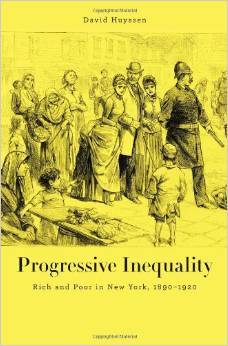
David Huyssen is a Lecturer in U.S. History at Yale, and the author of Progressive Inequality: Rich and Poor in New York, 1890-1920 (Harvard UP, 2014).


Read Full Post »

The Cartoon that Made People Scare to Go War in 1914

 Charles F. Howlett

HNN   May 1i, 2014

Historians, journalists, and leading political figures are now commemorating the one hundredth anniversary marking the beginning of World War 1. At the time of this tragic event it was called the Great War and would be referred to in history textbooks as such for a mere twenty-one years after its conclusion. Sadly, the world experienced another global conflict starting in 1939 and the Great War became World War 1.

At the time armed conflict began in August 1914, it was considered the Great War because it was total and its impact felt worldwide. Primarily, in the low countries of Western Europe and France fierce battles were waged marked by trench warfare so graphically depicted by German soldier Eric Remarque’s powerful work All Quiet on the Western Front and visually displayed in the 1939 movie of the same name starring American actor Lew Ayers; Ayers, by the way, though classified as a conscientious objector, served as my dad’s Army combat medic in the Philippines in 1944-45. Battles were also fought on the high seas, principally in the North Atlantic where the submarine came to symbolize a new twist to conventional warfare, abandoning all forms of civility with respect to terms of engagement. There were also large cannons capable of launching shells twenty-plus miles, mechanized tanks, battleships, which the Germans proudly referred to as dreadnoughts, and worst of all, mustard gas. Indeed, over the course of four years, Europe, America, and parts of the decaying Ottoman Empire were thrust into the worst war civilization had ever encountered. It was a game changer and by the time it was over, November 11, 1918, at least 8.5 million combatants were killed and many more wounded, untold numbers of civilians died, whole empires were destroyed, and societies were devastated by modern technological warfare. Physical, moral, and psychological shock reverberated throughout the European continent and elsewhere.

No one could have predicted how catastrophic it would be. But at the start of hostilities when Germany officially invaded Belgium on August 4, 1917, bringing Great Britain into the war on the side of France and Russia, a cartoonist by the name of John Tinney McCutcheon burst upon the scene in an effort to capture the realities of the time. He would not disappoint as his vivid imagination and poignant realism gave instant credibility to the popularity of wartime cartoons as a serious form of journalism. Indeed, other cartoonists such as J.N. Ding (Jay Norwood Darling), James Harrison “Hal” Donahey, and Edwin Marcus would follow suit as they, too, used their artistic talents to depict the costs of war.

But it was McCutcheon who got the ball rolling. He was certainly an interesting and dynamic person who loved the thrill of adventure; he went where the story was, regardless of the dangers involved. He was born on an Indiana farm in 1870, but destined to travel worldwide. At the age of sixteen he entered Purdue University, switching majors from mechanical engineering to industrial arts because he hated math. He chose wisely as his skills as a graphic artist would eventually garner him a Pulitzer Prize in 1931 for his cartoon, “A Wise Economist Asks a Question.” He worked for the Chicago Tribune for forty years, entertaining thousands of readers each day as his cartoons appeared on the front page just above the fold. But none would have as much long lasting impact as the one that was published on August 7, 1914.

It was while he was working for the Chicago Tribune covering the political turmoil in Mexico, where he also met Pancho Villa and drew a cartoon of this Mexican revolutionary sitting at a table with a pistol laying on top, that war officially broke out in Europe. McCutcheon, the adventurer, promptly left Mexico for Chicago to obtain correspondent credentials. While awaiting a ship bound for England to cover the hostilities—he was one of only four American newspapermen to be on-the-scene reporters at the war’s beginning and would make two others trips, one riding in a French warplane that was shot at by the Germans—he sketched five noted war cartoons capturing his feelings about the European conflict. One stood out. He succinctly titled it “The Colors.”

The cartoon quickly captured the attention of a wide readership not only among Tribune subscribers but also among readers throughout the country. His cartoon was widely distributed and supporters of peace relied upon it to call attention to the dangers of war. Peace activists were moved by the depictions of McCutcheon’s cartoon. It provided anti-preparedness advocates with a simple, yet powerful, message that the burden of war is shouldered by all. “The Colors” also inspired a later effort by the newly-established Woman’s Peace Party to display its own “War Against War” exhibit, replete with peace/antiwar cartoons, attracting thousands of visitors in May 1916 in cities across the United States. In 1919, moreover, when George J. Hecht published his The War in Cartoons: A History of the War in 100 cartoons by 27 of the most prominent American Cartoonists, he promptly took notice of McCutcheon’s “The Colors.” It remains one of the most famous antiwar cartoons of all time.

When it first appeared no one, not even McCutcheon, could have guessed how influential it would become. But at the top of the first page in The Chicago Tribune on August 7, readers were instantaneously focused on a simple, yet compelling, cartoon with four panels. As readers gazed at each panel they were suddenly drawn to the words below each one: “Gold and green are the fields in peace”; “Red are the fields in war”; “Black are the fields when the cannons cease”; “And white forevermore.”

Each line takes on even greater significance when attached to the picture above. Readers are first drawn to a harvest of peaceful abundance as a farmer tills his soil while bundling his wheat. Then reality sets in as the field is littered with dead soldiers and smoke billowing upward from exploding cannon shells. In the aftermath of the battle are the mourners, grieving at the loss of so many innocent lives. Finally, one is led to white gravestones marking the place where the soldiers died. All the while three of four trees remain intact—nothing goes unscathed from war’s wrath—as witness to the tragic events that just took place, yet symbols of survival and future hope. Civilization must press on. His words, coupled with such powerful images, highlight the somber significance of war’s real impact on life.

And so, we have “The Colors.”

One hundred years later as we reflect on McCutcheon’s words and images in “The Colors,” we should be reminded, as the eminent peace historian Lawrence Wittner points out, that in the past century wars led to the deaths of over a hundred million people, and today, we live in a world armed with some 17,000 nuclear weapons. Many additional lives continue to be lost in the present century due to ongoing internal fighting and external war. Sadly, “the colors” haven’t changed.

This is the black and white version readers saw in the Chicago Tribune:


 Charles F. Howlett is a Professor in the Education Division’s Graduate Programs at Molloy College. He has authored, co-authored, and co-edited books numerous book in American history and education, including the forthcoming Antiwar Dissent and Peace Activism in World War I America with Scott Bennett. He will be presenting a talk, “Images of Peace Activism in World War 1,” at the First World War Conference in October at Georgian Court University in New Jersey.


Read Full Post »

Brown v. Board of Education

HNN

The Warren Court (1953)

This page lists articles that put into historical perspective the changes wrought by the Supreme Court decision Brown v. Board of Education (1954). Click here to read the Brown decision.

Commentary on Recent Supreme Court Decisions Involving Brown

History

  • Bonnie Goodman Interview with Michael J. Klarman, Winner of the 2005 Bancroft Prize
  • Christopher W. Schmidt The Delusions Behind the Brown Decision
  • Ian Haney Lopez The Supreme Court Case that Got Right What Brown Got Wrong
  • Kansas State Historical Association«Brown v. Board of Education: The Case of the Century»–The Kansas Bar Association created a 70-minute video,»Brown v. Board of Education of Topeka: The Case of the Century,» and related teaching materials as a project for the 50th anniversary of the landmark decision. The video features a reenactment of the 1952 and 1953 oral arguments presented to the U. S. Supreme Court. The video will run continuously during the exhibit, Equal Education: The Fight, The Right May 1 – 30, 2004, at the Kansas History Center and Museum.
  • Eric Foner & Randall KennedyBrown at 50
  • Michael Klarman The Supreme Court Has Never Been in the Vanguard of Social Reform
  • Robert Jackson Symposium To commemorate and consider Brown at 50, the Robert H. Jackson Center recently hosted three special events in Jamestown, New York, and at nearby Chautauqua Institution. The symposium featured Nicholas Katzenbach, law clerks from the Supreme Court of 1954, and the sisters Linda Brown Thompson and Cheryl Brown Henderson, daughters of the late Oliver Brown of Topeka.
  • Newsweek Photo Gallery from the Era of Brown
  • Ellis Cose Why Brown Seems to Be a Bust
  • Suzanne Sataline Charles Sumner Made the Case Against Segregated Schools a Century Before Brown
  • Thomas Sowell We Are Still Paying the Price for the Faulty Reasoning in Brown
  • Sara Hebel 50 Years After Brown Inequities Remain at Universities
  • James Patterson Why It’s Right to Remember Brown
  • William Kashatus Despite Brown We Are Re-Segregating Our Schools
  • Cass SunsteinBrown Reconsidered?
  • Drew Jubera Why Wasn’t It Brown vs. Alabama or Brown vs. South Carolina?
  • Michael Klarman Why Brown Had Such an Impact
  • Chronicle of Higher Education What New Books Are Saying About the Impact of the Brown Decision
  • Justin EwersBrown V. Board of Education: 50 Years Later
  • Rick Shenkman The Panel Devoted to Brown at the 2004 OAH Convention


Read Full Post »

The Ambivalent Legacy of Brown v. Board

Jelani Cobb 

The New Yorker  May 16, 2014

brown-board-legacy.jpg

Brown v. Board plaintiffs, Topeka, Kansas, 1953. Photograph by Carl Iwasaki/Time Life Pictures/Getty.

In March of 1863, a fugitive slave named Gordon found his way to the Union Army lines in Baton Rouge, Louisiana. Exhausted from his efforts to escape his slaveholders and their dogs, he showed up in tattered rags. When doctors examined him, they saw that his back was marred by a lattice of keloid scars, evidence of the severe whippings he’d endured in bondage. He was photographed, and the image of this former slave, stripped to the waist, with lash marks inscribed on his skin like a bas-relief, was widely distributed in the North—as indisputable evidence of the evil that had brought the nation to the brink of self-destruction. Unlike the authors of slave narratives, Gordon’s ruined flesh could not be accused of hyperbole.

Gordon enlisted in the Union Army, and the image of his lacerated back came to represent an imperative in future struggles for racial equality. Merely highlighting the existence of injustice was insufficient; you had to show the brutal consequences of that injustice, as vividly as possible.

This kind of scar-bearing was an integral part of the twentieth-century movement to uproot Jim Crow, which reached its zenith sixty years ago this Saturday, with the Supreme Court’s ruling in Brown v. Board of Education. Thurgood Marshall’s assault on the edifice of segregation had been confounded by the question of whether the Fourteenth Amendment prohibited racial segregation. The Supreme Court’s decision in Plessy v. Ferguson, in 1896, had held that a putatively benign social separation could coexist with the amendment’s guarantee of equal protection under the law. The majority opinion, in fact, went so far as to argue that efforts to overturn segregation had been motivated by blacks’ misperceptions of the practice:

We consider the underlying fallacy of the plaintiff’s argument to consist in the assumption that the enforced separation of the two races stamps the colored race with a badge of inferiority. If this be so, it is not by reason of anything found in the act, but solely because the colored race chooses to put that construction upon it.

To combat the notion that the evils of segregation were so much hyperbole, Marshall and the other lawyers at the N.A.A.C.P. Legal Defense Fund called upon the psychologists Kenneth and Mamie Clark, whose famous “doll tests” had demonstrated that racism was damaging to the minds of black children. Beginning in 1939, the Clarks had conducted experiments showing that, when presented with two dolls identical in every way except color, black children consistently attributed favorable characteristics like beauty and intelligence to the white dolls, while reserving their most negative assessments for the dolls they most resembled. The Clarks’ work demonstrated that scars need not be visible in order to be indelible, and their data helped to bolster Marshall’s contention that racial separation violated the Fourteenth Amendment’s equal-protection clause.

The nascent civil-rights movement drew its moral authority, in some measure, from the image of African-Americans who were psychologically “damaged” by the legacy of slavery and the ongoing travesty of segregation. But those arguments, about the extent to which racism had wounded the African-American mind, have had a far more complicated legacy than the celebration of Brown would suggest. As the historian Daryl Michael Scott argues in his 1997 book, “Contempt and Pity”:

Liberals used damage imagery to play upon the sympathies of the white middle class. Oppression was wrong, they suggested, because it damaged personalities and changes had to be made to promote the well-being of African Americans. Rather than standing on the ideals of the American creed and making reparations for the nation’s failure to live up to the separate but equal doctrine set forth in Plessy v. Ferguson, liberals capitulated to the historic tendency of posing blacks as objects of pity.

Six decades after the Supreme Court struck down de-jure segregation, vast swaths of the American education system remain separated by race—indeed, there has been a trend toward resegregation in many areas, particularly in the South. But the most telling indicator of the ambiguous legacy of Brown may be the way we perceive the kinds of arguments that led to the decision.

In 1986, the anthropologist John Ogbu conducted a study of African-American academic performance, and he concluded that many black students viewed high educational achievement as a form of “acting white.” Ogbu’s conclusions were widely disputed by other researchers, yet the term—succinct in its oversimplification—leapt from scholarly journals into public debates about race. The Clarks’ doll tests were seen as an indictment of white racism, but the notion of “acting white”—fundamentally rooted in a similar tendency to ascribe virtue to whiteness—was nonetheless deployed as a means of pointing toward African-Americans’ own self-defeating behavior.

This rhetoric was not confined to white conservatives. In 2004, at a dinner sponsored by the N.A.A.C.P. Legal Defense Fund to mark the fiftieth anniversary of their victory in the Brown case, Bill Cosby departed from his notes and launched into a tirade against the shortcomings of impoverished African-Americans. Speaking of Kenneth Clark, by then an elderly widower, Cosby said:

Kenneth Clark, somewhere in his home in upstate New York … just looking ahead. Thank God, he doesn’t know what’s going on, thank God. But these people, the ones up here in the balcony fought so hard. Looking at the incarcerated, these are not political criminals. These are people going around stealing Coca-Cola. People getting shot in the back of the head over a piece of pound cake! Then we all run out and are outraged, “The cops shouldn’t have shot him.” What the hell was he doing with the pound cake in his hand?

Cosby’s remarks were applauded by many on the right, as well as by more than a few African-Americans. What was once considered “damage” had been transformed—by the passage of a few decades and by the insistence that racism was behind us now—into “pathology.” Cosby’s intemperate rhetoric tapped into a vein of frustration, seldom voiced in public, that, a half century beyond the most crucial judicial decision of the civil-rights era, the problems once attributed to legal segregation managed to persist. Despite Cosby’s invective, it was never clear where that frustration should be attributed. There are no metrics for how quickly a group should recover from legally enforced subordination, and no statistical rendering of ongoing racial inequalities could match the explanatory power of a “Colored Only” sign. If these complexities confounded people like Cosby, who’d actually lived through segregation, there was scant hope that they’d be readily perceived by many people who hadn’t.

Yet some things have remained constant. Alarmingly, versions of the Clarks’ doll test conducted in the past few years still yield results similar to those of the original experiments. In 2011, the sociologist Karolyn Tyson showed that concerns over “acting white” among black students tended to arise not in overwhelmingly black schools but precisely in settings in which black students were underrepresented. And yet, sixty years after Brown, the prevailing idea in these debates remains one that is similar to the argument presented in Plessy: that the major, and perhaps the only, problem with ongoing segregation is the way black people perceive and respond to it.

The United States may not be “post-racial,” as many claimed in the wake of Barack Obama’s election, but it clearly sees itself as post-racism, at least when it comes to explaining the color-coded disparities that still define the lives of millions of its citizens.

Jelani Cobb is Associate Professor of History and Director of the Institute for African American Studies at University of Connecticut.


Read Full Post »

Imagen

America as the second home of arnis, escrima, kali

 Perry Gil S. Mallari  

The Manila Times   May 18, 2014

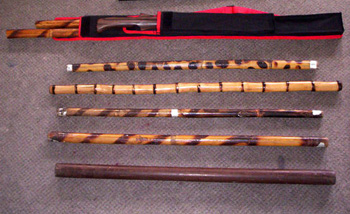
A collection of escrima fighting sticks. CONTRIBUTED PHOTO

A collection of escrima fighting sticks. CONTRIBUTED PHOTO

It was born in the Philippines but I would say that the United States is the second home of arnis, escrima and kali collectively known as Filipino martial arts (FMA).

Transplanted mainly through various waves of migration, the FMA has established deep roots in America. The growth, evolution and mutation of the FMA in the US are incomparable to any other nations where Philippine martial arts were also exported.

The FMA could have been exported to the US much earlier than the known exodus of Filipino farm laborers to California and Hawaii during the turn of the 20th century.

The book Manila Men in the New World: Filipino Migration to Mexico and the Americas from the Sixteenth Century by Floro L. Mercene tells that prior to the influx of farm worker from the Philippines to America during the said period, Filipino mariners under a Spanish command landed in Morro Bay, California in October 1587.

It is amazing to realize that Filipinos have reached the New World (what would become the United States of America) much earlier than the American colonization of the Philippines at the turn of the 20th century.

2-FMA-in-America

Cover of the book Manila Men in the New World: Filipino Migration to Mexico and the Americas from the Sixteenth Century by Floro L. Mercene.

Lafcadio Hearn, an American journalist wrote an article in the March 31, 1883 issue of Harper’s Weekly about a Filipino settlement in Saint Malo, Louisiana. The settlers of the community that were called “Manilamen,” were believed to be the roots of Filipinos in America. Hearn at that time believed that the settlement was already in existence for 50-years however, extensive research conducted by Marina Espina, a librarian at the University of New Orleans revealed that it could have existed earlier.It is amazing to realize that Filipinos have reached the New World (what would become the United States of America) much earlier than the American colonization of the Philippines at the turn of the 20th century.

Espina in 1988 published the results of her studies in a book titled Filipinos in Louisiana (A. F. Laborde & Sons, New Orleans, Louisiana, 1988).

Hearn described the Manilamen as seasoned fishermen who were robust and polite and could speak in Tagalog and Spanish. A part of the article reads: “Most of them are cinnamon-colored men; a few are glossily yellow, like that bronze into which a small proportion of gold is worked by the molder. Their features are irregular without being actually repulsive; some have the cheek-bones very prominent and the eyes of several are set slightly aslant. The hair is generally intensely black and straight, but with some individuals it is curly and browner. In Manila there are several varieties of the Malay race, and these Louisiana settlers represent more than one type. None of them appeared tall; the greater number were under-sized, but all well knit, and supple s fresh-water eels. Their hands and feet were small; their movements quick and easy, but sailorly likewise, as of men accustomed to walk upon rocking decks in rough weather. They speak the Spanish language; and a Malay dialect is also used among them.”

Evidences have been found that a number of Filipinos even participated in the American Civil War. This was proven by the research conducted by Nestor Palugod Enriquez, a retired US Navy personnel turned Filipino American historian. Enriquez located the specific names of Filipino volunteers on the following records: the Massachusetts State Rosters, Military Images magazine, original muster rolls at the National Archives, the New Hampshire Rosters (issued by State Adjutant General.

Pension—Pension Records, National Archives, Washington, D.C.) and the Naval Rendezvous Reports (available at the National Archives, Washington, D.C.). There is a high probability that those early Filipinos in America may have had used their skills in arnis, escrima and kali in that war.

But the biggest part of the FMA migration in the US most probably occurred at the beginning of the 20th century when many Filipino men filled in the demand for workers in the plantations of Hawaii and the farmlands of California. Many FMA pioneers in America like Angel Cabales, Juanito Lacoste and Leo Giron were at one time or another worked as farm laborers in Hawaii and California. A part of Dan Inosanto’s book The Filipino Martial Arts, narrates of how Cabales made it to the US, it reads, “Cabales left the Philippines in 1939 and joined a crew of a cargo ship that took him to distant ports of the world. Each port, each foreign dock brought a new set of adventures and with them a knowledge of survival. After working in Alaska, Cabales wandered from county to county in California. He ultimately joined the Filipino farm laborers around Stockton where he now lives.”

Mark Wiley, in his book Filipino Martial Culture tells how Giron arrived in America, “Like other Filipinos who relocated in the United States, Giron did so by way of boat.

He traveled on the President Lincoln and docked in San Francisco on November 17, 1926. Soon thereafter he relocated to Stockton, California, and took work cutting celery and asparagus for seventeen and a half cents an hour. The hourly wage at that time was thirty-five cents an hour.”

Perhaps one of the most notable early public demonstrations of the FMA in the US was that of the late Grandmaster Ben Largusa. Largusa, a disciple of juego todo champion Floro Villabrille performed at the historic Ed Parker Long Beach Karate International in 1964. Bruce Lee performed there too and Parker recalled in one of his writings before he passed away that Lee and Largusa impressed the other masters who were present in the event.

In 1966, Cabales opened the first public escrima academy in the US in Stockton, California.

Then came global recognition via the medium of cinema. Inosanto briefly but spectacularly introduced the FMA to moviegoers worldwide through the film The Game of Death starring the legendary Lee. Known as Lee’s protégé, Inosanto was responsible in introducing the late founder of jeet kune do to escrima specifically the use of the tabak toyok or nunchaku. With an international superstar like Lee picking up escrima sticks, the FMA was finally included in the world map of martial arts. Few would argue that this film is an important landmark in the history of the FMA and much of the FMA’s popularity today, it owe to Inosanto’s film works.


Read Full Post »

Happy 50th Anniversary National Museum of American History!

 Pamela M. Henson  January 23, 2014

Smithsonian Institute Archives

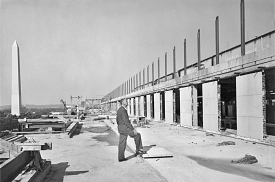
Frank A. Taylor at Museum of History & Technology, by Unknown, c. 1964, Smithsonian Archives - History Div, SIA2009-0003 or 83-2074

Frank A. Taylor at Museum of History & Technology, by Unknown, c. 1964, Smithsonian Archives – History Div, SIA2009-0003 or 83-2074

On the evening of January 22, 1964, the Smithsonian hosted an A-List party to dedicate its newest museum, the Museum of History and Technology, now the National Museum of American History.  The building was the dream of its first director, Frank A. Taylor, who had joined the National Museum staff after high school, and after graduate school, advanced to Curator, Director, and Director General of all Smithsonian museums.  When Taylor returned from World War II, he recalled in an oral history interview, the exhibits in the old National Museum buildings looked shabby and out of date.  He first led an Exhibits Modernization Program, which oversaw the renovation of all the National Museum’s exhibits from the mid-1950s to the mid-1960s.  The new exhibits attracted new interest in the Institution among the U. S. Congress and donors.  The Smithsonian had been attempting to establish a separate history museum since the 1920s, but had met with little support.  Taylor initially sought to build a museum of technology, like the Deutsches Museum in Germany, but was convinced to include plans for a museum of American history.  With the support of the new Secretary, Leonard Carmichaellegislation was signed into law on June 31, 1956, creating the new museum. The first modern building on the National Mall, the new museum opened with ten exhibit halls completed, with an additional fifty opening in the following years.

Chief Justice Warren Speaking at the Museum of History and Technology Dedication, by Unknown, January 22, 1964, Smithsonian Archives - History Div, SIA2011-1489 and P-6411-19.

Chief Justice Warren Speaking at the Museum of History and Technology Dedication, by Unknown, January 22, 1964, Smithsonian Archives – History Div, SIA2011-1489 and P-6411-19.

Former history teacher and Smithsonian supporter President Lyndon Johnson dedicated the building on January 22, at a black tie party attended by Members of Congress, philanthropists, Smithsonian Regents, and many other distinguished guests.  The party was not without its hiccups, Taylor recalled.  The U. S. Secret Service was present since the President was speaking, and they sprang into action when someone accidently bumped against the stage light switch and turned it off.  Shortly thereafter, the wife of a member of the Smithsonian Board of Regents could no longer see her husband on stage. He was recovering from a serious heart attack, so she alerted the Secret Service, who once again sprang into action, only to find he had moved his seat a bit and was hidden behind another person.  But overall the party was a great success, setting the stage for the Secretary-elect S. Dillon Ripley, who assumed office that week and oversaw the Institution’s great period of growth from 1964 to 1984.

Newly Completed Museum of History and Technology, by Unknown, 1964, Smithsonian Archives - History Div, SIA2010-2181 or P6499-A or MAH-P6499A.

Newly Completed Museum of History and Technology, by Unknown, 1964, Smithsonian Archives – History Div, SIA2010-2181 or P6499-A or MAH-P6499A.

The Museum opened to the public on January 23rd, and in the first weekend, 54,000 people visited the new Museum.  The new halls included the Flag Hall, First Ladies’ Hall, and the halls of Everyday Life in the American Past, American Costume, Farm Machinery, Light Machinery, Tools, Vehicles, Railroads, as well as a temporary exhibition presenting examples of exhibits to be installed in other halls of the building.

So we send out congratulations for a happy 50th anniversary to the National Museum of American History and all the staff and volunteers who have made it a success in the past five decades!

Related Resources:

National Museum of American History, Smithsonian Institution Archives

Read Full Post »

« Newer Posts - Older Posts »