Feeds:
Entradas
Comentarios

Posts Tagged ‘American Civil War’

This Was One of the Little-Recognized Causes of the Civil War 

HNN  August 17, 2014

I remember reading many years ago W. E. B. Du Bois’s complaint that Americans knew far too little of the decisive role blacks played in winning their freedom.  He pointed specifically to a biography of Ulysses S. Grant in which the author, W. E. Woodward, wrote of African Americans as “the only people in the history of the world . . . that ever became free without any effort of their own. . . . They twanged banjos around the railroad stations, sang melodious spirituals, and believed that some Yankee would soon come along and give each of them forty acres of land and a mule.”  I was in graduate school at the time and congratulated myself on knowing better – that blacks had served in the Union army.  But that was about all I knew of it. As the proud holder of a college degree in history, I thought that was just about all I needed to know.  There are none so ignorant as the educated ignorant.

Some historians still downplay the wider role of blacks in bringing on freedom, preferring to emphasize Abraham Lincoln’s role as the Great Emancipator.  Historian James McPherson, a leading defender of Lincoln’s Great Emancipator image, argues in Drawn with the Sword: Reflections on the American Civil War (1996) that without Lincoln there would have been no war and, hence, no opportunity for freedom. With regard to emancipation, it was Lincoln’s determination that was “the essential condition, the one thing without which it would not have happened.” Without Lincoln, there would have been no Emancipation Proclamation and no Thirteenth Amendment. Therefore, says McPherson, “Lincoln freed the slaves.”

Arguments such as those of McPherson and others have some validity as far as they go. To my knowledge, no reputable scholar denies that Lincoln and the Union military played a significant part in the emancipation process. But following their lines of reasoning more deeply, we cannot help but see the efforts of black folk at their core.

Lincoln’s effort to preserve the Union was, of course, a reaction to the South’s secession, a movement engineered by slaveholders who feared not only Lincoln but, more immediately, their own slaves. Controlling slaves had been increasingly difficult for years. It could only be more difficult, perhaps impossible, with slaves believing that Lincoln’s election meant their freedom. How could they believe otherwise? Though Lincoln was no threat to slavery where it existed, and said so often during the 1860 presidential campaign, fire-eating secessionists railed against him as a radical abolitionist with a secret agenda to foment slave rebellion. Such overheated rhetoric was intended to stir up support for secession among southern whites, but southern blacks heard the message too. Rebellion and rumors of rebellion pervaded the South that year and drove slaveholder fears to a fever pitch. Most significantly, underlying their fear was the certain knowledge that slaves wanted freedom. It was that fear, born of generations of slave resistance, that led to secession, war, and slavery’s downfall.

Slaveholders’ doubts about their ability to maintain slavery indefinitely had a long history. The need to justify slavery had for decades occupied their brightest minds. The need to keep southern whites, three-quarters of whom owned no slaves, supporting slavery made fomenting fear of blacks a political priority.  Most threatening to slaveholders were the slaves themselves. Blacks had never submitted to slavery willingly or completely. They did little more than they had to do and took liberties where they could. They resisted in so many ways that the slaveholders’ need to exercise control was constant and consuming.  Had blacks been content to remain enslaved, slaveholders would have had no cause for alarm. Nor would abolitionist arguments have inspired such panic among them. As it was, slaveholder fears of threats to slavery, as much from within as from without, led them to insist on guarantees for slavery’s future and the means to control that future. And that fear led them to secede when those guarantees and their means of control seemed at risk. As Professor John Ashworth reminds us inSlavery, Capitalism and Politics in the Antebellum Republic (1995), there was a direct causal link between the slaves’ desire for freedom and slaveholder politics. “Behind every event in the history of the sectional controversy,” Ashworth points out, “lurked the consequences of black resistance to slavery.”

That resistance was not confined to the South. Escaping slaves saw to that. By the tens of thousands they headed north, undermining northern efforts to keep the slave’s war south of the Mason-Dixon Line. In so doing, as Professor Scott Hancock stresses in “Crossing Freedom’s Fault Line” (Civil War History, 2013), black folk “maintained an unrelenting pressure on the sectional fault lines of identity, law, and space.” That pressure produced large cracks in those fault lines and increasingly drew northerners into the conflict. Time and again, northern failures to keep blacks and slavery locked in the South put them at odds with slaveholders’ expansionist demands. Hancock concludes, and rightly so, that “not simply slavery, but slaves – black people! – caused the Civil War.”

It was, then, at the heart of it all, the unrelenting resistance to slavery among slaves themselves that was the essential condition, the one thing without which the sectional crisis, secession, the Civil War, the Emancipation Proclamation, and the Thirteenth Amendment would not have happened.

Of course, it did not happen overnight. For more than two centuries before the Civil War, millions of African Americans lived in bondage all their lives. But it was a resisted bondage, an ongoing struggle, that would eventually reach its consummation. The internal pressures against slavery – rebellion, resistance, escape – were always there and became ever greater as slavery spread. Slaveholders clamped down with more slave codes, more slave patrols, and increasingly brutal control. But the more they tried to tighten their grip on slaves, the more slaves slipped through their fingers. By the late 1850s there were an estimated fifty thousand escapees annually, temporary and permanent. Such resistance fueled a desperation reflected in slaveholder politics and the secession crisis. The resulting war was neither an isolated event nor an end point in itself.  It was part of a massive black resistance movement that had been going on for generations, finally becoming so intense that the country as a whole could hardly help being drawn into it.

Even so, in an effort to avoid war, Congress passed, and Lincoln supported, a constitutional amendment, the Corwin Amendment, that would have guaranteed slavery in the slave states forever.  In the war’s early months, both Congress and Lincoln insisted that the conflict was a white man’s war in which blacks could have no part. But black folk knew the war was theirs and quickly took ownership of it.  Black resistance largely brought on the war, then pressed Lincoln in the direction he eventually went.  By escaping in the tens of thousands and making freedom a fact, blacks forced Lincoln to recognize that fact with the Emancipation Proclamation. They made the document their own, and made it much more that it was.  In the upper South, where the Proclamation did not apply, blacks claimed freedom anyway.  In the lower South, they made freedom real by aiding escaping slaves, serving the Union army as guides and spies, assisting Confederate deserters and armed deserter gangs, giving aid to escaping Union prisoners, resisting abuse, and engaging in open rebellion.  They established freedom for themselves by traveling at will, threatening escape to secure wages, and even claiming land and property when they could.  Still, most Americans today seem to assume that Lincoln, almost single-handedly and of his own volition, “freed the slaves.”  Certainly most students coming into my freshman U.S. history course assume that to be the case, which is in large part what prompted me to write my book, I Freed Myself.

In the war’s aftermath, although whites willfully ignored the wartime role of blacks, memories of self-emancipation efforts remained clear in the minds of black folk.  One day a candidate for local office in Illinois asked Duncan Winslow, a former slave and Union veteran, for his vote in an upcoming election. As if to seal the deal, the candidate told Winslow, “Don’t forget. We freed you people.” In response, Winslow raised his wounded arm and said, “See this? Looks to me like I freed myself.”  Blacks would go on freeing themselves for generations to come.

David Williams is a professor of history at Valdosta State University and the author of the, “I Freed Myself: African American Self-Emancipation in the Civil War Era” (Cambridge University Press, 2014).

Read Full Post »

This Is How Racist America Was During the Civil War

HNN August 1, 2014

During the Civil War, many New York City newspapers were closely aligned with the anti-war, pro-Southern wing of the Democratic Party. Republicans called them «Copperheads» after the venomous snakes that originate in the area that had become the Confederacy. Their hatred of Abraham Lincoln was probably only surpassed by their virulent racism and hatred of Black Americans. Their pages were filled with racially offensive language that would be blipped out on the Daily Show with Jon Stewart and most newspapers today are hesitant about printing. I use the word «nigger» in this op ed. I do not use it lightly and I will only use it when quoting directly from newspaper articles from the era. I do not believe it is possible to convey the depth of racism in Northern society during the Civil War era without using this inflammatory and defamatory term.

In 1864 the Daily News was accused of receiving payments from Confederate agents to promote anti-war rallies in New York City and it inflamed racial tension by claiming that racial mixing or miscegenation was the «doctrine and dogma» of the Republican Party. The editorial page of the Weekly Day-Book, which from October 1861 to October 1863 was known as The Caucasian, carried the banner «White Men Must Rule America.»

In the months leading up to the July 1863 Draft Riots, John Mullaly, editor of the Roman Catholic Church’s newspaper, Metropolitan Record, called for armed resistance. At a Union Square rally May 19, 1863, Mullaly declared «the war to be wicked, cruel and unnecessary, and carried on solely to benefit the negroes, and advised resistance to conscription if ever the attempt should be made to enforce the law.» Following the July Draft riots, Mullaly was indicted for «inciting resistance to the draft.»

In its August 23, 1863 issue, the Herald, which had the largest circulation in the country, predicted that the Republican Party would eventually nominate and unite behind Abraham Lincoln when it realized he was the person «predestined and foreordained by Providence to carry on the war, free the niggers, and give all of the faithful a share of the spoils.» On October 7, 1863, the Herald described the Ohio gubernatorial election as a battle to decide «whether the copperheads or the niggerheads are more obnoxious to the great conservative body of the people.»

The 1864 Presidential election provided the Copperhead press an opportunity to express open, casual, and nasty racism. A key figure was journalist David Goodman Croly, who at one time or another worked for the New York Evening Post, the Herald, and the World. Croly helped to anonymously produce one of the more avowedly racist attacks on Republicans and African Americans produced during the Civil War, a 72-page pamphlet titled «Miscegenation: The Theory of the Blending of the Races, Applied to the White Man and the Negro.» The pamphlet charged that the Civil War was a war of «amalgamation» with the goal of «blending of the white and black,» starting with the intermixing of Negroes and Irish.

Many newspapers, including the World, argued the pamphlet was the work of abolitionists and represented their actual program, rather than an attempt to undermine abolition. The New York Freeman’s Journal & Catholic Register, a «peace at any cost» Democratic Party newspaper closely aligned with Fernando Wood, claimed that the «beastly doctrine of the intermarriage of black men and white women» had been «encouraged by the President of the United States» and that «filthy black niggers» were mingling with «white people and even ladies everywhere, even at the President’s levees.»

The editors of the New York Times, were eventually sucked in by the fraud. In a March 19, 1864 editorial, they wrote, «We regret to learn from numerous sources that we are on the point of witnessing intermarriage on a grand scale between the whites and blacks of this Republic. It has, as most of our readers are aware, been long held by logicians of the Democratic school, that once you admit the right of a negro to the possession of his own person, and the receipt of his own wages, you are bound either to marry his sister, or give your daughter in marriage to his son. The formula into which this argument has always been thrown was this: If all blacks are fit to be free every white man is bound to marry a black: ‘Niggers’ are blacks: Therefore every white man is bound to marry a ‘nigger.’ »

A week later, on March 26, 1864, a Times editorial stated: «we have no hesitation in saying that if we had at the outset conceived it possible that hostility to Slavery would ever have led to wholesale intermarriage with negroes, or of all marriageable Republicans and their sisters, that party should never have received any countenance or support from this journal. We owe it to ourselves and posterity to say that the odious matrimonial arrangements, into which so many of those whose opinions on certain great questions of public policy we have hitherto shared, have taken us wholly by surprise.»

By March 30, 1864 the Times had realized it was a victim of a hoax. «Trusting entirely, as we stated at the time, to the assertions of the Copperhead press, we have made mention of sundry movements alleged to be in process for the more wide-spread diffusion of the new political gospel of Miscegenation . . .  [T]he Copperhead newspapers have been spreading false reports, which is scarcely conceivable.» However, not only did the paper not apologize for its racism, but it complained «[t]he Copperheads are responsible for this state of things. They have aroused the whole colored community, by their highly-colored pictures of the connubial fate that awaits them at Republican hands, to a state of intense excitement.»

Given the virulent racism of the anti-war Copperhead Democrats and the still open racism of both the pro-war Democrats and Unionist Republicans in New York City and the north, it is amazing that slavery in the United States ended at all. Emancipation was a tribute to the doggedness of abolitionists, Black and White, the need for Black manpower for the North to win the war, and major miscalculations by Southern secessionists who mistakenly exaggerated Northern opposition to slavery and support for Black rights.

Alan Singer is a historian and Professor of Secondary Education at Hofstra University, author of «New York and Slavery: Time to Teach the Truth» (2008), and editor of the «New York and Slavery: Complicity and Resistance» curriculum that received the 2005 National Council for the Social Studies program of excellence award.  This piece was written with research assistance from Joseph Palaia, graduate student, Hofstra University.

Read Full Post »

How Coffee Fueled the Civil War

Jon Grispan

The New York Times  July 9, 2014

index2It was the greatest coffee run in American history. The Ohio boys had been fighting since morning, trapped in the raging battle of Antietam, in September 1862. Suddenly, a 19-year-old William McKinley appeared, under heavy fire, hauling vats of hot coffee. The men held out tin cups, gulped the brew and started firing again. “It was like putting a new regiment in the fight,” their officer recalled. Three decades later, McKinley ran for president in part on this singular act of caffeinated heroism.

At the time, no one found McKinley’s act all that strange. For Union soldiers, and the lucky Confederates who could scrounge some, coffee fueled the war. Soldiers drank it before marches, after marches, on patrol, during combat. In their diaries, “coffee” appears more frequently than the words “rifle,” “cannon” or “bullet.” Ragged veterans and tired nurses agreed with one diarist: “Nobody can ‘soldier’ without coffee.”

Union troops made their coffee everywhere, and with everything: with water from canteens and puddles, brackish bays and Mississippi mud, liquid their horses would not drink. They cooked it over fires of plundered fence rails, or heated mugs in scalding steam-vents on naval gunboats. When times were good, coffee accompanied beefsteaks and oysters; when they were bad it washed down raw salt-pork and maggoty hardtack. Coffee was often the last comfort troops enjoyed before entering battle, and the first sign of safety for those who survived.

Photo

A sketch of exchanged Union prisoners receiving rations aboard the ship New York. Library of Congress

The Union Army encouraged this love, issuing soldiers roughly 36 pounds of coffee each year. Men ground the beans themselves (some carbines even had built-in grinders) and brewed it in little pots called muckets. They spent much of their downtime discussing the quality of that morning’s brew. Reading their diaries, one can sense the delight (and addiction) as troops gushed about a “delicious cup of black,” or fumed about “wishy-washy coffee.” Escaped slaves who joined Union Army camps could always find work as cooks if they were good at “settling” the coffee – getting the grounds to sink to the bottom of the unfiltered muckets.

For much of the war, the massive Union Army of the Potomac made up the second-largest population center in the Confederacy, and each morning this sprawling city became a coffee factory. First, as another diarist noted, “little campfires, rapidly increasing to hundreds in number, would shoot up along the hills and plains.” Then the encampment buzzed with the sound of thousands of grinders simultaneously crushing beans. Soon tens of thousands of muckets gurgled with fresh brew.

Confederates were not so lucky. The Union blockade kept most coffee out of seceded territory. One British observer noted that the loss of coffee “afflicts the Confederates even more than the loss of spirits,” while an Alabama nurse joked that the fierce craving for caffeine would, somehow, be the Union’s “means of subjugating us.” When coffee was available, captured or smuggled or traded with Union troops during casual cease-fires, Confederates wrote rhapsodically about their first sip.

The problem spilled over to the Union invaders. When Gen. William T. Sherman’s Union troops decided to live off plunder and forage as they cut their way through Georgia and South Carolina, soldiers complained that while food was plentiful, there were no beans to be found. “Coffee is only got from Uncle Sam,” an Ohio officer grumbled, and his men “could scarce get along without it.”

Confederate soldiers and civilians would not go without. Many cooked up coffee substitutes, roasting corn or rye or chopped beets, grinding them finely and brewing up something warm and brown. It contained no caffeine, but desperate soldiers claimed to love it. Gen. George Pickett, famous for that failed charge at Gettysburg, thanked his wife for the delicious “coffee” she had sent, gushing: “No Mocha or Java ever tasted half so good as this rye-sweet-potato blend!”

Did the fact that Union troops were near jittery from coffee, while rebels survived on impotent brown water, have an impact on the outcome of the conflict? Union soldiers certainly thought so. Though they rarely used the word “caffeine,” in their letters and diaries they raved about that “wonderful stimulant in a cup of coffee,” considering it a “nerve tonic.” One depressed soldier wrote home that he was surprised that he was still living, and reasoned: “what keeps me alive must be the coffee.”

Others went further, considering coffee a weapon of war. Gen. Benjamin Butler ordered his men to carry coffee in their canteens, and planned attacks based on when his men would be most caffeinated. He assured another general, before a fight in October 1864, that “if your men get their coffee early in the morning you can hold.”

Coffee did not win the war – Union material resources and manpower played a much, much bigger role than the quality of its Java – but it might say something about the victors. From one perspective, coffee was emblematic of the new Northern order of fast-paced wage labor, a hurried, business-minded, industrializing nation of strivers. For years, Northern bosses had urged their workers to switch from liquor to coffee, dreaming of sober, caffeinated, untiring employees. Southerners drank coffee too – in New Orleans especially – but the way Union soldiers gulped the stuff at every meal pointed ahead toward the world the war made, a civilization that lives on today in every office breakroom.

But more than that, coffee was simply delicious, soothing – “the soldier’s chiefest bodily consolation” – for men and women pushed beyond their limits. Caffeine was secondary. Soldiers often brewed coffee at the end of long marches, deep in the night while other men assembled tents. These grunts were too tired for caffeine to make a difference; they just wanted to share a warm cup – of Brazilian beans or scorched rye – before passing out.

This explains their fierce love. When one captured Union soldier was finally freed from a prison camp, he meditated on his experiences. Over his first cup of coffee in more than a year, he wondered if he could ever forgive “those Confederate thieves for robbing me of so many precious doses.” Getting worked up, he fumed, “Just think of it, in three hundred days there was lost to me, forever, so many hundred pots of good old Government Java.”

So when William McKinley braved enemy fire to bring his comrades a warm cup – an act memorialized in a stone monument at Antietam today – he knew what it meant to them.

Follow Disunion at twitter.com/NYTcivilwar or join us on Facebook.

Jon Grinspan

Jon Grinspan is a National Endowment for the Humanities fellow at the Massachusetts Historical Society.

Read Full Post »

 A Woman at War

Erin Lindsay

New York Times

June 30, 2014


index2On June 19, 1864, Pvt. Lyons Wakeman died of dysentery in the Marine U.S.A. General Hospital in New Orleans, after having marched 200 miles and seen combat at the Battle of Pleasant Hill, part of the Union’s Red River campaign in Louisiana. But it would be years before Wakeman’s real identity was revealed: Lyons Wakeman was born a woman, Sarah Rosetta Wakeman.

The only people who knew for certain the soldier’s true identity were the parents and eight siblings Lyons left behind. But even they decided to keep the soldier’s secret, and afterward spoke only of Lyons as their beloved brother.

How Rosetta – she went by her middle name – managed to conceal her identity during her final month in the hospital is still a mystery. Perhaps those caring for her knew, but simply decided to let Rosetta carry the secret she’d kept for the entire two years she’d served in the 153rd New York State Volunteers to her grave in the Chalmette National Cemetery near New Orleans, where she is buried under her alias.

When Rosetta first left home in rural upstate New York, in the summer of 1862, she found employment as a canal man, agreeing “to run 4 trips from Binghamton to Utica for 20$ in money,” according to her letters home. It was on her first trip ferrying coal that Rosetta “saw some soldiers” near Utica who encouraged her to enlist for three years, gaining her “100 and 52$ in money” plus $13 a month thereafter – a substantial raise from the wages she had been earning.

Much of the money that Rosetta earned she sent home to her parents, telling them, “All the money I send you I want you should spend it for the family in clothing or something to eat.” Since her father was in debt, at least some of Rosetta’s motivation for enlisting was probably to help support her family. But she also alludes to more personal reasons, saying, “I want to drop all old affray and I want you to do the same and when i come home we will be good friends as ever,” and later remarking, “I had got tired of stay[ing] in that neighborhood. I knew that I could help you more to leave home than to stay.”

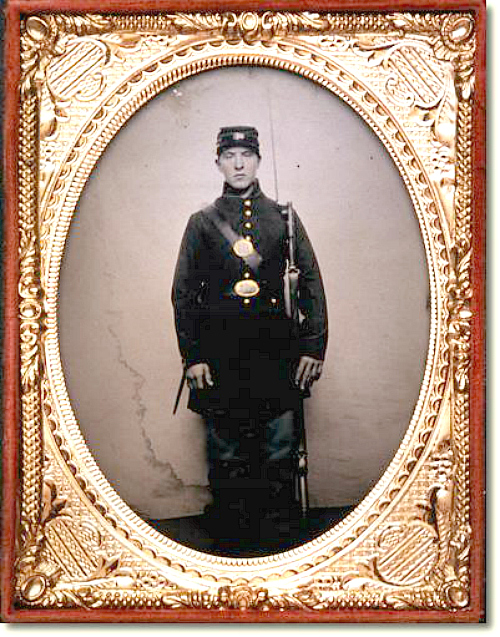
Private Lyons Wakeman. (Reflection of an Uncommom Man, http://gregsegroves.blogspot.com/2013/07/private-lyons-wakeman.html)

Private Lyons Wakeman. (Source: Reflection of an Uncommom Man, http://gregsegroves.blogspot.com/2013/07/private-lyons-wakeman.html)

What conflict she had with her family is unclear, but perhaps the answer lies in the independent spirit that shines through Rosetta’s letters, particularly when she writes, “I will dress as I have a mind to for all anyone else [cares], and if they don’t let me Alone they will be sorry for it.” She also reveals her hopes of having her own farm, “in Wisconsin. On the Prairie,” and her utter lack of fear of “rebel bullets.”

She does not seem the kind of young woman who would be happy in a traditionally feminine role, and indeed, over a year into her military service, she wrote, “I have enjoyed myself the best since I have been gone away from home than I ever did before in my life. I have had plenty of money to spend and a good time aSoldier[ing]. I find just as good friends among Strangers as I do at home.” She goes on to suggest that she might re-enlist for five years and $800. “I can do that if I am a mind to. What do you think about that?”

How Rosetta managed to serve without discovery is one of the great questions surrounding not just her, but all 250 known female Civil War soldiers. There are clues, however. She must have talked a good game when it came to engaging in typical male enterprises; she peppers many of her letters with questions about the family farm – even, in her last letter home, asking her father to “write all the particulars about that farm and let me know how much stock you have got to keep this summer and how many Calves you raise and how many hogs you have got.” Perhaps, too, as the eldest child, Rosetta had worked as her father’s farmhand and was no stranger to physical labor.

Rosetta must have been good at playing the part, too. She boasted how she could “drill as well as any man” and took up certain masculine mannerisms, telling her mother, “I use all the tobacco I want” and also admitting, “There is a good many temptations in the army. I got led away into this world So bad that I sinned a good deal.”

What exactly her sins were, she never mentions, though in a letter written on Jan. 20, 1864, a few day after her 21st birthday, she detailed a fistfight with another private in her company: “Mr. Stephen Wiley pitched on me and I give him three or four pretty good cracks and he put downstairs with him Self.” What caused the fight, Rosetta doesn’t say, but Wiley was court-martialed twice for drunkenness and once for theft during the fall of 1863, whereas Rosetta “never got to fighting but once.” Still, standing at only 5 feet tall, Rosetta, according to her own account, easily defended herself from Wiley, even though his records describe him as seven inches taller. She was an able soldier, performed her duties as required, and participated in combat bravely. Perhaps that was all the convincing she needed to do.

Interestingly, aside from her family, there were some soldiers who were aware of what Rosetta was doing. A year into her service, after having seen no one from home, she recounted how she “could hardly Stand it” when she learned that the 109th New York State Volunteers were stationed nearby. She obtained a pass to visit and “found Henry Austin and Perry Wilder. They knew me just as Soon as they see me. You better believe I had a good visit with them.” The two young men clearly recognized Rosetta, despite her disguise, and yet, when it was time for her to leave, they let her go and never told anyone of her true identity.

Many of the known female soldiers had help in keeping their secret: husbands, fiancés, family members. Even so, it seems certain that Rosetta and the other women performed their duties well and earned their fellow soldiers’ respect, enough so those same soldiers were willing to continue serving alongside them, and sometimes even testified in order to help the women earn veterans’ benefits.

Rosetta herself did not seem overly troubled by her deception. As part of her duties, she was a guard at Carroll Prison, where there were three female prisoners: “One of them was a Major in the union army and she went into battle with her men. When the Rebels bullets was acoming like a hail storm she rode her horse and gave orders to the men. Now She is in Prison for not doing aCcordingly to the regulation of war.” After this brief description, plus noting the two Confederate spies were “smart looking women and [have] good education,” Rosetta makes no further remarks.

Did she guard these women directly? If so, did she and the female soldier acknowledge each other? What did Rosetta think about the possibility that she, too, might be imprisoned? We’ll never know. Surely it must have been comforting to find another woman in the ranks, even if it was also distressing to know that imprisonment could be her own fate.

Likewise, Rosetta was not much concerned with the reasons for the war. Though she guarded “contraband,” slaves who had been captured or had escaped north and were considered spoils of war, she never mentions slavery directly. Even when she notes that the army had drafted “black men as well as White men,” she makes no judgment. She never even once mentions the idea of preserving the Union, though when she learns of the New York draft riots, she writes, “I would like to see some of them Copperheads come down here and get killed.” And she then blames officers for the war’s dragging on, stating “if they would knock down the officers’ pay to 13$ a month, this war would soon be settle.” But it seems Rosetta’s biggest concerns were getting her pay, helping her family, participating in battle and deciding what she would do after the war.

Regardless of what Rosetta might have done had she lived, it is safe to say that her parents, Harvey and Emily, both native New Yorkers and at least fifth-generation Americans, never anticipated that their eldest daughter would be living as a man and writing letters home from the front lines of the Union Army’s Red River campaign, where she “was under fire about 4 hours and laid on the field of battle all night.” What is obvious is that even if her choices had caused concern, her family loved and respected her enough to preserve her letters and keep her photograph safe and her memory alive for generations. Hopefully, they found a way to be proud of her, too.

Follow Disunion at twitter.com/NYTcivilwar or join us on Facebook.


Sources: Lauren Cook Burgess, ed., “An Uncommon Soldier: The Civil War Letters of Sarah Rosetta Wakeman, Alias Pvt. Lyons Wakeman, 153rd Regiment, New York State Volunteers, 1862-1864”; DeAnne Blanton and Lauren M. Cook, “They Fought Like Demons: Women Soldiers in the Civil War.”

Erin Lindsay McCabe

Erin Lindsay McCabe is the author of the novel “I Shall Be Near to You,” about the life of Sarah Rosetta Wakeman


Read Full Post »

I Freed Myself: African American Self-Emancipation in the Civil War Era

Marshall Poe 

New Books in History  June 5, 2014

David Williams

David Williams

Lincoln was very clear–at least in public–that the Civil War was not fought over slavery: it was, he 61eT-apOtrL._SL160_said, for the preservation of the Union first and foremost. So it’s not surprising that when the conflict started he had no firm plan to emancipate the slaves in the borderland or Southern states. He also knew that such a move might prove very unpopular in the North.

So why did he issue the Emancipation Proclamation on January 1, 1863? There are many reasons. According to David Williams‘ fascinating new book I Freed Myself: African American Self-Emancipation in the Civil War Era (Cambridge University Press, 2014), an important and neglected one has to do with African American self-emancipation. After the war began, masses of slaves began to leave the South and head for the Northern lines. The Union forces received them as “contraband” seized from the enemy during wartime. As such, their status was uncertain. Many wanted to fight or at least serve as auxiliaries in the Union armies like freemen, but they were still seen as property. As Williams points out, the North certainly needed their manpower–as Lincoln knew better than anyone. Bearing this in mind, the President felt the time was propitious to do what he thought was right all along–free the slaves. Listen in.

Read Full Post »

The Political War

Allen C. Guelzo

The New York Times  June 5, 2014

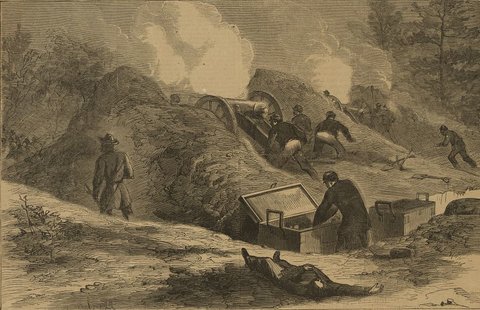
A Union artillery battery at Cold Harbor. Library of <Congress

A Union artillery battery at Cold Harbor. Library of <Congress

Pity Abraham Lincoln. Everything that should have gone right for the Union cause in the spring of 1864 had, in just a few weeks, gone defiantly and disastrously wrong.

For two years, the 16th president had toiled uphill against the secession of the Confederate states, against the incompetence of his luckless generals and against his howling critics from both sides of the congressional aisle. Finally, in the summer and fall of 1863, the course of the war had begun to turn his way. Two great victories at Gettysburg and Vicksburg staggered the Confederates, and those were followed by a knockdown blow delivered at Chattanooga by the man who was fast becoming Lincoln’s favorite general, Ulysses S. Grant. “The signs look better,” Lincoln rejoiced, “Peace does not appear so distant as it did.”

Peace was not the only thing that would be brought closer by victory. The presidential election of 1864 was looming, and if Lincoln had any desire for a second term, a victorious end to the war was the surest way to secure it. He had never seriously considered taking what appeared to some people as an obvious shortcut to remaining in office – declaring the war to be a national emergency and suspending elections for the duration, though two Union governors, in Indiana and Illinois, had done what amounted to that on the state level. That only made the need for military victory all the more urgent, and so Lincoln installed Grant as general in chief of all the Union armies in March 1864, and Grant obliged him with a comprehensive strategic plan that united Union assaults in Georgia, Alabama and, under his own direct command, in Virginia.

None of it worked, and the place where it seemed to work the least was under Grant’s own nose. Crossing the Rapidan River on May 4, 1864, Grant’s army entered at once into a series of head-to-head contests with Robert E. Lee’s fabled Army of Northern Virginia. Fighting three pitched battles – at the Wilderness, Spotsylvania Court House and the North Anna River – and enduring numerous smaller collisions, Grant worked his way down toward the Confederate capital at Richmond, which he got within 10 miles of by the end of the month. But the fighting had cost a colossal total of 40,000 dead, wounded and missing, and Lincoln gloomily understood that the Northern public “hold me responsible.”

They weren’t the only ones. Radicals within Lincoln’s own Republican Party in Congress had long been convinced that Lincoln’s preference for a soft postwar Reconstruction was dis-heartening the Republican base. They were further angered when the Republican national committee, headed by Lincoln’s ally Edwin D. Morgan, met in late February 1864 and announced that the party would hold its presidential nominating convention in Baltimore in June, not as “Republicans,” but as the “National Union Convention.” As Grant’s campaign in Virginia ground agonizingly forward, the most vehement of the Radicals – led by Frederick Douglass, Wendell Phillips and Horace Greeley – staged a protest convention in Cleveland’s Cosmopolitan Hall, and on June 4 nominated the Radical darling, John Charles Fremont.

If ever there was a moment when Lincoln needed good news from the battlefield, it was now, and Grant wanted to deliver it. The staggering blows he had dealt the rebels convinced him a little too easily that the Confederates were “really whipped,” that “our men feel they have gained morale over the enemy and attack with confidence,” and that with one more blow, “success over Lee’s army is already assured.” On June 1, Grant launched a hasty strike at Cold Harbor, before the bulk of his army could get into action. Even so, the attack cracked the Confederate defenses on the Cold Harbor road and forced them to fall back. With another good push, Grant might just be able “crush Lee’s army on the north side of the James, with the prospect in case of success of driving him into Richmond, capturing the city perhaps without a siege, and putting the Confederate government to flight” – not to mention providing a rousing military endorsement for Lincoln’s renomination.

But Grant, in his eagerness, had badly misread the Confederates, and when he launched a full-dress attack at Cold Harbor on June 3, it resembled (as one Confederate general put it) “not war but murder.” Well-prepared Confederate infantrymen mowed down federal at-tackers. Grant’s army sustained 3,500 casualties in the main attack and another 2,500 in related actions that day, and the armies settled into a miserable standoff.

Yet Grant carefully limited his report of the Cold Harbor debacle to four terse sentences, including the claim that “our loss was not severe.” And in the official report of the campaign he filed after the war, Cold Harbor consumed just three sentences in 51 pages. For years afterward, Grant’s doubters wondered whether he had deliberately soft-pedaled the failure at Cold Harbor in order to limit political damage to Lincoln on the eve of the Baltimore convention. There is no direct evidence of such collusion; still, Grant’s dismissal of his losses as “not severe” is peculiar.

Even more peculiar, newspaper reporting from the field was shut down by the War Department because of “a violent storm.” The New York Times (whose editor, Henry Raymond, was the new chairman of the National Union Party’s national Committee) did not publish an ac-count of the June 3 attack for three more days, and even then, merely observed that “losses were inconsiderable.”

Strangest of all, however, was Grant’s refusal to propose a truce to recover the wounded from the battlefield until June 7. Military tradition dictated that only the loser of an engagement asked for such a truce. Even though there could not have been much debate about who had won and who had lost at Cold Harbor, Grant delayed the truce agreement (and any public admission of defeat) for four days, while men suffered and died from thirst, blood loss and exposure.

By June 7, however, any anxiety that bad news from Cold Harbor would endanger Lincoln’s nomination was past. That same day, the Union National Convention opened at the Front Street Theater in Baltimore, with Robert J. Breckinridge asking triumphantly, “Does any one doubt that this convention intends to say that Abraham Lincoln shall be the nominee?” They did not, and the next day, undisturbed by any news of Cold Harbor, Lincoln – described by one state delegation as “the second savior of the world” – was unanimously renominated by the convention.

Given how diligently the National Union Party’s staff had worked to ensure Lincoln’s renomination in the months before the Baltimore assembly, even the freshest news from Cold Harbor might not have made much difference. But keeping the ill wind at bay certainly did not hurt. Nor was it uncommon in this war for the impact of bad military news to be blunted by creative hesitation. One of Grant’s corps commanders was overheard telling a staffer not to report actual casualty figures: “It will never do, Locke, to make a showing of such heavy losses.” After that, wrote the officer who overheard him, “I always doubted reports of casualties.” It irked one Philadelphia newspaper on June 9 to admit that “we can scarcely find out that there was fought one of the bloodiest battles of the war, yet, until yesterday, no one knew its result.” This was, in the end, a highly political war, in which military decisions frequently turned before the winds of politics. And in the coming months, Lincoln would find far greater political challenges in the path of re-election than the ones presented by Cold Harbor.

Follow Disunion at twitter.com/NYTcivilwar or join us on Facebook.


Sources: R.P. Basler, ed., “Collected Works of Abraham Lincoln”; Larry T. Balsamo, “’We Cannot Have Free Government without Elections’: Abraham Lincoln and the Election of 1864,” Journal of the Illinois State Historical Society 94 (Summer 2001); Gordon C. Rhea, “Cold Harbor: Grant and Lee, May 26-June 3, 1864”; Ralph Morris Goldman, “The National Party Chairmen and Committees: Factionalism at the Top”; Andrew F. Rolle, “John Charles Fremont: Character As Destiny”; The War of the Rebellion: A Compilation of the Official Records of the Union and Confederate Armies, Series One, 37 (pt 1); Gordon C. Rhea, “The Overland Campaign,” Hallowed Ground 15 (Spring 2014); The New York Times, June 6 and 8, 1864; Ernest B. Furgurson, “Not War But Murder: Cold Harbor, 1864”; D.F. Murphy, “Proceedings of the National Union Convention Held in Baltimore, Md., June 7th and 8th, 1864”; Morris Schaff, “The Battle of the Wilderness”; David E. Long, “Cover-up at Cold Harbor,” Civil War Times Illustrated 36 (June 1997).


Allen C. Guelzo, professor of the Civil War era at Gettysburg College, is the author, most recently, of “Gettysburg: The Last Invasion.”

Read Full Post »

A Mysterious Map of Louisiana

Susan Schulten

The New York Times   May 25, 2014


These days the intersection of cartography and Big Data is all the rage: Using information from the 2010 census, countless news outfits, including The New York Times, have created tools allowing readers to make customized maps of everything from trends in ethnic and racial composition to the dynamics of housing development. Indeed, we have come to expect that any large body of data will be visualized through maps and infographics. Such tools help to transform information into knowledge, and at their best allow us to see patterns that might otherwise be lost.

But while the technology may be new, the idea of mapping data in the United States can actually be traced to the Civil War. Earlier posts in Disunion have discussed the maps of slavery generated by the United States Coast Survey. At the same time, the Census Office (also part of the Treasury Department) was experimenting with maps of not just one but multiple types of data. These were designed to aid the Union war effort, but perhaps more importantly to plan for Reconstruction.

The National Archives


One of the most fascinating — and mysterious — of these experiments is an unsigned, undated map of Louisiana, buried within the voluminous war records of the National Archives. The map contains almost no environmental information save for the river systems and a few railroads. Even roads are omitted, truly unusual for any 19th-century map.

Instead, the emphasis is on parish boundaries, within which are listed free and slave populations alongside data about resources, from swine to ginned cotton. While this population data would have been available as early as 1862, the agricultural data was only published in 1864. With this information, officers and administrators moving through the state could locate the richest parishes, the largest sources of labor and the easiest means of river and rail transportation. (Oddly, the map does not list the output from over 1,500 sugar plantations located along the lower Mississippi River.)

A closer look at southeastern Louisiana
A closer look at southeastern Louisiana    (The National Archives)

The Census Office was experimenting with this type of map throughout the war. At the request of Gen. William Tecumseh Sherman, for instance, the superintendent of the census annotated a previously printed map of Georgia with information on livestock and crop yields as the former embarked on his ambitious march in the fall of 1864 deep into enemy territory. But Louisiana presented an entirely different — though equally unprecedented — challenge to the Union Army: how to control and administer a conquered region where nearly half the population was no longer strictly enslaved, but which was largely exempt from the Emancipation Proclamation.

The quandary began in April 1862, when Adm. David Farragut captured New Orleans. Soon after, President Lincoln appointed Gen. Benjamin Butler as commander of the gulf. Lincoln hoped to cultivate Unionist sentiment in New Orleans, and thereby lure Louisiana out of the Confederacy. But Butler’s rigid policies and questionable confiscation of cotton alienated many in New Orleans and the parishes beyond, even though his military quarantine effectively ended the murderous yellow fever epidemic that had ravaged the city for decades.

Butler’s tenure was brief, and by the end of 1862 Lincoln had replaced him with the former governor of Massachusetts, Maj. Gen. Nathaniel P. Banks. As commander of the gulf, Banks’s military charge was to expand the realm of Union control into Texas and up the Mississippi. But equally complex was the political task of governing an area under Union occupation. In 1860 Louisiana had a population of 600,000, slightly more than half of whom were white. Yet in some of the parishes with large plantations, blacks far outnumbered whites, especially after the war took men of military age to the Confederate Army. The Confiscation Act of March 1862 prohibited Union soldiers from returning slaves to their masters, and thereby the very presence of the Army disrupted slavery. But without any clear mandate for emancipation, many of the conditions of slavery remained. Louisiana was in limbo.

Thus Banks faced the problem of rebuilding an immensely fertile region with a profoundly unstable (and still unfree) labor system. That’s where the map came in, for it allowed Banks to see the general economic capacity of the state. While such data would have been available to anyone with access to the published records of the 1860 census (published in 1862), to see such information organized geographically enabled Banks to think strategically about managing the population, its chief crop and its food supply.

Banks’s system of labor contracts drew intense criticism from all sides, including freedmen, former plantation owners and especially antislavery Republicans in the Union. Historians have also judged it harshly for its repressive techniques, which reflected a desire to control the black population and keep plantations functioning. At the height of its operation in 1864, Banks’s system of labor contracts involved 50,000 laborers on 1,500 estates. And in part because of his labor policies, the state’s agricultural production grew significantly in 1863. In this situation, Banks probably used the map to measure the strength and resources of individual parishes. The map probably also aided Banks as he began to conscript blacks (sometimes forcibly) into the Army. By the end of 1864 he had organized more than 28 regiments, which meant that Louisiana contributed more black soldiers to the Union Army than any other state.

In these various ways, the map measured the population and its resources. In this respect the map anticipates the extensive Federal mapping efforts of the Census after the war; by the 20th century, such cartographic and statistical tools of governance had become routine.

In both the management of labor and soldiers, the map enabled Banks to govern and control by seeing the aggregate strength and composition of the population and its resources. In this respect the map anticipated the extensive federal mapping efforts of the census in postwar decades; today we live with such tools as a matter of course.

In the summer of 1864, Louisiana designed a new state constitution that abolished slavery. Thereafter, in some respects, the map was immediately outdated, and in fact it may be one of the last maps that used the term “slave.” Yet while such a category was crumbling throughout 1864, the conditions of true freedom lay far in the future, and in fact Banks’ strict efforts to regulate the movement of African-Americans laid the groundwork for the punitive black codes of the early Reconstruction period. After all, his primary goal was to control the population, and in this respect the map was no mystery at all, but the result of the logic of war.

Map courtesy of the National Archives and Records Administration in College Park, Maryland.

Follow Disunion at twitter.com/NYTcivilwar or join us on Facebook.


Susan Schulten

Susan Schulten is a history professor at the University of Denver and the author of “The Geographical Imagination in America, 1880-1950” and “Mapping the Nation: History and Cartography in Nineteenth-Century America.”

Read Full Post »

index2

The Civil War and P.T.S.D.

Dillon Carroll

The New York Times   May 23, 2014

Edson Bemis was a hard man to kill. Rebel soldiers tried three times, and three times they failed. At the Battle of Antietam, a musket ball ripped through his left arm. Two years later, in the horrible fighting in the Wilderness, he was shot in the abdomen, just above the groin. The ball was never extracted, remaining in his body until the day he died.

The Confederates came the closest to killing Bemis in February 1865. At Hatcher’s Run, Va., a Minié ball struck him in the head. He lay near death for several days, his skull cracked and leaking brain matter. Most passed him off for dead. Dr. Albert VanDevour, however, did not, and instead performed a risky surgery to remove the bullet from his skull. Bemis improved immediately, eventually recovering, much to the shock of everyone.

The war was finally over for Bemis. He moved to Suffield, Conn., with his wife, Jane, where they hoped to start a new life. He began working for W.W. Cooper’s, a local merchant house, but very quickly it became clear to everyone that Bemis was not right. One of his colleagues at W.W. Cooper’s, George N. Kendall, described his health as “never very good,” and Bemis began to suffer from “spells of vertigo” or “something that afflicted his head” so much so that he frequently could not work.

Kendall noticed that Edson was also “very forgetful.” He had wild mood swings, and Kendall wrote “any little thing irritates him.” He was increasingly subject to memory loss. Sometimes, for several hours each day, he had no memory of where he had been or what he had done. Eventually he had to stop working at W.W. Cooper’s because of his condition.

In 1890, Bemis suffered what appeared to be a stroke, and his condition, which was already bad, got exponentially worse. A pension official came to Suffield to interview the Bemis family and friends, and immediately noticed that although Bemis was only 55 in 1895, he walked “like a man of 80!” His wife had to assist him in dressing, she had to “cut his meat and wash his potatoes” and she described him as being “like a child.” The pension official wrote that Bemis’s only job each day was to go to the post office “right below here for the mail and to a few houses above for a pail of milk every day this is all he can do.”

In 1900, Jane had apparently had enough, and Bemis was examined and institutionalized in Westboro Insane Hospital in Westboro, Mass. By this time, his condition had spiraled even further. A doctor at Westboro, Lewis Bryant, wrote that Bemis believed he was “thirty years old” but he could not recall the present “year month or day of the week.” Bemis believed that “the civil war is still going on” and, occasionally, would “see dogs in the room.” Bryant described him as “silly, emotional, crying and laughing without apparent cause” and having “little memory confusing the present with the past…soils his clothing has had delusions and false sights, and at times requires the care and attentions usually given a child.”

Celestia Bemis, his sister, who coincidentally married a man with the last name Bemis, came to Westboro and took charge of Edson, taking him to her farm in North Brookfield. Celestia and Jane did not get along, and their feud spilled over into the notes of the pension official who occasionally checked up on Bemis. Jane claimed that Celestia ordered her to stay away from him, because her presence excited him too much, while Celestia claimed that Jane had never once tried to visit Bemis, and was content to keep cashing his pension checks without ever seeing him. Jane last saw her husband in August of 1900; he died two months later. She continued collecting a pension until her death in 1917.

Bemis’s story was not an uncommon one among Civil War veterans. Historians are beginning to uncover what was a virtual epidemic of emotional, psychological and neurological trauma that afflicted soldiers after the war. Veterans labored under emotional and psychological stress in ways that are disturbingly similar to the present. Alcoholism was rampant, as was unemployment. Suicide was endemic. Civil War veterans dotted the wards of insane asylums across the country.

Modern science would most likely have given Bemis a diagnosis of traumatic brain injury, caused by a blow to the head or a penetrating injury of the skull. Such injuries are all too common among veterans of Iraq and Afghanistan today. Symptoms of T.B.I. range from headaches, confusion, lightheadedness and dizziness to fatigue, mood changes, depression, changes in sleep patterns, restlessness and agitation. That seems to be consistent with Bemis’s litany of postwar complaints.

RELATED

If so many Civil War veterans were troubled with emotional and psychological trauma, why has it taken us so long to discover them? Veterans were loath to admit they were traumatized. In the 19th century, mental illness carried a tremendous stigma, and most veterans fought a private battle rather than disclose their trauma.

Additionally, most families preferred to care for mentally ill loved ones at home. Bemis’s care as his mental health declined became a community project. Jane certainly performed the lion’s share of the work. She dressed him, fed him, and sometimes had to help him in the bathroom. But she could not watch him all the time. A.P. Sherwin, a local doctor, later testified that everyone “in town knows soldier to be mentally afflicted” and all the people in Suffield near the Bemis household “watch him closely.” Jane Bemis testified that she did not watch him “on the street” because “everybody knows him” and that he only “goes a short way from home.”

Finally, the relationship between warfare and psychological trauma has only recently become better understood. War trauma has distressed veterans in nearly every war, but the whispers of shell shock and combat fatigue never really entered the public consciousness. It was not until after Vietnam that veterans’ groups successfully lobbied the American Psychiatric Association to include post-traumatic stress disorder in the Diagnostic and Statistics Manual of Mental Disorders. Since then, our understanding and empathy for veterans afflicted with psychological trauma has grown rapidly. Bemis’s life demonstrates that combat has been damaging to the human brain and the human psyche long before we were willing and able to give the maladies a name.

Follow Disunion at twitter.com/NYTcivilwar or join us on Facebook.


Sources: Soldier’s Certificate No. 59,267, Cpl. Edson D. Bemis, Company K, 20th Massachusetts Volunteer Infantry, National Archives; Case Files of Approved Pension Applications of Veterans Who Served in the Army and Navy Mainly in the Civil War and the War with Spain, 1861-1934, National Archives; Steven T. DeKosky, “Traumatic Brain Injury: Football, Warfare, and Long-Term Effects,” in the New England Journal of Medicine 363, No. 14 (Sept. 30, 2010); Rebecca J. Anderson, “Shell Shock: An Old Injury with New Weapons,” Molecular Interventions 8, No. 5 (Oct. 2008); Emily Singer, “Brain Trauma in Iraq,” Technology Review 111, No. 3 (May–June 2008); Jeanne Marie Laskas, “Game Brain,” GQ, Oct. 2009; Ben McGrath, “Does Football Have a Future?” New Yorker, Jan. 31, 2011.

Dillon Carroll

Dillon Carroll is a graduate student in history at the University of Georgia.


Read Full Post »

 What Should Historians Make of «Black Confederates?»

Glenn Brashe

The Civil War Monitor  May 5, 2014

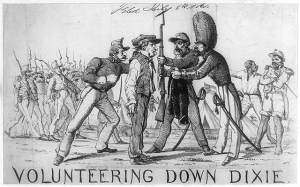
Volunteering Down Dixie,a northern cartoon, satirizes the enlistment of Confederate troops as two "Black Confederates" look on.

Volunteering Down Dixie,a northern cartoon, satirizes the enlistment of Confederate troops as two «Black Confederates» look on.

The topic of so-called “Black Confederates” is controversial. Some insist that Confederate nationalism motivated thousands of African Americans to fight alongside their masters, proving that slavery did not cause the American Civil War. The Internet has become one of the primary means of spreading this nonsense. While professional historians scoff, the “black confederate myth” is popping up on monuments across the south and even temporarily appeared in a Virginia textbook.

When asked about “Black Confederates,” historians often question the sources used by the myth’s supporters, pointing out that they are usually second-hand and anecdotal, or a product of post-war Lost Cause propaganda.  Other historians simply pooh-pooh the claims. I believe that these are not effective responses. A better approach is to place the evidence back into the context in which it first emerged.

In a number of primary sources, people claim to have seen African Americans fighting alongside Rebel soldiers. Most of these sightings were likely of slaves serving as body servants for their soldier masters, or were of the thousands of slaves impressed to work on confederate fortifications. Still, individual human motivations are rarely monolithic and therefore it is not irrational to believe that in the excitement of combat a few of these black men picked up weapons and got involved in the fighting.  Some perhaps felt that in their particular situation it was in their best interest to demonstrate “loyalty” to their masters. Others may have been deceived about the intentions of northern soldiers; white southerners repeatedly told their slaves that Yankees were intent on capturing blacks to send them away to labor in the Caribbean.

Yet while these incidences were in nowhere near the numbers that some claim today, the exaggeration of such tales to promote an agenda is not new. In pushing for emancipation, some abolitionists and radical Republicans widely publicized these stories. In propaganda-like fashion, they greatly exaggerated them to further their cause, and thus they were the first to give these reports more credence and attention than they deserved.

Immediately after the July 1861 battle at Manassas, Virginia, scattered news reports claimed that people saw blacks fighting there among the Confederates. The New York Times, for example, declared that «we hear of black regiments» in the Rebel army, and reprinted a story from the Richmond Enquirer heralding an «ebony patriot» who shot a Yankee officer and captured another. The Charlotte (N.C.) Western Democratcelebrated the «sable patriots» of Manassas and claimed «many cases . . . of [northern] prisoners being taken by negroes.» Some Northerner newspapers claimed that blacks had fought for the Confederates that day in significant numbers. «It is boasted that there are two well drilled regiments of negroes in [the Confederate] army» the Chicago Tribune reported. «The fact that negroes fought in the battle at Bull Run is undisputed,» one correspondent concluded after discussing the battle with Union soldiers who had been in it. «They were forced to do it, but they fought.»

Far more important than the veracity of these dubious claims, is that emancipationists used them to shape northern public opinion and Union war policy. The day before the battle, the U.S. Senate debated a bill that would allow the confiscation of Rebel property used to support Confederate armies. After the battle, Senator Lyman Trumbull proposed an amendment to the bill that broadened the definition of property liable for confiscation to include slaves. «I understand that Negroes were in the fight which has recently occurred,” Trumbull said on the Senate floor. “Negroes who are used to destroy the Union and to shoot down the Union men by the consent of their traitorous masters [should be confiscated].» While there was some objection to the amendment, news from Manassas swayed some senators. Conservative senator John C. Ten Eyck, for example, explained that he previously voted against the amendment, but now changed his mind. «Having learned and believing that [slaves] have been used and employed with arms in their hands to shed the blood of Union-loving men of this country,» he argued, «I shall vote in favor of this amendment.” The amendment and the Confiscation Act overwhelmingly passed, becoming the first legislation that allowed Union commanders to harbor runaway slaves.

To further promote emancipation as a military necessity, abolitionists continued to spread reports of slaves fighting for the Confederacy. In September 1861, famed black abolitionist Frederick Douglass maintained «it is now pretty well established, that there are at the present moment many colored men in the Confederate army doing duty . . . as real soldiers. . . . There were such soldiers at Manassas, and they are probably there still.» Harriet Beecher Stowe, author of Uncle Tom’s Cabin, issued a warning. «The question is not Shall there be black regiments. But, Shall they fight on our side or the side of the enemies?» If the government did not emancipate the slaves, she insisted, the North would have to fight an increasing numbers of blacks in rebel armies.

With hindsight, these fears were unwarranted. The Confederate government vehemently resisted enrolling black troops until the last months of the conflict. In fact, after the Manassas battle a Rebel officer suggested the creation of black regiments but Confederate president Jefferson Davis labeled the idea «stark madness» and claimed such an action “would revolt and disgust the whole South.»

But these were real concerns, and reports continued to come in.  On December 22, for example, Confederates attacked several companies of Union soldiers during a routine reconnaissance up the Virginia Peninsula. Some soldiers claimed that blacks were among their assailants. «Many colored men were in the enemy’s ranks,» Chaplain Richard F. Fuller recorded in his diary that night, «the rebels having no tender scruples about arming the slaves.»

A day after the skirmish, the number of blacks engaged in it was inflated to promote an agenda. In a letter to The Indianapolis Journal, a Hoosier soldier made the outrageous claim that Union soldiers encountered «a body of 700 negro infantry, all armed with muskets, who opened fire.» The wounded soldiers «testify positively that they were shot by negroes.» The soldier called on the government to act; «If they fight us with negroes, why should not we fight them with negroes too?» The story soon found its way into newspapers across the north as a means of promoting emancipation.

In the early months of 1862, these stories continued to be a regular feature in the speeches and editorials of emancipationists. In pushing for both emancipation and the recruitment of black troops, an abolitionist newspaper maintained that the Confederates «have been fighting in close companionship with negroes, from the beginning!» William Lloyd Garrison maintained that Southern blacks “are at the service of the country whenever we accept them. But the Government will not accept them, and the rebel slaveholders are mustering them in companies, and in regiments.» In front of an audience at the Smithsonian Institute, Wendell Phillips insisted «if Abraham Lincoln does not have the negro on his side, Jefferson Davis will have him on his.»

The Peninsula Campaign, the major event in the eastern theater in the spring of 1862, increased these allegations. During the Yorktown siege, for instance, Northern newspapers reported that the Confederates forced blacks to act as sharpshooters, and as artillery gunners. Both the New York Times and thePhiladelphia Inquirer claimed that blacks were seen “uniformed and armed” at Yorktown, and the Baltimore American insisted they were “keeping guard as other soldiers.”

While the Peninsula Campaign was unfolding, Congress deliberated a second confiscation act that would allow for the seizure and liberation of all slaves owned by Rebels, regardless of whether the Confederacy had impressed their labor.  Such legislation would potentially expand the number of freed slaves. To support the bill, these reports of black Confederate soldiers were a mainstay in the northern press and on the floors of Congress.

«Of course the . . . Democrats and the ‘conservatives,’ the Chicago Tribune editorialized, «see nothing wrong [with the Confederates] training the black man to cut up our troops, but let the proposition be made for a negro regiment in the Union service, and they start back in terror at the idea.» The editors were outraged that «slaves may . . . carry muskets for our Southern brethren» and «shoot down our soldiers under the fear of their master’s lash,» but were not allowed to fight for the Union cause. “Does not every man see,” Representative John Hickman told congress, that when the Confederates “are at liberty to employ their slaves, not only in the erection of fortifications, but . . . in the defense of [these] military works, it is a matter of necessity to deprive them of these auxiliaries?”

Radicals were not alone in making such assertions. Conservative Senator John Sherman told Congress, «The question must be decided whether the negro[s] . . .  shall be employed only to aid the rebels.» Sherman insisted that Southern slaves not only performed all the army’s hardest labor, but the «rebels fight side by side with them. . . . Now, shall we avail ourselves of their services, or shall the enemy alone use them?»

«I think we can not be mistaken,» moderate Republican senator James Doolittle argued, the Confederates “have employed negroes not only upon intrenchements and in camp service, but have organized and put arms in their hands to shoot down our sons and our brothers on the field of battle.» Because of this «fact,» the senator maintained, the government should authorize the president «to employ them, and even to arm them.»

Commenting on the debates, the New York Commercial Advertiser noted that the Confederates had used their slaves “as gunners on fortifications, and as picket guards. These are ascertained facts. It is also said they have some negroes enrolled in regiments.» The Commercial’s editors found it «refreshing» that «the recent debates in Congress indicate a definite policy» which would begin to deprive the South of their black laborers. The prediction proved accurate: at the end of July 1862 Congress passed the Second Confiscation Act, and Lincoln presented the Emancipation Proclamation to his cabinet.

I am not suggesting that these reports of so-called “black confederates” were the primary reason why many northerners came to embrace emancipation. However, they clearly played a significant part in the debate, and yet historians rarely, if ever, present or acknowledge these claims when discussing emancipation. As a result, they have fallen into the hands of “neo-confederates.” It is profoundly ironic that modern Confederate apologists now use these emancipationist exaggerations to support their own interpretations of southern motives.

To successfully combat the “black confederates myth,” historians should not simply explain away these accounts. Rather, we should take them out of the hands of those who attempt to use them to glorify the Confederacy, put them back into the context of the emancipation debate in which they first appeared, and in doing so reveal their true importance. While these sightings of so-called “Black Confederates” do not prove African American support for the Confederacy, they do illuminate one largely unexplored reason why Northerners came to embrace emancipation as a war aim.

Glenn David Brasher is the author of The Peninsula Campaign and the Necessity of Emancipation (2012) and winner of the 2013 Wiley-Silver Prize from the Center for Civil War Research.

Sources: Douglass’ Monthly IV (September, 1861): 516; Charlotte Western Democrat July 30, August 6, 1861; Chicago Tribune, July 29, 1861, March 19, 1862, May 29, 1862; Congressional Globe, 37th Congress, First Session, 218-219, 1484; Congressional Globe, 37th Congress, 2nd Session, 1801, 3198-99, 3229-30; Richard F. Fuller, Chaplain Fuller; Being a Life Sketch of a New England Clergyman and Army Chaplain (Boston: Walker, Wise, 1863), 232; Indianapolis Journal, December 27, 1861; Bruce Levine, «Black Confederates,» North and South 10:2 (July 2007): 42; Liberator, August 23, 1861; National Anti-Slavery Standard, August 3, 1861; New York Commercial Advertiser quoted in Cincinnati Gazette, July 15, 1862; New York Times, January 14, 1862, April 27, 1862; Philadelphia Inquirer, April 25, 1862; Principia, September 21, 1861, January 30, 1862.

Illustration Courtesy of the Library of Congress (loc.gov).

Read Full Post »

Are Historians Overestimating the Impact of Civil War Deaths on Americans of the 19th Century?

HNN     April 20, 2014

Union soldiers entrenched along the west bank of the Rappahannock River at Fredericksburg, Virginia

What did the Civil War’s death toll mean to those who lived through it? We are now told that wartime deaths were unprecedented and overwhelming, and constituted one of the fundamental experiences for the wartime generation. But is this really true?

In recent years, statistical descriptions have been used by historians — including renowned scholars such as James McPherson, Eric Foner and Drew Gilpin Faust, but also celebrated filmmakers Ken and Ric Burns, among many – to drive home a characterization of the war based on the scale of death. They may be found across the range of media regarding the war, in films, museums, popular histories, scholarly treatises and lectures.

One such statistic is that the number of soldiers’ deaths in the Civil War – approximately 750,000 – was greater than the total number suffered in all other American wars combined. A second point makes use of the first figure: If one calculates the proportion of the total population who died while in military service during the war, and applies this percentage to present-day population figures, the equivalent number of deaths in the 21st century would reach above 7 million. This is a staggering figure that suggests that the Civil War generation made almost inconceivable sacrifices.

But while factually correct, the statistics work to exaggerate the impact of the war. At its essence, the use of these statistics is designed to provide perspective, a laudatory goal. It is supposed to allow those of us looking back on the war to get a clear sense of the emotional texture of the time. The problem is that doing so violates one of the central codes of historical analysis: avoid presentism.

Instead of putting us in the minds of those who experienced the Civil War, it conjures up significance by equating disparate eras. And it is not enough simply to speak about numbers. To understand how deaths affect a culture, it is essential to examine the meaning ascribed to them beyond the statistics. In the case of the Civil War, historians have not adequately taken into account the context of death and dying in the period.

Solid scholarly work exists on the central importance of death in antebellum America and the ordinary experience of death during the war, but Civil War historians have tended to sidestep this literature in order to claim the war years as exceptional. They have also underplayed the significance of the demographic realities that Americans faced before, during, and after the war. These reveal a society constantly coping with large-scale mortality. Americans throughout the period were lucky if they survived into middle age, and they recognized that life was more fragile than we do today.

Evidence for the extraordinary importance of affliction in the lives of antebellum Americans may be found in nearly any historical source from the period. Newspapers almost always included both poems about the death of loved ones and advertisements for nostrums claiming to cure a variety of ailments. Health became an important focus of advice manuals, and fiction frequently made use of death and sickness as plot devices. In many cases, private correspondence concerned matters of health to the exclusion of most other topics, and diaries overflowed withdescriptions of suffering.

Given these circumstances, it is important to remember that approximately two-thirds of the deaths of soldiers came as a result of disease, rather than on the battlefield. Looking back from today, these numbers are difficult to fathom, and the image conjured by them is of horrendously unsanitary conditions in military camps. After all, these deathsseem to be as much a product of war as those that resulted from wounds: soldiers in camp were there to fight the war and they died because the conditions were necessary to conduct field operations with a massive army.

But this is a present-minded understanding of the circumstances, because it ignores the epic antebellum confrontation with disease. If we work from an assumption that deaths from disease were not viewed at the time as war casualties, but rather as a continuation of prewar circumstances, instead of 750,000 casualties faced by Civil War-era Americans, we are left with 250,000. If we divide this figure by the four years of war, we have a crude estimate of 62,500 battlefield deaths per year.

But even this figure requires context to understand its significance. It is important to keep in mind that death rates were tremendously variable in the period, even within relatively stable locales, because of the unpredictable nature of contagious disease. Some areas reported rates that varied from below 2 percent up to 6 percent. A conservative estimate of a 2 percent death rate for 1860 would have meant about 629,000 deaths that year for the nation as a whole, while a 3 percent rate would have resulted in 943,000 deaths (today’s rate is consistently below 0.8 percent). The additional battlefield deaths in the war would thus represent an increase of between 7 and 10 percent over the normal rates. Significant, but hardly catastrophic.

If we look at changes in estimated death rates from Massachusetts that include antebellum, bellum and post-bellum periods, we notice that these Civil War variations had contemporary parallels. The largest single change in the 19th century in Massachusetts (including the Civil War years) occurred between 1871 and 1872, a 22 percent increase. However, the greatest change in the death rate between single years for Chicago between 1847 and 1864 was an astounding 296 percent. The Civil War additions, therefore, would not be out of line with normal variations before and after the war.

The experience with epidemic sickness and death in other historical moments should also remind us that Americans have been much more blasé about death from sickness than they are today. During the global flu epidemic at the end of World War I as many as 100 million worldwide, including 600,000 in the United States (roughly five times the number of American casualties in World War I and approaching the total number of deaths in the Civil War), perished over the course of just a few months. In addition, this was an unusual strain of influenza that killed mainly the healthiest cohort of the population (those in their 20s and 30s) through a violent immune response. If any event should have triggered re-evaluation of the nation’s approach to death (based solely on changes in incidence and scale, as Civil War historians often calculate), this would be it.

Yet one historian’s book on the subject is titled “America’s Forgotten Pandemic,” and he spends a significant portion of the book trying to explain why the epidemic seemed to disappear from public consciousness so soon after it waned. The answer, in part, is that well into the 20th century Americans viewed disease — and the death that came with it — as a constant, as something that had to be dealt with as part of everyday existence.

This is not to say that deaths in the war were not emotionally wrenching, or that they did not raise any number of new issues for Americans. The antebellum evidence shows that within a sentimentalized culture, death was indeedan important and profoundly disturbing event. Deaths in the war were also viewed in this way, and the trauma associated with them was real, heartfelt and an added burden.

The demographic picture that spans the war years, however, undermines the idea that the magnitude of death in the war necessarily forced Americans to reassess the implications of the carnage. Furthermore, because so many people died young in this era, the casualties would be interpreted very differently than today. The sense of loss that 21st century Americans associate with the relatively rare death of a young person was not the standard mode of response then.

Moreover, the connection of the deaths in the war to a greater cause imbued them with a meaning that should not be overlooked, and that may be seen as an improvement over the struggle to make sense of the vast numbers of dead during the antebellum period. In some way, the significance ascribed to deaths while in the service of protecting the Union or Confederacy obviated the antebellum need for understanding God’s will when those in the prime of life were cut down. For family members of soldiers, the interpretation was easily found. As a Minnesotan soldier named Patrick Taylor noted in a letter to his parents upon the death of his brother (the two fought side by side at Gettysburg), “Isaac has not fallen in vain. What though one of your six soldiers has fallen on the altar of our country. ’Tis a glorious death; better die free than live slaves.’”

The evidence from the period makes clear that historians need to re-evaluate the way we have come to understand the carnage of the Civil War. The war added to an existing demographic and cultural problem rather than creating an entirely new one. Given this milieu, the nearly ubiquitous use by historians of a set of factually correct, yet misleading, statistics needs rethinking. To make a case for the bloodiness of the war in this manner says more about how we interpret these figures today — and the uses we make of them — than about the way Americans actually experienced the wrenching conflict.

Nicholas Marshall is an associate professor of history at Marist College. This article was adapted from Professor Marshall’s article “The Great Exaggeration: Death and the Civil War,” published in the Journal of the Civil War Era 4 (March, 2014).

Read Full Post »

« Newer Posts - Older Posts »