Feeds:
Entradas
Comentarios

JFK Was an Unapologetic Liberal


His underrated career as ideological warrior

by David Greenberg

New Republic  | November 11, 2013

Imagen
In the fiftieth anniversary of John F. Kennedy’s assassination, the hype—the movies and books and magazine covers, the roundups and reminiscences and retrospectives—is in overdrive. How can America resist another JFK love-in? The popular adoration of Kennedy, five decades on, puzzles pundits and historians, who note, correctly, that he neither led the nation through war nor racked up a legislative record on par with that of Woodrow Wilson, Franklin Roosevelt, or Lyndon Johnson.

Some explanations for the discrepancy are obvious: His youth and good looks. His vigor, grace, and cool. The facility with which he projected this image through television, of which he was the first presidential master. And the assassination itself, which by taking Kennedy in his prime allowed Americans to spin fantasies of greatness unrealized.

Yet neither the Camelot mystique nor Kennedy’s premature death can fully explain his continuing appeal. There was no cult of Warren Harding in 1973, no William McKinley media blitz in 1951. I would submit that Kennedy’s hold on us stems also from the way he used the presidency, his commitment to exercising his power to address social needs, his belief that government could harness expert knowledge to solve problems—in short, from his liberalism.

To make that case requires first correcting some misperceptions. Wasn’t JFK a cold warrior who called on Americans to gird for a “long twilight struggle”? Didn’t he drag his heels on civil rights? Didn’t he give us tax cuts a generation before Ronald Reagan? While there’s some truth to those assertions, layers of revisionism and politicized misreadings of Kennedy have come to obscure his true beliefs. During the 1960 presidential campaign, when Republicans tried to make the term liberal anathema, Kennedy embraced it. A liberal, he said in one speech, “cares about the welfare of the people—their health, their housing, their schools, their jobs, their civil rights, and their civil liberties,” and under that definition, he said, “I’m proud to say I’m a ‘liberal.’”

In 1960, the United States was gripped by a quest for “national purpose,” a yearning to find a meaningful goal for America’s energies. This desire had several sources. The cold war was enervating. Material comfort gave rise to an existential uncertainty about what our riches were supposed to produce, a malaise captured in books such as John Kenneth Galbraith’s The Affluent Society and David Riesman’s Abundance for What? Kennedy’s pledge to “get America moving again” should be understood as a part of this collective soul-searching. After the hands-off economic management of President Eisenhower’s free-marketeers, Kennedy promised an aggressive effort to spur growth and create jobs. After Eisenhower’s neglect of mounting urban problems, Kennedy promised a federal commitment to education and housing. After Sputnik and the U-2 affair, Kennedy promised a vigorous effort to win hearts and minds around the world.

As an activist, Kennedy called on Americans to trust government to address the nation’s problems; as a pragmatist, he bade them to believe that dedicated public servants could again muster, as they had during the New Deal, the requisite know-how. In word and in deed, JFK put the weight of his presidency behind a liberal program. He backed a demand-side—not supply-side—tax cut designed to put money in people’s hands to stimulate short-term economic activity. The War on Poverty (an idea he had rolled out during the campaign) sought to alleviate penury, especially among the elderly, by pushing for Medicare and expanded Social Security benefits. The President’s Commission on the Status of Women endorsed workplace equality, child care facilities for working women, paid maternity leave, better Social Security benefits for widows, and equal pay for comparable work. Federal employees got collective bargaining.

Even on civil rights, where Kennedy often gave into his fear of alienating the Southern bloc, he ultimately put the power of the federal government behind racial equality. He used federal troops to ensure the enrollment of black students at the universities of Mississippi and Alabama; his administration implemented the first “affirmative action” program for government employees and contractors. Some movement leaders seethed with frustration over his slow pace. But when the historian Ellen Fitzpatrick compiled post-assassination condolence letters to Jackie Kennedy for a 2010 book, she found affecting notes from African Americans who considered Kennedy, as one correspondent wrote, “a beacon—a light in the darkness who would indeed be a second Emancipator.” His picture graced walls and mantelpieces.

In foreign policy, too, Kennedy’s liberalism has been underappreciated. We hear nowadays that he ran to the right of Richard Nixon on national security in 1960—a claim supported chiefly by his invocation of the so-called missile gap. But that stance no more made Kennedy a hawk in 1960 than Barack Obama’s 2008 pledge to escalate in Afghanistan placed him to the right of John McCain. Overall, in 1960, it was Kennedy who expressed skepticism about the extension of military forces around the globe. He was, to be sure, a staunch anti-communist, and not averse to using hard power. But it was Nixon, not Kennedy, who was ready to go to war to defend Quemoy and Matsu, the tiny islands off China’s shore, while Kennedy questioned his rival’s ill-considered stance.

JFK’s 1961 inaugural address, too, is typically misread as saber-rattling. But his famous call to steel the nation for the cold war conflict was a prologue to the exposition of a more hopeful, conciliatory policy. In that speech, Kennedy endorsed the United Nations as “our last best hope,” warned against the stockpiling of nukes, urged arms-control negotiations, and held out the prospect of collaboration in science, medicine, and commerce. Press accounts treated it as a summons to work toward peace.

In office, Kennedy also preferred diplomacy to military intervention. His wariness of using force led him to deny the CIA-supported Cuban rebels the sufficient air cover they needed at the Bay of Pigs; 18 months later, it counseled him to buck his military chiefs and negotiate the withdrawal of Soviet missiles. He rejected initial calls to get involved in Laos, and his frequently voiced doubts about the effectiveness of U.S. military support for South Vietnam make it at least plausible to surmise that, had he lived, Kennedy wouldn’t have escalated as Johnson did (a speculative matter either way). Following the Cuban missile crisis, moreover, Kennedy redoubled efforts to pull back from the brink. He installed the “hot line” to Moscow and concluded a historic nuclear test-ban treaty. If by “cold warrior” we mean someone cognizant of the stakes of the superpower rivalry, JFK deserves the label. But his presidency was marked at least as much by efforts to defuse tensions as it was by the adventurism for which he has since become known.

Under Kennedy, popular support for government was near its peak. More than 70 percent of Americans said they trusted Washington most or all of the time. As the Vietnam war and the kulturkampf of the 1960s dragged on, that figure declined. Today, after decades of anti-government rhetoric and gridlock, debt and wage stagnation, it stands at about 20 percent. Promises of an activist government are met with cynicism, hostility, and questions about the price tag. The climate is inhospitable to those who would rally the public to higher purposes.

Layers of revisionism and politicized misreadings of Kennedy have come to obscure his true beliefs.

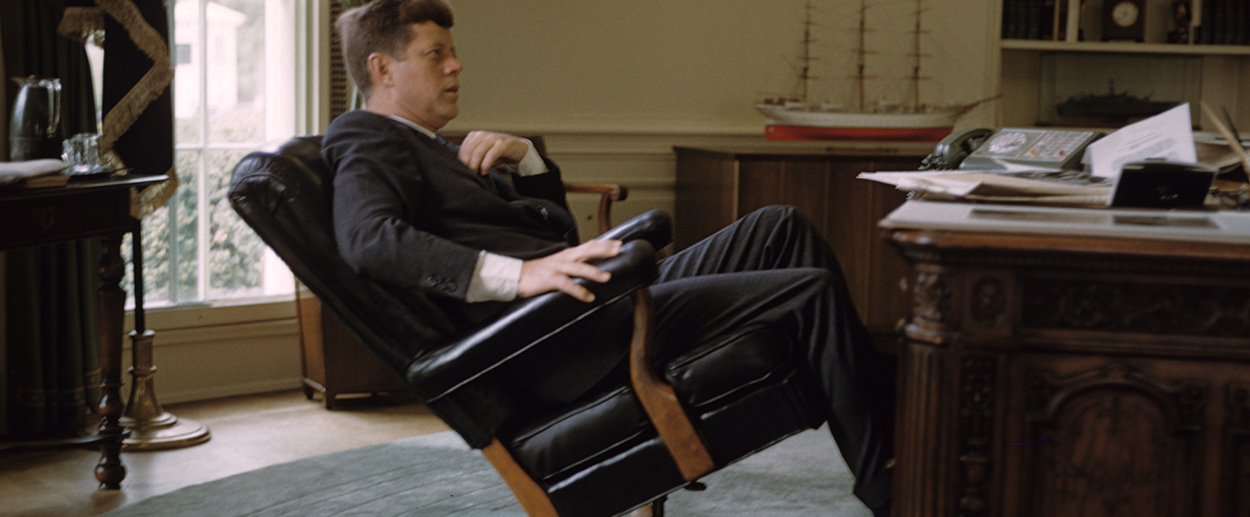
JFK is a reminder that this wasn’t always so. Retrospectives on him inevitably include the witty press conferences, the white-tie White House dinners with the likes of Pablo Casals, the photos of John Jr. playing under the Oval Office desk. But the warm feelings Americans have toward Kennedy may be something more than nostalgia for a glamorous presidency cut short. They reflect a wistfulness for the sense of common purpose and faith in a collective project that a proudly liberal president helped the nation achieve.

David Greenberg, a contributing editor at The New Republic, is a professor of history and of journalism and media studies at Rutgers University.

Source URL: http://www.newrepublic.com//article/115522/jfk-was-unapologetic-liberal
The Five Best Kennedy Assassination Books
Jon Wiener
The Nation    November, 11, 2013

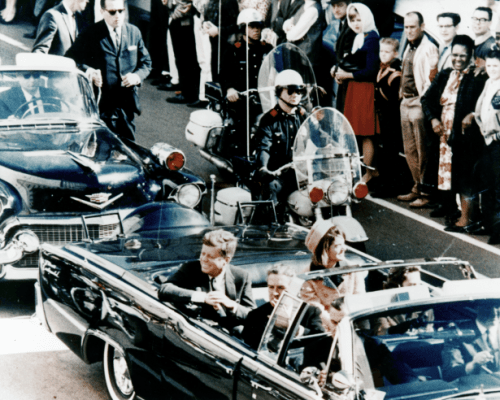
President Kennedy minutes before his assassination in Dallas, Texas, November 22, 1963. (Baylor University Collections)

President Kennedy minutes before his assassination in Dallas, Texas, November 22, 1963. (Baylor University Collections)

November 22 is of course the fiftieth anniversary of the Kennedy assassination. I haven’t read all 1,000 books about it, but I have five favorites:

Don DeLillo, Libra
“We will build theories that gleam like jade idols,” says DeLillo’s surrogate, a CIA historian writing the secret history of Dallas. “We will follow the bullet trajectories backwards to the lives that occupy the shadows, actual men who moan in their dreams.” In the novel, two CIA veterans of the Bay of Pigs seek to arouse anti-Cuban sentiment by organizing an assassination attempt by a Castro supporter. But in their plan, the assassin—with an identity “made out of ordinary pocket litter”—will miss. DeLillo, as John Leonard wrote in The Nation, “is an agnostic about reality.”

Stephen King, 11/22/63
When Jake steps thru the secret passage in Al’s Diner in Maine, it takes him back to 1958; can he stick around and change the course of history by stopping Oswald before November 22, 1963? And what if he discovers that the conspiracy theorists were right, and JFK was shot by someone else? Eight hundred and fifty wonderful pages of time travel romance and adventure in a world where the food tastes better and the music is more fun—and where history itself resists change, with all its might.

Robert Caro, LBJ: The Passage of Power chapters 11–13
The assassination seen through LBJ’s eyes, one car back in the motorcade in Dealey Plaza: after Oswald’s first shot, Secret Service agent Rufus Youngblood shouted, “Get down! Get down!” Then LBJ “was on the floor, his face on the floor, with the weight of a big man lying on top of him,” as the two cars sped toward Parkland Hospital. When they arrived, Agent Youngblood said, ‘I want you and Mrs. Johnson to stick with me and the other agents as close as you can. We are going into the hospital and we aren’t gonna stop for anything or anybody. Do you understand?’ ‘Okay, pardner, I understand,’ Lyndon Johnson said.”

Norman Mailer, Oswald’s Tale
Mailer in his reporter-researcher mode: at age 70, he spent six cold months in Minsk, where Oswald had lived with his Russian wife Marina for thirty months starting in 1960. Mailer interviewed fifty people and used the KGB’s tapes from Oswald’s bugged apartment to paint a vivid picture of the dullness and misery of their lives. Mailer said he started “with a prejudice in favor of the conspiracy theorists,” but he found Oswald to have been a lonely Marxist megalomaniac and an angry loser. In the end, Robert Stone wrote in The New York Review of Books, Mailer had to conclude that “absurdity and common death gape far wider beneath us than high conspiracy, tragedy, or sacrifice.”

Vincent Bugliosi, Reclaiming History
An encyclopedia of assassination conspiracies, with each and every one refuted, “revealed as a fraud on the American public.” One thousand six hundred oversize pages, plus a CD with 1,100 pages of notes, written by the legendary criminal prosecutor. “No group of top-level conspirators,” he argues, “would ever employ someone as unstable and unreliable as Oswald to commit the biggest murder in history, no such group would ever provide its hit man with a twelve-dollar rifle to get the job done, and any such group would help its hit man escape or have a car waiting to drive him to his death, not allow him to be wandering out in the street, catching cabs and buses to get away, as we know Oswald did.”

Jon Wiener teaches U.S. history at UC Irvine.

Comparto con mis lectores algunos blogs de historia norteamericana que me parecen interesante y útiles. Desafortunadamente, ninguno de ellos es en castellano.

A pocas semanas del cincuenta aniversario del asesinato de John F. Kennedy –uno de los eventos más traumáticos de la historia estadounidense– la History News Network nos ofrece una recopilación de interesantes y valiosos trabajos sobre diversos aspectos de la vida y obra del trigésimo quinto presidente de los Estados Unidos. Comparto con mis lectores este valioso recurso.

HNN Hot Topics: John F. Kennedy

This Book Was the First to Spill JFK’s Secrets.
by John B. JudisSo why has «The Search for JFK» been unfairly forgotten?OCTOBER 31, 2013
The Man with the President’s Ear, Arthur Schlesinger Jr. and JFK
by Ted WidmerNo historian has ever been as close to power as Arthur Schlesinger Jr. was to President Kennedy.OCTOBER 28, 2013
Rethinking the JFK Legacy
by Steven M. GillonThere is a wide gap between the way historians view JFK and how the public perceives him.OCTOBER 28, 2013
Channelling George Washington: What if John F. Kennedy Had Lived?
by Thomas FlemingHad JFK lived, could he have beaten second-termitis?OCTOBER 28, 2013
JFK vs. the Military
by Robert DallekDuring the Cuban missile crisis, Kennedy struggled as much with the Pentagon as he did with the Kremlin.SEPTEMBER 12, 2013
Kennedy’s Finest Moment
by Peniel E. JosephJune 11, 1963, may not be a widely recognized date these days, but it might have been the single most important day in civil rights history.JUNE 11, 2013
The Cuban Missile Crisis ExComm Meetings: Getting it Right After 50 Years
by Sheldon M. SternIt is just over thirty years since, as historian at the JFK Library, I listened for the first time to the then classified recordings of the Cuban missile crisis White House meetings of the Executive Committee of the National Security Council (ExComm).OCTOBER 14, 2013
Kennedy, the Elusive President
by Jill AbramsonWas Kennedy really a great president?OCTOBER 23, 2013
Does Mimi Alford’s New Memoir Finally Mean the Death Knell for the Camelot Myth of JFK?
by Vaughn Davis BornetThe confirmation of the philandering JFK.MARCH 5, 2012
Who Really Won the 1960 Election?
by David StebenneNovember 8, 2010 marks the fiftieth anniversary of the presidential election of 1960, which still very much interests those who care about disputed elections.NOVEMBER 14, 2010
Did the 1960 Presidential Debates Really Matter?
by James L. BaughmanProbably not, but they have been election rituals ever since.SEPTEMBER 20, 2013
1963: 11 Seconds in Dallas
by Max Holland and Johann RushWithin hours of John F. Kennedy’s assassination on November 22, 1963, the Kodak film exposed by Abraham Zapruder became the most important home movie ever made.NOVEMBER 23, 2007
The Kennedy Brothers and Civil Rights
by Sheldon M. SternIn The Bystander: John F. Kennedy and the Struggle for Black Equality, Basic Books, 2006, Nick Bryant concludes that JFK was too cautious and hesitant on civil rights.MAY 27, 2007
Errors Still Afflict the Transcripts of the Kennedy Presidential Recordings
by Sheldon M. SternEverything has a history including the writing of history itself.FEBRUARY 21, 2005
The Cuban Missile Crisis Myth You Probably Believe
by Sheldon M. SternDebunking the Trollope Ploy narrative propagated by RFK.OCTOBER 24, 2004
Why the History Channel Had to Apologize for the Documentary that Blamed LBJ for JFK’s Murder
by Stanley I. KutlerLBJ’s family and friends heatedly protested the program.APRIL 7, 2004
Why We Are Still Preoccupied with the Kennedy Might-Have-Beens
by William C. KashatusAfter forty years, the assassination of President John F. Kennedy continues to ignite countless conspiracy theories, rising from the strange circumstances and seemingly inexplicable actions surrounding it.NOVEMBER 16, 2003

– See more at: http://hnn.us/article/153861#sthash.4ILPLL1r.dpuf

Una cineasta muestra el pasado esclavista de su familia y llama a investigar las propias raíces

Democracy Now

31 de octubre de 2013

Traces3.jpg

Para seguir hablando de la esclavitud, nos acompaña una mujer que dio a conocer que sus antepasados fueron la mayor familia vendedora de esclavos de la historia de EE.UU. Katrina Browne documentó sus raíces en la película «Traces of the Trade: A Story From the Deep North (Rastros del comercio: una historia del norte profundo). La película mostró cómo su familia, de Rhode Island, fue la familia esclavista más grande en la historia de EE.UU. Después de que la película se viera en el canal PBS en 2008, Browne fundó el Centro de búsqueda de datos históricos y legados de la esclavitud. Hablamos con Browne y Craig Steven Wilder, autor del nuevo libro “Ebony & Ivy: Race, Slavery and the Troubled History of America’s Universities” (Hiedras y ébano. Raza, esclavitud y la problemática historia de las universidad estadounidenses).

Escuche/Vea/Lea (en inglés)

October 31, 2013

The Dreams of War

By JONATHAN W. WHITE

The Civil War placed new and unique strains on Americans, and their dreams reflected those hardships. Sometimes the war intruded on people’s slumber, vividly bringing to life the horrors of the conflict; for others, nighttime was an escape from the hard realities of life and death in wartime. When Americans recorded their dreams in their diaries, letters and memoirs, they sought to make sense of the changing world around them, and to cope with the confusion, despair, and loneliness of life amid the turmoil of a gigantic civil war.

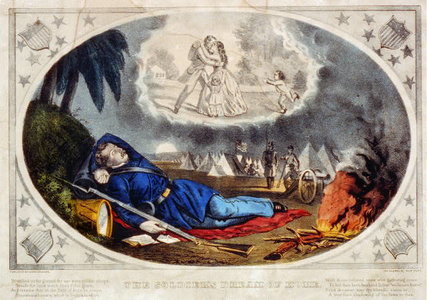
The most common theme in both Northern and Southern soldiers’ dreams was “home.” A New York soldier wrote to his wife: “Last night I dreamed of being at home as I often do and sweet were the kisses what I took all around.” A 36-year-old Virginia soldier likewise told his 16-year-old sweetheart, “I dream about you som times three or four nights in succesion[.] I dream som mighty good dreams about you.”

But dreams of home could lead to disappointment after sunrise. “I dreamed of huging and kissing you all night last night,” wrote one Indiana soldier to his wife. “Oh, how happy I was but how bad I did feel this morning.” Similarly, Lt. Richard Goldwaite of the 99th New York Infantry told his wife that he dreamed “you came here to see me and we were a going to have a good time in my tent when night came,” but “when I woke up in the morning and did not find you, I was mad enough to go over to Baltimore and get drunk.”

“The Soldier’s Dream of Home,” by Currier & Ives Library of Congress

“The Soldier’s Dream of Home,” by Currier & Ives
Library of Congress

Soldiers’ dreams of home often revealed their fears of spousal infidelity. Capt. Thomas Jefferson Hyatt of the 126th Ohio Volunteers had several “very queer” dreams one night. In the first, he dreamed that his marriage “had run out and we were about arranging another term.” In the second, he dreamed that his wife “had abandoned me and … was about to form an alliance with Lt. Watson of this Regt.” At first Hyatt was content with this new arrangement, “as I supposed I was free to go where I chose.” But soon he “began to feel very badly, and could not think of the separation.” When he awoke, he was relieved to find it had all been a dream.

These kinds of dreams were ubiquitous. A Minnesota infantryman, Duren F. Kelley, dreamed that he saw his wife on a street in Minnesota but that she “seemed to take no notice of me and kept right on.” Such dreams almost drove a Wisconsin soldier to suicide — in his dreams. After dreaming that his wife left him for a neighbor, Miles Butterfield dreamed that he went to the train tracks to “put an end to my Miserable life by lying down on the track and letting the cars run over me, for now I had nothing to live for as you and the Baby was gone.” He then told his wife that she needed to write to him more often.

Wives also dreamed of infidelity. An Irish woman named Betty Murphy dreamed that her husband, a Union soldier named Timothy Murphy, left her and married “a nigger winch.” In response, he playfully chided her, “i amnot as yet i dunt now howe soon i may get one the[y] are [as] plnty [as] cattle around.” He then assured her, “give my love to the children and a bushil of kisses to each one and 2 bushil for your self.”

Dreams of the girls back home were common in the Union and Confederate armies. One Virginia officer dreamed of “having a nice time” with a Miss Sallie. Two nights later he dreamed of a Miss Kate. Four days later, he dreamed that he was about to “pop the question” to a Miss Frances. Meanwhile, the Union general Godfrey Weitzel told his future wife of a dream: “You and I sneaked away from the rest of the folks and went upstairs to that little front room in your house and we had such a pleasant time. But alas! It was only a dream.”

Even a few wet dreams survive in the historical record. A Pennsylvania chaplain noted a peculiar reason that two men in the regiment claimed for a discharge: “Both of them have been married for some years; and yet such are the pernicious effects of the early indulgences, that now they frequently have nocturnal emissions, foul dreams, etc. — besides rheumatism and general debility — such as renders them unfit for service.”

Nightmares of battle could be as jarring as dreams of home were pleasant. An Alabama soldier wrote that his dreams of battle “frighten me more than ever the fight did when I was wide awake,” while a Massachusetts infantryman lamented that “the minute I get into a doze I hear the whistling of the shells and the shouts and groans” of the wounded. “It is horrible.”

Dreams of battle could also be revealed as a soldier talked in his sleep. One Union soldier overheard his tent mate “evidently chasing a rebel in his dream,” while another slumbering soldier shouted, “By detail, load; two, three, four! Sponge; two, three, four! Ram two, three! Ready, fire!” Soldiers languishing in prisoner-of-war camps frequently dreamed of sumptuous meals, giant lice and prisoner exchanges.

The war could quite literally intervene in dreams as well. While sleeping through a cannonade, one New Hampshire volunteer dreamed that he was watching “a Fourth of July Celebration at home.” Weather could have similar effects. “We had a tremendous Thunder shower last night,” wrote one Massachusetts soldier, Charles Harvey Brewster. “I lay dreaming and I thought it was cannon. I thought we were marching towards it, and could see the smoke and I wondered why the balls did not come, finally I woke up and there came a clap precisely like the firing of cannon, and I expected to hear the long roll, but when I heard the rain pattering on the tent I concluded that it was all right.”

The changing nature of the war also affected some Confederates’ dreams, even when they could not fully recognize how. On Jan. 14, 1863 — just two weeks after Lincoln issued his Emancipation Proclamation — an Arkansas soldier wrote to his mother of a strange dream he’d had: “I dreamed last night of being at Aunt Polly’s, at a big dinner. I thought things didnt go on right; I thought I had to eat by the side of a negro and he had a plate to eat on, and I had none.” One would think that the meaning of such a dream would have been obvious to this soldier (his other letters attest to his political awareness, and he frequently mentioned Lincoln), but he wrote, “If you can interpret that dream you may do it for I cant.” Still, he felt confident that he had nothing to fear. “I dont think it will ever come to pass; I know it will never be that way at aunt Polly’s house. I think a heap of aunt Polly and I know if the feds do whip us, she will not allow the negroes to eat at her table with white folks.”

As with these soldiers, the war often caused restless nights for civilians, and war dreams could torment people for days. Elizabeth Blair Lee dreamed that the Confederates captured one of the federal forts outside of Washington in September 1861. She dreamed herself onto Pennsylvania Avenue “in a scene of great anguish and trouble.” “I tell you this,” she wrote her husband, “to let you see how these terrible times haunt me.”

In their sleep, Confederate civilians often dreamed themselves to faraway, peaceful places. A woman who had moved to Arkansas dreamed herself back to Minnesota in 1863, where her family was “pursuing their peaceful everyday duties just as calmly” and where the “pasture reaches to the Pacific Ocean.” A Louisiana girl, meanwhile, dreamed herself into wonderful conversations with Charlotte Brontë, William Shakespeare and the Apostle Paul. “Dreams! who would give up the blessing?” she confided in her diary in the middle of the war. “I would not care to sleep, if I could not dream.”

http://opinionator.blogs.nytimes.com/2013/10/31/the-dreams-of-war/ 

31disunion-white-thumbStandardJonathan W. White is an assistant professor of American studies at Christopher Newport University. He is the author of “Abraham Lincoln and Treason in the Civil War: The Trials of John Merryman” and the forthcoming “Emancipation, the Union Army, and the Reelection of Abraham Lincoln.” He is also writing a book called “Midnight in America: A History of Sleep and Dreams during the Civil War.”

32a40fd-7.cached


The Man with the President’s Ear, Arthur Schlesinger Jr. and JFK
No historian has ever been as close to power as Arthur Schlesinger Jr. was to President Kennedy as a new collection of his letters marvelously shows. Ted Widmer on the whirl of celebrity and policy that dance across the pages.

by Ted Widmer  | October 27, 2013

The Daily Beast Company
The 50th anniversary of John F. Kennedy’s presidency winds down this fall, and it is refreshing to have these two books, each a celebration of genuine life and thought, as we enter an echo chamber that is unlikely to promote either in the weeks leading up to November 22.

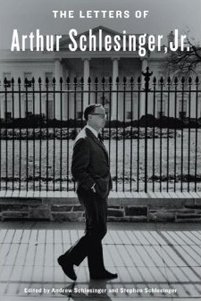
‘The Letters of Arthur Schlesinger, Jr.’ Edited by Andrew Schlesinger and Stephen Schlesinger. 672 pages. Random House. .

‘The Letters of Arthur Schlesinger, Jr.’ Edited by Andrew Schlesinger and Stephen Schlesinger. 672 pages. Random House. .

Schlesinger’s letters complete a download that has been coming steadily since his death in 2007. Indeed, after going to his reward, he has been publishing at a prodigious pace. First came the Journal, in a hefty volume in 2007. Then, in 2011, the lengthy interviews he conducted in 1964 with Jacqueline Kennedy. Now, the letters, lovingly culled by his two sons, Andrew and Stephen, which offer more grist for a mill that was not exactly grist-deficient.

In a postscript, the editors recount the process of sifting through this pile of paper—134 boxes, with about 200 letters in each—and estimate that their father wrote 35,000 letters! Evidently, he never sent one without making a copy—ergo, this book. This paper trail seems almost incomprehensible in the Age of Twitter—letters, written on paper, composed of full sentences and paragraphs, making complex arguments, rooted in history and facts. Reading it during the government shutdown, it felt like an ancient cuneiform, testifying to the strengths and weaknesses of the civilization that preceded our own time. Ours feels smaller—tweetier—in comparison.

I had that feeling even when Arthur was alive (I was one of his 35,000 correspondents). Now and then, a postcard would arrive with a curt message, typed on a manual typewriter. Who types a postcard? It felt like a summons from Olympus. Typed on an Olympia.

To reenter the world of his correspondence is like a form of time travel, giving the reader access to the same vertiginous ride he was on, following the presidency and the course of American liberalism from its high-water mark under FDR, through its many peaks and valleys since then.

President-elect John F. Kennedy is greeted by Harvard professor Arthur M. Schlesinger Jr., (right) at the professor’s residence in Cambridge, Massachusetts on January 9, 1961. (Bettmann/Corbis)

The first letter dates from 1945, the year of FDR’s apotheosis, and the publication of Schlesinger’s Age of Jackson. That great work was as much about FDR as Jackson, and its appearance as a great chieftain left the stage helped establish Schlesinger as something above the ranks of a normal historian. He was a sage and a soothsayer, a mystic who communed with the spirits of former presidents and helped divine the path forward for current and would-be occupants of the White House.

Schlesinger goes ballistic when Boehner misquotes Lincoln— “Seriously, Congressman, do you really think those quotations sound like Abraham Lincoln? Come on!”

There is a festive tone throughout, and the first letter, written from a Paris that is about to be liberated, reveals Schlesinger at the center of a party, and loving it (“What a two days! It is just as well that world wars are so few. I don’t know how many peace celebrations I could stand per generation, especially in Paris.”) Throughout the late 40s and 50s we see him building his networks, joining Adlai Stevenson’s eggheads, and slowly falling in love with the upstart Senator from Massachusetts, John F. Kennedy. They had known each other slightly at Harvard, and the letters reveal Kennedy dexterously working on Schlesinger in the most artful way, asking leading questions about obscure 19th century Senators (his weak spot), and slowly recruiting an actual Arthur into the magical kingdom that would become Camelot. Schlesinger had a bit of explaining to do as 1960 approached, and Stevenson and Kennedy jostled on the way to the nomination they both sought (Arthur’s wife Marian remained an Adlai supporter). But he sorted that out, and for the rest of his long life, basked in the afterglow of the Kennedy White House. Indeed, he was probably much more valuable as a former aide than he was when Kennedy was actually president. His 1965 book, A Thousand Days, retains its vigor, and has never been excelled as a study of those years. He defended Kennedy’s positions long deep into the 60s and 70s, and was especially helpful clarifying his positions on Vietnam, when others were falsely invoking him to justify escalation of the war. These letters also reveal him to be a keeper of the liberal flame in other ways, urging candidates not to wobble on the legacy of the New Deal, and to stand by core principles, even during the long amnesia brought on by Reaganism and its aftermath.
To his credit, he seemed to enjoy the years out of power as much as his thousand days. As gate-keeper, he was always available to disburse advice to new aspirants, and the correspondence includes nearly everyone from our political pantheon, including a Republican or two—George H.W. Bush is in there, and even John Boehner makes a cameo (Schlesinger goes ballistic when Boehner misquotes Lincoln— “Seriously, Congressman, do you really think those quotations sound like Abraham Lincoln? Come on!”).

To be sure, there were fights, and some of the most entertaining letters relive the arguments—with William F. Buckley, and Lillian Hellman, to name a few. He took it from all sides; from a left that regarded the courtier with distrust, and disliked his anti-communism; and from a right that found him too left-wing, too Harvard, too much. The biggest argument of all, Vietnam, caused some of Schlesinger’s friendships to fall apart. As these letters reveal, those were agonizing days for liberals. Schlesinger was right on the fault line, more establishment than the young protesters, but outraged over the venality of a war that had no achievable purpose. Schlesinger, with his sharp ear for language, hated the mealy-mouthed arguments he was hearing from centrist Democrats like Hubert Humphrey, who sprang from the same liberal tradition he did. (Humphrey misidentified him as “Art,” rather than Arthur—one wonders if intentionally). The letters convey the full intensity of an argument that came to a full boil around 1968, and has never stopped simmering.

Throughout, we see Schlesinger navigating the blurry lines of historian, participant, observer, and observee. Obviously, he loved the limelight. A typical letter, to a young schoolgirl in Pennsylvania, begins “I am glad, but a little appalled, to know that I have been chosen as your topic for a term paper.” He relished the chance to pour out his thoughts, to friends far and near (an amusing note from 1957 reveals that he and Lyndon Johnson enjoyed meeting each other, but each felt that the other person talked too much). The full weirdness of the 1960s is on display here, with letters to celebrities like Sammy Davis Jr. following closely upon sober policy messages to high-ranking members of the LBJ administration.

It would have been interesting to read a few more letters from his inbox, the emphasis is decidedly on the ones he wrote to others, but some of the ones he received are gems. In one, Adlai Stevenson explains, like a displaced Mafia don, why he feels angry at JFK, whose career he helped to advance. In another, Henry Kissinger defends his wounded pride, after a well-aimed hit from Arthur (Kissinger had defended his honor in a 1974 press conference, and Schlesinger quoted Emerson, “the louder he talked of his honor, the faster we counted our spoons.”) The conversation could get loud, and large issues were at stake. But the fact that a conversation was actually happening, and that friends and rivals like Schlesinger, Kissinger, and Moynihan could write each other so volubly was good for the republic. There are a lot of good-natured insults—many from William F. Buckley, Jr.—and those little bee-stings read nostalgically, from a time when the Right and Left didn’t agree, but at least tolerated each other’s existence. During October’s government shut-down, the bankruptcy of public conversation was very much in evidence.

Robert Dallek’s profile of the Kennedy White House offers a very different perspective on the presidency, and the particular president Schlesinger served. Schlesinger figures in the book, but in this telling, he is only one of many courtiers circling around the vital center of American power.

Dallek is deeply knowledgeable about Kennedy, and his 2003 biography, JFK: An Unfinished Life, broke new ground for its revelations of medical information relating to the 35th president. An Unfinished Life was apparently an apt title, for Dallek now returns to the subject, as so many biographers do, conscious that the public will never lose its fascination for John F. Kennedy. With this volume, he pulls the camera back a bit from the star, to pan across the full range of supporting actors giving daily life to the New Frontier. It’s a smart idea for a book. Through this tour d’horizon, we meet all of the major aides, and a few (not too many) of the minor ones. I was mildly disappointed that there was not more emphasis on two aides in particular, Kenny O’Donnell and Larry O’Brien—charter members of the “Irish Mafia” who gave President Kennedy unstinting loyalty and hardened political advice. They were under-represented when the wordsmiths (Schlesinger and Sorensen) wrote their books in the 1960s, but they were integral to the story, and to the work of governance that underlay the glamour. Dallek brings out in vivid detail the debates over Vietnam and Cuba that dominated so much of the Kennedy presidency. He pays less attention to domestic difficulties, like the civil rights struggle, or the efforts to fight poverty and pollution that were gaining traction near the end. Overall, this is a highly capable synthesis of the work done within the Kennedy White House, and the complex range of personalities at the heart of it all.

Near the end of his letters, Arthur Schlesinger quotes Benjamin Franklin, near his own demise, who said that he had never troubled himself worrying about the divinity of Christ, because he expected to know the truth soon, “with less trouble.” Perhaps the two skeptics are together now, lamenting our failure to live up to the founders (a lament that goes back nearly to the founders themselves). In any event, the publication of these two books continues an important conversation with the past, all the more urgent at a time when no one in power seems to be talking to anyone else. As long as Congresses and Presidents exasperate each other, Schlesinger will have an audience, and an afterlife.

Ted Widmer is Assistant to the President for Special Projects at Brown University. He edited Listening In: The Secret White House Tape Recordings of John F. Kennedy.

JFK at Rice University in September 1962. Image via Wiki Commons.

Rethinking the JFK Legacy

Steven M. Gillo

huffingtonpost.com October 27, 2013

As we approach the 50th anniversary of President John F. Kennedy’s assassination we are reminded of his enduring hold on the popular imagination. Once again countless magazine articles, newspaper stories, books, and television stories will focus on the man, his presidency, and his death. Politicians from both parties continue to invoke his name to sell themselves and their policies. Polls show that Kennedy is America’s favorite president, ranking above Washington, Lincoln, and Roosevelt.

Public adulation of Kennedy baffles many historians who have spent the past twenty years assaulting the foundation of Camelot. The public sees him as a bold and gallant leader who inspired the young, helped the disadvantaged, pushed for civil rights, stood down the Russians, and added glamor and style to the White House.

In recent years, however, many historians have focused attention on Kennedy’s shortcomings: the obsession with Fidel Castro, his reluctant support of civil rights, and the escalation in Vietnam. They have also probed beneath the glossy Kennedy charm and discovered a man who was dependent on prescription medication and who possessed an insatiable sexual appetite. Kennedy, a recent critic charged, was «deficient in integrity, compassion, and temperance.» That is a harsh judgment, and certainly not one shared by most historians. Most would agree, however, that his short time in office prevented JFK from leaving a lasting legacy of accomplishment.

Why the wide gap between the way historians view Kennedy and how the public perceives him? Part of the problem is that historians have difficulty appreciating Kennedy’s emotional impact on the public. Kennedy was the first president to use television to bypass the Washington opinion-makers and communicate directly with the American public. Television made obsolete traditional models which used legislative accomplishments to determine influence.

Because of the intimate relationship Kennedy established with the American public many people felt a sense of personal loss at his death. The assassination affected America unlike any other single event in modern history — with the possible exception of 9/11. No American born prior to 1960 can forget where he or she was the moment they heard the news of the President’s death. Seventy-five hours of television coverage helped create a shared sense of national grief. Four of five Americans felt «the loss of someone very close and dear,» and more than half cried.

Inevitably, in the years that followed Americans have searched to give his death some meaning. Our refusal to accept that Kennedy’s death could have been the result of a random, inexplicable act of violence has led us to search for more satisfying explanations. We refuse to accept that a loser like Lee Harvey Oswald could single-handedly kill a man as great as JFK. That search for meaning has lead to the creation of a mythical, heroic Kennedy. The thread that runs through most conspiracy theories, and permeates the popular view of JFK, is that nefarious individuals conspired to kill the President because he offered a new direction for the country.

But the Kennedy mystique is based on more than his photogenic qualities and his tragic death. In trying to understand Kennedy’s appeal I am reminded of what our first professional biographer, James Parton, wrote about Thomas Jefferson. «If Jefferson was wrong,» he wrote, «America is wrong. If Jefferson was right. America is right.»

Since the Puritans came to America searching for deliverance from the corruption of the Old World, Americans have believed in national destiny. Thomas Jefferson declared the new nation «the last best hope of mankind.» Herman Melville compared Americans to the biblical tribes of Israel, calling them «the peculiar chosen people… the Israel of our time.» At the heart of this belief was a faith that the future would always be better than the past. America stood as the exception to the historical rules which dictated that great civilizations eventually peaked and crumbled. Devoid of the class conflict, racial tensions, and the imperial designs that characterized other civilizations, America would move inevitably toward realizing its divinely inspired mission to be «as a city upon a hill.»

More than any president since FDR, Kennedy embodied these ideals of American greatness. Kennedy, like the nation he led, seemed larger than life. Every dimension of the New Frontier projected an image of strength and vitality: the inspirational rhetoric of sacrifice and idealism; the aristocratic elegance and democratic demeanor; the brilliant but compassionate advisers. Robert Frost captured the mood of the nation when he predicted that the Kennedy years would be an «Augustan age of poetry and power.»

The tragic series of events that followed Kennedy’s death challenged our faith in national destiny. A lost war in Vietnam and a crippling oil embargo reminded us that we could not shape the world in our own image. At home, racial violence, student protests, and government corruption revealed that America remained a deeply divided nation. During our time of trouble we turned to a heroic Kennedy for comfort. He reminded us of a time when America stood strong in the world, our nation felt united, and life seemed simpler. As the American dream slips further from the grasp of most people, as our faith in government and our hope for the future diminishes, we cling more tenaciously than ever to a mythic view of Kennedy.

We have transformed Kennedy into a metaphor of American greatness and judged all of his successors by that standard. Not surprisingly, they look dull by comparison. Politicians, eager to win the hearts of American voters, have tried to mimic Kennedy’s style and to steal his message. Republicans have invoked Kennedy’s memory to sell programs — supply-side economics, for example — that were antithetical to JFK’s own policies. President Obama flexed his political and legislative muscle to push through legislation that was far more ambitious than anything JFK could have imagined, yet even he, and his accomplishments, appear diminished by the comparison to a mythical Kennedy.

Over the years, the public, which has grown cynical and angry over raised expectations and diminished results, has moved to the sidelines of American politics waiting for the «next JFK.» Powerful, well-organized and well-funded, interest groups have moved to fill the void.

It is ironic that the memory of JFK would weaken political institutions. Kennedy won the presidency in 1960 by advocating change and, at least on a rhetorical level, he challenged us to confront old ideas. «For the great enemy of truth,» he said in a famous Yale commencement address in 1963, «is very often not the lie — deliberate, contrived, and dishonest — but the myth — persistent, persuasive, and unrealistic.»

Ultimately, our fascination with Kennedy tells us more about ourselves, our deeply rooted beliefs and our need for heroes, then it does shed light on the man or his times. Kennedy was a very mortal man, very much a product of his times. In life he offered few solutions to the pressing issues of his time. His memory, burdened by the weight of myth, limits our ability to find answers to the problems of our own time.

http://www.huffingtonpost.com/steven-m-gillon/rethinking-the-jfk-legacy_b_4167729.html

Steven M Gillon is Scholar-in-Residence at History and Professor of History at the University of Oklahoma

America’s Top Colleges and Universities Have a Hidden Legacy of Slavery [INTERVIEW]

by David Austin Walsh

History News Network

October 23, 2013

Source: Wikipedia.

In 2006, Brown University issued an extraordinary report detailing the university’s relationship with the slave trade. The authors, drawn from Brown faculty, administration, and alumni, acknowledged the deep, intertwined history of the slave trade and the university — and the role slave labor played in the very construction of the school. The report made headlines across the country, not least because it was commissioned by Brown president Ruth Simmons, the first African American and the first woman to become president of an Ivy League university.

But Brown is hardly the only venerable university in the United States that is reckoning with its hidden legacy of slavery. Craig S. Wilder, professor of history at the Massachusetts Institute of Technology, demonstrates in his acclaimed new book Ebony & Ivy: Race, Slavery, and the Troubled History of America’s Universities, that practically every college and university founded during colonial-era America — Harvard, William & Mary, Yale, Princeton, the University of Pennsylvania, Columbia, Brown, Rutgers, and Darthmouth — has a history of slavery to confront.

Professor Wilder recently spoke with me over the phone from his office in Cambridge about his book, the research behind it, and what America’s oldest and most elite colleges can do to confront this painful history.

* * * * *

Ebony and Ivy explores the intertwined relationship between the first colleges and universities in America and slavery. It argues that most older institutions of higher education in America were built on the back of slave labor. Were there particular universities that were relatively more invested in the slave economy?

Yes, and I think part of the goal [of writing the book] for me was to explore, to find out, to discover, the role that slavery played in the founding and the rise of these institutions.

To see that at Harvard in its earliest years, one of the residents of the campus was an enslaved man, or that the first eight presidents of Princeton – then the College of New Jersey – were slave owners, and enslaved people lived in the presidents’ houses and served the presidents and students. To see the evolution of the Harvard/Yale/Princeton faculties, and the founding moment of Yale, when the founding trustees gathered to plan out the organization and wrote the bylaws of the new school – they were actually accompanied by their slaves to that meeting.

So one of the things I found really interesting while researching the book was how intimate the relationship was between the academy and slavery in the colonial world, and how much these colonial institutions depended upon enslaved people, but also on the broader economy of the slave trade.

You made the point in the book that many of the founders of these universities became quite wealthy as merchants profiting off of the slave trade.

Yes, that’s true. But you really have to look very closely at the denominational roots of the schools, and the denominational origins of the colonials.

From the perspective of the twenty-first century, when you think about Columbia or the University of Pennsylvania, or Dartmouth, you think of them as wealthy, historic institutions. But these were pretty lean institutions in the eighteenth century, when they were founded. They were local institutions. The ministers and local activists founded these schools turned to local sources of wealth, and in the mid-Atlantic and New England, that meant they often turned to families who made their fortunes in the Atlantic trade, and a significant proportion of that trade was in African slaves.

What were the missions of colonial governments and colleges and how did those missions intersect with slavery?

The mission of the earliest colleges — specifically Harvard, the College of William and Mary, and Yale – was actually to supply ministers, for two purposes: to supply religious leaders for the primarily British and to lesser extent European population in the colonies, but also to minister to the neighboring native nations.

And as I alluded to earlier, one of the ways the founders of these schools paid for the the supplying of the faculty – and these faculties are really actually quite tiny – was to turn to local sources of wealth. At William and Mary, that meant the planters of Virginia, and the planters actually become the governors and trustees of this school. Harvard turned to local merchants in the seventeenth century, many of whom were West India suppliers who sent fish, for instance, south o the West Indies. As one economic historian put it, the cheapest quality fish was what was sent down to feed the enslaved population of the West Indies.

Not only did Harvard’s New England backers have close ties to West Indian slavery, the school also followed these commercial networks south to seek out wealthy West Indian donors. And not only donors – also students. One of the ways in which these schools maintained themselves was by recruiting a supply of students who had money who could afford tuition who were in search of education, and so beginning really in the seventeenth century with Harvard, and continuing through the founding of the mid-eighteenth century colleges (which were all of the colleges from Princeton to Dartmouth), looking for students and recruiting students in the West Indies becomes a fairly ordinary business.

To get back to your question about the denominational origins, here this is where the colleges were actually doing the local work they were founded to do. Baptists in Rhode Island established the College of Rhode Island (now Brown University) in order to supply an orthodox and well-trained ministry for themselves.

That means that you have these very odd moments, one of which didn’t end up in the book but which I’m writing about separately. I found it oddly ironic that before the British even evacuated North America after the Revolution, before they even finished evacuating New York, the president of the College of Rhode Island James Manning sat down at his desk and began sending letters off to England to wealthy Baptist friends. One of the things he’s asking for is to put the small matter of the past conflict — which has just ended — behind them, and remember that they’re Baptists. The future of the communion rested upon their close ties. These are actually fundraising letters. Manning offered to rename the school after wealthy Baptist British donors, and asked for help in locating such a person. The school was ruined by the war – it’d been occupied by both armies for a time – and there was a lot of rebuilding to be done. But what I find striking about that moment is that even at the end of the American Revolution, after seven or eight years of conflict and bloodshed, the denominational ties between these schools and England remained intact enough that many college presidents thought they could continue to use them as a source of funds and students.

Now, going back to something we touched on a little bit earlier, the use of slave labor to actually build these universities and operate them. I realize it’s very difficult to actually find slave narratives and stories, but were you able to piece together any stories from any of these campuses about the slave laborers who lived there?

Well, you don’t evidence of it on every campus, but you do find evidence of it on enough campuses and in enough archives to realize it was fairly common to use slave labor. For instance at Brown, when the original trustees were raising donations for the school, local residents of Providence and Newport donated cash, lumber, and other goods, and they donated the labor of their slaves. You can actually see people donated the labor of their enslaved person for a certain period of time. At the College of William and Mary, teams of slaves were used for the upkeep of various buildings, and the College actually held a fairly sizable population of slaves for use as campus servants, dedicated at times to specific buildings. Some of the students at William and Mary brought slaves to campus with them.

Eleazar Wheelock, the founder of Dartmouth, arrived in New Hampshire in 1770. He brought with him eight enslaved black people, and he wrote in his narrative [memoir] about the early struggle to build the college (he later used the narrative as a fundraising tool). He wrote about the use of his slaves to help lay out the fields and raise some of the original structures of the college to get things going. He actually has several places in his narrative about the things he’d assigned his laborers to do to improve the campus and expand his ability to take in students.

How long have you been researching this topic?

Eleven years from the beginning to the publication of the book.

It started back in 2002, when I had just gotten tenure at Williams and I’d moved to Dartmouth that fall. I had just finished my second book project when I’d gotten there, and I decided to do something small, and I wanted to write a history of black abolitionists in New York – probably just an article. I wanted to explain how these free black people who opposed slavery in the decades before the Civil War managed to become professionals when they were in fact excluded from colleges and universities — how do you professionalize in a world where you lack access to higher education? Part of the reason I wanted to write that article is because in many ways it’s a very New England story, because a lot of them from the mid-Atlantic came up to New England to study privately.

But what ended up happening is that I became much more interested in the fact – in part because I was at Dartmouth and Dartmouth has an extraordinary Native American studies program — that Dartmouth had Native American students on its campus for two hundred years before the 1830s and 1840s. So the barrier wasn’t just race. There was clearly something much more interesting happening. And that needed an explanation. It suggested that colleges had a role in the colonial world that I really hadn’t thought about.

So I dropped that original project, and I just started looking earlier and earlier into the histories of these schools and the way that they functioned in the individual colonies. Why native students had been brought to campus and under what circumstances. The oddness of looking at campuses as a site where Native Americans, European Christians, and Africans co-existed but in very different capacities and in very different ways. I was intrigued with the college as a site for exploring and reinterpreting early American history and saying something new about early American history.

What about the 2006 report of the Brown University Steering Committee on Slavery and Justice, which investigated Brown’s relationship with the slave trade?

Where the Brown report became important for me is that four years later I realized this was a huge topic. I was nowhere near the point where I could outline the structure of a book, but I had done four years of research, and I felt like I had four years of very interesting — but not necessarily connected material — and I was ready to stop. I thought that maybe I should just publish a few articles on these various things that were interesting in different journals and forget about some larger project.

But when the Brown report came out I was just honestly sort of taken by both the boldness of the report, the courage of President Ruth Simmons who commissioned the report, and in taking up this task, particularly being the first person of color and the first woman to head an Ivy League school, I just thought the extraordinary courage it took to take that step, and to commission the report, and her articulation of the obligation to pursue those truths and pursue that history to the students, faculty, and alumni at Brown and the broader community, I just found it so compelling that I felt obliged to continue. I didn’t know it was going to be another seven years before I was done… that’s the story of how I got here. It was not a project I had set out to do. I just kind of wandered in this direction as I became more and more intrigued by this possibility of rethinking early American history by reexamining the role of the college in the colonial world.

Do you feel in the aftermath of the Brown report – and quite possibly in the aftermath of the publication of your own book — there will be a reassessment at these various colleges and universities of institutional memory?

Yes, I think so, but I think the Brown report did that. And I think what has happened since then has really been striking. If you think about what’s been happening at Emory, Alabama, North Carolina, and Harvard, faculty, students, librarians, alumni, and now even the presidents of these institutions – and even the trustees — are increasingly taking steps to recognize this history, to acknowledge it, and to address it in institutionally specific ways.

I think in many ways that’s a measure of just how powerful the Brown report was. The impact it’s had on the broader galaxy of elite academic institutions. Not all have done it, but a lot of them have. And I think that’s only going to move forward. One of the great lessons of the Brown report, and of Brown’s experiences in history, is that seven years later, Brown is stronger because of the decisions made between 2003 and 2006, when President Simmons commissioned the report and when the report was released. It’s a stronger community, and it’s taken a leadership position in a very difficult public engagement with history that’s painful, but that we have a need to address, and that we ultimately cannot escape.

David Austin Walsh is the editor of the History News Network. Follow him on Twitter @davidastinwalsh.
See more at: http://hnn.us/article/153693#sthash.RrKmrKQo.dpuf

Before Solomon Northup: Fighting Slave Catchers in New York

by Marjorie Waters

HNN, October 18, 2013

12 Years a Slave, the 1853 book and now a feature film starring Chiwetel Ejiofor, Michael Fassbender, Benedict Cumberbatch, and Brad Pitt, has made Solomon Northup the most well-known Northerner to be kidnapped into slavery, but he was not alone. Men, women, entire families, children — all African Americans were vulnerable, whether they were escaped slaves or, like Northup, legally free. When Northup was seized in 1841, a kidnapping epidemic in the North was well into its second decade. Among the many victims was William Dixon, taken near his home on the corner of Hester Street and the Bowery in lower Manhattan in 1837.

Most runaway slaves were young men, and many set their sights on New York City. They were drawn by the density, especially below 14th Street, and by the numbers of free blacks. In 1830, just three years after slavery ended in New York State, Manhattan was home to a quarter million people, including some 14,000 African Americans. It was the largest black population in the North. But the city did not welcome fugitive slaves. Despite a growing abolitionist movement, the dominant atmosphere of New York was pro-Southern and pro-slavery, a product of the city’s deep involvement in the cotton trade. If runaways made it to this complicated place, they called themselves free, took new names, and kept their heads down.

Slave catchers knew that New York was fertile ground, and they prowled the city streets with the law on their side. The U.S. Constitution protected the right of slave owners to reclaim runaways, and the 1793 Fugitive Slave Law established the procedure. It required little more than a hearing before a U.S. judge or a local magistrate, and some paperwork. Those who interfered were subject to a $500 fine.

If a captive admitted to being an escaped slave, his or her fate was sealed. If not, the judge or magistrate made a determination, often relying on a vague description: “He is about 5 feet 10 inches high, about 30 years of age, very dark complexion … large whiskers, and a sharp face.” Most hearings were over quickly, and captives could be on a southbound ship before family or friends knew they were missing.

William Dixon was a big, powerfully built man who earned his living as a whitewasher. On the morning of April 4, 1837, he picked up his brush and pail and said good bye to his wife. Minutes later he was seized by three men. One was a Baltimore policeman named Ridgely, and the other two were New Yorkers whom Dixon may well have recognized: Tobias Boudinot and Daniel Nash.

Most black New Yorkers knew these men, by reputation and probably on sight. Their names (and those of informers, black or white) were circulated by the New York Committee of Vigilance, a mostly black organization formed in 1836. It focused much of its effort on the men who made slave catching a thriving business in the city: Boudinot and Nash, both New York policemen, and City Recorder Richard Riker, the local magistrate who usually ruled in their favor. Local abolitionists called this threesome the Kidnapping Club.

In the growing face-off between North and South, several Northern states wrote personal liberty laws to protect their free citizens from unlawful seizure, which Southern interests vigorously challenged. New York’s 1828 law gave fugitives the right to petition for the writ de homine replegiando, entitling them to a jury trial. The Committee of Vigilance championed this right, and the New York Manumission Society, an organization of prominent white men, provided victims with a lawyer. Help was available for captives, assuming they were not whisked away to a waiting ship.
For unknown reasons, William Dixon was not whisked away. He spent a week in Bridewell Prison, located in City Hall Park. This lucky delay gave anti-kidnapping forces time to prepare. The Manumission Society assigned lawyer Horace Dresser, and the Vigilance Committee publicized this latest capture. When Dixon’s hearing finally began on April 11, it was so crowded with his supporters that Recorder Riker had to move the proceedings out of his chambers and into a larger space in City Hall. The spotlight was on this case.

On the first day, Dresser petitioned for de homine replegiando, Riker set bail at $500, and William Dixon made a statement to the court. He said he was innocent, a free man. A. G. Ridgely made a counter claim: that “William Dixon” was a slave named Jake, owned by Dr. Walter Allender of Baltimore, and that he had run away in 1832.

On the second day, witnesses testified in support of each side. Several said they’d known Dixon in the North before 1832. A free black man from Philadelphia stated that he had known the captive all his life, known his parents, and visited their home. All the witnesses on Dixon’s behalf, and Dixon himself, had been coached to lie. The truth would have returned Dixon to slavery.

A crowd of black New Yorkers, estimated at 1,000 or more, gathered outside City Hall and waited for word. Many of them had likely been on hand when Riker heard another kidnaping case, just days earlier. Then they had watched powerlessly as the captive, who admitted to being a fugitive, was led away. Now they were agitated and determined. At the end of the second day of the hearing, the sheriff appeared, leading Dixon back to Bridewell. Uncertain how to read what they saw, the crowd surged forward. A voice called, “To the rescue!” Someone tossed Dixon a dagger and a knife and told him to run. He hesitated, then raced down Duane Street and hid in a basement, where he was easily recaptured. Justice of the Peace John Bloodgood, who was not involved in Dixon’s case, saw the commotion from City Hall, called for police support, and rushed out to help the sheriff. Instead he was attacked himself. A woman came up from behind and grabbed him violently around the neck. Other protestors tackled the justice and assaulted him. When police arrived, most of the attackers escaped into the crowd, but the woman and one of the men were arrested.

Months of legal wrangling over Dixon followed, covered by the white abolitionist press and The Colored American, New York’s new black newspaper. By July, Dixon’s supporters had at last managed to raise the bail. He was released from prison and secretly taken to Canada, where he was safely beyond Allender’s reach. He was still there in September, when Justice Bloodgood dropped charges against his attackers, noting that the woman was too ill to appear in court, and the man had died in Bridewell. Surviving records do not indicate whether they had contracted a deadly disease in prison, where infectious outbreaks were common, or had been beaten for assaulting Justice Bloodgood. But the mob action, and all the attention paid to Dixon, apparently rattled City Hall. In October, when Boudinot and Nash appeared with another captive, four magistrates refused to hear the case, Riker and Bloodgood among them.

Dixon spent four months in Canada. In November 1837, a member of the Manumission Society traveled north and brought him back to New York, possibly for a court appearance. For his supporters, and perhaps for Dixon himself, more than his personal freedom was at stake. They were looking to win this case and strengthen the legal defense of future captives. Still, Dixon could have remained in Canada, free, and he chose not to.

His case unresolved, Dixon returned to his home and went back to work. Several months later, on a New York street, he ran into someone from his slavery days, a Baltimore runaway who had just made it to freedom and was feeling indescribable relief. Dixon nervously told the man he was no longer known as Jake, and that Allender was trying to reclaim him. He warned the newcomer to trust no one, and not to go to the wharves for work or to a boarding house for a room. He said there were informers who would betray him to slave catchers for a few dollars. Seemingly worried that this vulnerable man might sell what he knew, Dixon soon vanished into the crowded streets.

Solomon Northup was a freeman, tricked and sold into bondage. William Dixon was an actual fugitive who was not returned to slavery. Dr. Allender may have been unwilling to spend more on an aging runaway, or he may have been urged not to give abolitionists a dangerous legal victory. Whatever the reason, Dixon’s case never came before New York’s highest court. Like Northup’s, his story was remarkable and rare. Most victims of kidnapping never saw freedom again.

In the 1840 census, William Dixon was listed as a free colored person living with his wife in their old neighborhood. But life was not easy in a city that still leaned so heavily toward the south. Dixon had challenged the Kidnapping Club, and won. But Tobias Boudinot, the club’s most powerful member, remained on New York’s police force, rising to the rank of captain. In 1850, William A. Dixon, occupation whitewasher, age 50, was listed in the federal census among the inmates of city prison — the Tombs — charged with an unspecified felony. The same year, the new Fugitive Slave Law preempted Northern states’ personal liberty laws and significantly strengthened the rights of slave holders. By then, the recent fugitive who met Dixon on the street had moved to Rochester and taken the name Frederick Douglass.

– See more at: http://hnn.us/article/153653#sthash.jgaX3Pzw.dpuf

Marjorie Waters has been a consultant to the New-York Historical Society education department, writing and developing classroom materials for the Society’s major exhibitions. She developed a case study about William Dixon for the curriculum for New York Divided: Slavery and the Civil War, the historical society’s follow-up exhibition to Slavery in New York. This article is based on that case study.