Archive for the ‘Imperialismo norteamericano’ Category
Uprooted
Posted in Imperialismo norteamericano, tagged Farm labor camps, Japanese-American, World War II on 15 agosto 2014| Leave a Comment »
Long Echoes of War and Speech Woodrow Wilson, World War I and American Idealism
Posted in Imperialismo norteamericano, tagged Great War, Woodrow Wilson, World War I, World War One on 14 agosto 2014| Leave a Comment »
Long Echoes of War and Speech
Woodrow Wilson, World War I and American Idealism
The New York Times August 13, 2014
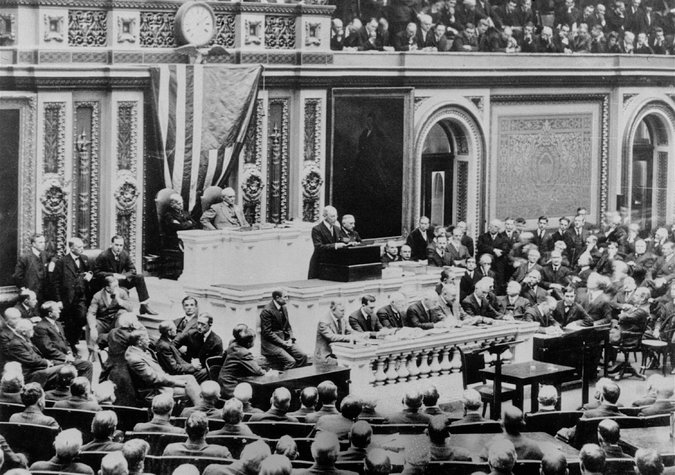
President Woodrow Wilson announced to a joint session of Congress on April 2, 1917, that a new age had begun. Credit Associated Press
Woodrow Wilson is almost never quoted by name when modern presidents speak, but he remains audible all the same, particularly in the echoes that still reverberate a hundred years after the Great War.
In late May, President Obama spoke at West Point, where he defined America’s place in the world much as Wilson might have — propping up the international order, defending human rights, and walking eternally down the path of virtue. George W. Bush, so different in so many ways, also radiated Wilsonian idealism, even as he claimed to be an un-Wilsonian realist. His second Inaugural Address, drawn straight from the Wilson playbook, declared “the ultimate goal of ending tyranny in our world.” That remains a work in progress.
Wilson did not speak this way when World War I broke out in the summer of 1914. At first, he barely mentioned the diplomatic catastrophe unleashed by the assassinations at Sarajevo. On July 27, the day before Austria declared war on Serbia, he gave a press conference, and said meekly, “The United States has never attempted to interfere in European affairs.” Wilson’s silence coincided with a personal crisis of his own. His wife Ellen lay dying that summer, and when one of his daughters asked him about the growing chance of war, he said simply, “I can think of nothing — nothing, when my dear one is suffering.” She expired on Aug. 6, as the war began.
But his silence also reflected astonishment that war was breaking out, against all expectations, in an era that had at least as many clichés about globalization as our own. And it stemmed from an old presidential tradition, soon to be shattered, of avoiding grandiose statements about human betterment. George Washington, in his Farewell Address, specifically urged Americans to steer clear of foreign conflicts. The Monroe Doctrine proposed noninterference by Americans in Europe, as well as the opposite. Theodore Roosevelt advocated for silence as well — his famous adage to speak softly and carry a big stick — even if he did not always achieve it.
Wilson showed no signs of breaking from this tradition, at first. After Sarajevo, he gave a Fourth of July address that never even mentioned the killings a week earlier. Americans seemed to approve. In 1916, “He Kept Us Out of War” was a popular slogan that helped Wilson to eke out victory over his Republican rival, Charles Evans Hughes.
But Wilson’s silence would eventually give way to a different voice, the one that we remember him for. In the spring of 1917, after three horrific years, the world had changed greatly, and so had he. As he brought the United States to the precipice of war, he began to speak in a way that has defined the American presidency ever since. It was not merely that the United States would enter a European theater for the first time, in huge numbers. Wilson also asked that Americans fight to make the world “safe for democracy.” In a sense, he asked the United States to become the world’s judge as well as its sheriff, with an evangelical optimism that has brought both inspiration and exasperation to the 96 percent of the world that is not American.
Earlier presidents had expressed some of these aspirations: Thomas Jefferson proclaimed America the “world’s best hope” in his first inaugural, and Lincoln had often expressed himself likewise, in a language of aspiration. But these remarks expressed only a forlorn wish. They never formed a policy aim, and they fell far short of calling for intervention in Europe, where violations of human rights were as easy to find as the next hillside.
By 1917, Wilson was ready to take that step. He was hardly a natural interventionist. But the war was increasingly affecting American noncombatants, and insulting human rights on an epic scale, with mounting civilian casualties, chemical weapons, and the targeting of neutral vessels.
Accordingly, in the spring of 1917, Wilson began to deliver a stream of public statements that broke his earlier silence, and defined war not so much as a military exercise as an attempt to set the world right. Suddenly, a new language of human rights was being delivered by a president, from something like a pulpit, backed for the first time with the full might of American power.
On Feb. 26, he asked Congress to declare “armed neutrality,” a precursor to war, to defend the world’s “fundamental human rights.” His second inaugural, on March 5, promised to fight for “the principles of a liberated mankind.” In his war message of April 2, Wilson announced that a new age had begun, in which Americans would make the world safe, not only for democracy, but a broad catalog of rights that included freedom of the seas, the independence of small nations, and the right of all nations to unite, to “make the world itself at last free.”
That was a tall order. But since then, we have never stopped marching toward a goal that remains a bit otherworldly. Wilson was an effective messenger in 1917, drawing on his Presbyterianism, his grasp of American history, and his childhood memory of growing up in a region that had recently been occupied by an invading army (inconveniently, that of the United States). In this sense, Wilson’s language of self-determination might be understood as a final legacy of the Civil War.
The language of 1917 proved durable. Without doubt, Franklin D. Roosevelt’s messages during World War II were improved by his articulation of the core freedoms Americans were fighting for. The better speeches of the Cold War — John F. Kennedy’s in particular — conveyed a vivid sense of what American values meant to the world. Yet a tone of high moral dudgeon could also weaken a presidential speech, when it proved ineffective, or untethered to economic reality, or borderline delusional — Lyndon Johnson’s insistence that democracy was coming soon to Vietnam, or George W. Bush’s similar predictions for Iraq.
It has become fashionable to criticize Wilson for naïveté as well as self-righteousness. Evangelical statements require some suspension of disbelief, but ultimately, as he learned the hard way, soaring aspirations have a way of crashing back to earth. American forces did join the battle in 1917, and they tipped the balance, giving thrust to Wilson’s promises. But democracy, that catch-all term, proved difficult when he returned home from his European peacemaking efforts in 1919 and tried to enlist a skeptical Congress behind his vision of an improved world order.
At the same time, the words linger, expressive of something elusive that presidents still seek to articulate. As it turned out, a prophecy he made in his Fourth of July speech in 1914 was self-fulfilling: “The most patriotic man, ladies and gentlemen, is sometimes the man who goes in the direction that he thinks right even when he sees half the world against him.” A century later, that is often what American foreign policy feels like, as we reel from one undemocratic place to another, hoping to limit the carnage. To aspire to the best in Wilson’s oratory, while guarding against the worst, feels like a reliable course for a nation still finding its way in a world that has yet to be made safe for anything.
Ted Widmer is assistant to the president for special projects at Brown University. He recently edited “Listening In: The Secret White House Recordings of John F. Kennedy.”
Why Pardoning Nixon Wasn’t Good for America
Posted in Imperialismo norteamericano, tagged Gerald Ford, Richard Nixon, Watergate on 11 agosto 2014| Leave a Comment »
Why Pardoning Nixon Wasn’t Good for America
HNN August 8, 2014

If Watergate is a story of accountability, President Gerald Ford’s pardon of Nixon is a story of presidential immunity. Here The Nation was especially spot-on, comprehending the sinister significance of the pardon right from the start.
Issued before any prosecution of Nixon had commenced, and without any acknowledgment of guilt on Nixon’s part, Ford’s pardon created a dual system of justice—one for ordinary Americans and another for the President. (Ford’s excuse that Nixon had “suffered enough” could have been applied, of course, to any person whose criminal activities had been exposed.) Unlike its persistence in tackling Watergate, Congress backed away from any serious investigation of the pardon. We will thus probably never know whether Nixon and his lieutenant Ford made a secret deal over the pardon—-in which Nixon would resign promptly and Ford would pardon him, not only shielding the President from prosecution, but limiting the Republican Party’s electoral losses at the polls in November.
Sadly, Watergate did not deter other Presidents from abusing their power. From Ronald Reagan and the Iran/Contra scandal to the present, Presidents have used the mantra of national security to ignore the Constitution. Worse, Ford’s pardon has grown into a principle of impunity for Presidents. It is not simply that Presidents are now viewed as safe from prosecution; they cannot even be investigated. No investigation has examined the presidential deceptions that drove us into the Iraq War, or the presidential authorizations of warrantless wiretapping in violation of law, or the possible criminal liability of former President George W. Bush and other top administration officials for violating laws on torture. Neither Congress nor the courts have taken the Watergate example to heart and stood firmly against presidential crimes or serious misconduct. Instead of remembering that Nixon cynically invoked “national security” to conceal ordinary crimes having nothing to do with the country’s welfare, they cower at the term, allowing Presidents to broaden their powers enormously.
Lack of government accountability runs directly contrary to the Constitution. The framers understood the threat that a strong executive would pose to our democracy; they knew because they had themselves overthrown a king and were careful students of history. To preserve our democracy, we need to rediscover the meaning of presidential accountability. One good way to start is to understand what went right—and wrong—in Watergate. For that effort, this volume of The Nation’s coverage of the subject is a useful resource.
Did Mexico Reshape the American Civil Rights Movement?
Posted in Imperialismo norteamericano, tagged American Civil Rights, Civil rights, John Dewey, México, pragmatism on 11 agosto 2014| Leave a Comment »
Did Mexico Reshape the American Civil Rights Movement? –
HNN August 10, 2014

It was a moment that schoolteacher Primitivo Alvarez never forgot. In the state of Tlaxcala, 50 miles and a massive volcano to the east of Mexico City, American philosopher John Dewey cautioned his hosts from the Mexican federal government not to copy the institutional models that others had constructed. It was 1926, and Dewey was surveying the work of his Mexican students in Mexico’s rural provinces and delivering a series of lectures in Mexico City that would shortly be published by the New Republic.  “Dewey wanted the rural schoolteachers of Mexico to remember the urgency and necessity of avoiding imitation, even if the model originated in the advanced countries, because each nation organizes its own system of education in accordance with its unique history, tradition, racial past, and economic and social institutions,” wrote Alvarez. Everyone knew which models were not to be copied. During the dictatorship of Porfirio Díaz, Catholicism and social Darwinism had been allowed to harden into an ideology of hierarchy that younger intellectuals were now replacing. Dewey was a perfect fit for the new institutions of postrevolutionary Mexico, Alvarez and others believed. New ideas and new models, porous to change and experimentation, would destroy the make-believe world of poverty and violence that Mexico’s Porfirian leaders had created.
As he looked back on his monumental study of the New Deal, historian Arthur Schlesinger, Jr. celebrated the ideas of John Dewey’s pragmatism for the influence they had wrought on FDR’s politics in the aftermath of the Great Depression. “A thoroughgoing philosophy of experience, framed in the light of science and technology, could produce an organized social intelligence,” wrote Schlesinger, Jr. in The Age of Roosevelt. “And the organized social intelligence, Dewey believed, could direct the processes of social change into a rational and beatific future.” Schlesinger, Jr. was not alone in underscoring the importance of Dewey’s pragmatism in the creation of the modern liberal order. Henry May argued that pragmatism had helped usher in the bundle of ideas that separated the twentieth century from the nineteenth, a rupture that he referred to as “the end of American innocence.” Alfred Kazin had included pragmatism and social science as part of the revolution that had produced modernist literature, meanwhile. And one could see Dewey’s relationship to modern education in Lawrence Cremin’s classic studies from the 1950s and 60s.
What is surprising given Dewey’s formidable role in American culture and later historiographical return in the work of contemporary scholars like Robert Westbrook and Richard Bernstein has been the absence of attention to Dewey’s influence in Mexico at the same time that the New Deal was being formulated in the U.S. During the period of rich policy experimentation between 1920 and 1940 that followed the devastating Mexican Revolution, John Dewey’s Mexican students hitched pragmatism to state policy in Mexico in the effort to destroy the institutions of the Porfirian political order and rebuild the postrevolutionary nation anew. In newly-established public schools, they used pragmatism to integrate Mexico’s ethnic groups into a single community of citizens. In scientific institutes centered in Mexico City, they used the scientific ethos to experiment with applied psychology, anthropology, and sociology. In rural states to the west and south of Mexico City, they attempted to balance the relationship between theory and practice that Dewey believed was central to social philosophy. Just as in Henry May’s portrait of pragmatism, Dewey’s ideas in Mexico helped separate the social determinisms of 19th-century Mexico from the modernist ethics that Mexico’s revolutionaries created after 1920.
The efforts in Mexico to achieve the progressive society that Dewey once referred to as the “great community” were filled with institutional difficulty and philosophical peril. The greatest of the Mexican pragmatists, Columbia University-trained Moisés Sáenz, once chastised a group of Americans for their complacent understanding of a complex society whose civil war had just finished killing one million of its own people. “Our emotions occlude our vision; we become confused by the complexity of experience; our accomplishments contradict each other at every turn; they seem to put the most obvious and the most profound into war with one another,” he told his audience. A decade later, Sáenz created a vibrant metaphor for the attempt to blend theory with practice that John Dewey’s pragmatism had made central to modern social critique. “We are walking on the edge of a knife,” he wrote. “We must choose between excessive empiricism and excessive speculation.” Precarious government financing, ongoing local rebellions, and threats to the national territory always made pragmatist attempts at reform a difficult enterprise fraught with the possibilities of failure and slow incremental advance at most.
Yet for Americans who were trying to understand how state power could be used to alleviate economic conflict and to create new relationships among culturally distinct communities, Mexico’s postrevolutionary experiments represented a rich set of policy models that they imported into the United States as they sought to transform public government and public schools in the American West. In rural Tlaxcala in the 1930s, for example, teacher training academies provided these Americans with new ideas about how government could work with local communities to create new schools. Science institutes established by the Secretariat of Public Education in Mexico City by 1930 provided them examples of the role of social scientists in government bureaucracy. And in Morelos, laboratory schools showed them how daily work patterns could be integrated into language-instruction models.
The anthropologists, psychologists, and educational philosophers who studied Mexico’s pragmatist experiments in the 1930s carried Mexico’s lessons into the 1940s desegregation movement in Texas, California, and Arizona as they sought to refashion America’s racial hierarchy. For Ralph L. Beals, Montana Hastings, George I. Sanchez, and Edwin Embree, Mexico’s policy work represented a bridge between state-led reform efforts abroad and political change at home. Daniel T. Rodgers has argued in Atlantic Crossings that progressive policy work in Europe and the United States was never free from misunderstanding and misreading. Yet such mistranslations did not prevent Americans from learning social policy from government models abroad, he argued. In a similar fashion, Mexico’s social reform experiments became discrete policy antecedents for these American racial liberals that have not been accounted for by scholars of pragmatism, the federal state, and US-Mexico relations. Government reform and civil rights in the American West were not uniquely domestic phenomena, the career of Mexican pragmatism shows us, but offshoots of policy reform and nationalism in Mexico in the two decades that followed the Mexican Revolution. School desegregationist George I. Sanchez agreed. “Nothing has affected my thinking and my feelings more than Mexico’s experience – redemption by armed Revolution, then Peace by Revolution,” he wrote in 1966 as he looked back on his career. “This latter revolution still goes on, and I associate myself with it vicariously – from afar, and from close-up examination there as often as I can.”
Mexico’s policy influence over the United States reverses the way that scholars understand the US-Mexico relationship. We typically think of the United States as a hegemonic nation whose power shapes the nations of Latin America along a north to south trajectory. But the example of Mexico during the 1930s and 40s shows us that Mexican government policy influenced American politics as much as American power influenced the history of Mexico. Thus, while Americans tend to think of Mexico as a country of “chaos” – a word that has been perennially repeated in accounts of Mexican history from 1920 to the present day – Mexican policy change has been important to the United States in ways that Americans have not imagined. Pragmatism in Mexico helped to reshape the moral character of American nationalism and democracy, and at the level of institutional practice rather than in theory alone, during a moment of heavy social change in American history. That John Dewey’s influence was part of that process only underscores the centrality of his ideas to social change abroad as much as in the United States.
Ruben Flores is an intellectual and cultural historian from El Paso, Texas who studied at Princeton and Berkeley before coming to the University of Kansas. Flores is the Undergraduate Director for the Department of American Studies and Associate Director of the Center for Latin American and Caribbean Studies.
Hiroshima: What People Think Now
Posted in Imperialismo norteamericano, tagged Bombing of Hiroshima, Harry S. Truman, Hiroshima, Hiroshima and Nagasaki, Hiroshima bomb, Hiroshima Day, Hiroshima Peace Memorial, Japan on 6 agosto 2014| Leave a Comment »
Hiroshima: What People Think Now
HNN August 8, 2010

Hiroshima Peace Memorial, also known as the A-Bomb Dome. The atomic bomb which destroyed Hiroshima detonated almost precisely above the building. Credit: Wikipedia
Related Links
- Photos Reveal Horror Of Hiroshima (Huffington Post, 5-3-08)
- Links to Sites on the Internet Concerning Hiroshima (HNN, 1-15-10)
- Truman on Trial (HNN, 8-9-05)
- HNN Hot Topics: Hiroshima at Sixty-Five
- What Recent Scholarship Concludes About Hiroshima (8-12-05)
- Harry S. Truman’s Hiroshima Dilemma Rumbles Down the Decades (8-10-05)
News
- Hiroshima marks 67th anniversary of A-bomb attack (8-5-12)
- Was the use of nuclear weapons against Japan justified? D.M. Giangreco says yes (8-3-12)
- Japan marks Nagasaki atomic bomb attack of 1945 (8-9-10)
- Survivors of Hiroshima and Nagasaki Atomic Bomb Attacks Call for Nuclear-Free World (8-6-10)
- Memorial service at Tinian’s A-bomb assembly pit (8-6-10)
- U.S. attends first Hiroshima atomic bomb anniversary (8-6-10)
- Son of Pilot Who Dropped A-Bomb Opposes Plan to Send U.S. Delegation to Hiroshima Ceremony (8-4-10)
- U.S. to attend Hiroshima anniversary for first time (7-29-10)
- Morris ‘Dick’ Jeppson dies at 87; weapons specialist armed the atomic bomb dropped on Hiroshima (4-7-10)
- Jon Stewart Apologizes For Calling Truman a War Criminal (5-1-09)
- Catholic Website Calls Hiroshima a Sin and the Complaints Fly (8-24-05)
- Hiroshima bomb didn’t win war, according to Soviet archives (8-12-05)
- Koreans Also Died from the Hiroshima and Nagasaki Bombings (8-12-05)
- Japan’s Atomic Bomb Victims Complain that Their Government Still Neglects Them & Refuses to Take Responsibility (8-12-05)
- Why the Atomic Bombing of Japan Is Missing from Our WW II Cultural Memory (8-1-05)
Commentary: Historians
- How «Five Old Men» Started the Roll-Back of Hiroshima Revisionism By Dennis Giangreco
- Ira Chernus’s MythicAmerica: Myth Versus Myth: Remembering Nagasaki (8-8-12)
- Stanley Kutler: Hiroshima: Truman’s Choices Revisited (8-8-12)
- Cynthia C. Kelly: Leslie R. Groves and the Unchecked Forces of Nature (8-6-12)
- Murray Polner: Hiroshima & Nagasaki: 66 Years Later (8-15-11)
- Jeff Tenuth: Hiroshima and Nagaski: Two Opinions (8-22-10)
- John J. McLaughlin: The Bomb Was Not Necessary (8-10-10)
- Jane Braxton: Coming of Age with Hiroshima’s Mourning (8-6-10)
- Stanley Kutler: 65 Years After Hiroshima: Truman’s Choices (8-6-10)
- Greg Mitchell: Andrew Bacevich, His Lost Son, and Obama’s War in Afghanistan (7-9-10)
- Vaughn Davis Bornet: A Total War in the Pacific Came to an Unimaginable End (9-2-09)
- Tom Engelhardt: As Another August 6th Approaches (8-3-09)
- D.M. Giangreco: Did Truman Really Oppose the Soviet Union’s Decision to Enter the War Against Japan? (11-20-06)
- Robert P. Newman: Has the History Profession Awarded a Prize to Another Flawed Book? (4-30-06)
- Sean L. Malloy: Four Days in May … Henry L. Stimson and the Decision to Use the Atomic Bomb (4-4-09)
- Robert James Maddox: The Greatest Hoax In American History: Japan’s Alleged Willingness to Surrender During the Final Months of World War II (7-28-08)
- D. M. Giangreco: Was Dwindling US Army Manpower a Factor in the Atom Bombing of Hiroshima? (7-20-08)
- Leo Maley III and Uday Mohan: Conservative Revisionists and Hiroshima (12-2-07)
- Werner Gruhl: It’s Time to Acknowledge that Hiroshima Followed Imperial Japan’s Decision to Launch a Terrible War on Its Neighbors (12-2-07)
- Leo Maley III and Uday Mohan: Not Everyone Wanted to Bomb Hiroshima (11-5-07)
- Richard Rhodes: The Manhattan Project: A Great Work of Human Collaboration (9-10-07)
- Richard B. Frank: Review of Hiroshima in History: The Myths of Revisionism, ed. Robert James Maddox (8-22-07)
- William D. Hartung: Did We Miss the Lesson of Nagasaki? (8-12-07)
- Lawrence S. Wittner: Why Hiroshima Day Events Matter (8-6-07)
- Ronald Takaki: The Lessons of Hiroshima (8-6-07)
- Peter J. Kuznick: The Decision to Risk the Future … Harry Truman, the Atomic Bomb and the Apocalyptic Narrative (7-23-07)
- Robert James Maddox: Why Another Book on Hiroshima? (5-16-07)
- Tom Engelhardt: George Weller’s Censored Eyewitness Dispatches on the atomic bombing and Japan’s POWs (1-21-07)
- Tom Engelhardt: Hiroshima Story (8-6-06)
- Robert Newman: What Kai Bird and Martin Sherwin Got Wrong About Hiroshima (8-12-05)
- Harvey Wasserman: Nagasaki, the Forgotten Atomic Target (8-9-05)
- Thomas C. Reeves: The Bombing of Dresden (8-20-05)
- Lawrence S. Wittner: 60 Years After Hiroshima: What We Need to Do to Make Progress Controlling Nukes (8-5-05)
- Kai Bird and Martin J. Sherwin: The Myth of Hiroshima (8-5-05)
- Geoffrey Wheatcroft: Hiroshima Wasn’t Uniquely Wicked (8-5-05)
- Gar Alperovitz: 60 Years Later, Historians Are Still Arguing (8-3-05)
- Max Boot: Why Feel Guilty About Hiroshima? (8-3-05)
- Leo Maley III and Uday Mohan: Why It’s Time for Us to Confront Hiroshima (7-31-05)
- Lawrence S. Wittner: Will We Still Remember Hiroshima After the Last Victims Die? (7-31-05)
- Herbert P. Bix: Why Did the Japanese Delay Surrendering? (8-1-05)
- Barton J. Bernstein: Why We Dropped the Bomb (7-31-05)
- David Kennedy: Why U.S. Leaders Never Questioned the Idea of Dropping the Bomb (7-25-05)
- Richard Frank: Sixty Years After Hiroshima, We Have the Secret Intercepts that Shaped the Decision (8-8-05)
- Mark Selden: New Documents Show How the Story of the Bomb Was Suppressed (7-17-05)
- Eric Rauchway: Why Kristof’s Wrong About the Hiroshima Bomb (8-6-03)
- Gar Alperovitz: NYT’s Kristof Is Wrong (8-11-03)
- Bill Witherup: Richland, WA … Where They Made the Plutonium Used in The Bomb (6-05)
- Michael Pearlman: Review of Robert P. Newman’s Enola Gay and the Court Of History (3-05)
- Brent Staples: What Godzilla Was Really All About (5-1-05)
- Yuki Tanaka: Even in Japan People Are Forgetting the Memory of Hiroshima (2-21-05)
- Mark Selden: Living With the Bomb … The Atomic Bomb in Japanese Consciousness (1-26-05)
- Tom Engelhardt: Hiroshima, 59 Years Later … And Still There Are Silences We Can’t Break Yes (8-6-04)
- William Thompson: A Conversation with a Survivor of Hiroshima (4-19-04)
- William Thompson: Revisiting Hiroshima (4-7-04)
- William Thompson: Why Do We Have to Keep Dredging Up Old Stuff About Hiroshima? (4-7-04)
- Uday Mohan and Leo Maley III: Hiroshima … The Anniversary We Misremember (7-5-02)
Commentary: Media
- Kazuko Hamada: Lessons Learned from Hiroshima and Fukushima (8-6-12)
- Francis J. Gavin: Hiroshima — An Uncertain and Contested Legacy (8-6-12)
- Phil Strongman: Hiroshima Is A War Crime That Haunts My Family, 67 Years On (8-5-12)
- Jennifer Lind: Apology Diplomacy at Hiroshima (7-16-10)
- Mark Tooley: Religiously Remembering Hiroshima (8-13-10)
- David Pilling: Hiroshima Still Clouds a Postwar Friendship (8-12-10)
- Greg Mitchell: How Press Censorship Hid the Shocking Truth About Nagasaki A-Bomb 65 Years Ago (8-9-10)
- Warren Kozak: A Hiroshima Apology? (8-9-10)
- Daniel Bruno Sanz: Sixty-Five Years After Hiroshima, the Nightmare of Nuclear War Haunts Us Still (8-9-10)
- Bruce McQuain: I Have Little Sympathy for the Japanese on this Subject (8-6-10)
- Greg Mitchell: U.S. Sends Envoy to Hiroshima for First Time — But Use of Bomb, Then and Now, Still Defended (8-6-10)
- Kenzaburo Oe: Hiroshima and the Art of Outrage (8-6-10)
- Jonathan Tobin: Hiroshima, Obama, and Truman (8-6-10)
- Greg Mitchell: How the First Nuclear Blast, 65 Years Ago Today, Set Truman on Path to Hiroshima (8-16-10)
- Greg Mitchell: Secrecy and Deadly Radiation: On the Birth of the Nuclear Age 65 Years Ago (7-14-10)
- Oliver Kamm: Paul Tibbets and Enola Gay … About those Obits (11-2-07)
- Oliver Kamm: Hiroshima and Ethics (8-21-07)
- Mark D. Tooley: The Methodist Church Mythologizes Nagasaki and Hiroshima (8-9-07)
- Oliver Kamm: Hiroshima … Terrible, but Not a Crime (8-6-07)
- Fred Ikle: We Were Lucky After Hiroshima (8-5-05)
- Greg Mitchell: Hiroshima Film Cover-up Exposed (8-12-05)
- Nicholas Kristof: Hiroshima: Blood on Our Hands? (8-5-03)
- Tadatoshi Akiba: Hiroshima (8-12-03)
- Paul Olum: Memoir of a Bomb Maker …»The Gadget» (7-5-02)
50 Years Ago Congress Gave the President a Blank Check for War
Posted in Guerra de Vietnam, Imperialismo norteamericano, Resolución del Golfo de Tonkin, tagged Great Society, Gulf of Tonkin Resolution, LBJ, Lyndon B. Johnson, U. S. Congress, Vietnam War on 4 agosto 2014| Leave a Comment »
50 Years Ago Congress Gave the President a Blank Check for War
by Leonard Steinhorn
HNN August 3, 2014

Walt Rostow showing LBJ a map of Khe Sanh in 1968
Fifty years ago, on August 10, 1964, President Lyndon Johnson signed what is known as the Gulf of Tonkin Resolution. It is a day that should live in infamy.
On that day, the President gave himself the power “to take all necessary steps, including the use of armed forces,” to fight the spread of communism in Southeast Asia and assist our ally in South Vietnam “in defense of its freedom.”
Or as former Secretary of Defense Robert McNamara put it decades later, it gave “complete authority to the president to take the nation to war.”
History has shown that the resolution was built on a foundation of misinformation, fabrication, and willful evasion of the truth. Contrary to what the President claimed, there was no unprovoked “act of aggression” against the American destroyers that were patrolling the Tonkin Gulf, and a second alleged incident never even took place.
But the Johnson administration was looking for a pretext to escalate the war. “We don’t know what happened,” National Security Adviser Walter W. Rostow told the president after Congress passed the resolution, “but it had the desired result.”
The Gulf of Tonkin Resolution may have had the desired result, but the war it unleashed didn’t.
By the time Lyndon Johnson left office more than four years later, we had amassed over half a million troops in Vietnam, lost nearly 37,000 soldiers, dropped more bomb tonnage than we had in all of World War II, released chemical weapons – Napalm and Agent Orange – throughout Southeast Asia, and burned thousands of South Vietnamese homes and villages to the ground.
Yet it was increasingly clear by then that we could not win the war.
Rather than stopping any dominoes from falling in Southeast Asia, the Gulf of Tonkin Resolution set in motion a series of dominoes in our own country that would profoundly alter our politics, economy, and culture for years to come.
Perhaps the most significant decision President Johnson made beyond using his newly authorized power to escalate the war was to hide the cost of the war and resist any tax increase to pay for it. Johnson feared that any congressional debate over funding the war would come at the expense of his Great Society program.
He wanted both guns and butter, but he worried that Congress would choose guns over butter. So once again he resorted to obfuscation and deception to get his way.
What resulted was a cascading series of economic consequences that would transform our nation and undermine the Great Society he so dearly wanted to protect.
To pay for the war without gutting his robust domestic agenda, Johnson resorted to deficit spending which fueled an already overheating economy that was now being asked to divert its productivity away from consumer goods and toward the war effort.
Consumer demand began to outstrip supply, and that let the inflation genie out of the bottle. Less than five years after the Gulf of Tonkin Resolution passed, inflation more than quadrupled.
Johnson couldn’t hide the rising cost of the war for long, and by 1968 he asked for a 10 percent tax surcharge on all but the poorest Americans. But it came at a cost: Congress demanded, and he had to accept, a 10 percent reduction in domestic discretionary spending. Barely three years after birthing the Great Society, he began to starve it to pay for the war. It never fully recovered.
To middle and working class Americans, the backbone of the New Deal coalition, the war’s economic impact was taking a toll. Though inflation meant pay raises once a year, prices for food and consumer goods were rising every month which then ate away at any increase in their wages.
Their standard of living began to stagnate. Nor were taxes indexed to inflation in those years, so every pay increase risked pushing them into a higher tax bracket, which took even more money from their pockets in addition to the tax surcharge they would have to pay.
These were largely Democratic voters who generally supported the president and the war – many had their own boys fighting in Vietnam – so if they were looking for blame they weren’t about to point the finger at a deceptive and misguided war policy.
Instead, they saw higher taxes, higher domestic spending, and lots of fanfare for a Great Society that didn’t seem to include them. They also saw domestic unrest and urban riots.
To them, they were hard-working Americans who played by the rules yet were now forced to tread water just to keep from falling behind while government seemed to be giving everything away to the poor. That domestic programs themselves were getting squeezed by the war was a detail that got lost in the heat of the moment.
Couple these growing resentments with the fact that it was their boys, not the children of the well-educated, who were being sent off to war. From their perspective, the liberal elites were taxing them to coddle the poor, yet when it came to defending our nation these same liberal elites sheltered their sons in colleges and universities.
Those seeking to understand the rise of Reagan Democrats and white working class Republican populists – and the corresponding demise of the New Deal majority – need look no further. The cultural and political divide that began in the Sixties was a direct result of the deceit that brought us the Vietnam War.
And what was then a still fragile liberal consensus that government could mitigate the hardships of poverty – a consensus that enabled passage of the Great Society legislation – began to erode.
That an administration could dissemble us into war would lead to another cultural and political repercussion of Vietnam: our growing and seemingly permanent distrust of government.
Trust in government peaked at 76 percent in 1964, not coincidentally the same year as the Gulf of Tonkin Resolution, and declined precipitously in the years thereafter, reaching what was then a low of 25 percent in 1980, according to the University of Michigan’s National Election Studies.
Not all of this decline is due to Vietnam, but a war built on the original sin of deception, fiction, and illusion deserves a good deal of the blame.
Almost daily, Americans were treated to an official version of the war that had us winning. The Johnson administration trumpeted body counts and bombing raids and assured us, in the famous words of General William Westmoreland, that there was “light at the end of the tunnel.”
But there was no light. The dark reality we saw every night on television contradicted what our leaders were telling us. We saw bloodied soldiers, troops burning villages, body bags, fear and despair and little of the triumphalism that was emanating from the Pentagon.
When the Vietcong launched their Tet Offensive in January 1968, striking at the U.S. Embassy and other key sites in the heart of Saigon, Americans had a hard time reconciling the official version with what they were witnessing.
Thus was born the credibility gap between the American government and its citizens.
And nowhere did it grow wider than among journalists, who were greeted with untruths during the daily military briefings in Vietnam – known as the Five O’clock Follies – and saw through such euphemisms as “pacification,” which in truth meant torching Vietnamese huts and shooting those who resisted, and “collateral damage,” which in reality meant civilian deaths.
Reflexive skepticism of government remains a defining characteristic of contemporary journalism.
Watergate, which calcified the credibility gap, also grew out of Vietnam when President Richard Nixon authorized his secretive White House Plumbers to retaliate against Daniel Ellsberg, whose leak of the Pentagon Papers laid bare the duplicity behind the Gulf of Tonkin Resolution and the U.S. prosecution of the war.
Years later Senator Wayne Morse of Oregon, one of two who voted against the Gulf of Tonkin Resolution, told Ellsberg that if members of Congress had seen the evidence from the Pentagon Papers in 1964, “the Tonkin Gulf Resolution would never have gotten out of committee, and if it had been brought to the floor, it would have been voted down.”
What Lyndon Johnson saw as a ploy to grant him war powers ended up harming so many and transforming our nation in ways the President surely never intended. It would end up engulfing the liberalism he so loved. The Gulf of Tonkin Resolution and the hubris behind it were the linchpins of Johnson’s Shakespearean Vietnam tragedy – and ours as well.
Leonard Steinhorn is a professor of communication and affiliate professor of history at American University, where he teaches politics, strategic communication, and courses on the presidency and recent American history. He is the author of the much discussed book on baby boomers, The Greater Generation: In Defense of the Baby Boom Legacy, and co-author of the critically acclaimed By the Color of Our Skin: The Illusion of Integration and The Reality of Race.
President Warren Harding’s Love Letters Open to the Public
Posted in Imperialismo norteamericano, tagged Warren G. Harding on 30 julio 2014| 1 Comment »
President Warren Harding’s Love Letters Open to the Public
HNN July 29, 2014
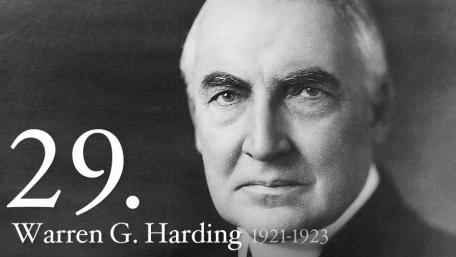 The Library [of Congress] today opened to the public a collection of approximately 1,000 pages of correspondence between 29th U.S. President Warren G. Harding and his mistress, Carrie Fulton Phillips. The letters, which have been locked in a vault in the Library’s Manuscript Division since their donation in 1972, can be viewed online here.
The letters were written between 1910 and 1920 during an affair that began in 1905 between then-Ohio Lt. Gov. Warren Harding and family friend Carrie Fulton Phillips. The vast majority of the letters were written by Harding, many while he served in the U.S. Senate (1915-1921). Phillips is represented mainly by drafts and notes. The Library has recently obtained additional material from the Phillips/Mathée family, which is also now available online here.
Taken as a whole, the correspondence sheds light on a man in love on the eve of his presidency and a country on the brink of World War I. Examples include:
- Harding to Phillips, on the back of his portrait photo, Dec. 24, 1910: «My Darling, There are no words, at my command, sufficient to say the full extent of my love for you …»
- Harding to Phillips, Jan. 26, 1915, from San Francisco’s Palace Hotel (where Harding died in 1923), regarding their correspondence: «Won’t you please destroy? You are not always careful with letters, and if you destroy, you won’t need to be careful.»
- Harding to Phillips, Jan. 11, 1917, on prohibition for the District of Columbia. Harding votes «no» believing that the citizens of the District should decide for themselves: «Just now I am catching the very devil by mail for my attitude on prohibition in the district. I hope you do not wholly disapprove. I voted as I said I would when asking for my election and have kept the faith.»
- Harding to Phillips, March 25, 1917, about the looming war vote: «I have pondered the situation with soberness and solemnity ever mindful of the great responsibility. How unthinking and unfair you are when you accuse me of playing politics! I represent a state with hundreds of thousands of German Republicans. Nobody knows better than I do that I seal my political fate by displeasing them. I know it makes me a one-term official to oppose their desires, but I prefer to perform a duty in good conscience even though I know it means the end of my public service.»
- Harding to Phillips, April 1917, concerning their arguments about the war: «You quote that silly lie about my having said ‘a little scrap might be a good thing’ Can you think me so dumb-headed as to say a thing like that to a pacifist delegation, even if I thought it? In my address I refuted that statement in Cincinnati where some unthinking or unintelligent liar originated it. Clearly it was a fair sample of the easy lying in these hysterical or inconsiderate times.»
- Phillips’ notes in response to the previous letter, May 1917: «The ‘silly lie’ denied made in Cin. Speech—you said it to me. I didn’t know it was said by you till then. I only speak of the thing you said to me.». . . «What is it we’re fighting for, democratic principals? Yes, that’s it—and liberty! –and humanity! We had a Negro equality man under democracy lynched yesterday—Great pretexts, these, of ours!»
- Harding to Phillips, Feb. 17, 1918: «Let me lecture you a bit. It is quite all right for you to express yourself freely on war matters to me. This does not say you are right, but there is no harm in free expression to me. I can understand. But do, please, I beg you, be prudent in talking to others. . . . Remember your country is in war, and things are not normal, and toleration is not universal, and justice is not always discriminating.»
- Harding to Phillips, Feb. 2 1920: «We have blundered. We will not talk about the blame. I accept my full share of it. We did blunder. I give you the most tribute that a man can. There was no cheating. We both understood. We were both married. No lies were told. We felt the sense of family obligations. Happily there has been no irreparable damage.»
Phillips kept the letters hidden in a box in her home in Marion, Ohio, where they remained unseen for nearly 40 years. Upon Phillips’ illness and subsequent death in 1960, the correspondence was discovered by a court-appointed lawyer, who made the collection available to a potential Harding biographer in 1963. The use of the letters by the biographer was thwarted by a lawsuit brought by the president’s nephew, Dr. George Harding. An Ohio judge closed the papers on July 29, 1964, and after extended litigation, the Harding-Phillips letters were purchased by Dr. Harding from Phillips’ heirs. In 1972, Dr. Harding donated the letters to the Library of Congress for safekeeping, with the stipulation that the Library keep the papers closed until July 29, 2014—50 years from the day the Ohio judge first closed them.
The Library held a symposium on July 22 to discuss the Harding-Phillips correspondence and what it reveals about Harding’s character and political views; his relationship with his wife; and implications for national security during World War I, given Phillips’ German partisanship. Moderated by Manuscript Division Chief James Hutson, the panel included Library archivist Karen Linn Femia, who processed the correspondence; Dr. Richard Harding, a grandnephew of the president, who described the family’s reaction to the opening of the president’s personal correspondence; and James Robenalt, author of «The Harding Affair: Love and Espionage During the Great War.» Members of the Mathée family provided a written statement that was read at the event. A webcast of the program can be viewed at go.usa.gov/5Mbd.
Founded in 1800, the Library of Congress is the nation’s oldest federal cultural institution and the largest library in the world. The Library seeks to spark imagination and creativity and to further human understanding and wisdom by providing access to knowledge through its magnificent collections, programs, publications and exhibitions. Many of the Library’s rich resources can be accessed through its website at www.loc.gov.
The Library [of Congress] holds nearly 69 million manuscript items, including the papers of 23 American presidents, from George Washington to Calvin Coolidge. Many of these items are accessible on the Library’s website.
U.S. most take honest look at costs of spaceflight
Posted in Imperialismo norteamericano, tagged NASA on 30 julio 2014| Leave a Comment »
U.S. most take honest look at costs of spaceflight
Jonathan Coopersmith
The Houston Chronicle July 23, 2014
 The harsh criticism by the National Research Council of NASA‘s unfocused and underfinanced plans to send astronauts to Mars is not new («Adrift: As NASA fixates on Mars, rivals shoot for the moon» – Page A1, Sunday). Since 1969, NASA has unsuccessfully struggled with three underlying problems. First, every president and Congress wants the glory of human spaceflight without being willing to pay the cost. No president has wanted, as Richard Nixon stated, to be known as the president who stopped sending American astronauts into space. When Apollo 11 landed on the moon on July 20, 1969, it conclusively ended the space race. This American victory also destroyed the political justification for spending $26 billion (over $100 billion today) to send men to the moon.
Second, beyond the 60,000 Americans and hundreds of thousands of Vietnamese and Iraqis killed in the Vietnam and Iraqi wars, is another, less visible casualty: NASA’s ambitious plans for the human exploration of space. The political desire not to raise taxes to cover the rising cost of the Vietnam War meant NASA’s budget peaked in 1966. Nearly three decades later, George W. Bush‘s invasion of Iraq deprived his 2004 Vision for Space Exploration of the money it needed to succeed.
Third, spaceflight is expensive. Just reaching orbit costs about $10,000 per pound (by comparison, when I fly from Bush Intercontinental Airport to another U.S. location, I pay about $2-4 per pound of me). Space itself is a harsh, unforgiving environment. It’s not called rocket science (actually rocket engineering) for nothing. Sending astronauts into space is especially expensive: People demand life support and higher reliability systems.
When the Bush administration in 2004 decided to retire the shuttle in 2010, the decision was made on grounds of safety and to free money for its Vision for Space Exploration. Achieving the Vision’s goals of sending astronauts back to the moon and on to Mars was predicated on not significantly increasing NASA’s budget, a decision criticized – correctly – at the time as unrealistic. The Obama administration canceled the Vision in 2009 because it was significantly behind schedule and over budget, partly due to underfunding from the Bush administration, which – having decided not to increase taxes to pay for the Iraq War – tried to minimize federal spending elsewhere.
Under Obama, NASA has pushed commercialization of rockets to send cargo and astronauts to the International Space Station. Ironically, a president criticized as «socialist» has promoted opportunities for private enterprise against the opposition of some Republican lawmakers who normally claim to favor market over government enterprises. The budget battles, sequestration and government shutdown hit NASA especially hard.
The problems are not all political. Since 1981, NASA has spent over $21 billion on rocket programs that it canceled. The space agency, like the military, has been guilty of excessive optimism about costs and technology development. Apollo was the only human space program to come in on budget because NASA AdministratorJames Webb doubled the estimate from his engineers and then told the White House and Congress that if they were not willing to pay that amount, then don’t start.
What can be done? First, Congress, the president and NASA need to be honest with each other and the American people about the cost of space exploration. If the country is not prepared to invest in human spaceflight, then perhaps it is better not to start at all. Underfunding projects usually results in higher total costs, delays and even cancellations, wasting the talents of skilled engineers, scientists and managers.
Second, to reduce the cost of reaching orbit, NASA should set and meet a goal of $100 per pound to orbit (and settle for $500) by 2025. If successful, this long-term research and development will radically change the economics of space exploration and exploitation. Because developing low-cost access to space will demand many years and billions of dollars, this is a legitimate and worthy goal for government, similar to the development of the interstate highway system. Indeed, the civilian rockets that launched satellites and astronauts since the 1960s owe their genesis to the $12 billion spent from 1945-57 (over $90 billion today) by the military developing rockets.
Third, Congress should fully fund the Commercial Crew Program so Boeing, SpaceX or Sierra Nevada can build a new generation of spaceships to carry astronauts into low-Earth orbit. Now, NASA pays Russia approximately $70 million to launch each American astronaut to the space station.
Finally, at the risk of sounding facetious, stay out of wars of choice. In addition to the loss of so many young men and women, the Vietnam and second Iraqi wars consumed trillions of dollars, sucking resources and opportunities away from our country. Perhaps a few more dollars to the State Department may do more for NASA than anyone realizes.
Jonathan Coopersmith, an associate professor of history at Texas A&M University, teaches the history of technology
What Went Wrong With the American Experiment?
Posted in Imperialismo norteamericano, tagged Thomas Paine on 29 julio 2014| 1 Comment »

What Went Wrong with the American Experiment?
by Jim Sleeper
HNN Juy 27, 2014
What so loudly we hailed
For centuries most Americans have believed that “the shot heard ‘round the world” in 1775 from Concord, Massachusetts heralded the Enlightenment’s entry into history. Early observers of America such as G.W.F. Hegel, EdwardGibbon, and Edmund Burke believed that, too. A new kind of republican citizenwas rising, amid and against adherents of theocracy, divine-right monarchy, aristocracy, and mercantilism. Republican citizens were quickening humanity’s stride toward horizons radiant with promises never before held and shared as widely as they were in America.
The creation of the United States really was a Novus Ordo Seclorum, a New Order of the Ages, a society’s first self-aware, if fumbling and compromised effort to live by the liberal expectation that autonomous individuals could govern themselves together without having to impose religious doctrines or mystical narratives of tribal blood or soil. With barely a decorous nod to The Creator, the founders of the American republic conferred on one another the right to have rights, a distinguished group of them constituting the others as “We, the people.”
That revolutionary effort is not just in trouble now, or endangered, or under attack, or reinventing itself. It’s in prison, with no prospect of parole, and many Americans, including me, who wring our hands or wave our arms about this are actually among the jailers. We haven’t yet understood the shots fired and heard ‘round the world from 74 American schools, colleges, and military bases since the Sandy Hook School massacre of December, 2012.
These shots haven’t been fired by embattled farmers at invading armies. They haven’t been fired by terrorists who’ve penetrated our surveillance and security systems. With few exceptions, they haven’t been fired by aggrieved non-white Americans. They’ve been fired mostly by young, white American citizens at other white citizens, and by American soldiers at other American soldiers, inside the very institutions where republican virtues and beliefs are nurtured and defended.
They’ve been fired from within a body politic so drained of candor and trust that, beneath our continuing lip-service to republican premises, practices, we’ve let a court conflate the free speech of flesh-and-blood citizens with the disembodied wealth of anonymous shareholders, and we’ve let lawmakers, bought or intimidated by gun peddlers and zealots, render us helpless against torrents of marketed fear and vengeance that are dissolving a distinctively American democratic ethos the literary historian Daniel Aaroncharacterized as “ethical and pragmatic, disciplined and free.”
Many Americans are adapting to living with variants of force and fraud that erupt in road rage; lethal stampedes by shoppers on sale days; security precautions in their homes against the prospect of armed invasion; gladatorialization and corruption in sports; nihilism in entertainment that fetishizes violence without context and sex without attachment; the casino-like financing of utterly unproductive economic activities such as the entertainment I’ve just mentioned and the predatory lending that has tricked millions out of their homes; the commercial groping and goosing of private lives and public spaces, even in the marketing of ordinary consumer goods; and the huge, new prison industry that Americans have created to deter or punish broken, violent men, most of them non-white, only to find schools in even the whitest, “safest” neighborhoods imprisoned by fear of white gunmen who’ve often been students themselves.
Abroad, meanwhile, thousands more shots, fiendish and celebratory, are being fired into the corpses of American national-security and nation-building projects by terrorists and fanatics we were told had been decimated. These projects cost trillions of dollars and hundreds of thousands of lives, limbs, homes, and hopes, including those of American soldiers, contractors, and idealists. Their sacrifices can’t justify retroactively what shouldn’t have been undertaken in the first place.
Stressed by all this republican derangement, millions are spending billions on palliatives, medications, addictions, and even surveillance designed to protect them from themselves. All those vials, syringes, security systems, and shootings reflect the introduction of what Gibbon called “a slow and secret poison into the vitals of the empire…” until Roman citizens “no longer possessed that public courage which is nourished by the love of independence, the sense of national honour, the presence of danger, and the habit of command. They received laws and governors from the will of their sovereign, and trusted for their defence to a mercenary army.” Only a few late-Roman republicans recalling their old freedoms, concluded, with Livy, that “We have become too ill to bear our sickness or their cures.”
What went wrong?
You might argue, and quite rightly, that “We, the people” have always subverted the truths we’d held to be self-evident, beginning with slavery and continuing with plutocracy. Yet somehow the republic kept experiencing what Lincoln called “a new birth of freedom,” thanks only partly to the fortuitous confluence of two oceans’ protection, a vast continent’s ever-alluring frontier, and unending streams of aspiring immigrants:
Not like the brazen giant of Greek fame
With conquering limbs astride from land to land,
Here at our sea-washed, sunset gates will stand
A mighty woman with a torch
Whose flame is the imprisoned lightning,
And her name: Mother of Exiles
True enough, the republic thus limned by Emma Lazarus in “The New Colossus,” her poem for the Statue of Liberty, needed those exiles for its burgeoning labor market. And it still had a guiding aristocracy of sorts, but supposedly “an aristocracy of talent and virtue,” as Jefferson put it, and not one of blood and ill-gotten wealth. True, too, certain lingering Puritan beliefs had nourished in the embattled farmers (and, even long before 1775, in some of the Puritans themselves) a conviction that resistance to tyranny is obedience to God. That injunction to defy worldly power sometimes in the name of a Higher Power legitimated individual conscience and autonomy, right up through the non-violent defiance of the best of the civil-rights and anti-war movements of the 1960s.
But the American emphasis on individual conscience and autonomy also gestated a liberal capitalist republic that has reduced individualism to market exchanges in ways that are now destroying both individuals and the society. A liberal capitalist republic has to rely on its citizens to uphold voluntarily certain public virtues and beliefs that neither the liberal state nor markets can nourish or defend. The liberal state isn’t supposed to judge between one way of life and another, after all; and markets reward you as a self-interested consumer and investor, not as a citizen who might put such interests aside at times to advance a greater good that self-interest alone can’t achieve.
The moral silence and often bankruptcy of states and markets leaves citizen-leaders to be nourished and trained all the more intensively in institutions that stand somewhat apart from the state and markets. The Puritan founders of America’s oldest colleges understood this, but they expected that those colleges’ graduates would serve a theocratic state that would control markets and everything else. We’re right to dismiss the Puritans’ theocracy because it was repressive and hypocritical. But we’re wrong to have lost a side of its animating spirit that would have kept markets from controlling and devouring republican government and even our bodies and ourselves.
Symptoms and scapegoating
Having miscarried republican self-discipline and conviction so badly, we find ourselves scrambling to monitor, measure, and control the consequences, such as the proliferation of mental illness and the glorification and marketing of guns, as if these were causing our implosion. They aren’t. They’re symptoms, not causes — reactions to widespread heartbreak at the breakdown of what Tocqueville called republican habits of the heart that we used to cultivate.
Equally symptomatic, not causal, are self-avowedly “deviant” and “transgressive” gyrations by people who imagine that the sunset of civic-republican order heralds a liberating, Dionysian dawn. Even our war-makers’ and mongers’ grand strategies and the growing militarization of our domestic police forces are more symptomatic than causal of the public derangement that’s rising all around us.
But turning the bearers of such frightening symptoms into our primary villains or scapegoats would only deepen our blindness to the disease, which is as old as the biblical worship of the Golden Calf and as new as Goldman-Sachs. It runs deeper than anything that anyone but the Puritans and their Old Testament models tried to tackle.
I’m not suggesting we can or should return to Puritanism! Anyone expecting to recover that faith and way of life is stumbling up dry streambeds toward wellsprings that have themselves run dry. But we do need wellsprings that could fortify us to take risks even more daunting than those taken by the embattled farmers. We’d somehow have to reconfigure or abandon empty comforts, escapes, and protections that both free-market conservatives and readers of Salon are accustomed to buying and selling, sometimes against our own best hopes and convictions. Sloughing off our bad old repressions, we’ve been swept up by swift market currents that turn countercultures into over-the-counter cultures and promote a free-for-all that’s a free-for-none as citizens become customers chasing “freedoms” for sale.
Our cure would also require re-weaving a fabric of public candor and comity strong enough to resist the rise of ressentiment, a public psychopathology, once associated with the rise of fascism, in which insecurities, envy, and hatreds that many have been nursing in private converge in scary public eruptions that diminish their participants even in seeming to make them big. Ressentiment’s “little-big man” seeks easy targets for frustrations borne of exploitation by powers that he’s afraid to face and reckon with head-on. Blaming scapegoats warps his assessment of his hardships and options and drives him to wreak vengeance on them as soon as there are enough little-big men (and women, of course) to do so en masse under a Glenn Beck or a Sarah Palin.
Whether ressentiment erupts in racist violence, sectarian fanaticism, anti-Communist witch hunts, totalitarian show trials, politically correct cultural revolutions, or sadistic escapism, its most telling symptoms are paranoia and routinized bursts of hysteria. Under the ministrations of gifted demagogues, its grievances and pain assume a fleeting brilliance that soon collapses, tragi-comically or catastrophically, on its own cowardice and lies.
Its targets often shift. The 9/11 attacks brought a reprieve of sorts to African-Americans, the republic’s most enduring scapegoats, when the burden of white censure pivoted toward Muslims. Louis Farrakhan’s Nation of Islam lost credibility, but so did whites such as the neoconservative Daniel Pipes, who kept on insisting years after 9/11 that the first black president was a Muslim and a friend of terrorists.
The slipperiness of scapegoating became clear to me in 1993, as I wrote about a deranged black gunman, Colin Ferguson, who’d opened fire in a Long Island Rail Road car, killing six passengers. Even while holding him responsible, I saw him bearing symptoms far more widespread than his private demons. Noting Ferguson’s enthusiasm for a politics of rage, paranoia, and death threats then prominent on a black radio station and in demagogic street politics, I warned that even deranged loners are sometimes better attuned to our subconscious hatreds and fears than we care to admit. That was true, too, of Jared Loughner, the white paranoid-schizophrenic and anti-government fantasist who killed a U.S. District Court judge and six other people while trying to kill but severely wounding US Rep. Gabrielle Giffords and 13 others in 2011.
While apocalyptic religious and racist ranting can provoke emotionally disturbed people, so can journalism and entertainment that massage hatreds too diffuse to be called racist, religious, or ideological. Some school shooters nursed the depictions of violence and lust that are pumped incessantly into young Americans’ horizons with the help of new technologies and investment strategies that ride reckless misreadings of the First Amendment. This hasn’t been done with malevolent intent as often as it’s been done in a kind of civic mindlessness by media corporations incentivized and indeed forced by market pressures to bypass our brains and hearts on the way to our lower viscera and wallets by exaggerating fears of armed home invasion, government takeover, and vengeful victory by gunplay.
The invisible disease
Relatively few young Americans follow these siren songs into acts of destruction. But the public fetishizing of sex and violence without context or caring dampens many others’ faith in society during their formative years. You don’t need to know a lot of developmental psychology or anthropology to know that children crave culturally coherent tests of prowess and loyalty in symbolic rites of passage that ratify their communal belonging. When such rites and symbols fail, some flail about, seeking order in private delusions, Dartmouth College fraternities, and public orchestrations of ressentiment.
In 1775, most American communities still filtered such basic generational and human needs through traditions that encompassed kinship bonds and seasonal rhythms. In Common Sense, Thomas Paine could urge readers like them to take their recent experiences of monarchy “to the touchstones of nature” and decide whether they would abide the empire’s abuses. Today, those “touchstones of nature” – and with them, republican convictions about selfhood and society — have been torn up by runaway engines and developments in technology, communications, and even intimate biology that would terrify Paine, Adam Smith and John Locke, not to mention those who fired the first shot at Concord. This time, we’re all in bed with the enemy.
In The Cultural Contradictions of Capitalism 40 years ago, Daniel Bell – no anti-capitalist, but prophetic enough about the worship of Golden Calves — argued that free markets no longer make free men because “economic liberalism has become… corporate oligopoly, and, in the pursuit of private wants, a hedonism that is destructive of social needs.” He warned that consumer capitalism displaces the needs that the early republic filtered through nature’s rhythms and kinship traditions. It displaces those needs with ginned-up “wants” that “by their nature, are unlimited and insatiable…. [T]he rational calculation of efficiency and return” displace “the principle of the public household,” strip-mining and selling off fragments of cultural narratives.
Without civic wellsprings and narratives deep and compelling enough to strengthen a society’s adhesives and disciplines in the hearts of its young, neither free-market conservatives nor world-is-flat neoliberal cosmopolitans can reconcile their professed commitments to ordered, republican liberty with their knee-jerk obedience to riptides of destructive investment that are dissolving republican virtue and sovereignty before our eyes.
No wonder we’re losing our vision, in both senses of the word:
▪ Our business press was too blind to see that a tsunami of predatory lending would wreck the national economy and throw millions from their homes. ▪ Our market-addled Congressional committees and blue-ribbon commissions on national intelligence couldn’t discover, until Edward Snowden revealed it, that public surveillance had taken on an all-devouring life of its own.
▪ Our foreign-policy savants across the ideological spectrum were too blind see that the Soviet Union was so much weaker than American Cold War propaganda and hysteria insisted that it imploded in 1989. The fabled “missile gap” that John F. Kennedy ran on in 1960 was as imaginary as Saddam Hussein’s WMD, but anyone who tried telling either of those truths was charged with a “failure of nerve” or worse by the blind war-mongers in our midst.
▪ Neo-conservative and Vulcan conservative advocates of using American military force to spread democracy abroad couldn’t see that their strategy was doomed because democracy isn’t woven that way and because it was destroying democracy at home in ways that, if unchecked, will destroy the republic whose strengths they’ve so badly misconstrued and betrayed.
▪ Our consumer society, addicted to cheap comforts and quick fixes, can’t see its own Orwellian ensnarement by commercial censors, and it couldn’t take Al Gore’s “Inconvenient Truth” about global warming seriously enough to offset the onrushing damage with the serious sacrifices we have yet to make.
▪ Our gilded political consultants, pollsters, and campaign donors were too blind to see the boiling undercurrents that have swept away House Majority Leader Eric Cantor. Nor can they see that Cantor’s political demise presages an inflammation of ressentiment so wild that the coming, specious, “Who Lost Iraq?” debate will be accompanied by the shot that some military veteran who feels betrayed will fire at a politician who’s been left holding the empty bag of our civic-republican hopes.
We are flying almost totally blind, punched bloody by a Hand we keep insisting is Invisible. We can see only the sickness of the gunmen and of the proliferation of their guns. Treatment of those symptoms is urgently needed, but it will be insufficient to curb the wrecking ball that global capitalism has become on our willfully blind watch, and triage won’t renew the civic fabric.
Exemplary defiance
Whenever republican candor and courage have seemed about to succumb like this to tribal and theocratic delusions or to force and fraud in the past, some citizens have roused others to fend off threats to republican premises and practices:
▪ In 1776 a young schoolteacher named Nathan Hale was caught trying to track and expose the military and intelligence operations of the only established, legitimate government of his time. But just before his hanging he said, “I only regret that I have but one life to give for my country” and became an incarnation of a nascent republic.
▪ Hale’s dignity in adversity, unfathomable to many of us these days, anticipated that of Martin Luther King, Jr. and black churchgoers who walked unarmed and trembling toward armed men and dogs with nothing but their faith and their long-shot strategy to de-legitimate the seemingly impregnable segregationist establishment of their time by appealing to republican principles and an American civil religion whose theology was as vague as that of the founders.
▪ Hale’s dignity also anticipated that of three Yale seniors I came upon one wintry morning in 1968 as they gave university chaplain William Sloane Coffin, Jr. their military draft cards to announce their resistance to the U. S. Government on behalf of the American republic.
“The government says we’re criminals, but we say the government is criminal for waging this war,” said one of the seniors, struggling to find his voice against a gusting wind and against fear. For all we knew, these guys were about to be arrested on the spot, and some of us felt arrested morally by their example because they were ready to pay the penalty of law in order to affirm their commitment to honest law itself.
Coffin, who held to a Calvinist theology that, like King’s, saw resistance to tyranny as obedience to God, was present to bless a courage that few national-security state conservatives understand, in the idiom of an American civil-religion few neoliberals and post-modern leftists understand. When he quoted Dylan Thomas’ “Do not go gentle into that good night; rage, rage, against the dying of the light,” that civil religion seemed to awaken briefly from slumber and to walk and talk again, re-moralizing the state and the law, and the silent, wild confusion I was feeling gave way to something like awe. (I described this experience in The Washington Monthly in 2000, during the protracted “election” of George W. Bush.)
▪ Hale’s courage also anticipated Edward Snowden’s. Both young men may have been impetuous and otherwise flawed in some respects, but they showed that resistance to corrupted power requires not only prowess, means, and will, but an elusive, republican sensibility that’s cultivated in civil society and confirmed in little daily interactions long before it emerges in demonstrations of civic courage that startle and move other citizens.
With a wonderment somewhat like Hegel’s, the German political philosopher Jurgen Habermas marveled at this “constitutional patriotism” in American citizens who possessed what Gibbon described as “that public courage which is nourished by the love of independence, the sense of national honor, the presence of danger, and the habit of command.”
When I tell young millennials these stories, though, many of them listen pretty much as they would to tales about knights in shining armor, long ago and far away. Much closer to them are the school shootings and internet mayhem that make brave citizenship seem archaic, implausible, and irrelevant to self-discovery and social change.
Yet republican expectations do have ways of re-surfacing whenever “We, the people” begin to imagine what our lives would be like, singly and together, if we had to live without them. Not everyone can be seduced or intimidated away from them. But, with so many Americans are generations removed from any easily recoverable religious or ethno-racial identity or other adhesive, we have to ask: Where are the touchstones or narratives strong enough renew public virtues and beliefs that neither markets nor the liberal state do much to nourish or defend?
Nourishing a new liberal order
The question should prompt a quest for a political culture that isn’t too commercial and vapid and that isn’t held together only by demagoguery and delusion. No reconfiguration of today’s capitalism will be possible without something better than that. Yet no think tank, legislature, or foundation can carry that quest or that reconfiguration to a just conclusion. Nor can an Occupy Wall Street that isn’t grounded in something deeper than its own noble effort to be the change it wants us all to make.
Nor can our “illness” be cured by champions of a new foreign-policy “realism” such as Robert Kagan, who urge us to face the inevitable challenges of a world where only willpower and force can sustain the liberal order that many Americans take for granted. That’s right as far as it goes, but it begs the question of where willpower comes from and what, within the liberal order itself, is sapping that willpower.
Quoting Michael Ignatieff, Kagan speculates candidly that liberal civilization itself “runs deeply against the human grain and is achieved and sustained only by the most unremitting struggle against human nature.” Perhaps, Kagan adds, “this fragile democratic garden requires the protection of a liberal world order, with constant feeding, watering, weeding, and the fencing off of an ever-encroaching jungle.” But he can’t seem to face the challenge posed by the new shots heard ‘round the world from America: the jungle and its encroachments begin not only abroad but within our own garden.
What seems our greatest weakness could be one of our greatest strengths, although it, too, won’t be enough: even 150 years after the founding, the philosopher George Santayana wrote that Americans still heralded the Enlightenment’s entry into history precisely because they’d “all been uprooted from their several soils and ancestries and plunged together into one vortex, whirling irresistible in a space otherwise quite empty. To be an American is of itself almost a moral condition, an education and a career….”
Although there’s plenty to regret and respect in the traditions we’ve lost, there’s no turning back from the “moral condition” and “career” we face as citizens. We have no choice but to keep faith with the republic and one another. If Americans have a manifest destiny now, it’s to lead in weaving a new republican fabric that markets can serve but not subvert.
In 2008, Barack Obama seemed to incarnate so brilliantly the promise of weaving our diversity into a new republican discipline — he even invoked Puritan and biblical wellsprings in some of his speeches — that many people ‘round the world considered him a prophet who would satisfy their hunger for new narratives. Probably no national political leader ever can do that. The narratives the world needs will have to come from other prophets and leaders yet unsung. I do think that Americans will be strong among them, if only because we’ve had so much experience generating that hunger by generating the civic-republican-capitalist effort that has failed.
Jim Sleeper, a writer and teacher on American civic culture and politics and a lecturer in political science at Yale, is the author of «The Closest of Strangers: Liberalism and the Politics of Race in New York» (W.W. Norton, 1990) and «Liberal Racism» (Viking, 1997, Rowman & Littlefield, 2002). More of his articles and commentary are available at jimsleeper.com. This article was first published on Open Democracy.
The Tragedy of American Diplomacy and US Imperialism
Posted in Imperialismo norteamericano, tagged American Imperialism, History of the American Foreign Relations, The Tragedy of American Diplomacy, Tragedy of American Diplomacy, William Appleman Williams on 29 julio 2014| Leave a Comment »

The Tragedy of American Diplomacy and US Imperialism
July 29, 2014 Imperial and Blobal Forum
 William Appleman Williams is considered the founder of the “strongly influential” Wisconsin School of U.S. foreign relations imperial history that took root from within the History Department at the University of Wisconsin, Madison. Williams’s book The Tragedy of American Diplomacy, first published in 1959, was the first of many revisionist imperial histories of American foreign policy that appeared amid what would become the broader radical New Left movement.
Beginning with Tragedy, Wisconsin-School-inspired revisionist histories suggest that, owing to the distinctive nature of American capitalism, imperial presidents embarked upon a bipartisan quest for foreign markets with broad business and agrarian support, culminating in the acquisition of both a formal and informal American empire. Williams termed it “Open Door imperialism,” an American manifestation of “the imperialism of free trade.”
In this episode of the Centre’s Talking Empire podcast series, hosted by Professor Richard Toye, I discuss the significant historiographical influence of Tragedy, particularly how it and subsequent New Left imperial revisionist histories helped overturn longstanding conceptions of American imperial expansion. As a result, The Tragedy of American Diplomacy continues to retain a dominant position within the study of American imperial history and historiography.
Episode 10: The Tragedy of American Diplomacy
Professor Richard Toye interviews Dr. Marc-William Palen about William Appleman Williams’s Tragedy of American Diplomacy (1959) and its long-term influence within American imperial history and historiography.
For the Interview click here.
Blog Stats
- 1.333.354 hits
-
Únete a otros 603 suscriptores
Entradas y Páginas Populares
Publicaciones

-




- marzo 2026
- febrero 2026
- agosto 2025
- junio 2025
- marzo 2025
- febrero 2025
- enero 2025
- diciembre 2024
- noviembre 2024
- octubre 2024
- septiembre 2024
- julio 2024
- junio 2024
- mayo 2024
- abril 2024
- marzo 2024
- febrero 2024
- enero 2024
- diciembre 2023
- noviembre 2023
- octubre 2023
- agosto 2023
- julio 2023
- junio 2023
- mayo 2023
- abril 2023
- marzo 2023
- febrero 2023
- diciembre 2022
- noviembre 2022
- octubre 2022
- septiembre 2022
- agosto 2022
- julio 2022
- junio 2022
- mayo 2022
- abril 2022
- marzo 2022
- febrero 2022
- enero 2022
- diciembre 2021
- noviembre 2021
- octubre 2021
- septiembre 2021
- agosto 2021
- julio 2021
- junio 2021
- mayo 2021
- abril 2021
- marzo 2021
- febrero 2021
- enero 2021
- diciembre 2020
- noviembre 2020
- octubre 2020
- septiembre 2020
- agosto 2020
- julio 2020
- junio 2020
- mayo 2020
- abril 2020
- marzo 2020
- febrero 2020
- enero 2020
- diciembre 2019
- noviembre 2019
- octubre 2019
- agosto 2019
- julio 2019
- junio 2019
- mayo 2019
- abril 2019
- marzo 2019
- febrero 2019
- enero 2019
- noviembre 2018
- octubre 2018
- agosto 2018
- julio 2018
- mayo 2018
- abril 2018
- marzo 2018
- febrero 2018
- enero 2018
- octubre 2017
- septiembre 2017
- agosto 2017
- abril 2017
- marzo 2017
- diciembre 2016
- octubre 2016
- septiembre 2016
- junio 2016
- mayo 2016
- noviembre 2015
- octubre 2015
- septiembre 2015
- agosto 2015
- julio 2015
- junio 2015
- mayo 2015
- abril 2015
- marzo 2015
- febrero 2015
- enero 2015
- diciembre 2014
- noviembre 2014
- octubre 2014
- septiembre 2014
- agosto 2014
- julio 2014
- junio 2014
- mayo 2014
- abril 2014
- marzo 2014
- febrero 2014
- enero 2014
- diciembre 2013
- noviembre 2013
- octubre 2013
- septiembre 2013
- agosto 2013
- julio 2013
- junio 2013
- mayo 2013
- abril 2013
- marzo 2013
- febrero 2013
- diciembre 2012
- noviembre 2012
- octubre 2012
- septiembre 2012
- junio 2012
- mayo 2012
- febrero 2012
- enero 2012
- diciembre 2011
- noviembre 2011
- agosto 2011
- junio 2011
- mayo 2011
- abril 2011
- enero 2011
- noviembre 2010
- julio 2010
- junio 2010
- mayo 2010
- marzo 2010
- febrero 2010
- enero 2010
- diciembre 2009
- noviembre 2009
- octubre 2009
- septiembre 2009
- agosto 2009
- julio 2009
- junio 2009
- mayo 2009
- abril 2009
- marzo 2009
- enero 2009
- septiembre 2008
- julio 2008
- mayo 2008
- abril 2008

 El Imperio de Calibán
