Feeds:
Entradas
Comentarios

Archive for the ‘Imperialismo norteamericano’ Category

Rare Footage of FDR at NIH

Rebecca C. Warlow

Circulating Now  September 10, 2014

On October 31, 1940, just days before President Franklin Delano Roosevelt would be elected to an unprecedented third term as President of the United States, he traveled to Bethesda to dedicate the National Cancer Institute and the new campus of what was then the National Institute of Health (NIH), before it would eventually become known in plural form—National Institutes of Health—as multiple units were established over subsequent years.

President Roosevelt stands at a podium surrounded by american flags at the top of the steps of a colonial brick building.

That late October afternoon, Roosevelt stood on the steps of the new main NIH building, ready to address a crowd of 3,000 people. Still relevant today, in a variety of contexts, are the subjects he discussed: the need for preparedness in light of war and for research into deadly diseases, recent improvements in public health and health care, and hope that the research conducted at NIH would lead to new cures for and even the prevention of disease.

Today, the National Library of Medicine is making the film of Roosevelt’s speech publicly available for the first time, nearly 74 years after the President made his speech. Sound recordings, transcripts, andphotographs of this event have been available publicly for many years. Our research suggests, however, that this rare film footage has not been seen publicly since its recording and may no longer exist anywhere else.

The live footage of the speech was given to NLM many years ago by the National Archives and Records Administration. The recording does not appear to have been professionally produced, although news organizations such as CBS were present on that day. The camera is unsteady in places, a hand sweeps across the lens, and the filming starts and stops, though it isn’t known whether this is a result of the original filming or of later editing.

While we have long been able to hear Roosevelt’s support for public health and medical research, now we can see him state some of his powerful words from this important speech, and truly appreciate the experience of being in the audience on that historic day. The President’s concluding words capture the weight of the moment: “Today the need for the conservation of health and physical fitness is greater than at any time in the nation’s history. In dedicating this Institute, I dedicate it to the underlying philosophy of public health, to the conservation of life, to the wise use of the vital resources of our nation. I voice for America, and for the stricken world, our hopes, our prayers, our faith, in the power of man’s humanity to man.”

Five years before Roosevelt’s dedication, in 1935, Luke and Helen Wilson had donated land in Bethesda, Maryland, to the government to be used as the new home of the National Institute of Health. At the dedication, President Roosevelt thanked Mrs. Wilson for the gift she and her husband had made to and for the benefit of the nation, “For the spacious grounds on which these buildings stand we are indebted to Mr. and Mrs. Luke I. Wilson, who wrote me in 1935, asking if part of their estate at Bethesda, Maryland, could be used to the benefit of the people of this nation. I would tell her now as she sits beside me that in their compassion for suffering, their hope for human action to alleviate it, she and her husband symbolized the aspirations of millions of Americans for a cause such as this. And we are very grateful.”

The Wilsons’ donated their land shortly before the President signed the Social Security Act in 1935. The Act contained provisions meant to assist in “establishing and maintaining adequate public health services” throughout the country. Roosevelt made certain in his speech to pointedly address those who opposed some of his proposed health care initiatives, stating that “neither the American people nor their government intend to socialize medical practice any more than they plan to socialize industry.”

The possibility of the United States entering the war in Europe was also clearly on the President’s mind. In his speech, he tied together the “strategic importance of health” with the need for the nation to be prepared for war, saying, “The total defense that we have heard so much about of late—that total defense which this nation seeks—involves a great deal more than building airplanes and ships and guns and bombs, for we cannot be a strong nation unless we are a healthy nation, and so we must recruit not only men and materials, but also knowledge and science in the service of national strength.”

Roosavelt, in a pinstripe suit, stands at a podium flanked by columns.

Roosevelt lauded the past work of the National Institute of Health and emphasized the need to be vigilant against illnesses from abroad. “These buildings, which we dedicate, represent new and improved housing for an institution which has a long and distinguished background of accomplishment in this task of research… Now that we are less than a day by plane from the jungle-type yellow fever of South America, less than two days from the sleeping sickness of equatorial Africa, less than three days from cholera and bubonic plague, the ramparts we watch must be civilian in addition to military.”

In his remarks, the President singled out the new National Cancer Institute (NCI) that he was dedicating. He praised the Institute, stating “It is promoting and stimulating cancer research throughout the nation; it is bringing to the people of the nation a message of hope because many forms of the disease are not only curable but even preventable. Beyond this, it is doing research here and in many universities to unravel the mysteries of cancer. We can have faith in the ultimate results of these efforts.”

It is our honor and privilege to make this film footage available now as excitement is building for the upcoming PBS broadcast of the new Ken Burns documentary, The Roosevelts: An Intimate History, a landmark project that was funded in part by the National Endowment for the Humanities, with whom NLM is working on initiatives of common interest.

For their assistance in determining what research suggests to be the uniqueness of this footage, we thank our colleagues in the NLM’s Audiovisual Program and Development Branch of the Lister Hill National Center for Biomedical Communications, the NIH Office of History, and the National Archives and Records Administration. We also thank our colleagues Dr. David Cantor for the extensive historical research he completed on the subject of FDR and the NIH before we initiated our effort to make this film public available, and especially Anatoliy Milihkiker, a contract archives technician in the History of Medicine Division, who recognized the unique content of this film as he undertook a recent survey of the our extensive historical audio-visual collections.

Portrait of Rebecca Warlow.Rebecca C. Warlow is Head of Images and Archives in the History of Medicine Division at the National Library of Medicine.

Read Full Post »

Credit Photograph by David Hume Kennerly/White House via AP

Credit Photograph by David Hume Kennerly/White House via AP


Obama and the Fall of Saigon

By

The New Yorker    September 10, 2014

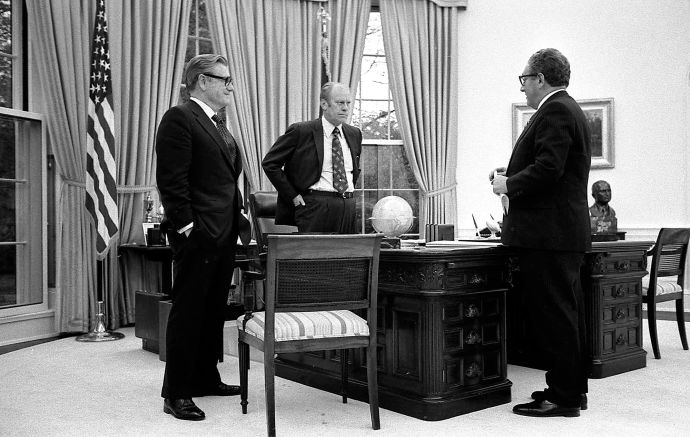
Almost forty years ago, in April of 1975, as the North Vietnamese Army was sweeping through South Vietnam toward Saigon, President Gerald Ford addressed a joint session of Congress. He asked for seven hundred and twenty-two million dollars in emergency military assistance for the government of South Vietnam. He invoked the dire risk faced by tens of thousands of South Vietnamese, including those affiliated with the United States. In “Last Days in Vietnam,” Rory Kennedy’s gripping new documentary about the fall of South Vietnam and the chaotic U.S. evacuation, Henry Kissinger, who was the Secretary of State, says of Ford, “He had two major concerns. The first was to save as many people as we could. He cared for the human beings involved—that they were not just pawns and, once they had lost their military power, they were abandoned. The second was the honor of America—that we would not be seen at the final agony of South Vietnam as having stabbed it in the back.”

It’s a little jarring to hear Kissinger distance himself on moral grounds from using human beings as pawns. His and Richard Nixon’s policy in Southeast Asia amounted to little more than that: sacrificing untold hundreds of thousands of Vietnamese and Cambodians, as well as thousands of American troops, to bloodless terms like “credibility,” “strategic realignment,” and “peace with honor.” But Kissinger’s account of American efforts during the fall of South Vietnam is accurate: in Washington and in Saigon, officials went to great, though tragically belated, lengths to rescue those Vietnamese associated with the governments of South Vietnam and the United States. “Last Days in Vietnam” will unsettle many of your fixed ideas about the end of the war. (For example, the film raises the possibility that, had Nixon not resigned over Watergate, nine months before the fall of Saigon, the North Vietnamese wouldn’t have invaded the South so readily, because they regarded Nixon as a madman capable of anything.)

In the long view of history, the war was unwinnable. As Neil Sheehan’s masterpiece “A Bright Shining Lie” shows, it was a war of Vietnamese nationalism, and the French and American interventions were seen by most Vietnamese as last stands of colonialism rather than as Cold War imperatives. By that April, two years after the signing of the Paris Peace Accords and the withdrawal of the last American combat forces, most people back home didn’t want to hear the name of the country where, in twelve years, almost sixty thousand U.S. troops had died. Congress, reflecting that exhaustion, voted down Ford’s emergency request (which would only have postponed defeat). Hearing the news, the mild-mannered President cursed, “The sons of bitches!” The fall of Saigon was just days away.

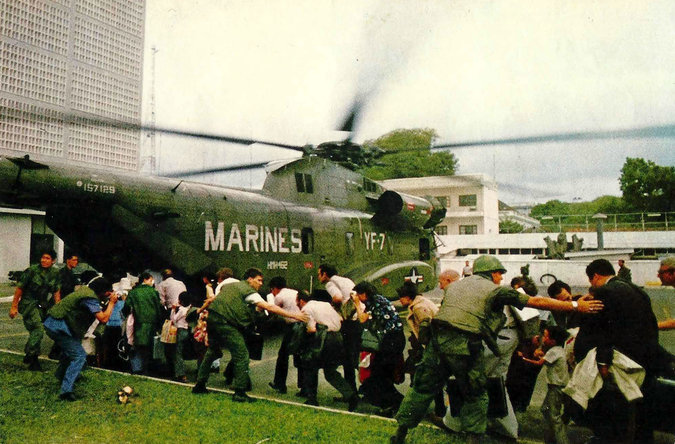
“Last Days in Vietnam” is full of dramatic tales illustrated by vivid archival footage. With no space for a landing, a South Vietnamese pilot drops his family out of his transport helicopter, onto the deck of an offshore American Navy vessel, then dives into the South China Sea and saves himself as the chopper crashes into the waves. A Vietnamese student named Binh Po buys and talks his way onto the grounds of the U.S. Embassy in Saigon, joining ten thousand other desperate people, only to wind up among the four hundred and twenty left behind when an order from President Ford ends the evacuation prematurely and the last Marine chopper takes off. (Binh Po spent a year in a Communist reëducation camp before escaping from Vietnam by boat, in 1979.) Marine Sergeant Mike Sullivan and other Embassy guards, without orders, take it upon themselves to make sure that the Vietnamese they know personally—tailors, cooks, dishwashers, and their families—make it out on the Chinooks. As North Vietnamese tank divisions roll toward Saigon, individual Americans break official rules and risk their lives to get as many of the Vietnamese who worked with Americans as they can to safety, along with their families—an inspiring example of moral heroism in the final days of a war best known for its mistakes, crimes, and sheer waste.

At the same time, the evacuation was a disaster. Ambassador Graham Martin, a rigid Cold Warrior out of “The Quiet American,” refused to believe that Saigon was about to fall, and wouldn’t allow fixed-wing air evacuations from the Tan Son Nhut airbase while it remained out of North Vietnamese hands. The result of Martin’s delusion was the frantic helo lifts from the Embassy grounds, the last and worst option, too little and too late, which left tens of thousands of our Vietnamese allies behind to suffer the brutality of the North. Yet even Martin, who lost his only son in the war, emerges, more ambiguously, as a conscientious diplomat at the last hour, postponing his own evacuation long enough to get thousands of Vietnamese out.

Army Captain Stuart Herrington, one of the heroes of the evacuation, had to lie to the Vietnamese left behind at the Embassy, telling them that a big chopper was on the way, then sneak away to board the last flight off the roof. Still haunted, he speaks for the film: “The end of April of 1975 was the whole Vietnamese involvement in a microcosm. Promises made in good faith, promises broken, people being hurt because we didn’t get our act together. The whole Vietnamese war is a story that kind of sounds like that. But, on the other hand, sometimes there are moments when good people have to rise to the occasion and do the things that need to be done, and in Saigon there was no shortage of people like that.”

Back in 2007, when I started writing about the betrayal of Iraqis associated with America in Iraq, I spoke with two of the men featured in “Last Days in Vietnam”: Frank Snepp, the chief C.I.A. analyst in Saigon and the author of “Decent Interval,” an account of that period; and Richard Armitage, a naval officer, who returned to Vietnam as a civilian defense official and ended up bringing twenty thousand Vietnamese out on boats. Hearing their stories, I thought that the analogies with Iraq were obvious—willful blindness at the highest levels, no plan for rescuing Iraqis—but the differences were even sharper. The Vietnam-era Americans came off much better. With a few exceptions, it was hardly possible to imagine Embassy officials or troops in Baghdad taking great risks to get their Iraqi contacts out before we left. Relationships with Iraqis were much more distant, and Americans much more isolated, owing to security restrictions and other factors. Above all, in Baghdad there was a pervasive air of deskbound caution, buck-passing, and ass-covering, in contrast with the Wild West atmosphere that broke out, for better and for worse, in Saigon in April of 1975. It was all too easy for Americans in Iraq not to know what they didn’t want to know.

On Wednesday night, President Obama will speak to the country about his strategy for fighting the Islamic State in Iraq and al-Sham. I wonder if he’ll have a chance to see “Last Days in Vietnam,” which opened on Friday. He would probably be struck by the historical irony that, like Ford, he must try to explain to Congress and a weary, sour public why the U.S. should get involved again in a far-off, supposedly concluded war that most Americans now view as a waste.

This is a speech that Obama, even more than Ford, never wanted to give. He ran for reëlection, in part, on having fulfilled a promise to end the war in Iraq—always the previous Administration’s war. His eagerness to be rid of the albatross of Iraq played no small part in clearing the way for ISIS to take a third of the country, including Mosul, and to threaten Baghdad and Erbil.

All the more reason to give the President credit (though his political enemies never will) for his willingness, however reluctant, to turn around and face the catastrophe unfolding in Iraq and Syria. Wednesday’s speech will no doubt nod toward staying out (no boots on the ground, no new “American war”), even as it makes the case for going back in (air strikes, international coalitions, the moral and strategic imperative to defeat ISIS). This is the sort of balancing act that Obama speeches specialize in. But he also needs to tell the country bluntly that there will almost certainly be more American casualties, and that the struggle against ISIS—against radical Islam generally, but especially in this case—will be difficult, with no quick military solution and no end in sight. Otherwise, he’ll have brought the public and Congress on board without levelling with them, a pattern set in Vietnam and repeated in Iraq, with unhappy consequences.

By the time Ford gave his speech, that war was lost, and seven hundred and twenty-two million dollars couldn’t have done what billions of dollars and half a million American troops hadn’t—though the end game, as Kennedy’s film compellingly shows, was a last unnecessary fiasco. But the Iraq War never ended, except in the minds of most Americans. Unlike Vietnam, ISIS is an irreconcilable enemy and a metastasizing threat. We Americans want to wake up as fast as possible from our historical nightmares, whatever the cost to other people. It’s human nature. Unfortunately, this one still requires our attention.

George Packer became a staff writer in 2003. For the magazine, he has covered the Iraq War, and has also written about the atrocities committed in Sierra Leone, civil unrest in the Ivory Coast, the megacity of Lagos, and the global counterinsurgency. In 2003, two of his New Yorker articles won Overseas Press Club awards—one for his examination of the difficulties faced during the occupation and reconstruction of Iraq, and one for his coverage of the civil war in Sierra Leone. His book “The Assassins’ Gate: America in Iraq” was named one of the ten best books of 2005 by the New York Times and won the New York Public Library’s Helen Bernstein Book Award and an Overseas Press Club book award. He is also the author of “The Village of Waiting,” about his experience as a Peace Corps volunteer in Africa, and “Blood of the Liberals,” a three-generational nonfiction history of his family and American liberalism in the twentieth century, which won the Robert F. Kennedy Book Award; in addition, he has written two novels, “The Half Man” and “Central Square.” He has contributed numerous articles, essays, and reviews to the New York Times Magazine, Dissent, Mother Jones, Harpers, and other publications. He was a Guggenheim Fellow in 2001-02, and has taught writing at Harvard, Bennington, and Columbia. His most recent book is “The Unwinding: An Inner History of the New America.”

Read Full Post »

hnn-logo-new
Mark Byrnes
HNN   September 10, 2014

Truman with Stalin and Churchill at Potsdam, 1945

Historians try to do the impossible: recreate and preserve the past. We do so knowing that the product, even at its most encyclopedic, will inevitably be imperfect and incomplete. The resultant telescoping of events can have the effect of robbing the past of its fullness and complexity.

In diplomatic history, what is sometimes lost in the retelling is the deliberative part of policy-making. That is certainly true in popular versions of history. In our haste, we too often cut to the chase: the decision. In memory, we see decision rather than deliberation. The danger is that it then becomes easy to forget the deliberation ever happened.

When this tendency infects politics and punditry at a tumultuous time, we get the kind of excitable hand-wringing that has dominated both fields for the last several weeks. John McCain and Lindsey Graham fret in the New York Times that President Obama is “dithering” on ISIS. The second ISIS video showing the beheading of an American journalist adds to the sense of urgency that something—and one suspects, in the minds of some people, anything—must be done. Maureen Dowd blasts Obama’s deliberations and absurdly asserts that “panic is a sign of clear thinking.” David Brooks longs for the post-World War II visionary decisiveness of Harry Truman, George Marshall, and Dean Acheson.

Brooks, with his “the sky is falling” alarmism about the state of the world, makes some truly astounding statements.  Incredibly, he asserts: “There has been a norm, generally operating over the past few decades, or even centuries, that big, powerful nations don’t gobble up everything around them just because they can.”

Centuries? Does Brooks not know that the 19th century saw the western states “gobble up” much of the rest of the world? Does he think that doesn’t count because their empires were not often immediately “around them”? Did the U.S. invasion of Iraq in 2003 not count simply because the U.S. didn’t annex the country?

That absurdity aside, his main point is that “Putin and ISIS … are threats to our civilizational order.” He longs for “a leader who can step outside the crush of events and explain how fundamental the threat to the rules of civilization now is.” That, he argues, is what Truman, Marshall, and Acheson did after World War II.

Brooks is guilty of the kind of telescoping I mentioned above. With the Truman Doctrine, he says, those leaders were “establishing certain norms and creating a framework for civilization.”

What Brooks does not mention is that the policy of containment was not fully formed or articulated until nearly two years after the defeat of Hitler. As Alonzo Hamby puts it in Man of the People, his biography of Truman, “[a]s late as the fall of 1946, [Truman] presided over a foreign policy that was more a response to disparate crises than a strategically unified whole.” Sounds familiar.

While there were voices in his administration calling for a tougher line on the Soviet Union, Truman himself was often seen by critics as vacillating between a soft and hard approach. According to Hamby, the Truman Doctrine speech—seen by Brooks as emblematic of a clear vision of the rules of civilization—was “[l]ess the product of a consciously formulated strategy than of a rush of events that demanded a decision.” Again, sounds familiar.

Brooks says: “People who conduct foreign policy live today under the shadow of the postwar era.” Perhaps, but that is only because, in retrospect, we can conveniently forget the nearly two years of indecision that preceded the Truman Doctrine speech. That shadow is cast primarily by a romanticized notion of the past that emerges out of ignorance of its complexity.

It also seems worth noting that the proposals Truman made in that March 1947 speech were fairly modest. There was no call for American military intervention, no boots on the ground, no air strikes–just a statement of political support for the Greek government and a fairly modest proposal to increase financial aid to it. In short, it was not at all unlike the statements of support for Ukraine and Iraq that Obama has made.

No doubt Brooks would object that it was the principle Truman announced, not the specific proposals, that mattered: “it must be the policy of the United States to support free peoples who are resisting attempted subjugation by armed minorities or by outside pressures,” Truman said.

Any student of the cold war knows, however, that the stark universalism of that statement, its refusal to distinguish carefully between vital and peripheral issues, led to disasters like the American war in Vietnam, and led the “father of containment,” George Kennan, to decry what his idea became in practice.

In addition, when Truman prudently recognized the limits of American power in China, he was savagely lambasted by reactionary politicians who blamed him for “losing” China, and not living up to the universalism of his own doctrine. Rep. Richard Nixon denounced Dean Acheson as an appeaser, referring sneeringly to “Acheson’s College of Cowardly Communist Containment.” Sen. William Jenner said that Gen. George Marshall was “a living lie” who was “eager to play the role of a front man for traitors.” Joe McCarthy accused Marshall of being part of “a conspiracy on a scale so immense as to dwarf any previous such venture in the history of man.” Such are the political costs of recognizing the limits of American power.

Despite all of the carping of the critics, Obama’s deliberations, his refusal to engage in dramatic, impulsive gestures that may do more harm than good, his desire to line up allies for a concerted, considered, long-term response to the challenges represented by Putin and ISIS represent the historical policy-making norm, not dangerous “dithering.”

Mark Byrnes is an associate professor of history at Wofford College in Spartanburg, SC.

Read Full Post »


Commonplace

John Paul Jones, a New «Pattern» for America

Anne Roth-Reinhardt

Common-Place  vol. 14 · no. 4 · Summer 2014
Portrait of John Paul Jones, by Charles Willson Peale, from life (c. 1781-1784), INDE 11886. Courtesy of the Independence National Historic Park, Philadelphia, Pennsylvania.

Portrait of John Paul Jones, by Charles Willson Peale, from life (c. 1781-1784), INDE 11886. Courtesy of the Independence National Historic Park, Philadelphia, Pennsylvania.

In September of 1776, the Continental Navy became the first American military branch to designate an official uniform. In March of 1777 it became the first to alter it. The change originated from John Paul Jones and a small group of naval officers dissatisfied with the mandated ensemble consisting of a red-lapelled blue coat, a gold-laced waistcoat, and blue breeches. An unofficial agreement allowed American naval men to substitute a white-lined, red-lapelled blue coat and white waistcoat for the official model, and to forego blue breeches for white. The alterations, ornamented with an epaulet inscribed with a rattlesnake and «Don’t Tread on me,» Samuel Eliot Morison observes, resulted in «a much smarter uniform than the blue and red.» Perhaps the «smartest» quality of the new uniform, however, derived from the confusion it caused during engagements with the enemy. From a distance, ships populated by officers dressed in the new uniform resembled captains of the British fleet, leading John Adams to describe the uniform as «English.» Lowering the ensign, at least temporarily, added to the deception. This masquerade, embraced by Captain Jones, created a tactical advantage while at sea: the enemy saw the unmarked ship as familiar and relaxed its defenses, only to find itself unexpectedly engaged, and quite often over-matched, by a smaller, scrappier opponent.

Was the hero actually a bloodthirsty pirate? A rake and seducer of ladies? Indeed, a robber, a murderer, a political opportunist?

John Paul Jones was a figure who would have been familiar to most American readers in the first half of the nineteenth century as the greatest naval hero of the Revolutionary War. Lauded as the first officer to raise the Grand Union flag aboard an American warship (the Alfred, in 1775), the victor of ferocious sea battles against the British frigate Serapis and the man-of-war Drake, Jones is best known today as the originator of the oft-quoted American mantra «I have not yet begun to fight.» John Paul Jones enjoyed popular acclaim throughout the nineteenth century. No fewer than twenty-three biographies featured Jones as the subject; three editions of his writings and letters became available to the public; and fiction writers, poets, and dramatists on both sides of the Atlantic claimed Jones as their title character. In iconography Jones cut his most dashing figure—a figure he personally constructed and adorned with that costume he himself had carefully designed in 1776. After Charles Willson Peale painted his portrait four years later, and Jean-Antoine Houdon sculpted his bust in 1780-1, these depictions set the pattern for pictures of Jones for at least seventy years thereafter—with precisely the kind of commanding appearance he favored for himself. But the duplicity he had stitched into the navy’s uniform—what you saw was not what you actually got—became a motif that worked its way into an entire series of representations of Jones after his death in 1792.

Of course, in patriotic histories of the Revolution Jones stood in for the courageous patriot, the tireless warrior in the battle for Independence. Still, Jones had lived a highly eventful life before (and after) joining the American cause, and his nineteenth-century commentators seized upon those adventures to depict certain unsavory aspects of the hero’s character. Although crewman Nathaniel Fanning understood Jones to be «a great lover of the ladies» for his practice of «carrying off» women, many nineteenth-century authors indicted Jones as a «libertine» and a «rapist,» even while they commended his patriotic service to their audience of young men. George Sinclair, as early as 1807, published a biography of Jones modeled after the 1803 London-based original with the omnibus title: The Interesting Life, Travels, Voyages, and Daring Engagements of the Celebrated and Justly Notorious Pirate, Paul Jones: Containing Numerous Anecdotes of Undaunted Courage, in the Prosecution of his Nefarious Undertakings. So was the hero actually a bloodthirsty pirate? A rake and seducer of ladies? Indeed, a robber, a murderer, a political opportunist?

From Uniforms of the United States Navy: 1776-1898, plate 1. Courtesy of the U.S. Printing Office, Washington, D.C. (1966).


Marble copy of original portrait bust of John Paul Jones by Jean Antoine Houdon, 1780.

Houdon was commissioned to make the bust by the Masonic lodge in Paris of which both he and Jones were members. Image courtesy of the United States Naval Academy Museum, Annapolis, Maryland.

For many readers (and publishers), it may have been so much the better that tales of John Paul Jones presented him as a ruthless pirate. In much of popular literature, the pirate was the «romantic outlier» rather than the feared terrorist plundering ships and port cities. Versions of pirates attractive to popular audiences emerged through such works as Byron’s Corsair; numerous popular ballads about Captain Kidd, notably, «The Dying Words of Captain Robert Kidd»; Alexandre Exquemelin’s popular history The History of the Bucaniers of America (first published in Dutch in 1678, this book offered influential accounts of the lives of seventeenth-century pirates); Charles Ellms’ frequently reprinted collection of pirate biographies, The Pirates Own Book (1837); and numerous popular songs about the piratical life. From a political standpoint, in some quarters piracy even became synonymous not with greedy banditry but with independence and the struggle against injustice. American pirate-types, like those characterized in The Florida Pirate (1823) and later in Herman Melville’s novella «Benito Cereno,» often flew the skull and crossbones only after being «denied the general consent of nations.» Moreover, in early nineteenth-century British and American novels, John Paul Jones (or men based upon the late captain) frequently dropped in on tales of mismatched love, maritime adventure, and epic romance. Among the best known examples are James Fenimore Cooper’s The Pilot, Walter Scott’s The Pirate, and Alexandre Dumas’s Captain Paul. For the inheritors of the Revolution, to use Joyce Appleby’s phrase, at least to the book-buying public, the static portrait of the stalwart patriot was often shelved in favor of the excitement of the rakish marauder.

When William Borradaile reissued Sinclair’s edition of Life and Remarkable Adventures … of John Paul Jones twenty years after its first publication, he included a frontispiece illustration of Jones shooting one of his officers point-blank, even as he advertised Jones as the «celebrated» hero rather than the «celebrated and justly notorious pirate» as originally promoted by Sinclair’s title. «Paul Jones Shooting Lieutenant Grub», Borradaile’s choice for his edition’s frontispiece, echoes the spirit of the image titled «Paul Jones shooting a sailor who had attempted to strike his colors in an engagement» (1779) found in the British original and, as a result, raised old concerns over the increasingly storied figure. While «Paul Jones Shooting Lieutenant Grub» cloaks the captain in national legitimacy as Jones and his combatants announce their shared cause through their similar uniforms, the illustration exposes the captain’s barbarism in his actions. The print not only indicts Jones of summarily executing one of his crew, but the range of the shot and the bodies below it also suggest the action to be both murderous and habitual. Jones may be remembered for raising the American colors aboard the Alfred and refusing quarter with «I have not yet begun to fight»; however, the Grub image illustrates a dark side of Jones’s fiery will and the bloodshed that sometimes ensued, in the process questioning his legitimacy as a hero.

Paul Jones Shooting Lieutenant Grub,» frontispiece to George Sinclair, The Interesting Life, Travels, Voyages, and Daring Engagements of the Celebrated and Justly Notorious Pirate, Paul Jones: Containing Numerous Anecdotes of Undaunted Courage, in the Prosecution of his Nefarious Undertakings, published by W. Borradaile (New York, 1823). Courtesy of the American Antiquarian Society, Worcester, Massachusetts.


This frontispiece illustration therefore revealed the flexibility of cultural memory and encouraged some writers to try to rehabilitate Jones’s reputation by publishing official accounts of his life authorized by the Jones estate. For although The Life and Remarkable Adventures… was sold as a sensational novel, the impression of Jones as a piratical murderer made the leap from fictional illustration to widely accepted fact, according to newspaper articles and biographical accounts, and Jones’s family wanted to «correct» that image. Historian Robert Sands, armed with a more complete set of Jones’s papers and determined to «circulate an unvarnished and full account of the rear admiral’s life,» credits the ubiquity of both the Grub print and the false testimony incited by it as his motivation for publishing the corrective Life and Correspondence of John Paul Jones (1830). Sands, dissatisfied with the ever-evolving «juvenile» version of Jones’s story, produced Life and Correspondence to tidy the chronological disorder of the captain’s life found in previously circulated versions, what he calls the «inextricable confusion» created by some «capricious demon»; rectify the «fabulous» and «monstrous legends» encouraged by the popular press; and correct the biographical misrepresentation constructed by a «decidedly» British gloss.

The protagonists that emerge through the pages of antebellum fiction, however, illustrate the public’s appetite for the «active and enterprising» miscreant rather than the cleaner and perhaps more accurate version of the American hero provided by authorized biographies like Sands’. American authors working in the genre of popular romance in this period often disguised their heroes as misunderstood beggars, thieves, and pirates in order to muddle the distinction between hero and villain. Herman Melville further complicates the distinction by characterizing Jones as the «model rogue» in his novel Israel Potter, the lone «crimson thread» flitting through the «blue-jean» travails of Israel R. Potter.

Serialized in 1854-55, Israel Potter is loosely based on a pamphlet autobiography written by a Rhode Island-born veteran of the Revolutionary War who had been taken prisoner by the British and lived much of his life in exile in England. The novel appears, at first glance, to be a bad-luck story of an American boy always caught in the wrong place at the wrong time. Although Israel Potter shares the field-to-battle story popularized by Israel Putnam, Potter’s Bunker Hill experience leads to capture rather than to celebrity and sends him to England in chains. Melville recounts the clumsy happenings described in the original autobiography, including Potter’s chance meetings with King George III and Benjamin Franklin (in his role as the American ambassador to France), yet the novel eventually veers away from authenticity, in both style and content, and links the fate of Potter to the various enterprises of John Paul Jones. Melville, for example, positions Israel within earshot of Jones’s famous «I have not yet begun to fight» speech, and credits him with sparking Jones’s fiery retaliation upon the port of Whitehaven, the city the captain first sailed from at age twelve. Yet Israel’s fame is short lived. His fictional service to Jones—much like his «real» life—eventually lands him aboard another British ship and keeps him on the wrong side of the Atlantic for the better part of fifty years.

Melville advertised his Revolutionary tale as an «adventure» in a letter to his editors at Putnam’s, yet the intention of the autobiographical pamphlet Life and remarkable adventures of Israel R. Potter (1824) was to secure remuneration for Potter’s military service rather than to spin a thrilling tale of intrigue. In his motley characterization, however, Melville does more than transform Potter’s story from one of hapless exile to one of unlikely celebrity as it riffs on autobiography to produce fiction. Israel Potter presents Jones, as well as the country he serves, as more rogue than Revolutionary. Melville’s Jones looks like the pirates in Exquemelin’s Bucaniers of America, dresses like the pirate suggested by the lurid frontispieces of sensational novels, and acts like the pirates cum revolutionaries of nineteenth-century American fiction, all the while advertised as the emblem of a maturing nation—as Melville writes, «America is, or may yet be, the Paul Jones of nations.» Like the confusion Jones fashioned at sea, the narrative portrait offered in Israel Potter alternates between patriot and pirate, and therefore refuses to advance a single version of the nation’s complicated history.

Life and remarkable adventures of Israel R. Potter, (a native of Cranston, Rhode-Island,) : who was a soldier in the American Revolution, and took a distinguished part in the Battle of Bunker Hill (in which he received three wounds,) after which he was taken prisoner by the British, conveyed to England…, frontispiece and title page. Printed by J. Howard, for I.R. Potter (Providence, 1824). Courtesy of the American Antiquarian Society, Worcester, Massachusetts.

Of course, Melville allows neither his narrator nor Israel to actually call Jones a pirate. Israel may describe Jones’s «jaunty barbarism» and «savage» markings under his European finery, but he never truly interprets what he sees. Assumptions and hearsay, however, provoke incidental characters to associate Jones with piracy. An oddly placed maritime «quack-doctress» calls Jones a «reprobate pirate»; English sailors assume the Ranger to be «some bloodthirsty pirate» when they fail to recognize her nationality; and a British ship unknowingly solicits information from Jones about «that bloody pirate, Paul Jones.» In the last instance, Melville shows Jones, when confronted by his reputation, as a light-hearted Robin Hood rather than a despotic Captain Kidd. He encourages his enemies to arm themselves with money rather than ammunition: «So, away with ye; ye don’t want any powder and ball to give him. He wants contributions of silver, not lead. Prepare yourselves with silver, I say»—and offers a keg of pickles rather than one of powder demanded by his enemies.

Melville’s use of the term «pirate» as a charge leveled at Jones only by his enemies did revive this earlier cultural mythology of Jones in the 1850s, as most subtitles of American publications about Jones by this point had stopped using the word «pirate,» and most accounts had done away with inflammatory frontispiece illustrations. Yet not all Americans succumbed to the intoxicating memory of Paul Jones. The 1846 edition of Life and Adventures of John Paul Jones may lack a frontispiece illustration, but its preface decries the character of Jones and other revolutionary leaders even as it reprints the partially disreputable version of Jones within, announcing that «the whole race of magnificent barbarians, gorgeous tyrants, unparalleled cutthroats, and gigantic robbers … have never been able to fix our devotion.»

Melville reinforces the roguish designation of Jones as «outlaw,» as well as Israel’s initial impression of the captain, by fashioning him as more Continental aristocrat than stalwart George Washington, while at the same time marking him as recklessly uncivilized. Never does the reader of Israel Potter see the Jones of Peale’s 1781 portrait, nor do we witness the proud dignity illustrated by the many Jones prints and publications of the nineteenth century. Instead, we are given «pagan» tattoos covered by a «laced coat sleeve» and hands covered in rings and «muffled in ruffles.» The novel’s references to clothing and appearance, rather than offering a sense of period authenticity, reinforce Melville’s editorial position suggested by his tongue-in-cheek introduction, contradict the popular understanding of «homespun» through uncomplimentary characterizations of Potter and Benjamin Franklin, and certainly complicate the understanding of Jones in the nineteenth-century imagination.

Jones as the emblem of America as created though Melville’s paradoxical layering («à-la-mode [but not] altogether civilized…») criticizes the American practice of myth-making even as it creates a maritime frontiersman as its «Representative Man,» to use Emerson’s term. Although Melville’s Jones resembles the lonely backwoodsman of much of the frontier literature of the period, the Jones of Israel Potter appears as Indian rather than as an «Indian-fighter» like other frontiersmen. Of course, Melville’s representative American displaces Native Americans even as he assumes so-called «Indian» characteristics. By comparing Jones’s manner to «a look as of a parading Sioux demanding homage to his gewgaws» and determining the captain’s seated posture to be «like an Iroquois,» Melville prompts the reader to rely on stereotypical «stock» poses for Native Americans created by literature and then directs the reader to assign these characteristics to Paul Jones. These descriptions co-opt familiar notions of indigenous peoples to disguise the Scottish Jones in «native» legitimacy while dressed as the very English enemy he sought to destroy.

«Bunker Hill Monument,» in Our Country: or, The American parlor keepsake, published by J.M. Usher (Boston, 1854). Courtesy of the American Antiquarian Society, Worcester, Massachusetts.


Coupled with the cultural resurrection of colonial homespun fabric, evidenced through the emergence of spinning wheels as parlor ornaments and historical decor at public events—such as Fourth of July celebrations—in the mid-nineteenth century, initiated in part by Horace Bushnell’s 1851 tribute to the «simply worthy» men and women of America’s pre-Revolutionary «Age of Homespun,» it would seem that Melville might have wanted the lasting image of Jones that readers took from his novel to emphasize Jones’s humbler attributes rather than his interest in fashionable apparel. Yet, clothing—and Jones’s interest in it—is a frequent topic of conversation. Upon their reunion aboard the Ranger, Potter and Jones almost immediately digress into discussions of apparel. Paul Jones even solicits Israel’s opinion of his hat—»What do you think of my Scotch bonnet?»—overtly calling attention to Jones’s national origin, but also signaling the captain’s concern for his appearance and his alteration of the naval uniform. The sartorial packaging of Jones in Israel Potter begs the question of authorial intent. Namely, why did Melville clothe his self-professed national emblem—»the Paul Jones of nations»—in European fashion rather than joining his contemporaries and idealizing the homespun and «linsey-woolsey» of the heroes that fought the Revolution?

Melville, it would seem, uses clothing to critique the United States’ emerging national mythology through the «homespun» of Israel and the «linsey-woolsey» of Franklin, and punctuates the argument through the fashionable «savagery» of John Paul Jones. The raw portrait of the swarthy, daring Jones, therefore, becomes an ideal rather than an embarrassment for Melville’s America, a model of transparency and honesty. In Israel Potter Jones can no sooner hide his «savage» tattoos than camouflage the absence of rings from his hand. Try as he might, Melville’s Jones can never transcend his true identity by dressing in European finery. In spite of his sartorial extravagance, or rather because of it, Jones becomes the icon of America which—like Jones, Melville insists—must admit its failings despite the prevailing trends in national mythology. America in the mid-nineteenth century may have been trying to fashion an identity for itself based on the Yankee ideal popularized by Benjamin Franklin, and to identify itself as a pioneering nation rooted in characters ranging from Cooper’s frontiersman Natty Bumppo to the 1856 Whig candidate for president John C. Frémont, whose campaign identified him as «The Pathfinder.» From Melville’s more jaundiced perspective, however, such posturing in the 1850s was a ruse, and America (having just seized California and much of the Southwest from Mexico) was more a pirate than a pioneer.

John Paul Jones duped the British by disguising his identity in enemy colors. Melville’s counterfeit deceives the «skimmer of pages» who, in trusting the authenticity of the historical reprint, believes the character of Jones created in Israel Potter to be a «true blue» copy of the man lionized by American memory. It is not. The alternate «crimson thread» spun by Melville challenges the portrait of Captain Jones and, by extension, American identity. America in Israel Potter is no different from the gardener’s son who surreptitiously finds himself leading a navy. Rather than American Exceptionalism and the «city upon the hill» motif put forward by John Winthrop aboard the Arbella, Melville emphasizes the reliance upon chance for the nation’s success, and he refashions the accepted standard of the «pattern American» through his endorsement of the «unprincipled» and «reckless» John Paul Jones. Melville’s challenge to popular memory probably went unnoticed by the early readers of Israel Potter who, even when being complimentary, saw little in the text beyond a pleasurable diversion. Yet Melville’s single book-length offering of historical fiction, dedicated «TO HIS HIGHNESS THE Bunker-Hill Monument» topples gilded memorials to the past and American nostalgia with his collage of the pirate-patriot-indigenous-foppish John Paul Jones. In lieu of monuments, Melville—against the grain of most of his contemporaries—leaves a democratic marker more fitting to the ideology and cultural fabric of the antebellum United States at mid-century; a marker that prophetically foreshadows a civil war that would tear the fabric of the nation to shreds.

Further reading:

For information on John Paul Jones, see Samuel Eliot Morison’s John Paul Jones: A Sailors Biography (Boston, 1959) and the more recent Evan Thomas, John Paul Jones: Sailor, Hero, and Father of the American Navy (New York, 2003). For information on American identity and national mythology, see D.H. Lawrence, Studies in Classic American Literature (New York, 1923); Richard Slotkin, Regeneration Through Violence: The Mythology of the American Frontier, 1600-1860 (Middletown, Conn., 1973.) For information on homespun and its connection to the national imagination of the nineteenth century, see Laurel Thatcher Ulrich’s The Age of Homespun: Objects and Stories in the Creation of an American Myth (New York, 2001).

For the primary sources quoted here, see Henry Brooke, Book of Pirates. (Philadelphia, 1841); Carrington Bowles, Paul Jones shooting a sailor who had attempted to strike his colours in an engagement (1779); Nathaniel Fanning, Narrative of the adventures of an American navy officer, who served during part of the American Revolution under the command of Com. John Paul Jones, Esq. (New-York, 1806); Florida pirate, or, An account of a cruise in the schooner Esparanza (New York, 1823); John Paul Jones, The interesting life, travels, voyages, and daring engagements, of that celebrated and justly renowned commander, Paul Jones. : Containing numerous anecdotes of undaunted courage, in the prosecution of his various enterprises. / Written by himself (Philadelphia, 1817); Life and Adventures of John Paul Jones (New York, 1846); Herman Melville, The Confidence Man: His Masquerade (1857) and Israel Potter: His Fifty Years of Exile (1855); Charles Willson Peale, John Paul Jones, oil on canvas (1781); Israel R. Potter, Life and remarkable adventures of Israel R. Potter (Providence, 1824); Robert Sands, Life and Correspondence of John Paul Jones (New York, 1830); «The Sea Captain, or Tit for Tat» (Boston, 1811).


Anne Roth-Reinhardt is a lecturer at the University of Minnesota and a former Jay T. Last Fellow (2010) at the American Antiquarian Society


Read Full Post »

ast Days in Vietnam Civilians evacuating ahead of Communist troops about to enter Saigon in this documentary opening Friday. Credit Juan Valdez/American Experience Films, WGBH

Last Days in Vietnam Civilians evacuating ahead of Communist troops about to enter Saigon in this documentary opening Friday. Credit Juan Valdez/American Experience Films, WGBH


Witnesses to the Collapse
‘Last Days in Vietnam’ Looks at Fall of Saigon
By A. O. SCOTT    

The New York Times  September 4, 2014
Perhaps the most striking thing about “Last Days in Vietnam,” Rory Kennedy’s eye-opening documentary about the 1975 evacuation of the American Embassy in Saigon, is how calmly it surveys what was once among the angriest topics in American political life. The story is full of emotion and danger, heroism and treachery, but it is told in a mood of rueful retrospect rather than simmering partisan rage. Ms. Kennedy, whose uncle John F. Kennedy expanded American involvement in Vietnam and whose father, Robert F. Kennedy, became one of the ensuing war’s most passionate critics, explores its final episode with an open mind and lively curiosity. There are old clips that have never been widely seen and pieces of information that may surprise many viewers.
Pictures, moving and still, have always been part of the American collective memory of Vietnam. The fall of Saigon conjures up the image of a helicopter on a rooftop as desperate people try to climb aboard. One thing I learned from “Last Days in Vietnam” is that it was not the roof of the embassy, as is sometimes assumed, but of the building where the C.I.A. station chief lived, in another part of the city. What happened at the embassy — and in the waters off the coast of Saigon — was desperate and dramatic and much more complicated.

1
The Paris Peace Accords of 1973 had provisionally maintained the partition of Vietnam into North and South. As soon as the American forces were gone, the Communist North began to unify the country by force, sweeping quickly through Da Nang and other Southern cities and closing in on Saigon by April of 1975. For tangled reasons that Ms. Kennedy and her interview sources manage to clarify impressively, plans for evacuation were delayed until the 11th hour. Thousands of Vietnamese who had loyally served the American cause and the South Vietnamese government were in imminent danger, and “Last Days in Vietnam” is largely a chronicle of efforts to get them and their families out.


 Evacuees board a helicopter. Credit Bettmann, Corbis/American Experience Films

Evacuees board a helicopter. Credit Bettmann, Corbis/American Experience Films

The narrators are an assortment of American and Vietnamese men who witnessed the events firsthand, and whose accounts are deftly woven into a conciseand gripping film. Some are well known, like Henry A. Kissinger, the secretary of state and national security adviser at the time, and Richard L. Armitage, who went on to serve in the State Department in the administration of George W. Bush. At the time, he was a naval officer, and he remains a natural-born storyteller with a gruff sense of humor and a vivid sense of detail. Hour-by-hour accounts of the airlifts that brought thousands of people from the embassy to American ships are provided by embassy guards, journalists and military personnel. We hear from residents of Saigon who made it out, and also from some who didn’t.
The central figure in the drama is the American ambassador, Graham Martin, who died in 1990 and could not be interviewed for “Last Days in Vietnam.” That is unfortunate, but the portrait that emerges from archival news footage and the memories of others is fascinating in its ambiguity. As the North Vietnamese armies routed the Southern forces, he refused to plan an exit strategy, believing in the face of overwhelming evidence that South Vietnam would survive.

 The crew members aboard the U.S.S. Kirk signal an arriving helicopter to send its passengers out, on April 29, 1975. Credit Hugh Doyle/American Experience Films

The crew members aboard the U.S.S. Kirk signal an arriving helicopter to send its passengers out, on April 29, 1975. Credit Hugh Doyle/American Experience Films

This almost delusional stubbornness — which Ms. Kennedy’s interviewees still marvel at 40 years later — revealed another side as the Communist capture of Saigon (now Ho Chi Minh City) drew near. Defying prudent advice and at some risk to his own safety, Ambassador Martin delayed his own departure from the embassy for as long as he could, so that as many Vietnamese as possible could escape.
Not that this is a story with a happy ending. What followed was brutality and repression on the part of the victors, and a refugee crisis among their victims. Now that so much time has passed, and relations between the United States and Vietnam have normalized, it might have been good to hear a voice or two from the other side, to learn what was going through the minds of the soldiers entering Saigon as the Americans left. But this omission does not diminish what Ms. Kennedy has accomplished, which is fairly and compassionately to reconstruct a messy episode in history.


Read Full Post »

The right’s food stamp embarrassment: A history lesson for the haters

Caitlin Rathe

Salon.com   September 1, 2014

The right's food stamp embarrassment: A history lesson for the haters

Franklin D. Roosevelt (Credit: AP)

Food stamps became part of American life 50 years ago this Sunday when President Lyndon B. Johnson signed the Food Stamp Act into law on Aug. 31, 1964. The program has been a whipping boy almost ever since, especially from conservatives who call the Supplemental Nutrition Assistance Program (SNAP, the contemporary name for food stamps) a costly and demoralizing example of government overreach.

But SNAP was not an idea first created by liberal do-gooders of the 1960s. Food stamps emerged three decades earlier with active participation of businessmen, the heroes of the exact group of people who want to see the program dissolved today.

The early Great Depression was marked by a “paradox of poverty amidst plenty.” Massive crop surpluses led to low prices for farmers. At first, President Franklin D. Roosevelt’s administration tried paying farmers to plow under surplus crops and kill livestock. In theory, decreasing the supply would raise farm prices incentivizing farmers to get their crops to market. But the plan was met with outrage from hungry citizens who said they could have put the destroyed “surplus” food to good use.

After this failed start, Roosevelt tried another plan. Government purchased excess crops at a set price and distributed them at little or no cost to poor Americans. But this system was also met with criticism, this time from the sellers of food goods. Wholesalers and retailers were upset that government distribution bypassed “the regular commercial system,” undercutting their profits.

The Roosevelt administration started the first pilot food stamp program in 1939 to integrate businesses in getting food to the hungry. However, there were concerns about the food stamp program’s success. A news magazine at the time reported, “there was no difficulty in selling the idea to grocers,” but some feared that the “real beneficiaries” wouldn’t cooperate. Unlike the image conjured up today of the poor clamoring for government aid, in the time of perhaps the greatest need in the past century, businesses were more excited about the federal assistance than the hungry individuals who were to benefit.

And it turns out businessmen had good reason for their glee; in the first months of the pilot program, grocery receipts were up 15 percent in the dozen “stamp towns.” Conservatives appreciated people “going through the regular channels of trade” and not relying on “government machinery” to bring food to people. The program proved to be so successful that it expanded to half of the counties in the nation by 1943. But the conditions that led to the program’s creation, high unemployment and large agricultural surpluses, disappeared in the WWII economy and the pilot program was shelved.

Twenty years later, the 1960 CBS documentary “Harvest of Shame” demonstrated hunger and poverty remained a reality for far too many Americans. Newly inaugurated President John F. Kennedy found it unconscionable that in the wealthiest nation on the planet, close to one-quarter lived in poverty without access to enough nutritious food to lead productive lives. He used his first executive order in office to reinstate the food stamp pilot program.

After JFK’s assassination, President Johnson reflected on the continued existence of hunger in America. However, the Texan was adamant that any government help would provide people with “a hand up, not a hand out.” Food stamps provided the perfect way to do this. JFK’s pilot program had proven that food stamps improved low-income families’ diets “while strengthening markets for the farmer and immeasurably improving the volume of retail food sales.” And importantly, the poor purchased more food “using their own dollars.” Based on this assessment, LBJ made the Food Stamp Program a permanent part of the welfare state.

Much like grocers in the stamp towns of the late 1930s, grocery chains today continue to bring in increased sales from SNAP receipts during recessions. Remember last winter when stimulus funds expired and Wal-Mart disclosed lower than expected fourth quarter profits? While Wal-Mart refuses to disclose its total revenues from SNAP, it is estimated they took in 18 percent of total SNAP benefits in 2013, or close to $13 billion in sales. They publicly reported lower earnings per share as “the sales impact from the reduction in SNAP benefits that went into effect Nov. 1 is greater than we expected.”

SNAP recipients, then, are not the program’s only beneficiaries. Businesses profit handsomely from them, too. How ironic that in today’s concentrated grocery-retail market, the chains most ideologically opposed to welfare spending benefit the most from this welfare program. Even more ironic is the fact that the idea behind SNAP originated with grocery men in the 1930s who saw a way to route welfare spending through their businesses. When will today’s conservatives claim as their own these daring and entrepreneurial businessmen who, in part, made the Food Stamp Program possible?

Caitlin Rathe is a graduate student at University of California, Santa Barbara.


Read Full Post »

 header

Mr. Kurtz Comes to America
by RON JACOBS

Counterpunch.com   September 7, 2014

Joseph Conrad is responsible for some of the best writing on imperialism’s darker side in the English language. The jungles of Marlowe and Kurtz in his classic novel Heart of Darkness remain some of literature’s ugliest manifestations of European hubris and white racism ever written. Conrad’s characters are so well contrived they have become metaphors for the imperial economic and cultural system of domination that is championed by its kings and rulers as much as it is maligned by its victims and those opposed to its machinations. The sheer brutality of the rational yet insane Kurtz represents the reality of colonialism at its most murderous. Kurtz’s statement at the end of the novel, “Exterminate all the brutes!” is the most succinct take on colonialism and imperialism’s final solution to challenges from their subjects that exists.

Furthermore, that statement represents not only a solution for Kurtz and his real life inspirations and imitators; it also represents the history of European subjugation of the planet. This is why essayist Sven Lindquist used it for the title of his classic on the history of imperialist racism, Exterminate All the Brutes! Likewise, a new history of the United States from Roxanne Dunbar Ortiz, titled An Indigenous People’s History of the United States, discusses and illuminates what may be the most obvious and complete expression of Kurtz’s sentiment—the genocidal destruction of the indigenous peoples of North America. This genocide was close to total. Entire nations of people were killed off, their cultures denied, and their lands stolen. The physical methods undertaken in the course of this destruction gave new definition to the term brutality. The philosophical underpinnings of the centuries’ long endeavor provided a spiritual and epistemological rationale for the brutality.

 Indigenous-History

Virtually all history has elements that are never pretty, never uplifting, and rarely mentioned by most historians. This book is one such history. The saga Dunbar Ortiz chronicles is one born in resistance to European and American colonialism and imperialism. From the struggles against the early British settlers in New England and Virginia to the final catastrophes at Sand Creek and Wounded Knee, Dunbar Ortiz never flinches from the truth. Because it is a history of the United States, and given the fact that the United States was created on land absconded from the people living on and cultivating the land when they arrived, it is also a history whose primary definition is that resistance. Early on, the comparison to the more modern settler states of South Africa and Israel is made. However, it remains clear that the land called the United States is the template for settler colonialism. This history makes it clear that this process is not only about land, it is also about the total erasure of those being replaced from human memory. Undertaking such a project involved a combination of murderous militarism, psychological manipulation and the creation of a myth that told the settlers any killing they undertook against the natives was blessed by God, no matter how cruel a form such killing took.

There were various colonial-settler warriors who took greater delight than others in the mass murder they perpetrated. Andrew “Old Hickory” Jackson and William Tecumseh Sherman were two such men. Jackson had no shame when it came to his racist attitudes towards Native Americans and Blacks. Indeed, his men fashioned reins from for their horses from the skin of Shawnees they had killed. Meanwhile, Sherman’s reputation as the reigning master of total warfare against a population was only enhanced during the US counterinsurgency campaigns against Native Americans. His burning of Atlanta during the US Civil War remains as one of history’s most brutal and bloody campaigns against a civilian population in the long and bloody history of warfare. Some of his final public statements quoted in this text prove his bloodlust never changed. As Dunbar Ortiz reminds the reader, the tactics of war undertaken by these men and the multitude of other US soldiers and militia men remain in use today in every military foray undertaken by Washington’s troops and mercenaries.

Some stories cry out to be told. Often, the reason they have not been told is because those in power fear the particular truths of the tale.

The story told by Roxanne Dunbar Ortiz in An Indigenous People’s History of the United States is one such story. It has been too long in telling. Dunbar Ortiz’s writes her narrative with a measured rage that enlivens the history being told, challenging the reader to reconsider every other history ever written about the United States. Essential myths of American exceptionalism are destroyed in these pages while the truths of its bloody genesis and maintenance are categorically declaimed. Informed by Frantz Fanon and Tecumseh alike, Dunbar Ortiz has written a well-researched and important history of genocidal war and indigenous resistance. When it comes to the settler nation called the United States, there is very little virtue in what is written in these pages. This book takes its place in the library of those history texts that tell the history the rulers do not want told. That in itself is justification enough for its publication. Dunbar Ortiz’s captivating and incisive writing only enhances that justification.

Ron Jacobs is the author of the just released novel All the Sinners, Saints. He is also the author of The Way the Wind Blew: a History of the Weather Underground and Short Order Frame Up and The Co-Conspirator’s Tale. Jacobs’ essay on Big Bill Broonzy is featured in CounterPunch’s collection on music, art and sex, Serpents in the Garden. His third novel All the Sinners Saints is a companion to the previous two and is due out in April 2013. He is a contributor to Hopeless: Barack Obama and the Politics of Illusion, published by AK Press. He can be reached at: ronj1955@gmail.com.

Read Full Post »

Lincoln

Bring Back the Party of Lincoln

Heather Cox Richardson

The New York Times  September 3, 2014

CHESTNUT HILL, Mass. — FOR all the differences between establishment Republicans and Tea Party insurgents, their various efforts to rebrand the Grand Old Party tend to start from a common premise: the belief that Ronald Reagan was the quintessential Republican, and that his principle of defending wealth and the wealthy should remain the party’s guiding vision.

In doing so, they misunderstand the party’s longer history. They would do better to look to earlier presidents, and model their new brand on the eras when the Republican Party opposed the control of government by an elite in favor of broader economic opportunity.

The history of the Republican Party is marked by vacillation between its founding principle of opportunity and its domination by the wealthy elite. The party came together in the 1850s in opposition to the wealthy slaveholders who controlled the federal government. Democrats acting on their behalf insisted that America’s primary principle was the Constitution’s protection of property, and they pushed legislation to let planters monopolize the country’s resources at the expense of the working class.

Abraham Lincoln and others recoiled from the idea of government as a prop for the rich. In organizing the Republican Party, they highlighted the equality of opportunity promised in the Declaration of Independence and warned that a healthy economy depended on widespread prosperity. Northerners and hardscrabble Westerners flocked to that vision, and elected Lincoln to the White House in 1860.

Even as the Civil War raged, Republicans made good on their promise: They gave farmers their own land, created public colleges, funded a transcontinental railroad, took control of the national currency away from rich bankers, and ended slavery. To pay for their initiatives, they invented national taxes, including the income tax. The middle class grew, and the North and West, regions covered by the new programs, boomed.

But as soon as the war ended, wealthy Americans joined with those who hated African-Americans and immigrants to insist that slaveholders had been right: Permitting poor men to have a say in government had produced policies that redistributed wealth. Only a few years after building a federal system that cleared the way for equal opportunity, Republicans faced a racist and xenophobic backlash against an active government — and they folded. By the 1880s, the party’s leaders had abandoned their message of opportunity and tied themselves to big business. Like the slaveholders before them, they argued that the rich were the country’s true producers, directing the work of lesser men. The party strengthened laws that protected business and crushed laborers, then jiggered the electoral map to stay in power.

Republicans controlled the federal government for decades after the Civil War, and their policies funneled wealth upward — with dire consequences. In 1893, the economy crashed, and too few Americans had enough purchasing power to revive it. Lincoln had been right: Government that served the wealthy would ruin the country.

The party responded, and a new Republican Party emerged from the Panic of 1893, rededicated to Lincoln’s vision. Led by Theodore Roosevelt, the progressive Republicans recognized that government had to address the systemic inequalities of industrialization or no man could rise.

They cleaned up the cities, promoted public education, protected workers and regulated business. Their policies fed a strong and growing middle class; their vision resurrected the Republican Party.

But, as before, wealthy Americans pushed back. During the “Red Summer” of 1919, they whipped up riots against African-Americans, immigrants and workers, accusing them of sucking tax dollars from hard-working white people.

And again, the party folded: During the ensuing backlash against government activism, Republican leaders handed policy making to businessmen. In the 1920s, they slashed taxes and government programs and refused to address growing economic inequalities.

Then, on Oct. 29, 1929, the bottom fell out of the stock market, and Republican policies had once again concentrated wealth and destroyed purchasing power that might have put the economy back together. The Republicans looked finished.

It took a new leader who would embrace Lincoln’s principles to return the party to health. Dwight D. Eisenhower’s experiences in World War II convinced him that the only way to prevent the rise of dictators was to promote economic equality around the world. He used the government to desegregate American schools, promote higher education and start the largest public works program in American history, the 1956 Federal-Aid Highway Act.

Eisenhower’s policies were enormously popular, but they inspired the wrath of businessmen, who claimed that taxes funding public programs were an unconstitutional redistribution of wealth. They demonized minorities, young people, women and Democrats, and with the help of social conservatives, tied the Republican Party once more to big business.

The consequences were predictable: After Reagan’s 1980 election, economic stability turned into the Great Divergence, in which wealth moved steadily upward. In 2008, the economy crashed.

Twice in its history, the Republican Party regained its direction and popularity after similar disasters by returning to its original defense of widespread individual economic success. The same rebranding is possible today, if Republicans demote Reagan from hero to history and rally to a leader like Lincoln, Roosevelt or Eisenhower — someone who believes that the government should promote economic opportunity rather than protect the rich.

Read Full Post »

Read Full Post »

This Was One of the Little-Recognized Causes of the Civil War 

HNN  August 17, 2014

I remember reading many years ago W. E. B. Du Bois’s complaint that Americans knew far too little of the decisive role blacks played in winning their freedom.  He pointed specifically to a biography of Ulysses S. Grant in which the author, W. E. Woodward, wrote of African Americans as “the only people in the history of the world . . . that ever became free without any effort of their own. . . . They twanged banjos around the railroad stations, sang melodious spirituals, and believed that some Yankee would soon come along and give each of them forty acres of land and a mule.”  I was in graduate school at the time and congratulated myself on knowing better – that blacks had served in the Union army.  But that was about all I knew of it. As the proud holder of a college degree in history, I thought that was just about all I needed to know.  There are none so ignorant as the educated ignorant.

Some historians still downplay the wider role of blacks in bringing on freedom, preferring to emphasize Abraham Lincoln’s role as the Great Emancipator.  Historian James McPherson, a leading defender of Lincoln’s Great Emancipator image, argues in Drawn with the Sword: Reflections on the American Civil War (1996) that without Lincoln there would have been no war and, hence, no opportunity for freedom. With regard to emancipation, it was Lincoln’s determination that was “the essential condition, the one thing without which it would not have happened.” Without Lincoln, there would have been no Emancipation Proclamation and no Thirteenth Amendment. Therefore, says McPherson, “Lincoln freed the slaves.”

Arguments such as those of McPherson and others have some validity as far as they go. To my knowledge, no reputable scholar denies that Lincoln and the Union military played a significant part in the emancipation process. But following their lines of reasoning more deeply, we cannot help but see the efforts of black folk at their core.

Lincoln’s effort to preserve the Union was, of course, a reaction to the South’s secession, a movement engineered by slaveholders who feared not only Lincoln but, more immediately, their own slaves. Controlling slaves had been increasingly difficult for years. It could only be more difficult, perhaps impossible, with slaves believing that Lincoln’s election meant their freedom. How could they believe otherwise? Though Lincoln was no threat to slavery where it existed, and said so often during the 1860 presidential campaign, fire-eating secessionists railed against him as a radical abolitionist with a secret agenda to foment slave rebellion. Such overheated rhetoric was intended to stir up support for secession among southern whites, but southern blacks heard the message too. Rebellion and rumors of rebellion pervaded the South that year and drove slaveholder fears to a fever pitch. Most significantly, underlying their fear was the certain knowledge that slaves wanted freedom. It was that fear, born of generations of slave resistance, that led to secession, war, and slavery’s downfall.

Slaveholders’ doubts about their ability to maintain slavery indefinitely had a long history. The need to justify slavery had for decades occupied their brightest minds. The need to keep southern whites, three-quarters of whom owned no slaves, supporting slavery made fomenting fear of blacks a political priority.  Most threatening to slaveholders were the slaves themselves. Blacks had never submitted to slavery willingly or completely. They did little more than they had to do and took liberties where they could. They resisted in so many ways that the slaveholders’ need to exercise control was constant and consuming.  Had blacks been content to remain enslaved, slaveholders would have had no cause for alarm. Nor would abolitionist arguments have inspired such panic among them. As it was, slaveholder fears of threats to slavery, as much from within as from without, led them to insist on guarantees for slavery’s future and the means to control that future. And that fear led them to secede when those guarantees and their means of control seemed at risk. As Professor John Ashworth reminds us inSlavery, Capitalism and Politics in the Antebellum Republic (1995), there was a direct causal link between the slaves’ desire for freedom and slaveholder politics. “Behind every event in the history of the sectional controversy,” Ashworth points out, “lurked the consequences of black resistance to slavery.”

That resistance was not confined to the South. Escaping slaves saw to that. By the tens of thousands they headed north, undermining northern efforts to keep the slave’s war south of the Mason-Dixon Line. In so doing, as Professor Scott Hancock stresses in “Crossing Freedom’s Fault Line” (Civil War History, 2013), black folk “maintained an unrelenting pressure on the sectional fault lines of identity, law, and space.” That pressure produced large cracks in those fault lines and increasingly drew northerners into the conflict. Time and again, northern failures to keep blacks and slavery locked in the South put them at odds with slaveholders’ expansionist demands. Hancock concludes, and rightly so, that “not simply slavery, but slaves – black people! – caused the Civil War.”

It was, then, at the heart of it all, the unrelenting resistance to slavery among slaves themselves that was the essential condition, the one thing without which the sectional crisis, secession, the Civil War, the Emancipation Proclamation, and the Thirteenth Amendment would not have happened.

Of course, it did not happen overnight. For more than two centuries before the Civil War, millions of African Americans lived in bondage all their lives. But it was a resisted bondage, an ongoing struggle, that would eventually reach its consummation. The internal pressures against slavery – rebellion, resistance, escape – were always there and became ever greater as slavery spread. Slaveholders clamped down with more slave codes, more slave patrols, and increasingly brutal control. But the more they tried to tighten their grip on slaves, the more slaves slipped through their fingers. By the late 1850s there were an estimated fifty thousand escapees annually, temporary and permanent. Such resistance fueled a desperation reflected in slaveholder politics and the secession crisis. The resulting war was neither an isolated event nor an end point in itself.  It was part of a massive black resistance movement that had been going on for generations, finally becoming so intense that the country as a whole could hardly help being drawn into it.

Even so, in an effort to avoid war, Congress passed, and Lincoln supported, a constitutional amendment, the Corwin Amendment, that would have guaranteed slavery in the slave states forever.  In the war’s early months, both Congress and Lincoln insisted that the conflict was a white man’s war in which blacks could have no part. But black folk knew the war was theirs and quickly took ownership of it.  Black resistance largely brought on the war, then pressed Lincoln in the direction he eventually went.  By escaping in the tens of thousands and making freedom a fact, blacks forced Lincoln to recognize that fact with the Emancipation Proclamation. They made the document their own, and made it much more that it was.  In the upper South, where the Proclamation did not apply, blacks claimed freedom anyway.  In the lower South, they made freedom real by aiding escaping slaves, serving the Union army as guides and spies, assisting Confederate deserters and armed deserter gangs, giving aid to escaping Union prisoners, resisting abuse, and engaging in open rebellion.  They established freedom for themselves by traveling at will, threatening escape to secure wages, and even claiming land and property when they could.  Still, most Americans today seem to assume that Lincoln, almost single-handedly and of his own volition, “freed the slaves.”  Certainly most students coming into my freshman U.S. history course assume that to be the case, which is in large part what prompted me to write my book, I Freed Myself.

In the war’s aftermath, although whites willfully ignored the wartime role of blacks, memories of self-emancipation efforts remained clear in the minds of black folk.  One day a candidate for local office in Illinois asked Duncan Winslow, a former slave and Union veteran, for his vote in an upcoming election. As if to seal the deal, the candidate told Winslow, “Don’t forget. We freed you people.” In response, Winslow raised his wounded arm and said, “See this? Looks to me like I freed myself.”  Blacks would go on freeing themselves for generations to come.

David Williams is a professor of history at Valdosta State University and the author of the, “I Freed Myself: African American Self-Emancipation in the Civil War Era” (Cambridge University Press, 2014).

Read Full Post »

« Newer Posts - Older Posts »