Feeds:
Entradas
Comentarios

Archive for 2014

Long Echoes of War and Speech

Woodrow Wilson, World War I and American Idealism

The New York Times    August 13, 2014
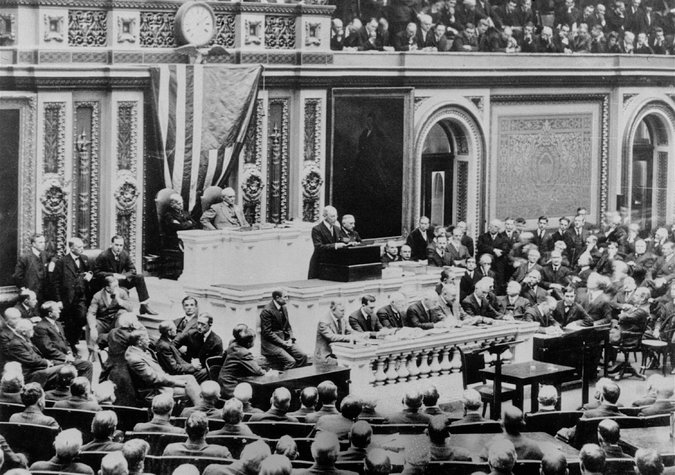
President Woodrow Wilson announced to a joint session of Congress on April 2, 1917, that a new age had begun. Credit Associated Press

President Woodrow Wilson announced to a joint session of Congress on April 2, 1917, that a new age had begun. Credit Associated Press

Woodrow Wilson is almost never quoted by name when modern presidents speak, but he remains audible all the same, particularly in the echoes that still reverberate a hundred years after the Great War.

In late May, President Obama spoke at West Point, where he defined America’s place in the world much as Wilson might have — propping up the international order, defending human rights, and walking eternally down the path of virtue. George W. Bush, so different in so many ways, also radiated Wilsonian idealism, even as he claimed to be an un-Wilsonian realist. His second Inaugural Address, drawn straight from the Wilson playbook, declared “the ultimate goal of ending tyranny in our world.” That remains a work in progress.

Wilson did not speak this way when World War I broke out in the summer of 1914. At first, he barely mentioned the diplomatic catastrophe unleashed by the assassinations at Sarajevo. On July 27, the day before Austria declared war on Serbia, he gave a press conference, and said meekly, “The United States has never attempted to interfere in European affairs.” Wilson’s silence coincided with a personal crisis of his own. His wife Ellen lay dying that summer, and when one of his daughters asked him about the growing chance of war, he said simply, “I can think of nothing — nothing, when my dear one is suffering.” She expired on Aug. 6, as the war began.

But his silence also reflected astonishment that war was breaking out, against all expectations, in an era that had at least as many clichés about globalization as our own. And it stemmed from an old presidential tradition, soon to be shattered, of avoiding grandiose statements about human betterment. George Washington, in his Farewell Address, specifically urged Americans to steer clear of foreign conflicts. The Monroe Doctrine proposed noninterference by Americans in Europe, as well as the opposite. Theodore Roosevelt advocated for silence as well — his famous adage to speak softly and carry a big stick — even if he did not always achieve it.

Wilson showed no signs of breaking from this tradition, at first. After Sarajevo, he gave a Fourth of July address that never even mentioned the killings a week earlier. Americans seemed to approve. In 1916, “He Kept Us Out of War” was a popular slogan that helped Wilson to eke out victory over his Republican rival, Charles Evans Hughes.

But Wilson’s silence would eventually give way to a different voice, the one that we remember him for. In the spring of 1917, after three horrific years, the world had changed greatly, and so had he. As he brought the United States to the precipice of war, he began to speak in a way that has defined the American presidency ever since. It was not merely that the United States would enter a European theater for the first time, in huge numbers. Wilson also asked that Americans fight to make the world “safe for democracy.” In a sense, he asked the United States to become the world’s judge as well as its sheriff, with an evangelical optimism that has brought both inspiration and exasperation to the 96 percent of the world that is not American.

Earlier presidents had expressed some of these aspirations: Thomas Jefferson proclaimed America the “world’s best hope” in his first inaugural, and Lincoln had often expressed himself likewise, in a language of aspiration. But these remarks expressed only a forlorn wish. They never formed a policy aim, and they fell far short of calling for intervention in Europe, where violations of human rights were as easy to find as the next hillside.

By 1917, Wilson was ready to take that step. He was hardly a natural interventionist. But the war was increasingly affecting American noncombatants, and insulting human rights on an epic scale, with mounting civilian casualties, chemical weapons, and the targeting of neutral vessels.

Accordingly, in the spring of 1917, Wilson began to deliver a stream of public statements that broke his earlier silence, and defined war not so much as a military exercise as an attempt to set the world right. Suddenly, a new language of human rights was being delivered by a president, from something like a pulpit, backed for the first time with the full might of American power.

On Feb. 26, he asked Congress to declare “armed neutrality,” a precursor to war, to defend the world’s “fundamental human rights.” His second inaugural, on March 5, promised to fight for “the principles of a liberated mankind.” In his war message of April 2, Wilson announced that a new age had begun, in which Americans would make the world safe, not only for democracy, but a broad catalog of rights that included freedom of the seas, the independence of small nations, and the right of all nations to unite, to “make the world itself at last free.”

That was a tall order. But since then, we have never stopped marching toward a goal that remains a bit otherworldly. Wilson was an effective messenger in 1917, drawing on his Presbyterianism, his grasp of American history, and his childhood memory of growing up in a region that had recently been occupied by an invading army (inconveniently, that of the United States). In this sense, Wilson’s language of self-determination might be understood as a final legacy of the Civil War.

The language of 1917 proved durable. Without doubt, Franklin D. Roosevelt’s messages during World War II were improved by his articulation of the core freedoms Americans were fighting for. The better speeches of the Cold War — John F. Kennedy’s in particular — conveyed a vivid sense of what American values meant to the world. Yet a tone of high moral dudgeon could also weaken a presidential speech, when it proved ineffective, or untethered to economic reality, or borderline delusional — Lyndon Johnson’s insistence that democracy was coming soon to Vietnam, or George W. Bush’s similar predictions for Iraq.

It has become fashionable to criticize Wilson for naïveté as well as self-righteousness. Evangelical statements require some suspension of disbelief, but ultimately, as he learned the hard way, soaring aspirations have a way of crashing back to earth. American forces did join the battle in 1917, and they tipped the balance, giving thrust to Wilson’s promises. But democracy, that catch-all term, proved difficult when he returned home from his European peacemaking efforts in 1919 and tried to enlist a skeptical Congress behind his vision of an improved world order.

At the same time, the words linger, expressive of something elusive that presidents still seek to articulate. As it turned out, a prophecy he made in his Fourth of July speech in 1914 was self-fulfilling: “The most patriotic man, ladies and gentlemen, is sometimes the man who goes in the direction that he thinks right even when he sees half the world against him.” A century later, that is often what American foreign policy feels like, as we reel from one undemocratic place to another, hoping to limit the carnage. To aspire to the best in Wilson’s oratory, while guarding against the worst, feels like a reliable course for a nation still finding its way in a world that has yet to be made safe for anything.

Ted Widmer is assistant to the president for special projects at Brown University. He recently edited “Listening In: The Secret White House Recordings of John F. Kennedy.”

Read Full Post »

Why Pardoning Nixon Wasn’t Good for America

HNN  August 8, 2014

This excerpt was adapted from the foreword to Smoking Gun, The Nation on Watergate, 1952 – 2010 (eBookNation, August 4, 2014), written by former US Representative Elizabeth Holtzman. The former Congresswoman served on the House Judiciary Committee and voted to impeach Nixon; you can download the new e-book, a unique real-time history from the pages of The Nation magazine on the rise and fall of Richard Nixon — and the consequences for American democracy — to read instantly on your tablet, e-reader, smartphone or computer. It is also available as a paperback (coming October 2014).


If Watergate is a story of accountability, President Gerald Ford’s pardon of Nixon is a story of presidential immunity. Here The Nation was especially spot-on, comprehending the sinister significance of the pardon right from the start.

Issued before any prosecution of Nixon had commenced, and without any acknowledgment of guilt on Nixon’s part, Ford’s pardon created a dual system of justice—one for ordinary Americans and another for the President. (Ford’s excuse that Nixon had “suffered enough” could have been applied, of course, to any person whose criminal activities had been exposed.) Unlike its persistence in tackling Watergate, Congress backed away from any serious investigation of the pardon. We will thus probably never know whether Nixon and his lieutenant Ford made a secret deal over the pardon—-in which Nixon would resign promptly and Ford would pardon him, not only shielding the President from prosecution, but limiting the Republican Party’s electoral losses at the polls in November.

Sadly, Watergate did not deter other Presidents from abusing their power. From Ronald Reagan and the Iran/Contra scandal to the present, Presidents have used the mantra of national security to ignore the Constitution. Worse, Ford’s pardon has grown into a principle of impunity for Presidents. It is not simply that Presidents are now viewed as safe from prosecution; they cannot even be investigated. No investigation has examined the presidential deceptions that drove us into the Iraq War, or the presidential authorizations of warrantless wiretapping in violation of law, or the possible criminal liability of former President George W. Bush and other top administration officials for violating laws on torture. Neither Congress nor the courts have taken the Watergate example to heart and stood firmly against presidential crimes or serious misconduct. Instead of remembering that Nixon cynically invoked “national security” to conceal ordinary crimes having nothing to do with the country’s welfare, they cower at the term, allowing Presidents to broaden their powers enormously.

Lack of government accountability runs directly contrary to the Constitution. The framers understood the threat that a strong executive would pose to our democracy; they knew because they had themselves overthrown a king and were careful students of history. To preserve our democracy, we need to rediscover the meaning of presidential accountability. One good way to start is to understand what went right—and wrong—in Watergate. For that effort, this volume of The Nation’s coverage of the subject is a useful resource.

Read Full Post »

Did Mexico Reshape the American Civil Rights Movement? –

HNN  August 10, 2014


It was a moment that schoolteacher Primitivo Alvarez never forgot. In the state of Tlaxcala, 50 miles and a massive volcano to the east of Mexico City, American philosopher John Dewey cautioned his hosts from the Mexican federal government not to copy the institutional models that others had constructed. It was 1926, and Dewey was surveying the work of his Mexican students in Mexico’s rural provinces and delivering a series of lectures in Mexico City that would shortly be published by the New Republic“Dewey wanted the rural schoolteachers of Mexico to remember the urgency and necessity of avoiding imitation, even if the model originated in the advanced countries, because each nation organizes its own system of education in accordance with its unique history, tradition, racial past, and economic and social institutions,” wrote Alvarez. Everyone knew which models were not to be copied. During the dictatorship of Porfirio Díaz, Catholicism and social Darwinism had been allowed to harden into an ideology of hierarchy that younger intellectuals were now replacing. Dewey was a perfect fit for the new institutions of postrevolutionary Mexico, Alvarez and others believed. New ideas and new models, porous to change and experimentation, would destroy the make-believe world of poverty and violence that Mexico’s Porfirian leaders had created.

As he looked back on his monumental study of the New Deal, historian Arthur Schlesinger, Jr. celebrated the ideas of John Dewey’s pragmatism for the influence they had wrought on FDR’s politics in the aftermath of the Great Depression. “A thoroughgoing philosophy of experience, framed in the light of science and technology, could produce an organized social intelligence,” wrote Schlesinger, Jr. in The Age of Roosevelt. “And the organized social intelligence, Dewey believed, could direct the processes of social change into a rational and beatific future.” Schlesinger, Jr. was not alone in underscoring the importance of Dewey’s pragmatism in the creation of the modern liberal order. Henry May argued that pragmatism had helped usher in the bundle of ideas that separated the twentieth century from the nineteenth, a rupture that he referred to as “the end of American innocence.” Alfred Kazin had included pragmatism and social science as part of the revolution that had produced modernist literature, meanwhile. And one could see Dewey’s relationship to modern education in Lawrence Cremin’s classic studies from the 1950s and 60s.

What is surprising given Dewey’s formidable role in American culture and later historiographical return in the work of contemporary scholars like Robert Westbrook and Richard Bernstein has been the absence of attention to Dewey’s influence in Mexico at the same time that the New Deal was being formulated in the U.S. During the period of rich policy experimentation between 1920 and 1940 that followed the devastating Mexican Revolution, John Dewey’s Mexican students hitched pragmatism to state policy in Mexico in the effort to destroy the institutions of the Porfirian political order and rebuild the postrevolutionary nation anew. In newly-established public schools, they used pragmatism to integrate Mexico’s ethnic groups into a single community of citizens. In scientific institutes centered in Mexico City, they used the scientific ethos to experiment with applied psychology, anthropology, and sociology. In rural states to the west and south of Mexico City, they attempted to balance the relationship between theory and practice that Dewey believed was central to social philosophy. Just as in Henry May’s portrait of pragmatism, Dewey’s ideas in Mexico helped separate the social determinisms of 19th-century Mexico from the modernist ethics that Mexico’s revolutionaries created after 1920.

The efforts in Mexico to achieve the progressive society that Dewey once referred to as the “great community” were filled with institutional difficulty and philosophical peril. The greatest of the Mexican pragmatists, Columbia University-trained Moisés Sáenz, once chastised a group of Americans for their complacent understanding of a complex society whose civil war had just finished killing one million of its own people. “Our emotions occlude our vision; we become confused by the complexity of experience; our accomplishments contradict each other at every turn; they seem to put the most obvious and the most profound into war with one another,” he told his audience. A decade later, Sáenz created a vibrant metaphor for the attempt to blend theory with practice that John Dewey’s pragmatism had made central to modern social critique. “We are walking on the edge of a knife,” he wrote. “We must choose between excessive empiricism and excessive speculation.” Precarious government financing, ongoing local rebellions, and threats to the national territory always made pragmatist attempts at reform a difficult enterprise fraught with the possibilities of failure and slow incremental advance at most.

Yet for Americans who were trying to understand how state power could be used to alleviate economic conflict and to create new relationships among culturally distinct communities, Mexico’s postrevolutionary experiments represented a rich set of policy models that they imported into the United States as they sought to transform public government and public schools in the American West. In rural Tlaxcala in the 1930s, for example, teacher training academies provided these Americans with new ideas about how government could work with local communities to create new schools. Science institutes established by the Secretariat of Public Education in Mexico City by 1930 provided them examples of the role of social scientists in government bureaucracy. And in Morelos, laboratory schools showed them how daily work patterns could be integrated into language-instruction models.

The anthropologists, psychologists, and educational philosophers who studied Mexico’s pragmatist experiments in the 1930s carried Mexico’s lessons into the 1940s desegregation movement in Texas, California, and Arizona as they sought to refashion America’s racial hierarchy. For Ralph L. Beals, Montana Hastings, George I. Sanchez, and Edwin Embree, Mexico’s policy work represented a bridge between state-led reform efforts abroad and political change at home. Daniel T. Rodgers has argued in Atlantic Crossings that progressive policy work in Europe and the United States was never free from misunderstanding and misreading. Yet such mistranslations did not prevent Americans from learning social policy from government models abroad, he argued. In a similar fashion, Mexico’s social reform experiments became discrete policy antecedents for these American racial liberals that have not been accounted for by scholars of pragmatism, the federal state, and US-Mexico relations. Government reform and civil rights in the American West were not uniquely domestic phenomena, the career of Mexican pragmatism shows us, but offshoots of policy reform and nationalism in Mexico in the two decades that followed the Mexican Revolution. School desegregationist George I. Sanchez agreed. “Nothing has affected my thinking and my feelings more than Mexico’s experience – redemption by armed Revolution, then Peace by Revolution,” he wrote in 1966 as he looked back on his career. “This latter revolution still goes on, and I associate myself with it vicariously – from afar, and from close-up examination there as often as I can.”

Mexico’s policy influence over the United States reverses the way that scholars understand the US-Mexico relationship. We typically think of the United States as a hegemonic nation whose power shapes the nations of Latin America along a north to south trajectory. But the example of Mexico during the 1930s and 40s shows us that Mexican government policy influenced American politics as much as American power influenced the history of Mexico. Thus, while Americans tend to think of Mexico as a country of “chaos” – a word that has been perennially repeated in accounts of Mexican history from 1920 to the present day – Mexican policy change has been important to the United States in ways that Americans have not imagined. Pragmatism in Mexico helped to reshape the moral character of American nationalism and democracy, and at the level of institutional practice rather than in theory alone, during a moment of heavy social change in American history. That John Dewey’s influence was part of that process only underscores the centrality of his ideas to social change abroad as much as in the United States.

Ruben Flores is an intellectual and cultural historian from El Paso, Texas who studied at Princeton and Berkeley before coming to the University of Kansas. Flores is the Undergraduate Director for the Department of American Studies and Associate Director of the Center for Latin American and Caribbean Studies.

Read Full Post »

Liberals Need to Take Back the Idea of American Exceptionalism

HNN  August 10, 2014

Related Link  American Exceptionalism Watch (Ben Alpers)

The Wisconsin Public Radio/National Public Radio show To the Best of Our Knowledge regularly asks writers if they have a “Dangerous Idea” that they would like to talk about (unscripted). My Dangerous Idea was American exceptionalism.

I did not speak on the dangers of the right-wing rendition of American exceptionalism, but rather on the original idea of American exceptionalism, which is dangerous because it demands progressive action and struggle to realize. I spoke for several minutes. The producers then edited it down to three minutes. You can listen to my argument here. The following text is a slightly edited version of what I had to say:

American exceptionalism sounds like a very conservative idea, right?

But you know what? For more than 200 years, American exceptionalism was a radical idea. It was an idea of liberals and progressives. It was an idea that didn’t say “we are superior” – that we have all the answers. No, it was an idea about what America could be, should be and, if we act on it, would be.

Think back to the words of someone like Thomas Paine – “We have it in our power to begin the world over again” – and to his call for the creation of an unprecedented democratic republic. Think about the Founders and the writing of the U.S. Constitution. We hear about the Constitution’s conservatism. And yet those first words, “We the People.” Those are radical words. Those kinds of words provided American life with democratic imperative. They embedded a democratic impulse in American life.

You know, there’s a democratic spirit inside almost all Americans. The democratic idea of American exceptionalism insisted that We the People can govern – that we don’t need kings and aristocrats – that we can govern ourselves. And that we can govern ourselves not only politically, but also that we can govern ourselves economically and culturally.

And then think about the generations of Americans empowered by that argument, that vision, that promise: the Freethinkers, the Abolitionists, the women’s rights advocates, the labor unionists, the civil rights campaigners. Those folks believed in American exceptionalism and they used that belief – which they knew they shared with their fellow citizens – to challenge their fellow citizens to make America freer, more equal and more democratic.

That idea of American exceptionalism didn’t see American progress as natural or inevitable, but it was compelling. That idea of American exceptionalism empowered generations to make America better – to recognize that we were a grand experiment in democracy, and the only way you can carry out an experiment is to test its limits.

Now, something obviously went wrong. Today, when you hear the argument about American exceptionalism, it’s almost always a conservative argument – you know, it’s not about life, liberty and the pursuit of happiness, but about life, liberty and the pursuit of property – that is, protect property, limit government. It’s not about democracy; it’s about individualism.

But even sadder than that – because we’ve always heard conservatives argue that kind of thing – is that, at best, we are told we have to defend what exists, not advance what exists.

But of course, the saddest thing is that liberals and progressives seem embarrassed by the idea of American exceptionalism, because they have somehow allowed themselves [we have somehow allowed ourselves] to believe that an argument for American exceptionalism is an argument for American superiority, an argument that claims “we have all the answers.’’

We need to remember that American exceptionalism [as Thomas Paine, Walt Whitman, Herman Melville, Eugene Debs, Franklin and Eleanor Roosevelt, and Martin Luther King saw it] is a challenge to enhance freedom, equality and democracy. Indeed, the danger is that if we forget that dangerous idea, we will cease to be Americans.

So, we progressives should redeem it.

Harvey J. Kaye is professor of democracy and justice studies at the University of Wisconsin-Green Bay and the author of the new book “The Fight for the Four Freedoms: What Made FDR and the Greatest Generation Truly Great” (Simon & Schuster). Follow him on Twitter: @harveyjkaye. This article was first published on Our Future.

Read Full Post »

Hiroshima: What People Think Now

HNN  August 8, 2010

Hiroshima Peace Memorial, also known as the A-Bomb Dome. The atomic bomb which destroyed Hiroshima detonated almost precisely above the building. Credit: Wikipedia

Related Links

News

Commentary: Historians

Commentary: Media


Read Full Post »

Our political era, as most of us understand it, starts in 1980. The election of Ronald Reagan is the opening shot, the first of the three massive conservative backlashes (1994 and 2010 are the others) that have irretrievably shaped our sense of political possibility.

That is not how we see our economic history, though: there it is the middle years of the 1970s that mark the turning point when median wages stopped their steady postwar rise, Keynesian solutions failed, productivity stalled, and the gains of the wealthy began to take off. Culturally, too, an hour listening to any classic rock radio station or watching a cable rerun network is a reminder that the mid-’70s are very much part of our own world.

The “invisible bridge” in the title of Rick Perlstein’s new book reconnects the politics of the early and mid 1970s to the Reagan era, and thereby to the present. The tawdry end of Richard Nixon and the emergence of Reagan on the national stage only seem like wholly different phenomena—because Nixon was hardly a movement conservative, except when that pose was useful to him; because Reagan challenged Nixon’s successor and pardoner; and because their personalities seemed so wildly at variance, with one deeply engaged in dark conspiracies, the other nodding affably.

But Perlstein, among other achievements, draws a straight line from the “Final Days” to morning in America, demonstrating that Reagan was as unflinching a defender of Nixon as was an oddball like Rabbi Baruch Korff. The manipulation of patriotic imagery and cultural division that we associate with Reagan (placing “heroes” in the audience at the State of the Union address, for example) was merely an evolution on a political theme developed by Nixon and extended by Ford. For instance, Perlstein’s brilliant opening chapter reveals in deep detail the fabrication underlying the dramatic return of American prisoners of war from Vietnam and the creation of the category of the “Missing in Action,” even though there was no evidence that American soldiers were still alive in Vietnam after the end of the war. Both the POW return and the MIA fiction were contrived mostly as a distraction from the far more shocking conditions in South Vietnamese prison camps, a delusion that remained prevalent until a commission led by Senators John McCain and John Kerry finally brought it to an end in 1993. The election of 1980 was a restoration, not a revolution.

Although each of his three books is structured around an individual politician, Perlstein’s subject is always political movements and political culture. “Biography doesn’t much interest me,” Perlstein wrote in The Baffler in 2012. “Powerful men are but a means to the more profound end of sizing up the shifting allegiances on the demand side of our politics.” His first book, Before the Storm, about Barry Goldwater’s 1964 presidential campaign, became an important point of reference for liberals when it appeared in 2001, and it remains so. In those uncertain moments after the end of the chaotic, timid Clinton administration, and as the tragedy of the Bush years was coming into sight, Before the Storm taught us that winning elections is not always the main goal and that a campaign that ends in a historic loss, but builds the foundations of a coherent and passionate ideological movement, can achieve lasting change, visible only years later. The “fighting Dem” bloggers of the Bush years read Storm as a call to action, but it was also a brilliant, tight history of the early figures in the conservative movement and the Republican establishment’s clumsy struggle to hold them at bay.

Where Goldwater hung in the background of Storm, Perlstein put his protagonist at the center of Nixonland (2008), casting American politics during the upheavals of the late 1960s through the lens of Nixon’s own psychological torments, rooted in his collegiate resentment of the “Franklins”—the smug, elite student society at Whittier College—and his own club, the square and aspiring “Orthogonians.” It is not so much that Nixon imposed his view of the world on the nation; rather, he provided an explanation that connected perfectly to the breakdown of the late 1960s, and resonated particularly with a resentful white working class.

The Invisible Bridge is a more complex book than either of its predecessors. Perlstein describes it as an account of the events that led to Reagan coming within a hair’s breadth of toppling Ford at the Republican convention in 1976, a victory-in-defeat that is surely as consequential to the modern conservative ascendancy as Goldwater’s campaign. But the first glimmers of a draft-Reagan campaign don’t appear until almost the 500th page of this 800-page book.

Along the way to the showdown in Kansas City—the last nominating convention, of either major party, whose result was not certain on the first day—is a political history of the middle years of the 1970s, focusing on the Watergate investigations, the subsequent exposés of the CIA, and the many other collapses of trust that opened the door to outsiders such as Jimmy Carter and Reagan. Perlstein provides a rough and cluttered cultural history of the period, featuring phenomena such as Wacky Packages (trading cards and stickers with punning names of consumer products) that will make older Gen X-ers want to rummage through the boxes in their parents’ attics.

Woven through an otherwise chronological narrative of 1973–1976 is a serviceable but unnecessary biography of Reagan, surely the least interesting of the last thirteen men elected to the presidency. Perlstein draws out less well-known aspects of Reagan’s background, particularly the role of Lemuel Boulware, who as General Electric’s vice president of labor and community relations enlisted Reagan to make speeches for the company espousing the particular brand of free-market and anti-labor ideology, with a thin patina of social conservatism, that is still the dominant strain in official conservatism. Reagan’s flip, in his mid-forties, from modest anti-Communist liberalism to the far right was made possible by Boulwarism, Perlstein says, “a right-wing politics that imagined no necessity for class conflict at all” because business would take care of workers’ needs. That matched Reagan’s sense of himself—a man at once above conflict and gleefully sowing it.

Following the model he employed in Nixonland, Perlstein half-heartedly uses a fragment of the Reagan biography as the interpretive lens for the entire half-decade: when he was a high school lifeguard, Reagan apparently overstated his life-saving feats, and as an adult, Perlstein says, he adopted the posture of the “rescuer” in the face of Watergate, the CIA revelations, the Symbionese Liberation Army, and all the other confusion, chaos, and distrust.

Eh, maybe. Not only is this a banal interpretation of both the era and of Reagan, but it also rests too much agency in Reagan, the individual, when the whole point of the Perlstein project is to trace the lines of the conservative counterrevolution, undistracted by the charms and psychodrama of its front men.

The book works best when it does exactly that, just as the 1976 Reagan campaign took off when it, too, stopped focusing on the man at the top of the ticket. Reagan had been losing in the early primaries, during which the wily but not-quite-conservative campaign manager John Sears had been trying to sell him as an experienced governor and non-scary potential president. Heading into the North Carolina primary, Senator Jesse Helms and his lieutenant Tom Ellis, using the army of direct-mail donors and activists assembled by Helms’s National Congressional Club, picked up the campaign and encouraged Reagan to talk solely about hot-button conservative issues of the moment, such as the threat of détente with the Soviet Union and the proposed Panama Canal treaties. Victory in North Carolina re-launched the conservative ascendancy. In a sense the movement—in the form of its issues and its direct-mail operations—was more successful than the man.

• • •

A more interesting interpretation of the mid-’70s and their relevance emerges from the less Reagan-centric narrative, from the “demand side” of politics, and from the torrent of anecdotes, quotes, movie summaries, and clips that make up the bulk of the book. But this interpretation is never stated as explicitly as the Reagan-as-rescuer trope. It goes something like this: a large segment of the white population of the United States, something like Nixon’s “silent majority,” was deeply unsettled by the social and political changes of the late 1960s and ’70s, and “felt ignored, patronized . . . by arrogant liberalism,” as Perlstein puts it. He is largely respectful toward these people, who include the first wave of school textbook activists—led by a Texas couple who asked reporters to call them only by the husband’s name, “the Mel Gablers”—bussing foes in Boston, and grassroots opponents of the Equal Rights Amendment and the Panama Canal treaties. That respect does not extend to Reagan or to elite conservative activists, particularly figures who occupy both the Nixon and Reagan machines, such as Pat Buchanan, who rather than creating a politics that could hear and address those anxieties, exploited them and deepened the divide—for power and often just for money.

Almost complicit in the rise of the right—and this is where Perlstein’s grand theory of politics gets interesting—are Democrats and liberals, particularly the reformist generation of the “Class of ’74” congressional Democrats and the 1976 Democratic presidential candidates, who get a surprising amount of attention in a book ostensibly about the Republican contest. Perlstein twice quotes Gary Hart, elected to the Senate in 1974, declaring, “We’re not a bunch of little Hubert Humphreys.” But Humphrey himself, the former vice president then back in the Senate and leading the push for a full-employment act, appears only fleetingly, as an undeclared 1976 candidate. Most of the other 1976 contenders—particularly the duplicitous Jimmy Carter; sanctimonious, shallow Frank Church; and quasi-conservative bullshit artist Jerry Brown—are regarded much as Perlstein sees Barack Obama: too naïve about the right, uninterested in economic justice, too eager to compromise and to distance themselves from the historical legacy of FDR-LBJ-Humphrey liberalism. As Perlstein sees it, the angry white working class is as poorly served by posers and spinners such as Hart as by the professional dividers on the right.

This is a cold dismissal of a moment that is as central to the history of liberalism as of conservatism. Perlstein regards the Class of ’74 Democrats as merely arrogant, high-minded reformers who kicked out old populists such as House Banking Committee chairman Wright Patman. No doubt ’70s reformist liberalism—a tradition that can be traced forward to the Obama administration—had profound blind spots, particularly to the role of political machines in building support and community for working-class families. But its effort to open up Congress had a deep history, going back to the 1950s. Immovable committee chairs such as Patman (though he was far from the worst) were progressive on a few dimensions, but on others—especially civil rights, the only issue that mattered—had posed barriers for decades. Opening up Congress ultimately led to a period of legislative entrepreneurship that included many of the foundations of modern government: environmental and workplace safety regulations, huge expansion of health coverage culminating in the Affordable Care Act, even passage of Humphrey’s Full Employment Act, none of which would have been possible had the old Southern lions remained on their thrones.

Perlstein skips over this context, in this and other instances, simply because, with the exceptions of the Reagan biography and the opening set piece on the POW-MIA scam, his tale relies entirely on the immediacy of the press. If there were a soundtrack to this book, it would be the spins and clicks of an old microfilm machine, zipping, slowing, and pausing through archives of the Milwaukee Journal-Sentineland other mid-sized newspapers, picking up quotes, images, long-forgotten anecdotes, ads for wig shops or “golden age” pornographic movies.

Indeed, you come away from the book feeling the way you would after a long afternoon in the library reading those microfilms—you might find what you were looking for, but much more as well, and you’ll get a little fuzzy-headed in the process. None of Perlstein’s material is uninteresting; there is just too much of it. There is a great book within The Invisible Bridge, but it would be about 500 pages long, the length of Before the Storm. It is about the structure and strength of the conservative movement, the continuities between Nixon’s politics and Reagan’s, the failure of liberals and Democrats (and organized labor, whose disintegration during the decade goes mostly unmentioned) to speak to the economic and cultural panic of the decade. The Invisible Bridge is too difficult to get through, making it unlikely to achieve the audience or influence of its predecessor.

It is Perlstein’s misfortune that he doesn’t appear to have had the kind of editor who could not only cut the scrapbook clutter, but also keep the story governed by Perlstein’s own maxim: “Biography doesn’t much interest me.” The “demand-side” of politics is the story here, and it is up to the patient reader to find it.

Mark Schmitt is Director of the program on political reform at the New America Foundation and former executive editor of The American Prospect.

Read Full Post »

HNN  August 3, 2014


Before leading her nation into default on its sovereign debt for the second time in twelve years, Argentina’s President Cristina Fernandez de Kirchner might profitably have examined the work of America’s first Treasury Secretary, Alexander Hamilton, when he faced a debt crisis.

In 1789, the new government of the United States confronted a tower of “sovereign debt.”  In a nation with only three fledgling banks and a rudimentary financial structure, the debts of state and national governments totaled roughly 40 percent annual economic output.  The national government had no revenues other than funds voluntarily contributed by states.  When the Massachusetts state government raised taxes to pay down its debts, thousands of armed citizens marched on the federal arsenal in Springfield in Shays’ Rebellion of 1786.

The American debts accrued during eight years of Revolution against the British Empire.  The debt instruments ranged from formal loan papers, to largely worthless paper currency, to scribbled receipts for seized supplies or soldier pay, to “indents” for missed interest payments.  For four years before 1789, no American government had paid interest on its debts.

The new Treasury Secretary, a 32-year-immigrant from the Caribbean, confronted a wildly unstable financial market when he took office.  As with Argentine debt in recent years, the value of American debt paper had been driven down to 20 percent of face value or less.

Canny investors – including Abigail Adams, wife of new Vice President John Adams – were snapping up those bargains, betting that the new government would have to make good on the debts.

Investors’ agents carried satchels of cash to Southern and Western communities, sweeping up debts while sometimes misleading the sellers about the political situation.  A congressmen traveling to New York passed two express riders headed south with money for speculation; a financier sent two ships to South Carolina with goods and cash for buying military certificates.  The atmosphere in New York, then the center of government and of speculation , grew feverish.  James Madison referred disdainfully to the prevailing “avidity for stock.”

The questions swirled, reinforcing  all that was speculation.  Would Hamilton honor all of the debts of the national government?  Would he assume the debts of the state governments?  Would he pay the face value of the debt?  Would he pay in hard money or create a new shaky paper currency?  What interest would he pay?  What schedule for redemption?

In early January 1790-, after only four months on the job, Hamilton issued his “Report on Public Credit.”  With the implicit backing of President George Washington, he proposed to repay all the federal debt and all the state debts, and to do so with hard money.  The redemption periods would be long and some of the interest rates would be reduced.  Only current holders of the debt would be paid.  For most speculators, the result would be a bonanza.

Speculation continued for eight long months later, until Congress largely adopted Hamilton’s plan.

Some opposed Hamilton’s scheme.  It rewarded wealthy speculators and gave nothing to the poor soldiers and farmers who had sold their government IOUs for pennies on the dollar.  America, James Madison complained, was erecting monuments of gratitude “not to those who saved her liberties, but to those who had enriched themselves in her funds.”

But Hamilton’s hardheaded approach established the credit of both the national and state governments.  The United States prospered on that solid foundation.

Argentina today, in contrast, denounces as vultures” those speculators who scooped up Argentine debt at dramatically discounted prices.  Having failed to come to terms with them, Argentina defaults and its markets tumble.   That’s not how Alexander Hamilton did it.

David O. Stewart is the author of «Madison’s Gift: Five Partnerships that Built America,» which will be released by Simon & Schuster in February 2015. His other books include «The Summer of 1787: The Men Who Invented the Constitution» and «American Emperor: Aaron Burr’s Challenge to Jefferson’s America.»

Read Full Post »

This Is How Racist America Was During the Civil War

HNN August 1, 2014

During the Civil War, many New York City newspapers were closely aligned with the anti-war, pro-Southern wing of the Democratic Party. Republicans called them «Copperheads» after the venomous snakes that originate in the area that had become the Confederacy. Their hatred of Abraham Lincoln was probably only surpassed by their virulent racism and hatred of Black Americans. Their pages were filled with racially offensive language that would be blipped out on the Daily Show with Jon Stewart and most newspapers today are hesitant about printing. I use the word «nigger» in this op ed. I do not use it lightly and I will only use it when quoting directly from newspaper articles from the era. I do not believe it is possible to convey the depth of racism in Northern society during the Civil War era without using this inflammatory and defamatory term.

In 1864 the Daily News was accused of receiving payments from Confederate agents to promote anti-war rallies in New York City and it inflamed racial tension by claiming that racial mixing or miscegenation was the «doctrine and dogma» of the Republican Party. The editorial page of the Weekly Day-Book, which from October 1861 to October 1863 was known as The Caucasian, carried the banner «White Men Must Rule America.»

In the months leading up to the July 1863 Draft Riots, John Mullaly, editor of the Roman Catholic Church’s newspaper, Metropolitan Record, called for armed resistance. At a Union Square rally May 19, 1863, Mullaly declared «the war to be wicked, cruel and unnecessary, and carried on solely to benefit the negroes, and advised resistance to conscription if ever the attempt should be made to enforce the law.» Following the July Draft riots, Mullaly was indicted for «inciting resistance to the draft.»

In its August 23, 1863 issue, the Herald, which had the largest circulation in the country, predicted that the Republican Party would eventually nominate and unite behind Abraham Lincoln when it realized he was the person «predestined and foreordained by Providence to carry on the war, free the niggers, and give all of the faithful a share of the spoils.» On October 7, 1863, the Herald described the Ohio gubernatorial election as a battle to decide «whether the copperheads or the niggerheads are more obnoxious to the great conservative body of the people.»

The 1864 Presidential election provided the Copperhead press an opportunity to express open, casual, and nasty racism. A key figure was journalist David Goodman Croly, who at one time or another worked for the New York Evening Post, the Herald, and the World. Croly helped to anonymously produce one of the more avowedly racist attacks on Republicans and African Americans produced during the Civil War, a 72-page pamphlet titled «Miscegenation: The Theory of the Blending of the Races, Applied to the White Man and the Negro.» The pamphlet charged that the Civil War was a war of «amalgamation» with the goal of «blending of the white and black,» starting with the intermixing of Negroes and Irish.

Many newspapers, including the World, argued the pamphlet was the work of abolitionists and represented their actual program, rather than an attempt to undermine abolition. The New York Freeman’s Journal & Catholic Register, a «peace at any cost» Democratic Party newspaper closely aligned with Fernando Wood, claimed that the «beastly doctrine of the intermarriage of black men and white women» had been «encouraged by the President of the United States» and that «filthy black niggers» were mingling with «white people and even ladies everywhere, even at the President’s levees.»

The editors of the New York Times, were eventually sucked in by the fraud. In a March 19, 1864 editorial, they wrote, «We regret to learn from numerous sources that we are on the point of witnessing intermarriage on a grand scale between the whites and blacks of this Republic. It has, as most of our readers are aware, been long held by logicians of the Democratic school, that once you admit the right of a negro to the possession of his own person, and the receipt of his own wages, you are bound either to marry his sister, or give your daughter in marriage to his son. The formula into which this argument has always been thrown was this: If all blacks are fit to be free every white man is bound to marry a black: ‘Niggers’ are blacks: Therefore every white man is bound to marry a ‘nigger.’ »

A week later, on March 26, 1864, a Times editorial stated: «we have no hesitation in saying that if we had at the outset conceived it possible that hostility to Slavery would ever have led to wholesale intermarriage with negroes, or of all marriageable Republicans and their sisters, that party should never have received any countenance or support from this journal. We owe it to ourselves and posterity to say that the odious matrimonial arrangements, into which so many of those whose opinions on certain great questions of public policy we have hitherto shared, have taken us wholly by surprise.»

By March 30, 1864 the Times had realized it was a victim of a hoax. «Trusting entirely, as we stated at the time, to the assertions of the Copperhead press, we have made mention of sundry movements alleged to be in process for the more wide-spread diffusion of the new political gospel of Miscegenation . . .  [T]he Copperhead newspapers have been spreading false reports, which is scarcely conceivable.» However, not only did the paper not apologize for its racism, but it complained «[t]he Copperheads are responsible for this state of things. They have aroused the whole colored community, by their highly-colored pictures of the connubial fate that awaits them at Republican hands, to a state of intense excitement.»

Given the virulent racism of the anti-war Copperhead Democrats and the still open racism of both the pro-war Democrats and Unionist Republicans in New York City and the north, it is amazing that slavery in the United States ended at all. Emancipation was a tribute to the doggedness of abolitionists, Black and White, the need for Black manpower for the North to win the war, and major miscalculations by Southern secessionists who mistakenly exaggerated Northern opposition to slavery and support for Black rights.

Alan Singer is a historian and Professor of Secondary Education at Hofstra University, author of «New York and Slavery: Time to Teach the Truth» (2008), and editor of the «New York and Slavery: Complicity and Resistance» curriculum that received the 2005 National Council for the Social Studies program of excellence award.  This piece was written with research assistance from Joseph Palaia, graduate student, Hofstra University.

Read Full Post »

50 Years Ago Congress Gave the President a Blank Check for War 

by Leonard Steinhorn

HNN August 3, 2014


Walt Rostow showing LBJ a map of Khe Sanh in 1968


Fifty years ago, on August 10, 1964, President Lyndon Johnson signed what is known as the Gulf of Tonkin Resolution. It is a day that should live in infamy.

On that day, the President gave himself the power “to take all necessary steps, including the use of armed forces,” to fight the spread of communism in Southeast Asia and assist our ally in South Vietnam “in defense of its freedom.”

Or as former Secretary of Defense Robert McNamara put it decades later, it gave “complete authority to the president to take the nation to war.”

History has shown that the resolution was built on a foundation of misinformation, fabrication, and willful evasion of the truth. Contrary to what the President claimed, there was no unprovoked “act of aggression” against the American  destroyers that were patrolling the Tonkin Gulf, and a second alleged incident never even took place.

But the Johnson administration was looking for a pretext to escalate the war. “We don’t know what happened,” National Security Adviser Walter W. Rostow told the president after Congress passed the resolution, “but it had the desired result.”

The Gulf of Tonkin Resolution may have had the desired result, but the war it unleashed didn’t.

By the time Lyndon Johnson left office more than four years later, we had amassed over half a million troops in Vietnam, lost nearly 37,000 soldiers, dropped more bomb tonnage than we had in all of World War II, released chemical weapons – Napalm and Agent Orange – throughout Southeast Asia, and burned thousands of South Vietnamese homes and villages to the ground.

Yet it was increasingly clear by then that we could not win the war.

Rather than stopping any dominoes from falling in Southeast Asia, the Gulf of Tonkin Resolution set in motion a series of dominoes in our own country  that would profoundly alter our politics, economy, and culture for years to come.

Perhaps the most significant decision President Johnson made beyond using his newly authorized power to escalate the war was to hide the cost of the war and resist any tax increase to pay for it. Johnson feared that any congressional debate over funding the war would come at the expense of his Great Society program.

He wanted both guns and butter, but he worried that Congress would choose guns over butter. So once again he resorted to obfuscation and deception to get his way.

What resulted was a cascading series of economic  consequences that would transform our nation and undermine the Great Society he so dearly wanted to protect.

To pay for the war without gutting his robust domestic agenda, Johnson resorted to deficit spending which fueled an already overheating economy that was now being asked to divert its productivity away from consumer goods and toward the war effort.

Consumer demand began to outstrip supply, and that let the inflation genie out of the bottle. Less than five years after the Gulf of Tonkin Resolution passed, inflation more than quadrupled.

Johnson couldn’t hide the rising cost of the war for long, and by 1968 he asked for a 10 percent tax surcharge on all but the poorest Americans. But it came at a cost: Congress demanded, and he had to accept, a 10 percent reduction in domestic discretionary spending. Barely three years after birthing the Great Society, he began to starve it to pay for the war. It never fully recovered.

To middle and working class Americans, the backbone of the New Deal coalition, the war’s economic impact was taking a toll. Though inflation meant pay raises once a year, prices for food and consumer goods were rising every month which then ate away at any increase in their wages.

Their standard of living began to stagnate. Nor were taxes indexed to inflation in those years, so every pay increase risked pushing them into a higher tax bracket, which took even more money from their pockets in addition to the tax surcharge they would have to pay.

These were largely Democratic voters who generally supported the president and the war – many had their own boys fighting in Vietnam – so if they were looking for blame they weren’t about to point the finger at a deceptive and misguided war policy.

Instead, they saw higher taxes, higher domestic spending, and lots of fanfare for a Great Society that didn’t seem to include them. They also saw domestic unrest and urban riots.

To them, they were hard-working Americans who played by the rules yet were now forced to tread water just to keep from falling behind while government seemed to be giving everything away to the poor. That domestic programs themselves were getting squeezed by the war was a detail that got lost in the heat of the moment.

Couple these growing resentments with the fact that it was their boys, not the children of the well-educated, who were being sent off to war. From their perspective, the liberal elites were taxing them to coddle the poor, yet when it came to defending our nation these same liberal elites sheltered their sons in colleges and universities.

Those seeking to understand the rise of Reagan Democrats and white working class Republican populists – and the corresponding demise of the New Deal majority – need look no further. The cultural and political divide that began in the Sixties was a direct result of the deceit that brought us the Vietnam War.

And what was then a still fragile liberal consensus that government could mitigate the hardships of poverty – a consensus that enabled passage of the Great Society legislation – began to erode.

That an administration could dissemble us into war would lead to another cultural and political repercussion of Vietnam: our growing and seemingly permanent distrust of government.

Trust in government peaked at 76 percent in 1964, not coincidentally the same year as the Gulf of Tonkin Resolution, and declined precipitously in the years thereafter, reaching what was then a low of 25 percent in 1980, according to the University of Michigan’s National Election Studies.

Not all of this decline is due to Vietnam, but a war built on the original sin of deception, fiction, and illusion deserves a good deal of the blame.

Almost daily, Americans were treated to an official  version of the war that had us winning. The  Johnson administration trumpeted body counts and bombing raids and assured us, in the famous words of General William Westmoreland, that there was “light at the end of the tunnel.”

But there was no light. The dark reality we saw every night on television contradicted what our leaders were telling us. We saw bloodied soldiers, troops burning villages, body bags, fear and despair and little of the triumphalism that was emanating from the Pentagon.

When the Vietcong launched their Tet Offensive in  January 1968, striking at the U.S. Embassy and other key sites in the heart of Saigon, Americans had a hard time reconciling the official version with what they were witnessing.

Thus was born the credibility gap between the American government and its citizens.

And nowhere did it grow wider than among journalists, who were greeted with untruths during the daily military briefings in Vietnam – known as the Five O’clock Follies – and saw through such euphemisms as “pacification,” which in truth meant torching Vietnamese huts and shooting those who resisted, and “collateral damage,” which in reality meant civilian deaths.

Reflexive skepticism of government remains a defining characteristic of contemporary journalism.

Watergate, which calcified the credibility gap, also grew out of Vietnam when President Richard Nixon authorized his secretive White House Plumbers to retaliate against Daniel Ellsberg, whose leak of the Pentagon Papers laid bare the duplicity behind the Gulf of Tonkin Resolution and the U.S. prosecution of the war.

Years later Senator Wayne Morse of Oregon, one of two who voted against the Gulf of Tonkin Resolution, told Ellsberg that if members of Congress had seen the evidence from the Pentagon Papers in 1964, “the Tonkin Gulf Resolution would never have gotten out of committee, and if it had been brought to the floor, it would have been voted down.”

What Lyndon Johnson saw as a ploy to grant him war powers ended up harming so many and transforming our nation in ways the President surely never intended. It would end up engulfing the liberalism he so loved. The Gulf of Tonkin Resolution and the hubris behind it were the linchpins of Johnson’s Shakespearean Vietnam tragedy – and ours as well.

Leonard Steinhorn is a professor of communication and affiliate professor of history at American University, where he teaches politics, strategic communication, and courses on the presidency and recent American history. He is the author of the much discussed book on baby boomers, The Greater Generation: In Defense of the Baby Boom Legacy, and co-author of the critically acclaimed By the Color of Our Skin: The Illusion of Integration and The Reality of Race.

Read Full Post »

President Warren Harding’s Love Letters Open to the Public

HNN  July 29, 2014

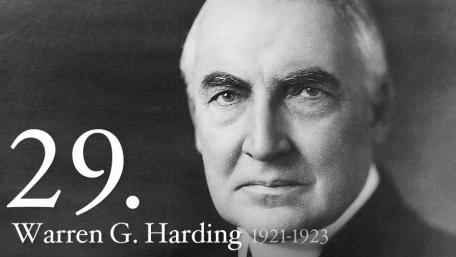
29wh_headerThe Library  [of Congress] today opened to the public a collection of approximately 1,000 pages of correspondence between 29th U.S. President Warren G. Harding and his mistress, Carrie Fulton Phillips. The letters, which have been locked in a vault in the Library’s Manuscript Division since their donation in 1972, can be viewed online here.

The letters were written between 1910 and 1920 during an affair that began in 1905 between then-Ohio Lt. Gov. Warren Harding and family friend Carrie Fulton Phillips. The vast majority of the letters were written by Harding, many while he served in the U.S. Senate (1915-1921). Phillips is represented mainly by drafts and notes. The Library has recently obtained additional material from the Phillips/Mathée family, which is also now available online here.

Taken as a whole, the correspondence sheds light on a man in love on the eve of his presidency and a country on the brink of World War I. Examples include:

      • Harding to Phillips, on the back of his portrait photo, Dec. 24, 1910: «My Darling, There are no words, at my command, sufficient to say the full extent of my love for you …»
      • Harding to Phillips, Jan. 26, 1915, from San Francisco’s Palace Hotel (where Harding died in 1923), regarding their correspondence: «Won’t you please destroy? You are not always careful with letters, and if you destroy, you won’t need to be careful.»
      • Harding to Phillips, Jan. 11, 1917, on prohibition for the District of Columbia. Harding votes «no» believing that the citizens of the District should decide for themselves: «Just now I am catching the very devil by mail for my attitude on prohibition in the district. I hope you do not wholly disapprove. I voted as I said I would when asking for my election and have kept the faith.»
      • Harding to Phillips, March 25, 1917, about the looming war vote: «I have pondered the situation with soberness and solemnity ever mindful of the great responsibility. How unthinking and unfair you are when you accuse me of playing politics! I represent a state with hundreds of thousands of German Republicans. Nobody knows better than I do that I seal my political fate by displeasing them. I know it makes me a one-term official to oppose their desires, but I prefer to perform a duty in good conscience even though I know it means the end of my public service.»
      • Harding to Phillips, April 1917, concerning their arguments about the war: «You quote that silly lie about my having said ‘a little scrap might be a good thing’ Can you think me so dumb-headed as to say a thing like that to a pacifist delegation, even if I thought it? In my address I refuted that statement in Cincinnati where some unthinking or unintelligent liar originated it. Clearly it was a fair sample of the easy lying in these hysterical or inconsiderate times.»
      • Phillips’ notes in response to the previous letter, May 1917: «The ‘silly lie’ denied made in Cin. Speech—you said it to me. I didn’t know it was said by you till then. I only speak of the thing you said to me.». . . «What is it we’re fighting for, democratic principals? Yes, that’s it—and liberty! –and humanity! We had a Negro equality man under democracy lynched yesterday—Great pretexts, these, of ours!»
      • Harding to Phillips, Feb. 17, 1918: «Let me lecture you a bit. It is quite all right for you to express yourself freely on war matters to me. This does not say you are right, but there is no harm in free expression to me. I can understand. But do, please, I beg you, be prudent in talking to others. . . . Remember your country is in war, and things are not normal, and toleration is not universal, and justice is not always discriminating.»
      • Harding to Phillips, Feb. 2 1920: «We have blundered. We will not talk about the blame. I accept my full share of it. We did blunder. I give you the most tribute that a man can. There was no cheating. We both understood. We were both married. No lies were told. We felt the sense of family obligations. Happily there has been no irreparable damage.»

Phillips kept the letters hidden in a box in her home in Marion, Ohio, where they remained unseen for nearly 40 years. Upon Phillips’ illness and subsequent death in 1960, the correspondence was discovered by a court-appointed lawyer, who made the collection available to a potential Harding biographer in 1963. The use of the letters by the biographer was thwarted by a lawsuit brought by the president’s nephew, Dr. George Harding. An Ohio judge closed the papers on July 29, 1964, and after extended litigation, the Harding-Phillips letters were purchased by Dr. Harding from Phillips’ heirs. In 1972, Dr. Harding donated the letters to the Library of Congress for safekeeping, with the stipulation that the Library keep the papers closed until July 29, 2014—50 years from the day the Ohio judge first closed them.

The Library held a symposium on July 22 to discuss the Harding-Phillips correspondence and what it reveals about Harding’s character and political views; his relationship with his wife; and implications for national security during World War I, given Phillips’ German partisanship. Moderated by Manuscript Division Chief James Hutson, the panel included Library archivist Karen Linn Femia, who processed the correspondence; Dr. Richard Harding, a grandnephew of the president, who described the family’s reaction to the opening of the president’s personal correspondence; and James Robenalt, author of «The Harding Affair: Love and Espionage During the Great War.» Members of the Mathée family provided a written statement that was read at the event. A webcast of the program can be viewed at go.usa.gov/5Mbd.

Founded in 1800, the Library of Congress is the nation’s oldest federal cultural institution and the largest library in the world. The Library seeks to spark imagination and creativity and to further human understanding and wisdom by providing access to knowledge through its magnificent collections, programs, publications and exhibitions. Many of the Library’s rich resources can be accessed through its website at www.loc.gov.

The Library  [of Congress] holds nearly 69 million manuscript items, including the papers of 23 American presidents, from George Washington to Calvin Coolidge. Many of these items are accessible on the Library’s website.


Read Full Post »

« Newer Posts - Older Posts »