Feeds:
Entradas
Comentarios

Archive for 2014

We still lie about slavery: Here’s the truth about how the American economy and power were built on forced migration and torture

Edward E. Baptist

Salon.com  September 7, 2014

We still lie about slavery: Here's the truth about how the American economy and power were built on forced migration and torture

The Shores family, near Westerville, Neb., in 1887. Jerry Shores was one of a number of former slaves to settle in Custer County. (Credit: AP/Solomon D. Butcher)

1937

A beautiful late April day, seventy-two years after slavery ended in the United States. Claude Anderson parks his car on the side of Holbrook Street in Danville. On the porch of number 513, he rearranges the notepads under his arm. Releasing his breath in a rush of decision, he steps up to the door of the handmade house and knocks.

Danville is on the western edge of the Virginia Piedmont. Back in 1865, it had been the last capital of the Confederacy. Or so Jefferson Davis had proclaimed on April 3, after he fled Richmond. Davis stayed a week, but then he had to keep running. The blue-coated soldiers of the Army of the Potomac were hot on his trail. When they got to Danville, they didn’t find the fugitive rebel. But they did discover hundreds of Union prisoners of war locked in the tobacco warehouses downtown. The bluecoats, rescuers and rescued, formed up and paraded through town. Pouring into the streets around them, dancing and singing, came thousands of African Americans. They had been prisoners for far longer.

In the decades after the jubilee year of 1865, Danville, like many other southern villages, had become a cotton factory town. Anderson, an African-American master’s student from Hampton University, would not have been able to work at the segregated mill. But the Works Progress Administration (WPA), a bureau of the federal government created by President Franklin D. Roosevelt’s New Deal, would hire him. To put people back to work after they had lost their jobs in the Great Depression, the WPA organized thousands of projects, hiring construction workers to build schools and artists to paint murals. And many writers and students were hired to interview older Americans—like Lorenzo Ivy, the man painfully shuffling across the pine board floor to answer Anderson’s knock.

Anderson had found Ivy’s name in the Hampton University archives, two hundred miles east of Danville. Back in 1850, when Lorenzo had been born in Danville, there was neither a university nor a city called Hampton—just an American fort named after a slaveholder president. Fortress Monroe stood on Old Point Comfort, a narrow triangle of land that divided the Chesapeake Bay from the James River. Long before the fort was built, in April 1607, the Susan Constant had sailed past the point with a boatload of English settlers. Anchoring a few miles upriver, they had founded Jamestown, the first permanent English- speaking settlement in North America. Twelve years later, the crews of two storm-damaged English privateers also passed, seeking shelter and a place to sell the twenty- odd enslaved Africans (captured from a Portuguese slaver) lying shackled in their holds.

After that first 1619 shipload, some 100,000 more enslaved Africans would sail upriver past Old Point Comfort. Lying in chains in the holds of slave ships, they could not see the land until they were brought up on deck to be sold. After the legal Atlantic slave trade to the United States ended in 1807, hundreds of thousands more enslaved people passed the point. Now they were going the other way, boarding ships at Richmond, the biggest eastern center of the internal slave trade, to go by sea to the Mississippi Valley.

By the time a dark night came in late May 1861, the moon had waxed and waned three thousand times over slavery in the South. To protect slavery, Virginia had just seceded from the United States, choosing a side at last after six months of indecision in the wake of South Carolina’s rude exit from the Union. Fortress Monroe, built to protect the James River from ocean- borne invaders, became the Union’s last toehold in eastern Virginia. Rebel troops entrenched themselves athwart the fort’s landward approaches. Local planters, including one Charles Mallory, detailed enslaved men to build berms to shelter the besiegers’ cannon. But late this night, Union sentries on the fort’s seaward side saw a small skiff emerging slowly from the darkness. Frank Baker and Townshend rowed with muffled oars. Sheppard Mallory held the tiller. They were setting themselves free.

A few days later, Charles Mallory showed up at the gates of the Union fort. He demanded that the commanding federal officer, Benjamin Butler, return his property. Butler, a politician from Massachusetts, was an incompetent battlefield commander, but a clever lawyer. He replied that if the men were Mallory’s property, and he was using them to wage war against the US government, then logically the men were therefore contraband of war.

Those first three “contrabands” struck a crack in slavery’s centuries-old wall. Over the next four years, hundreds of thousands more enslaved people widened the crack into a gaping breach by escaping to Union lines. Their movement weakened the Confederate war effort and made it easier for the United States and its president to avow mass emancipation as a tool of war. Eventually the Union Army began to welcome formerly enslaved men into its ranks, turning refugee camps into recruiting stations—and those African-American soldiers would make the difference between victory and defeat for the North, which by late 1863 was exhausted and uncertain.

After the war, Union officer Samuel Armstrong organized literacy programs that had sprung up in the refugee camp at Old Point Comfort to form Hampton Institute. In 1875, Lorenzo Ivy traveled down to study there, on the ground zero of African- American history. At Hampton, he acquired an education that enabled him to return to Danville as a trained schoolteacher. He educated generations of African-American children. He built the house on Holbrook Street with his own Hampton-trained hands, and there he sheltered his father, his brother, his sister-in-law, and his nieces and nephews. In April 1937, Ivy opened the door he’d made with hands and saw and plane, and it swung clear for Claude Anderson without rubbing the frame.

Anderson’s notepads, however, were accumulating evidence of two very different stories of the American past—halves that did not fit together neatly. And he was about to hear more. Somewhere in the midst of the notepads was a typed list of questions supplied by the WPA. Questions often reveal the desired answer. By the 1930s, most white Americans had been demanding for decades that they hear only a sanitized version of the past into which Lorenzo Ivy had been born. This might seem strange. In the middle of the nineteenth century, white Americans had gone to war with each other over the future of slavery in their country, and slavery had lost. Indeed, for a few years after 1865, many white northerners celebrated emancipation as one of their collective triumphs. Yet whites’ belief in the emancipation made permanent by the Thirteenth Amendment, much less in the race- neutral citizenship that the Fourteenth and Fifteenth Amendments had written into the Constitution, was never that deep. Many northerners had only supported Benjamin Butler and Abraham Lincoln’s moves against slavery because they hated the arrogance of slaveholders like Charles Mallory. And after 1876, northern allies abandoned southern black voters.

Within half a century after Butler sent Charles Mallory away from Fortress Monroe empty-handed, the children of white Union and Confederate soldiers united against African-American political and civil equality. This compact of white supremacy enabled southern whites to impose Jim Crow segregation on public space, disfranchise African- American citizens by barring them from the polls, and use the lynch- mob noose to enforce black compliance. White Americans imposed increased white supremacy outside the South, too. In non- Confederate states, many restaurants wouldn’t serve black customers. Stores and factories refused to hire African Americans. Hundreds of midwestern communities forcibly evicted African-American residents and became “sundown towns” (“Don’t let the sun set on you in this town”). Most whites, meanwhile, believed that science proved that there were biologically distinct human races, and that Europeans were members of the superior one. Anglo- Americans even believed that they were distinct from and superior to the Jews from Russia, Italians, Greeks, Slavs, and others who flooded Ellis Island and changed the culture of northern urban centers.

By the early twentieth century, America’s first generation of professional historians were justifying the exclusions of Jim Crow and disfranchisement by telling a story about the nation’s past of slavery and civil war that seemed to confirm, for many white Americans, that white supremacy was just and necessary. Above all, the historians of a reunified white nation insisted that slavery was a premodern institution that was not committed to profit-seeking. In so doing, historians were to some extent only repeating pre–Civil War debates: abolitionists had depicted slavery not only as a psychopathic realm of whipping, rape, and family separation, but also as a flawed economic system that was inherently less efficient than the free- labor capitalism developing in the North. Proslavery writers disagreed about the psychopathy, but by the 1850s they agreed that enslavers were first and foremost not profit-seekers. For them, planters were caring masters who considered their slaves to be inferior family members. So although anti- and proslavery conclusions about slavery’s morality were different, their premises about slavery-as- a-business model matched. Both agreed that slavery was inherently unprofitable. It was an old, static system that belonged to an earlier time. Slave labor was inefficient to begin with, slave productivity did not increase to keep pace with industrialization, and enslavers did not act like modern profit- seeking businessmen. As a system, slavery had never adapted or changed to thrive in the new industrial economy—let alone to play a premier role as a driver of economic expansion—and had been little more than a drag on the explosive growth that had built the modern United States. In fact, during the Civil War, northerners were so convinced of these points that they believed that shifting from slave labor to free labor would dramatically increase cotton productivity.

It didn’t. But even though the data of declining productivity over the ensuing three score and ten years suggested that slavery might have been the most efficient way to produce the world’s most important crop, no one let empirical tests change their minds. Instead, historians of Woodrow Wilson’s generation imprinted the stamp of academic research on the idea that slavery was separate from the great economic and social transformations of the Western world during the nineteenth century. After all, it did not rely upon ever-more efficient machine labor. Its unprofitable economic structures supposedly produced antique social arrangements, and the industrializing, urbanizing world looked back toward them with contempt—or, increasingly, nostalgia. Many whites, now proclaiming that science proved that people of African descent were intellectually inferior and congenitally prone to criminal behavior, looked wistfully to a past when African Americans had been governed with whips and chains. Granted, slavery as an economic system was not modern, they said, and had neither changed to adapt to the modern economy nor contributed to economic expansion. But to an openly racist historical profession—and a white history- reading, history-thinking public obsessed with all kinds of race control—the white South’s desire to whitewash slavery in the past, and maintain segregation now and forever, served the purpose of validating control over supposedly premodern, semi-savage black people.

Such stories about slavery shaped the questions Claude Anderson was to ask in the 1930s, because you could find openly racist versions of it baked into the recipe of every American textbook. You could find it in popular novels, politicians’ speeches, plantation-nostalgia advertising, and even the first blockbuster American film: Birth of a Nation. As president, Woodrow Wilson—a southern-born history professor—called this paean to white supremacy “history written with lightning,” and screened it at the White House. Such ideas became soaked into the way America publicly depicted slavery. Even many of those who believed that they rejected overt racism depicted the era before emancipation as a plantation idyll of happy slaves and paternalist masters. Abolitionists were snakes in the garden, responsible for a Civil War in which hundreds of thousands of white people died. Maybe the end of slavery had to come for the South to achieve economic modernity, but it didn’t have to come that way, they said.

The way that Americans remember slavery has changed dramatically since then. In tandem with widespread desegregation of public spaces and the assertion of black cultural power in the years between World War II and the 1990s came a new understanding of the experience of slavery. No longer did academic historians describe slavery as a school in which patient masters and mistresses trained irresponsible savages for futures of perpetual servitude. Slavery’s denial of rights now prefigured Jim Crow, while enslaved people’s resistance predicted the collective self-assertion that developed into first the civil rights movement and later, Black Power.

But perhaps the changes were not so great as they seemed on the surface. The focus on showing African Americans as assertive rebels, for instance, implied an uncomfortable corollary. If one should be impressed by those who rebelled, because they resisted, one should not be proud of those who did not. And there were very few rebellions in the history of slavery in the United States. Some scholars tried to backfill against this quandary by arguing that all African Americans together created a culture of resistance, especially in slave quarters and other spaces outside of white observation. Yet the insistence that assertive resistance undermined enslavers’ power, and a focus on the development of an independent black culture, led some to believe that enslaved people actually managed to prevent whites from successfully exploiting their labor. This idea, in turn, created a quasi-symmetry with post–Civil War plantation memoirs that portrayed gentle masters, who maintained slavery as a nonprofit endeavor aimed at civilizing Africans.

Thus, even after historians of the civil rights, Black Power, and multicultural eras rewrote segregationists’ stories about gentlemen and belles and grateful darkies, historians were still telling the half that has ever been told. For some fundamental assumptions about the history of slavery and the history of the United States remain strangely unchanged. The first major assumption is that, as an economic system—a way of producing and trading commodities—American slavery was fundamentally different from the rest of the modern economy and separate from it. Stories about industrialization emphasize white immigrants and clever inventors, but they leave out cotton fields and slave labor. This perspective implies not only that slavery didn’t change, but that slavery and enslaved African Americans had little long-term influence on the rise of the United States during the nineteenth century, a period in which the nation went from being a minor European trading partner to becoming the world’s largest economy—one of the central stories of American history.

The second major assumption is that slavery in the United States was fundamentally in contradiction with the political and economic systems of the liberal republic, and that inevitably that contradiction would be resolved in favor of the free-labor North. Sooner or later, slavery would have ended by the operation of historical forces; thus, slavery is a story without suspense. And a story with a predetermined outcome isn’t a story at all.

Third, the worst thing about slavery as an experience, one is told, was that it denied enslaved African Americans the liberal rights and liberal subjectivity of modern citizens. It did those things as a matter of course, and as injustice, that denial ranks with the greatest in modern history. But slavery also killed people, in large numbers. From those who survived, it stole everything. Yet the massive and cruel engineering required to rip a million people from their homes, brutally drive them to new, disease-ridden places, and make them live in terror and hunger as they continually built and rebuilt a commodity-generating empire—this vanished in the story of a slavery that was supposedly focused primarily not on producing profit but on maintaining its status as a quasi-feudal elite, or producing modern ideas about race in order to maintain white unity and elite power. And once the violence of slavery was minimized, another voice could whisper, saying that African Americans, both before and after emancipation, were denied the rights of citizens because they would not fight for them.

All these assumptions lead to still more implications, ones that shape attitudes, identities, and debates about policy. If slavery was outside of US history, for instance—if indeed it was a drag and not a rocket booster to American economic growth—then slavery was not implicated in US growth, success, power, and wealth. Therefore none of the massive quantities of wealth and treasure piled by that economic growth is owed to African Americans. Ideas about slavery’s history determine the ways in which Americans hope to resolve the long contradiction between the claims of the United States to be a nation of freedom and opportunity, on the one hand, and, on the other, the unfreedom, the unequal treatment, and the opportunity denied that for most of American history have been the reality faced by people of African descent. Surely, if the worst thing about slavery was that it denied African Americans the liberal rights of the citizen, one must merely offer them the title of citizen—even elect one of them president—to make amends. Then the issue will be put to rest forever.

Slavery’s story gets told in ways that reinforce all these assumptions. Textbooks segregate twenty-five decades of enslavement into one chapter, painting a static picture. Millions of people each year visit plantation homes where guides blather on about furniture and silverware. As sites, such homes hide the real purpose of these places, which was to make African Americans toil under the hot sun for the profit of the rest of the world. All this is the “symbolic annihilation” of enslaved people, as two scholars of those weird places put it.2 Meanwhile, at other points we tell slavery’s story by heaping praise on those who escaped it through flight or death in rebellion, leaving the listener to wonder if those who didn’t flee or die somehow “accepted” slavery. And everyone who teaches about slavery knows a little dirty secret that reveals historians’ collective failure: many African-American students struggle with a sense of shame that most of their ancestors could not escape the suffering they experienced.

The truth can set us free, if we can find the right questions. But back in the little house in Danville, Anderson was reading from a list of leading ones, designed by white officials—some well- meaning, some not so well-meaning. He surely felt how the gravity of the questions pulled him toward the planet of plantation nostalgia. “Did slaves mind being called ‘nigger’?” “What did slaves call master or mistress?” “Have you been happier in slavery or free?” “Was the mansion house pretty?” Escaping from chains is very difficult, however, so Anderson dutifully asked the prescribed questions and poised his pencil to take notes.

Ivy listened politely. He sat still. Then he began to speak: “My mother’s master was named William Tunstall. He was a mean man. There was only one good thing he did, and I don’t reckon he intended to do that. He sold our family to my father’s master George H. Gilman.”

Perhaps the wind blowing through the window changed as a cloud moved across the spring sun: “Old Tunstall caught the ‘cotton fever.’ There was a fever going round, leastways it was like a fever. Everyone was dying to get down south and grow cotton to sell. So old Tunstall separated families right and left. He took two of my aunts and left their husbands up here, and he separated altogether seven husbands and wives. One woman had twelve children. Yessir. Took ‘em all down south with him to Georgia and Alabama.”

Pervasive separations. Tears carving lines on faces. Lorenzo remembered his relief at dodging the worst, but he also remembered knowing that it was just a lucky break. Next time it could’ve been his mother. No white person was reliable, because money drove their decisions. No, this wasn’t the story the books told.

So Anderson moved to the next question. Did Ivy know if any slaves had been sold here? Now, perhaps, the room grew darker.

For more than a century, white people in the United States had been singling out slave traders as an exception: unscrupulous lower-class outsiders who pried apart paternalist bonds. Scapegoaters had a noble precedent. In his first draft of the Declaration of Independence, Thomas Jefferson tried to blame King George III for using the Atlantic slave trade to impose slavery on the colonies. In historians’ tellings, the 1808 abolition of the Atlantic trade brought stability to slavery, ringing in the “Old South,” as it has been called since before the Civil War. Of course, one might wonder how something that was brand new, created after a revolution, and growing more rapidly than any other commodity-producing economy in history before then could be considered “old.” But never mind. Historians depicted slave trading after 1808 as irrelevant to what slavery was in the “Old South,” and to how America as a whole was shaped. America’s modernization was about entrepreneurs, creativity, invention, markets, movement, and change. Slavery was not about any of these things—not about slave trading, or moving people away from everyone they knew in order to make them make cotton. Therefore, modern America and slavery had nothing to do with each other.

But Ivy spilled out a rush of very different words. “They sold slaves here and everywhere. I’ve seen droves of Negroes brought in here on foot going South to be sold. Each one of them had an old tow sack on his back with everything he’s got in it. Over the hills they came in lines reaching as far as the eye can see. They walked in double lines chained together by twos. They walk ‘em here to the railroad and shipped ’em south like cattle.”

Then Lorenzo Ivy said this: “Truly, son, the half has never been told.”

To this, day, it still has not. For the other half is the story of how slavery changed and moved and grew over time: Lorenzo Ivy’s time, and that of his parents and grandparents. In the span of a single lifetime after the 1780s, the South grew from a narrow coastal strip of worn-out plantations to a subcontinental empire. Entrepreneurial enslavers moved more than 1 million enslaved people, by force, from the communities that survivors of the slave trade from Africa had built in the South and in the West to vast territories that were seized—also by force—from their Native American inhabitants. From 1783 at the end of the American Revolution to 1861, the number of slaves in the United States increased five times over, and all this expansion produced a powerful nation. For white enslavers were able to force enslaved African-American migrants to pick cotton faster and more efficiently than free people. Their practices rapidly transformed the southern states into the dominant force in the global cotton market, and cotton was the world’s most widely traded commodity at the time, as it was the key raw material during the first century of the industrial revolution. The returns from cotton monopoly powered the modernization of the rest of the American economy, and by the time of the Civil War, the United States had become the second nation to undergo large-scale industrialization. In fact, slavery’s expansion shaped every crucial aspect of the economy and politics of the new nation—not only increasing its power and size, but also, eventually, dividing US politics, differentiating regional identities and interests, and helping to make civil war possible.

The idea that the commodification and suffering and forced labor of African Americans is what made the United States powerful and rich is not an idea that people necessarily are happy to hear. Yet it is the truth. And that truth was the half of the story that survived mostly in the custodianship of those who survived slavery’s expansion—whether they had been taken over the hill, or left behind. Forced migration had shaped their lives, and also had shaped what they thought about their lives and the wider history in which they were enmeshed. Even as they struggled to stay alive in the midst of disruption, they created ways to talk about this half untold. But what survivors experienced, analyzed, and named was a slavery that didn’t fit the comfortable boxes into which other Americans have been trying to fit it ever since it ended.

I read Lorenzo Ivy’s words, and they left me uneasy. I sensed that the true narrative had been left out of history—not only American history in general, but even the history of slavery. I began to look actively for the other half of the story, the one about how slavery constantly grew, changed, and reshaped the modern world. Of how it was both modernizing and modern, and what that meant for the people who lived through its incredible expansion. Once I began to look, I discovered that the traces of the other half were everywhere. The debris of cotton fevers that infected white entrepreneurs and separated man and woman, parent and child, right and left, dusted every set of pre–Civil War letters, newspapers, and court documents. Most of all, the half not told ran like a layer of iridium left by a dinosaur- killing asteroid through every piece of testimony that ex- slaves, such as Lorenzo Ivy, left on the historical record: thousands of stanzas of an epic of forced separations, violence, and new kinds of labor.

For a long time I wasn’t sure how to tell the story of this muscular, dynamic process in a single book. The most difficult challenge was simply the fact that the expansion of slavery in many ways shaped the story of everything in the pre–Civil War United States. Enslavers’ surviving papers showed calculations of returns from slave sales and purchases as well as the costs of establishing new slave labor camps in the cotton states. Newspapers dripped with speculations in land and people and the commodities they produced; dramatic changes in how people made money and how much they made; and the dramatic violence that accompanied these practices. The accounts of northern merchants and bankers and factory owners showed that they invested in slavery, bought from and sold to slaveholders, and took slices of profit out of slavery’s expansion. Scholars and students talked about politics as a battle about states’ rights or republican principles, but viewed in a different light the fights can be seen as a struggle between regions about how the rewards of slavery’s expansion would be allocated and whether that expansion could continue.

The story seemed too big to fit into one framework. Even Ivy had no idea how to count the chained lines he saw going southwest toward the mountains on the horizon and the vast open spaces beyond. From the 1790s to the 1860s, enslavers moved 1 million people from the old slave states to the new. They went from making no cotton to speak of in 1790 to making almost 2 billion pounds of it in 1860. Stretching out beyond the slave South, the story encompassed not only Washington politicians and voters across the United States but also Connecticut factories, London banks, opium addicts in China, and consumers in East Africa. And could one book do Lorenzo Ivy’s insight justice? It would have to avoid the old platitudes, such as the easy temptation to tell the story as a collection of topics—here a chapter on slave resistance, there one on women and slavery, and so on. That kind of abstraction cuts the beating heart out of the story. For the half untold was a narrative, a process of movement and change and suspense. Things happened because of what had been done before them—and what people chose to do in response.

No, this had to be a story, and one couldn’t tell it solely from the perspective of powerful actors. True, politicians and planters and bankers shaped policies, the movement of people, and the growing and selling of cotton, and even remade the land itself. But when one takes Lorenzo Ivy’s words as a starting point, the whole history of the United States comes walking over the hill behind a line of people in chains. Changes that reshaped the entire world began on the auction block where enslaved migrants stood or in the frontier cotton fields where they toiled. Their individual drama was a struggle to survive. Their reward was to endure a brutal transition to new ways of labor that made them reinvent themselves every day. Enslaved people’s creativity enabled their survival, but, stolen from them in the form of ever- growing cotton productivity, their creativity also expanded the slaveholding South at an unprecedented rate. Enslaved African Americans built the modern United States, and indeed the entire modern world, in ways both obvious and hidden.

One day I found a metaphor that helped. It came from the great African-American author Ralph Ellison. You might know his novel Invisible Man. But in the 1950s, Ellison also produced incredible essays. In one of them he wrote, “On the moral level I propose we view the whole of American life as a drama enacted on the body of a Negro giant who, lying trussed up like Gulliver, forms the stage and the scene upon which and within which the action unfolds.”

The image fit the story that Ivy’s words raised above the watery surface of buried years. The only problem was that Ellison’s image implied a stationary giant. In the old myth, the stationary, quintessentially unchanging plantation was the site and the story of African-American life from the seventeenth century to the twentieth. But Lorenzo Ivy had described a world in motion. After the American Revolution—which seemed at the time to portend slavery’s imminent demise—a metastatic transformation and growth of slavery’s giant body had begun instead. From the exploitation, commodification, and torture of enslaved people’s bodies, enslavers and other free people gained new kinds of modern power. The sweat and blood of the growing system, a network of individuals and families and labor camps that grew bigger with each passing year, fueled massive economic change. Enslaved people, meanwhile, transported and tortured, had to find ways to survive, resist, or endure. And over time the question of their freedom or bondage came to occupy the center of US politics.

Excerpted from “The Half Has Never Been Told: Slavery and the Making of American Capitalism” by Edward E. Baptist. Published by Basic Books, a member of the Perseus Books Group. Copyright 2014 by Edward E. Baptist. Reprinted with permission of the publisher. All rights reserved.

Edward E. Baptist is Associate professor at Cornell University

Read Full Post »

The right’s food stamp embarrassment: A history lesson for the haters

Caitlin Rathe

Salon.com   September 1, 2014

The right's food stamp embarrassment: A history lesson for the haters

Franklin D. Roosevelt (Credit: AP)

Food stamps became part of American life 50 years ago this Sunday when President Lyndon B. Johnson signed the Food Stamp Act into law on Aug. 31, 1964. The program has been a whipping boy almost ever since, especially from conservatives who call the Supplemental Nutrition Assistance Program (SNAP, the contemporary name for food stamps) a costly and demoralizing example of government overreach.

But SNAP was not an idea first created by liberal do-gooders of the 1960s. Food stamps emerged three decades earlier with active participation of businessmen, the heroes of the exact group of people who want to see the program dissolved today.

The early Great Depression was marked by a “paradox of poverty amidst plenty.” Massive crop surpluses led to low prices for farmers. At first, President Franklin D. Roosevelt’s administration tried paying farmers to plow under surplus crops and kill livestock. In theory, decreasing the supply would raise farm prices incentivizing farmers to get their crops to market. But the plan was met with outrage from hungry citizens who said they could have put the destroyed “surplus” food to good use.

After this failed start, Roosevelt tried another plan. Government purchased excess crops at a set price and distributed them at little or no cost to poor Americans. But this system was also met with criticism, this time from the sellers of food goods. Wholesalers and retailers were upset that government distribution bypassed “the regular commercial system,” undercutting their profits.

The Roosevelt administration started the first pilot food stamp program in 1939 to integrate businesses in getting food to the hungry. However, there were concerns about the food stamp program’s success. A news magazine at the time reported, “there was no difficulty in selling the idea to grocers,” but some feared that the “real beneficiaries” wouldn’t cooperate. Unlike the image conjured up today of the poor clamoring for government aid, in the time of perhaps the greatest need in the past century, businesses were more excited about the federal assistance than the hungry individuals who were to benefit.

And it turns out businessmen had good reason for their glee; in the first months of the pilot program, grocery receipts were up 15 percent in the dozen “stamp towns.” Conservatives appreciated people “going through the regular channels of trade” and not relying on “government machinery” to bring food to people. The program proved to be so successful that it expanded to half of the counties in the nation by 1943. But the conditions that led to the program’s creation, high unemployment and large agricultural surpluses, disappeared in the WWII economy and the pilot program was shelved.

Twenty years later, the 1960 CBS documentary “Harvest of Shame” demonstrated hunger and poverty remained a reality for far too many Americans. Newly inaugurated President John F. Kennedy found it unconscionable that in the wealthiest nation on the planet, close to one-quarter lived in poverty without access to enough nutritious food to lead productive lives. He used his first executive order in office to reinstate the food stamp pilot program.

After JFK’s assassination, President Johnson reflected on the continued existence of hunger in America. However, the Texan was adamant that any government help would provide people with “a hand up, not a hand out.” Food stamps provided the perfect way to do this. JFK’s pilot program had proven that food stamps improved low-income families’ diets “while strengthening markets for the farmer and immeasurably improving the volume of retail food sales.” And importantly, the poor purchased more food “using their own dollars.” Based on this assessment, LBJ made the Food Stamp Program a permanent part of the welfare state.

Much like grocers in the stamp towns of the late 1930s, grocery chains today continue to bring in increased sales from SNAP receipts during recessions. Remember last winter when stimulus funds expired and Wal-Mart disclosed lower than expected fourth quarter profits? While Wal-Mart refuses to disclose its total revenues from SNAP, it is estimated they took in 18 percent of total SNAP benefits in 2013, or close to $13 billion in sales. They publicly reported lower earnings per share as “the sales impact from the reduction in SNAP benefits that went into effect Nov. 1 is greater than we expected.”

SNAP recipients, then, are not the program’s only beneficiaries. Businesses profit handsomely from them, too. How ironic that in today’s concentrated grocery-retail market, the chains most ideologically opposed to welfare spending benefit the most from this welfare program. Even more ironic is the fact that the idea behind SNAP originated with grocery men in the 1930s who saw a way to route welfare spending through their businesses. When will today’s conservatives claim as their own these daring and entrepreneurial businessmen who, in part, made the Food Stamp Program possible?

Caitlin Rathe is a graduate student at University of California, Santa Barbara.


Read Full Post »

 header

Mr. Kurtz Comes to America
by RON JACOBS

Counterpunch.com   September 7, 2014

Joseph Conrad is responsible for some of the best writing on imperialism’s darker side in the English language. The jungles of Marlowe and Kurtz in his classic novel Heart of Darkness remain some of literature’s ugliest manifestations of European hubris and white racism ever written. Conrad’s characters are so well contrived they have become metaphors for the imperial economic and cultural system of domination that is championed by its kings and rulers as much as it is maligned by its victims and those opposed to its machinations. The sheer brutality of the rational yet insane Kurtz represents the reality of colonialism at its most murderous. Kurtz’s statement at the end of the novel, “Exterminate all the brutes!” is the most succinct take on colonialism and imperialism’s final solution to challenges from their subjects that exists.

Furthermore, that statement represents not only a solution for Kurtz and his real life inspirations and imitators; it also represents the history of European subjugation of the planet. This is why essayist Sven Lindquist used it for the title of his classic on the history of imperialist racism, Exterminate All the Brutes! Likewise, a new history of the United States from Roxanne Dunbar Ortiz, titled An Indigenous People’s History of the United States, discusses and illuminates what may be the most obvious and complete expression of Kurtz’s sentiment—the genocidal destruction of the indigenous peoples of North America. This genocide was close to total. Entire nations of people were killed off, their cultures denied, and their lands stolen. The physical methods undertaken in the course of this destruction gave new definition to the term brutality. The philosophical underpinnings of the centuries’ long endeavor provided a spiritual and epistemological rationale for the brutality.

 Indigenous-History

Virtually all history has elements that are never pretty, never uplifting, and rarely mentioned by most historians. This book is one such history. The saga Dunbar Ortiz chronicles is one born in resistance to European and American colonialism and imperialism. From the struggles against the early British settlers in New England and Virginia to the final catastrophes at Sand Creek and Wounded Knee, Dunbar Ortiz never flinches from the truth. Because it is a history of the United States, and given the fact that the United States was created on land absconded from the people living on and cultivating the land when they arrived, it is also a history whose primary definition is that resistance. Early on, the comparison to the more modern settler states of South Africa and Israel is made. However, it remains clear that the land called the United States is the template for settler colonialism. This history makes it clear that this process is not only about land, it is also about the total erasure of those being replaced from human memory. Undertaking such a project involved a combination of murderous militarism, psychological manipulation and the creation of a myth that told the settlers any killing they undertook against the natives was blessed by God, no matter how cruel a form such killing took.

There were various colonial-settler warriors who took greater delight than others in the mass murder they perpetrated. Andrew “Old Hickory” Jackson and William Tecumseh Sherman were two such men. Jackson had no shame when it came to his racist attitudes towards Native Americans and Blacks. Indeed, his men fashioned reins from for their horses from the skin of Shawnees they had killed. Meanwhile, Sherman’s reputation as the reigning master of total warfare against a population was only enhanced during the US counterinsurgency campaigns against Native Americans. His burning of Atlanta during the US Civil War remains as one of history’s most brutal and bloody campaigns against a civilian population in the long and bloody history of warfare. Some of his final public statements quoted in this text prove his bloodlust never changed. As Dunbar Ortiz reminds the reader, the tactics of war undertaken by these men and the multitude of other US soldiers and militia men remain in use today in every military foray undertaken by Washington’s troops and mercenaries.

Some stories cry out to be told. Often, the reason they have not been told is because those in power fear the particular truths of the tale.

The story told by Roxanne Dunbar Ortiz in An Indigenous People’s History of the United States is one such story. It has been too long in telling. Dunbar Ortiz’s writes her narrative with a measured rage that enlivens the history being told, challenging the reader to reconsider every other history ever written about the United States. Essential myths of American exceptionalism are destroyed in these pages while the truths of its bloody genesis and maintenance are categorically declaimed. Informed by Frantz Fanon and Tecumseh alike, Dunbar Ortiz has written a well-researched and important history of genocidal war and indigenous resistance. When it comes to the settler nation called the United States, there is very little virtue in what is written in these pages. This book takes its place in the library of those history texts that tell the history the rulers do not want told. That in itself is justification enough for its publication. Dunbar Ortiz’s captivating and incisive writing only enhances that justification.

Ron Jacobs is the author of the just released novel All the Sinners, Saints. He is also the author of The Way the Wind Blew: a History of the Weather Underground and Short Order Frame Up and The Co-Conspirator’s Tale. Jacobs’ essay on Big Bill Broonzy is featured in CounterPunch’s collection on music, art and sex, Serpents in the Garden. His third novel All the Sinners Saints is a companion to the previous two and is due out in April 2013. He is a contributor to Hopeless: Barack Obama and the Politics of Illusion, published by AK Press. He can be reached at: ronj1955@gmail.com.

Read Full Post »

Lincoln

Bring Back the Party of Lincoln

Heather Cox Richardson

The New York Times  September 3, 2014

CHESTNUT HILL, Mass. — FOR all the differences between establishment Republicans and Tea Party insurgents, their various efforts to rebrand the Grand Old Party tend to start from a common premise: the belief that Ronald Reagan was the quintessential Republican, and that his principle of defending wealth and the wealthy should remain the party’s guiding vision.

In doing so, they misunderstand the party’s longer history. They would do better to look to earlier presidents, and model their new brand on the eras when the Republican Party opposed the control of government by an elite in favor of broader economic opportunity.

The history of the Republican Party is marked by vacillation between its founding principle of opportunity and its domination by the wealthy elite. The party came together in the 1850s in opposition to the wealthy slaveholders who controlled the federal government. Democrats acting on their behalf insisted that America’s primary principle was the Constitution’s protection of property, and they pushed legislation to let planters monopolize the country’s resources at the expense of the working class.

Abraham Lincoln and others recoiled from the idea of government as a prop for the rich. In organizing the Republican Party, they highlighted the equality of opportunity promised in the Declaration of Independence and warned that a healthy economy depended on widespread prosperity. Northerners and hardscrabble Westerners flocked to that vision, and elected Lincoln to the White House in 1860.

Even as the Civil War raged, Republicans made good on their promise: They gave farmers their own land, created public colleges, funded a transcontinental railroad, took control of the national currency away from rich bankers, and ended slavery. To pay for their initiatives, they invented national taxes, including the income tax. The middle class grew, and the North and West, regions covered by the new programs, boomed.

But as soon as the war ended, wealthy Americans joined with those who hated African-Americans and immigrants to insist that slaveholders had been right: Permitting poor men to have a say in government had produced policies that redistributed wealth. Only a few years after building a federal system that cleared the way for equal opportunity, Republicans faced a racist and xenophobic backlash against an active government — and they folded. By the 1880s, the party’s leaders had abandoned their message of opportunity and tied themselves to big business. Like the slaveholders before them, they argued that the rich were the country’s true producers, directing the work of lesser men. The party strengthened laws that protected business and crushed laborers, then jiggered the electoral map to stay in power.

Republicans controlled the federal government for decades after the Civil War, and their policies funneled wealth upward — with dire consequences. In 1893, the economy crashed, and too few Americans had enough purchasing power to revive it. Lincoln had been right: Government that served the wealthy would ruin the country.

The party responded, and a new Republican Party emerged from the Panic of 1893, rededicated to Lincoln’s vision. Led by Theodore Roosevelt, the progressive Republicans recognized that government had to address the systemic inequalities of industrialization or no man could rise.

They cleaned up the cities, promoted public education, protected workers and regulated business. Their policies fed a strong and growing middle class; their vision resurrected the Republican Party.

But, as before, wealthy Americans pushed back. During the “Red Summer” of 1919, they whipped up riots against African-Americans, immigrants and workers, accusing them of sucking tax dollars from hard-working white people.

And again, the party folded: During the ensuing backlash against government activism, Republican leaders handed policy making to businessmen. In the 1920s, they slashed taxes and government programs and refused to address growing economic inequalities.

Then, on Oct. 29, 1929, the bottom fell out of the stock market, and Republican policies had once again concentrated wealth and destroyed purchasing power that might have put the economy back together. The Republicans looked finished.

It took a new leader who would embrace Lincoln’s principles to return the party to health. Dwight D. Eisenhower’s experiences in World War II convinced him that the only way to prevent the rise of dictators was to promote economic equality around the world. He used the government to desegregate American schools, promote higher education and start the largest public works program in American history, the 1956 Federal-Aid Highway Act.

Eisenhower’s policies were enormously popular, but they inspired the wrath of businessmen, who claimed that taxes funding public programs were an unconstitutional redistribution of wealth. They demonized minorities, young people, women and Democrats, and with the help of social conservatives, tied the Republican Party once more to big business.

The consequences were predictable: After Reagan’s 1980 election, economic stability turned into the Great Divergence, in which wealth moved steadily upward. In 2008, the economy crashed.

Twice in its history, the Republican Party regained its direction and popularity after similar disasters by returning to its original defense of widespread individual economic success. The same rebranding is possible today, if Republicans demote Reagan from hero to history and rally to a leader like Lincoln, Roosevelt or Eisenhower — someone who believes that the government should promote economic opportunity rather than protect the rich.

Read Full Post »

fronterawilderness

 De la frontera y el conservacionismo progresista

José Anazagasty Rodríguez

80grados   5 de setiembre de 2014

La democracia estadounidense germinó en el inhóspito, inhabitado y agreste yermo, el wilderness. Esa era al menos la idea básica detrás de la popular “tesis de la frontera” del historiador estadounidense Frederick Jason Turner. Con ella el historiador rechazaba el supuesto de la “germ theory of politics” que situaba la germinación de las instituciones políticas en Europa, convirtiendo las instituciones estadounidenses en un copia de estas. Para Turner las instituciones estadounidenses eran diferentes de las europeas porque los estadounidenses enfrentaron y dominaron un medioambiente formidable y distinto del europeo, una enorme extensión de tierra “gratis” que llamaron la frontera. Según Turner, fue en el contexto de la conquista de ese confín, conocido también como wilderness, y su transformación en un lugar espléndido, habitado y cultivado, que los estadounidenses formaron sus instituciones.

Turner propuso un relato histórico que tornó aquel confín donde se topaban lo salvaje y lo civilizado en el germen primordial de la historia estadounidense. Para el afamado historiador de la frontera fue precisamente sobre ella, y gracias a las acciones de los colonos que en su lucha la transformaron, que se instauró el orden social estadounidense, incluyendo sus instituciones políticas. De acuerdo con el relato de Turner el wilderness dominó inicialmente al colono pero este, ya adaptado, eventual y paulatinamente, lo conformó a sus necesidades. Es por ello que para Turner la frontera era el lugar de la más rápida y efectiva americanización. Allí los colonos y la frontera misma se hacían americanos mientras se efectuaba la historia estadounidense y se desertaba lo europeo. Como explicaba el propio Turner: “Thus the advance of the frontier has meant a steady movement away from the influence of Europe, a steady growth of independence on American lines. And to study this advance, the men who grew up under these conditions, and the political, economic, and social results of it, is to study the really American part of our history.”

Desde una óptica lamarckista, Turner propuso básicamente que el desarrollo de las instituciones estadounidenses era fruto de las interacciones humanas con la frontera, con las fuerzas naturales allí. Ese lamarckismo, muy popular entre los científicos sociales de la época, explica en parte la buena recepción que tuvo la tesis de Turner entre los intelectuales estadounidenses, popularidad que se extendió hasta los años treinta. Como expresó el historiador Ray A. Bellington, la tesis de Turner fue uno de los conceptos más usados para dilucidar la historia estadounidense, aunque también uno de los más controversiales. Poco después que Turner la presentara ante la American Historical Association en 1893 la tesis generó mucho entusiasmo entre los historiadores. El entusiasmo no se limitó a los historiadores, pues la misma fue adoptada, adaptada y reforzada por diversos intelectuales en varias disciplinas, incluyendo varios “antropólogos lineales” como William John McGee, un importante ideólogo del conservacionismo rooseveltiano, y hasta por el propio presidente.

El Presidente Theodore Roosevelt, para quien la frontera era sagrada, un recinto para la comunión con Dios, recurrió al mito de la frontera para así suministrarle a sus políticas ambientales no solo de aires morales sino además de “sueño americano.” Para él, la fortaleza moral y espiritual de la nación requería la conservación de la naturaleza. Pero el conservacionismo rooselveltiano era también progresista y apoyaba como tal la intervención estatal para garantizar la explotación racional de los recursos naturales. Desde la perspectiva de Roosevelt, la fortaleza material de la nación así lo requería. La ciencia garantizaría la racionalidad necesaria, por lo que Rooselvelt recurrió a intelectuales como McGee, quien articuló un discurso conservacionista basado en principios lamarckistas y el “espíritu progresista” del pueblo estadounidense. Los paralelos entre la propuesta de este y la tesis turneriana son innegables.

McGee fue, aparte de antropólogo, geólogo, inventor, etnólogo, y conservacionista. Fue partícipe del desarrollo de las políticas conservacionistas de Roosevelt y colaboró inclusive en la redacción de los discursos del célebre presidente. De hecho, Roosevelt le debía a McGee su construcción de un público conservacionista al que su administración invocaba para legitimar sus políticas ambientales. McGee fue también Vicepresidente y Secretario del Inland Waterway Commision, líder del Bureau of Ethnology, y Presidente y Vicepresidente del National Geographic Society.

Para McGee el conservacionismo era la fase culminante del movimiento evolucionario Lamarckista. Desde esa perspectiva la naturaleza humana se constituía en la interacción histórica de los humanos con las fuerzas ambientales, una lucha que podía y debía proporcionar progreso moral y espiritual. Pero si el imaginario pastoril estadounidense, inspirado en Thomas Jefferson, recurría al pequeño y solitario terrateniente conquistando la frontera, McGee lo socializaba. Para él, el héroe fronterizo era, más que un individuo, el representante de un “espíritu colectivo” que constituía y manipulaba su entorno en colaboración con otros sujetos. Al registrar esa cooperación McGee destacaba la importancia de la organización social, la que para él garantizaba la mejor adaptación al ambiente, así como su conquista, como confirmaba la experiencia estadounidense.

Para McGee la historia de Estados Unidos era la de un pueblo forjado en su lucha con la naturaleza, uno que además de adaptarse a las condiciones ambientales podía alterar esas condiciones a su favor, tomando, como se desprende de la propuesta evolucionista de Lamarck, una participación activa en la transformación del ambiente y consecuentemente de su propia especie. Y esa transformación era para McGee, como para muchos otros conservacionistas de la Era Progresista, tan espiritual y moral como material. En la lucha con la naturaleza, y como otro derivado del proceso, se construían la sociedad estadounidense y su identidad nacional.

Si en fases previas a la conservacionista el dominio de la naturaleza había resultado en el deterioro ambiental y la sobreexplotación de los recursos naturales, el paso a la fase conservacionista significaba para McGee la normalización e institucionalización del uso racional y planificado de esos recursos. Para él, los estadounidenses ya se movían en esa dirección y esa movida era un producto normal de su evolución. Y como en otras fases, la intervención de las instituciones era inevitable y deseable. Ante los retos ambientales, estas debían establecer los medios para concretar el proyecto conservacionista. Para el ideólogo conservacionista, el pueblo estadounidense, la más avanzada variación de la especie humana, consumaría la fase culminante del proceso evolutivo. Y ejecutarlo era no solo natural sino además el deber patriótico y moral de los estadounidenses.

El conservacionismo de McGee, como el de muchos otros conservacionistas progresistas, era utilitarista. Estos progresistas promovían un manejo científico —racional, metódico, juicioso, y planificado— de la explotación capitalista de los recursos naturales. En su imaginario la naturaleza era una reserva de recursos necesaria para el crecimiento económico. Lo que McGee y estos rechazaban no era el usufructo capitalista sino la explotación ineficiente, depredadora, y descomedida de los recursos naturales a manos de algunos capitalistas glotones. Se trataba de un llamado a la prudencia en el uso y manejo de recursos naturales. Para muchos conservacionistas del “momento progresista” conservar las reservas naturales era apremiante dada la clausura de la frontera a finales del siglo 19. El fin de la misma significó para ellos la potencial liquidación de la abundancia natural que para muchos había hasta entonces sostenido el exitoso crecimiento económico de la nación. La situación requería una política abarcadora de conservación, lo que se convirtió en uno de los proyectos medulares de la administración Roosevelt.

Fue precisamente durante los primeros años de la Era Progresista que Estados Unidos se inició como fuerza imperialista tras adquirir un imperio directo transcontinental. El nuevo imperio representó recursos naturales adicionales así como nuevas oportunidades para el proyecto conservacionista. Las nuevas colonias sirvieron como laboratorios para la puesta en práctica de varios programas y políticas conservacionistas, particularmente en el campo de la silvicultura, que más tarde serían aplicadas en Estados Unidos. De hecho, fue en Filipinas que Glifford Pinchot implantó algunos de sus políticas y programas, las que inspirarían la silvicultura estadounidense desde entonces. Sin embargo, se la ha dado muy poca atención a la articulación ideológica y discursiva del imperio en el movimiento conservacionista-progresista.

Me propongo, en una columna subsecuente, una lectura de un escrito de McGee publicado en National Geographic Magazine de 1898, antes de que sirviera como oficial gubernamental bajo Roosevelt, para develar algunos aspectos de esa construcción.

José Anazagasty Rodríguez es Catedrático Asociado en el programa de Sociología del Departamento de Ciencias Sociales de la Universidad de Puerto Rico, Recinto Universitario de Mayagüez. Es especialista en sociología ambiental, estudios americanos y teoría social, y ha realizado investigaciones en la retórica imperialista estadounidense y la producción capitalista de la naturaleza en Puerto Rico. Es co-editor, con Mario R. Cancel, de los libros «We the people: la representación americana de los puertorriqueños 1898-1926 (2008)» y «Porto Rico: hecho en Estados Unidos (2011)».

Read Full Post »

index2

The Civil War and the Southern Belle

In the beginning of the war, Southern women wanted their men to leave — in droves, and as quickly as possible. They were the Confederate Army’s most persuasive and effective recruitment officers, shaming anyone who shirked his duty to fight. A young English immigrant in Arkansas enlisted after being accosted at a recruitment meeting. “If every man did not hasten to battle, they vowed they would themselves rush out and meet the Yankee vandals,” he wrote of Southern women. “In a land where women are worshipped by men, such language made them war-mad.”

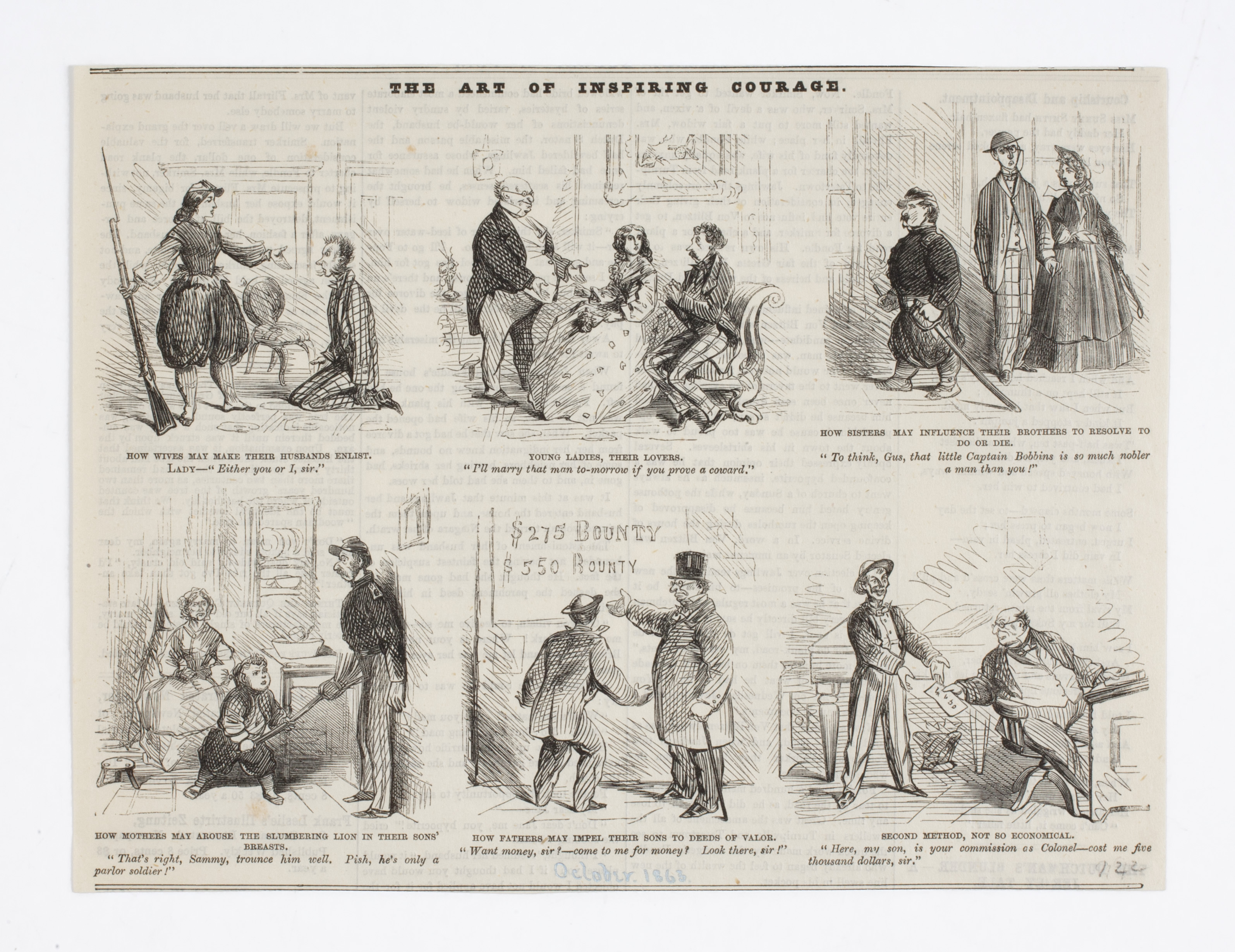
Newspapers printed gender-bending cartoons that drove the point home. In one, a musket-wielding woman dressed in trousers and a kepi looms over her cowering beau, insisting, “Either you or I, sir.” One Alabama schoolgirl spoke for many of her peers when she declared, “I would not marry a coward.” At balls and parties girls linked arms and sang, “I am Bound to be a Soldier’s Wife or Die an Old Maid.” One belle, upon hearing that her fiancé refused to enlist, sent her slave to deliver a package enclosing a note. The package contained a skirt and crinoline, and the note these terse words: “Wear these, or volunteer.” He volunteered.

A Winslow Homer drawing from 1865 showing a captain, who lost an arm, with his newly independent wife.

A Winslow Homer drawing from 1865 showing a captain, who lost an arm, with his newly independent wife.Credit Brooklyn Museum


In the sudden absence of husbands, fathers, brothers and beaus, white Southern women discovered a newfound freedom — one that simultaneously granted them more power in relationships and increased their likelihood of heartbreak. Gone were the traditions of antebellum courtships, where family connections and wealth were paramount and a closed circle of friends and neighbors scrutinized potential mates, a process that could last for years. The war’s disruptions forced elite Southern parents to loosen rules regarding chaperoning and coquetry, which one prominent lecturer called “an artful mixture of hypocrisy, fraud, treachery and falsehood” that risked tarnishing a girl’s reputation. The girls themselves relinquished the anticipation, instilled since birth, that they would one day assume their positions as wives, mothers and slave mistresses, that their lives would be steeped in every privilege and comfort. The war ultimately challenged not only long-held traditions of courtship and marriage, but the expectation that one might wed at all.

At least in cities where the Confederate Army established a base of operations, young women were overwhelmed by the number of prospective suitors. Thousands of men flocked to the Confederate capital of Richmond, prepared to work in one of the government departments or to train for duty in the Army. The Central Fair Grounds just west of the city were transformed into “Camp Lee,” where the new recruits set up tents and conducted military drills. “Between eight and ten thousand men went down Main St. this afternoon,” wrote a 16-year-old Richmond diarist. “It was very tantalizing to me to hear the drum and the cheering and to be able to see nothing but their bayonets and the tops of their heads. It is wicked in me to wish that I had gone out so that I might see them, and not to wish that I had gone to church, but I love the soldiers so much, that I forget almost everything else when I get to thinking about them.”

Troops marching through the capital blew kisses to the Richmond belles, who returned the attention with unprecedented abandon, waving handkerchiefs and tossing pocket Bibles and pincushions. In the antebellum years, new acquaintances required a formal letter of introduction, but the war allowed for association with complete strangers, men whose names they didn’t even know. The women took unchaperoned trips to Confederate campgrounds, going on horseback rides and picnics, allowing uniformed men to serenade them and plant lingering kisses on their hands — all activities once restricted to engaged couples. Even their style of banter changed, turning aggressive and overtly political, a rebellion against their old identities as genteel Southern ladies. “I confess myself a rebel, body and soul,” declared a Louisiana girl, adding, “Confess? I glory in it!” Union soldiers occupying Southern towns complained of “she-rebels” who spat at them and emptied the contents of chamber pots on their heads.

The relaxed wartime atmosphere led to increased physical intimacy, although in letters and diaries Southern women admitted only to flirting. Casual relationships, and even casual engagements — “slight, silly love affairs,” as one woman called them — flourished. Both women and men kept engagements secret, sometimes specifying that each was still free to see others. “Neither of us is to consider this engagement binding,” wrote a Georgia belle to her betrothed, a Confederate lieutenant. “If another is loved, no sense of honor will prevent our immediately letting the other know of it — so you are still at liberty to fall in love with whom you please, without considering me at all in the way.” One Georgia cavalryman predicted, “If we Stay heare much longer in about 9 months from now thare will be more little Gorgians [sic] a Squalling through this contry then you can Shake a Stick at.” Such liaisons could endanger elite women’s reputations and, in some cases, their lives. One Richmond woman, who became pregnant after an affair with a married Confederate officer, died as a result of complications from a self-induced abortion.

Southern women in rural areas grappled with entirely different concerns: the dearth of suitable men — or any men at all. By the summer of 1863, in New Bern, N. C., only 20 of the 250 white people remaining in town were men. The war was on its way to claiming one in five white Southern men of military age (leaving behind more than 70,000 widows), a situation that prompted frantic letters to the editor. “Having made up my mind not to be an old maid,” an 18-year-old Virginian wrote to the editor of the Southern Literary Messenger, “and having only a moderate fortune and less beauty, I fear I shall find it rather difficult to accomplish my wishes” (nevertheless she hopefully listed her skills, which included making brandy peaches and “throw[ing] socks in a corner”).

Widowed women in their 30s faced stiff competition for available men in their age group, and suffered constant reminders of their grim odds. The editor of the Petersburg (Va.) Daily Register took pity on older eligible women during the social season of 1864, helpfully warning them against using rouge. “Bachelors are a shy game,” he pointed out, “and when convinced of one deception imagine many more.” As if strategizing over how to thwart younger rivals wasn’t taxing enough, the widows were also national laughingstocks — punch lines to the endless “old maid” jokes that became a staple of American humor. If you were alive during the Civil War, chances are you heard the one about the schoolboy who threw a stone at a dog; he missed the pooch, but hit seven old maids.

As time passed and casualties mounted, some women grew resigned to the idea of life without a husband, while others compromised on acceptable partners. “One looks at a man so differently when you think he may be killed tomorrow,” one South Carolina woman mused. “Men whom up to this time I had thought dull and commonplace … seemed charming.” One in 13 soldiers returned home missing limbs, and the press, pulpit and politicians reminded Southern women that it was their patriotic duty to marry disabled veterans. The “limping soldier,” argued the president of the Confederacy, Jefferson Davis, should be treated as aristocracy after the war: “To the young ladies I would say when choosing between an empty sleeve and the man who had remained at home and grown rich, always take the empty sleeve.” There was, of course, a third option that some women took: the unspeakable faux pas of marrying a Yankee. A Nashville girl wrote her brother in the Confederate Army that the local belles were “dropping off into the arms of the ruthless invader.” One, a girl who carried a stiletto and threatened to emulate Charlotte Corday should the enemy invade her city, had “gone the way of all flesh and married an officer with that detestable eagle on his shoulder.”

Toward the end of the war, many Southern women who were widowed or had never married sustained themselves with female friendships (or “Boston marriages,” as they came to be called in the North). They proudly proclaimed their independence, asserting that they preferred the freedom of single life to the entanglements of marriage — a risky “lottery,” in the words of a Louisiana diarist, that subjected women to the “despotism of one man.” While they certainly mourned the deaths of male suitors — as they did the deaths of male relatives — they no longer considered spinsterhood a tragedy. “Clara … thinks we’ll all be old maids yet,” wrote a South Carolinian, recording a friend’s predictions. She added, “I don’t doubt it, neither do I care very much.”

By 1865, all Southern women — the happily and regrettably single, the perpetually engaged, the wives and widows — had tired of the war. The Confederacy was shrinking, and the morale of its remaining men shrinking with it. The Northern press ran a widely reprinted cartoon called “sowing” and “reaping,” chiding Southern women for “hounding their men on to Rebellion” and then complaining about its effects. The Union blockade had sent the cost of goods and food skyrocketing. They were starving; they feared the terrors of Yankee occupation; they had exhausted both their patriotism and their patience. “Oh my dear husband how shall I live without you?” wrote one Mississippi woman. “When will this cruel war end?” It was time, at last, for the surviving husbands, fathers, brothers and beaus to lay down their arms and come home.

Karen Abbott’s forthcoming book, “Liar, Temptress, Soldier, Spy: Four Women Undercover in the Civil War,” will be published in September. Her website is http://www.karenabbott.net.

SOURCES: Catherine Clinton, “Southern Families at War: Loyalty and Conflict in the Civil War South”; Lisa Tendrich Frank, “Women in the American Civil War”; Giselle Roberts, “The Confederate Belle”; Anya Jabour, “Scarlett’s Sisters: Young Women in the Old South”; David Andrew Silkenat, “Suicide, Divorce, and Debt in Civil War era North Carolina” (dissertation); Lacy K. Ford, “A Companion to the Civil War and Reconstruction”; Mary Elizabeth Massey, “Women in the Civil War”; Richard F. Selcer, “Civil War America, 1850-1875”; A. Wilson Greene, “Civil War Petersburg: Confederate City in the Crucible of War”; William C. David and Russ A. Pritchard, “Fighting Men of the Civil War”; Stephen W. Berry, “All That Makes a Man: Love and Ambition in the Civil War South” and “Weirding the War: Stories from the Civil War’s Ragged Edges”; Amy Murrell Taylor, “The Divided Family in Civil War America”; J. David Hacker, Libra Hilde, and James Holland Jones, “The Effect of the Civil War on Southern Marriage Patterns.”

Read Full Post »

Read Full Post »

The Two Legacies of Richard Nixon that Shaped the Modern Republican Party

HNN    August 17, 2014


The fortieth anniversary of Richard Nixon’s resignation from the presidency last week passed without much attention to the question of the former president’s historical significance and his role in the history of the modern Republican party. Twenty years after his death, it is apparent that Nixon shaped the political world in which we now live, and the last fifty years of the twentieth century are properly seen as The Age of Nixon. In race relations and the fundamental beliefs of the modern Republican party, Nixon was a more consequential historical figure than Ronald Reagan.

In the 1950s, Nixon was sympathetic to African-American aspirations and was someone who impressed Martin Luther King with his understanding of the civil rights impulse. The 1960 election changed all that as black voters helped put John Kennedy in the White House. Convinced that the election had been stolen from him, Nixon said of African-American support of Democrats, “it’s a bought vote and it isn’t bought by civil rights.” From there, even though his administration enforced civil rights laws, it was a short step to the Southern Strategy that turned the states of the Confederacy from Democratic to Republican over the next three decades.  Nixon, through aides like Pat Buchanan, reinforced the Republican commitment to white voters that underpins so much of the Republican opposition to President Obama.

As Nixon told a friend after the 1960 election, “we won, but they stole it from us.”  Contrary to the portrait of patriotic self-denial and deference to the election of John F. Kennedy that Nixon later proffered, he and the Republicans were quite prepared to contest Kennedy’s success until they knew there was no case that would withstand scrutiny. Yet the lesson that Nixon took away from 1960 was not that politics was like war, in which victory justifies all.

In that insight lay the roots of Watergate. Presidents could not, in Nixon’s mind commit illegal acts. Faced with a Democratic Party whose tactics impaired its dubious legitimacy, the Republicans should stop at nothing to achieve and maintain power. Entering the White House in January 1969, Nixon saw himself surrounded by enemies bent on his political annihilation. It was only right in such a dangerous political environment to meet fire with fire, criminality with criminality, dirty tricks with similar tactics.

The Watergate generation saw in Nixon’s methods violations of the Constitution that led to his resignation. But in time the assumption grew among Republicans that Nixon had been right all along. Nixon might believe that Democrats had more fun than Republicans did, and for a time he toyed with the idea of a new political party. In that he emulated Dwight D. Eisenhower and Modern Republicanism. Yet in his heart of hearts Nixon believed that the Democrats were the Other in American politics, a criminal enterprise that abused the rules of partisan behavior for selfish ends. They did not deserve fair play, which was only for suckers in public life.

The lesson stuck. Watergate had not been a moment of constitutional truth. Impeachment was a tactic that Republicans could deploy, first against Bill Clinton, and now against President Obama. Nixon taught that only Republicans had a true commitment to American values and therefore the only viable and defensive claim on fundamental legitimacy in American life. In the universe of Richard Nixon, only the winning side had the luxury of moral values. Commitment to democratic practices was only a sham that the true political sophisticates adhered to only at their peril. His disciples abound. They restrict voting of minorities, they filibuster everything, they gerrymander with abandon, they deny medical care even though people die as a result.

Nixon famously invoked a sign he had seen while campaigning, “Bring us together,” it read. It made for good rhetoric, but in his career he was the architect of two policies that are still tearing the country apart. His belief that politics is actually war demands perpetual battle with unconditional surrender as the only sensible goal at hand, whereas his fealty to the southern strategy, which dictates the exclusion of fast-growing minorities, questions the very survivability of his own party. These are the dilemmas that the United States now contemplates as it ponders the legacy of Richard Milhous Nixon.

Lewis L. Gould, visiting distinguished professor at Monmouth College, is the author of «The Republicans: A History of the Grand Old Party,» which the Oxford University Press will publish next month.

Read Full Post »

This Was One of the Little-Recognized Causes of the Civil War 

HNN  August 17, 2014

I remember reading many years ago W. E. B. Du Bois’s complaint that Americans knew far too little of the decisive role blacks played in winning their freedom.  He pointed specifically to a biography of Ulysses S. Grant in which the author, W. E. Woodward, wrote of African Americans as “the only people in the history of the world . . . that ever became free without any effort of their own. . . . They twanged banjos around the railroad stations, sang melodious spirituals, and believed that some Yankee would soon come along and give each of them forty acres of land and a mule.”  I was in graduate school at the time and congratulated myself on knowing better – that blacks had served in the Union army.  But that was about all I knew of it. As the proud holder of a college degree in history, I thought that was just about all I needed to know.  There are none so ignorant as the educated ignorant.

Some historians still downplay the wider role of blacks in bringing on freedom, preferring to emphasize Abraham Lincoln’s role as the Great Emancipator.  Historian James McPherson, a leading defender of Lincoln’s Great Emancipator image, argues in Drawn with the Sword: Reflections on the American Civil War (1996) that without Lincoln there would have been no war and, hence, no opportunity for freedom. With regard to emancipation, it was Lincoln’s determination that was “the essential condition, the one thing without which it would not have happened.” Without Lincoln, there would have been no Emancipation Proclamation and no Thirteenth Amendment. Therefore, says McPherson, “Lincoln freed the slaves.”

Arguments such as those of McPherson and others have some validity as far as they go. To my knowledge, no reputable scholar denies that Lincoln and the Union military played a significant part in the emancipation process. But following their lines of reasoning more deeply, we cannot help but see the efforts of black folk at their core.

Lincoln’s effort to preserve the Union was, of course, a reaction to the South’s secession, a movement engineered by slaveholders who feared not only Lincoln but, more immediately, their own slaves. Controlling slaves had been increasingly difficult for years. It could only be more difficult, perhaps impossible, with slaves believing that Lincoln’s election meant their freedom. How could they believe otherwise? Though Lincoln was no threat to slavery where it existed, and said so often during the 1860 presidential campaign, fire-eating secessionists railed against him as a radical abolitionist with a secret agenda to foment slave rebellion. Such overheated rhetoric was intended to stir up support for secession among southern whites, but southern blacks heard the message too. Rebellion and rumors of rebellion pervaded the South that year and drove slaveholder fears to a fever pitch. Most significantly, underlying their fear was the certain knowledge that slaves wanted freedom. It was that fear, born of generations of slave resistance, that led to secession, war, and slavery’s downfall.

Slaveholders’ doubts about their ability to maintain slavery indefinitely had a long history. The need to justify slavery had for decades occupied their brightest minds. The need to keep southern whites, three-quarters of whom owned no slaves, supporting slavery made fomenting fear of blacks a political priority.  Most threatening to slaveholders were the slaves themselves. Blacks had never submitted to slavery willingly or completely. They did little more than they had to do and took liberties where they could. They resisted in so many ways that the slaveholders’ need to exercise control was constant and consuming.  Had blacks been content to remain enslaved, slaveholders would have had no cause for alarm. Nor would abolitionist arguments have inspired such panic among them. As it was, slaveholder fears of threats to slavery, as much from within as from without, led them to insist on guarantees for slavery’s future and the means to control that future. And that fear led them to secede when those guarantees and their means of control seemed at risk. As Professor John Ashworth reminds us inSlavery, Capitalism and Politics in the Antebellum Republic (1995), there was a direct causal link between the slaves’ desire for freedom and slaveholder politics. “Behind every event in the history of the sectional controversy,” Ashworth points out, “lurked the consequences of black resistance to slavery.”

That resistance was not confined to the South. Escaping slaves saw to that. By the tens of thousands they headed north, undermining northern efforts to keep the slave’s war south of the Mason-Dixon Line. In so doing, as Professor Scott Hancock stresses in “Crossing Freedom’s Fault Line” (Civil War History, 2013), black folk “maintained an unrelenting pressure on the sectional fault lines of identity, law, and space.” That pressure produced large cracks in those fault lines and increasingly drew northerners into the conflict. Time and again, northern failures to keep blacks and slavery locked in the South put them at odds with slaveholders’ expansionist demands. Hancock concludes, and rightly so, that “not simply slavery, but slaves – black people! – caused the Civil War.”

It was, then, at the heart of it all, the unrelenting resistance to slavery among slaves themselves that was the essential condition, the one thing without which the sectional crisis, secession, the Civil War, the Emancipation Proclamation, and the Thirteenth Amendment would not have happened.

Of course, it did not happen overnight. For more than two centuries before the Civil War, millions of African Americans lived in bondage all their lives. But it was a resisted bondage, an ongoing struggle, that would eventually reach its consummation. The internal pressures against slavery – rebellion, resistance, escape – were always there and became ever greater as slavery spread. Slaveholders clamped down with more slave codes, more slave patrols, and increasingly brutal control. But the more they tried to tighten their grip on slaves, the more slaves slipped through their fingers. By the late 1850s there were an estimated fifty thousand escapees annually, temporary and permanent. Such resistance fueled a desperation reflected in slaveholder politics and the secession crisis. The resulting war was neither an isolated event nor an end point in itself.  It was part of a massive black resistance movement that had been going on for generations, finally becoming so intense that the country as a whole could hardly help being drawn into it.

Even so, in an effort to avoid war, Congress passed, and Lincoln supported, a constitutional amendment, the Corwin Amendment, that would have guaranteed slavery in the slave states forever.  In the war’s early months, both Congress and Lincoln insisted that the conflict was a white man’s war in which blacks could have no part. But black folk knew the war was theirs and quickly took ownership of it.  Black resistance largely brought on the war, then pressed Lincoln in the direction he eventually went.  By escaping in the tens of thousands and making freedom a fact, blacks forced Lincoln to recognize that fact with the Emancipation Proclamation. They made the document their own, and made it much more that it was.  In the upper South, where the Proclamation did not apply, blacks claimed freedom anyway.  In the lower South, they made freedom real by aiding escaping slaves, serving the Union army as guides and spies, assisting Confederate deserters and armed deserter gangs, giving aid to escaping Union prisoners, resisting abuse, and engaging in open rebellion.  They established freedom for themselves by traveling at will, threatening escape to secure wages, and even claiming land and property when they could.  Still, most Americans today seem to assume that Lincoln, almost single-handedly and of his own volition, “freed the slaves.”  Certainly most students coming into my freshman U.S. history course assume that to be the case, which is in large part what prompted me to write my book, I Freed Myself.

In the war’s aftermath, although whites willfully ignored the wartime role of blacks, memories of self-emancipation efforts remained clear in the minds of black folk.  One day a candidate for local office in Illinois asked Duncan Winslow, a former slave and Union veteran, for his vote in an upcoming election. As if to seal the deal, the candidate told Winslow, “Don’t forget. We freed you people.” In response, Winslow raised his wounded arm and said, “See this? Looks to me like I freed myself.”  Blacks would go on freeing themselves for generations to come.

David Williams is a professor of history at Valdosta State University and the author of the, “I Freed Myself: African American Self-Emancipation in the Civil War Era” (Cambridge University Press, 2014).

Read Full Post »

Read Full Post »

« Newer Posts - Older Posts »