Why Lee Harvey Oswald Pulled the Trigger
by Steven M. Gillon
HNN November 20, 2013
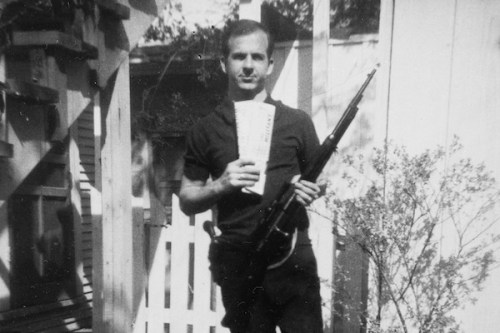
Image via Wiki Commons.
It has been fifty years since that tragic day in Dallas, but Americans remain fascinated with both the details of John F. Kennedy’s assassination and its meaning. This year will see the publication of nearly a dozen new books, and a flood of reprints, as the assassination cottage industry shifts into high gear. A number of television networks have produced documentary specials devoted to the assassination.
The question that is appropriate to ask at this point is: Is there really anything new to learn? While writing my new book, Lee Harvey Oswald: 48 Hours to Live, I went back to the standard narrative of that day — the Warren Commission. How well does it hold up in light of five decades of attacks?
In September 1964, The President’s Commission on the Assassination of President Kennedy, popularly known as the Warren Commission, concluded that Lee Harvey Oswald, acting alone, had fired three bullets from the sixth floor of the school book depository building.
The Warren Commission initially received a warm reception. Before the release of the report, a Gallup poll found that only 29 percent of Americans thought Oswald acted alone, while 52 percent believed in some kind of conspiracy. A few months after the release of the report, 87 percent of respondents believed Oswald shot the president.
Over the next few years however, critics turned public opinion against the report. In 1966, Mark Lane published his best-seller Rush to Judgment. Later that year, a New Orleans district attorney, Jim Garrison, launched a highly publicized, but deeply flawed, investigation of his own which purported to reveal a vast conspiracy. At the same time Life Magazine published color reproductions of the Zapruder film under the cover: «Did Oswald Act Alone? A Matter of Reasonable Doubt.» The editors questioned the Commission’s conclusions and called for a new investigation.
Most of these early skeptics used the Warren Commission’s own evidence against it. They focused on contradictions among some of the witnesses about the number of shots and from where they were fired. Some witnesses claim they heard gunfire from the grassy knoll, an elevated area to the front, right of the presidential limousine. A favorite topic was the so-called «magic bullet.» According to the Warren Commission, Oswald fired three shots in less than eight seconds: the first shot missed, the second shot struck Kennedy in the back, exited through his throat, and then hit Governor Connally, breaking a rib, shattering his wrist, and ending up in his thigh. Critics claimed the bullet, which remained largely intact, could not have been responsible for all of the damage. Also, if Connally and Kennedy were hit by different bullets in a fraction of a second, then it meant there had to be another shooter.
The most serious threat to the Commission’s credibility, however, came not from the army of investigative reporters and self-styled assassination experts, but from new government investigations.
In 1975 the Senate Select Committee on Intelligence headed by Idaho’s Frank Church, revealed that American intelligence agencies had systematically hidden important evidence from the Warren Commission. Both the FBI and the CIA had lied by omission to the Warren Commission. One prominent senator told a television audience that «the [Warren] report… has collapsed like a house of cards.»
These revelations led to the creation of the House Select Committee on Assassinations (HSCA). In December 1978, after two years of work, the committee was prepared to issue a report that supported all the major conclusions of the Warren Commission. It found no evidence of a conspiracy. No second shooter. But in the final weeks the committee changed its opinion and concluded that although Oswald was the assassin, there was a conspiracy involving a second gunman.
The committee relied on the highly questionable, and now discredited, acoustical analysis of a police dictabelt recording from Dallas police headquarters. It contained sounds from a police motorcycle in Dealey Plaza whose radio transmitting switch was stuck in the «on» position. Two acoustics experts said there was a 95 percent certainty that the recording revealed that four shots had been fired at the presidential motorcade. As a result the House Committee came to the bizarre conclusion that a second shooter fired at the president but missed.
Coming in the wake of Vietnam and Watergate, the HSCA report added to public cynicism about the Warren Commission conclusions. At just the time that Americans were learning that the government lied to them about Vietnam and Watergate, they now discovered it had lied about aspects of the assassination of President Kennedy. If the CIA and the FBI had lied to the Commission, the reasoning went, then they clearly had something to hide.
There were now two conspiracies: The conspiracy to assassinate the President and, potentially, an even larger and more insidious plot among powerful figures in government and the media to cover it up.
In 1991, filmmaker Oliver Stone tapped into these doubts, and added his own paranoid twist, to create the wildly popular movie JFK. The film portrayed an elaborate web of conspiracy involving Vice President Johnson, the FBI, the CIA, the Pentagon, the KGB, pro-Castro and anti-Castro forces, defense contractors, and assorted other officials and agencies. The movie makes it seem that First Lady Jackie Kennedy was the only person in Dealey Plaza that day who was not planning to murder the president.
The movie ended with a plea for audience members to ask Congress to open up all Kennedy assassination records. The plea worked. In 1992, Congress passed a sweeping law that placed all remaining government documents pertaining to the assassination in a special category and loosened the normal classification guidelines. The legislation led to the most ambitious declassification effort in American history — more than five million documents in total.
What we have learned from the new government investigations and from the flood of declassified documents is that Warren Commission got it mostly right. There have been no shocking revelations to challenge the conclusion that Lee Harvey Oswald acted alone. Moreover, there has emerged no convincing alternative explanation of what took place in Dallas on November 22, 1963.
Yet the new information does highlighted one major flaw with the Warren Commission: its failure to present a convincing explanation for why Lee Harvey Oswald shot JFK. Much of the final commission report represented an indictment of Oswald. It failed to ascribe a single motive, but it made a strong case that Oswald was little more than a disaffected sociopath who was in desperate need of attention. It spent a great deal of effort showing how the events in his childhood – growing up without a father, feeling isolated, moving often, and dealing with an overbearing mother – turned him into an angry, embittered sociopath.
Many of the new documents and information, while fragmentary and often contradictory, reveal that Oswald was driven as much by ideology as he was by personal demons. None of the information reveals a conspiracy, or proves the involvement of any outside group, but it does reinforce a possible political motive to the assassination, highlighting that Oswald was driven by a desire to prove his fidelity to the Cuban Revolution, gain Castro’s respect, and possibly travel to Cuba as a conquering hero. In his fantasy world, Oswald probably assumed that he would be welcomed in Cuba as the man who killed the American devil, not appreciating that neither Castro nor the Soviets would wish to incur the wrath of the United States by harboring JFK’s assassin.
Why did the Warren Commission fail to highlight Oswald’s political motives? Cold War fears likely chilled the Commission’s desire to place too much emphasis on Oswald’s pro-Castro activities. The Commission knew a great deal about Oswald’s politics: his early embrace of Marxism, his defection to the Soviet Union, his involvement in pro-Castro groups in New Orleans, and his attempted assassination of right-wing retired general Edwin Walker a few months before he killed JFK. It pointed out that while he was being interrogated Oswald asked to be represented by a lawyer, John Apt, who represented many Communist party figures. It mentioned that Oswald had traveled to Mexico City where he shuttled back and forth between the Soviet embassy and the Cuban consulate in search of a visa. Yet it refused to connect the dots.
More importantly, the Commission lacked the proper context for evaluating Oswald’s motives because it was denied relevant intelligence information. Recently declassified document reveal that American intelligence agencies had kept close tabs on Oswald in the months before the shot JFK. The CIA took pictures of Oswald outside the Soviet embassy and even recorded his phone calls. But none of this evidence was turned over to the Commission, and all of it was later destroyed. The Commission, for example, never saw a memo prepared by J. Edgar Hoover that reported that Oswald had threaten to kill JFK during his trip to Mexico City just three weeks before the assassination.
In the most important omission, the CIA refused to provide the Commission with any of the information related to its activities in Cuba, including proposed assassination plots against Castro. Attorney General Robert Kennedy, who oversaw the administration’s anti-Castro campaign, deliberately misled the Commission, denying that he was aware of any relevant information.
The final Commission report states, without any supporting evidence, that Oswald became disillusioned with Castro and Cuba after he was denied a visa to enter that country in late September. There is tantalizing evidence that just the opposite is true: As the Hoover memo suggests, it is more likely that Oswald killed Kennedy in order to convince Cuban authorities to accept his petition for a visa.
If the Commission had known about the administration’s covert campaign against Castro it would have seen Oswald’s pro-Castro actions in a new light, and could have investigated further some of his actions and associations.
The new more complicated portrait of Oswald does not change the fact that he pulled the trigger, but it does muddy the waters about why. Since he was killed before he confessed or was placed on trial we will never know for sure. Unfortunately, the Warren Commission’s incomplete portrait of Oswald and his motives has fed the conspiracy frenzy and served to undermine public faith in its lone-gunman theory.
Steven M. Gillon is the Scholar-in-Residence at The History Channel and professor of history at the University of Oklahoma. He is the author of Lee Harvey Oswald: 48 Hours to Live.
Read Full Post »




 El Imperio de Calibán