Feeds:
Entradas
Comentarios

Posts Tagged ‘Brown v. Board of Education’

Para conmemorar el mes de la historia afromericana, la página Catalog de los National Archives, publica este análisis de algunos casos judiciales relacionados a la lucha de los negros estadounidenses por la  igualdad y la protección de la ley. Algunos de los casos son famosos como Plessy v. Ferguson (1896) que “legalizó” la segregación racial en Estados Unidos, otros son menos conocidos, pero no por ello menos importantes en la larga lucha de los afroamericanos contra el racismo y la discriminación racial.

El objetivo de esta nota es evidenciar e ilustrar cómo los afroamericanos usaron el sistema judicial de su país como herramienta en la batalla por los derechos civiles.
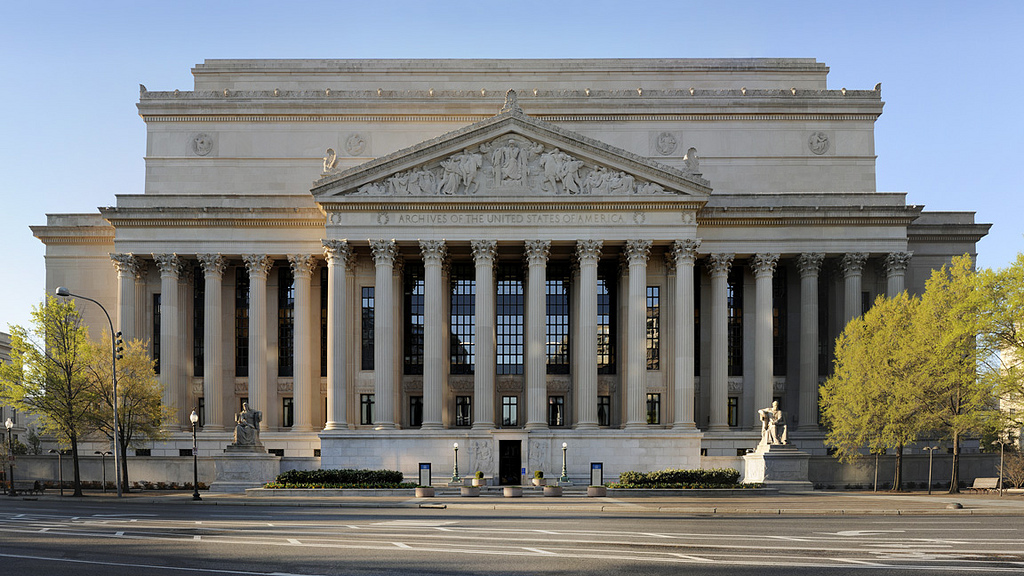
The National Archives in Washington, DC | National Archives

Inclinándose hacia la justicia: Derechos civiles en los tribunales federales

Catalog    7 de febrero de 2024

En honor al Mes de la Historia Afroamericana, echamos un vistazo a cómo los afroamericanos han utilizado históricamente el sistema judicial en busca de la igualdad de derechos. Estos casos abarcan la historia de los Estados Unidos, comenzando mucho antes de la Era de los Derechos Civiles de mediados del siglo XX. El Catálogo de los Archivos Nacionales incluye casos que llegaron a la Corte Suprema, como  Scott v. Sandford en 1857, Plessy v. Ferguson en 1896 y Brown v. Board of Education en 1954. Estos casos históricos y otros menos conocidos ilustran cómo el poder judicial ha sido durante mucho tiempo un campo de batalla central en la lucha por los derechos civiles.


Hay muchos otros casos relacionados con los derechos civiles dentro de los Tribunales de Distrito y de Circuito de los Estados Unidos que están en manos de las National Archives Field Facilities. Puede que no todos tengan la misma fama (o infamia) que algunos de los casos más citados, pero estos ejemplos  de los National Archives Chicago ponen de relieve cómo los activistas negros han utilizado los sistemas judiciales para luchar contra las leyes y políticas racistas en Estados Unidos. A menudo hay una línea intermedia entre estos registros judiciales, lo que ejemplifica cómo el progreso no siempre es lineal. El Dr. Martin Luther King Jr. dijo: “el arco del universo moral es largo, pero se inclina hacia la justicia”.  Estos casos también pueden mostrar cómo los casos bien estudiados encajan en una imagen más amplia de ese arco.


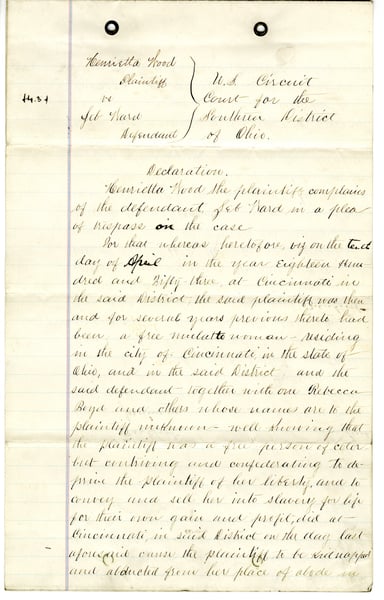
Henrietta Wood vs. Zeb Ward, Declaration

Henrietta Wood vs. Zeb Ward, Declaración, Identificador de los Archivos Nacionales 148721411

La decisión de la Corte Suprema de 1857 en el caso Dred Scott declaró que las personas de ascendencia africana no eran ciudadanos de los Estados Unidos y, por lo tanto, no podían esperar ninguna protección del gobierno federal o de los tribunales. Menos de 15 años después, en 1871, una mujer anteriormente esclavizada llamada Henrietta Wood presentó una demanda civil para obtener reparaciones y ganó. Wood vivía como una mujer libre en Cincinnati en 1853 cuando Zeb Ward, en connivencia con los antiguos esclavistas de Wood, la secuestró y la llevó a Kentucky.  Como dice el caso, “la demandante ha sido privada de su tiempo y del valor de su trabajo por el espacio de quince años y obligada a trabajar para dicho demandado… que ha sido reducida a la esclavitud y tratada como esclava todo ese tiempo y sometida a grandes dificultades, abusos y opresión, y a causa de dicho traslado injusto al estado de Mississippi y Texas, y su dicha coacción y encarcelamiento allí, se le impidió regresar a su hogar en Cincinnati hasta el mes de abril del año mil ochocientos sesenta y siete”. Fue un caso largo, pero en abril de 1878 el jurado emitió un veredicto a favor de Wood y le otorgó $ 2500 en daños y perjuicios. Ver el caso completo en el Catálogo: Henrietta Wood vs. Stone Ward. Leer más sobre Dred Scott v. Sandford en DocsTeach (en inglés).


Eva V. Gazaway by John W. Gazaway, her next friend vs. William J. WhiteEva V. Gazaway por John W. Gazaway, su próximo amigo vs. William J. White, página 46, Identificador de los Archivos Nacionales 312294066


En 1881, setenta y siete años antes de que Oliver Brown demandara a la Junta de Educación de Topeka, un padre de familia de Springfield, Ohio, intentó utilizar el tribunal para forzar la integración de las escuelas públicas de Springfield. John W. Gazaway, que era reverendo en Springfield, demandó al superintendente William White en nombre de su hija Eva, de ocho años, para que se le permitiera asistir a la escuela pública de Shaffer Street, que estaba mucho más cerca de donde vivían que cualquiera de las escuelas designadas para niños negros. Al igual que en el caso de Brown v. Junta de Educación, la demanda de Gazaway fue un esfuerzo deliberado de los activistas para poner fin a la segregación. En noviembre de 1882, un jurado falló a favor del superintendente, y las escuelas de Springfield permanecieron segregadas. Vea el caso del Tribunal de Circuito de los Estados Unidos en Cincinnati aquí Eva V. Gazaway por John W. Gazaway, su próximo amigo vs. William J. White.


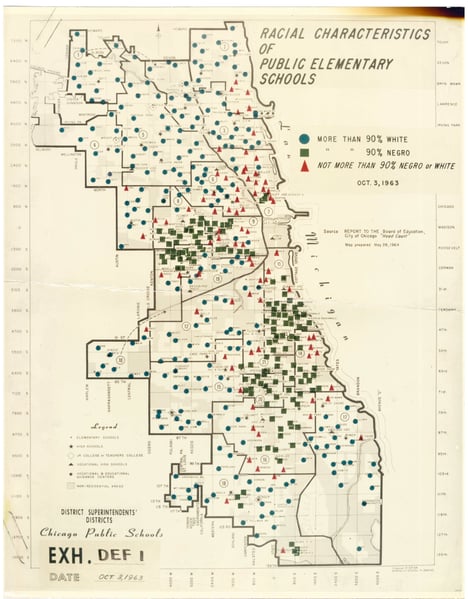
Exhibit, Racial Characteristics of Public Elementary Schools

Exhibit, Racial Characteristics of Public Elementary Schools, National Archives Identifier 12008848

Este y otros casos, como el de James H. Vines et al. v. James Cruse et al, ejemplifican cómo los éxitos del Movimiento por los Derechos Civiles se basaron en décadas de trabajo activista. Y la decisión en el caso Brown v. Board of Ed no marcó el final de este trabajo, como se muestra en casos como James William Webb, Jr. et al. v. The City of Chicago Board of Education and Benjamin Willis, que buscaron poner fin a la segregación en el sistema de escuelas públicas de Chicago en la década de 1960.

Estos son solo algunos de los casos que se han presentado. Existen muchos más casos de derechos civiles en el Catálogo de los Archivos Nacionales de nuestras instalaciones en todo el país, y hay aún más que se pueden encontrar que aún no han sido identificados o digitalizados. Si está interesado en este tema, puede buscar en  el catálogo o comunicarse con nuestro personal de referencia utilizando el  formulario Contáctenos.  Seleccione Investigación y, a continuación, Casos judiciales


¿Dónde se encuentran los registros?

Los registros de los tribunales de circuito y distrito de los Estados Unidos  son mantenidos por las instalaciones regionales de los National Archives que manejan ese estado.

Más información

  • Los National Archives no tienen una lista maestra nacional de expedientes de casos por nombre, tipo o contenido. Los registros están organizados secuencialmente por número de expediente, no por el tipo de demanda civil.
  • Dependiendo del tipo de tribunal federal y de la fecha del caso, puede haber índices y expedientes disponibles para ayudar a localizar un expediente judicial en particular. Busque los archivos de casos digitalizados en el  Catalog of the National Archives ingresando los nombres de las partes del caso y/o las variaciones de nombres.
  • Si la búsqueda no tiene éxito, determine dónde se habría presentado el caso (por ejemplo, “U.S. District Court for the Central Division of California” o “U.S. Court of Appeals for the Eighth Circuit”). Usando la ubicación de la corte, comuníquese con la instalación indicada en la guía donde se encuentran los registros para obtener más ayuda.
  • Para obtener más informacción se puede visitar el History Hub blog  Indexes of Case Files Created by Federal Courts: Introduction (Part 1 of 3), Indexes of Records Created by Federal Courts: Examples of Indexes (Part 2 of 3), and Indexes of Case Files Created by Federal Courts: Digitized and Digitale Indexess (Parte 3 de 3). Revise esta información antes de intentar solicitar registros en línea.

¿Le gustaría leer sobre más casos de Derechos Civiles?  Echa un vistazo a una versión extendida en History Hub.


Traducción: Norberto Barreto Velázquez


Read Full Post »

Getting Right with Brown

Brown vs Board team

Brown v. Board team.(Photo: NAACP Legal Defense

For over sixty years, no matter where you stand on the constitutional spectrum, you have had to get right with Brown v. Board of Education. Decided sixty-one years ago this coming May 17, Brown is one of the best-known decisions of the U.S. Supreme Court, one of the Court’s most beloved – or at least well-regarded – decisions, and a key juncture in the development of American constitutional law.

There are several reasons why Brown should matter that much.

First, Brown was a watershed decision by the Supreme Court, putting an end, at least on paper, to nearly sixty years of “separate but equal” as a constitutional rule governing access to public facilities and accommodations. Ever since the 1896 Plessy v. Ferguson decision, in which the Court established the “separate but equal” rule as a guide to interpreting the Fourteenth Amendment’s equal protection clause, a central goal of the NAACP’s Legal Defense Fund (usually called the “Inc Fund”) was to end “separate but equal.” For years, Thurgood Marshall led the Inc Fund in combating “separate but equal” by applying legal ju-jitsu to the rule: if facilities were not equal, they could not be separate. If they were unequal and the state insisted on separation, the state had to create a whole new facility equal to the segregated facility for African-Americans to use. Thus, in a lawsuit requiring the University of Oklahoma to integrate its law school, the Court held that a roped-off desk in the Oklahoma Supreme Court’s library was not an equal law school for the African-American who had been admitted to the University of Oklahoma’s law school. Either the state had to create a new law school matching the existing one lecture-hall for lecture-hall, library for library, moot-court society for moot-court society, brick for brick, or it had to integrate its existing law school and admit the black student. Thurgood Marshall had tired of this incremental game, realizing that segregationists would apply legal ingenuity to create new ways of segregating so that the Inc Fund would have to fight each one, step by step. Thus, Marshall concluded, it was time to “go for the whole hog” and mount a head-on attack on segregation as inherently unequal.

Second, Brown was a triumph for public-interest lawyering. Marshall and his colleagues at the Inc Fund had won, at least on paper, an epochal victory for equality before the law. It would encourage lawyers taking on many other kinds of cases – for women’s equality, for equality of gays and lesbians, to name just two categories – and to use American constitutional law as an instrument of reform. In particular, when political processes were unresponsive to the growing demand for embracing racial equality, lawsuits seeking judicial action would prove to be an effective and versatile tool of forcing social change.

Third, Brown was a test of the Supreme Court and the lower federal courts. It opened the door for a generation of litigation and appeals focusing on defining what the commands of the original Brown decision meant and should mean.Brown launched an era of judicial intervention in school governance, in public accommodations, and in other areas of law. The courts would superintend the ways that an entire society treated the black and white races. No longer could discrimination continue in schools or in other forms of public accommodations, without having to meet the scrutiny of courts and judges using the equal-protection clause as a yardstick.

Fourth, Brown was a test of the Constitution itself, and of ways to interpret it. The debate sparked by Brown (and the line of cases following and developing its holdings) focused on the Court’s interpretation of the Fourteenth Amendment and its history. The Court had decided that the passing of time and the evolution of values might render a rule of constitutional interpretation no longer valid. Scholars debated whether the Court had overreached in deciding Brown as it had. Some emphasized the need for “neutral principles” of constitutional law as the only sound basis for sweeping constitutional change via courts – and disputed whether Brown was based on such principles. Some emphasized the need for judicial prudence and self-restraint in exercising judicial review – and disputed whether Brown had been consistent with or in gross violation of such judicial prudence and self-restraint. Some insisted that the Court had to be bound by the original intent of the framers of the Fourteenth Amendment, while others argued that an originalist methodology of constitutional interpretation needlessly froze the Constitution as of 1868. Many disputes still roiling the waters of American constitutional jurisprudence can trace their roots to the dispute over Brown.

At the same time, a fifth significance of Brown is that the decision found surprisingly swift acceptance by many Americans as just, symbolizing the Court’s role in American life as distilled by the inscription over the front door of the Supreme Court Building: EQUAL JUSTICE UNDER LAW. The decision signaled a major shift in public opinion about how the nation ought to treat African-Americans and a major public reconceptualization of the Court itself, one that to some degree is still with us. One source of the anger that many Americans feel against the Supreme Court’s recent decisions on gun rights and campaign finance is the disparity that they see between such decisions and what the Court achieved in Brown.

On May 17, 1954, the announcement of the Court’s unanimous decision of Brown v. Board of Education set off a constitutional earthquake that shook all of American society and law. That earthquake still reverberates among us, as it enters its seventh decade – and we all should remember it.

About the Author

R. B. Bernstein

R. B. Bernstein teaches at City College of New York’s Colin Powell School and New York Law School; his books includeThomas Jefferson (2003), The Founding Fathers Reconsidered (2009), the forthcoming The Education of John Adams, and the forthcoming The Founding Fathers: A Very Short Introduction, all from Oxford University Press.

Read Full Post »

logo

The Civil Rights Project    May 15, 2014

Segregation Increases after Desegregation Plans Terminated by Supreme Court

LOS ANGELES: Marking the 60th anniversary of the landmark U.S. Supreme Court decision Brown v Board of Education, UCLA’s Civil Rights Project/Proyecto Derechos Civiles (CRP) assessed the nation’s progress in addressing school segregation in it’s new report released today, Brown at 60: Great Progress, a Long Retreat and an Uncertain Future, and found that the vast transformation of the nation’s school population since the civil rights era includes an almost 30% drop in white students and close to quintupling of Latino students.

Brown at 60 shows that the nation’s two largest regions, the South and West, now have a majority of what were called “minority” students. Whites are only the second largest group in the West. The South, always the home of most black students, now has more Latinos than blacks and is a profoundly tri-racial region.

The Brown decision in 1954 challenged the legitimacy of the entire «separate but equal» educational system of the South, and initiated strides toward racial and social equality in schools across the nation. Desegregation progress was very substantial for Southern blacks, in particular, says the report, and occurred from the mid-1960s to the late l980s.

The authors state that, contrary to many claims, the South has not gone back to the level of segregation beforeBrown. It has, however, lost all of the additional progress made after l967, but is still the least segregated region for black students.

Since the 1990s, the Supreme Court has fundamentally changed desegregation law, states the report, and many major desegregation plans have ended. CRP’s statistical analysis shows that segregation increased substantially after desegregation plans were terminated in many large districts including Charlotte, NC; Pinellas County, FL; and Henrico County, VA.

«Brown was a major accomplishment and we should rightfully be proud. But a real celebration should also involve thinking seriously about why the country has turned away from the goal of Brown and accepted deepening polarization and inequality in our schools,” said Gary Orfield, co-author of the study and co-director of the Civil Rights Project. “It is time to stop celebrating a version of history that ignores our last quarter century of retreat and begin to make new history by finding ways to apply the vision of Brown in a transformed, multiracial society in another century.”

This new research affirms that the growth of segregation coincides with the demographic surge in the Latino population. Segregation has been most dramatic for Latino students, particularly in the West, where there was substantial integration in the l960s but segregation has soared since.

The report stresses that segregation occurs simultaneously across race and poverty. The report details a half-century of desegregation research showing the major costs of segregation, particularly for students of color and poor students, and, conversely, the variety of benefits offered by schools with student enrollment of all races.

Among the key findings of the research are:

  • Black and Latino students are an increasingly large percentage of suburban enrollment, particularly in larger metropolitan areas, and are moving to schools with relatively few white students.
  • Segregation for blacks is the highest in the Northeast, a region with extremely high district fragmentation.
  • Latinos are now significantly more segregated than blacks in suburban America.
  • Black and Latino students tend to be in schools with a substantial majority of poor children, while white and Asian students typically attend middle class schools.
  • Segregation is by far the most serious in the central cities of the largest metropolitan areas; the states of New York, Illinois and California are the top three worst for isolating black students.
  • California is the state in which Latino students are most segregated.

The report concludes with recommendations about how the nation might pursue making the promise of Brown a reality in the 21st century–providing equal opportunity to all students regardless of race or economic background.

“Desegregation is not a panacea and it is not feasible in some situations,” said co-author Erica Frankenberg, assistant professor at Pennsylvania State University. “Where it is possible–and it still is possible in many areas–desegregation properly implemented can make a very real contribution to equalizing educational opportunities and preparing young Americans to live, work and govern together in our extremely diverse society.”

Brown at 60 is being released from New York University’s Metropolitan Center for Research on Equity and the Transformation of Schools, where Orfield delivers the keynote address, on Friday, May 16, 2014, for Brown 60 and Beyond. The report includes various tables showing segregation state-by-state and can be found here.

Related Documents


About the Civil Rights Project at UCLA

Founded in 1996 by former Harvard professors Gary Orfield and Christopher Edley, Jr., The Civil Rights Project/Proyecto Derechos Civiles is now co-directed by Orfield and Patricia Gándara, professors at UCLA. Its mission is to create a new generation of research in social science and law on the critical issues of civil rights and equal opportunity for racial and ethnic groups in the United States. It has monitored the success of American schools in equalizing opportunity and has been the authoritative source of segregation statistics. CRP has commissioned more than 400 studies, published more than 15 books and issued numerous reports from authors at universities and research centers across the country. The U.S. Supreme Court, in its 2003 Grutter v. Bollingerdecision upholding affirmative action, and in Justice Breyer’s dissent (joined by three other Justices) to its 2007Parents Involved decision, cited the Civil Rights Project’s research.


Read Full Post »

Brown v. Board of Education

HNN

The Warren Court (1953)

This page lists articles that put into historical perspective the changes wrought by the Supreme Court decision Brown v. Board of Education (1954). Click here to read the Brown decision.

Commentary on Recent Supreme Court Decisions Involving Brown

History

  • Bonnie Goodman Interview with Michael J. Klarman, Winner of the 2005 Bancroft Prize
  • Christopher W. Schmidt The Delusions Behind the Brown Decision
  • Ian Haney Lopez The Supreme Court Case that Got Right What Brown Got Wrong
  • Kansas State Historical Association«Brown v. Board of Education: The Case of the Century»–The Kansas Bar Association created a 70-minute video,»Brown v. Board of Education of Topeka: The Case of the Century,» and related teaching materials as a project for the 50th anniversary of the landmark decision. The video features a reenactment of the 1952 and 1953 oral arguments presented to the U. S. Supreme Court. The video will run continuously during the exhibit, Equal Education: The Fight, The Right May 1 – 30, 2004, at the Kansas History Center and Museum.
  • Eric Foner & Randall KennedyBrown at 50
  • Michael Klarman The Supreme Court Has Never Been in the Vanguard of Social Reform
  • Robert Jackson Symposium To commemorate and consider Brown at 50, the Robert H. Jackson Center recently hosted three special events in Jamestown, New York, and at nearby Chautauqua Institution. The symposium featured Nicholas Katzenbach, law clerks from the Supreme Court of 1954, and the sisters Linda Brown Thompson and Cheryl Brown Henderson, daughters of the late Oliver Brown of Topeka.
  • Newsweek Photo Gallery from the Era of Brown
  • Ellis Cose Why Brown Seems to Be a Bust
  • Suzanne Sataline Charles Sumner Made the Case Against Segregated Schools a Century Before Brown
  • Thomas Sowell We Are Still Paying the Price for the Faulty Reasoning in Brown
  • Sara Hebel 50 Years After Brown Inequities Remain at Universities
  • James Patterson Why It’s Right to Remember Brown
  • William Kashatus Despite Brown We Are Re-Segregating Our Schools
  • Cass SunsteinBrown Reconsidered?
  • Drew Jubera Why Wasn’t It Brown vs. Alabama or Brown vs. South Carolina?
  • Michael Klarman Why Brown Had Such an Impact
  • Chronicle of Higher Education What New Books Are Saying About the Impact of the Brown Decision
  • Justin EwersBrown V. Board of Education: 50 Years Later
  • Rick Shenkman The Panel Devoted to Brown at the 2004 OAH Convention


Read Full Post »