Feeds:
Entradas
Comentarios

Posts Tagged ‘African Americans History’

The Charleston Massacre and the Rape Myth of Reconstruction


Time Works Wonders

For That I Do Suspect The Lusty Moor Hath Leap’d Into My Seat.» Thomas Nast, 1870 (Photo: Library of Congress)

As Dylann Roof massacred nine people in cold blood after they studied the Bible together on Wednesday night at the Emanuel AME Church in Charleston, he told a church member who survived that he felt compelled to carry out the murders. “You rape our women and you’re taking over our country,” Roof said. “And you have to go.” We might take such a bizarre statement as a sign that this act of racial terrorism was also the act of a lunatic. But if Dylann Roof is deranged, his derangement is deeply steeped in a history of white supremacy that has long expressed the threat of black economic and political power in sexual terms.

Apologists for slavery often contended that people of African descent were by nature bestial, and that they would surely revert to a state of savagery without the discipline of enslavement. These fears continued to haunt the white southern imagination through the era of emancipation and Reconstruction, as terrorist organizations like the Ku Klux Klan gained support from significant segments of the white southern populace in the late 1860s by claiming they acted as forces of law and order against hordes of black thieves and rapists intent on causing mayhem and despoiling white women. In truth, there were no waves of black crime during Reconstruction, and the Klan was little more than the paramilitary arm of the resurgent southern Democratic Party. The Klan existed to intimidate, brutalize, and murder economically ambitious and politically assertive black people and their allies, and its presence faded in the early 1870s as much because white Democrats had succeeded in retaking control of many southern state governments as because the federal government cracked down on the organization.

The unmistakable link between fears of black power and fears of the sexual violation of white women, however, not only outlasted Reconstruction but became an increasingly prominent element of white southern racial pathology as the nineteenth century progressed. Even the so-called Redemption of state governments by white Democrats could not entirely contain black political activism, and the chronically depressed southern economy produced masses of economically insecure white southerners who felt that black agricultural and industrial workers took too many of the region’s scarce resources, lacked proper deference to white people, and did just a bit too well for themselves. The widespread anxiety among white men that they would not be able to provide for their wives and children easily transformed into concerns that they would not be able to protect their wives and children. On the racially charged landscape of the post-emancipation South the logic of white supremacy called forth the violent response that it always did.

The phenomenon of lynching, which is America’s signature act of racial terror, began a noticeable rise in the 1880s and became epidemic by the turn of the twentieth century. And it was practically axiomatic in the minds of white southerners that such extralegal mob violence was necessary to clamp down on black sexual predators with designs on the bodies of white women. Even southern congressmen used such claims to defend lynchings. In the early 1920s, for example, Representative James Buchanan of Texas voiced his opposition to proposed federal anti-lynching legislation by denouncing “the damnable doctrine of social equality which excites the criminal sensualities of the criminal element of the Negro race and directly incites the diabolical crime of rape upon white women. Lynching follows as swift as lightning, and all the statutes of State and Nation cannot stop it.” Representative Thomas Upton Sisson of Mississippi agreed, asserting that white southern men “are going to protect our girls and womenfolk from these black brutes. When these black fiends keep their hands off the throats of the women of the South then lynching will stop.”

Such wildly racist delusions, not to mention the expressions of patriarchal control over white women, said far more about white men than they did about black men. Indeed, in light of the systematic rape of black women by white men dating back to the era of slavery, it takes no deep psychological insight to observe that the lurid horror of black rapists conjured by white southerners was more a matter of projection than of reality. The belief remained unshakable nonetheless, and those bold and courageous enough to observe that the threat of the black rapist was a myth placed themselves in tremendous danger. Most famously, when Tennessee journalist Ida B. Wells argued in the 1890s that most liaisons between white women and black men were consensual and that the specter of the black male rapist was a lie, a white mob destroyed the offices of her newspaper. Wells left the South altogether because she was sure she would be murdered.

The numbers of lynchings in the United States would eventually crest and then diminish over the course of the twentieth century, but the myth of the black rapist was a stubborn one to uproot. It was never far from the surface in white southern defenses of segregation during the Civil Rights Era, for instance, with the hostility to the prospect of integrated schools, swimming pools, and other public spaces often conveyed in terms of the idea that integration would mean “mongrelization,” as even black male children surely had their eyes on white girls. Wednesday’s attack in Charleston is plain evidence that the myth still thrives today, and that it is deadly.

What happened in Charleston is so rife with symbolism and so anchored in America’s racial past that it nearly leaves a person breathless. The shootings happened at a church that has long been the center of black activism in the state of South Carolina, in a city that was the heart of the mainland colonial transatlantic slave trade. That church is one that Denmark Vesey, who planned a thwarted slave rebellion, helped found in 1818, and that his son redesigned after whites burned the original building to the ground. The shootings happened one day after the 193rd anniversary of when Vesey’s rebellion would have transpired and two days before the Juneteenth holiday that commemorates the end of slavery in the United States. The shooter proudly placed a license plate on the front of his car bearing the Confederate battle flag that flew at full staff in front of the statehouse in Columbia even the day after the atrocity.

One smaller and perhaps less-observed symbolic element, however, may be the most telling. Dylann Roof was captured and arrested in the town of Shelby, North Carolina, which is the birthplace of author Thomas Dixon. Dixon’s most famous work, entitled The Clansman, glorifies the Reconstruction-era Ku Klux Klan and imagines the organization as having saved the white South from a fusion of white abolitionist and black southern political rule and from legions of former slaves set on raping white women. Dixon’s book, published in 1905, was a vicious and mendacious act of distorted historical revisionism. But it was a powerful one. Ten years later it served as the source material for D.W. Griffith’s pathbreaking film The Birth of a Nation. The film places the attempted rape of a white woman by a former slave at the very core of the story, and it shows Klansmen as the saviors of white civilization from an oppressive government that is trying to forcibly impose black equality. The movie nearly singlehandedly prompted a national revival of the Ku Klux Klan. And it was a film that white audiences lined up for months to watch. That was true not only in the South. It was true everywhere in the United States. Fifty years after the Civil War ended, white Americans largely agreed that the nation born out of its ashes was one that rightfully belonged only to them.

About the Author

Joshua D. Rothman

Joshua D. Rothman is Professor of History and Director of the Frances S. Summersell Center for the Study of the South at the University of Alabama. He is the author, most recently, of Flush Times and Fever Dreams: A Story of Capitalism and Slavery in the Age of Jackson (2012), and is currently working on a book about the slave traders Isaac Franklin, John Armfield, and Rice Ballard.

Read Full Post »

A Rebellious Act: The Founding of Charleston’s African Church


Emanuel AME Church

Emanuel AME Church. (Photo: wenzday01 flickr CC)

Last week, Dylann Storm Roof murdered nine people in Charleston’s Emanuel African Methodist Episcopal Church in an act of white supremacist terror, once again introducing violence into a church with deep roots in the history of Charleston. Founded in 1818 as the first A.M.E. Church in the South and one of the largest black Methodist congregations in the country at the time, the church served as a symbol of black resistance to white supremacy from the moment of its founding. As such, it almost immediately drew the ire of white Charleston. As many have observed, the church’s revolutionary potential was realized in 1822, when it became implicated in the insurrection scheme planned by a free black man named Denmark Vesey. The very founding and existence of the church, however, was in itself a revolutionary and rebellious act.

Richard Allen founded America’s first African Methodist Episcopal Church in Philadelphia in 1816. Two years later, after disputes with the city’s Methodist church over the use of church funds and of its burial ground, black Charlestonians sought to form their own independent black church. In 1818, after being ordained in Philadelphia, a free black man named Morris Brown founded Charleston’s “African Church,” – it wasn’t until after the Civil War that it became known as Emanuel A.M.E. – which was affiliated with the A.M.E. Church. Over 4,000 black Charlestonians subsequently joined, making the African Church not only the oldest independent black congregation south of Maryland, but also the largest A.M.E. Church outside of Philadelphia. During the slave trade era, 2 of every 5 enslaved people imported into the United States came through the port of Charleston, and at the time of the African Church’s founding enslaved people constituted 70% of Charleston County’s population. In a city and region so deeply invested in the slave system, defying white authority and establishing an independent black church was a revolutionary act.

The African Church was a unique institution in black Charleston because of its ability to bring together people of African descent from different backgrounds. Charleston’s black community was often divided along class, color, and status lines – free people of color tried to distance themselves from slavery, people of mixed racial ancestry tried to derive advantage from their lighter complexions, and skilled artisans and business owners strove to increase social distance between themselves and unskilled free and enslaved laborers. The African Church’s congregation blurred the lines dividing black Charlestonians, fostering a sense of common, racial identity that may not have existed elsewhere in the city.

White authorities feared the church’s revolutionary potential, and almost immediately began enacting measures to counteract it. From the moment of its founding, the African Church dealt with regular and persistent harassment from whites and from Charleston authorities. Charleston’s city guard arrested 140 members and ministers in June 1818, including founder Morris Brown, for violating the states prohibition on educating slaves. Each of the ministers arrested were encouraged to leave the state, but also offered the opportunity to pay fines or face imprisonment. Morris Brown chose prison and remained in Charleston.

Two years later in 1820, a group of prominent white Charlestonians petitioned the state legislature to express their continued concern about the presence of an independent black church in the city. The petitioners called the legislature’s attention to the “evils” they felt the African Church represented. These men pointed to the “spacious building that has lately been erected in the immediate neighborhood of Charleston for the exclusive ownership of negroes and colored people, from means supplied to them by abolition societies.” The gathering of an all black congregation was a self-evident evil, one made all the more concerning by the congregants’ alleged affiliation with northern abolitionists. Whites feared the possibilities of free and enslaved blacks meeting together outside the supervision and control of whites. Not only did these petitioners want to prevent this black congregation from meeting, they sought specifically to prohibit “free negroes and colored people” from visiting “the eastern states for ordination and other religious pretences and again returning.” White Charlestonians felt they actively needed to prevent the independent worship of free and enslaved blacks.

In 1822, whites’ worst fears about the insurrectionary possibility of the African Church came to fruition in the Denmark Vesey conspiracy, a plot that deeply implicated the African Church. Many of the accused leaders of the conspiracy played active roles in the church, with some, like Vesey, serving as class leaders. The authors of the published Official Report of the plot condemned the African Church in no uncertain terms, placing blame squarely on the church for fostering an environment in which the seed of such an insurrection could grow. They decried its “inflammatory and insurrectionary doctrines” and accused the church of instilling “perverted religion and fanaticism” in its congregants. Many of the slave witnesses implicated the African Church as well, though certainly under pressure (if not torture) from their white interrogators, whose views towards the church were well known. An enslaved man named William Paul, in his testimony against one of the conspirators, claimed to have been told that “all those belonging to the African Church are engaged in the insurrection.”

Another published account of the proceedings that followed the Vesey plot’s discovery argued that “religious fanaticism has not been without its effect on this project,” and that “the secession of a large body of blacks from the white Methodist church, with feelings of irritation and disappointment, formed a hot bed” which gave “life and vigor” to insurrectionary ideas. It continued, noting “Among the conspirators, a majority of them belonged to the African Church and among those executed were several who had been class leaders.” In the immediate aftermath of the conspiracy, Charleston authorities directly tied the insurrectionary activity to the African Church. By all accounts, the Vesey conspiracy would not have been possible without the independent space and inspiration the African Church provided.

Denmark Vesey also allegedly used his knowledge of the Bible to denounce the slave system and recruit other slaves and free people of color to his insurrectionary plot. The Official Report accused Vesey of having “rendered himself familiar with all those parts of the scriptures, which he thought he could pervert to his purpose; and would readily quote them to prove that slavery was contrary to the laws of God.” Benjamin Ford, a white Charleston resident aged 15 or 16, told the court that when Vesey came into his family’s shop, he would readily discuss the hardships faced by blacks. Further, Ford claimed, “his general conversation was about religion which he would apply to slavery,” and “all his religious remarks were mingled with slavery.” Vesey, an active member of the African Church with experience with and exposure to the political and ideological currents of the Atlantic World, espoused radical religious views and was, according to the witnesses who cooperated with white authorities, unafraid to share them with any who would listen.

Deeply implicated in the Denmark Vesey insurrection conspiracy, the African Church was burned by whites when its role in the affair became clear. Though congregants attempted to re-establish the church, the state would soon reaffirm its commitment to outlawing black churches and schools. Black congregants continued to meet, often in secret, through the rest of the antebellum era. As in many other southern communities, the church was one of the first things to be re-established in the wake of the Civil War and emancipation.

Though the veracity of the details of the Vesey conspiracy remain contested, they reveal how the African Church specifically, and religion more broadly, figured significantly in the 1822 insurrection plot and in the lives of black Charlestonians. Many of the accused conspirators played active roles in the church. Beyond that, the African Church could have facilitated the planning of the conspiracy and fostered a sense of racial solidarity by bringing together members of Charleston’s black community across class, color, and status lines. The church may have even instilled in some black Charlestonians, both free and enslaved, a sense of religious duty to revolt against the slave system. At the most basic level, free and enslaved blacks leaving a white-controlled congregation in 1818 to form an independent black church in the heart of the South Carolina lowcountry and the slave South represented an inherently rebellious act. From the moment of its founding, Charleston’s African Church was a site of protest, rebellion, and revolutionary possibility. It was perhaps this status as a site of black independence and rebellion that made Emanuel A.M.E. a target.

The murder of 9 people there continues a long history of white violence.

A version of this article originally appeared on Marksism.

About the Author

John Marks

John Marks is a doctoral candidate in history at Rice University interested in race, slavery, and identity in the Atlantic World. His dissertation examines racial identity among free people of color in Charleston, South Carolina and Cartagena de Indias during the Age of Revolutions.

Read Full Post »

By 

New Republic June 8, 2015

American cinema has never been particularly kind to black folks. As blacks moved north into cities with burgeoning movie palaces and industrial jobs and laws designed to keep them impoverished and on the margins, filmic representation of black life—limited for most of the time between World War I and Vietnam to “Toms, Coons, Mulattoes, Mammies and Bucks,” as historian Donald Bogle put it in 1973—was the lens through which American society viewed blacks.1

Anyone who took silver screen representations of blacks at face value would come away with the notion that black folks were, by and large, stupid, cowardly, lazy and worthy of subjugation, censure and plunder. That this is just how America has largely treated its African American population both before and since is no accident. When the blustery but occasionally insightful critic Armond White said “you have a culture of criticism that simply doesn’t want Black people to have any kind of power, any kind of spiritual understanding or artistic understanding of themselves,” he wasn’t wrong.

“ARoad Three Hundred Years Long: Cinema and the Great Migration,” a series at New York’s Museum of Modern Art that began last Monday and runs through June 12th, provides a much-needed corrective, a narrative of black resistance to the dominant mode of slanderous Hollywood storytelling—both now and, somewhat miraculously, in the days of Jim Crow. Curated by MoMA’s Joshua Siegel and independent curator Thomas Beard of Light Industry, the country’s leading micro-cinema for experimental film, the exhibition is pegged to the Museum’s show of Jacob Lawrence’s Great Migration paintings. “A Road Three Hundred Years Long” includes many films that catered to black audiences in the era of their flight from terror, showcasing a significant amount of pre-war black filmmaking as well as movies by contemporary black filmmakers that explore the mysterious legacy of the Great Migration.

Blacks were unable to go to segregated movie theaters in the south except under special circumstances—“midnight rambles,” for example, which were late night screenings of popular films and black-themed movies for black patrons that were barred during the day. But some black owned movie theaters persisted and some of the work shown there, both home movies and narrative features, found appreciative pre-war audiences. MoMA’s program includes many of these films, as well as WPA-style proletarian news reels and avant-garde non-fiction films, to showcase images of black life that—despite the specter of prejudice—highlight unadorned, provincially black, middle class normality in a way that is painfully rare. These spaces have largely escaped Hollywood visions of black American life, obsessed as they are with broad stereotype (see this summer’s Dope) or elegantly rendered historical struggle (Selma12 Years a Slave).

But for black experimentalists (like Kevin Jerome Everson, who directed Company Line) or great, sadly underemployed black narrative directors—like Charles Burnett, who made To Sleep with Anger, and Julie Dash, who did Daughters of the Dust—the forgotten spaces of black American life provide wonderful fodder for exploring the mysterious resilience of black middle class life.

The program’s most interesting discoveries are rooted further in the past. Oscar Micheaux and Spencer Williams were the only African Americans to make narrative feature films in the years before the Civil Rights Movement and they are very much at the center of “A Road Three Hundred Years Long.”Several works by Micheaux, the most prolific of the black pre-war filmmakers, are on display, including his 1920 film The Symbol of the Unconquered. A rejoinder of sorts to The Birth of a Nation, it remains one of the watershed moments in black film history.

Meanwhile, Williams’s work is the subject of the documentary Juke: Passages from the films of Spencer Williams, a series-opening compilation film by noted found footage documentarian Thom Andersen (Los Angeles Plays Itself). Williams is known more as the star of the popular early ’50s sitcom the Amos ‘n’ Andy than as a groundbreaking independent filmmaker. Financed by a Jewish Texan named Alfred Sack, Williams’ moralizing work is often compared to Tyler Perry’s, but given the era he worked in he couldn’t hope to control the means of production on his own (as Perry famously has).

Williams’ race movies made great use of magic realist flourishes in his early films; in The Blood of Jesus, undeniably his masterwork, the devil drives a flatbed truck with sinners perched on the back and Angels—given etherealness through that most basic cinematic trickery, the double exposure—hover over the bed of a woman who lies mortally wounded.Andersen’s interest, however, lies mainly in recontextualizing clips from Williams’ films to highlight the documentary-like aspects they contain. Because so few motion picture images of black middle class life were taken in Dallas suburbs or Harlem night clubs, in cab stands and in juke joints, in sitting rooms and in neighborhood streets, Williams’ scenes have a representative quality that transcends their narratives of jazz age sin and Christian redemption, one that Andersen’s deft cutting compiles in a lucid, if decidedly non-narrative way. (Next winter, arthouse film distributor Kino Lorber will release a box set of Micheaux and Williams movies.)

This has been a watershed year for black repertory programming in the city. Between the Film Society of Lincoln Center’s “Telling It Like It Is: Black Independents in New York 1968-1986,” the Brooklyn Academy of Music’s Space is the Place: Afrofuturism in Film,” and “A Road Three Hundred Years Long,” movies about black life have been given significant platforms in some of New York’s august cultural institutions. The takeaway from these wonderfully curated programs, though, is grimmer: Looking through the filmographies of the artists involved, very little of their work has come with the support of our national film culture’s most enduring brands, the Hollywood studios. One quickly gets the sense that thoughtful, nuanced stories about the African American experience aren’t welcome out there.

Today African Americans are underrepresented in the movie industry’s workforce, both in front of and behind the camera. In the boardroom and in the postproduction house, blackness is scarce. This holds true for every strata of the industry, from the dying vestiges of New York’s indiewood to the hallways of power at Los Angeles’ major studios. I imagine there may be a black person within the studio apparatus who holds the power to green light movies about the parochial anxieties, dreams and predilections of American negroes without fear of quizzical glances from his peers and superiors, but I’ve yet to meet or hear of this person. I’m not holding my breath.

This year and last year are the only consecutive years in cinematic history in which films directed by people of African descent were nominated for the Oscar for best picture. But look for African Americans when you walk through the offices of a major film production or distribution outfit—you’ll still only find them at the guard’s desk or near the janitor’s closet. That narrative has to change.

Brandon Harris

A visiting assistant Professor of Film at SUNY Purchase and Contributing Editor of Filmmaker Magazine, Brandon Harris’ criticism and journalism has appeared in The New YorkerVice, The Daily Beast and n+1. His film Redlegs is a New York Times Critic’s Pick.

Read Full Post »

Getting Right with Brown

Brown vs Board team

Brown v. Board team.(Photo: NAACP Legal Defense

For over sixty years, no matter where you stand on the constitutional spectrum, you have had to get right with Brown v. Board of Education. Decided sixty-one years ago this coming May 17, Brown is one of the best-known decisions of the U.S. Supreme Court, one of the Court’s most beloved – or at least well-regarded – decisions, and a key juncture in the development of American constitutional law.

There are several reasons why Brown should matter that much.

First, Brown was a watershed decision by the Supreme Court, putting an end, at least on paper, to nearly sixty years of “separate but equal” as a constitutional rule governing access to public facilities and accommodations. Ever since the 1896 Plessy v. Ferguson decision, in which the Court established the “separate but equal” rule as a guide to interpreting the Fourteenth Amendment’s equal protection clause, a central goal of the NAACP’s Legal Defense Fund (usually called the “Inc Fund”) was to end “separate but equal.” For years, Thurgood Marshall led the Inc Fund in combating “separate but equal” by applying legal ju-jitsu to the rule: if facilities were not equal, they could not be separate. If they were unequal and the state insisted on separation, the state had to create a whole new facility equal to the segregated facility for African-Americans to use. Thus, in a lawsuit requiring the University of Oklahoma to integrate its law school, the Court held that a roped-off desk in the Oklahoma Supreme Court’s library was not an equal law school for the African-American who had been admitted to the University of Oklahoma’s law school. Either the state had to create a new law school matching the existing one lecture-hall for lecture-hall, library for library, moot-court society for moot-court society, brick for brick, or it had to integrate its existing law school and admit the black student. Thurgood Marshall had tired of this incremental game, realizing that segregationists would apply legal ingenuity to create new ways of segregating so that the Inc Fund would have to fight each one, step by step. Thus, Marshall concluded, it was time to “go for the whole hog” and mount a head-on attack on segregation as inherently unequal.

Second, Brown was a triumph for public-interest lawyering. Marshall and his colleagues at the Inc Fund had won, at least on paper, an epochal victory for equality before the law. It would encourage lawyers taking on many other kinds of cases – for women’s equality, for equality of gays and lesbians, to name just two categories – and to use American constitutional law as an instrument of reform. In particular, when political processes were unresponsive to the growing demand for embracing racial equality, lawsuits seeking judicial action would prove to be an effective and versatile tool of forcing social change.

Third, Brown was a test of the Supreme Court and the lower federal courts. It opened the door for a generation of litigation and appeals focusing on defining what the commands of the original Brown decision meant and should mean.Brown launched an era of judicial intervention in school governance, in public accommodations, and in other areas of law. The courts would superintend the ways that an entire society treated the black and white races. No longer could discrimination continue in schools or in other forms of public accommodations, without having to meet the scrutiny of courts and judges using the equal-protection clause as a yardstick.

Fourth, Brown was a test of the Constitution itself, and of ways to interpret it. The debate sparked by Brown (and the line of cases following and developing its holdings) focused on the Court’s interpretation of the Fourteenth Amendment and its history. The Court had decided that the passing of time and the evolution of values might render a rule of constitutional interpretation no longer valid. Scholars debated whether the Court had overreached in deciding Brown as it had. Some emphasized the need for “neutral principles” of constitutional law as the only sound basis for sweeping constitutional change via courts – and disputed whether Brown was based on such principles. Some emphasized the need for judicial prudence and self-restraint in exercising judicial review – and disputed whether Brown had been consistent with or in gross violation of such judicial prudence and self-restraint. Some insisted that the Court had to be bound by the original intent of the framers of the Fourteenth Amendment, while others argued that an originalist methodology of constitutional interpretation needlessly froze the Constitution as of 1868. Many disputes still roiling the waters of American constitutional jurisprudence can trace their roots to the dispute over Brown.

At the same time, a fifth significance of Brown is that the decision found surprisingly swift acceptance by many Americans as just, symbolizing the Court’s role in American life as distilled by the inscription over the front door of the Supreme Court Building: EQUAL JUSTICE UNDER LAW. The decision signaled a major shift in public opinion about how the nation ought to treat African-Americans and a major public reconceptualization of the Court itself, one that to some degree is still with us. One source of the anger that many Americans feel against the Supreme Court’s recent decisions on gun rights and campaign finance is the disparity that they see between such decisions and what the Court achieved in Brown.

On May 17, 1954, the announcement of the Court’s unanimous decision of Brown v. Board of Education set off a constitutional earthquake that shook all of American society and law. That earthquake still reverberates among us, as it enters its seventh decade – and we all should remember it.

About the Author

R. B. Bernstein

R. B. Bernstein teaches at City College of New York’s Colin Powell School and New York Law School; his books includeThomas Jefferson (2003), The Founding Fathers Reconsidered (2009), the forthcoming The Education of John Adams, and the forthcoming The Founding Fathers: A Very Short Introduction, all from Oxford University Press.

Read Full Post »

Slavery, Freedom, Citizenship, and Teaching


 What does freedom mean?

African American Intellectual History Society January 26, 2015

This week, I’ll start teaching a senior seminar titled Slavery, Freedom, and Citizenship, and I’ll open by posing that question to my students. It’s one of my not-yet-old standbys, in part because it invites response without requiring any specific preparation by the students. It’s a question that doesn’t need much help to get the ball rolling. And it (ideally) pulls students in to a conversation by having them grapple with one of the most important questions of black and American life, past and present.

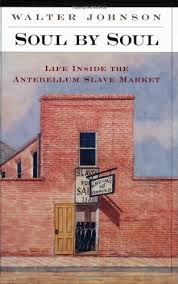
SoulThe class calls on students to think about slavery, freedom, and citizenship as both real experiences and concepts that were continually made and remade by black and white Americans in the nineteenth century. I’ll have a chance to re-read some of my favorite things, like parts of Walter Johnson’s Soul by Soul. In a chapter called “Making a World out of Slaves,” Johnson expands upon Ed Morgan’s “American paradox,” showing the ways that freedom was tied to whiteness and that those linked statuses were created not only through the enslavement, but also the blackness, of others. We’ll step through historiography to consider the ways enslavement was made and remade, reading John Blassingame on enslaved “personality types” and Stephanie Camp on communities, geographies, and the nature of resistance. And we’ll think about the creation of both freedom and citizenship in the work of fugitives, lawmakers, presidents, soldiers, Freedmen’s Bureau agents, night riders, and of course freed women and men.

A big reason why I’m so excited about the class is that I’ll have a chance to think through the complexities of these three statuses. Is freedom simply the absence of enslavement? What do various unfreedoms in our past and present tell us about the possibilities and limits of American freedom? What does it mean that citizenship imposes limits on freedom? Is freedom in the sense of liberty from all obligations a desirable goal?

Having students examine and discuss these and other difficult questions is part of my vision of an ideal classroom. I’ve told myself and others that my goal as a teacher is to have undergraduates do “practice history” – thinking critically and arguing both forcefully and carefully. But why? What do these students, all senior history majors, but most of whom will choose not to follow my career path, gain by thinking like historians? Caleb McDaniel recently tweeted responses to a survey in which he asked undergraduates about the value of history in the present. Most offered some version of the idea that history repeats itself, and that knowing the past will help us avoid mistakes in the future. Most scholars would say that the answer is far more complicated, but I’ve had a hard time figuring out what exactly I think the answer is.

The other day I mentioned to my eye doctor that I teach African American history. She volunteered that she had recently learned that Abraham Lincoln “didn’t particularly like” black people; emancipation was no more than a strategy to win the war. Leaving aside questions about why that was the first aspect of black history that came to mind, that sort of confident simplification stuck with me. It’s the impulse I want students to push against. Ultimately, many of us aim to instill empathy in students, but even that in itself isn’t the clearest way to explain the value of the past in the present. Understanding historical actors as they existed in their own worlds demands that we think—not only about what happened and how it happened, but also about how complicated life has been, and, by extension, remains. Lincoln did not “free the slaves,” but he is remembered as having done so. Further, the slaves were “freed,” and many of them credited Lincoln with that change. My hope is for students to be, or become, comfortable recognizing this complexity, dwelling in the contradictory truths that Lincoln had both much and little to do with emancipation.

I guess that in the end I want students to think, and to want to think, in and beyond my classroom. We all might have a lot to gain from a little thoughtfulness.

Read Full Post »

Here Is What Can Make a Difference in Race Relations – And It Happened in Major League Baseball Decades Ago

Michael H. Ebner

HNN  October 12, 2014


The obituary a few weeks ago of a former major league baseball player – George Shuba – has furnished a useful lesson about race.

Shuba, a journeyman outfielder, played for six years with the Brooklyn Dodgers (1948-1950 and 1951-1955). He never appeared in more than one-hundred games during his career, although he did have the distinction of playing in the World Series of 1952, 1953, and 1955. Brooklyn won its first world championship in the latter year. On the field Shuba is best remembered as a dependable pinch hitter – lifetime batting average of .259, with twenty-five home runs (one of them against the Yankees in the World Series of 1953) – for a team that was regularly in contention for the National League pennant.

Largely forgotten until the publication of his obituary last week, now Shuba is celebrated for breaking an inter-racial taboo. He did so by extending his hand by way of congratulating teammate Jackie Robinson, who had just hit a home run for the minor league team known as the Montreal Royals of the International League. The late Jules Tygiel, a peerless researcher, made no mention of it. Arnold Rampersad, in his biography of Robinson, mentions the handshake – and includes a photograph of it – but does not make much of the incident.

Next we turn to the obituary of Steve Gromek (1920-2002), a pitcher for the Cleveland Indians and later the Detroit Tigers. Over a seventeen-year career (1941-1957), he compiled a respectable win-loss record of 128-108. He won nineteen games during 1951 and eighteen in 1954. Gromek also won a World Series game in 1948, filling in for baseball legend Bob Feller who required an extra day of rest.

When Jackie Robinson arrived in the major leagues in 1947, he experienced the sting of racial hostility. A handful of his Brooklyn Dodger teammates unsuccessfully sought to prevail on the management of the Dodgers to drop Robinson from the roster. Pee Wee Reese – the team’s captain and shortstop, later elected to the Baseball Hall of Fame – rejected the opportunity to sign a petition circulated among teammates opposing Robinson’s presence on the roster. Well known is that the ringleader of the petition effort, Dixie Walker, ultimately found himself traded away by the Dodgers.

When the Dodgers played in Cincinnati a fan hurled vicious epithets at Robinson. Reese – a native Kentuckian – quietly walked across the infield to Robinson and gently placed his arm on his teammate’s shoulder. The hecklers ceased. While this moment remains much remembered, no known image exists.

This brings us to Larry Doby, the first African American to play in the American League. The rookie outfielder hit a key home run in the World Series of 1948, securing Gromek’s winning pitching effort. Afterwards Gromek enthusiastically hugged Doby in the clubhouse, an image that made its way into newspapers. Margaret Mackenzie wrote about the episode for the Pittsburgh Courier, a widely read African American newspaer: »That picture of Gromek and Doby has unmistakable flesh and blood cheeks pressed close together, brawny arms tightly clasped, equally wide grins.» The chief message of the Doby-Gromek picture is acceptance.»

Years later Gromek, a native of Hammtramck, Michigan – a largely white working-class suburb adjacent to Detroit – experienced ostracism but quickly shrugged it off. Today the Gromek-Doby embrace remains an iconic image in the history of American race relations.

These episodes – each of them situated in the immediate aftermath of World War II – reflect changing racial sensibilities. The Swedish social scientist Gunnar Myrdal, in his landmark book – An American Dilemma (1944) – anticipated the shifting tableaux of race relations in post-war American culture. What is remarkable is that major league baseball – its game played before crowds numbering in the tens of thousands – represented an agent of social change. The re-integration of professional baseball occurred seven years in advance of Brown v. Tulsa Board of Education.

Michael H. Ebner is professor of American history of emeritus at Lake Forest College. He can be reached at ebner@mx.lakeforest.edu

Read Full Post »

This Was One of the Little-Recognized Causes of the Civil War 

HNN  August 17, 2014

I remember reading many years ago W. E. B. Du Bois’s complaint that Americans knew far too little of the decisive role blacks played in winning their freedom.  He pointed specifically to a biography of Ulysses S. Grant in which the author, W. E. Woodward, wrote of African Americans as “the only people in the history of the world . . . that ever became free without any effort of their own. . . . They twanged banjos around the railroad stations, sang melodious spirituals, and believed that some Yankee would soon come along and give each of them forty acres of land and a mule.”  I was in graduate school at the time and congratulated myself on knowing better – that blacks had served in the Union army.  But that was about all I knew of it. As the proud holder of a college degree in history, I thought that was just about all I needed to know.  There are none so ignorant as the educated ignorant.

Some historians still downplay the wider role of blacks in bringing on freedom, preferring to emphasize Abraham Lincoln’s role as the Great Emancipator.  Historian James McPherson, a leading defender of Lincoln’s Great Emancipator image, argues in Drawn with the Sword: Reflections on the American Civil War (1996) that without Lincoln there would have been no war and, hence, no opportunity for freedom. With regard to emancipation, it was Lincoln’s determination that was “the essential condition, the one thing without which it would not have happened.” Without Lincoln, there would have been no Emancipation Proclamation and no Thirteenth Amendment. Therefore, says McPherson, “Lincoln freed the slaves.”

Arguments such as those of McPherson and others have some validity as far as they go. To my knowledge, no reputable scholar denies that Lincoln and the Union military played a significant part in the emancipation process. But following their lines of reasoning more deeply, we cannot help but see the efforts of black folk at their core.

Lincoln’s effort to preserve the Union was, of course, a reaction to the South’s secession, a movement engineered by slaveholders who feared not only Lincoln but, more immediately, their own slaves. Controlling slaves had been increasingly difficult for years. It could only be more difficult, perhaps impossible, with slaves believing that Lincoln’s election meant their freedom. How could they believe otherwise? Though Lincoln was no threat to slavery where it existed, and said so often during the 1860 presidential campaign, fire-eating secessionists railed against him as a radical abolitionist with a secret agenda to foment slave rebellion. Such overheated rhetoric was intended to stir up support for secession among southern whites, but southern blacks heard the message too. Rebellion and rumors of rebellion pervaded the South that year and drove slaveholder fears to a fever pitch. Most significantly, underlying their fear was the certain knowledge that slaves wanted freedom. It was that fear, born of generations of slave resistance, that led to secession, war, and slavery’s downfall.

Slaveholders’ doubts about their ability to maintain slavery indefinitely had a long history. The need to justify slavery had for decades occupied their brightest minds. The need to keep southern whites, three-quarters of whom owned no slaves, supporting slavery made fomenting fear of blacks a political priority.  Most threatening to slaveholders were the slaves themselves. Blacks had never submitted to slavery willingly or completely. They did little more than they had to do and took liberties where they could. They resisted in so many ways that the slaveholders’ need to exercise control was constant and consuming.  Had blacks been content to remain enslaved, slaveholders would have had no cause for alarm. Nor would abolitionist arguments have inspired such panic among them. As it was, slaveholder fears of threats to slavery, as much from within as from without, led them to insist on guarantees for slavery’s future and the means to control that future. And that fear led them to secede when those guarantees and their means of control seemed at risk. As Professor John Ashworth reminds us inSlavery, Capitalism and Politics in the Antebellum Republic (1995), there was a direct causal link between the slaves’ desire for freedom and slaveholder politics. “Behind every event in the history of the sectional controversy,” Ashworth points out, “lurked the consequences of black resistance to slavery.”

That resistance was not confined to the South. Escaping slaves saw to that. By the tens of thousands they headed north, undermining northern efforts to keep the slave’s war south of the Mason-Dixon Line. In so doing, as Professor Scott Hancock stresses in “Crossing Freedom’s Fault Line” (Civil War History, 2013), black folk “maintained an unrelenting pressure on the sectional fault lines of identity, law, and space.” That pressure produced large cracks in those fault lines and increasingly drew northerners into the conflict. Time and again, northern failures to keep blacks and slavery locked in the South put them at odds with slaveholders’ expansionist demands. Hancock concludes, and rightly so, that “not simply slavery, but slaves – black people! – caused the Civil War.”

It was, then, at the heart of it all, the unrelenting resistance to slavery among slaves themselves that was the essential condition, the one thing without which the sectional crisis, secession, the Civil War, the Emancipation Proclamation, and the Thirteenth Amendment would not have happened.

Of course, it did not happen overnight. For more than two centuries before the Civil War, millions of African Americans lived in bondage all their lives. But it was a resisted bondage, an ongoing struggle, that would eventually reach its consummation. The internal pressures against slavery – rebellion, resistance, escape – were always there and became ever greater as slavery spread. Slaveholders clamped down with more slave codes, more slave patrols, and increasingly brutal control. But the more they tried to tighten their grip on slaves, the more slaves slipped through their fingers. By the late 1850s there were an estimated fifty thousand escapees annually, temporary and permanent. Such resistance fueled a desperation reflected in slaveholder politics and the secession crisis. The resulting war was neither an isolated event nor an end point in itself.  It was part of a massive black resistance movement that had been going on for generations, finally becoming so intense that the country as a whole could hardly help being drawn into it.

Even so, in an effort to avoid war, Congress passed, and Lincoln supported, a constitutional amendment, the Corwin Amendment, that would have guaranteed slavery in the slave states forever.  In the war’s early months, both Congress and Lincoln insisted that the conflict was a white man’s war in which blacks could have no part. But black folk knew the war was theirs and quickly took ownership of it.  Black resistance largely brought on the war, then pressed Lincoln in the direction he eventually went.  By escaping in the tens of thousands and making freedom a fact, blacks forced Lincoln to recognize that fact with the Emancipation Proclamation. They made the document their own, and made it much more that it was.  In the upper South, where the Proclamation did not apply, blacks claimed freedom anyway.  In the lower South, they made freedom real by aiding escaping slaves, serving the Union army as guides and spies, assisting Confederate deserters and armed deserter gangs, giving aid to escaping Union prisoners, resisting abuse, and engaging in open rebellion.  They established freedom for themselves by traveling at will, threatening escape to secure wages, and even claiming land and property when they could.  Still, most Americans today seem to assume that Lincoln, almost single-handedly and of his own volition, “freed the slaves.”  Certainly most students coming into my freshman U.S. history course assume that to be the case, which is in large part what prompted me to write my book, I Freed Myself.

In the war’s aftermath, although whites willfully ignored the wartime role of blacks, memories of self-emancipation efforts remained clear in the minds of black folk.  One day a candidate for local office in Illinois asked Duncan Winslow, a former slave and Union veteran, for his vote in an upcoming election. As if to seal the deal, the candidate told Winslow, “Don’t forget. We freed you people.” In response, Winslow raised his wounded arm and said, “See this? Looks to me like I freed myself.”  Blacks would go on freeing themselves for generations to come.

David Williams is a professor of history at Valdosta State University and the author of the, “I Freed Myself: African American Self-Emancipation in the Civil War Era” (Cambridge University Press, 2014).

Read Full Post »

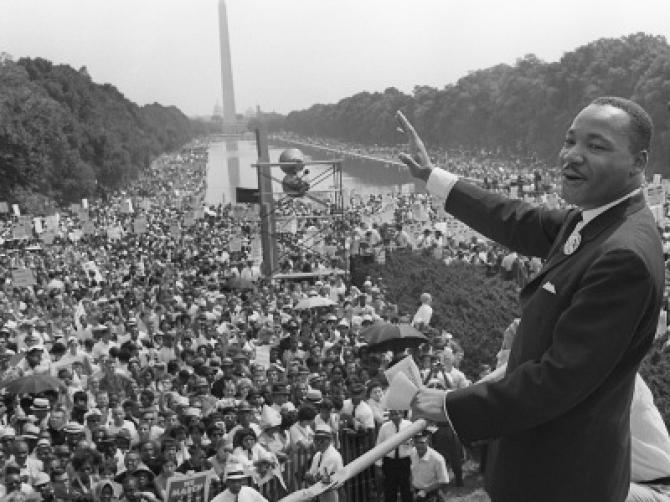
Martin Luther King Jr. waves to supporters on the Mall in Washington, D.C., Aug. 28, 1963. AFP/GETTY IMAGES

Martin Luther King Jr. waves to supporters on the Mall in Washington, D.C., Aug. 28, 1963.
AFP/GETTY IMAGES

MLK’s Case for Reparations Included Disadvantaged Whites

Jonathan Rieder
The Root July 15, 2014

What does white America owe black America? To even broach that question 50 years after the Civil Rights Act of 1964 seems straight-out wacky. Did not the election of a black president redeem the nation? At a minimum, it’s rude—refusing to avert the eyes from that elephant in the room: “America begins in black plunder and white democracy.” That’s how Ta-Nehisi Coates deemed it recently in his extraordinary “The Case for Reparations.”

Far from fringe lunacy, the idea of a primal debt was obvious to Martin Luther King Jr. Exactly 50 years ago this month in Why We Can’t Wait, his Harper & Row account of the Birmingham, Ala., protests, he made his own impassioned case for compensation. And yet no matter how much he shared Coates’ desire to square accounts, King would settle on a rival solution for the crimes of slavery and all the forms of racism that succeeded it.

In the rapture of King’s crescendo at the March on Washington, it’s easy to forget the language of bankers that pervaded the first half of “I Have a Dream” (pdf): “America had defaulted on this promissory note” of “life, liberty and the pursuit of happiness.” One year later, in Why We Can’t Wait, he was not coy about the nation’s “need to pay a long overdue debt to its citizens of color.” He retold the story of his 1959 visit to India, where Prime Minister Jawaharlal Nehru recounted all the preferential policies that aided the untouchables: “This is our way of atoning for the centuries of injustices we have inflicted upon these people.”

Invoking the sacred precedent of “our fighting men [in World War ll]” who “had been deprived of certain advantages and opportunities,” King ticked off all the things—the GI Bill of Rights—that were done “to make up for this.” Then King pivoted and pounced: “Certainly the Negro has been deprived” and just as surely “robbed of the wages of his toil.” You didn’t need a course in logic to complete the syllogism.

The passage of the Civil Rights Act of 1964 did not diminish King’s zeal for reparations. “Frederick Douglass said we should have 40 acres and a mule,” he told a mass meeting not long before his death. Instead, the nation left blacks “penniless and illiterate after 244 years of slavery.” Calculating that $20 a week for the 4 million slaves would have added up to $800 billion, he noted acerbically, “They owe us a lot of money.”

The failure to repair thus added a new crime to the original one. It was like putting a man in jail and discovering his innocence years later: “And then you go up to him and say, ‘You are free,’ but you don’t give him any bus fare to get to town. You don’t give him any money … to get on his feet in life again. Every code of jurisprudence would rise up against that.”

There was still one more twist in the torment to come. All those “white peasants from Europe” who enjoyed the largesse of land grants and low-interest loans “are the very people telling the black man that he ought to lift himself by his own bootstraps. … It’s a cruel jest to say to a bootless man that he ought to lift himself by his own bootstraps.”

Are the progeny of those “white peasants” readier to reckon with our racist legacy? Thirty-five years ago, a Brooklyn, N.Y., woman fumed to me about the TV program Roots, “If they keep shoving that stuff down our throats, there’s never going to be peace. … that was over 200 years ago that this slavery bit was!”

Today, countless Americans think blacks have received compensation in the form of anti-poverty money and quotas. As one person told political consultant Stanley Greenberg (pdf), “Didn’t they get 40 acres and a mule? That’s more than I got.” West Indians and African immigrants, too, sometimes complain that black Americans are too racial, and many millennials who used to thrill to President Barack Obama’s exalted flights are preoccupied with their own plights and the grit of a post-Lehman Brothers economy.

Meanwhile, the vast majority of whites even reject apologies for slavery, which cost nothing save one’s dignity. Many of the supporters of affirmative action whom Stanford political scientist Paul Sniderman queried in the 1990s endorsed the remedy only if blacks were not its sole recipients and the rationale was universal: “help people who are out of work” rather than “because of the historic injustices blacks have suffered.”

It’s possible that attaching a race to the injustice made the respondents squirm. Perhaps it forced whites to dwell on this unsettling fact: Our success in part is a windfall, reaped from the access black exclusion gave us to jobs, slots in housing markets and much else.

In truth, white psyches and circumstances are too varied to sustain such generalities. The woman who recoiled from “that slavery bit” didn’t lack empathy. She filled up with emotion as she observed, “The blacks were treated worse than animals; they were taken up from their own happy soil.” When Greenberg returned to McComb County, Mich. (pdf), before the 2008 election, some of the same Reagan Democrats (or their children) who had seen blacks as the source of all their ills in the 1980s and heard Jesse Jackson’s “Our time has come” as “Your time is over,” could now acknowledge America’s special burden: “We did hold them back, and a lot of people were cheated.” As for Sniderman’s respondents, likely many of them saw universalism as a different, equally righteous take on healing and helping.

Maybe, then, it’s best to settle for those modest moral advances, especially if that’s the price of any coalition of conscience that might some day be motivated to remedy the ills of suffering Americans. Better to leave the fuller atonement to those Deep South museums that have confronted their louche local past; people who exit Twelve Years a Slave in turmoil; lawsuits seeking compensation for specific violations like the racist rampage in Tulsa, Okla. Anything more perfect might be the enemy of the good, even the moral good.


Ultimately, in the very chapter of Why We Can’t Wait in which he laid out the justice of reparations, King rejected the idea of recompense for blacks alone. It’s not that he was prepared to abandon this equation of restorative justice: The nation that did something special against the Negro had to do something special for him.

But the special thing that King proposed—“A gigantic Bill of Rights for the Disadvantaged, our veterans of the long siege of denial”—left plenty of room for white “veterans” in the mix. He offered solace to the least of these, no matter what their complexion. Inevitably, there was a shrewdness to this inclusion, part of the effort to woo white allies and crystallize the liberal coalition on race that had been growing since Birmingham. It was also, King underlined, “a simple matter of justice.”

Already in 1964, King was looking beyond the Civil Rights Act. He could grasp its limited power to effect “improvements” in the Negro’s “way of life.” He could see that rights and respect might arrive more quickly than economic equality. He could also see that however much white supremacy left blacks vulnerable to inimical forces, the forces could be unsentimentally free of bigotry and wreak havoc on whites and blacks alike.

At the March on Washington, King invited whites to join the  “we” who could sing, “Free at last … we are free at last,” and thus share in bondage and deliverance. He did something just as generous inWhy We Can’t Wait. Likely it took a Christian whose idea of a fair exchange was blessing those who curse you to offer poor and middling Southern whites this face-saving gift: He defined them not as beneficiaries of white supremacy but as “victims of slavery” who suffered their own “derivative bondage.” This wasn’t masochism talking, but a faith at once hard-boiled and brimming with grace.

What, then, about balancing the ledger for specifically black injuries? Throughout Why We Can’t Wait, there are hints that resolving matters of policy and politics didn’t still all the feelings churning within King. “A price can be placed on unpaid wages,” he underlined, but “no amount of gold could provide an adequate compensation for the exploitation and humiliation of the Negro in America down through the centuries.” He rejected an easy “four-minute atonement” as inadequate to “400 years of sinning.”

Atone, you sinners! That is the sound of the muffled voice of the preacher rising up through the printed page. And in the end it seems Coates, too, is seeking something similar: recognition as much as reparations; “not a handout, a payoff, hush money, or a reluctant bribe” but “the full acceptance of our collective biography and its consequences.”

King harbored no illusions that whites as a whole had the moral gumption to undergo that ordeal. In the Letter From the Birmingham Jail, he observed, “I suppose I should have realized that few members of the oppressor race can understand the deep groans and passionate yearnings of the oppressed race.”

The evidence for pessimism only intensified as 1964 unfolded. George Wallace broke out of his Southern lair. White backlash quickened in the North. By 1968 King could warn, “a nation that put as many Japanese in a concentration camp … could put black people in concentration camps.”

And so, in the absence of full justice, the preacher could be a chastising prophet, who once told a mass meeting: “Do you know that in America the white man sought to annihilate the Indian, literally to wipe him out, and he made a national policy that said in substance, the only good Indian is a dead Indian? Now, a nation that got started like that has a lot of repentin’ to do.”

But even rebuke did not close the case. There remained the work of memory and mourning. King never stopped honoring that history, whose pain could not be fully assuaged by rebuke or recognition. In the refuge of a black church, in the nurturant embrace of his people, he grieved: “We read on the Statue of Liberty that America is the mother of exiles.” But whites “never evinced the maternal care and concern for its black exiles who were brought to this nation in chains. And isn’t it the ultimate irony … that the Negro could sing in one of its sorrow songs, ‘Sometimes I feel like a motherless child.’”

As the audience erupted in applause, King demanded, “What sense of estrangement, what sense of rejection, what sense of hurt could cause a people to use such a metaphor?”

Jonathan Rieder, a professor of sociology at Barnard College, Columbia University, is the author most recently of Gospel of Freedom: Martin Luther King Jr.’s Letter From Birmingham Jail and the Struggle That Changed a Nation and The Word of the Lord Is Upon Me: The Righteous Performance of Martin Luther King Jr.


Read Full Post »

Invisible Empire: An ‘Imperial’ History of the KKK

Dr. Kristofer Allerfeldt
History Department, University of Exeter

Imperial & Global Fórum  July 7, 2014

invisible-empireInvisible EmpireHistorians are used to the concept of formal and informal empires. They are used to empires expanding and empires declining. Most are perhaps less familiar with a concept bandied about in the United States from the late 1860s to the mid-1930s – that of an “invisible” empire.

In reality this empire was anything but invisible. Born in the turmoil of the post-Civil War South, by the mid-1920s it had spread to all mainland states of the Union, claiming some ten million members.

It was also known as the Ku Klux Klan.

As with much of the history of the KKK, the origins of the term “Invisible Empire” are disputed. Some claim that it emerged from Confederate General Robert E Lee’s polite request to keep his support for the nascent Klan “invisible”. Others see it as a part of the secrecy surrounding the original hooded fraternity. Whichever origin is chosen, there’s no doubting it was a useful phrase.

Arguing that Lee’s Klan connection was kept “invisible” at his own request was a trump card for those dedicated to the order’s mission of “Redeeming” the South’s pre-bellum traditions. However invisible, connection to the most illustrious figure of the Confederate war effort gave the Klan prestige and legitimacy, not only during the struggles of post war reconstruction, but also when the Klan re-emerged in 1915. Claiming he had wanted his ties kept secret also made it more difficult for either the general sceptics or the KKK’s enemies to disprove his connection with the vigilante organization of Reconstruction – which they all attempted to do.

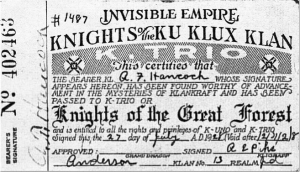
 Membership card of A.F. Handcock in the Invisible Empire Knights of the Ku Klux Klan (1928)


Membership card of A.F. Handcock in the Invisible Empire Knights of the Ku Klux Klan (1928)

The controversy surrounding Lee’s allegedly “invisible” connection also, of course, makes it more difficult for historians now to accurately assess his connection. Early accounts of the Klan repeat the rumour, largely because the order was seen in a generally positive light. In some measure this was the result of a negative view of the Reconstruction efforts carried out in the post-war South. These Radical Republican-led attempts at racial integration and universal education were almost universally seen as the misguided efforts of unrealistic idealists, or viewed as the actions of corrupt politicians. Further, many of the historians writing histories of the Klan from Reconstruction through until at least the 1920s were, or claimed they were related to, members of the order.

The result was that accounts like that of Susan Lawrence Davis (1924) reiterated the myth offering no hint of its origins and making no attempt to show its authenticity.[1] Merely stating the case seems frequently to be considered enough proof by the standards of the time, but Davis’ background tells us much about her real sympathies. She was the daughter of a Confederate colonel and Klansman, Lawrence Ripley Davis. What is more she draws on equally unreliable sources, like the memoirs of one of the founders, John C Lester.

However, unlike previous accounts, Davis even quotes Lee’s words. She has the general tell the deputation asking him to head the order in May 1867 that, “I would like to assist you in any plan that offers relief. I cannot be with you in person but I will follow you, but it must be invisible.” She goes on to explain, “When this message was delivered to the [Klan] convention it led to the christening of the United Ku Klux Klan, the “Invisible Empire””.

By the end of the 1920s the Klan’s position in American society was less secure. A series of sexual and financial scandals combined with revelations of its violent methods reduced both the numbers and reputation of the order. The result was that even apologists tended to veer away from associating the symbol of Southern chivalry and gentility – Lee – with a tainted order of what even its leader had referred to as violent, ill-educated “second hand Ford owners”. Consequently, most historians since the 1930s have tended to see the Invisible Empire as being an example of the order’s fascination with mysticism.

This securely ties the order back to the craze for secret brotherhoods which swept across the United States in the wake of the Civil War. The period from 1865 to 1930 saw a huge explosion in fraternities of all types, so much so it is referred to as the “Golden Age of Fraternity”. College Greek letter fraternities; fraternities associated with particular trades, ethnicities and interests; fraternities formed to achieve certain aims, as well as the more traditional varieties like the Freemasons, Oddfellows and Shriners all prospered and expanded. One estimate claimed that around 1900, one in five American adult males was a member of at least one fraternity, many belonged to several.

The Klan itself had started as a simple fraternity. Around Christmas 1865, six bored ex-Confederate veterans, recently de-mobbed, formed their own fraternity – simply for entertainment. Like many other contemporary orders secrecy was central to the new fraternity. It had elaborate oaths of secrecy threatening dire punishment for those who spread details of the order. It had weird names to disguise the identity of members, and elaborate costumes to hide their faces. When, by 1868, the order had spread across the Southern states and was terrorizing those attempting to empower and integrate the region’s four million ex-slaves, that invisibility proved vital to avoiding prosecution and counter-attack.

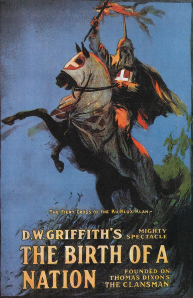
birth-of-nation-movie-poster-900Similarly when the Klan was reformed in 1915, secrecy remained essential, not so much for the protection of its members, but more for the frisson of excitement and exclusivity it gave its members as part of a society made even more famous with the blockbuster release of Birth of a Nation (1915) on the silver screen.

As the Klan organisation expanded in the 1920s its “invisible” nature continued to help it. It enabled recruiters to gull fee-paying members into joining an order that never had anywhere near the ten million members it claimed at its peak in 1924. It allowed the organisation to exaggerate its power, by claiming it had members – sworn to secrecy, of course – at all levels of government from the White House down. It allowed the leadership to disavow actions of members they felt were acting to damage the image of the fraternity and disguise the order’s rapid decline from the mid-1920s onwards. Its leadership apparently found the concept of an “Invisible Empire” had much more to commend it than a visible one..

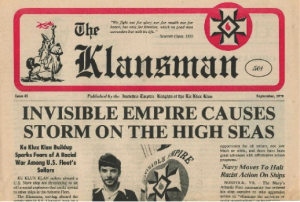
Klan newspaper of the 1970s.

Klan newspaper of the 1970s.

Having said that the concept of the Invisible Empire has proved a constant headache for historians. Secrecy and exaggeration, added to the lack of records and a reluctance of many to admit their own, or relatives, association with the Klan mean that our histories of the fraternity are necessarily to some extent speculative – especially when it comes to numbers. Nevertheless, this very secrecy makes new theories, new explanations and, of course, new histories of the Klan possible.

Kristofer Allerfeldt will be working on a new history of the Klan in conjunction with his PhD student, Miguel Hernandez, in 2015.

—-

[1] Susan Lawrence Davis, The Authentic History of the Ku Klux Klan (New York, 1924).

Read Full Post »

Mississippi Burning: 50th Anniversary of KKK Murder of 3 Civil Rights Workers

Democracy Now   June 20. 2014

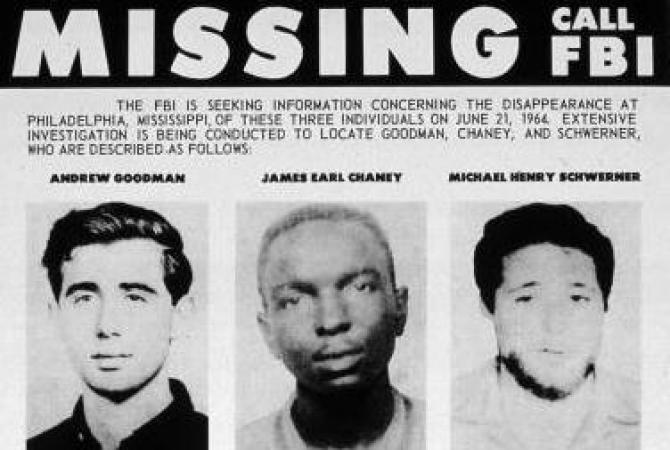
UnknownSaturday marks the 50th anniversary of the killing of three civil rights workers in Mississippi, a pivotal moment in the 1960s struggle for equality.

On June 21, 1964, James Chaney, Andrew Goodman and Michael Schwerner were ambushed by a gang of Klansmen. The three were beaten and shot, their bodies found weeks later buried in an earthen dam. They had come to Mississippi to register African-American voters as part of the Freedom Summer campaign.

A number of Klan members were convicted on minor charges, with none serving more than six years. It took 41 years before a murder conviction was handed down in the case, with former Ku Klux Klansman Edgar Ray Killen found guilty of manslaughter in 2005.

Democracy Now! aired a special report on the murder case in 2010, which was featured in the documentary, «Neshoba: The Price of Freedom.» Although dozens of white men are believed to have been involved in the murders and cover-up, only one man, a Baptist preacher named Edgar Ray Killen, is behind bars today. Four suspects are still alive in the case.

In this report, we air excerpts of «Neshoba» and speak with its co-director, Micki Dickoff. We are also joined by the brothers of two of the victims, Ben Chaney and David Goodman.

civilrightsworkers.jpg.CROP.rtstoryvar-large

We also speak with award-winning Mississippi-based journalist Jerry Mitchell of the Clarion-Ledger, who has spent the past 20 years investigating unresolved civil rights murder cases, as well as Bruce Watson, author of the book, «Freedom Summer: The Savage Season that Made Mississippi Burn and Made America a Democracy.»

Click here to watch this special report.

Read Full Post »

« Newer Posts - Older Posts »