Feeds:
Entradas
Comentarios

Archive for the ‘Imperialismo norteamericano’ Category

Confederates in the Jungle

disunion45The Fourth of July celebration has all the hallmarks of a scene from “Gone with the Wind,” or a county fair in the most unreconstructed corners of Mississippi or Alabama. The men, dressed in Confederate gray shell jackets, yellow-trimmed frock coats, kepis and plumed black slouch hats, cross the dance floor to select their partners, elegant young women in colorful hoop-skirted ball gowns. Arm in arm, they step to the rhythms of ancient dances, as the fiddle and banjo strike up the old-time strains of “Dixie’s Land,” “The Yellow Rose of Texas,” “The Virginia Reel” and “Cumberland Gap.”

Meanwhile, families gather around banquet tables loaded down with dishes that are the products of centuries-old Southern family recipes. Along the sidelines, vendors hawk rebel battle flags, Confederate campaign caps, and T-shirts, mugs and bumper stickers emblazoned with slogans like “Hell no, we won’t forget!”

Nearby stands a small stucco-walled chapel. An old cemetery, shaded by Alabama pines and bougainvillea, contains over 500 graves with stones bearing such venerable Southern names as MacKnight, Miller and Baird, Steagall, Oliver, and Norris, Owens, Carlton and Cobb.

The setting is, in fact, in the South – very far south, in Brazil.

The Festa Confederada is held as often as four times a year in Campo, an area carved out of the sugar cane fields outside Americana, a modern city of some 200,000 residents in the state of São Paulo. All the participants are “Confederados” – fifth-generation descendants of Southerners who immigrated here in the days following the Civil War. The entire scene – the dress, the music, food, even the conversation – is a carefully rendered homage to those disaffected rebels who elected to leave their conquered nation and make a new home in a foreign land.

By 1866, the future for countless Southerners appeared bleak. Not only had their bid for nationhood been destroyed; in many instances, so had their homes, their communities and their livelihood. The prospect of living under the harsh fist of the conquering North was more than many were willing to bear. As one Confederado descendant wrote, “Helpless under military occupation and burdened by the psychology of defeat, a sense of guilt, and the economic devastation wrought by the war, many felt they had no choice but to leave.”

There were other reasons. For some, the prospect of laboring alongside former slaves was unacceptable. And then there were those adventurers who hoped to find gold or silver in what was being widely touted as a tropical paradise. Whatever their impetus, for tens of thousands of Southerners, the promise of a new beginning in a new land was irresistible, and Latin America beckoned.

The Southerners’ knowledge of agriculture made them an attractive asset, and a number of countries, including Mexico, Honduras and Venezuela, competed to colonize the disaffected Americans. The most favorable offer, however, came from Brazil’s Emperor Dom Pedro II. Desperate to expand the cultivation of cotton in his country, he put together a proposal offering an impressive list of amenities, including the building of a new road and rail infrastructure for conveying crops to market. Brazil had been a strong ally to the Confederacy throughout the war, harboring and supplying rebel ships. And although Brazil had closed its ports to the African slave trade in 1850, it would not abolish slavery for another 38 years. Of all the Latin American nations, Brazil was the one with which the Southerners felt the strongest bond.

Joseph Whitaker and Isabel Norris, two early Confederate migrants to Brazil.

Joseph Whitaker and Isabel Norris, two early Confederate migrants to Brazil.Credit Whitaker Family Archive

In contrast to the often tired crops of the American South, Brazilian cotton was of a high quality, and could be harvested twice a year. Sugar cane, corn, rice, tobacco, bananas and manioc flourished as well, and Southern farmers, as well as doctors, teachers, dentists, merchants, artisans and machinists, envisioned a glowing future. Brazil would become the New South! The all-too-real obstacles – a foreign culture with a difficult language, strong native competition, an often hostile environment, a racially mixed society, a restrictive national religion, homesickness and the loneliness of distance and isolation – factored little in their plans.

There are no accurate records documenting the exact number of émigrés; some historians have placed the figure at around 40,000, from across the former Confederacy, and even loyal border states. It was high enough, however, to necessitate the formation of colonization societies, with agents whose main functions were to gather information on living conditions and financial prospects, and to ensure a smooth transition.

For most, the first destination was Brazil’s capital, Rio de Janeiro. The vessels in which they sailed ranged from small packets to large ships, and while some completed the 5,600-mile voyage in an uneventful month, for others the voyage was arduous, and sometimes fatal. The Neptune sank in a storm off the coast of Cuba, taking with it all but 17 passengers. And an outbreak of smallpox on the Margaret claimed the lives of nearly everyone aboard.

When the Southerners disembarked, they were greeted by brass bands, parades and flowery speeches. One former Confederate general recalled, “Balls and parties and serenades were our nightly accompaniment and whether in town or in the country it was one grand unvarying scene of life, love and seductive friendship.” The emperor greeted many of the new arrivals personally, as the bands played “Dixie.” As he had promised, the new arrivals were given free temporary living quarters in a Rio hotel, and the food and accommodations far exceeded their expectations.

Conditions would never be this elegant again. Dom Pedro’s grand promises of governmental support for the farmers went generally unfulfilled, through no fault of his own. Coincidentally, the year the Civil War ended brought the outbreak of the War of the Triple Alliance, in which Brazil played a major part. The booming economy of the previous decades collapsed, plunging the country into an economic depression. By the time the first Southerners arrived, the emperor was confronting enormous internal issues, and struggling with poor health. The colonists were left to make their own way.

While most members of the Southern professional class settled in the larger cities, such as Rio and São Paulo, the rest chose to literally plant their roots farther down the coast or in the vast, dense interior. Their scattered colonies dotted a 250-square-mile stretch along the country’s east coast, and great distances often separated them. Many of the chosen locations were inhospitable and ill-suited for growing crops. Without the promised road and rail system, crops that did thrive often grew too far from the market. Farms failed, community leaders died and colonies fell apart under power struggles and losing battles with illness and the elements. The few planters who bought slaves and sought to replicate the old antebellum plantation system found only failure.

Some disillusioned colonists returned home; others migrated to the most successful settlement — the Norris Colony, established in 1865 by Col. William Norris. The former Alabama senator had chosen the site carefully, and it soon became the most populous and productive American colony in Brazil, eventually containing some 100 families. And when the railroad finally did come through, the settlers built the beginnings of the nearby market town that survives today as Americana.

Even here, though, life could be brutal. The former rebel Col. Anthony T. Oliver had immigrated among the first settlers, along with his wife, Beatrice, and two teenage daughters. Within the first year, Beatrice died of tuberculosis, followed shortly by both daughters. When locals denied his wife burial in the Catholic graveyard, Oliver donated a section of his land – dubbed “Campo” – for a Protestant cemetery exclusively for the Confederados. Soon, the colonists built a small chapel nearby, which became the center of worship and connection for the transplanted Americans.

Hard though the life could be, many who chose their locations well and put in the work succeeded. Through the use of what the native Brazilians perceived as advanced cultivation methods and tools, the colonists’ crops flourished. In addition to raising native produce, they introduced such homegrown crops as watermelon and pecans. So popular was the “Georgia Rattlesnake” watermelon that by the late 19th century, Confederados were shipping 100 carloads daily from Americana to various parts of Brazil. Within a short time, the displaced rebels established a reputation as hard workers and as diligent and independent citizens.

Fort Sumter

They did, however, go to great lengths to maintain their own identity. Although subsequent generations intermarried with the Brazilians, they never lost sight of their history and traditions. This was not always viewed in a positive light. Wrote one former Georgia planter in 1867, “The Anglo-Saxons are completely ignorant of amalgamation of thoughts and religion. Naturally egotistical, they do not admit superiors, nor do they accept customs which are in disagreement with their preformed ideas. They think it is their right to be boss. In my opinion … the Anglo-Saxon and his descendants are birds of prey, and woe to those who get in their way.”

One clear indicator of the fierceness with which the rebel settlers maintained their identity is in their speech. Despite five generations of assimilation, the English language has survived, perfect and intact, among a number of the bilingual Confederados. Amazingly, although most have not visited the United States, their speech clearly reflects that of the American South. When Jimmy Carter, then the governor of Georgia, visited Campo in 1972, he was stunned: “The most remarkable thing was, when they spoke they sounded just like people in South Georgia.”

The Confederados represent a human treasure trove for modern-day linguists. Throughout the past century and a half, scholars have puzzled over what the Southerners of the Civil War era actually sounded like. The Brazilian descendants’ English, in the words of one latter-day rebel, has been “preserved in aspic”; in its purist form, it stands virtually frozen in time, reflecting the pronunciations and speech patterns of their forebears, dating from the third quarter of the 19th century.

Similar settlements in Mexico and other Latin American countries faltered; Brazil was the only place where the Confederate émigrés managed to carve a life and an extended community from the jungle, and to found a thriving dynasty. Today, the living descendants of Brazil’s original rebels are scattered throughout the country, and they enjoy the richness of a dual culture. They see themselves as Brazilians, but also as distinctly American – the last rebels of the Civil War. Says one historian, “They are proud to have Brazil as their mother country, and the United States as their grandmother country.” As one descendant, who learned English before he learned Portuguese, put it, “Actually, we’re the most Southern and the only truly unreconstructed Confederates that there are on Earth. We left right after the war, and we never pledged allegiance to the damn Yankee flag.”


Ron Soodalter

Ron Soodalter is the author of “Hanging Captain Gordon: The Life and Trial of an American Slave Trader” and a co-author of “The Slave Next Door: Human Trafficking and Slavery in America Today.” He is a frequent contributor to America’s Civil War magazine, and has written several features for Civil War Times and Military History.

Read Full Post »

Vietnam: 40 años de una masacre

Por Luis Mazarrasa Mowinckel

EL PAÍS  04 de mayo de 2015
PeticionImagenCAGDPPIW

Un tanque norvietnamita cruza delante del palacio presidencial en Saigón el 30 de abril de 1975. / Reuters

El 30 de abril de 1975 los telediarios mostraban la imagen en blanco y negro de un tanque con la bandera del Vietcong derribando la verja metálica del Palacio Presidencial de Saigón. La Guerra de Vietnam había terminado. Atrás quedaba un conflicto de altísima intensidad que había durado quince años, si se cuenta a partir del comienzo de la actividad guerrillera del Vietcong contra el Gobierno de Vietnam del Sur, en 1959, o incluso 34 si se considera como punto de partida los ataques de las guerrillas de Ho Chi Minh contra el colonialismo francés.

La Guerra de Vietnam, que tomaba por asalto a diario los noticieros de los años sesenta y setenta, fue el enfrentamiento bélico más fotografiado y filmado de la historia, el mayor filón que haya existido para un corresponsal de guerra y el que dejó también casi tantas bandas sonoras como los filmes sobre la II Guerra Mundial.

Esa cobertura exhaustiva del conflicto, sobre todo a partir de la total implicación del Ejército de EE UU a favor de Vietnam del Sur en 1964, fue precisamente un factor fundamental en su desarrollo, ya que incendió a la opinión pública mundial, incluida la norteamericana, que reclamó masivamente la retirada de esa potencia de la guerra en un país del Sureste asiático.

El origen de la contienda que terminó con la victoria de las tropas del Norte y la reunificación de Vietnam en 1975 se encuentra en la lucha del Viet Minh –el ejército guerrillero al mando del líder Ho Chi Minh- en los años cincuenta contra la potencia colonial que desde 1883 había integrado el país, junto con Laos y Camboya, en la Indochina Francesa.

Efectivamente, tras la derrota del invasor japonés al término de la II Guerra Mundial la actividad guerrillera y las ansias independentistas de los vietnamitas se recrudecieron. Así, con la rendición del ejército colonial en 1954 a los vietnamitas del general Giap, en lo que se calificó como el desastre de Dien Bien Phu, Francia se vio obligada a abandonar sus colonias en Indochina.

Los Acuerdos de Ginebra de ese mismo año establecieron una frontera temporal a lo largo del río Ben Hai, a la altura del Paralelo 17, que separó hasta las elecciones de 1956 el norte del país, con un Gobierno comunista que había liderado la victoria, de un Vietnam del Sur, capitalista y cuyos dirigentes se habían alineado con la Francia colonial.

Sin embargo, ante la previsible victoria de Ho Chi Minh –el líder del Norte apoyado por China- en las elecciones acordadas en Ginebra por todas las partes, el primer ministro del Sur, Ngo Dinh Diem, convocó un referéndum en su territorio que lo reafirmó en el cargo, suspendió los comicios y estableció como definitiva la frontera que dividía a la República Democrática de Vietnam del Norte –con capital en Hanoi- y a Vietnam del Sur, con un gobierno instalado en Saigón, también dictatorial, anticomunista y fuertemente ligado a los intereses de Estados Unidos, que desde la marcha de los franceses había inundado el sur de asesores militares.

Museo de Arte (11)

Cartel de propaganda en el Museo de Arte de Vietnam. / luis mazarrasa

La flagrante violación de los acuerdos de paz provocó el fin del alto el fuego y la reanudación, pues, de los ataques del Ejército del Norte en los alrededores del Paralelo 17 y de su guerrilla aliada del Vietcong en numerosos puntos del Sur donde se había infiltrado.

1964 marca el inicio de la implicación total de EE UU en el conflicto. El presidente Lyndon B. Johnson, que ha sucedido al asesinado John F. Kennedy, aprovecha el incidente del Golfo de Tonkín, en agosto de ese año –cuando dos buques norteamericanos fueron supuestamente atacados-, como pretexto para bombardear Vietnam del Norte y ordenar el desembarco masivo de marines en las playas de Danang. A finales de 1965 ya eran 184.000 los soldados estadounidenses en el territorio y dos años más tarde, medio millón.

Años después del fin de la contienda se reveló que, en realidad, el destructor Maddox sufrió un ataque al encontrarse en aguas jurisdiccionales norvietnamitas apoyando una operación de tropas de Vietnam del Sur, mientras que el Turner Joy no sufrió agresión alguna. Además, también se demostró que Lyndon Johnson ya disponía de un borrador de la resolución del suceso con fecha anterior a que el incidente de Tonkín hubiera ocurrido.

Las razones que en un principio los presidentes Kennedy y Johnson declararon a la opinión pública norteamericana para justificar la implicación en una guerra: la agresión a un país aliado por los comunistas de Ho Chi Minh y la “evidente” amenaza de un contagio a todo el Sureste asiático en caso de la victoria del Norte, que podría inducir a Tailandia, Camboya, Laos y Corea del Sur a integrarse en el bloque socialista, fueron perdiendo fuerza a medida que las noticias mostraban la terrible devastación provocada por los bombardeos de los B-52 en ciudades y aldeas y los testimonios de numerosos veteranos licenciados del combate y de otros tantos objetores a filas que rechazaban “ir a masacrar a unos campesinos de un país tan lejano”, como declaró algún marine a la vuelta a casa.

PeticionImagenCAQC6OHG

Dos niños corren por una carretera intentando escapar de un ataque con napalm, en Trang Bang, a 26 millas de Saigón, el 8 de junio de 1972. / Reuters

Mientras el conflicto se enconaba, EE UU bombardeaba incesantemente Hanoi y otras ciudades del Norte y el presidente de Vietnam del Sur era asesinado en un golpe de Estado apoyado por la propia Administración norteamericana, las fuerzas armadas de Ho Chi Minh protagonizaban espectaculares golpes de mano, como la Ofensiva del Tet en 1968, que marcó el punto de inflexión en la guerra. Las imágenes en directo de la mismísima embajada de EE UU en Saigón tomada durante unas horas por un grupo de guerrilleros, que actuaban en coordinación con otros que atacaron más de cien ciudades y pueblos protegidos por los marines, conmocionaron aún más a una sociedad que meses más tarde viviría las manifestaciones pacifistas del verano  del amor en 1968 en California y las más violentas del mayo francés.

A ello se sumó la revelación de masacres cometidas por los marines en distritos como My Lai, donde el 16 de marzo de 1968 tres pelotones asesinaron a cientos de campesinos, mujeres, ancianos y niños, y las imágenes de la destrucción causada por los bombardeos y la utilización masiva por parte de EE UU de armas químicas, como el napalm y otras.

En 1970, el descrédito del Gobierno norteamericano por la guerra de Vietnam alcanza su cenit a raíz del golpe de estado tramado por los servicios de inteligencia estadounidenses contra el rey de la vecina Camboya, Norodom Sihanouk. Los soldados norteamericanos cruzaron la frontera para respaldar al dictador Lon Nol como mandatario del país y la Administración de Richard Nixon, el nuevo presidente de EE UU, se vio inmersa en otra guerra hasta entonces llevada en secreto.

Para entonces Estados Unidos ya había perdido más de 40.000 soldados en la Guerra de Vietnam, algo inaceptable para su opinión pública. Por contra, los cinco millones de víctimas vietnamitas –entre combatientes y civiles- no suponían lastre alguno para el Gobierno de Lê Duân, sucesor del recién fallecido Ho Chi Minh. Nadie cuestionaba el precio que habría de pagarse por una guerra nacionalista de liberación.

El 27 de enero de 1973 Estados Unidos, los dos Vietnam y el Vietcong firmaron en París un alto el fuego, la retirada total de las tropas estadounidenses, la liberación de prisioneros y la creación de un Consejo Nacional de Reconciliación. Por primera vez en 115 años el país se veía libre de la presencia de militares extranjeros. EE UU sufría la primera derrota de su historia, que le había causado más de 58.000 militares muertos.

PeticionImagenCAX3DEV2

Atentado del Vietcong en la embajada de Estados Unidos en Saigón. / Agencia Keystone

Pero los Acuerdos de París no trajeron la paz inmediata, con el Sur tremendamente debilitado por la marcha de EE UU y las deserciones masivas de sus tropas. Las hostilidades se reanudaron y en enero de 1975 el Ejército del Norte cruzaba el Paralelo 17 en dirección a Saigón, esta vez sin ceder el protagonismo a los guerrilleros Vietcong.

El general Nguyen Van Thieu, a la cabeza de la República de Vietnam del Sur desde 1967, vio como la promesa de ayuda económica de EE UU para la fase de transición después de los Acuerdos de París era rechazada por la nueva Administración de Gerald Ford, al frente de un país con las heridas del conflicto vietnamita en carne viva y la vergüenza de la dimisión de Richard Nixon una año antes, en 1974, por el caso Watergate.

Con las ciudades del centro del país: Hue, Danang, Nha Trang… cayendo en manos del Norte como fichas de dominó, Van Thieu se atrincheró con sus pocos leales en Saigón hasta el 21 de abril de 1975, cuando dimitió y huyó camino del exilio. Nueve días más tarde, el 30 de abril, Saigón –que las nuevas autoridades de un Vietnam reunificado cambiarían el nombre por Ciudad de Ho Chi Minh- caía en medio de la euforia nacionalista. Las imágenes de la apresurada huida del embajador norteamericano y del personal de la CIA a bordo de helicópteros, horas antes desde las azoteas de sus edificios hacia portaaviones anclados en el Mar del Sur de China, serían la última humillación mediática para EE UU, envuelto en un conflicto que, como declararía años más tarde Robert S. McNamara, el ideólogo de los bombardeos sobre Hanoi y uno de los cocineros del embuste del incidente de Tonkín, fue un tremendo error: “No fuimos conscientes que los vietnamitas no luchaban solo por imponer el comunismo, sino por un ideal nacionalista”.

Hoy, cuando Vietnam celebra los cuarenta años de paz casi por primera vez en su convulsa historia, el país pasa por un espectacular desarrollo económico en el que la pobreza extrema prácticamente se ha erradicado y llueven las inversiones nacionales y extranjeras, aunque sus campos de verdes arrozales todavía sufren las secuelas de los bombardeos y la guerra química. Y medio millón de niños, muchos de ellos nacidos cuatro décadas después, padece terribles deformidades como consecuencia de la irrigación de la jungla con el agente naranja, el defoliante utilizado por EE UU para destruir el ecosistema del país. Su componente principal, la dioxina, daña el ADN de las personas expuestas y se estima que puede transmitir sus efectos durante tres generaciones.

Con un modelo calcado de su gigante vecino chino, Vietnam es una dictadura de partido único en lo político y sin asomo de libertad de expresión ni disidencia y, al mismo tiempo, se halla inmerso en un capitalismo casi salvaje en lo económico.

Luis Mazarrasa Mowinckel es autor de Viajero al curry (Ed. Amargord) y de la Guía Azul de Vietnam y de numerosos reportajes sobre este país.

Read Full Post »

Saigon-hubert-van-es

By 

New Republic    April 29, 2015

On April 23, 1975, before a youthful crowd of forty-five hundred at Tulane University, President Gerald R. Ford announced that the Vietnam War was over. “Today,” the president proclaimed, “America can regain the sense of pride that existed before Vietnam, but it cannot be achieved by refighting a war that is finished as far as America is concerned.” The crowd erupted in “a jubilant roar” and “nearly raised the roof with whoops and hollers,” the New Republic’s White House correspondent wrote. In less than a week, thousands of Americans and tens of thousands of Vietnamese would be evacuated from Saigon as the North Vietnamese Army closed in on the capital city.

One hundred and thirty thousand Vietnamese left South Vietnam that April, ten times the number that the State Department had planned for. In the final phase alone, in just over 14 hours’ time, Marine helicopters lifted out almost 8,000 U.S. military personnel, South Vietnamese, and their dependents—about 5,600 from Tan Son Nhut airport, another 2,206 from the roof and courtyard of the U.S. embassy in Saigon, and dozens more from other locations.

Like the Vietnam War itself, the evacuation of Saigon was both a demonstration of extraordinary courage and resolve, and an ignominious failure.  Thousands of Americans and many South Vietnamese acted heroically and selflessly during those final weeks of near chaos, among them State Department, Defense Department, and intelligence officials, Marine Corps soldiers and officers, Marine helicopter pilots and crews, Air America pilots and crews, and many South Vietnamese civilians and military personnel. The United States thereby avoided what could have been a horrible disaster. As National Security Council official Richard Smyser noted, “I can at least say that we did do the decent thing to get the people help.”

At the same time, the evacuation of Saigon was a disaster in some fundamental respects. As Smyser also pointed out: “It was obvious that we couldn’t help them all.” Hundreds of thousands of Vietnamese who wanted to leave could not. These were the people who didn’t make it on board USAF transport aircraft or the CIA’s Air America flights, who couldn’t reach the helicopters, who were unable to make it onto the U.S. embassy grounds, or who could not escape by boat. Many simply did not have the political clout, military standing, personal ties, cash and other valuable possessions, good looks—many dancers and bar girls were among those taken out—or other assets that allowed them to get out.

The sheer numbers were daunting. As of mid-April, about 4,000 Americans remained in Saigon, according to the U.S. embassy and NSC’s calculations, and they figured there were another 90,000 relatives of U.S. citizens who likely wanted to leave. There were also 17,000 local employees of the U.S. government and their 120,000 relatives, whom Graham Martin, the U.S. ambassador to South Vietnam, had promised he’d evacuate. Martin wrote Brent Scowcroft, then deputy national security advisor, that the United States owed protection to about 175,000 people, among them “local national employees, in-laws of U.S. citizens, Vietnamese employees of American concerns, including the communications media, American foundations, and volunteer agencies, religious leaders, and Western educated professionals” in the employment of the Thieu government. The government of South Vietnam had about 600,000 employees of its own, too, together with their dependents—and all of them would be vulnerable to reprisals after the fall of Saigon. A total of two to three million people thus had a legitimate claim for being evacuated or a good reason to fear for their safety should they stay in South Vietnam.

With the North Vietnamese forces [in late March and early April, 1975] advancing much faster than either Hanoi or Saigon had expected, the situation in South Vietnam became acute. One hundred and twenty-five Vietnamese Air Force planes were able to flee to U-Tapao and other bases in Thailand—many of the aircraft filled with refugees—and much of the Vietnamese navy was also able to escape, eventually making it to Subic Bay in the Philippines. But ARVN personnel, officials of the Thieu government, and others who had worked for the U.S. and South Vietnam governments were trapped. “It was frantic, a mess,” Scowcroft told Newsweek.

Survivors from both the North Vietnamese and South Vietnamese armies have attested to the fact many ARVN units fought vigorously to defend what remained of South Vietnam against the advancing communist divisions, despite their logistical handicaps and waning morale, especially around Xuan Loc. However, that same commitment wasn’t apparent among South Vietnamese government officials or its civilians. “No spirit of support or sacrifice has been summoned,” wrote one reporter. “No crowds of Saigonese collected blood or money or food for the soldiers, or helped care for the sick and wounded in the hospitals, or offered their services for the refugees,” observed another. “No swarms of volunteers appeared at recruiting stations. No civilians built barricades or filled sandbags or dug antitank ditches. Nor were they asked to.” Ultimately, “the Saigon regime could find no reserve of will largely because it had no relation to its own people,” the reporter, Arnold Isaacs, found. “Its leaders could conceive [of] useless appeals to the United States for the return of B-52s, but not to their countrymen for a common effort at survival.”

“Vietnam [was] falling to pieces,” in the words of David Hume Kennerly, Ford’s prize-winning photographer. Kennerly agreed with the State Department’s William Hyland that Vietnam was a lost cause. “I don’t care what the generals tell you,” Kennerly told the president after visiting Vietnam with Army Chief of Staff Frederick C. Weyand in April, “they’re bullshitting if they say that Vietnam has got more than three or four weeks left.”

Ford, Kissinger, Scowcroft, Schlesinger, Ambassador Martin, and Joint Chiefs Chairman General George S. Brown (who succeeded Admiral Moorer in July, 1974) now [had to decide] how to evacuate Saigon.

In early April the planning began in earnest. “Timing is of utmost importance,” the State Department reported to Scowcroft, adding that “for maximum success the implementation must begin promptly after intelligence sources have indicated Saigon is doomed—and before it is too late to be effective.” Since the evacuation would most likely leave South Vietnam without any effective political and military governing authority, the White House wanted to start the evacuation only when absolutely necessary. Yet the more it delayed, the less the chance that all U.S. officials, American citizens, and high-risk Vietnamese needing to leave Saigon would be able to get out safely. Fundamentally related to the matter of timing was, therefore, the matter of “sufficient speed,” since the logistics of the evacuation depended on which assets—ships, helicopters, cargo planes, commercial aircraft—were available, in what numbers, and when.

The timing and speed of the operation depended, in turn, on more basic questions. Who was to be evacuated? How many were to be taken out? And what was their order of priority? It was assumed that virtually all U.S. citizens would leave (some missionaries, humanitarian volunteers, and contractors excepted), but it wasn’t obvious to U.S. officials which and how many South Vietnamese were to be evacuated. Defense Secretary Schlesinger and some members of Congress wanted to evacuate few, if any, South Vietnamese. In many of his decisions on the evacuation, the president was given the option to leave all South Vietnamese (or those South Vietnamese remaining, as the case may be) behind to face the North Vietnamese.

Another factor Ford’s advisers had to consider was how the U.S. government was going to protect those being evacuated, as well as the flight crews and the soldiers helping get people out, since Congress had prohibited U.S. forces in Vietnam from engaging in further conflict. Would extra forces need to be brought in? How was the U.S. military to respond when attacked by hostile fire? And would some in the South Vietnamese military who opposed the Americans’ departure resist and obstruct the evacuation?

In addition, Ford’s top military and civilian advisers had to decide on a policy for those rescued at sea, since many South Vietnamese were fleeing by boat. What resources should the United States spend on rescuing the boat people, especially if most were not in the high-risk category? How was the administration going to handle the thousands of refugees? Where were these people to be housed, fed, processed, and eventually located?

Scowcroft and his NSC staff, Bud McFarlane in particular, were responsible for overseeing and coordinating almost all phases of the evacuation. They monitored how many Americans and Vietnamese U.S. forces took out each day, using figures from the Saigon embassy and Department of Defense, so as to calculate how many people remained to be evacuated. They coordinated actions with the State Department and the Pacific Command. Mostly, they simply tried to impose a modicum of order on what Scowcroft called a “confusing, crazy” mess.

Under the circumstances, Scowcroft advocated evacuating “as many as possible,” believing the United States had a “moral obligation” to those who worked for the U.S. government and to U.S. contractors. He also believed that Washington’s management of the evacuation would affect the United States’ international reputation: “Other nations will see in our handling of this issue how the U.S. deals with the people of a country which has long been involved with us.”

The administration feared that the Americans still in Saigon would effectively become hostages. DCI [William] Colby and embassy officials warned that some South Vietnamese held the position that the “evacuation of Americans should not be permitted unless guarantees for their own safety [were] made.” Americans might be subject to “reprisals” if the United States attempted to evacuate U.S. citizens “without taking along friendly South Vietnamese.” The South Vietnamese might even “fire on anyone trying to leave.”

Ford decided to evacuate as many as possible, including the South Vietnamese dependents of American personnel, the high-risk Vietnamese along with their families and other dependents, and others who had assisted or collaborated with the United States.  Scowcroft gave Ford immense credit for this decision, especially since members of the Senate Foreign Relations Committee had unanimously recommended that the last U.S. forces be withdrawn “as fast as possible.” Ford had “nothing to gain” politically by refusing to abandon the Vietnamese, Scowcroft pointed out, while he had “everything to lose” had the evacuation led to U.S. casualties or a subsequent military engagement with the North Vietnamese. It was, he later wrote, “perhaps Ford’s finest hour. It was a tough, lonely decision made with great courage.”

With the North Vietnamese about to overrun Saigon, Kissinger and Scowcroft depended on Ambassador Martin’s presence on the ground and relied on his judgment of the situation.  Martin nevertheless attempted to stall the evacuation as long as he could and tried to delay the closing of the defense attaché’s office, the withdrawal of U.S. military forces, and the shutting down of the South Vietnamese government.

On April 21, after Martin told Thieu it was time to leave, the South Vietnamese president resigned and was flown to Taipei, where his brother was ambassador (Thieu’s wife had already left for Taiwan). On April 28, after a weeklong interregnum during which the vice president was in charge, Duong Van Minh (known as “Big Minh”) became president of South Vietnam. The next morning, the situation deteriorated further. The South Vietnamese army began to disband and the North Vietnamese shelled Tan Son Nhut airport—the center of the U.S. military presence in South Vietnam—littering the runway with the debris of destroyed aircraft and wrecked trucks.

When [Secretary of Defense James] Schlesinger heard the news that the airport was inoperable, he called Scowcroft, yelling at him, “For Christ’s sake, let’s go to the helos.” Ford checked with Kissinger and agreed: “We have no choice but to send in the helicopters, get our Americans out, and try to save as many friends as we can,” Ford told Scowcroft. Thirty minutes later, Armed Forces Radio in Saigon played “White Christmas,” signaling that the final evacuation was under way. Some South Vietnamese had their own name for the operation: “The Running.”

Over the final two days of April, 71 helicopters made 689 sorties staffed by 865 Marines. As long as Americans remained at the embassy, Martin knew, the helicopters would keep flying. So he used the flights to evacuate dependents and other at-risk Vietnamese, even as hundreds of Americans at the embassy remained to be evacuated. To Kissinger, Scowcroft, and the Joint Chiefs, Martin’s insistence on evacuating Vietnamese against explicit orders to the contrary was insubordinate. “Graham gave me an initial headcount of several hundred that included both Americans and Vietnamese,” McFarlane reports in his memoirs, “and we started the [last set] of sorties.” Once the helicopters lifted off, however, “Graham reported back” and gave McFarlane “a number that was more than we had started with.” Since McFarlane “knew what [Graham] was doing,” and since he agreed with “his desire to evacuate as many Vietnamese as possible,” he didn’t pass anything along. After a while, “Henry caught on,” and he became very upset when his military assistant admitted that Martin “was padding things a bit and bringing out more Vietnamese.”

The usually calm Scowcroft snapped. “Understand there are still about 400 Americans in embassy compound,” he cabled Martin. “You should ensure that all, repeat all, Americans are evacuated in this operation ASAP.”

Furious, the ambassador gave as good as he got:

Perhaps you can tell me how to make some of these Americans abandon their half-Vietnamese children, or how the president would look if he ordered this.  Am well aware of the danger here tomorrow and I want to get out tonight. But I damn well need at least 30 CH-53s [Sikorsky Sea Stallion helicopters] or the equivalent to do that. Do you think you can get president to order CINCPAC [Office of the US Commander in Chief Pacific] to finish job quickly? I repeat, I need 30 ch-53s and I need them now.

As the waves of helicopters scurried back and forth between the U.S. embassy and the U.S. fleet, Martin kept boarding Vietnamese, even though embassy staff, U.S. Marines, and others waited at the mission. “Brent Scowcroft had promised me 50 more of those big helicopters,” Martin recalled. “We had taken the Vietnamese and the Koreans to whom we had made a promise, we carefully counted them and brought them across the wall into the inner compound. We had no intention of bringing the people we had left in the outer compound. We were going to bring these other people out—some of them were cabinet ministers and so on.”

Many wouldn’t get out. The word in the White House and in the Pentagon was that Martin was “always going to have 2,000 more.” “No matter how many helicopters left, the estimate of the number of evacuees remaining never changed,” one helicopter squadron commander said. “It was like trying to empty a ‘bottomless pit.’” Military leaders already held Martin responsible for delaying the evacuation, and they now (rightly) suspected that he was deliberately withholding Americans so he could evacuate more Vietnamese.

For his part, Martin blamed Scowcroft for not ordering enough helicopter sorties so he could evacuate all of the Vietnamese still at the embassy. “Actually we very carefully calculated the whole bloody business, taking ninety at a time, and with what Scowcroft had promised me—well, God knows if you can’t count on the President’s National Security Adviser, who the hell do you count on?”

But the decision wasn’t Martin’s to make. The White House and Joint Chiefs had decided that time was up. Recounted Martin, “Suddenly we got this message that everything was off. ‘The next helicopter is coming; please come out.’” After receiving the news, he cabled Scowcroft, “Plan to close mission Saigon approximately 0430…Due to necessity to destroy [communications] gear, this is the last Saigon message to SecState.”

At 4:42 a.m. on April 30, the ambassador, pale, suffering from insomnia, unsteady on his feet, and still recovering from a recent medical operation, was helicoptered from the embassy. Additional helicopters rescued the remaining few Americans. The final CH-46 and its escort of Cobra gunships landed just before 8:00 a.m.—in full daylight—to pick up the last eleven Marines. As the last Marines quickly climbed the stairs up to the embassy roof, desperate South Vietnamese raced up behind them. And as the Marines hastily boarded the one waiting helicopter, the first Vietnamese to reach the roof made a dive for the helicopter as it began to lift off.

About 400 Vietnamese who were crowded in the embassy courtyard and whom Martin or other U.S. officials had promised to evacuate were stranded. For the U.S. officials and Marines taking the last few helicopters, the scene was excruciating: Although orders were orders, many of them had worked for years with the South Vietnamese, and they felt responsible for abandoning them.

At about noon on April 30, the lead tank from the 324th Division of the North Vietnamese army crashed through the gates to the presidential palace in Saigon. Big Minh was placed under arrest, and the U.S. embassy was ransacked not long afterward. All of Vietnam was in communist hands.

The evacuation crisis was the most severe leadership test Brent Scowcroft had faced in his career. Throughout it, he was constantly in touch with Kissinger and frequently with the president. He spoke often with Schlesinger and others in the Department of Defense as well as with Ambassador Martin, Wolfgang Lehmann, [CIA station chief] Tom Polgar, and President Thieu, whether by telephone or cable. He also worked closely with Adm. Noel Gayler, commander in chief of the Pacific Command. And he was “able to knock heads together at CINCPAC and with the fleet commanders when critical bottlenecks showed up,” historian John Prados reported, not losing sight of what the U.S. hoped to achieve.

Scowcroft ran the situation room “for a long, exhausting day of one emergency after another.” And with the twelve-hour time difference between Washington and Vietnam, he was often up most of the night and sometimes all night during those final days. To others in the White House, he appeared “frail and exhausted.” In contrast to Kissinger, who “grew increasingly irate and short-tempered” as the evacuation drew to a climax, Scowcroft kept his poise. Hartmann, who disliked the holdovers from the Nixon White House, especially Kissinger, appreciated Scowcroft’s “tireless and unflappable” personality.

Still, Scowcroft found the end of the Vietnam War greatly disturbing. Having dealt with hundreds of families of POWs and MIAs in his role as military assistant and having himself been confined to military hospitals for two years, he couldn’t view the episode and the suffering it involved from twenty thousand feet.

The end of the Vietnam War was in many ways a microcosm of the multifaceted history of the failed U.S. involvement in Indochina. “It was,” admitted Scowcroft, “a miracle we got out.”

This piece was excerpted from The Strategist: Brent Scowcroft and the Call of National Security. (PublicAffairs Press, 2015)

Bartholomew Sparrow is a professor and associate chair of the Department of Government at the University of Texas at Austin

Read Full Post »

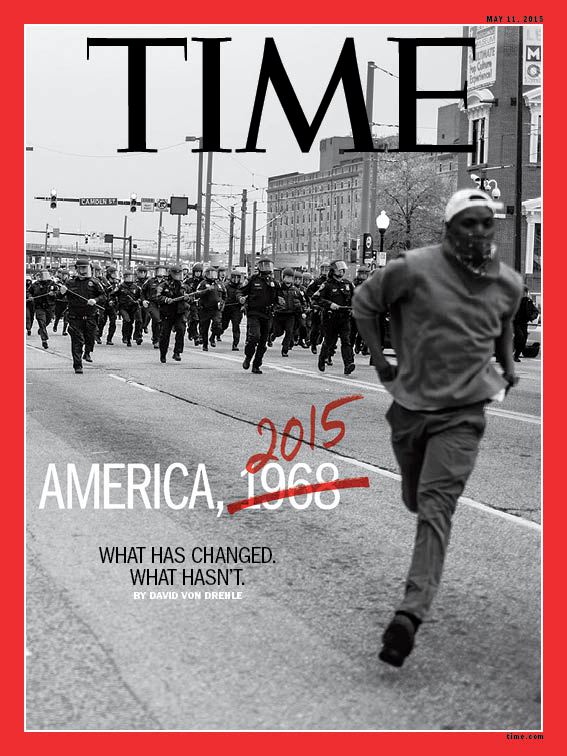
Why Race Riots Happen in US Cities

baltimore-cover-final

Recent images from Baltimore of citizens clashing with police, police in riot gear, and burning buildings appear similar to other riotous incidents in U.S. urban history.

One could go back to the late-90s in Wilmington, NC and see much, much worst.

During that urban upheaval, citizens destroyed parts of the town and forcefully removed dozens of members of a recently defeated political party.

But those rioters were white. The victims of mob violence were black. And the late-90s refers to the 1890s.

The Wilmington, NC, race war, like the NYC draft riots in 1863 and the violence that destroyed the Black sections of Tulsa, Oklahoma in 1921, represents one of many moments of urban racial violence in U.S. history.

If one wants to begin to try and understand what currently unfolds in the streets of Baltimore, one should bear in mind a few historical facts.

First, such violence has happened many times before. Urban race riots in the U.S. happened when civil society showed disregard for black life and people had no faith in their justice system.

Second, history matters a great deal in understanding why urban racial violence occurs, when it happens, and why it happens.

Commentators often discuss all of these moments of violence as race riots, as if they were all the same. They are not, especially when we take a long historical view of racial violence in American cities. Urban race riots from the early twentieth century are not even remotely similar to what people in the U.S. have called race riots since the 1940s.

The three examples I mentioned above featured riotous whites killing black citizens, often with tacit approval – and sometimes active participation – of local law enforcement.

The social, political, and historical context of the violence matters.

So does the very long history of this violence in our country.

We cannot understand what happens today without a deep knowledge of how this violence unfolded in the past, and the recent events that triggered a current conflagration.

Despite profound differences between various types of race riots in US cities, the long history of these destructive moments reveal four commonalities, which might help us understand what is happening in our current cities and how these events connect to past moments of urban racial violence.

One, urban race riots occur when large numbers of people have no or little faith in their current legal system to repair widely perceived injustices.

This fact is probably most important. It is why white men destroyed black Tulsa in 1921. It is why black people burned Los Angels in 1965 and 1992.

Two, violent uprisings usually occur in American cities when groups of people congregate, either in unplanned, spontaneous ways or after scheduled gatherings that descend into unfocused action. In Wilmington, NC, in 1898, the expulsion of black voters happened after a planned political coup led by Democrats. In Memphis in the spring of 1968, some marchers who supported the striking black sanitation workers peeled off from Dr. Kings nonviolent protest and broke windows of downtown stores.

Three, a large presence of law enforcement absent direct one-on-one engagement with angry protesters makes matters worse, not better.

No one really knows why riots stop when they do. But military forces and mass arrests, historically, do not help matters, at least not in the short term.

In Detroit in 1967, the National Guard caused even more deaths than happened during the initial riot.  Once the violence ceases, such police forces do keep order, but peace ensues more quickly and with less reverberations when representatives of civil society – mayors, governors, police forces, respected figures from the angered community – show empathy and try to connect with enraged citizens.

This happened in NYC in 1968 when the mayor and local leaders walked all around Black communities after MLK’s assassination. Some sporadic violence occurred in Harlem and Bed-Sty, but those areas did not burn like over 100 other places that April.

Four, riotous violence does long term damage to the social and economic stability of urban communities where they occur. Some people still point to the riots in Newark in 1967 and how the business districts in that city’s black sections never came back after that violence. Same with the once thriving U street in DC, which burned in 68 and was an economic desert until gentrification revitalized it, and not in ways that benefited low-income black Washingtonians. LA burned in 65 and all sorts of revitalization efforts went into effect, mostly through an organization called the Watts Labor Community Action Council. Then in 1992 the riots destroyed the WLCAC headquarters. The white riots in Tulsa in 1921 totally destroyed the Black business district, and the Black community there never recovered fully.

White riots against black people up through the 1940s and black riots against property and police from the 1960s through the present are certainly not the same types of urban violence. Not by a long shot.

But the long history of urban race riots in America and the contemporary case of Baltimore have some similarities and issues one should consider when trying to make sense of what is happening, and might happen in the future.

These riots in Baltimore did not just happen.

They reflect people’s lack of faith in their civil society – all of it – especially the justice system.

They happened when groups of people got together – sometimes in peaceful assembly and sometimes spontaneously – and then vented their anger and frustration through violence. This violence might be focused insofar as it targets specific objects of frustration, namely police officers and businesses; but it is largely uncoordinated.

A bold presence of law and order, absent direct outreach with angry citizens, or major peaceful protests, which are happening in Baltimore, will probably not make matters better in the short run. Most important, police force without empathy and understanding does not repair the initial lack of faith in the justice system.

The violence, the initial spark of Freddie Gray’s murder, and the rebellious violence that followed, hurts the areas where it happens in the long run. Businesses and communities destroyed by violence, especially ones where low-income people live, work and shop, do not do well in the long term after such violence.

A lot of people want to condemn the rioters in Baltimore harder and louder than they seem to condemn the malfeasance and violence that killed Freddie Gray. Others want to – need to – stay on message: the real injustice here is not broken windows, but broken spines, as DeRay McKesson said in a CNN interview. With so much coverage of burnt stores and broken windows and people throwing rocks at cops, the wider public can lose sight that, at the center of all this is another dead black man, and all known evidence indicates that police killed him.

If the U.S.  wants to address the causes of these riots in Baltimore people first need to address what killed Freddie Gray, and so many others: corrupt, brutal, police officers.

At the same time, history of urban racial violence in the U.S. since the 1960s shows that the people rioting may feel good in the short term, but in the long term their actions hurt the communities and the people their anger supposedly represents.

Those communities and people were in bad economic and social shape before the riots, and had been for a long time, and no one outside of them  seemed to care; not really.

If a contemporary urban race riot is “the language of the unheard,” as MLK said, than maybe America should wake up and listen to those people before they speak with rocks and fire.

Brian Purnell

Brian%20Purnell%200454Brian Purnell is Associate Professor of Africana Studies and History at Bowdoin College. He is the author of Fighting Jim Crow in the County of Kings: The Congress of Racial Equality in Brooklyn (Kentucky, 2013), which won the New York State Historical Association Manuscript Prize in 2012. He has worked on several public history projects with the Brooklyn Historical Society, the Bronx County Historical Society, the Brooklyn Public Library and the University of South Carolina. Before joining the faculty at Bowdoin, he worked for six years at Fordham University as Research Director of the Bronx African American History Project and as an Assistant Professor of African American Studies (2006-2010). He is currently working on two books. The first is an oral history autobiography of Jitu Weusi (Leslie Campbell), a prominent educator and Black Nationalist activist in Brooklyn, New York, during the Civil Rights and Black Power Movements. The second is a history of urban community development corporations since the mid-1960s tentatively entitled, “Unmaking Ghettos: The Golden Age of Community Development in America’s Black Metropolises.” Brian lives in Brunswick, Maine, with his wife, Leana Amaez, and their four children: Isabella, Gabriel, Lillian and Emilia.

Read Full Post »

Lyndon Johnson and the Dominican Intervention of 1965

By David Coleman

US troops patrol the streets near a food line in Santo Domingo on 5 May 1965 during the Dominican Crisis.
US troops patrol the streets near a food line in Santo Domingo
on 5 May 1965 during the Dominican Crisis.

LBJ Regretted Ordering U.S. Troops into Dominican Republic in 1965, White House Tapes Confirm; Yet He Insisted, «I’d do the same thing right this second.»

Dominican Intervention 50 Years Ago Sparked Mainly by Fear of Communists: «I Sure Don’t Want to Wake Up … and Find Out Castro’s in Charge,» President Said

New Transcripts of Key White House Tapes Clarify and Illuminate LBJ’s Personal Role in Decision-Making during the Crisis

National Security Archive Electronic Briefing Book No. 513

Posted – April 28, 2015
Edited by David Coleman
For more information, contact:
David Coleman, david@historyinpieces.com, 703/942-9245
or nsarchiv@gwu.edu, 202/994-7000

Washington, D.C., April 28, 2015 – President Lyndon Johnson regretted sending U.S. troops into the Dominican Republic in 1965, telling aides less than a month later, «I don’t want to be an intervenor,» according to new transcripts of White House tapes published today (along with the tapes themselves) for the first time by the National Security Archive at George Washington University (www.nsarchive.org).

Johnson ordered U.S. Marines into Santo Domingo 50 years ago today. Three weeks later, he lamented both that the crisis had cost American lives and that it had turned out badly on the ground as well as for the United States’ – and Johnson’s own – political standing. Nevertheless, he insisted he would «do the same thing right this second.»

In conversations with aides captured on the White House taping system, Johnson expressed sharp frustrations, including with the group surrounding exiled President Juan Bosch, whom the United States was supporting. Speaking in late May 1965, Johnson told an adviser, «they have to clean themselves up, as I see it, where we can live with them. Put enough perfume on to kill the odor of killing 20 Americans and wounding 100.»

Johnson’s public explanation for sending the Marines into Santo Domingo was to rescue Americans endangered by civil war conditions in the Dominican Republic. But his main motivation, the tapes and transcripts confirm, was to prevent a Communist takeover. Basing his decision largely on assertions by the CIA and others in the U.S. government that Cuba’s Fidel Castro had been behind the recent uprising, Johnson confided to his national security advisor, «I sure don’t want to wake up … and find out Castro’s in charge.»

That intelligence, along with other information Johnson received during the crisis, turned out to be erroneous – a possibility LBJ himself worried about at the time.

The tapes, transcript and introductory material presented in this posting were provided by David Coleman, former chair of the Presidential Recordings Program at the Miller Center at the University of Virginia, and a Fellow at the National Security Archive. As Coleman notes, the materials are revelatory about Johnson’s personal conduct of the crisis and his decision-making style as president. The transcripts, in several cases newly created by Coleman, are crucial to understanding the material on the tapes, which can be hard to decipher and are therefore often of limited usefulness on their own to researchers.

* * * * *

Lyndon Johnson and the Dominican Intervention of 1965

By David Coleman

Fifty years ago today, some 400 U.S. Marines landed in the Dominican Republic. By the end of the following day, over 1,000 more had landed. In the coming weeks, they were joined by U.S. Army forces. Eventually, tens of thousands of U.S. troops would be engaged in what became known as the Dominican Intervention, first as part of a U.S. unilateral military action and then under the auspices of an international force compiled by the Organization of American States.

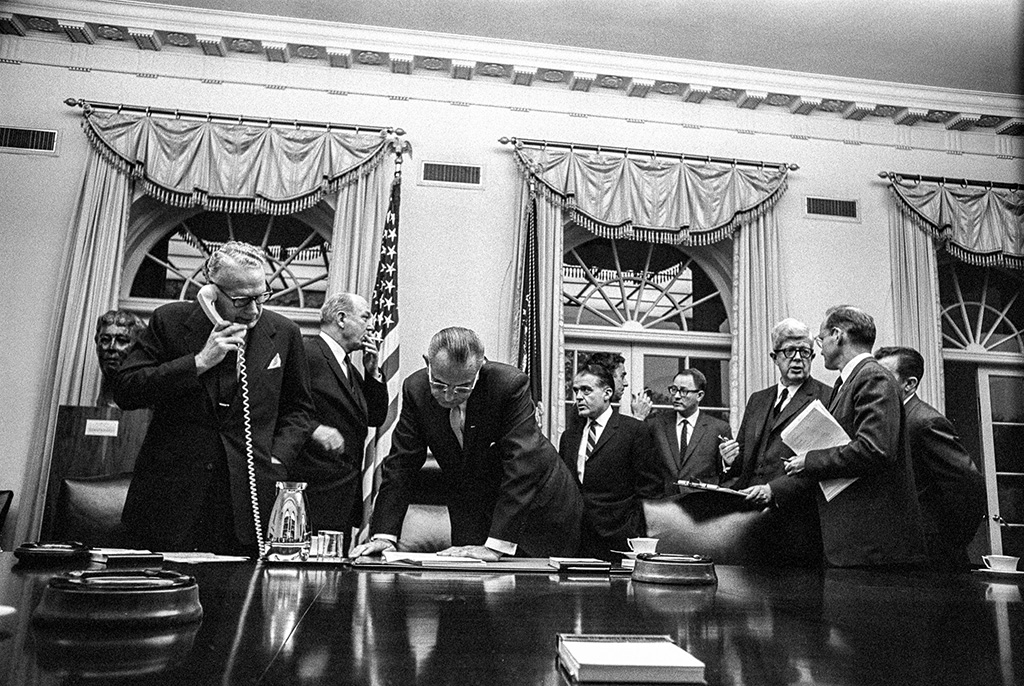
President Johnson huddles with advisers in the Cabinet Room of the White House on April 28, 1965, just before delivering his televised speech announcing the deployment of U.S. Marines into Santo Domingo in the Dominican Republic. L-R: George Ball, Sec. Dean Rusk, President Lyndon B. Johnson, Jack Valenti, Richard Goodwin, unidentified, George Reedy, McGeorge Bundy, unidentified. Photo by Yoichi Okamoto / LBJ Library.

Four days earlier, the Dominican Republic had begun a spiral into civil war when members of the Partido Revolucionario Dominicano (Dominican Revolutionary Party) and their allies stormed the National Palace and installed a provisional president. Resistance from Loyalist forces led to escalating levels of violence.

A series of increasingly dire reports from the U.S. Ambassador to the Dominican Republic, William Tapley «Tap» Bennett, Jr., warning that the situation was getting dangerous for American citizens in the country and that outside influences were likely playing an influential role in the revolution convinced Johnson that he had to act and that he did not have the luxury of time to assemble an international coalition through the Organization of American States.

Against the advice of many of his senior advisers, Johnson personally decided to send in the Marines. Their declared mission was to protect and evacuate U.S. citizens from the island. As he explained it to a national television audience on the evening of April 28, it was «in order to give protection to hundreds of Americans who are still in the Dominican Republic and to escort them safely back to this country.»[1]

There was no mention of a communist threat in his public statement; nor had there been in his news conference comments the previous afternoon. Indeed, Johnson himself had specifically removed any such references from the drafts of his statement to encourage an emphasis on the peace-keeping and humanitarian aspects of the intervention. But there was a second important part of the military mission. As Chairman of the Joint Chiefs of Staff General Earle Wheeler put it in orders to General Bruce Palmer Jr., the commander of U.S. forces, the mission had two objectives, one announced and one unannounced.

Your announced mission is to save US lives. Your unannounced mission is to prevent the Dominican Republic from going Communist. The President has stated that he will not allow another Cuba—you are to take all necessary measures to accomplish this mission. You will be given sufficient forces to do the job.[2]

Johnson feared that Castro-ite and Communist forces were threatening to establish a Communist regime in the Dominican Republic. But there was little hard evidence of such influence—something Johnson suspected at the time and which prompted later private expressions of regret.

LBJ’s secretly recorded White House tapes provide a deeply textured and intimate view of his decision making during the crisis.[3]

The telephone had long been one of Johnson’s essential work tools, allowing him to neutralize geography and compress time in reaching out beyond the bubble of the Oval Office. During the Dominican crisis, he employed it extensively, connecting directly with Tap Bennet in Santo Domingo, and with Puerto Rico where Abe Fortas (the future Supreme Court justice) had volunteered his services as a line of communication with exiled president Juan Bosch. He was also able to get status reports at all hours directly from the duty officers in the White House Situation Room and the Pentagon Military Command Center.

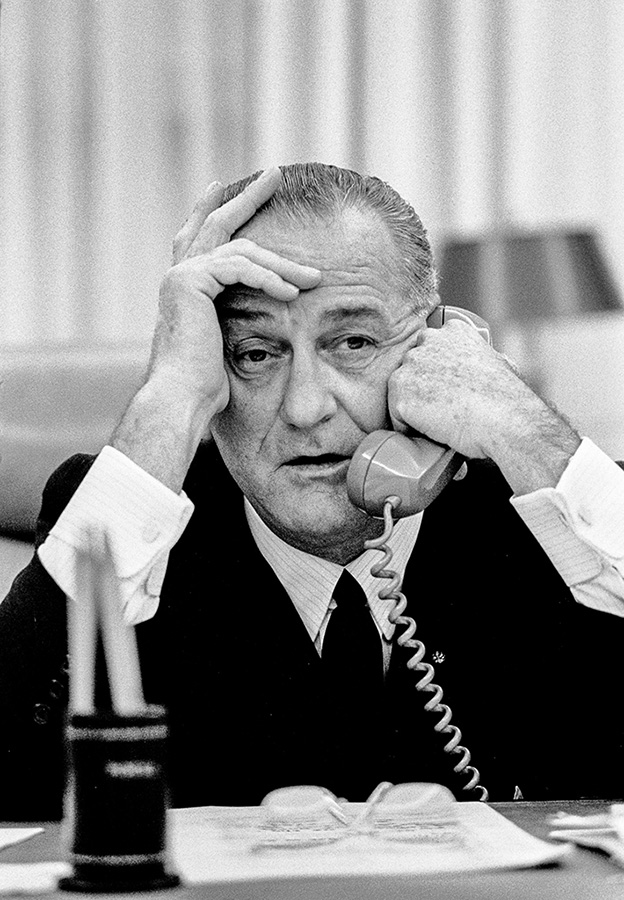
President Lyndon Johnson on the telephone in the Oval Office on July 17, 1965. Photo by Yoichi Okamoto / LBJ Library.

But it did not always go smoothly. The lack of secure communications equipment meant that the President and his representatives in the Caribbean typically had to speak over open lines that were prone to interception or just the more mundane problem of crossed lines. In some cases, that led to absurdly convoluted codes being improvised that often created more confusion than clarity. In one call presented below, Johnson tells Secretary of Defense Robert McNamara to call Bennett in Santo Domingo to ask his opinion on whether to send in an additional 500 Marines. «Listen for him to cough right loud, and if he doesn’t, why, let’s move,» Johnson instructs.[4]

Reflecting Johnson’s own heavy personal involvement in directing the intervention, the crisis is represented on hundreds of tapes in the Johnson collection of secretly recorded White House telephone conversations. Below is only a small sampling taken mainly from the first days when the important decisions were being made about sending U.S. Marines into harm’s way and whether to escalate U.S. military involvement.

The transcripts presented here provide a cross-section illustrating Johnson’s personal management of the crisis. Some of them are entirely new; others are improved versions of transcripts that have been published elsewhere previously. Together they reveal the kind of information that the President was hearing, including when, how, and from whom. They reveal, strikingly and often jarringly, the kind of incomplete and often flawed information that was being used to make important decisions. And they show the gap between what was being said in public and what was being said in private, a phenomenon that had troubled the administration less than a year earlier in the Tonkin Gulf episode and would become increasingly important as the Vietnam War raged on.

* * * * *

Links to Tapes and Transcripts

[Note: The following tapes are available at the Lyndon B. Johnson Presidential Library, White House (WH) and Situation Room (SR) Series, Recordings and Transcripts of Conversations and Meetings.]

(See http://www.lbjlib.utexas.edu/johnson/archives.hom/Dictabelt.hom/content.asp.)

Read Full Post »

Rioting: An American Tradition

Group of young white men turn a car on its side during Detroit riots of 1943

Group of young white men turn a car on its side during Detroit riots of 1943. (Photo: Walter P. Reuther Library)

Some observers look aghast at the people rioting in Baltimore in protest of the police brutality that led to Freddie Gray’s horrific death in police custody. Pundits have bemoaned the actions of “thugs” who looted stores and burned cars, and politicians have pled for non-violence. Plenty of bewildered observers have wondered what good it does anyone to burn their own neighborhoods. But looking at the rioters in Baltimore, or any other place, in isolation misses the point. If Americans have one grand political tradition, it is rioting.

There was a little matter of some tea in Boston in 1773, when men dressed up as American Indians boarded three ships moored at Griffin’s Wharf, broke open their valuable cargoes of tea, and dumped the chests overboard. They destroyed about 90,000 pounds of tea, worth about $1.7 million today.

New York City exploded dramatically at least twice in the mid-nineteenth century. In May 1849 more than 25 people were killed and more than 120 injured in a struggle over which Shakespearean actor was better: American Edwin Forrest or Englishman William Charles Macready. The Astor Place Riot, as it was known, was so violent the authorities started to worry they had lost control of the city. They called out troops, who fired indiscriminately into the crowd.

Only fourteen years later, New York City blew up again when men furious at a new federal draft for Union soldiers turned against the men they blamed for the war itself. They killed Republican officials and soldiers, then turned on the city’s African American community. At least 120 people died and another 2000 were injured. Rioters destroyed between 1 and 5 million dollars in property, about fifty buildings, including two churches and an orphan asylum for African American children. In today’s dollars, that would be between $20 million and about $96 million in damage. This remains the most destructive riot in American history.

Cincinnati exploded in March 1884 when a mob set out to lynch a convicted murderer who had been sentenced to twenty years of prison rather than execution. Three days of rioting left more than 50 people dead (but not the prisoner, who had temporarily escaped) and more than 300 wounded.

In Ludlow, Colorado, in 1914, after company guards and the Colorado National Guard fell on a camp of striking coal miners and their families, killing between 20 and 26 of them, the strikers armed themselves and attacked coal mines and property over a forty-mile stretch of land. Between 69 and 199 people were killed.

Three days of race riots in Detroit, in 1943, broke out when 25,000 white workers walked off their war-related jobs at the Packard Motor Car Company rather than work next to three African Americans who had been promoted to their assembly lines. The rioting stopped only when President Roosevelt sent in federal troops. The fighting left 34 dead.

Another race riot tore Oxford, Mississippi apart on the night of September 29, 1962, after the federal government tried to enforce the enrollment of James Meredith, a black army veteran, at the University of Mississippi. Two civilians were killed and more than 300 wounded by white rioters before federal troops restored order.

For a week in August 1965, the African American residents of the Watts neighborhood of Los Angeles rioted. Thirty-four people died and more than $40 million worth of property was destroyed before 4,000 members of the California National Guard restored order. The Watts riots were the first of several years of race riots that burned across American cities in the late 1960s.

It was also Los Angeles that saw the Rodney King riots of 1992 after four white LAPD officers were acquitted of assault and use of excessive force in their beating of African American Rodney King after a high-speed chase. Rioters looted, burned, and attacked others, including, spectacularly, a white truck driver, Reginald Denny, who was stopped at a traffic light. In six days, 53 people were killed, more than 2,000 injured, and more than $1 billion in property was destroyed. The rioting ended when soldiers were deployed to calm the city.

If there is one constant in American history it is rioting.

There is a common theme to most American riots that is obscured if any one of them is seen only in isolation. What do Samuel Adams and his Tea Party protesters have to do with black rioters at Watts in 1965? What similarities are there between the Irish immigrants who fought over actors in the Astor Place Riot and the members of the white Cincinnati lynch mob?

American rioters take to the streets for a peculiarly American reason: They believe that the government is unduly privileging someone over them. The game, they think, has been rigged, and they are the losers.

The Boston Tea Partiers insisted that they were being taxed unfairly by the British Parliament to benefit the wealthy British East India Company to which Parliament had awarded an expensive monopoly on the tea trade. The Astor Place Riot was not about the actors’ talent – both were highly skilled – it was a struggle over who would control New York City politics: the elites who favored the British actor, or the workingmen who favored the American.

And so it went through almost every American riot: the issue at stake was that government appeared to be favoring one group over another. The New York City Draft Riots turned poor white Democrats against the wealthier white Republicans whose war policies they believed were killing them to benefit African Americans. In Cincinnati in 1884 the mob insisted that criminal voters were keeping a corrupt political machine in power, and that, in turn, those corrupt politicians were cutting criminals slack in the courts (this argument is still advanced on Wikipedia today). In Ludlow, the fact that the National Guard murdered more than 20 civilians, including women and children, camped in tents gave pretty strong evidence that the government favored employers.

The white plant workers in Detroit in 1943 recoiled from the influx of southern African Americans to their neighborhoods. Those southern workers had been recruited by the government to move north to work in war industries. Government officials built housing for the black migrants in a white neighborhood, and after white supremacists burned a cross, racial violence erupted. While both sides complained that government policies favored the other, it is notable that 75% percent of the injuries in the riot were suffered by African-Americans, but black people made up 85% of the arrests.

This same racial dynamic lay behind the riots in Oxford and Los Angeles. Whites at Ole Miss were explicit that they had no intention of bowing to a government that favored African Americans. At Watts and in the Rodney King riots, both sparked by white police brutality, African Americans reacted to the American systems of power that were stacked against the black community.

As long as America is a democracy, we will have riots. But they will not all be viewed in the same historical light. Riots bring popular attention to a perceived inequality. Once people start paying attention, the unfairness of the underlying situations in places like Ludlow or Watts or even colonial Boston, make them sit up and work to fix those inequalities. But as often, popular attention to the rage of rioters makes it clear that the rioters are the ones trying to maintain inequalities. Popular disgust for the mobs in the New York City Draft Riots or at Ole Miss moved society forward too, but not in the way those rioters anticipated. Far from achieving their ends, the rioters in New York City in 1863 or the ones a century later at Ole Miss created a backlash that advanced the very policies they opposed.

The people who are burning Baltimore are not thugs. They are Americans, acting in a grand American political tradition. Calling them thugs and demanding non-violence prejudges them as those who are out of step with modern America. It says that, like the New York City Draft Rioters or the segregationists at Ole Miss, the wrongs they are protesting are in their own heads. That the city of Baltimore has paid damages to more than 100 victims of police brutality in the past three years, and that Freddie Gray’s spine was mysteriously severed and his larynx crushed in police custody, makes it seem unlikely that today’s protesters are imagining injustice.

Heather Cox Richardson

Historian. Author. Professor. Budding Curmudgeon. Heather Cox Richardson studies the contrast between image and reality in America, especially in politics.

Read Full Post »

La intervención estadounidense en República Dominicana: 50 años

Medio siglo después, es hora de refutar las ideas convencionales en Washington

Abraham F. Lowenthal

El país 28 de abril de 2015

LowenthalLa intervención militar de Estados Unidos en la República Dominicana que comenzó el 28 de abril de 1965 fue objeto de numerosas condenas en su momento, tanto en América Latina como en Estados Unidos. Su propósito fue evitar “una segunda Cuba”, pero las autoridades norteamericanas, en especial el presidente Lyndon B. Johnson, fueron mucho más allá de los hechos objetivos al especular sobre la posibilidad de que los comunistas se hicieran del poder. El imperativo de evitar esa segunda Cuba distorsionaba su capacidad de reunir información veraz y analizarla.

Con el paso del tiempo, sin embargo, muchos en Washington empezaron a considerar la intervención en la República Dominicana como un éxito. Su argumento era que se habían logrado los cuatro objetivos propuestos: proteger a los ciudadanos estadounidenses y de otros países, detener la violencia, impedir una posible toma comunista del poder y restaurar los procesos constitucionales para bien del pueblo dominicano. Para dichos analistas, el episodio fue una demostración de poder de Estados Unidos que proporcionó enseñanzas prácticas sobre el uso eficaz de la fuerza. Esta opinión acerca de la operación dominicana pasó a ser una conclusión a la que Washington arribo sin el suficiente análisis.

Exactamente 50 años después de la invasión, ha llegado el momento de refutar esa idea tan prevaleciente.

Los costes de la intervención de 1965

Los costes de la intervención de 1965 no se han calculado debidamente. Los costes humanos y materiales fueron importantes, pero fueron los costes intangibles los que fueron especialmente elevados. La intervención en la República Dominicana redujo las probabilidades de éxito de las reformas pacíficas que muchos funcionarios estadounidenses deseaban ver en América Latina. Algunos conservadores latinoamericanos –sobre todo en Centroamérica– llegaron a la conclusión de que Estados Unidos no iba a permitir que triunfaran los movimientos reformistas. Muchos de los latinoamericanos comprometidos con el cambio democrático se convencieron de que Estados Unidos iba a oponerse incluso a esas reformas, y que por consiguiente valdría la pena unir fuerzas con la extrema izquierda.

La intervención dominicana tuvo también graves consecuencias dentro de Estados Unidos. La escandalosa falta de transparencia del gobierno de Johnson agravó la desconfianza entre la administración y muchos líderes de opinión, contribuyendo a la crisis de credibilidad que acabó inspirando la reacción estadounidense ante Vietnam.

Donde más serios fueron los costes intangibles fue en la República Dominicana. La intervención intensificó la fragmentación política y la dependencia de Estados Unidos, e hizo más difícil el desarrollo de instituciones políticas efectivas. Irónicamente, una de las principales contribuciones resultó de la reforma inmigratoria de ese año en EEUU, cuya consecuencia fue un aumento de la inmigración dominicana, con el consiguiente flujo de remesas, experiencias e ideas.

La relativa facilidad para terminar la intervención

En el caso de la República Dominicana, varios aspectos singulares ayudan a explicar la facilidad con la que Estados Unidos pudo terminar la ocupación. Dos reconocidos líderes políticos –Juan Bosch y Joaquín Balaguer—contribuyeron a resolver la crisis mediante la convocatoria de nuevas elecciones. La excepcional prudencia mostrada por el presidente provisional, Héctor García-Godoy, y el embajador estadounidense, Ellsworth Bunker, permitieron la rápida partida de las fuerzas norteamericanas. Si después Estados Unidos hubiera enviado sus tropas a Haití –que no tenía instituciones ni grupos políticos sólidos, ni figuras políticas de peso–, habría sido más difícil partir, como sucedería posteriormente en Irak y Afganistán.

La experiencia dominicana indica con claridad que Estados Unidos necesita diseñar métodos alternativos para perseguir sus objetivos, sobre todo ayudando a fomentar el desarrollo político, social y económico de los países y territorios más cercanos geográficamente, con los cuales el país está tan estrechamente relacionado.

La enorme diferencia entre las relaciones de Estados Unidos con sus vecinos más próximos y el resto de sus relaciones internacionales ha sido evidente desde hace mucho tiempo, pero ha adquirido especial importancia durante los últimos 50 años. Las nociones históricas de soberanía significan cada vez menos, aunque se sigan proclamando a voces.

Los problemas derivados de la creciente interacción de Estados Unidos y sus vecinos –tráfico de personas, drogas y armas, inmigración, medio ambiente, salud pública, turismo médico y prestaciones sociales y de sanidad transferibles, catástrofes naturales, política policial y vigilancia de fronteras– son retos especialmente complejos para las dos partes. Estas difíciles cuestiones, internacionales e internas al mismo tiempo, se complican aún más en los países con muy escasa capacidad estatal –Guatemala, Honduras y Haití en particular–, con quienes se hace aún más necesario mantener una estrecha cooperación por el bien de los pueblos de ambos lados, una necesidad que crece año tras año.

Cincuenta años después de la intervención de 1965 en la República Dominicana, producto de la obsesión de Washington con Fidel Castro, no solo ha llegado el momento de tener una relación de mutuo respeto con Cuba sino también de desafiar otras mentalidades enquistadas y encontrar respuestas más creativas a la persistente interdependencia entre los países de la Cuenca del Caribe y Estados Unidos.

Abraham F. Lowenthal, catedrático emérito en la Universidad de Southern California e investigador titular no residente de la Brookings Institution, fue fundador y director del Programa Latinoamericano del Woodrow Wilson Center y del Diálogo Interamericano.

Traducción de María Luisa Rodríguez Tapia

Read Full Post »

It’s The Apocalypse, Stupid: Understanding Christian Opposition to Obamacare, Civil Rights, New Deal and More

Daniel Silliman

Religión Dispatches  December 2, 2014

rapture
Title: American Apocalypse: A History of Modern Evangelicalism
Author: Matthew Avery Sutton
Publisher: Harvard University Press
Release Date: December 15, 2014  
    

American Apocalypse: A History of Modern Evangelicalism Book CoverAmerican evangelicals have been waiting for the world to end for a long time. But that’s not to say they’ve just been sitting around. Apocalypticism has inspired evangelistic crusades, moral reform movements, and generations of political activism.

In his latest book, Matthew Avery Sutton, a professor of history at Washington State University, traces this history of American evangelical apocalypticism from the end of the 19th century to the present day. In the process, he proposes a revised understanding of American evangelicalism, focused on the urgent expectations of the end of human history. If you want to understand modern evangelicalism, Sutton says, you have to understand their End Times theology.

Daniel Silliman spoke with Sutton at the Heidelberg Center for American Studies, in Heidelberg, Germany.

Why write about evangelical Christian apocalypticism?

The question that initially sparked this research was why were fundamentalists and their evangelical heirs skeptical of the state? Why were and are they critical of the federal government? I started thinking about this in the context of the health care debates over the last decade. Why were so many Christians so reluctant to support national health care? I could see why they were critical of the Democratic party on gay rights. I could see why they were critical on abortion. What I didn’t understand is why, as a conservative Bible believing Christian, you would be opposed expanding health care.

This book is a very long, 480-page answer to that question.

My argument in a nutshell is that the apocalyptic theology that developed in the 1880s and 1890s led radical evangelicals to the conclusion that all nations are going to concede their power in the End Times to a totalitarian political leader who is going to be the Antichrist. If you believe you’re living in the last days and you believe you’re moving towards that event, you’re going to be very suspicious and skeptical of anything that seems to undermine individual rights and individual liberties, and anything that is going to give more power to the state.

How significant is apocalypticism in the history of American evangelicalism?

The idea that Jesus is coming back soon was a fairly radical and unconventional idea in the 19th century, but by the 21st century it’s the air American Christians breathe. The most recent polls said something like 58 percent of white evangelicals believe Jesus is going to return by 2050. They simply take for granted that there is going to be a Rapture and Jesus is going to come back.

I took those statistics and others like them and moved backwards in time. What I found in my research was that apocalypticism was central to fundamentalists and evangelicals. What made them most distinct, what set them apart from liberal Protestants is not what we’ve traditionally thought. It’s not questions of the virgin birth or how you read the Bible or questions of the nature of the incarnation or the literal resurrection of Jesus or Jesus’s miracles. All those matter, all of those things do set them apart, but they don’t affect how they live their daily lives. The one thing that affects how they live their daily lives is that they believe we are moving towards the End Times, the rise of the Antichrist, towards a great tribulation and a horrific human holocaust.

In their minds, the imminent Second Coming would not be as important as getting people saved. Salvation, converting sinners, would be the most important thing driving them. But in terms of how they’re shaping and organizing their own lives, I think apocalypticism has been the driving force for much of the last century. It has fueled the movement and shaped it in fundamental ways.

If you haven’t been in the archives it’s really unbelievable to read these articles, these sermons and these letters, to realize how much apocalypticism saturated the minds of fundamentalists and evangelicals in the 20th century. The looming rise of the Antichrist was just the forefront of their thinking.

And they say that. Over and over again. They’re very clear.

This is significant because to believe the world is rapidly moving to its end effects how you vote, how you’re going to structure your education, how you understand the economy, how you’re going to treat global events, how you’re going to look at organizations like the United Nations.

Apocalypticism is central to understanding how fundamentalists and then evangelicals acted.

Can you give a broad outline of this theology?

It’s a relatively complicated theology that fundamentalists and then evangelicals drew from a lot of different influences, a lot of different impulses. The key to unlocking their theology is to see some fairly obscure passages from the books of Daniel, Ezekiel, Revelation, and Jesus’s sermon in Matthew 24 through their eyes.

But their conlusions, broken down to their simplest form are these: We’re living in the church age and we’re moving towards the Rapture. Jesus will Rapture all true believers out of this world, they’ll just disappear, they’ll go up to heaven with Jesus, and then with the loss of Christian influence in the world, Satan will have free rein to take power through a political leader, called the Antichrist, who is then going to rule over the world for seven years. This period is called the Tribulation. Antichrist rule will lead to a series of wars, which will then culminate with Jesus coming with an army of saints and fighting the battle of Armageddon, in the literal land of Palestine. Jesus will defeat the Antichrist, vanquish evil and then establish a new kingdom.

There’s been a long debate in Christian history about the timing of Jesus’s Second Coming. Would he come to initiate the start of a new millennium, a 1,000 years of peace and prosperity, or would he come at its conclusion? Fundamentalists and most evangelicals believed that Jesus is going to come back before the millennium. From there they determined that there will be signs or indications that tell us we’re approaching the Second Coming. They believe the Bible had laid out these signs, the sequence of events that would happen, as they understood it, as we get closer and closer and closer to the Second Coming of Christ.

The rough picture is that we’re moving towards the End Times. Instead of the idea that Christians are building the kingdom of God on earth, the earth is on a quick, slippery slope descending to hell.

What is the practical effect of this expectation?

Traditionally, people have believed that this expectation that Jesus is coming back would lead to indifference, that people would focus on the next world, they would invest very little in this world. In fact, they’ve done just the opposite. This is a central argument in the book.

D.L. Moody is often used to illustrate the idea of indifference. He famously said that the world is a sinking ship and God has given him a lifeboat and told him to save as many as he could. That’s the idea, that there’s not anything you can do but save those who are sinking. At the same time, Moody turned around and established what were later known at the Moody Church and the Moody Bible Institute, which were extremely active in reform movements during the progressive era. They were focused on issues of crime in Chicago, sanitation, temperance, and in all kinds of moral reform efforts.

It’s clear from Moody to Billy Sunday to Aimee Semple McPherson to Billy Graham to Jerry Falwell, that to believe that Jesus is coming at any moment does not make you less active or less involved in your culture. They say over and over and over again that this is not the case. We just haven’t heard them. Every generation of evangelicals and fundamentalists says it. Their apocalyptic theology makes them more active not less.

There is a biblical argument for this that they use. It’s the parable of the talents. In this story a ruler invests in his servants, giving each of them a number of talents, or money. He then goes away to another kingdom. When he comes back he wants to know what they’ve done with their talents. Some had buried their talents, afraid of losing it. Some had lost the money, wasting their talents. But some had invested wisely and made more money. So the returning ruler rewarded those who had invested wisely and maximized their talents and used them for greater good. For fundamentalists and evangelicals, the point here is that God has given them talents. He’s gone away, he’s coming back, he’s coming back soon, and he’s going to ask what you’ve done with your talents. Jesus ended the parable by instructing the disciples to “occupy” until I come. And that’s what fundamentalists and evangelicals have done.

That means that, far more than many other Christians, they believe they have a responsibility to act as vehemently, as radically, as urgently as possible.

What I’m arguing is that in fact the conviction that Jesus is coming back very very soon creates a sense of urgency, or anxiety or excitement that means there is no time to spare, because the clock is ticking and they’re almost out of time.

The standard narrative of white evangelical history is a great withdrawal from culture in the 1920s and then a reengagement in the 1950s, leading to the religious right in 1980s. Do you want to revise that?

Yes. That’s one of the historiographical arguments I’m making in the book. The traditional argument is that fundamentalists were active and engaged in American society until the Scopes trial, the anti-evolution trial, in 1925. They were humiliated and defeated in the Scopes trial, they withdrew and focused on building their churches, their institutions, but they weren’t engaged in mainstream culture until the rise of Billy Graham who helped turn them around. Then it’s a few quick steps to the rise of the religious right.

That’s incorrect. They never gave up. They never withdrew or disengaged from culture. In the 1930s, for example, most of these fundamentalists were very critical of the New Deal. For Americans who were actively looking for signs of the coming Antichrist in the context of the 1930s, in the context of Hitler, Stalin and Mussolini, Roosevelt had all the markings of someone setting the stage for the end times. He was concolidating power. Government was growing.

I found a letter from one of Franklin D. Roosevelt’s operatives. He had gone out to survey the country and look for areas of strength and weakness before the 1936 election and what he told FDR is that the greatest threat was not from the economic reactionaries, that was his term, but from the religious reactionaries. He said the “so-called evangelical churches are strongly against you.” It was shortly after that that FDR issued a letter to all the churches of the nation, asking for their support, and asking what he could do to better meet their needs.

Fundamentalists were involved in politics, they were involved in social reform. A few of them were talking about abortion and same-sex relations in the 1930s. They were very much active and involved with what was going on around them. There’s just no evidence to show that they retreated.

I’m trying to decenter the Scopes trial as not that substantial of a moment in the history of evangelicalism.

What about African-American evangelicals? How were they apocalyptic?

This was one of my favorite parts of doing this book. I wanted to take seriously how African-American evangelicals compared and contrasted with white evangelicals. They started from the same theological premises, but came to very different political and social conclusions.

They had that sense of fever and anxiety and hope for Jesus’s Second Coming, but for them, the signs of the times and the method of occupying until he comes were very, very different.

There were a number of important and substantial issues that were not on white evangelicals’ radar screens, but for black evangelicals, they were absolutely central to what it meant to be living in an apocalyptic age. For them a sign of the End Times was not the supposed lawlessness of Martin Luther King, Jr., a claim made by some white evangelicals. No, for African Americans a sign of the coming tribulation was lynching. They didn’t see the Antichrist coming out of the New Deal, they saw the Antichrist as an extension of state governments that were racist and had Jim Crowed them for generations. They too had a very strong sense that Jesus was coming back, but he was coming back for different reasons, he was going to right different wrongs, and he was going to bring a different kind of peace and a different kind of justice. A different kind of millennium.

While African Americans were having their own theological discussions among themselves, they were also aware of developments in the white evangelical community, but they were not engaging directly with white theologians. For them it was a different kind of discussion. For them, thinking through apocalyptic theology was happening in the context of a long black liberation tradition, so they put a lot of emphasis, for instance, on a verse in Psalms that talks about a great leader coming out of Abyssinia or Ethiopia. There was a sense in which Jesus’s return was the coming of a black liberator.

White fundamentalists and evangelicals were very clear that they didn’t want anything to do with African Americans for most of the twentieth century. They didn’t see African Americans as able to contribute to their movement. The racial assumptions were built into who evangelicals and fundamentalists were as people, just like the vast majority of white Americans right alongside them. They were no different.

But what apocalypticism did was give white evangelicals a framework and a rationale for fighting the Civil Rights movement, for example. In the last days, they insisted, there will be lawlessness. So they saw the Civil Rights movement as an example of people who break the law. Whiteness influenced these evangelical theologians, and when we compare them with African American theologians we can see how their sensitivities influenced the way they read, understood, and applied the Bible.

How does apocalypticism shape someone like Billy Graham and, by extension, modern evangelicalism?

Billy Graham gets a pass from a lot of scholars who pay very little attenion to his apocalypticism. I think that’s wrong. I think it’s been a core of his ministry. In 1949, when Graham had his first major revival in Los Angeles, the famous one that put him on the map, the revival began just days after Harry Truman announced that the Soviets had tested an atomic bomb. So Graham used this to say, the end is near, the time is close. You have to get saved today because Jesus is coming back.

He would say getting people saved is the engine driving him, but the reason there’s an urgency to getting people saved is that Jesus may be coming back before we wake up in the morning. And he would say that at every revival campaign. That was his message.

He wrote about it more than just about any other topic. He published books on apocalypticism in the 1960s and the 80s and the 90s and 2010. In 2010, writing as a 91-year-old, he believed this message was one of the most important things he could leave behind on this earth. In this book he says the signs are now clearer than ever. He’s written a lot of books, but five on apocalypticism? I don’t know that he’s covered any other topic in five books.

At the same time, I want to be very clear: postwar evangelicalism grew far more diverse than interwar fundamentalism. After the war, the movement got bigger, broader, more inclusive and less tied to apocalypticism. What happens is essentially evangelicalism divides, and you have these more respectable people like Graham and Carl F. H. Henry and Harold John Ockenga, and others on one track preaching a respectable, moderate apocalypticism. Then you have populist apocalyptics who become incredibly popular, like Hal Lindsey in the 1970s, Tim LaHaye in the 1990s and into the 2000s. Then, you have growing numbers of self-proclaimed evangelicals completely rejecting the apocalypticism that had for so long given their movement its distinctive identity. The story of postwar evangelicals is this tension between the more respectable, more careful, more savvy, leaders and those who preached a radical populist apocalypticism that harkened back to the 1910s, 1920s, and 1930s.

And yet the apocalyptic never leaves. It’s still there, that’s where the polls come back. It’s now assumed by hundreds of millions of Americans that the rapture is a real thing and that Jesus is coming back.

It’s a genius theology, because it allows people to look at very diverse, very troubling, very dark contemporary events and put them in a context; to say, “I know why this is happening, and it’s going to turn out OK. We are going to be OK.” It gives them peace, comfort and hope in a world that often offers none of those things.

Read Full Post »

Whatever Happened to the Environmental Movement?

HNN April 22, 2015

Today, April 22, marks forty-five years since the first Earth Day. On this day in 1970, millions of people of all ages, politics, and regions of the country participated in thousands of locally planned events. Teach-ins, rallies, protests, and gatherings and discussions of many kinds expressed the nationwide concern about unchecked pollution and environmental destruction.

Earth Day inaugurated a decade of environmental action. Responding to this popular outcry, the federal government created the Environmental Protection Agency, protected endangered species, cleaned up the air and water (mostly), banned or restricted toxic chemicals, tightened regulation of nuclear power plants, and established the Superfund to clean up toxic waste sites.

Earth Day 2015 is unlikely to be anything like that first Earth Day. Environmental organizations have far more members than in 1970 (the Sierra Club, for example, has almost 40 times more members) but are weaker than ever. Congress has passed no major environmental legislation in 25 years. The environmental movement has never been bigger – or less effective at the national level.

Many factors explain environmentalism’s relative impotence now. Yet, since most Americans agree that something needs to be done about problems like global warming, extinction, and other environmental issues, perhaps the most important factor has been the disappearance of charismatic, effective leaders. In the 1960s and 1970s, prominent authors and activists fired up a movement that challenged and changed the nation. Rachel Carson’s Silent Spring spread the word about the dangerous chemicals humans were putting into the natural world (and into us). David Brower led the Sierra Club to national prominence and political influence. Edward Abbey’s books like his bestselling Desert Solitaire railed against destruction of American wilderness. Ever since the days of John Muir (founder of the Sierra Club) and Theodore Roosevelt (the “greenest” president in the nation’s history) over a century ago, popular figures like these had fought commercial interests to a standstill.

Interestingly, these figures all had one common element in their backgrounds, one which helps explain their success as environmental leaders, but one which historians have not noticed. They all grew up in a Presbyterian church. Presbyterians a century ago were a more fervent breed than their mild middle-class descendants today. They were righteously indignant against the greed of private interests who would corrupt politics and injury the common good for private profit. An intense moral urgency drove them to stop those who selfishly destroyed natural places or hurt the weak and poor. They felt impelled to preach righteousness to an erring nation.

For 50 years beginning in 1889, a series of leaders and government officials, all raised Presbyterian, made conservation and environmentalism a powerful national force. They established forest reserves, later called National Forests, and added new national parks. In this half century, only in the administrations of Methodist William McKinley and Unitarian William Howard Taft did the cause of conservation lose priority.

The most determined was Roosevelt, creator of dozens of parks, national forests, national monuments, and wildlife sanctuaries. When people called him “a preacher of righteousness,” he merely joked that after all he had “such a bully pulpit.” His friend Muir, too, preached, offering the God of the mountains to anxious urban America.

By the 1960s, Presbyterians rarely filled national office, but like Old Testament prophets called the nation to righteousness and helped birth the environmental movement. Carson’s father and uncle were Presbyterian ministers. Her landmark Silent Spring of 1962 drew its power from its scientific arguments as well as its moral indictment of heedless corrupting corporate greed. Brower called his standard talk the “Sermon” and treated environmentalism as a religion. He successfully led fights against dams in the Grand Canyon and for the protection of works of the Creator from a rapacious mankind. Abbey, whose mother played organ in her small-town Presbyterian church, also decried the destruction of wilderness Edens for profit.

But in the changing Presbyterian church the fires of righteous moralism cooled. Their pulpits ceased to supply role models and train the preachers of righteousness who gave environmentalism urgency and fervor. Rightwing Protestants, filled with disdain for social justice and government regulation and fired with a righteous self-confidence, took their place. They rallied their congregations and sent them off to the “culture wars.” Both environmentalism and liberalism have been on the defensive ever since.

If nothing else, Earth Day 2015 should remind us that people are ready and eager to fight for a greener, healthier, more just world. Once, churches like the Presbyterians raised up inspiring, effective leaders who in the secular world could lead mighty crusades. Yet as they declined, no similar institution took its place, and the environmental movement wanders in the wilderness without prophets to lead it to the Promised Land.

Mark Stoll, Associate Professor of History and Director of Environmental Studies at Texas Tech University, is the author of “Inherit the Holy Mountain: Religion and the Rise of American Environmentalism.”

Read Full Post »

Capturing History as it Really Happened in October 1962 

Sheldon M. Stern

HNN April 20, 2015

President Kennedy meets in the Oval Office with General Curtis LeMay – Wikipedia

Historians are obviously familiar with research based on old or new primary sources as well as with work that synthesizes both primary and secondary sources. Historical investigation based on audio recordings, however, is clearly distinct from these more traditional categories of historical investigation because, as Max Holland and I wrote in 2005—

the historian shoulders an even larger burden in this new genre. He or she is obviously selecting, deciphering, and making judgments about a primary source, much like the editor of a documentary collection. But, in the process of transcribing a tape recording, the historian is also creating a facsimile—while still endeavoring to produce a reliable, “original” source. In essence, the historian/editor unavoidably becomes the author of a “new” source because even a transcript alleged to be “verbatim” is irreducibly subjective at some level. As a result, the historian’s responsibility in this genre is a very unusual one, and requires the most careful scholarship imaginable. No other task of discovery and/or interpretation in the historical canon is quite comparable.

As the audio recordings from the Kennedy, Johnson, and Nixon presidencies have gradually been made public, historians have been drawn to this extraordinary challenge. As Columbia University’s Alan Brinkley concluded, “No collection of manuscripts, no after-the-fact oral history, no contemporary account by a journalist will ever have the immediacy or the revelatory power of these conversations.”

My own work, which includes the three books cited above on the JFK Cuban missile crisis tapes, has underscored the unique value of these recordings, for example, by demonstrating—conclusively and incontrovertibly—that Robert Kennedy’s Thirteen Days should no longer be taken seriously as a historically reliable account of the October 1962 White House ExComm meetings.

Last month the History News Network ran my short piece about a fascinating and surprising exchange between President Kennedy and Republican House Minority Leader Charles Halleck at the height of the Cuban missile crisis. In fact, there are many such dramatic and revelatory exchanges on the ExComm tapes and editor Rick Shenkman has agreed to my suggestion to periodically offer HNN readers additional historical snapshots of some of the most striking moments on these unique recordings.

The Context

On Sunday, October 14, 1962, U-2 photos revealed solid evidence of Soviet ballistic missile sites in Cuba. National Security Adviser McGeorge Bundybrought the photos to the White House early on October 16. President Kennedy, his face and voice taut with anger at Soviet duplicity, reeled off the names of key members of the National Security Council and told Bundy to organize a meeting later that morning. He then summoned his brother, Attorney General Robert Kennedy, to the White House. “Oh shit! Shit!, Shit! Those sons a’ bitches Russians,” RFK exclaimed after seeing the U-2 pictures. The Kennedys had tried over forty back channel contacts with an official at the Soviet embassy in an effort to deter Khrushchev. Their efforts, as a result of calculated Soviet deception, had come to nothing.

The Soviets and Cubans, of course, were aware of the Kennedy administration’s own deceptions, namely the secret war in Cuba, which included sabotaging the Cuban economy and plots to assassinate Fidel Castro. Nikita Khrushchev claimed that the Soviet nuclear missiles in Cuba were defensive—to protect Castro’s revolution against another American attack. Khrushchev also anticipated that Kennedy would accept the deployment in Cuba as a reasonable counterweight to American missiles in Turkey and Italy. But, the Soviet leader grossly underestimated the intensity of American fears of a communist military outpost in the Western Hemisphere.

October 16, 1962

As the president’s advisers entered the Cabinet Room, the human implications of the situation was made poignantly plain when they found JFK talking with his nearly five-year-old daughter, Caroline. She quickly scurried from the room and the meeting began. The fifteen men gathering that morning were stunned that the Soviets had taken such a gamble just ninety miles from the Florida coast and infuriated that the administration had been deceived by top Kremlin officials. President Kennedy assumed that if the U.S. took military action against Cuba, the U.S.S.R. would move against West Berlin. The U.S. would be forced to respond; the Soviets would react in turn—and so on—escalating towards the unthinkable. A reckless or careless move could set in motion an irreversible and catastrophic chain of events.

Nonetheless, the tone of the discussions was nearly always calm and businesslike—making it difficult for the listener to grasp that the stakes were potentially nothing less than human survival. The meetings were also remarkably egalitarian, and participants spoke freely with no regard for rank. Indeed, there were repeated disagreements with the president—sometimes bordering on rudeness and disrespect. There were also moments of laughter, clearly an emotional necessity in coping with what became nearly two weeks of unrelenting, around-the-clock anxiety and uncertainty.

The overriding question was clear at the outset: what exactly were the Soviets doing in Cuba? JFK and most of his advisers had little or no experience in photo analysis, and the strange objects in the U-2 pictures could easily be mistaken for trucks or farm equipment. Arthur Lundahl, director of the National Photographic Interpretation Center, and missile expert Sydney Graybeal were on hand to explain the evidence. The president pored over the photos using a large magnifying glass and participants later recalled that he appeared nervous and exasperated.

Deputy CIA director General Marshall Carter began by identifying fourteen canvas-covered missile trailers, sixty-seven feet in length and nine feet in width, photographed on October 14 at an MRBM site in San Cristobal. Lundahl pointed to small rectangular shapes and whispered to the president, “These are the launchers here.” President Kennedy then asked how far advanced the construction had been when the photos were taken. Lundahl admitted that his analysts had never seen this kind of installation before. “Not even in the Soviet Union?” Kennedy pressed. “No sir,” Lundahl replied.

The CIA had kept careful tabs on Soviet missile bases, but Lundahl reminded the president that surveillance had been suspended after a U-2 was shot down in 1960. “How do you know this is a medium-range ballistic missile?” Kennedy asked. “The length, sir,” Lundahl responded patiently. “The length of the missile?” Kennedy replied, examining the photo, “Which part?” Graybeal handed the president photos of missiles from the U.S.S.R.’s annual May Day parade. JFK then asked grimly if the missiles in Cuba were ready to be fired; not yet, Graybeal declared. The bases, however, were being assembled more rapidly than similar sites previously observed in the U.S.S.R., and no one could be sure when the missiles would be ready to launch their deadly payloads at military sites or cities in the U.S.

Defense Secretary Robert McNamara pressed Graybeal further—were Soviet nuclear warheads also in Cuba? “Sir, we’ve looked very hard,” Graybeal replied. “We can find nothing that would spell ‘nuclear warhead.’ ” He added, however, that the warheads could be mounted on the missiles in just a few hours. General Maxwell Taylor, chairman of the Joint Chiefs of Staff, also stressed that the sites could rapidly become operational. McNamara insisted that the Soviets would never risk a military confrontation over missiles that did not have nuclear warheads: “There must be some storage site there. It should be one of our important objectives to find that storage site … but it seems extremely unlikely that they are now ready to fire, or maybe ready to fire within a matter of hours, or even a day or two.” The missile bases apparently did not have to be attacked—at least not immediately. One decision quickly commanded a consensus: the president should authorize further U-2 flights to locate any other missile bases and the elusive warheads and storage sites.

General Taylor, however, deepened the uncertainties facing the president by acknowledging that it was impossible to be certain exactly when the missiles sites would become operational and, in any event, air strikes would not destroy “a hundred percent” of the missiles. Secretary of State Dean Rusk agreed, and cautioned that if the Russians “shoot those missiles,” before, during, or after air strikes, “we’re in a general nuclear war.” McNamara agreed that air strikes had to be carried out before the missiles became operational: “if they become operational before the air strike, I do not believe we can state we can knock them out before they can be launched, and ifthey’re launched, there is almost certain to be chaos in part of the East Coast or the area in a radius of six hundred to one thousand miles from Cuba.” Less than an hour into their first meeting, the president and his advisers were confronting the possibility that millions of Americans might be only hours away from a nuclear attack.

One key question remained—what was the Soviet motive for a nuclear presence in Cuba? “There must be some major reason for the Russians to set this up,” JFK speculated. “Must be that they’re not satisfied with their ICBMs.” Taylor agreed that Soviet short-range missiles in Cuba supplemented “their rather defective ICBM system.” But, no one in the room raised the possibility that Khrushchev might be trying to protect Cuba from the Kennedy administration’s covert war against Castro’s government.

– Dr. Stern is the author of numerous articles and “Averting ‘the Final Failure’: John F. Kennedy and the Secret Cuban Missile Crisis Meetings (2003), “The Week the World Stood Still: Inside the Secret Cuban Missile Crisis (2005), and “The Cuban Missile Crisis in American Memory: Myths vs. Reality (2012), all in the Stanford University Press Nuclear Age Series. He was Historian at the Kennedy Library from 1977 to 2000. 

Read Full Post »

« Newer Posts - Older Posts »