Feeds:
Entradas
Comentarios

Archive for mayo 2014

 What Should Historians Make of «Black Confederates?»

Glenn Brashe

The Civil War Monitor  May 5, 2014
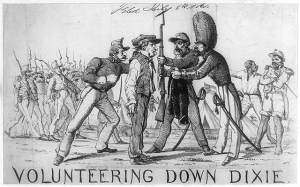
Volunteering Down Dixie,a northern cartoon, satirizes the enlistment of Confederate troops as two "Black Confederates" look on.

Volunteering Down Dixie,a northern cartoon, satirizes the enlistment of Confederate troops as two «Black Confederates» look on.

The topic of so-called “Black Confederates” is controversial. Some insist that Confederate nationalism motivated thousands of African Americans to fight alongside their masters, proving that slavery did not cause the American Civil War. The Internet has become one of the primary means of spreading this nonsense. While professional historians scoff, the “black confederate myth” is popping up on monuments across the south and even temporarily appeared in a Virginia textbook.

When asked about “Black Confederates,” historians often question the sources used by the myth’s supporters, pointing out that they are usually second-hand and anecdotal, or a product of post-war Lost Cause propaganda.  Other historians simply pooh-pooh the claims. I believe that these are not effective responses. A better approach is to place the evidence back into the context in which it first emerged.

In a number of primary sources, people claim to have seen African Americans fighting alongside Rebel soldiers. Most of these sightings were likely of slaves serving as body servants for their soldier masters, or were of the thousands of slaves impressed to work on confederate fortifications. Still, individual human motivations are rarely monolithic and therefore it is not irrational to believe that in the excitement of combat a few of these black men picked up weapons and got involved in the fighting.  Some perhaps felt that in their particular situation it was in their best interest to demonstrate “loyalty” to their masters. Others may have been deceived about the intentions of northern soldiers; white southerners repeatedly told their slaves that Yankees were intent on capturing blacks to send them away to labor in the Caribbean.

Yet while these incidences were in nowhere near the numbers that some claim today, the exaggeration of such tales to promote an agenda is not new. In pushing for emancipation, some abolitionists and radical Republicans widely publicized these stories. In propaganda-like fashion, they greatly exaggerated them to further their cause, and thus they were the first to give these reports more credence and attention than they deserved.

Immediately after the July 1861 battle at Manassas, Virginia, scattered news reports claimed that people saw blacks fighting there among the Confederates. The New York Times, for example, declared that «we hear of black regiments» in the Rebel army, and reprinted a story from the Richmond Enquirer heralding an «ebony patriot» who shot a Yankee officer and captured another. The Charlotte (N.C.) Western Democratcelebrated the «sable patriots» of Manassas and claimed «many cases . . . of [northern] prisoners being taken by negroes.» Some Northerner newspapers claimed that blacks had fought for the Confederates that day in significant numbers. «It is boasted that there are two well drilled regiments of negroes in [the Confederate] army» the Chicago Tribune reported. «The fact that negroes fought in the battle at Bull Run is undisputed,» one correspondent concluded after discussing the battle with Union soldiers who had been in it. «They were forced to do it, but they fought.»

Far more important than the veracity of these dubious claims, is that emancipationists used them to shape northern public opinion and Union war policy. The day before the battle, the U.S. Senate debated a bill that would allow the confiscation of Rebel property used to support Confederate armies. After the battle, Senator Lyman Trumbull proposed an amendment to the bill that broadened the definition of property liable for confiscation to include slaves. «I understand that Negroes were in the fight which has recently occurred,” Trumbull said on the Senate floor. “Negroes who are used to destroy the Union and to shoot down the Union men by the consent of their traitorous masters [should be confiscated].» While there was some objection to the amendment, news from Manassas swayed some senators. Conservative senator John C. Ten Eyck, for example, explained that he previously voted against the amendment, but now changed his mind. «Having learned and believing that [slaves] have been used and employed with arms in their hands to shed the blood of Union-loving men of this country,» he argued, «I shall vote in favor of this amendment.” The amendment and the Confiscation Act overwhelmingly passed, becoming the first legislation that allowed Union commanders to harbor runaway slaves.

To further promote emancipation as a military necessity, abolitionists continued to spread reports of slaves fighting for the Confederacy. In September 1861, famed black abolitionist Frederick Douglass maintained «it is now pretty well established, that there are at the present moment many colored men in the Confederate army doing duty . . . as real soldiers. . . . There were such soldiers at Manassas, and they are probably there still.» Harriet Beecher Stowe, author of Uncle Tom’s Cabin, issued a warning. «The question is not Shall there be black regiments. But, Shall they fight on our side or the side of the enemies?» If the government did not emancipate the slaves, she insisted, the North would have to fight an increasing numbers of blacks in rebel armies.

With hindsight, these fears were unwarranted. The Confederate government vehemently resisted enrolling black troops until the last months of the conflict. In fact, after the Manassas battle a Rebel officer suggested the creation of black regiments but Confederate president Jefferson Davis labeled the idea «stark madness» and claimed such an action “would revolt and disgust the whole South.»

But these were real concerns, and reports continued to come in.  On December 22, for example, Confederates attacked several companies of Union soldiers during a routine reconnaissance up the Virginia Peninsula. Some soldiers claimed that blacks were among their assailants. «Many colored men were in the enemy’s ranks,» Chaplain Richard F. Fuller recorded in his diary that night, «the rebels having no tender scruples about arming the slaves.»

A day after the skirmish, the number of blacks engaged in it was inflated to promote an agenda. In a letter to The Indianapolis Journal, a Hoosier soldier made the outrageous claim that Union soldiers encountered «a body of 700 negro infantry, all armed with muskets, who opened fire.» The wounded soldiers «testify positively that they were shot by negroes.» The soldier called on the government to act; «If they fight us with negroes, why should not we fight them with negroes too?» The story soon found its way into newspapers across the north as a means of promoting emancipation.

In the early months of 1862, these stories continued to be a regular feature in the speeches and editorials of emancipationists. In pushing for both emancipation and the recruitment of black troops, an abolitionist newspaper maintained that the Confederates «have been fighting in close companionship with negroes, from the beginning!» William Lloyd Garrison maintained that Southern blacks “are at the service of the country whenever we accept them. But the Government will not accept them, and the rebel slaveholders are mustering them in companies, and in regiments.» In front of an audience at the Smithsonian Institute, Wendell Phillips insisted «if Abraham Lincoln does not have the negro on his side, Jefferson Davis will have him on his.»

The Peninsula Campaign, the major event in the eastern theater in the spring of 1862, increased these allegations. During the Yorktown siege, for instance, Northern newspapers reported that the Confederates forced blacks to act as sharpshooters, and as artillery gunners. Both the New York Times and thePhiladelphia Inquirer claimed that blacks were seen “uniformed and armed” at Yorktown, and the Baltimore American insisted they were “keeping guard as other soldiers.”

While the Peninsula Campaign was unfolding, Congress deliberated a second confiscation act that would allow for the seizure and liberation of all slaves owned by Rebels, regardless of whether the Confederacy had impressed their labor.  Such legislation would potentially expand the number of freed slaves. To support the bill, these reports of black Confederate soldiers were a mainstay in the northern press and on the floors of Congress.

«Of course the . . . Democrats and the ‘conservatives,’ the Chicago Tribune editorialized, «see nothing wrong [with the Confederates] training the black man to cut up our troops, but let the proposition be made for a negro regiment in the Union service, and they start back in terror at the idea.» The editors were outraged that «slaves may . . . carry muskets for our Southern brethren» and «shoot down our soldiers under the fear of their master’s lash,» but were not allowed to fight for the Union cause. “Does not every man see,” Representative John Hickman told congress, that when the Confederates “are at liberty to employ their slaves, not only in the erection of fortifications, but . . . in the defense of [these] military works, it is a matter of necessity to deprive them of these auxiliaries?”

Radicals were not alone in making such assertions. Conservative Senator John Sherman told Congress, «The question must be decided whether the negro[s] . . .  shall be employed only to aid the rebels.» Sherman insisted that Southern slaves not only performed all the army’s hardest labor, but the «rebels fight side by side with them. . . . Now, shall we avail ourselves of their services, or shall the enemy alone use them?»

«I think we can not be mistaken,» moderate Republican senator James Doolittle argued, the Confederates “have employed negroes not only upon intrenchements and in camp service, but have organized and put arms in their hands to shoot down our sons and our brothers on the field of battle.» Because of this «fact,» the senator maintained, the government should authorize the president «to employ them, and even to arm them.»

Commenting on the debates, the New York Commercial Advertiser noted that the Confederates had used their slaves “as gunners on fortifications, and as picket guards. These are ascertained facts. It is also said they have some negroes enrolled in regiments.» The Commercial’s editors found it «refreshing» that «the recent debates in Congress indicate a definite policy» which would begin to deprive the South of their black laborers. The prediction proved accurate: at the end of July 1862 Congress passed the Second Confiscation Act, and Lincoln presented the Emancipation Proclamation to his cabinet.

I am not suggesting that these reports of so-called “black confederates” were the primary reason why many northerners came to embrace emancipation. However, they clearly played a significant part in the debate, and yet historians rarely, if ever, present or acknowledge these claims when discussing emancipation. As a result, they have fallen into the hands of “neo-confederates.” It is profoundly ironic that modern Confederate apologists now use these emancipationist exaggerations to support their own interpretations of southern motives.

To successfully combat the “black confederates myth,” historians should not simply explain away these accounts. Rather, we should take them out of the hands of those who attempt to use them to glorify the Confederacy, put them back into the context of the emancipation debate in which they first appeared, and in doing so reveal their true importance. While these sightings of so-called “Black Confederates” do not prove African American support for the Confederacy, they do illuminate one largely unexplored reason why Northerners came to embrace emancipation as a war aim.

Glenn David Brasher is the author of The Peninsula Campaign and the Necessity of Emancipation (2012) and winner of the 2013 Wiley-Silver Prize from the Center for Civil War Research.

Sources: Douglass’ Monthly IV (September, 1861): 516; Charlotte Western Democrat July 30, August 6, 1861; Chicago Tribune, July 29, 1861, March 19, 1862, May 29, 1862; Congressional Globe, 37th Congress, First Session, 218-219, 1484; Congressional Globe, 37th Congress, 2nd Session, 1801, 3198-99, 3229-30; Richard F. Fuller, Chaplain Fuller; Being a Life Sketch of a New England Clergyman and Army Chaplain (Boston: Walker, Wise, 1863), 232; Indianapolis Journal, December 27, 1861; Bruce Levine, «Black Confederates,» North and South 10:2 (July 2007): 42; Liberator, August 23, 1861; National Anti-Slavery Standard, August 3, 1861; New York Commercial Advertiser quoted in Cincinnati Gazette, July 15, 1862; New York Times, January 14, 1862, April 27, 1862; Philadelphia Inquirer, April 25, 1862; Principia, September 21, 1861, January 30, 1862.

Illustration Courtesy of the Library of Congress (loc.gov).
Read Full Post »

Church and the State in America: a Brief Primer

Ira Chernus

HNN      May 5, 2014

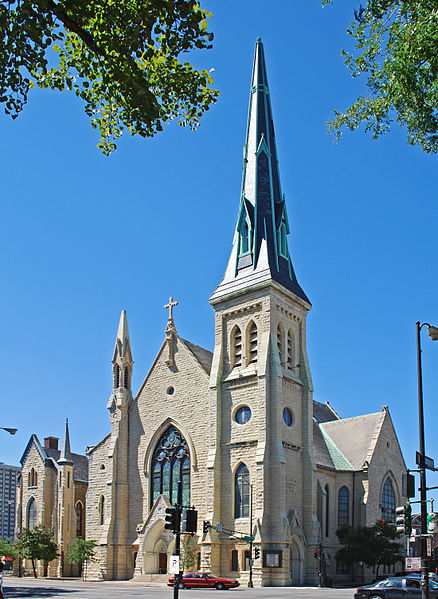
153347-Union_Park_Congregational_Church_and_Carpenter_Chapel_Chicago_IL

Congregational Church, Chicago, Illinois

The Supreme Court has ruled, 5-4, that Greece, New York, can open its town meetings with a prayer, even though nearly all the prayers have contained distinctively Christian language. No doubt advocates and critics of the opinion are scouring American history, looking for proof that their view is correct.

If they look with an unjaundiced eye, they’ll quickly discover one basic principle: Whatever position you hold on this issue, you can find some support in our nation’s history. So history alone cannot resolve the ongoing debate. But it can help inform the debate.

To understand that history we have to begin in the European Middle Ages, when the Roman Catholic Church held sway over the religious life of almost all western Europeans. Politically each area was usually ruled by a single a monarch.  Since «Church» and «state» were both monolithic institutions, it made sense to talk about «church-state relations» quite literally.

In principle, both sides usually agreed that the state ruled over the affairs of this world and the church ruled over the affairs of the soul as it headed toward the next world. In practice, though, each side often tried to extend its power over the other.

When the Protestant reformation came along in the 16th century, it refuted the Catholic church’s claim to control other-worldly affairs. But it did not challenge the basic idea that each area should have one secular ruler and one established church, and the two should live side by side, each respecting the other’s domain. So tensions between church and state inevitably continued.

Since nearly all the early European colonists in what would become the United States were Protestants, they brought that Protestant view with them. Different denominations had majorities in the various colonies, and each had its own model of church-state relations.

But nearly everyone assumed that it could make sense for a colony to have one established church, which would have special privileges from and influence upon the colony. Most of the colonies did, in fact, have established churches.

By the early 1700s, though, the colonies were filling up with immigrants from different places who held different religious views. So the established churches everywhere had to tolerate dissent from the official religion, to a greater or lesser degree.  At the same time, the colonies were experimenting with all sorts of different political structures.

Thus «church» and «state» were no longer monolithic entities as they had been in medieval times. Gradually, the term «church» became a code word for religion in general, including the many different religious beliefs and practices held by different groups and individuals. And the term «state» became a code word for the many various political structures — town, city, county, colonial legislature, royal council, etc.

Things got more complicated in the 18th century as people found their identity based less in fixed social institutions and more in open-ended individual conscience. The Enlightenment philosophers taught that religion was a matter of private belief and individual relationship with God. They also taught that every individual was free to choose their own political views and that the state should base its policies on the will of the majority.

A large Christian revival movement called the Great Awakening reinforced the idea that religion is a matter of inner experience and personal relationship with God more than membership in a church. So the Enlightenment and the Awakening combined to promote individualism and the notion of religion as a private matter.

By the time of the American Revolution, then, there was a complex triangular structure, with private individuals, political institutions («state»), and religious institutions («church») all interacting. So the term «church-state relations» meant, more than ever, an endlessly complex set of changing relations among all the different forms of religious and political life.

But there was a growing belief in the colonies that the private individual had highest priority, that the main role of the state was to protect the individual’s rights, including the right to decide on one’s own religion.

The colonists who joined the Revolution against England all agreed on one thing: the English political system was a tyranny, and the Church of England was part of that tyranny. So there was growing fear of the very idea of an established church.

It was only natural, then, that the new United States would want to protect its citizens from an established church. So the first words of the Bill of Rights said that «Congress shall make no law respecting an establishment of religion, or prohibiting the free exercise thereof

But there was no clear agreement then, as there is none now, about exactly what those words mean.

Some see the two clauses making two opposites points. «No law respecting establishment of religion» makes it illegal to force people to practice  a religion; «no law prohibiting free exercise» makes it illegal to stop people from practicing religion. The «no establishment» clause protects the people and the government from religion. The «free exercise» clause protects religion from the government and the will of the majority.

But some say that both clauses actually make the same point: They both protect individuals from the federal government. The government cannot impose a religious institution on any individual, nor can the government restrict any individual’s religious life. In fact some religious institutions supported the 1st amendment when it was ratified and refused to take any support from the government because they feared such support would entitle the government to impose controls upon them.

The debate about the meaning of the 1st amendment and the intentions of the founders still rages on because they did not bequeath to us any single consistent view on church and state. They all claimed to be Christian. But they had many different ideas of what it meant to be Christian. Each individual could hold what we might see as contradictory views and practices.

To take one important example: Thomas Jefferson created the image of a «wall of separation between church and state» and wrote powerfully about the need to protect the religious freedom of every individual. Yet in the Declaration of Independence he based the entire political philosophy of the new nation on the idea that all men are endowed by their Creator with certain unalienable rights. Without God, Jefferson’s whole political philosophy makes no sense. Jefferson was also devoted to the teachings of Jesus, but only as he understood them; he even created his own version of the Gospels. Jefferson also supported, on occasion, legislation to create public prayer days and to punish people who broke Sabbath laws.

If we cannot expect logical consistency even from Thomas Jefferson, we certainly can’t expect it from the founding fathers as a group.

The 1st amendment was the product of political compromise among the founders. So perhaps it is best to see it as the beginning of a conversation or debate about the relation of political and religious life. Perhaps many of the founders knew that all they could agree on was the need to continue the debate.

Though the founders disagreed on what it meant to be Christian, they all assumed that some version of what each one saw as the «basics» of Christianity was more or less necessary as a foundation of an orderly society. Most of them assumed that Christian values were the basis of political liberty.

Even those who were wary of Christian bias would probably have agreed with Justice Anthony Kennedy, who wrote the majority opinion in the recent Greece case:

«Prayer is but a recognition that, since this nation was founded and until the present day, many Americans deem that their own existence must be understood by precepts far beyond the authority of government to alter or define.»

So most of the founders saw no contradiction between the federal government guaranteeing freedom of religion and the states having established churches that could get special privileges from government, provide prayers for political occasions, and dictate the teaching of religion in schools

But by the late 18th century all the states had so much diversity that the power of established churches was rapidly fading. Massachusetts was the last state to end its established church, in 1833. By the 19th century, then, Americans did not merely believe in the right to dissent from the dominant church. They assumed that there would no longer be any dominant church.

Yet the 19th century was dominated by one religious view: evangelical Christianity. Evangelicals emphasized individual experience as the basis of religion. So religion became, more than ever, a matter of individual choice, which led to the creation of many new churches. But the evangelical fervor also strengthened the idea that all Christians share basic values in common, and that these were the core values of the American way of life — a view that would surface again in some 20th century Supreme Court decisions.

For evangelicals, the «wall of separation» meant that everyone was free to influence the government as much as possible according to their own version of Christian values, with the goal of making America the kingdom of God on earth. For some that meant causes we would consider liberal, like free public schools for all and the abolition of slavery. For some it meant causes that we would call conservative, like prohibition of alcohol and teaching the Bible in public schools. Many felt comfortable supporting all these reform movements.

From the 1840s on large waves of Catholic immigrants came to the U.S.. They learned to accept religious pluralism and reject the old Catholic tradition of one universal church for everyone. But they created their own schools, raising new questions about state support for religious education. These problems, like nearly all problems of church and state in the 19th century, were dealt with at the local and state levels.

After the Civil War, the 14th amendment made all states subject to rule by the federal constitution, opening the way for federal courts to apply the 1st amendment and rule on church-state issues. In 1879 the Supreme Court issued its first opinion directly dealing with church and state. It ruled that the government could forbid Mormons from practicing polygamy. The Court cited words written by Jefferson indicating that the wall of separation prevents the government only from controlling religious beliefs. But the government could forbid behaviors it deemed harmful to society.

However it was not until the 1940s that the Supreme Court began addressing the church-state question in earnest. By that time the federal government was playing a much larger role in the life of every American, while a slowly rising tide of secularism was undermining the notion of America as a Christian nation. For growing numbers of Americans, «the American way of life» meant a dedication to pluralism, diversity, and the fullest protection of individual rights. These factors combined to bring many issues related to religion before the Court.

In 1940 the Court took on the case of Jehovah’s Witnesses who argued they should be able to go door to door without a state license. The Court agreed, declaring for the first time that the 1st amendment’s «free exercise of religion» clause applied to local and state governments as well as the federal.

In the same year, though, a group of Jehovah’s Witnesses argued that their children should not be required to salute the flag in school because it violated their free exercise of religion. The Court ruled against them. Then two years later, in an almost identical case, it ruled that the Jehovah’s Witness children did not have to salute the flag.

Why the abrupt turnaround? There is some evidence that the Court was influenced by a wave of criticism of its first decision from scholars and newspapers, and also by dismay over a wave of anti-Jehovah’s Witness prejudice after the first ruling. This case reminds us that the Court is never making its decision in some abstract realm of pure legal rationality. It is always, to some extent, a barometer of the climate of public opinion.

In the Everson case of 1947 taxpayers argued that their town, which paid for children’s bus rides to public school, should not pay for Catholic children’s bus rides to Catholic school. Writing for the majority, Justice Hugo Black penned a famous, stirring defense of the wall of separation, arguing that the 1st amendment’s «no establishment of religion» clause applied to local and state as well as federal law. This became an accepted principle of later Court cases. Yet Black and the majority decided in favor of the Catholic children getting public money because it was going to them as individuals, not to the church.

This case, and the Court’s reversal in the Jehovah’s Witness cases, foreshadowed the history of church-state cases ever since then. There has been no consistent pattern, but rather what Justice Robert Jackson called a «winding, serpentine» wall of separation, full of all sorts of unpredictable twists and turns in the Court’s views.

Vagueness often prevails. In the Lemon case of 1971, the Court ruled that no law may «have the primary effect of either advancing or inhibiting religion» and left it for later Courts to figure out what that means.  Now the Court has added another contorted brick to that wall, by a 5-4 margin, as has so often been true in recent church-state cases.

The Court still reflects the climate of public opinion, which remains divided and uncertain about the proper relation of religious life to the body politic and the lives of individuals, or what we have come to call «church and state.» So the debate initiated by the 1st amendment goes on — which may be just what the founders intended.

Ira Chernus is professor of Religious Studies at the University of Colorado, Boulder.


Read Full Post »

Forty-six years ago, in January 1966, Jonathan Schell, a 23-year-old not-quite-journalist found himself at the farming village of Ben Suc, 30 miles from the South Vietnamese capital, Saigon.  It had long been supportive of the Vietcong.  Now, in what was dubbed Operation Cedar Falls, the U.S. military (with Schell in tow) launched an operation to solve that problem.  The “solution” was typical of how Americans fought the Vietnam War.  All the village’s 3,500 inhabitants were to be removed to a squalid refugee camp and Ben Suc itself simply obliterated — every trace of the place for all time.  Schell’s remarkable and remarkably blunt observations on this grim operation were, no less remarkably, published in the New Yorker magazine and then as a book, causing a stir in a country where anti-war sentiment was growing fast.

In 1967, Schell returned to Vietnam and spent weeks in the northern part of the country watching from the backseats of tiny U.S. forward air control planes as parts of two provinces were quite literally blown away, house by house, village by village, an experience he recalls in today’s TomDispatch post.  From that came another New Yorker piece and then a book, The Military Half, which offered (and still offers) an unmatched journalistic vision of what the Vietnam War looked like.  It was a moment well captured in a mocking song one of the American pilots sang for him after an operation in which he had called in bombs on two Vietnamese churches, but somehow missed the white flag flying in front of them. The relevant stanza went:

“Strafe the town and kill the people,
Drop napalm in the square,
Get out early every Sunday
And catch them at their morning prayer.”

If Afghanistan is the war we somehow haven’t managed to notice most of the time, even while it’s going on, Vietnam was the war Americans couldn’t forget and have never been able to kick, possibly because we never managed to come to grips with just what it was and what we did there. Now, so many years later, in a monumental essay appearing in print in the Nation magazine and online here at TomDispatch, Schell returns (via Nick Turse’s new book, Kill Anything that Moves: The Real American War in Vietnam) to the haunted terrain he last visited so many decades ago All of us, whether we know it or not, still live with the ghosts of that moment. Tom

How Did the Gates of Hell Open in Vietnam? 
A New Book Transforms Our Understanding of What the Vietnam War Actually Was 
By Jonathan Schell

TomDispatch.com  May 4, 2014

For half a century we have been arguing about “the Vietnam War.” Is it possible that we didn’t know what we were talking about? After all that has been written (some 30,000 books and counting), it scarcely seems possible, but such, it turns out, has literally been the case.

Now, in Kill Anything that MovesNick Turse has for the first time put together a comprehensive picture, written with mastery and dignity, of what American forces actually were doing in Vietnam. The findings disclose an almost unspeakable truth.  Meticulously piecing together newly released classified information, court-martial records, Pentagon reports, and firsthand interviews in Vietnam and the United States, as well as contemporaneous press accounts and secondary literature, Turse discovers that episodes of devastation, murder, massacre, rape, and torture once considered isolated atrocities were in fact the norm, adding up to a continuous stream of atrocity, unfolding, year after year, throughout that country.

It has been Turse’s great achievement to see that, thanks to the special character of the war, its prime reality — an accurate overall picture of what physically was occurring on the ground — had never been assembled; that with imagination and years of dogged work this could be done; and that even a half-century after the beginning of the war it still should be done. Turse acknowledges that, even now, not enough is known to present this picture in statistical terms. To be sure, he offers plenty of numbers — for instance the mind-boggling estimates that during the war there were some two million civilians killed and some five million wounded, that the United States flew 3.4 million aircraft sorties, and that it expended 30 billion pounds of munitions, releasing the equivalent in explosive force of 640 Hiroshima bombs.

Yet it would not have been enough to simply accumulate anecdotal evidence of abuses. Therefore, while providing an abundance of firsthand accounts, he has supplemented this approach. Like a fabric, a social reality — a town, a university, a revolution, a war — has a pattern and a texture.  No fact is an island. Each one is rich in implications, which, so to speak, reach out toward the wider area of the surrounding facts. When some of these other facts are confirmed, they begin to reveal the pattern and texture in question.

Turse repeatedly invites us to ask what sort of larger picture each story implies. For example, he writes:

“If one man and his tiny team could claim more KIAs [killed in action] than an entire battalion without raising red flags among superiors; if a brigade commander could up the body count by picking off civilians from his helicopter with impunity; if a top general could institutionalize atrocities through the profligate use of heavy firepower in areas packed with civilians — then what could be expected down the line, especially among heavily armed young infantrymen operating in the field for weeks, angry, tired, and scared, often unable to locate the enemy and yet relentlessly pressed for kills?”

Like a tightening net, the web of stories and reports drawn from myriad sources coalesces into a convincing, inescapable portrait of this war — a portrait that, as an American, you do not wish to see; that, having seen, you wish you could forget, but that you should not forget; and that the facts force you to see and remember and take into account when you ask yourself what the United States has done and been in the last half century, and what it still is doing and still is.

Scorched Earth in I Corps

My angle of vision on these matters is a highly particular one. In early August 1967, I arrived in I Corps, the northernmost district of American military operations in what was then South Vietnam.  I was there to report for the New Yorker on the “air war.” The phrase was a misnomer.  The Vietnamese foe, of course, had no assets in the air in the South, and so there was no “war” of that description.

There was only the unilateral bombardment of the land and people by the fantastic array of aircraft assembled by the United States in Vietnam.  These ranged from the B-52, which laid down a pattern of destruction a mile long and several football fields wide; to fighter bombers capable of dropping, along with much else, 500-pound bombs and canisters of napalm; to the reconfigured DC-3 equipped with a cannon capable of firing 100 rounds per second; to the ubiquitous fleets of helicopters, large and small, that crowded the skies. All this was abetted by continuous artillery fire into “free-fire” zones and naval bombardment from ships just off the coast.

By the time I arrived, the destruction of the villages in the region and the removal of their people to squalid refugee camps was approaching completion. (However, they often returned to their blasted villages, now subject to indiscriminate artillery fire.) Only a few pockets of villages survived. I witnessed the destruction of many of these in Quang Ngai and Quang Tinh provinces from the back seat of small Cessnas called Forward Air Control planes.

As we floated overhead day after day, I would watch long lines of houses burst into flames one after another as troops moved through the area of operation.  In the meantime, the Forward Air Controllers were calling in air strikes as requested by radio from troops on the ground. In past operations, the villagers had been herded out of the area into the camps.  But this time, no evacuation had been ordered, and the population was being subjected to the full fury of a ground and air assault. A rural society was being torn to pieces before my eyes.

The broad results of American actions in I Corps were thus visible and measurable from the air. No scorched earth policy had been announced but scorched earth had been the result.  Still, a huge piece was missing from the puzzle.  I was not able to witness most of the significant operations on the ground firsthand. I sought to interview some soldiers but they would not talk, though one did hint at dark deeds.  “You wouldn’t believe it so I’m not going to tell you,” he said to me. “No one’s ever going to find out about some things, and after this war is over, and we’ve all gone home, no one is ever going to know.”

In other words, like so many reporters in Vietnam, I saw mainly one aspect of one corner of the war.  What I had seen was ghastly, but it was not enough to serve as a basis for generalizations about the conduct of the war as a whole. Just a few years later, in 1969, thanks to the determined efforts of a courageous soldier, Ron Ridenhour, and the persistence of a reporter, Seymour Hersh, one piece of the hidden truth about ground operations in I Corp came to light.

It was the My Lai massacre, in which more than 500 civilians were murdered in cold blood by Charlie Company, 1st Battalion, 20th Infantry, of the Americal Division. In subsequent years, news of other atrocities in the area filtered into the press, often many years after the fact. For example, in 2003 theToledo Blade disclosed a campaign of torture and murder over a period of months, including the summary execution of two blind men by a “reconnaissance” squad called Tiger Force.  Still, no comprehensive picture of the generality of ground operations in the area emerged.

It has not been until the publication of Turse’s book that the everyday reality of which these atrocities were a part has been brought so fully to light. Almost immediately after the American troops arrived in I Corps, a pattern of savagery was established. My Lai, it turns out, was exceptional only in the numbers killed.

Turse offers a massacre at a village called Trieu Ai in October 1967 as a paradigm.  A marine company suffered the loss of a man to a booby trap near the village, which had in fact had been mostly burned down by other American forces a few days earlier.  Some villagers had, however, returned for their belongings. Now, the Marine company, enraged by its loss but unable to find the enemy, entered the village firing their M-16s, setting fire to any intact houses, and tossing grenades into bomb shelters.

A Marine marched a woman into a field and shot her.  Another reported that there were children in the shelters that were being blown up.  His superior replied, “Tough shit, they grow up to be VC [Vietcong].”  Five or ten people rushed out of a shelter when a grenade was thrown into it.  They were cut down in a hail of fire. Turse comments:

“In the story of Trieu Ai one can see virtually the entire war writ small.  Here was the repeated aerial bombing and artillery fire… Here was the deliberate burning of peasant homes and the relocation of villagers to refugee camps… Angry troops primed to lash out, often following losses within the unit; civilians trapped in their paths; and officers in the field issuing ambiguous or illegal orders to young men conditioned to obey — that was the basic recipe for many of the mass killings carried out by army soldiers and marines over the years.”

The savagery often extended to the utmost depravity: gratuitous torture, killing for target practice, slaughter of children and babies, gang rape.  Consider the following all-too-typical actions of Company B, 1st Battalion, 35th infantry beginning in October 1967:

“The company stumbled upon an unarmed young boy.  ‘Someone caught him up on a hill, and they brought him down and the lieutenant asked who wanted to kill him…’ medic Jamie Henry later told army investigators. A radioman and another medic volunteered for the job.  The radioman… ’kicked the boy in the stomach and the medic took him around behind a rock and I heard one magazine go off complete on automatic…’

“A few days after this incident, members of that same unit brutalized an elderly man to the point of collapse and then threw him off a cliff without even knowing whether he was dead or alive…

“A couple of days after that, they used an unarmed man for target practice…

“And less than two weeks later, members of Company B reportedly killed five unarmed women…

“Unit members rattled off a litany of other brutal acts committed by the company… [including] a living woman who had an ear cut off while her baby was thrown to the ground and stomped on…”

Pumping Up the Body Count

Turse’s findings completed the picture of the war in I Corps for me.  Whatever the policy might have been in theory, the reality, on the ground as in the air, was the scorched earth I had witnessed from the Forward Air Control planes. Whatever the United States thought it was doing in I Corps, it was actuallywaging systematic war against the people of the region.

And so it was, as Turse voluminously documents, throughout the country.  Details differed from area to area but the broad picture was the same as the one in I Corps. A case in point is the war in the Mekong Delta, home to some five to six million people in an area of less than 15,000 square miles laced with rivers and canals. In February 1968, General Julian Ewell, soon to be known by Vietnamese and Americans alike as “the Butcher of the Delta,” was placed in charge of the 9th Infantry Division.

In December 1968, he launched Operation Speedy Express. His specialty, amounting to obsession, was increasing “the body count,” ordained by the high command as the key measure of progress in defeating the enemy. Theoretically, only slain soldiers were to be included in that count but — as anyone, soldier or reporter, who spent a half-hour in the field quickly learned — virtually all slain Vietnamese, most of them clearly civilians, were included in the total.  The higher an officer’s body count, the more likely his promotion. Privates who turned in high counts were rewarded with mini-vacations. Ewell set out to increase the ratio of supposed enemy soldiers killed to American soldiers killed.  Pressure to do so was ratcheted up at all levels in the 9th Division. One of his chiefs of staff “went berserk,” in the words of a later chief of staff.

The means were simple: immensely increase the already staggering firepower being used and loosen the already highly permissive “rules of engagement” by, for example, ordering more night raids.  In a typical night episode, Cobra gunships strafed a herd of water buffalo and seven children tending them. All died, and the children were reported as enemy soldiers killed in action.

The kill ratios duly rose from an already suspiciously high 24 “Vietcong” for every dead American to a completely surreal 134 Vietcong per American.  The unreality, however, did not simply lie in the inflated kill numbers but in the identities of the corpses.  Overwhelmingly, they were not enemy soldiers but civilians.  A “Concerned Sergeant” who protested the operation in an anonymous letter to the high command at the time described the results as he witnessed them:

“A battalion would kill maybe 15 to 20 a day.  With 4 battalions in the Brigade that would be maybe 40 to 50 a day or 1200 a month 1500, easy. (One battalion claimed almost 1000 body counts one month!)  If I am only 10% right, and believe me its lots more, then I am trying to tell you about 120-150 murders, or a My Lay [My Lai] each month for over a year.”

This range of estimates was confirmed in later analyses. Operations in I Corp perhaps depended more on infantry attacks supported by air strikes, while Speedy Express depended more on helicopter raids and demands for high body counts, but the results were the same: indiscriminate warfare, unrestrained by calculation or humanity, on the population of South Vietnam.

Turse reminds us that off the battlefield, too, casual violence — such as the use of military trucks to run over Vietnamese on the roads, seemingly for entertainment — was widespread.  The commonest terms for Vietnamese were the racist epithets “gooks,” “dinks,” and “slopes.”  And the U.S. military machine was supplemented by an equally brutal American-South Vietnamese prison system in which torture was standard procedure and extrajudicial executions common.

How did it happen? How did a country that believes itself to be guided by principles of decency permit such savagery to break out and then allow it to continue for more than a decade?

Why, when the first Marines arrived in I Corps in early 1965, did so many of them almost immediately cast aside the rules of war as well as all ordinary scruples and sink to the lowest levels of barbarism?  What chains of cause and effect linked “the best and the brightest” of America’s top universities and corporations who were running the war with the murder of those buffalo boys in the Mekong Delta?

How did the gates of hell open? This is a different question from the often-asked one of how the United States got into the war. I cannot pretend to begin to do it justice here. The moral and cognitive seasickness that has attended the Vietnam War from the beginning afflicts us still. Yet Kill Anything that Movespermits us, finally, to at least formulate the question in light of the actual facts of the case.

Reflections would certainly seem in order for a country that, since Vietnam, has done its best to unlearn even such lessons as were learned from that debacle in preparation for other misbegotten wars like those in Iraq and Afghanistan. Here, however, are a few thoughts, offered in a spirit of thinking aloud.

The Fictitious War and the Real One

Roughly since the massacre at My Lai was revealed, people have debated whether the atrocities of the war were the product of decisions by troops on the ground or of high policy, of orders issued from above — whether they were “aberrations” or “operations.” The first school obviously lends itself to bad-apple-in-a-healthy-barrel thinking, blaming individual units for unacceptable behavior while exonerating the higher ups; the second tends to exonerate the troops while pinning the blame on their superiors.

Turse’s book shows that the barrel was rotten through and through.  It discredits the “aberration” school once and for all. Yet it does not exactly offer support for the orders-from-the-top school either. Perhaps the problem always was that these alternatives framed the situation inaccurately.  The relationship between policy and practice in Vietnam was, it turns out, far more peculiar than the two choices suggest.

It’s often said that truth is the first casualty of war. In Vietnam, however, it was not just that the United States was doing one thing while saying another (for example, destroying villages while claiming to protect them), true as that was.  Rather, from its inception the war’s structure was shaped by an attempt to superimpose a false official narrative on a reality of a wholly different character.

In the official war, the people of South Vietnam were resisting the attempts of the North Vietnamese to conquer them in the name of world communism.  The United States was simply assisting them in their patriotic resistance.  In reality, most people in South Vietnam, insofar as they were politically minded, were nationalists who sought to push out foreign conquerors: first, the French, then the Japanese, and next the Americans, along with their client state, the South Vietnamese government which was never able to develop any independent strength in a land supposedly its own.  This fictitious official narrative was not added on later to disguise unpalatable facts; it was baked into the enterprise from the outset.

Accordingly, the collision of policy and reality first took place on the ground in Trieu Ai village and its like. The American forces, including their local commanders, were confronted with a reality that the policymakers had not faced and would not face for many long years. Expecting to be welcomed as saviors, the troops found themselves in a sea of nearly universal hostility.

No manual was handed out in Washington to deal with the unexpected situation. It was left to the soldiers to decide what to do. Throughout the country, they started to improvise. To this extent, policy was indeed being made in the field. Yet it was not within the troops’ power to reverse basic policy; they could not, for instance, have withdrawn themselves from the whole misconceived exercise.  They could only respond to the unexpected circumstances in which they found themselves.

The result would combine an incomprehensible and impossible mission dictated from above (to win the “hearts and minds” of a population already overwhelmingly hostile, while pulverizing their society) and locally conceived illegal but sometimes vague orders that left plenty of room for spontaneous, rage-driven improvisation on the ground. In this gap between the fiction of high policy and the actuality of the real war was born the futile, abhorrent assault on the people of Vietnam.

The improvisatory character of all this, as Turse emphasizes, can be seen in the fact that while the abuses of civilians were pervasive they were not consistent. As he summarizes what a villager in one brutalized area told him decades later, “Sometimes U.S. troops handed out candies.  Sometimes they shot at people.  Sometimes they passed through a village hardly touching a thing.  Sometimes they burned all the homes. ‘We didn’t understand the reasons why the acted in the way they did.’”

Alongside the imaginary official war, then, there grew up the real war on the ground, the one that Turse has, for the first time, adequately described.  It is no defense of what happened to point out that, for the troops, it was not so much their orders from on high as their circumstances — what Robert J. Lifton has called “atrocity-producing situations” — that generated their degraded behavior. Neither does such an account provide escape from accountability for the war’s architects without whose blind and misguided policies these infernal situations never would have arisen.

In one further bitter irony, this real war came at a certain point to be partially codified at ever higher levels of command into policies that did translate into orders from the top. In effect, the generals gradually — if absurdly, in light of the supposed goals of the war — sanctioned and promoted the de facto war on the population.  Enter General Ewell and his body counts.

In other words, the improvising moved up the chain of command until the soldiers were following orders when they killed civilians, though, as in the case of Ewell, those orders rarely took exactly that form.  Nonetheless, the generals sometimes went quite far in formulating these new rules, even when they flagrantly contradicted official policies.

To give one example supplied by Turse, in 1965, General William Westmoreland, who was made commander of U.S. forces in Vietnam in 1964, implicitly declared war on the peasantry of South Vietnam. He said:

“Until now the war has been characterized by a substantial majority of the population remaining neutral.  In the past year we have seen an escalation to a higher intensity in the war.  This will bring about a moment of decision for the peasant farmer.  He will have to choose if he stays alive.”

Like his underlings, Westmoreland, was improvising. This new policy of, in effect, terrorizing the peasantry into submission was utterly inconsistent with the Washington narrative of winning hearts and minds, but it was fully consistent with everything his forces were actually doing and about to do in I Corps and throughout the country.

A Skyscraper of Lies

One more level of the conflict needs to be mentioned in this context.  Documents show that, as early as the mid-1960s, the key mistaken assumptions of the war — that the Vietnamese foe was a tentacle of world communism, that the war was a front in the Cold War rather than an episode in the long decolonization movement of the twentieth century, that the South Vietnamese were eager for rescue by the United States — were widely suspected to be mistaken in official Washington.  But one other assumption was not found to be mistaken: that whichever administration “lost” Vietnam would likely lose the next election.

Rightly or wrongly, presidents lived in terror of losing the war and so being politically destroyed by a movement of the kind Senator Joe McCarthy launched after the American “loss” of China in 1949.  Later, McGeorge Bundy, Lyndon Johnson’s national security advisor, would describe his understanding of the president’s frame of mind at the time this way:

«LBJ isn’t deeply concerned about who governs Laos, or who governs South Vietnam — he’s deeply concerned with what the average American voter is going to think about how he did in the ball game of the Cold War. The great Cold War championship gets played in the largest stadium in the United States and he, Lyndon Johnson, is the quarterback, and if he loses, how does he do in the next election? So don’t lose. Now that’s too simple, but it’s where he is. He’s living with his own political survival every time he looks at these questions.”

In this context, domestic political considerations trumped the substantive reasoning that, once the futility and horror of the enterprise had been revealed, might have led to an end to the war. More and more it was understood to be a murderous farce, but politics dictated that it must continue. As long as this remained the case, no news from Vietnam could lead to a reversal of the war policies.

This was the top floor of the skyscraper of lies that was the Vietnam War. Domestic politics was the largest and most fact-proof of the atrocity-producing situations.  Do we imagine that this has changed?

Jonathan Schell is a Fellow at The Nation Institute, and the peace and disarmament correspondent for the Nation magazine. Among many other works, he is the author of The Real War, a collection of his New Yorkerreportage on the Vietnam War.


Read Full Post »

WPost

Fine Print: U.S. can’t seem to shake the ‘water cure’ as a method of interrogation

Walter Pincus

The Washington Post  May 1, 2014


“He is simply held down and then water is poured onto his face down his throat and nose from a jar; and that is kept up until the man gives some sign or becomes unconscious. And then . . . he is simply . . . rolled aside rudely, so that water is expelled. A man suffers tremendously, there is no doubt about it,” according to testimony given to the Senate committee.

That sounds as if it could be an excerpt from the classified Senate Select Committee on Intelligence report on the CIA’s post-9/11 capture, detention and interrogation programs that included waterboarding.

In a March 11 floor speech, the committee’s chairman, Sen. Dianne Feinstein, D-Calif., said the panel is investigating “the horrible details of a CIA program that never, never, never should have existed.”

But that quote was from testimony delivered in 1903 by U.S. Army Lt. Grover Flint before the Senate Philippines Committee. Chaired by Sen. Henry Cabot Lodge, R-Mass., the committee was reviewing how U.S. Army units were dealing with Filipino fighters who opposed the United States taking over governing their country in the wake of the Spanish-American War.

Sorry, folks, but it’s time to recall George Santayana’s remark in 1905, “Those who cannot remember the past are condemned to repeat it.”

The Lodge panel dealt in part with allegations that U.S. troops and Filipino units working with them since 1900 had used that era’s version of waterboarding and other tortuous methods against the rebels.

The committee was dominated by Republican senators who supported the harsh tactics, which included the so-called water cure, an interrogation technique used to gather what was considered necessary information. Even President Theodore Roosevelt said at the time that “the water cure is an old Filipino method of mild torture. Nobody was seriously damaged whereas the Filipinos had inflicted incredible tortures on our people.”

It recalls the way former president George W. Bush put it in “Decision Points,” his 2010 book. “Waterboarding 1/8is3/8 a process of simulated drowning. No doubt the procedure was tough, but medical experts assured the CIA that it did no lasting harm,” he wrote.

In 1902, federal Judge William Howard Taft, appointed by Roosevelt to head the Philippine Commission to help establish a postwar government in Manila, was asked about the use of the “water cure” by the Lodge panel.

Taft said, “There have been in individual instances of water cure, that torture which I believe involves pouring water down the throat so that the man swells and gets the impression that he is going to be suffocated and then tells what he knows, which was a frequent treatment under the Spaniards, I am told.”

And while there were some cases in which U.S. military personnel faced investigations and courts-martial, Secretary of War Elihu Root sent the committee a report in 1902 that said, in part, “charges in the public press of cruelty and oppression exercised by our soldiers towards natives of the Philippines” had been either “unfounded or grossly exaggerated.”

Col. S.W. Groesbeck, once judge advocate general of the Philippines, said publicly, “I believe the water cure, as practiced by the American army in the Philippines, to be the most humane method of obtaining information from prisoners of war that is known to modern warfare.”

Coercive interrogation methods, to include forms of waterboarding, have been a continuing problem for Americans, their government ,and U.S. military and intelligence services.

Perhaps it shouldn’t keep happening, but waterboarding does reappear when circumstances arise that seem to justify — if not demand — such actions.

The Washington Post on Jan. 21, 1968, ran a front-page photo of a U.S. soldier supervising the waterboarding of a captured North Vietnamese soldier. The caption says the technique induced “a flooding sense of suffocation and drowning, meant to make him talk.” Because of the photo, the U.S. Army initiated an investigation and the soldier was court-martialed and convicted of torturing a prisoner.

The CIA had a training manual, “KUBARK Counterintelligence Interrogation — July 1963,” whose title was the code word used for the agency in Vietnam. It was used to train new interrogators and described its contents as “basic information about coercive techniques available for use in the interrogation situation.”

These included forcing detainees to stand or sit in “stress positions,” cutting off sources of light, and disrupting their sleep and their diet. Among the manual’s conclusions: The threat of pain is a far more effective interrogation tool than actually inflicting pain, but threats of death do not help.

Given this history, it should not have surprised anyone that in the fear that permeated the country post-9/11, that those responsible for protecting the nation would employ whatever techniques necessary to prevent another attack.

Torture-like interrogations were used in Afghanistan, Iraq and Guantanamo, not just by the CIA but also by the military. No one in the White House or on Capitol Hill, informed of what was going in those first years after 9/11, raised public objections.

In her March speech, Feinstein said that if her committee’s report is declassified, “we will be able to ensure that an un-American, brutal program of detention and interrogation will never again be considered or permitted.”

That’s easy to say but, it seems, much harder to do.

While serving in the Army Counterintelligence Corps 58 years ago, I was trained as an interrogator. My training emphasized developing a rapport with a subject over time to help get needed information.

But in a battlefield situation or facing the possibility of an imminent terrorist attack, I honestly can’t say what I would do.

It’s under such difficult circumstances that presidents and lawmakers will find their positions truly tested.

As will we all.

«Walter Pincus reports on intelligence, defense and foreign policy for The Washingon Post. He first came to the paper in 1966 and has covered numerous subjects, including nuclear weapons and arms control, politics and congressional investigations. He was among Post reporters awarded the 2002 Pulitzer Prize for national reporting. Among many other honors were the 1977 George Polk Award for articles exposing the neutron warhead, a 1981 Emmy from writing a CBS documentary on strategic nuclear weapons, and most recently the 2010 Arthur Ross Award from the American Academy for Diplomacy for columns on foreign policy.»

Read Full Post »


header

image_strip_1

La Encyclopedia of American Studies (EAS) ha adoptado una política de acceso gratuito a sus contenidos que, sin lugar a dudas, será de beneficio para todos aquellos interesados en la historia, economía, política, literatura, artes, culturas de los Estados Unidos. La Encyclopedia of American Studies cuenta con más de 800 artículos, además de bibliografías, imágenes y otros tipos de materiales relacionados a los estudios norteamericanos.


Read Full Post »

« Newer Posts