Feeds:
Entradas
Comentarios

Archive for noviembre 2013

The Five Best Kennedy Assassination Books
Jon Wiener
The Nation    November, 11, 2013
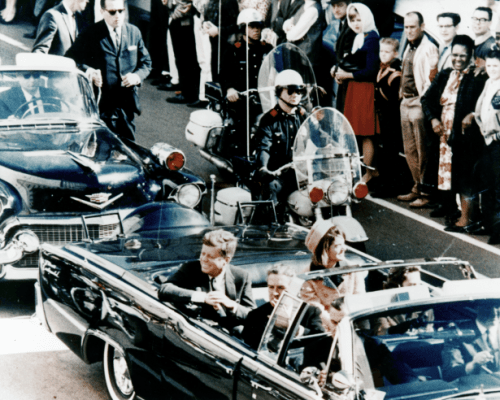
President Kennedy minutes before his assassination in Dallas, Texas, November 22, 1963. (Baylor University Collections)

President Kennedy minutes before his assassination in Dallas, Texas, November 22, 1963. (Baylor University Collections)

November 22 is of course the fiftieth anniversary of the Kennedy assassination. I haven’t read all 1,000 books about it, but I have five favorites:

Don DeLillo, Libra
“We will build theories that gleam like jade idols,” says DeLillo’s surrogate, a CIA historian writing the secret history of Dallas. “We will follow the bullet trajectories backwards to the lives that occupy the shadows, actual men who moan in their dreams.” In the novel, two CIA veterans of the Bay of Pigs seek to arouse anti-Cuban sentiment by organizing an assassination attempt by a Castro supporter. But in their plan, the assassin—with an identity “made out of ordinary pocket litter”—will miss. DeLillo, as John Leonard wrote in The Nation, “is an agnostic about reality.”

Stephen King, 11/22/63
When Jake steps thru the secret passage in Al’s Diner in Maine, it takes him back to 1958; can he stick around and change the course of history by stopping Oswald before November 22, 1963? And what if he discovers that the conspiracy theorists were right, and JFK was shot by someone else? Eight hundred and fifty wonderful pages of time travel romance and adventure in a world where the food tastes better and the music is more fun—and where history itself resists change, with all its might.

Robert Caro, LBJ: The Passage of Power chapters 11–13
The assassination seen through LBJ’s eyes, one car back in the motorcade in Dealey Plaza: after Oswald’s first shot, Secret Service agent Rufus Youngblood shouted, “Get down! Get down!” Then LBJ “was on the floor, his face on the floor, with the weight of a big man lying on top of him,” as the two cars sped toward Parkland Hospital. When they arrived, Agent Youngblood said, ‘I want you and Mrs. Johnson to stick with me and the other agents as close as you can. We are going into the hospital and we aren’t gonna stop for anything or anybody. Do you understand?’ ‘Okay, pardner, I understand,’ Lyndon Johnson said.”

Norman Mailer, Oswald’s Tale
Mailer in his reporter-researcher mode: at age 70, he spent six cold months in Minsk, where Oswald had lived with his Russian wife Marina for thirty months starting in 1960. Mailer interviewed fifty people and used the KGB’s tapes from Oswald’s bugged apartment to paint a vivid picture of the dullness and misery of their lives. Mailer said he started “with a prejudice in favor of the conspiracy theorists,” but he found Oswald to have been a lonely Marxist megalomaniac and an angry loser. In the end, Robert Stone wrote in The New York Review of Books, Mailer had to conclude that “absurdity and common death gape far wider beneath us than high conspiracy, tragedy, or sacrifice.”

Vincent Bugliosi, Reclaiming History
An encyclopedia of assassination conspiracies, with each and every one refuted, “revealed as a fraud on the American public.” One thousand six hundred oversize pages, plus a CD with 1,100 pages of notes, written by the legendary criminal prosecutor. “No group of top-level conspirators,” he argues, “would ever employ someone as unstable and unreliable as Oswald to commit the biggest murder in history, no such group would ever provide its hit man with a twelve-dollar rifle to get the job done, and any such group would help its hit man escape or have a car waiting to drive him to his death, not allow him to be wandering out in the street, catching cabs and buses to get away, as we know Oswald did.”

Jon Wiener teaches U.S. history at UC Irvine.

Read Full Post »

Comparto con mis lectores algunos blogs de historia norteamericana que me parecen interesante y útiles. Desafortunadamente, ninguno de ellos es en castellano.

Read Full Post »

A pocas semanas del cincuenta aniversario del asesinato de John F. Kennedy –uno de los eventos más traumáticos de la historia estadounidense– la History News Network nos ofrece una recopilación de interesantes y valiosos trabajos sobre diversos aspectos de la vida y obra del trigésimo quinto presidente de los Estados Unidos. Comparto con mis lectores este valioso recurso.

HNN Hot Topics: John F. Kennedy

This Book Was the First to Spill JFK’s Secrets.
by John B. JudisSo why has «The Search for JFK» been unfairly forgotten?OCTOBER 31, 2013
The Man with the President’s Ear, Arthur Schlesinger Jr. and JFK
by Ted WidmerNo historian has ever been as close to power as Arthur Schlesinger Jr. was to President Kennedy.OCTOBER 28, 2013
Rethinking the JFK Legacy
by Steven M. GillonThere is a wide gap between the way historians view JFK and how the public perceives him.OCTOBER 28, 2013
Channelling George Washington: What if John F. Kennedy Had Lived?
by Thomas FlemingHad JFK lived, could he have beaten second-termitis?OCTOBER 28, 2013
JFK vs. the Military
by Robert DallekDuring the Cuban missile crisis, Kennedy struggled as much with the Pentagon as he did with the Kremlin.SEPTEMBER 12, 2013
Kennedy’s Finest Moment
by Peniel E. JosephJune 11, 1963, may not be a widely recognized date these days, but it might have been the single most important day in civil rights history.JUNE 11, 2013
The Cuban Missile Crisis ExComm Meetings: Getting it Right After 50 Years
by Sheldon M. SternIt is just over thirty years since, as historian at the JFK Library, I listened for the first time to the then classified recordings of the Cuban missile crisis White House meetings of the Executive Committee of the National Security Council (ExComm).OCTOBER 14, 2013
Kennedy, the Elusive President
by Jill AbramsonWas Kennedy really a great president?OCTOBER 23, 2013
Does Mimi Alford’s New Memoir Finally Mean the Death Knell for the Camelot Myth of JFK?
by Vaughn Davis BornetThe confirmation of the philandering JFK.MARCH 5, 2012
Who Really Won the 1960 Election?
by David StebenneNovember 8, 2010 marks the fiftieth anniversary of the presidential election of 1960, which still very much interests those who care about disputed elections.NOVEMBER 14, 2010
Did the 1960 Presidential Debates Really Matter?
by James L. BaughmanProbably not, but they have been election rituals ever since.SEPTEMBER 20, 2013
1963: 11 Seconds in Dallas
by Max Holland and Johann RushWithin hours of John F. Kennedy’s assassination on November 22, 1963, the Kodak film exposed by Abraham Zapruder became the most important home movie ever made.NOVEMBER 23, 2007
The Kennedy Brothers and Civil Rights
by Sheldon M. SternIn The Bystander: John F. Kennedy and the Struggle for Black Equality, Basic Books, 2006, Nick Bryant concludes that JFK was too cautious and hesitant on civil rights.MAY 27, 2007
Errors Still Afflict the Transcripts of the Kennedy Presidential Recordings
by Sheldon M. SternEverything has a history including the writing of history itself.FEBRUARY 21, 2005
The Cuban Missile Crisis Myth You Probably Believe
by Sheldon M. SternDebunking the Trollope Ploy narrative propagated by RFK.OCTOBER 24, 2004
Why the History Channel Had to Apologize for the Documentary that Blamed LBJ for JFK’s Murder
by Stanley I. KutlerLBJ’s family and friends heatedly protested the program.APRIL 7, 2004
Why We Are Still Preoccupied with the Kennedy Might-Have-Beens
by William C. KashatusAfter forty years, the assassination of President John F. Kennedy continues to ignite countless conspiracy theories, rising from the strange circumstances and seemingly inexplicable actions surrounding it.NOVEMBER 16, 2003

– See more at: http://hnn.us/article/153861#sthash.4ILPLL1r.dpuf

Read Full Post »

Una cineasta muestra el pasado esclavista de su familia y llama a investigar las propias raíces

Democracy Now

31 de octubre de 2013

Traces3.jpg

Para seguir hablando de la esclavitud, nos acompaña una mujer que dio a conocer que sus antepasados fueron la mayor familia vendedora de esclavos de la historia de EE.UU. Katrina Browne documentó sus raíces en la película «Traces of the Trade: A Story From the Deep North (Rastros del comercio: una historia del norte profundo). La película mostró cómo su familia, de Rhode Island, fue la familia esclavista más grande en la historia de EE.UU. Después de que la película se viera en el canal PBS en 2008, Browne fundó el Centro de búsqueda de datos históricos y legados de la esclavitud. Hablamos con Browne y Craig Steven Wilder, autor del nuevo libro “Ebony & Ivy: Race, Slavery and the Troubled History of America’s Universities” (Hiedras y ébano. Raza, esclavitud y la problemática historia de las universidad estadounidenses).

Escuche/Vea/Lea (en inglés)

Read Full Post »

« Newer Posts