Feeds:
Entradas
Comentarios

Archive for the ‘John F. Kennedy’ Category

JFK Was an Unapologetic Liberal


His underrated career as ideological warrior

by David Greenberg

New Republic  | November 11, 2013

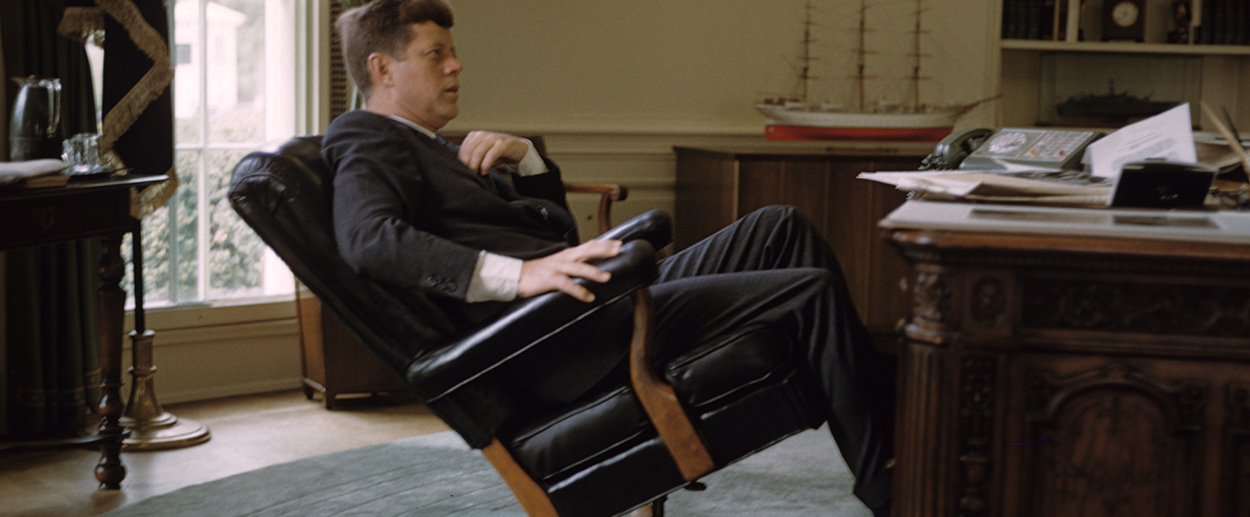
Imagen
In the fiftieth anniversary of John F. Kennedy’s assassination, the hype—the movies and books and magazine covers, the roundups and reminiscences and retrospectives—is in overdrive. How can America resist another JFK love-in? The popular adoration of Kennedy, five decades on, puzzles pundits and historians, who note, correctly, that he neither led the nation through war nor racked up a legislative record on par with that of Woodrow Wilson, Franklin Roosevelt, or Lyndon Johnson.

Some explanations for the discrepancy are obvious: His youth and good looks. His vigor, grace, and cool. The facility with which he projected this image through television, of which he was the first presidential master. And the assassination itself, which by taking Kennedy in his prime allowed Americans to spin fantasies of greatness unrealized.

Yet neither the Camelot mystique nor Kennedy’s premature death can fully explain his continuing appeal. There was no cult of Warren Harding in 1973, no William McKinley media blitz in 1951. I would submit that Kennedy’s hold on us stems also from the way he used the presidency, his commitment to exercising his power to address social needs, his belief that government could harness expert knowledge to solve problems—in short, from his liberalism.

To make that case requires first correcting some misperceptions. Wasn’t JFK a cold warrior who called on Americans to gird for a “long twilight struggle”? Didn’t he drag his heels on civil rights? Didn’t he give us tax cuts a generation before Ronald Reagan? While there’s some truth to those assertions, layers of revisionism and politicized misreadings of Kennedy have come to obscure his true beliefs. During the 1960 presidential campaign, when Republicans tried to make the term liberal anathema, Kennedy embraced it. A liberal, he said in one speech, “cares about the welfare of the people—their health, their housing, their schools, their jobs, their civil rights, and their civil liberties,” and under that definition, he said, “I’m proud to say I’m a ‘liberal.’”

In 1960, the United States was gripped by a quest for “national purpose,” a yearning to find a meaningful goal for America’s energies. This desire had several sources. The cold war was enervating. Material comfort gave rise to an existential uncertainty about what our riches were supposed to produce, a malaise captured in books such as John Kenneth Galbraith’s The Affluent Society and David Riesman’s Abundance for What? Kennedy’s pledge to “get America moving again” should be understood as a part of this collective soul-searching. After the hands-off economic management of President Eisenhower’s free-marketeers, Kennedy promised an aggressive effort to spur growth and create jobs. After Eisenhower’s neglect of mounting urban problems, Kennedy promised a federal commitment to education and housing. After Sputnik and the U-2 affair, Kennedy promised a vigorous effort to win hearts and minds around the world.

As an activist, Kennedy called on Americans to trust government to address the nation’s problems; as a pragmatist, he bade them to believe that dedicated public servants could again muster, as they had during the New Deal, the requisite know-how. In word and in deed, JFK put the weight of his presidency behind a liberal program. He backed a demand-side—not supply-side—tax cut designed to put money in people’s hands to stimulate short-term economic activity. The War on Poverty (an idea he had rolled out during the campaign) sought to alleviate penury, especially among the elderly, by pushing for Medicare and expanded Social Security benefits. The President’s Commission on the Status of Women endorsed workplace equality, child care facilities for working women, paid maternity leave, better Social Security benefits for widows, and equal pay for comparable work. Federal employees got collective bargaining.

Even on civil rights, where Kennedy often gave into his fear of alienating the Southern bloc, he ultimately put the power of the federal government behind racial equality. He used federal troops to ensure the enrollment of black students at the universities of Mississippi and Alabama; his administration implemented the first “affirmative action” program for government employees and contractors. Some movement leaders seethed with frustration over his slow pace. But when the historian Ellen Fitzpatrick compiled post-assassination condolence letters to Jackie Kennedy for a 2010 book, she found affecting notes from African Americans who considered Kennedy, as one correspondent wrote, “a beacon—a light in the darkness who would indeed be a second Emancipator.” His picture graced walls and mantelpieces.

In foreign policy, too, Kennedy’s liberalism has been underappreciated. We hear nowadays that he ran to the right of Richard Nixon on national security in 1960—a claim supported chiefly by his invocation of the so-called missile gap. But that stance no more made Kennedy a hawk in 1960 than Barack Obama’s 2008 pledge to escalate in Afghanistan placed him to the right of John McCain. Overall, in 1960, it was Kennedy who expressed skepticism about the extension of military forces around the globe. He was, to be sure, a staunch anti-communist, and not averse to using hard power. But it was Nixon, not Kennedy, who was ready to go to war to defend Quemoy and Matsu, the tiny islands off China’s shore, while Kennedy questioned his rival’s ill-considered stance.

JFK’s 1961 inaugural address, too, is typically misread as saber-rattling. But his famous call to steel the nation for the cold war conflict was a prologue to the exposition of a more hopeful, conciliatory policy. In that speech, Kennedy endorsed the United Nations as “our last best hope,” warned against the stockpiling of nukes, urged arms-control negotiations, and held out the prospect of collaboration in science, medicine, and commerce. Press accounts treated it as a summons to work toward peace.

In office, Kennedy also preferred diplomacy to military intervention. His wariness of using force led him to deny the CIA-supported Cuban rebels the sufficient air cover they needed at the Bay of Pigs; 18 months later, it counseled him to buck his military chiefs and negotiate the withdrawal of Soviet missiles. He rejected initial calls to get involved in Laos, and his frequently voiced doubts about the effectiveness of U.S. military support for South Vietnam make it at least plausible to surmise that, had he lived, Kennedy wouldn’t have escalated as Johnson did (a speculative matter either way). Following the Cuban missile crisis, moreover, Kennedy redoubled efforts to pull back from the brink. He installed the “hot line” to Moscow and concluded a historic nuclear test-ban treaty. If by “cold warrior” we mean someone cognizant of the stakes of the superpower rivalry, JFK deserves the label. But his presidency was marked at least as much by efforts to defuse tensions as it was by the adventurism for which he has since become known.

Under Kennedy, popular support for government was near its peak. More than 70 percent of Americans said they trusted Washington most or all of the time. As the Vietnam war and the kulturkampf of the 1960s dragged on, that figure declined. Today, after decades of anti-government rhetoric and gridlock, debt and wage stagnation, it stands at about 20 percent. Promises of an activist government are met with cynicism, hostility, and questions about the price tag. The climate is inhospitable to those who would rally the public to higher purposes.

Layers of revisionism and politicized misreadings of Kennedy have come to obscure his true beliefs.

JFK is a reminder that this wasn’t always so. Retrospectives on him inevitably include the witty press conferences, the white-tie White House dinners with the likes of Pablo Casals, the photos of John Jr. playing under the Oval Office desk. But the warm feelings Americans have toward Kennedy may be something more than nostalgia for a glamorous presidency cut short. They reflect a wistfulness for the sense of common purpose and faith in a collective project that a proudly liberal president helped the nation achieve.

David Greenberg, a contributing editor at The New Republic, is a professor of history and of journalism and media studies at Rutgers University.

Source URL: http://www.newrepublic.com//article/115522/jfk-was-unapologetic-liberal
Read Full Post »

The Five Best Kennedy Assassination Books
Jon Wiener
The Nation    November, 11, 2013

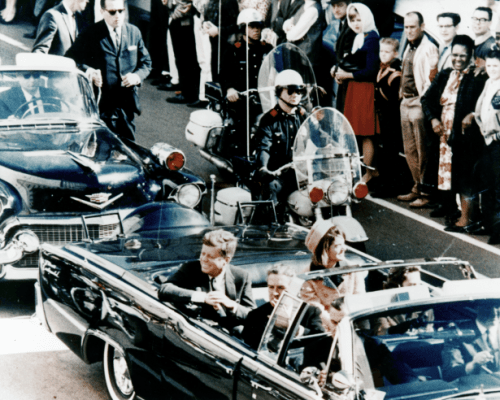
President Kennedy minutes before his assassination in Dallas, Texas, November 22, 1963. (Baylor University Collections)

President Kennedy minutes before his assassination in Dallas, Texas, November 22, 1963. (Baylor University Collections)

November 22 is of course the fiftieth anniversary of the Kennedy assassination. I haven’t read all 1,000 books about it, but I have five favorites:

Don DeLillo, Libra
“We will build theories that gleam like jade idols,” says DeLillo’s surrogate, a CIA historian writing the secret history of Dallas. “We will follow the bullet trajectories backwards to the lives that occupy the shadows, actual men who moan in their dreams.” In the novel, two CIA veterans of the Bay of Pigs seek to arouse anti-Cuban sentiment by organizing an assassination attempt by a Castro supporter. But in their plan, the assassin—with an identity “made out of ordinary pocket litter”—will miss. DeLillo, as John Leonard wrote in The Nation, “is an agnostic about reality.”

Stephen King, 11/22/63
When Jake steps thru the secret passage in Al’s Diner in Maine, it takes him back to 1958; can he stick around and change the course of history by stopping Oswald before November 22, 1963? And what if he discovers that the conspiracy theorists were right, and JFK was shot by someone else? Eight hundred and fifty wonderful pages of time travel romance and adventure in a world where the food tastes better and the music is more fun—and where history itself resists change, with all its might.

Robert Caro, LBJ: The Passage of Power chapters 11–13
The assassination seen through LBJ’s eyes, one car back in the motorcade in Dealey Plaza: after Oswald’s first shot, Secret Service agent Rufus Youngblood shouted, “Get down! Get down!” Then LBJ “was on the floor, his face on the floor, with the weight of a big man lying on top of him,” as the two cars sped toward Parkland Hospital. When they arrived, Agent Youngblood said, ‘I want you and Mrs. Johnson to stick with me and the other agents as close as you can. We are going into the hospital and we aren’t gonna stop for anything or anybody. Do you understand?’ ‘Okay, pardner, I understand,’ Lyndon Johnson said.”

Norman Mailer, Oswald’s Tale
Mailer in his reporter-researcher mode: at age 70, he spent six cold months in Minsk, where Oswald had lived with his Russian wife Marina for thirty months starting in 1960. Mailer interviewed fifty people and used the KGB’s tapes from Oswald’s bugged apartment to paint a vivid picture of the dullness and misery of their lives. Mailer said he started “with a prejudice in favor of the conspiracy theorists,” but he found Oswald to have been a lonely Marxist megalomaniac and an angry loser. In the end, Robert Stone wrote in The New York Review of Books, Mailer had to conclude that “absurdity and common death gape far wider beneath us than high conspiracy, tragedy, or sacrifice.”

Vincent Bugliosi, Reclaiming History
An encyclopedia of assassination conspiracies, with each and every one refuted, “revealed as a fraud on the American public.” One thousand six hundred oversize pages, plus a CD with 1,100 pages of notes, written by the legendary criminal prosecutor. “No group of top-level conspirators,” he argues, “would ever employ someone as unstable and unreliable as Oswald to commit the biggest murder in history, no such group would ever provide its hit man with a twelve-dollar rifle to get the job done, and any such group would help its hit man escape or have a car waiting to drive him to his death, not allow him to be wandering out in the street, catching cabs and buses to get away, as we know Oswald did.”

Jon Wiener teaches U.S. history at UC Irvine.

Read Full Post »

JFK at Rice University in September 1962. Image via Wiki Commons.

Rethinking the JFK Legacy

Steven M. Gillo

huffingtonpost.com October 27, 2013

As we approach the 50th anniversary of President John F. Kennedy’s assassination we are reminded of his enduring hold on the popular imagination. Once again countless magazine articles, newspaper stories, books, and television stories will focus on the man, his presidency, and his death. Politicians from both parties continue to invoke his name to sell themselves and their policies. Polls show that Kennedy is America’s favorite president, ranking above Washington, Lincoln, and Roosevelt.

Public adulation of Kennedy baffles many historians who have spent the past twenty years assaulting the foundation of Camelot. The public sees him as a bold and gallant leader who inspired the young, helped the disadvantaged, pushed for civil rights, stood down the Russians, and added glamor and style to the White House.

In recent years, however, many historians have focused attention on Kennedy’s shortcomings: the obsession with Fidel Castro, his reluctant support of civil rights, and the escalation in Vietnam. They have also probed beneath the glossy Kennedy charm and discovered a man who was dependent on prescription medication and who possessed an insatiable sexual appetite. Kennedy, a recent critic charged, was «deficient in integrity, compassion, and temperance.» That is a harsh judgment, and certainly not one shared by most historians. Most would agree, however, that his short time in office prevented JFK from leaving a lasting legacy of accomplishment.

Why the wide gap between the way historians view Kennedy and how the public perceives him? Part of the problem is that historians have difficulty appreciating Kennedy’s emotional impact on the public. Kennedy was the first president to use television to bypass the Washington opinion-makers and communicate directly with the American public. Television made obsolete traditional models which used legislative accomplishments to determine influence.

Because of the intimate relationship Kennedy established with the American public many people felt a sense of personal loss at his death. The assassination affected America unlike any other single event in modern history — with the possible exception of 9/11. No American born prior to 1960 can forget where he or she was the moment they heard the news of the President’s death. Seventy-five hours of television coverage helped create a shared sense of national grief. Four of five Americans felt «the loss of someone very close and dear,» and more than half cried.

Inevitably, in the years that followed Americans have searched to give his death some meaning. Our refusal to accept that Kennedy’s death could have been the result of a random, inexplicable act of violence has led us to search for more satisfying explanations. We refuse to accept that a loser like Lee Harvey Oswald could single-handedly kill a man as great as JFK. That search for meaning has lead to the creation of a mythical, heroic Kennedy. The thread that runs through most conspiracy theories, and permeates the popular view of JFK, is that nefarious individuals conspired to kill the President because he offered a new direction for the country.

But the Kennedy mystique is based on more than his photogenic qualities and his tragic death. In trying to understand Kennedy’s appeal I am reminded of what our first professional biographer, James Parton, wrote about Thomas Jefferson. «If Jefferson was wrong,» he wrote, «America is wrong. If Jefferson was right. America is right.»

Since the Puritans came to America searching for deliverance from the corruption of the Old World, Americans have believed in national destiny. Thomas Jefferson declared the new nation «the last best hope of mankind.» Herman Melville compared Americans to the biblical tribes of Israel, calling them «the peculiar chosen people… the Israel of our time.» At the heart of this belief was a faith that the future would always be better than the past. America stood as the exception to the historical rules which dictated that great civilizations eventually peaked and crumbled. Devoid of the class conflict, racial tensions, and the imperial designs that characterized other civilizations, America would move inevitably toward realizing its divinely inspired mission to be «as a city upon a hill.»

More than any president since FDR, Kennedy embodied these ideals of American greatness. Kennedy, like the nation he led, seemed larger than life. Every dimension of the New Frontier projected an image of strength and vitality: the inspirational rhetoric of sacrifice and idealism; the aristocratic elegance and democratic demeanor; the brilliant but compassionate advisers. Robert Frost captured the mood of the nation when he predicted that the Kennedy years would be an «Augustan age of poetry and power.»

The tragic series of events that followed Kennedy’s death challenged our faith in national destiny. A lost war in Vietnam and a crippling oil embargo reminded us that we could not shape the world in our own image. At home, racial violence, student protests, and government corruption revealed that America remained a deeply divided nation. During our time of trouble we turned to a heroic Kennedy for comfort. He reminded us of a time when America stood strong in the world, our nation felt united, and life seemed simpler. As the American dream slips further from the grasp of most people, as our faith in government and our hope for the future diminishes, we cling more tenaciously than ever to a mythic view of Kennedy.

We have transformed Kennedy into a metaphor of American greatness and judged all of his successors by that standard. Not surprisingly, they look dull by comparison. Politicians, eager to win the hearts of American voters, have tried to mimic Kennedy’s style and to steal his message. Republicans have invoked Kennedy’s memory to sell programs — supply-side economics, for example — that were antithetical to JFK’s own policies. President Obama flexed his political and legislative muscle to push through legislation that was far more ambitious than anything JFK could have imagined, yet even he, and his accomplishments, appear diminished by the comparison to a mythical Kennedy.

Over the years, the public, which has grown cynical and angry over raised expectations and diminished results, has moved to the sidelines of American politics waiting for the «next JFK.» Powerful, well-organized and well-funded, interest groups have moved to fill the void.

It is ironic that the memory of JFK would weaken political institutions. Kennedy won the presidency in 1960 by advocating change and, at least on a rhetorical level, he challenged us to confront old ideas. «For the great enemy of truth,» he said in a famous Yale commencement address in 1963, «is very often not the lie — deliberate, contrived, and dishonest — but the myth — persistent, persuasive, and unrealistic.»

Ultimately, our fascination with Kennedy tells us more about ourselves, our deeply rooted beliefs and our need for heroes, then it does shed light on the man or his times. Kennedy was a very mortal man, very much a product of his times. In life he offered few solutions to the pressing issues of his time. His memory, burdened by the weight of myth, limits our ability to find answers to the problems of our own time.

http://www.huffingtonpost.com/steven-m-gillon/rethinking-the-jfk-legacy_b_4167729.html

Steven M Gillon is Scholar-in-Residence at History and Professor of History at the University of Oklahoma

Read Full Post »

« Newer Posts