Feeds:
Entradas
Comentarios

Archive for the ‘Imperialismo norteamericano’ Category

KEVIN M. KRUSE   One Nation Under God: How Corporate America Invented Christian America

BASIC BOOKS, 2015
by LILIAN CALLES-BARGER 
New Books in American Studies  Network  MAY 22, 2015

Kevin M. Kruse

Kevin M. Kruse is professor of history at Princeton University and author of One Nation Under God: How Corporate America Invented Christian America (Basic Books, 2015). Kruse argues that the idea that America was always a «Christian nation» dates from the 1930s. In opposition to FDR’S New Deal, businessmen and religious leaders began to promote the idea of «freedom under God.» The post-war era brought new fears of the advancement of domestic communism. In a decisive turn from an earlier social gospel, these leaders established a Christian ethos based on the ideas of private property, capitalism, and individual economic freedom. Adding «under God» to the pledge of allegiance, designating «In God We Trust» as the official motto of the nation, the controversial attempt to institute prayer and bible distribution in American schools were all forerunner to the Christian Right at the end of the century. Kruse’s narrative focuses on how American leaders from different powerful sectors of the nation sought through legislation and public practices to unify a pluralistic nation under a capitalist-affirming Christian framework. The result was not unity but a more fragmented and divided nation. In unfolding the narrative Kruse challenges the often-benign public religious images of men like Billy Graham, Dwight D. Eisenhower, and a multitude of recognizable business leaders. The book opens up a timely conversation on the meaning of religious pluralism and the place of religion in American public life.

Read Full Post »

How the Civil War Became the Indian Wars

The New York Times    May 25, 2015

These two conflicts, long segregated in history and memory, were in fact intertwined. They both grew out of the process of establishing an American empire in the West. In 1860, competing visions of expansion transformed the presidential election into a referendum. Members of the Republican Party hearkened back to Jefferson’s dream of an “empire for liberty.” The United States, they said, should move west, leaving slavery behind. This free soil platform stood opposite the splintered Democrats’ insistence that slavery, unfettered by federal regulations, should be allowed to root itself in new soil. After Abraham Lincoln’s narrow victory, Southern states seceded, taking their congressional delegations with them.

Never ones to let a serious crisis go to waste, leading Republicans seized the ensuing constitutional crisis as an opportunity to remake the nation’s political economy and geography. In the summer of 1862, as Lincoln mulled over the Emancipation Proclamation’s details, officials in his administration created the Department of Agriculture, while Congress passed the Morrill Land Grant Act, the Pacific Railroad Act and the Homestead Act. As a result, federal authorities could offer citizens a deal: Enlist to fight for Lincoln and liberty, and receive, as fair recompense for their patriotic sacrifices, higher education and Western land connected by rail to markets. It seemed possible that liberty and empire might advance in lock step.

But later that summer, Lincoln dispatched Gen. John Pope, who was defeated by Lee at the Second Battle of Bull Run, to smash an uprising among the Dakota Sioux in Minnesota. The result was the largest mass execution in the nation’s history: 38 Dakotas were hanged the day after Christmas 1862. A year later, Kit Carson, who had found glory at the Battle of Valverde, prosecuted a scorched-earth campaign against the Navajos, culminating in 1864 with the Long Walk, in which Navajos endured a 300-mile forced march from Arizona to a reservation in New Mexico.

That same year, Col. John Chivington, who turned back Confederates in the Southwest at the Battle of Glorieta Pass, attacked a peaceful camp of Cheyennes and Arapahos at Sand Creek in Colorado. Chivington’s troops slaughtered more than 150 Indians. A vast majority were women, children or the elderly. Through the streets of Denver, the soldiers paraded their grim trophies from the killing field: scalps and genitalia.

In the years after the Civil War, federal officials contemplated the problem of demilitarization. Over one million Union soldiers had to be mustered out or redeployed. Thousands of troops remained in the South to support Reconstruction. Thousands more were sent West. Set against that backdrop, the project of continental expansion fostered sectional reconciliation. Northerners and Southerners agreed on little at the time except that the Army should pacify Western tribes. Even as they fought over the proper role for the federal government, the rights of the states, and the prerogatives of citizenship, many Americans found rare common ground on the subject of Manifest Destiny.

Fort Sumter

During the era of Reconstruction, many American soldiers, whether they had fought for the Union or the Confederacy, redeployed to the frontier. They became shock troops of empire. The federal project of demilitarization, paradoxically, accelerated the conquest and colonization of the West.

The Fetterman Fight exploded out of this context. In the wake of the Sand Creek Massacre, Cheyennes, Arapahos and various Sioux peoples forged an alliance, hoping to stem the tide of settlers surging across the Plains. Officials in Washington sensed a threat to their imperial ambitions. They sent Maj. Gen. Grenville Dodge, who had commanded a corps during William Tecumseh Sherman’s pivotal Atlanta campaign, to win what soon became known as Red Cloud’s War. After another year of gruesome and ineffectual fighting, federal and tribal negotiators signed the Treaty of Fort Laramie, guaranteeing the Lakotas the Black Hills “in perpetuity” and pledging that settlers would stay out of the Powder River Country.

The Indian wars of the Reconstruction era devastated not just Native American nations but also the United States. When the Civil War ended, many Northerners embraced their government, which had, after all, proved its worth by preserving the Union and helping to free the slaves. For a moment, it seemed that the federal government could accomplish great things. But in the West, Native Americans would not simply vanish, fated by racial destiny to drown in the flood tide of civilization.

Red Cloud’s War, then, undermined a utopian moment and blurred the Republican Party’s vision for expansion, but at least the Grant administration had a plan. After he took office in 1869, President Grant promised that he would pursue a “peace policy” to put an end to violence in the West, opening the region to settlers. By feeding rather than fighting Indians, federal authorities would avoid further bloodshed with the nation’s indigenous peoples. The process of civilizing and acculturating Native nations into the United States could begin.

disunion45This plan soon unraveled. In 1872, Captain Jack, a Modoc headman, led approximately 150 of his people into the lava beds south of Tule Lake, near the Oregon-California border. The Modocs were irate because federal officials refused to protect them from local settlers and neighboring tribes. Panic gripped the region. General Sherman, by then elevated to command of the entire Army, responded by sending Maj. Gen. Edward Canby to pacify the Modocs. A decade earlier, Canby had devised the original plan for the Navajos’ Long Walk, and then later had helped to quell the New York City Draft Riots. Sherman was confident that his subordinate could handle the task at hand: negotiating a settlement with a ragtag band of frontier savages.

But on April 11, 1873, Good Friday, after months of bloody skirmishes and failed negotiations, the Modoc War, which to that point had been a local problem, became a national tragedy. When Captain Jack and his men killed Canby – the only general to die during the Indian wars – and another peace commissioner, the violence shocked observers around the United States and the world. Sherman and Grant called for the Modoc’s “utter extermination.” The fighting ended only when soldiers captured, tried, and executed Captain Jack and several of his followers later that year. Soon after, the Army loaded the surviving Modocs onto cattle cars and shipped them off to a reservation in Indian Territory (present-day Oklahoma).

President Grant’s Peace Policy perished in the Modoc War. The horror of that conflict, and the Indian wars more broadly, coupled with an endless array of political scandals and violence in the states of the former Confederacy – including the brutal murder, on Easter Sunday 1873 in Colfax, La., of at least 60 African-Americans – diminished support for the Grant administration’s initiatives in the South and the West.

The following year, Lt. Col. George Armstrong Custer claimed that an expedition he led had discovered gold in the Black Hills – territory supposedly safeguarded for the Lakotas by the Fort Laramie Treaty. News of potential riches spread around the country. Another torrent of settlers rushed westward. Hoping to preserve land sacred to their people, tribal leaders, including Red Cloud, met with Grant. He offered them a new reservation. “If it is such a good country,” one of the chiefs replied, “you ought to send the white men now in our country there and leave us alone.” Crazy Horse, Sitting Bull and other warriors began attacking settlers. Troops marched toward what would be called the Great Sioux War.

Crazy Horse and his band of Indians on their way from Camp Sheridan to surrender at Red Cloud Agency, 1877.

Horse and his band of Indians on their way from Camp Sheridan to surrender at Red Cloud Agency, 1877.Credit Library of Congress.


Early in 1876, Lt. Gen. Philip Sheridan, the Army’s commander on the Plains, insisted that all Indians in the region must return to their reservations. The Lakotas and Northern Cheyennes refused. That summer, as the nation celebrated its centennial, the allied tribes won two victories in Montana: first at the Rosebud and then at the Little Bighorn. The Army sent reinforcements. Congress abrogated the Lakotas’ claims to land outside their reservation. The bloodshed continued until the spring of 1877, when the tribal coalition crumbled. Sitting Bull fled to Canada. Crazy Horse surrendered and died in federal custody.

The final act of this drama opened in 1876. When federal officials tried to remove the Nez Perce from the Pacific Northwest to Idaho, hundreds of Indians began following a leader named Chief Joseph, who vowed to fight efforts to dispossess his people. Sherman sent Maj. Gen. Oliver Otis Howard, formerly head of the Freedmen’s Bureau, to quiet the brewing insurgency. As Howard traveled west, the 1876 election remained undecided. The Democrat Samuel Tilden had outpolled the Republican Rutherford B. Hayes by nearly 300,000 votes. But both men had fallen short in the Electoral College. Congress appointed a commission to adjudicate the result. In the end, that body awarded the Oval Office to Hayes. Apparently making good on a deal struck with leading Democrats, Hayes then withdrew federal troops from the South, scuttling Reconstruction.

Less than two months after Hayes’s inauguration, Howard warned the Nez Perce that they had 30 days to return to their reservation. Instead of complying, the Indians fled, eventually covering more than 1,100 miles of the Northwest’s forbidding terrain. Later that summer, Col. Nelson Miles, a decorated veteran of Antietam, the Peninsula Campaign and the Appomattox Campaign, arrived to reinforce Howard. Trapped, Chief Joseph surrendered on Oct. 5, 1877. He reportedly said: “I am tired. My heart is sick and sad. From where the sun now stands, I will fight no more forever.”

One hundred and fifty years after the Civil War, collective memory casts that conflict as a war of liberation, entirely distinct from the Indian wars. President Lincoln died, schoolchildren throughout the United States learn, so that the nation might live again, resurrected and redeemed for having freed the South’s slaves. And though Reconstruction is typically recalled in the popular imagination as both more convoluted and contested – whether thwarted by intransigent Southerners, doomed to fail by incompetent and overweening federal officials, or perhaps some combination of the two – it was well intended nevertheless, an effort to make good on the nation’s commitment to freedom and equality.

But this is only part of the story. The Civil War emerged out of struggles between the North and South over how best to settle the West – struggles, in short, over who would shape an emerging American empire. Reconstruction in the West then devolved into a series of conflicts with Native Americans. And so, while the Civil War and its aftermath boasted moments of redemption and days of jubilee, the era also featured episodes of subjugation and dispossession, patterns that would repeat themselves in the coming years. When Chief Joseph surrendered, the United States secured its empire in the West. The Indian wars were over, but an era of American imperialism was just beginning..

Boyd Cothran is an assistant professor of United States Indigenous and cultural history at York University in Toronto and the author of “Remembering the Modoc War: Redemptive Violence and the Making of American Innocence.” Ari Kelman is the McCabe-Greer Professor of the Civil War Era at Penn State and the author of “A Misplaced Massacre: Struggling Over the Memory of Sand Creek,” which won the Bancroft Prize in 2014, and, with Jonathan Fetter-Vorm, “Battle Lines: A Graphic History of the Civil War.” Cothran and Kelman are both writing books about the relationship between Reconstruction and Native American history

Read Full Post »

America’s First Political Cartoons

A look back at some of the illustrations that graced the pages of Puck magazine, America’s first humor magazine that satirized political and social issues of the day.
National Journal  May 22, 2015

(Joseph Keppler/Puck Magazine/Wikimedia Commons)

This cartoon, «The Modern Colossus of [Rail] Roads,» dated December 10, 1879, depicts New York Central Railroad President Henry Vanderbilt at the center as the most powerful tycoon in the U.S. railroad industry. Standing on his feet are two other powerful industry figures, Cyrus West Field (left), who controlled the New York Elevated Railroad Company, and Jay Gould (right), who controlled the Union Pacific Railroad.

(Frederick Burr Opper/Library of Congress)

Belva Lockwood, the first woman to argue a case before the Supreme Court, is pictured here alongside presidential candidate Ben Butler (labeled «B.B.») of the Greenback/Anti-Monopoly Party. In 1884, Lockwood was chosen by the small California-based Equal Rights Party as their presidential nominee, and the media quickly seized upon the news.

(Louis Dalrymple/Library of Congress)

In this June 23, 1897, illustration, the magazine’s recurring character, Puck, (after the word «puckish,» which means childishly mischievous) is handing a bouquet of flowers labeled «1837» and «1897» to Queen Victoria, who is sitting on a throne, holding a scepter, and leaning forward to accept the flowers.

(Udo J. Kepple/Puck Magazine/Wikimedia Commons)

This cartoon, dated March 30, 1898, depicts Richard «Boss» Croker, the head of New York City’s Tammany Hall, as the sun, with politicians and people from various professions revolving around him. With Tammany Hall, Croker controlled one of the most powerful political institutions of his time.

(Louis Dalrymple/Puck Magazine/Wikimedia Commons)

A cartoon, dated May 11, 1898, urging war with Spain over Cuba. A month earlier, the United States had declared war on Spain after the sinking of the battleship Maine in Havana harbor on February 15, 1898. The bottom of the photo reads, «The duty of the hour: To save her not only from Spain, but from a worse fate.» The Spanish-American War eventually ended with the signing of the Treaty of Paris on December 1898, after Spain lost control of Cuba, Puerto Rico, the Philippines, Guam, and other islands.

(Wikimedia Commons)

A 1901 cartoon depicting business magnate John D. Rockefeller, founder of Standard Oil, one of the world’s first and largest multinational corporations. Rockefeller stands on a podium with his company’s name and wears a crown labeled with the names of major railroads. In 1901, an anarchist assassinated President McKinley and included corporations like Standard Oil among his antitrust rhetoric.

(Udo J. Kepple/Puck Magazine/Library of Congress)

(Udo J. Kepple/Puck Magazine/Library of Congress)

In this illustration from April 1, 1903, Nicholas II, the last czar of Russia, is kneeling on one knee before a pillow, on which rests a scroll of papers labeled «Ukase civil and religious reforms,» with rays of light labeled «Enlightenment» beaming down on him. Nicholas II’s reign marked a turbulent time of immense political change in Russian history, and he and his family were executed on July 17, 1918.

(Udo J. Kepple/Puck Magazine/Library of Congress)

This March 9, 1904, illustration shows steel magnate Charles M. Schwab as Napoleon sitting on a rock in the middle of the ocean, looking back at the setting sun labeled «Business Reputation.» In his hands are papers labeled «Investigation Ship Building Scandal,» and other papers labeled «Steel Trust» are in his coat pocket.

This March 9, 1904, illustration shows steel magnate Charles M. Schwab as Napoleon sitting on a rock in the middle of the ocean, looking back at the setting sun labeled «Business Reputation.» In his hands are papers labeled «Investigation Ship Building Scandal,» and other papers labeled «Steel Trust» are in his coat pocket.

(Frank A. Nankivell/Library of Congress)

A Fourth of July cartoon from 1905 showing a crowd of people celebrating a spinning firework display with the head of Uncle Sam at the center.

(Frank A. Nankivell)


This illustration, dated February 2, 1910, shows banker John Pierpont «J.P.» Morgan clutching to his chest large New York City buildings labeled «Billion Dollar Bank Merger.» In the foreground, a young child puts a coin in a «toy bank» and Morgan’s left arm reaches around the buildings to grab it for himself. Three years earlier, during the Panic of 1907, Morgan resolved a banking crisis after major New York banks were on the verge of bankruptcy. The U.S. Federal Reserve System was created following the Panic, which the magazine cover alludes to with its title, «The Central Bank—A look back at some of the illustrations that graced the pages of Puck magazine, America’s first humor magazine that satirized political and social issues of the day.Why should Uncle Sam establish one, when Uncle Pierpont is already on the job?»

(Brynolf Wennerberg)

This illustration, dated July 25, 1914, shows a tall beautiful woman with red hair, wearing a long green dress and a headband with a feather. She is holding up her hands and perched on her fingers are several diminutive male figures who are courting her with bouquets of flowers, bags of money, serenading her, appealing to her, and even threatening suicide.

(Henry Mayer/Puck Publishing Corporation/Library of Congress)

A torch-bearing woman labeled «Votes for Women,» symbolizing the awakening of the nation’s women to the desire for suffrage, strides across the Western states, where women already had the right to vote, toward the East where women are reaching out to her, dated February 20, 1915.

(Rolf Armstrong/Library of Congress)

In this February 20, 1915, illustration, Puck is pictured with a pencil in his hand, next to a woman wearing a uniform and a sash labeled «Votes for Women.»

(Library of Congress)

This cartoon, dated October 9, 1915, «I Did Not Raise My Girl To Be a Voter,» is a parody of the anti-World War I protest song «I Did Not Raise My Boy To Be A Soldier,» with the context altered to women’s suffrage. A conductor labeled «political boss» leads a lone female soloist surrounded by a male chorus with various labels, including «procurer,» «child-labor employer,» and «sweat-shop owner.» Arguments in favor of granting women the right to vote included the contention that female voters would support laws that reduced prostitution, labor abuses, and other social evils.

Annum Masroor

Audience Engagement Fellow

amasroor@nationaljournal.com

Annum Masroor is an audience engagement fellow at National Journal. Previously, she was an intern at The Nation, Salon.com, and Democracy Now!. She graduated from the University of Georgia with a B.A. in international affairs and Arabic, and from Columbia University Graduate School of Journalism with an M.S. in journalism. She is from Savannah, GA.

Read Full Post »

HEATHER COX RICHARDSON  Wounded Knee: Party Politics and the Road to an American Massacre

BASIC BOOKS, 2010

by MARSHALL POE 
New Books on Native American Studies  MARCH 19, 2011

Heather Cox Richardson

[Crossposted from New Books in History] Of all the events in American history, two are far and away the most troubling: slavery and the near-genocidal war against native Americans. In truth, we’ve dealt much better with the former than the latter. The slaves were emancipated. After a long and painful struggle, their descendants won their full civil rights. Though that struggle is not yet finished, near equality has been reached in many areas of American life. And almost all Americans understand that slavery was wrong. None of this can be said about the campaign against native Americans. Instead of emancipation, the Indians–or rather those left after the slaughter–were «removed» to reservations where their way of life was destroyed. After a long and painful struggle, many of their descendants are still in those reservations and living in poverty. They struggle still, but are not equal to other Americans by most measures. And many Americans refuse to believe that the U.S. was wrong in killing, sequestering, and impoverishing the native Americans.

They are wrong to do so, for we know what happened and why thanks to historians such as Heather Cox Richardson. In her eye-opening new book Wounded Knee: Party Politics and the Road to an American Massacre(Basic Books, 2010) she shows just how calculated, self-serving, and even spiteful the White assault on the Plains Indians was. Despite what they said (mostly to the Indians themselves), the Whites never had any real intention of allowing the Sioux and others to keep their land, maintain their way of life, or even to continue to exist. It was clear to them that the Indians would either become White (meaning would take up farming) or would go. The Whites weren’t exactly cynics; rather they were self-deceiving fatalists. They came to believe that destiny itself compelled them to assimilate or annihilate the Indians.

But destiny didn’t destroy the Plains Indians. The government of the United States of America did.

Read Full Post »

LEIGH ANN WHEELER

How Sex Became a Civil Liberty

OXFORD UNIVERSITY, 2013
by LILIAN CALLES BARGER
New Books in History   APRIL 6, 2015

Leigh Ann Wheeler is professor of history at Binghamton University. Her book How Sex Became a Civil Liberty (Oxford University Press, 2013), examines the role of the American Civil Liberties Union in establishing sexual rights as grounded in the U.S. constitution. Wheeler begins in the bohemian New York with the personal biographies of individuals who established the ACLU for the protection of anti-government speech. Early ACLU leaders displayed sexualproclivities and outlooks outside the mainstream. Beginning with obscenity laws that hampered the distribution of contraceptives and birth control information, the ACLU legally pursued sexual practice, expression, and the right to privacy as civil liberties. Presenting their own clients, building collisions with advocacy groups, providing legal briefs to decision makers, directing activism, and influencing public opinion, the ACLU brought about change in a wide array of laws that restrained and criminalized sexual behavior and expression. This was not a smooth process of advancement. The implications of class, race, and gender created conflicts, contradictions, and ironies in establishing the sexual rights of individuals against the contrary rights of others and communities to unwanted sex and sexual content. As blacks and women entered the ranks of the ACLU in the 1960s and 70s they brought new conflicts within the sexual rights agenda. Reproductive freedom, rape shield laws, homosexual rights, and the rights of profit-seeking pornographers are some of the many issues of ACLU advocacy. While seeking to build a privacy wall around sexual expression and practice, sexual rights advocacy contributed to the current cultural saturation with sexual images and messages blurring the lines between public and private. Wheeler has provided a thoroughly researched, complex, and compelling history of how issues surrounding sexuality became recognized as civil liberties guaranteed by the constitution.

Read Full Post »

JENNIFER DELTON Rethinking the 1950s: How Anticommunism and the Cold War Made America Liberal

CAMBRIDGE UNIVERSITY PRESS, 2013
by CHRISTINE M. LAMBERSON
New Books in History  APRIL 23, 2015

Jennifer Delton

Conventional wisdom among historians and the public says anticommunism and the Cold War were barriers to reform during their height in the 1950s. In this view, the strong hand of a conservative anticommunism and Cold War priorities thwarted liberal and leftist reforms, political dissent and dreams of social democracy. Jennifer Delton is a professor of history at Skidmore College, and her new book, Rethinking the 1950s: How Anticommunism and the Cold War Made America Liberal (Cambridge University Press, 2013) encourages us–as the title suggests–to rethink that conventional view. She argues that in fact the Cold War and anticommunism promoted and justified many liberal goals rather than stifling them. Her book demonstrates that supposed conservatives championed many liberal causes while many liberals genuinely supported the Cold War and anticommunism. For example, she discusses the liberal beliefs and actions of business leaders and politicians like Dwight Eisenhower, who are often thought of as conservative figures, to show the dominance of liberal political ideas during this period. On the other side, she also argues that liberals, such as many labor activists, were themselves strongly anticommunist because they saw communism as truly damaging to their cause, not simply because they aimed to avoid the taint of a communist label. These sentiments had important effects on policy as well. From high taxes to regulation, civil rights and the continuance of New Deal programs, liberal ideas held sway. They had a powerful effect on policy, not in spite of, but because of the larger Cold War context. In the interview, Delton discusses her book and its importance in reforming both historians’ views of the period and our broader thinking about partisan politics and nationalism.

Read Full Post »

Library of Congress

A Brief History of American Executions

From hanging to lethal injection
Matt Ford
 The Atlantic   June 2015

nging is perhaps the quintessential American punishment. In the pre-revolutionary era, criminals were also shot, pressed between heavy stones, broken on the wheel, or burned alive. (An estimated 16,000 people have been put to death in this country since the first recorded execution, in 1608.) But the simplicity of the noose triumphed, and its use spread as the republic grew.

In theory, a hanging is quick and relatively painless: the neck snaps immediately. But hangings can be grisly. If the rope is too short, the noose will slowly strangle the condemned. If the rope is too long, the force of the fall can decapitate the person.

The Supreme Court has never struck down a method of execution as unconstitutional. But states have at times tried to make the process more humane. “Hanging has come down to us from the dark ages,” New York Governor David B. Hill told the state legislature in 1885. He asked “whether the science of the present day” could produce a way to execute the condemned “in a less barbarous manner.”

Thomas Edison offered up his Menlo Park laboratory for New York officials to test electrocution on animals. Confident that the method would be painless and instantaneous, state legislators abolished hanging and mandated the use of the electric chair for all death sentences, starting in 1890. Other states slowly followed, although hanging never truly disappeared—the most recent one took place in Delaware in 1996.

Despite their scientific veneer, new methods had their own pitfalls. When Nevada performed the first execution by lethal gas in 1924, prison officials initially considered pumping the gas into the inmate’s cell while he slept. They opted instead to build an airtight chamber, but it was initially so chilly inside—just 49 degrees—that the gas pooled ineffectually on the floor.

Electrocution also proved to be far from foolproof. In 1946, Louisiana’s electric chair, set up by a guard and an inmate who were drunk, failed to kill 17-year-old Willie Francis, who had been convicted of murder. “I am not dying!” he screamed as he writhed. Francis appealed to the Supreme Court and argued that another turn in the electric chair would constitute cruel and unusual punishment. He lost his case, 5–4, and the state’s second attempt to electrocute him worked.

In 1972, the Supreme Court halted all executions in the U.S., ruling that state death-penalty statutes were too arbitrary. Four years later, the justices upheld revised statutes, and capital punishment resumed. Soon after, an Oklahoma legislator asked Jay Chapman, the state’s chief medical examiner, to help create a method to replace electrocution. Chapman, who once described himself as “an expert in dead bodies but not an expert in getting them that way,” devised a three-drug cocktail of sodium thiopental, pancuronium bromide, and potassium chloride. If administered via intravenous injection, he said, it would anesthetize and paralyze an inmate and then stop his heart. Texas was the first state to use lethal injection, in 1982; by the 1990s, the method was widespread. (Some states were reluctant to give up electrocution, however. Florida kept its aging electric chair running through the 1990s, even after two inmates’ heads caught fire.)

If lethal injection goes—whether because states can’t find execution drugs or because the Supreme Court strikes it down—what will replace it? Some states have already begun bringing back old methods in case they need an alternative. Tennessee is reviving the electric chair, and Oklahoma has authorized the use of lethal gas. In March, Utah reauthorized firing squads after abandoning them in favor of lethal injection 11 years ago.

ABOUT THE AUTHOR

  • MATT FORD is an associate editor atThe Atlantic, where he covers law and the courts.

Read Full Post »

Getting Right with Brown

Brown vs Board team

Brown v. Board team.(Photo: NAACP Legal Defense

For over sixty years, no matter where you stand on the constitutional spectrum, you have had to get right with Brown v. Board of Education. Decided sixty-one years ago this coming May 17, Brown is one of the best-known decisions of the U.S. Supreme Court, one of the Court’s most beloved – or at least well-regarded – decisions, and a key juncture in the development of American constitutional law.

There are several reasons why Brown should matter that much.

First, Brown was a watershed decision by the Supreme Court, putting an end, at least on paper, to nearly sixty years of “separate but equal” as a constitutional rule governing access to public facilities and accommodations. Ever since the 1896 Plessy v. Ferguson decision, in which the Court established the “separate but equal” rule as a guide to interpreting the Fourteenth Amendment’s equal protection clause, a central goal of the NAACP’s Legal Defense Fund (usually called the “Inc Fund”) was to end “separate but equal.” For years, Thurgood Marshall led the Inc Fund in combating “separate but equal” by applying legal ju-jitsu to the rule: if facilities were not equal, they could not be separate. If they were unequal and the state insisted on separation, the state had to create a whole new facility equal to the segregated facility for African-Americans to use. Thus, in a lawsuit requiring the University of Oklahoma to integrate its law school, the Court held that a roped-off desk in the Oklahoma Supreme Court’s library was not an equal law school for the African-American who had been admitted to the University of Oklahoma’s law school. Either the state had to create a new law school matching the existing one lecture-hall for lecture-hall, library for library, moot-court society for moot-court society, brick for brick, or it had to integrate its existing law school and admit the black student. Thurgood Marshall had tired of this incremental game, realizing that segregationists would apply legal ingenuity to create new ways of segregating so that the Inc Fund would have to fight each one, step by step. Thus, Marshall concluded, it was time to “go for the whole hog” and mount a head-on attack on segregation as inherently unequal.

Second, Brown was a triumph for public-interest lawyering. Marshall and his colleagues at the Inc Fund had won, at least on paper, an epochal victory for equality before the law. It would encourage lawyers taking on many other kinds of cases – for women’s equality, for equality of gays and lesbians, to name just two categories – and to use American constitutional law as an instrument of reform. In particular, when political processes were unresponsive to the growing demand for embracing racial equality, lawsuits seeking judicial action would prove to be an effective and versatile tool of forcing social change.

Third, Brown was a test of the Supreme Court and the lower federal courts. It opened the door for a generation of litigation and appeals focusing on defining what the commands of the original Brown decision meant and should mean.Brown launched an era of judicial intervention in school governance, in public accommodations, and in other areas of law. The courts would superintend the ways that an entire society treated the black and white races. No longer could discrimination continue in schools or in other forms of public accommodations, without having to meet the scrutiny of courts and judges using the equal-protection clause as a yardstick.

Fourth, Brown was a test of the Constitution itself, and of ways to interpret it. The debate sparked by Brown (and the line of cases following and developing its holdings) focused on the Court’s interpretation of the Fourteenth Amendment and its history. The Court had decided that the passing of time and the evolution of values might render a rule of constitutional interpretation no longer valid. Scholars debated whether the Court had overreached in deciding Brown as it had. Some emphasized the need for “neutral principles” of constitutional law as the only sound basis for sweeping constitutional change via courts – and disputed whether Brown was based on such principles. Some emphasized the need for judicial prudence and self-restraint in exercising judicial review – and disputed whether Brown had been consistent with or in gross violation of such judicial prudence and self-restraint. Some insisted that the Court had to be bound by the original intent of the framers of the Fourteenth Amendment, while others argued that an originalist methodology of constitutional interpretation needlessly froze the Constitution as of 1868. Many disputes still roiling the waters of American constitutional jurisprudence can trace their roots to the dispute over Brown.

At the same time, a fifth significance of Brown is that the decision found surprisingly swift acceptance by many Americans as just, symbolizing the Court’s role in American life as distilled by the inscription over the front door of the Supreme Court Building: EQUAL JUSTICE UNDER LAW. The decision signaled a major shift in public opinion about how the nation ought to treat African-Americans and a major public reconceptualization of the Court itself, one that to some degree is still with us. One source of the anger that many Americans feel against the Supreme Court’s recent decisions on gun rights and campaign finance is the disparity that they see between such decisions and what the Court achieved in Brown.

On May 17, 1954, the announcement of the Court’s unanimous decision of Brown v. Board of Education set off a constitutional earthquake that shook all of American society and law. That earthquake still reverberates among us, as it enters its seventh decade – and we all should remember it.

About the Author

R. B. Bernstein

R. B. Bernstein teaches at City College of New York’s Colin Powell School and New York Law School; his books includeThomas Jefferson (2003), The Founding Fathers Reconsidered (2009), the forthcoming The Education of John Adams, and the forthcoming The Founding Fathers: A Very Short Introduction, all from Oxford University Press.

Read Full Post »

Avatar de CIGH ExeterImperial & Global Forum

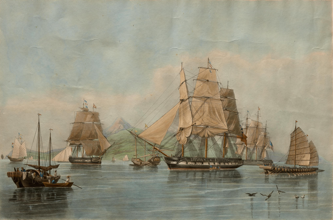
“Opium ships at Lintin in China, 1824,” by William John Huggins, 1828. Courtesy of Peabody Essex Museum. “Opium ships at Lintin in China, 1824,” by William John Huggins, 1828. Courtesy of Peabody Essex Museum.

Dane Morrison
Salem State University
Follow on Twitter @trueyankees

On a balmy Sunday evening in March 1838, a colorful conclave of English, Parsee, American, and Hong merchants crowded the resplendent grand hall of the New English factory in Canton in a sort of town meeting to hear Chief Superintendent and Plenipotentiary of Britain’s China trade, Charles Eliot. Eliot was there to announce Britain’s response to the arrival of Imperial Commissioner Lin Zexu, who had arrived days earlier with a commission to eliminate the opium trade, his sweeping proclamation demanding they deliver “every particle of opium” to him for destruction. It was addressed to “the Barbarians of every nation.” Recognizing the sprinkling of Americans in the hall, Eliot expressed his delight for their tacit cooperation, and assured them, too, of the protection of the…

Ver la entrada original 1.466 palabras más

Read Full Post »

The War of Northern Aggression

A leading Civil War historian challenges the new orthodoxy about how slavery ended in America.
 

Jacobin.com  Issue No. 7

EMANCI4 On November 6, 1860, the six-year-old Republican Party elected its first president. During the tense crisis months that followed — the “secession winter” of 1860–61 — practically all observers believed that Lincoln and the Republicans would begin attacking slavery as soon as they took power.

Democrats in the North blamed the Republican Party for the entire sectional crisis. They accused Republicans of plotting to circumvent the Constitutional prohibition against direct federal attacks on slavery. Republicans would instead allegedly try to squeeze slavery to death indirectly, by abolishing it in the territories and in Washington DC, suppressing it in the high seas, and refusing federal enforcement of the Slave Laws. The first to succumb to the Republican program of “ultimate extinction,” Democrats charged, would be the border states where slavery was most vulnerable. For Northern Democrats, this is what caused the crisis; the Republicans were to blame for trying to get around the Constitution.

Southern secessionists said almost exactly the same thing. The Republicans supposedly intended to bypass the Constitution’s protections for slavery by surrounding the South with free states, free territories, and free waters. What Republicans called a “cordon of freedom,” secessionists denounced as an inflammatory circle of fire.

The Southern cooperationists — those who opposed immediate secession — agreed with the secessionists’ and Northern Democrats’ analysis of Republican intentions. But they argued that the only way the Republicans would actually have the power to act on those intentions was if the Southern states seceded. If the slave states remained within the Union, the Republicans would not have the majorities in Congress to adopt their antislavery policies. And if the South did secede, all bets would be off. The rebellious states would forfeit all the constitutional protections of slavery. The South would get something much worse than a cordon of freedom. It would get direct military intervention, leading to the immediate and uncompensated emancipation of the slaves.

The slaves themselves seem to have understood this. They took an unusual interest in the 1860 election and had high hopes for what Lincoln’s victory would mean. They assumed that Lincoln’s inauguration would lead to war, that war would bring on a Union invasion of the South, and that the invading Union army would free the slaves.

But to read what historians have been saying for decades is to conclude that all of these people — the Democrats, the secessionists, the cooperationists, and the slaves — were all wrong. The Northern Democrats were just demagogues. The secessionists were hysterical. And the slaves were, alas, sadly misguided.

Unwilling to take seriously what contemporaries were saying, historians have constructed a narrative of Emancipation and the Civil War that begins with the premise that Republicans came into the war with no intention of attacking slavery — indeed, that they disavowed any antislavery intentions. The narrative is designed to demonstrate the original premise, according to which everyone at the time was mistaken about what the Republicans intended to do.

It’s a familiar chronology: Under the terms of the First Confiscation Act of August 1861, disloyal masters would “forfeit” the use of their slaves, but the slaves were not actually freed. Lincoln ordered General John C. Frémont to rescind his decree of that September freeing the slaves of rebels in Missouri, and several months later the President rescinded General Hunter’s order abolishing slavery in three states. As late as the summer of 1862, we are reminded, Lincoln was writing letters to Horace Greeley saying that if he could end the war without freeing a single slave, he would do so. Even after the President finally promised an emancipation proclamation, in September 1862, several months elapsed until the proclamation actually came on January 1, 1863.

Only then, according to the standard narrative, was the North committed to emancipation. Only then did the purpose of the Civil War expand from the mere restoration of the Union to include the overthrow of slavery.

In one form or another, this narrative is familiar to all scholars of the period. Historians who agree on little else will agree on this version of the story, even when they have entirely divergent interpretations of what it means.

But what if the original premise is wrong? What if, during the secession winter of 1860–61, everybody was right about what the Republicans intended to do about slavery? What if the Republicans came into the war ready and willing to destroy slavery? What does that do for a narrative of emancipation?

For one thing, it flies in the face of the prevailing neo-revisionism in contemporary Civil War scholarship. The old revisionist interpretation, which reached its zenith of influence in the 1930s and 1940s, came in many varieties. But it always rested on an essentially negative proposition: whatever else the war was about, it was not about slavery. This viewpoint required one set of claims about the South, and another about the North.

Jacobin-Series-3bdd91b95cfc219305403acaa1630163

Revisionists claimed that slavery was already dying in the South, that it was unprofitable, that it wasn’t important to Southern economy and society, that it had reached the natural limits of its expansion, and that Southern leaders were more concerned about defending state rights than protecting slavery. Most contemporary historians, though not all of them, now reject these old revisionist claims. Slavery was thriving and the Southern states seceded to protect it.

But revisionists also claimed that the North did not go to war over slavery. If there were “interests” involved, they were the interests of Northern capitalists against Southern agrarians. The Civil War was an accident brought on by bungling politicians. The abolitionists were a tiny, beleaguered minority; most Northerners shared the general conviction of black racial inferiority. 
The South had slavery, the argument went, but the North was racist too. This argument, in turn, was really just a revival of the antebellum Democratic Party’s relentless efforts to shift the terms of debate from slavery to race.

Today, this revisionist interpretation of the North is alive and well. Indeed, it is pervasive among historians. We are repeatedly told that the North did not go to war over slavery. The Civil War is once again denounced as morally unjustified on the grounds that the North was not motivated by any substantial antislavery convictions. Emancipation itself is described as an accidental byproduct of a war the North fought for no purpose beyond the restoration of the Union. A recent study of the secession crisis states that during the war, slavery was abolished “inadvertently.”

Contemporary scholarship is saturated by this neo-revisionist premise. Like the antebellum Democrats and the Civil War revisionists, neo-revisionists have insistently shifted the terms of the debate from slavery to race. Virtually any Republican in 1860 would have recognized this argument as Democratic Party propaganda.

If I sound skeptical, that’s because I am. On the basis of my research, I can no longer accept the thesis that the Union did not begin emancipating slaves until 
January 1, 1863.

It was never my intention to overturn the conventional narrative. I began by accepting the standard assumption that that the first Confiscation Act achieved nothing. But I still wanted to know what Republicans thought they were doing when they passed the law. Why did the Act turn out to be so toothless? Why did it fail to free any slaves? Secondary accounts usually pass over this question; they couldn’t provide me with the answers I needed: who wrote the law, where did it come from, how did people talk about it?

To my astonishment, I discovered that Section Four of the Act, the clause specifically authorizing the forfeiture of slaves, was written by Senator Lyman Trumbull, chair of the Judiciary Committee, as an emancipation clause. Indeed, it was understood by everyone in Congress to be an emancipation clause. Trumbull’s proposal was denounced by Democrats and border-state congressmen as an emancipation clause, defended almost unanimously by congressional Republicans as an emancipation clause. These men thought they were writing an emancipation bill. That’s what they said at the time.

A full-scale congressional debate erupted in July of 1861, focusing on the legitimacy of the emancipation that Republicans were undertaking. When I read those debates I wondered where the arguments for emancipation had come from.

I went back to the secession debates. And sure enough, everything critics had accused the Republicans of planning to do was exactly what Republicans themselves were saying they were going to do.

The great mistake that historians have made, I realized, was a misreading of the constitutional premises of the Republican antislavery agenda. I doubt anything Lincoln said is more commonly repeated by historians than the promise he made in his inaugural address not to interfere with slavery in the states where it already existed. That little quotation is all the proof historians seem to require to demonstrate that when the war began, neither Lincoln nor the Republicans had any idea of emancipating slaves.

In fact, nearly every abolitionist (and just about every historian I can think of) would agree with Lincoln: the Founders had made a series of compromises resulting in a Constitution that did not allow the federal government to abolish slavery in any state where it existed.

William Lloyd Garrison wrote that consensus into the founding document of the American Anti-Slavery Society, the 1833 Declaration of Sentiments, which flatly declared that the power to abolish slavery rested exclusively with the states. Theodore Dwight Weld said the same thing. So did Joshua Giddings, Salmon Chase, and Charles Sumner. The federal government had no power to interfere with slavery in the states where it already existed.

Which raises the obvious question: how did the abolitionists expect to get slavery abolished? A small group of nonpolitical abolitionists argued for moral suasion. An even smaller faction of antislavery radicals argued that the Constitution was an antislavery document. But most abolitionists believed, on the one hand, that the Constitution did not allow the federal government to abolish slavery in the states, but that on the other hand, political action was necessary for slavery to be abolished. Given the Constitution’s restrictions, what did opponents of slavery think could be done?

Coming out of the 1860 election, Republicans declared that there were two possible policies. The first was to make freedom national and restrict slavery to the states where it already existed. Republican policymakers would seal off the South: they would no longer enforce the Fugitive Slave Clause; slavery would be suppressed on the high seas; it would be abolished in Washington DC, banned from all the Western territories, and no new slave states would be admitted to the Union. A “cordon of freedom” would surround the slave states. Then Republicans would offer a series of incentives to the border states where slavery was weakest: compensation, subsidies for voluntary emigration of freed slaves, a gradual timetable for complete abolition.

Slavery was intrinsically weak, Republicans said. By denationalizing it, they could put it on a course of ultimate extinction. Surrounded on all sides, deprived of life-giving federal support, the slave states would one by one abolish slavery on their own, beginning with the border states. Each new defection would further diminish the strength of the remaining slave states, further accelerating the process of abolition. Yet because the decision to abolish slavery remained with the states, Republican policies would not violate the constitutional ban on direct federal interference in slavery.

The South would simply have to accept this. And if it couldn’t tolerate such a federal policy, it could leave the Union. But once it seceded, all bets would be off — it would lose the Constitutional protections that it had previously enjoyed. The Republicans would then implement the second policy: direct military emancipation, immediate and uncompensated.

Republicans said this openly during the secession crisis. And that’s what they were saying in Congress as they debated the Confiscation Act. It’s time to start rethinking our fundamental assumptions about the causes as well as the trajectory of the Civil War. And we can start by taking the perceptions of its contemporaries a great deal more seriously.

James Oakes teaches American History at the CUNY Graduate Center. His latest book is The Scorpion’s Sting: Antislavery and the Coming of the Civil War.

Read Full Post »

« Newer Posts - Older Posts »