Feeds:
Entradas
Comentarios

Posts Tagged ‘U. S. Congress’

Adoptada en 1868,  la Decimocuarta es una de las enmiendas más importantes de la Constitución de los Estados Unidos  por el papel que ha jugado en la protección de los derechos de los ciudadanos estadounidenses, el respeto al debido proceso de ley  y la defensa de la igualdad de la protección ante la ley.  Sin ella habría sido muy difícil enfrentar el racismo, la segregación racial, la homofobia y el discrimen. Esta también ha jugado un papel político, pues su interpretación, dirían muchos equivocada, llevó a la Corte Suprema a garantizar la victoria de George W. Bush en las elecciones presidenciales de 2000.

El 8 de febrero la Corte Suprema oirá los alegatos de quienes buscan eliminar  a Trump  como candidato presidencial esgrimiendo como arma la tercera sección de la Decimocuarta Enmienda, negándole el derecho a aspirar a la presidencia a quienes hubieran cometidos actos de traición. Hija de la Reconstrucción, la Enmienda 14 buscaba atender los retos que la sociedad estadounidenses enfrentaba tras la Guerra Civil. Uno de ellos era qué hacer con los altos funcionarios de la Confederación a quienes la Enmienda les cerró la puerta a la presidencia del país por considerarlos traidores. La Corte Suprema tendrá que decidir si quienes acusan a Trump de traición por sus acciones durante el ataque al Congreso el 6 de enero de 2021 están en lo correcto y, por ende, Trump no puede ser candidato a la presidencia.

En esta nota publicada en JStor Daily se nos incluye una versión anotada de la Enmienda Catorce que busca ayudar a los interesados en este tema, a entender el papel histórico de la enmienda a través de vínculos a ensayos de acceso libre.
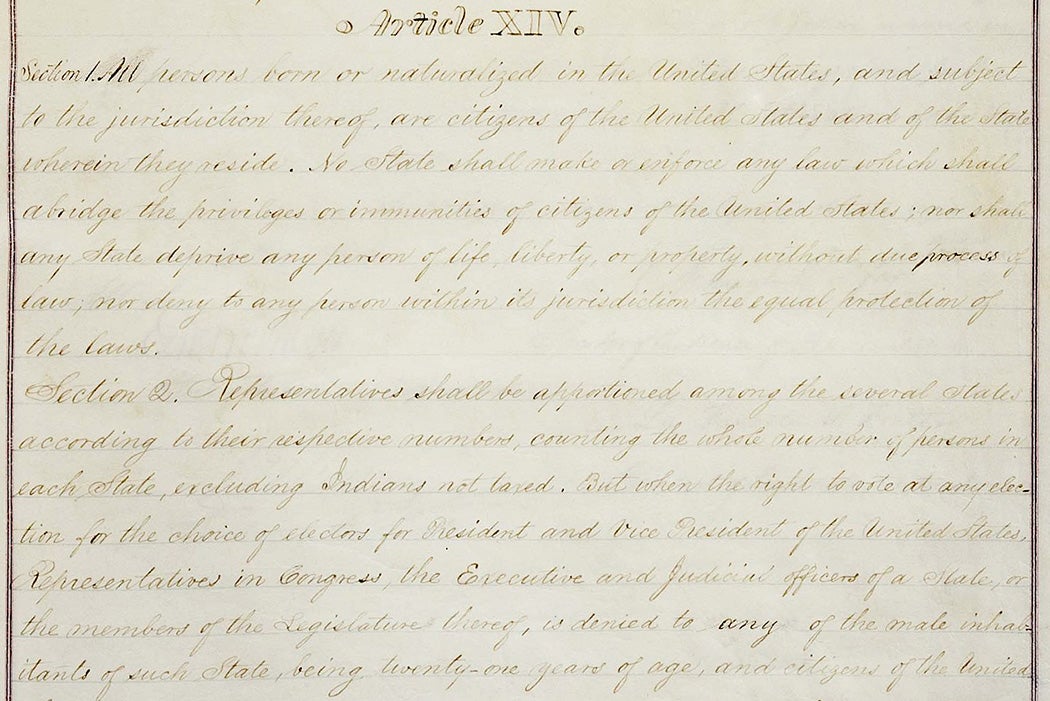

The first page of the 14th Amendment of the United States Constitution

La Decimocuarta Enmienda:  Anotada

Liz Tracey 

JStor Daily   22 de enero de 2024 

El 8 de febrero de 2024, la Corte Suprema  de los Estados Unidos escuchará los argumentos en Trump v. Anderson: si un estado (Colorado) puede eliminar a un candidato presidencial de una boleta primaria en virtud de la Sección 3 de la Decimocuarta Enmienda de la Constitución de los Estados Unidos. El expresidente está apelando la decisión de la Corte Suprema de Colorado que determinó que “las acciones del Sr. Trump antes y el 6 de enero de 2021 constituyeron participar en una insurrección, y que los tribunales tenían la autoridad para hacer cumplir la Sección 3 contra una persona que el Congreso no había designado específicamente“.

No es la primera vez que la Decimocuarta Enmienda ha estado involucrada en una elección presidencial: en 2000,  la decisión mayoritaria  en el caso Bush v. Gore  sostuvo que la cláusula de protección igualitaria en la Sección 1 requería que se detuviera el recuento del “hanging chad”, otorgando efectivamente la presidencia a George W. Bush.

El alcance de las decisiones de la Corte Suprema de EE. UU. que se basan en partes de la Decimocuarta Enmienda es bastante amplio y abarca cuestiones fundamentales de los derechos y libertades civiles estadounidenses, incluida la ciudadanía, el matrimonio, la elección reproductiva, los derechos LGBTQ+, el derecho al voto y los derechos de los acusados de delitos. Como una de las Enmiendas de Reconstrucción destinadas a modificar (o en algunos casos, crear) un marco para el gobierno federal posterior a la Guerra Civil, la Decimocuarta llegó a incluir gran parte de lo que se necesitaba en un “nuevo” Estados Unidos.

La erudición de la Constitución, y de las enmiendas individuales, está bien representada en JSTOR; esta anotación de la Decimocuarta Enmienda es sólo una pequeña muestra de lo que se puede encontrar. Como siempre ocurre con las anotaciones, todos los artículos enlazados son de lectura y acceso gratuitos.

________________________

Enmienda XIV

Sección 1.

Todas las personas nacidas o naturalizadas en los Estados Unidos, y  sujetas a su jurisdicción, son ciudadanos de los Estados Unidos y del estado en el que residen. Ningún estado dictará o hará cumplir  ninguna ley que restrinja los privilegios o inmunidades de los ciudadanos de los Estados Unidos; ni privará a ninguna persona de la vida, la libertad o la propiedad, sin el debido proceso legal; ni negará a ninguna persona dentro de su jurisdicción la igual protección   de  las leyes.

Sección 2.

Los representantes se distribuirán entre los diversos estados de acuerdo con sus respectivos números, contando el número total de personas en cada estado, excluyendo a los indios que no pagan impuestos. Pero cuando se niegue el derecho a votar en cualquier elección para la elección de los  electores para Presidente y Vicepresidente de los Estados Unidos, los representantes en el Congreso, los funcionarios ejecutivos y judiciales de un estado, o los miembros de la legislatura del mismo, a cualquiera de los  habitantes varones de  dicho estado, teniendo veintiún años de edad,  y ciudadanos de los Estados Unidos, o de cualquier manera reducida, excepto por la participación en rebelión u otro crimen, la base de la representación en ellos se reducirá en la proporción que el número de tales ciudadanos varones tendrá con respecto al número total de ciudadanos varones de veintiún años de edad en dicho estado.

Sección 3.

Ninguna persona podrá ser Senador o Representante en el Congreso, o  elector de Presidente y Vicepresidente, ni ocupar ningún cargo, civil o militar, bajo los Estados Unidos, o bajo cualquier estado, que, habiendo prestado juramento previamente, como miembro del Congreso, o como funcionario de los Estados Unidos, o como miembro de cualquier legislatura estatal,  o como funcionario ejecutivo o judicial de cualquier estado, para apoyar la Constitución de los Estados Unidos, haya participado en una insurrección o rebelión contra la misma, o haya brindado ayuda o consuelo a sus enemigos. Pero el Congreso puede, por el voto de dos tercios de cada Cámara, eliminar dicha incapacidad.

Sección 4.

La validez de la deuda pública de los Estados Unidos, autorizada por la ley, incluidas las deudas contraídas para el pago de pensiones y recompensas por servicios prestados en la represión de la insurrección o rebelión, no será cuestionada. Pero ni los Estados Unidos ni ningún estado asumirán ni pagarán ninguna deuda u obligación contraída en ayuda de la insurrección o rebelión contra los Estados Unidos, ni ninguna reclamación por la pérdida o emancipación de ningún esclavo; pero todas esas deudas, obligaciones y reclamaciones se considerarán ilegales y nulas.

Sección 5.

El Congreso tendrá la facultad de hacer cumplir, mediante legislación apropiada, las disposiciones de este artículo.


Recursos

JSTOR es una biblioteca digital para académicos, investigadores y estudiantes. Los lectores de JSTOR Daily pueden acceder a la investigación original detrás de nuestros artículos de forma gratuita en JSTOR.

Social Science, Vol. 50, No. 1 (Winter 1975), pp. 3–9
Pi Gamma Mu, International Honor Society in Social Sciences
The Yale Law Journal, Vol. 108, No. 8, Symposium: Moments of Change: Transformation in American Constitutionalism (June 1999), pp. 2003–2009
The Yale Law Journal Company, Inc.
The American Historical Review, Vol. 92, No. 1 (February 1987), pp. 45–68
Oxford University Press on behalf of the American Historical Association
Journal of the Civil War Era, Vol. 10, No. 1, Cracks in the Foundation: The Fourteenth Amendment and Its Limits: A Special Issue (March 2020), pp. 29–53
University of North Carolina Press
The Yale Law Journal, Vol. 101, No. 6 (April 1992), pp. 1193–1284
The Yale Law Journal Company, Inc.
The Yale Law Journal, Vol. 122, No. 8, Symposium Issue: the Gideon Effect: Rights, Justice, and Lawyers Fifty Years After Gideon V. Wainwright (June 2013), pp. 2150–2174
The Yale Law Journal Company, Inc.
Columbia Law Review, Vol. 123, No. 1 (January 2023), pp. 1–100
Columbia Law Review Association, Inc.
Daedalus, Vol. 143, No. 3, The Invention of Courts (Summer 2014), pp. 51–61
The MIT Press on behalf of American Academy of Arts & Sciences
The Yale Law Journal, Vol. 97, No. 6 (May 1988), pp. 1153–1172
The Yale Law Journal Company, Inc.
The Journal of American History, Vol. 88, No. 2 (September 2001), pp. 436–443
Oxford University Press on behalf of Organization of American Historians
Family Advocate, Vol. 38, No. 4, Same-Sex Marriage Is Settled: But important questions remain (Spring 2016), pp. 6–10
American Bar Association
Duke Law Journal, Vol. 53, No. 3 (December 2003), pp. 875–965
Duke University School of Law
Equality under the Constitution: Reclaiming the Fourteenth Amendment, (1983), pp. 57–72
Cornell University Press
Journal of the Civil War Era, Vol. 10, No. 1, Cracks in the Foundation: The Fourteenth Amendment and Its Limits: A Special Issue (March 2020), pp. 81–104
University of North Carolina Press
Law and Contemporary Problems, Vol. 67, No. 3, Conservative and Progressive Legal Orders (Summer, 2004), pp. 175–211
Duke University School of Law
The Yale Law Journal, Vol. 121, No. 7 (May 2012), pp. 1584–1670
The Yale Law Journal Company, Inc.
Racism & Felony Disenfranchisement: An Intertwined History
Brennan Center for Justice
The Journal of Southern History, Vol. 22, No. 4 (November 1956), pp. 477–497
Southern Historical Association
Negro History Bulletin, Vol. 12, No. 1 (OCTOBER 1948), pp. 10–11, 15–18
Association for the Study of African American Life and History
Virginia Law Review, Vol. 99, No. 6 (October 2013), pp. 1291–1326
Virginia Law Review
The Journal of American History, Vol. 74, No. 3, The Constitution and American Life: A Special Issue (December 1987), pp. 863–883
Oxford University Press on behalf of Organization of American Historians
ABA Journal, Vol. 103, No. 5 (May 2017), pp. 36–47
American Bar Association
The American Journal of Legal History, Vol. 49, No. 2 (April 2007), pp. 180–196
Oxford University Press

Traducido por Norberto Barreto Velázquez

Read Full Post »

50 Years Ago Congress Gave the President a Blank Check for War 

by Leonard Steinhorn

HNN August 3, 2014


Walt Rostow showing LBJ a map of Khe Sanh in 1968


Fifty years ago, on August 10, 1964, President Lyndon Johnson signed what is known as the Gulf of Tonkin Resolution. It is a day that should live in infamy.

On that day, the President gave himself the power “to take all necessary steps, including the use of armed forces,” to fight the spread of communism in Southeast Asia and assist our ally in South Vietnam “in defense of its freedom.”

Or as former Secretary of Defense Robert McNamara put it decades later, it gave “complete authority to the president to take the nation to war.”

History has shown that the resolution was built on a foundation of misinformation, fabrication, and willful evasion of the truth. Contrary to what the President claimed, there was no unprovoked “act of aggression” against the American  destroyers that were patrolling the Tonkin Gulf, and a second alleged incident never even took place.

But the Johnson administration was looking for a pretext to escalate the war. “We don’t know what happened,” National Security Adviser Walter W. Rostow told the president after Congress passed the resolution, “but it had the desired result.”

The Gulf of Tonkin Resolution may have had the desired result, but the war it unleashed didn’t.

By the time Lyndon Johnson left office more than four years later, we had amassed over half a million troops in Vietnam, lost nearly 37,000 soldiers, dropped more bomb tonnage than we had in all of World War II, released chemical weapons – Napalm and Agent Orange – throughout Southeast Asia, and burned thousands of South Vietnamese homes and villages to the ground.

Yet it was increasingly clear by then that we could not win the war.

Rather than stopping any dominoes from falling in Southeast Asia, the Gulf of Tonkin Resolution set in motion a series of dominoes in our own country  that would profoundly alter our politics, economy, and culture for years to come.

Perhaps the most significant decision President Johnson made beyond using his newly authorized power to escalate the war was to hide the cost of the war and resist any tax increase to pay for it. Johnson feared that any congressional debate over funding the war would come at the expense of his Great Society program.

He wanted both guns and butter, but he worried that Congress would choose guns over butter. So once again he resorted to obfuscation and deception to get his way.

What resulted was a cascading series of economic  consequences that would transform our nation and undermine the Great Society he so dearly wanted to protect.

To pay for the war without gutting his robust domestic agenda, Johnson resorted to deficit spending which fueled an already overheating economy that was now being asked to divert its productivity away from consumer goods and toward the war effort.

Consumer demand began to outstrip supply, and that let the inflation genie out of the bottle. Less than five years after the Gulf of Tonkin Resolution passed, inflation more than quadrupled.

Johnson couldn’t hide the rising cost of the war for long, and by 1968 he asked for a 10 percent tax surcharge on all but the poorest Americans. But it came at a cost: Congress demanded, and he had to accept, a 10 percent reduction in domestic discretionary spending. Barely three years after birthing the Great Society, he began to starve it to pay for the war. It never fully recovered.

To middle and working class Americans, the backbone of the New Deal coalition, the war’s economic impact was taking a toll. Though inflation meant pay raises once a year, prices for food and consumer goods were rising every month which then ate away at any increase in their wages.

Their standard of living began to stagnate. Nor were taxes indexed to inflation in those years, so every pay increase risked pushing them into a higher tax bracket, which took even more money from their pockets in addition to the tax surcharge they would have to pay.

These were largely Democratic voters who generally supported the president and the war – many had their own boys fighting in Vietnam – so if they were looking for blame they weren’t about to point the finger at a deceptive and misguided war policy.

Instead, they saw higher taxes, higher domestic spending, and lots of fanfare for a Great Society that didn’t seem to include them. They also saw domestic unrest and urban riots.

To them, they were hard-working Americans who played by the rules yet were now forced to tread water just to keep from falling behind while government seemed to be giving everything away to the poor. That domestic programs themselves were getting squeezed by the war was a detail that got lost in the heat of the moment.

Couple these growing resentments with the fact that it was their boys, not the children of the well-educated, who were being sent off to war. From their perspective, the liberal elites were taxing them to coddle the poor, yet when it came to defending our nation these same liberal elites sheltered their sons in colleges and universities.

Those seeking to understand the rise of Reagan Democrats and white working class Republican populists – and the corresponding demise of the New Deal majority – need look no further. The cultural and political divide that began in the Sixties was a direct result of the deceit that brought us the Vietnam War.

And what was then a still fragile liberal consensus that government could mitigate the hardships of poverty – a consensus that enabled passage of the Great Society legislation – began to erode.

That an administration could dissemble us into war would lead to another cultural and political repercussion of Vietnam: our growing and seemingly permanent distrust of government.

Trust in government peaked at 76 percent in 1964, not coincidentally the same year as the Gulf of Tonkin Resolution, and declined precipitously in the years thereafter, reaching what was then a low of 25 percent in 1980, according to the University of Michigan’s National Election Studies.

Not all of this decline is due to Vietnam, but a war built on the original sin of deception, fiction, and illusion deserves a good deal of the blame.

Almost daily, Americans were treated to an official  version of the war that had us winning. The  Johnson administration trumpeted body counts and bombing raids and assured us, in the famous words of General William Westmoreland, that there was “light at the end of the tunnel.”

But there was no light. The dark reality we saw every night on television contradicted what our leaders were telling us. We saw bloodied soldiers, troops burning villages, body bags, fear and despair and little of the triumphalism that was emanating from the Pentagon.

When the Vietcong launched their Tet Offensive in  January 1968, striking at the U.S. Embassy and other key sites in the heart of Saigon, Americans had a hard time reconciling the official version with what they were witnessing.

Thus was born the credibility gap between the American government and its citizens.

And nowhere did it grow wider than among journalists, who were greeted with untruths during the daily military briefings in Vietnam – known as the Five O’clock Follies – and saw through such euphemisms as “pacification,” which in truth meant torching Vietnamese huts and shooting those who resisted, and “collateral damage,” which in reality meant civilian deaths.

Reflexive skepticism of government remains a defining characteristic of contemporary journalism.

Watergate, which calcified the credibility gap, also grew out of Vietnam when President Richard Nixon authorized his secretive White House Plumbers to retaliate against Daniel Ellsberg, whose leak of the Pentagon Papers laid bare the duplicity behind the Gulf of Tonkin Resolution and the U.S. prosecution of the war.

Years later Senator Wayne Morse of Oregon, one of two who voted against the Gulf of Tonkin Resolution, told Ellsberg that if members of Congress had seen the evidence from the Pentagon Papers in 1964, “the Tonkin Gulf Resolution would never have gotten out of committee, and if it had been brought to the floor, it would have been voted down.”

What Lyndon Johnson saw as a ploy to grant him war powers ended up harming so many and transforming our nation in ways the President surely never intended. It would end up engulfing the liberalism he so loved. The Gulf of Tonkin Resolution and the hubris behind it were the linchpins of Johnson’s Shakespearean Vietnam tragedy – and ours as well.

Leonard Steinhorn is a professor of communication and affiliate professor of history at American University, where he teaches politics, strategic communication, and courses on the presidency and recent American history. He is the author of the much discussed book on baby boomers, The Greater Generation: In Defense of the Baby Boom Legacy, and co-author of the critically acclaimed By the Color of Our Skin: The Illusion of Integration and The Reality of Race.

Read Full Post »