Feeds:
Entradas
Comentarios

White House Efforts to Blunt 1975 Church Committee Investigation into CIA Abuses Foreshadowed Executive-Congressional Battles after 9/11
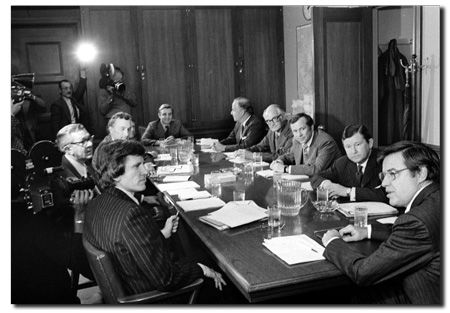
Church-Committee (1)

Church Committee

National Security Archive Electronic Briefing Book No. 522
Posted – July 20, 2015
Edited by John Prados and Arturo Jimenez-Bacardi

Washington, D.C., July 20, 2015 – Forty years ago this year, Congress’s first serious inquiry into CIA abuses faced many of the same political and bureaucratic obstructions as Senate investigators have confronted in assessing Intelligence Community performance since the September 11, 2001, terrorist attacks. Records posted today for the first time by the National Security Archive document the often rough-and-tumble, behind-the-scenes dynamics between Congress and the Executive Branch during the “Year of Intelligence” – highlighted by the investigations of the congressional Church and Pike committees.
In 1975, it was then-Deputy Chief of Staff Dick Cheney who spearheaded the Ford White House’s hostile approach to Congress, which required the CIA to submit all proposed responses to Capitol Hill for prior presidential approval and featured the explicit intent to keep investigators away from the most sensitive records. Those events presaged the battles between the Senate Select Committee on Intelligence (SSCI) and the U.S. Intelligence Community since 2012 over plans to publish the former’s 6,000-page report on the CIA’s rendition, detention and interrogation program.Among White House and Intelligence Community stated concerns during the period of the Church and Pike inquiries were preserving the effectiveness of the CIA and reassuring future operatives who might fear their “heads may be on the block” for their actions, no matter how well-intentioned. But intelligence officials also worried that disclosures of agency operations would be “disastrous” for CIA’s standing in the world: “We are a great power and it is important that we be perceived as such,” a memo to the president warned, urging that “our intelligence capability to a certain extent be cloaked in mystery and held in awe.”

Related to today’s posting, a much larger compilation of 1,000 documents, many of them previously classified, was published in June 2015 in the online collection CIA Covert Operations II: The Year of Intelligence, 1975, the second in a series on the CIA through the Digital National Security Archive, a joint project with the scholarly publisher ProQuest.

Today’s e-book touches on the high points of one major aspect of the 1975 experience – the Church committee’s efforts to obtain evidence for its inquiry and countervailing work by the White House and CIA to limit and restrict the Senate’s access. Documents posted today show that:

  • The White House of President Gerald R. Ford, spearheaded by deputy assistant to the president Richard Cheney, quickly seized control of the administration’s response to the congressional investigations.
  • Lists of records to which the Church committee requested access for its investigation were reviewed in detail and Mr. Cheney ultimately decided whether to provide them in each case.
  • Specific records in categories approved for access were first sent to the White House for individual review and recommendation by National Security Council staff, followed by approval from Mr. Cheney.
  • The White House required the CIA to propose measures to govern Church committee access to CIA materials. These accommodation measures were then reviewed both by Deputy Assistant Cheney and Counsel to the President Philip Buchen.
  • CIA accommodation measures were explicitly designed to keep Church committee investigators away from its most important records.
  • National Security Council officials convened at the White House to express themselves in advance regarding proposed CIA testimony to the Church committee.

* * * * *

Fortieth Anniversary: The Church Committee, the White House and the CIA, Spring 1975

By John Prados and Arturo Jimenez-Bacardi

President Gerald Ford (center) with White House Chief of Staff Donald Rumsfeld (left), and Rumsfeld’s assistant, Dick Cheney, in the Oval Office, April 28, 1975. (Source: David Hume Kennerly, photographer; courtesy Gerald R. Ford Library)

Washington, D.C., July 17, 2015 – Forty years ago there had never been a public investigation directly aimed at the Central Intelligence Agency. Congressional oversight had long been a matter of secret subcommittees and information privately shared with small circles of legislators. What reviews of intelligence there had been were carried out in the dark using reliable people. Even with major flops like the abortive Bay of Pigs invasion of Cuba, official investigations were confined to the executive branch—within the CIA itself or under the auspices of the National Security Council (NSC) at the White House. Public dissatisfaction with the CIA had grown through the Vietnam war, however. Concern spiked with the Watergate scandal, then revelations of the agency’s role in attempting to raise a Russian submarine off the floor of the Pacific Ocean, and its hand in the Chilean political troubles which led to the overthrow and death of Salvador Allende. On December 22, 1974 curiosity and concern became a firestorm of anger when the New York Times revealed that the CIA had spied on American citizens, monitored their political views, and carried this out on a massive scale for many years. The allegations were white hot because the law prohibited the CIA from engaging in domestic activity.[1]

President Gerald R. Ford, then vacationing at Vail, Colorado, was surprised to be told of the new CIA exposé, followed on succeeding days by yet more allegations of CIA skullduggery. The president demanded an explanation from CIA director William E. Colby. The agency’s chief responded with a report that confirmed New York Timesreporter Seymour Hersh had uncovered real CIA operations. It became apparent in the course of a few days that investigation was inevitable. Ford made an effort to take control of the issue early in January 1975 by means of creating a presidential commission under Vice-President Nelson A. Rockefeller. This was an inquiry of the old kind, one by minions who could be trusted to stay away from sensitive matters. But just a couple of weeks later President Ford let the cat out of the bag himself, admitting to visiting newspaper editors that he wanted to control the investigation to avoid sensitive issues like CIA participation in assassination plots. The mention of assassination plots blew the lid off the investigation issue. By the end of January 1975 both the United States Senate and the House of Representatives had established special committees to investigate U.S. intelligence.

The Senate committee would be the first to pull itself together and begin its inquiry. It was led by Idaho Democratic Senator Frank Church. The House committee would be delayed for months by squabbles over collusion with the CIA involving its own secret House overseers, so the first struggles over access to agency material were fought with the Senate.

Meanwhile the “Colby Report,” the preliminary response the CIA director had compiled to meet President Ford’s demand for information, became a focus that helped define how the various players approached the question of CIA information. At an early Senate hearing, on January 15, 1975, Director Colby tried to walk the thin line of belittling the press revelations while acknowledging that some of them were true. He recited the same story line he had used with the Rockefeller Commission, which naturally drew from the Colby Report. Colby’s testimony infuriated Henry Kissinger, then occupying the posts of national security adviser and secretary of state simultaneously. Kissinger was outraged both that Colby was speaking out of school and that he had not cleared his remarks with the White House in advance.

The White House reaction, which might have sounded predictable today, belonged to a pattern just being set in 1975. Why White House officials would have expected the CIA director to do anything other than rely upon the Colby Report for his testimony, none of them has ever said. Philip Buchen, the president’s counsel and point man on these investigations, left no record. Richard Cheney, the top operator, wrote a memoir that distances himself from the action despite information that has become available about his central role.[2] Kissinger writes of Colby burning a match in a gasoline depot.[3] But Colby’s only alternative would have been to say nothing and that, in the superheated political climate of January 1975, was not a viable option. The Colby Report had been pulled together very quickly because it was based on a larger in-house study, informally known as “The Family Jewels,” that had been ordered by Colby’s predecessor. If the CIA director had to say anything, there could be no doubt he was going to rely upon these sources. Nevertheless, the White House determined to ride herd on the CIA for its dealings with the investigations.

CIA Director William Colby at a press conference at CIA headquarters, September 12, 1975. (Source: Larry Morris, photographer; Washington Post / Getty Images)

IA Director William Colby at a press conference at CIA headquarters, September 12, 1975. (Source: Larry Morris, photographer; Washington Post / Getty Images)

William E. Colby, who had returned to CIA from a Vietnam assignment just in time to witness the fallout from the Watergate scandal, wrote that he learned from Watergate that a CIA “distancing” strategy actually left suspicions behind, and that he recognized the congressional authority to investigate. On its own the CIA would have been on very shaky legal and constitutional ground in denying Congress. Investigation of the executive branch had always been a recognized role for the legislature, and law existed which specified that executive branch agencies could not deny any information necessary to an investigation by a properly constituted congressional inquiry. The denial strategy just would not work.[4] Therefore, from Colby’s perspective, the application of White House control was a good thing. Apart from the anger expressed towards him personally, the White House intervention gave Director Colby a useful and convenient rationale for denying information to congressional investigators.

CIA deputy general counsel Walter Pforzheimer was simply wrong when he told an interviewer in 1998 that whatever Bill Colby had in his mind on a given day was going to come out.[5] The documents selected below from the National Security Archive’s “CIA Covert Action II” set demonstrate conclusively just how far from the truth was the perception that the CIA was giving away the store in 1975. Rather than letting out all the secrets, what happened during the Year of Intelligence was a very carefully-contrived process in which the Ford White House asserted its prerogative to approve every release and the CIA followed suit. The Church Committee laid out its demands for information; they were reviewed and frequently denied; and the committee ended by appealing, cajoling, negotiating, or begging for data.

From the outset, Ford administration strategy relied upon giving the appearance of cooperation while invoking national security to shield information. On February 22, for example, Director Colby met with secretaries Kissinger, James R. Schlesinger, and others on measures to protect data (Document 1). Five days later, with Senator Church, Colby agreed to waive the agency’s employee secrecy oaths in dealing with the committee, and he promised to provide such basic material as organization charts, budget information, and legal authorities. In return Colby obtained the senator’s consent to subject his committee investigators to the kind of secrecy agreements considered at the White House on February 22.[6] The language the secrecy agreements eventually employed appears in Document 14.

On March 5, 1975, Senators Church and John Tower, the committee’s Republican vice-chairman, together with their staff chiefs, went to the White House to meet with President Ford and key administration officials. In his coat pocket Senator Church carried a list of White House documents he required for the investigation. Among them were the materials Colby and Church had discussed a week earlier. President Ford’s talking points for the meeting (Document 4)promised cooperation but emphasized a need not to “cripple” the intelligence agencies or reduce the CIA “to the level of a newspaper clipping and filing agency.” Senator Church promised not to be a “wrecking crew.” Mr. Ford played the Senate investigation against that of the House of Representatives, remarking that he did not want to put on paper his agreement to cooperate as he would then be forced into a similar agreement with the House committee, and, the president went on, “It’s best not to formalize. Let’s proceed on a case-by-case basis.”[7]

What the promised cooperation actually meant began to become evident after March 12, when Senator Church sent a new list of required documents directly to Director Colby at the CIA (Document 5). Only a few days later, in an encounter with a senior Colby aide, a senior staffer for the House committee complained that CIA’s exceptions to what it was being asked to produce were “so broad as to encompass nearly everything” (Document 6). On March 24 a White House official, possibly assistant to the president Richard Cheney, returned a copy of the Church-CIA document request that had been annotated to indicate approvals for the provision of the materials (Document 9). A wide swath of documents were to be denied.

On March 25, the CIA provided a progress report on its arrangements and guidelines (Document 10). Material bearing on the president would be entirely denied to investigators, who would be entitled only to briefings based on real material. At the next level there would be “fondling files” to be consulted only at the CIA or another originating agency.

On March 29 Robert C. McFarlane, then an NSC staff member, completed his evaluation of White House documents requested by the Church committee (Document 11). Again covert operations, which the Church investigators had an obvious interest in examining, were notably underplayed.

A favorite device of the CIA and White House in meeting the demands of congressional investigators became the “abstract.” Classified abstracts of much larger bodies of work, reports, reviews, or histories were repeatedly compiled. There are examples in several of the exhibits included here (Document 11, Document 21, Document 23). This permitted the administration to claim it had made an effort to satisfy investigators without, in fact, giving much away.
Faced with this problem, the administration came up with a device too clever by half – seeking a Freedom of Information Act (FOIA) exemption for agency documents submitted to Congress (Document 26). This would free the CIA and other agencies to keep secret the material given to Congress, refusing any FOIA request for that information. At the same time, since the CIA position was that classified information disclosed by any means other than direct release by the agency remained officially secret, if Congress did decide to release CIA documents the agency would be able to pretend the information was still classified. Fortunately for the public, in 1975 there was no political possibility the CIA could succeed in obtaining an FOIA exemption of that kind.The insoluble problem which remained for Ford administration officials was that the Congress, a coordinate branch of government, had complete authority within its sphere. White House and CIA officials could never resolve the implications of this for the secrecy of their records. This quandary would arise again in the fall of 1975 with the House investigating committee, but it was already a factor during the spring with Church. An identical dilemma has faced the present-day CIA confronted with the SSCI inquiry into its torture and detention programs. The CIA’s top lawyer in 1975, John Warner, frankly advised that, while he could see no plain authority for the Congress to release classified data, there was no question the Congress had a constitutional immunity from the consequences of releasing any piece of classified information (Document 15). Ranging over the same set of thorny issues, on April 14 NSC staffer McFarlane wrote that until the secrecy could be guaranteed, no classified information should be supplied to the Church committee(Document 19). (A forthcoming National Security Archive posting will address the revival of this issue, even more sharply, with the Pike Committee.)

With intractable secrecy issues still unresolved, the Church committee continued moving ahead with its investigation, closing in on the subject of covert operations that Ford officials had sought to avoid. White House lawyer Philip Buchen drafted an approval memo for a decision on what to cover in dealing with Church on covert operations. He wanted to restrict access to senators Church and Tower only, and to permit discussion of just eight covert operations (Document 27). Deputy national security adviser Brent Scowcroft issued a different decision memo. This provided that CIA present a briefing that spoke of covert operations in general, without reference to techniques, times or places (Document 28). The testimony Director Colby would present would be reviewed in advance by the NSC.

The electronic briefing book ends with Director Colby’s account to the National Security Council of his meeting with the committee heads and his testimony to the full committee(Document 31). Reacting to Colby’s remarks, the irrepressible Kissinger declares it “an act of national humiliation” for a nation to have laws that prevent a president from ordering an assassination.

* * * * *

THE DOCUMENTS

Document 1: White House, National Security Council Staff, Memo of Conversation, Kissinger, Schlesinger, Colby, Areeda, Hoffman, Silberman, Scowcroft, “Investigation of Allegations of CIA Domestic Activities,” February 20, 1975.

Source: Gerald R. Ford Library, Gerald R. Ford Papers, National Security Files, Memoranda of Conversations, box 9.

This White House Memorandum of Conversation shows Kissinger warning that the investigations on the intelligence community could be “as damaging to the intelligence community as McCarthy was to the Foreign Service,” potentially leading to “the drying up of the imagination of the people on which we depend. If people think they will be indicted ten years later for what they do.” As such, the group comes up with several plans for controlling the investigations and the information they share with the committees. Suggestions include: setting up “secrecy agreements” with Committee members in order to control the materials and information that will be shared with them, and giving committee members secret documents in hopes that they are leaked to the press, allowing the White House to refuse to share more documents citing “executive privilege.”

Document 2: White House, Office of Congressional Relations, Senate, “Schedule Proposal for President,” February 22, 1975.

Source: Gerald R. Ford Presidential Library, Gerald R. Ford Papers, President’s Handwriting File, National Security Series, Box 30, folder, “Intelligence (2).”

On February 22, 1975, President Ford is informed that Senators Frank Church and John Tower, the Chairmen and Vice Chairmen, respectively, of the Senate Select Committee to Study Governmental Operations with Respect to Intelligence Activities, have asked to meet with the President to discuss the committee’s inquiries and to request the President’s full cooperation with the committee.

Document 3: White House, Office of Congressional Relations, Senate, Note for William Kendall from HDC, February 25, 1975.

Source: Gerald R. Ford Presidential Library, Gerald R. Ford Papers, President’s Handwriting File, National Security Series, Box 30, folder, “Intelligence (2).”

On February 25, 1975, a White House staffer with the initials HCD sends a note to William Kendall, the Deputy Assistant to the President for Congressional Relations, to try and set up a meeting with the President and Senators Church and Tower before March 5 in order for Henry Kissinger to attend the meeting. (The meeting is eventually scheduled for that date and Kissinger is unable to attend).

Document 4: White House, Office of Congressional Relations, Senate, “Presidential Meeting with Senators Frank Church (D-Idaho) and John Tower (R-Texas),” March 4, 1975.

Source: Gerald R. Ford Presidential Library, Gerald R. Ford Papers, President’s Handwriting File, National Security Series, Box 30, folder, “Intelligence (2).”

On March 4, 1975, President Ford receives a briefing memo to prepare for his meeting the following day with Senators Church and Tower. As part of the President’s talking points, he is to mention that he wants to cooperate with the committee, however, a series of dire warnings are presented. First, in the process of investigating allegations of impropriety, it is essential that, “we not cripple the effectiveness of the institutions which are so critically important to the very survival of this country.” Second, while “willful wrongdoing cannot be tolerated,” we must also “be careful that we do not create the impression among loyal dedicated intelligence personnel that their heads may be on the block in later years for actions they undertook in the belief they were serving their country… ” if this were to happen, “the CIA would be reduced to the level of a newspaper clipping and filing service.” Third, the memo warns that “disclosures would be disastrous” for perceptions of the U.S. around the world: “We are a great power and it is important that we be perceived as such.” Therefore, it is necessary that “our intelligence capability to a certain extent be cloaked in mystery and held in awe.” Given such concerns, the memo concludes that we must “tread very carefully” and that the goal must be “to preserve and enhance the confidence of the American people in their intelligence organizations.” To do so, the White House will cooperate with the Committee, however there will be a “presumption against providing sensitive material not indispensably material to the inquiry.”

Document 5: Church Committee, Letter from Senator Frank Church to CIA Director William Colby, March 12, 1975.

Source: Gerald R. Ford Presidential Library, White House Operations, Richard Cheney Files, Intelligence Series, Box 6, Folder, “Congressional Investigations (1).”

This letter from Senator Church to CIA Director Colby outlines the types of documents that the Committee is requesting from the CIA, including files from the U.S. Intelligence Board staff, the Offices of the Director and Deputy Director, the General Counsel, the Legislative Counsel, Comptroller, Inspector General, Historical Studies, and Finance, as well as documents pertaining to Colby’s testimony to the Senate Appropriations Committee on January 15, 1975.

Document 6: Central Intelligence Agency, Memorandum for the Record, “Meeting with Jack Boos, House Select Committee Staff Member, 14 March 1975,” March 17, 1975.

Source: NARA, CIA CREST Files, CIA-RDP77M00144R00020058-6

In this CIA memorandum of conversation, Jack Boos, Staff Member for the House Select Committee on Intelligence, is quoted expressing his frustration at the CIA guidelines for access to documents, asking, “How soon will you invoke executive privilege?” and noting that Director Colby’s exceptions to documents “are so broad as to encompass nearly everything.” The memo then explains a number of security provisions that could be used during the investigations. Ultimately, the document concludes that, “I am not sure that Boos was reassured that the Committee and its Staff would have the access they think they need.”

Document 7: White House, Office of the Deputy Assistant to the President, Richard Cheney Handwritten Notes re strategy to cope with Church Committee, c. March 24, 1975.

Source: Gerald R. Ford Presidential Library, White House Operations, Richard Cheney Files, Intelligence Series, Box 6, Folder, “Intelligence – General.”

Dick Cheney’s handwritten notes briefly outline a strategy to cope with Church Committee demands.

Document 8: White House, Office of the Deputy Assistant to the President, Richard Cheney Handwritten Notes re on the problem of coping with the Church Committee, c. March 24, 1975.

Source: Gerald R. Ford Presidential Library, White House Operations, Richard Cheney Files, Intelligence Series, Box 6, Folder, “Congressional Investigations (1).”

This brief handwritten note by Cheney cautions that the White House has no coherent policy for dealing with Congressional requests concerning their investigations.

Document 9: White House, Office of Congressional Relations, Senate, Copy of Senator Frank Church’s letter to CIA Director William Colby of March 12, 1975 with White House notations, c. March 24, 1975.

Source: Gerald R. Ford Presidential Library, White House Operations, Robert K. Wolthius Files, Subject Series, Box 2, Folder, “Intelligence Investigations – Church Committee (2).”

This is a copy of Senator Church’s March 12 letter [Document 5] to CIA Directory Colby requesting documents from the CIA bearing Cheney’s handwritten notations of White House decisions as to which to provide the Committee. Items to be withheld were marked “no” or left blank. More than half of the requested “special studies” (eleven of twenty) were to be denied, including those on covert operations, among them the postmortem on the Bay of Pigs debacle. Also denied was the 1967 “Katzenbach Report” and a companion study of CIA activities at American universities, both triggered by the very public revelation that the CIA had funded voluntary groups of American university students (the National Student Association). All reports of the Bureau of the Budget or the Office of Management and Budget (OMB) – White House entities – were to be denied, which was unfortunate because the most recent management study of the intelligence community that existed had been done by OMB in November 1971. Access to the Colby Report was ruled out and the “Family Jewels” were to be protected, save for a CIA Inspector General’s study that had covered some of the same ground.

Document 10: Central Intelligence Agency, “Responsibilities and Support,” March 25, 1975.

Source: Gerald R. Ford Presidential Library, White House Operations, Richard Cheney Files, Intelligence Series, Box 6, Folder, “Congressional Investigations (1).”

This memo provides a progress report and outlines CIA guidelines for dealing with inquiries from Congress. It explains the creation of an Ad Hoc Coordinating Group tasked as the principal mechanism for coordinating the exchange of information within the CIA, with the White House, with the USIB, and with the investigating Committees. The memo also describes security procedures being set up to share information with Congress, and outlines four levels of security that will be applied. The CIA would create a central index to record all materials released and to index and abstract papers and testimony. Officials offered a “central reading room” – at CIA – for investigators to go to read agency documents. The data deemed most sensitive will “not be available to Select Committee Staff in its raw form.” This included memos to and from the president. Congressional investigators would be restricted to briefings about that material. At the next level there would be “‘fondling files’” that could be viewed only at the originating agency, with “specific limitations placed upon them by the agencies concerned.” At the next lower level documents would actually be given to the investigators but only in a sanitized form. Only at the lowest level would data be directly provided in unexpurgated form. If the briefings did not satisfy the committee there would be negotiations. The memo then explains a process where Committee members could challenge such limitations, which could open the door for documents to be read in the presence of authorized agency personnel. The memo also outlines a strategy for dealing with press inquiries and allegations.

Document 11: White House, National Security Council, Memorandum, from Robert C. McFarlane to Brent Scowcroft, “Submission of Documents to the Senate Select Committee on Intelligence Operations,” March 29, 1975.

Source: Gerald R. Ford Presidential Library, Gerald R. Ford Papers, White House Operations, Richard Cheney Files, Box 7, Folder, “Intel-Release of Documents to Church Committee 4/2/75 (1).”

This NSC Report by Robert McFarlane to General Scowcroft describes seventy-two NSC directives/documents and recommends whether they should be made available to the Church Committee. The McFarlane evaluation recommended in favor of the provision of general organizational material but it was thin in regard to approvals of material related to covert operations. The directive then in force governing approval of covert operations, called National Security Decision Memorandum 40, was approved for release. But many earlier documents in the NSC-10 and NSC-5412 series were to be restricted to a classified abstract. NSC-124/2, which had created the Special Group (Counter-Insurgency) in the Kennedy administration, should be denied, McFarlane advised. Also to be denied were presidential decision memos on Radio Free Europe (1961) and psychological warfare operations in wartime.

Document 12: White House, (Probably NSC – Robert McFarlane), “Summary/Abstract of Report Requested by Senate Select Committee (Dulles-Jackson-Correa Report),” c. April 1975.

Source: Gerald R. Ford Presidential Library, Gerald R. Ford Papers, White House Operations, Richard Cheney Files, Box 7, Folder, “Intel-Release of Documents to Church Committee 4/2/75 (1).”

This document is a White House summary of a 1949 National Security Council policy review of intelligence functions, requested by the Church Committee. “The CIA and National Organization for Intelligence” found that the CIA had failed to produce coordinated national intelligence estimates and that it engaged in much duplicative activity. The report advocated the consolidation of CIA operational activities under a single directorate, separated administratively and physically, to the extent possible, from the analytical side of the agency. This became an impetus for creation of the CIA operations directorate. The note goes on to warn that the policy review, also known as NSC-50, cited two more interim reports that the Church Committee might be interested in but did not know about, and which Ford officials had not examined.

Document 13: White House, Memorandum from Philip Buchen to President Ford, “Request of Senate Select Committee to Study Governmental Operations with respect to Intelligence Activities for Information,” April 2, 1975.

Source: Gerald R. Ford Presidential Library, Gerald R. Ford Papers, White House Operations, Richard Cheney Files, Intelligence Series, Box 7, Folder, “Buchen Memo re Release of Docs (1).”

This White House memo for President Ford explains that the documents requested by the Church Committee have been reviewed by the offices of Jack Marsh, Counsel to the President, and Brent Scowcroft, the National Security Adviser. The memo recommends the release of several documents, including the Colby report. However, some documents “which are so sensitive or so central to the Presidency” will not be made available, and in the future might only be revealed to Senators Church and Tower. The memo refers to documents in Tab A, B, and C, Tab A refers to Senator Church’s information request list [Document 5] in this EBB, and Tab B refers to Robert McFarlane’s NSC analysis of the materials [Document 11]. Tab C is the Colby Report.

Document 14: Senate Select Committee to Study Governmental Operations with Respect to Intelligence Activities, Draft “Employee Notice and Agreement Concerning Treatment of Confidential Material,” April 5, 1975.

Source: NARA, CIA CREST Files, CIA-RDP77M00144R000400020055-9

This is the draft employee agreement concerning the treatment of classified information that all committee staff members had to sign. Director Colby had told colleagues at a February 22 meeting [Document 1] that agreements of this kind would prevent the committees from releasing CIA information. He obtained Church’s agreement to constrain investigators in this way on February 27.

Document 15: Central Intelligence Agency, Open Memorandum by John Warner, CIA General Counsel, “Authority of Congress to Release Classified Data,” April 11, 1975.

Source: Gerald R. Ford Presidential Library, Gerald R. Ford Papers, James E. Connor Files, Intelligence Series, Box 56, Folder, “House Select Committee – Legal Opinions on Subpoenas for CIA Documents (1).”

This CIA memo by General Counsel John Warner concludes that, “I have found no express authority for Congress to publicly release information classified by the executive branch pursuant to an Executive Order issued by the President.” At the same time, Warner notes that, “Congress is constitutionally immunized, at least in part, against any consequences flowing from release and disclosure of classified information.” The memo goes on to explain the law behind his conclusions and presents different scenarios in which members of Congress are and are not liable for disclosing classified information. The implication is that there is no effective recourse to Congress releasing any information it desires.

Document 16: White House, Office of Congressional Relations, Senate, Memorandum from Patrick E. O’Connell to Friedersdorf, Hills, Kendall, and Loen, “Senator Frank Church’s Press Conference on CIA Select Committee Meeting, April 9 1975, 4:45pm,” April 11, 1975.

Source: Gerald R. Ford Presidential Library: Gerald R. Ford Papers, White House Central File, Agency Series, box 19, Folder, “F.G. 6-2: Central Intelligence Agency 1/1/75-6/30/75.”

This White House Office of Congressional Relations memo notes that the Church Committee is seeking Executive Directives to the CIA, which the Committee believes it has jurisdiction over and are not protected by executive privilege.

Document 17: White House, Office of Congressional Relations, Senate, Memorandum from James A. Wilderotter to Rumsfeld, Cheney, Buchen, Hills, Marsh, Wolthuis, Scowcroft, and McFarlane, “Response to Church Committee Request for CIA Backup Materials, Relating to Director Colby’s January 15, 1975 Testimony before the Senate Appropriations Committee,” April 11, 1975.

Source: Source: Gerald R. Ford Presidential Library, Gerald R. Ford Papers, White House Operations, Richard Cheney Files, Intelligence Series, Box 6, Folder, “Intelligence-Congressional Investigations (1).”

This heavily excised memo concerns follow-on requests from the Church Committee. It takes up several of the items listed by Senator Church, describing several documents requested by the Church Committee concerning CIA Director Colby’s January 15, 1975 testimony to the Senate Appropriations Committee, and argues in favor of releasing some of them.

Document 18: White House, Memorandum from James Wilderotter to Cheney, and Rumsfeld, “Material for the Senate Select Committee Investigating Intelligence Activities,” April 11, 1975.

Source: Gerald R. Ford Presidential Library, Gerald R. Ford Papers, White House Operations, Richard Cheney Files, Intelligence Series, Box 6, Folder, “Intelligence-Congressional Investigations (1).”

This is a brief summary of four CIA reports requested by the Church Committee. The document also outlines potential problems that might arise if they are shared with the committee. These include: a 1954 “Report on the Covert Activities of the Central Intelligence Agency” (Doolittle Report); a 1962 “Final Report of Working Group on Organization and Activities;” a 1965 “Review of Selected NSA Cryptanalytic Efforts” (The Bissell Report); and, also from 1965, “The Long Range Plan of the Central Intelligence Agency.” To take one example, the Doolittle Report was reviewed for names of personnel that had appeared before the review board, with many deleted, and a loss to historical interpretation of the period. In 1975 deleting this material arguably served no identifiable national security purpose.

Document 19: White House, Memorandum from Robert McFarlane to James Wilderotter, “Procedures for Safeguarding Classified Information,” April 14, 1975.

Source: Gerald R. Ford Presidential Library, Gerald R. Ford Papers, White House Operations, Robert K. Wolthius Files, Subject Series, Box 2, Folder, “Intelligence Investigations – Church Committee (2).”

This NSC Memo to the Church Committee raises several concerns regarding safeguarding classified information based on Senator Church’s claim to have the “right to make public any document provided to it … ” The memo objects to this claim, arguing that such decisions should be made by the President. The memo concludes that pending the resolution of this matter, “no classified information should be provided to the Committee.”

Document 20: White House, Memorandum for the Record by James Wilderotter, “Meeting with David W. Belin, April 15, 1975,” April 16, 1975.

Source: Gerald R. Ford Presidential Library, Gerald R. Ford Papers, White House Operations, Robert K. Wolthius Files, Subject Series, Box 2, Folder, “Intelligence Investigations – Church Committee (2).”

This memo summarizes a meeting between White House functionary James Wilderotter and David Belin, Executive Director of the Rockefeller Commission, concerning the sharing of documents with the Church Committee. Belin agrees with Wilderotter’s requests to limit the sharing of some documents, including the omission of materials relating to assassination plots raised in a CIA Inspector General’s report.

Document 21: White House, Summary of CIA Internal Histories, forwarded from James Wilderotter to Richard Cheney, April 18, 1975.

Source: Gerald R. Ford Presidential Library, Gerald R. Ford Papers, White House Operations, Richard Cheney Files, Intelligence Series, Box 6, Folder, “Intelligence-Congressional Investigations (1).”

This is a brief summary of two CIA reports requested by the Church Committee. The document outlines potential problems that might arise if the reports are shared with the Committee. These include: from 1967, “Report on Strategic Warning;” and from 1968, “Intelligence Activities and Foreign Policy.”

Document 22: White House, Memorandum from James Wilderotter to Rumsfeld, Cheney, Buchen, Hills, Marsh, Wolthuis, Scowcroft, and McFarlane, “Studies Requested by the Church Committee,” (attached are document approval forms), April 21, 1975.

Source: Gerald R. Ford Presidential Library, Gerald R. Ford Papers, White House Operations, Richard Cheney Files, Intelligence Series, Box 6, Folder, “Intelligence-Congressional Investigations (1).”

This memo presents Wilderotter’s recommendation with respect to half a dozen studies and reviews of intelligence and asks senior officials to note their approval or rejection. One of the six, concerning National Security Agency electronic spying (the Bissell Report of February 1965), should be withheld, it is argued, with no decision made at least until its contents have been discussed in a general way with senior Church Committee staff. Wilderotter assesses the other five as suitable for revelation to selected committee members at CIA headquarters, with classified abstracts furnished to the full committee at some later date.

Document 23: White House, Memorandum from James Wilderotter to Rumsfeld, Cheney, Buchen, Hills, Marsh, Wolthuis, Scowcroft, and McFarlane, “CIA Internal Histories Requested by the Senate Select Committee,” April 23, 1975.

Source: Gerald R. Ford Presidential Library, Gerald R. Ford Papers, White House Operations, Richard Cheney Files, Intelligence Series, Box 6, Folder, “Intelligence-Congressional Investigations (2).”

Wilderotter writes a cover memorandum describing a set of internal CIA histories that have been requested, and encloses brief CIA summaries of the histories. The CIA notes categorize each of the documents and describe in general terms what they cover. Eleven can be released to the Church Committee but five others will need further review before they are released. In fact, in subsequent years a number of these histories were declassified, entered the public domain, and were published without any perceptible negative effect on the national security.[8]

Document 24: Central Intelligence Agency, Fax to White House, Buchen, Hills, and Wilderotter, re More Materials to Church Committee, April 24, 1975.

Source: Gerald R. Ford Presidential Library, Gerald R. Ford Papers, White House Operations, Robert K. Wolthius Files, Subject Series, Box 2, Folder, “Intelligence Investigations – Church Committee (1).”

This is a CIA fax to the White House responding to the Church Committee request for all materials relating to CIA Director Colby’s December 22, 1974 Report and January 15, 1975 Senate Testimony. The memo warns that such a request may raise, “policy issues involved here which we should focus on soon and also discuss strategy.”

Document 25: White House, Memorandum from James Wilderotter to Rumsfeld, Cheney, Buchen, Hills, Marsh, Wolthuis, Scowcroft, and McFarlane, “Reports Requested by the Senate Select Committee,” May 7, 1975.

Source: Gerald R. Ford Presidential Library, Gerald R. Ford Papers, White House Operations, Robert K. Wolthius Files, Subject Series, Box 2, Folder, “Intelligence Investigations – Church Committee (1).”

This memorandum summarizes two CIA reports requested by the Church Committee: from 1964, “Middle East Task Force Report” (the Nolting Report); and from 1966, “Foreign Intelligence Collection Requirements” (The Cunningham Report). Wilderotter recommends that the Cunningham report should be made available at CIA, however the Nolting report should only be discussed in general terms with Senators Church and Tower. Summaries and concerns regarding both reports are provided.

Document 26: Central Intelligence Agency, Office of Legislative Counsel, Memorandum for the Record, “Requests under the Freedom of Information Act for Agency Documents Provided Select Committees and the President’s Commission,” May 8, 1975.

Source: NARA, CIA CREST Files, CIA-RDP77M00144R000400020052-2

This CIA memorandum discusses the potential of adding an exemption “to relieve the Agency from responding to requests under the Freedom of Information Act for Agency documents provided to the House and Senate Select Committees and the President’s Commission investigating CIA.” In case such an amendment does not pass the Congress, a Joint Resolution is proposed where any material furnished to the Committees “shall not be publicly disclosed without the express approval of the Chairman of these Select Committees and the head of the particular agency or department involved.”

Document 27: White House, Memorandum from Buchen, Kissinger, Marsh, and Rumsfeld to President Ford, “Request of Senate Select Committee on Intelligence Activities for Information on Covert Actions,” Draft, May 9, 1975.

Source: Gerald R. Ford Presidential Library, Gerald R. Ford Papers, White House Operations, Robert K. Wolthius Files, Subject Series, Box 2, Folder, “Intelligence Investigations – Church Committee (1).”

This approval memorandum sought President Ford’s decision on a strategy of allowing administration officials to avoid testifying to the Church Committee at all. Instead Buchen recommends a strategy of briefing only Senators Church and Tower on CIA covert actions. In this context the President would permit specific discussion of ten covert operations, with current activities to be covered only generically. For example, he would permit discussion of the Katzenbach report of 1967, which had been denied in the initial White House review of the Church document requests [Document 9]. Buchen lays out the pros and cons of his suggested course of action.

Document 28: White House, National Security Council, Memorandum from Brent Scowcroft, to CIA Director William Colby, “Briefing of the Senate Select Committee on Covert Action,” c. May 9, 1975.

Source: Gerald R. Ford Presidential Library, Gerald R. Ford Papers, White House Operations, Robert K. Wolthius Files, Subject Series, Box 2, Folder, “Intelligence Investigations – Church Committee (1).”

This memo outlines the president’s authorization of a more restrictive course than Philip Buchen had recommended. Director Colby is to discuss covert operations with Senators Church and Tower alone, and only in the most generic terms. The memo requests that the final text of the CIA’s briefing to Congress be reviewed by the Counsel to the President (Buchen).

Document 29: White House, Office of Counsel to the President, Phillip Buchen, Meeting Briefing Memo, “Meeting with Secretaries Kissinger, Schlesinger, and Director Colby, Wednesday, May 14, 1975,” May 13, 1975.

Source: Gerald R. Ford Presidential Library, Gerald R. Ford Papers, President’s Handwriting File, National Security Series, Box 30, folder, “Intelligence (2).”

In this advance briefing memo, White House Counsel Buchen discusses a strategy for dealing with further Church Committee requests on covert operations. Topics include what CIA Director Colby should discuss with Senators Church and Tower the following day. The goal of Colby’s briefing should be to “induce the Chairman and ranking Minority Member to impose limitations on the further investigation of the subjects covered.” The CIA should seek to confine the discussion to a limited list of cases of covert operations, and impose restrictions on committee staff access to CIA records of its activities.

Document 30: White House, Memorandum from James Wilderotter to Rumsfeld, Cheney, Buchen, Hills, Marsh, Wolthuis, Scowcroft, and McFarlane, “CIA Responses to Senate Select Committee Follow-up Requests for ‘All files relating to CIA participation in the so-called Huston Plan’ and ‘Files relating to penetration of the email, mail opening or mail cover,’” May 13, 1975.

Source: Gerald R. Ford Presidential Library, Gerald R. Ford Papers, White House Operations, Robert K. Wolthius Files, Subject Series, Box 2, Folder, “Intelligence Investigations – Church Committee (1).”

This memo summarizes CIA materials concerning the “Huston Plan” relating to domestic activities and requests White House authorization for sharing them with the Church Committee.

Document 31: White House, National Security Council Meeting Minutes, Part III of III, May 15, 1975.

Source: Gerald R. Ford Presidential Library, Gerald R. Ford Papers, Kissinger-Scowcroft Files, NSC Minutes Series, Box 1, Folder, “May 15, 1975.”

In this set of National Security Council Meeting Minutes, CIA Directory Colby describes his testimony to the Church Committee: “it was like being a prisoner in the dock, there was a real interrogation. All the questions were on assassination and it was like ‘when did you stop beating your wife?’” Colby also explains a discussion on assassinations he had with Church where, “I also told them that our policy and our orders are very clear: we will have nothing to do with assassination: Church ended by saying that is not enough. We need to have a law which prohibits assassination in time of peace.” To which Kissinger responded, “It is an act of insanity and national humiliation to have a law prohibiting the President from ordering assassination.”


[1] Seymour Hersh, “Huge C.I.A. Operation reported in U.S. against Anti-War Forces, Other Dissidents in Nixon Years,” New York Times, December 22, 1974, p. 1.

[2] Richard Cheney with Liz Cheney, In My Time: A Personal and Political Memoir. New York: Simon & Schuster, 2011.

[3] Henry A. Kissinger, Years of Renewal. New York: Simon & Schuster, 1999, p. 320.

[4] William E. Colby with Peter Forbath, Honorable Men: My Life in the CIA. New York: Simon & Schuester, 1978, p. 444.

[5] John Prados, William E. Colby and the CIA: The Secret Wars of a Controversial Spymaster. Lawrence: University of Kansas Press, 2009, quoted p. 306.

[6] Loch K. Johnson, A Season of Inquiry: The Senate Intelligence Investigation. Lexington: University Press of Kentucky, 1985, p. 28-9.

[7] Ibid., p. 30-31.

[8] For example, Arthur B. Darling, The Central Intelligence Agency: An Instrument of Government, to 1950 (University Park: Pennsylvania State University Press, 1990); or Ludwell Lee Montague, General Walter Bedell Smith as Director of Central Intelligence, October 1950-February 1953 (University Park: Pennsylvania State University Press, 19

/

Why Are So Many Distraught to Learn that Slavery Was the Cause of the Civil War? 

HNN   July 19, 2015

We would all like to be able to believe stories and events that we have heard throughout our life. Regardless of where we acquire them, no one likes to feel as though they need to fact check. In history as well as other disciplines, the need to corroborate the narrative is simply a given. We refer to this study as historiography. Essentially the examination of not just the history, but who is telling the history. Who are the individuals, are they objective in recording the events, and do they have biases that would alter what we would otherwise take as truth? More importantly, it is an excellent life lesson, being able to be critical in a constructive manner. In other words, not being gullible.

I always begin the semester by showing my classes a clip of Ron Paul giving a lecture on the origins of the Civil War. To sum up this lengthy talk, he is advocating that the Civil War was fought solely based on state’s rights issues, little to do with slavery. That being said, today nearly all scholars would argue that this belief is a complete fallacy. The catalyst for the Civil War was one hundred percent based on the issue of slavery, more specifically the expansion of such. However, the more imperative issue I try to convey to my students is who wrote such a narrative that made its way into our country’s story and there became taken as truth?

The answer is actually surprisingly simple, the losers. There was a massive campaign throughout the South, years following the Civil War, to illustrate the South did not fight for such an institution, but for individual rights. The comparison of the South to our Founding Father’s similar fight during the American Revolution is a noteworthy example. Of course, over time this becomes even more deeply engrained, even making its way into the textbooks.

Why? Because who in the middle of the twentieth century wanted to admit great grandpa fought for something other than an honorable and admirable ideology. Ron Paul would be the product of this faulty narrative being taught in school and he would then go on to proliferate that same message. An individual who did not study the American Civil War in depth, would potentially take what a well thought of leader such as Ron Paul said simply as the truth, without hesitation.

It is normal and expected to trust individuals whom we admire or appear to be knowledgeable on a topic. There are countless times I find myself falling into this same trap. Whether it is our banker, our politicians, or others, history teaches us that a society that flourishes questions what has always been accepted as reality. Therefore we enable modifications to the status quo and perhaps affect positive change.

South Carolina recently signed a bill to remove the Confederate flag from their capitol. Despite the arguments of a loss of history to some degree, we could argue questioning the meaning of a Confederate flag flying above a government institution in the twenty-first century leads us to be more sensitive to race relations and equality in a progressive nation. Regardless of whether we agree or disagree with the flag’s removal is irrelevant. The significance is to applaud the idea that we are being constructively critical, questioning what our ideology as a society may be lacking, and possibly teaching our younger generations to follow suit in the world they will be creatimg.

Dale Schlundt holds a Master’s Degree in Adult Education with a concentration in American History from the University of Texas at San Antonio. He is currently an Adjunct Professor for Palo Alto College and Northwest Vista College. Dale has two new books available, Tracking Life’s Lessons: Through Experiences, History, and a Little Interpretation and Education Decoded (A Collection of My Writings) now available on Amazon.

The Christian Roots of Modern Environmentalism

@ThePublicSquare

Zocalo Public Square is a not-for-profit Ideas Exchange that blends live events and humanities journalism.

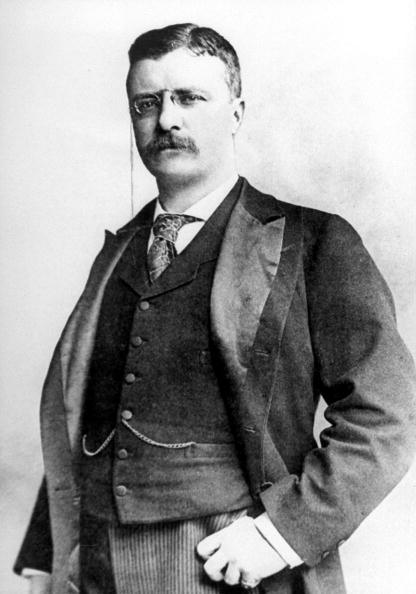
Portrait of American President Theodore (Teddy) Roosevelt.  (Photo by Time Life Pictures/Mansell/The LIFE Picture Collection/Getty Images)

Portrait of American President Theodore (Teddy) Roosevelt. (Photo by Time Life Pictures/Mansell/The LIFE Picture Collection/Getty Images)

Like only a handful of presidents, Theodore Roosevelt lives in our memory and popular culture. He is the bespectacled face gazing from Mount Rushmore, the namesake for the teddy bear, and the advice-giving Rough Rider, played by Robin Williams in the movie Night at the Museum. We remember him, too, as the trust buster who broke up monopolies, the avid outdoorsman and conservationist who preserved parks, forests, and wildlife, and the politician who crusaded for a “fair deal,” a just and equitable society that works for everyone.

Yet Roosevelt’s colorful life and accomplishments distract us from an essential part of him: the profoundly moralistic worldview that fired his progressive zeal. Some recent biographers go so far as to overlook this element of his character completely, but Roosevelt’s friends and colleagues recognized in him, in the words of one friend, “the greatest preacher of righteousness in modern times. Deeply religious beneath the surface, he made right living seem the natural thing, and there was no man beyond the reach of his preaching and example.” As Senator Henry Cabot Lodge mused, “The blood of some ancestral Scotch Covenanter or of some Dutch Reformed preacher facing the tyranny of Philip of Spain was in his veins, and with his large opportunities and his vast audiences he was always ready to appeal for justice and righteousness.”

Lodge astutely singled out the Calvinist traditions in Roosevelt’s ancestry: the Dutch Reformed Church on his father’s side and the Scottish Presbyterian Church (whose Covenanters fought the tyranny of England’s Charles I) on his mother’s, not to mention his own upbringing in New York’s Madison Square Presbyterian Church. How significant Roosevelt’s religious origins were really struck home to me when I realized how many national leaders of the Progressive Era shared them. I had been looking at the denominational origins of major American environmentalists and already knew how dominant people raised Presbyterian, often with ministers in the family, were during its rise. Still, when I turned to progressivism I was unprepared for the extent to which Presbyterians ran the show. Non-Presbyterian presidents held office a mere eight-and-a-half years between 1885 and 1921. Of those born in the church, —Grover Cleveland, Benjamin Harrison, Roosevelt, and Woodrow Wilson—two, Cleveland and Wilson, were sons of ministers. Only two Presidents before Cleveland were raised Presbyterian, and none after Wilson has been.

I wondered what all this Presbyterianism could mean for progressivism, a movement that included people of all faiths, and what this religious strain in politics meant for crusades that these days might be typically colored strictly “red” or “blue.”

Progressives grew up in an era in which big money corrupted politics, large corporations dominated the economy, and environmental crises threatened the natural world – forces that might rouse the ire of those on the “blue” side of the spectrum today. But the situation was a call to arms for those who were steeped in the Calvinist demand for a righteous society, a kind of moralizing that might be more considered on the “red” side of the current spectrum.

At this time in history, though, it was the progressives who were the evangelicals out to spread righteousness in the nation. Censorious Presbyterians attacked greed and avarice with a special vengeance, as the sins that prompted Eve to reach for the forbidden fruit and exile us all from the Garden.

I realized how easily Presbyterian evangelical righteousness translated from church pulpits to political podiums. This church imbued Roosevelt and his fellow progressive leaders with the moral courage to take on the concentrated wealth that corrupted American democracy and dominated the economy. When in 1901 Roosevelt found himself with “such a bully pulpit,” in his famous phrase, no wonder that he impressed people as a preacher of righteousness.

This same moral courage was necessary to drive American environmentalism. Calvinist churches fostered a particularly strong interest in nature and natural history; John Calvin himself regarded nature as a place where God drew nearest and communicated himself and he spoke of the natural world as the theater of his glory. To many Calvinists, nature study had an aura of sanctity as a moral occupation for men, women, and children alike. God, they said, gave natural resources to humans to use for the common good, but not sinfully to waste or turn to greedy or selfish purposes.

Under Harrison, Cleveland, Roosevelt, and Wilson, national government made dramatic strides in conservation. They expanded National Parks from one to two dozen, organized the Park Service, created millions of acres of National Forests, established the Forest Service, and named and promulgated conservation. They had essential assistance from their Secretaries of Interior (parks) and Agriculture (forests), who during the heyday of conservation between 1889 and 1946 were Presbyterians in three years out of four. For Wilson, a Southerner little interested in conservation, Interior Secretary Franklin Lane was prime instigator of major parks expansion and organization.

Roosevelt was the unexcelled exemplar of this passion for nature and moralism about its use. As a boy, he created a zoo in his home and learned taxidermy to preserve specimens. At Harvard, he originally intended to study natural history. After he chose a career in politics, he was an unusually knowledgeable ornithologist and published books on natural history, hunting, and his wilderness adventures. Aptly, as vice president, Roosevelt was climbing Mount Marcy in the Adirondacks when he learned William McKinley had died and he was now president.

Roosevelt believed government must protect nature and natural resources against the rapacious forces of self-interested avarice. “Conservation is a great moral issue,” he asserted. “I believe that the natural resources must be used for the benefit of all our people, and not monopolized for the benefit of the few.” As president, he added five National Parks, created the first 18 National Monuments, quadrupled the acreage of National Forests, established the first 51 bird refuges and four game refuges, oversaw the first irrigation projects and several major dams, and made the new term “conservation” the cornerstone of his political agenda.

After he died in 1919, Roosevelt inspired many to carry on with his work. One was the fervent progressive Harold Ickes, who said of the moment he learned of Roosevelt’s death, “something went out of my life that has never been replaced.” Unsurprisingly, Ickes was a Presbyterian who once intended to go into the ministry. One friend even called him “furiously righteous.” Among his many acts as Secretary of Interior in the administration of Roosevelt’s cousin Franklin, he desegregated the National Parks and added the first four parks intended to remain as undeveloped wilderness: Everglades, Olympic, Kings Canyon, and Isle Royale. His career was a fitting capstone to the great era of progressive Presbyterianism.

Mark Stoll is an associate professor at Texas Tech University in Lubbock. He is the author most recently of Inherit the Holy Mountain: Religion and the Rise of American Environmentalism.

On Wall Street: Slavery Lost, Found, and Remembered

HNN   July 7, 2015

Related Link The Rise of Wall Street

Rememory is a word the Nobel Prize-winning author Toni Morrison used for historical events that have been lost and recovered.

On June 27, 2015 an original building was remembered. A plaque commemorating the slave market that stood in New York City on the East River at Wall Street was planted in the soil, erected at the site of the original building.

A Brooklyn councilman, community leaders, activist students and other New Yorkers contributed to making the city aware of its past. The mayor and his wife gave a speech at the dedication and an award-winning poet recited a poem to lost colonial-era ancestors and history, but none of these events were enough. So much more has to be done to recognize the contributions of people who passed through the slave market.

The plaque marking the site on Wall Street between Pearl and Water Streets was proposed by Brooklyn writer, artist and activist, Christopher Cobb. The language for the plaque was crafted by the New York City Parks Department and the City’s Landmark Preservation Commission, with assistance from Christopher Moore, former director of the Schomburg Center for Black Culture, the research branch of the New York Public Library in Harlem. Many people contributed directly and indirectly.

The plaque is important because when we lose a landmark, one such as the slave market, an image we can see at the Skyscraper Museum on Battery Place in New York City, it may be lost to history. When we lose a landmark we cannot see, smell and touch, it is necessary to create a truthful, dramatic experience that tells the story. Rememory. The artist, Kara Walker, created a dramatic installation in the sugar monument at the Domino Sugar Factory on New York’s East River in Brooklyn. Authors Sven Beckert, Eric Foner, Edward E. Baptist, Anne Farrow-Joel Lang-Jenifer Frank, and Michelle Alexander and others retold stories of wealth and growth in the western world in their recent books about slavery.

For years, I wrote about the slave market and other monuments in New York. But what struck me was the timing of the installation of the plaque, given what happened in Charleston, South Carolina when nine black people were struck down by a white supremacist in a domestic terrorist attack in their church at a Bible study group. President Barack Obama closed his eulogy to the struck down minister, Rev. Clementa Pinckney and the eight others, by leading not only the congregation, the city and the state but also the nation and the world in an inspirational rendition of “Amazing Grace.” But that tribute too was only a beginning. There is so much about American history that so many are unaware of.

Among the surprising commentaries surrounding the devastating event in Charleston was a television interview with a spokesman for a Confederate group, former Georgia congressman in the U.S. House of Representative and an actor on the Dukes of Hazard TV show. He said this about American slavery: “Slavery, it ain’t like it was a Southern sin. It was a national American sin. It built Wall Street and the American economy.”

So what did he mean? Let us reflect on what is said on the newly installed plaque, called, “New York’s Municipal Slave Market”:

On Wall Street, between Pearl and Water Streets, a market that auctioned enslaved people of African ancestry was established by a Common Council law on November 30, 1711. This slave market was in use until 1762. Slave owners wanting to hire out their enslaved workers, which included people of Native American ancestry, as day laborers, also had to do so at that location. In 1726 the structure was renamed The Meal Market because corn, grain and meal – crucial ingredients to the Colonial diet – were also exclusively traded there.

Slavery was introduced to Manhattan in 1626. By the mid-18th century approximately one in five people living in New York was enslaved and almost half of Manhattan households included at least one slave. Although New York State abolished slavery in 1827, complete abolition came only in 1841 when the State of New York abolished the right of non-residents to have slaves in the state for up to nine months. However, the use of slave labor elsewhere for the production of raw materials such as sugar and cotton was essential to the economy of New York both before and after the Civil War. Slaves also cleared forest land for the construction of Broadway and were among the workers that built the wall that Wall Street is named for and helped build the first Trinity Church. Within months of the market’s construction, New York’s first slave uprising occurred a few blocks away on Maiden Lane, led by enslaved people from the Coromatee and Pawpaw peoples of Ghana.

The South Carolina terrorist said he chose Charleston, South Carolina because it is the most historic city in his state. He said he was out-of-his-mind when he read that at one point in history there were more Negroes in South Carolina than there were whites. It was no accident that he attacked one of the most historic religious institutions not only in the South but in America — the Emanuel African Methodist Episcopal Church (AME), founded by enslaved, free and abolitionist African Americans, including Denmark Vesey, who rebelled against slavery in 1822.

We wonder what the terrorist would say if he read that at one point in Early American history, in 1650, the number of bondaged African Americans in New York was second only to the number in South Carolina, and in New York there were rebellions in 1712, 1741 and other years. So let’s review the words of the Wall Street plaque. Good people have to be aware of history because evil people are paying attention. (Maybe today someone will finally make the formerly enslaved abolitionist Denmark Vesey movie that filmmakers have been trying to make for so many years.)

My intimate knowledge of some of the ancestors in New York, having researched genealogy and combed the records for a book, is vivid. My maternal great-grandmother was Elizabeth Hunter of Jamaica. Governor Robert Hunter, British Royal Governor of the British Colonies in New York and New Jersey from 1710 to 1720, and Governor of the British Colony in Jamaica from 1727 to 1734 was her ancestor. The slave market was established under his watch. When Governor Robert Hunter was in New York, before he went to Jamaica, he was integrally involved in overseeing the monies used in the Colonies. He petitioned Queen Anne to have a smaller denomination of money for the merchants and their customers and decried what he called the “hard usage” of colonial African Americans.

I ignored Governor Hunter on our family tree, even after I found the genealogical records, but he resurfaced in my New York research when I researched entrepreneurial African American potters, and my Scottish and African American ancestors in Colonial New York. By hard usage, he and other colonials meant the use of free African Americans labor to transport the timbers that built ships, buildings and military forts in the city. The free laborers also built the businesses of the variety of entrepreneurs who owned them as enslaved people.

So view the plaque’s words, owners . . . hire out their enslaved workers. These and other slave owners were not average individuals; they were business people who hired out the humans they held in bondage. They not only pocketed the money their slaves earned and used the money to build a fortune, they also used the people’s free labor to build their own businesses. When President George Washington landed on the East River, a few blocks from the site of the former slave market where slavers still traded humans, he must have seen the hard usage. The Founding Fathers and Financial Founding Fathers owned slaves. They built the banks and created the nation’s currency. Enslaved people built the industries that built New York.

The banks were built on Wall Street during this era. In 2011, at a Wall Street festive gathering, a Financial Follies for financial reporters, BNY Mellon Bank taunted protesters outside in the Occupy Wall Street movement with a satirical promotional ad. The bank’s ad said: “We don’t mean to brag, but we’ve been Occupying Wall Street for 227 years.” Banks from Bank of America, J. P. Morgan Chase, Citibank, Wells Fargo, Mellon Bank and others had their roots in earlier banks on Wall Street during the slavery era.

So view the plaque’s words,the use of slave labor elsewhere for the production of raw materials such as sugar and cotton. The profits from sugar and slavery were not only produced elsewhere and used to build banks and businesses on Wall Street as the plaque says, but there were sugar mills at the edge of Wall Street. These New York merchants’ major commerce at the time was human cargo and sugar, imported from the Caribbean Islands. The sugar was stored in New York’s sugar houses owned by its leading families; sugar was refined in the refineries, and profitable liquor shipped to the other colonies and to Europe. A “Sugar House” stood on the south side of Liberty Street at Cedar Street, adjoining the Dutch Church, and another one stood one block north on Cortlandt Street in the 1700s. Liberty Street Sugar House was owned by Peter Livingstone, a merchant, and the adjoining one by John Van Cortlandt, a merchant. These and other names cover Manhattan, Bronx and Brooklyn. There were major sugar factories in Brooklyn, and that is why Kara Walker’s sugar installation is so significant.

Profits from sugar, cotton, slavery and slave ships created fortunes. Entrepreneurs who used free slave labor as “hard usage” were called merchant, sea captain, tavern owner, brewer, lawyer, minister, politician, governor, mayor, distiller, vintner, doctor, baker, shopkeeper, shipowner, silversmith, sailmaker, victualler, cordwainer, watchmaker, insurer. The whole insurance industry worldwide was started and built on slavery. Edward Lloyd started Lloyds in his storefront in London in 1688 when he posted the list of ships and took bets on which ones would survive. Insurance was a main business of the men who sat in the taverns on and surrounding Wall Street and who traded at the slave market. The American insurance industries from Aetna to Hartford have their roots in Wall Street-financed slavery.

This is the place where the economic, social and civic foundations of the nation originated. Tenant farmers from the Hudson Valley supplied the colonial city with produce at the Oswego Market on Broadway. The farmers protested the inequities and unequal treatment by one of New York’s largest landowners, Stephen Van Rensselaer IV, in 1845. The Stock Exchange at Wall and Broad Streets was formed in 1792, and there was already an Exchange, the first Exchange on the East River at Broad and Dock Streets, today’s Pearl Street. This is the site of the current slavery plaque. That site has been a trade location since the era of the Dutch and the British, when shipping and slavery were the world’s major commercial businesses.

The wealth that empowered the colonists to revolt against Britain during the American Revolutionary War came from the labor of people who cleared the forests, built roads. The governors bargained with the Mohawks and other Native Americans upstate, whose timbers were transported by slaves to the city.

View the plaque’s words,enslaved people from the Coromatee and Pawpaw peoples of Ghana. I have documented ancestors from the 1600s and 1700s who were Coromantees from Ghana, West Africa. I researched and traced how they survived, how they received the name, Coromantee. Koromantyn was the name of the village from which they came.

This plaque recently placed on Wall Street describes people who have deep roots not only in America, but also in the world.

Pearl Duncan has two upcoming books, one about the DNA roots of African American ancestors and another about colonial ships, Wall Street and New York and New Yorkers.

For all the hereafter


African American Intellectual History Society July 5, 2015

The Fourteenth Amendment is a living document, and Clarence Thomas is a terrible historian

June 26 was a pretty good day for civil rights: the Supreme Court guaranteed the right for same-sex couples to marry by a 5-4 majority in Obergefell v. Hodges.

True to form, the conservatives dissented, drawing upon arguments from strict construction and original intent. Clarence Thomas served up one particular flavor: “Since well before 1787, liberty has been understood as freedom from government action, not entitlement to government benefits.” The presumption being that the benefits of marriage are somehow a government give-away, like those apocryphal Obama cell phones. 

This is the same strange logic that led Andrew Johnson to veto the Civil Rights Act of 1866 on the grounds that guaranteeing equal rights for all Americans, regardless of race or former status as slaves, constituted granting African Americans “special” rights. In protecting the rights of the freedpeople, Johnson argued, the bill established “safeguards which go infinitely beyond any that the General Government has ever provided for the white race. In fact, the distinction of race and color is by the bill made to operate in favor of the colored and against the white race.”

Of course this is not the case.  Freedom is not a government give-way, it’s a government guarantee.

Marriage has been many things over many years, but in our day it is foremost a contract that imparts particular benefits and responsibilities. The government has no compelling interest in impeding that contract, only prejudicial ones. Repeat: The case for same-sex marriage is not a reach. For the government to stand aside and let people do what they will is entirely in line with old-school liberalism, and even what passes for modern libertarianism.

It may indeed be right that, as Thomas writes, “government cannot bestow dignity, and it cannot take it away.” But it sure can mess with your ability to enjoy the basic benefits of the society around you, as Thomas’s own examples (slavery, Japanese internment) deftly illustrate. (Great example of reactionary mentality masquerading as race pride.)

Oppressive policies such as segregation and internment may or may not degrade their victims in their own minds, but that is not the point. The point is that these are state-sponsoredefforts to try to make that degradation succeed. By Thomas’s warped interpretation of African American history, slavery was just fine, for even if the state practiced and championed the institution, the slaves’ sense of self could never be obliterated. It is not the consequence on the psyche of the oppressed that matters, it is the states’ intention and practice of oppressionthat requires remedy.

Antonin Scalia may not like it, but “normal” changes (sometimes remarkably rapidly), and same-sex marriage is the new normal. Thankfully, what was acceptable in 1787 or 1866 may not be acceptable now, and vice versa. The Constitution is not a stone tablet. As attests what happened in 1972, when Title IX was created to protect women’s rights, the protections guaranteed by the Fourteenth Amendment adapt to the times.

If we’re going by original intent, then the original intent of the Fourteenth Amendment was flexibility.  The Fourteenth Amendment was created not just to protect the rights of freed slaves, but to let the national government protect the rights of all threatened minorities, far into the future.

It’s worth a read – at least, of the critical Section I.

All persons born or naturalized in the United States, and subject to the jurisdiction thereof, are citizens of the United States and of the State wherein they reside. No State shall make or enforce any law which shall abridge the privileges or immunities of citizens of the United States; nor shall any State deprive any person of life, liberty, or property, without due process of law; nor deny to any person within its jurisdiction the equal protection of the laws.

You don’t hear anything at all about the actual rights that are protected, do you?  That’s because the intent of the amendment was much broader than that.

The amendment does specify who rights belong to, for it defines federal and state citizenship — clearly, and really for the first time.  That dealt with problem number one, for if the oppressed (in this case, freed slaves) had the rights of citizens, they themselves could invoke the full force of the law on their own behalf. Good old American individualism and small-government mentality.

But there was a second problem the framers also had to address. The original Constitution severely constrained the power of the federal government to impair the individual liberties of American citizens — that’s the Bill of Rights, and particularly the Fifth Amendment. At the time, this all fit nicely with the political ideology of the revolution: liberty was thought kept safest when distributed far from central government, in the states.

But what happened when the states themselves acted against individual liberties? In a contest between state and federal government, which would prevail? To put it another way: the Constitution (through the Bill of Rights) protects individual liberties against the unjust exercise of federal power; what, though, would protect individual rights against the unjust exercise of state power?

In asserting the primacy of federal over state authority, the 39th Congress crafted a sweeping reconceptualization of federal-state relations, making the federal government the ultimate and final arbiter in cases where individual rights are infringed upon by the power of government.

So let’s imagine going back in time (cue wavy-screen-time-machine effect), so we can be there at the birth of the thing.

An ongoing problem did indeed spark the creation of the Fourteenth Amendment. This was the plight of four million bondspersons now free, who were being subjected to virtual re-enslavement not simply by their former masters, but by the states of what had been the Confederacy. When former planters and their representatives returned to southern statehouses just after the Civil War, the states immediately passed a series of debilitating black codes, which strictly limited blacks’ political participation, their access to the political process, and their paths to economic mobility.

Events such as the Memphis Riot of 1866 demonstrated that those freed from slavery required the full protections of citizenship, which only the federal government could provide (image courtesy Wikipedia)

Events such as the Memphis Riot of 1866 demonstrated that those freed from slavery required the full protections of citizenship, which only the federal government could provide (image courtesy Wikipedia)

The Civil Rights Act of 1866 sought to remedy this by defining American natives as citizens, and extending to all in the southern states equal rights of federal citizenship.

The immediate purpose of the Fourteenth Amendment was to ensure the constitutionality of the Civil Rights Act, so that any southern-controlled Congress of the future could not repeal it. James Garfield proposed to “lift that great and good law above the reach of political strife, beyond the reach of the plots and machinations of any party, and fix it in the serene sky, in the eternal firmament of the Constitution, where no storm of passion can shake it and no cloud can obscure it.” What happened to the Fourteenth in the courts of the late 1800s mocked such high-minded hopefulness (more on this in a little), but it does signal the framers’ deep and lasting purposes. The framers viewed their work as repairing a flaw in the original Constitution.

They didn’t change the Constitution to pass a law; they passed the law because they had fixed the Constitution.

They posed their solution in broad and principled terms precisely because they realized that the specific case they confronted could come up again and again in other guises, whenever states sought to undermine liberty. Despite Andrew Johnson’s objection, the amendment did not promote the interests of one special group – what was termed “class legislation” back in the day. It was meant to clearly establish the principles that granted Congress the ability to step in and protect the rights of any group targeted by the states for unequal treatment.

To be sure, there was a cost to framing the amendment in terms of broad principles, for such general language could be interpreted in many ways, some contrary to the original spirit and purpose of the amendment. This is exactly what happened in the last quarter of the nineteenth century and the first quarter of the next, when the Supreme Court began eviscerating the amendment’s role in protecting freedpeople’s rights. Instead, the court transformed it into a tool for corporations to resist government regulation. No conservatives at that time complained about original intent.

This process went stunningly far. In 1896, the Supreme Court ruled that in being compelled to sit in a segregated streetcar Homer Plessy had not had his civil rights violated. Why not? Because according to the majority opinion, the Fourteenth Amendment “could not have been intended to abolish distinctions based upon color, or to enforce social, as distinguished from political, equality, or a commingling of the two races upon terms unsatisfactory to either.” A rather profound misreading of the amendment’s original intent, no? Again, conservatives didn’t complain.

But the very vagueness that permitted such atrocious misreadings is now serving its purpose exactly as intended. As with the framers of the original Constitution, the framers of the Fourteenth understood that they were making rules not just for their day, but to serve the following generations as well. And they knew that those who followed would likely need their creation for new purposes. They knew they were crafting a broad protection of liberty, and they did not care to specify the conditions under which it should operate, because that was the job of the generations to follow. Their job was simply to secure Congress the right to step in whenever the states impaired the rights of individuals. That’s the whole purpose of the powerful Section I.

So though they clearly sought to root out an existing evil against the freedpeople, the framers of the amendment explained it as having broad application. Foremost among these men was Ohio Congressman John Bingham, who put the question simply to Congress: “whether you will give by this amendment of the people of the United States the power, by legislative enactment, to punish officials of States for violation of the oaths enjoined upon them by their Constitution?”

The Congressmen debating the measure clearly thought about its wide application. They wondered if it might be used by married women to argue for expanded rights to property, and they anticipated (and affirmed) that the amendment would create naturalized citizens of everyone native-born, regardless of their heritage. William Pitt Fessenden of Maine went so far as to suggest that Bingham had not even proposed the measure to support the Civil Rights Act of 1866. “During all the discussion in the committee that I heard,” he stated, “nothing was ever said about the civil rights bill in connection with that. It was placed on entirely different grounds.”

When asked directly if the amendment were not intended solely to protect the rights of freed slaves, Bingham replied that “it is proposed as well to protect the thousands and tens of thousands and hundreds of thousands of loyal white citizens of the United States whose property, by State legislation, has been wrested from them under confiscation, and protect them also against banishment.” (This was a reference to Confederate treatment of Union loyalists.) He also suggested that it would apply to states that violated the rights of blacks from antebellum-era racial prohibitions in nominally “free” states such as Indiana and Oregon.

Moreover, Bingham understood Congress to be undertaking a work of long-term constitutional significance. The Fourteenth Amendment constituted a redemptive effort to fix a fundamental flaw in the original plan of government. When South Carolina had sought to nullify federal law back in 1833, Bingham argued, Congress had “looked in vain for any grant of power in the Constitution” to support the civil rights of South Carolinians who dissented from their state’s policy.

In fixing this flaw, the new amendment would clarify the issue not just in the present. Forever after, it would “protect by national law the privileges and immunities of all the citizens of the Republic and the inborn rights of every person within its jurisdiction whenever the same shall be abridged or denied by the unconstitutional acts of any State.”

This long-term security was needed, Bingham believed, for the Confederacy had demonstrated just how much damage could be wrought in the name of states’ rights. The Civil War’s untold losses in lives and property had made this clear. The nation now demanded “something in the shape of a security for the future against the recurrence of the enormous evils under which the country has labored for the last four years.” This echoed the language of the Joint Committee on Reconstruction, on which Bingham served, which asserted the government’s duty “to secure itself against similar wrongs in the future.”  The framers understood themselves to have provided an ongoing solution for a general problem (the states’ interference with individual liberties) that might arise at any time in the future.

Ohio Congressman John Bingham, one of the framers of the 14th Amendment, and the its most vocal champion in the House

Ohio Congressman John Bingham, one of the framers of the 14th Amendment, and its most vocal champion in the House

In Obergefell v. Hodges, the majority ruled sagely, and completely within the original intent of the framers of the Fourteenth Amendment. The rights its confers are not government give-aways or special favors. They are a bold assertion of the federal government’s responsibility to secure the liberties of minorities singled out for state-sponsored prejudice.

If, as Clarence Thomas and his strict constructionist colleagues assert, we should consider original intent, then we cannot do better than the words of the amendment’s most important framer. According to Bingham, those who wrote, championed, and passed the Fourteenth Amendment sought nothing more than “the care of the Republic, not only for the present, but for all the hereafter.”

Confederate Flags in the Jim Crow North

by 

The African American  Intellectual History Society   July 1, 2015
Bronx Confederate Flags 003

Photo: Opponents of local civil rights activists raise a Confederate flag in the Bronx, July 1963

+++

Over the years, what many people recognize as the Confederate flag, the “Stars and Bars,” which decorated several official flags that insurrectionists who fought against the United States flew during the Civil War (1861-1865), has symbolized different types of American identity.

During the 1950s, white Southerners who opposed racial integration and civil rights for black Americans used the Confederate flag as a symbol of their resistance against what they saw as a tyrannical federal government that sought to eradicate their cultures and customs. Some Southerners called these mores their “way of life.”

They were not totally wrong since their official “way of life” involved oppressing American blacks in practically every possible way.

White people could treat black citizens like dogs, or worse, outright terrorize them, at voting polls, in courts, at workplaces, in stores, at theaters, in public schools. Racial segregation even ruled cemeteries.

Racial segregation dominated the South.

So, when Supreme Court decisions and federal laws sided with citizens who fought against racist segregation, white Southerners knew their way of life’s days were numbered. They resisted the civil rights movement. They opposed equal citizenship for black Americans and equal protection of the law for black people.

They showed their defiance the same way Southern insurrectionists did during the Civil War: they flew their Stars and Bars.

Nowadays, some white Southerners (and black ones too) say that the flag serves as a symbol of their heritage. It honors their ancestors. They argue that the Confederate flag does not stand for slavery; even though that flag flew over armies that marched to create a new nation built to preserve white supremacy and racial slavery.

The Confederate political leader, Alexander Stephens, made plain why the insurrectionists fought that war and flew their flag when he explained that his new government’s, “foundations are laid, its cornerstone rests, upon the great truth that the (N)egro is not equal to the white man; that slavery, subordination to the superior race, is his natural and normal condition.”

Perhaps the cultural and political meanings that the Confederate flag represented in the 1860s and in the 1950s have changed.

Perhaps now, in the 2010s, the Confederate flag means different things – heritage and sectional pride – than it meant in the past: massive resistance against the civil rights movement and a new nation to protect white people’s ability to enslave black people.

Perhaps.

But that flag’s connection to the white nationalist terrorist’s shooting of 9 Black people in Charleston, South Carolina, proves that the Stars and Bars still have a great amount of white nationalist, racist, segregationist meaning woven within its fabric.

+++

During today’s raging culture wars over the Confederate flag, Americans should remember that white Southerners do not have a monopoly on the Confederate flag’s meaning, or its use.

Historians have shown how supposedly “Southern” forms of racism and terrorism, as well as activist movements against those cultural and political practices, existed throughout the nation.

For example, contrary to notions of its strictly rural Southern existence, during its resurgence in the 1920s the Ku Klux Klan wielded power and influence in cities across the country.

Even during the 1960s, when some whites outside the South wanted adamantly to oppose any type of civil rights for black Americans, they used two of the strongest, clearest symbols to communicate their political views and cultural identity: KKK hoods and Confederate flags.

In the summer of 1963, black and white civil rights activists in the Allerton Avenue section of the northeast Bronx, New York, staged nonviolent protests for black people to have more jobs at local White Castle restaurants.

Some of their opponents paraded in KKK hoods, waved Confederate flags, and donned Confederate garb (see below pictures). One counter demonstrator tried to have a nine-month old pose for a picture wearing a replica of a Confederate officer’s hat.

Bronx Confederate Flags 002

Bronx Confederate Flags 004

Ironically, many of the white residents of the northeast Bronx neighborhood where those protests occurred descended from Italian immigrants. They stood next to Confederate flags and a person dressed like a Klansman, but at one time the white American nationalists who used those symbols throughout the decades also violently opposed southern Europeans and Catholics immigrating into the United States.

When Bronx whites who opposed the civil rights movement in their own community wanted to express their nationalism and identity, and their political opposition against black employment at White Castle, they knew exactly what symbols to use, what flags to fly, and what chants to shout. They sang, “Dixie.” They yelled, “Go home nigger.” A taxi driver from the community told a New York Post reporter, “We aren’t going to let the colored people take over our neighborhood like they have everywhere else in the city.”

+++

Over the years, the Confederate flag emerged as a very American symbol of white nationalism, white identity, and opposition against any type of civil rights and civil equality for black people in the United States.

Some Southerners claim the Confederate flag as a symbol of their cultural identity and historical heritage, and the Stars and Bars may very well have such sentimental value.

But personal heritage cannot erase or replace national history.

Since the Civil War, Americans around the country have used that flag to symbolize their opposition of black civic equality, even black people’s very humanity.

As twenty first century Americans call for the flag’s removal from public buildings, especially state capitals, historians should also do more research into the ways the Confederate flag served as a powerful national symbol, not merely a regional or sectional one, for white nationalism and domestic racist terrorism.

Brian Purnell

Brian%20Purnell%200454Brian Purnell is Associate Professor of Africana Studies and History at Bowdoin College. He is the author of Fighting Jim Crow in the County of Kings: The Congress of Racial Equality in Brooklyn (Kentucky, 2013), which won the New York State Historical Association Manuscript Prize in 2012. He has worked on several public history projects with the Brooklyn Historical Society, the Bronx County Historical Society, the Brooklyn Public Library and the University of South Carolina. Before joining the faculty at Bowdoin, he worked for six years at Fordham University as Research Director of the Bronx African American History Project and as an Assistant Professor of African American Studies (2006-2010). He is currently working on two books. The first is an oral history autobiography of Jitu Weusi (Leslie Campbell), a prominent educator and Black Nationalist activist in Brooklyn, New York, during the Civil Rights and Black Power Movements. The second is a history of urban community development corporations since the mid-1960s tentatively entitled, “Unmaking Ghettos: The Golden Age of Community Development in America’s Black Metropolises.” Brian lives in Brunswick, Maine, with his wife, Leana Amaez, and their four children: Isabella, Gabriel, Lillian and Emilia.

EPISODE 13: SUZANNA REISS ON DRUG CONTROL, COCA-COLA, AND PHARMACEUTICALS

Today’s guest discusses the history of the coca leaf and the U.S. drug control regime. Amongst other topics, we discuss the importance of coca to both Coca-Cola and Merck and the pharmaceutical industry. For Suzanna Reiss, this provides a way to interpret the history of capitalism across the mid-twentieth century and after.

Suzanna Reiss is Associate Professor of History at the University of Hawai’i at Manoa. She is author of We Sell Drugs: The Alchemy of US Empire. You can read more about her work here.

Check out this episode!Flavoring extract copy 2

Video of the Week: The Ku Klux Klan parades down Pennsylvania Ave 1928

HNN June 23, 2015


America’s Long History of Racial Fear

By

We’re History  June 24, 2015
An Amalgamation Waltz

An Amalgamation Waltz. Edward Williams Clay, 1839 (Photo: American Antiquarian Society)

Calling Wednesday’s shootings in Charleston a “tragedy” makes this explosion of murderous violence seem like an accident. It isn’t an accident. It is the legacy of an excruciating history that began with racial slavery and continued through the post-Civil War campaign to maintain white supremacy – a campaign that has persisted to the present day and which shapes how many white Americans think about and respond to black Americans.

At the heart of Wednesday’s violence is America’s history of chattel slavery, a labor system built on violence, in which all whites were effectively authorized to do violence to African Americans in order to keep them at work and prevent them from challenging their enslavement. But this brutal system also produced rebellions. Whites – even those who never owned a slave – lived with the fear that that racial order might be turned upside down, destroying everything that they held dear. In other words, whites attributed to blacks the same desire for domination that they themselves were exercising. It is no accident that the alleged shooter is reported to have said: “You rape our women and you’re taking over our country.”

The history of chattel slavery, upended in the Civil War, was followed by the history of Reconstruction, a moment during which America’s racial hierarchy was unsettled, and black people were able to claim a measure of political and civil equality. But the moment was a brief one. White conservatives all over the South, abetted by many white northerners, denounced the new interracial Southern governments as exactly the “world turned upside down” that they had feared during slavery. They overthrew those governments by force and fraud and set about reconstructing white supremacy as best they could without the law of slavery as a foundation.

The Reconstruction years thus gave way to another history: the continuing struggle by white supremacist activists to create and enforce Jim Crow’s exclusion, segregation, and lynching. This struggle took a lot of work, and it required that whites remain intensely fearful of blacks. One of the greatest victories of white supremacy in this era was to persuade whites that they confronted an epidemic of black men raping white women. Despite overwhelming evidence that this claim was unfounded (especially as revealed by Ida B. Wells-Barnett), the fantasy that predatory black men routinely victimized white women became the justification for lynching. Those fears may have run deepest in the South, where the great majority of the black population resided well into the twentieth century, but they found a home in the North and West as well.

As Jim Crow began to crack beneath the blows of the post-WWII black freedom movement, politicians drew on that history to sustain white racial domination. Scare campaigns against the Civil Rights Movement promised that civil and political equality would unleash black men’s alleged sexual ambitions and, once again, overturn a well-established racial hierarchy. The power and persuasiveness of those arguments helped explain the residential segregation and redlining across the North that lies at the heart of so many of today’s inequities. It lay behind the differential sentencing laws for powder and crack cocaine and undergirded the fearful discussion of “super-predators” in the 1980s and 1990s. It is still used to justify the overwhelmingly disproportionate police scrutiny, arrest, and conviction and incarceration of African Americans.

America’s long racial history of imagining blacks as fearsome, criminal, and bent on political and sexual domination has never gone away. This is not because the fantasy is real, but because it has played such a powerful role for hundreds of years. No wonder that it is so readily wielded as a weapon, whether through cynicism, ignorance, or ruthlessness. No wonder that its murderous version of history was so easy for Dylann Roof to find and embrace.

Dylan Roof’s murderous night is not simply a South Carolina tragedy. It is an expression and a consequence of American history – a history that the nation has hardly reckoned with, much less overcome.

About the Author

Stephen Kantrowitz

Stephen Kantrowitz is Vilas Distinguished Achievement Professor of History at the University of Wisconsin-Madison and the author of several books, including Ben Tillman and the Reconstruction of White Supremacy.

NPR JUNE 22, 2015 
These historical photographs depict the forearms of human test subjects after being exposed to nitrogen mustard and lewisite agents in World War II experiments conducted at the Naval Research Laboratory in Washington, D.C.

These historical photographs depict the forearms of human test subjects after being exposed to nitrogen mustard and lewisite agents in World War II experiments conducted at the Naval Research Laboratory in Washington, D.C. Courtesy of the Naval Research Laboratory

As a young U.S. Army soldier during World War II, Rollins Edwards knew better than to refuse an assignment.

When officers led him and a dozen others into a wooden gas chamber and locked the door, he didn’t complain. None of them did. Then, a mixture of mustard gas and a similar agent called lewisite was piped inside.

«It felt like you were on fire,» recalls Edwards, now 93 years old. «Guys started screaming and hollering and trying to break out. And then some of the guys fainted. And finally they opened the door and let us out, and the guys were just, they were in bad shape.»

About This Investigation

This is Part 1 of a two-part investigation on mustard gas testing conducted by the U.S. military during World War II. The second story in this report will examine the failures by the Department of Veterans Affairs to provide benefits to those injured by military mustard gas experiments.

Edwards was one of 60,000 enlisted men enrolled in a once-secret government program — formally declassified in 1993 — to test mustard gas and other chemical agents on American troops. But there was a specific reason he was chosen: Edwards is African-American.

«They said we were being tested to see what effect these gases would have on black skins,» Edwards says.

An NPR investigation has found evidence that Edwards’ experience was not unique. While the Pentagon admitted decades ago that it used American troops as test subjects in experiments with mustard gas, until now, officials have never spoken about the tests that grouped subjects by race.

For the first time, NPR tracked down some of the men used in the race-based experiments. And it wasn’t just African-Americans. Japanese-Americans were used as test subjects, serving as proxies for the enemy so scientists could explore how mustard gas and other chemicals might affect Japanese troops. Puerto Rican soldiers were also singled out.

Rollins Edwards as a young soldier in 1945 at Clark Air Base in the Philippines.

Rollins Edwards as a young soldier in 1945 at Clark Air Base in the Philippines. Courtesy of Rollins Edwards

White enlisted men were used as scientific control groups. Their reactions were used to establish what was «normal,» and then compared to the minority troops.

All of the World War II experiments with mustard gas were done in secret and weren’t recorded on the subjects’ official military records. Most do not have proof of what they went through. They received no follow-up health care or monitoring of any kind. And they were sworn to secrecy about the tests under threat of dishonorable discharge and military prison time, leaving some unable to receive adequate medical treatment for their injuries, because they couldn’t tell doctors what happened to them.

Army Col. Steve Warren, director of press operations at the Pentagon, acknowledged NPR’s findings and was quick to put distance between today’s military and the World War II experiments.

«The first thing to be very clear about is that the Department of Defense does not conduct chemical weapons testing any longer,» he says. «And I think we have probably come as far as any institution in America on race. … So I think particularly for us in uniform, to hear and see something like this, it’s stark. It’s even a little bit jarring.»

NPR shared the findings of this investigation with Rep. Barbara Lee, D-Calif., a member of the Congressional Black Caucus who sits on a House subcommittee for veterans affairs. She points to similarities between these tests and the Tuskegee syphilis experiments, where U.S. government scientists withheld treatment from black sharecroppers in Alabama to observe the disease’s progression.

«I’m angry. I’m very sad,» Lee says. «I guess I shouldn’t be shocked when you look at the syphilis studies and all the other very terrible experiments that have taken place as it relates to African-Americans and people of color. But I guess I’m still shocked that, here we go again.»

Segregated troops practice movement in protective gear at Edgewood Arsenal in Maryland in the early 1940s.

Segregated troops practice movement in protective gear at Edgewood Arsenal in Maryland in the early 1940s. Army Signal Corps via National Archives

Lee says the U.S. government needs to recognize the men who were used as test subjects while it can still reach some, who are now in their 80s and 90s.

«We owe them a huge debt, first of all. And I’m not sure how you repay such a debt,» she says.

Mustard gas damages DNA within seconds of making contact. It causes painful skin blisters and burns, and it can lead to serious, and sometimes life-threatening illnesses including leukemia, skin cancer, emphysema and asthma.

In 1991, federal officials for the first time admitted that the military conducted mustard gas experiments on enlisted men during World War II.

According to declassified records and reports published soon after, three types of experiments were done: Patch tests, where liquid mustard gas was applied directly onto test subjects’ skin; field tests, where subjects were exposed to gas outdoors in simulated combat settings; and chamber tests, where men were locked inside gas chambers while mustard gas was piped inside.

Even once the program was declassified, however, the race-based experiments remained largely a secret until a researcher in Canada disclosed some of the details in 2008. Susan Smith, a medical historian at the University of Alberta in Canada, published an article in The Journal of Law, Medicine & Ethics.

U.S. troops in Panama participate in a chemical warfare training exercise with smoke during World War II.

U.S. troops in Panama participate in a chemical warfare training exercise with smoke during World War II. Howard R. Wilson/Courtesy of Gregory A. Wilson

In it, she suggested that black and Puerto Rican troops were tested in search of an «ideal chemical soldier.» If they were more resistant, they could be used on the front lines while white soldiers stayed back, protected from the gas.

The article received little media attention at the time, and the Department of Defense didn’t respond.

Despite months of federal records requests, NPR still hasn’t been given access to hundreds of pages of documents related to the experiments, which could provide confirmation of the motivations behind them. Much of what we know about the experiments has been provided by the remaining living test subjects.

Juan Lopez Negron, who’s Puerto Rican, says he was involved in experiments known as the San Jose Project.

Military documents show more than 100 experiments took place on the Panamanian island, chosen for its climate, which is similar to islands in the Pacific. Its main function, according to military documents obtained by NPR, was to gather data on «the behavior of lethal chemical agents.»

Document

One of the studies uncovered by NPR through the Freedom of Information Act was conducted in the Spring 1944. It describes how researchers exposed 39 Japanese American soldiers and 40 white soldiers to mustard and lewisite agents over the course of 20 days. Read the study.

Lopez Negron, now 95 years old, says he and other test subjects were sent out to the jungle and bombarded with mustard gas sprayed from U.S. military planes flying overhead.

«We had uniforms on to protect ourselves, but the animals didn’t,» he says. «There were rabbits. They all died.»

Lopez Negron says he and the other soldiers were burned and felt sick almost immediately.

«I spent three weeks in the hospital with a bad fever. Almost all of us got sick,» he says.

Edwards says that crawling through fields saturated with mustard gas day after day as a young soldier took a toll on his body.

Rollins Edwards, who lives in Summerville, S.C., shows one of his many scars from exposure to mustard gas in World War II military experiments. More than 70 years after the exposure, his skin still falls off in flakes. For years, he carried around a jar full of the flakes to try to convince people of what happened to him.

Rollins Edwards, who lives in Summerville, S.C., shows one of his many scars from exposure to mustard gas in World War II military experiments. More than 70 years after the exposure, his skin still falls off in flakes. For years, he carried around a jar full of the flakes to try to convince people of what happened to him. Amelia Phillips Hale for NPR

«It took all the skin off your hands. Your hands just rotted,» he says. He never refused or questioned the experiments as they were occurring. Defiance was unthinkable, he says, especially for black soldiers.

«You do what they tell you to do and you ask no questions,» he says.

Edwards constantly scratches at the skin on his arms and legs, which still break out in rashes in the places he was burned by chemical weapons more than 70 years ago.

During outbreaks, his skin falls off in flakes that pile up on the floor. For years, he carried around a jar full of the flakes to try to convince people of what he went through.

But while Edwards wanted people to know what happened to him, others — like Louis Bessho — didn’t like to talk about it.

His son, David Bessho, first learned about his father’s participation as a teenager. One evening, sitting in the living room, David Bessho asked his dad about an Army commendation hanging on the wall. David Bessho, who’s now retired from the Army, says the award stood out from several others displayed beside it.

«Generally, they’re just kind of generic about doing a good job,» he says. «But this one was a bit unusual.»

The commendation, presented by the Office of the Army’s Chief of the Chemical Warfare Service, says: «These men participated beyond the call of duty by subjecting themselves to pain, discomfort, and possible permanent injury for the advancement of research in protection of our armed forces.»

Attached was a long list of names. Where Louis Bessho’s name appears on Page 10, the list begins to take on a curious similarity. Names like Tanamachi, Kawasaki, Higashi, Sasaki. More than three dozen Japanese-American names in a row.

«They were interested in seeing if chemical weapons would have the same effect on Japanese as they did on white people,» Bessho says his father told him that evening. «I guess they were contemplating having to use them on the Japanese.»

(Left) A portrait of Louis Bessho from 1969. (Right) Military orders from April 1944 for Japanese-American soldiers, including Bessho, who were part of the military's mustard gas testing at Edgewood Arsenal in Maryland.

(Left) A portrait of Louis Bessho from 1969. (Right) Military orders from April 1944 for Japanese-American soldiers, including Bessho, who were part of the military’s mustard gas testing at Edgewood Arsenal in Maryland.

Documents that were released by the Department of Defense in the 1990s show the military developed at least one secret plan to use mustard gas offensively against the Japanese. The plan, which was approved by the Army’s highest chemical warfare officer, could have «easily kill[ed] 5 million people.»

Japanese-American, African-American and Puerto Rican troops were confined to segregated units during World War II. They were considered less capable than their white counterparts, and most were assigned jobs accordingly, such as cooking and driving dump trucks.

Susan Matsumoto says her husband, Tom, who died in 2004 of pneumonia, told his wife that he was OK with the testing because he felt it would help «prove he was a good United States citizen.»

Matsumoto remembers FBI agents coming to her family’s home during the war, forcing them to burn their Japanese books and music to prove their loyalty to the U.S. Later, they were sent to live at an internment camp in Arkansas.

Matsumoto says her husband faced similar scrutiny in the military, but despite that, he was a proud American.

«He always loved his country,» Matsumoto says. «He said, ‘Where else can you find this kind of place where you have all this freedom?’ »


NPR Investigations Research Librarian Barbara Van Woerkom contributed reporting and research to this investigation. NPR Photo Editor Ariel Zambelich and reporters Jani Actman and Lydia Emmanouilidou also contributed to this story.