National Security Archive Electronic Briefing Book No. 465
April 2, 2014
Edited by James G. Hershberg and Peter Kornbluh
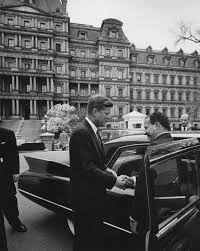
President Kennedy and President Joao Goulart on a state visit to Washington April 2, 1962.
Washington, DC, April 2, 2014 – Almost two years before the April 1, 1964, military takeover in Brazil, President Kennedy and his top aides began seriously discussing the option of overthrowing Joao Goulart’s government, according to Presidential tape transcripts posted by the National Security Archive on the 50th anniversary of the coup d’tat. «What kind of liaison do we have with the military?» Kennedy asked top aides in July 1962. In March 1963, he instructed them: «We’ve got to do something about Brazil.»
The tape transcripts advance the historical record on the U.S. role in deposing Goulart — a record which remains incomplete half a century after he fled into exile in Uruguay on April 1, 1964. «The CIA’s clandestine political destabilization operations against Goulart between 1961 and 1964 are the black hole of this history,» according to the Archive’s Brazil Documentation Project director, Peter Kornbluh, who called on the Obama administration to declassify the still secret intelligence files on Brazil from both the Johnson and Kennedy administrations.
Revelations on the secret U.S. role in Brazil emerged in the mid 1970s, when the Lyndon Johnson Presidential library began declassifying Joint Chiefs of Staff records on «Operation Brother Sam» — President Johnson’s authorization for the U.S. military to covertly and overtly supply arms, ammunition, gasoline and, if needed, combat troops if the military’s effort to overthrow Goulart met with strong resistance. On the 40th anniversary of the coup, the National Security Archive posted audio files of Johnson giving the green light for military operations to secure the success of the coup once it started.
«I think we ought to take every step that we can, be prepared to do everything that we need to do,» President Johnson instructed his aides regarding U.S. support for a coup as the Brazilian military moved against Goulart on March 31, 1964.
But Johnson inherited his anti-Goulart, pro-coup policy from his predecessor, John F. Kennedy. Over the last decade, declassified NSC records and recently transcribed White House tapes have revealed the evolution of Kennedy’s decision to create a coup climate and, when conditions permitted, overthrow Goulart if he did not yield to Washington’s demand that he stop «playing» with what Kennedy called «ultra-radical anti-Americans» in Brazil’s government. During White House meetings on July 30, 1962, and on March 8 and 0ctober 7, 1963, Kennedy’s secret Oval Office taping system recorded the attitude and arguments of the highest U.S. officials as they strategized how to force Goulart to either purge leftists in his government and alter his nationalist economic and foreign policies or be forced out by a U.S.-backed putsch.
Indeed, the very first Oval Office meeting that Kennedy secretly taped, on July 30, 1962, addressed the situation in Brazil. «I think one of our important jobs is to strengthen the spine of the military,» U.S. Ambassador Lincoln Gordon told the President and his advisor, Richard Goodwin. «To make clear, discreetly, that we are not necessarily hostile to any kind of military action whatsoever if it’s clear that the reason for the military action is…[Goulart’s] giving the country away to the…,» «Communists,» as the president finished his sentence. During this pivotal meeting, the President and his men decided to upgrade contacts with the Brazilian military by bringing in a new US military attaché-Lt. Col. Vernon Walters who eventually became the key covert actor in the preparations for the coup. «We may very well want them [the Brazilian military] to take over at the end of the year,» Goodwin suggested, «if they can.» (Document 1)
By the end of 1962, the Kennedy administration had indeed determined that a coup would advance U.S. interests if the Brazilian military could be mobilized to move. The Kennedy White House was particularly upset about Goulart’s independent foreign policy positions during the Cuban Missile Crisis. Although Goulart had assisted Washington’s efforts to avoid nuclear Armageddon by acting as a back channel intermediary between Kennedy and Castro — a top secret initiative uncovered by George Washington University historian James G. Hershberg — Goulart was deemed insufficiently supportive of U.S. efforts to ostracize Cuba at the Organization of American States. On December 13, Kennedy told former Brazilian President Juscelino Kubitschek that the situation in Brazil «worried him more than that in Cuba.»
On December 11, 1962, the Executive Committee (EXCOMM) of the National Security Council met to evaluate three policy alternatives on Brazil: A. «do nothing and allow the present drift to continue; B. collaborate with Brazilian elements hostile to Goulart with a view to bringing about his overthrow; C. seek to change the political and economic orientation of Goulart and his government.» [link to document 2] Option C was deemed «the only feasible present approach» because opponents of Goulart lacked the «capacity and will to overthrow» him and Washington did not have «a near future U.S. capability to stimulate [a coup] operation successfully.» Fomenting a coup, however «must be kept under active and continuous consideration,» the NSC options paper recommended.
Acting on these recommendations, President Kennedy dispatched a special envoy — his brother Robert — to issue a face-to-face de facto ultimatum to Goulart. Robert Kennedy met with Goulart at the Palacio do Alvarada in Brazilia on December 17, 1962. During the three-hour meeting, RFK advised Goulart that the U.S. had «the gravest doubts» about positive future relations with Brazil, given the «signs of Communist or extreme left-wing nationalists infiltration into civilian government positions,» and the opposition to «American policies and interests as a regular rule.» As Goulart issued a lengthy defense of his policies, Kennedy passed a note to Ambassador Gordon stating: «We seem to be getting no place.» The attorney general would later say that he came away from the meeting convinced that Goulart was «a Brazilian Jimmy Hoffa.»
Kennedy and his top aides met once again on March 7, 1963, to decide how to handle the pending visit of the Brazilian finance minister, Santiago Dantas. In preparation for the meeting, Ambassador Gordon submitted a long memo to the president recommending that if it proved impossible to convince Goulart to modify his leftist positions, the U.S. work «to prepare the most promising possible environment for his replacement by a more desirable regime.» (Document 5) The tape of this meeting (partially transcribed here for the first time by James Hershberg) focused on Goulart’s continuing leftward drift. Robert Kennedy urged the President to be more forceful toward Goulart: He wanted his brother to make it plain «that this is something that’s very serious with us, we’re not fooling around about it, we’re giving him some time to make these changes but we can’t continue this forever.» The Brazilian leader, he continued, «struck me as the kind of wily politician who’s not the smartest man in the world … he figures that he’s got us by the—and that he can play it both ways, that he can make the little changes, he can make the arrangements with IT&T and then we give him some money and he doesn’t have to really go too far.» He exhorted the president to «personally» clarify to Goulart that he «can’t have the communists and put them in important positions and make speeches criticizing the United States and at the same time get 225-[2]50 million dollars from the United States. He can’t have it both ways.»
As the CIA continued to report on various plots against Goulart in Brazil, the economic and political situation deteriorated. When Kennedy convened his aides again on October 7, he wondered aloud if the U.S. would need to overtly depose Goulart: «Do you see a situation where we might be—find it desirable to intervene militarily ourselves?» The tape of the October 7 meeting — a small part of which was recently publicized by Brazilian journalist Elio Gaspari, but now transcribed at far greater length here by Hershberg — contains a detailed discussion of various scenarios in which Goulart would be forced to leave. Ambassador Gordon urged the president to prepare contingency plans for providing ammunition or fuel to pro-U.S. factions of the military if fighting broke out. «I would not want us to close our minds to the possibility of some kind of discreet intervention,» Gordon told President Kennedy, «which would help see the right side win.»
Under Gordon’s supervision, over the next few weeks the U.S. embassy in Brazil prepared a set of contingency plans with what a transmission memorandum, dated November 22, 1963, described as «a heavy emphasis on armed intervention.» Assassinated in Dallas on that very day, President Kennedy would never have the opportunity to evaluate, let alone implement, these options.
But in mid-March 1964, when Goulart’s efforts to bolster his political powers in Brazil alienated his top generals, the Johnson administration moved quickly to support and exploit their discontent-and be in the position to assure their success. «The shape of the problem,» National Security Advisor McGeorge Bundy told a meeting of high-level officials three days before the coup, «is such that we should not be worrying that the [Brazilian] military will react; we should be worrying that the military will not react.»
«We don’t want to watch Brazil dribble down the drain,» the CIA, White House and State Department officials determined, according to the Top Secret meeting summary, «while we stand around waiting for the [next] election.»
THE DOCUMENTS
Document 1: White House, Transcript of Meeting between President Kennedy, Ambassador Lincoln Gordon and Richard Goodwin, July 30, 1962. (Published in The Presidential Recordings of John F. Kennedy, The Great Crises, Volume One (W.W. Norton), edited by Timothy Naftali, October 2001.)
The very first Oval Office meeting ever secretly taped by President Kennedy took place on July 30, 1962 and addressed the situation in Brazil and what to do about its populist president, Joao Goulart. The recording — it was transcribed and published in book The Presidential Recordings of John F. Kennedy, The Great Crises, Volume One — captures a discussion between the President, top Latin America aide Richard Goodwin and U.S. Ambassador to Brazil Lincoln Gordon about beginning to set the stage for a future military coup in Brazil. The President and his men make a pivotal decision to appoint a new U.S. military attaché to become a liaison with the Brazilian military, and Lt. Col. Vernon Walters is identified. Walters later becomes the key covert player in the U.S. support for the coup. «We may very well want them [the Brazilian military] to take over at the end of the year,» Goodwin suggests, «if they can.»
Document 2: NSC, Memorandum, «U.S. Short-Term policy Toward Brazil,» Secret, December 11, 1962
In preparation for a meeting of the Executive Committee (EXCOMM) of the National Security Council, the NSC drafted an options paper with three policy alternatives on Brazil: A. «do nothing and allow the present drift to continue; B. collaborate with Brazilian elements hostile to Goulart with a view to bringing about his overthrow; C. seek to change the political and economic orientation of Goulart and his government.» Option C was deemed «the only feasible present approach» because opponents of Goulart lacked the «capacity and will to overthrow» him and Washington did not have «a near future U.S. capability to stimulate [a coup] operation successfully.» Fomenting a coup, however «must be kept under active and continuous consideration,» the NSC options paper recommended. If Goulart continued to move leftward, «the United States should be ready to shift rapidly and effectively to…collaboration with friendly democratic elements, including the great majority of military officer corps, to unseat President Goulart.»
Document 3: NSC, «Minutes of the National Security Council Executive Committee Meeting, Meeting No. 35,» Secret, December 11, 1962
The minutes of the EXCOMM meeting record that President Kennedy accepted the recommendation that U.S. policy «seek to change the political and economic orientation of Goulart and his government.»
Document 4: U.S. Embassy, Rio de Janeiro, Airgram A-710, «Minutes of Conversation between Brazilian President Joao Goulart and Attorney General Robert F. Kennedy, Brasilia, 17 December 1962,» December 19, 1962
In line with JFK’s decision at the Excom meeting on December 11 to have «representative sent specially» to talk to Goulart, the president’s brother made a hastily-prepared journey to «confront» the Brazilian leader over the issues that had increasingly concerned and irritated Washington-from his chaotic management of Brazil’s economy and expropriation of U.S. corporations such as IT&T, to his lukewarm support during the Cuban missile crisis and flirtation with the Soviet bloc to, most alarming, his allegedly excessive toleration of far left and even communist elements in the government, military, society, and even his inner circle. Accompanied by US ambassador Lincoln Gordon, RFK met for more than three hours with Goulart in the new inland capital of Brasília at the modernistic lakeside presidential residence, the Palácio do Alvorada. A 17-page memorandum of conversation, drafted by Amb. Gordon, recorded the Attorney General presenting his list of complaints: the «many signs of Communist or extreme left-wing nationalists infiltration» into civilian government, military, trade union, and student group leaderships, and Goulart’s personal failure to take a public stand against the «violently anti-American» statements emanating from «influential Brazilians» both in and out of his government, or to embrace Kennedy’s Alliance for Progress. Turning to economic issues, he said his brother was «very deeply worried at the deterioration» in recent months, from rampant inflation to the disappearance of reserves, and called on Goulart to get his «economic and financial house in order.» Surmounting these obstacles to progress, RFK stressed, could mark a «turning point in relations between Brazil and the U.S. and in the whole future of Latin America and of the free world.» When Goulart defended his policies, Kennedy scribbled a note to Ambassador Gordon: «We seem to be getting no place.» JFK’s emissary voiced his fear «that President Goulart had not fully understood the nature of President Kennedy’s concern about the present situation and prospects.»
Document 5: Department of State, Memorandum to Mr. McGeorge Bundy, «Political Considerations Affecting U.S. Assistance to Brazil,» Secret, March 7, 1963
In preparation for another key Oval office meeting on Brazil, the Department of State transmitted two briefing papers, including a memo to the president from Amb. Gordon titled «Brazilian Political Developments and U.S. Assistance.» The latter briefing paper (attached to the first document) was intended to assist the President in deciding how to handle the visit of Brazilian Finance Minister San Tiago Dantas to Washington. Gordon cited continuing problems with Goulart’s «equivocal, with neutralist overtones» foreign policy, and the «communist and other extreme nationalist, far left wing, and anti-American infiltration in important civilian and military posts with the government.»
Document 6: Excerpts from John F. Kennedy’s conversation regarding Brazil with U.S. Ambassador to Brazil Lincoln Gordon on Friday March 8, 1963 (Meeting 77.1, President’s Office Files, John F. Kennedy Presidential Library, Boston)
On March 8, 1963, a few days before Dantas’ arrived, JFK reviewed the state of US-Brazilian relations with his top advisors, including Secretary of State Dean Rusk, his ambassador to Brazil, Lincoln Gordon, and his brother Robert. Unofficially transcribed here by James G. Hershberg (with assistance from Marc Selverstone and David Coleman) this is apparently the first time that it has been published since the tape recording was released more than a decade ago by the John F. Kennedy Presidential Library in Boston. As the comments by Rusk, Gordon, and RFK make clear, deep dissatisfaction with Goulart persisted. «Brazil is a country that we can’t possibly turn away from,» Secretary of State Rusk told the president. «Whatever happens there is going to be of decisive importance to the hemisphere.» Rusk frankly acknowledged that the situation wasn’t yet so bad as to justify Goulart’s overthrow to «all the non-communists or non-totalitarian Brazilians,» nor to justify a «clear break» between Washington and Rio that would be understood throughout the hemisphere. Instead, the strategy for the time being was to continue cooperation with Goulart’s government while raising pressure on him to improve his behavior, particularly his tolerance of far-leftist, anti-United States, and even communist associates-to, in JFK’s words, «string out» aid in order to «put the screws» on him. The president’s brother, in particular, clearly did not feel that Goulart had followed through since their meeting a few months earlier on his vows to put a lid on anti-U.S. expressions or make personnel changes to remove some of the most egregiously leftist figures in his administration. Goulart, stated RFK, «struck me as the kind of wily politician who’s not the smartest man in the world but very sensitive to this [domestic political] area, that he figures that he’s got us by the—and that he can play it both ways, that he can make the little changes…and then we give him some money and he doesn’t have to really go too far.»
Document 7: CIA, Current Intelligence Memorandum, «Plotting Against Goulart,» Secret, March 8, 1963
For more than two years before the April 1, 1964 coup, the CIA transmitted intelligence reports on various coup plots. The plot, described in this memo as «the best-developed plan,» is being considered by former minister of war, Marshal Odylio Denys. In a clear articulation of U.S. concerns about the need for a successful coup, the CIA warned that «a premature coup effort by the Brazilian military would be likely to bring a strong reaction from Goulart and the cashiering of those officers who are most friendly to the United States.»
Document 8: State Department, Latin American Policy Committee, «Approved Short-Term Policy in Brazil,» Secret, October 3, 1963
In early October, the State Department’s Latin America Policy Committee approved a «short term» draft policy statement on Brazil for consideration by President Kennedy and the National Security Council. Compared to the review in March, the situation has deteriorated drastically, according to Washington’s point of view, in large measure due to Goulart’s «agitation,» unstable leadership, and increasing reliance on leftist forces. In its reading of the current and prospective situation, defining American aims, and recommending possible lines of action for the United States, the statement explicitly considered, albeit somewhat ambiguously, the U.S. attitude toward a possible coup to topple Goulart. «Barring clear indications of serious likelihood of a political takeover by elements subservient to and supported by a foreign government, it would be against U.S. policy to intervene directly or indirectly in support of any move to overthrow the Goulart regime. In the event of a threatened foreign-government-affiliated political takeover, consideration of courses of action would be directed more broadly but directly to the threatened takeover, rather than against Goulart (though some action against the latter might result).» Kennedy and his top aides met four days later to consider policy options and strategies–among them U.S. military intervention in Brazil.
Document 9: Excerpts from John F. Kennedy’s conversation regarding Brazil with U.S. Ambassador to Brazil Lincoln Gordon on Monday, October 7, 1963 (tape 114/A50, President’s Office Files, John F. Kennedy Presidential Library, Boston)
«Do you see a situation where we might be-find it desirable to intervene militarily ourselves?» John F. Kennedy’s question to his ambassador to Brazil, Lincoln Gordon, reflected the growing concerns that a coup attempt against Goulart might need U.S. support to succeed, especially if it triggered an outbreak of fighting or even civil war. This tape, parts of which were recently publicized by Brazilian journalist Elio Gaspari, has been significantly transcribed by James G. Hershberg (with assistance from Marc Selverstone) and published here for the first time. It captured JFK, Gordon, Defense Secretary Robert S. McNamara and other top officials concluding that the prospect of an impending move to terminate Goulart’s stay in office (long before his term was supposed to come to an end more than two years later) required an acceleration of serious U.S. military contingency planning as well as intense efforts to ascertain the balance between military forces hostile and friendly to the current government. In his lengthy analysis of the situation, Gordon — who put the odds at 50-50 that Goulart would be gone, one way or another, by early 1964 — outlined alternative scenarios for future developments, ranging from Goulart’s peaceful early departure («a very good thing for both Brazil and Brazilian-American relations»), perhaps eased out by military pressure, to a possible sharp Goulart move to the left, which could trigger a violent struggle to determine who would rule the country. Should a military coup seize power, Gordon clearly did not want U.S. squeamishness about constitutional or democratic niceties to preclude supporting Goulart’s successors: «Do we suspend diplomatic relations, economic relations, aid, do we withdraw aid missions, and all this kind of thing — or do we somehow find a way of doing what we ought to do, which is to welcome this?» And should the outcome of the attempt to oust Goulart lead to a battle between military factions, Gordon urged study of military measures (such as providing fuel or ammunition, if requested) that Washington could take to assure a favorable outcome: «I would not want us to close our minds to the possibility of some kind of discreet intervention in such a case, which would help see the right side win.» On the tape, McNamara suggests, and JFK approves, accelerated work on contingency planning («can we get it really pushed ahead?»). Even as U.S. officials in Brazil intensified their encouragement of anti-communist military figures, Kennedy cautioned that they should not burn their bridges with Goulart, which might give him an excuse to rally nationalist support behind an anti-Washington swerve to the left: Washington needed to continue «applying the screws on the [economic] aid» to Brazil, but «with some sensitivity.»
Document 10: State Department, Memorandum, «Embassy Contingency Plan,» Top Secret, November 22, 1963
Dated on the day of President Kennedy’s assassination in Dallas, this cover memo describes a new contingency plan from the U.S. Embassy in Brazil that places «heavy emphasis on U.S. armed intervention.» The actual plan has not been declassified.
Document 11: NSC, Memcon, «Brazil,» Top Secret, March 28, 1964
As the military prepared to move against Goulart, top CIA, NSC and State Department officials met to discuss how to support them. They evaluated a proposal, transmitted by Ambassador Gordon the previous day, calling for covert delivery of armaments and gasoline, as well as the positioning of a naval task force off the coast of Brazil. At this point, U.S. officials were not sure if or when the coup would take place, but made clear their interest in its success. «The shape of the problem,» according to National Security Advisor McGeorge Bundy, «is such that we should not be worrying that the military will react; we should be worrying that the military will not react.»
Document 12: U.S. Embassy, Brazil, Memo from Ambassador Gordon, Top Secret, March 29, 1964
Gordon transmitted a message for top national security officials justifying his requests for pre-positioning armaments that could be used by «para-military units» and calling for a «contingency commitment to overt military intervention» in Brazil. If the U.S. failed to act, Gordon warned, there was a «real danger of the defeat of democratic resistance and communization of Brazil.»
Document 13: Joint Chiefs of Staff, Cable, [Military attaché Vernon Walters Report on Coup Preparations], Secret, March 30, 1964
U.S. Army attaché Vernon Walters meets with the leading coup plotters and reports on their plans. «It had been decided to take action this week on a signal to be issued later.» Walters reported that he «expects to be aware beforehand of go signal and will report in consequence.»
Document 14 (mp3): White House Audio Tape, President Lyndon B. Johnson discussing the impending coup in Brazil with Undersecretary of State George Ball, March 31, 1964.
Document 15: White House, Memorandum, «Brazil,» Secret, April 1, 1964
As of 3:30 on April 1st, Ambassador Gordon reports that the coup is «95% over.» U.S. contingency planning for overt and covert supplies to the military were not necessary. General Castello Branco «has told us he doesn’t need our help. There was however no information about where Goulart had fled to after the army moved in on the palace.
Document 16: Central Intelligence Agency, Intelligence Cable, «Departure of Goulart from Porto Alegre for Montevideo,» Secret, April 2, 1964
CIA intelligence sources report that deposed president Joao Goulart has fled to Montevideo.
Read Full Post »
 You’ll never guess what fun topic we’re going to address this week, kids! That’s right: The years of Mitt Romney’s mission in France! We’ll learn all about how the Vietnam War was a just and important fight to save Southeast Asia from being crushed by dominoes, and why things happened as they did — or as Donald Rumsfeld recently analyzed the war with characteristic depth, “Some things work out, some things don’t, that didn’t.”




 El Imperio de Calibán