Feeds:
Entradas
Comentarios

Posts Tagged ‘Vietnam War’

hnn-logo-new

Burying Vietnam, Launching Perpetual War

HNN   February 8, 2015

158450-amrea.jpg

The 1960s — that extraordinary decade — is celebrating its 50th birthday one year at a time. Happy birthday, 1965!  How, though, do you commemorate the Vietnam War, the era’s signature catastrophe?  After all, our government prosecuted its brutal and indiscriminate war under false pretexts, long after most citizens objected, and failed to achieve any of its stated objectives.  More than 58,000 Americans were killed along with more than four million Vietnamese, Laotians, and Cambodians.

So what exactly do we write on the jubilee party invitation? You probably know the answer. We’ve been rehearsing it for decades. You leave out every troubling memory of the war and simply say:  “Let’s honor all our military veterans for their service and sacrifice.”

For a little perspective on the 50th anniversary, consider this: we’re now as distant from the 1960s as the young Bob Dylan was from Teddy Roosevelt.  For today’s typical college students, the Age of Aquarius is ancient history.  Most of their parents weren’t even alive in 1965 when President Lyndon Johnson launched a massive escalation of the Vietnam War, initiating the daily bombing of the entire country, North and South, and an enormous buildup of more than half a million troops.

In the post-Vietnam decades, our culture has buried so much of the history once considered essential to any debate about that most controversial of all American wars that little of substance remains.  Still, oddly enough, most of the 180 students who take my Vietnam War class each year arrive deeply curious.  They seem to sense that the subject is like a dark family secret that might finally be exposed.  All that most of them know is that the Sixties, the war years, were a “time of turmoil.”  As for Vietnam, they have few cultural markers or landmarks, which shouldn’t be surprising.  Even Hollywood — that powerful shaper of historical memory — stopped making Vietnam movies long ago.  Some of my students have stumbled across old films like Apocalypse Now and Platoon, but it’s rare for even one of them to have seen either of the most searing documentaries made during that war, In the Year of the Pig and Hearts and Minds.  Such relics of profound antiwar fervor simply disappeared from popular memory along with the antiwar movement itself.

On the other hand, there is an advantage to the fact that students make it to that first class without strong convictions about the war.  It means they can be surprised, even shocked, when they learn about the war’s wrenching realities and that’s when real education can begin.  For example, many students are stunned to discover that the U.S. government, forever proclaiming its desire to spread democracy, actually blocked Vietnam’s internationally sanctioned reunification election in 1956 because of the near certainty that Vietnamese Communist leader Ho Chi Minh would be the overwhelming winner.

They’re even more astonished to discover the kind of “free-fire zone” bloodshed and mayhem the U.S. military unleashed on the South Vietnamese countryside.  Nothing shocks them more, though, than the details of the My Lai massacre in which American ground troops killed, at close range, more than 500 unarmed, unresisting, South Vietnamese civilians — most of them women, children, and old men — over a four-hour stretch on March 16, 1968.  In high school, many students tell me, My Lai is not discussed.

An American Tragedy

Don’t think that young students are the only products of a whitewashed history of the Vietnam War.  Many older Americans have also been affected by decades of distortion and revision designed to sanitize an impossibly soiled record.  The first step in the cleansing process was to scrub out as much memory as possible and it began even before the U.S.-backed regime in South Vietnam collapsed in 1975.  A week before the fall of Saigon, President Gerald Ford was already encouraging citizens to put aside a war that was “finished as far as America is concerned.”  A kind of willful amnesia was needed, he suggested, to “regain the sense of pride that existed before Vietnam.”

At that moment, forgetting made all the sense in the world since it seemed unimaginable, even to the president, that Americans would ever find a positive way to remember the war — and little wonder.  Except for a few unapologetic former policymakers like Walt Rostow and Henry Kissinger, virtually everyone, whatever their politics, believed that it had been an unmitigated disaster.  In 1971, for example, a remarkable 58 percent of the public told pollsters that they thought the conflict was “immoral,” a word that most Americans had never applied to their country’s wars.

How quickly times change.  Jump ahead a decade and Americans had already found an appealing formula for commemorating the war.  It turned out to be surprisingly simple: focus on us, not them, and agree that the war was primarily an Americantragedy.  Stop worrying about the damage Americans had inflicted on Vietnam and focus on what we had done to ourselves.  Soon enough, President Ronald Reagan and his followers were claiming that the war had been disastrous mainly because it had weakened an American sense of pride and patriotism, while inhibiting the nation’s desire to project power globally.  Under Reagan, “Vietnam” became a rallying cry for both a revived nationalism and militarism.

Though liberals and moderates didn’t buy Reagan’s view that Vietnam had been a “noble” and winnable war, they did generally support a growing belief that would, in the end, successfully supplant lingering antiwar perspectives and focus instead on a process of national “healing.”  At the heart of that new creed was the idea that our own veterans were the greatest victims of the war and that their wounds were largely a consequence of their shabby treatment by antiwar protestors upon returning from the battle zone to an unwelcoming home front.  Indeed, it became an article of faith that the most shameful aspect of the Vietnam War was the nation’s failure to embrace and honor its returning soldiers.

Of course, there was a truth to the vet-as-victim belief.  Vietnam veterans had, in fact, been horribly ill-treated.  Their chief abuser, however, was their own government, which first lied to them about the causes and nature of the war, then sent them off to fight for an unpopular, dictatorial regime in a land where they were widely regarded as foreign invaders.  Finally, on their return, it failed to provide them with either adequate support or benefits.

And corporate America was also to blame.  Employers were reluctant to hire or train them, in many cases scared off by crude 1970s media stereotypes about wacko, drug-addled, and violent vets.  Nor did traditional veterans’ organizations like the American Legion or the Veterans of Foreign Wars provide a warm welcome to those coming home from a deeply contested and unpopular war filled with disillusioned soldiers.

The Antiwar Movement Dispatched to the Trash Bin of History

appy_american.jpgIn the 1980s, however, the Americans most saddled with blame for abusing Vietnam veterans were the antiwar activists of the previous era.  Forget that, in its later years, the antiwar movement was often led by and filled with antiwar vets.  According to a pervasive postwar myth, veterans returning home from Vietnam were commonly accused of being “baby killers” and spat upon by protestors.  The spat-upon story — wildly exaggerated, if not entirely invented — helped reinforce the rightward turn in American politics in the post-Vietnam era.  It was a way of teaching Americans to “honor” victimized veterans, while dishonoring the millions of Americans who had fervently worked to bring them safely home from war.  In this way, the most extraordinary antiwar movement in memory was discredited and dispatched to the trash bin of history.

In the process, something new happened.  Americans began to treat those who served the country as heroic by definition, no matter what they had actually done.  This phenomenon first appeared in another context entirely.  In early 1981, when American diplomats and other personnel were finally released from 444 days of captivity in Iran, the former hostages were given a hero’s welcome for the ages.  There was a White House party, ticker-tape parades, the bestowal of season tickets to professional sporting events, you name it.  This proved to be where a new definition of “heroism” first took root.  Americans had once believed that true heroes took great risks on behalf of noble ideals.  Now, they conferred such status on an entire group of people who had simply survived a horrible ordeal.

To do so next with Vietnam veterans, and indeed with every soldier or veteran who followed in their footsteps seemed like a no-brainer. It was such an easy formula to apply in a new, far more cynical age.  You no longer had to believe that the missions American “heroes” fought were noble and just; you could simply agree that anyone who “served America” in whatever capacity automatically deserved acclaim.

By the time the Vietnam Veterans Memorial was opened on Washington’s Mall in 1982, a consensus had grown up around the idea that, whatever you thought about the Vietnam War, all Americans should honor the vets who fought in it, no matter what any of them had done.  Memorial planners helped persuade the public that it was possible to “separate the warrior from the war.”  As the black granite wall of the Memorial itself so vividly demonstrated, you could honor veterans without commenting on the war in which they had fought.  In the years to come, that lesson would be repeated so often that it became a bedrock part of the culture.  A classic example was an ad run in 1985 on the 10th anniversary of the war’s end by defense contractor United Technologies:

“Let others use this occasion to explain why we were there, what we accomplished, what went wrong, and who was right. We seek here only to draw attention to those who served… They fought not for territorial gain, or national glory, or personal wealth.  They fought only because they were called to serve… whatever acrimony lingers in our consciousness… let us not forget the Vietnam veteran.”

Since the attacks of 9/11, ritualized support for troops and veterans, more symbolic than substantive, has grown ever more common, replete with yellow ribbonsairport greetingswelcome home ceremoniesmemorial highwayshonor flightsbenefit concerts, and ballgame flyovers.  Through it all, politicians, celebrities, and athletes constantly remind us that we’ve never done enough to demonstrate our support.

Perhaps some veterans do find meaning and sustenance in our endless thank-yous, but others find them hollow and demeaning.  The noble vet is as reductive a stereotype as the crazy vet, and repeated empty gestures of gratitude foreclose the possibility of real dialogue and debate.  “Thank you for your service” requires nothing of us, while “Please tell me about your service” might, though we could then be in for a disturbing few hours.  As two-tour Afghan War veteran Rory Fanning has pointed out, “We use the term hero in part because it makes us feel good and in part because it shuts soldiers up… Thank yous to heroes discourage dissent, which is one reason military bureaucrats feed off the term.”

13 Years’ Worth of Commemorating the Warriors

Although a majority of Americans came to reject the wars in both Afghanistan and Iraq in proportions roughly as high as in the Vietnam era, the present knee-jerk association between military service and “our freedom” inhibits thinking about Washington’s highly militarized policies in the world.  And in 2012, with congressional approval and funding, the Pentagon began institutionalizing that Vietnam “thank you” as a multi-year, multi-million-dollar “50th Anniversary Commemoration of the Vietnam War.”  It’s a thank-you celebration that is slated to last 13 years until 2025, although the emphasis is on the period from Memorial Day 2015 to Veterans Day 2017.

You won’t be surprised to learn that the Pentagon’s number-one objective is “to thank and honor veterans of the Vietnam War” in “partnership” with more than 10,000 corporations and local groups which are “to sponsor hometown events to honor Vietnam veterans, their families, and those who were prisoners of war and missing in action.”  Additional goals include: “to pay tribute to the contributions made on the home front” (presumably not by peace activists) and “to highlight the advances in technology, science, and medicine related to military research conducted during the Vietnam War.” (It’s a little hard to imagine quite what that refers to though an even more effective Agent Orange defoliant or improved cluster bombs come to mind.)

Since the Pentagon realizes that, however hard you try, you can’t entirely “separate the warrior from the war,” it is also seeking “to provide the American public with historically accurate materials and interactive experiences that will help Americans better understand and appreciate the service of our Vietnam veterans and the history of U.S. involvement in the Vietnam War.”  However, it turns out that “accuracy” and “appreciation” can both be served only if you carefully scrub that history clean of untoward incidents and exclude all the under-appreciators, including the thousands of American soldiers who became so disgusted with the war that they turned on their officers, avoided or refused combat missions, deserted in record numbers, and created the most vibrant antiwar GI and veterans movement in our history.

The most ambitious of the “educational resources” provided on the Vietnam War Commemoration website is an “interactive timeline.”  As other historians have demonstrated, this historical cavalcade has proven to be a masterwork of disproportion, distortion, and omission.  For example, it offers just three short sentences on the “killings” at My Lai (the word “massacre” does not appear) and says that the officer who led Charlie Company into the village, Lt. William Calley, was “sentenced to life in prison” without adding that he was paroled by President Richard Nixon after just three-and-a-half years under house arrest.

That desperately inadequate description avoids the most obviously embarrassing question: How could such a thing happen?  It is conveniently dropped onto a page that includes lengthy official citations of seven American servicemen who received Medals of Honor. The fact that antiwar Senator Robert Kennedy entered the presidential race on the same day as the My Lai massacre isn’t even mentioned, nor his assassination three months later, nor the assassination of Martin Luther King, Jr., just weeks after My Lai, an event that spurred bitter and bloody racial clashes on U.S. military bases throughout South Vietnam and the world.

It should not go unnoticed that the same government that is spending $65 million commemorating the veterans of a once-reviled war has failed to provide sufficient medical care for them.  In 2014, news surfaced that the Veterans Administration had left some 100,000 veterans waiting for medical attention and that some VA hospitals sought to cover up their egregious delays.  Every day an estimated 22 veterans commit suicide, and among vets of Iraq and Afghanistan the suicide rate, according to one study, is 50 percent higher than that of their civilian peers.

The Pentagon’s anniversary commemoration has triggered some heated push-back from groups like Veterans for Peace and the Vietnam Peace Commemoration Committee (co-founded by Tom Hayden).  Both are planning alternative commemorations designed to include antiwar perspectives once so common but now glaringly absent from popular memory.  From such efforts might come the first full public critical reappraisal of the war to challenge four decades of cosmetic makeover.

Unfortunately, in our twenty-first-century American world of permanent war, rehashing Vietnam may strike many as irrelevant or redundant.  If so, it’s likely that neither the Pentagon’s commemoration nor the antiwar counter-commemorations will get much notice.  Perhaps the most damaging legacy of the post-Vietnam era lies in the way Americans have learned to live in a perpetual “wartime” without war being part of daily consciousness.  While public support for Washington’s war policies is feeble at best, few share the Vietnam era faith that they can challenge a war-making machine that seems to have a life of its own.

Last year, U.S. Special Operations forces conducted secret military missions in 133 countries and are on pace to beat that mark in 2015, yet these far-flung commitments go largely unnoticed by the major media and most citizens.  We rely on one percent of Americans “to protect our freedoms” in roughly 70 percent of the world’s countries and at home, and all that is asked of us is that we offer an occasional “thank you for your service” to people we don’t know and whose wars we need not spend precious time thinking about.

From the Vietnam War, the Pentagon and its apologists learned fundamental lessons about how to burnish, bend, and bury the truth. The results have been devastating. The fashioning of a bogus American tragedy from a real Vietnamese one has paved the way for so many more such tragedies, from Afghanistan to Iraq, Pakistan to Yemen, and — if history is any guide — an unknown one still emerging, no doubt from another of those 133 countries.


Christian Appy, professor of history at the University of Massachusetts, is the author of three books about the Vietnam War, including the just-published American Reckoning: The Vietnam War and Our National Identity (Viking).  This article was first published on TomDispatch.com.

Read Full Post »

How the Pentagon Papers Came to be Published by the Beacon Press Told by Daniel Ellsberg & Others

Democracy Now  December 26, 2014

In 1972 Beacon Press lost a Supreme Court case brought against it by the U.S. government for publishing the first full edition of the Pentagon Papers. It is now well known how The New York Times first published excerpts of the top-secret documents in June 1971, but less well known is how the Beacon Press, a small nonprofit publisher affiliated with the Unitarian Universalist Association, came to publish the complete 7,000 pages that exposed the true history of U.S. involvement in Vietnam. Their publication led the Beacon Press into a spiral of two-and-a-half years of harassment, intimidation, near bankruptcy and the possibility of criminal prosecution. This is a story that has rarely been told in its entirety. In 2007, Amy Goodman moderated an event at the Unitarian Universalist conference in Portland, Oregon, commemorating the publication of the Pentagon Papers and its relevance today. Today, we hear the story from three men at the center of the storm: former Pentagon and RAND Corporation analyst, famed whistleblower, Daniel Ellsberg, who leaked the Pentagon Papers to The New York Times; former Alaskan senator and presidential candidate Mike Gravel, who tells the dramatic story of how he entered the Pentagon Papers into the Congressional Record and got them to the Beacon Press; finally, Robert West, the former president of the Unitarian Universalist Association. We begin with Ellsberg, who Henry Kissinger once described as «the world’s most dangerous man.»

Transcript

This is a rush transcript. Copy may not be in its final form.

AMY GOODMAN: We turn now back to an historic 2007 event, a discussion about how the Pentagon Papers came to be published. In 1972, Beacon Press lost a Supreme Court case brought against it by the U.S. government for publishing the first full edition of the Pentagon Papers. It’s well known how The New York Times first published excerpts of the secret documents in June ’71, but less well known is how the Boston-based Beacon Press, a small nonprofit publisher affiliated with the Unitarian Universalist Association, came to publish the complete 7,000 pages that exposed the true history of U.S. involvement in Vietnam. Beacon’s publication led the Press into a spiral of two-and-a-half years of FBI harassment, intimidation, near bankruptcy and the possibility of criminal prosecution. This is a story that’s rarely been told in its entirety.

Well, back in 2007, I moderated this historic event at the annual meeting of the Unitarian Universalist conference. It took place in Portland, Oregon, in front of about 5,000 people. It was commemorating the publication of the Pentagon Papers and its relevance today.

Today, we hear the story from the three men on the stage at the center of the storm: former Pentagon and RAND Corporation analyst, famed whistleblower, Daniel Ellsberg, who leaked the Pentagon Papers to The New York Times; we also hear from former Alaskan senator and former presidential candidate Mike Gravel—he’ll tell the dramatic story of how he entered the Pentagon Papers into the Congressional Record and got them to the Beacon Press; finally, Robert West, the former president of the Unitarian Universalist Association.

We begin with famed whistleblower Daniel Ellsberg, who Henry Kissinger once called «the most dangerous man in America.»

DANIEL ELLSBERG: There were 7,000 pages of top-secret documents that demonstrated unconstitutional behavior by a succession of presidents, the violation of their oath and the violation of the oath of every one of their subordinates—I, for one—who had participated in that terrible, indecent fraud over the years in Vietnam, lying us into a hopeless war, which has, of course—and a wrongful war—which has, of course, been reproduced and is being reproduced right now and may occur again in Iran. So the history of that, I thought, might help us get out of that particular war.

Let me skip over the intervening 22 months then, really, which passed after I first copied the Pentagon Papers, when I was trying to get them out, and the senators and others who were not up to the task of putting them out, people who were otherwise very admirable and very credible in their antiwar activities: Senator Fulbright, Senator McGovern, Gaylord Nelson, Senator Gaylord Nelson, various others. Except for Nelson, Fulbright, McGovern and Senator Mathias, some of the best people in the Senate, had, in fact, contrary to the way it’s often reported, not refused to bring out these papers when I discussed them with them. Each one agreed to bring them out and then thought better of it over a period of time, said they just couldn’t do it, take the risk—in effect, in other words, «You take the risk, but I’ve got an important position here, and I can’t ruffle the waters here.»

I read in—I did give them to The New York Times — sorry, to Neil Sheehan, but with no assurance that they would come out in the Times, and for reasons not clear to me still, Neil, who, again, acted very admirably and credibly, as did the Times, which took a great risk in deciding to publish the papers, did not tell me they were bringing them out. I’m not clear to this day quite why that was. But so I continued up—while they were working to get the papers ready for publication in the spring of 1971, I was still worrying and trying to see where I could get them out. I approached Pete McCloskey, who, again, agreed to do it, but took efforts to get them officially from the Defense Department before he did that. He was very supportive of me during my trial later.

And I also thought then—I read in the paper about a Senator Gravel, whom I really didn’t know much about, from Alaska, who was conducting a filibuster against the draft, which was exactly what should have been done. By the way, I had raised as a litmus test—I probably never told Mike this—I had raised the idea of a filibuster with a number of senators as a litmus test to see whether they were the kind of person who might go one step beyond that and maybe put out these papers. And in every case I got serious answers—they weren’t frivolous—but the point was, as Senator Goodell put it to me, «Dan, in my business, you can’t afford to look ridiculous. You cannot afford to be laughed at.» And he said, «If I could find other people who would join me, I would do it.» I heard that, by the way—I’ll mention—each name I’m mentioning here is very—the top people in the Senate. Senator—oh, darn, at my age I forget some of these names—but anyway, other senators said much the same: «If I could find somebody else to go with me, I would do it, but I can’t do it by myself. I would look foolish. I can’t afford that.»

So here was a senator who was not afraid to look foolish, basically, and that’s the fear that keeps people in line all there lives. Don’t get out of line. It’s the kind of thing you learn at your mother’s knee to get along, go along—your father’s knee. And don’t stick out, don’t make yourself look, you know—don’t raise your head, sort of this thing, and look ridiculous. But he wasn’t afraid to do that on a transcendent issue like the draft in the middle of this war. So I thought, «OK, maybe this is the guy.» I hadn’t met—I had met the other ones before, I knew them. So I didn’t know him. I said, «OK, he’s doing a filibuster.»

So at some point—and we were just discussing this. It’s not even clear in my mind when I had a discussion I’ll mention in a moment, but I do remember very clearly that not knowing that the Pentagon Papers were about to be published by The New York Times on June 13th—the night of June 12th, they came out, I was in Boston at the time—and nobody had told me that this was happening, so I had them in my apartment for the first time ever. I had never allowed them to be in our apartment, lest the FBI swoop down and get them. That was my nightmare. I had a number of copies stashed with different people, so I could say, even from jail, you know, «OK, get that one out or get this out,» with my 10-cent call that I was allowed, that they couldn’t stop it. But I never allowed it to be in my apartment. For once, I had it there because—and Mike did not even know this—because I intended to communicate with his office on Monday to go to Washington, not knowing they were coming out in the Times, and offer this thing to this man who was conducting the filibuster.

So I was quite shocked to learn from a friend in the Times that the building was locked down. They were worried about an FBI raid and an injunction, because they were copying this seven—they were putting out this big study, which I hadn’t been told. So I go, «Well, that’s very interesting.» And meanwhile, I had these papers in my apartment. The FBI might come any minute, and I had already had a scheduled meeting with Howard Zinn that night, with our families—his wife and my wife—to go to see Butch Cassidy and the Sundance Kid. And so, I called Howard, didn’t say it over the phone, but I said, «I’ll come to your apartment. We’ll go from your place,» and I went there with the papers, and asked him if I could dump them in his apartment for that night, which he said, you know, «Fine.» I had already shown him. He was one of two people I’d shown—Noam Chomsky and Howard Zinn, both—some of these papers earlier.

So, the papers came out that night, and we got them at midnight in Harvard Square. There wasn’t a lot of attention on Sunday to them, which everybody was surprised at in The New York Times. The TV didn’t pick it up, and so forth. But on Monday they had got attention, and the key thing was that John Mitchell, the attorney general, then asked a request of The New York Times that they cease publication of this criminal act, stop this. Remember, they had lost their law firm already, Lord & Day, on the grounds that their lawyers had told them this was treason and a criminal act, and they wouldn’t represent them. And Mitchell was confirming that and telling them that they must stop.

Well, they went ahead; they did not obey the request. So the next day, Tuesday, they enjoined The New York Times for the first time in our history. We know from the tapes now that Nixon had asked Mitchell on the tape—I’ve heard this—the day before, on Monday, Mitchell wanted to put the Times on notice. And, of course, Nixon says, «Have we ever done this before?» And Mitchell says, «Oh, yes, many times.» Terrific legal advice from the bond lawyer. It had never been done in our history and, of course, led to a constitutional battle, which Nixon lost and the attorney general lost. But they did enjoin it, and so the question was what to do next.

I hadn’t been identified yet, but I decided, on the base of one other person who suggested it to me, that I give it to The Washington Post. And meanwhile, I had called up Gravel’s office—I was still able to use a phone, not my home phone, but I went out to a pay phone—and said to the person there, «Is your boss interested in putting out the Pentagon»—I didn’t say the «Pentagon Papers»—»Is your boss intending to keep up this filibuster? Is he going to stay there?» They said, «Oh, absolutely.» I said, «Well, I’ve got some material that could keep him reading till the end of the year, if he’s interested in it, you know.» And that being the number one story at the moment, he sort of guessed what it was. And I think Mike will go on from there. He went on and informed Mike of this possibility. But the question then was how to get them to him. I could no longer travel, as I’d planned to do.

So I’ll end with this story, which will tie in with—Mike can take up the story from there. The question was how to get it to him. I was not in a position to travel at this point. So I did arrange with a former colleague from RAND, Ben Bagdikian, an editor of The Washington Post who had spent a year or two at RAND as a consultant—mic’s down? Can you hear me? OK—Ben Bagdikian, I said, I knew. So I called him up and arranged to have him come to Boston—yeah, it was a colorful story, which I think is told in the thing you have there. He came to Boston, Cambridge. We took a room at the Treadway Inn near Harvard Square, and my wife and I brought these boxes of ill-assorted papers, tremendous stuff we hadn’t collated ideally, to him, and we spent the night with him collating and putting them in an order that he could take back with him. And in the morning he had this big box. He didn’t have—he needed a cord for the box and asked the Treadway, and the motel owner said, «Well, somebody’s been tethering a dog outside. I can give you the dog cord.» So we tied up the box, and he went off and put it on.

My wife and I looked at the television before we went home. We had been all night on this now. This was about 7:00, 8:00, 7:30 in the morning, and there was our home being—with some FBI agents knocking on the door on live television. And they were knocking on the door, so we thought, «Hmm, maybe this isn’t the best time, you know, to go back home, actually.» And what had happened was that Sid Zion, who was mad at the Times for having fired him, had rather quickly found out who their source was, and to get back at them, he had revealed it on a radio show, the Barry Graves show, the night before. So the FBI was at my door, and having seen it on television, I was now in a position to not be caught and to put out the other copies.

Well, the reason—so we didn’t go home. We went underground in Cambridge. For the next 13 days, the FBI conducted what the papers said was the biggest manhunt since the Lindbergh kidnapping, and they were—we were in Cambridge—they were all over the world, in the south of France, in [inaudible] in California. I had a feeling there was a good deal of junketing going on, actually, by the FBI looking for us, but meanwhile we were putting it out to these other newspapers.

And I will mention, as one last point here, it’s always the Times and the Post who are mentioned, of course, as having had the courage to go along with this, as we spent the 13 days putting it out. That’s why I was evading the FBI. I had other copies, and I was putting them out. Actually, there were four injunctions, also The Boston Globe and the St. Louis Post-Dispatch, before they gave up on injunctions, or there would have been more. Altogether 17 other newspapers published those papers. And oddly, they don’t seem to mention it much in their own histories. They don’t commemorate this, as we’re commemorating the Beacon Press right now, but they should. That was a wave of civil disobedience across the country by publishers who were being told that they were violating the Espionage Act, they were committing treason, they were hurting national security. They read the documents we gave them and decided they didn’t agree with that as Americans and patriots, and they published them. So it was institutional civil disobedience of a type—I don’t really know of any country or any other journalists, and that’s a kind of freedom and courage we need to celebrate and we need to continue. So, thank you very much.

AMY GOODMAN: Pentagon Papers whistleblower Dan Ellsberg. Coming up, former Senator Mike Gravel picks up the story from there. But first, our break, sung by Barbra Streisand for Dan Ellsberg.

[break]

AMY GOODMAN: Barbra Streisand singing «I’ll Get By,» a live recording at a 1973 fundraiser for Daniel Ellsberg. Yoko Ono, John Lennon, Ringo Starr and George Harrison of The Beatles also attended. This is Democracy Now!, democracynow.org, The War and Peace Report. I’m Amy Goodman, as we turn now to Senator Mike Gravel from Alaska. In 1971, he received the Pentagon Papers from Washington Post journalist Ben Bagdikian, who in turn had gotten them from Daniel Ellsberg.

MIKE GRAVEL: Let me just pick up where he left off, because it really—there’s a lot of little vignettes, and I’ll talk fast, but I want to get all the details out, because I know what you want to know is the inside skinny. You can read the broad lines, but it’s what happened to both our lives at the time that—

Dan calls my office. He talks to Joe Rothstein, who was my administrative assistant. My administrative assistant—I was down in the Senate gym getting a massage. I was on the table. And, of course, you can’t have staff come into the Senate. This is hallowed ground, so—into the Senate gym. So he’s knocking at the door. He says, «I’ve got to see the senator! It’s an emergency!» And he works his way in to get into the massage stall, and the masseur pulls back a little bit, and he whispers down in my ear. He says, «Somebody wants to give you the Pentagon Papers.» I said, «Man! Where is he?» He says, «He’s going to call us back.» So, man, I get dressed up real quick. We bolt back to the office. And I’m sitting in my office waiting for this call.

Along comes this voice. He says, «Senator, would you read the Pentagon Papers as part of your filibuster?» I says, «Yes. Now please hang up.» The reason for that is I have a background in intelligence. When I was 23 years old, I was a top-secret control officer. I could classify and I could declassify, and I was 23 years old.

So now, here are the papers coming at me. I had a sense of what they were, was a history, a history, and, of course, I had read what the Times had published. And so, lo and behold, Dan and I have other conversations. To tell you the truth, our memories are a little vague. He informed me about something that I didn’t know, and occasionally I had done that with him, when he was doing his memoir Secrets. We’d spend near a couple days: «Oh, is that what—that’s your interpretation of what you think we did?» «Yes.» «Well, no, that’s my»—»Oh, no. We did it that way.» And what happens, that’s human beings. We all have a different read on some of the details.

The long and short of it is, he called me in a few days, and he was angry. He was on the phone, and he says, «Why the hell haven’t you used the papers?» And I says, «Why the hell haven’t you got them to me? I don’t have them. I haven’t heard anything.» So he goes back to Ben Bagdikian, and Ben then contacts my office.

Well, quite candidly, I didn’t know who Ben was, but he wanted to get to meet with me. So we meet somewhat secretively on the front steps of the Capitol behind a column in broad daylight during the session. So Ben is standing there. We’re talking about how we’re going to move the papers across, and then out comes Bob Dole, who was one of my enemies, but we’re on the same committee, and he walks up, and Bagdikian is slipping behind a column so he can’t be seen. And so, I get rid of Dole fairly fast, and so we go back.

And Bagdikian had this plan. We’re going to meet someplace out in the country, you know, Rock Creek Park in a dark—I say, «Wait a second, Ben. I’ve got to tell you. I’ve got a little more experience in this than you have. What we’re going to do, here’s how we’re going to transfer the papers: You’re going to come at 12:00 at night under the marquee of the Mayflower Hotel in Washington, D.C. At 12:00 you park your car there. I will come up with my car. You’ll open your trunk. I’ll open my trunk. And I’ll pop the papers in, and I’ll race off. That’s the way we’ll do it, before God and country, and they won’t even know what happened.»

Well, what happens? A group of Alaskan natives walk by, «Oh, there’s our senator,» and they all want to come up and talk with me. And I’m trying to peel them away: «Well, I’ve got to run. I’ve got to run.» And so, I got in my car. We did that. We transferred the papers. I sped away, parked my car, came back in, and Ben and I had a coffee.

I took the papers home. Where are you going to put them? I brought them home. That’s the first time I told my wife at the time, Rita, I says, «I’ve got the Pentagon Papers right here.» And, of course, the whole world was looking, trying to chase him down and catch him and get the papers. She says, «What are you going to do with them?» «We’re going to put them under the bed, and we’re going to sleep on them. That’s what we’re going to do.» We did.

Next morning—I’m dyslexic, and so I couldn’t read all those papers if it took me a year. And so, what happened, I started calling staff in. And I said, «Look at, you’re going to come in. You bring a toilet kit. Don’t tell your wife what you’re doing. You’re just coming to the senator’s house.» And I met them at the door, and I said, «Look at, I’ve got the Pentagon Papers. You come in, you can’t leave until I leave. But I won’t think ill of you if you don’t come in, because there’s risks that we don’t know anything about.» And so, every one, to the person, said, «Senator, let me have it.» So about four or five people for two days were sleeping on the living room floor, and we would go through the papers.

The style that I used in going through it, I was reading my little portion of it, the first part of it, which is the most historic and the most interesting part. But the others would—I said, «Whenever you come across a name, come and show me the name.» I would then read around the context and make a judgment if this should be excised or not. And when we excised, we didn’t just take a pencil, we took scissors and cut it out, so there would be no misunderstandings.

Now, I’ve got to bring the papers from my home to the Capitol, and so I buy two flight bags, you know, those old flight bags without wheels. I buy two of those to honor the papers. And so, I spend the money, pack them up with two bags like that, and so I’m going to take them to the Capitol. But now I’m concerned, so I call the Vietnam Veterans of America, and I say, «Look at, I’ve got a problem. I need somebody to guard my office. And what I want, I want the most disabled veterans you can find.» And lo and behold, I trudge in—and I wouldn’t let my staff touch the papers—so I trudge in with my two big bags, heavy, and, of course, staff is walking with me, and the cops, they’re looking. Why the hell is the senator carrying the bags and the staff is not carrying his bags? So we walk down to the end of the hall, and there are about six, seven soldiers in uniform, you know it, ponytails, badges all over, all in wheelchairs. And they could do wheelies. And all they could do—they didn’t know what I had. All they said: «Go get ’em, Senator! Go get ’em!» I was just about to cry, with the commitment of these human beings. And they guarded the office. No, but they would have thrown their bodies at anybody that tried to break in.

I had the papers, so I go to the floor of the Senate. Now, I had made a deal with Alan Cranston. I had to get—I wanted to read in the filibuster. Now, I had a little bit of ego trip going on here: I wanted to break Strom Thurmond’s record in filibustering. And the draft was going to expire at the end of the month, so I wanted to two days, about close to 48 hours, break his record. Now, how are you going to do that? Most people don’t know when Huey Long and those guys used to debate, what they’d do is—they’re drinking a lot of water—they pee right on floor, right on the Senate floor. Make no mistake about it. But I’m a little more cultured than that. So what I do is I rig myself up. I go to the doctor’s office. I tell him what’s going on, tell him I’m going to filibuster. And so, he rigs me up with a colostomy bag with a little hose down to my ankle. And my administrative assistant’s job is going to bleed the colostomy bag.

Then, it gets better than that. We now go to—I’ve got to get somebody to chair, because you can’t control the floor if you don’t control the chair. So I go to Alan Cranston, my closest friend. I say, «Alan, I need help.» «Well, what do you need, Mike?» «I’ve got the Pentagon Papers.» «Oh, my god, Mike! You need more than help. You’ve got problems,» so he says. I said, «Alan, you don’t have to do anything to risk. You don’t have to touch the papers. You just get in the chair by 5:00. We’ll turn around, and you just stay in that chair as long as I’m filibustering.» And that was our plan. And so, I said, «Now go down to the doctor’s office and get a colostomy bag.» He does that. And, of course, I had a rubber mat. It was very interesting to go into the dynamics of that.

So, lo and behold, I come to the floor of the Senate. I’m trudging in with these papers. I put them next to my desk. And I was a freshman, so I was way on the side. And so, Muskie had come up to me for some committee—we were on the same committee. He’s talking to me. He looks down at these two black bags, and he says, «Mike, are those the Pentagon Papers?» And I look up at him with a blank stare. It was just a joke on his part. But I’m looking at him, «My god!» So, lo and behold—here, I’m a nice guy, so what I wanted to do, I know I’m going to be talking for a couple days, so I want to tell the staff of the Senate that, «Hey, you better call your wife, because you’re not getting out here shortly.»

And so, what I do is I lay on a quorum call. Now, if you’re familiar with the procedures in the Senate, a quorum call, they have to now stop—they have to start calling the roll. And there was only one other senator in the chamber. That was Griffin. The Democrats had gone to a banquet. The Republicans had gone home. And so, there’s two senators in the chamber. So I lay on a quorum call. Griffin walks up to me, and he says, «Mike, what are you going to do?» I says, «Well, you know, I’m just continuing my filibuster on the draft.» But I had always done that because Mansfield had set up a two track. Mind you, I filibustered for five months. It could only happen because Mansfield set it up without anybody seeing his velvet hand. And so, I says, «Well, you know.» He says, «But wait, what are you doing at night?» I said, «Well, the draft is about to expire, and I just want to really make a big show.»

He goes back to his desk, and he’s thinking and he’s thinking. Then, of course, I wait 30 minutes to let the staff notify that they’re going to be there a good part of the evening. And, lo and behold, I make a unanimous consent to remove to quorum call. He objects. The minute he did that, I knew I had just been harpooned. And all I could think is, my mind: Good men don’t win. Good men don’t win. I was so angry. He came up to me, and he says, «Well, Mike, what are you doing?» And I started swearing at him, you cannot believe. Well, by that time, he knew something was really afoot. So he went to the Republican cloak room, said, «Stay away from the Senate,» telling all the Republicans. I’m sending my troops to go out there and get the Democrats to come back from the banquet. Well, that goes on for ‘til about 9:30, 10:00, and we could not get a quorum. I’m stuck.

Rothstein comes up to me, and he says, «Senator, we’re stuck. There’s nothing we can do here.» So I grabbed—and he says, «But our attorneys think they’ve got a plan B.» So we grab the bags, trudge back to the office again. By this time, the Vietnam vets are out there, they know there’s something really serious afoot, because there’s a lot of media following us. And so, I go in, sit down. «What’s our plan?» «Well, Senator, it’s interesting. There’s not much hope, but we do have one precedent that we could follow.» And that’s the precedent, believe it or not, the House Un-American Activities Committee, for those of you who know what that means.

He says, «What they were doing is they would go around the country and they would immediately call a hearing so that they could grab somebody, pull him up, swear him in, and get him to talk.» He says, «With that precedent, what you could do»—and now, mind you, I’m a freshman—»you’re chairman of a committee, a subcommittee,»—and, of course, that committee was the Buildings and Grounds Committee. So, lo and behold, they say, «What you could do is you could convene a hearing of this committee, and you would be still within the umbrage of the Senate.» And so, I said, «Fine. Let’s do that.» But what we’ve got to do is we’ve got to have somebody to testify. So we type up the notice that I’m chairman, I’m calling a hearing, slip it under the doors of all these senators who are not there, that I’m notifying them of the hearing, so that that’s covered legally. And then the peace group calls up a Congressman Dowd from Upper New York. He doesn’t know what it’s about. All they tell him on the telephone: «Senator Gravel needs you to come and testify at a very important hearing.» He gets dressed—he was an elderly fellow—gets dressed, comes down, and we convene.

By this time, we’re upstairs in one of the Senate chambers, committee room, and the whole phalanx of the media. And then Congressman Dowd comes up, and I’m sitting there with my two black bags and my staff assistant. And the congressman—and I gavel the meeting to order. «Congressman, can I help you? Now, I understand you want to testify.» He says, «Yes. I’d like to get a federal building in my district.» And I say, «Congressman, let me interrupt you right there. I know you need a federal building in your district, and I’d love to give you a federal building in your district, but I’ve got to tell you, our government’s broke. We don’t have any money to give you a federal building. And let me tell you why we’re broke: because we’re squandering all this money in Southeast Asia. And let me tell you how we got into Southeast Asia.» And I haul out the papers, put them on the table, and I’m reading.

It gets better than that. I read for an hour. Now, here again, I’m dyslexic, but there’s no way on God’s green earth I’m going to read—but I’m reading it. Now, keep in mind I hadn’t slept for about three or four days. And so, I’m reading, and I break out sobbing. It’s about 12:00 at night, and I am sobbing, and I can’t get control of myself. Here’s what was going through my head. A journalist on one of the networks the next morning: «Well, this was a bizarre occurrence the night before. You know, Gravel was very bizarre. He cried.» And so, what I was sobbing over—I had been to Walter Reed a month or more before to walk around, and I couldn’t take it. I couldn’t take it emotionally to look at the wounded. And so, I can handle macro-problems, but not micro-, and so, lo and behold, I kept saying to myself, «My god! I love my country. My country is committing immoral acts. We’re killing human beings. There’s no reason for it.» And I’m sobbing, and as I’m dyslexic, I’m reading rote. You know, I couldn’t follow the words in front of me. So Rothstein comes up to me. He says—and the understatement of the year—he says, «Senator, I think you’ve lost it.»

And so—and I keep sobbing, and then he goes back, and I try to get a hold of myself, and I can’t. And so he comes back. He says, «Senator, why don’t you put it in the record.» And then I sobered up immediately and said, «Oh, yes. I got power. I’m the chairman of this committee. So I move and ask unanimous consent to put all these papers that I was going to read into the record, to put them in the record automatically.» Bang! They’re in the record. That’s how it officially got into the record of the United States of America.

And obviously, the media, by that point, they’re out there going really—so I put the papers back in. We’re trudging back to my office. The media is following us. «We want the papers! We want the papers!» So we cut a deal with them. «Look at, we’ve got a copy of the papers, because we want to hang on to a set. And as we copy them, we’ll turn them to you. We’ll set up a pool, and then you go copy them and distribute them to the world.» That’s what happened all night long. And that’s what made the Supreme Court decision moot, which was at 11:00 or 12:00 that very day. And what they did is they said you could not put on prior restraint, but what you could do is, if you published, you’d be at risk. And that’s what happened. Those that had published took the risks, but they weren’t prepared to take the risks after that.

We scoured the country, and this is where the meeting comes in with Beacon. We scoured the country, could not find one major or minor, or anybody, that would touch the Pentagon Papers. We had some inkling that maybe MIT Press would, so with my staff, Fishman and one other attorney, we go to Boston. Whoever was handling it—and I don’t recall—at the time, he said, «Senator, I’ve got bad news for you. MIT Press won’t touch it with a 10-foot pole.» And then I’m just crestfallen, like we’re going to check how to get back to Washington. He said, «But I’ve got some good news for you: Beacon Press has got the money, and they will publish it. And Gobin Stair and Bob West are downtown in Boston waiting for you, if you want to come down and make the deal with them.» And I said, «Let’s go!» And we had a press conference shortly thereafter. And that’s when we announced that we were going to do it.

I was a Unitarian even before all this happened in Alaska, but I can’t tell you what I feel for Beacon Press, for the Unitarians and for Dan Ellsberg. Dan quoted and likes to say that when I went in the service, I was going in to be a spy, but I wasn’t getting any action, so I went in to be a combat infantry platoon leader. And on the patch on my shoulder said, «Follow me.» Well, when I saw Dan do what he did, all I could think of: Here’s a guy that’s walking up the hill, taking his life in his own hands, and the least I could do is follow Dan Ellsberg.

AMY GOODMAN: Former Alaska Senator Mike Gravel, who put the Pentagon Papers into the public record. When we come back, the man who allowed the Beacon Press to take the risk of publishing the secret documents, an act that almost brought down the Unitarian Church. This is Democracy Now! Back in a minute.

[break]

AMY GOODMAN: Ringo Starr singing «With a Little Help from My Friends,» yes, sung at the 1973 fundraiser for Daniel Ellsberg. I’m Amy Goodman. This is Democracy Now!, democracynow.org, The War and Peace Report, as we pick up the story with Robert West, the former president of the Unitarian Universalist Association and Beacon Press. While every other publishing house former Senator Gravel had approached and had refused to publish the Pentagon Papers, West agreed, despite the considerable political and financial risks involved.

ROBERT WEST: My first involvement with the Pentagon Papers was on a midsummer day in 1971, when the director of Beacon Press, Gobin Stair, came into my office. He told me about the 35 publishers who had refused to publish them, and he requested my approval for Beacon Press to do it. I gave my approval that day, and we started down a path that led through two-and-a-half years of government intimidation, harassment and threat of criminal punishment.

Beacon published the Pentagon Papers that October, after having publicly announced its intention in August. In September, Gobin was visited by two intelligence agents from the Defense Department who, in a meeting Gobin described to me as intimidating, tried to dissuade him from publishing the papers. He also received a phone call from President Nixon, who, after saying what a decent fellow Gobin was, pointedly suggested that he was sure Gobin would not want to get into trouble by proceeding to publish them.

One morning in early November, a vice president of our bank called our UUA treasurer to advise us that FBI agents had secretly been working at the bank for the last seven days. They were there with a subpoena from the federal grand jury that called for copies of all UUA financial records, which meant every check written and every check deposited into UUA accounts over a period of four-and-a-half months, amounting to thousands of checks, including those of all individuals who contributed to our denomination.

Senator Gravel immediately brought contempt proceedings against the government and succeeded in halting the FBI investigation and examination of our bank records for two months. But agents were authorized to resume their scrutiny on January 10. The next day, the UUA filed suit against the FBI, the Justice Department and the grand jury, seeking to stop the investigation. We emphasized the grounds of religious freedom and freedom of association, as well as freedom of the press. And we succeeded in halting it on a temporary basis.

But before all the events had run their course in 1974, we were in federal courts on numerous occasions, including the Supreme Court. FBI agents served grand jury subpoenas on Gobin Stair and our UUA treasurer, and then withdrew them. The U.S. attorney in Boston filed a memorandum in court that indicated the strong likelihood that Beacon Press officials would be prosecuted for criminal activity. And Gobin Stair was subpoenaed to appear at the Ellsberg trial in California, with me next in line.

Ultimately, the mistrial that was declared in the Ellsberg case meant we did not have to appear at the federal trial in California. The federal court in Boston never allowed the FBI investigation of our bank records to continue, and no one associated with Beacon Press or the UUA was prosecuted for criminal activity.

What the government did to us as a continental religious denomination was unprecedented in the history of our nation. The Justice Department investigated our entire denomination’s financial affairs and threatened our association’s staff members because one of our departments, Beacon Press, published one book that was controversial, a text that was already in the public domain.

The relevance of our experience, those 35 years ago, to secrecy and deception in government today is patently obvious. For example, three of the issues and principles that were involved in our court actions were misuse of power of the Justice Department, invasion of privacy, and misuse of secrecy by the government. All of those clearly apply to what is happening today.

In his 1972 dissenting opinion in the Gravel case, Supreme Court Justice Douglas said, «The story of the Pentagon Papers is a chronicle of the suppression of vital decisions to protect the reputations and political hides of men who work an amazingly successful scheme of deception on the American people.» And he went on to say in that decision that he had no choice but to hold that it was the government that is lawless, not the press.

In 1971, Senator Gravel wrote, «The Pentagon Papers show that we have created a new culture, protected from the influence of American life by the shield of secrecy.» In that same year, Beacon Press Editor-in-Chief Arnold Tovell spoke of the Pentagon Papers aiding those who try to unravel exactly how a well-meaning nation could have committed such a colossal blunder in its foreign affairs.

In closing, I would cite these words from my annual report to the 1973 UUA General Assembly, words that could be spoken just as appropriately in this general assembly today: We in this denomination have confidence in a democratic process. We want to make known our determination to resist every government intrusion upon constitutional liberties and to encourage others also to resist. We, as a religious movement, are qualified by our nature, by our heritage, and indeed by our recent experience, to play a significant role at this time in our history to help resist and reverse the ominous trend affecting constitutional liberties. We can, and we will.

AMY GOODMAN: Dan Ellsberg, in the last few years, you have been calling for people, who like you 35 years ago were inside the system, to step outside and to release an equivalent of the Pentagon Papers. Do you think they exist—the papers and these people who could step forward?

DANIEL ELLSBERG: Well, of course, the papers exist. The Pentagon Papers, the equivalent of them, exist in safes in Washington, all over Washington, not only in the Pentagon, but in the CIA and the State Department and elsewhere. Are there people who realize what the meaning of those—the full meaning of those papers in their safes? Yes. We know from many leaks and memoirs that have come out that there were people in the White House and the CIA and the Pentagon who realized that we were being lied into war. They realized that as early as 2001.

So my message, Amy, over the last two years has been to officials in that position, of whom there are hundreds, not only in 2001 and 2002, hundreds right now who could prevent a war with Iran that is on the tracks right now, that they know, and that they know would be disastrous. They could put that out with the authority of their position, but especially of documents, at the risk—the certainty—of losing their clearances, which would almost certainly—which would mean losing their career with the executive branch, possibly, very likely, subjecting them to prosecution, possibly to conviction, possibly to prison. And by taking that risk, they would have a high chance of averting a catastrophe that would lead to the deaths of tens, hundreds of thousands of people and disastrously reduce our security. They know that. So by taking their own personal risk, like the 5,000 people who went to prison as draft resisters in Vietnam, and by the people here who took risks with their institution and their privacy, by taking that risk they could avert this.

AMY GOODMAN: Pentagon Papers whistleblower Dan Ellsberg, Unitarian leader Robert West and former Senator Mike Gravel. They were all speaking in 2007 at an event I moderated in front of the Unitarian Universalist Church, a crowd of 5,000 in Portland, Oregon.

Read Full Post »

lbj-obama-combo(1)

President Barack Obama has lost his hold on a majority of Americans, according to recent polls. Though more than two years remain in his term, the popular appeal that propelled him to win the 2008 and 2012 elections may be beyond recovery.

It is sadly reminiscent of what President Lyndon B. Johnson experienced in the mid-1960s after winning the 1964 presidential election by one of the largest landslides in U.S. history.  This is not to suggest that history is repeating itself. There are too many differences between Johnson and Obama — both the men and their presidencies — to argue that. Yet, as Mark Twain said, history may not repeat itself, but it does rhyme.

In broad terms, though, LBJ and Obama share a record of pushing through bold domestic reforms, then losing momentum as foreign affairs blocked their progressive programs. With Johnson, it was largely foreign problems that stopped his forward motion. With Obama, it has been foreign and domestic developments.

lbj-crowds

Johnson’s Great Society and War on Poverty programs generated strong conservative opposition to so broad an expansion of federal power. Johnson most likely wouldn’t even have been able to enact his stunning domestic reforms if not for President John F. Kennedy’s assassination in November 1963. This tragedy gave Johnson a martyr to invoke in his effort to pass the 1964 Civil Rights Bill, which forbids racial segregation in public accommodations and helped establish an anti-poverty agency that Johnson said JFK intended to create.

The two-thirds Democratic majorities that Johnson had in both the House of Representatives and the Senate after the 1964 elections allowed him to push through the Voting Rights Act, as well as Medicare and federal aid to education. Numerous other progressive reforms became law in 1965 and 1966, including two new Cabinet departments –transportation and housing and urban development.

By 1967, however, Johnson’s advocacy of additional reforms had fallen victim to the fighting in Vietnam, where the United States was losing close to thousands of combat troops every month, and doubts had arisen about the wisdom of fighting a war against insurgents in the Vietnamese jungles. The public  questioned why American sacrifices in Southeast Asia were essential to defeating Communist Russia and China in the Cold War.

The surprising North Vietnamese-Viet Cong Tet offensive in the winter of 1968 did much to create a Johnson “credibility gap.” He had been insisting the U.S. military could see the light at the end of the tunnel in Vietnam.

“How do you know when LBJ is telling the truth?” Johnson’s critics would ask. “When he rubs his chin or pulls at his ear lobes, he’s telling the truth. When he moves his lips, you know he’s lying.”

lbj-mlk

Tet and the credibility gap helped end any prospect of renewed progressive advances in the United States and destroyed Johnson’s chances of winning another term. Vietnam crushed Johnson’s reform ambitions and hopes of a historical reputation as one of America’s great presidents.

Ironically, Johnson thought if he lost Vietnam it would kill his reform agenda. But it was the fighting in Vietnam that ruined all his progressive dreams.

Obama has had no single foreign-affairs frustration comparable to Vietnam. Historians will likely credit the Obama administration with more advances toward a more humane society. His signed into law his signature initiative, the Affordable Care Act, designed to provide health insurance to most of the more than 40 million uninsured; promoted equal rights for women, including equal pay for similar work; ensured equal treatment under the law for gays and lesbians; increased protections for the environment, and pressed for sympathetic treatment of illegal immigrants, especially the “Dreamers,” children brought to the United States by their parents.

The Obama presidency will likely be remembered as part of the country’s progressive tradition — dating back to President Theodore Roosevelt and continuing with the administrations of Presidents Woodrow Wilson, Franklin D. Roosevelt and Johnson.

At this juncture, however, when Democrats look unlikely to take back the House or perhaps hold the Senate in the midterm elections, Obama’s progressive agenda seems to be stymied by both domestic and foreign developments.

At home, he confronts the aggressively conservative Tea Party movement. Its message has been consistently anti-government — and anti-Obama.

During one of the five dinners that Obama has held with a group of presidential historians (including me), I said the Tea Party is practicing classic “politics of resentment.” Though Tea Party adherents talk about being opposed to government debt and intrusion into people’s private lives, this is only the overt part of their opposition, I explained. Tea Party adherents are mainly white, middle-class citizens, angry at being elbowed aside by minority voters. Obama replied only that he saw something “subterranean” in their outlook.

lbj-signing-voting-rgt-bigger

In many ways, though, these Tea Party conservatives are a throwback to the fundamentalists of the 1920s, who spoke out against blacks, Catholics, Jews and immigrants. The 1924 National Origins Act, strongly supported by small-town and rural Americans across the country, served as a roadblock to post-1870 immigrants, who flocked to America from Southern and Eastern Europe. When Johnson put through major immigration reform in 1965, tossing out the National Origins measure, he called the 1924 law “racist.”

Tea Party-inclined Republican representatives in the House have indeed played a large part in stopping Obama’s reform agenda. The Republican House majority has often made it impossible for the president to negotiate compromises on his proposals and virtually killed some legislative advances Obama hoped would expand his record of progressive reforms.

Even if the Republicans didn’t control the House, however, Obama’s foreign-policy problems would likely have made a bold reform program problematic. In May 2009, at the first of our White House dinners, three historians (full disclosure: including me) cautioned the president against expanding the war in Afghanistan or sending in additional ground forces.  History has shown the difficulty of combining guns and butter, we stated.

Consider: U.S. participation in World War I ended the Progressive movement; after Pearl Harbor, FDR said “Dr. Win the War” had replaced “Dr. New Deal;” President Harry S. Truman’s Fair Deal went a-glimmering with the Korean War, and LBJ’s Great Society came to a halt with Vietnam.

lbj -- obama-face

Obama replied that he was not unmindful of what we were saying. But, he added, he had a problem with this argument. We took it to mean that though he had labeled Iraq a “mistake” and vowed to “remove” U.S. troops from there as soon as possible, he had called Afghanistan a “necessary” conflict and could not back away from it without paying a substantial political price or abandoning a foreign-policy judgment he still considered accurate.

Other foreign problems have also undermined Obama’s popularity. These include a red line in Syria that he never enforced, as well as an inability to influence events in Egypt or the fighting between Israel and Hamas. He also looks unprepared to deal with Islamic State’s challenge to the Iraqi government and other Middle East nations, and the Ebola crisis has driven his approval numbers lower. With only about 40 percent of the country now supporting him, it is doubtful that he could have led other bold reforms through even a more sympathetic Congress.

Like Truman, Johnson and Jimmy Carter before him, Obama now looks like he could end his presidency on a sour note. Yet he still has two years to recoup some of the lost political ground and find a formula that excites renewed enthusiasm for his leadership.

It is doubtful that Obama will end up with as poor a reputation as Johnson. Recent polls place Johnson third from the bottom in the rankings of public approval for the 10 last presidents — ahead of only Richard M. Nixon and George W. Bush. Obama will certainly do better than that.

The high hopes Obama initially brought to the White House, however, have been disappointed. He has again forcefully demonstrated that being president can be a hazardous enterprise.

PHOTO (TOP): REUTERS/Jonathan Ernst/LBJ Presidential Library

PHOTO (INSERT 1): President Lyndon B. Johnson shaking hands with a crowd in 1966. REUTERS/LBJ Presidential Library

PHOTO (INSERT 2): President Lyndon B. Johnson talking with Martin Luther King Jr. in the Cabinet Room of the White House in Washington, March 18, 1966. REUTERS/LBJ Presidential Library photo by Yoichi Okamoto

PHOTO (INSERT 3): President Lyndon B. Johnson signing Voting Rights Act of 1965.

PHOTO (INSERT 4): President Barack Obama speaks during a visit to the Denver Police Academy in Denver, Colorado, April 3, 2013. REUTERS/Kevin Lamarque

Robert Dallek

Robert Dallek is the author of two volumes on President Lyndon B. Johnson, «Lone Star Rising: Lyndon Johnson in his Times 1908-1960» and «Flawed Giant 1961-1973.» He is also the author of «An Unfinished Life: John F. Kennedy 1917-1963» and most recently «Camelot’s Court: Inside the Kennedy White House.» He is now writing a biography of Franklin D. Roosevelt.

Read Full Post »

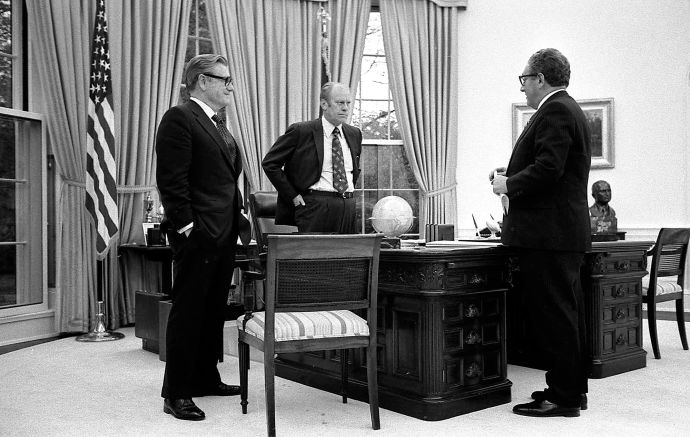
Credit Photograph by David Hume Kennerly/White House via AP

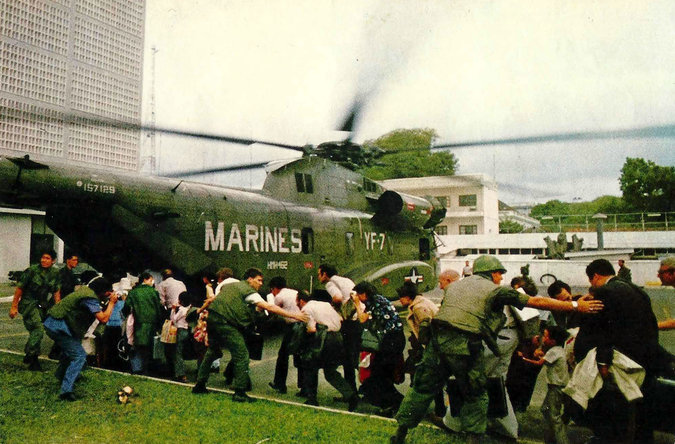
Credit Photograph by David Hume Kennerly/White House via AP


Obama and the Fall of Saigon

By

The New Yorker    September 10, 2014

Almost forty years ago, in April of 1975, as the North Vietnamese Army was sweeping through South Vietnam toward Saigon, President Gerald Ford addressed a joint session of Congress. He asked for seven hundred and twenty-two million dollars in emergency military assistance for the government of South Vietnam. He invoked the dire risk faced by tens of thousands of South Vietnamese, including those affiliated with the United States. In “Last Days in Vietnam,” Rory Kennedy’s gripping new documentary about the fall of South Vietnam and the chaotic U.S. evacuation, Henry Kissinger, who was the Secretary of State, says of Ford, “He had two major concerns. The first was to save as many people as we could. He cared for the human beings involved—that they were not just pawns and, once they had lost their military power, they were abandoned. The second was the honor of America—that we would not be seen at the final agony of South Vietnam as having stabbed it in the back.”

It’s a little jarring to hear Kissinger distance himself on moral grounds from using human beings as pawns. His and Richard Nixon’s policy in Southeast Asia amounted to little more than that: sacrificing untold hundreds of thousands of Vietnamese and Cambodians, as well as thousands of American troops, to bloodless terms like “credibility,” “strategic realignment,” and “peace with honor.” But Kissinger’s account of American efforts during the fall of South Vietnam is accurate: in Washington and in Saigon, officials went to great, though tragically belated, lengths to rescue those Vietnamese associated with the governments of South Vietnam and the United States. “Last Days in Vietnam” will unsettle many of your fixed ideas about the end of the war. (For example, the film raises the possibility that, had Nixon not resigned over Watergate, nine months before the fall of Saigon, the North Vietnamese wouldn’t have invaded the South so readily, because they regarded Nixon as a madman capable of anything.)

In the long view of history, the war was unwinnable. As Neil Sheehan’s masterpiece “A Bright Shining Lie” shows, it was a war of Vietnamese nationalism, and the French and American interventions were seen by most Vietnamese as last stands of colonialism rather than as Cold War imperatives. By that April, two years after the signing of the Paris Peace Accords and the withdrawal of the last American combat forces, most people back home didn’t want to hear the name of the country where, in twelve years, almost sixty thousand U.S. troops had died. Congress, reflecting that exhaustion, voted down Ford’s emergency request (which would only have postponed defeat). Hearing the news, the mild-mannered President cursed, “The sons of bitches!” The fall of Saigon was just days away.

“Last Days in Vietnam” is full of dramatic tales illustrated by vivid archival footage. With no space for a landing, a South Vietnamese pilot drops his family out of his transport helicopter, onto the deck of an offshore American Navy vessel, then dives into the South China Sea and saves himself as the chopper crashes into the waves. A Vietnamese student named Binh Po buys and talks his way onto the grounds of the U.S. Embassy in Saigon, joining ten thousand other desperate people, only to wind up among the four hundred and twenty left behind when an order from President Ford ends the evacuation prematurely and the last Marine chopper takes off. (Binh Po spent a year in a Communist reëducation camp before escaping from Vietnam by boat, in 1979.) Marine Sergeant Mike Sullivan and other Embassy guards, without orders, take it upon themselves to make sure that the Vietnamese they know personally—tailors, cooks, dishwashers, and their families—make it out on the Chinooks. As North Vietnamese tank divisions roll toward Saigon, individual Americans break official rules and risk their lives to get as many of the Vietnamese who worked with Americans as they can to safety, along with their families—an inspiring example of moral heroism in the final days of a war best known for its mistakes, crimes, and sheer waste.

At the same time, the evacuation was a disaster. Ambassador Graham Martin, a rigid Cold Warrior out of “The Quiet American,” refused to believe that Saigon was about to fall, and wouldn’t allow fixed-wing air evacuations from the Tan Son Nhut airbase while it remained out of North Vietnamese hands. The result of Martin’s delusion was the frantic helo lifts from the Embassy grounds, the last and worst option, too little and too late, which left tens of thousands of our Vietnamese allies behind to suffer the brutality of the North. Yet even Martin, who lost his only son in the war, emerges, more ambiguously, as a conscientious diplomat at the last hour, postponing his own evacuation long enough to get thousands of Vietnamese out.

Army Captain Stuart Herrington, one of the heroes of the evacuation, had to lie to the Vietnamese left behind at the Embassy, telling them that a big chopper was on the way, then sneak away to board the last flight off the roof. Still haunted, he speaks for the film: “The end of April of 1975 was the whole Vietnamese involvement in a microcosm. Promises made in good faith, promises broken, people being hurt because we didn’t get our act together. The whole Vietnamese war is a story that kind of sounds like that. But, on the other hand, sometimes there are moments when good people have to rise to the occasion and do the things that need to be done, and in Saigon there was no shortage of people like that.”

Back in 2007, when I started writing about the betrayal of Iraqis associated with America in Iraq, I spoke with two of the men featured in “Last Days in Vietnam”: Frank Snepp, the chief C.I.A. analyst in Saigon and the author of “Decent Interval,” an account of that period; and Richard Armitage, a naval officer, who returned to Vietnam as a civilian defense official and ended up bringing twenty thousand Vietnamese out on boats. Hearing their stories, I thought that the analogies with Iraq were obvious—willful blindness at the highest levels, no plan for rescuing Iraqis—but the differences were even sharper. The Vietnam-era Americans came off much better. With a few exceptions, it was hardly possible to imagine Embassy officials or troops in Baghdad taking great risks to get their Iraqi contacts out before we left. Relationships with Iraqis were much more distant, and Americans much more isolated, owing to security restrictions and other factors. Above all, in Baghdad there was a pervasive air of deskbound caution, buck-passing, and ass-covering, in contrast with the Wild West atmosphere that broke out, for better and for worse, in Saigon in April of 1975. It was all too easy for Americans in Iraq not to know what they didn’t want to know.

On Wednesday night, President Obama will speak to the country about his strategy for fighting the Islamic State in Iraq and al-Sham. I wonder if he’ll have a chance to see “Last Days in Vietnam,” which opened on Friday. He would probably be struck by the historical irony that, like Ford, he must try to explain to Congress and a weary, sour public why the U.S. should get involved again in a far-off, supposedly concluded war that most Americans now view as a waste.

This is a speech that Obama, even more than Ford, never wanted to give. He ran for reëlection, in part, on having fulfilled a promise to end the war in Iraq—always the previous Administration’s war. His eagerness to be rid of the albatross of Iraq played no small part in clearing the way for ISIS to take a third of the country, including Mosul, and to threaten Baghdad and Erbil.

All the more reason to give the President credit (though his political enemies never will) for his willingness, however reluctant, to turn around and face the catastrophe unfolding in Iraq and Syria. Wednesday’s speech will no doubt nod toward staying out (no boots on the ground, no new “American war”), even as it makes the case for going back in (air strikes, international coalitions, the moral and strategic imperative to defeat ISIS). This is the sort of balancing act that Obama speeches specialize in. But he also needs to tell the country bluntly that there will almost certainly be more American casualties, and that the struggle against ISIS—against radical Islam generally, but especially in this case—will be difficult, with no quick military solution and no end in sight. Otherwise, he’ll have brought the public and Congress on board without levelling with them, a pattern set in Vietnam and repeated in Iraq, with unhappy consequences.

By the time Ford gave his speech, that war was lost, and seven hundred and twenty-two million dollars couldn’t have done what billions of dollars and half a million American troops hadn’t—though the end game, as Kennedy’s film compellingly shows, was a last unnecessary fiasco. But the Iraq War never ended, except in the minds of most Americans. Unlike Vietnam, ISIS is an irreconcilable enemy and a metastasizing threat. We Americans want to wake up as fast as possible from our historical nightmares, whatever the cost to other people. It’s human nature. Unfortunately, this one still requires our attention.

George Packer became a staff writer in 2003. For the magazine, he has covered the Iraq War, and has also written about the atrocities committed in Sierra Leone, civil unrest in the Ivory Coast, the megacity of Lagos, and the global counterinsurgency. In 2003, two of his New Yorker articles won Overseas Press Club awards—one for his examination of the difficulties faced during the occupation and reconstruction of Iraq, and one for his coverage of the civil war in Sierra Leone. His book “The Assassins’ Gate: America in Iraq” was named one of the ten best books of 2005 by the New York Times and won the New York Public Library’s Helen Bernstein Book Award and an Overseas Press Club book award. He is also the author of “The Village of Waiting,” about his experience as a Peace Corps volunteer in Africa, and “Blood of the Liberals,” a three-generational nonfiction history of his family and American liberalism in the twentieth century, which won the Robert F. Kennedy Book Award; in addition, he has written two novels, “The Half Man” and “Central Square.” He has contributed numerous articles, essays, and reviews to the New York Times Magazine, Dissent, Mother Jones, Harpers, and other publications. He was a Guggenheim Fellow in 2001-02, and has taught writing at Harvard, Bennington, and Columbia. His most recent book is “The Unwinding: An Inner History of the New America.”

Read Full Post »

ast Days in Vietnam Civilians evacuating ahead of Communist troops about to enter Saigon in this documentary opening Friday. Credit Juan Valdez/American Experience Films, WGBH

Last Days in Vietnam Civilians evacuating ahead of Communist troops about to enter Saigon in this documentary opening Friday. Credit Juan Valdez/American Experience Films, WGBH


Witnesses to the Collapse
‘Last Days in Vietnam’ Looks at Fall of Saigon
By A. O. SCOTT    

The New York Times  September 4, 2014
Perhaps the most striking thing about “Last Days in Vietnam,” Rory Kennedy’s eye-opening documentary about the 1975 evacuation of the American Embassy in Saigon, is how calmly it surveys what was once among the angriest topics in American political life. The story is full of emotion and danger, heroism and treachery, but it is told in a mood of rueful retrospect rather than simmering partisan rage. Ms. Kennedy, whose uncle John F. Kennedy expanded American involvement in Vietnam and whose father, Robert F. Kennedy, became one of the ensuing war’s most passionate critics, explores its final episode with an open mind and lively curiosity. There are old clips that have never been widely seen and pieces of information that may surprise many viewers.
Pictures, moving and still, have always been part of the American collective memory of Vietnam. The fall of Saigon conjures up the image of a helicopter on a rooftop as desperate people try to climb aboard. One thing I learned from “Last Days in Vietnam” is that it was not the roof of the embassy, as is sometimes assumed, but of the building where the C.I.A. station chief lived, in another part of the city. What happened at the embassy — and in the waters off the coast of Saigon — was desperate and dramatic and much more complicated.

1
The Paris Peace Accords of 1973 had provisionally maintained the partition of Vietnam into North and South. As soon as the American forces were gone, the Communist North began to unify the country by force, sweeping quickly through Da Nang and other Southern cities and closing in on Saigon by April of 1975. For tangled reasons that Ms. Kennedy and her interview sources manage to clarify impressively, plans for evacuation were delayed until the 11th hour. Thousands of Vietnamese who had loyally served the American cause and the South Vietnamese government were in imminent danger, and “Last Days in Vietnam” is largely a chronicle of efforts to get them and their families out.


 Evacuees board a helicopter. Credit Bettmann, Corbis/American Experience Films

Evacuees board a helicopter. Credit Bettmann, Corbis/American Experience Films

The narrators are an assortment of American and Vietnamese men who witnessed the events firsthand, and whose accounts are deftly woven into a conciseand gripping film. Some are well known, like Henry A. Kissinger, the secretary of state and national security adviser at the time, and Richard L. Armitage, who went on to serve in the State Department in the administration of George W. Bush. At the time, he was a naval officer, and he remains a natural-born storyteller with a gruff sense of humor and a vivid sense of detail. Hour-by-hour accounts of the airlifts that brought thousands of people from the embassy to American ships are provided by embassy guards, journalists and military personnel. We hear from residents of Saigon who made it out, and also from some who didn’t.
The central figure in the drama is the American ambassador, Graham Martin, who died in 1990 and could not be interviewed for “Last Days in Vietnam.” That is unfortunate, but the portrait that emerges from archival news footage and the memories of others is fascinating in its ambiguity. As the North Vietnamese armies routed the Southern forces, he refused to plan an exit strategy, believing in the face of overwhelming evidence that South Vietnam would survive.

 The crew members aboard the U.S.S. Kirk signal an arriving helicopter to send its passengers out, on April 29, 1975. Credit Hugh Doyle/American Experience Films

The crew members aboard the U.S.S. Kirk signal an arriving helicopter to send its passengers out, on April 29, 1975. Credit Hugh Doyle/American Experience Films

This almost delusional stubbornness — which Ms. Kennedy’s interviewees still marvel at 40 years later — revealed another side as the Communist capture of Saigon (now Ho Chi Minh City) drew near. Defying prudent advice and at some risk to his own safety, Ambassador Martin delayed his own departure from the embassy for as long as he could, so that as many Vietnamese as possible could escape.
Not that this is a story with a happy ending. What followed was brutality and repression on the part of the victors, and a refugee crisis among their victims. Now that so much time has passed, and relations between the United States and Vietnam have normalized, it might have been good to hear a voice or two from the other side, to learn what was going through the minds of the soldiers entering Saigon as the Americans left. But this omission does not diminish what Ms. Kennedy has accomplished, which is fairly and compassionately to reconstruct a messy episode in history.


Read Full Post »

50 Years Ago Congress Gave the President a Blank Check for War 

by Leonard Steinhorn

HNN August 3, 2014


Walt Rostow showing LBJ a map of Khe Sanh in 1968


Fifty years ago, on August 10, 1964, President Lyndon Johnson signed what is known as the Gulf of Tonkin Resolution. It is a day that should live in infamy.

On that day, the President gave himself the power “to take all necessary steps, including the use of armed forces,” to fight the spread of communism in Southeast Asia and assist our ally in South Vietnam “in defense of its freedom.”

Or as former Secretary of Defense Robert McNamara put it decades later, it gave “complete authority to the president to take the nation to war.”

History has shown that the resolution was built on a foundation of misinformation, fabrication, and willful evasion of the truth. Contrary to what the President claimed, there was no unprovoked “act of aggression” against the American  destroyers that were patrolling the Tonkin Gulf, and a second alleged incident never even took place.

But the Johnson administration was looking for a pretext to escalate the war. “We don’t know what happened,” National Security Adviser Walter W. Rostow told the president after Congress passed the resolution, “but it had the desired result.”

The Gulf of Tonkin Resolution may have had the desired result, but the war it unleashed didn’t.

By the time Lyndon Johnson left office more than four years later, we had amassed over half a million troops in Vietnam, lost nearly 37,000 soldiers, dropped more bomb tonnage than we had in all of World War II, released chemical weapons – Napalm and Agent Orange – throughout Southeast Asia, and burned thousands of South Vietnamese homes and villages to the ground.

Yet it was increasingly clear by then that we could not win the war.

Rather than stopping any dominoes from falling in Southeast Asia, the Gulf of Tonkin Resolution set in motion a series of dominoes in our own country  that would profoundly alter our politics, economy, and culture for years to come.

Perhaps the most significant decision President Johnson made beyond using his newly authorized power to escalate the war was to hide the cost of the war and resist any tax increase to pay for it. Johnson feared that any congressional debate over funding the war would come at the expense of his Great Society program.

He wanted both guns and butter, but he worried that Congress would choose guns over butter. So once again he resorted to obfuscation and deception to get his way.

What resulted was a cascading series of economic  consequences that would transform our nation and undermine the Great Society he so dearly wanted to protect.

To pay for the war without gutting his robust domestic agenda, Johnson resorted to deficit spending which fueled an already overheating economy that was now being asked to divert its productivity away from consumer goods and toward the war effort.

Consumer demand began to outstrip supply, and that let the inflation genie out of the bottle. Less than five years after the Gulf of Tonkin Resolution passed, inflation more than quadrupled.

Johnson couldn’t hide the rising cost of the war for long, and by 1968 he asked for a 10 percent tax surcharge on all but the poorest Americans. But it came at a cost: Congress demanded, and he had to accept, a 10 percent reduction in domestic discretionary spending. Barely three years after birthing the Great Society, he began to starve it to pay for the war. It never fully recovered.

To middle and working class Americans, the backbone of the New Deal coalition, the war’s economic impact was taking a toll. Though inflation meant pay raises once a year, prices for food and consumer goods were rising every month which then ate away at any increase in their wages.

Their standard of living began to stagnate. Nor were taxes indexed to inflation in those years, so every pay increase risked pushing them into a higher tax bracket, which took even more money from their pockets in addition to the tax surcharge they would have to pay.

These were largely Democratic voters who generally supported the president and the war – many had their own boys fighting in Vietnam – so if they were looking for blame they weren’t about to point the finger at a deceptive and misguided war policy.

Instead, they saw higher taxes, higher domestic spending, and lots of fanfare for a Great Society that didn’t seem to include them. They also saw domestic unrest and urban riots.

To them, they were hard-working Americans who played by the rules yet were now forced to tread water just to keep from falling behind while government seemed to be giving everything away to the poor. That domestic programs themselves were getting squeezed by the war was a detail that got lost in the heat of the moment.

Couple these growing resentments with the fact that it was their boys, not the children of the well-educated, who were being sent off to war. From their perspective, the liberal elites were taxing them to coddle the poor, yet when it came to defending our nation these same liberal elites sheltered their sons in colleges and universities.

Those seeking to understand the rise of Reagan Democrats and white working class Republican populists – and the corresponding demise of the New Deal majority – need look no further. The cultural and political divide that began in the Sixties was a direct result of the deceit that brought us the Vietnam War.

And what was then a still fragile liberal consensus that government could mitigate the hardships of poverty – a consensus that enabled passage of the Great Society legislation – began to erode.

That an administration could dissemble us into war would lead to another cultural and political repercussion of Vietnam: our growing and seemingly permanent distrust of government.

Trust in government peaked at 76 percent in 1964, not coincidentally the same year as the Gulf of Tonkin Resolution, and declined precipitously in the years thereafter, reaching what was then a low of 25 percent in 1980, according to the University of Michigan’s National Election Studies.

Not all of this decline is due to Vietnam, but a war built on the original sin of deception, fiction, and illusion deserves a good deal of the blame.

Almost daily, Americans were treated to an official  version of the war that had us winning. The  Johnson administration trumpeted body counts and bombing raids and assured us, in the famous words of General William Westmoreland, that there was “light at the end of the tunnel.”

But there was no light. The dark reality we saw every night on television contradicted what our leaders were telling us. We saw bloodied soldiers, troops burning villages, body bags, fear and despair and little of the triumphalism that was emanating from the Pentagon.

When the Vietcong launched their Tet Offensive in  January 1968, striking at the U.S. Embassy and other key sites in the heart of Saigon, Americans had a hard time reconciling the official version with what they were witnessing.

Thus was born the credibility gap between the American government and its citizens.

And nowhere did it grow wider than among journalists, who were greeted with untruths during the daily military briefings in Vietnam – known as the Five O’clock Follies – and saw through such euphemisms as “pacification,” which in truth meant torching Vietnamese huts and shooting those who resisted, and “collateral damage,” which in reality meant civilian deaths.

Reflexive skepticism of government remains a defining characteristic of contemporary journalism.

Watergate, which calcified the credibility gap, also grew out of Vietnam when President Richard Nixon authorized his secretive White House Plumbers to retaliate against Daniel Ellsberg, whose leak of the Pentagon Papers laid bare the duplicity behind the Gulf of Tonkin Resolution and the U.S. prosecution of the war.

Years later Senator Wayne Morse of Oregon, one of two who voted against the Gulf of Tonkin Resolution, told Ellsberg that if members of Congress had seen the evidence from the Pentagon Papers in 1964, “the Tonkin Gulf Resolution would never have gotten out of committee, and if it had been brought to the floor, it would have been voted down.”

What Lyndon Johnson saw as a ploy to grant him war powers ended up harming so many and transforming our nation in ways the President surely never intended. It would end up engulfing the liberalism he so loved. The Gulf of Tonkin Resolution and the hubris behind it were the linchpins of Johnson’s Shakespearean Vietnam tragedy – and ours as well.

Leonard Steinhorn is a professor of communication and affiliate professor of history at American University, where he teaches politics, strategic communication, and courses on the presidency and recent American history. He is the author of the much discussed book on baby boomers, The Greater Generation: In Defense of the Baby Boom Legacy, and co-author of the critically acclaimed By the Color of Our Skin: The Illusion of Integration and The Reality of Race.

Read Full Post »

hnn-logo-new

No End of a lesson- Unlearned

William R. Polk

HNN June 15, 2014

America appears once again to be on the brink of a war. This time the war is likely to be in Syria and/or in Iraq. If we jump into one or both of these wars, they will join, by my count since our independence, about 200 significant military operations (not all of which were legally «wars») as well as countless «proactive» interventions, regime-change undertakings, covert action schemes and search-and-destroy missions. In addition the United States has provided weapons, training and funding for a variety of non-American military and quasi-military forces throughout the world. Within recent months we have added five new African countries. History and contemporary events show that we Americans are a warring people.

So we should ask: what have we learned about ourselves, our adversaries and the process in which we have engaged?

The short answer appears to be «very little.»

As both a historian and a former policy planner for the American government, I will very briefly here (as I have mentioned in a previous essay, I am in the final stages of a book to be called A Warring People, on these issues), illustrate what I mean by «very little.»

I begin with us, the American people. There is overwhelming historical evidence that war is popular with us. Politicians from our earliest days as a republic, indeed even before when we were British colonies, could nearly always count on gaining popularity by demonstrating our valor. Few successful politicians were pacifists.

Even supposed pacifists found reasons to engage in the use of force. Take the man most often cited as a peacemaker or at least a peaceseeker, Woodrow Wilson. He promised to «keep us out of war,» by which he meant keeping us out of big, expensive European war. Before becoming president, however, he approved the American conquest of Cuba and the Philippines and described himself as an imperialist; then, as president, he occupied Haiti, sent the Marines into the Dominican Republic and ordered the Cavalry into Mexico. In 1918, he also put American troops into Russia. Not only sending soldiers: his administration carried out naval blockades, economic sanctions, covert operations — one of which, allegedly, involved an assassination attempt on a foreign leader — and furnished large-scale arms supplies to insurgents in on-going wars.

The purpose, and explanation, of our wars varied. I think most of us would agree that our Revolution, the First World War and the Second World War were completely justified. Probably Korea was also. The United States had no choice on the Civil war or, perhaps, on the War of 1812. Many, particularly those against the Native Americans would today be classified as war crimes. It is the middle range that seem to me to be the most important to understand. I see them like this.

Some military ventures were really misadventures in the sense that they were based on misunderstandings or deliberate misinformation. I think that most students of history would put the Spanish-American, Vietnamese, Iraqi and a few other conflicts in this category. Our government lied to us — the Spaniards did not blow up the Maine; the Gulf of Tonkin was not a dastardly attack on our innocent ships and Iraq was not about to attack us with a nuclear weapon, which it did not have.

But we citizens listened uncritically. We did not demand the facts. It is hard to avoid the charge that we were either complicit, lazy or ignorant. We did not hold our government to account.

Several war and other forms of intervention were for supposed local or regional requirements of the Cold War. We knowingly told one another that the «domino theory» was reality: so a hint of Communist subversion or even criticism of us sent us racing off to protect almost any form of political association that pretended to be on our side. And we believed or feared that even countries that had little or no connections with one another would topple at the touch — or even before their neighbors appeared to be in trouble. Therefore, regardless of their domestic political style, monarchy, dictatorship. democracy., it mattered not, they had to be protected. Our protection often included threats of invasion, actual intervention, paramilitary operations, subversion and/or bribery, justified by our proclaimed intent to keep them free. Or at least free from Soviet control. Included among them were Guatemala, Nicaragua, Brazil, Chile, Italy, Greece, Syria, Lebanon, Iran, Indonesia, Vietnam and various African countries.

Some interventions were for acquisition of their resources or protection of our economic assets. Guatemala, Chile, Iraq, Iran and Indonesia come to mind.

Few, if any, were to establish the basis of peace or even to bring about ceasefires. Those tasks we usually left to the United Nations or regional associations.

The costs have been high. Just counting recent interventions, they have cost us well over a hundred thousand casualties and some multiple of that in wounded; they have cost «the others» — both our enemies and our friends — large multiples of those numbers. The monetary cost is perhaps beyond counting both to them and to us. Figures range upward from $10 trillion.

The rate of success of these aspects of our foreign policy, even in the Nineteenth century, was low. Failure to accomplish the desired or professed outcome is shown by the fact that within a few years of the American intervention, the condition that had led to the intervention recurred. The rate of failure has dramatically increased in recent years. This is because we are operating in a world that is increasingly politically sensitive. Today even poor, weak, uneducated and corrupt nations become focused by the actions of foreigners. Whereas before, a few members of the native elite made the decisions, today we face «fronts.» parties, tribes and independent opinion leaders. So the «window of opportunity» for foreign intervention, once at least occasionally partly open, is now often shut.

Delta Force of Task Force 20 alongside troops of 3rd Battalion, 327th Infantry Regiment, at Uday Hussain and Qusay Hussein’s hideout (Wikipedia)

I will briefly focus on five aspects of this transformation:

First, nationalism has been and remains the predominant way of political thought of most of the world’s people. Its power has long been strong (even when we called it by other names) but it began to be amplified and focused by Communism in the late Nineteenth century. Today, nationalism in Africa, much of Asia and parts of Europe is increasingly magnified by the rebirth of Islam in the salafiyah movement.

Attempts to crush these nationalist-ideological-religious-cultural movements militarily have generally failed. Even when, or indeed especially when, foreigners arrive on the scene, natives put aside their mutual hostilities to unite against them. We saw this particularly vividly and painfully in Somalia. The Russians saw it in Çeçnaya and the Chinese, among the Uyghur peoples of Xinjiang (former Chinese Turkistan).

Second, outside intervention has usually weakened moderate or conservative forces or tendencies within each movement. Those espousing the most extreme positions are less likely to be suborned or defeated than the moderates. Thus particularly in a protracted hostilities, are more likely to take charge than their rivals. We have seen this tendency in each of the guerrilla wars in which we got involved; for the situation today, look at the insurgent movements in Syria and Iraq. (For my analysis of the philosophy and strategy of the Muslim extremists, see my essay «Sayyid Qutub’s Fundamentalism and Abu Bakr Naji’s Jihadism» on my website.)

What is true of the movements is even more evident in the effects on civic institutions and practices within an embattled society. In times of acute national danger, the «center» does not hold. Centrists get caught between the insurgents and the regimes. Insurgents have to destroy their relationship to society and government if they are to «win.» Thus, in Vietnam for example, doctors and teachers, who interfaced between government and the general population were prime targets for the Vietminh in the 1950s.

And, as the leaders of governments against whom the insurgents are fighting become more desperate, they suppress those of their perceived rivals or critics they can reach. By default, these people are civilians who are active in the political parties, the media and the judiciary . And, as their hold on power erodes and «victory» becomes less likely, regimes also seek to create for themselves safe havens by stealing money and sending it abroad. Thus, the institutions of government are weakened and the range of enemies widens. We have witnessed these two aspects of «corruption» — both political and economic — in a number of countries. Recent examples are Vietnam and Afghanistan.

In Vietnam at least by 1962 the senior members of the regime had essentially given up the fight. Even then they were preparing to bolt the country. And the army commanders were focused on earning money that they sold the bullets and guns we gave them to the Vietminh. In Afghanistan, the regime’s involvement in the drug trade, its draining of the national treasury into foreign private bank accounts (as even Mr. Karzai admitted) and in «pickpocketing» hundreds of millions of dollars from aid projects is well documented.  (See the monthly reports of the American Special Inspector General for Afghan Reconstruction.)

Third, our institutional memory of programs, events and trends is shallow. I suggest that it usually is no longer than a decade. Thus, we repeat policies even when the record clearly shows that they did not work when previously tried. And we address each challenge as though it is unprecedented. We forget the American folk saying that when you find yourself in a hole, the best course of action is to stop digging. it isn’t only that our government (and the thousands of «experts,» tacticians and strategists it hires) do not «remember» but also that they have at hand only one convenient tool — the shovel. What did we learn from Vietnam? Get a bigger, sharper shovel.

Fourth, despite or perhaps in part because of our immigrant origins, we are a profoundly insular people. Few of us have much appreciation of non-American cultures and even less fellow feeling for them. Within a generation or so, few immigrants can even speak the language of their grand parents. Many of us are ashamed of our ethnic origins.

Thus, for example, at the end of the Second World War, despite many of us being of German or Italian or Japanese cultural background, we were markedly deficient in people who could help implement our policies in those countries. We literally threw away the language and culture of grandparents. A few years later, when I began to study Arabic, there were said to be only five Americans not of Arab origin who knew the language. Beyond language, grasp of the broader range of culture petered off to near zero. Today, after the expenditure of significant government subsidies to universities (in the National Defense Education Act) to teach «strategic» languages, the situation should be better. But, while we now know much more, I doubt that we understand other peoples much better.

If this is true of language, it is more true of more complex aspects of cultural heritage. Take Somalia as an example. Somalia was not, as the media put it, a «failed state»; it was and is a «non-state.» That is, the Somalis do not base their effective identify as members of a nation state. Like almost everyone in the world did before recent centuries, they thought of themselves as members of clans, tribes, ethnic or religious assemblies or territories. It is we, not they, who have redefined political identity. We forget that the nation-state is a concept that was born in Europe only a few centuries ago and became accepted only late in the Nineteenth century in Germany and Italy. For the Somalis, it is still an alien construct. So, not surprisingly, our attempt to force them or entice them to shape up and act within our definition of statehood has not worked. And Somalia is not alone. And not only in Africa. Former Yugoslavia is a prime example: to be ‘balkanized’ has entered our language. And, if we peek under the flags of Indonesia, Burma, Pakistan, Afghanistan, Iraq, the Congo, Mali, the Sudan and other nation-states we find powerful forces of separate ethnic nationalisms.

The effects of relations among many of the peoples of Asia and Africa and some of the Latin Americans have created new political and social configurations and imbalances within and among them. With European and American help the governments with which we deal have acquired more effective tools of repression. They can usually defeat the challenges of traditional groups. But, not always. Where they do not acquire legitimacy in the eyes of significant groups — «nations» — states risk debilitating, long-term struggles. These struggles are, in part, the result of the long years of imperial rule and colonial settlement. Since Roman times, foreign rulers have sought to cut expenses by governing through local proxies. Thus, the British turned over to the Copts the unpopular task of colleting Egyptian taxes and to the Assyrians the assignment of controlling the Iraqi Sunnis. The echo of these years is what we observe in much of the «Third World» today. Ethnic, religious and economic jealousies abound and the wounds of imperialism and colonialism have rarely completely healed. We may not be sensitive to them, but to natives they may remain painful. Americans may be the «new boys on the block,» but these memories have often been transferred to us.

Finally, fifth, as the preeminent nation-state America has a vast reach. There is practically no area of the world in which we do not have one sort of interest or another. We have over a thousand military bases in more than a hundred countries; we trade, buy and sell, manufacture or give away goods and money all over Latin America, Africa, Asia and Europe. We train, equip and subsidize dozens of armies and even more paramilitary or «Special» forces. This diversity is, obviously, a source of strength and richness, but, less obviously, it generates conflicts between what we wish to accomplish in one country and what we think we need to accomplish in another. At the very least, handling or balancing our diverse aims within acceptable means and at a reasonable cost is a challenge.

It is a challenge that we seem less and less able to meet.

Take Iraq as an example. As a corollary of our hostility to Saddam Husain, we essentially turned Iraq over to his enemies, the Iraqi Shia Muslim. (I deal with this in my Understanding Iraq, New York: HarperCollins, 2005, 171 ff.) There was some justification for this policy. The Shia community has long been Iraq’s majority and because they were Saddam’s enemies, some «experts» naively thought they would become our friends. But immediately two negative aspects of our policy became evident: non-specialists: first, the Shiis took vengeance on the Sunni Muslim community and so threw the country into a vicious civil war. What we called pacification amounted to ethnic cleansing. And, second, the Shia Iraqi leaders (the marjiaah) made common cause with coreligionist Iranians with whom we were nearly at war all during the second Bush administration. Had war with Iran eventuated, our troops in Iraq would have been more hostages than occupiers. At several points, we had the opportunity to form a more coherent, moral and safer policy. I don’t see evidence that our government or our occupation civil and military authorities even grasped the problem; certainly they did not find ways to work toward a solution. Whatever else may be said about it, our policy was dysfunctional.

I deserve to be challenged on this statement: I am measuring (with perhaps now somewhat weakened hindsight) recent failures against what we tried to do in the Policy Planning Council in the early 1960s. If our objective is, as we identify it, to make the world at least safe, even if not safe for democracy, we are much worse off today than we were then. We policy planners surely then made many significant mistakes (and were often not heeded), but I would argue that we worked within a more coherent framework than our government does today. Increasingly, it seems to me that we are in a mode of leaping from one crisis to the next without having understood the first or anticipating the second. I see no strategic concept; only tactical jumps and jabs.

So what to do?

At the time of the writing of the American Constitution, one of our Founding Fathers, Gouverneur Morris, remarked that part of the task he and others of the authors put it, was “to save the people from their most dangerous enemy, themselves.” Translated to our times, this is to guard against our being «gun slingers.» All the delegates were frightened by militarism and sought to do the absolute minimum required to protect the country from attack. They refused the government permission to engage in armed actions against foreigners except in defense. I believe they would have been horrified, if they could have conceived it, by the national security state we have become. They certainly did not look to the military to solve problems of policy. They would have agreed, I feel sure, that very few of the problem we face in the world today could be solved by military means So, even when we decide to employ military means, we need to consider not only the immediate but the long-term effects of our actions. We have, at least, the experience and the intellectual tools to do so. So why have we not?

We have been frequently misled by the success of our postwar policies toward both Germany and Japan. We successfully helped those two countries to embark upon a new era. And, during the employment of the Truman Doctrine in Greece, the civil war there ended. There were special reasons for all three being exceptions. Perhaps consequent to those successes, when we decided to destroy the regimes of Saddam Husain and Muammar Qaddafi, we gave little thought of what would follow. We more or less just assumed that things would get better. They did not. The societies imploded. Had we similarly gone into Iran, the results would have been a moral, legal and economic disaster. Now we know — or should know — that unless the risk is justified, as our Constitution demands it be by an imminent armed attack on the United States, we should not make proactive war on foreign nations. We have sworn not to do so in the treaty by which we joined the United Nations. In short, we need to be law abiding, and we should look before we leap.

Our ability to do any of these things will depend on several decisions.

The first is to be realistic: there is no switch we can flip to change our capacities. To look for quick and easy solutions is part of the problem, not part of the solution.

The second is a matter of will and the costs and penalties that attach to it. We would be more careful in foreign adventures if we had to pay for them in both blood and treasure as they occurred. That is, «in real time.» We now avoid this by borrowing money abroad and by inducing or bribing vulnerable members of our society and foreigners to fight for us.. All our young men and women should know that they will be obliged to serve if we get into war, and we should not be able to defer to future generations the costs of our ventures. We should agree to pay for them through immediate taxes rather than foreign loans.

The third is to demand accountability. Our government should be legally obligated to tell us the truth. If it does not, the responsible officials should be prosecuted in our courts and, if they violate our treaties or international law, they should have to come before the World Court of Justice. We now let them off scot-free. The only «culprits» are those who carry out their orders.

Fourth, in the longer term, the only answer to the desire for better policy is better public education. For a democracy to function, its citizens must be engaged. They cannot be usefully engaged if they are not informed. Yet few Americans know even our own laws on our role in world affairs. Probably even fewer know the history of our actions abroad — that is, what we have done in the past with what results and at what cost.

And as a people we are woefully ignorant about other peoples and countries. Polls indicate that few Americans even know the locations of other nations. The saying that God created war to teach Americans geography is sacrilegious. If this was God’s purpose, He failed. And beyond geography, concerning other people’s politics, cultures and traditions, there is a nearly blank page. Isn’t it time we picked up the attempt made by such men as Sumner Wells (with his An Intelligent American’s Guide to the Peace and his American Foreign Policy Library), Robert Hutchins, James Conant and others (with the General Education programs in colleges and universities) and various other failed efforts to make us a part of humanity?

On the surface, at least, resurrecting these programs is just a matter of (a small amount of) money. But results won’t come overnight. Our education system is stogy, our teachers are poorly trained and poorly paid, and we, the consumers, are distracted by quicker, easier gratifications than learning about world affairs. I had hoped that we would learn from the «real schools» of Vietnam and other failures, but we did not. The snippets of information which pass over our heads each day do not and cannot make a coherent pattern. Absent a matrix into which to place «news,» it is meaningless. I have suggested in a previous essay that we are in a situation like a computer without a program. We get the noise, but without a means to «read» it, it is just gibberish.

Our biggest challenge therefore comes down to us: unless or until we find a better system of teaching, of becoming aware that we need to learn and a desire to acquire the tools of citizenship, we cannot hope to move toward a safer, more enriching future.

This is a long-term task.

We had better get started.

William R. Polk was a professor of history at the University of Chicago. During the Kennedy and part of the Johnson administrations, he was the member of the Policy Planning Council responsible for North Africa, the Middle East and Central Asia. Among his books are «Understanding Iraq, Violent Politics and Understanding Iran.» He is vice chairman of the W.P. Carey Foundation

Read Full Post »

Forty-six years ago, in January 1966, Jonathan Schell, a 23-year-old not-quite-journalist found himself at the farming village of Ben Suc, 30 miles from the South Vietnamese capital, Saigon.  It had long been supportive of the Vietcong.  Now, in what was dubbed Operation Cedar Falls, the U.S. military (with Schell in tow) launched an operation to solve that problem.  The “solution” was typical of how Americans fought the Vietnam War.  All the village’s 3,500 inhabitants were to be removed to a squalid refugee camp and Ben Suc itself simply obliterated — every trace of the place for all time.  Schell’s remarkable and remarkably blunt observations on this grim operation were, no less remarkably, published in the New Yorker magazine and then as a book, causing a stir in a country where anti-war sentiment was growing fast.

In 1967, Schell returned to Vietnam and spent weeks in the northern part of the country watching from the backseats of tiny U.S. forward air control planes as parts of two provinces were quite literally blown away, house by house, village by village, an experience he recalls in today’s TomDispatch post.  From that came another New Yorker piece and then a book, The Military Half, which offered (and still offers) an unmatched journalistic vision of what the Vietnam War looked like.  It was a moment well captured in a mocking song one of the American pilots sang for him after an operation in which he had called in bombs on two Vietnamese churches, but somehow missed the white flag flying in front of them. The relevant stanza went:

“Strafe the town and kill the people,
Drop napalm in the square,
Get out early every Sunday
And catch them at their morning prayer.”

If Afghanistan is the war we somehow haven’t managed to notice most of the time, even while it’s going on, Vietnam was the war Americans couldn’t forget and have never been able to kick, possibly because we never managed to come to grips with just what it was and what we did there. Now, so many years later, in a monumental essay appearing in print in the Nation magazine and online here at TomDispatch, Schell returns (via Nick Turse’s new book, Kill Anything that Moves: The Real American War in Vietnam) to the haunted terrain he last visited so many decades ago All of us, whether we know it or not, still live with the ghosts of that moment. Tom

How Did the Gates of Hell Open in Vietnam? 
A New Book Transforms Our Understanding of What the Vietnam War Actually Was 
By Jonathan Schell

TomDispatch.com  May 4, 2014

For half a century we have been arguing about “the Vietnam War.” Is it possible that we didn’t know what we were talking about? After all that has been written (some 30,000 books and counting), it scarcely seems possible, but such, it turns out, has literally been the case.

Now, in Kill Anything that MovesNick Turse has for the first time put together a comprehensive picture, written with mastery and dignity, of what American forces actually were doing in Vietnam. The findings disclose an almost unspeakable truth.  Meticulously piecing together newly released classified information, court-martial records, Pentagon reports, and firsthand interviews in Vietnam and the United States, as well as contemporaneous press accounts and secondary literature, Turse discovers that episodes of devastation, murder, massacre, rape, and torture once considered isolated atrocities were in fact the norm, adding up to a continuous stream of atrocity, unfolding, year after year, throughout that country.

It has been Turse’s great achievement to see that, thanks to the special character of the war, its prime reality — an accurate overall picture of what physically was occurring on the ground — had never been assembled; that with imagination and years of dogged work this could be done; and that even a half-century after the beginning of the war it still should be done. Turse acknowledges that, even now, not enough is known to present this picture in statistical terms. To be sure, he offers plenty of numbers — for instance the mind-boggling estimates that during the war there were some two million civilians killed and some five million wounded, that the United States flew 3.4 million aircraft sorties, and that it expended 30 billion pounds of munitions, releasing the equivalent in explosive force of 640 Hiroshima bombs.

Yet it would not have been enough to simply accumulate anecdotal evidence of abuses. Therefore, while providing an abundance of firsthand accounts, he has supplemented this approach. Like a fabric, a social reality — a town, a university, a revolution, a war — has a pattern and a texture.  No fact is an island. Each one is rich in implications, which, so to speak, reach out toward the wider area of the surrounding facts. When some of these other facts are confirmed, they begin to reveal the pattern and texture in question.

Turse repeatedly invites us to ask what sort of larger picture each story implies. For example, he writes:

“If one man and his tiny team could claim more KIAs [killed in action] than an entire battalion without raising red flags among superiors; if a brigade commander could up the body count by picking off civilians from his helicopter with impunity; if a top general could institutionalize atrocities through the profligate use of heavy firepower in areas packed with civilians — then what could be expected down the line, especially among heavily armed young infantrymen operating in the field for weeks, angry, tired, and scared, often unable to locate the enemy and yet relentlessly pressed for kills?”

Like a tightening net, the web of stories and reports drawn from myriad sources coalesces into a convincing, inescapable portrait of this war — a portrait that, as an American, you do not wish to see; that, having seen, you wish you could forget, but that you should not forget; and that the facts force you to see and remember and take into account when you ask yourself what the United States has done and been in the last half century, and what it still is doing and still is.

Scorched Earth in I Corps

My angle of vision on these matters is a highly particular one. In early August 1967, I arrived in I Corps, the northernmost district of American military operations in what was then South Vietnam.  I was there to report for the New Yorker on the “air war.” The phrase was a misnomer.  The Vietnamese foe, of course, had no assets in the air in the South, and so there was no “war” of that description.

There was only the unilateral bombardment of the land and people by the fantastic array of aircraft assembled by the United States in Vietnam.  These ranged from the B-52, which laid down a pattern of destruction a mile long and several football fields wide; to fighter bombers capable of dropping, along with much else, 500-pound bombs and canisters of napalm; to the reconfigured DC-3 equipped with a cannon capable of firing 100 rounds per second; to the ubiquitous fleets of helicopters, large and small, that crowded the skies. All this was abetted by continuous artillery fire into “free-fire” zones and naval bombardment from ships just off the coast.

By the time I arrived, the destruction of the villages in the region and the removal of their people to squalid refugee camps was approaching completion. (However, they often returned to their blasted villages, now subject to indiscriminate artillery fire.) Only a few pockets of villages survived. I witnessed the destruction of many of these in Quang Ngai and Quang Tinh provinces from the back seat of small Cessnas called Forward Air Control planes.

As we floated overhead day after day, I would watch long lines of houses burst into flames one after another as troops moved through the area of operation.  In the meantime, the Forward Air Controllers were calling in air strikes as requested by radio from troops on the ground. In past operations, the villagers had been herded out of the area into the camps.  But this time, no evacuation had been ordered, and the population was being subjected to the full fury of a ground and air assault. A rural society was being torn to pieces before my eyes.

The broad results of American actions in I Corps were thus visible and measurable from the air. No scorched earth policy had been announced but scorched earth had been the result.  Still, a huge piece was missing from the puzzle.  I was not able to witness most of the significant operations on the ground firsthand. I sought to interview some soldiers but they would not talk, though one did hint at dark deeds.  “You wouldn’t believe it so I’m not going to tell you,” he said to me. “No one’s ever going to find out about some things, and after this war is over, and we’ve all gone home, no one is ever going to know.”

In other words, like so many reporters in Vietnam, I saw mainly one aspect of one corner of the war.  What I had seen was ghastly, but it was not enough to serve as a basis for generalizations about the conduct of the war as a whole. Just a few years later, in 1969, thanks to the determined efforts of a courageous soldier, Ron Ridenhour, and the persistence of a reporter, Seymour Hersh, one piece of the hidden truth about ground operations in I Corp came to light.

It was the My Lai massacre, in which more than 500 civilians were murdered in cold blood by Charlie Company, 1st Battalion, 20th Infantry, of the Americal Division. In subsequent years, news of other atrocities in the area filtered into the press, often many years after the fact. For example, in 2003 theToledo Blade disclosed a campaign of torture and murder over a period of months, including the summary execution of two blind men by a “reconnaissance” squad called Tiger Force.  Still, no comprehensive picture of the generality of ground operations in the area emerged.

It has not been until the publication of Turse’s book that the everyday reality of which these atrocities were a part has been brought so fully to light. Almost immediately after the American troops arrived in I Corps, a pattern of savagery was established. My Lai, it turns out, was exceptional only in the numbers killed.

Turse offers a massacre at a village called Trieu Ai in October 1967 as a paradigm.  A marine company suffered the loss of a man to a booby trap near the village, which had in fact had been mostly burned down by other American forces a few days earlier.  Some villagers had, however, returned for their belongings. Now, the Marine company, enraged by its loss but unable to find the enemy, entered the village firing their M-16s, setting fire to any intact houses, and tossing grenades into bomb shelters.

A Marine marched a woman into a field and shot her.  Another reported that there were children in the shelters that were being blown up.  His superior replied, “Tough shit, they grow up to be VC [Vietcong].”  Five or ten people rushed out of a shelter when a grenade was thrown into it.  They were cut down in a hail of fire. Turse comments:

“In the story of Trieu Ai one can see virtually the entire war writ small.  Here was the repeated aerial bombing and artillery fire… Here was the deliberate burning of peasant homes and the relocation of villagers to refugee camps… Angry troops primed to lash out, often following losses within the unit; civilians trapped in their paths; and officers in the field issuing ambiguous or illegal orders to young men conditioned to obey — that was the basic recipe for many of the mass killings carried out by army soldiers and marines over the years.”

The savagery often extended to the utmost depravity: gratuitous torture, killing for target practice, slaughter of children and babies, gang rape.  Consider the following all-too-typical actions of Company B, 1st Battalion, 35th infantry beginning in October 1967:

“The company stumbled upon an unarmed young boy.  ‘Someone caught him up on a hill, and they brought him down and the lieutenant asked who wanted to kill him…’ medic Jamie Henry later told army investigators. A radioman and another medic volunteered for the job.  The radioman… ’kicked the boy in the stomach and the medic took him around behind a rock and I heard one magazine go off complete on automatic…’

“A few days after this incident, members of that same unit brutalized an elderly man to the point of collapse and then threw him off a cliff without even knowing whether he was dead or alive…

“A couple of days after that, they used an unarmed man for target practice…

“And less than two weeks later, members of Company B reportedly killed five unarmed women…

“Unit members rattled off a litany of other brutal acts committed by the company… [including] a living woman who had an ear cut off while her baby was thrown to the ground and stomped on…”

Pumping Up the Body Count

Turse’s findings completed the picture of the war in I Corps for me.  Whatever the policy might have been in theory, the reality, on the ground as in the air, was the scorched earth I had witnessed from the Forward Air Control planes. Whatever the United States thought it was doing in I Corps, it was actuallywaging systematic war against the people of the region.

And so it was, as Turse voluminously documents, throughout the country.  Details differed from area to area but the broad picture was the same as the one in I Corps. A case in point is the war in the Mekong Delta, home to some five to six million people in an area of less than 15,000 square miles laced with rivers and canals. In February 1968, General Julian Ewell, soon to be known by Vietnamese and Americans alike as “the Butcher of the Delta,” was placed in charge of the 9th Infantry Division.

In December 1968, he launched Operation Speedy Express. His specialty, amounting to obsession, was increasing “the body count,” ordained by the high command as the key measure of progress in defeating the enemy. Theoretically, only slain soldiers were to be included in that count but — as anyone, soldier or reporter, who spent a half-hour in the field quickly learned — virtually all slain Vietnamese, most of them clearly civilians, were included in the total.  The higher an officer’s body count, the more likely his promotion. Privates who turned in high counts were rewarded with mini-vacations. Ewell set out to increase the ratio of supposed enemy soldiers killed to American soldiers killed.  Pressure to do so was ratcheted up at all levels in the 9th Division. One of his chiefs of staff “went berserk,” in the words of a later chief of staff.

The means were simple: immensely increase the already staggering firepower being used and loosen the already highly permissive “rules of engagement” by, for example, ordering more night raids.  In a typical night episode, Cobra gunships strafed a herd of water buffalo and seven children tending them. All died, and the children were reported as enemy soldiers killed in action.

The kill ratios duly rose from an already suspiciously high 24 “Vietcong” for every dead American to a completely surreal 134 Vietcong per American.  The unreality, however, did not simply lie in the inflated kill numbers but in the identities of the corpses.  Overwhelmingly, they were not enemy soldiers but civilians.  A “Concerned Sergeant” who protested the operation in an anonymous letter to the high command at the time described the results as he witnessed them:

“A battalion would kill maybe 15 to 20 a day.  With 4 battalions in the Brigade that would be maybe 40 to 50 a day or 1200 a month 1500, easy. (One battalion claimed almost 1000 body counts one month!)  If I am only 10% right, and believe me its lots more, then I am trying to tell you about 120-150 murders, or a My Lay [My Lai] each month for over a year.”

This range of estimates was confirmed in later analyses. Operations in I Corp perhaps depended more on infantry attacks supported by air strikes, while Speedy Express depended more on helicopter raids and demands for high body counts, but the results were the same: indiscriminate warfare, unrestrained by calculation or humanity, on the population of South Vietnam.

Turse reminds us that off the battlefield, too, casual violence — such as the use of military trucks to run over Vietnamese on the roads, seemingly for entertainment — was widespread.  The commonest terms for Vietnamese were the racist epithets “gooks,” “dinks,” and “slopes.”  And the U.S. military machine was supplemented by an equally brutal American-South Vietnamese prison system in which torture was standard procedure and extrajudicial executions common.

How did it happen? How did a country that believes itself to be guided by principles of decency permit such savagery to break out and then allow it to continue for more than a decade?

Why, when the first Marines arrived in I Corps in early 1965, did so many of them almost immediately cast aside the rules of war as well as all ordinary scruples and sink to the lowest levels of barbarism?  What chains of cause and effect linked “the best and the brightest” of America’s top universities and corporations who were running the war with the murder of those buffalo boys in the Mekong Delta?

How did the gates of hell open? This is a different question from the often-asked one of how the United States got into the war. I cannot pretend to begin to do it justice here. The moral and cognitive seasickness that has attended the Vietnam War from the beginning afflicts us still. Yet Kill Anything that Movespermits us, finally, to at least formulate the question in light of the actual facts of the case.

Reflections would certainly seem in order for a country that, since Vietnam, has done its best to unlearn even such lessons as were learned from that debacle in preparation for other misbegotten wars like those in Iraq and Afghanistan. Here, however, are a few thoughts, offered in a spirit of thinking aloud.

The Fictitious War and the Real One

Roughly since the massacre at My Lai was revealed, people have debated whether the atrocities of the war were the product of decisions by troops on the ground or of high policy, of orders issued from above — whether they were “aberrations” or “operations.” The first school obviously lends itself to bad-apple-in-a-healthy-barrel thinking, blaming individual units for unacceptable behavior while exonerating the higher ups; the second tends to exonerate the troops while pinning the blame on their superiors.

Turse’s book shows that the barrel was rotten through and through.  It discredits the “aberration” school once and for all. Yet it does not exactly offer support for the orders-from-the-top school either. Perhaps the problem always was that these alternatives framed the situation inaccurately.  The relationship between policy and practice in Vietnam was, it turns out, far more peculiar than the two choices suggest.

It’s often said that truth is the first casualty of war. In Vietnam, however, it was not just that the United States was doing one thing while saying another (for example, destroying villages while claiming to protect them), true as that was.  Rather, from its inception the war’s structure was shaped by an attempt to superimpose a false official narrative on a reality of a wholly different character.

In the official war, the people of South Vietnam were resisting the attempts of the North Vietnamese to conquer them in the name of world communism.  The United States was simply assisting them in their patriotic resistance.  In reality, most people in South Vietnam, insofar as they were politically minded, were nationalists who sought to push out foreign conquerors: first, the French, then the Japanese, and next the Americans, along with their client state, the South Vietnamese government which was never able to develop any independent strength in a land supposedly its own.  This fictitious official narrative was not added on later to disguise unpalatable facts; it was baked into the enterprise from the outset.

Accordingly, the collision of policy and reality first took place on the ground in Trieu Ai village and its like. The American forces, including their local commanders, were confronted with a reality that the policymakers had not faced and would not face for many long years. Expecting to be welcomed as saviors, the troops found themselves in a sea of nearly universal hostility.

No manual was handed out in Washington to deal with the unexpected situation. It was left to the soldiers to decide what to do. Throughout the country, they started to improvise. To this extent, policy was indeed being made in the field. Yet it was not within the troops’ power to reverse basic policy; they could not, for instance, have withdrawn themselves from the whole misconceived exercise.  They could only respond to the unexpected circumstances in which they found themselves.

The result would combine an incomprehensible and impossible mission dictated from above (to win the “hearts and minds” of a population already overwhelmingly hostile, while pulverizing their society) and locally conceived illegal but sometimes vague orders that left plenty of room for spontaneous, rage-driven improvisation on the ground. In this gap between the fiction of high policy and the actuality of the real war was born the futile, abhorrent assault on the people of Vietnam.

The improvisatory character of all this, as Turse emphasizes, can be seen in the fact that while the abuses of civilians were pervasive they were not consistent. As he summarizes what a villager in one brutalized area told him decades later, “Sometimes U.S. troops handed out candies.  Sometimes they shot at people.  Sometimes they passed through a village hardly touching a thing.  Sometimes they burned all the homes. ‘We didn’t understand the reasons why the acted in the way they did.’”

Alongside the imaginary official war, then, there grew up the real war on the ground, the one that Turse has, for the first time, adequately described.  It is no defense of what happened to point out that, for the troops, it was not so much their orders from on high as their circumstances — what Robert J. Lifton has called “atrocity-producing situations” — that generated their degraded behavior. Neither does such an account provide escape from accountability for the war’s architects without whose blind and misguided policies these infernal situations never would have arisen.

In one further bitter irony, this real war came at a certain point to be partially codified at ever higher levels of command into policies that did translate into orders from the top. In effect, the generals gradually — if absurdly, in light of the supposed goals of the war — sanctioned and promoted the de facto war on the population.  Enter General Ewell and his body counts.

In other words, the improvising moved up the chain of command until the soldiers were following orders when they killed civilians, though, as in the case of Ewell, those orders rarely took exactly that form.  Nonetheless, the generals sometimes went quite far in formulating these new rules, even when they flagrantly contradicted official policies.

To give one example supplied by Turse, in 1965, General William Westmoreland, who was made commander of U.S. forces in Vietnam in 1964, implicitly declared war on the peasantry of South Vietnam. He said:

“Until now the war has been characterized by a substantial majority of the population remaining neutral.  In the past year we have seen an escalation to a higher intensity in the war.  This will bring about a moment of decision for the peasant farmer.  He will have to choose if he stays alive.”

Like his underlings, Westmoreland, was improvising. This new policy of, in effect, terrorizing the peasantry into submission was utterly inconsistent with the Washington narrative of winning hearts and minds, but it was fully consistent with everything his forces were actually doing and about to do in I Corps and throughout the country.

A Skyscraper of Lies

One more level of the conflict needs to be mentioned in this context.  Documents show that, as early as the mid-1960s, the key mistaken assumptions of the war — that the Vietnamese foe was a tentacle of world communism, that the war was a front in the Cold War rather than an episode in the long decolonization movement of the twentieth century, that the South Vietnamese were eager for rescue by the United States — were widely suspected to be mistaken in official Washington.  But one other assumption was not found to be mistaken: that whichever administration “lost” Vietnam would likely lose the next election.

Rightly or wrongly, presidents lived in terror of losing the war and so being politically destroyed by a movement of the kind Senator Joe McCarthy launched after the American “loss” of China in 1949.  Later, McGeorge Bundy, Lyndon Johnson’s national security advisor, would describe his understanding of the president’s frame of mind at the time this way:

«LBJ isn’t deeply concerned about who governs Laos, or who governs South Vietnam — he’s deeply concerned with what the average American voter is going to think about how he did in the ball game of the Cold War. The great Cold War championship gets played in the largest stadium in the United States and he, Lyndon Johnson, is the quarterback, and if he loses, how does he do in the next election? So don’t lose. Now that’s too simple, but it’s where he is. He’s living with his own political survival every time he looks at these questions.”

In this context, domestic political considerations trumped the substantive reasoning that, once the futility and horror of the enterprise had been revealed, might have led to an end to the war. More and more it was understood to be a murderous farce, but politics dictated that it must continue. As long as this remained the case, no news from Vietnam could lead to a reversal of the war policies.

This was the top floor of the skyscraper of lies that was the Vietnam War. Domestic politics was the largest and most fact-proof of the atrocity-producing situations.  Do we imagine that this has changed?

Jonathan Schell is a Fellow at The Nation Institute, and the peace and disarmament correspondent for the Nation magazine. Among many other works, he is the author of The Real War, a collection of his New Yorkerreportage on the Vietnam War.


Read Full Post »

DOKTOR ZOOM

Wonkette.com March 30, 2014

super-green-beretYou’ll never guess what fun topic we’re going to address this week, kids! That’s right: The years of Mitt Romney’s mission in France! We’ll learn all about how the Vietnam War was a just and important fight to save Southeast Asia from being crushed by dominoes, and why things happened as they did — or as Donald Rumsfeld recently analyzed the war with characteristic depth, “Some things work out, some things don’t, that didn’t.”

With typical clarity of purpose, our 8th-grade textbook, America: Land I Love (A Beka, 1994, 2006), explains exactly why America had to fight in Vietnam:

Concerned Americans believed in the domino theory of Communism in the poorer areas of the world. President Eisenhower had first used this term while referring to Southeast Asia. He said all of the countries there were like a row of standing dominoes. South Vietnam was the first domino, and the Communists were trying to knock it over. lf South Vietnam fell, all of the others — Cambodia, Laos, Thailand, Burma, Indonesia — would fall, too. Lesser developed nations were especially vulnerable to Communism. Foreign policy planners began to refer to the poorest nations as the “Third World.”

Eisenhower believed it, and it must have been so. Also the third world (no, they don’t explain the term). Strangely, Land I Love makes no mention of how, following the fall of South Vietnam, all those other countries turned communist as well.

Our other text, the 11/12th-grade United States History for Christian Schools (Bob Jones University Press, 2001), is a little less absolute about all this; it devotes space to the initial involvement in Vietnam in the ’50s and early ’60s in fairly objective terms, and described the shift in American troops’ role from “advisors” to combatants with this up-to-date metaphor:

Ostensibly the troops were there to train the South Vietnamese army and to protect American personnel. However, the situation in Asia, as one historian has noted, was proving to be like a “tar baby”: the more the United States tried to free itself, the more entangled it became.

Surprisingly, considering its tendency to be the less frothing-mad of the two texts, U.S. Historyhas no doubt about the reality of the event that led to the expansion of the U.S. role:

In the midsummer of 1964 the American destroyer Maddox repulsed an attack by North Vietnamese patrol boats in the Gulf of Tonkin. Although the affair was relatively minor, Johnson denounced this attack on an American vessel and asked Congress to pass a joint resolution giving him authority to respond to Communist aggression in Vietnam.

Land I Love at least calls it an “alleged” attack, but in its eagerness to justify the fight against atrocity-committing communists, weirdly suggests that it came after American soldiers were in frequent combat:

Communist guerrillas, called Viet Cong, terrorized innocent South Vietnamese villagers, forcing men, women, and children to help them. The Viet Cong sometimes equipped little children with explosives and sent them on suicide missions against unsuspecting American soldiers who had come to liberate the villages. In 1964, the North Vietnamese navy allegedly attacked American ships in the Gulf of Tonkin.

Apart from that Gulf of Tonkin slip, U.S. History presents a pretty fair discussion of the Vietnam conflict, noting that it was “not a clear-cut conflict between two separate nations, as the Korean War had been. Americans were fighting both the North Vietnamese and pro-Communist South Vietnamese (called the Viet Cong).” U.S. History even notes that the South Vietnamese government, while non-Communist, “was corrupt, undemocratic, and unstable. The only advantage it offered to Americans was that it was ‘better than the Communists.’” We’re wondering if Bob Jones University has investigated the loyalty of whoever wrote that — nothing of the sort appears in Land I Love.

And then there’s the whole “limited war” strategy; U.S. History suggests that it was not a simple decision:

Johnson was committed to the idea of a limited, defensive war. He did not want to risk an outright war against North Vietnam — a war which might draw in the Soviet Union or Communist China, divert dollars from the Great Society at home, and prove politically damaging.

Land I Love knows, of course, that the real purpose of teaching history is to tell children who the good guys and bad guys were:

President Johnson wanted to fight the Communists in South Vietnam, but Congress refused to allow American forces to take the offensive and invade Communist North Vietnam. Congress opposed a clear military victory and the President himself wavered in his commitment because he did not want military spending to interfere with social welfare programs.

Under President Johnson, the United States sent some 500,000 American soldiers to South Vietnam to defend freedom in a no-win conflict known as the Vietnam War. These men fought bravely but they were not allowed to win. Conservative Americans felt that if the military had been allowed to fight the war as it should have been fought, fewer people would have been killed and Communism would have been defeated in that part of the world.

Land I Love is not quite as certain about how the war “should have been fought,” but it knows for sure that we should have won, because we’re America.

To its credit, U.S. History includes this lovely cynical comment from an unidentified girl in the early days of the campus protest movement: “I was told if I voted for Goldwater we would be at war in six months. I did — and we were.” It even acknowledges that the Johnson administration was deceptive about he progress of the war:

President Johnson feared that if Americans knew how deeply committed the United States was to the war and how it was actually going, they would stop supporting the programs of the Great Society. Therefore, he attempted to disguise the number of U.S. troops involved in the conflict and to cover setbacks. All that the American people generally heard were cheery, optimistic reports of how well the war was going.

U.S. History even blames Johnson’s deceptions — partly — for the public response to the 1968 Tet Offensive, noting that after the Viet Cong’s initially successful assault on targets all over South Vietnam, U.S. and South Vietnamese troops eventually “drove back the enemy, recapturing what had been lost and inflicting massive casualties”:

Militarily, the Tet Offensive was a failure for the Communists, but it had a dramatic effect on the American public. Television newscasts emphasized the negative aspects — the suddenness of the attack and the heavy losses — thus leading many Americans to believe that Tet was a Communist victory. The U.S. government, to some extent, reaped what it had sown. Having misled the American people and media about the course of the war, the government now faced the wrath of a public who wanted to know how things could come so close to disaster so suddenly. After Tet, many Americans were seemingly no longer looking to win the war; they only wanted a way out.

That’s really not much different from Kid Zoom’s secular textbook, The American Pageant, which says the Tet offensive “ended in a military defeat but a political victory for the Viet Cong.”

Happily, we have Land I Love to infuse a much-needed taste of Pure Wingnut Bullshit:

The Tet Offensive. Congress’s refusal to allow the American military to take an offensive position and fight to win was exposed in early 1968 when the Viet Cong began a series of devastating battles known as the Tet Offensive. As American and South Vietnamese troops suffered heavy casualties, it became clear that unless Congress allowed the troops to invade North Vietnam, Laos, and Cambodia and wipe out the Communist guerrillas and their war factories, the Vietnam conflict would never end.

Land I Love is so busy with the “what we shoulda done” to even note that the Tet offensive didn’t succeed in holding any significant territory — so yep, that really was some political victory for the Viet Cong; it even convinced rightwing textbook editors that all was lost.

We’ll let Land I Love have the last word this week, because it’s just so brilliantly paranoid, right down to the paragraph heading:

Betrayals all around. Although Congress refused to allow the needed military action, American and South Vietnamese forces managed to hold the Communists back. But Communist troops from North Vietnam continued to pour into the South, and European countries who sympathized with the Communists continued to supply North Vietnam with food and medical supplies. Some conservatives felt that Communist sympathizers in high-ranking government positions were deliberately hindering the U.S. military’s ability to achieve a victory in Vietnam.

Yes, this Christian textbook just complained that North Vietnamese were allowed to eat and get medical supplies. And of course, we never find out who those high-ranking traitors were, with all their back-stabbing, but they were almost certainly there.

Next Week: We’ll wrap up Vietnam and look at the dangerous radicals in the “peace” movement; take a wild guess which textbook makes no mention at all of My Lai, the Pentagon Papers, or Kent State? Hint: It’s the one that’s sure America was betrayed.

[Image Credit: Cover of Tod Holton: Super Green Beret (1967). Read the whole incredible mess at Ethan Persoff’s blog]


Read more at http://wonkette.com/545253/sundays-with-the-christianists-u-s-history-books-that-won-in-vietnam#gRL3CPftg9kVRjiD.99

Read Full Post »

hnn-logo-new
America´s Dien Bien Phu Syndrome

by John Prados
Histrory News Network    March 12, 2014
Image via Wiki Commons.

Image via Wiki Commons.

March 13, 2014 marks the sixtieth anniversary of the day in 1954 when the Vietnamese revolutionaries known as the Viet Minh opened the Battle of Dien Bien Phu, which marked the end of the French imperial adventure in Indochina. General Vo Nguyen Giap, the Viet Minh commander, passed away just a few months ago and did not live to see this day. But Giap, who served as the defense minister of North Vietnam through the entire American War — and, indeed, many Vietnamese — always considered Dien Bien Phu their greatest moment.

It’s not hard to see why.

During America’s war in Vietnam, the North Vietnamese beneffitted from having a real army, trained over years, well-equipped by Chinese and Soviet patrons, and a well-entrenched state apparatus. At the time of Dien Bien Phu, by contrast, the Viet Minh controlled only portions of the land (outside of the major cities, naturally), faced economic challenges, and were already weary from years of bitter fighting. In addition, the logistical obstacles simply in mounting the effort to assault the remote French position were enormous.

Dien Bien Phu was a far-away mountain valley in the northwest quadrant of Vietnam, hundreds of miles from Viet Minh bases. Roads were few and mostly had not been maintained for a decade. To support an army there — and the Viet Minh numbered 50,000 men — required a scale of supply far beyond anything the Vietnamese had ever attempted. Their opponents, the French Expeditionary Corps, possessed all the advantages of a modern, Western army — tanks, guns, planes, elite paratroops and Foreign Legion units, sophisticated command control mechanisms, good intelligence regarding their adversary — and they fought in a region where the Viet Minh had made many fewer inroads with the population than in the coastal lowlands. The French had another major advantage: massive militaryaid from the United States, a torrent by comparison with Chinese and Soviet support for the Viet Minh.

But this did not mean the French expected victory to be easy at Dien Bien Phu. It was in many respects the final roll of the dice for the French war effort — and the generals knew it. Like their enemy, France had grown weary of the war. The mountain valley lay far from French bases too, and the total French lack of control of the ground in northwest Vietnam made Dien Bien Phu completely dependent on aerial supply. When Giap’s artillery opened a barrage on Dien Bien Phu’s airfield, the only way French troops could be resupplied was via airdrop. Within days Giap’s men captured positions that sealed it completely shut with anti-aircraft guns ringing the drop zone.

By then, the battle became an albatross around the French neck. Only American intervention in the form of Operation Vulture could have saved the French position. Washington struggled hard throughout the siege of Dien Bien Phu, and even after it ended, to craft conditions suitable for American military action. The effort to create a platform from which to intervene did not end with the Geneva agreements of 1954, or with the formation of the Southeast Asia Treaty Organization, or even with U.S. support for the nascent government of South Vietnam — and it ultimately led direct to America’s war in Vietnam.

The decades since Dien Bien Phu are littered with similar dramas. The typical production features a local ally — usually a government but sometimes an insurgent force — who possesses a modicum of power but is unstable, and an adversary (with varying degrees of power and determination) contesting some place the United States considers to have strategic importance. Today, the play is Crimea. Syria was yesterday. A year ago, Libya. Iraq (and its prelude). Afghanistan. Kosovo. Haiti. Somalia. Panama. Nicaragua. Lebanon. the Dominican Republic. The reviews of these productions can be left to others.

At Dien Bien Phu, the United States had a substantial capacity to act. But the lesson of Dien Bien Phu is that the critical variables lie in the stability of America’s local ally and in its own goals and interests, rather than U.S. firepower. At Dien Bien Phu American intelligence believed there was no reason the loss of the French garrison should affect the overall conduct of the war. But General Giap and Ho Chi Minh knew better. A weary American ally had decided the game was no longer worth the candle and wanted to get out of the war. That made Paris extraordinarily vulnerable to the impact of a military defeat in the Vietnamese mountains. Washington discovered it could not make Paris stick to the commitments the French made along the way as the U.S. strove to craft conditions for its intervention. Something similar appears to have happened in Afghanistan, where Hamid Karzai is backing away his own commitments to the United States.

In making their decisions on intervention, United States officials need to become much more sophisticated in their appreciations of the stability of local allies — and discerning of the goals and interests of those parties to conflict.

John Prados is a senior fellow of the National Security Archive in Washington, DC. His current ebook is Operation Vulture: America’s Dien Bien Phu. Read more of Prados’s work on his website. © John Prados, 2014

Read Full Post »

« Newer Posts - Older Posts »