Feeds:
Entradas
Comentarios

Posts Tagged ‘Slavery’

«Counter-Revolution of 1776»: Was U.S. Independence War a Conservative Revolt in Favor of Slavery?

Democracy Now    June 27, 2014

As the United States prepares to celebrate Independence Day, we look at why July 4 is not a cause for celebration for all. For Native Americans, it may be a bitter reminder of colonialism, which brought fatal diseases, cultural hegemony and genocide. Neither did the new republic’s promise of «life, liberty and the pursuit of happiness» extend to African Americans. The colonists who declared their freedom from England did not share their newly founded liberation with the millions of Africans they had captured and forced into slavery. We speak with historian Gerald Horne, who argues the so-called Revolutionary War was actually a conservative effort by American colonists to protect their system of slavery. He is the author of two new books: «The Counter-Revolution of 1776: Slave Resistance and the Origins of the United States of America» and «Race to Revolution: The U.S. and Cuba During Slavery and Jim Crow.» Horne is professor of history and African American studies at the University of Houston.

TRANSCRIPT

This is a rush transcript. Copy may not be in its final form.

AMY GOODMAN: This is Democracy Now!, democracynow.org,The War and Peace Report. I’m Amy Goodman in Chicago with our next guest. Juan González is in New York.

JUAN GONZÁLEZ: Well, next weekend, the United States celebrates the Fourth of July, the day the American colonies declared their independence from England in 1776. While many Americans will hang flags, participate in parades and watch fireworks, Independence Day is not a cause for celebration for all. For Native Americans, it is yet another bitter reminder of colonialism, which brought fatal diseases, cultural hegemony and full-out genocide. Neither did the new republic’s promise of life, liberty and the pursuit of happiness extend to African Americans. As our next guest notes, the white colonists who declared their freedom from the crown did not share their newly founded liberation with the millions of Africans they had captured and forced into slavery.

AMY GOODMAN: Professor Gerald Horne argues that the so-called Revolutionary War was actually a counterrevolution, in part, not a progressive step forward for humanity, but a conservative effort by American colonialists to protect their system of slavery.
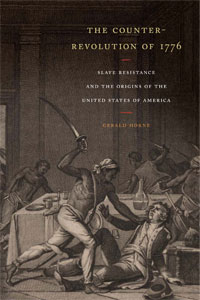
9781479893409_FullFor more, Professor Horne joins us here in our Chicago studio. He’s the author of two new books: The Counter-Revolution of 1776: Slave Resistance and the Origins of the United States of America and another new book, just out, Race to Revolution: The U.S. and Cuba During Slavery and Jim Crow. Professor Horne teaches history and African American studies at the University of Houston.

Welcome to Democracy Now! It’s great to have you with us. So, as we move into this Independence Day week, what should we understand about the founding of the United States?

GERALD HORNE: We should understand that July 4th, 1776, in many ways, represents a counterrevolution. That is to say that what helped to prompt July 4th, 1776, was the perception amongst European settlers on the North American mainland that London was moving rapidly towards abolition. This perception was prompted by Somerset’s case, a case decided in London in June 1772 which seemed to suggest that abolition, which not only was going to be ratified in London itself, was going to cross the Atlantic and basically sweep through the mainland, thereby jeopardizing numerous fortunes, not only based upon slavery, but the slave trade. That’s the short answer.

The longer answer would involve going back to another revolution—that is to say, the so-called Glorious Revolution in England in 1688, which, among other things, involved a step back from the monarch—for the monarch, the king, and a step forward for the rising merchant class. This led to a deregulation of the African slave trade. That is to say, the Royal African Company theretofore had been in control of the slave trade, but with the rising power of the merchant class, this slave trade was deregulated, leading to what I call free trade in Africans. That is to say, merchants then descended upon the African continent manacling and handcuffing every African in sight, with the energy of demented and crazed bees, dragging them across the Atlantic, particularly to the Caribbean and to the North American mainland. This was prompted by the fact that the profits for the slave trade were tremendous, sometimes up to 1,600 or 1,700 percent. And as you know, there are those even today who will sell their firstborn for such a profit. This, on the one hand, helped to boost the productive forces both in the Caribbean and on the mainland, but it led to numerous slave revolts, not least in the Caribbean, but also on the mainland, which helped to give the mainlanders second thoughts about London’s tentative steps towards abolition.

JUAN GONZÁLEZ: Gerald Horne, one of the things that struck me in your book is not only your main thesis, that this was in large part a counterrevolution, our—the United States’ war of independence, but you also link very closely the—what was going on in the Caribbean colonies of England, as well as in the United States, not only in terms of among the slaves in both areas, but also among the white population. And, in fact, you indicate that quite a few of those who ended up here in the United States fostering the American Revolution had actually been refugees from the battles between whites and slaves in the Caribbean. Could you expound on that?

GERALD HORNE: It’s well known that up until the middle part of the 18th century, London felt that the Caribbean colonies—Jamaica, Barbados, Antigua, in particular—were in some ways more valuable than the mainland colonies. The problem was that in the Caribbean colonies the Africans outnumbered the European settlers, sometimes at a rate of 20 to one, which facilitated slave revolts. There were major slave revolts in Antigua, for example, in 1709 and 1736. The Maroons—that is to say, the Africans who had escaped London’s jurisdiction in Jamaica—had challenged the crown quite sternly. This led, as your question suggests, to many European settlers in the Caribbean making the great trek to the mainland, being chased out of the Caribbean by enraged Africans. For example, I did research for this book in Newport, Rhode Island, and the main library there, to this very day, is named after Abraham Redwood, who fled Antigua after the 1736 slave revolt because many of his, quote, «Africans,» unquote, were involved in the slave revolt. And he fled in fear and established the main library in Newport, to this very day, and helped to basically establish that city on the Atlantic coast. So, there is a close connection between what was transpiring in the Caribbean and what was taking place on the mainland. And historians need to recognize that even though these colonies were not necessarily a unitary project, there were close and intimate connections between and amongst them.

AMY GOODMAN: So, why this great disparity between how people in the United States talk about the creation myth of the United States, if you will—I’m not talking about indigenous people, Native American people—and this story that you have researched?

GERALD HORNE: Well, it is fair to say that the United States did provide a sanctuary for Europeans. Indeed, I think part of the, quote, «genius,» unquote, of the U.S. project, if there was such a genius, was the fact that the founders in the United States basically called a formal truce, a formal ceasefire, with regard to the religious warfare that had been bedeviling Europe for many decades and centuries—that is to say, Protestant London, so-called, versus Catholic Madrid and Catholic France. What the settlers on the North American mainland did was call a formal truce with regard to religious conflict, but then they opened a new front with regard to race—that is to say, Europeans versus non-Europeans.

This, at once, broadened the base for the settler project. That is to say, they could draw upon those defined as white who had roots from the Atlantic to the Ural Mountains, and indeed even to the Arab world, if you look at people like Ralph Nader and Marlo Thomas, for example, whose roots are in Lebanon but are considered to be, quote, «white,» unquote. This obviously expanded the population base for the settler project. And because many rights were then accorded to these newly minted whites, it obviously helped to ensure that many of them would be beholden to the country that then emerged, the United States of America, whereas those of us who were not defined as white got the short end of the stick, if you like.

JUAN GONZÁLEZ: And, Gerald Horne, as a result of that, during the American Revolution, what was the perception or the attitude of the African slaves in the U.S. to that conflict? You also—you talk about, during the colonial times, many slaves preferred to flee to the Spanish colonies or the French colonies, rather than to stay in the American colonies of England.

GERALD HORNE: You are correct. The fact of the matter is, is that Spain had been arming Africans since the 1500s. And indeed, because Spain was arming Africans and then unleashing them on mainland colonies, particularly South Carolina, this put competitive pressure on London to act in a similar fashion. The problem there was, is that the mainland settlers had embarked on a project and a model of development that was inconsistent with arming Africans. Indeed, their project was involved in enslaving and manacling every African in sight. This deepens the schism between the colonies and the metropolis—that is to say, London—thereby helping to foment a revolt against British rule in 1776.

It’s well known that more Africans fought alongside of the Redcoats—fought alongside the Redcoats than fought with the settlers. And this is understandable, because if you think about it for more than a nanosecond, it makes little sense for slaves to fight alongside slave masters so that slave masters could then deepen the persecution of the enslaved and, indeed, as happened after 1776, bring more Africans to the mainland, bring more Africans to Cuba, bring more Africans to Brazil, for their profit.

AMY GOODMAN: We’re talking to historian Gerald Horne. He’s author of two new books. We’re talking about The Counter-Revolution of 1776. The subtitle of that book is Slave Resistance and the Origins of the United States of America. And his latest book, just out, is called Race to Revolution: The U.S. and Cuba During Slavery and Jim Crow. He’s professor of history and African American studies at University of Houston. When we come back, we’ll talk about that second book about Cuba. Stay with us.

[break]

AMY GOODMAN: «Slavery Days» by Burning Spear, here on Democracy Now!, democracynow.org,The War and Peace Report. I’m Amy Goodman in Chicago. Juan González is in New York. Before we talk about the book on slavery, I want to turn to President Obama’s remarks at the White House’s Fourth of July celebration last year. This is how President Obama described what happened in 1776.

PRESIDENT BARACK OBAMA: On July 4th, 1776, a small band of patriots declared that we were a people created equal, free to think and worship and live as we please, that our destiny would not be determined for us, it would be determined by us. And it was bold, and it was brave. And it was unprecedented. It was unthinkable. At that time in human history, it was kings and princes and emperors who made decisions. But those patriots knew there was a better way of doing things, that freedom was possible, and that to achieve their freedom, they’d be willing to lay down their lives, their fortune and their honor. And so they fought a revolution. And few would have bet on their side. But for the first time of many times to come, America proved the doubters wrong. And now, 237 years later, this improbable experiment in democracy, the United States of America, stands as the greatest nation on Earth.

JUAN GONZÁLEZ: That was President Obama talking about the meaning of July 4th. Gerald Horne, your book, The Counter-Revolution of 1776, is a direct rebuttal of this, as you call, creation myth. Could you talk about that?

GERALD HORNE: Well, with all due respect to President Obama, I think that he represents, in those remarks you just cited, the consensus view. That is to say that, on the one hand, there is little doubt that 1776 represented a step forward with regard to the triumph over monarchy. The problem with 1776 was that it went on to establish what I refer to as the first apartheid state. That is to say, the rights that Mr. Obama refers to were accorded to only those who were defined as white. To that degree, I argue in the book that 1776, in many ways, was analogous to Unilateral Declaration of Independence in the country then known as Southern Rhodesia, now Zimbabwe, in November 1965. UDI, Unilateral Declaration of Independence, was in many ways an attempt to forestall decolonization. 1776, in many ways, was an attempt to forestall the abolition of slavery. That attempt succeeded until the experiment crashed and burned in 1861 with the U.S. Civil War, the bloodiest conflict, to this point, the United States has ever been involved in.

AMY GOODMAN: So, Gerald Horne, how does this story, this, what you call, counterrevolution, fit in with your latest book, Race to Revolution: The U.S. and Cuba During Slavery and Jim Crow?

GERALD HORNE: Well, there’s a certain consistency between the two books. Keep in mind that in 1762 Britain temporarily seized Cuba from Spain. And one of the regulations that Britain imposed outraged the settlers, as I argue in both books. What happened was that Britain sought to regulate the slave trade, and the settlers on the North American mainland wanted deregulation of the slave trade, thereby bringing in more Africans. What happens is that that was one of the points of contention that lead to a detonation and a revolt against British rule in 1776.

I go on in the Cuba book to talk about how one of the many reasons why you have so many black people in Cuba was because of the manic energy of U.S. slave traders and slave dealers, particularly going into the Congo River Basin and dragging Africans across the Atlantic. Likewise, I had argued in a previous book on the African slave trade to Brazil that one of the many reasons why you have so many black people in Brazil, more than any place outside of Nigeria, is, once again, because of the manic energy of U.S. slave traders and slave dealers, who go into Angola, in particular, and drag Africans across the Atlantic to Brazil.

It seems to me that it’s very difficult to reconcile the creation myth of this great leap forward for humanity when, after 1776 and the foundation of the United States of America, the United States ousts Britain from control of the African slave trade. Britain then becomes the cop on the beat trying to detain and deter U.S. slave traders and slave dealers. It seems to me that if this was a step forward for humanity, it was certainly not a step forward for Africans, who, the last time I looked, comprise a significant percentage of humanity.

JUAN GONZÁLEZ: And, Gerald Horne, so, in other words, as you’re explaining the involvement of American companies in the slave trade in Brazil and Cuba, this—that book and also your The Counter-Revolution of 1776 makes the same point that slavery was not just an issue of interest in the South to the Southern plantation owners, but that in the North, banking, insurance, merchants, shipping were all involved in the slave trade, as well.

GERALD HORNE: Well, Juan, as you well know, New York City was a citadel of the African slave trade, even after the formal abolition of the U.S. role in the African slave trade in 1808. Rhode Island was also a center for the African slave trade. Ditto for Massachusetts. Part of the unity between North and South was that it was in the North that the financing for the African slave trade took place, and it was in the South where you had the Africans deposited. That helps to undermine, to a degree, the very easy notion that the North was abolitionist and the South was pro-slavery.

AMY GOODMAN: So, Gerald Horne, what most surprised you in your research around Cuba, U.S. slavery and Jim Crow?

GERALD HORNE: Well, what most surprised me with regard to both of these projects was the restiveness, the rebelliousness of the Africans involved. It’s well known that the Africans in the Caribbean were very much involved in various extermination plots, liquidation plots, seeking to abolish, through force of arms and violence, the institution of slavery. Unfortunately, I think that historians on the North American mainland have tended to downplay the restiveness of Africans, and I think it’s done a disservice to the descendants of the population of mainland enslaved Africans. That is to say that because the restiveness of Africans in the United States has been downplayed, it leads many African Americans today to either, A, think that their ancestors were chumps—that is to say, that they fought alongside slave owners to bring more freedom to slave owners and more persecution to themselves—or, B, that they were ciphers—that is to say, they stood on the sidelines as their fate was being determined. I think that both of these books seek to disprove those very unfortunate notions.

AMY GOODMAN: So, as we move into the Independence Day weekend next weekend, what do you say to people in the United States?

GERALD HORNE: What I say to the people in the United States is that you have proved that you can be very critical of what you deem to be revolutionary processes. You have a number of scholars and intellectuals who make a good living by critiquing the Cuban Revolution of 1959, by critiquing the Russian Revolution of 1917, by critiquing the French Revolution of the 18th century, but yet we get the impression that what happened in 1776 was all upside, which is rather far-fetched, given what I’ve just laid out before you in terms of how the enslaved African population had their plight worsened by 1776, not to mention the subsequent liquidation of independent Native American polities as a result of 1776. I think that we need a more balanced presentation of the foundation of the United States of America, and I think that there’s no sooner place to begin than next week with July 4th, 2014.

AMY GOODMAN: Well, Gerald Horne, I want to thank you very much for being with us. Historian Gerald Horne is author of two new books: The Counter-Revolution of 1776: Slave Resistance and the Origins of the United States of America as well as Race to Revolution: The U.S. and Cuba During Slavery and Jim Crow. He’s a professor of history and African American studies at the University of Houston.

That does it for our broadcast. Happy birthday to Jon Randolph. Democracy Now! has two job openings — administrative director, as well as a seasoned Linux systems administrator — as well asfall internships. Check out democracynow.org/jobs for more information.


Read Full Post »

I Freed Myself: African American Self-Emancipation in the Civil War Era

Marshall Poe 

New Books in History  June 5, 2014

David Williams

David Williams

Lincoln was very clear–at least in public–that the Civil War was not fought over slavery: it was, he 61eT-apOtrL._SL160_said, for the preservation of the Union first and foremost. So it’s not surprising that when the conflict started he had no firm plan to emancipate the slaves in the borderland or Southern states. He also knew that such a move might prove very unpopular in the North.

So why did he issue the Emancipation Proclamation on January 1, 1863? There are many reasons. According to David Williams‘ fascinating new book I Freed Myself: African American Self-Emancipation in the Civil War Era (Cambridge University Press, 2014), an important and neglected one has to do with African American self-emancipation. After the war began, masses of slaves began to leave the South and head for the Northern lines. The Union forces received them as “contraband” seized from the enemy during wartime. As such, their status was uncertain. Many wanted to fight or at least serve as auxiliaries in the Union armies like freemen, but they were still seen as property. As Williams points out, the North certainly needed their manpower–as Lincoln knew better than anyone. Bearing this in mind, the President felt the time was propitious to do what he thought was right all along–free the slaves. Listen in.

Read Full Post »

Reminding People of a Lynching Was What Bothered Them? 

HNN  May 30, 2014


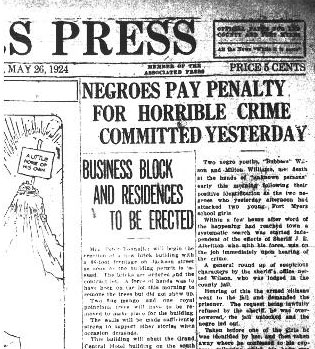
155743-LynchingArticleI recently contributed to items in the local press (see here) and on radio (see here) concerning the ninetieth anniversary of a particularly gruesome lynching that took place in Fort Myers, Florida, over the weekend of May 25-26, 1924. Predictably, some local respondents were not happy that this anniversary was being publicized. One disgruntled reader complained, «Just can’t allow racism to fade away can you News Press? Instead of a piece relating how people of different races help each other because of their selfless goodwill (past or present), you all instead choose to keep alive a 90 year old evil doing by long since dead racist murderers.» In this article I will demonstrate why such reactions are mistaken and why these events should continue to be analyzed and explored in public media.

The first reason to keep highlighting this history is that lynching arose from racist stereotyping, a menace that continues in the present day. In Fort Myers in 1924, two black teenagers, aged just 16 and 14 were seen skinny-dipping with two white female friends. The two boys were assumed to be guilty of rape. In an article published by Steve Dougherty in the Fort Myers News-Press in 1976, an eyewitness stated that one of the girls protested that the two boys were innocent of any wrong-doing, yet the boys were still lynched. The racist beliefs of the whites overwhelmed their willingness to view the evidence impartially. This has clear parallels with criminal justice today, where juries can be influenced by the fact that young black males continue to be depicted in some media as criminal and sexually aggressive, instead of being treated as individuals.

The second reason is that the historical record on lynching is incomplete and in need of correction. Although the NAACP did awesome work to keep records of lynchings, it often had to rely on newspaper reports that presented the events from the point of view of the lynchers. In Fort Myers, for example, the motive of the lynchers was recorded as being to punish sexual assault (rape), yet this assault existed only in the eyes of the beholders. No evidence was presented to establish that the lynching victims had committed the alleged crime. The name of one of the victims was repeatedly given as Bubbers Wilson, when infact the death records clearly show that his name was RJ Johnson, a fact that the black community knew very well.

Failure to verify such facts at the time shows the local contempt of authorities for justice and accurate reporting. These violations of the historical record should be corrected; it is surely our duty as scholars to attend to this.

A third reason to focus on such lynchings is to ask our students and readers to walk a mile in the shoes of African-Americans of both historical periods. A white student of today who places himself or herself in the mind of a black male from 1924 can better understand how a young black male must continue to have two «looking glass selves»: a self that is reflected back to him by his fellow blacks, and one that is reflected back to him by a white viewpoint of suspicion and prejudice. Trayvon Martin spent his short life looking into these mirrors, which played a role in his death. Perhaps the student of today will be the juror of tomorrow, and the justice system is more likely to be seen to be doing its job correctly: treating all persons equally before the law, regardless of gender or skin color?

Jonathan Harrison is an adjunct Professor in Sociology at Florida Gulf Coast University and Hodges University whose PhD was in the field of racism and antisemitism.

Read Full Post »

The Case for Reparations: Ta-Nehisi Coates on Reckoning With U.S. Slavery & Institutional Racism

Democracy Now    May 29, 2014

An explosive new cover story in the June issue of The Atlantic magazine by the famed essayist Ta-Nehisi Coates has rekindled a national discussion on reparations for American slavery and institutional racism. Coates explores how slavery, Jim Crow segregation, and federally backed housing policy systematically robbed African Americans of their possessions and prevented them from accruing inter-generational wealth. Much of the essay focuses on predatory lending schemes that bilked potential African-American homeowners, concluding: «Until we reckon with our compounding moral debts, America will never be whole.» Click here to watch Part 2 of this interview.»:http://www.democracynow.org/2014/5/30/part_2_ta_nehisi_coateson

Transcript

This is a rush transcript. Copy may not be in its final form.

AMY GOODMAN: «The case for reparations. 250 years of slavery. Nine years of Jim Crow. 60 years of separate but equal. 35 years of racist housing policy. Until we reckon with our compounding moral debts, America will never be whole.» So begins an explosive new cover story in the June issue of the Atlantic magazine by the famed essayist Ta-Nehisi Coates. The article is being credited for rekindling a national discussion on reparations for American slavery and institutional racism.

JUAN GONZÁLEZ: In the essay, Ta-Nehisi Coates exposes how slavery, Jim Crow, segregation, and federally backed housing policy systematically robbed African Americans of their possessions and prevented them from accruing intergenerational wealth. Much of the piece focuses on predatory lending schemes that built potential African-American homeowners. This is a video that The Atlantic released a preview its new cover story, «The Case for Reparations.»

*BILLY LAMAR BROOKS SR.: This area here represents the poorest of the poor in the city of Chicago.

MATTIE LEWIS: I’ve always wanted to own my own house, because I work for white people when I was in the South, and they had beautiful homes and I always said, one day I was going to have me one.

JACK MACNAMARA: White folks created the ghetto. It drives me crazy today even that we don’t admit that. This is the best example I can think of the institutional racism.

JUAN GONZÁLEZ: To talk about «The Case for Reparations,» we’re joined now by Ta-Nehisi Coates here in New York City. Welcome to Democracy Now! You start your article with one particular figure, Clyde Ross. Tell us his story and why you decided to begin with him.

TA-NEHISI COATES: Mr. Ross is really just emblematic of much of what has happened to African-Americans across the 20th century, and I emphasize 20th century. Mr. Ross was born in the Delta region of Mississippi. His family was not particularly poor, they actually quite prominent farmers. They had their land and virtually all of their possessions taken from them through a scheme around allegedly back taxes and were reduced to sharecropping. In the sharecropping system, there was no sort of assurances over what they might get versus what they actually picked. When I first met Mr. Ross, the first thing he said to me was he left Mississippi for Chicago because he was seeking the protection of the law. I didn’t quite understand what he meant by that. But, as he explained it to me, he said, listen, there were no black judges, no black prosecutors, no black police — basically, we had no law. We were outlaws and people could take from us whatever they wanted. That was very much his early life. He went to Chicago thinking things would be a little different. On the surface, they were. He managed to get a job, got married, had a decent life. He was basically looking for that one more emblem of the American middle class in the Eisenhower years, and that was the possession of a home. Unfortunately, due to government policy, Mr. Ross at that time, like most African-Americans, was unable to secure a loan due to policies or red-lining and deciding who deserved the loans and who doesn’t. There was a broad, broad consensus that African-Americans, for no other reason besides blatant racism, could not be responsible homeowners. Mr. Ross, as happens when people are pushed out of the legitimate loan market ended up in the illegitimate loan market and got caught up in the system of contract buying, which is essentially just a particularly onerous rent to own scheme for people looking to buy houses. Ended up purchasing a house, I believe at $27,000 he paid for it. The person who sold it to him had bought the house only six months before for $12,000. Mr. Ross later became an activist, helped formed the Contract Buyers League, and just fought on behalf of African American home owner on the west side of Chicago. I should add that it is estimated during this period that 85% of African-Americans looking to buy homes in Chicago bought through contract lending.

JUAN GONZÁLEZ: Let’s hear Clyde Ross and his onward speaking a in 1969 on behalf of the Contract Buyers League a coalition of black homeowners on Chicago’s South and West Sides from all of whom had been locked into the the same system of predatory lending.

CLYDE ROSS: They have cheated us out of more than money. We have been cheated out of the right to be human beings in a society. We have been cheated out of buying homes at a decent price. Now it’s time now, we got a chance. The Contract Buyers League has presented a chance for these people in this area to move out of this crippled society, to move up. Stand on your own two feet. Be human beings, fight for what you know is right. Fight.

AMY GOODMAN: Ta-Nehisi Coates, can you talk about this example and others in this remarkable piece and how you then talk about the bill for reparations that has been introduced by John Conyers year after year in the house, and what reparations would actually look like?

TA-NEHISI COATES: What I try to establish in this piece is that there is a conventional way of talking about the relationship in America between the African-American community and the white community, and it is one that we are very comfortable with. I call it basically the lunch table view of the problem with racism in America is that black people want to sit at one table and white people want to sit at another lunch table. If we could just get black and white people to like each other, love each other, everything would be solved. In fact, even these terms that we’re using are inventions, and they’re inventions of racism. If you trace back the history back to 1619, a better way of describing the relationship between black and white people is one of plunder, the constant stealing, the taking from black people that extends from slavery up through Jim Crow policy. Slavery is obviously the stealing of people’s labor. In some cases the outright theft of people’s children, and the vending of people’s children, the taking of the black body for whatever profit you can wring from it, up through the Jim Crow South where you have a system of debt peonage, sharecropping — which really isn’t much different minus the actual selling of children you steal, exploiting labor and taking as much as you can from it. Into a system when you think about something like separate but equal. In the Civil Rights Movement, we traditionally picture colored only water fountains, white only restrooms. The thing people have to remember, if you take a state like Mississippi or anywhere in the deep South where you have a public university system, black people are paying into that. Black people are pledging their fealty to the state and yet, they aren’t getting the same return. This is theft. This is systemized. When we try to talk about the practicality of it, I spent 16,000 words almost just trying to actually make the case. At the end, what I come to is that the actionable thing right now is to support Representative John Conyers’ Bill H.R.40 for a study of what slavery has actually done, what the legacy of slavery has actually done to black people and what are remedies we might come up with. I did that not so much to dodge the question, but because I think to actually even sketch out what this might be would take another 16,000 words. We have to calculate what slavery was. We have to calculate what Jim Crow was. We have to calculate what we lost in terms of redlining and come to some sort of ostensible number and figure out whether we can actually pay it back. And if we can’t, what we might do in lieu of that.

JUAN GONZÁLEZ: When you mentioned that the systemic plunder that occurred, I mean, this is not ancient history.

TA-NEHISI COATES: No, no.

JUAN GONZÁLEZ: In the most recent economic crisis in the country, there was this enormous reduction in the wealth of African-Americans in the country as a result of the housing crisis, yet the narrative portrays it as the housing crisis was caused — the conservative narrative is — by affirmative action policies of Fannie Mae and Freddie Mac to make it easier for African-Americans with low credit to get loans. Talk about that and this enormous wealth loss that occurred recently.

TA-NEHISI COATES: Well, the great sociologist Douglas Massey has a very interesting paper out specifically about the foreclosure crisis as it should be rightly called that happened very, very recently. One of the things he demonstrates in the paper is the thing that made this possible, segregation was a driver of this. If you think about it, it makes perfect sense. The African-American community is the most segregated community in the country, and what you have in that community is a population of people who have been traditionally cut off from wealth building opportunities. So, anxious to get wealth-building opportunities. If you are a banker and you are looking sell a scheme to somebody and rip somebody off, well there your marks are, right there, right in the same place. That’s essentially what happened.

AMY GOODMAN: Ta-Nehisi Coates, I wanted to go to this issue of reparations and the examples you have seen, for example, after the Holocaust, Germany and the Jews. Can you talk about how those reparations took place?

TA-NEHISI COATES: It is very, very interesting. One of the reasons why I included that history, because as we know, reparations for African-Americans has all sorts of practical problems that we would have to deal with and fight about. I wanted to just demonstrate that even in the case of reparations to Israel, the one that’s most cited, this was not a sure thing. One thing that people often say about African-American reparations is, well, oh you’re just talking about savory, that was so long ago, as though if we were talking about a more proximate or more present case it would be much easier. But, in fact, the fact it was so close made it really, really hard for people, made it hard for some Israelis who did not want to feel like they were taking a buck off of folks’ mothers or brothers or sisters or grandmas who had just been killed. In Germany in fact, if we look at the public opinion surveys at the time, they were no more — Germans in the popular sense — were no more apt to take responsibility today than Americans are for slavery. So, it was a very, very difficult piece. What’s interesting and I think one of the lessons that can be learned from it, however, is the way it was structured. In fact, Germany did not just cut a check to Israel. What they actually did was they gave them vouchers. Those vouchers that were worth a certain amount of money, those vouchers had to be used with German companies. So, essentially, what they structured was a stimulus for West Germany while giving reparations to Israel at the same time. It gives us some clue that some sort of creative solutions we might have in the African-American community.

JUAN GONZÁLEZ: One of the issues you also raise is that this reparations demand is not new in American history. You talk about Belinda Royall who in 1783 had been a slave for 50 years, became a freed woman. She petitioned the Commonwealth of Massachusetts for reparations.

TA-NEHISI COATES: Right, right, right, and I think people think of this as something that just sort of came up, you know 150 years — Black people — reparations is basically as old as this country is, and it’s not just, as you mention, Belinda Royall, people like that, but, it is also white people who understood at the time some great injury had been done. Many of the quaker meetings for instance — basically, they would excommunicate people who didn’t just free their slaves, but actually gave them something, you know, paid them reparations in return. We have the great quote from Timothy Dwight who was the president of Yale who said, to liberate these folks, to free these folks and to give them nothing would be to entail a curse upon them. Effectively, that is actually what happened upon African American and really, I would argue, upon the country at large. Many, many people of the Revolutionary generation, the generation that fought in the Revolutionary War, understood that slavery was somehow in contradiction to what America was saying it was. Many of those folks also at the very least gave land to African-Americans when they were liberated. Some of them educated them. But they understood to just cut somebody out into the wild, which is basically what happened to black people, would not be a good thing.

AMY GOODMAN: Ta-Nehisi Coates, we want to thank you very much for being with us. We’re going to do part two right after the show and we will post it online at democracynow.org. Ta-Nehisi Coates is a national correspondent of The Atlantic where he writes about culture, politics and social issues. He has just written a cover story called «The Case for Reparations.» Ta-Nehisi Coates is also the author of the memoir «The Beautiful Struggle

Read Full Post »

Part 2: Ta-Nehisi Coates on Segregation, Housing Discrimination and “The Case for Reparations”

Democracy Now May 30, 2014

We air part two of our interview with famed essayist Ta-Nehisi Coates about his cover article in The Atlantic, “The Case for Reparations,” in which he exposes how slavery, Jim Crow segregation, and federally backed housing policy have systematically robbed African Americans of their possessions and prevented them from accruing inter-generational wealth. “It puts a lie to the myth that African Americans who act right, who are respectable, are somehow therefore immune to the plunder that is symptomatic of white supremacy in this country,” Coates says. “It does not matter. There’s no bettering yourself that will get you out of this.”

Watch Part 1 of this interview.

Read Full Post »

A Mysterious Map of Louisiana

Susan Schulten

The New York Times   May 25, 2014


These days the intersection of cartography and Big Data is all the rage: Using information from the 2010 census, countless news outfits, including The New York Times, have created tools allowing readers to make customized maps of everything from trends in ethnic and racial composition to the dynamics of housing development. Indeed, we have come to expect that any large body of data will be visualized through maps and infographics. Such tools help to transform information into knowledge, and at their best allow us to see patterns that might otherwise be lost.

But while the technology may be new, the idea of mapping data in the United States can actually be traced to the Civil War. Earlier posts in Disunion have discussed the maps of slavery generated by the United States Coast Survey. At the same time, the Census Office (also part of the Treasury Department) was experimenting with maps of not just one but multiple types of data. These were designed to aid the Union war effort, but perhaps more importantly to plan for Reconstruction.

The National Archives


One of the most fascinating — and mysterious — of these experiments is an unsigned, undated map of Louisiana, buried within the voluminous war records of the National Archives. The map contains almost no environmental information save for the river systems and a few railroads. Even roads are omitted, truly unusual for any 19th-century map.

Instead, the emphasis is on parish boundaries, within which are listed free and slave populations alongside data about resources, from swine to ginned cotton. While this population data would have been available as early as 1862, the agricultural data was only published in 1864. With this information, officers and administrators moving through the state could locate the richest parishes, the largest sources of labor and the easiest means of river and rail transportation. (Oddly, the map does not list the output from over 1,500 sugar plantations located along the lower Mississippi River.)

A closer look at southeastern Louisiana
A closer look at southeastern Louisiana    (The National Archives)

The Census Office was experimenting with this type of map throughout the war. At the request of Gen. William Tecumseh Sherman, for instance, the superintendent of the census annotated a previously printed map of Georgia with information on livestock and crop yields as the former embarked on his ambitious march in the fall of 1864 deep into enemy territory. But Louisiana presented an entirely different — though equally unprecedented — challenge to the Union Army: how to control and administer a conquered region where nearly half the population was no longer strictly enslaved, but which was largely exempt from the Emancipation Proclamation.

The quandary began in April 1862, when Adm. David Farragut captured New Orleans. Soon after, President Lincoln appointed Gen. Benjamin Butler as commander of the gulf. Lincoln hoped to cultivate Unionist sentiment in New Orleans, and thereby lure Louisiana out of the Confederacy. But Butler’s rigid policies and questionable confiscation of cotton alienated many in New Orleans and the parishes beyond, even though his military quarantine effectively ended the murderous yellow fever epidemic that had ravaged the city for decades.

Butler’s tenure was brief, and by the end of 1862 Lincoln had replaced him with the former governor of Massachusetts, Maj. Gen. Nathaniel P. Banks. As commander of the gulf, Banks’s military charge was to expand the realm of Union control into Texas and up the Mississippi. But equally complex was the political task of governing an area under Union occupation. In 1860 Louisiana had a population of 600,000, slightly more than half of whom were white. Yet in some of the parishes with large plantations, blacks far outnumbered whites, especially after the war took men of military age to the Confederate Army. The Confiscation Act of March 1862 prohibited Union soldiers from returning slaves to their masters, and thereby the very presence of the Army disrupted slavery. But without any clear mandate for emancipation, many of the conditions of slavery remained. Louisiana was in limbo.

Thus Banks faced the problem of rebuilding an immensely fertile region with a profoundly unstable (and still unfree) labor system. That’s where the map came in, for it allowed Banks to see the general economic capacity of the state. While such data would have been available to anyone with access to the published records of the 1860 census (published in 1862), to see such information organized geographically enabled Banks to think strategically about managing the population, its chief crop and its food supply.

Banks’s system of labor contracts drew intense criticism from all sides, including freedmen, former plantation owners and especially antislavery Republicans in the Union. Historians have also judged it harshly for its repressive techniques, which reflected a desire to control the black population and keep plantations functioning. At the height of its operation in 1864, Banks’s system of labor contracts involved 50,000 laborers on 1,500 estates. And in part because of his labor policies, the state’s agricultural production grew significantly in 1863. In this situation, Banks probably used the map to measure the strength and resources of individual parishes. The map probably also aided Banks as he began to conscript blacks (sometimes forcibly) into the Army. By the end of 1864 he had organized more than 28 regiments, which meant that Louisiana contributed more black soldiers to the Union Army than any other state.

In these various ways, the map measured the population and its resources. In this respect the map anticipates the extensive Federal mapping efforts of the Census after the war; by the 20th century, such cartographic and statistical tools of governance had become routine.

In both the management of labor and soldiers, the map enabled Banks to govern and control by seeing the aggregate strength and composition of the population and its resources. In this respect the map anticipated the extensive federal mapping efforts of the census in postwar decades; today we live with such tools as a matter of course.

In the summer of 1864, Louisiana designed a new state constitution that abolished slavery. Thereafter, in some respects, the map was immediately outdated, and in fact it may be one of the last maps that used the term “slave.” Yet while such a category was crumbling throughout 1864, the conditions of true freedom lay far in the future, and in fact Banks’ strict efforts to regulate the movement of African-Americans laid the groundwork for the punitive black codes of the early Reconstruction period. After all, his primary goal was to control the population, and in this respect the map was no mystery at all, but the result of the logic of war.

Map courtesy of the National Archives and Records Administration in College Park, Maryland.

Follow Disunion at twitter.com/NYTcivilwar or join us on Facebook.


Susan Schulten

Susan Schulten is a history professor at the University of Denver and the author of “The Geographical Imagination in America, 1880-1950” and “Mapping the Nation: History and Cartography in Nineteenth-Century America.”

Read Full Post »

Felon disfranchisement preserves slavery’s legacy

By Pippa Holloway

Oxford University Press Blog    April 28, 2014

Nearly six million Americans are prohibited from voting in the United States today due to felony convictions. Six states stand out: Alabama, Florida, Kentucky, Mississippi, Tennessee, and Virginia. These six states disfranchise seven percent of the total adult population – compared to two and a half percent nationwide. African Americans are particularly affected in these states. In Florida, Kentucky, and Virginia more than one in five African Americans is disfranchised. The other three are not far behind. Not only do individuals lose voting rights when they are incarcerated, on probation, or paroled, a common practice in many states, but some or all ex-felons are barred from voting. All six of these states have non-automatic restoration processes that make it difficult or impossible to have one’s rights restored. Not coincidentally, all of these states maintained a system of racial slavery until the Civil War.

At the other end of the spectrum are northeastern states, mostly those in New England, which put up few obstacles to voting by convicted individuals. Maine and Vermont are the only states in the nation that do not disfranchise anyone for a crime, even individuals who are incarcerated. Among the remaining 48 states, Massachusetts and New Hampshire disfranchise the smallest percentage of convicted individuals. Connecticut, Rhode Island, and Pennsylvania are also far below the national average.

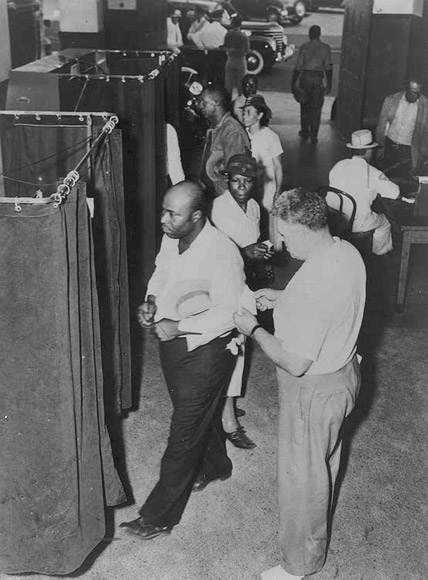
Voters at the Voting Booths. ca. 1945. NAACP Collection, The African American Odyssey: A Quest for Full Citizenship, Library of Congress. Public domain via Wikimedia Commons. - See more at: http://blog.oup.com/2014/04/felon-disfranchisement-preserves-slaverys-legacy/#sthash.wdlC2De3.dpuf

Voters at the Voting Booths. ca. 1945. NAACP Collection, The African American Odyssey: A Quest for Full Citizenship, Library of Congress. Public domain via Wikimedia Commons. – See more at: http://blog.oup.com/2014/04/felon-disfranchisement-preserves-slaverys-legacy/#sthash.wdlC2De3.dpuf

Generalizations about regional difference are complex should be made cautiously. Although the six states with the highest rates of disfranchisement are all in the South, six other states also impose life-long disfranchisement for some or all felons. Arizona and Nevada have relatively high rates of felon disfranchisement. Midwestern states, particularly Illinois, Indiana, Ohio, and Michigan, have low rates of felon disfranchisement, as does North Dakota. Nonetheless, the Northeast and South stand in stark contrast.

Regional differences in felon disfranchisement today are the result of regionally divergent histories of slavery and criminal justice. New England states had outlawed slavery by 1800. Soon, they also stopped treating convicts like slaves, barring state-administered corporal punishment for criminal offenses in the first few decades of the nineteenth century. Instead, northeastern states embraced an ideology of criminality that emphasized rehabilitation. This attitude toward both slavery and punishment led many citizens and lawmakers in the northeast to oppose disfranchisement of convicts or at least curb the reach of this punishment. In the colonial era, Connecticut limited the courts that could deny convicts the vote. Maine’s 1819 constitutional convention rejected a proposal to disfranchise for crime. Vermont ended the practice in 1832. In other northeastern states proponents of such disfranchisement measures faced strong opposition. For example, Pennsylvania’s 1873 constitutional convention restricted felon disfranchisement to those convicted of election-related crimes; an effort to disfranchise convicts in Maryland in 1864 passed only after a long debate.

In contrast in the nineteenth-century South two groups were permanently cast out of full citizenship: African Americans and convicts. Although the enslavement of African Americans ended in 1865, “infamy” – the legal status of those convicted of serious crimes – was imposed on a growing number of the new black citizens. Accusations of prior crimes were used in the 1866 election as one of the first tools used to deny the vote to former slaves. In the 1870s, nearly every state in the former Confederacy (Texas being the exception) modified its laws to disfranchise for petty theft, a move celebrated by white leaders as a step toward disfranchising African Americans.

The legacy of slavery and segregation in the South is important to this story but so is the different regional trajectory of criminal justice. All southern states except South Carolina and Georgia (states today that still have among the lowest rates of disfranchisement in the South) enacted laws disfranchising for crime between 1812 and 1838, and there is little evidence of dissent or debate over this punishment anywhere in the region. Furthermore, southern states rejected the concept of criminal rehabilitation and focused instead on punishment. After the Civil War “convict lease” systems replicated in many ways the system of slavery for those who fell into it, creating a class of mostly-black individuals who were subject to physical punishment, public abuse, and humiliation, and denied voting rights.

PippaIn the past, as is also true today, individuals with criminal convictions fought long battles to regain their voting rights. Far from being a population that is uninterested in politics, individuals barred from voting have challenged obstacles to re-enfranchisement and overcome tremendous hurdles to have their voting rights restored. Consider the case of Jefferson Ratliff, an African American farmer living in Anson County, North Carolina, who in 1887 paid the court an astounding $14 to have his citizenship rights restored, ten years after his conviction for larceny (including three years’ incarceration) for stealing a hog. In Giles County, Tennessee in 1888 a man named Henry Murray paid $2.70 in court costs in an unsuccessful effort to have his voting rights restored. In other cases, poor and illiterate individual petitioners facing a complicated legal process sought help from friends and neighbors. In Georgia, Lewis Price petitioned Governor William Y. Atkinson in 1895 for a pardon so that he could vote. He explained, “I am a poor ignorant negro and I have no money to pay to the lawyers to work for me. So I have to depend on my friends to do all of my writing.”

The historical record shows that state and local governments have consistently failed, throughout the nation’s history, to enforce these laws in a fair and uniform way. Coordinating voter registration lists with criminal court records and pardon records — difficult in today’s world of information technology — was nearly impossible in the late nineteenth and early twentieth century. People who should have been able to vote were often denied the vote due to false allegations of disfranchising offenses; convictions were secured through suspect judicial processes prior to an election for partisan ends; and people who should have been disfranchised often voted. Sometimes these appear to have been honest mistakes made by officials charged with merging complicated statutory and constitutional requirements with voter registration data and court records. In many cases though, other agendas—partisan, racial, personal—seem to have been at work. In short, felon disfranchisement laws have long been subject to error and abuse.

Race both rationalized and motivated laws imposing lifelong disfranchisement for certain criminal acts in the post-Civil War period. Since then a variety of factors have led to the persistent sense, particularly in southern states, that individuals with prior criminal convictions are marked with a disgrace and contamination that is incompatible with full citizenship. Felon disfranchisement today preserves slavery’s racial legacy by producing a class of individuals who are excluded from suffrage, disproportionately impoverished, members of racial and ethnic minorities, and often subject to labor for below-market wages. In these six southern states, the ballot box is just as out of reach for former convicts as it was for enslaved African Americans two centuries ago.

Dr. Pippa Holloway is the author of Living in Infamy: Felon Disfranchisement and the History of American Citizenship, published Oxford University Press in December 2012. She is Professor of History at Middle Tennessee State University. Contemporary data comes from Christopher Uggen, Sara Shannon, Jeff Manza, “State-Level Estimates of Felon Disenfranchisement in the United States, 2010.”


Read Full Post »

 What Should Historians Make of «Black Confederates?»

Glenn Brashe

The Civil War Monitor  May 5, 2014

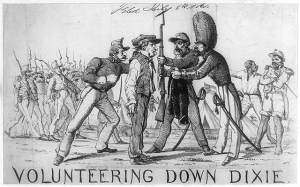
Volunteering Down Dixie,a northern cartoon, satirizes the enlistment of Confederate troops as two "Black Confederates" look on.

Volunteering Down Dixie,a northern cartoon, satirizes the enlistment of Confederate troops as two «Black Confederates» look on.

The topic of so-called “Black Confederates” is controversial. Some insist that Confederate nationalism motivated thousands of African Americans to fight alongside their masters, proving that slavery did not cause the American Civil War. The Internet has become one of the primary means of spreading this nonsense. While professional historians scoff, the “black confederate myth” is popping up on monuments across the south and even temporarily appeared in a Virginia textbook.

When asked about “Black Confederates,” historians often question the sources used by the myth’s supporters, pointing out that they are usually second-hand and anecdotal, or a product of post-war Lost Cause propaganda.  Other historians simply pooh-pooh the claims. I believe that these are not effective responses. A better approach is to place the evidence back into the context in which it first emerged.

In a number of primary sources, people claim to have seen African Americans fighting alongside Rebel soldiers. Most of these sightings were likely of slaves serving as body servants for their soldier masters, or were of the thousands of slaves impressed to work on confederate fortifications. Still, individual human motivations are rarely monolithic and therefore it is not irrational to believe that in the excitement of combat a few of these black men picked up weapons and got involved in the fighting.  Some perhaps felt that in their particular situation it was in their best interest to demonstrate “loyalty” to their masters. Others may have been deceived about the intentions of northern soldiers; white southerners repeatedly told their slaves that Yankees were intent on capturing blacks to send them away to labor in the Caribbean.

Yet while these incidences were in nowhere near the numbers that some claim today, the exaggeration of such tales to promote an agenda is not new. In pushing for emancipation, some abolitionists and radical Republicans widely publicized these stories. In propaganda-like fashion, they greatly exaggerated them to further their cause, and thus they were the first to give these reports more credence and attention than they deserved.

Immediately after the July 1861 battle at Manassas, Virginia, scattered news reports claimed that people saw blacks fighting there among the Confederates. The New York Times, for example, declared that «we hear of black regiments» in the Rebel army, and reprinted a story from the Richmond Enquirer heralding an «ebony patriot» who shot a Yankee officer and captured another. The Charlotte (N.C.) Western Democratcelebrated the «sable patriots» of Manassas and claimed «many cases . . . of [northern] prisoners being taken by negroes.» Some Northerner newspapers claimed that blacks had fought for the Confederates that day in significant numbers. «It is boasted that there are two well drilled regiments of negroes in [the Confederate] army» the Chicago Tribune reported. «The fact that negroes fought in the battle at Bull Run is undisputed,» one correspondent concluded after discussing the battle with Union soldiers who had been in it. «They were forced to do it, but they fought.»

Far more important than the veracity of these dubious claims, is that emancipationists used them to shape northern public opinion and Union war policy. The day before the battle, the U.S. Senate debated a bill that would allow the confiscation of Rebel property used to support Confederate armies. After the battle, Senator Lyman Trumbull proposed an amendment to the bill that broadened the definition of property liable for confiscation to include slaves. «I understand that Negroes were in the fight which has recently occurred,” Trumbull said on the Senate floor. “Negroes who are used to destroy the Union and to shoot down the Union men by the consent of their traitorous masters [should be confiscated].» While there was some objection to the amendment, news from Manassas swayed some senators. Conservative senator John C. Ten Eyck, for example, explained that he previously voted against the amendment, but now changed his mind. «Having learned and believing that [slaves] have been used and employed with arms in their hands to shed the blood of Union-loving men of this country,» he argued, «I shall vote in favor of this amendment.” The amendment and the Confiscation Act overwhelmingly passed, becoming the first legislation that allowed Union commanders to harbor runaway slaves.

To further promote emancipation as a military necessity, abolitionists continued to spread reports of slaves fighting for the Confederacy. In September 1861, famed black abolitionist Frederick Douglass maintained «it is now pretty well established, that there are at the present moment many colored men in the Confederate army doing duty . . . as real soldiers. . . . There were such soldiers at Manassas, and they are probably there still.» Harriet Beecher Stowe, author of Uncle Tom’s Cabin, issued a warning. «The question is not Shall there be black regiments. But, Shall they fight on our side or the side of the enemies?» If the government did not emancipate the slaves, she insisted, the North would have to fight an increasing numbers of blacks in rebel armies.

With hindsight, these fears were unwarranted. The Confederate government vehemently resisted enrolling black troops until the last months of the conflict. In fact, after the Manassas battle a Rebel officer suggested the creation of black regiments but Confederate president Jefferson Davis labeled the idea «stark madness» and claimed such an action “would revolt and disgust the whole South.»

But these were real concerns, and reports continued to come in.  On December 22, for example, Confederates attacked several companies of Union soldiers during a routine reconnaissance up the Virginia Peninsula. Some soldiers claimed that blacks were among their assailants. «Many colored men were in the enemy’s ranks,» Chaplain Richard F. Fuller recorded in his diary that night, «the rebels having no tender scruples about arming the slaves.»

A day after the skirmish, the number of blacks engaged in it was inflated to promote an agenda. In a letter to The Indianapolis Journal, a Hoosier soldier made the outrageous claim that Union soldiers encountered «a body of 700 negro infantry, all armed with muskets, who opened fire.» The wounded soldiers «testify positively that they were shot by negroes.» The soldier called on the government to act; «If they fight us with negroes, why should not we fight them with negroes too?» The story soon found its way into newspapers across the north as a means of promoting emancipation.

In the early months of 1862, these stories continued to be a regular feature in the speeches and editorials of emancipationists. In pushing for both emancipation and the recruitment of black troops, an abolitionist newspaper maintained that the Confederates «have been fighting in close companionship with negroes, from the beginning!» William Lloyd Garrison maintained that Southern blacks “are at the service of the country whenever we accept them. But the Government will not accept them, and the rebel slaveholders are mustering them in companies, and in regiments.» In front of an audience at the Smithsonian Institute, Wendell Phillips insisted «if Abraham Lincoln does not have the negro on his side, Jefferson Davis will have him on his.»

The Peninsula Campaign, the major event in the eastern theater in the spring of 1862, increased these allegations. During the Yorktown siege, for instance, Northern newspapers reported that the Confederates forced blacks to act as sharpshooters, and as artillery gunners. Both the New York Times and thePhiladelphia Inquirer claimed that blacks were seen “uniformed and armed” at Yorktown, and the Baltimore American insisted they were “keeping guard as other soldiers.”

While the Peninsula Campaign was unfolding, Congress deliberated a second confiscation act that would allow for the seizure and liberation of all slaves owned by Rebels, regardless of whether the Confederacy had impressed their labor.  Such legislation would potentially expand the number of freed slaves. To support the bill, these reports of black Confederate soldiers were a mainstay in the northern press and on the floors of Congress.

«Of course the . . . Democrats and the ‘conservatives,’ the Chicago Tribune editorialized, «see nothing wrong [with the Confederates] training the black man to cut up our troops, but let the proposition be made for a negro regiment in the Union service, and they start back in terror at the idea.» The editors were outraged that «slaves may . . . carry muskets for our Southern brethren» and «shoot down our soldiers under the fear of their master’s lash,» but were not allowed to fight for the Union cause. “Does not every man see,” Representative John Hickman told congress, that when the Confederates “are at liberty to employ their slaves, not only in the erection of fortifications, but . . . in the defense of [these] military works, it is a matter of necessity to deprive them of these auxiliaries?”

Radicals were not alone in making such assertions. Conservative Senator John Sherman told Congress, «The question must be decided whether the negro[s] . . .  shall be employed only to aid the rebels.» Sherman insisted that Southern slaves not only performed all the army’s hardest labor, but the «rebels fight side by side with them. . . . Now, shall we avail ourselves of their services, or shall the enemy alone use them?»

«I think we can not be mistaken,» moderate Republican senator James Doolittle argued, the Confederates “have employed negroes not only upon intrenchements and in camp service, but have organized and put arms in their hands to shoot down our sons and our brothers on the field of battle.» Because of this «fact,» the senator maintained, the government should authorize the president «to employ them, and even to arm them.»

Commenting on the debates, the New York Commercial Advertiser noted that the Confederates had used their slaves “as gunners on fortifications, and as picket guards. These are ascertained facts. It is also said they have some negroes enrolled in regiments.» The Commercial’s editors found it «refreshing» that «the recent debates in Congress indicate a definite policy» which would begin to deprive the South of their black laborers. The prediction proved accurate: at the end of July 1862 Congress passed the Second Confiscation Act, and Lincoln presented the Emancipation Proclamation to his cabinet.

I am not suggesting that these reports of so-called “black confederates” were the primary reason why many northerners came to embrace emancipation. However, they clearly played a significant part in the debate, and yet historians rarely, if ever, present or acknowledge these claims when discussing emancipation. As a result, they have fallen into the hands of “neo-confederates.” It is profoundly ironic that modern Confederate apologists now use these emancipationist exaggerations to support their own interpretations of southern motives.

To successfully combat the “black confederates myth,” historians should not simply explain away these accounts. Rather, we should take them out of the hands of those who attempt to use them to glorify the Confederacy, put them back into the context of the emancipation debate in which they first appeared, and in doing so reveal their true importance. While these sightings of so-called “Black Confederates” do not prove African American support for the Confederacy, they do illuminate one largely unexplored reason why Northerners came to embrace emancipation as a war aim.

Glenn David Brasher is the author of The Peninsula Campaign and the Necessity of Emancipation (2012) and winner of the 2013 Wiley-Silver Prize from the Center for Civil War Research.

Sources: Douglass’ Monthly IV (September, 1861): 516; Charlotte Western Democrat July 30, August 6, 1861; Chicago Tribune, July 29, 1861, March 19, 1862, May 29, 1862; Congressional Globe, 37th Congress, First Session, 218-219, 1484; Congressional Globe, 37th Congress, 2nd Session, 1801, 3198-99, 3229-30; Richard F. Fuller, Chaplain Fuller; Being a Life Sketch of a New England Clergyman and Army Chaplain (Boston: Walker, Wise, 1863), 232; Indianapolis Journal, December 27, 1861; Bruce Levine, «Black Confederates,» North and South 10:2 (July 2007): 42; Liberator, August 23, 1861; National Anti-Slavery Standard, August 3, 1861; New York Commercial Advertiser quoted in Cincinnati Gazette, July 15, 1862; New York Times, January 14, 1862, April 27, 1862; Philadelphia Inquirer, April 25, 1862; Principia, September 21, 1861, January 30, 1862.

Illustration Courtesy of the Library of Congress (loc.gov).

Read Full Post »

index2The Black Press During the Civil War

Kevin McGruder

The New York Times   March 13, 2014

Although the Civil War began as a conflict over secession, from the start most blacks saw it as an opportunity to free the enslaved with a Union victory – a theme reflected in the robust black press that prospered across the North.

In New York City, the war was closely chronicled by two newspapers, The Anglo-African and The Christian Recorder. Established in 1859 by the editor Robert Hamilton and his brother Thomas, The Anglo-African reported extensively on the Civil War and the emancipation efforts. But Anglo-African articles also covered the breadth of African-American life, with a focus on political issues relevant to black Americans, presented by black writer and activists like Frances Ellen Watkins Harper, the Rev. James W.C. Pennington and Martin Delany.

The Christian Recorder, founded in 1848, was a national weekly newspaper published by the African Methodist Episcopal Church, based in Philadelphia, but with correspondents across the country. The New York area was served by correspondents in Manhattan and Brooklyn, who, along with The Recorder’s editor, provided an unvarnished critique of the war and frequently of New York’s black community.

Black New Yorkers were uniquely positioned to participate in debates regarding the war and emancipation. In the 1860s New York City and New York State were centers of free black advocacy. The abolitionist Frederick Douglass lived in Rochester. Many of the “colored men’s conventions” that met periodically from 1830 until 1864 met in New York State. New York City was a center of philanthropy, abolitionist activism and publishing. The city’s 1860 black population of 12,000, from a total population of approximately 800,000, made it second in population to Philadelphia’s free black community.

Black newspapers weren’t just sources of information, but of activism. As the country hurtled toward war in February 1861, The Christian Recorder spread word of a meeting held to plan for a “day of humiliation, fasting and prayer that God would avert the judgments about to fall upon this guilty nation.” They were also a center for debate: As soon as the war began in April 1861, even though black troops had not yet been accepted by the Union Army, there was heated discussion in the black community about the duties of blacks in regard to the war. Some voices in the black press, like The Christian Recorder, questioned the logic of black soldiers’ risking their liberty (captured black soldiers could be enslaved) or their lives for a country whose Supreme Court had held that black people, whether enslaved or free, were not citizens.

The Anglo-African, though, actively promoted the use of black troops in an editorial titled “The Reserve Guard” that August:

Colored men whose fingers tingle to pull the trigger, or clutch the knife aimed at the slaveholders in arms, will not have to wait much longer. Whether the fools attack Washington and succeed or whether they attempt Maryland and fail, there is equal need for calling out the nation’s ‘Reserve Guard.’

The newspapers were more than just hortatory – they also provided historical and comparative analysis of the issues surrounding emancipation. On Jan. 4, 1862, The Christian Recorder reinforced calls for emancipation with a persuasive and prophetic editorial that asked, “What would be the effect of the emancipation of the slaves?” Using data from the British Caribbean, where slavery had been abolished in the 1830s, the editorial confronted two major arguments against emancipation: that the formerly enslaved would “overrun the entire North as the frogs did the Egyptians in the days of Moses,” and that if emancipated “they will refuse to work, and will engage in robbery and murder.” The editorial noted that neither points had been borne out in the Caribbean, that there were already many formerly enslaved people in the South who chose to remain in the South, and that many of these people were cultivating small farmsteads that were key to the independent lives they desired. The writer concluded that for the United States, it was in “our interest to emancipate the slaves of both the rebel and loyal citizens, for it will not only crush rebellion, but increase our prosperity, decrease crime in our midst, and prevent insurrections with their fearful horrors.”

Reading these papers offers a surprising view into the nuanced ways that blacks greeted early signs of emancipation. They greeted Lincoln’s Preliminary Emancipation Proclamation of September 1862, for example, with great anticipation but also some anxiety. Because the effective date for a permanent Emancipation Proclamation was three months away, on Jan. 1, 1863, the fear was that something might occur to change course during the intervening period. In response, in an October editorial, The Christian Recorder swept aside doubts and framed the Proclamation as an answer to prayers:

Now, let the North if they are in favor of the Union, not stop and tremble at the proclamation, but say, like all honest and good men will say, that it is the Lord’s doings, and who shall hinder it? Yes, God has looked down upon this great national sin, and is now frowning upon it, and declares His judgment upon it. He has heard the groans of His people, and has come down to deliver them.

The Emancipation Proclamation did become effective on Jan. 1, 1863, and the Jan. 10 issue of the The Anglo-African contained over a page of accounts of Emancipation celebrations in New York, St. Louis and Boston.

In addition to emancipating the enslaved in the states then in rebellion, the Proclamation also included a provision for recruiting black soldiers. While this order had national implications, the states that had remained in the Union had the final say on admitting black troops, since militias were organized by the states – a fact highlighted in the black press. Massachusetts and Rhode Island organized some of the first black regiments, and New York City’s black press played an important role in advocating for the recruitment of black troops.

That March Congress passed the Conscription Act, authorizing the first military draft. When the actual draft process began in New York City in July 1863, mobs of white workingmen, resentful of being asked to put their lives at risk for black people whom they had been told would flood Northern cities taking their jobs, destroyed the Manhattan Draft office and then roamed the city over four days in the largest assault on the black community in New York’s history. Union troops arrived on the fourth day of the rioting and put an end to the violence. In the aftermath, The Christian Recorder recounted defense efforts: “In Weeksville and Flatbush, the colored men who had manhood in them armed themselves, and threw out their pickets every day and night, determined to die defending their homes.”

But the paper also criticized other black New Yorkers: “To see strong, hearty, double-fisted men, fleeing like sheep before the whoop of a dozen half-grown Irish lads, leaving their wives behind to take care of themselves, was indeed humiliating.”

While black New Yorkers recovered from the riots, the black press redoubled its advocacy of black troop recruitment. In its final issue of 1863, The Anglo-African announced:

The War Department having at last done justice to colored men, and authorized the raising of a colored regiment in this State, to be known as the Twentieth Regiment United States Colored Troops, meetings have been called in several wards, as will be seen by reference to our advertising columns, for the purpose of discussing plans to promote enlistments and providing for the families of those who may enlist.

The recruiting was so successful that a second regiment, the 26th, was authorized. When the regiments left for battle in March of 1864, New York’s black press shifted its focus to advocacy for equal pay for black soldiers. At the same time The Anglo-African and the Christian Recorder chronicled battlefield efforts, and with a shift in wartime momentum toward the Union in 1864, began to focus on issues such as black voting, that would need to be attended to in peacetime. The Anglo-African continued publication until December 1865. The Christian Recorder continues to appear today, as a monthly publication.

Follow Disunion at twitter.com/NYTcivilwar or join us on Facebook.


Sources: The Anglo-African; The Christian Recorder; Sandy Dwayne Martin, “Black Churches and the Civil War: Theological and Ecclesiastical Significance of Black Methodist Involvement, 1861-1865”; Paul Finkelman, “Encyclopedia of African American History, 1619-1895, From the Colonial Period to the Age of Frederick Douglass”; Iver Bernstein, “The New York City Draft Riots: Their Significance for American Society and Politics in the Age of the Civil War”, Rhoda Golden Freeman, “The Free Negro in New York City in the Era Before the Civil War”; William Seraile, “New York’s Black Regiments During the Civil War.”


Kevin McGruder is an assistant professor of history at Antioch College. He is the author of  “A Fair and Open Field: The Responses of Black New Yorkers to the New York City Draft Riots” and the co-author, with Velma Maia Thomas, of  Emancipation Proclamation, Forever Free.

Read Full Post »

800px-SlaveDanceand_Music

American Finance Grew on the Back of Slaves

By Edward E. Baptist and Louis Hyman 

Chicago Sun-Times.com March 7, 2014 

Last weekend we watched the Oscars and, like most people, were pleased that “Twelve Years a Slave” won Best Picture. No previous film has so accurately captured the reality of enslaved people’s lives. Yet though Twelve Years shows us the labor of slavery, it omits the financial system — asset securitization — that made slavery possible.

Most people can see how slave labor, like the cotton-picking in “Twelve Years A Slave,” was pure exploitation. Few recognize that a financial system nearly as sophisticated as ours today helped Solomon Northup’s enslavers steal him, buy him, and market the cotton he made. The key patterns of that financial history continue to repeat themselves in our history. Again and again, African-American individuals and families have worked hard to produce wealth, but American finance, whether in the antebellum period or today, has snatched black wealth through bonds backed by asset securitization.

Recently, the assets behind these bonds were houses. In the antebellum period, the assets were slaves themselves.

Every year or two, somebody discovers that a famous bank on Wall Street profited from slavery. This discovery is always treated as if the relationship between slavery and the American financial system were some kind of odd accident, disconnected from the present. But it was not an accident. The cotton and slave trades were the biggest businesses in antebellum America, and then as now, American finance developed its most innovative products to finance the biggest businesses.

In the 1830s, powerful Southern slaveowners wanted to import capital into their states so they could buy more slaves. They came up with a new, two-part idea: mortgaging slaves; and then turning the mortgages into bonds that could be marketed all over the world.

First, American planters organized new banks, usually in new states like Mississippi and Louisiana. Drawing up lists of slaves for collateral, the planters then mortgaged them to the banks they had created, enabling themselves to buy additional slaves to expand cotton production. To provide capital for those loans, the banks sold bonds to investors from around the globe — London, New York, Amsterdam, Paris. The bond buyers, many of whom lived in countries where slavery was illegal, didn’t own individual slaves — just bonds backed by their value. Planters’ mortgage payments paid the interest and the principle on these bond payments. Enslaved human beings had been, in modern financial lingo, “securitized.”

As slave-backed mortgages became paper bonds, everybody profited — except, obviously, enslaved African Americans whose forced labor repaid owners’ mortgages. But investors owed a piece of slave-earned income. Older slave states such as Maryland and Virginia sold slaves to the new cotton states, at securitization-inflated prices, resulting in slave asset bubble. Cotton factor firms like the now-defunct Lehman Brothers — founded in Alabama — became wildly successful. Lehman moved to Wall Street, and for all these firms, every transaction in slave-earned money flowing in and out of the U.S. earned Wall Street firms a fee.

The infant American financial industry nourished itself on profits taken from financing slave traders, cotton brokers and underwriting slave-backed bonds. But though slavery ended in 1865, in the years after the Civil War, black entrepreneurs would find themselves excluded from a financial system originally built on their bodies. As we remind our students in our new online course American Capitalism: A History, African-Americans — unable to borrow either to buy property or start businesses — lived in a capitalist economy that allowed them to work, but not to benefit.

More recently, history repeated itself — or more accurately, continued. The antebellum world eerily prefigured the recent financial crisis, in which Wall Street securitization once again stepped in to strip black families of their wealth.

In the 1990s red-lining began to end and black homeownership rates began to rise, increasing the typical family’s wealth to $12,100 by 2005 — or one-twelfth that of white households. In those years, African-American family incomes were also rising about as rapidly as white family incomes. And yet, African-American buyers, playing catch-up after centuries of exclusion from the benefits of credit, still typically had lower net worth and credit ratings. They paid higher interest rates and fees to join the housing bubble, and so securitizing their mortgages brought enormous profits to lenders and investors.

Then the crash of 2008 came. By 2010, median African-American household wealth had plunged by 60 percent — all those years of hard work lost in fees, interest, and falling prices. For whites, the decline was only 23 percent, and those losses were short-lived. Lenders resumed lending to white borrowers, restoring the value of their assets. But African-American borrowers have had a much harder time getting new loans, much less holding on to property bought at securitization-inflated prices. Median white household wealth is now back up to 22 times that of blacks — erasing African-Americans’ asset gains over the preceding 20 years.

Recent foreclosures represent another transfer of wealth from African-Americans to the investors of the world. For the past 200 years, the success of American finance has been built on the impoverishment of African-American families. We should remember the heroic struggles of African Americans to get political equality, but to forget their exclusion from our financial system, except as a source of exploitation, is to miss a basic truth of not only black history but financial history.

Edward E. Baptist and Louis Hyman teach history at Cornell University.

Read Full Post »

« Newer Posts - Older Posts »