Feeds:
Entradas
Comentarios

Posts Tagged ‘Slavery’

President Obama, the National Prayer Breakfast, and Slavery
HNN   February 9, 2015

The controversy over President Obama’s remarks at last week’s National Prayer Breakfast is a strange one. Noting the horrors carried out by the so-called Islamic State and others around the globe claiming to be acting in the name of Islam, the President asserted that American Christians might want to reflect with some humility upon their own past before they condemn an entire faith based on the actions of its most twisted adherents. After all, he observed, “slavery and Jim Crow all too often was [sic] justified in the name of Christ.” The speech enraged former Virginia governor Jim Gilmore, who claimed Obama’s comments were “the most offensive I’ve ever heard a president make in my lifetime.” Somewhat less heatedly, Richard Moore, the president of the Southern Baptist Ethics and Religious Liberty Commission, took issue with Obama’s historical characterization, insisting that “the evil actions that he mentioned were clearly outside the moral parameters of Christianity itself and were met with overwhelming moral opposition from Christians.”

It is hardly unusual for President Obama to elicit criticism, of course, but the criticisms in this instance are particularly odd because, as a matter of history, the contention he put forth at the National Prayer Breakfast is so obviously true. With regard to the defense of slavery especially, Christian justifications for the institution were so ubiquitous in the American South before the Civil War that the only real challenge is in listing their variations. Slavery’s defenders routinely turned to the Old Testament and observed that the Hebrew patriarchs were all slaveholders and that the laws of the ancient Israelites were rife with rules about slaveholding. Looking to the New Testament, they pointed out that Christ himself never condemned slavery, took comfort from the Epistle to Philemon in which Paul urged the enslaved fugitive Onesimus to return to his master, and regularly cited verses commanding that slaves be obedient and submissive. Some defenders made a case for the notion that people of African descent were the lineage of Noah’s son Ham condemned by God to be eternal servants and thus a divinely sanctioned enslaved race, and others argued that slaveholding was part of white southerners’ religious duty to bring Christianity to African heathens.

So vital was Christianity to the southern defense of slavery that some historians have estimated that ministers penned roughly half of all proslavery literature in the decades after 1830, though it was hardly only ministers like Baptist leader Richard Furman who one might have heard state that “the right of holding slaves is clearly established in the Holy Scriptures.” Secular politicians drew upon such arguments as well. Jefferson Davis, for example, claimed that slavery “was established by decree of Almighty God” and was “sanctioned in the Bible, in both Testaments, from Genesis to Revelation,” while his contemporary, South Carolina Senator James Henry Hammond, blasted opponents of slavery by arguing that “the doom of Ham has been branded on the form and features of his African descendants” and that “man cannot separate what God hath joined.”

It is no less the case that the worldview of many abolitionists was deeply shaped by Christianity as well, and that a significant number of them saw their activities on behalf of the enslaved as their moral responsibility as Christians. Their liberationist faith, however, was not nearly so widely embraced in the public sphere. The dozens of instances of antislavery activists in the North and the South being shouted down, warned out, fired, assaulted, attacked by mobs, and occasionally murdered amply demonstrate this, put the lie to Richard Moore’s belief that Christianity served more as weapon against slavery than it did its greatest shield, and bolster President Obama’s fundamental point that any religion is susceptible to being used for good and evil alike. Mr. Moore, in fact, ought to know this better than most people. The Southern Baptist Convention, after all, was in its origins an explicitly pro-slavery denomination. It only exists in the first place because Baptists in slaveholding states insisted upon the allowance of slaveholding missionaries and broke away from their northern brethren in 1845 rather than accept a restriction on or judgment of their “property rights.” That the SBC has since apologized for and repudiated its historical relationship to slavery is surely something supported by Mr. Moore. That it took until 1995 for it to do so may recommend his reconsideration of how “clearly outside the moral parameters of Christianity” slavery was in the United States.

Joshua D. Rothman is Professor of History and Director of the Frances S. Summersell Center for the Study of the South at the University of Alabama. He is the author, most recently, of «Flush Times and Fever Dreams: A Story of Capitalism and Slavery in the Age of Jackson» (2012), and is currently working on a book about the slave traders Isaac Franklin, John Armfield, and Rice Ballard.  This article was first published at www.werehistory.org: serious history for regular people

Read Full Post »

Slavery, Freedom, Citizenship, and Teaching


 What does freedom mean?

African American Intellectual History Society January 26, 2015

This week, I’ll start teaching a senior seminar titled Slavery, Freedom, and Citizenship, and I’ll open by posing that question to my students. It’s one of my not-yet-old standbys, in part because it invites response without requiring any specific preparation by the students. It’s a question that doesn’t need much help to get the ball rolling. And it (ideally) pulls students in to a conversation by having them grapple with one of the most important questions of black and American life, past and present.

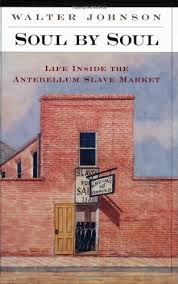
SoulThe class calls on students to think about slavery, freedom, and citizenship as both real experiences and concepts that were continually made and remade by black and white Americans in the nineteenth century. I’ll have a chance to re-read some of my favorite things, like parts of Walter Johnson’s Soul by Soul. In a chapter called “Making a World out of Slaves,” Johnson expands upon Ed Morgan’s “American paradox,” showing the ways that freedom was tied to whiteness and that those linked statuses were created not only through the enslavement, but also the blackness, of others. We’ll step through historiography to consider the ways enslavement was made and remade, reading John Blassingame on enslaved “personality types” and Stephanie Camp on communities, geographies, and the nature of resistance. And we’ll think about the creation of both freedom and citizenship in the work of fugitives, lawmakers, presidents, soldiers, Freedmen’s Bureau agents, night riders, and of course freed women and men.

A big reason why I’m so excited about the class is that I’ll have a chance to think through the complexities of these three statuses. Is freedom simply the absence of enslavement? What do various unfreedoms in our past and present tell us about the possibilities and limits of American freedom? What does it mean that citizenship imposes limits on freedom? Is freedom in the sense of liberty from all obligations a desirable goal?

Having students examine and discuss these and other difficult questions is part of my vision of an ideal classroom. I’ve told myself and others that my goal as a teacher is to have undergraduates do “practice history” – thinking critically and arguing both forcefully and carefully. But why? What do these students, all senior history majors, but most of whom will choose not to follow my career path, gain by thinking like historians? Caleb McDaniel recently tweeted responses to a survey in which he asked undergraduates about the value of history in the present. Most offered some version of the idea that history repeats itself, and that knowing the past will help us avoid mistakes in the future. Most scholars would say that the answer is far more complicated, but I’ve had a hard time figuring out what exactly I think the answer is.

The other day I mentioned to my eye doctor that I teach African American history. She volunteered that she had recently learned that Abraham Lincoln “didn’t particularly like” black people; emancipation was no more than a strategy to win the war. Leaving aside questions about why that was the first aspect of black history that came to mind, that sort of confident simplification stuck with me. It’s the impulse I want students to push against. Ultimately, many of us aim to instill empathy in students, but even that in itself isn’t the clearest way to explain the value of the past in the present. Understanding historical actors as they existed in their own worlds demands that we think—not only about what happened and how it happened, but also about how complicated life has been, and, by extension, remains. Lincoln did not “free the slaves,” but he is remembered as having done so. Further, the slaves were “freed,” and many of them credited Lincoln with that change. My hope is for students to be, or become, comfortable recognizing this complexity, dwelling in the contradictory truths that Lincoln had both much and little to do with emancipation.

I guess that in the end I want students to think, and to want to think, in and beyond my classroom. We all might have a lot to gain from a little thoughtfulness.

Read Full Post »

hnn-logo-new

The Surprising Reason Why Racial Inequality Is so Great in the United States

HNN  November 14, 2014

The long-term evolution of income and wealth inequality has become one of the central issues in the current economic and political debate. However, the fact that in the United States inequality displays a strong racial component has not been sufficiently emphasized in the recent discussion.

We asked ourselves whether a link could be found between current inequality and the past history of racial relations in the US. There is no doubt that the latter were profoundly shaped by the reality of slavery. Indeed, when we compare the performances of US counties, we find that income inequality in the present day is strongly correlated with the share of slaves in the population back in 1860. Besides, we discover that this finding is driven by the racial component of income inequality. This means that those counties that in the past relied more heavily on the use of slave labor are still showing a larger degree of inequality between blacks and whites. This correlation stubbornly persists a century and a half after the abolition of slavery, despite the subsequent massive relocation of former slaves away from the deep South where slavery was more prevalent, and notwithstanding the progress achieved by civil rights movement.

We then asked ourselves what is the driver of the link we uncover between the history of slavery and current inequality. Our hypothesis was that the long-term influence of slavery may have run through its negative impact on human capital accumulation for blacks, that is, through a persistent racial gap in education.

After the Civil War, the vast majority of African-American former slaves had no exposure to formal schooling. For the first generations of their descendants, access to education remained severely limited, both quantitatively and qualitatively, since they were able to complete fewer years of schooling and they were segregated in badly funded public schools. Being education locally administered and financed, the political exclusion of blacks inevitably resulted in a limited supply of education and reduced funding. The separate but equal doctrine permitted the racial segregation of southern schools until the 1960s. After the enactment of the civil and voting rights legislation, the racial schooling gap declined substantially in several dimensions, such as educational attainment and achievement, literacy rates, spending per pupil, and economic returns to education.

However, what our data say is not only that the gaps are still far from closed, but also that they can be largely explained by past slavery. In other words, the share of slaves in the population in 1860 is also correlated with current racial inequality in school attainment. Since the quantity of human capital is the main determinant of earnings, it follows that the schooling gap has immediate repercussions on income inequality across races.

To sum up, we can trace a chain of clear causal links that from past slavery lead to today’s racial gap in education and, through that channel, to the racial gap in income, which in turns contributes to income inequality.

The declared goal of recent federal education programs – such as Obama’s Race to the Top and Bush’s No Child Left Behind – has been the removal of the racial and ethnic educational gaps that persistently afflict the American society. This goal is consistent with the evidence we collect, which shows how deeply educational inequality is rooted in the history of the country.

Graziella Bertocchi is Professor of Economics at the University of Modena and Reggio Emilia (Italy). Arcangelo Dimico is Lecturer in Economics at the Queen’s University of Belfast (UK). Together they authored the article “Slavery, Education, and Inequality,” published in the European Economic Review, vol. 70, 2014, pages 197-209.

Read Full Post »

Shannon Freshwater

NEWBURYPORT, Mass. — WHEN we think of the South, a host of images come to mind: slaves and masters, Klansmen and freedom riders, magnolias and cotton fields.

Americans have fewer enduring impressions of the North. It simply stands as the nation’s default region. Most Northerners behave as though they come from America writ large, rather than from a subsection of it. The North seems unremarkable. It holds no dark mystery, no agonies buried deep within. We forget that many parts of the North have an identity, culture, politics and racial history all their own.

Americans know that we cannot understand Southern history, or our nation’s history more generally, without coming to grips with slavery and Jim Crow. But we fail to apply this lesson to the North. We like to think that the struggle for racial equality is tangential to Northern history. This leads us to distort our perceptions of the North and to misinterpret American history as a whole.

Northern cities and states have long harbored movements for racial democracy, as well as for racial segregation, within the same heart and soul. Progress and regression have existed together. That duality helps to explain the mind of the North. Only a clearer understanding of the North’s mottled past can enable us to better reckon with this painful moment in our racial history, after the death of Eric Garner on Staten Island and a grand jury’s decision not to indict the officer whose chokehold led to his death.

Few have written more eloquently about the North and the South than the historian C. Vann Woodward. In Woodward’s formulation, those who came up in the South shouldered the “burden of Southern history.” The past, defined by slavery and segregation, was something to overcome.

The Northern past admits to no such torment. Tales of the Pilgrims and abolitionists sketch a noble portrait. Northern history looms as a source of aspiration and inspiration. It is something to affirm.

This has been true particularly in the Northeast, which has stood as a place of possibility and a model for the country. To E. B. White, New York was the nation’s “visible symbol of aspiration”; John F. Kennedy saw the democratic institutions of Massachusetts as “beacon lights for other nations as well as our sister states.” These ideals could serve as a spur to action and at some moments, Northeasterners drew upon the region’s mystique in order to propel themselves ahead of the rest of the nation. Yet they could also deploy this mystique as a mask, a way for whites to obscure and excuse their region’s dogged racism and oppression.

The history of the Northeast contains stunning steps toward racial progress as well as vicious episodes of backlash. In 1947, many Brooklyn residents welcomed a black ballplayer and anointed Ebbets Field as the frontier of interracial democracy. At the same time, African-American families from the South were shunted into Brooklyn’s burgeoning ghettos. When Jackie and Rachel Robinson attempted to buy a home in the suburbs of Westchester County, N.Y., and Fairfield County, Conn., they encountered hostile white homeowners who did not want African-Americans as neighbors (although the couple was eventually able to buy a house in Stamford, Conn.).

The story of school segregation is even more insidious. To give one example, the School Committee in Springfield, Mass., pursued redistricting and student-transfer policies that produced virtually all-black schools. African-American parents filed a lawsuit in 1964, and the N.A.A.C.P. took up their case. While on the witness stand, members of the School Committee claimed innocence and ignorance, and denied the very existence of segregation. In 1965, the state of Massachusetts went on to pass a law that outlawed “racial imbalance” — the first such law in the nation. The following year, Massachusetts voters would become the first to popularly elect a black senator, Edward W. Brooke. Just as whites forged a breakthrough in the electoral arena, segregation increased in the schools of Springfield, not to mention Boston.

In 1970, Abraham A. Ribicoff of Connecticut stood on the Senate floor and gave public expression to the region’s open secret. “The North is guilty,” Senator Ribicoff charged, “of monumental hypocrisy” in its treatment of African-Americans. One year later, he proposed a policy that would desegregate every metropolitan school system. The plan was big and bold, and it was to take 12 years. It allowed each locality to determine the specifics. Senator Ribicoff envisioned a combination of strategically located educational malls, magnet schools and redistricting. The N.A.A.C.P. opposed his policy. Black leaders thought that the early 1980s was too long to wait for widespread school integration. Of course, we are still waiting.

Many Americans know New York City’s recent history of racial violence, which includes the killing of Yusuf Hawkins in Bensonhurst and Michael Griffith in Howard Beach. But there were many others who are all but forgotten, like Willie Turks, a black transit worker, who was beaten to death by a group of white teenagers in Gravesend in 1982.

Northeasterners do not think of this history as one that shapes our identity. But if we really grapple with the mind of the North, we will be forced to acknowledge, finally, that our region is not just a land of liberty. We will also confront a racial past that is far messier than we might like. It is neither a triumphant story of progress nor a tale of segregation without relief.

We carry the two warring stories with us still. And now we stand at a crossroads. We can summon our better angels, and act forcefully, or we can continue to live like this. Which heritage will we act on? Which story will win out?

Read Full Post »


hnn-logo-new


Slavery in America: Back in the Headlines

Daina Ramey Berry

HNN  November 23, 1014


People think they know everything about slavery in the United States, but they don’t. They think the majority of African slaves came to the American colonies, but they didn’t. They talk about 400 hundred years of slavery, but it wasn’t. They claim all Southerners owned slaves, but they didn’t. Some argue it was a long time ago, but it wasn’t.

Slavery has been in the news a lot lately. Perhaps it’s because of the increase in human trafficking on American soil or the headlines about income inequality, the mass incarceration of African Americans or discussions about reparations to the descendants of slaves. Several publications have fueled these conversations: Ta-Nehisi Coates’ The Case for Reparations in The Atlantic Monthly, French economist Thomas Picketty’s Capital in the Twenty First Century, historian Edward Baptist’s The Half Has Never Been Told: Slavery and The Making of American Capitalism, and law professor Bryan A. Stevenson’s Just Mercy: A Story of Justice and Redemption.

As a scholar of slavery at the University of Texas at Austin, I welcome the public debates and connections the American people are making with history. However, there are still many misconceptions about slavery.

I’ve spent my career dispelling myths about “the peculiar institution.” The goal in my courses is not to victimize one group and celebrate another. Instead, we trace the history of slavery in all its forms to make sense of the origins of wealth inequality and the roots of discrimination today. The history of slavery provides deep context to contemporary conversations and counters the distorted facts, internet hoaxes and poor scholarship I caution my students against.

Four myths about slavery

Myth One: The majority of African captives came to what became the United States.

Truth: Only 380,000 or 4-6% came to the United States. The majority of enslaved Africans went to Brazil, followed by the Caribbean. A significant number of enslaved Africans arrived in the American colonies by way of the Caribbean where they were “seasoned” and mentored into slave life. They spent months or years recovering from the harsh realities of the Middle Passage. Once they were forcibly accustomed to slave labor, many were then brought to plantations on American soil.

Myth Two: Slavery lasted for 400 years.

Popular culture is rich with references to 400 years of oppression. There seems to be confusion between the Transatlantic Slave Trade (1440-1888) and the institution of slavery, confusion only reinforced by the Bible, Genesis 15:13:

Then the Lord said to him, ‘Know for certain that for four hundred years your descendants will be strangers in a country not their own and that they will be enslaved and mistreated there.

Listen to Lupe Fiasco – just one Hip Hop artist to refer to the 400 years – in his 2011 imagining of America without slavery, “All Black Everything”:

[Hook]

You would never know

If you could ever be

If you never try

You would never see

Stayed in Africa

We ain’t never leave

So there were no slaves in our history

Were no slave ships, were no misery, call me crazy, or isn’t he

See I fell asleep and I had a dream, it was all black everything

[Verse 1]

Uh, and we ain’t get exploited

White man ain’t feared so he did not destroy it

We ain’t work for free, see they had to employ it

Built it up together so we equally appointed

First 400 years, see we actually enjoyed it

tt9cfqkm-1413841594.jpg

A plantation owner with his slaves. (National Media Museum from UK)

Truth: Slavery was not unique to the United States; it is a part of almost every nation’s history from Greek and Roman civilizations to contemporary forms of human trafficking. The American part of the story lasted fewer than 400 years.

How do we calculate it? Most historians use 1619 as a starting point: 20 Africans referred to as ”servants” arrived in Jamestown, VA on a Dutch ship. It’s important to note, however, that they were not the first Africans on American soil. Africans first arrived in America in the late 16th century not as slaves but as explorers together with Spanish and Portuguese explorers. One of the best known of these African “conquistadors” was Estevancio who traveled throughout the southeast from present day Florida to Texas. As far as the institution of chattel slavery – the treatment of slaves as property – in the United States, if we use 1619 as the beginning and the 1865 Thirteenth Amendment as its end then it lasted 246 years, not 400.

Myth Three: All Southerners owned slaves.

Truth: Roughly 25% of all southerners owned slaves. The fact that one quarter of the Southern population were slaveholders is still shocking to many. This truth brings historical insight to modern conversations about the Occupy Movement, its challenge to the inequality gap and its slogan “we are the 99%.”

Take the case of Texas. When it established statehood, the Lone Star State had a shorter period of Anglo-American chattel slavery than other Southern states – only 1845 to 1865 – because Spain and Mexico had occupied the region for almost one half of the 19th century with policies that either abolished or limited slavery. Still, the number of people impacted by wealth and income inequality is staggering. By 1860, the Texas enslaved population was 182,566, but slaveholders represented 27% of the population, controlled 68% of the government positions and 73% of the wealth. Shocking figures but today’s income gap in Texas is arguably more stark with 10% of tax filers taking home 50% of the income.

Myth Four: Slavery was a long time ago.

Truth: African-Americans have been free in this country for less time than they were enslaved. Do the math: Blacks have been free for 149 years which means that most Americans are two to three generations removed from slavery. However, former slaveholding families have built their legacies on the institution and generated wealth that African-Americans have not been privy to because enslaved labor was forced; segregation maintained wealth disparities; and overt and covert discrimination limited African-American recovery efforts.

The value of slaves

Economists and historians have examined detailed aspects of the enslaved experience for as long as slavery existed. Recent publications related to slavery and capitalism explore economic aspects of cotton production and offer commentary on the amount of wealth generated from enslaved labor.

My own work enters this conversation looking at the value of individual slaves and the ways enslaved people responded to being treated as a commodity. They were bought and sold just like we sell cars and cattle today. They were gifted, deeded and mortgaged the same way we sell houses today. They were itemized and insured the same way we manage our assets and protect our valuables.

y6br69t3-1413802703.jpg

Extensive Sale of Choice Slaves, New Orleans 1859, Girardey, C.E. (Natchez Trace Collection, Broadside Collection, Dolph Briscoe Center for American History)

Extensive Sale of Choice Slaves, New Orleans 1859, Girardey, C.E.

(Natchez Trace Collection, Broadside Collection, Dolph Briscoe Center for American History)

Enslaved people were valued at every stage of their lives, from before birth until after death. Slaveholders examined women for their fertility and projected the value of their “future increase.” As they grew up, enslavers assessed their value through a rating system that quantified their work. An “A1 Prime hand” represented one term used for a “first rate” slave who could do the most work in a given day. Their values decreased on a quarter scale from three-fourths hands to one-fourth hands, to a rate of zero, which was typically reserved for elderly or differently abled bondpeople (another term for slaves.)

Guy and Andrew, two prime males sold at the largest auction in US History in 1859, commanded different prices. Although similar in “all marketable points in size, age, and skill,” Guy commanded $1240 while Andrew sold for $1040 because “he had lost his right eye.” A reporter from the New York Tribune noted “that the market value of the right eye in the Southern country is $240.” Enslaved bodies were reduced to monetary values assessed from year to year and sometimes from month to month for their entire lifespan and beyond. By today’s standards, Andrew and Guy would be worth about $33,000-$40,000.

Slavery was an extremely diverse economic institution; one that extrapolated unpaid labor out of people in a variety of settings from small single crop farms and plantations to urban universities. This diversity is also reflected in their prices. Enslaved people understood they were treated as commodities.

“I was sold away from mammy at three years old,” recalled Harriett Hill of Georgia. “I remembers it! It lack selling a calf from the cow,” she shared in a 1930s interview with the Works Progress Administration. “We are human beings” she told her interviewer. Those in bondage understood their status. Even though Harriet Hill “was too little to remember her price when she was three, she recalled being sold for $1400 at age 9 or 10, “I never could forget it.”

Slavery in popular culture

Slavery is part and parcel of American popular culture but for more than 30 years the television mini-series Roots was the primary visual representation of the institution except for a handful of independent (and not widely known) films such as Haile Gerima’s Sankofa or the Brazilian Quilombo. Today Steve McQueen’s 12 Years a Slave is a box office success, actress Azia Mira Dungey has a popular web series called Ask a Slave, and in Cash Crop sculptor Stephen Hayes compares the slave ships of the 18th century with third world sweatshops.

From the serious – PBS’s award-winning Many Rivers to Cross – and the interactive Slave Dwelling Project- whereby school aged children spend the night in slave cabins – to the comic at Saturday Night Live, slavery is today front and center.

The elephant that sits at the center of our history is coming into focus. American slavery happened — we are still living with its consequences.

Daina Ramey Berry, Ph.D. is an associate professor of history and African and African Diaspora Studies at the University of Texas at Austin. She is also a Public Voices Fellow, author and award–winning editor of three books, currently at work on book about slave prices in the United States funded in part by the National Endowment for the Humanities. Follow her on Twitter: @lbofflesh. This articles was first published by Not Even Past.

Read Full Post »

A Forgotten Stage of the Atlantic Slave Trade

by Gregory E. O’Malley 

HNN September 21, 2014

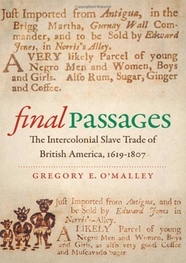
156926-FPJOn January 9, 1786, thirty-five “Men, Women, boys and Girls” from Angola climbed aboard a small brig in Kingston’s busy harbor and returned to sea. They had recently survived an Atlantic crossing to Jamaica with hundreds of other captives, but the vagaries of the Atlantic slave market split them off for another voyage. Embarking on this second ocean passage, the smaller group of captives climbed aboard a much smaller vessel, called Mars. The crew also packed the hold with goods, so the Angolans maneuvered around barrels of rum, sugar, and pimento.

The observant among them gleaned from the sun or stars that this new voyage carried them north, instead of west. They surely noticed a change in the weather. Winter gripped North America, and even in Georgia that January, locals remarked at “the severity of it.” The Mars rocked and thrashed in violent waves whipped up by storms out of the northeast. Frigid rains and high seas drenched the deck with water that dripped and sloshed into the hold. Contrary winds caused an unexpectedly “long passage.” Provisions ran low.

The crew headed for the nearest harbor, but one of the Angolan women succumbed to cold or hunger and “died two days before [the Mars] got into port.” Mercifully, the other thirty-four prisoners survived to reach Savannah, Georgia—probably unaware that their intended destination had been a place called Charleston, farther up the coast. The merchant in charge of selling the survivors perceived them as “a very slight made People,” probably because their passage from Jamaica on short rations made them appear so. One man died “a few days after they arrived.” The others recovered enough for sale into American slavery, but it would eight months after sailing from Jamaica before the last of them sold.

As typically told, the story of the Atlantic slave trade ends after the ocean crossing. A transatlantic slave ship glides into an American port, planters flock to an auction on the pier, and enslaved people presumably march with new owners to nearby plantations. Slave trade histories usually end with such a sale, but for hundreds of thousands of enslaved African people the journey did not end there. Labor-hungry plantation owners were not the only buyers of weary survivors of the Middle Passage; merchant speculators sought human commodities as well.

Port records, merchant papers, and imperial correspondence all suggest that a thriving intercolonial slave trade dispersed as many as a quarter of the African people who arrived in the New World, extending their dangerous journeys to American plantations. Such “final passages,” after the Atlantic crossing, occurred for a variety of reasons. Some colonial markets were too small to attract vessels directly from Africa with hundreds of slaves, but could be profitably targeted by intercolonial traders with a few enslaved people and an assortment of goods; some European empires enjoyed stronger trading positions in Africa than others, creating supply and price discrepancies across imperial borders in the Americas, setting the stage for smuggling; some important sites of American slavery were inland, requiring overland distribution after the Middle Passage. Whatever the reasons, colonial port records document more than seven thousand such shipments originating in British American colonies alone. Thousands more ventures surely occurred—in other regions and in periods not covered by surviving records.

Despite the vast scale of such intercolonial trafficking, historians have been slow to recognize and examine it, a blind spot especially pronounced for the British Atlantic. The oversight may stem partly from the long shadow that Philip Curtin cast on the field. His path-breaking book, The Atlantic Slave Trade: A Census (1969), was framed by a simple and straightforward question: Just how many African people crossed the Atlantic in the slave trade? That question (and his attempt to answer it by synthesizing regional estimates from the extant secondary scholarship) was an essential starting point for slave trade studies. But in some ways, Curtin’s focus on quantifying the transatlantic migration circumscribed the field—in ways both obvious and more surprising. – See more at: http://historynewsnetwork.org/article/156926#sthash.K6rDShzB.dpuf

Most straightforward, for decades after Curtin’s book appeared, slave trade scholars focused on the so-called “numbers game,” with one scholar after another revising Curtin’s estimates. Some used census records and demographic modeling; others counted the captives in port records and shipping returns. Such efforts culminated in Voyages: The Transatlantic Slave Trade Database (www.slavevoyages.org), spearheaded by David Eltis, which seeks to document each individual voyage that carried Africans across the Atlantic. It is a prodigious work that documents more than 35,000 slave-trading ventures. The database improves our knowledge of the trade’s scale, organization, and mortality, and it stands as a monument to scholarly collaboration, with dozens of researchers contributing data. Despite these virtues, however, the database is limited to voyages that crossed the Atlantic—omitting the intercolonial trade—perhaps because that is how Curtin framed the question that launched the field.

More surprising perhaps, critics of such quantitative study have also focused on the Atlantic crossing at the expense of other phases of the trade. In recent years, a rich historiography has called for moving beyond the counting of enslaved people crossing the Atlantic to achieve a more humanizing portrayal—one that reckons more with what enslaved migrants endured, how they understood their journeys, and what cultures they carried with them. Marcus Rediker’s The Slave Ship: A Human History (2008) and Stephanie Smallwood’s Saltwater Slavery (2009), for example, focus explicitly on lived experiences aboard slave ships, on putting a human face on the millions of people who had been counted by other slave trade scholars. Yet these works, too, stop after the Atlantic crossing. They describe the infamous Middle Passage, but do not examine the networks of dispersal that forced beleaguered men and women onward—from Barbados to Savannah, from Jamaica to Panama, or from Charleston to the North American backcountry.

Yet hundreds of thousands of enslaved people did move on. Weary, often ill, angry, and often terrified, they arrived in a first American port only to be purchased by intercolonial speculators. American traders bought enslaved people in one port for transshipment to another, adding additional weeks and new dangers to the voyages of captives. Mortality in this intercolonial trade was devastating for people already debilitated by the Middle Passage. Furthermore, dispersal after the Atlantic crossing often separated transatlantic shipmates who shared language, culture, or even ties of kinship. And the importance of such intra-American trafficking extends beyond the devastating experiences of captives. The intercolonial slave trade spread the institution of slavery to new colonies and helped colonial merchants elaborate their trade networks. Many general traders in the Americas (and imperial policymakers) saw such slave trading as vital to opening a broader business with new customers, entangling the profits of slave trading with all manner of other commerce.

There is a certain irony to slave trade scholars focusing only on the Atlantic crossing—an irony captured in the phrase used to describe that journey. For most twenty-first-century readers, “Middle Passage” conjures thoughts of the horrific experiences of African captives in their forced Atlantic crossings, but the voyage was termed “middle” to reflect European, not African, experience. For European traders the transatlantic voyage typically formed the second leg of a three-part journey: a first passage, from Europe to Africa with trade goods; a “middle” passage, from Africa to America with slaves; and a third voyage, from America back to Europe with colonial staples. This “triangle” trade gave the Middle Passage its name. Despite these Eurocentric origins, scholars have claimed the term for the slave trade’s victims. But ironically, “Middle Passage” actually fits the experiences of African migrants better than most scholars have realized. The journeys of enslaved Africans did not begin at their ports of embarkation for the ocean crossing, nor did they end when transatlantic vessels reached the Americas. Instead, people often fell into slavery deep in the African interior, facing a first passage to the Atlantic coast; likewise, many enslaved people spread outward after the Middle Passage, often settling hundreds or even thousands of miles away from their first American landfall. Understanding the African migration experience—and the full profits of slave trading—requires reckoning with these final passages after the Atlantic crossing.

Gregory E. O’Malley is an Associate Professor of History at the University of California, Santa Cruz and the author of «Final Passages: The Intercolonial Slave Trade of British America, 1619-1807» (2014

Read Full Post »

La Universidad de Columbia acaba de dar acceso gratuito a los cursos «online» (MOOC) del historiador norteamericano Eric Foner. Autor de obras imprescindibles como Reconstruction: America’s Unfinished Revolution, 1863-1877  (1988) y The Fiery Trial: Abraham Lincoln and American Slavery (2011), Foner es uno de los grandes analistas de la guerra civil norteamericana y del periodo de la Reconstrucción.

Columbia University Releases Eric Foner’s Civil War MOOCs. It’s Free! 

HNN  September 17, 2014

Free history courses to reach educators and students worldwide, expanding Columbia’s online teaching initiatives

NEW YORK, New York, September 11, 2014 — Columbia University’s Center for New Media Teaching and Learning (CCNMTL) today announced the release of three new online courses on edX: The Civil War and Reconstruction. Eric Foner, Pulitzer-Prize-winning historian and Columbia University’s DeWitt Clinton Professor of History, teaches this three-part massive open online course (MOOC). On Wednesday, September 17, the first course launches – the series is free and accessible to anyone anywhere with an Internet connection, including K-12 educators and students.

The new history series, the first humanities course offering by Columbia on edX, is an open learning experience spread out over weeks of stimulating lectures, interactive assignments, and community discussions. The entire series is 27 weeks long and challenges students to examine the politics of history and investigate themes that are still very present in our national dialogue – the balance of power between local and national authority, the boundaries of citizenship, and the meaning of freedom and equality.

“We are delighted that Eric Foner is kicking off Columbia’s involvement with the edX platform,” said Columbia University Provost John H. Coatsworth. “His course series on the Civil War will highlight one of our finest teachers while providing students around the world with a window on to the outstanding humanities instruction for which Columbia is known.”

The three online courses are:

1. A House Divided: The Road to Civil War, 1850-1861 – 10 weeks, beginning September 17

2. A New Birth of Freedom: The Civil War, 1861-1865 – 8 weeks, beginning December 1

3. The Unfinished Revolution: Reconstruction and After, 1865-1890 – 9 weeks, beginning February 25

The series trailer is online here:

“Recent events have underscored the fact that our society is still grappling with the long-term legacies of slavery and the failure of Reconstruction, so this history is especially pertinent today” said Professor Foner.

“If you want to know where the world you’re living in came from,” Foner tells us in the trailer, “you need to know about the Civil War era.”

“The Columbia Center for New Media Teaching and Learning is thrilled to see Eric Foner‘s work published this way,” said CCNMTL director Maurice Matiz. “Besides having a great interest in getting those connected to Columbia during Foner’s long career —our alumni— access to the course, we are also hoping that the course will have broad appeal given the public interest in this key period of our history.”

“We are honored to work with Eric Foner on his first MOOC, “The Civil War and Reconstruction,” and to help history-lovers everywhere connect with this prominent historian to develop a deeper understanding and appreciation of our shared past and society today,” said Anant Agarwal, edX CEO and professor of Electrical Engineering and Computer Science at MIT.

This MOOC series is also registered as an XSeries on edX, giving learners the opportunity to sign up and receive a verified certificate of achievement that authenticates their successful completion of each course.

Visit ColumbiaX here.

In addition, the lecture videos from the entire course will be published on CCNMTL’s YouTube channel.

Read Full Post »

We still lie about slavery: Here’s the truth about how the American economy and power were built on forced migration and torture

Edward E. Baptist

Salon.com  September 7, 2014

We still lie about slavery: Here's the truth about how the American economy and power were built on forced migration and torture

The Shores family, near Westerville, Neb., in 1887. Jerry Shores was one of a number of former slaves to settle in Custer County. (Credit: AP/Solomon D. Butcher)

1937

A beautiful late April day, seventy-two years after slavery ended in the United States. Claude Anderson parks his car on the side of Holbrook Street in Danville. On the porch of number 513, he rearranges the notepads under his arm. Releasing his breath in a rush of decision, he steps up to the door of the handmade house and knocks.

Danville is on the western edge of the Virginia Piedmont. Back in 1865, it had been the last capital of the Confederacy. Or so Jefferson Davis had proclaimed on April 3, after he fled Richmond. Davis stayed a week, but then he had to keep running. The blue-coated soldiers of the Army of the Potomac were hot on his trail. When they got to Danville, they didn’t find the fugitive rebel. But they did discover hundreds of Union prisoners of war locked in the tobacco warehouses downtown. The bluecoats, rescuers and rescued, formed up and paraded through town. Pouring into the streets around them, dancing and singing, came thousands of African Americans. They had been prisoners for far longer.

In the decades after the jubilee year of 1865, Danville, like many other southern villages, had become a cotton factory town. Anderson, an African-American master’s student from Hampton University, would not have been able to work at the segregated mill. But the Works Progress Administration (WPA), a bureau of the federal government created by President Franklin D. Roosevelt’s New Deal, would hire him. To put people back to work after they had lost their jobs in the Great Depression, the WPA organized thousands of projects, hiring construction workers to build schools and artists to paint murals. And many writers and students were hired to interview older Americans—like Lorenzo Ivy, the man painfully shuffling across the pine board floor to answer Anderson’s knock.

Anderson had found Ivy’s name in the Hampton University archives, two hundred miles east of Danville. Back in 1850, when Lorenzo had been born in Danville, there was neither a university nor a city called Hampton—just an American fort named after a slaveholder president. Fortress Monroe stood on Old Point Comfort, a narrow triangle of land that divided the Chesapeake Bay from the James River. Long before the fort was built, in April 1607, the Susan Constant had sailed past the point with a boatload of English settlers. Anchoring a few miles upriver, they had founded Jamestown, the first permanent English- speaking settlement in North America. Twelve years later, the crews of two storm-damaged English privateers also passed, seeking shelter and a place to sell the twenty- odd enslaved Africans (captured from a Portuguese slaver) lying shackled in their holds.

After that first 1619 shipload, some 100,000 more enslaved Africans would sail upriver past Old Point Comfort. Lying in chains in the holds of slave ships, they could not see the land until they were brought up on deck to be sold. After the legal Atlantic slave trade to the United States ended in 1807, hundreds of thousands more enslaved people passed the point. Now they were going the other way, boarding ships at Richmond, the biggest eastern center of the internal slave trade, to go by sea to the Mississippi Valley.

By the time a dark night came in late May 1861, the moon had waxed and waned three thousand times over slavery in the South. To protect slavery, Virginia had just seceded from the United States, choosing a side at last after six months of indecision in the wake of South Carolina’s rude exit from the Union. Fortress Monroe, built to protect the James River from ocean- borne invaders, became the Union’s last toehold in eastern Virginia. Rebel troops entrenched themselves athwart the fort’s landward approaches. Local planters, including one Charles Mallory, detailed enslaved men to build berms to shelter the besiegers’ cannon. But late this night, Union sentries on the fort’s seaward side saw a small skiff emerging slowly from the darkness. Frank Baker and Townshend rowed with muffled oars. Sheppard Mallory held the tiller. They were setting themselves free.

A few days later, Charles Mallory showed up at the gates of the Union fort. He demanded that the commanding federal officer, Benjamin Butler, return his property. Butler, a politician from Massachusetts, was an incompetent battlefield commander, but a clever lawyer. He replied that if the men were Mallory’s property, and he was using them to wage war against the US government, then logically the men were therefore contraband of war.

Those first three “contrabands” struck a crack in slavery’s centuries-old wall. Over the next four years, hundreds of thousands more enslaved people widened the crack into a gaping breach by escaping to Union lines. Their movement weakened the Confederate war effort and made it easier for the United States and its president to avow mass emancipation as a tool of war. Eventually the Union Army began to welcome formerly enslaved men into its ranks, turning refugee camps into recruiting stations—and those African-American soldiers would make the difference between victory and defeat for the North, which by late 1863 was exhausted and uncertain.

After the war, Union officer Samuel Armstrong organized literacy programs that had sprung up in the refugee camp at Old Point Comfort to form Hampton Institute. In 1875, Lorenzo Ivy traveled down to study there, on the ground zero of African- American history. At Hampton, he acquired an education that enabled him to return to Danville as a trained schoolteacher. He educated generations of African-American children. He built the house on Holbrook Street with his own Hampton-trained hands, and there he sheltered his father, his brother, his sister-in-law, and his nieces and nephews. In April 1937, Ivy opened the door he’d made with hands and saw and plane, and it swung clear for Claude Anderson without rubbing the frame.

Anderson’s notepads, however, were accumulating evidence of two very different stories of the American past—halves that did not fit together neatly. And he was about to hear more. Somewhere in the midst of the notepads was a typed list of questions supplied by the WPA. Questions often reveal the desired answer. By the 1930s, most white Americans had been demanding for decades that they hear only a sanitized version of the past into which Lorenzo Ivy had been born. This might seem strange. In the middle of the nineteenth century, white Americans had gone to war with each other over the future of slavery in their country, and slavery had lost. Indeed, for a few years after 1865, many white northerners celebrated emancipation as one of their collective triumphs. Yet whites’ belief in the emancipation made permanent by the Thirteenth Amendment, much less in the race- neutral citizenship that the Fourteenth and Fifteenth Amendments had written into the Constitution, was never that deep. Many northerners had only supported Benjamin Butler and Abraham Lincoln’s moves against slavery because they hated the arrogance of slaveholders like Charles Mallory. And after 1876, northern allies abandoned southern black voters.

Within half a century after Butler sent Charles Mallory away from Fortress Monroe empty-handed, the children of white Union and Confederate soldiers united against African-American political and civil equality. This compact of white supremacy enabled southern whites to impose Jim Crow segregation on public space, disfranchise African- American citizens by barring them from the polls, and use the lynch- mob noose to enforce black compliance. White Americans imposed increased white supremacy outside the South, too. In non- Confederate states, many restaurants wouldn’t serve black customers. Stores and factories refused to hire African Americans. Hundreds of midwestern communities forcibly evicted African-American residents and became “sundown towns” (“Don’t let the sun set on you in this town”). Most whites, meanwhile, believed that science proved that there were biologically distinct human races, and that Europeans were members of the superior one. Anglo- Americans even believed that they were distinct from and superior to the Jews from Russia, Italians, Greeks, Slavs, and others who flooded Ellis Island and changed the culture of northern urban centers.

By the early twentieth century, America’s first generation of professional historians were justifying the exclusions of Jim Crow and disfranchisement by telling a story about the nation’s past of slavery and civil war that seemed to confirm, for many white Americans, that white supremacy was just and necessary. Above all, the historians of a reunified white nation insisted that slavery was a premodern institution that was not committed to profit-seeking. In so doing, historians were to some extent only repeating pre–Civil War debates: abolitionists had depicted slavery not only as a psychopathic realm of whipping, rape, and family separation, but also as a flawed economic system that was inherently less efficient than the free- labor capitalism developing in the North. Proslavery writers disagreed about the psychopathy, but by the 1850s they agreed that enslavers were first and foremost not profit-seekers. For them, planters were caring masters who considered their slaves to be inferior family members. So although anti- and proslavery conclusions about slavery’s morality were different, their premises about slavery-as- a-business model matched. Both agreed that slavery was inherently unprofitable. It was an old, static system that belonged to an earlier time. Slave labor was inefficient to begin with, slave productivity did not increase to keep pace with industrialization, and enslavers did not act like modern profit- seeking businessmen. As a system, slavery had never adapted or changed to thrive in the new industrial economy—let alone to play a premier role as a driver of economic expansion—and had been little more than a drag on the explosive growth that had built the modern United States. In fact, during the Civil War, northerners were so convinced of these points that they believed that shifting from slave labor to free labor would dramatically increase cotton productivity.

It didn’t. But even though the data of declining productivity over the ensuing three score and ten years suggested that slavery might have been the most efficient way to produce the world’s most important crop, no one let empirical tests change their minds. Instead, historians of Woodrow Wilson’s generation imprinted the stamp of academic research on the idea that slavery was separate from the great economic and social transformations of the Western world during the nineteenth century. After all, it did not rely upon ever-more efficient machine labor. Its unprofitable economic structures supposedly produced antique social arrangements, and the industrializing, urbanizing world looked back toward them with contempt—or, increasingly, nostalgia. Many whites, now proclaiming that science proved that people of African descent were intellectually inferior and congenitally prone to criminal behavior, looked wistfully to a past when African Americans had been governed with whips and chains. Granted, slavery as an economic system was not modern, they said, and had neither changed to adapt to the modern economy nor contributed to economic expansion. But to an openly racist historical profession—and a white history- reading, history-thinking public obsessed with all kinds of race control—the white South’s desire to whitewash slavery in the past, and maintain segregation now and forever, served the purpose of validating control over supposedly premodern, semi-savage black people.

Such stories about slavery shaped the questions Claude Anderson was to ask in the 1930s, because you could find openly racist versions of it baked into the recipe of every American textbook. You could find it in popular novels, politicians’ speeches, plantation-nostalgia advertising, and even the first blockbuster American film: Birth of a Nation. As president, Woodrow Wilson—a southern-born history professor—called this paean to white supremacy “history written with lightning,” and screened it at the White House. Such ideas became soaked into the way America publicly depicted slavery. Even many of those who believed that they rejected overt racism depicted the era before emancipation as a plantation idyll of happy slaves and paternalist masters. Abolitionists were snakes in the garden, responsible for a Civil War in which hundreds of thousands of white people died. Maybe the end of slavery had to come for the South to achieve economic modernity, but it didn’t have to come that way, they said.

The way that Americans remember slavery has changed dramatically since then. In tandem with widespread desegregation of public spaces and the assertion of black cultural power in the years between World War II and the 1990s came a new understanding of the experience of slavery. No longer did academic historians describe slavery as a school in which patient masters and mistresses trained irresponsible savages for futures of perpetual servitude. Slavery’s denial of rights now prefigured Jim Crow, while enslaved people’s resistance predicted the collective self-assertion that developed into first the civil rights movement and later, Black Power.

But perhaps the changes were not so great as they seemed on the surface. The focus on showing African Americans as assertive rebels, for instance, implied an uncomfortable corollary. If one should be impressed by those who rebelled, because they resisted, one should not be proud of those who did not. And there were very few rebellions in the history of slavery in the United States. Some scholars tried to backfill against this quandary by arguing that all African Americans together created a culture of resistance, especially in slave quarters and other spaces outside of white observation. Yet the insistence that assertive resistance undermined enslavers’ power, and a focus on the development of an independent black culture, led some to believe that enslaved people actually managed to prevent whites from successfully exploiting their labor. This idea, in turn, created a quasi-symmetry with post–Civil War plantation memoirs that portrayed gentle masters, who maintained slavery as a nonprofit endeavor aimed at civilizing Africans.

Thus, even after historians of the civil rights, Black Power, and multicultural eras rewrote segregationists’ stories about gentlemen and belles and grateful darkies, historians were still telling the half that has ever been told. For some fundamental assumptions about the history of slavery and the history of the United States remain strangely unchanged. The first major assumption is that, as an economic system—a way of producing and trading commodities—American slavery was fundamentally different from the rest of the modern economy and separate from it. Stories about industrialization emphasize white immigrants and clever inventors, but they leave out cotton fields and slave labor. This perspective implies not only that slavery didn’t change, but that slavery and enslaved African Americans had little long-term influence on the rise of the United States during the nineteenth century, a period in which the nation went from being a minor European trading partner to becoming the world’s largest economy—one of the central stories of American history.

The second major assumption is that slavery in the United States was fundamentally in contradiction with the political and economic systems of the liberal republic, and that inevitably that contradiction would be resolved in favor of the free-labor North. Sooner or later, slavery would have ended by the operation of historical forces; thus, slavery is a story without suspense. And a story with a predetermined outcome isn’t a story at all.

Third, the worst thing about slavery as an experience, one is told, was that it denied enslaved African Americans the liberal rights and liberal subjectivity of modern citizens. It did those things as a matter of course, and as injustice, that denial ranks with the greatest in modern history. But slavery also killed people, in large numbers. From those who survived, it stole everything. Yet the massive and cruel engineering required to rip a million people from their homes, brutally drive them to new, disease-ridden places, and make them live in terror and hunger as they continually built and rebuilt a commodity-generating empire—this vanished in the story of a slavery that was supposedly focused primarily not on producing profit but on maintaining its status as a quasi-feudal elite, or producing modern ideas about race in order to maintain white unity and elite power. And once the violence of slavery was minimized, another voice could whisper, saying that African Americans, both before and after emancipation, were denied the rights of citizens because they would not fight for them.

All these assumptions lead to still more implications, ones that shape attitudes, identities, and debates about policy. If slavery was outside of US history, for instance—if indeed it was a drag and not a rocket booster to American economic growth—then slavery was not implicated in US growth, success, power, and wealth. Therefore none of the massive quantities of wealth and treasure piled by that economic growth is owed to African Americans. Ideas about slavery’s history determine the ways in which Americans hope to resolve the long contradiction between the claims of the United States to be a nation of freedom and opportunity, on the one hand, and, on the other, the unfreedom, the unequal treatment, and the opportunity denied that for most of American history have been the reality faced by people of African descent. Surely, if the worst thing about slavery was that it denied African Americans the liberal rights of the citizen, one must merely offer them the title of citizen—even elect one of them president—to make amends. Then the issue will be put to rest forever.

Slavery’s story gets told in ways that reinforce all these assumptions. Textbooks segregate twenty-five decades of enslavement into one chapter, painting a static picture. Millions of people each year visit plantation homes where guides blather on about furniture and silverware. As sites, such homes hide the real purpose of these places, which was to make African Americans toil under the hot sun for the profit of the rest of the world. All this is the “symbolic annihilation” of enslaved people, as two scholars of those weird places put it.2 Meanwhile, at other points we tell slavery’s story by heaping praise on those who escaped it through flight or death in rebellion, leaving the listener to wonder if those who didn’t flee or die somehow “accepted” slavery. And everyone who teaches about slavery knows a little dirty secret that reveals historians’ collective failure: many African-American students struggle with a sense of shame that most of their ancestors could not escape the suffering they experienced.

The truth can set us free, if we can find the right questions. But back in the little house in Danville, Anderson was reading from a list of leading ones, designed by white officials—some well- meaning, some not so well-meaning. He surely felt how the gravity of the questions pulled him toward the planet of plantation nostalgia. “Did slaves mind being called ‘nigger’?” “What did slaves call master or mistress?” “Have you been happier in slavery or free?” “Was the mansion house pretty?” Escaping from chains is very difficult, however, so Anderson dutifully asked the prescribed questions and poised his pencil to take notes.

Ivy listened politely. He sat still. Then he began to speak: “My mother’s master was named William Tunstall. He was a mean man. There was only one good thing he did, and I don’t reckon he intended to do that. He sold our family to my father’s master George H. Gilman.”

Perhaps the wind blowing through the window changed as a cloud moved across the spring sun: “Old Tunstall caught the ‘cotton fever.’ There was a fever going round, leastways it was like a fever. Everyone was dying to get down south and grow cotton to sell. So old Tunstall separated families right and left. He took two of my aunts and left their husbands up here, and he separated altogether seven husbands and wives. One woman had twelve children. Yessir. Took ‘em all down south with him to Georgia and Alabama.”

Pervasive separations. Tears carving lines on faces. Lorenzo remembered his relief at dodging the worst, but he also remembered knowing that it was just a lucky break. Next time it could’ve been his mother. No white person was reliable, because money drove their decisions. No, this wasn’t the story the books told.

So Anderson moved to the next question. Did Ivy know if any slaves had been sold here? Now, perhaps, the room grew darker.

For more than a century, white people in the United States had been singling out slave traders as an exception: unscrupulous lower-class outsiders who pried apart paternalist bonds. Scapegoaters had a noble precedent. In his first draft of the Declaration of Independence, Thomas Jefferson tried to blame King George III for using the Atlantic slave trade to impose slavery on the colonies. In historians’ tellings, the 1808 abolition of the Atlantic trade brought stability to slavery, ringing in the “Old South,” as it has been called since before the Civil War. Of course, one might wonder how something that was brand new, created after a revolution, and growing more rapidly than any other commodity-producing economy in history before then could be considered “old.” But never mind. Historians depicted slave trading after 1808 as irrelevant to what slavery was in the “Old South,” and to how America as a whole was shaped. America’s modernization was about entrepreneurs, creativity, invention, markets, movement, and change. Slavery was not about any of these things—not about slave trading, or moving people away from everyone they knew in order to make them make cotton. Therefore, modern America and slavery had nothing to do with each other.

But Ivy spilled out a rush of very different words. “They sold slaves here and everywhere. I’ve seen droves of Negroes brought in here on foot going South to be sold. Each one of them had an old tow sack on his back with everything he’s got in it. Over the hills they came in lines reaching as far as the eye can see. They walked in double lines chained together by twos. They walk ‘em here to the railroad and shipped ’em south like cattle.”

Then Lorenzo Ivy said this: “Truly, son, the half has never been told.”

To this, day, it still has not. For the other half is the story of how slavery changed and moved and grew over time: Lorenzo Ivy’s time, and that of his parents and grandparents. In the span of a single lifetime after the 1780s, the South grew from a narrow coastal strip of worn-out plantations to a subcontinental empire. Entrepreneurial enslavers moved more than 1 million enslaved people, by force, from the communities that survivors of the slave trade from Africa had built in the South and in the West to vast territories that were seized—also by force—from their Native American inhabitants. From 1783 at the end of the American Revolution to 1861, the number of slaves in the United States increased five times over, and all this expansion produced a powerful nation. For white enslavers were able to force enslaved African-American migrants to pick cotton faster and more efficiently than free people. Their practices rapidly transformed the southern states into the dominant force in the global cotton market, and cotton was the world’s most widely traded commodity at the time, as it was the key raw material during the first century of the industrial revolution. The returns from cotton monopoly powered the modernization of the rest of the American economy, and by the time of the Civil War, the United States had become the second nation to undergo large-scale industrialization. In fact, slavery’s expansion shaped every crucial aspect of the economy and politics of the new nation—not only increasing its power and size, but also, eventually, dividing US politics, differentiating regional identities and interests, and helping to make civil war possible.

The idea that the commodification and suffering and forced labor of African Americans is what made the United States powerful and rich is not an idea that people necessarily are happy to hear. Yet it is the truth. And that truth was the half of the story that survived mostly in the custodianship of those who survived slavery’s expansion—whether they had been taken over the hill, or left behind. Forced migration had shaped their lives, and also had shaped what they thought about their lives and the wider history in which they were enmeshed. Even as they struggled to stay alive in the midst of disruption, they created ways to talk about this half untold. But what survivors experienced, analyzed, and named was a slavery that didn’t fit the comfortable boxes into which other Americans have been trying to fit it ever since it ended.

I read Lorenzo Ivy’s words, and they left me uneasy. I sensed that the true narrative had been left out of history—not only American history in general, but even the history of slavery. I began to look actively for the other half of the story, the one about how slavery constantly grew, changed, and reshaped the modern world. Of how it was both modernizing and modern, and what that meant for the people who lived through its incredible expansion. Once I began to look, I discovered that the traces of the other half were everywhere. The debris of cotton fevers that infected white entrepreneurs and separated man and woman, parent and child, right and left, dusted every set of pre–Civil War letters, newspapers, and court documents. Most of all, the half not told ran like a layer of iridium left by a dinosaur- killing asteroid through every piece of testimony that ex- slaves, such as Lorenzo Ivy, left on the historical record: thousands of stanzas of an epic of forced separations, violence, and new kinds of labor.

For a long time I wasn’t sure how to tell the story of this muscular, dynamic process in a single book. The most difficult challenge was simply the fact that the expansion of slavery in many ways shaped the story of everything in the pre–Civil War United States. Enslavers’ surviving papers showed calculations of returns from slave sales and purchases as well as the costs of establishing new slave labor camps in the cotton states. Newspapers dripped with speculations in land and people and the commodities they produced; dramatic changes in how people made money and how much they made; and the dramatic violence that accompanied these practices. The accounts of northern merchants and bankers and factory owners showed that they invested in slavery, bought from and sold to slaveholders, and took slices of profit out of slavery’s expansion. Scholars and students talked about politics as a battle about states’ rights or republican principles, but viewed in a different light the fights can be seen as a struggle between regions about how the rewards of slavery’s expansion would be allocated and whether that expansion could continue.

The story seemed too big to fit into one framework. Even Ivy had no idea how to count the chained lines he saw going southwest toward the mountains on the horizon and the vast open spaces beyond. From the 1790s to the 1860s, enslavers moved 1 million people from the old slave states to the new. They went from making no cotton to speak of in 1790 to making almost 2 billion pounds of it in 1860. Stretching out beyond the slave South, the story encompassed not only Washington politicians and voters across the United States but also Connecticut factories, London banks, opium addicts in China, and consumers in East Africa. And could one book do Lorenzo Ivy’s insight justice? It would have to avoid the old platitudes, such as the easy temptation to tell the story as a collection of topics—here a chapter on slave resistance, there one on women and slavery, and so on. That kind of abstraction cuts the beating heart out of the story. For the half untold was a narrative, a process of movement and change and suspense. Things happened because of what had been done before them—and what people chose to do in response.

No, this had to be a story, and one couldn’t tell it solely from the perspective of powerful actors. True, politicians and planters and bankers shaped policies, the movement of people, and the growing and selling of cotton, and even remade the land itself. But when one takes Lorenzo Ivy’s words as a starting point, the whole history of the United States comes walking over the hill behind a line of people in chains. Changes that reshaped the entire world began on the auction block where enslaved migrants stood or in the frontier cotton fields where they toiled. Their individual drama was a struggle to survive. Their reward was to endure a brutal transition to new ways of labor that made them reinvent themselves every day. Enslaved people’s creativity enabled their survival, but, stolen from them in the form of ever- growing cotton productivity, their creativity also expanded the slaveholding South at an unprecedented rate. Enslaved African Americans built the modern United States, and indeed the entire modern world, in ways both obvious and hidden.

One day I found a metaphor that helped. It came from the great African-American author Ralph Ellison. You might know his novel Invisible Man. But in the 1950s, Ellison also produced incredible essays. In one of them he wrote, “On the moral level I propose we view the whole of American life as a drama enacted on the body of a Negro giant who, lying trussed up like Gulliver, forms the stage and the scene upon which and within which the action unfolds.”

The image fit the story that Ivy’s words raised above the watery surface of buried years. The only problem was that Ellison’s image implied a stationary giant. In the old myth, the stationary, quintessentially unchanging plantation was the site and the story of African-American life from the seventeenth century to the twentieth. But Lorenzo Ivy had described a world in motion. After the American Revolution—which seemed at the time to portend slavery’s imminent demise—a metastatic transformation and growth of slavery’s giant body had begun instead. From the exploitation, commodification, and torture of enslaved people’s bodies, enslavers and other free people gained new kinds of modern power. The sweat and blood of the growing system, a network of individuals and families and labor camps that grew bigger with each passing year, fueled massive economic change. Enslaved people, meanwhile, transported and tortured, had to find ways to survive, resist, or endure. And over time the question of their freedom or bondage came to occupy the center of US politics.

Excerpted from “The Half Has Never Been Told: Slavery and the Making of American Capitalism” by Edward E. Baptist. Published by Basic Books, a member of the Perseus Books Group. Copyright 2014 by Edward E. Baptist. Reprinted with permission of the publisher. All rights reserved.

Edward E. Baptist is Associate professor at Cornell University
Read Full Post »

This Was One of the Little-Recognized Causes of the Civil War 

HNN  August 17, 2014

I remember reading many years ago W. E. B. Du Bois’s complaint that Americans knew far too little of the decisive role blacks played in winning their freedom.  He pointed specifically to a biography of Ulysses S. Grant in which the author, W. E. Woodward, wrote of African Americans as “the only people in the history of the world . . . that ever became free without any effort of their own. . . . They twanged banjos around the railroad stations, sang melodious spirituals, and believed that some Yankee would soon come along and give each of them forty acres of land and a mule.”  I was in graduate school at the time and congratulated myself on knowing better – that blacks had served in the Union army.  But that was about all I knew of it. As the proud holder of a college degree in history, I thought that was just about all I needed to know.  There are none so ignorant as the educated ignorant.

Some historians still downplay the wider role of blacks in bringing on freedom, preferring to emphasize Abraham Lincoln’s role as the Great Emancipator.  Historian James McPherson, a leading defender of Lincoln’s Great Emancipator image, argues in Drawn with the Sword: Reflections on the American Civil War (1996) that without Lincoln there would have been no war and, hence, no opportunity for freedom. With regard to emancipation, it was Lincoln’s determination that was “the essential condition, the one thing without which it would not have happened.” Without Lincoln, there would have been no Emancipation Proclamation and no Thirteenth Amendment. Therefore, says McPherson, “Lincoln freed the slaves.”

Arguments such as those of McPherson and others have some validity as far as they go. To my knowledge, no reputable scholar denies that Lincoln and the Union military played a significant part in the emancipation process. But following their lines of reasoning more deeply, we cannot help but see the efforts of black folk at their core.

Lincoln’s effort to preserve the Union was, of course, a reaction to the South’s secession, a movement engineered by slaveholders who feared not only Lincoln but, more immediately, their own slaves. Controlling slaves had been increasingly difficult for years. It could only be more difficult, perhaps impossible, with slaves believing that Lincoln’s election meant their freedom. How could they believe otherwise? Though Lincoln was no threat to slavery where it existed, and said so often during the 1860 presidential campaign, fire-eating secessionists railed against him as a radical abolitionist with a secret agenda to foment slave rebellion. Such overheated rhetoric was intended to stir up support for secession among southern whites, but southern blacks heard the message too. Rebellion and rumors of rebellion pervaded the South that year and drove slaveholder fears to a fever pitch. Most significantly, underlying their fear was the certain knowledge that slaves wanted freedom. It was that fear, born of generations of slave resistance, that led to secession, war, and slavery’s downfall.

Slaveholders’ doubts about their ability to maintain slavery indefinitely had a long history. The need to justify slavery had for decades occupied their brightest minds. The need to keep southern whites, three-quarters of whom owned no slaves, supporting slavery made fomenting fear of blacks a political priority.  Most threatening to slaveholders were the slaves themselves. Blacks had never submitted to slavery willingly or completely. They did little more than they had to do and took liberties where they could. They resisted in so many ways that the slaveholders’ need to exercise control was constant and consuming.  Had blacks been content to remain enslaved, slaveholders would have had no cause for alarm. Nor would abolitionist arguments have inspired such panic among them. As it was, slaveholder fears of threats to slavery, as much from within as from without, led them to insist on guarantees for slavery’s future and the means to control that future. And that fear led them to secede when those guarantees and their means of control seemed at risk. As Professor John Ashworth reminds us inSlavery, Capitalism and Politics in the Antebellum Republic (1995), there was a direct causal link between the slaves’ desire for freedom and slaveholder politics. “Behind every event in the history of the sectional controversy,” Ashworth points out, “lurked the consequences of black resistance to slavery.”

That resistance was not confined to the South. Escaping slaves saw to that. By the tens of thousands they headed north, undermining northern efforts to keep the slave’s war south of the Mason-Dixon Line. In so doing, as Professor Scott Hancock stresses in “Crossing Freedom’s Fault Line” (Civil War History, 2013), black folk “maintained an unrelenting pressure on the sectional fault lines of identity, law, and space.” That pressure produced large cracks in those fault lines and increasingly drew northerners into the conflict. Time and again, northern failures to keep blacks and slavery locked in the South put them at odds with slaveholders’ expansionist demands. Hancock concludes, and rightly so, that “not simply slavery, but slaves – black people! – caused the Civil War.”

It was, then, at the heart of it all, the unrelenting resistance to slavery among slaves themselves that was the essential condition, the one thing without which the sectional crisis, secession, the Civil War, the Emancipation Proclamation, and the Thirteenth Amendment would not have happened.

Of course, it did not happen overnight. For more than two centuries before the Civil War, millions of African Americans lived in bondage all their lives. But it was a resisted bondage, an ongoing struggle, that would eventually reach its consummation. The internal pressures against slavery – rebellion, resistance, escape – were always there and became ever greater as slavery spread. Slaveholders clamped down with more slave codes, more slave patrols, and increasingly brutal control. But the more they tried to tighten their grip on slaves, the more slaves slipped through their fingers. By the late 1850s there were an estimated fifty thousand escapees annually, temporary and permanent. Such resistance fueled a desperation reflected in slaveholder politics and the secession crisis. The resulting war was neither an isolated event nor an end point in itself.  It was part of a massive black resistance movement that had been going on for generations, finally becoming so intense that the country as a whole could hardly help being drawn into it.

Even so, in an effort to avoid war, Congress passed, and Lincoln supported, a constitutional amendment, the Corwin Amendment, that would have guaranteed slavery in the slave states forever.  In the war’s early months, both Congress and Lincoln insisted that the conflict was a white man’s war in which blacks could have no part. But black folk knew the war was theirs and quickly took ownership of it.  Black resistance largely brought on the war, then pressed Lincoln in the direction he eventually went.  By escaping in the tens of thousands and making freedom a fact, blacks forced Lincoln to recognize that fact with the Emancipation Proclamation. They made the document their own, and made it much more that it was.  In the upper South, where the Proclamation did not apply, blacks claimed freedom anyway.  In the lower South, they made freedom real by aiding escaping slaves, serving the Union army as guides and spies, assisting Confederate deserters and armed deserter gangs, giving aid to escaping Union prisoners, resisting abuse, and engaging in open rebellion.  They established freedom for themselves by traveling at will, threatening escape to secure wages, and even claiming land and property when they could.  Still, most Americans today seem to assume that Lincoln, almost single-handedly and of his own volition, “freed the slaves.”  Certainly most students coming into my freshman U.S. history course assume that to be the case, which is in large part what prompted me to write my book, I Freed Myself.

In the war’s aftermath, although whites willfully ignored the wartime role of blacks, memories of self-emancipation efforts remained clear in the minds of black folk.  One day a candidate for local office in Illinois asked Duncan Winslow, a former slave and Union veteran, for his vote in an upcoming election. As if to seal the deal, the candidate told Winslow, “Don’t forget. We freed you people.” In response, Winslow raised his wounded arm and said, “See this? Looks to me like I freed myself.”  Blacks would go on freeing themselves for generations to come.

David Williams is a professor of history at Valdosta State University and the author of the, “I Freed Myself: African American Self-Emancipation in the Civil War Era” (Cambridge University Press, 2014).

Read Full Post »

Martin Luther King Jr. waves to supporters on the Mall in Washington, D.C., Aug. 28, 1963. AFP/GETTY IMAGES

Martin Luther King Jr. waves to supporters on the Mall in Washington, D.C., Aug. 28, 1963.
AFP/GETTY IMAGES

MLK’s Case for Reparations Included Disadvantaged Whites

Jonathan Rieder
The Root July 15, 2014

What does white America owe black America? To even broach that question 50 years after the Civil Rights Act of 1964 seems straight-out wacky. Did not the election of a black president redeem the nation? At a minimum, it’s rude—refusing to avert the eyes from that elephant in the room: “America begins in black plunder and white democracy.” That’s how Ta-Nehisi Coates deemed it recently in his extraordinary “The Case for Reparations.”

Far from fringe lunacy, the idea of a primal debt was obvious to Martin Luther King Jr. Exactly 50 years ago this month in Why We Can’t Wait, his Harper & Row account of the Birmingham, Ala., protests, he made his own impassioned case for compensation. And yet no matter how much he shared Coates’ desire to square accounts, King would settle on a rival solution for the crimes of slavery and all the forms of racism that succeeded it.

In the rapture of King’s crescendo at the March on Washington, it’s easy to forget the language of bankers that pervaded the first half of “I Have a Dream” (pdf): “America had defaulted on this promissory note” of “life, liberty and the pursuit of happiness.” One year later, in Why We Can’t Wait, he was not coy about the nation’s “need to pay a long overdue debt to its citizens of color.” He retold the story of his 1959 visit to India, where Prime Minister Jawaharlal Nehru recounted all the preferential policies that aided the untouchables: “This is our way of atoning for the centuries of injustices we have inflicted upon these people.”

Invoking the sacred precedent of “our fighting men [in World War ll]” who “had been deprived of certain advantages and opportunities,” King ticked off all the things—the GI Bill of Rights—that were done “to make up for this.” Then King pivoted and pounced: “Certainly the Negro has been deprived” and just as surely “robbed of the wages of his toil.” You didn’t need a course in logic to complete the syllogism.

The passage of the Civil Rights Act of 1964 did not diminish King’s zeal for reparations. “Frederick Douglass said we should have 40 acres and a mule,” he told a mass meeting not long before his death. Instead, the nation left blacks “penniless and illiterate after 244 years of slavery.” Calculating that $20 a week for the 4 million slaves would have added up to $800 billion, he noted acerbically, “They owe us a lot of money.”

The failure to repair thus added a new crime to the original one. It was like putting a man in jail and discovering his innocence years later: “And then you go up to him and say, ‘You are free,’ but you don’t give him any bus fare to get to town. You don’t give him any money … to get on his feet in life again. Every code of jurisprudence would rise up against that.”

There was still one more twist in the torment to come. All those “white peasants from Europe” who enjoyed the largesse of land grants and low-interest loans “are the very people telling the black man that he ought to lift himself by his own bootstraps. … It’s a cruel jest to say to a bootless man that he ought to lift himself by his own bootstraps.”

Are the progeny of those “white peasants” readier to reckon with our racist legacy? Thirty-five years ago, a Brooklyn, N.Y., woman fumed to me about the TV program Roots, “If they keep shoving that stuff down our throats, there’s never going to be peace. … that was over 200 years ago that this slavery bit was!”

Today, countless Americans think blacks have received compensation in the form of anti-poverty money and quotas. As one person told political consultant Stanley Greenberg (pdf), “Didn’t they get 40 acres and a mule? That’s more than I got.” West Indians and African immigrants, too, sometimes complain that black Americans are too racial, and many millennials who used to thrill to President Barack Obama’s exalted flights are preoccupied with their own plights and the grit of a post-Lehman Brothers economy.

Meanwhile, the vast majority of whites even reject apologies for slavery, which cost nothing save one’s dignity. Many of the supporters of affirmative action whom Stanford political scientist Paul Sniderman queried in the 1990s endorsed the remedy only if blacks were not its sole recipients and the rationale was universal: “help people who are out of work” rather than “because of the historic injustices blacks have suffered.”

It’s possible that attaching a race to the injustice made the respondents squirm. Perhaps it forced whites to dwell on this unsettling fact: Our success in part is a windfall, reaped from the access black exclusion gave us to jobs, slots in housing markets and much else.

In truth, white psyches and circumstances are too varied to sustain such generalities. The woman who recoiled from “that slavery bit” didn’t lack empathy. She filled up with emotion as she observed, “The blacks were treated worse than animals; they were taken up from their own happy soil.” When Greenberg returned to McComb County, Mich. (pdf), before the 2008 election, some of the same Reagan Democrats (or their children) who had seen blacks as the source of all their ills in the 1980s and heard Jesse Jackson’s “Our time has come” as “Your time is over,” could now acknowledge America’s special burden: “We did hold them back, and a lot of people were cheated.” As for Sniderman’s respondents, likely many of them saw universalism as a different, equally righteous take on healing and helping.

Maybe, then, it’s best to settle for those modest moral advances, especially if that’s the price of any coalition of conscience that might some day be motivated to remedy the ills of suffering Americans. Better to leave the fuller atonement to those Deep South museums that have confronted their louche local past; people who exit Twelve Years a Slave in turmoil; lawsuits seeking compensation for specific violations like the racist rampage in Tulsa, Okla. Anything more perfect might be the enemy of the good, even the moral good.


Ultimately, in the very chapter of Why We Can’t Wait in which he laid out the justice of reparations, King rejected the idea of recompense for blacks alone. It’s not that he was prepared to abandon this equation of restorative justice: The nation that did something special against the Negro had to do something special for him.

But the special thing that King proposed—“A gigantic Bill of Rights for the Disadvantaged, our veterans of the long siege of denial”—left plenty of room for white “veterans” in the mix. He offered solace to the least of these, no matter what their complexion. Inevitably, there was a shrewdness to this inclusion, part of the effort to woo white allies and crystallize the liberal coalition on race that had been growing since Birmingham. It was also, King underlined, “a simple matter of justice.”

Already in 1964, King was looking beyond the Civil Rights Act. He could grasp its limited power to effect “improvements” in the Negro’s “way of life.” He could see that rights and respect might arrive more quickly than economic equality. He could also see that however much white supremacy left blacks vulnerable to inimical forces, the forces could be unsentimentally free of bigotry and wreak havoc on whites and blacks alike.

At the March on Washington, King invited whites to join the  “we” who could sing, “Free at last … we are free at last,” and thus share in bondage and deliverance. He did something just as generous inWhy We Can’t Wait. Likely it took a Christian whose idea of a fair exchange was blessing those who curse you to offer poor and middling Southern whites this face-saving gift: He defined them not as beneficiaries of white supremacy but as “victims of slavery” who suffered their own “derivative bondage.” This wasn’t masochism talking, but a faith at once hard-boiled and brimming with grace.

What, then, about balancing the ledger for specifically black injuries? Throughout Why We Can’t Wait, there are hints that resolving matters of policy and politics didn’t still all the feelings churning within King. “A price can be placed on unpaid wages,” he underlined, but “no amount of gold could provide an adequate compensation for the exploitation and humiliation of the Negro in America down through the centuries.” He rejected an easy “four-minute atonement” as inadequate to “400 years of sinning.”

Atone, you sinners! That is the sound of the muffled voice of the preacher rising up through the printed page. And in the end it seems Coates, too, is seeking something similar: recognition as much as reparations; “not a handout, a payoff, hush money, or a reluctant bribe” but “the full acceptance of our collective biography and its consequences.”

King harbored no illusions that whites as a whole had the moral gumption to undergo that ordeal. In the Letter From the Birmingham Jail, he observed, “I suppose I should have realized that few members of the oppressor race can understand the deep groans and passionate yearnings of the oppressed race.”

The evidence for pessimism only intensified as 1964 unfolded. George Wallace broke out of his Southern lair. White backlash quickened in the North. By 1968 King could warn, “a nation that put as many Japanese in a concentration camp … could put black people in concentration camps.”

And so, in the absence of full justice, the preacher could be a chastising prophet, who once told a mass meeting: “Do you know that in America the white man sought to annihilate the Indian, literally to wipe him out, and he made a national policy that said in substance, the only good Indian is a dead Indian? Now, a nation that got started like that has a lot of repentin’ to do.”

But even rebuke did not close the case. There remained the work of memory and mourning. King never stopped honoring that history, whose pain could not be fully assuaged by rebuke or recognition. In the refuge of a black church, in the nurturant embrace of his people, he grieved: “We read on the Statue of Liberty that America is the mother of exiles.” But whites “never evinced the maternal care and concern for its black exiles who were brought to this nation in chains. And isn’t it the ultimate irony … that the Negro could sing in one of its sorrow songs, ‘Sometimes I feel like a motherless child.’”

As the audience erupted in applause, King demanded, “What sense of estrangement, what sense of rejection, what sense of hurt could cause a people to use such a metaphor?”

Jonathan Rieder, a professor of sociology at Barnard College, Columbia University, is the author most recently of Gospel of Freedom: Martin Luther King Jr.’s Letter From Birmingham Jail and the Struggle That Changed a Nation and The Word of the Lord Is Upon Me: The Righteous Performance of Martin Luther King Jr.


Read Full Post »

« Newer Posts - Older Posts »